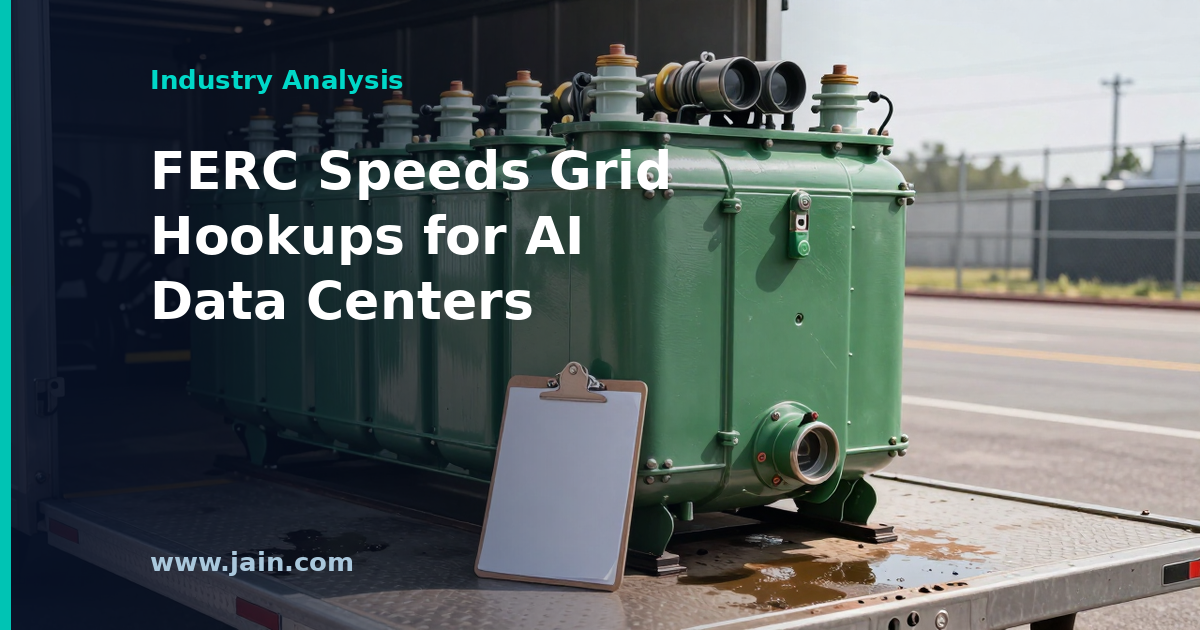
Federal energy regulators have approved a plan to accelerate grid interconnection for AI-focused data centers, according to reporting from The Hill dated June 18, 2026. The action is aimed at shortening the multi-year waits large new electric loads currently face before they can plug into the U.S. transmission system.
Executive Summary
The Federal Energy Regulatory Commission (FERC) — the U.S. agency that oversees interstate electricity transmission — has cleared a policy pathway to speed how quickly new AI data centers can connect to the grid. Interconnection, the technical and legal process of joining a large customer or generator to the transmission network, has become one of the tightest bottlenecks in the buildout of AI infrastructure.
The decision matters because power, not chips or real estate, is now the binding constraint on where and when hyperscale AI campuses can come online. Faster interconnection could unlock stalled projects and shift competitive dynamics among regions, utilities, and cloud providers. It also raises pointed questions about cost allocation, reliability, and fairness to existing ratepayers that the underlying reporting does not fully resolve.
Why Interconnection Became the AI Bottleneck
Modern AI training campuses can draw hundreds of megawatts — the equivalent of a small city — from a single site. Under standard interconnection procedures, utilities and regional grid operators must study how such loads affect voltage, congestion, and reliability before allowing them to energize. Those studies, layered on top of transmission upgrades that can take years to build, have produced queues stretching well beyond the planning horizon of any AI product cycle. A FERC-blessed fast-track pathway signals that regulators now view the status quo as economically untenable for a strategically important sector.
For laypeople, the shorthand is this: getting a large factory or data center plugged into the high-voltage grid is not like flipping a switch. It requires engineering studies, contracts, and sometimes new wires or substations. Cutting that timeline is powerful — and, if done badly, risky.
Winners, Losers, and Regional Reshuffling
Hyperscalers and colocation developers with shovel-ready sites near existing transmission capacity are the most obvious beneficiaries. So are utilities in regions with headroom on their networks, which can now court AI load with a credible speed-to-power pitch. Conversely, developers whose projects depended on being ahead in a strict first-come, first-served queue may see their positional advantage erode if fast-track criteria reward readiness or strategic importance over queue date.
Regional grid operators — PJM in the Mid-Atlantic, ERCOT in Texas, MISO in the Midwest, and others — will translate the federal signal into local tariffs and procedures. Expect divergence: some markets will move aggressively, others cautiously, producing a patchwork that data center site selectors will have to navigate carefully.
Reliability, Ratepayers, and the Fairness Question
Speed has trade-offs. Interconnection studies exist to protect the grid from destabilizing new loads and to fairly allocate the cost of network upgrades. Compressing that process invites two legitimate concerns: whether reliability margins are being quietly thinned, and who ultimately pays for the transmission investments that AI campuses require. If costs are socialized to residential and small-business ratepayers, expect political blowback from consumer advocates and state regulators, some of whom have already pushed back on hyperscaler-driven rate designs.
A fair reading of the policy shift is that it is neither a giveaway nor a threat on its face — the details of eligibility, cost allocation, and reliability safeguards will determine whether it holds up. Those details are precisely what the initial reporting leaves thin, and they warrant close scrutiny from all sides, including industry proponents.
Background
The U.S. electric grid was largely built for a world of predictable, gradually growing demand. The arrival of AI training and inference at scale has upended that assumption, with individual campuses requesting more power than some entire industrial parks. At the same time, transmission construction has slowed under permitting, siting, and supply-chain pressures, producing interconnection queues that in some regions exceed the total installed capacity of the grid itself.
FERC has spent recent years working through a series of reforms to modernize interconnection procedures, including changes to generator queue processing. Extending similar urgency to large loads such as AI data centers marks a notable expansion of that agenda and reflects the growing recognition that power access is now central to U.S. competitiveness in artificial intelligence.