
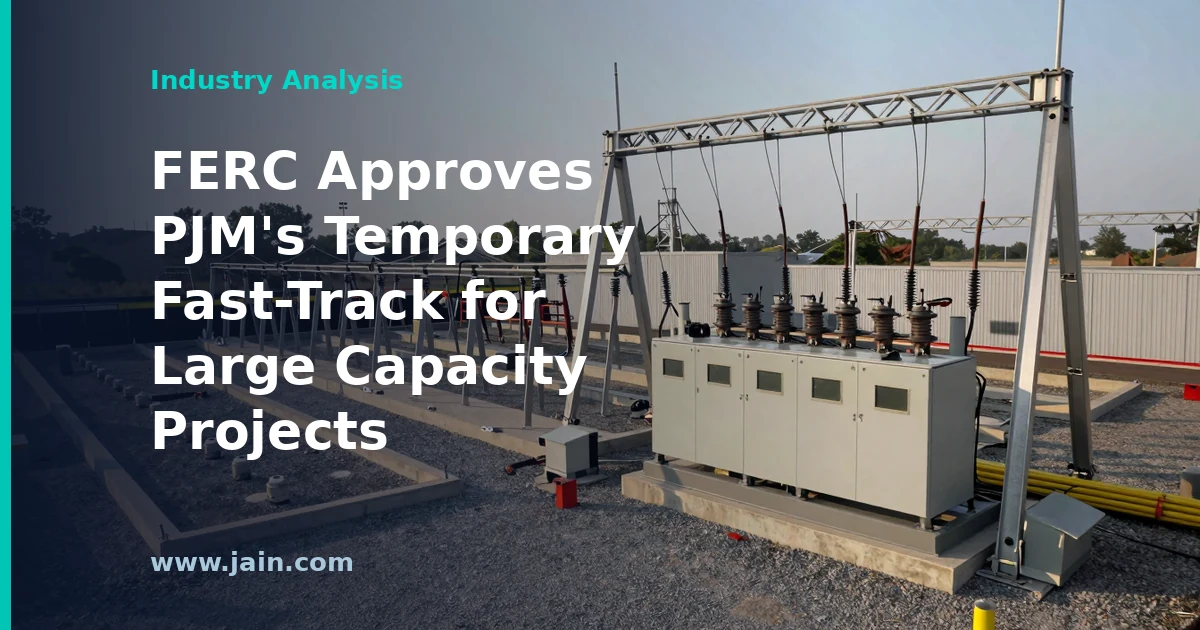
The Federal Energy Regulatory Commission (FERC) has approved a temporary process that allows PJM Interconnection — the operator of the largest wholesale electricity market in the United States, serving 13 states and the District of Columbia — to fast-track large capacity projects, according to a June 10, 2026 report from PJM’s Inside Lines publication. The measure is expressly temporary, aimed at accelerating the arrival of sizable new power resources at a moment when the region’s demand outlook is being reshaped by electrification and data center growth.
Executive Summary
FERC’s approval gives PJM a sanctioned shortcut: a temporary pathway to move large capacity projects — power resources big enough to matter for regional reliability — through its processes faster than the standard sequence would allow. In a system where a generation project can spend years in the interconnection queue before delivering a single megawatt, the ability to pull select large projects forward is one of the most consequential levers a grid operator can hold.
The details published in the brief report are limited, but the direction is unmistakable and consistent with PJM’s recent trajectory: regulators and the grid operator are prioritizing speed-to-power for large resources. For data center developers, utilities, and generation investors across the mid-Atlantic and Midwest, the practical question is no longer whether PJM will triage its pipeline, but which projects benefit, on what criteria, and for how long the temporary window stays open.
Why the Queue Became the Bottleneck
To connect a new power plant to the high-voltage grid, a developer must pass through the grid operator’s interconnection queue — the engineering and cost-allocation study process that determines what network upgrades a project needs before it can safely deliver power. Across the U.S., and acutely in PJM, that process became a multi-year bottleneck as applications surged past the pace of study work. Projects that are financed, sited, and ready to build can still sit waiting for paperwork and grid studies.
Meanwhile, PJM’s supply-demand picture has tightened from both directions: older fossil plants are retiring while forecast demand climbs, driven in significant part by data center construction in places like Northern Virginia, the densest data center market in the world. When ready supply can’t get connected but demand keeps arriving, prices and reliability risk both rise. A fast-track for large capacity projects attacks that mismatch at its procedural source.
A Temporary Lever, Not Structural Reform
The word “temporary” is doing real work here. FERC has not rewritten PJM’s standard interconnection or capacity rules; it has approved a time-bounded exception that pulls certain large projects ahead. That framing matters for two reasons. First, it signals that regulators see the current situation as an emergency-adjacent gap — a bridge measure until broader queue reforms and new supply catch up. Second, it leaves the durable rules of the road intact, which limits how much long-term investment behavior the order alone can change.
Bridge measures carry their own risk: if the underlying study backlog and construction constraints (transformers, turbines, skilled labor, transmission upgrades) don’t ease, a temporary fast-track can become a recurring one. Market participants will reasonably ask whether this is a one-time triage or the first installment of a standing priority lane for large resources.
Winners, Losers, and the Fairness Question
Any fast-track creates a queue-jumping question. Projects selected for expedited treatment gain a material commercial advantage — earlier revenue, earlier capacity market participation, and first claim on scarce grid headroom. Projects that remain in the standard process, including many smaller renewable and storage developments, effectively wait longer in relative terms even if their absolute timelines don’t change. FERC approvals of this kind typically turn on whether the selection criteria are transparent and non-discriminatory, and that is exactly where scrutiny from developers and consumer advocates will concentrate.
There is also a resource-mix dimension. “Large capacity projects” tends, in practice, to favor big dispatchable plants — the kind that can be counted on during peak demand — over distributed or intermittent resources. That is defensible on reliability grounds, but it shapes the competitive landscape, and the release gives no detail on how technology-neutral the criteria are.
What It Means for the Data Center Buildout
For the digital infrastructure industry, this is a supply-side answer to a demand-side surge. Data center campuses now routinely request hundreds of megawatts — utility-scale loads — and the pace at which PJM can connect new generation directly governs how fast those campuses can energize. A credible fast-track for large supply projects modestly improves the odds that new load and new generation arrive in the same timeframe rather than years apart.
It is not, however, a cure. Interconnecting a power plant faster does not by itself build the transmission lines, substations, and transformers that both generators and large loads need. Operators and their customers should read this as one favorable policy data point in a long chain — permitting, equipment lead times, and local siting fights still set the real clock.
Background
PJM Interconnection dispatches power and runs wholesale electricity markets for roughly 65 million people across a footprint stretching from the mid-Atlantic into the Midwest. Over the past several years, the region has become the epicenter of the U.S. power-demand story: an enormous backlog of projects in the interconnection queue, accelerating retirements of older generation, and surging load forecasts driven heavily by data center construction — most visibly in Northern Virginia’s “Data Center Alley.” Those pressures have pushed PJM’s capacity market prices sharply higher and made speed-to-power a central policy concern.
Against that backdrop, PJM and FERC have pursued a series of reforms to modernize the interconnection process and, where necessary, create expedited pathways for resources deemed critical to reliability. The temporary fast-track approved here is the latest step in that sequence, extending the theme of triaging a congested pipeline so the largest, most reliability-relevant projects reach the grid sooner.
Source: FERC OKs Temporary Process To Fast-Track Large Capacity Projects — a PJM Inside Lines report, published June 10, 2026, on FERC’s approval of a temporary expedited pathway for large capacity projects in the PJM region.