
TL;DR · 30-second read
The Short Version
Envision, a Chinese clean-energy company, says it is the first to run a new kind of power system for artificial intelligence computers in everyday commercial use, at a giant computing campus in Inner Mongolia.
Today, electricity usually passes through several bulky boxes before it reaches a computer. Envision’s system converts grid power once into 800 volts of direct current, the steady one-way current batteries produce, and feeds it straight to the machines. Batteries sit in the middle and smooth out sudden jumps in demand within thousandths of a second.
Why it matters: those jumps are one of the hardest problems in powering artificial intelligence. Envision has not said how big this first installation is.
Envision announced on November 2, 2026, via PR Newswire, that an integrated 800-volt direct current (800V DC) power system is now running live AI computing workloads at its Galaxy AI data center campus in Ulanqab, Inner Mongolia, China. The company calls it the world’s first commercial deployment of such a system in a large-scale AI data center. The system takes 10-kilovolt medium-voltage grid power and converts it to an 800V DC bus using solid-state transformers (SSTs), which are electronic power converters that replace the traditional copper-and-iron transformer. Battery storage and AI-driven controls are built into the chain all the way to the server rack.
The Galaxy campus began operating in August 2026. It has a planned capacity of 3 gigawatts and is designed to support up to one million AI accelerators at full build-out, with more than 80% of its power planned to come from direct renewable connections. Envision did not say how much of that capacity the new 800V DC system currently serves.
Executive Summary
Most data centers step grid power down through a large transformer, run it through an uninterruptible power supply (UPS), and then let each server convert alternating current (AC) to direct current (DC) for its chips. Envision says it has collapsed that chain. A solid-state transformer converts medium-voltage AC directly to 800V DC, batteries sit on that DC bus, and a controller called Dubhe coordinates the two in real time. The company says the result is higher conversion efficiency, a smaller equipment footprint, less copper cabling, and room for denser AI racks.
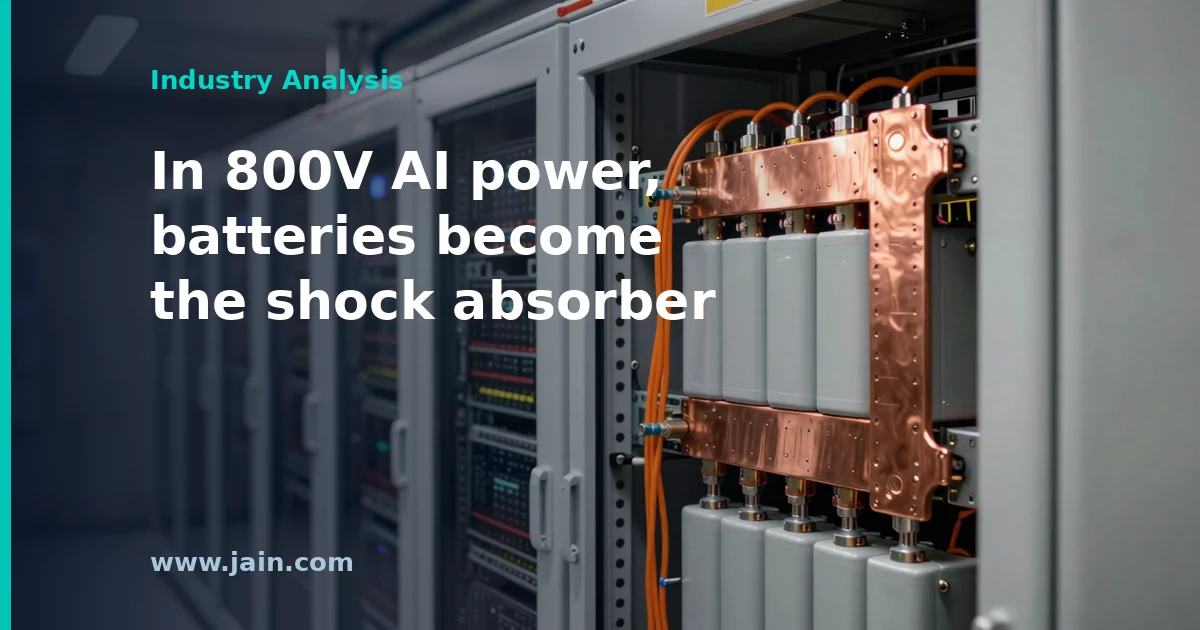
The more consequential detail is the battery’s job description. Envision says its storage provides second-scale power support and minute-scale backup, and that millisecond-level coordination between the transformers and batteries absorbs GPU load fluctuations locally. That puts the battery in continuous, active service rather than idle standby. If that design spreads, it changes how operators specify storage, which vendors supply it, and how much of an AI cluster’s volatility the utility grid has to see.
The claim has limits. Envision has not disclosed the size of the deployment, published efficiency figures, or named an outside customer. The operator of the campus is also the vendor of the system. This is a credible signal that 800V DC is moving from roadmap to service. It is not yet evidence that conventional transformer-and-UPS designs are being displaced at scale.
One Conversion Instead of Four
Electricity loses a little energy every time it changes form. A conventional AI data center typically converts power several times. Utility medium voltage is stepped down by a transformer. A UPS rectifies it to DC to charge batteries, then inverts it back to AC. Power distribution units carry it to racks, and each server’s power supply converts it to DC once more. Every stage adds losses, heat, floor space and equipment to maintain.
Envision’s design converts 10 kV medium voltage straight to an 800V DC bus, then adjusts the DC voltage down for the computing hardware. The physics behind the copper claim is simple. For the same power, a higher voltage needs less current, and less current means thinner conductors and lower resistive losses. That matters most as rack power climbs, because delivering very high power at low voltage requires heavy busbars and cabling that consume both space and copper.
Envision describes the efficiency, footprint and copper gains as significant but has not published numbers for any of them. Industry readers should treat the direction of those benefits as well established in principle. The magnitude in this deployment is unverified.
The Battery Moves From Standby to Active Duty
This is the part of the announcement that most changes how the facility is built. In a traditional UPS, the battery mostly waits for an outage. Envision describes three capabilities, and two of them concern storage working continuously. The batteries provide second-scale power support as well as minute-scale backup. Millisecond-level coordination between the SSTs and storage absorbs GPU load fluctuations locally. The release frames the problem directly: operators must keep supply stable as computing loads swing sharply from moment to moment.
Those swings come from the way large AI jobs run. Thousands of accelerators can ramp up and down together, which produces power steps far sharper than conventional IT loads. If the batteries and controller absorb those steps on the DC bus, the transformer and the grid connection see a smoother draw. The operational consequences follow from that. Storage is sized for fast response and frequent cycling, not just runtime. The control software becomes as critical as the hardware it coordinates. And the boundary between “UPS” and “battery energy storage system” starts to blur.
Several groups are affected. UPS manufacturers face an architecture in which their traditional product is absorbed into the power chain. Battery suppliers gain a role that is more demanding and potentially larger. Utilities and grid operators have a stake in whether AI campuses pass volatility upstream. That matters especially for a campus like Galaxy, which plans to draw more than 80% of its power from direct renewable connections that fluctuate themselves.
On Notice, Not Yet Replaced
Three features of this deployment argue for measured conclusions. First, “world’s first” is Envision’s own characterisation, and the company has not said how many racks or megawatts run on the 800V DC system against Galaxy’s planned 3 GW. Second, Envision owns the campus and builds the power system. Vertical integration makes a first deployment easier, but it also means the reference customer is the vendor. The stronger test will be an independent operator choosing it. Third, conventional AC architecture is backed by decades of standards, certified protection equipment and field-service networks. DC at 800V has its own engineering demands, including interrupting fault currents that lack AC’s natural zero crossing, and those take time to mature across a supply chain.
The strategic logic is still clear. Envision is pairing the power system with its own campus build-out and its Mission Gobi target of 5 GW of green AI data center capacity in desert regions by 2030. A company that controls renewable supply, storage and the facility has an incentive to prove an end-to-end design in-house and then sell it. The architecture to watch is the battery-and-controller layer, because that is where the release locates the hard problem.
Background
Envision describes itself as a global leader in green technology. Its Envision Energy unit runs an energy storage and AI data center power systems business, led by Senior Vice President Kevin Huang. The company has tied its AI data center strategy to renewable supply. Its Galaxy campus in Ulanqab, Inner Mongolia, opened in August 2026 with a planned 3 GW capacity, room for up to one million AI accelerators, and a goal of drawing more than 80% of its power from direct renewable connections. Its Mission Gobi initiative targets 5 GW of green AI data center capacity in desert regions by 2030.
The wider industry is preparing to move from low-voltage rack power toward 800V DC as AI racks grow denser. Higher-voltage DC reduces the current, copper and conversion stages needed to feed each rack. It also requires new protection equipment, standards and supply chains. In the announcement, Huang said the system turns “power-compute coordination from a strategic vision into an operational reality.” Source: Envision Achieves World’s First Commercial Deployment of Integrated 800V DC SST-Based Power System in Large-Scale AI Data Center, Envision’s November 2, 2026 announcement of its 800V DC power system at the Galaxy AI data center campus in Ulanqab, China.Sources