
Investor Stanley Druckenmiller has disclosed new equity positions in three publicly traded bitcoin miners — Hut 8, Riot Platforms and Bitdeer — according to a Yahoo Finance report dated June 27, 2026. All three companies have been actively repositioning parts of their energized data center footprints toward artificial intelligence and high-performance computing workloads.
Executive Summary
The disclosure matters less for its dollar size, which the source does not quantify, than for the pattern: a well-known macro investor concentrating on three miners that share a common pivot story. Hut 8, Riot Platforms and Bitdeer each control large blocks of contracted power and operational data center sites — assets that have become scarce in a market where AI training and inference demand is running ahead of grid interconnection queues.
For readers outside finance, a stake disclosure of this kind does not commit the manager to a long-term view, nor does it validate any specific company’s execution. It does, however, mark that a discretionary investor with a long macro track record sees enough upside in the miner-to-AI trade to take exposure to all three names rather than pick a single winner.
Why Miners Are Suddenly AI Real Estate Plays
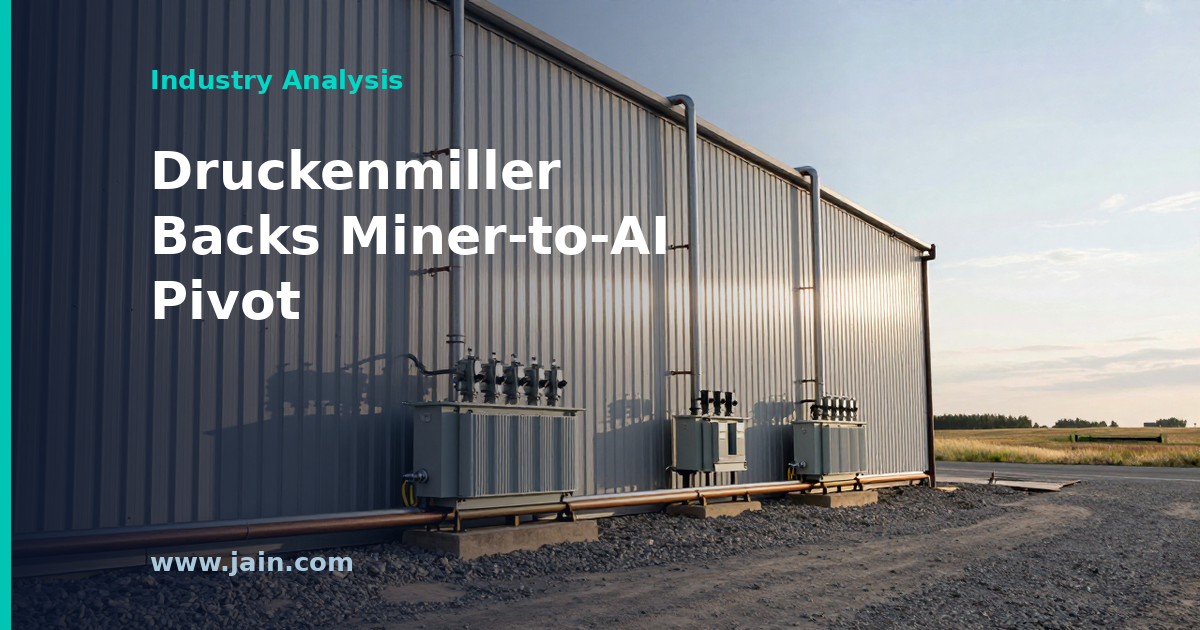
Bitcoin miners spent the last decade acquiring something the AI industry now urgently needs: interconnected sites with signed power contracts, substations, cooling, and the permits to operate at hundreds of megawatts. Building that stack from scratch in the United States or Canada today typically takes three to seven years, dominated by utility interconnection studies rather than construction. Miners already have the electrons, even if their existing buildings were designed for air-cooled ASIC racks rather than liquid-cooled GPU clusters.
That gap — energized land versus AI-ready halls — is the core of the investment thesis. Retrofitting a mining shed for high-density GPU compute is expensive and technically demanding, but it is faster and cheaper than winning a new interconnection. Investors buying the miner-to-AI story are effectively paying for optionality on power, with bitcoin revenue as a floor while sites are converted or leased.
Three Companies, Three Different Bets
Grouping Hut 8, Riot and Bitdeer together is convenient but glosses over meaningful differences. Hut 8 has publicly pursued a diversified compute strategy that includes managed services and AI-oriented capacity. Riot Platforms has historically emphasized scale in Texas mining, with more recent signals toward HPC hosting. Bitdeer combines self-mining, hosting and its own ASIC design, with sites across multiple jurisdictions.
A basket approach — taking positions in all three rather than one — is consistent with an investor who believes the theme will work but is uncertain which operator will convert power into AI revenue most efficiently. It also spreads exposure across different regulatory regimes, customer mixes, and balance sheets, each of which will matter more than the bitcoin price if AI hosting becomes the primary revenue line.
What A 13F-Style Signal Does and Does Not Mean
Position disclosures by well-known investors routinely move share prices, and coverage of this kind tends to be read as endorsement. It is worth being precise about what such a filing conveys: it is a snapshot of holdings as of a past date, without cost basis, without hedges, and without the manager’s forward intent. A stake can be trimmed or exited before the market ever sees the next disclosure.
For infrastructure buyers evaluating these operators as potential AI capacity providers, the more relevant questions are contractual: what tenants have signed, at what power price, on what term, and with what service-level commitments around uptime and density. Those data points, not fund flows, determine whether a converted mining site is a credible enterprise-grade colocation offering.
Background
Publicly traded bitcoin miners emerged as a distinct equity category after 2017, scaling rapidly through the 2020-2021 crypto cycle by locking in long-term power contracts, often in Texas, the U.S. Midwest, Canada and Scandinavia. The 2024 bitcoin halving compressed mining margins and coincided with an unprecedented surge in AI compute demand, prompting several miners to publicly reposition energized sites toward AI and high-performance computing hosting.
Hut 8, Riot Platforms and Bitdeer are three of the most-watched names in that transition. Institutional investor attention to the group has grown as hyperscalers and AI-native tenants search for sites where power is already contracted, since new utility interconnections in North America can take years to secure.
Source: Stanley Druckenmiller Opens Positions in Hut 8, Riot Platforms And Bitdeer – Yahoo Finance — Yahoo Finance report disclosing new equity stakes taken by Druckenmiller in three bitcoin miners pursuing AI infrastructure pivots.