
TL;DR · 30-second read
The Short Version
Digital Realty, one of the world’s biggest owners of data centers (the warehouse-like buildings full of computers that run websites, apps and artificial intelligence), has switched on a new high-voltage power line in Frankfurt, Germany.
The cable runs about 16 kilometers, roughly 10 miles, underground to a site meant to hold 11 data centers eventually.
The surprising part is the order of events. The electricity connection is arriving before the full set of buildings. In busy tech hubs, getting enough power is now harder than putting up buildings, so power comes first.
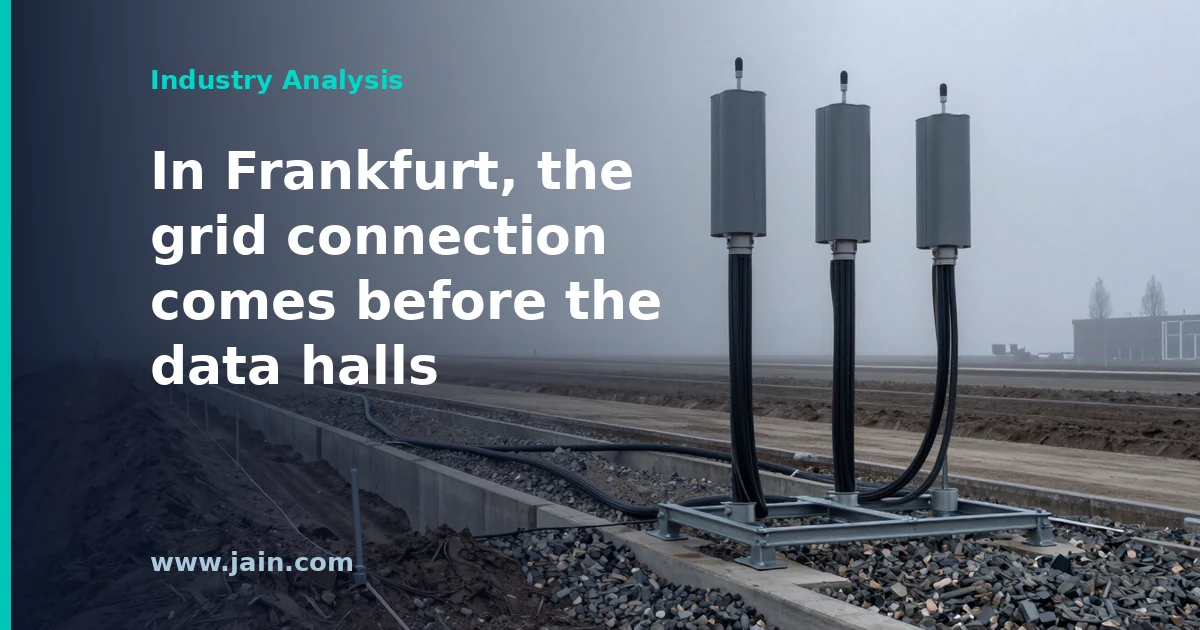
Digital Realty has energized a new 110 kV power line that runs about 16 kilometers underground to a Frankfurt campus planned for 11 data centers, Pluang and Stock Titan reported. 110 kV means 110,000 volts, which is the high-voltage tier of Germany’s distribution grid. The line is intended to increase the electrical capacity available to the site.
The company has not disclosed the line’s capacity in megawatts, its cost, or a construction schedule for the campus’s planned buildings.
Executive Summary
The announcement is a power-infrastructure milestone, not a building opening. Digital Realty has put into service a 16 km underground high-voltage connection for a campus that is still described as planned for 11 data centers. The grid link is therefore in place well ahead of the full build-out it is meant to support.
That sequencing is the story. In Frankfurt, one of Europe’s largest and most power-constrained data center markets, the hardest part of adding capacity is no longer constructing halls. It is securing electricity at utility scale. An operator that has its high-voltage path already energized can offer customers capacity on a firmer timeline than one still waiting on grid upgrades. This matters more as AI hardware pushes the power drawn per rack sharply higher.
The limits are equally clear. Without a megawatt figure, cost, or tenant commitments, the line’s commercial significance cannot yet be measured. It shows how Digital Realty is approaching Frankfurt. It does not yet show how much capacity it will sell there, or when.
The Grid Connection Is Now the First Building Block
The key fact is the order of events. The 110 kV line is energized while the campus it feeds is still described as planned for 11 data centers. A connection of this kind is not added one building at a time. It is delivered once, sized for the eventual campus, and the buildings follow. That reverses the older pattern, in which an operator built a facility first and then asked the local utility for a bigger supply as tenants filled it.
The reason is lead time. Data halls increasingly use prefabricated electrical and cooling modules and can go up comparatively quickly. A high-voltage cable is much slower. It needs a route, permits, civil works beneath a dense city for roughly 16 km, and close coordination with the grid operator. Finishing that cable first turns the slowest dependency in the project into a completed asset. The people affected are customers who need committed dates for energized capacity, rival operators who still have to wait for grid upgrades, and the grid operator, which now has a large new load point to plan around.
There is a caveat. Digital Realty has not said how many megawatts the line can deliver. It is therefore not possible to judge whether this single connection covers the full 11-building plan or only its first phases.
Why Frankfurt Makes Power the Scarce Input
Frankfurt is one of Europe’s core data center hubs. It hosts DE-CIX, one of the world’s largest internet exchange points (the facilities where networks hand traffic to one another), and it serves a large financial sector and major cloud regions. Customers cluster there because short physical distances mean low latency, which is the delay between a request and a response. That clustering concentrates very large electrical loads in a small area.
Electricity networks cannot expand at the same pace. New substations and high-voltage lines take years to plan and build. Frankfurt has also set a planning framework for where data centers may be located, and Germany’s Energy Efficiency Act places efficiency, renewable-power and waste-heat obligations on the sector. Laying the line underground reflects the same urban constraints. Buried cables generally cost more than overhead lines, but in a built-up city they are often the only route that can realistically be permitted.
Owning the Path to Power Changes the Economics
Building utility-scale power ahead of demand is a capital decision with two sides. The upside is that in a constrained market, energized capacity is what customers are actually buying. That applies especially to AI training and inference deployments, whose dense GPU racks draw far more power than traditional servers. A campus with its high-voltage connection already live can compete for large deployments that cannot easily be placed elsewhere.
The risk is that the spending only earns a return as buildings are completed and leased. If leasing is slow, the cost of the connection is carried before revenue arrives. Digital Realty has not disclosed what the line cost or how it was financed, so investors cannot yet weigh that trade-off. For buyers of capacity, the practical point applies across the market: ask operators how much capacity is already energized and contracted, not only how much is planned.
Background
Digital Realty is one of the world’s largest data center owners. It is structured as a real estate investment trust, a company that owns income-producing property and pays out most of its taxable income to shareholders. It leases space, power and network connections to cloud providers, enterprises and carriers. Its 2020 acquisition of Interxion substantially expanded its presence in Europe, including Frankfurt.
Frankfurt is one of Europe’s leading data center hubs, often grouped with London, Amsterdam, Paris and Dublin. Its role as an interconnection point and financial center has drawn heavy investment. Grid capacity, local planning rules and German energy-efficiency requirements increasingly shape where and how fast new capacity can be built there. Source: Digital Realty activates new 110 kV power line to boost Frankfurt data center capacity (Pluang): report on the energization of a 110 kV line serving Digital Realty’s Frankfurt campus. Also reported by Stock Titan: the roughly 16 km underground line to a campus planned for 11 data centers.Sources