
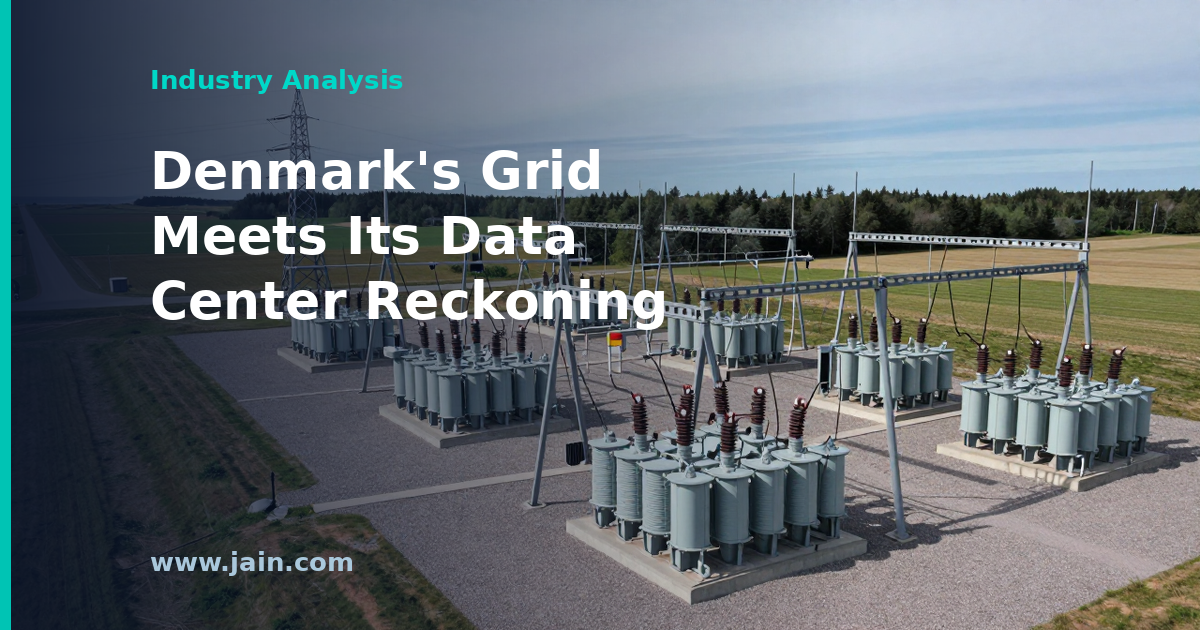
CNBC reports that Denmark is confronting a data center reckoning as its electricity grid struggles to keep pace with demand from new and planned compute campuses. The story frames Denmark — long marketed as a cool-climate, renewable-rich destination for hyperscale sites — as an early warning for the wider European market.
Executive Summary
Denmark built its data center pitch on wind power, fiber connectivity, and a stable regulatory climate. According to CNBC’s May 5, 2026 reporting, that pitch has now collided with a physical limit: the grid itself. Surging load from AI training clusters and cloud expansion is arriving faster than transmission and generation can be built to serve it.
The significance is less about one country and more about a pattern. When a small, wealthy, wind-heavy grid begins turning away or slow-walking data center load, it signals that Europe’s compute buildout is entering a capacity-constrained phase where power availability — not land, tax breaks, or fiber — decides who gets to build and when.
From Marketing Advantage to Physical Constraint
For roughly a decade, Nordic countries sold themselves as the natural home for hyperscale compute: cold air for free cooling, abundant wind and hydro, and grids with historically high renewable penetration. Denmark in particular attracted anchor tenants on that narrative. The CNBC framing suggests the narrative has aged faster than the infrastructure. Interconnection — the physical and contractual act of tying a new large load into the transmission system — is now a multi-year exercise in many European jurisdictions, and Denmark appears to be joining that queue-bound club.
The economics shift accordingly. When power is the binding constraint, the value of a permitted, energized site rises sharply relative to a greenfield parcel with only a land option. Developers holding older, already-connected sites gain leverage; newcomers face longer development cycles and more expensive grid upgrades passed through in connection fees.
The AI Load Curve Is Not the Cloud Load Curve
Traditional cloud regions grew in relatively predictable megawatt increments. AI training campuses do not. A single modern training hall can request tens to hundreds of megawatts at a single point of interconnection, with utilization profiles that are peakier and less flexible than a general-purpose cloud zone. Grids planned around gradual electrification of transport and heat were not sized for step-change industrial loads landing in single postcodes.
That mismatch is what turns a growth story into a reckoning. It is not that Denmark lacks renewable generation in aggregate; it is that moving power from where wind blows to where a proposed campus wants to plug in requires transmission that takes years to permit and build. In the interim, either the load waits, the grid operator constrains it, or fossil balancing quietly rises to keep the system stable.
Winners, Losers, and the New Site-Selection Playbook
Operators with existing energized capacity in Denmark and neighboring markets benefit from scarcity pricing on colocation and wholesale power capacity. Hyperscalers with the balance sheet to co-invest in transmission or to sign long-tenor renewable PPAs (power purchase agreements — long-term contracts to buy electricity from a specific generator) can still move forward, but on the utility’s timeline. Smaller enterprises and AI startups without that leverage are pushed toward secondary markets or toward renting capacity rather than building it.
Regulators and policymakers face their own trade-off. Restricting new data center load protects households and existing industry from grid stress and price spikes, but risks ceding a strategically important slice of the AI economy to jurisdictions willing to build faster. The Danish debate, as CNBC frames it, is a preview of choices Ireland, the Netherlands, and parts of Germany have already had to make explicitly.
What Substantiated, What Is Not
The reporting substantiates the direction — grid stress from data center demand in Denmark — more than any specific quantified ceiling. Readers should treat headline claims of “overwhelmed” grids as a description of pipeline pressure and interconnection backlog rather than active blackouts. The useful takeaway is directional: European compute siting is repricing around power, and Denmark is a visible early data point rather than a singular crisis.
Background
Denmark, along with Sweden, Norway, and Finland, spent the 2010s courting hyperscale data center investment on the strength of cool weather, renewable generation, and connectivity to mainland Europe. Anchor projects from major U.S. cloud providers helped establish the region as a credible alternative to the FLAP-D markets (Frankfurt, London, Amsterdam, Paris, Dublin).
By the mid-2020s, that same set of European markets began hitting grid constraints as electrification of transport, heating, and industry collided with a step-change in compute demand from AI. Ireland’s moratorium in the Dublin area and the Netherlands’ national siting restrictions were the first public signals; Denmark’s current situation extends that pattern into the Nordics themselves.
Source: Denmark faces data center reckoning as power grid overwhelmed by surging demand – CNBC. CNBC reports on grid stress in Denmark as data center demand outpaces available electricity infrastructure.