
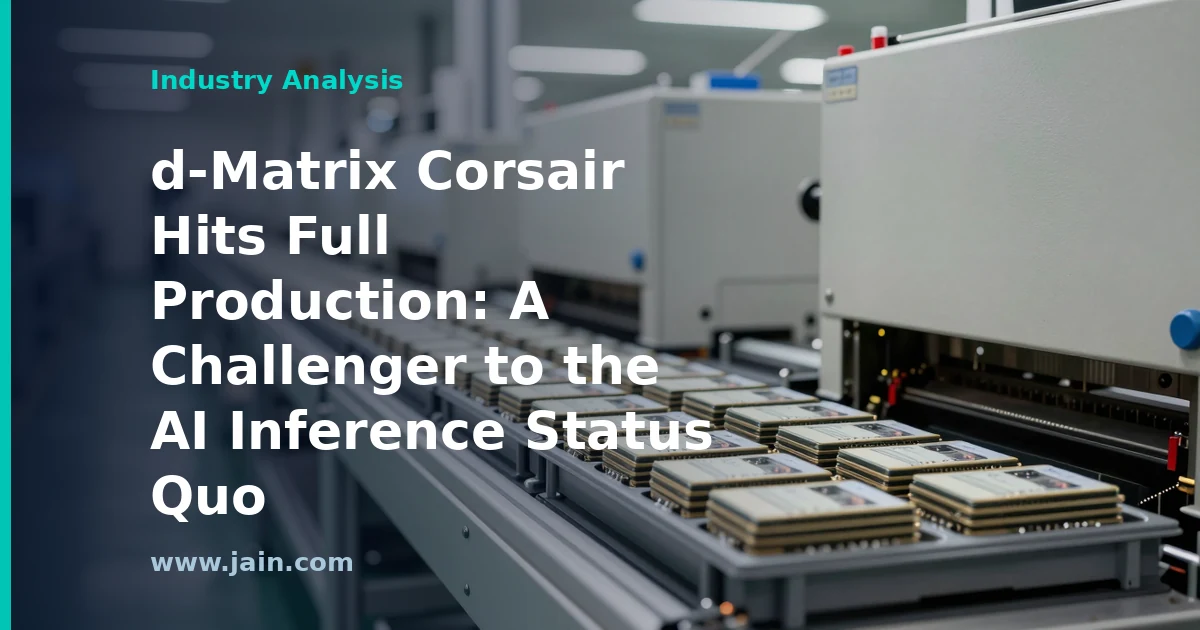
Silicon Valley chip startup d-Matrix announced on June 10, 2026 that Corsair, its flagship AI inference accelerator, has entered full production, with the company attributing the ramp to customer demand. Corsair is a PCIe-card accelerator built on d-Matrix’s digital in-memory compute architecture, designed to run large language model inference — the work of generating answers from already-trained models — faster and more efficiently than general-purpose GPUs.
Executive Summary
d-Matrix says its Corsair inference platform has moved from early availability into full production. For a fabless semiconductor startup, that transition is one of the hardest milestones in the business: it signals that the design, manufacturing partners, packaging, and software stack are mature enough to ship at volume rather than in evaluation quantities. The company frames the ramp as demand-driven, though the release does not disclose shipment volumes, named customers, or revenue.
The announcement matters because it lands in the middle of the industry’s most consequential architectural debate: whether AI inference — now widely expected to dwarf training as a share of total AI compute spending — will remain a GPU market, or fracture into specialized silicon. Corsair is a purpose-built bet that inference is fundamentally a memory problem, not a compute problem, and that an architecture which collapses the distance between memory and math can win on cost and energy per token. Full production is the point at which that thesis stops being a slide deck and starts being testable in customer data centers.
The Memory-Bandwidth Wall, Explained
When a large language model generates text, the dominant cost is not arithmetic — it is moving the model’s billions of parameters from memory to the processor over and over, once per generated token. Processors have gotten faster far more quickly than memory has gotten closer, a gap the industry calls the memory-bandwidth wall. GPUs attack it with expensive stacks of high-bandwidth memory (HBM) bolted alongside the compute die; d-Matrix attacks it by performing the math inside the memory arrays themselves, an approach called digital in-memory compute. Less data movement means, in principle, lower latency and less energy per token.
The architectural logic is sound and the problem is real — memory bandwidth, not raw FLOPS, is the binding constraint on most production LLM serving today. The open question has never been whether in-memory compute is elegant, but whether it can be manufactured at scale, programmed easily, and priced competitively. A full-production milestone speaks directly to the first of those three tests.
From Demo Silicon to Volume: Why This Milestone Is the Hard One
The graveyard of AI chip startups is full of companies that produced impressive demonstration silicon but never crossed into volume manufacturing. Getting there requires acceptable yields from foundry partners, stable supply of advanced packaging, qualified server integrations, and a software stack that customers other than the vendor’s own engineers can actually use. By declaring full production, d-Matrix is asserting it has cleared those gates.
What the release does not do is quantify the claim. “Full production to meet customer demand” is a statement about readiness, not about scale: no unit volumes, deployment sizes, or purchasers are disclosed. That is typical for a private company’s press release, but it means the milestone should be read as necessary rather than sufficient evidence of commercial traction. The verifiable signals — named customers, independent benchmarks, follow-on orders — come later, and observers should watch for them.
The Economics of Challenging an Incumbent
Every inference challenger faces the same asymmetry: Nvidia’s advantage is only partly the silicon. Its CUDA software ecosystem, developer familiarity, and guaranteed supply relationships make GPUs the default even where specialized chips post better numbers on paper. Challengers such as Groq, Cerebras, and SambaNova — and the hyperscalers’ in-house chips like Google’s TPUs and Amazon’s Inferentia — have each carved positions by competing on cost per token, latency, or energy rather than generality.
d-Matrix’s opening is real, though. Inference is a workload buyers purchase continuously, priced per token, which makes operating cost — dominated by power and hardware amortization — brutally legible. Enterprises and cloud providers are also actively seeking second sources to gain pricing leverage over the GPU supply chain. A challenger does not need to displace the incumbent to build a substantial business; it needs to win the subset of workloads where its architecture’s advantages are largest and the switching costs are manageable.
What It Means for the Data Center
For data-center operators, the interesting property of accelerators like Corsair is the form factor: PCIe cards that slot into standard servers, rather than the dense, increasingly liquid-cooled rack-scale systems that frontier GPUs demand. If inference-optimized silicon delivers competitive throughput at meaningfully lower power per token — a claim d-Matrix has consistently made in its marketing, and one that independent benchmarking will need to validate — it extends the useful life of conventional air-cooled facilities that cannot economically retrofit for 100-kilowatt racks.
That has second-order implications for the industry’s power crunch. Inference demand is growing at exactly the moment grid interconnection has become the limiting factor on data-center construction. Any architecture that serves more tokens per megawatt is, in effect, a capacity play — and that, more than any single benchmark, is why purpose-built inference silicon keeps attracting capital.
Background
Founded in 2019, d-Matrix spent its first years developing digital in-memory compute through successive test chips before unveiling Corsair in late 2024 as its first volume product, aimed squarely at low-latency large language model serving. The company has raised several hundred million dollars from investors including Microsoft’s M12, Temasek, SK hynix, and Playground Global — one of the better-capitalized entrants in a crowded field of AI chip startups formed on the thesis that inference workloads will eventually dwarf training.
That thesis has moved from contrarian to consensus: as deployed AI applications scale, the recurring cost of serving models has become the industry’s central economic problem, and the market for inference-optimized alternatives to GPUs has drawn challengers ranging from venture-backed startups to the hyperscalers’ own silicon programs. Full production of Corsair marks d-Matrix’s transition from architectural argument to shipping product in that contest.
Source: d-Matrix Corsair AI Inference Platform Enters Full Production to Meet Customer Demand — company press release via PR Newswire, June 10, 2026, announcing the production ramp of d-Matrix’s inference accelerator platform.