
TL;DR · 30-second read
The Short Version
A giant computer campus for Google’s artificial intelligence work is rising near Amarillo, Texas. A company called Crusoe has now said it is the developer behind it.
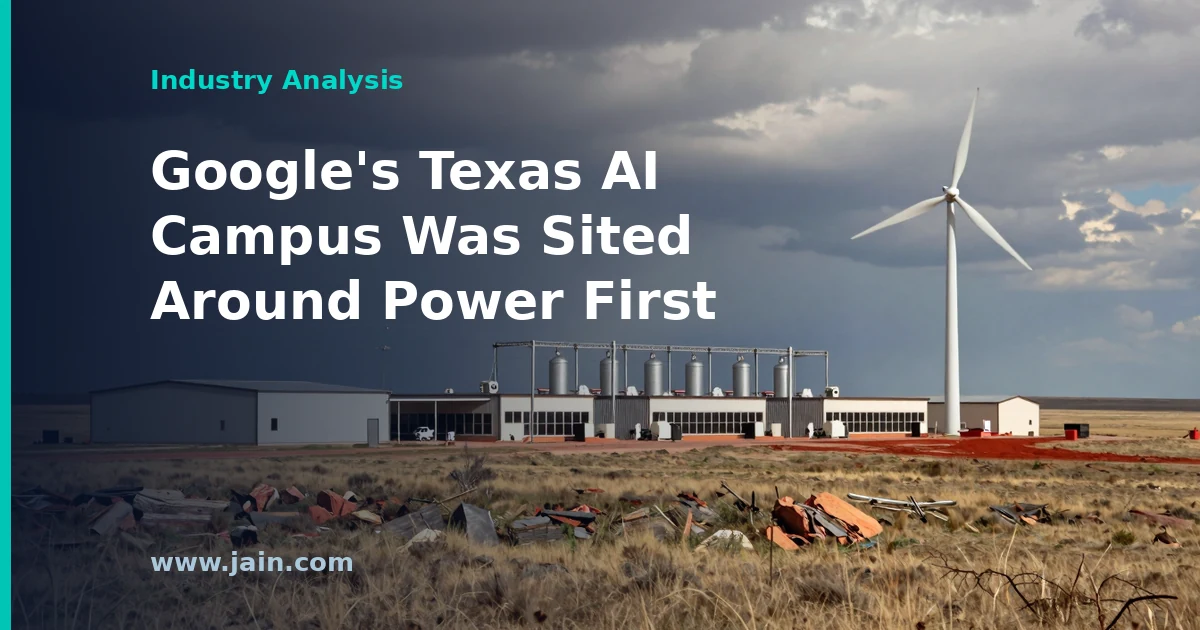
The interesting part is the location. The campus sits beside two wind farms, one running and one still being built. At full output, each could supply roughly the electricity a small city uses.
Artificial intelligence needs enormous amounts of power, so this project went to where the power is made. More than 5,500 people work there daily. Crusoe has not said what runs the computers when the wind drops.
Crusoe announced on September 28, 2026, that it is the developer of Google’s data center campus under construction in Armstrong County, Texas, outside Amarillo. Construction began in June 2025, and Crusoe says more than 5,500 skilled workers are on site daily.
The campus has a direct connection to two adjacent wind farms owned by Serena: Goodnight 1, which is operating, and Goodnight 2, which is under construction. Each is rated at 265.5 megawatts (MW), for 531 MW combined. Crusoe did not disclose the campus’s own electricity demand or the project’s cost.
Executive Summary
The announcement attaches a developer’s name to a Google AI campus that has been under construction for about 15 months. It also describes a specific power arrangement: the campus connects directly to neighboring wind farms, and surplus generation flows to the grid when wind output exceeds campus demand.
The significance lies in the order of decisions. Crusoe presents the site as an example of its “energy-first strategy,” which means building data centers at the source of abundant, low-cost energy instead of bringing power to a preferred location later. For a company of Google’s scale, the project shows at least one AI campus being delivered through a developer that makes energy access central to its pitch.
Key claims remain unquantified, including the campus’s power demand, its supply when wind output falls, and the promised benefits for local ratepayers. Those details will determine how far the Armstrong County model can serve as a template for other AI projects.
Why the 531 MW Connection Points to a Power-First Site
The strongest evidence for a power-first site is physical. Crusoe describes a direct connection to two adjacent wind farms with 531 MW of combined rated capacity, and it says the campus is being built at the source of West Texas wind energy. That places generation next to demand, rather than relying only on power moved across long distances from elsewhere on the grid.
The arrangement also appears to have influenced new supply. Crusoe says Goodnight 2 was “catalyzed by” its development at the site. If so, the data center is more than a customer for existing generation: its demand helped support another 265.5 MW wind project. Crusoe has not published the contract terms behind that claim, but the stated mechanism is clear. A large, nearby electricity user can give a generation project a ready source of demand.
This affects several groups. Developers with energy expertise can offer large technology companies, often called hyperscalers, a route to capacity that starts with power. Wind farm owners may find a new kind of anchor customer. Utilities and grid planners have to consider a large user that is also linked to neighboring generation and can send surplus power onto the grid. Still, this is one campus, and it follows one company’s stated strategy. It shows that the model is being used at significant scale, not that it has become the industry standard.
Rated Capacity Is Not the Same as Round-the-Clock Supply
The 531 MW figure is easy to misread. It describes what the wind farms are rated to produce, not what they will deliver at every hour or what the campus will consume. It also includes Goodnight 2, which is not yet operating. Today, only half of that rated capacity is running.
The operational challenge is matching two different patterns. AI computing clusters generally benefit from steady, dependable electricity, while wind output rises and falls with the weather. Crusoe explains what happens when wind generation exceeds campus demand: surplus power goes to the grid. It does not explain how the campus is supplied when generation falls short, which is the more demanding case for a facility built to run continuously.
The answer also bears on the “clean energy” description. A campus could rely on wind for much of its supply while still drawing on the wider grid at other times, and the share of each would shape both its costs and its emissions profile. Without the campus load and a supply breakdown, outsiders cannot yet judge how much of its electricity will come from the adjacent turbines.
The Grid Benefits and Water Savings Need Numbers
Crusoe says surplus power will benefit local ratepayers and reduce curtailment, the practice of cutting wind output when the grid cannot use or carry it. The logic is plausible: a large nearby user could absorb generation that might otherwise be wasted. The size of the benefit, however, depends on how often curtailment occurs at this location, how much the campus absorbs, and how costs are allocated among customers. Crusoe has not published estimates for any of these.
The cooling claim is similar. A closed-loop, non-evaporative liquid system recirculates coolant instead of evaporating water to reject heat, and Crusoe says it is designed to limit water use primarily to domestic needs such as kitchens. That is a meaningful design choice in the context of West Texas, but there is an engineering trade-off to examine. Non-evaporative systems can require more electricity for heat rejection, particularly in hot weather. Annual water-use and energy-efficiency figures would allow a fuller assessment.
Speed Is the Selling Point, but the Milestones Are Missing
Crusoe CEO Chase Lochmiller said, “We broke ground in June 2025 and are building at the same swift pace we set in Abilene.” The more than 5,500 workers on site daily suggest a very large construction effort, and Crusoe also lists two campuses under development in Abilene as part of a growing West Texas portfolio.
Workforce size, however, measures activity rather than delivered capacity. For buyers and investors tracking AI infrastructure, the more useful milestones are energization dates, the capacity available in each phase, and the date Goodnight 2 begins operating. Those dates would show whether starting with power actually shortens the path to usable computing capacity.
Background
AI data centers house large clusters of specialized computers that require substantial electricity and cooling. Reliable power has therefore become a central consideration in planning and siting large campuses. Crusoe positions itself around that issue, combining energy sourcing, AI-optimized data center development and an AI cloud platform.
Armstrong County is outside Amarillo, and Crusoe includes the campus in a growing West Texas portfolio alongside two campuses under development in Abilene. Its strategy is to locate facilities at sources of abundant, low-cost energy, with the aim of making better use of existing assets and encouraging new generation. Source: Crusoe Develops Google AI Data Center Campus in Armstrong County, TX, Crusoe’s September 28, 2026 announcement of its role as developer of the campus.Sources