
TL;DR · 30-second read
The Short Version
A 64-year-old coal plant in western Michigan was supposed to shut down in May 2025. The federal government ordered it to keep burning coal anyway, saying the power was needed to stop blackouts.
A federal appeals court has now ruled that order was unlawful, because there was no real emergency. Keeping the plant open has cost about $259 million so far, and Midwest households and businesses may end up paying much of it in their electricity bills.
The government is still issuing similar orders at other plants, so the fight is not over.
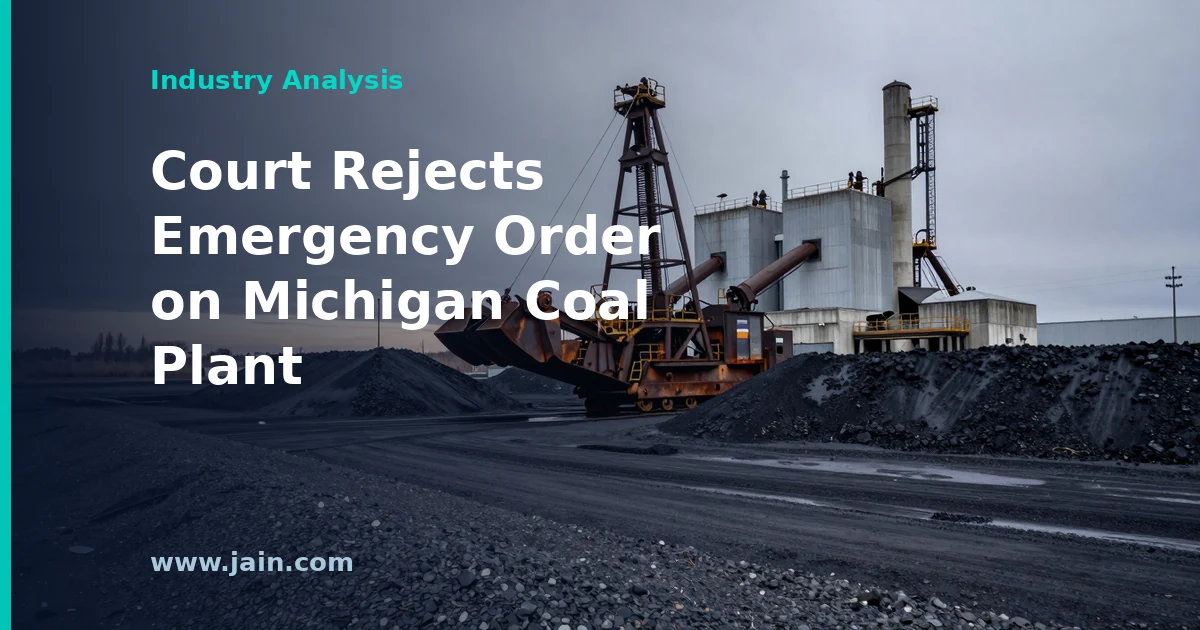
The U.S. Court of Appeals for the District of Columbia Circuit ruled Friday that the Energy Department exceeded its authority when it forced Michigan’s J.H. Campbell coal-fired power plant to operate past its scheduled May 2025 retirement. The Associated Press reported that a unanimous three-judge panel sided with environmental groups and the states of Michigan, Illinois and Minnesota, finding there was no genuine emergency under the Federal Power Act. Writing for the panel, Judge Cornelia Pillard described the statute’s emergency provision as “essentially a narrow, last-resort backstop” and called the reversal of the plant’s “long and carefully planned retirement” disruptive.
The 64-year-old plant in West Olive, operated by Consumers Energy, has stayed online under successive orders signed by Energy Secretary Chris Wright, who argued the unit was needed for regional reliability. Keeping it running has cost roughly $259 million so far, according to new financial filings. Consumers Energy said it is reviewing the ruling and will keep the plant operating under a more recent Energy Department directive that extends through mid-November.
Executive Summary
The decision is the first appellate ruling to test how far the Energy Department can stretch emergency authority to keep generation online, and it lands squarely against the department. The court did not weigh in on whether the Campbell plant’s output was useful last winter. It held that usefulness is not the legal test: the emergency provision applies only when immediate, last-resort action is required and when the Energy Department in particular must act, rather than the states responsible for making sure enough generation exists to meet demand.
That distinction matters well beyond one coal unit. Since President Trump’s January 2025 executive order declaring a national energy emergency, which cited demand growth from artificial intelligence and data centers, the administration has used the same authority to hold roughly half a dozen coal plants and one Pennsylvania oil-and-gas plant past their closure dates. The ruling gives challengers in Indiana, Colorado, Florida and Washington a precedent written by the court that most federal energy appeals run through.
It also sharpens a question the industry has largely deferred. If aging fossil units cannot be conscripted by federal order, then the burden of serving new data center load falls back where the court says it belongs, on state regulators, regional grid operators and the developers themselves. Emergency orders were never a capacity plan. They are now a considerably less reliable one.
A Backstop, Not a Planning Tool
The Federal Power Act’s emergency provision, Section 202(c), lets the Energy Department order a power plant to run during a sudden crisis. It was written for hurricanes, fuel shortages and deep freezes, not for structural shortfalls that everyone can see coming years out. The D.C. Circuit read it that way, holding that the authority is “triggered only when there is a need for immediate, essentially last-resort action and the circumstances require action by DOE in particular, as opposed to action by the state or states responsible for resource adequacy.” Resource adequacy is the industry term for having enough generation on hand to meet peak demand, and in the United States it is primarily a state and regional grid operator responsibility.
The second half of the holding is the part utilities will read twice. Reversing a long-planned retirement, the court said, is itself disruptive. That reflects operational reality. A plant scheduled to close sheds staff, winds down coal supply contracts, defers environmental capital spending and is replaced in the resource plan by something else. Restarting that machinery is not free, and the court treated the disruption as a cost of the order rather than a neutral act of caution.
It is worth being precise about what the court did not decide. The panel reviewed statutory authority, not engineering. The Energy Department’s specific claims, that Campbell delivered more than 650 megawatts daily from January 21 to February 1 and that coal output in affected regions rose 25 percent at the peak of the winter storms, were not rejected as facts. Its broader claim that the orders “likely saved hundreds of lives” is a causal inference the department has not published supporting analysis for. And if the output genuinely was needed during those storms, that points to a resource adequacy gap which the ruling says states and grid operators, not emergency orders, are supposed to close.
The $259 Million Question
The hard number in this story is the cost: roughly $259 million to keep one 64-year-old unit running past its retirement date. Costs from reliability orders of this kind are typically recovered through regional rates, which is why the challengers, and Michigan’s attorney general, framed the case around Midwest ratepayers footing the bill for a plant their own utility had planned to close. Sierra Club attorney Sanjay Narayan called the ruling a victory for families “paying to keep this old, expensive and dirty power plant online.”
Advocacy framing aside, the underlying economics are not really contested. A unit gets a retirement date because its running costs, maintenance burden and emissions compliance no longer pencil out against alternatives. An emergency order does not change that arithmetic; it transfers the loss to someone else. Neither Consumers Energy nor the Energy Department has published the plant’s operating economics under the orders, so the $259 million figure is the only quantified measure of what the intervention has cost, and the ruling leaves open who ultimately absorbs it.
For large electricity buyers, this is the cost-allocation fight in miniature. Reliability insurance for a region has to be paid for by somebody. When it is bought through an emergency order rather than a capacity market or a bilateral contract, the payer is chosen administratively and litigated afterward. That is a poor foundation for a ten-year power budget.
What AI Load Growth Actually Needs
The January 2025 executive order invoked artificial intelligence and data center growth as justification for a national energy emergency. Set the scale side by side. Campbell’s contribution during the storm period was a bit over 650 megawatts, which the Energy Department described as enough for hundreds of thousands of homes. It is also roughly the appetite of a single large AI training campus of the kind being announced across the Midwest and Mid-Atlantic. Holding a handful of aging units online buys time measured in months and capacity measured against one or two hyperscale projects.
The practical takeaway for developers is that announced retirement dates just became more credible as planning inputs. Siting a campus on the assumption that a nearby fossil unit will be kept alive by federal order is now a materially riskier bet. The binding constraints remain what they were: interconnection queues, the multi-year backlog of requests to connect new plants and large loads to the grid, plus transformer and turbine lead times. None of those are addressed by an emergency order.
The court’s federalism framing pushes the pressure toward state commissions and regional grid operators, and through them toward large customers. Expect more of what is already emerging: on-site or behind-the-meter generation, long-term contracts that fund firm capacity directly, and demand flexibility arrangements in which a data center agrees to curtail during system peaks in exchange for faster service. Those are slower and more expensive than a federal directive, but they do not expire when a panel of judges rules.
The Orders Keep Coming
The administration’s response was immediate. Hours after the ruling, Secretary Wright issued a new emergency order keeping the TransAlta-operated Centralia plant in Washington online; it had been scheduled to close at the end of 2025. Similar orders cover plants in Indiana, Colorado and Florida, and a Pennsylvania oil-and-gas plant has been directed to keep its turbines running as a hedge against Mid-Atlantic shortages. Consumers Energy, for its part, will keep Campbell running through mid-November under a separate directive while it reviews the decision.
Each order stands on its own record, so the ruling does not automatically void the others. It does hand challengers a template, and because the D.C. Circuit hears most federal energy appeals, its reasoning carries unusual weight. The Energy Department has not said whether it will seek rehearing or Supreme Court review, which is the near-term question for anyone modeling how long this authority remains usable.
For plant owners, an emergency order is revenue with a legal tail. Payments made under an order later found unlawful invite disputes over recovery and potential disallowance, and the uncertainty itself imposes planning costs on utilities trying to decide whether to retire, retrofit or resell a marginal unit. The cleanest reading of Friday’s decision is not that coal must close on schedule. It is that the federal government cannot unilaterally decide it should not.
Background
The J.H. Campbell plant has operated on Michigan’s west side for 64 years and is run by Consumers Energy, the regulated utility subsidiary of CMS Energy. Like much of the aging coal fleet in the Midwest grid region, it was slated for closure as operating costs, maintenance demands and cleaner alternatives shifted the economics. Its retirement date of May 2025 had been in utility resource plans for years before the Energy Department intervened.
Section 202(c) of the Federal Power Act, the provision at issue, has historically been used sparingly and briefly, typically during hurricanes, fuel disruptions or extreme cold snaps. That changed after President Trump’s January 2025 executive order declaring a national energy emergency, which cited electricity demand growth from artificial intelligence and data centers. Since then the department has used the authority to hold roughly half a dozen coal plants past their closure dates, plus an oil-and-gas plant in Pennsylvania, producing litigation in several states of which the Michigan case is the first to reach an appellate decision. Source: Federal court rejects Trump order keeping Michigan coal plant open — Associated Press report on the D.C. Circuit ruling that the Energy Department exceeded its authority in ordering the J.H. Campbell coal plant to operate past its scheduled retirement.Sources