
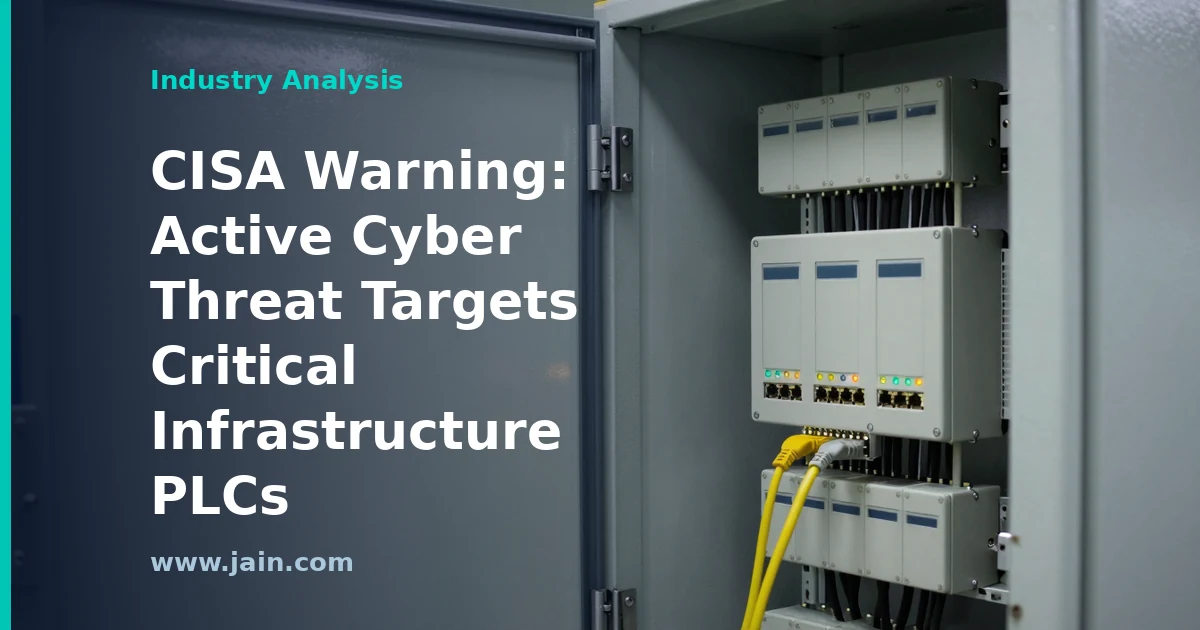
The US government has issued a warning about an active cyber threat targeting critical infrastructure, with programmable logic controllers (PLCs) — the ruggedized industrial computers that directly operate pumps, breakers, valves and cooling equipment — at the center of the concern, according to an April 26, 2026 Fox Business report. The alert comes from the Cybersecurity and Infrastructure Security Agency (CISA), the Department of Homeland Security unit responsible for defending the systems that keep power, water and communications running.
The report describes the threat as active — meaning adversaries are currently attempting or conducting intrusions, not merely capable of them. Details on attribution, affected vendors and confirmed victims were not included in the initial coverage.
Executive Summary
According to the report, CISA is warning that threat actors are actively targeting operational technology (OT) — the layer of industrial control systems that sits between software and physical machinery — across US critical infrastructure sectors. PLCs matter because they are the last digital step before a physical action: a compromised email server leaks data, but a compromised PLC can shut off a pump, trip a breaker or disable a chiller.
For operators of power systems and data centers, the warning lands on a well-documented weak spot. Many PLCs in the field run with default credentials, lack modern authentication, and were designed for isolated networks that have since been bridged to corporate IT and the internet for remote monitoring. When CISA flags active targeting of this equipment, the practical message is that exposure that was theoretically risky yesterday is being probed today.
It is worth being precise about what the initial coverage does and does not establish. The existence of a federal warning is reported; the specific advisory, the threat actor behind the activity, the vulnerabilities exploited and whether any disruption has occurred are not detailed in the source. Operators should treat the report as a prompt to consult CISA’s published advisories directly rather than act on secondhand characterizations.
Why PLCs Are the Soft Underbelly of Critical Infrastructure
A programmable logic controller is a small industrial computer that reads sensors and drives equipment on a fixed loop — open this valve, start that fan, trip this breaker. They are built for reliability and longevity, not security: units installed 15 or 20 years ago are still in service, many with no authentication, unencrypted protocols, and firmware that is rarely if ever updated. Security researchers have called this class of exposure “insecure by design,” because the weaknesses are features of the product era, not bugs that a patch can remove.
The attack path is usually mundane. Adversaries do not need exotic exploits when internet-scanning tools can find PLCs and their human-machine interfaces exposed directly online, often protected by a default password printed in the vendor manual. That is why prior US government advisories on OT threats have emphasized basics — take devices off the public internet, change default credentials, segment networks — rather than sophisticated countermeasures. An “active threat” warning against this backdrop suggests someone is systematically working through that exposed population.
The Data-Center Angle: OT Risk Is Not Just a Utility Problem
Data-center operators sometimes read critical-infrastructure warnings as a power-and-water problem. That is a mistake. A modern data center is itself a dense OT environment: building management systems, chillers, computer-room air handlers, generators, transfer switches and uninterruptible power supplies are all orchestrated by PLCs and adjacent controllers. An attacker who cannot touch a single server can still take a facility down — or force a thermal shutdown — by manipulating the cooling plant.
The interdependence runs both ways. Data centers are among the fastest-growing loads on the US grid, and their availability depends on the same utility OT systems the warning implicates. A regional grid disruption caused by an OT intrusion becomes every colocation tenant’s outage. That shared fate is why federal warnings of this kind deserve attention across the infrastructure stack, not just inside utilities’ security teams.
What “Active” Changes — and What It Doesn’t
Government cyber warnings span a wide range, from generic threat awareness to specific incident-driven alerts with indicators of compromise. The word “active” pushes toward the serious end: it implies observed adversary operations, not hypothetical capability. Recent history supports taking such language literally. In late 2023, US water utilities had Unitronics PLCs defaced by an Iran-linked group exploiting default passwords, and through 2024 and 2025 US agencies repeatedly warned that state-sponsored actors — most prominently the China-linked group tracked as Volt Typhoon — had pre-positioned inside US critical-infrastructure networks for potential future disruption.
What the initial report does not change is the economics of the defense. OT security spending has historically lagged IT security because control systems were assumed to be isolated, and because taking a production PLC offline to patch it carries real operational cost. The honest reading of a headline-level report is that it confirms direction — attackers continue to move toward the physical layer — without yet telling operators which specific products or protocols to triage first. That specificity has to come from the underlying CISA advisory itself.
The Operator Playbook: Boring, Proven, and Still Not Done
The mitigations for PLC-targeting campaigns have been remarkably consistent across a decade of advisories: inventory every controller and its network path; remove OT devices from direct internet exposure; put remote access behind VPNs with multi-factor authentication; change default and shared credentials; segment OT networks from IT with monitored boundaries; and maintain tested manual-operation and restoration procedures so a cyber event does not automatically become a physical outage.
The persistent gap is not knowledge but execution — asset inventories are incomplete, legacy gear cannot support modern authentication, and maintenance windows are scarce. For executives, the actionable question this warning raises is not “are we compliant?” but “if CISA named our PLC vendor tomorrow, could we locate every affected unit within a day?” Organizations that cannot answer yes have their next quarter’s OT security priority already defined.
Background
CISA was established in 2018 as the Department of Homeland Security’s lead agency for defending civilian critical infrastructure, and industrial control systems have been a steady focus of its advisory output. The threat it tracks has escalated visibly: the 2021 Colonial Pipeline ransomware attack showed how IT intrusions can halt physical operations, the late-2023 Unitronics incidents showed hacktivists compromising water-utility PLCs through default passwords, and joint advisories in 2024 warned that the China-linked group Volt Typhoon had quietly pre-positioned inside US energy, water and communications networks.
Against that backdrop, PLC-focused warnings are less a new development than an intensifying pattern. The installed base of industrial controllers — millions of devices across utilities, manufacturing and building systems, many designed before cybersecurity was a requirement — represents one of the longest-tail risk remediation problems in US infrastructure, because the equipment often outlives both its vendor support and the network assumptions it was built on.
Source: US warns of active cyber threat targeting critical infrastructure — Fox Business report, April 26, 2026, on a CISA warning concerning active targeting of industrial control systems.