
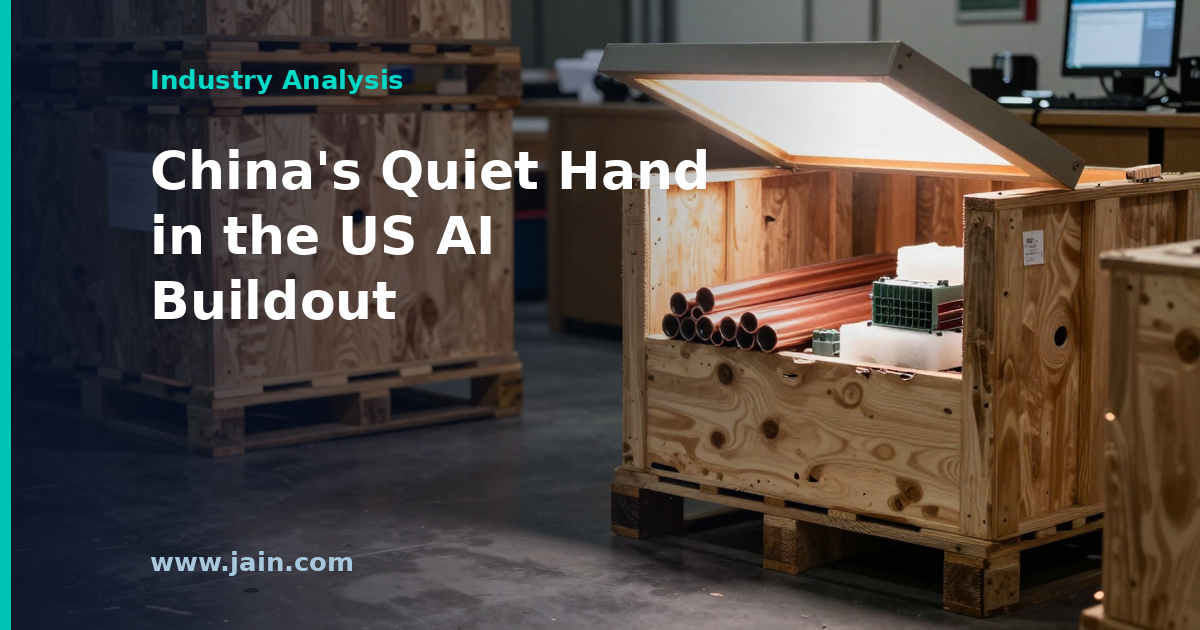
Axios reported on May 21, 2026 that Chinese-made components and materials are quietly flowing into the United States data-center construction boom, even as Washington tightens export controls on advanced chips headed the other direction. The piece frames the dependency as a geopolitical risk for the AI infrastructure now being stood up at record pace.
Executive Summary
The Axios story argues that America’s data-center surge — the physical backbone of the current AI wave — leans on a supply chain in which Chinese firms still play a meaningful, if under-discussed, role. That includes hardware, electrical gear, and construction inputs sourced directly or through intermediaries.
The reason it matters is straightforward: policymakers have spent two years hardening the outbound side of the US–China technology relationship, restricting what advanced silicon and tools American companies can sell to Chinese buyers. The inbound side of the same relationship — what the US buys to build the facilities that host AI — has drawn far less scrutiny, and the article suggests that gap is now visible in the numbers.
The Buildout Nobody Fully Sourced
Hyperscale data-center construction is a bill of materials problem as much as a real-estate problem. A single campus consumes transformers, switchgear, busways, generators, cabling, cooling coils, racks, and structural steel in volumes that already exceed what Western manufacturers can supply on the timelines operators want. When Tier-1 vendors are booked out, buyers turn to whoever can ship — and Chinese factories remain the marginal supplier for a long list of electrical and mechanical components. The Axios framing is that this quiet substitution is bigger than the industry publicly acknowledges.
None of that is inherently a scandal; global sourcing is how infrastructure gets built. It becomes a policy question when the same components sit inside facilities that host frontier AI training runs, defense workloads, or critical services, and when the exporting country is also the strategic competitor the export-control regime is designed around.
Asymmetric Controls, Symmetric Exposure
US policy since 2022 has focused almost entirely on the outbound flow: chips, chip-making equipment, and increasingly the model weights and cloud capacity that could be used to train frontier AI abroad. The inbound flow — grid-scale transformers, power distribution units, network gear, cooling hardware — has been governed by a patchwork of tariffs, Section 232 reviews, and Buy American rules that were not designed with AI infrastructure in mind.
If the Axios reporting holds, the practical implication is that America’s ability to build AI capacity is partly gated by a country it is simultaneously trying to slow down in AI. That is a fragile equilibrium: a future round of tariffs or export restrictions from either side could stretch already long lead times for the exact components operators need most.
Who Gains, Who Gets Squeezed
Western manufacturers of transformers, switchgear, and cooling equipment stand to benefit if buyers and regulators push harder on country-of-origin — but only if they can add capacity, which takes years and skilled labor that is itself in short supply. Hyperscalers with the balance sheets to pre-buy multi-year allocations from domestic and allied suppliers are best positioned; smaller colocation operators and enterprise builders, who buy in smaller lots and later in the cycle, would feel any supply squeeze first.
For AI customers, the second-order effect is schedule risk. A data-center delivery pushed from Q2 to Q4 because a Chinese-sourced transformer was reclassified or a substitute part is on allocation translates directly into delayed GPU deployments and delayed model training. In an environment where compute is the binding constraint on product roadmaps, that is a real cost.
Reading the Claim Carefully
The Axios piece is a framing article, not a forensic supply-chain audit, and the responsible read is to hold both possibilities open. It is plausible that Chinese content in US data-center construction is material and under-reported, given how opaque multi-tier supply chains are. It is also fair to ask how much of the reported exposure is finished Chinese-branded equipment versus subcomponents inside Western-branded gear, and how much is displaceable at reasonable cost versus genuinely single-sourced. Those distinctions determine whether this is a policy problem, a procurement problem, or a headline.
Background
The US data-center industry is in the middle of the largest capacity expansion in its history, driven by generative AI training and inference demand from hyperscalers and a new tier of AI-native operators. That expansion has already collided with constraints on grid interconnection, transformer supply, water, and permitting.
In parallel, the US and China have spent the past several years decoupling on advanced semiconductors, with successive rounds of US export controls on chips and chip-making tools and Chinese retaliation on critical minerals. The Axios story sits at the intersection of those two trends, arguing that the physical layer of the AI economy is still more entangled with China than the policy conversation has acknowledged.
Source: China is secretly fueling America’s data center rage – Axios — reporting that Chinese components and materials are a quiet but material input to the US data-center buildout supporting AI.