Category: Security

  • NIST Rewrites PNT Cybersecurity Guidance for the CSF 2.0 Era

    NIST Rewrites PNT Cybersecurity Guidance for the CSF 2.0 Era

    The U.S. National Institute of Standards and Technology (NIST) has revised its cybersecurity guidance for positioning, navigation and timing (PNT) services, realigning it to version 2.0 of the NIST Cybersecurity Framework and expanding its treatment of GPS disruption, artificial-intelligence risk and supply-chain threats, according to trade coverage published on 12 May 2026.

    PNT services are the satellite and terrestrial systems that tell equipment where it is and, more importantly for infrastructure operators, what time it is to within billionths of a second. The revision is guidance rather than regulation: it gives operators of data centers, power grids, financial systems and telecom networks a structured way to inventory their dependence on those signals and to defend the systems that consume them.

    Executive Summary

    NIST’s foundational PNT profile was written to satisfy Executive Order 13905, signed in February 2020, which directed the federal government to help critical-infrastructure owners use PNT services more responsibly. That original profile was built on the first-generation Cybersecurity Framework (CSF 1.1). CSF 2.0, published in February 2024, added a sixth core function — Govern — alongside Identify, Protect, Detect, Respond and Recover, and pushed supply-chain risk management from a subcategory into a first-class concern. A PNT profile pinned to the older framework was, over time, going to drift out of step with how organizations actually structure their security programs.

    The substantive additions matter more than the renumbering. Deliberate GPS jamming and spoofing have moved from a theoretical concern to a routinely reported operating condition in several regions, particularly for aviation and maritime users, and the same interference affects any fixed receiver in range. Adding explicit treatment of AI risk acknowledges that machine-learning systems are increasingly used both to detect anomalous timing signals and, on the other side, to generate more convincing spoofed ones. Supply-chain coverage addresses a quieter problem: most operators do not buy PNT directly, they buy it embedded inside a network switch, a phasor measurement unit or a timing appliance from a vendor they have never audited on this dimension.

    For infrastructure buyers, the practical value is leverage. Voluntary NIST profiles tend to become procurement language, insurance questionnaires and audit checklists within a few budget cycles, which is usually how they change behaviour.

    Timing Is Infrastructure, Even When Nobody Owns It

    Precise time is the least-discussed dependency in modern digital infrastructure. Distributed databases use timestamps to order transactions and resolve conflicts; if clocks in two availability zones diverge, writes can be applied out of order or reject each other. Mobile networks use tight synchronization to keep adjacent cells from interfering, and time-division and 5G radio schemes are particularly unforgiving of drift. Electrical grids use time-stamped phasor measurements — sampled tens of times per second across hundreds of miles — to detect instability, which only works if every sampler agrees on the moment of sampling. Financial venues are required to timestamp orders to prove sequence. In each case the clock is not a feature of the system; it is a precondition for the system being correct.

    The awkward part is that most of this timing arrives free, from space, via GPS and its counterparts. A rooftop antenna the size of a coffee mug feeds a receiver that disciplines a local oscillator, and the resulting signal is distributed inside the building over NTP or the more precise Precision Time Protocol. Nobody is billed for it, so it rarely appears on a dependency map, and it is frequently owned by facilities or network engineering rather than by security. A NIST profile that forces the question — which of our systems fail, and how visibly, if this signal degrades — is doing useful work before it recommends a single control.

    Degradation is also the hard case. An antenna that goes dark is easy to detect and fail over. A receiver that is being spoofed reports a confident, plausible, wrong time, and a good spoof walks the clock slowly enough that naive threshold alarms never fire. That failure mode propagates silently into logs, transaction ordering and forensic timelines, which is precisely why it belongs in a cybersecurity framework rather than a facilities runbook.

    What CSF 2.0 Actually Changes for a PNT Program

    The addition of the Govern function is not cosmetic. Under CSF 1.1, an operator could describe technical PNT controls without ever assigning accountability for them. Govern asks who owns the risk, how it is expressed in policy, what the risk tolerance is, and how third-party dependencies are managed. For timing, that maps onto a real organizational gap: the team that installs the GPS antenna, the team that runs the NTP servers and the team that would be blamed for a corrupted transaction log are usually three different teams with no shared document.

    The supply-chain emphasis lands on a genuinely under-examined surface. PNT capability is overwhelmingly delivered as a component — a receiver module, a timing card, an oscillator, firmware that parses satellite messages. Buyers evaluating a timing appliance typically compare holdover specifications and price, not the provenance of the receiver chipset or the vendor’s firmware-update practices. Asking suppliers to document that lineage is the kind of requirement that is trivial to write and expensive to satisfy, and it will surface differences between vendors who have anticipated the question and those who have not.

    The AI dimension is the newest and, on the evidence available in the headline alone, the least defined. There are at least three distinct concerns worth separating: machine-learning models used to classify anomalous PNT signals, which can be evaded or poisoned; AI-assisted generation of spoofing waveforms, which lowers the skill required to mount an attack; and AI systems that consume PNT data as an input, where corrupted timing quietly corrupts inference. Guidance that treats these as one topic would be less useful than guidance that treats them as three.

    Who Benefits, and What It Costs to Comply

    The clearest commercial beneficiaries are vendors of resilient timing: makers of rubidium and cesium clocks and high-quality oven-controlled oscillators that let a facility ride out signal loss in holdover for hours or days, suppliers of multi-constellation receivers that can fall back from GPS to Galileo, GLONASS or BeiDou, providers of terrestrial and fibre-delivered time services, and the smaller field of anti-spoofing and signal-authentication products. None of these are new categories. What a widely cited framework profile changes is the buyer’s ability to justify the line item, because “NIST’s profile asks us to demonstrate holdover capability” is a more durable argument than an engineer’s professional unease.

    The cost falls unevenly. Large hyperscale and carrier operators have generally engineered timing redundancy already, often with multiple antennas, atomic holdover and diverse distribution; for them the work is documentation, governance and supplier attestation rather than capital equipment. Regional colocation providers, industrial operators and mid-sized utilities are the ones more likely to discover a single receiver feeding a single time server with no holdover behind it. That asymmetry is worth naming plainly: guidance of this kind tends to raise the floor, and raising the floor is more expensive for whoever is standing on it.

    It is also worth being precise about what this announcement is and is not. It is a revision to voluntary guidance, aligned to a voluntary framework, from a standards body with no enforcement authority. It does not compel any operator to buy anything or meet any deadline. The realistic mechanism of influence is indirect — contract language, insurer questionnaires, sector regulators who cite NIST documents by reference — and that mechanism works on a timescale of years, not quarters. Readers should treat the substantive question as open until the document text itself is examined: alignment to CSF 2.0 is a structural claim, and whether the underlying technical recommendations have materially advanced is something only the revised profile can answer.

    Background

    NIST is the U.S. federal standards body whose cybersecurity publications are used far beyond the federal government, both domestically and internationally, as a common vocabulary for security programs. Its Cybersecurity Framework, first issued in 2014 and revised as CSF 2.0 in February 2024, is descriptive rather than prescriptive: it organizes outcomes into core functions and lets each sector write a “profile” mapping those outcomes to its own risks. The PNT profile is one such sector-style profile, created after Executive Order 13905 in February 2020 identified over-reliance on satellite timing as a national infrastructure risk.

    That concern has only sharpened. GPS and its peer constellations broadcast extremely weak signals from roughly 20,000 kilometres away, which makes them inherently easy to overpower locally with modest equipment. Widespread interference has been reported around several conflict zones in recent years, affecting aviation and maritime navigation, and the same physics applies to any fixed rooftop receiver. Meanwhile the number of systems that silently depend on nanosecond-accurate time — cloud databases, 5G radio networks, grid phasor measurement, financial timestamping — has grown considerably faster than the redundancy protecting it.

    Source: NIST revises PNT services cybersecurity guidance under CSF 2.0 to address GPS disruption, AI risks, supply chain threats — Industrial Cyber, 12 May 2026, reporting NIST’s realignment of its positioning, navigation and timing profile to version 2.0 of the Cybersecurity Framework.
  • OpenAI Launches Daybreak: An AI-vs-AI Turn in Cyber Defense

    OpenAI Launches Daybreak: An AI-vs-AI Turn in Cyber Defense

    On May 11, 2026, CIO Dive reported that OpenAI has launched Daybreak, a product aimed at combating cyber threats. The launch moves the company best known for ChatGPT and its GPT model family directly into the cybersecurity market, where it will compete with established security vendors that have spent the past three years bolting AI assistants onto their platforms.

    Public details at launch are limited: the report identifies the product and its defensive mission, but headline coverage does not spell out pricing, availability, deployment model, or named customers.

    Executive Summary

    OpenAI’s entry into cyber defense is notable less for what Daybreak is — the initial reporting leaves much of that undefined — than for what it signals: the leading frontier-model lab now believes security operations is a market worth owning directly, rather than one to serve indirectly through partners building on its models. Cybersecurity is one of the few enterprise software categories where AI’s value proposition is immediate and measurable, because defenders are chronically outnumbered and attackers have already begun using AI tooling of their own.

    For security and infrastructure leaders, the announcement crystallizes a shift that has been building since 2023: threat detection and response is becoming an AI-versus-AI contest, where the speed and quality of a defender’s models matter as much as the size of its analyst team. Whether Daybreak can convert OpenAI’s model advantage into security outcomes depends on factors the launch coverage does not yet address — chiefly what telemetry it sees, how it deploys, and what evidence backs its detections.

    Why a Frontier AI Lab Wants the Security Business

    OpenAI’s move up the stack from model provider to security product vendor follows a clear commercial logic. Security operations centers — the teams (often called SOCs) that monitor an organization’s networks for intrusions — generate exactly the kind of high-volume, high-stakes text and log analysis that large language models handle well: triaging alerts, summarizing incidents, correlating signals across systems, and drafting response actions. Security budgets are also among the most resilient lines in enterprise IT spending, making the category attractive for a company under pressure to show durable enterprise revenue against its enormous compute costs.

    OpenAI has also been edging toward this market for years. It has published periodic reports on threat actors abusing its models, run a cybersecurity grant program to fund defensive AI research, and operated a public bug bounty. Daybreak, as reported, converts that adjacency into a product. The strategic question is whether a model lab can succeed in a market where incumbents own something OpenAI historically has not: the security telemetry itself.

    The AI-vs-AI Arms Race Reaches the SOC

    The defensive case for AI is grounded in an asymmetry every security leader knows: attackers need one gap, defenders must cover everything, and skilled analysts are scarce. AI-assisted attackers have raised the tempo — more convincing phishing, faster reconnaissance, quicker exploitation of newly disclosed vulnerabilities — while defenders drown in alerts, most of them false positives. An AI system that can triage that flood credibly, around the clock, addresses a genuine and well-documented operational pain, not a manufactured one.

    But the AI-vs-AI framing cuts both ways. Detection models can be probed, evaded, and manipulated; a defensive AI that acts autonomously can be turned into a liability if an attacker learns to trigger false responses or poison its inputs. The launch coverage does not indicate how much autonomy Daybreak exercises, and that distinction — assistant that recommends versus agent that acts — is the single most consequential design choice in this product category.

    A Crowded Field Where Incumbents Hold the Telemetry

    OpenAI arrives late to a race its own models helped start. Microsoft ships Security Copilot atop its Defender and Sentinel telemetry; CrowdStrike has Charlotte AI woven into the Falcon platform; Google pairs its models with Mandiant threat intelligence and its security operations suite; Palo Alto Networks, SentinelOne, and others market AI-driven detection as core product. These incumbents hold an advantage that raw model quality does not erase: continuous, privileged visibility into endpoints, networks, and identity systems, plus years of labeled incident data to ground their detections.

    OpenAI’s plausible counters are the strength of its frontier models and its distribution — ChatGPT’s enterprise footprint gives it a door into companies that security-only vendors lack. There is also an awkward dependency to watch: Microsoft is simultaneously OpenAI’s largest partner and, in security, now a direct competitor. How Daybreak positions against Security Copilot will say a great deal about how far the two companies’ interests have diverged.

    What Buyers and Infrastructure Operators Should Watch

    For prospective buyers, the practical bar is unchanged by the vendor’s fame: measurable detection efficacy, tolerable false-positive rates, clear data-handling terms, and compliance attestations that security teams require before routing sensitive telemetry through any third party. Feeding an external AI service your security logs — among the most sensitive data an organization holds — demands stronger guarantees than a chatbot subscription, and the launch reporting does not yet describe them.

    For infrastructure operators, security AI is another driver of the inference boom: always-on analysis of logs and network traffic is compute-intensive and latency-sensitive, and regulated customers will push for regional or on-premises processing. Whether Daybreak runs purely in OpenAI’s cloud or supports customer-controlled deployment will shape which organizations can adopt it at all — and adds one more workload class to the demand already straining data center capacity.

    Background

    OpenAI, founded in 2015 and propelled to household-name status by ChatGPT’s late-2022 launch, has spent the years since expanding from research lab to enterprise software vendor, backed by a multibillion-dollar partnership with Microsoft and revenue from API access and ChatGPT subscriptions. Its security involvement had previously been defensive housekeeping — threat reports on model misuse, a cybersecurity grant program, a bug bounty — rather than product.

    The market it now enters has been the proving ground for enterprise AI since 2023, when Microsoft’s Security Copilot kicked off a wave of AI security assistants from CrowdStrike, Google, Palo Alto Networks, and others. The underlying driver is structural: a long-running shortage of security analysts colliding with attack volumes that AI tooling has helped adversaries scale.

    Source: OpenAI launches Daybreak to combat cyber threats — CIO Dive’s May 11, 2026 report on OpenAI’s entry into the cyber-defense market.

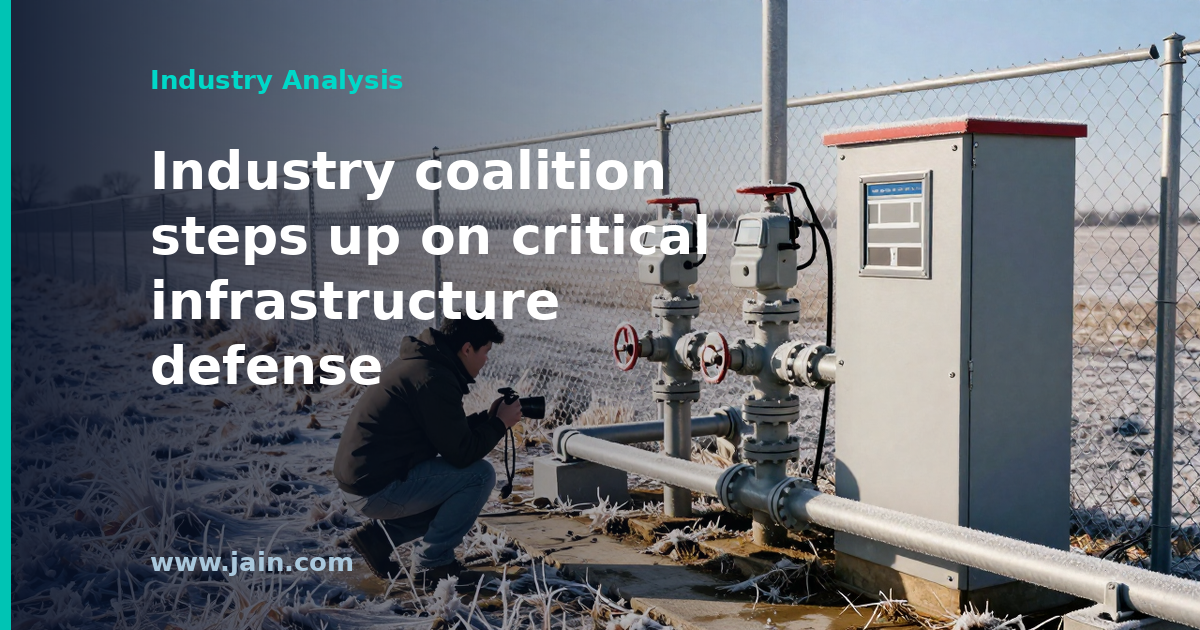
  • Industry Coalition Aims to Lead US Critical Infrastructure Cyber Defense

    Industry Coalition Aims to Lead US Critical Infrastructure Cyber Defense

    A newly formed cybersecurity industry coalition has said it intends to take a leading role in protecting United States critical infrastructure — the power grids, pipelines, water systems, telecommunications networks and data centers that other services depend on. The formation was reported on 11 May 2026 by Cybersecurity Dive.

    The coverage available to us is headline-level: it establishes that the coalition exists and states its ambition, but the membership roster, funding model, governance structure and operating timeline are not detailed in the material we can verify. This article analyzes the structural question the announcement raises — what an industry-led body can and cannot do for national cyber defense — and sets out the specifics that remain open.

    Executive Summary

    The announcement is best understood as a positioning move in a shifting division of labor. For roughly a decade, US critical infrastructure cyber defense has been organized around a federal hub — the Cybersecurity and Infrastructure Security Agency (CISA) — surrounded by sector-specific industry groups. Through 2025 and into 2026, CISA absorbed widely reported workforce reductions and proposed budget cuts, while the statutory liability protections that encouraged companies to share threat data with the government lapsed in late 2025 and became the subject of ongoing legislative debate. A vacuum, real or anticipated, invites someone to fill it.

    Why it matters for infrastructure operators: cyber defense at national scale is fundamentally a coordination problem, not a product problem. Attacks on one utility or carrier are previews of attacks on the next, and the value of any defensive body lies almost entirely in how fast and how completely warning travels between competitors. Whoever convenes that exchange sets the terms — what gets shared, with whom, under what legal cover, and at what price.

    What is not yet established: the coalition’s claim to leadership is, at this stage, a stated intention rather than a demonstrated capability. Nothing in the available reporting confirms who has joined, what the group will fund, or how it will relate to the federal agencies and existing sector bodies already occupying this space. Those are the tests worth applying, and they are answerable within months.

    Why Industry Is Volunteering for a Job It Once Resisted

    For most of the past decade, the private sector’s posture toward critical infrastructure cybersecurity policy was defensive: resist mandates, negotiate reporting rules, worry aloud about liability. A coalition announcing that it intends to lead is a notable inversion. The plainest explanation is not altruism but exposure. Roughly the great majority of US critical infrastructure is privately owned and operated, which means the operators absorb the losses — outage costs, ransom payments, regulatory penalties, insurance repricing — regardless of who holds the coordinating role in Washington.

    If federal coordinating capacity contracts, the risk does not disperse; it lands on balance sheets. Under those conditions, funding a shared defensive apparatus becomes a rational cost, in the same way that competing airlines jointly fund safety data programs because a crash at one carrier damages all of them. The economics here are the economics of a public good that private parties have decided to buy for themselves.

    The counter-reading deserves equal weight. Industry coalitions are also lobbying vehicles, and a group that positions itself as the operational leader of critical infrastructure defense acquires substantial influence over the regulation of its own members — including which standards become de facto requirements and which incidents are deemed reportable. Neither reading is disprovable from a formation announcement. Both should be held open until the governance documents appear.

    What a Coalition Can Do — and What Only Governments Can

    A well-run private body can do a great deal. It can pool threat intelligence faster than any agency clears it; it can run joint exercises, publish detection signatures, fund shared tooling for smaller utilities that cannot afford their own security teams, and set procurement standards that vendors must meet to sell into the sector. These are genuine capabilities, and where they already exist — in the sector-based Information Sharing and Analysis Centers, or ISACs, and in cross-vendor groups like the Cyber Threat Alliance — they have measurable value.

    What no coalition can do is exercise state power. It cannot compel a reluctant operator to patch, cannot seize infrastructure used by an adversary, cannot see foreign signals intelligence, cannot indict anyone, and cannot grant legal immunity to a company that hands over customer-adjacent telemetry. That last point is not a technicality. The 2015 information-sharing framework worked largely because it told general counsels that sharing indicators would not create antitrust or privacy liability. With that protection lapsed and its restoration unresolved, a private coalition asking members to share aggressively is asking them to accept legal risk that only Congress can remove.

    The realistic model, then, is complementary rather than substitutive. Industry can carry operational tempo — the fast, technical, day-to-day work of spotting and blocking. Government retains the coercive and intelligence functions. The failure mode to watch for is a coalition that markets itself as a replacement for federal capacity, because that framing tends to reduce political pressure to fund the functions industry structurally cannot perform.

    Winners, Losers, and Who Pays for Coordination

    If the coalition matures, the clearest beneficiaries are large operators with mature security programs. They already generate high-quality telemetry, they can absorb membership costs, and they gain influence over standards they were going to meet anyway. Hyperscale cloud providers and major data center and network operators sit in a particularly strong position: they see enormous volumes of attack traffic, which makes them the most valuable contributors and therefore the most powerful voices at the table.

    The parties at risk of being left out are the ones the country most needs covered — small municipal water systems, rural electric cooperatives, regional hospitals, mid-sized carriers. These organizations often run legacy operational technology, employ few or no dedicated security staff, and cannot pay meaningful dues. Any coalition serious about critical infrastructure rather than large enterprise defense has to answer how those operators are subsidized. A pricing model that tracks ability to pay is a strong signal of seriousness; a flat corporate membership fee is a signal that the group’s practical scope is narrower than its name.

    There is also a vendor question worth watching without prejudging it. Security suppliers have a legitimate operational role in any such body — they hold much of the visibility — and also a commercial interest in defining the standards their products satisfy. Governance that separates threat-sharing operations from standards-setting, with disclosed member lists and recusal rules, is the ordinary remedy. Its presence or absence will be visible in the founding documents.

    The Evidence Test to Apply Over the Next Two Quarters

    Announcements of this kind are cheap; sustained coordination is expensive. Four observable markers separate the two. First, a published member list with named operators from more than one sector — a coalition drawn from a single industry is a trade association with a broader title. Second, a funded budget and paid technical staff, rather than a volunteer steering committee. Third, a concrete first deliverable with a date: a joint exercise, a shared detection feed, a subsidized tooling program for small utilities.

    Fourth, and most diagnostic, an explicit statement of how the group relates to CISA, to the sector coordinating councils, and to the existing ISACs. Critical infrastructure defense is not an empty field; it is a crowded one with a decade of institutional plumbing. A new body that names its interfaces is doing engineering. A new body that does not is, for now, doing communications.

    None of this is a reason for skepticism about the underlying need. The threat picture that plausibly motivated the coalition — persistent adversary pre-positioning inside operational technology networks, ransomware against hospitals and municipalities, the exposure of long software supply chains — is well documented and does not depend on this announcement being substantive. The question is narrower and fairer: whether this particular vehicle is built to carry that weight.

    Background

    US critical infrastructure cyber defense has been organized since the mid-2010s around a public-private model: a federal coordinating hub, formalized as CISA in 2018, working alongside sector coordinating councils and the Information Sharing and Analysis Centers that circulate threat data within industries. The Cybersecurity Information Sharing Act of 2015 supplied the legal foundation, giving companies liability protection for passing indicators of compromise to the government and to each other. In 2021, CISA added the Joint Cyber Defense Collaborative to bring major technology and security firms into planning alongside federal agencies.

    That arrangement has come under strain. CISA sustained widely reported staffing reductions and proposed budget cuts through 2025 and into 2026, while the 2015 law’s information-sharing protections lapsed in late 2025 with restoration still contested in Congress. At the same time, publicly documented threats to operational technology networks — the industrial control systems that run grids, pipelines and water treatment — have grown more persistent. Roughly the great majority of the affected assets are privately held, meaning the operators carry the financial consequences regardless of how federal capacity evolves. That combination is the setting into which this coalition has announced itself.

    Source: New cybersecurity industry coalition aims to lead US critical infrastructure protection — Cybersecurity Dive, 11 May 2026, reporting the formation of an industry group intending to take a leading role in US critical infrastructure cyber defense.

  • Canvas Breach Underscores Why Student Data Is Now a Prime Cybercrime Target

    Canvas Breach Underscores Why Student Data Is Now a Prime Cybercrime Target

    Nextgov/FCW reported on May 10, 2026 that a breach involving Instructure’s Canvas — one of the most widely used learning management systems in North American education — has put a spotlight on cybercriminals’ growing appetite for student data. Canvas serves millions of students, instructors, and administrators across K-12 districts and higher education.

    The report frames the incident less as an isolated event and more as confirmation of a trend: education platforms, which concentrate personal records for entire student populations, have moved up the target list for data-motivated attackers.

    Executive Summary

    A breach touching Canvas matters because of concentration. A learning management system, or LMS — the software hub where courses, assignments, grades, and communications live — aggregates identity and academic records for every enrolled student at a subscribing institution. Compromise the platform, or credentials that reach into it, and an attacker can harvest data at the scale of whole districts and universities rather than one school at a time.

    The Nextgov/FCW framing — that the incident “spotlights cybercriminal appetite for student data” — matches a pattern the education sector has lived through repeatedly: attackers increasingly go after the shared vendors and platforms that sit beneath thousands of institutions, because one intrusion yields many victims. The available reporting establishes the theme clearly; what it does not yet establish, at least in the source material we reviewed, are the specifics — how many records, which institutions, what attack vector, and what the attackers have done with the data. Those details will determine how serious this particular incident proves to be.

    For institutional buyers of edtech and the infrastructure providers who host it, the practical takeaway does not depend on those specifics: student data now carries real black-market value, and the platforms holding it need to be defended — and contractually governed — like the high-value targets they have become.

    Why Student Data Became Valuable Loot

    Student records are unusually durable assets for criminals. A minor’s identity — name, date of birth, and in many systems a government ID number — typically has no credit history attached and no adult monitoring it, which means fraud built on it can run for years before anyone notices. Academic records also bundle contact details, family information, and sometimes health or disability accommodations, all useful for phishing, extortion, and identity fraud. Unlike a stolen credit card, which can be cancelled in minutes, a child’s identity cannot be reissued.

    That economic logic explains the trend the Nextgov/FCW headline captures. Attackers follow value density, and education platforms are dense: a single LMS tenant can hold records for tens of thousands of students. The sector has also historically underspent on security relative to finance or healthcare, making it a comparatively soft target with comparatively rich payoff.

    The Platform Concentration Problem

    Modern education runs on a handful of shared platforms — learning management systems, student information systems, and assessment tools — each serving thousands of institutions from common infrastructure. That consolidation delivers real benefits: schools get professionally operated software they could never build themselves. But it also creates single points of failure. The education sector saw this dynamic in the PowerSchool incident disclosed in early 2025, which affected school districts across North America through one vendor compromise, and in the 2023 MOVEit file-transfer campaign that swept up many universities. A Canvas-related breach fits the same structural pattern: the vendor layer is now where education’s biggest cyber risk concentrates.

    For Instructure, which was taken private by KKR in 2024 in a deal valued at roughly $4.8 billion, the incident arrives at a moment when trust is the product. An LMS is sticky infrastructure — institutions rarely switch — but procurement teams increasingly weigh security posture, breach history, and contractual liability terms alongside features and price. How transparently and quickly a vendor handles an incident tends to matter more to its long-term standing than the incident itself.

    What Institutions Must Actually Do

    The uncomfortable reality for schools and universities is that they cannot outsource accountability along with operations. Regulators and families will look to the institution, not just the vendor, when student data leaks. That argues for a concrete checklist: enforce multi-factor authentication and single sign-on for every LMS account, including integrations and service accounts; minimize what data the platform holds in the first place — an LMS rarely needs government ID numbers; audit third-party plugins and API tokens, which are a common quiet path into platform data; and negotiate breach-notification timelines and audit rights into vendor contracts before an incident, not after.

    Institutions should also rehearse the response: knowing within hours which student populations are affected, and communicating plainly to families, is the difference between a managed incident and a trust crisis. In the United States, FERPA — the federal law governing education records — sets baseline privacy duties, but state breach-notification laws and, increasingly, attorney-general scrutiny are where the real enforcement pressure now comes from.

    The Infrastructure Angle

    For the hosting and connectivity industry, education’s threat profile is converging with healthcare’s: sensitive personal data, thin security staffing, and heavy reliance on cloud vendors. That creates demand for managed security services, segmented hosting architectures, and logging and detection capabilities sized for institutions that cannot staff a 24/7 security operations center themselves. It also raises the bar for any provider hosting edtech workloads — expect customers to ask harder questions about tenant isolation, encryption-at-rest, and incident-response commitments than they did even two years ago.

    Background

    Instructure launched Canvas in 2011 as a cloud-native challenger to older learning management systems and grew it into a market leader across U.S. higher education and a major force in K-12. The company has passed through several ownership structures — an IPO, a 2020 take-private by Thoma Bravo, a return to public markets, and a roughly $4.8 billion acquisition by KKR completed in 2024 — reflecting how central, and how valuable, education software platforms have become.

    The breach lands amid a sustained rise in attacks on the education sector, where shared vendors concentrate data for thousands of institutions that individually maintain thin security teams. Incidents such as the PowerSchool compromise disclosed in early 2025 and the 2023 MOVEit campaign against universities established the pattern this report extends: attackers target the platform layer, and student data is the prize.

    Source: Canvas breach spotlights cybercriminal appetite for student data — Nextgov/FCW reporting, May 10, 2026, on a breach involving Instructure’s Canvas learning platform and the rising targeting of student data.

  • Anthropic’s Mythos and the AI Cyberthreat Debate: What Changed for Defenders?

    Anthropic’s Mythos and the AI Cyberthreat Debate: What Changed for Defenders?

    CNBC reported on May 9, 2026 that the arrival of Anthropic’s Mythos — the restricted-access tier of its new Claude 5 model family, offered to approved organizations without the dual-use safety measures applied to the generally available Claude Fable 5 — triggered what the outlet characterized as a cybersecurity “hysteria.” Security experts quoted in the report pushed back on the alarm, arguing that AI-assisted cyberthreats did not begin with this release: the capabilities driving concern were, in their view, already present in the threat landscape.

    Executive Summary

    The story here is less a product announcement than a collision of narratives. Anthropic’s two-tier release — Fable 5 for general availability with additional safeguards on dual-use capabilities, and Mythos 5, the same underlying model without those measures, restricted to approved organizations — was designed as a controlled way to ship frontier capability. Instead, the existence of a “less-safeguarded” tier became a lightning rod for fears that powerful AI is about to supercharge cybercrime.

    The experts CNBC spoke with offered a corrective that matters for anyone running infrastructure: attackers were already using AI — and plenty of non-AI tooling — before Mythos existed, and the defensive to-do list has not fundamentally changed. That framing does not make frontier models irrelevant to security; it relocates the question from “is a new superweapon loose?” to “how fast is attacker productivity improving, and are defenses keeping pace?” That second question is the one that determines budgets, architectures, and outcomes.

    What Mythos Actually Is — and Isn’t

    Mythos is not a separate, more dangerous model in the sense the alarmed coverage implied. By Anthropic’s own description, Claude Fable 5 and Claude Mythos 5 share the same underlying model; the difference is that Fable 5 ships to everyone with additional safety measures around dual-use capabilities — abilities useful to both defenders and attackers, such as vulnerability analysis — while Mythos 5 is available without those measures only to organizations Anthropic approves. In plain terms: the capability exists either way, and the question is who gets the unfiltered version.

    That structure is genuinely novel as policy. Rather than a binary choice between “release everything” and “withhold everything,” it treats model access like other controlled dual-use technology — think export-controlled security tooling — where vetting substitutes for blanket restriction. Whether that gating works depends entirely on details the public record doesn’t yet show: who qualifies, how vetting is done, and what prevents leakage from approved organizations.

    The ‘Already Here’ Argument

    The experts’ core claim — that the threat predates Mythos — rests on an uncomfortable truth about the current landscape. Attackers have had access to capable AI for years: earlier frontier models with imperfect safeguards, jailbreak techniques that bypass those safeguards, and open-weight models that ship with no enforcement mechanism at all. Phishing lures, reconnaissance, and malware development assistance did not need a 2026-vintage model to become practical.

    If that’s right, Mythos represents an increment on an existing curve, not a discontinuity. The practical consequence is that panic pegged to a single product launch misallocates attention. The steady, compounding improvement in attacker productivity — faster recon, more convincing social engineering at scale, quicker exploit development — was underway before this release and will continue regardless of how any one vendor gates access. Defenders planning around a single “AI threat event” are planning around the wrong shape of problem.

    What Defenders Should Actually Do

    For enterprises and infrastructure operators, the actionable takeaway is unglamorous: the controls that blunt AI-accelerated attacks are the same ones that blunt conventional attacks, executed with less tolerance for lag. Phishing-resistant authentication matters more when lures are machine-written and flawless. Patch velocity matters more when the window between disclosure and exploitation is shrinking. Segmentation and monitoring matter more when intrusions move faster once inside.

    There is also a genuine defensive upside in the same technology. The dual-use capabilities that raise concern — code analysis, vulnerability discovery — are precisely what security teams can use for triage, log analysis, and finding their own bugs before adversaries do. A tiered-access model like Mythos is, at least in intent, a mechanism for putting the strongest version of those capabilities in defenders’ hands specifically. Data center and network operators, who sit in the blast radius of any large-scale attack campaign, should evaluate that opportunity as seriously as they weigh the risk.

    The Hysteria Question — Interrogating Both Narratives

    CNBC’s framing invites scrutiny in both directions, and it deserves it. The alarm narrative should be pressed for evidence: are there documented incidents attributable to Mythos-class capability, or is the fear anticipatory? Anticipatory concern is legitimate — waiting for confirmed harm before acting is poor risk management — but it should be labeled as such, and it is worth asking who benefits from amplifying it, since a heightened threat narrative serves security vendors’ marketing as readily as it serves genuine caution.

    The reassurance narrative deserves the same treatment. “The threat was already here” can be true and still understate the marginal impact of stronger models; incumbents in the security industry have their own interest in framing AI risk as familiar territory their existing products already cover. And Anthropic’s own gating decision is an implicit acknowledgment that unrestricted access carries risk worth managing. The even-handed reading of the available material: the release changed the access-control landscape more than the threat landscape, and both the panic and the shrug are only partially supported by what has been publicly demonstrated.

    Background

    Anthropic, founded in 2021 by former OpenAI researchers, built its identity around AI safety while shipping successively more capable Claude models — a tension every frontier lab faces as models gain skills useful to attackers and defenders alike. With the Claude 5 family, the company formalized a new answer: split the release into Fable 5, generally available with added safeguards on dual-use capabilities, and Mythos 5, the same model without those measures, restricted to approved organizations. The cybersecurity community has meanwhile debated AI-enabled threats since at least the arrival of capable chatbots in 2022–2023, with each model generation reigniting the argument over whether AI meaningfully changes the offense-defense balance or merely speeds up familiar attacks.

    Source: Anthropic’s Mythos set off a cybersecurity ‘hysteria.’ Experts say the threat was already here — CNBC report (May 9, 2026, via Google News) on the security community’s reaction to Anthropic’s restricted Mythos model tier.

  • Canvas Breached Again: Ed-Tech’s Single Point of Failure

    Canvas Breached Again: Ed-Tech’s Single Point of Failure

    K-12 Dive reported on 9 May 2026 that a second data breach involving Canvas, the learning management system used across K-12 districts and higher education, is causing major disruptions for schools and colleges. The report follows an earlier Canvas-related breach, making this the second such incident in short order.

    The available coverage establishes the fact of a repeat incident and the resulting disruption to institutions. It does not, in the material reviewed here, specify the attack method, the volume or categories of data involved, the number of affected institutions, or whether the two incidents share a root cause.

    Executive Summary

    A learning management system, or LMS, is the software backbone of a modern course: it holds rosters, assignments, submissions, gradebooks and exam delivery. Canvas is one of the most widely deployed LMS platforms in American education, built by Instructure and used by districts and universities as the system of record for coursework. When it degrades, teaching does not simply slow down — it stops, because there is usually no parallel system holding the same data.

    The newsworthy element is not that an education platform was breached. It is that this is the second breach reported in short order. A first incident tests whether an organization can respond. A second tests whether the response worked. Repeat compromises typically point to one of a small set of conditions: credentials or session tokens that were never fully rotated, an intruder who retained access after eviction, an unpatched or unreviewed component in the same class as the first, or a downstream partner that was never brought into scope. Each of those is a remediation question, and each is answerable — but only by the party holding the forensic detail.

    Timing sharpens the operational impact. Early May falls squarely in the end-of-term assessment window for most US schools and colleges, when the LMS carries final submissions, proctored exams and grade calculation. Disruption in that window is not an inconvenience; it is an academic-continuity event with knock-on effects for transcripts, financial aid certification and graduation deadlines. For infrastructure and security buyers outside education, the case is a clean illustration of concentration risk in a single-tenant-of-record SaaS dependency.

    The Second Incident, Not the First, Is the Story

    Security teams judge an incident less by the initial intrusion than by what follows it. Every organization of scale will eventually be breached; what distinguishes a mature program is that the same door does not open twice. A second reported compromise in a short interval shifts the analytical question from “were they targeted?” to “did the fix hold?” That is a fair question to put to any vendor, and it is the one this report raises whether or not the two events prove to be related.

    Fairness cuts in the other direction too. A second breach is not, by itself, proof that remediation failed. Several benign-to-neutral explanations exist and are common in practice: a second disclosure can describe newly discovered scope from the same original intrusion, a different and unrelated vector, or an incident at a downstream integration partner rather than the core platform. Attackers also cluster around a victim once tooling and reconnaissance already exist, which produces repeat activity without implying negligence. Distinguishing among these requires forensic timeline data that the available reporting does not provide.

    What the incident does justify is a specific evidentiary demand rather than a verdict. Institutions are entitled to ask whether the two events share an initial access vector, whether all credentials, API keys and OAuth tokens — the long-lived digital passes that let one system act on a user’s behalf in another — were rotated after the first event, and whether an independent party validated the remediation. Those questions criticize a claim of containment, not a company. If the answers are strong, they should be easy to publish.

    When the LMS Goes Down, the Institution Goes Down

    Education has spent fifteen years consolidating what were once dozens of departmental systems into a single platform that authenticates users, stores coursework and computes grades. The efficiency case for that was real: one integration surface, one support contract, one identity model. The consequence is that the LMS has become what infrastructure engineers call a single point of failure — a component whose loss has no fallback path. Districts and universities generally cannot run a shadow gradebook, and faculty rarely retain complete offline copies of student submissions.

    The blast radius extends beyond the platform itself. An LMS typically sits behind single sign-on and connects outward to the student information system, proctoring tools, publisher content, plagiarism detection and analytics. Compromise of the identity layer or of the tokens linking those systems can propagate to services the institution never considered part of the incident. This is why security teams increasingly treat integration inventories, not just vendor lists, as the unit of risk assessment.

    The cost of disruption during finals is also asymmetric. A three-day outage in September is absorbed by rescheduling. The same outage in the second week of May collides with immovable deadlines: grade submission, degree conferral, athletic eligibility, visa compliance for international students and aid disbursement. Institutions that had documented manual fallbacks — paper exams, local submission channels, an offline grade export cadence — will have absorbed this far better than those that did not, and that gap is a planning choice more than a budget one.

    The Economics That Made Concentration Rational

    Education technology consolidated for structural reasons that will not reverse because of one incident. K-12 districts and mid-sized colleges typically run small IT teams with limited security staffing, and a single well-resourced vendor genuinely offers better baseline security than a dozen self-hosted alternatives. Switching an LMS is a multi-year project involving content migration, faculty retraining and integration rebuilds, which produces high switching costs and, in turn, a concentrated market with a handful of serious players. That concentration is the product of rational procurement, not of anyone’s bad faith.

    Where the economics distort is in accountability. Contractual remedies in ed-tech agreements are often capped at a fraction of annual fees, while the institution absorbs the breach-notification costs, credit monitoring, legal exposure under state student-privacy statutes and the operational cost of a lost assessment window. When the party best positioned to prevent an incident bears a small share of its cost, the market underinvests in resilience. Repeat incidents are precisely the trigger that moves that imbalance from an abstract governance point onto the negotiating table.

    The likely winners from an episode like this are the adjacent categories rather than rival LMS vendors: identity and access management, SaaS security posture management, third-party risk platforms, and cyber insurers repricing education portfolios. The likely losers are institutions in the middle of a renewal cycle with no leverage and no migration budget, and smaller ed-tech integrators whose customers now demand security attestations they are not staffed to produce.

    What Institutions Can Change Before the Next Term

    The practical response is not a migration; for most institutions that is neither affordable nor faster than the threat. It is reducing dependency at the margins. A scheduled export of gradebook and roster data to institution-controlled storage converts a total outage into a degraded-service event. Documented manual assessment procedures, rehearsed once before the term rather than improvised during it, preserve the academic calendar. Both are low-cost and within the authority of a registrar and a CIO acting together.

    On the security side, the highest-yield work is at the identity boundary the institution controls. That means enforcing phishing-resistant multi-factor authentication for administrator accounts, inventorying and shortening the lifetime of API tokens granted to third-party integrations, restricting administrative access by network and role, and monitoring for bulk data access patterns rather than only for login anomalies. None of this prevents a vendor-side compromise, but all of it limits how far one travels.

    Procurement is the slower lever with the larger effect. Renewals are the moment to require contractual breach-notification windows measured in hours, the right to receive post-incident reports and independent remediation validation, data-minimization commitments that keep sensitive fields out of the platform entirely, and exit assistance terms that make migration a credible threat. Buyers in other sectors negotiated these terms years ago; education has generally not, and a second incident is a reasonable occasion to start.

    Background

    Canvas is one of the most widely used learning management systems in American education, built by Instructure and adopted broadly across K-12 districts and colleges over the past decade. Its growth reflected a sector-wide consolidation: institutions replaced fragmented departmental tools with a single platform that handles authentication, coursework, assessment and grading, and that integrates outward to student information systems, proctoring services, publisher content and analytics.

    Education has become a persistent target for attackers because it combines rich personal data on minors and young adults with constrained security budgets and long vendor dependency chains. Large incidents at education platforms in recent years have shown that a single supplier compromise can propagate across thousands of districts simultaneously — the structural reason a breach at one vendor becomes national news rather than a local IT problem.

    Source: 2nd Canvas data breach causes major disruptions for schools, colleges – K-12 Dive — K-12 Dive reports that a second Canvas data breach has disrupted schools and colleges, published 9 May 2026.

  • OpenAI’s GPT-5.5-Cyber: Trusted Access Becomes a Template for Dual-Use AI Security

    OpenAI’s GPT-5.5-Cyber: Trusted Access Becomes a Template for Dual-Use AI Security

    On May 8, 2026, OpenAI announced GPT-5.5 and a cyber-specialized variant, GPT-5.5-Cyber, under the banner of “scaling trusted access for cyber.” The framing signals two moves at once: a frontier model tuned for cybersecurity work, and a distribution model that gates the most sensitive capabilities behind some form of vetting rather than open availability.

    The announcement positions OpenAI in the growing market for AI-assisted security operations — and squarely in the middle of the industry’s hardest dual-use question: how to put offensive-grade security capability in defenders’ hands without simultaneously arming attackers.

    Executive Summary

    The core of the announcement, as titled, is a pairing: GPT-5.5 as a general frontier model, and GPT-5.5-Cyber as a specialization aimed at cybersecurity tasks, with access to the cyber variant “scaled” through a trusted-access program rather than released uniformly to all customers. In plain terms, trusted access means the vendor decides who qualifies to use the most capable version — typically security teams, researchers, and organizations that pass some screening — instead of shipping the same capability to every API key.

    Why it matters: cybersecurity is the clearest dual-use domain in AI. The same model that triages vulnerabilities, writes detection rules, or reverse-engineers malware for a defender can, in principle, accelerate the same work for an attacker. Until now, frontier labs have mostly handled this with blanket refusals or usage policies. A named, productized trusted-access tier is a different approach — it treats capability gating as a distribution and go-to-market design, not just a safety filter.

    If the model works commercially, it sets a template competitors are likely to follow: specialized high-capability variants for sensitive domains, sold through vetted channels. That has real implications for who gets access to top-tier AI security tooling — and who is left using general-purpose models.

    The Dual-Use Problem Finally Gets a Product Answer

    Security capability in AI models is inherently symmetric. Finding a vulnerability is the same cognitive task whether you intend to patch it or exploit it; writing a proof-of-concept exploit is standard practice for legitimate penetration testers and a weapon in other hands. Frontier labs have struggled with this symmetry: refuse too much and the model is useless to the defenders who need it most, refuse too little and the vendor becomes an accelerant for attackers.

    Trusted-access gating is the middle path, and it is not a new idea in security — it mirrors how the industry already handles exploit databases, commercial penetration-testing frameworks, and vulnerability disclosure programs, where capability is real but access is credentialed. What is notable is a major AI lab formalizing that structure around a named model variant. The announcement’s title alone — “scaling” trusted access — suggests OpenAI believes it has a vetting process that can grow beyond a small pilot, which has historically been the hard part.

    Gated Distribution as Business Model

    There is a commercial logic here beyond safety. A gated, specialized model is naturally an enterprise product: it sells to security operations centers, managed security providers, incident-response firms, and government-adjacent buyers who can pass vetting and pay for differentiated capability. That segments the market — the general model for everyone, the cyber variant at presumably enterprise terms for qualified buyers — and it creates a moat that pure model quality does not, because the vetting infrastructure, compliance posture, and trust relationships are themselves hard to replicate.

    The likely winners are larger security organizations that clear the bar and gain leverage over stretched analyst teams. The losers, at least relatively, are independent researchers, small consultancies, and defenders in less-resourced regions, for whom vetting processes tend to be slower and costlier. Access criteria therefore become a competitive and even an equity question: security research has long depended on independent researchers, and a world where top-tier tooling requires institutional credentials changes who can do that work.

    A Template Others Were Already Converging On

    OpenAI is not moving in a vacuum. Frontier labs broadly have published preparedness or responsible-scaling frameworks that treat cyber capability as a tracked risk category, and the industry has been inching toward tiered access for sensitive capabilities. A shipped product with trusted-access gating turns that abstract governance conversation into a concrete precedent — one that regulators, enterprise buyers, and competing labs will now reference. Expect procurement teams to start asking every AI vendor a version of the same question: what do you gate, and how do you decide who gets in?

    For the infrastructure side of the industry — data centers, network operators, cloud and hosting providers — the practical takeaway is nearer-term: AI-assisted attacks and AI-assisted defense are both professionalizing. Organizations that host and connect critical workloads should assume adversaries will use whatever general-purpose capability remains open, and should evaluate whether gated defensive tooling belongs in their own security stack rather than treating this as a distant lab-policy story.

    Background

    OpenAI, founded in 2015 and best known for ChatGPT and the GPT model line, has moved steadily from general-purpose chat assistants toward specialized, enterprise-oriented offerings. Its GPT-5 generation, introduced in 2025, anchored a period in which frontier labs increasingly segmented models by capability tier and use case, while publishing risk frameworks that single out cyber capability as a category requiring special handling.

    The surrounding market has been converging on the same question from two directions: security vendors racing to embed AI copilots into detection and response products, and AI labs deciding how much raw security capability to expose and to whom. A formal trusted-access program for a cyber-specialized frontier model sits at the intersection of those two races — part product launch, part governance experiment.

    Source: Scaling Trusted Access for Cyber with GPT-5.5 and GPT-5.5-Cyber — OpenAI’s May 8, 2026 announcement of GPT-5.5 and a gated, cybersecurity-specialized model variant.

  • AI-Assisted Intrusion Attempt on a Mexican Water Utility Marks a New Escalation

    AI-Assisted Intrusion Attempt on a Mexican Water Utility Marks a New Escalation

    Cybersecurity Dive reported on May 7, 2026 that Anthropic’s Claude — one of the most widely used commercial AI models — was used in an attempted compromise of a water utility in Mexico. The report describes an attempted intrusion rather than a confirmed breach, but it places a name-brand AI assistant at the center of an attack on critical infrastructure: the systems that treat and deliver drinking water.

    Few operational details were available at publication — the utility was not named, the attacker was not identified, and the specific role Claude played in the operation was not spelled out in the material available to us.

    Executive Summary

    The reported incident matters less for what happened — an attempt, apparently unsuccessful — than for what it represents. Security researchers have warned for several years that general-purpose AI models would lower the barrier to entry for cyberattacks by helping less-skilled actors with reconnaissance, phishing, and malicious code. A reported attempt against a water utility moves that concern from the abstract to a sector where failure has physical, public-health consequences.

    It also continues a pattern in which AI developers themselves surface the misuse. Anthropic has previously published threat intelligence describing attackers abusing its models, including AI-assisted intrusion campaigns disclosed in 2025. When the tool being misused is a commercial product with usage monitoring, the vendor becomes an unusual new node in the detection chain — one that traditional network defenders never had.

    For infrastructure operators, the practical takeaway is not that AI created a new class of vulnerability, but that it compresses the time and skill needed to exploit the old ones. Water utilities — often small, thinly staffed, and running legacy control systems — are precisely where that compression bites hardest.

    Why Water Utilities Are the Soft Underbelly of Critical Infrastructure

    Water and wastewater systems are among the most fragmented critical-infrastructure sectors anywhere in the world: thousands of operators, many serving small populations on municipal budgets, with cybersecurity often handled part-time or not at all. Their industrial control systems — the SCADA and PLC equipment that opens valves, doses chemicals, and runs pumps (collectively called operational technology, or OT) — were frequently designed decades ago with no assumption of internet exposure. Recent years have brought intrusions at U.S. water authorities and repeated government advisories urging the sector to harden remote access and segment control networks.

    An attempt against a Mexican utility fits that global pattern rather than breaking it. Attackers, whether criminal or state-aligned, probe where defenses are thinnest, and water systems combine high public impact with comparatively low security maturity. The nationality of the target matters less than the target class: if AI-assisted tooling is being pointed at water systems anywhere, operators everywhere should assume they are in scope.

    What “AI-Assisted” Actually Changes for Attackers

    It is worth being precise about what an AI model can and cannot contribute to an intrusion. Models like Claude do not conjure novel exploits out of nothing, and vendors build safeguards intended to refuse plainly malicious requests. What AI demonstrably does is accelerate the unglamorous majority of attack work: researching a target organization, drafting convincing phishing lures, writing and debugging scripts, and triaging technical information at a speed a lone operator could not match. Anthropic’s own prior threat reporting, along with disclosures from other AI vendors, has described attackers using models in exactly these supporting roles — and, in the most serious 2025 disclosures, orchestrating substantial portions of intrusion campaigns with agentic AI tooling.

    The economic effect is a lower skill floor and a higher operational tempo. Attacks that once required a competent team can increasingly be attempted by fewer, less-skilled people. For defenders, that shifts the threat model: the question is no longer whether a sophisticated adversary might target a small utility, but how many unsophisticated ones now can. The reported incident, notably, was an attempt — a reminder that AI assistance does not guarantee success, and that basic controls still decide outcomes.

    The AI Vendor’s Dilemma: Dual-Use Tools and Public Disclosure

    This story also illustrates an emerging norm in which the AI company is both the abused platform and, frequently, the reporting party. A commercial model with centralized usage monitoring gives its vendor visibility that no firewall vendor or ISP has: the attacker’s actual working process. That visibility carries obligations — to detect misuse, disrupt it, and disclose it — and headlines like this one are the cost of transparency. A vendor that publicizes abuse of its own product accepts reputational risk that a silent competitor avoids, which is why disclosure practices deserve encouragement rather than punishment by headline.

    The available reporting does not specify who detected this attempt or how, and that distinction matters. If the vendor caught it, that validates model-level monitoring as a defensive layer. If the utility or a third party caught it, that says more about conventional defenses holding. Either way, the incident will sharpen debate about what AI companies owe critical-infrastructure operators: proactive victim notification, indicator sharing, and coordination with national cyber authorities are all plausibly on the table.

    What Infrastructure Operators Should Take From This

    None of the defensive fundamentals change because an attacker used AI; they simply become less optional. Segmenting IT networks from OT networks, eliminating direct internet exposure of control equipment, enforcing multi-factor authentication on remote access, and monitoring for anomalous activity remain the controls that turn attempts into non-events. What changes is the assumed frequency and polish of attacks: phishing emails get better, reconnaissance gets faster, and the long tail of small utilities that relied on obscurity loses that protection.

    For the broader infrastructure industry — data centers, network operators, and the vendors who serve utilities — the incident reinforces a commercial reality as much as a technical one: demand for OT security services, managed detection, and secure-by-design control systems is being driven by a threat environment that AI is measurably accelerating.

    Background

    Anthropic, founded in 2021 by former OpenAI researchers, develops the Claude family of AI models and has positioned itself around AI safety — including a practice of publicly disclosing misuse of its own products. In 2025 the company published threat intelligence describing attackers using Claude in intrusion campaigns, part of a broader industry reckoning with the dual-use nature of capable AI systems.

    The water sector, meanwhile, has spent years near the top of critical-infrastructure risk assessments. Thousands of small operators run aging industrial control systems on tight budgets, and governments in the U.S. and elsewhere have issued repeated warnings about intrusions targeting water authorities. The convergence of those two storylines — commodity AI capability and a chronically under-defended sector — is the context in which this reported incident lands.

    Source: Anthropic’s Claude used in attempted compromise of Mexican water utility — Cybersecurity Dive report, May 7, 2026, on an AI-assisted intrusion attempt against a water utility in Mexico.

  • Dragos Warns Frontier AI Models Were Used in a Critical Infrastructure Cyber-Attack

    Dragos Warns Frontier AI Models Were Used in a Critical Infrastructure Cyber-Attack

    Industrial cybersecurity firm Dragos has warned that large language models (LLMs) from OpenAI and Anthropic — the class of AI systems behind ChatGPT and Claude — were used in a cyber-attack against critical infrastructure, according to a report published by Infosecurity Magazine on May 6, 2026. The disclosure places frontier AI tools directly inside an attack on the operational technology (OT) world: the industrial control systems that run power grids, water treatment, pipelines, and manufacturing.

    Executive Summary

    According to the report, Dragos — one of the best-known specialists in securing industrial control systems — says commercial frontier LLMs were used in the course of an attack on critical infrastructure. If borne out in detail, this would be among the first publicly flagged cases tying named frontier-model providers to a real-world intrusion in the OT domain, rather than in ordinary IT networks.

    The significance is less about any single incident and more about the trajectory it confirms: general-purpose AI assistants can compress the time, skill, and cost required to research targets, write malicious tooling, and navigate unfamiliar industrial environments. For operators of data centers, utilities, and connectivity infrastructure, the warning is a signal that AI-assisted adversaries should now be part of baseline threat modeling — while readers should also note that, at headline level, the report leaves the technical specifics of how the models were used unconfirmed.

    AI Lowers the Barrier to Industrial Attacks

    Attacks on operational technology have historically demanded rare expertise: knowledge of protocols like Modbus and DNP3, familiarity with vendor-specific controllers, and patience to map physical processes. That scarcity of skill has been an unofficial defense. LLMs erode it. A capable general-purpose model can explain an unfamiliar protocol, draft scripts, translate documentation, and troubleshoot errors on demand — for an attacker as readily as for an engineer.

    That is why a warning from Dragos specifically matters. The firm’s entire focus is the OT threat landscape, and its naming of frontier models signals that AI-assisted tradecraft has crossed from IT espionage — where AI-enabled campaigns had already been documented by the model providers themselves — into the systems that keep physical infrastructure running.

    What “LLMs Used in an Attack” Can Actually Mean

    The phrase covers a wide spectrum, and the distinction matters enormously. At the mild end, attackers use AI for reconnaissance, phishing text, or code assistance — an efficiency gain, not a new capability. At the severe end, models orchestrate portions of an intrusion with limited human input, a pattern Anthropic itself publicly documented in late 2025 when it disclosed disrupting a state-linked campaign that abused its Claude models for largely automated espionage.

    The headline-level report does not establish where on that spectrum this incident sits, whether provider safeguards were bypassed (for example through jailbreaking or posing as legitimate security testers), or whether the models materially changed the outcome versus merely accelerating it. Readers should hold that uncertainty: “AI was used” is not yet “AI was decisive.” Equally, the involvement of a provider’s model in an attack is not evidence of negligence by that provider — every widely available tool, from scanners to cloud accounts, gets abused.

    The Defender’s Dilemma — and the Vendor Lens

    For infrastructure operators, the practical implications are concrete. AI-assisted attackers iterate faster, so detection and response windows shrink. The fundamentals become more valuable, not less: segmenting OT networks from IT, monitoring industrial protocols for anomalies, controlling remote access, and rehearsing manual-operation fallbacks. Defenders are also adopting AI for log triage and anomaly detection, setting up a genuine capability race on both sides of the wire.

    Fair scrutiny cuts in both directions. Dragos sells OT security products and services, so dramatic warnings align with its commercial interests — a reason to ask for technical specifics, not a reason to dismiss the claim. The firm has a long track record of credible, evidence-based industrial threat reporting, and the warning is consistent with disclosures the AI providers themselves have made about abuse of their models. The right posture is to treat the claim as plausible and important, and to press for the incident details that would let operators act on it.

    Background

    Dragos was founded in 2016 by former U.S. intelligence-community analysts, including CEO Robert M. Lee, and has built its reputation on tracking threat groups that target industrial control systems — publishing widely cited analyses of incidents like the attacks on Ukraine’s power grid. Its warnings carry unusual weight in the OT security community precisely because the firm rarely deals in hypotheticals.

    The AI-abuse backdrop was already forming before this report: through 2024 and 2025, OpenAI and Anthropic each published threat-intelligence reports documenting state-linked and criminal actors misusing their models, and in November 2025 Anthropic disclosed disrupting an espionage campaign in which its Claude models automated substantial portions of intrusion work. The Dragos warning, as reported on May 6, 2026, marks the extension of that trend to the critical-infrastructure domain.

    Source: OpenAI and Anthropic LLMs Used in Critical Infrastructure Cyber-Attack, Warns Dragos — Infosecurity Magazine report on a Dragos warning that frontier AI models were used in an attack on critical infrastructure, May 6, 2026.

  • CISA Urges Critical Infrastructure to ‘Fortify’ Against Cyber-Induced Outages

    CISA Urges Critical Infrastructure to ‘Fortify’ Against Cyber-Induced Outages

    The Cybersecurity and Infrastructure Security Agency (CISA) is urging critical-infrastructure operators to “fortify” their defenses “before it’s too late,” according to a May 4, 2026 report from Cybersecurity Dive. The framing is notable: rather than emphasizing response after an intrusion, the agency is pressing the companies that run power, water, communications, and other essential systems to harden themselves in advance of disruptive attacks.

    Executive Summary

    CISA — the federal agency responsible for helping defend U.S. critical infrastructure — has issued an urgent call for operators to strengthen their cyber defenses proactively. The “before it’s too late” language pairs cybersecurity with a concept infrastructure operators know well from storms and equipment failures: resilience, the ability to keep essential services running when something goes wrong.

    Why it matters: for critical infrastructure, a cyberattack is not just a data problem. Intrusions into the systems that control physical equipment can translate into real-world outages — power interruptions, water-treatment failures, communications blackouts. A warning framed around fortifying in advance signals that the agency views preparation, not post-incident cleanup, as the deciding factor in whether an attack becomes a disruption. The available source is a headline-level report, so the specific guidance, threat intelligence, or events behind the warning are not detailed — a gap we address below.

    Why ‘Fortify’ Signals Pre-Positioning, Not Just Response

    The word choice matters. “Fortify” describes work done before an attack: patching known vulnerabilities, segmenting networks so an intruder in one system cannot reach others, enforcing strong authentication, and rehearsing recovery. That contrasts with incident response, which begins only after a compromise is discovered. For most businesses, a breach means stolen data and remediation costs. For critical infrastructure, the stakes are physical — and restoration of physical systems can take days or weeks, not hours.

    “Before it’s too late” implies the agency believes the window for preparation is closing faster than operators are moving. Whether that urgency stems from specific threat activity or from a general assessment of readiness is not clear from the headline-level source, and readers should hold that distinction in mind. Either way, the direction of the message is unambiguous: waiting to invest until after an incident is the posture CISA is warning against.

    When Cybersecurity Becomes a Grid-Resilience Problem

    Critical infrastructure runs on two intertwined technology layers. Information technology (IT) handles data — email, billing, business systems. Operational technology (OT) controls physical processes — the industrial control systems that open breakers, run pumps, and manage turbines. As these layers have become more connected, an attacker who gets into the IT side has more paths toward the systems that keep the lights on. That is why a cybersecurity warning is, in effect, a grid-resilience warning: the failure mode of a successful attack is an outage.

    This convergence changes how operators must plan. Traditional resilience engineering — redundant equipment, backup power, spare parts — assumes failures are random or weather-driven. A cyber adversary is neither random nor passive; it can target the redundancy itself. Fortifying therefore means both hardening digital entry points and ensuring that manual fallbacks and recovery procedures actually work when automated systems cannot be trusted.

    What Operators and Buyers Should Take From a Headline-Level Warning

    It is worth being candid about the source: what is substantiated is that CISA issued an urgent public call for critical-infrastructure firms to strengthen defenses, as reported by a credible trade outlet. What is not substantiated — because the available text is a headline and summary — is any specific mandate, deadline, named threat, or sector-by-sector guidance. Operators should treat the warning as a prompt to consult CISA’s published guidance directly rather than acting on secondhand characterizations.

    The economics still point in a consistent direction. Demand pressure favors OT-security vendors, network-segmentation and monitoring tools, and consultancies that can assess industrial environments. The burden falls hardest on smaller utilities and municipal operators, whose security budgets are thin relative to the criticality of what they run — a mismatch that federal urgency alone does not fix. For data center and connectivity providers, the warning cuts both ways: they are critical infrastructure themselves, and they are also the platforms on which other operators’ resilience increasingly depends.

    Background

    CISA was established in 2018 to serve as the federal government’s lead civilian agency for cyber and infrastructure security. Because the overwhelming majority of U.S. critical infrastructure is privately owned, the agency works largely through advisories, shared threat intelligence, and voluntary partnerships rather than direct control — which is why the tone and urgency of its public warnings are watched closely as a signal of how the government reads the threat environment.

    Over the past decade, concern has shifted from data theft toward disruptive attacks on the operational systems behind essential services, as ransomware operators and state-linked actors have shown both intent and ability to reach the control networks of physical infrastructure. Warnings that pair cybersecurity with outage prevention reflect that shift: the measure of failure is no longer stolen records but darkened grids.

    Source: CISA urges critical infrastructure firms to ‘fortify’ before it’s too late — Cybersecurity Dive, May 4, 2026, reporting on CISA’s call for critical-infrastructure operators to harden cyber defenses proactively.