IsoEnergy Ltd. (NYSE American: ISOU; TSX: ISO) announced on August 24, 2026 that it has signed an Exploration Agreement with Kineepik Métis Local Inc., which represents Métis rights holders in the Kineepik Use and Occupancy Area, including members and residents of Pinehouse, Saskatchewan.
The agreement establishes a framework for engagement, information sharing and collaboration as IsoEnergy advances uranium exploration in the area, and provides for Kineepik community members and businesses to participate through business, employment and training opportunities. No financial terms, timelines or project-specific commitments were disclosed.
Executive Summary
The announcement is, on its face, a routine milestone in mineral exploration: a formal engagement framework between a uranium explorer and an Indigenous community whose territory overlaps its ground. IsoEnergy CEO Philip Williams described it as formalizing a long-standing relationship, while Kineepik President Mike Natomagan called it a milestone that ensures the community stays informed, has a voice in exploration, and sees exploration in its territory done responsibly.
It matters to infrastructure readers for a less obvious reason. The conversation about powering AI data centers increasingly runs through nuclear energy — and nuclear energy runs on uranium. Every reactor that utilities and hyperscalers hope will carry future compute load depends on a fuel supply chain that begins with exploration drills in places like Saskatchewan’s Athabasca Basin, the district IsoEnergy is exploring. Agreements like this one are how that upstream work earns the social license — the community acceptance a project needs beyond its legal permits — to proceed at all.
The release is thin on specifics: it describes a framework, not quantified commitments. But frameworks of this kind are increasingly standard practice in Canadian uranium country, and they shape whether deposits discovered today can become mines on the timelines the demand side is counting on.
Why a Drill Program in Saskatchewan Touches the Data Center Industry
Nuclear power has moved to the center of the debate about meeting AI-era electricity demand because it offers what data centers prize: large blocks of carbon-free, around-the-clock generation. But reactors are only the visible end of a long chain. Before fuel reaches a plant, uranium must be found, permitted, mined, milled, converted and enriched — a sequence that takes years at each stage. Exploration is the very front of that chain, and Canada’s Athabasca Basin, where IsoEnergy is advancing its Larocque East project, is one of the world’s premier uranium districts. The company says Larocque East hosts the Hurricane deposit, which it describes as the world’s highest-grade indicated uranium mineral resource — a company characterization, but one that signals why this ground attracts attention.
For readers who follow power procurement rather than mining, the takeaway is structural: any long-term bet on nuclear-powered compute is implicitly a bet that the upstream fuel chain scales alongside it. That chain’s pace is governed as much by community agreements, consultation processes and permitting as by geology. This release is a small data point in that larger question.
The Economics of Social License
In Canadian resource development, the duty to consult Indigenous rights holders is a constitutional and practical reality, and companies that treat engagement as a late-stage checkbox routinely face delays, disputes and stalled projects. Exploration agreements like this one are the industry’s answer: negotiated frameworks that define how information flows, how concerns are raised, and how economic benefits — jobs, training, contracts for community-owned businesses — are shared during the exploration phase, before anyone knows whether a mine will ever exist.
The release offers a glimpse of why this model has traction on the community side. Kineepik and the Northern Village of Pinehouse describe reinvesting profits from community-owned businesses into energy-efficient housing, youth infrastructure including a hockey arena, and a 12-unit Elders’ housing facility. That is the partnership thesis in miniature: resource activity as a revenue stream the community directs toward its own priorities. For the company, the value is risk reduction — a documented, mutually agreed process is far cheaper than conflict. Both interests are real, and neither is charity.
What the Agreement Does — and What It Doesn’t Claim
It is worth being precise about the scope here. This is an exploration agreement, not an impact benefit agreement of the kind typically negotiated when a project advances toward construction and mining. The release describes engagement, information sharing, and participation opportunities; it discloses no payments, equity, revenue sharing, employment targets or consent provisions, and it does not say which specific properties in IsoEnergy’s Saskatchewan portfolio it covers. Both parties’ statements are positive but general.
That does not make the announcement empty — formalizing a relationship in writing is a genuine step beyond ad hoc goodwill, and Natomagan’s framing that such agreements ‘give us a voice in exploration’ suggests the community sees substance in it. But investors and observers should read it as the establishment of a process, not the settlement of terms. The harder negotiations, if Hurricane or other targets advance toward development, lie ahead. The company’s own cautionary language acknowledges this, listing ‘aboriginal title and consultation issues’ among its ongoing risk factors.
Background
IsoEnergy is a uranium exploration and development company listed on the NYSE American and TSX, with assets across Canada, the United States and Australia positioned, in its words, to provide leverage to rising uranium prices. Its most advanced Canadian asset is Larocque East in Saskatchewan’s Athabasca Basin, containing the high-grade Hurricane deposit. The company has also been broadening beyond exploration: recent releases on the same wire announce the completed formation of DISA Uranium Corporation with DISA Technologies, described as a technology-enabled U.S. uranium platform for production, processing and remediation.
In Saskatchewan — home to some of the world’s richest uranium deposits — agreements between explorers and Indigenous communities have become an established feature of how projects advance. They reflect both Canada’s legal duty to consult rights holders and a practical recognition that projects proceed faster and more durably with community partnership than without it, a dynamic that grows in importance as renewed interest in nuclear power, including for data center demand, puts a spotlight on future uranium supply.
Corinex announced the launch of the Grid Intelligence Node (GIN) on August 24, 2026, releasing the news simultaneously in English, German, French, and Spanish from Vancouver and Mannheim. GIN is a retrofit device that combines broadband powerline (BPL) communication with three-phase current, voltage, and power-quality measurement at low-voltage feeders — the final segment of the grid that serves homes and small businesses.
Installed in secondary substations, cable distribution cabinets, and branch points, the node delivers 1-minute operational snapshots, 15-minute energy totals, and optional 1-second reporting, and feeds data into Corinex’s Plexigrid Intelligence modeling platform as well as third-party utility systems. The company says GIN is available now for evaluations, pilots, and commercial rollouts; no customers, pricing, or deployment figures were disclosed.
Executive Summary
The announcement addresses a genuine and well-documented problem: distribution utilities have historically had very little real-time visibility into the low-voltage network. Transmission grids are heavily instrumented, but the feeders that actually deliver power to end customers were built for one-way flow and monitored mostly through planning assumptions, delayed smart-meter data, and estimated load profiles. Electrification — electric vehicles, heat pumps, rooftop solar — is now stressing exactly that blind segment, and Corinex’s CTO Sam Shi frames GIN as the tool that shows operators “when, where, and to what extent” intervention is needed.
Corinex’s differentiator is its transport layer: GIN sends measurement and power-quality data over the existing low-voltage wires themselves via broadband powerline communication, so utilities don’t have to build a separate communications network or install certified billing meters at every measurement point. The data can flow into Corinex’s own GridValue management and Plexigrid Intelligence digital-twin software, or into a utility’s existing ADMS and SCADA platforms via MQTT, Ethernet, and Modbus.
What matters strategically is the stack play. Corinex is positioning sensing hardware as the feedstock for grid modeling and optimization software — a “digital twin” is only as good as its input data, as Shi himself notes. The release is credible on technical specifics but silent on commercial ones: there are no named utility customers, no pilot results, no pricing, and no independent validation of the accuracy claims.
Why the Low-Voltage Grid Became the Blind Spot That Matters
For most of the grid’s history, ignorance about low-voltage feeders was affordable. Power flowed one way, loads were predictable, and utilities sized neighborhood transformers with generous margins using statistical load profiles. That model is breaking. EV chargers can double a household’s peak demand, heat pumps shift load into winter evenings, and rooftop solar pushes power backward up feeders that were never designed for reverse flow. Meanwhile, surging electricity demand across the system — including from data-center buildout — is consuming the headroom utilities once relied on, making every megawatt of latent capacity in the existing distribution network more valuable.
The core problem GIN targets is that most utilities cannot see any of this happening in real time. Smart meters report consumption with delays and at billing granularity, not operational granularity. The release’s claim that operators depend on “planning assumptions, delayed meter data, and estimated load profiles” is a fair characterization of the industry status quo, and it explains why low-voltage observability has become a recognized category rather than a niche. A utility that cannot measure a feeder’s actual loading must either over-invest in copper and transformers or accept unknown risk — both expensive answers.
Sending Data Over the Wires You Already Own
Corinex’s architectural bet is broadband powerline: using the electricity cables themselves as the communications medium. The economic logic is straightforward. Instrumenting thousands of secondary substations and cable cabinets normally means paying for cellular contracts or fiber at each site; BPL rides infrastructure the utility already owns. GIN doubles as a BPL repeater with Ethernet connectivity, so each node extends the communications mesh while it measures. For retrofit deployments — which is how virtually all low-voltage monitoring will happen — that dual role is a real cost argument.
The measurement specifications are respectable for operational (non-billing) use: three-phase voltage and current with a stated RMS error of ≤0.5%, active/reactive/apparent power, harmonics and total harmonic distortion up to the 51st harmonic, and detection of voltage sags, swells, overload, and phase imbalance. Support for split-core current transformers and Rogowski coils matters practically, because it means installation without disconnecting conductors — a major factor in retrofit labor costs. The −25°C to +70°C operating range and optional IP67-rated (dust- and water-proof) enclosure address the unglamorous reality of curbside cabinets.
The honest caveat is that these are vendor-stated specifications. BPL performance is also famously dependent on line conditions — noise, distance, and network topology — and the release does not address throughput, latency guarantees, or how the system behaves on electrically noisy feeders, which are precisely the feeders most worth monitoring. None of this undermines the approach; it simply means pilot results, not datasheets, will decide the argument.
The Digital-Twin Play: Hardware as Feedstock for Software
The more strategically interesting layer is what sits above the node. GIN’s data feeds Corinex Plexigrid Intelligence, which reconstructs and models the network — a “digital twin,” meaning a continuously updated software replica of the physical grid. The release is candid about the dependency: “Digital twins are only as reliable as the data they are built on,” Shi says. That is true, and it cuts both ways — it is an argument for GIN, and an acknowledgment that grid-modeling software without field measurement has been running on assumptions.
The commercial destination is capacity decisions. A utility with an accurate low-voltage twin can quantify hosting capacity for EVs, heat pumps, and solar, and — critically — decide whether a constraint should be solved with flexibility (paying loads to shift) or with physical reinforcement (new cables and transformers). Those decisions carry large capital consequences, which is why observability vendors, meter manufacturers, and ADMS incumbents are all converging on this space. Corinex’s answer to lock-in concerns is notable: alongside its own stack, the release emphasizes open integration into ADMS, SCADA, and other platforms via MQTT and Modbus. That is the right posture for selling to utilities, which are structurally averse to single-vendor dependence — though the depth of those integrations is asserted, not demonstrated, in this announcement.
Background
Corinex, headquartered in Vancouver, Canada, with a presence in Mannheim, Germany, positions itself as a provider of technologies for the digital upgrade of low- and medium-voltage distribution grids. Its platform pairs broadband powerline communication — data transmission over the electricity cables themselves — with real-time sensing, network modeling, and edge control, and includes the GridValue network-management system and the Plexigrid Intelligence modeling and optimization software into which GIN’s measurements feed.
The market context is the broader electrification wave: as EVs, heat pumps, and distributed solar concentrate stress on the least-instrumented part of the grid, low-voltage observability has emerged as a distinct product category. Utilities and regulators increasingly treat measured grid data as a prerequisite for both congestion management and for unlocking spare capacity in existing infrastructure — the alternative to slow, capital-intensive physical reinforcement.
Financial media reports in August 2026 highlight that GE Vernova’s orders for AI data-center equipment in the first half of the year have already doubled the total it booked in all of 2025, according to coverage from The Motley Fool syndicated across Yahoo Finance and The Globe and Mail. In parallel, Yahoo Finance analysis asks whether Eaton Corporation and Trane Technologies — suppliers of electrical distribution gear and cooling systems, respectively — can emerge as major winners from the same AI data-center boom.
None of the items is a company press release; they are investor-focused analyses built around the order-growth headline. But taken together, they point at a consistent industry story: the equipment that powers and cools AI facilities, not the chips inside them, is where demand is now outrunning supply.
Executive Summary
The headline claim is striking: in one half-year, GE Vernova — the energy-equipment company spun out of General Electric — booked more AI data-center orders than in the entire previous year. The coverage frames this as evidence that hyperscalers and data-center developers are racing to lock in turbines, grid equipment, and electrical infrastructure years ahead of need. The companion piece extends the thesis to Eaton, which makes the switchgear, transformers, and power-distribution systems inside data centers, and Trane, whose chillers and thermal-management systems remove the enormous heat that AI server racks generate.
Why it matters: for the past two years, the constraint on AI capacity was widely assumed to be GPU supply. These reports suggest the constraint is migrating downstream — to megawatts and cooling tons. A data center without secured power generation, electrical distribution, and heat rejection cannot deploy a single chip, no matter how many accelerators its owner has purchased. If order books at the equipment makers are filling this fast, delivery lead times become a strategic variable for everyone building AI infrastructure.
A caveat up front: the source material is investment commentary, not audited disclosure. The doubling claim originates in stock-analysis coverage, and the articles supply no dollar figures, customer names, or delivery schedules that we can independently verify from the release text alone. The direction of the signal is consistent across outlets; the precision of it is not something this coverage establishes.
The Bottleneck Has Moved Downstream from Chips to Electrons
Every AI data center is, functionally, a machine for converting electricity into computation and heat. The industry spent 2023–2025 focused on the computation side — who could get GPUs, and how many. But GPUs are a fast-cycle product: fabs can expand output on a timescale of quarters. Heavy electrical equipment is not. Gas turbines, large power transformers, and high-capacity switchgear are engineered-to-order products with lead times measured in years, built in a small number of factories worldwide. When demand doubles, capacity cannot.
That asymmetry is what makes the reported GE Vernova order surge significant beyond one company’s income statement. If AI data-center orders in six months exceeded all of last year’s, buyers are effectively queueing — paying now for delivery slots later. In infrastructure markets, a lengthening queue is the classic signature of a bottleneck: the constraint on how fast the AI buildout can proceed stops being capital or chips and becomes the physical delivery calendar of the equipment supply chain.
Three Companies, Three Layers of the Same Stack
The coverage bundles GE Vernova, Eaton, and Trane together for a reason: they occupy successive layers of the same value chain. GE Vernova sits upstream, supplying power generation and grid-scale equipment — the megawatts themselves. Eaton sits in the middle, making the electrical distribution gear — switchgear, uninterruptible power supplies, transformers — that moves power safely from the substation to the server rack. Trane sits at the end of the energy journey, providing the chillers and cooling systems that reject the heat those racks produce. In a conventional data center, cooling can consume a substantial share of total power; AI racks, which run far denser than traditional IT loads, intensify that thermal problem.
The strategic implication is that AI demand does not create one winner but a chain of them — and a chain of potential choke points. An operator who secures generation but not switchgear, or switchgear but not chillers, still cannot open. That is why the market is asking the Trane-and-Eaton question at all: if the upstream layer (GE Vernova) is visibly capacity-constrained, the same dynamic plausibly applies to the layers behind it. Plausibly — the coverage poses the question about Eaton and Trane rather than documenting equivalent order data for them, and that distinction matters.
Reading Order Books Honestly: Signal, Not Revenue
Orders are a forward indicator, not money in the bank. An order becomes backlog, backlog becomes revenue only upon delivery, and the coverage here does not disclose the dollar value of the orders, their delivery timeline, cancellation terms, or margin profile. History counsels some humility: capital-equipment cycles have seen order books swell during booms and thin out when customers re-time projects. If AI capital spending decelerates — because model economics disappoint, power prices spike, or financing tightens — equipment orders placed years ahead of need are among the first things large buyers revisit.
There is also a framing question worth noting even-handedly. All three source articles are investor commentary keyed to stock tickers, published across financial outlets asking “is the stock still a buy?” That genre rewards dramatic framing of growth statistics. The underlying fact pattern — surging demand for power and cooling equipment from AI builders — is consistent with what the broader industry has been experiencing, and nothing in the coverage appears contrived. But readers should distinguish between the well-supported directional claim (demand is heavily outrunning historical levels) and the precise multiples in headlines, which the articles as syndicated do not source to specific filings in the material available here.
What This Means for Anyone Building or Buying Capacity
For data-center operators and enterprise buyers, the practical takeaway is that procurement of electrical and thermal equipment has become a competitive discipline, not a back-office function. When lead times stretch, operators who ordered early hold an asset — a delivery slot — that late movers cannot buy at any price in the short run. Expect that advantage to show up in which projects actually energize on schedule, and in the pricing power of colocation providers who already hold contracted power and installed cooling.
For the equipment makers, the boom is an opportunity wrapped in a capacity-planning dilemma: expand factories aggressively and risk overcapacity if AI spending normalizes, or expand cautiously and cede share. How GE Vernova, Eaton, and Trane each answer that question — none of which this coverage addresses — will shape the supply side of the AI buildout for the rest of the decade.
Background
GE Vernova became an independent company in 2024 when General Electric split into separate aviation, healthcare, and energy businesses, giving the energy unit a standalone identity spanning power generation, wind, and grid electrification. Eaton is a long-established power-management company whose electrical segment supplies the distribution and backup-power equipment inside commercial facilities and data centers. Trane Technologies, formed from the 2020 separation of Ingersoll-Rand’s climate businesses, is one of the world’s largest suppliers of commercial HVAC and chiller systems.
The market context is the AI infrastructure buildout that accelerated from 2023 onward, as hyperscale cloud providers and specialized developers began constructing data centers of unprecedented power density to train and run large AI models. That expansion has pushed demand for generation capacity, grid interconnection, electrical gear, and industrial cooling well beyond historical data-center norms — turning previously unglamorous equipment categories into strategically contested supply.
The Tennessee Valley Authority’s Board of Directors on August 20, 2026, approved a package of actions aimed at insulating ordinary ratepayers from the cost of surging data center demand: a modified wholesale rate structure that creates a new data center rate, adoption of the 2026 Integrated Resource Plan projecting a need for 11 to 32 gigawatts of additional generation by 2040, and an FY2027 budget that includes more than $13 billion in planned investment through FY2029.
TVA — the nation’s largest public power supplier, serving roughly 10 million people across seven southeastern states — also confirmed construction of 4,120 megawatts of new TVA-owned capacity, with another 3,000 megawatts under evaluation.
Executive Summary
The headline action is structural, not financial: TVA is changing who pays for growth. By carving data centers into their own wholesale rate class, the utility says it will align charges with the actual cost of serving that load and prevent residential and manufacturing customers from subsidizing the infrastructure that hyperscale computing requires. The move follows TVA’s signing of the Ratepayer Protection Pledge, a national initiative built around the same cost-causation principle — the idea that large power users should cover the full cost of the energy and grid capacity their facilities demand.
The rate change lands alongside two planning decisions that frame its scale. The 2026 Integrated Resource Plan — the long-range study utilities use to map future generation needs — projects the Valley region will need between 11 and 32 gigawatts of additional capacity by 2040, a range wide enough to signal genuine uncertainty about how much AI-driven demand will actually materialize. The FY2027 budget backs the near-term end of that build-out with more than $13 billion planned through FY2029, including over $1 billion annually to maintain the existing fleet and transmission system.
For the data center industry, the signal is unambiguous: in TVA territory, as in a growing number of utility service areas, large computing loads will be priced as a distinct customer class with distinct cost responsibility — and other regulated utilities will be studying this template closely.
Ring-Fencing Ratepayers Is Becoming Utility Orthodoxy
The core mechanism here is a familiar one in utility economics: cost allocation by customer class. Utilities have long charged residential, commercial, and industrial customers differently because they impose different costs on the system. What is new is treating data centers — historically lumped in with large industrial users — as a class of their own. The rationale is that hyperscale facilities demand power at a scale, density, and speed that requires dedicated generation and transmission investment; without a separate rate, those costs spread across everyone’s bills. TVA’s framing, echoed in the Ratepayer Protection Pledge it recently signed, is that data centers should carry the full freight of the infrastructure they trigger.
The release is explicit about the political economy driving this. Board Chair Mitch Graves invoked ‘hardworking American families and small businesses’ not being ‘left carrying the cost’ of AI’s electricity appetite. That language reflects a real pressure point: public concern that AI load growth is inflating household electricity bills has become one of the most potent consumer-energy narratives in the country. A public power agency with no shareholders — TVA answers to its board and, ultimately, to Congress — has strong incentives to get ahead of it. What the release does not disclose is the actual design of the new rate: no price levels, demand-charge structure, contract terms, or eligibility thresholds are given, which makes it impossible to judge yet how protective — or how burdensome to data center developers — the class will be in practice.
An 11-to-32 Gigawatt Question Mark
The 2026 Integrated Resource Plan’s projection that the region needs 11 to 32 gigawatts of additional capacity by 2040 deserves attention for its width as much as its size. The high end is nearly triple the low end — a spread that honestly reflects how speculative long-range AI demand forecasting remains. Data center interconnection queues across the country are known to contain duplicate and speculative requests, and utilities that build to the high case risk stranded assets if projects evaporate, while building to the low case risks reliability shortfalls if they don’t. TVA’s approach — approving a plan that ‘identifies a host of diverse generation mixes’ rather than committing to one — preserves optionality, which is prudent, though it also defers the hard resource choices.
The concrete commitments are nearer-term: 4,120 megawatts of new TVA-owned capacity under construction, 3,000 megawatts under evaluation, and more than $13 billion planned through FY2029. Against even the low-end 11-gigawatt need, that construction pipeline covers roughly a third — meaning substantially more investment decisions lie ahead. The new data center rate class is arguably what makes that math workable: if large loads pay their full cost of service, incremental capacity can be financed against contracted demand rather than socialized risk.
A Template Other Utilities Will Study — With Caveats
TVA occupies an unusual position that makes it both a bellwether and an imperfect template. As a self-supporting federal corporate agency, its board sets rates directly rather than litigating them before a state utility commission, so it can move faster than investor-owned utilities, which must take rate-class changes through contested regulatory proceedings. Its starting point is also enviable: the release notes TVA’s residential rates are lower than those paid by 80% of customers of the top 100 U.S. utilities, and its industrial rates lower than 90%. A low-cost incumbent can impose stricter terms on data centers without immediately pricing itself out of site-selection shortlists.
Still, the direction of travel matters for everyone in the digital infrastructure value chain. For data center developers and their tenants, specialized rate classes generally mean longer-term contracts, minimum-payment obligations, and less ability to externalize infrastructure risk — raising the cost floor but also, potentially, giving utilities the confidence to build capacity faster. For competing regions, TVA’s combination of cheap incumbent power, a massive build-out, and an explicit consumer-protection posture is a competitive statement: the Valley wants AI load, but on terms its board can defend publicly. Buyers evaluating the region should read the new rate’s fine print, once published, before assuming historical TVA pricing applies to them.
Background
Created by Congress in 1933, the Tennessee Valley Authority has grown into the largest public power supplier in the United States, serving roughly 10 million people through local power companies across seven southeastern states while funding itself entirely from electricity sales. Its service territory has become one of the country’s most active data center growth corridors, and TVA has been positioning for that demand: the utility recently reported $6.6 billion in operating revenues on nearly 82 billion kilowatt-hours of sales for the first six months of fiscal 2026, and was selected for a $400 million U.S. Department of Energy grant to accelerate next-generation nuclear power.
The August 2026 board actions arrive amid a national debate over who should pay for AI-driven load growth. Utilities across the country face record interconnection requests from hyperscale computing projects, and regulators, consumer advocates, and industry groups have increasingly converged on special rate classes and cost-causation pricing as the mechanism to keep that growth from flowing into household bills.
Meta is building a giant artificial intelligence computing complex in rural Louisiana, estimated at $50 billion. The local power company, Entergy Louisiana, plans to build new gas-fired generators to supply it.
On August 12, Louisiana’s utility regulators voted 3 to 1 to let Meta keep secret how it worked out how much electricity it needs. Officials have put that need at roughly several large power plants’ worth.
That matters to ordinary households. An adviser to the regulators estimated the deal would raise average monthly power bills by $8 to $13.
The Louisiana Public Service Commission voted 3-1 on Wednesday, August 12, 2026, to overturn an administrative law judge’s order that would have required Meta to disclose how it calculated the job projections and electricity needs for Hyperion, its artificial intelligence data center campus in Richland Parish, the Louisiana Illuminator reported. The project has been estimated at $50 billion. Republicans Jean-Paul Coussan, Mike Francis and Eric Skrmetta voted to reverse the order, Democrat Davante Lewis voted to uphold it, and Democrat Foster Campbell was absent.
The Alliance for Affordable Energy, the Union of Concerned Scientists, the Sierra Club and other groups had sought the records before the commission approves Entergy Louisiana’s plans to build generation for the campus: three natural gas-fired turbines initially, plus seven more generating units for a planned expansion. Administrative Law Judge Melanie Verzwyvelt approved their subpoena on July 10. Meta appealed, arguing the information contains trade secrets.
Executive Summary
The ruling keeps confidential the detailed load forecast behind one of the largest single-customer power buildouts in the country. The headline figures are public. Meta, Entergy and state officials have estimated Hyperion will need 5 gigawatts of power and support 1,000 permanent jobs. The derivation of those numbers is not public, and that includes how quickly demand ramps and what assumptions drive it. That derivation is what Entergy relied on when it asked regulators to approve new generation.
This matters because the generation will be built and paid for through a regulated utility. A consultant who advises the commission, Lane Sisung, filed an analysis in June estimating that the deal, if approved, would raise Entergy Louisiana customer bills by $8 to $13 per month on average. The Alliance for Affordable Energy has warned that customers could bear additional costs if Meta later backs out of its agreements.
The vote may be the final word on disclosure within the commission. The Alliance’s executive director, Logan Burke, said the group’s attorneys are weighing whether they can act before the full case concludes, including potentially in state court.
The Contested Number Is the Forecast, Not the Turbines
Most coverage of AI data centers focuses on the dollar figure, here $50 billion, or on the generation hardware. In Louisiana, the dispute that reached the commission was narrower: how Meta calculated its electricity needs. That calculation matters because a utility sizes new generation around a customer’s load forecast. Load means the amount of electricity a customer draws, and the forecast describes how much it will draw and when. Entergy’s applications to build turbines for Hyperion include power-need figures derived from Meta’s calculations, and the intervening groups argued Entergy never adequately explained how those figures were produced.
The scale explains why the forecast carries so much weight. Officials have put Hyperion’s eventual demand at 5 gigawatts, a gigawatt being a thousand megawatts. The build plan runs to ten generating units: three gas turbines to start and seven more for the announced expansion. Suppose the forecast overstates demand, or the ramp arrives later than modeled. Then capacity gets built ahead of the load it was meant to serve. Under a regulated model, the cost of stranded or underused plants can end up in the rate base shared by all customers unless contract terms prevent it. That is the concern the Alliance for Affordable Energy has raised. The commission’s own consultant has already put the average bill impact at $8 to $13 per month if the deal is approved, and that estimate itself rests on the load assumptions now kept confidential.
The people affected are Entergy Louisiana’s residential and business customers, whose bills move with the approved generation, and the commissioners, who must approve that generation without the underlying forecast on the public record. Entergy is affected too: its applications will be judged partly on figures it cannot fully show.
Two Arguments, Each With Unanswered Questions
The majority’s position has substance. Commissioner Coussan argued that the general figures for jobs and power demand are already public, that the granular data is proprietary, and that letting a third party not directly involved in commission proceedings subpoena sensitive information would set a bad precedent and could have “a chilling effect” on companies considering Louisiana. Detailed load and staffing projections can reveal commercial plans, and that concern is not unique to Meta.
The intervenors’ position has substance too. A headline figure like 5 gigawatts says little about timing, ramp rate or how firm the demand is, and regulators need those factors to judge whether ten generating units are the right size and pace. The groups have not shown that Meta’s forecast is wrong. Their argument is that it has not been explained, and that distinction matters when weighing their case. Coussan also described the effort as politically motivated, citing speakers at the hearing. That characterization does not address the cost-allocation question the filings actually raise, and the question stands on its own regardless of who asks it.
The ruling also leaves one question open: whether a middle path was available, such as review of the data under confidentiality protections by commission staff or intervenors. Neither side is reported to have publicly addressed that option, and it is the most obvious way to reconcile trade-secret protection with ratepayer scrutiny.
What It Signals for Single-Customer Power Buildouts
Hyperion concentrates two risks in one project: a single customer’s demand forecast and a regulated utility’s capital program. When generation is built mainly for one large load, the protections in the supply contract matter as much as the forecast. These include minimum payment terms, exit fees and collateral. None of those terms has been made public, and the non-disclosure agreements signed by state and local officials, including Gov. Jeff Landry, have kept much of the deal’s detail out of view.
This is one commission’s ruling, and it would be an overreach to call it a national pattern. But any regulator asked to approve generation built primarily for a single data center customer faces the same question Louisiana just answered: how much of the demand case must be public before costs can be assigned to the broader customer base. The next test here is whether the intervening groups take the matter to state court, and how the commission rules on Entergy’s generation applications themselves.
Background
Meta selected Richland Parish in northeast Louisiana for Hyperion, an artificial intelligence data center campus projected at about $50 billion. Meta, Entergy and state officials have estimated it will support 1,000 permanent jobs and require 5 gigawatts of power. Entergy Louisiana, the regulated utility serving the region, contracted to supply the campus and applied to the Louisiana Public Service Commission to build natural gas-fired generation for it. Many details of the arrangement have been covered by non-disclosure agreements signed by state and local officials.
The Louisiana Public Service Commission regulates the state’s investor-owned utilities, including approving new generation and the rates customers pay for it. Because generation approved for one customer can affect the rates of all customers, intervening groups have pressed for the demand calculations behind Entergy’s applications to be disclosed.
On July 22, an ordinary electrical fault on a power line in northern Virginia caused a cluster of data centers, the buildings full of computers that run the internet, to disconnect from the grid almost at once.
In minutes, about 4% of all the electricity being used across 13 states and Washington, D.C. vanished from the system.
The organization that runs that grid says the data centers were too jumpy. It is now considering rules requiring them to stay connected through brief power glitches. If those rules arrive, how a data center reacts to a glitch could decide whether it gets connected at all.
Utility Dive reported that PJM Interconnection, the grid operator for 13 Mid-Atlantic and Midwest states and the District of Columbia, is considering new interconnection reliability requirements for “computational loads” such as data centers and crypto-mining facilities. The requirements under consideration include “ride-through” standards, which require equipment to stay connected through brief voltage and frequency disturbances rather than disconnecting.
The trigger was a July 22 event in which about 3,800 MW of data center load in northern Virginia tripped offline in two waves after a fault on a 230-kV transmission line in Dominion Energy’s zone. PJM’s total load fell about 3.8%, from 99,984 MW to 96,205 MW. PJM called it the largest such event in its history.
Executive Summary
PJM is evaluating whether to expand its reliability requirements for large computing loads after data centers disconnected from the grid in response to what its Operating Committee chair called “a normally cleared fault.” In other words, the grid did what it was supposed to do, and the data centers dropped off anyway. PJM staff told an August 6 Operating Committee meeting that the facilities appear to be disconnecting too early.
This matters because it shifts part of the grid-reliability burden onto the load side. Until now, the obligation to stay online through disturbances has fallen mainly on power plants. PJM’s position is that a data center cluster large enough to remove nearly 4% of system demand in minutes now needs the same kind of behavioral rules. As David Souder, PJM’s executive director of system operations, put it, those requirements need to be “in place before the load comes on the system.”
The timing also matters. The North American Electric Reliability Corp. (NERC) is building national standards for computational loads under a Federal Energy Regulatory Commission directive. PJM said, however, that NERC will not address voltage and frequency ride-through until sometime next year. That leaves PJM weighing whether to act in the meantime.
How a Routine Fault Became a 3,800 MW Problem
Transmission faults happen constantly. A line gets struck by lightning or contacts a tree, protective relays isolate it within a fraction of a second, and voltage briefly sags on nearby parts of the network before recovering. Power plants are expected to “ride through” that sag, meaning they stay connected and keep producing. Data centers are generally built with the opposite instinct. Their electrical systems are designed to protect servers from bad power, so when voltage moves outside a set tolerance window, they switch to batteries and on-site generators and stop drawing from the grid.
For a single facility, that is sensible engineering. For a cluster, it becomes a system event. When thousands of megawatts of demand leave the grid at the same moment while generation keeps running, supply suddenly exceeds demand. Frequency and voltage swing, and the operator has to rebalance quickly. PJM said the July 22 event caused “a high imbalance between generation and load” and large swings in both voltage and frequency, and that it dispatched reactive power resources to bring system voltage down. PJM’s Operating Committee chair, Emanuel Bernabeu, described the data centers as “too sensitive to the kind of voltage that they like.”
The Event Sizes Are Growing Faster Than the Rules
PJM listed two earlier events in the same Dominion zone. Each caused a sudden load transfer of about 1,500 MW, one in 2024 and one in 2025. The July 22 event was roughly two and a half times that size. Three incidents in one region do not make a statistical trend, but the direction is consistent with how northern Virginia is building out: more and larger facilities, clustered on the same transmission network and often reacting to the same disturbance at once. For scale, 3,800 MW is on the order of the output of three large nuclear reactors.
The grid handled it. PJM said it brought its Area Control Error, the running measure of the mismatch between supply and demand, back within limits in nine minutes, against a NERC standard of 30 minutes. That is a good operational result, and it should not be read as a near miss. The concern PJM raised is forward-looking: each new facility connected under current practice adds to the amount of demand that could disappear in a single disturbance. At some point the operator has to either hold more balancing capacity in reserve or require the load to behave differently. PJM’s move signals it prefers the second option.
Ride-Through Moves From Design Choice to Condition of Connection
This is the substance behind the headline. PJM is framing the fix as an interconnection reliability requirement, a condition attached to connecting to the grid, rather than a best-practice guideline. Souder’s remark that requirements must be in place “before the load comes on the system” points to the interconnection queue as the enforcement point. If PJM follows through, projects now in development would need to show that their electrical design keeps them connected through a normally cleared fault. Retrofitting that behavior after energization is harder and more contested.
The practical effects would be felt in specific places. Developers and colocation operators would need to revisit the voltage and frequency tolerance settings on their uninterruptible power supplies and switchgear, and possibly the hardware itself. Hyperscale tenants would need to accept that their facilities ride out disturbances their servers were previously shielded from. Equipment vendors whose systems can demonstrate grid-friendly behavior would gain a selling point. Utilities such as Dominion, whose zone hosts the world’s largest data center cluster, would gain a clearer technical basis for connection studies. The rules would cover crypto miners too, because PJM used the broader category of “computational loads.” Mining loads are generally more flexible about interruption, but they are no less able to trip off in a block.
There is a real engineering tradeoff, and it deserves an even-handed hearing. Data center operators set tight tolerances to protect equipment and meet uptime commitments to customers, and loosening them carries risk for the operator. PJM’s argument is that the risk of undisciplined load, which falls on everyone connected to the grid, now outweighs the private risk. Where the thresholds land, and whether PJM offers alternatives such as coordinated or staggered transfer settings, will determine how costly the change becomes.
A Gap Between Regional Urgency and National Standards
NERC is scheduled to finalize registry criteria and initial reliability standards for computational loads by December 31, and to produce a plan by March for additional standards. According to PJM, ride-through for minimum voltage and frequency will not be addressed until sometime next year. Meanwhile, Northern Virginia continues to add capacity. That leaves PJM choosing between acting regionally now and risking a mismatch with a later national standard, or waiting and connecting more load under today’s practices. Wharton’s reference to “existing and future industry ride-through standards and practices” suggests PJM intends to align with NERC where it can, without waiting for NERC to finish.
Background
Northern Virginia, largely within Dominion Energy’s service zone, hosts the largest concentration of data centers in the world. Rapid growth in data center demand there and elsewhere in PJM’s 13-state footprint has made large computing loads a central grid-planning issue. PJM has reported sudden data center load transfers of about 1,500 MW in both 2024 and 2025, and NERC issued alerts on sudden data center load losses earlier in 2026, including a Level 3 alert in May calling for mandated actions.
Grid reliability rules in North America are set by NERC and approved by the Federal Energy Regulatory Commission. Regional operators such as PJM can add their own interconnection requirements. Historically those rules focused on generators. The rise of very large, clustered loads has prompted FERC to direct NERC to develop registry criteria and reliability standards specifically for computational loads.
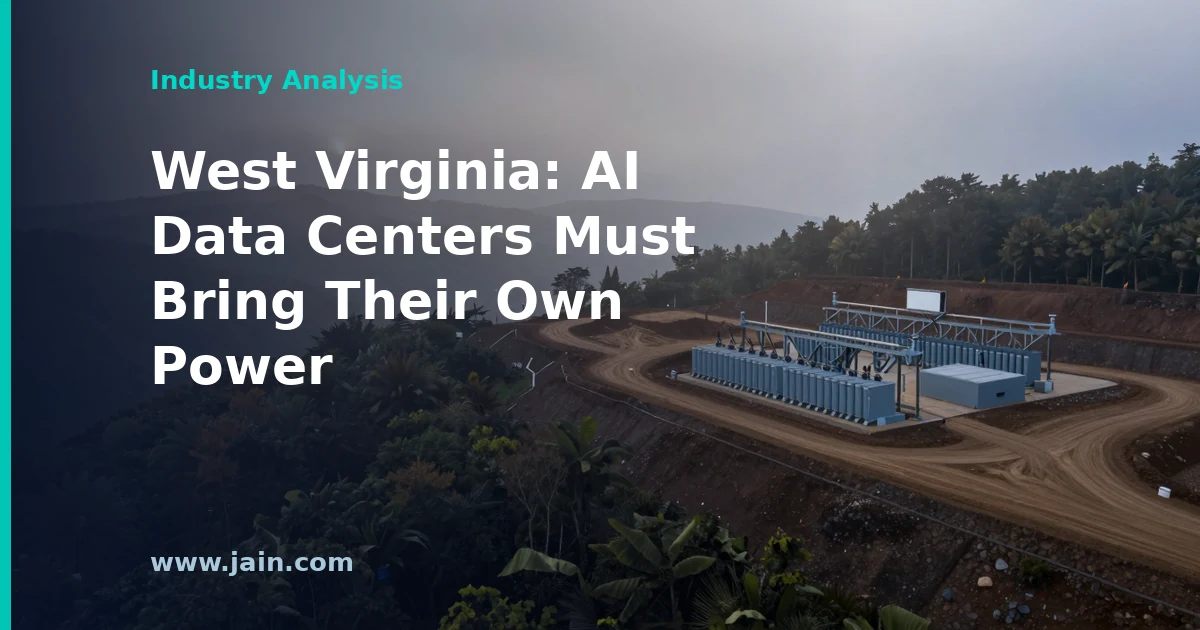
West Virginia wants the giant computer warehouses that power artificial intelligence, and it has none of them today.
Its new 20-year plan sets the terms. Companies must supply their own electricity instead of drawing on the power households use, and they must pay for any grid upgrades themselves. Half the money the projects bring in is set aside to cut, and eventually end, the state income tax.
The catch is that none of this has been tested yet. No company has signed on, and no one knows how much money will actually arrive.
On August 11, 2026, West Virginia Governor Patrick Morrisey, Senate President Randy Smith, House Speaker Roger Hanshaw and Department of Commerce leadership announced the West Virginia Responsible Data Center Development Plan, the Office of the Governor said. The framework relies on House Bill 2014, the Power Generation and Consumption Act, to set state-level oversight and development criteria for hyperscale data centers, the very large facilities built to run cloud and artificial-intelligence workloads.
The state says it starts with zero active hyperscale facilities. The plan is a 20-year strategy managed by a Data Economy Office. It requires developers to supply their own energy, and it dedicates 50 percent of project revenue to reducing the state personal income tax.
Executive Summary
West Virginia has published the rules it will use to attract AI-scale data centers. Before any hyperscale campus exists in the state, it has set four conditions. Developers must prove financial capacity, committed capital and clear power load projections to be certified. They must build, bring or procure their own energy and pay for their own grid and microgrid infrastructure. They must operate under a demand-response model that curtails grid use during peak stress. And project revenue is split by formula, with half going to income tax relief and none to the state general fund.
The central design choice is the energy requirement. Many jurisdictions compete for data centers on land, tax incentives and fiber. West Virginia is asking developers to arrive with a power solution already in hand. That changes who can realistically build in the state and what a site proposal has to contain. It also shifts the risk of new generation away from existing utility customers, at least on paper.
The release is strong on principles and light on mechanics. The revenue base, the enforcement of the ratepayer pledge, water targets and the advisory council’s standards are all still to come. The state’s projections of billions in investment and thousands of jobs have no figures behind them yet.
Bring Your Own Power Is the Real Entry Fee
The plan’s most consequential clause is the Ratepayer Protection Pledge. Developers must build, bring or procure their own energy resources and fully fund their own infrastructure and microgrid costs. A microgrid is a local power system that can run alongside the main grid or apart from it. The state says utility customers will not bear construction, operational or grid upgrade expenses. Certification also requires clear power load projections, meaning a forecast of how much electricity a facility will draw. As a result, a developer cannot secure a site first and look for power later. The energy plan is part of the application.
This is what makes site selection in West Virginia a power project. An AI campus proposal there needs the same pieces as a generation development: a fuel or supply source, generation or procurement contracts, and the capital to build them. It also has to coordinate capacity with the local utility and comply with the reliability frameworks of PJM (the regional grid operator for much of the Mid-Atlantic and Midwest), FERC (the federal energy regulator) and NERC (the body that sets grid reliability standards). On top of that, facilities must operate under demand response. During peak stress periods they either switch to on-site backup generation or cut their consumption.
The requirement is likely to favor well-capitalized developers and those with established generation partners. It is likely to filter out speculative land plays, which the release says it intends to reject. It also changes the conversation for AI tenants. Uptime at a West Virginia campus will depend partly on assets the developer owns and runs, not only on the utility. Demand response adds a further consideration: a facility must be able to curtail or self-supply during grid emergencies. Buyers will want to know how that interacts with their own service-level expectations.
A Revenue Formula Designed for Voters, Not Just Developers
The state has specified exactly where project revenue goes. Fifty percent is dedicated to reducing and ultimately eliminating the state personal income tax. Thirty percent goes to host counties for schools and government operations. Ten percent is spread across all other counties, and ten percent funds local water, wastewater and electrical upgrades. None enters the general revenue fund, and host county budgets cannot be negatively affected.
This structure answers a common local objection to data centers, which is that the host community carries the disruption while the benefits flow elsewhere. Tying half of the revenue to a statewide income tax cut also builds a constituency for the program beyond host counties. Whether the income tax goal is realistic depends on figures the state has not published. The plan does not say what counts as project revenue under the High Impact Data Center designation. It also gives no estimate of how much revenue a typical facility would generate. With zero hyperscale facilities today, the tax promise is a long-horizon aspiration rather than a budget line.
A Clean Slate, and an Unfinished Rulebook
The release says that before HB 2014, more than 50 West Virginia counties had no mechanism to approve, condition or deny large data center projects. That governance gap exists in many places that have seen sudden data center interest. Closing it at the state level before the first hyperscale project arrives is the plan’s clearest structural advantage. Developers get one certification path. Communities get a screening step that did not exist before.
Much of the detail is still to be written. A Data Center Advisory Council will recommend standards for setbacks, noise, site security and proximity to sensitive areas. On water, the state keeps existing oversight and says it is pioneering closed-loop systems, immersion cooling and reclaimed water. It aims to lead on Water Usage Effectiveness, a measure of water consumed per unit of computing energy. It has not set a numeric target or a requirement. Two claims in the release are also unquantified: that development will help modernize the grid and drive down residential rates over time, and that it will bring billions in investment and thousands of jobs. Both are reasonable goals, and neither is substantiated yet.
Background
West Virginia has long been an energy-producing state, and it sits inside the PJM grid region. That region’s reliability and capacity rules shape how any large new electricity user connects. The state enters the AI data center race without a single hyperscale campus. Until House Bill 2014, more than 50 of its counties had no formal mechanism to approve, condition or deny such projects.
The August 2026 plan builds on that law. It combines a Data Economy Office, a certification process for developers, a fixed revenue-sharing formula and a requirement that developers supply their own energy. Governor Morrisey described the approach as leading without repeating the mistakes of other states, which he did not name.
Crusoe, a company that rents out computing power for artificial intelligence, will spend six months testing a small nuclear reactor from startup Aalo alongside one of its compact data centers.
Aalo’s reactor is sized to match the gas-fired generators many of these sites already run on. The test is about whether it can keep the computers running reliably, even as their demand for electricity swings up and down.
If it works, the two companies aim to start building for real in 2029, but first Aalo needs a green light from federal nuclear safety regulators.
Crusoe, a cloud provider built specifically for AI workloads (often called a neocloud), and reactor developer Aalo Atomics will pair Aalo’s small modular reactor (SMR) technology with Crusoe’s modular Spark AI data center for a six-month trial, Fierce Network reported on August 11, 2026. The test will examine the reactor’s capacity factor, meaning how consistently it can run without downtime, along with its ability to follow the fluctuating power draw of AI workloads when combined with battery storage.
Both companies are targeting commercial nuclear-powered AI data center deployments in 2029. Aalo’s first product is the Aalo One Reactor in a 50-megawatt Aalo Pod configuration. Commercial deployment in the United States depends on approval from the Nuclear Regulatory Commission.
Executive Summary
The Crusoe–Aalo trial is a small-scale engineering test, not a power purchase deal. The goal is to find out whether a factory-built reactor and a factory-built data center can be tightly coupled on one site. According to Aalo CEO Matt Loszak, this will be the first time the two types of infrastructure are so closely integrated. Crusoe co-founder Cully Cavness described the work as mostly electrical engineering: controls, monitoring, load profiles and fault conditions running in both directions.
The strategic significance lies in how the reactor is sized. The large nuclear deals signed by the major hyperscalers mostly secure output from existing large plants. Aalo, by contrast, has built its 50-megawatt pod to fit the 10-to-50-megawatt range where on-site gas turbines currently power many data centers, and says it can make nuclear’s economics very competitive with natural gas. If that holds, small reactors would be competing for the on-site generator slot rather than against utility-scale nuclear. That claim is still a target and has not been demonstrated.
The Benchmark Is a Gas Turbine, Not a Gigawatt Plant
Hyperscaler nuclear deals have mostly involved large legacy plants that deliver power over the grid. Aalo is aiming at a different market. Loszak said many data centers are being powered by gas turbines and small modular gas generators in the 10-to-50-megawatt range, and that this is the reason Aalo chose a 50-megawatt pod. He described the design as a balance between economy of scale, which argues for larger units, and economy of number, which argues for mass-producing many identical ones. He added that a reactor as small as 1 megawatt would suffer on economics.
This sizing decision identifies the real competitor. A 50-megawatt pod that can be stacked is meant to fill the same role in a site plan that on-site gas fills today: dedicated, behind-the-meter capacity, sized in blocks, added as a campus grows. It is not meant to replace a grid connection to a 1-gigawatt plant. The people affected are data center developers and neoclouds that currently use gas to get around grid interconnection delays. Crusoe is one of them, and Cavness said the company already pursues natural gas, solar and batteries as a portfolio.
The comparison also sets the standard the technology must meet. On-site gas is a known quantity with established supply chains. Aalo’s statement that it can be very competitive with natural gas is a stated goal, and neither company has published cost-per-megawatt-hour figures to back it up. The benchmark is clear. Whether Aalo can hit it has not yet been shown.
Why the Trial Is About Load Following, Not Reactor Physics
Loszak said the first priority is capacity factor: can the reactor run for months with very limited downtime? The second priority is load following, meaning how well the power supply tracks demand as it changes. AI workloads are not flat. Loszak said Crusoe may simulate the different fluctuation patterns it sees across training and inference jobs. The setup will include battery storage so the companies can test how nuclear and batteries share the job of absorbing those swings.
This is the practical challenge of tight coupling. When a data center draws from the grid, the grid absorbs its variability. When a reactor sits beside the load with no grid in between, any mismatch between supply and demand has to be handled on site, through controls, storage, or the reactor’s own response. Cavness’s emphasis on fault conditions in both directions points to the same problem: a disturbance on either the data center side or the reactor side has to be contained without taking down the other.
This is also where the gas comparison is tested in practice. On-site generators are often chosen because operators can dispatch them to match load. A nuclear pod paired with batteries needs to show similar operational behavior before a buyer will treat it as a replacement. Six months of data on that pairing is exactly what a prospective buyer would want to see.
Time Is the Cost Line Both Companies Are Trying to Cut
Cavness described nuclear’s historic problem as time and money. Build timelines of a decade or more lead to cost overruns, which raise the price per kilowatt-hour. The proposed solution is modular, mass-manufactured units that bring down both the timeline and the cost. Aalo reached criticality, a sustained nuclear chain reaction, within three years of its founding, which is fast by the standards of the nuclear industry. Crusoe’s modular data center approach follows the same manufacturing-led thinking.
The 2029 target is aggressive, and several dependencies stand in the way. Aalo needs Nuclear Regulatory Commission approval before any domestic commercial deployment. The companies also acknowledge they will need to win over local communities, which are increasingly skeptical of data centers even without a reactor involved. Their stated answer is careful site selection and public education. A successful trial would reduce engineering risk, but it would not settle licensing, siting or cost, and those are the factors that will determine whether small nuclear actually takes a share of the on-site power market from gas.
Background
Crusoe is a neocloud, a cloud provider focused on AI computing, that builds its own data centers, including its modular Spark design. It has pursued several energy sources, including natural gas, solar and batteries, to power those sites as grid capacity for data centers has become harder to secure. Aalo Atomics is a nuclear developer building factory-made reactor pods. Its first product is the Aalo One Reactor in a 50-megawatt Aalo Pod configuration, and the company reached criticality within three years of its founding.
Nuclear power has become a major topic in data center planning. All three major hyperscalers have signed nuclear supply agreements, mostly with large existing plants. Small modular reactors are a newer, largely unproven category. Proponents argue they can avoid the decade-plus build times and cost overruns of traditional nuclear, but they have yet to demonstrate that at commercial scale.
Amazon is building its own natural gas power plant in west Texas to run a giant artificial intelligence computer center on the same site.
Its permit allows up to 33 million tons a year of carbon dioxide, the main gas warming the planet. That is more than any other power plant in the country.
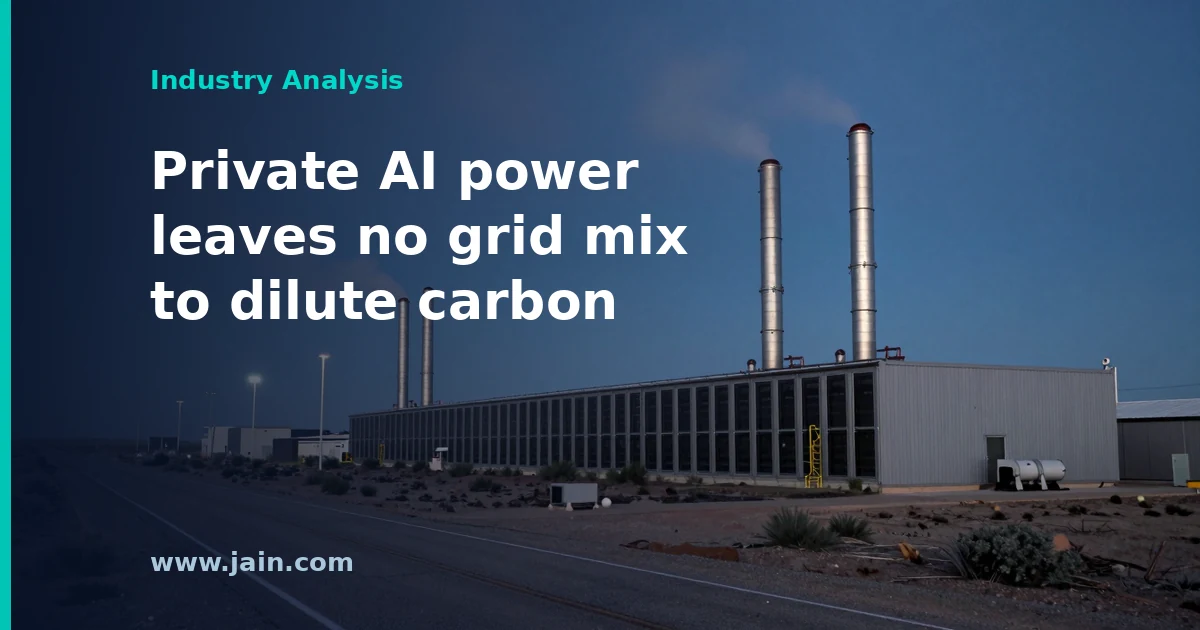
Plugging into the public grid mixes in wind, solar and nuclear power. A private gas plant does not, so every ton traces back to one project, while Amazon still promises to cancel out its carbon pollution by 2040.
Amazon is building a natural gas power plant in Pecos County, Texas, to supply a new AI data center on the same site, according to a New York Times report on August 8 that Tom’s Hardware covered the following day. Project permits describe a plant of up to 7.65 gigawatts (GW) running 35 gas turbines, authorized to release up to 33 million tons of carbon dioxide a year. That is more than any other power plant in the United States.
Amazon co-founded The Climate Pledge in 2019 and committed to net-zero carbon emissions across its global operations by 2040. Amazon spokeswoman Margaret Callahan said “the world looks different now than when we co-founded the climate pledge,” but that “our commitment hasn’t changed.”
Executive Summary
The Pecos County project is a clear example of “behind-the-meter” generation at hyperscale. Behind-the-meter means power is produced on site for a single user instead of being drawn from the public grid. Hyperscalers are the handful of companies that run cloud platforms at global scale. At 7.65 GW, this is a utility-sized power station built to serve one data center campus.
The scale matters, and so does the structure. A grid-connected data center’s footprint is an allocated share of a regional mix that includes gas, wind, solar and nuclear, and the operator can lower its reported figure with clean-energy contracts. A dedicated gas plant has one fuel and one customer. Every ton it emits traces to the AI campus it serves, and at the permitted ceiling those tons would make it the country’s largest single point source of power-sector CO2.
For Amazon, the plant sits in direct tension with a public 2040 net-zero goal. The company says the goal is intact but has not described how the two will be reconciled. For the wider industry, the permit is a preview of the emissions ledger that comes with choosing speed-to-power over grid interconnection.
No Grid Mix, No Dilution: Why Bring-Your-Own Power Changes the Carbon Math
A data center plugged into the public grid consumes electrons from a shared pool. Its reported electricity emissions are calculated from that regional mix, and under common greenhouse-gas accounting practice a buyer can point to renewable-energy contracts to lower the figure it reports. Two things soften the number: the grid’s own blend of generation sources, and the contracts layered on top.
A dedicated gas plant removes both. The 35 turbines permitted in Pecos County burn a single fuel for a single customer, so the permitted 33 million tons a year maps directly onto one AI campus. There is no wind farm or nuclear unit in the blend to average it down. If Amazon owns or controls the plant, standard accounting treats those tons as the company’s direct emissions, which are the hardest category to offset with purchased certificates. Even under a third-party ownership model, the link between the smokestack and the server hall is unambiguous.
That is why the number stands out. The permit is a ceiling, and actual emissions will depend on how many turbines are built and how hard they run. At the permitted level, though, one company’s AI buildout would exceed every other power plant in the country. Everyone weighing on-site generation is affected: Amazon’s own 2040 accounting, the more than 700 members of The Climate Pledge that Amazon co-founded, and every other hyperscaler now pricing the trade-off between waiting for the grid and building its own power.
Speed to Power Is Choosing the Fuel
The shift to on-site generation is driven mainly by time. Connecting a large new load to the grid can take years of studies and upgrades, and communities have grown wary of data centers pushing up local electricity bills. Building power on site sidesteps both problems. Gas has become the leading choice because turbines scale quickly and fuel is available. Nuclear agreements such as Microsoft’s Three Mile Island deal and large renewable portfolios are also being pursued, but they generally take longer to deliver at gigawatt scale.
Policy points in the same direction. The Trump administration has backed gas-fired data center projects and promoted oil, natural gas and coal over renewables, which lowers the regulatory friction for fossil-fueled generation at data center sites. Pecos County sits in the Permian Basin region, and that proximity to gas production strengthens the logistics case.
The economics change too. By building a 7.65 GW plant, Amazon effectively becomes a major power producer, which means taking on turbine procurement, fuel supply, plant operations and fuel-price exposure that grid customers leave to utilities. Turbine manufacturers and gas suppliers gain a large anchor customer. The operator gains control over its timeline, and in exchange it owns the emissions outright.
Testing the Claim That the Commitment Hasn’t Changed
Amazon’s position is that its 2040 net-zero goal stands even as the landscape shifts. The claim deserves a fair test. The company’s emissions have risen each year for the past several years, a trend analysts attribute to data center construction for AI. Microsoft has made a similar case about its 2030 goal amid its own carbon-intensive expansion. Neither company has abandoned its target, and ambitious targets set in advance of a technology shift are not inherently disingenuous.
The tension is structural, though. Gas plants are typically built to operate for decades, which would carry a facility of this size well past 2040. For a net-zero commitment to hold, something has to bridge the gap. That could be carbon capture, a later fuel switch, running the turbines far below their permitted ceiling as grid or clean supply arrives, or large-scale offsets. None of these has been described for this site. Until one is, the commitment is a statement of intent that the Pecos County permit does not yet support.
Background
Amazon operates more data centers than any other company worldwide and is building several new AI-focused campuses around the world. In 2019 it co-founded The Climate Pledge, committing to net-zero carbon emissions across its operations by 2040. Its emissions have nonetheless risen each year for the past several years as data center construction accelerated.
Across the industry, hyperscalers and data center operators are increasingly building dedicated on-site power instead of waiting for grid connections, driven by long interconnection timelines and local concern over rising electricity bills. Some are pursuing nuclear and renewable deals, but natural gas has become the leading choice because it can be scaled and brought online quickly.
Texas’s governor has stopped approving new data centers, the huge warehouses of computers behind artificial intelligence, from plugging into the state’s electric grid. The pause lasts until they report how much power and water they will use. His office says fewer than one in ten have followed the law that requires this.
President Trump called the pause a mistake. The stakes are large: companies have asked Texas for more than five times the most electricity the whole state has ever used at one moment.
Newsweek reported on August 8, 2026 that President Donald Trump called Texas Governor Greg Abbott’s pause on data center grid approvals “a mistake.” He said so in an interview with Punchbowl News released on August 7. Abbott announced on Monday, August 3 that Texas would halt approvals for proposed data centers seeking connections to the state grid. The halt holds while regulators audit each project’s expected electricity and water use, cooling systems, tax incentives, ownership and plans to limit local impacts. Projects that fail the state’s requirements are to be denied connections.
Abbott’s office tied the pause to demand figures from ERCOT, the Electric Reliability Council of Texas, which runs most of the state’s grid. About 90 percent of the 474 gigawatts of large-load interconnection requests under review come from data centers. That is more than five times ERCOT’s record peak demand of roughly 85.5 gigawatts. The governor’s press secretary also said fewer than 10 percent of data centers comply with a state law requiring them to report their power and water usage.
Executive Summary
The dispute looks like a clash over whether Texas wants data centers. The mechanism Abbott chose is narrower than that. The pause is not a ban. It applies mainly to proposed facilities seeking a grid connection, and it asks them to give the Public Utility Commission of Texas (PUCT) and ERCOT data that state law already requires. Projects that bring their own generation may be able to avoid the standard connection process altogether.
This matters for AI infrastructure because Texas is one of the most important markets for large AI campuses. The state’s planning problem is severe: requests on file far exceed anything the grid has ever delivered. Until developers disclose their power and water numbers, the state cannot separate projects that will be built from requests that will never draw a watt. For now, the fastest path to power in Texas runs through a filing cabinet as much as a substation.
Trump’s comments put the federal administration’s rhetoric at odds with a Republican governor who has courted the same industry. The disagreement is so far verbal, and Trump himself said he was “not taking positions.”
The Gate Is a Filing, Not a Ban
The operative detail in Abbott’s order is the disclosure requirement. According to his press secretary, Andrew Mahaleris, Texas law already obliges data centers to report their power and water usage, and fewer than 10 percent do. The pause, in his words, “requires data centers to provide PUCT and ERCOT with the required information for them to make fully informed decisions.” Projects that fail the state’s requirements should be denied connections. In practice, a developer’s place on the path to electricity now depends on whether its paperwork is complete, and not only on engineering studies and transmission capacity.
That changes who moves first. Developers that already track and report their expected load, water draw and cooling design can respond quickly once the audit begins. Those that filed interconnection requests without firm designs, or treated the reporting law as optional, face the longest delay. The audit also covers tax incentives, ownership and community mitigation, so the information burden goes beyond megawatts. The heaviest effect is likely in Oncor’s territory around Dallas-Fort Worth. ERCOT forecasts place the largest concentration of projected large-load growth there, across Dallas, Collin, Denton, Tarrant and Ellis counties.
A Queue Five Times the Size of the Grid
The scale explains why regulators want the data. ERCOT told lawmakers in July that 474 gigawatts of large-load requests are under review, about 90 percent from data centers. The grid’s all-time peak is about 85.5 gigawatts. A gigawatt is roughly the output of a large power plant, so the request queue equals several Texas grids stacked together. Utility-submitted forecasts show large-load requests rising from about five gigawatts in 2026 to more than 109 gigawatts by 2032. Even that is a fraction of the queue.
An interconnection request is an application for grid capacity, not a commitment to build. Developers often file for more sites than they will pursue, because securing a place in line is cheap compared with losing one. Grid planners size transmission lines and generation to the load they expect. Overbuilding for requests that vanish raises costs that ratepayers may carry. Underbuilding for load that arrives risks reliability. Verified disclosure is the tool that narrows that uncertainty, which is why the state has made it the condition for approval.
Two Claims, Both Worth Testing
Trump argued that communities gain from data centers: more investment, lower taxes and higher home values. He also said the industry “could be bigger than oil” for Texas. The investment case is real. Abbott himself called Texas “the epicenter of AI development” when Google announced a $40 billion cloud and AI infrastructure investment in the state in November. The home-value claim is less settled. Newsweek noted that studies point both ways, with regional economic lift on one side and localized noise, traffic and water concerns on the other. Public sentiment has also moved. An Emerson College poll in July found 63 percent of U.S. voters oppose AI data centers in or near their community, up 21 points since December 2025.
The governor’s reliability claim deserves the same scrutiny. Mahaleris cited a “more than 500 percent increase in peak electricity demand.” The figure appears to describe the request queue measured against the record peak, not electricity Texans are actually using today. That is consistent with 474 gigawatts against 85.5. The distinction matters: a queue of that size is a planning problem, not an imminent shortage. The duration of the pause has not been specified, which leaves the cost of the delay open-ended for projects already in line.
Onsite Power Becomes the Side Door
Because the pause targets grid connections, projects with their own generation may be able to proceed outside the standard process. That favors well-capitalized developers who can finance onsite gas turbines, contract with nearby generators, or build power alongside the campus. Smaller developers that depend on the grid have fewer options. If the pause runs long, the Texas pipeline could shift toward self-powered campuses. Those projects bring their own questions about fuel supply, emissions permitting and backup reliability.
The federal-state dimension has limits. ERCOT’s grid operates largely within Texas and is overseen by the state’s utility commission, so Washington’s direct levers over Texas grid connections are narrow. Trump’s comments may shape the political climate. The decisions on which data centers connect, and when, remain with Austin.
Background
Texas has become one of the central markets for AI infrastructure, drawing hyperscale campuses with its available land, transmission and fiber networks and a grid that has historically connected large loads quickly. Abbott has promoted that role, calling the state “the epicenter of AI development” when Google announced a $40 billion cloud and AI investment there in November. Local resistance has grown alongside the buildout. The proposed $1.1 billion Fort Worth Data Center Project in the Veale Ranch area drew resident concerns over power, water and infrastructure, and city officials delayed a tax incentive package after public opposition.
The Texas situation is part of a national surge. Pew Research Center counts over 1,500 new data centers in development across the U.S., and the Berkeley Research Group estimates about 3,000 projects at various stages. Unlike most of the country, the ERCOT grid operates largely within the state, so Texas regulators hold most of the authority over who connects and on what terms.