Artificial intelligence needs enormous amounts of electricity, and there is not enough to go around. That is making the companies that actually generate power unusually valuable.
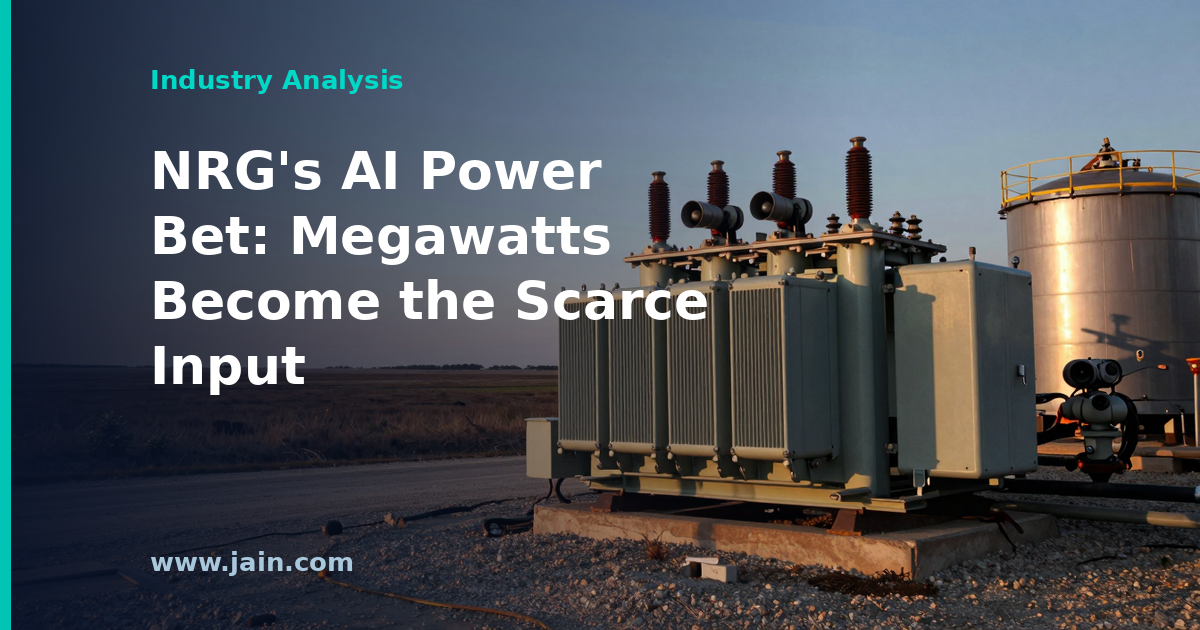
Shares of NRG Energy, a large American electricity producer and retailer, climbed sharply after investors focused on its plan to build about 4 gigawatts of new supply for data centers — roughly what four big nuclear reactors put out. One Texas project, sized at 1.2 gigawatts, is earmarked for a major cloud computing company that has not been named.
The stock is still down about 29 percent this year, so this is a bet, not a victory lap.
NRG Energy shares rose sharply in trading after bouncing off a fresh 52-week low, with TipRanks reporting that the move was driven by renewed investor attention to a perceived valuation disconnect and to NRG’s 4-gigawatt pipeline of power projects aimed at data centers — including a 1.2 GW build in Texas serving a major cloud operator. A gigawatt is a billion watts; 1.2 GW is the scale of a large conventional power station.
The rally coincided with broad strength across power and data-center infrastructure names as markets reassessed the long-term revenue potential of supplying electricity to AI-heavy cloud workloads. No specific analyst price-target changes accompanied the move. NRG’s market capitalisation stood at $23.35 billion, with year-to-date price performance of -29.08% and average trading volume of roughly 2.77 million shares.
Executive Summary
What moved was not an operating result but a valuation frame. NRG is an independent power producer and competitive retailer — a company that sells electricity at market prices rather than at rates set by a regulator. For most of the past decade, that business was valued like a mature commodity: cash-generative, cyclical, and structurally exposed to flat demand. The AI data-center buildout has broken that assumption, and the market is now testing whether generation capacity should be priced as a scarce asset instead.
The specific hook is NRG’s 4 GW development pipeline directed at data centers, anchored by a 1.2 GW Texas project tied to a large cloud customer. That combination — a named market, a named scale, and a described contracted anchor — is what separates a generator with an AI story from a generator with an AI slide. It gives investors something closer to a line of sight on high-margin, long-duration revenue than a general appeal to rising load growth.
The counterweight is the balance sheet. NRG carries a heavy debt load alongside recent revenue pressure and uneven cash flows, and it has committed to returning capital through buybacks and dividends. Those three claims on cash — deleveraging, development capital expenditure, and shareholder returns — compete directly. A stock still down more than 29% year-to-date reflects that unresolved tension as much as it reflects any AI optimism.
The Scarce Input Is No Longer the Chip
The bottleneck in AI infrastructure has migrated. Two years ago it was accelerators; today it is increasingly firm, deliverable electricity at a specific location on a specific date. Servers can be shipped. Interconnection — the physical and contractual process of attaching a large load to the grid — cannot be expedited by writing a bigger cheque. Where a hyperscaler (one of the giant cloud operators that build data centres at national scale) can secure power, it can build; where it cannot, capital sits idle.
That inversion is what re-rates a merchant generator. A company whose fleet was previously valued on forward power curves and capacity payments now holds an option on the fastest-growing industrial load in a generation. NRG’s move off a 52-week low on pipeline news rather than earnings news is the market pricing that optionality, not the underlying quarter. The distinction matters: optionality is real value, but it is value contingent on execution, and it can be repriced downward just as quickly.
Texas Is the Point, Not an Incidental Detail
The 1.2 GW project sits in Texas, and geography is doing analytical work here. Texas operates its own grid under ERCOT, largely outside federal interconnection jurisdiction, with an energy-only market design and a historically faster path from project conception to energisation than the multi-year queues that characterise other US regions. For a cloud operator with a delivery deadline, speed to power is worth a premium over marginal price.
NRG’s incumbency in that market is the differentiator. It already has generation assets, retail customer relationships, and operating experience in the region — which means the data-centre opportunity is an extension of an existing footprint rather than a greenfield bet. That lowers execution risk relative to a pure-play developer, though it does not eliminate the shared industry constraints: turbine manufacturing lead times, gas supply and pipeline capacity, transmission upgrades, and local permitting all sit outside any single company’s control.
A Pipeline Is a Menu, Not a Contract
The most important discipline for readers is distinguishing between the two numbers in this story. The 4 GW figure is a development pipeline — projects at varying stages of maturity, some of which will be built, some deferred, some abandoned. The 1.2 GW Texas build is described as anchored by a major cloud customer, which places it in a different category. Conflating the two produces a valuation that assumes 4 GW of contracted, revenue-generating capacity, which is not what a pipeline means.
This is where the balance sheet re-enters. Multi-gigawatt generation development is capital-intensive, front-loaded, and slow to convert to cash. A company with elevated leverage and uneven cash flows faces a genuine allocation problem: money spent on turbines is money not spent on debt reduction or buybacks. Investors rewarding NRG for growth and rewarding it for capital returns are, at some point, asking for two different companies. How management sequences those priorities — and whether it funds development on-balance-sheet, through project finance, or through partnership structures — will matter more to the outcome than the headline gigawatt count.
Who Wins, Who Pays
The clear beneficiaries of this repricing are owners of dispatchable generation — plants that can produce on demand rather than when the wind blows or the sun shines — in markets with load growth and workable interconnection timelines. Their bargaining position with data-centre developers has improved materially, and the contract structures now being negotiated increasingly resemble long-dated industrial offtake agreements rather than spot commodity sales.
The less-discussed side is who bears the cost. Large new loads on a constrained system put upward pressure on prices for everyone else, and the allocation of transmission and generation build costs between data-centre customers and general ratepayers is an unresolved regulatory question in several states. For enterprise buyers of colocation and cloud capacity, the practical implication is more immediate: power availability is becoming a primary site-selection constraint and a growing share of total cost, and contracts that were once priced casually on a per-kilowatt basis now deserve close reading on escalation, curtailment, and term.
Background
NRG Energy is a Houston-headquartered independent power producer and competitive retail electricity provider, operating generation assets and selling power to residential and commercial customers in deregulated US markets, with a substantial presence in Texas. Unlike a regulated utility, which earns a set return on approved investment, a merchant generator’s economics turn on wholesale power prices, plant availability, and the terms it can negotiate with large customers — a model that rewards scarcity and punishes oversupply.
For much of the past decade, US electricity demand was broadly flat, and the sector was valued accordingly: as a source of cash returns rather than growth. The data-center buildout has reversed that assumption within roughly two years. Grid operators across several regions are now processing interconnection requests measured in gigawatts from single customers, and the constraint on AI capacity expansion has shifted from computing hardware toward power delivery. That shift is what puts companies like NRG — which already own dispatchable generation in load-growth markets — at the centre of an investment story they were not previously part of.
Sources
Source: NRG Energy Surges As AI Power Deal Ignites Rally — TipRanks report on NRG Energy’s share move off a 52-week low, its 4 GW data-center power pipeline, and the 1.2 GW Texas project serving a major cloud operator.
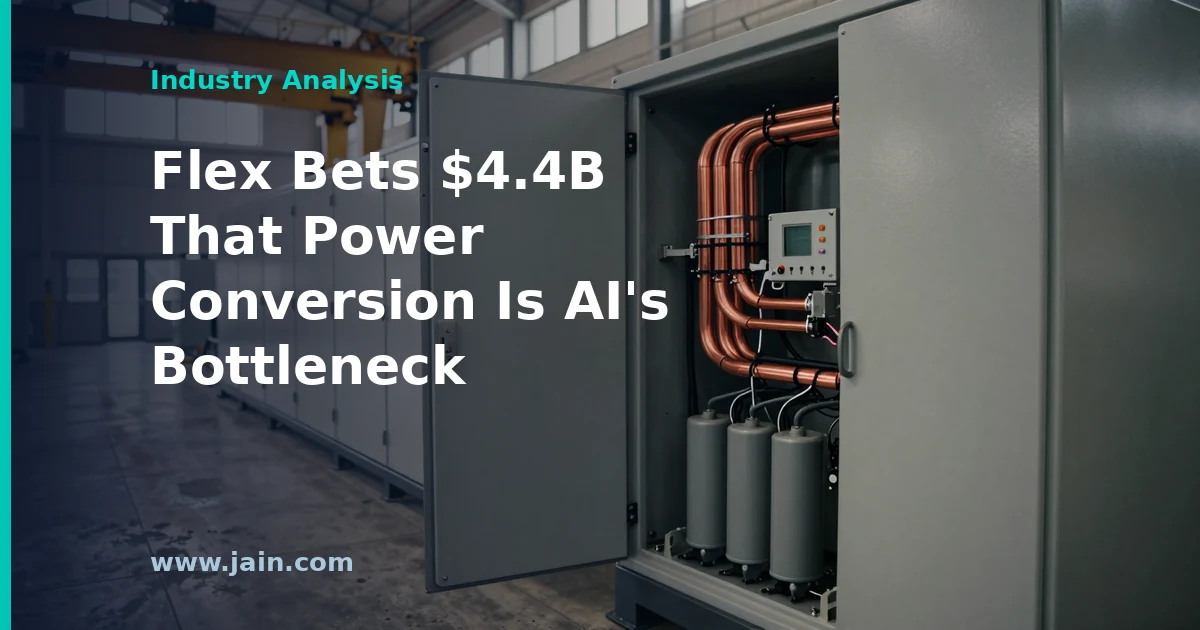
Flex, a company that builds and assembles products for other big brands, is paying $4.4 billion in cash for EPC Power, a California maker of equipment that converts electricity into the exact form computers can use.
Why care? The machines that run artificial intelligence swallow enormous amounts of electricity, and the unglamorous boxes that deliver it cleanly have become the hard part to get. Flex is betting the shortage is in the electrical plumbing, not the chips.
The deal is expected to be completed by the end of 2026.
Flex Ltd. (NASDAQ: FLEX) has agreed to acquire EPC Power Corp., a Poway, California designer and manufacturer of power conversion systems, for $4.4 billion in cash. The parties signed a Stock Purchase Agreement on September 3, 2026, under which Flex subsidiary ACS Acquisitions, Inc. buys all equity in EPC Power from Charge Parent, LLC, the holding vehicle for controlling shareholders Goldman Sachs Alternatives and Cleanhill Partners. Flex disclosed the agreement in an 8-K filed with the SEC on September 4, and is a party to the contract solely to guarantee its subsidiary’s obligations.
Flex’s announcement puts EPC Power’s calendar 2026 revenue at approximately $800 million, with roughly 40% organic growth expected in 2027 and EBITDA margin expanding by double-digit percentage points to approximately 30% that year. EPC Power says it has more than 15 GW deployed across 62 countries, and that annual U.S. manufacturing capacity will surpass 30 GW in 2027. The transaction is expected to close in the fourth quarter of 2026, subject to Hart-Scott-Rodino antitrust clearance and other customary conditions, after which EPC Power joins Flex’s Cloud and Power Infrastructure segment.
Executive Summary
This is a contract manufacturer paying a technology-company price. Flex has built its business designing and building hardware for other brands; EPC Power builds the equipment that sits between the grid and the server rack — rectifiers, DC-DC converters and grid-forming inverters, with solid-state transformers described in Flex’s announcement as planned development. Flex’s stated thesis, in CEO Revathi Advaithi’s words, is that “a generational shift in power architecture is underway,” and that owning the conversion layer lets Flex sell data center infrastructure as an integrated system rather than as parts.
The financial architecture matters as much as the strategic one. The 8-K describes a “locked box” structure in which EPC Power’s enterprise value was fixed as of June 30, 2026, with contractual protections against value leakage until closing — a mechanism common in private equity exits that gives the seller price certainty. Flex simultaneously signed a commitment letter with Citigroup Global Markets, Bank of America and BofA Securities for a senior unsecured 364-day bridge facility of up to $4.4 billion, a backstop it expects to replace with a permanent mix of debt and equity.
The timing is the sharpest detail. Flex states in both the 8-K and its announcement that EPC Power will land inside the Cloud and Power Infrastructure business, which Flex plans to separate into an independent public company in the first calendar quarter of 2027 — weeks after the acquisition is expected to close. Flex is, in effect, buying a $4.4 billion asset and then handing it to shareholders in a new vehicle.
The Bottleneck Moved Downstream of the Chip
For three years the constraint on AI buildouts was accelerators. The constraint discussed in this transaction is different: getting utility power into a building fast, and then converting it into something a rack of GPUs can drink without destabilizing the neighborhood grid. AI training and inference clusters draw power in large, fast swings — thousands of processors ramping together — which is closer to an industrial arc furnace than to the steady hum of a traditional colocation hall. EPC Power’s marketing centers on exactly this problem, and Flex is paying for the claim that solving it is a durable business rather than a moment.
The technical hook is the shift toward 800-volt DC distribution inside the data center. Conventional facilities step voltage down repeatedly and convert between alternating and direct current several times before power reaches a chip, losing a slice at each stage; higher-voltage DC architectures cut the number of conversions and the copper needed to carry the current. Flex’s announcement says EPC Power’s platform is engineered for these architectures with capabilities across rectifiers and DC-DC conversion. The grid-forming piece is complementary: most inverters follow the grid, matching a frequency someone else sets, while grid-forming units can establish voltage and frequency themselves, which is what lets a site run on batteries through a disturbance or energize before the utility interconnection is fully mature.
What $4.4 Billion Buys, Priced Against Flex’s Own Forecast
Work the disclosed numbers and the price becomes legible. Against approximately $800 million of calendar 2026 revenue, $4.4 billion is roughly 5.5 times sales. Apply the stated 40% organic growth and 2027 revenue lands near $1.1 billion; at the stated approximately 30% EBITDA margin, that implies something in the neighborhood of $330 million of 2027 EBITDA, or about 13 times forward earnings before interest, taxes, depreciation and amortization. Those multiples are derived arithmetic from Flex’s own projections, not company-stated figures, and they hold only if both projections land.
The margin guidance contains its own admission. If EBITDA margin expands by “double-digit percentage points” to reach approximately 30%, the 2026 margin is by definition 20% or below. Flex is paying today for a profitability structure that does not yet exist, on the expectation that mix shift toward data center product and scale in U.S. manufacturing delivers it. That is a defensible bet in a supply-constrained market — pricing power tends to follow scarcity — but it is a bet, and it is the single assumption most worth revisiting when the combined business reports actual results.
Buying an Asset You Plan to Give Away
Flex has told investors it will separate its Cloud and Power Infrastructure portfolio into an independent public company in the first quarter of 2027. EPC Power is being bought into that segment in the fourth quarter of 2026. The sequencing is deliberate: it makes the entity that goes public materially larger, faster-growing and more differentiated than it would otherwise be, and it moves the story of that company from “builds infrastructure hardware to order” toward “owns the power conversion layer.”
It also raises a capital-structure question that the filings flag rather than answer. Flex says it is evaluating financing alternatives and expects a combination of debt and equity, with committed financing from Citi and Bank of America standing behind it. Which balance sheet ultimately carries that debt — Flex’s or the new company’s — shapes both entities. Flex’s own forward-looking statement language lists the ability to achieve anticipated capital structures, credit ratings and financing in connection with the spin-off among its risks, which is an unusually direct acknowledgment that the two transactions are financially entangled. There is also a calendar risk: the purchase agreement’s outside date is December 31, 2026, subject to two automatic three-month extensions, meaning a slow antitrust review could push closing past the intended separation date.
Domestic Manufacturing as the Second Product
EPC Power’s pitch is not only technical. Flex describes U.S.-based engineering and manufacturing, and EPC Power’s own announcement says it expanded its domestic manufacturing footprint nearly tenfold under Goldman Sachs Alternatives and Cleanhill Partners, which first invested in 2021. In a market where electrical equipment lead times are a scheduling input and where tariff exposure and procurement rules increasingly favor domestic content, capacity located in the United States is a commercial asset in its own right, distinct from the merits of the hardware.
For buyers, the practical consequence is consolidation of the supply chain. A hyperscaler or colocation developer that previously bought conversion equipment, cooling and IT integration from separate vendors can, in principle, buy a larger integrated block from one supplier — faster to specify, but a heavier dependency. For other electronics manufacturing services firms, the transaction sets a marker: this asset was priced as differentiated intellectual property, not as assembly capacity, and the pool of independent power conversion specialists available to buy is not deep. For established power-equipment vendors, a well-capitalized new competitor now sits inside a manufacturing organization with a footprint spanning 30 countries.
Background
Flex Ltd. is one of the largest electronics manufacturing partners in the world, designing and building products for other brands across a footprint spanning 30 countries. In recent years it has pushed beyond assembly into data center power, cooling and IT infrastructure, organizing that work in a Cloud and Power Infrastructure segment that it has told investors it intends to separate into a standalone public company in the first quarter of 2027. Acquiring a power conversion specialist into that segment shortly before separation changes what the new company will look like on its first day of trading.
EPC Power was founded in 2010 in California and spent most of its life supplying inverters to the utility-scale battery storage market. Cleanhill Partners invested in 2021 on the thesis that power conversion would become critical as renewables, grid modernization and digital infrastructure converged; Goldman Sachs Alternatives later joined as a controlling shareholder. AI data centers then arrived as a second, larger market for the same core competence, because a building drawing power in large, rapid swings needs the same conversion and grid-stabilization hardware that a battery plant does — which is the convergence Flex is paying for.
Investigators in Germany are looking into whether someone deliberately damaged equipment at two power substations. A substation is the fenced yard of transformers and switches that takes electricity off long-distance lines and turns it into the kind you can use in a building.
Nobody has been blamed yet. It matters because the warehouses that hold our email, banking and streaming data sit directly behind that equipment. If a substation goes down, backup generators buy hours or days — not weeks.
The Associated Press reported that German authorities have opened an investigation into suspected sabotage following disruption at two electricity substations. Substations are the switching and voltage-conversion nodes that connect the high-voltage transmission network to the lower-voltage lines serving homes, industrial sites and data centers.
“Suspected sabotage” is an investigative classification rather than a finding: it describes how prosecutors are treating the damage while they work, not a conclusion about who caused it or why. Attribution, motive and the full operational impact are among the questions the investigation exists to resolve.
Executive Summary
An open sabotage investigation at two substations is, on its own, a small news item. Its significance for digital infrastructure is that it moves grid security out of the tabletop-exercise category and into the physical one. Most of the industry’s security spending and regulatory attention over the past decade has gone to cyber defence — network segmentation, intrusion detection, supply-chain controls. The asset that actually determines whether a data hall keeps running is a fenced compound full of transformers and switchgear, frequently sited on the edge of an industrial park, and usually protected by perimeter fencing, cameras and a locked gate.
The number two is the part worth noticing. European transmission and distribution networks are planned around an N-1 standard, meaning the system is designed to survive the loss of any single element without dropping customer supply. Simultaneous or near-simultaneous disruption at two sites is precisely the scenario that N-1 planning does not cover, which is why investigators treat multi-site events differently from a single equipment failure.
For data center operators, landlords and their enterprise customers, the practical question raised is not whether this particular incident affected any specific facility. It is whether the substations that feed dense clusters of digital infrastructure are secured in proportion to what depends on them — and whether operators actually know which substations those are.
A Substation Is a Concentration of Risk in a Small Fenced Yard
A substation does three jobs: it changes voltage, it switches circuits, and it protects the network by isolating faults. The physical contents are unglamorous — power transformers, circuit breakers, disconnectors, protection relays, control cabinets — and are often visible from a public road. There is no redundancy inside the fence. A transformer is a single object weighing tens of tonnes, filled with oil, and it either works or it does not.
What makes substations a disproportionate target is the repair asymmetry. Damage can be inflicted quickly and cheaply; large power transformers are custom-engineered for a specific network position, built to order, and moved by specialised heavy transport. Replacement is measured in months, not days, unless the operator holds a compatible spare and can physically get it to site. Utilities manage this with spares pools and mutual-assistance arrangements, but those programmes were sized for storms and equipment failure, not for a pattern of deliberate damage at multiple locations.
This is also why an investigation into two sites reads differently from an investigation into one. Coordination, if it is established, changes the planning assumption. It is worth being precise here: coordination has not been established, and treating an open probe as a confirmed campaign would be running ahead of the evidence.
Where Data Centers Actually Sit in the Blast Radius
A well-built colocation facility has layered protection against utility failure. Uninterruptible power supplies — battery or flywheel systems — carry the load for seconds to minutes. Diesel or gas generators then take over and, given fuel and fuel-delivery contracts, can run for days. Higher-resilience designs take two utility feeds, ideally from separate substations on separate network paths, so that one upstream failure is survivable without ever starting an engine.
Two things weaken that picture. First, “two feeds” is often two circuits that converge upstream at a single substation or a single transmission corridor — diversity on the invoice, not in the ground. Second, generators are engineered for outages measured in hours or days. A substation loss with a months-long transformer replacement is a different failure mode: the facility survives it technically, on fuel deliveries, at a cost structure nobody underwrote and with an emissions and permitting profile that many sites are not licensed for over extended periods.
The exposure is also geographically concentrated. Europe’s data center capacity clusters heavily around a handful of metros — Frankfurt above all, alongside London, Amsterdam, Paris and Dublin — precisely because that is where fibre, land and grid connections already exist. Concentration is efficient for interconnection and unhelpful for resilience: the same few substations and corridors serve a large share of a region’s compute.
Critical Infrastructure on Paper, Ordinary Utility Asset in the Field
Europe’s regulatory architecture already treats both energy and digital infrastructure as essential. The NIS2 Directive covers cybersecurity and incident reporting across sectors including energy and data centers, and the Critical Entities Resilience Directive addresses physical resilience — risk assessment, resilience plans, incident notification — for entities providing essential services. On paper, the substation and the data center it feeds are both in scope.
The gap is between designation and hardening. Obligations of this kind produce risk assessments, plans and reporting duties; they do not automatically produce ballistic barriers, intrusion detection at the fence line, hardened transformer walls or on-site response at every distribution node. The United States offers a useful comparator: after the 2013 Metcalf substation shooting in California, regulators adopted a dedicated physical security standard, NERC CIP-014, which requires targeted risk assessment and protection — but only for a defined set of transmission stations whose loss would cause instability or cascading outages. Most substations, in most countries, fall outside such tiers by design, because hardening every one of them is not economically serious.
That triage logic was built around outage consequence for the electricity system. It was not built around the question of which substations feed several hundred megawatts of concentrated digital load underpinning payments, logistics and public services. Whether those two rankings produce the same priority list is an open and answerable question, and one that data center operators are better placed to raise with their network operators than to wait to be told.
What Operators Can Reasonably Do Before the Regulation Catches Up
Nothing in an ongoing investigation obliges a data center operator to act. But the incident points at a diligence exercise that is cheap relative to its value: knowing, specifically, which substations and which transmission paths a site depends on, and whether the redundancy purchased is real upstream diversity or a paper duplicate. Many operators can answer this for their own switchgear and cannot answer it two nodes out.
The second exercise is duration. Contingency plans and service-level agreements are usually written against outages of hours. Modelling a multi-week loss of a primary feed changes the questions: fuel logistics and contracted supply priority, permit ceilings on generator run-hours, staffing rotations, and whether workload can be shifted to another region and at what latency and cost. Customers negotiating colocation or wholesale capacity are within their rights to ask for these answers in writing.
None of this argues for alarm. Grid operators handle equipment failure and weather damage continuously and restore service well; the system is more robust than a single investigation makes it look. The measured conclusion is narrower: physical security of the electricity assets serving digital infrastructure deserves the same explicit, documented attention that cyber risk has received, and right now, in most contracts, it does not get it.
Background
Electricity reaches a data center through a chain: generation, high-voltage transmission, one or more substations that step the voltage down, and finally the distribution circuits into the site’s own switchgear. Substations are the hinge points, and because they concentrate transformers and switching equipment in one compound they are also the points where a single physical failure has the widest effect. Grid planners compensate with the N-1 principle — designing the network so any one element can fail without cutting supply — and with spares pools and mutual-assistance agreements between utilities.
Digital infrastructure has been formally recognised as essential in European law: data centers sit within the digital infrastructure sector under NIS2, alongside energy in the same regime, and the Critical Entities Resilience Directive extends resilience duties beyond cyber to physical threats. The practical hardening picture is uneven, however, because protection regimes worldwide triage substations by their consequence for the electricity system rather than by the digital load they carry. That distinction is what an investigation into physical damage at grid assets brings into focus for the data center industry.
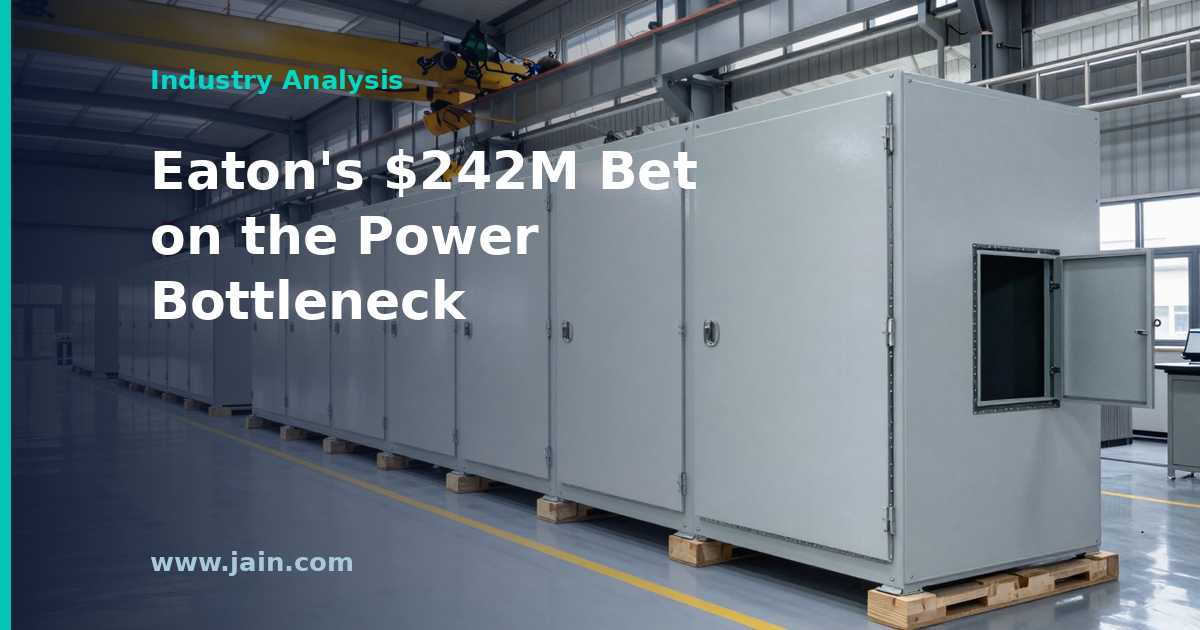
Eaton, a maker of electrical equipment, is spending more than $242 million on a new factory in North Little Rock, Arkansas. It will build the electrical rooms that feed power into data centers — assembled indoors on a production line and trucked to the site, the way a prefabricated house is.
The plant covers a million square feet, roughly seventeen football fields, and Eaton expects it to employ more than 1,200 people.
Why it matters: the thing slowing artificial intelligence down right now is not computer chips. It is getting electricity into the building.
Eaton (NYSE: ETN) announced on September 2, 2026 that it will invest more than $242 million in a new one-million-square-foot manufacturing facility in North Little Rock, Arkansas, which the company expects will double its U.S. capacity to build customized modular electrical enclosures and create more than 1,200 manufacturing, electrical and operations jobs. The plant will produce for Eaton’s Fibrebond business, which the company acquired in April 2025 and which has operated in Minden, Louisiana for more than 40 years.
Eaton says the added capacity is aimed at demand across data center, utility, industrial and digital communications markets. Arkansas Governor Sarah Huckabee Sanders, the Arkansas Economic Development Commission, the City of North Little Rock and the Metro Little Rock Alliance are named as partners on workforce development and technical-skills training tied to the site. Eaton did not announce a construction start date, a production timeline, or the value of any state or local incentives.
Executive Summary
An enclosure is the box the power gear lives in. A modular electrical enclosure is that box built in a factory — walls, switchgear, transformers, wiring, terminations — tested as a unit and shipped to site on a truck, so that work which would otherwise be done by electricians in a muddy field is instead done indoors on a production line. Eaton is committing $242 million to build more of them, and says the Arkansas plant will double what it can produce in the United States.
The scale of the check is worth keeping in proportion. Eaton reported $27.4 billion of revenue and $4.1 billion of net income in 2025; $242 million is under one percent of a single year’s sales. This is not a bet-the-company move. It is a capacity decision, and capacity decisions from component vendors are among the more honest signals available about where a supply chain is actually jammed — a factory takes years to pay back and cannot be quietly cancelled the way a press-release partnership can.
The signal here is specific: Eaton is not adding generation, or chips, or land. It is adding the ability to prefabricate the electrical middle of a data center. That points at a constraint that has migrated downstream, away from megawatts on paper and toward the physical equipment and skilled labor needed to move power the last few hundred feet into a building.
The Bottleneck Moved Downstream
For most of the current AI buildout, the public conversation about power has been about supply: whether utilities can generate enough electricity, whether gas turbines and grid interconnections can be secured, whether a region has spare capacity at all. Those constraints are real. But they are upstream constraints, and a project that clears them still has to solve a second problem — getting that power from the substation fence line into thousands of racks, through switchgear, transformers, breakers, busway and distribution equipment, all of it engineered to the specific site.
That downstream layer has become its own queue. The equipment is heavy, custom, subject to long lead times, and installed by a trade — industrial electricians — that is in short supply across the country and cannot be scaled on the schedule a hyperscale campus wants. Eaton’s own commentary points in this direction: the company said in July that it delivered record second-quarter 2026 results with accelerating orders and a growing backlog, and raised its organic growth guidance. A backlog is unshipped demand. Adding a factory is the response to a backlog you expect to persist.
Eaton’s framing supports a broad read rather than a purely AI one. The release names data center, utility, industrial and digital communications markets, and the company did not break out how much of the new capacity is earmarked for any of them. Utilities are replacing aging distribution equipment and telecom operators are densifying networks; both compete for the same factory hours. The honest statement is that Eaton sees enough aggregate demand across electrification end markets to double a product line’s U.S. footprint — with data centers as the loudest, but not the only, driver.
Why a Factory Beats a Field
The economic case for modular enclosures is a labor-arbitrage and schedule-certainty case, not a materials one. The same switchgear costs roughly the same whether it is installed on site or in a plant. What changes is who installs it, under what conditions, and when the schedule risk lands. In a factory, work is repeatable, weather-independent, inspected under controlled conditions, and performed by a trained workforce that stays put between jobs. On site, the same work is sequential, exposed to trade stacking and rain delays, and dependent on scarce electricians who must be hired into whatever county the campus was built in.
That is why Eaton’s chosen phrasing — customers wanting to deploy power infrastructure “faster, with greater certainty and less complexity” — maps onto something buyers can actually price. Certainty is the product. For an operator whose revenue starts the day the racks energize, compressing field electrical work and de-risking the commissioning date is worth paying a premium for, and it is measurable in a way that generic capacity claims are not.
The Fibrebond history explains why Eaton is doubling down rather than experimenting. Eaton bought the business in April 2025, and it had already been building enclosures in Minden, Louisiana for over 40 years; Eaton says Minden’s capacity has itself doubled over the past three years and continues to receive investment. Arkansas is therefore a second node, not a replacement — geographic diversification of a proven line, plus a labor pool in a metro area that a single small-town plant could not reach. It also fits a broader Eaton pattern of pushing toward integrated, pre-engineered data center solutions, including a reference design announced with Trane Technologies in August aimed at AI data center efficiency and installation cost.
What $242 Million Buys — and What It Doesn’t
Two arithmetic points deserve stating plainly. First, $242 million across one million square feet works out to roughly $242 per square foot of building — consistent with heavy industrial construction plus tooling, and a reminder that a meaningful share of this money is concrete and cranes, not incremental production equipment. Second, “doubles U.S. capacity” is a ratio without a denominator. Eaton has not published Minden’s current output in units, megawatts served, or dollars, so the doubling cannot be converted into how many data center halls per year the industry actually gains. Directionally credible; quantitatively opaque.
There is also a limit to what an enclosure plant can unclog. The enclosure is the wrapper; the constrained contents — large power transformers, medium-voltage switchgear, breakers, and the copper and steel behind them — have their own lead times and their own factories. Doubling enclosure assembly capacity relieves the integration and field-labor step. It does not by itself shorten the wait for a transformer. Buyers evaluating this announcement should ask which specific lead time in their own schedule it compresses.
On winners and losers: the clearest beneficiaries are large data center developers with repeatable designs, who can put standardized modular power blocks into a queue and take delivery on a predictable cadence. Regional electrical contractors lose some scope as work migrates from the field into the plant, though the field commissioning and interconnection work remains. Central Arkansas gains an anchor industrial employer and, per the release, a structured technical-training pipeline — genuinely valuable, and also the part of any plant announcement most exposed to slippage, since job counts are expectations rather than commitments and typically ramp over years. Competing enclosure and integrated-power vendors now face a rival with roughly twice the domestic assembly capacity, which is a durable competitive fact in a market where the scarce good is a delivery slot.
Background
Eaton, founded in 1911 and headquartered for operational purposes in Cleveland with legal domicile in Dublin, sells electrical and industrial power equipment into data center, utility, commercial, residential, aerospace and mobility markets. Its electrical business has been the primary beneficiary of two long-running trends the company calls electrification and digitalization — more of the economy running on electricity, and more of that electricity flowing into compute. It reported $27.4 billion of revenue in 2025 and serves customers in 180 countries.
The modular power segment it is expanding here sits at a specific choke point in data center construction. As campuses grew from tens to hundreds of megawatts, the electrical scope outgrew what could be reliably built in the field on the schedules operators demanded, and prefabrication moved from a niche option to a default for large repeatable designs. Eaton’s April 2025 purchase of Fibrebond bought it a four-decade-old position in that segment; the Arkansas plant is the first major capacity expansion announced under Eaton’s ownership, and it follows other moves toward pre-engineered data center offerings, including a reference design developed with Trane Technologies announced in August 2026.
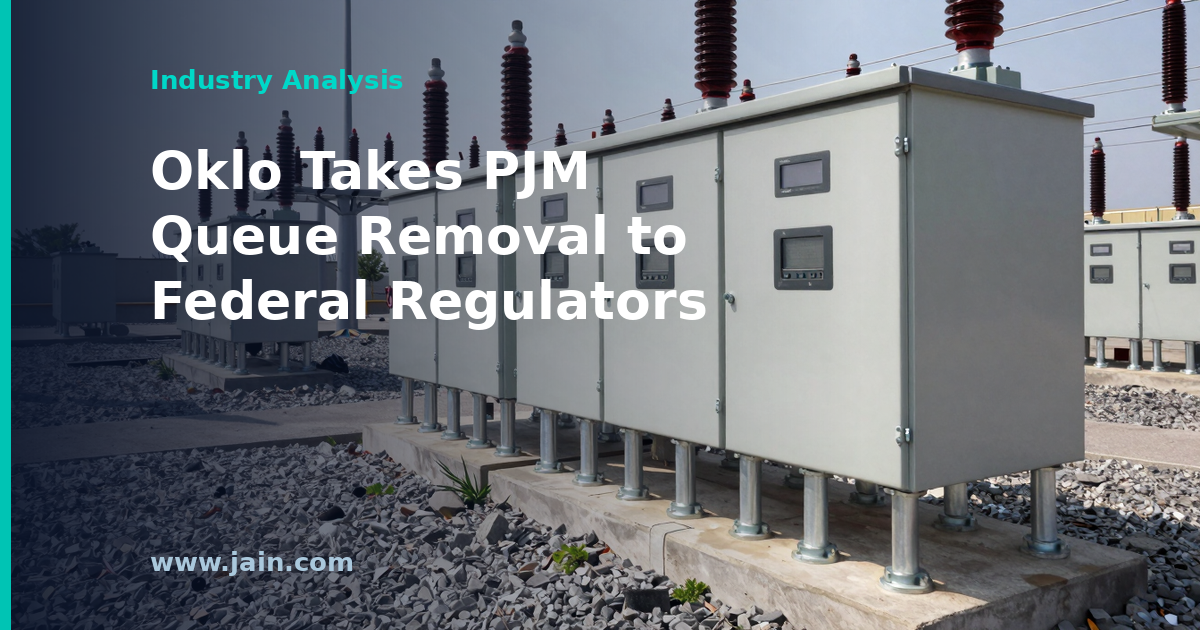
Oklo, a company developing small nuclear reactors to power data centers, says the organisation that runs the electricity grid across much of the eastern United States removed its project from the waiting list for a grid connection.
Oklo has asked federal energy regulators in Washington to step in and reverse that decision.
Why it matters: the computing sites behind artificial intelligence need huge amounts of round-the-clock electricity, and new nuclear plants are one proposed answer. They only work if they can get into the queue for a grid connection and stay there.
RTO Insider reported that advanced nuclear developer Oklo has filed a complaint at the Federal Energy Regulatory Commission (FERC) after PJM Interconnection, the grid operator for 13 mid-Atlantic and Midwestern states plus the District of Columbia, removed one of Oklo’s projects from its interconnection queue — the formal waiting list every new power plant must pass through before it can connect to the transmission system.
The complaint puts a federal regulator, rather than the grid operator, in charge of deciding whether the removal was consistent with PJM’s tariff. For Oklo, a pre-revenue company whose business model is selling electricity from reactors it owns and operates, queue standing is not a paperwork detail: it is the gate between a site plan and a saleable megawatt.
Executive Summary
The dispute is narrow on its face and consequential underneath. Interconnection queues were designed for conventional generators — gas plants, wind farms, solar arrays — that submit a request, hold a position, fund studies and reach commercial operation on a broadly predictable schedule. Advanced nuclear developers arrive with a different profile: long federal licensing timelines, first-of-a-kind designs, and in many cases a single named data center customer rather than a plan to sell into the wholesale market.
That mismatch is what makes the filing worth watching. If a queue administrator can remove an advanced nuclear project because it does not fit the milestones a queue was built to enforce, the practical route to nuclear-powered computing narrows considerably. If FERC finds the removal was inconsistent with the tariff, the ruling becomes a reference point for every reactor developer negotiating with a regional grid operator.
Neither outcome is guaranteed, and complaints of this kind are frequently resolved on procedural grounds that decide little beyond the case at hand. But the question underneath — how a grid built around large central generators accommodates purpose-built reactors serving concentrated digital load — is now in front of the regulator that will ultimately have to answer it.
The Queue Is the Real Bottleneck
An interconnection queue is a waiting list with legal force. Before any generator can deliver power onto the transmission grid, the grid operator must study how that injection affects voltage, stability and congestion, and determine what network upgrades the project must pay for. Position in the queue determines study order, cost allocation and, in practice, whether a project reaches commercial operation this decade or the next.
PJM’s queue has been among the most congested in the country. The operator has moved from a first-come, first-served process to a cycle-based approach that studies projects in clusters, tightened financial and site-control requirements, and worked through a large backlog of pending requests — all while facing the fastest load growth its territory has seen in a generation, much of it from data centers. Rules that screen out speculative applications are the direct consequence of that congestion, and they were not written with first-of-a-kind reactors in mind.
The tension is structural rather than adversarial. A queue administrator enforcing readiness milestones is doing what stakeholders asked for. A nuclear developer whose regulatory path runs through the Nuclear Regulatory Commission on a schedule it does not control will struggle to demonstrate readiness on a timetable calibrated to combined-cycle gas.
Behind the Meter, In Front of the Regulator
Much of the appeal of pairing reactors with data centers rests on co-location: siting generation next to the load so power flows directly to the customer rather than across the public grid. In industry shorthand this is ‘behind the meter’. It promises speed, because it appears to avoid the transmission upgrades that make grid connection slow, and it promises firm, carbon-free supply, which is what large computing operators say they want.
The regulatory reality has proven less accommodating. FERC’s 2024 rejection of an amended interconnection agreement covering an expanded co-located data center at the Susquehanna nuclear plant in Pennsylvania established that co-location is not a way around the grid operator; it is a matter the grid operator and the federal regulator both get to weigh in on. The unresolved questions — who pays for the transmission service a co-located load still relies on, what happens when the on-site generator trips, whether the arrangement shifts costs to other ratepayers — are why these arrangements keep arriving at FERC rather than being settled bilaterally.
Oklo’s complaint lands in that context. Whatever its specific merits, it asks the same underlying question the co-location docket asks: what obligations attach to generation built for one customer, and who decides.
What a Complaint Actually Buys
Filing at FERC gives Oklo a forum, a public record and a decision-maker with authority over PJM’s tariff. It also imposes costs. Complaint proceedings invite answers from the respondent and interventions from utilities, states, consumer advocates and rival developers; they can take months; and they can end in an order that resolves the immediate dispute without establishing the broader principle the filer wanted. For a company whose valuation rests substantially on the credibility of its development pipeline, a public dispute over queue standing is a signal customers and investors will read closely in both directions — as evidence of a real project worth fighting for, or as evidence that the path to power delivery is less settled than a pipeline chart suggests.
The wider audience is everyone else building this trade. Other advanced nuclear developers, hyperscale operators evaluating PJM sites, and independent power producers weighing co-located deals all need to know whether queue rules will bend to accommodate long-lead-time nuclear or whether nuclear will have to bend to the queue. An adverse ruling would push more projects toward markets and utilities outside PJM’s footprint, or toward structures that keep the reactor entirely off the transmission system. A favourable one would not shorten Nuclear Regulatory Commission timelines, but it would remove one source of uncertainty from an already long list.
The measured reading is that this case is a data point, not a verdict. No reactor gets built faster because of a FERC docket, and no data center gets powered by a queue position. What a ruling can do is tell the next developer what the rules are before it spends the money.
Background
Oklo Inc. is a US advanced nuclear developer that listed publicly through a merger with a special-purpose acquisition company in 2024 and trades on the New York Stock Exchange. Its Aurora design is a small fast reactor intended to be deployed in clusters, and its commercial model differs from traditional vendors: rather than selling reactors to utilities, Oklo intends to build, own and operate plants and sell the electricity under long-term contracts. That model makes the company a market participant subject to grid interconnection rules, not merely an equipment supplier. Its licensing path has been iterative — an earlier application was denied without prejudice in 2022 — and no Oklo plant is yet in commercial operation.
PJM, meanwhile, has spent several years managing an interconnection queue overwhelmed by requests while facing demand growth driven substantially by data centers in Virginia, Ohio and Pennsylvania. It replaced its serial queue process with a cluster-based one, added financial and site-control requirements to filter speculative applications, and has seen capacity prices climb sharply as supply retirements outpaced new entry. Those two trajectories — a nuclear developer that needs a grid position and a grid operator rationing them — are what meet in this complaint.
Vertiv is best known for keeping data centers cool. It is now spending up to $2.6 billion on a six-year-old North Carolina company that helps computing sites generate and manage their own electricity.
The reason: getting connected to the electricity grid has become the slowest part of building a facility for artificial intelligence. Waiting years for a utility hookup can cost more than building power on site.
The deal is expected to be completed by the end of 2026, if regulators clear it.
Vertiv Holdings Co (NYSE: VRT) announced on September 2, 2026 that its subsidiary Vertiv Corporation has agreed to acquire Utility Innovation Holdings, Inc. — which trades as UtilityInnovation Group, or UIG — a designer of microgrid controls, switchgear and behind-the-meter power architecture for data centers. Under the merger agreement dated September 1 and disclosed in an 8-K filed with the Securities and Exchange Commission, UIG equity holders, including holders of vested options and outstanding warrants, will receive approximately $1.45 billion in upfront cash at closing, subject to customary adjustments, plus up to $1.15 billion in additional cash payable in two tranches if EBITDA targets are met.
Vertiv’s announcement states the earnout is measured over 12- and 24-month periods and that the upfront price represents roughly 13 times UIG’s expected 2027 EBITDA. The company expects the transaction to be accretive to adjusted earnings per share in the first year after completion and says in the 8-K that it will fund the deal from existing resources. Closing is subject to customary conditions including expiration or termination of the Hart-Scott-Rodino antitrust waiting period, and is expected in the fourth quarter of 2026.
Executive Summary
Vertiv sells the power and cooling equipment that keeps data centers running — uninterruptible power supplies, switchgear, liquid cooling, and the service network behind them. The UIG acquisition extends that portfolio in a direction Vertiv has not previously owned: upstream of the building, to the point where a site meets the utility grid, and to the on-site generation and battery storage that increasingly sit alongside it.
The strategic argument in Vertiv’s announcement is that power availability, not thermal capacity, now sets the pace of AI data center construction. CEO Gio Albertazzi framed it as the time from “site selection to first token” — the moment a facility produces its first unit of AI model output. UIG’s technology is the coordination layer for that problem: proprietary controls software, customized microgrid switchgear and energy storage that can balance load and frequency in real time across on-site sources and utility-connected resources.
For buyers, the deal signals consolidation of a fragmented layer of the stack — power architecture has historically been assembled from separate engineering firms, switchgear vendors and generation suppliers. For investors, the disclosed multiple of roughly 13 times expected 2027 EBITDA on a business founded in 2020 makes this a growth purchase, with more than 40 percent of the potential headline value deferred into an earnout that pays only if that growth arrives.
The Bottleneck Moved From the Rack to the Interconnect
For most of the last decade, the hard engineering problem in a data center was heat. Denser servers meant more watts per rack, and the industry’s capital went into airflow, then into liquid cooling delivered directly to the chip. Vertiv built a large business on that transition. The constraint has now shifted one step further out. A modern AI campus can require more electricity than a mid-sized town, and in many markets the local utility cannot deliver that connection for years — developers join an interconnection queue, the waiting list utilities and grid operators maintain for large new loads, and the queue, not the construction schedule, sets the opening date.
Vertiv’s announcement names three deployment modes UIG’s technology is meant to serve, and they map neatly onto how operators are working around that queue: grid-connected sites, “bridge-to-grid” deployments where on-site generation carries the load until the utility connection arrives, and fully islanded sites running on their own generation. The common requirement across all three is control — software and switchgear that can balance generation, storage and load in real time, and that can disconnect from or support the grid as conditions demand. That is the capability Vertiv is buying, and it is a genuinely different discipline from selling a cooling distribution unit.
The framing also explains why the announcement stresses that decisions are “moving earlier in the planning process.” Whoever is in the room when a developer chooses a power architecture influences a long tail of downstream equipment specifications. Vertiv is paying for a seat at that earlier meeting.
What 13x Buys, and What the Earnout Actually Says
The disclosed valuation is unusually informative. Vertiv states that approximately $1.45 billion represents about 13 times UIG’s expected 2027 EBITDA — earnings before interest, taxes, depreciation and amortization, a rough proxy for operating cash generation. That arithmetic implies expected 2027 EBITDA in the region of $110 million for a company founded in 2020. Vertiv has not published UIG’s revenue, backlog or margin profile, so the implied figure is the only quantitative anchor on the target’s scale that the disclosure provides.
The earnout is the more revealing structure. Up to $1.15 billion in additional cash is payable in two tranches against EBITDA targets over 12- and 24-month periods, and Vertiv says the effective multiple would be “significantly lower” if the full earnout is paid. That statement only holds if the earned EBITDA is materially higher than the base — for a $2.6 billion total to price at a meaningfully lower multiple than 13x, the acquired business would need EBITDA well above $200 million, more than double the level implied by the upfront price. Vertiv has not spelled that out, but it follows from the two figures it did disclose.
Structurally, this is risk allocation working as intended: Vertiv pays a defensible price for the business as it stands and pays a premium only against results that arrive. It also concentrates the seller’s incentives into a 24-month window, which is a familiar tension in founder-led acquisitions — the metric that maximizes a two-year earnout is not always the investment that maximizes value in year five. Vertiv’s statement that it will fund the purchase from existing resources, and its declaration of a $0.0625 quarterly dividend in a separate 8-K the same day, together indicate the company does not view the upfront cash as balance-sheet-straining.
Buying the Conductor, Not the Instrument
The most deliberate choice in this deal is what Vertiv did not buy. It has not acquired a turbine manufacturer, an engine maker or a fuel cell developer. It bought controls software, microgrid switchgear and storage orchestration, and both executives quoted in the announcement went out of their way to stress technology-agnostic architecture — Albertazzi’s phrasing was “without tying customers to a single generation technology or supplier,” and UIG founder and CEO Sidney Hinton described flexible, technology-agnostic architectures as the company’s founding premise.
That positions Vertiv as the integration layer above a generation market whose winning technology is genuinely unsettled, with gas turbines, reciprocating engines, fuel cells and large battery installations all competing for the same on-site role. Selling the conductor rather than the instrument avoids betting on the outcome, and it preserves Vertiv’s ability to sell into projects where the generation vendor has already been chosen by someone else. It also puts Vertiv into more direct contact with electrical-infrastructure incumbents and with the engineering firms that have historically owned power architecture as a services engagement rather than a product.
The competitive question this raises for the wider market is whether power architecture becomes a productized, vendor-integrated layer — the direction Vertiv is clearly betting on — or remains a bespoke engineering exercise per site. If the former, early consolidation of scarce controls expertise is valuable. If the latter, Vertiv has bought a specialist consultancy at a product-company multiple.
Where the Risks Sit
Most of the $1.45 billion is a claim on future performance rather than on assets in place. UIG is six years old, with manufacturing in North Carolina and New Jersey and a European base in Dublin; scaling physical switchgear production to serve global hyperscale demand is a manufacturing problem, not only a software one, and neither company has described current capacity or lead times. The transaction also remains conditional: the merger agreement requires expiration or termination of the Hart-Scott-Rodino antitrust waiting period and other customary approvals before the expected fourth-quarter 2026 close.
The deeper exposure is to the thesis itself. Vertiv is paying a growth multiple for scarcity — specifically, the scarcity of fast grid connections. If interconnection timelines improve through regulatory reform or utility investment, or if AI infrastructure spending decelerates, the premium customers will pay for speed compresses, and with it the earnout Vertiv has agreed to fund. That is a defensible bet on the evidence currently available about grid constraints, but it is a bet on a constraint persisting, which is a different thing from a bet on demand persisting.
Investors should also note what the filing itself cautions: the representations and warranties in the merger agreement were negotiated to allocate risk between the parties, not to establish facts, and Vertiv explicitly says they should not be read as disclosures about either business.
Background
Vertiv Holdings Co (NYSE: VRT), headquartered in Westerville, Ohio and formerly the Emerson Network Power business, supplies the power, cooling and IT infrastructure that keeps data centers, communication networks and industrial facilities running, together with software, analytics and services, and does business in more than 130 countries. Its growth over recent years has been closely tied to data center construction, and particularly to the shift toward denser, higher-power computing that made advanced thermal management a mainstream requirement rather than a specialty.
The market context for this deal is the emergence of electricity supply as the gating factor in that construction. Large new computing loads must be approved and connected by utilities and grid operators, a process that can take years in constrained regions, which has pushed developers toward on-site generation, battery storage and microgrid architectures that let a site operate before — or partly independent of — its utility connection. UIG, founded in 2020, sits squarely in that niche, supplying the controls, switchgear and storage orchestration that make such systems balance load and frequency in real time.
NANO Nuclear Energy (Nasdaq: NNE) and Tillman Digital Gateway have signed a framework agreement under which NANO Nuclear would supply advanced nuclear power — specifically microreactors, factory-built reactors far smaller than conventional nuclear plants — to U.S. AI industrial zones being developed by Tillman Digital Gateway.
The announcement, carried by Energies Media and picked up by market commentary including Simply Wall St, describes the intended scope of the relationship. The material available does not state contracted capacity, named sites, pricing, financing, or a first-power date.
Executive Summary
The agreement pairs two halves of a problem the AI buildout keeps running into. Tillman Digital Gateway is assembling industrial-scale campuses for AI compute; NANO Nuclear is one of a cohort of U.S. developers designing microreactors intended to sit alongside large loads rather than feed a regional grid. On paper, that is a clean match: the data center needs firm, always-on power in one place, and a microreactor is designed to deliver exactly that.
What makes the news notable is less the technology than the sequencing. For two years, “behind-the-meter nuclear” — generation sited at the customer’s facility, bypassing the public grid — has functioned mostly as a directional statement in data center strategy decks. A named developer signing a framework with a named campus developer moves the conversation from category to counterparty.
It does not, however, move it to schedule. A framework agreement sets the terms on which later contracts might be written; it is not a power purchase agreement, an equipment order, or a construction commitment. The commercially decisive facts — how many megawatts, on which sites, by when, financed how, and licensed under what pathway — are the ones the announcement leaves open.
What a Framework Agreement Actually Buys
Energy procurement runs along a ladder of commitment. At the bottom sits the memorandum of understanding, which signals mutual interest and binds almost nothing. A framework agreement sits a rung up: it typically defines scope, roles, and the shape of future contracts, and it may include exclusivity or development obligations. Above it sit the documents that actually move money — definitive supply agreements, power purchase agreements with price and volume, and engineering, procurement and construction contracts.
The distinction matters because early-stage announcements in advanced nuclear are frequently read as orders. They are more accurately read as pipeline. For a pre-commercial reactor developer, a framework with a credible industrial counterparty is genuine progress: it demonstrates a customer willing to be named, and it gives the developer something concrete to show regulators, fuel suppliers, and capital markets. That is a real asset. It is simply a different asset from revenue.
The even-handed reading, then, is that this announcement substantiates commercial interest and a working relationship. It does not yet substantiate deployment. Both statements can be true at once, and coverage that collapses them into one another — in either direction — misreads the document.
Why AI Campuses Are Shopping for Their Own Reactors
The demand side of this story is not speculative. Large AI training and inference campuses want hundreds of megawatts in a single location, running near-continuously, with power quality that tolerates very little interruption. Grid interconnection — the process of getting a new large load or generator formally connected to the public network — has become the binding constraint in many U.S. markets, with queues and transmission upgrades measured in years rather than months.
That is what makes “behind-the-meter” attractive. If generation sits inside the fence, the campus avoids some of the interconnection wait, reduces exposure to congested transmission, and can present a cleaner load profile to the local utility. Microreactors extend the idea further: rather than a single large plant requiring a decade of site-specific construction, the design intent across the sector is factory fabrication, transport to site, and modular addition of units as a campus scales.
The economics are correspondingly attractive on paper and unproven in practice. Nobody yet has a fleet-scale cost curve for factory-built microreactors, because no U.S. commercial microreactor fleet exists to generate one. Buyers evaluating this option are, in effect, underwriting the assumption that serial manufacturing will do for small reactors what it has not yet done for large ones.
The Timeline Problem
Every advanced nuclear deal for AI infrastructure runs into the same arithmetic. Hyperscale capacity decisions operate on cycles of roughly two to four years from land to live racks. Nuclear operates on licensing, fuel, and fabrication cycles that are considerably longer. The U.S. Nuclear Regulatory Commission must license both the reactor design and each specific site; fuel — particularly the higher-assay low-enriched uranium many advanced designs require — depends on a domestic supply chain still being built; and first-of-a-kind manufacturing has a way of consuming schedule.
This is not a criticism unique to NANO Nuclear or to this agreement. It is the structural condition of the entire advanced nuclear sector, and it is precisely why frameworks without dates deserve to be read carefully rather than dismissed. The honest question for any such deal is not “is nuclear real?” — it plainly is — but “which power source is actually carrying the load in year one, year three, and year seven of this campus?”
In most credible plans, the answer for the near term is something else: grid supply where it can be obtained, gas turbines, fuel cells, or storage-firmed renewables, with nuclear entering later as an addition rather than a substitute. A framework signed today is best understood as an option on the back half of a campus’s power stack, not the front half.
Who Gains, and What Would Confirm It
The clearest near-term beneficiary of announcements like this is narrative positioning. For a listed pre-revenue developer, a named industrial counterparty changes the investment story from “design in development” to “design with identified demand,” which is a materially different pitch to capital markets — and, as the accompanying market commentary notes, the question is whether it should shift the narrative that far on the evidence disclosed. For Tillman Digital Gateway, the agreement signals to prospective AI tenants that long-horizon firm power is being addressed, which is increasingly a leasing differentiator.
The parties with the most to prove are the same ones. Confirmation would look concrete: a definitive supply or power purchase agreement with stated capacity, a named site entering the NRC licensing process, a secured fuel pathway, and disclosed financing for units that cost far more than a typical data center power plant. Each of those is observable and checkable; none of them is present in this announcement.
Incumbent power options are not displaced by this news. Gas turbine manufacturers with multi-year order books, grid utilities negotiating large-load tariffs, and developers of storage-backed renewables all continue to serve demand that exists now. The competitive question microreactors must eventually answer is not whether they are cleaner or firmer, but whether they arrive in time and at a delivered cost per megawatt-hour that a hyperscale tenant will actually sign for.
Background
Microreactors and small modular reactors emerged as a response to the cost and schedule problems of gigawatt-scale nuclear construction. Instead of building a large custom plant on site over a decade, the premise is to manufacture standardized units in a factory, ship them, and add capacity in increments. A cohort of U.S. developers, NANO Nuclear Energy among them, has pursued this route with designs at varying stages of regulatory review; none has yet reached commercial fleet operation in the United States.
Demand arrived faster than the technology. From 2023 onward, AI compute buildouts pushed data center power requirements into a range that strained grid interconnection processes across major U.S. markets, prompting technology and infrastructure firms to look at generating their own firm power on site. That convergence — mature demand meeting pre-commercial supply — is the context for framework agreements like this one, and it is also why the gap between announcement and delivery deserves close attention.
MARA Holdings, one of the largest publicly traded bitcoin mining companies, has announced a deal to acquire a site in Texas that is described as doubling its power capacity. Shares in the company rose following the news, according to the market report carrying the item.
The coverage available is a short market wire summary rather than a detailed transaction announcement. It does not disclose a purchase price, a megawatt figure, the seller, the closing timetable, or whether the acquired capacity is already energized and delivering power. Those details matter enormously to how the deal should be valued, and we flag them as open below.
Executive Summary
The headline event is straightforward: MARA has agreed to buy a Texas power site, and the market read the deal as a material expansion of the company’s electrical footprint. The framing itself is the story. The acquisition is being described by its power capacity, not by how much bitcoin mining equipment it can run or what it does to the company’s hashrate — the industry’s traditional measure of mining scale.
That word choice reflects a genuine shift in how these assets are priced. Across the sector, companies that were built to mine cryptocurrency have found that their most valuable possession is not their machines but their grid connections: sites where a utility has already agreed to deliver large volumes of electricity. Artificial intelligence data centers need exactly that, and they need it years sooner than the conventional development process can supply it. Energized megawatts have become the scarce commodity, and buying a site is often the fastest way to obtain them.
What the available reporting does not establish is whether this particular transaction is an AI-oriented move, a straightforward mining expansion, or an option the company intends to keep open. Until MARA publishes the transaction terms and the technical characteristics of the site, the stock reaction should be read as a market judgment about direction of travel rather than a verified change in the company’s earnings power.
The Asset Being Bought Is the Interconnect
When a large electricity consumer wants to plug into the grid, it joins an interconnection queue — a regulated process in which the grid operator studies whether the local network can absorb the new load and what upgrades are required. For projects at the scale a data center campus needs, that process is commonly measured in years, and completion is not guaranteed. A site that has already cleared it, or that carries a signed agreement for firm delivery, is therefore not just land with a substation on it. It is a permit to consume power on a timeline no greenfield developer can match.
This is why acquisitions in this corner of the market are increasingly quoted in megawatts rather than in square footage, revenue, or equipment. The buyer is purchasing schedule certainty. In a market where the demand for AI compute is running ahead of the physical infrastructure available to host it, time-to-power has become a pricing input in its own right, and sites with existing connections trade at premiums that would look irrational if you valued them only on the cash flow they currently produce.
The important caveat is that not all capacity is equal. “Interconnected” can mean an executed agreement, a completed study, or power actually flowing today; it can be firm or interruptible; and it can carry obligations to fund transmission upgrades. The report on MARA’s deal does not specify which, and that distinction is the difference between an asset that can host a paying tenant next year and one that cannot.
From Hashrate to Landlord: What Converts and What Does Not
The strategic logic of the miner-to-AI-landlord pivot is sound. Bitcoin mining revenue is volatile, tied to a token price the operator cannot influence and to a protocol that periodically halves the reward per block. Hosting AI workloads under multi-year contracts offers something structurally different: contracted, creditworthy cash flow that lenders and equity investors will capitalize at a far higher multiple. Several listed miners have already announced conversions or hosting agreements with AI compute providers, and the market has generally rewarded those announcements. MARA’s framing of a purchase around power capacity sits comfortably inside that pattern.
What does not transfer cleanly is the building. A bitcoin mining facility is engineered to be cheap and tolerant: often little more than ventilated shells or immersion tanks, with minimal power redundancy, modest fiber connectivity, and a business model that welcomes being switched off when electricity prices spike. An AI training or inference facility is close to the opposite. It needs redundant power paths, dense liquid cooling, low-latency fiber routes, and uptime commitments that make curtailment a contractual breach rather than a revenue opportunity. Converting one to the other is typically a rebuild of everything except the grid connection and the land.
That gap is also a capital gap. The cost per megawatt of a high-availability AI facility is a large multiple of the cost per megawatt of a mining shed, which means the acquisition price is frequently the smaller half of the eventual investment. Companies pursuing this route generally require a signed tenant, a financing partner, or both before the conversion capital can be committed. Whether MARA has any of those in place for this site is not addressed in the available material.
Why the Shares Rose, and What the Market Is Pricing
A stock moving up on a transaction with undisclosed terms is a signal about narrative rather than arithmetic. Investors cannot have modeled the earnings contribution of a deal whose price and megawatt count they have not seen. What they can price is optionality: the possibility that a company currently valued as a commodity producer holds assets that would be worth considerably more in the hands of an infrastructure landlord.
That re-rating opportunity is real but conditional. It requires the capacity to be genuinely deliverable, the sites to be suitable or economically convertible, and — decisively — a customer willing to sign a long contract. Each of those conditions has failed for someone in this sector before. There is also a dilution question that positive share-price reactions tend to obscure: infrastructure buildouts are funded, and miners have historically funded them through equity and convertible issuance. A higher share price makes that cheaper, which is a legitimate corporate benefit, but it means existing holders may be paying for growth in ownership as well as in cash.
The even-handed reading is that the market is rewarding a strategic posture that is well-supported by industry conditions, on the basis of a disclosure that is too thin to verify it. That is not a criticism of the transaction, which may well be attractive. It is an observation about the information asymmetry between a one-line headline and a decision to buy the stock.
Texas: Abundant Power With Real Constraints
Texas has been the natural home for energy-intensive computing for identifiable reasons. Its grid features substantial wind and solar generation, wholesale prices that can fall very low during periods of surplus, a comparatively fast permitting environment, and a market design that pays large flexible consumers to reduce demand when the system is stressed. For miners, whose machines can be shut off in seconds, that last feature converted grid stress into a revenue line.
The constraints are becoming more visible as the loads get larger. Grid operators and regulators in Texas have moved to tighten how very large new consumers are studied, connected, and expected to behave during emergencies, partly because the aggregate volume of requested large-load capacity has grown so quickly. Water availability for cooling, transmission congestion in specific zones, and local reaction to industrial power consumption in residential areas are all live issues. None of these prevent projects; they do affect which sites are actually developable and on what schedule.
The practical implication is that a Texas acquisition should be assessed zone by zone, not as a generic bet on cheap Texas electricity. Two sites with identical nameplate capacity can have very different value depending on where they sit relative to congestion, what obligations attach to their interconnection, and whether their power is firm or curtailable. Investors and prospective tenants should ask for that granularity before assuming the megawatts are fungible.
Background
MARA Holdings began life as Marathon Digital Holdings and grew into one of the largest listed bitcoin miners by building out fleets of specialized machines that compete to validate transactions in exchange for newly issued bitcoin. That business is inherently cyclical: revenue tracks the bitcoin price and the mining reward is cut roughly every four years by the protocol’s design, which puts persistent pressure on the cost of electricity per unit of output.
Since the surge in demand for AI computing, the industry’s calculus has changed. The facilities miners built to chase cheap power sit on exactly the resource AI data center developers cannot obtain quickly — large, permitted grid connections. A number of listed miners have consequently repositioned as power and infrastructure companies, selling or converting capacity to AI tenants under long-term contracts. Texas, with its deep renewable generation, flexible wholesale market and comparatively accessible permitting, has been the geographic center of that shift, and it is where much of the sector’s remaining connected capacity is being bought and sold.
nVent Electric (NYSE: NVT) has agreed to acquire Maverick Power for $1.75 billion, according to a deal roundup published by Benzinga and distributed via Google News. Maverick Power is positioned in the market as a maker of modular, factory-assembled power distribution equipment — the switchgear and enclosures that take utility-scale electricity and split it safely into the feeds a building actually uses.
The item appeared in a multi-company “Deal Dispatch” column that also noted Carets Corp exploring strategic alternatives, a formal phrase companies use when they open a review that can end in a sale, merger, spin-off or nothing at all. Beyond the buyer, the target and the headline price, the aggregated summary carries no further detail: no closing date, no financing structure, no management commentary and no stated revenue or earnings contribution.
Executive Summary
The transaction, as reported, is a straightforward statement of strategic intent. nVent’s core business is electrical connection and protection — enclosures, cable management, thermal management and electrical fastening. Adding a modular power distribution manufacturer moves the company further up the value chain, from housing and protecting electrical equipment toward supplying the switching and distribution gear itself, pre-integrated at a factory rather than assembled on site.
Why it matters is a question of sequencing. For three years the popular account of the AI buildout has centred on accelerators and high-bandwidth memory. Increasingly, the binding constraint sits earlier and lower in the stack: interconnection queues, transformers, breakers and medium-voltage switchgear. A campus with chips on order and no energised switchgear is not a data center; it is a warehouse. Capital is flowing accordingly, and a $1.75 billion cheque for distribution equipment capacity is a clear expression of that repricing.
A caution on evidence. The source here is a wire-service roundup, not a full company release, and the aggregated headline renders the price as “$1.75” without a unit; the billion-dollar reading is the one carried in the market framing of the deal. Everything in this article about strategic rationale, synergies and market position is analysis of a thinly documented item, not a summary of disclosed company statements. Readers should treat the price and parties as the reported facts and the rest as interpretation pending nVent’s own filings.
The Bottleneck Moved Downstream From the Chip
Every data center is, electrically, a funnel. High-voltage power arrives from the grid, a substation steps it down, medium-voltage switchgear divides and protects the resulting circuits, and transformers and low-voltage gear deliver usable power to racks. Medium voltage — broadly, the range between utility transmission levels and the volts running to equipment — is where a campus is actually carved into feeds. That equipment is heavy, custom-configured, safety-critical and made by a small number of qualified manufacturers.
AI campuses have made this segment structurally scarce in a way ordinary commercial construction never did. Density is the driver: an AI hall draws far more power per square foot than a traditional enterprise facility, so a given plot of land now demands vastly more switching apparatus. Demand for gear scaled with power draw, while the factories that build it scaled with the slower rhythms of industrial capital expansion. When order books lengthen faster than plants can be added, buying an existing manufacturer is often quicker than building one — which is a reasonable read of the logic behind a deal of this size.
The honest caveat is that no lead-time or backlog figures accompany this report. The scarcity argument is well established across the electrical equipment sector, but the specific pressure inside Maverick Power’s order book is not disclosed here, and it is the single number that would most affect how the price should be judged.
Why Factory-Built Beats Site-Built in a Labour-Constrained Market
The modular element deserves more attention than the price tag. Traditional electrical rooms are built on site: gear is delivered as components, and licensed electricians assemble, wire and commission it in place. Modular power distribution inverts this. Equipment is integrated, wired and tested in a controlled factory, then shipped as a completed unit — often an “e-house” or skid, essentially a prefabricated power room delivered on a truck — and connected on arrival.
The economics are compelling wherever skilled labour is the constraint rather than capital. Factory environments allow parallel production, repeatable quality control and testing before shipment; site work is sequential, weather-exposed and dependent on trades that are in demand across every construction sector simultaneously. For a hyperscale developer racing to energise capacity, compressing months of on-site electrical work into a delivery and a connection has value that can exceed the equipment premium several times over.
There is a trade-off buyers should weigh. Modular units are standardised by design, which limits customisation, concentrates dependency on a single supplier’s engineering, and shifts risk toward logistics — a delayed or damaged e-house is a bigger single point of failure than a delayed pallet of breakers. Whether prefabrication genuinely shortens total schedules also depends heavily on utility interconnection, which no manufacturer controls.
What nVent Gains, and What It Now Has to Prove
Strategically, the acquisition would broaden nVent from a components-and-enclosures supplier into a provider of larger integrated power blocks. That matters commercially because it changes who nVent sells to and how. Components are typically specified by engineers and bought through distribution; integrated power rooms are sold into capital projects, negotiated with developers and EPC firms — the engineering, procurement and construction contractors that build facilities — with longer cycles, larger orders and closer customer relationships.
Larger content per project also means larger exposure per project. Component suppliers are diversified across thousands of buildings; integrated-equipment suppliers concentrate revenue in a smaller number of very large customers. If AI capital expenditure moderates, or if a handful of hyperscalers reschedule campuses, that concentration cuts both ways. The premium being paid across the electrical equipment sector implicitly assumes that today’s demand curve holds long enough to earn it back.
The competitive backdrop is a field of much larger diversified electrical firms — the established switchgear incumbents — alongside specialist modular builders that emerged specifically to serve data center schedules. nVent’s plausible claim is speed and focus rather than scale. Validating it requires evidence not yet in the public record: production capacity, qualification status with major buyers, and whether the acquired plants can be expanded faster than competitors can add their own.
Reading a Thin Source Carefully
This story arrives through an aggregated deal column rather than a company announcement, and the difference is worth stating plainly for readers who track infrastructure capital flows. What is reported is the buyer, the target and a price. What is not reported — and therefore not something any analysis should assume — includes consideration mix, expected close, regulatory conditions, retained management, financial contribution and any stated synergy targets.
None of that implies anything is amiss; roundup formats simply compress. But it does mean the appropriate posture is provisional. The clean test of the thesis advanced here will be nVent’s own disclosure: if the company frames the deal around data center power capacity and order visibility, the scarcity reading is supported. If it frames it around channel breadth or industrial end markets, the AI-bottleneck framing is the market’s interpretation more than the buyer’s.
Background
nVent Electric became a standalone public company in 2018 when Pentair separated its electrical business, and it has since grown through acquisitions in enclosures, thermal management and electrical infrastructure. Its products are the unglamorous connective tissue of electrified buildings — the cabinets, mounts, heat-tracing and protection systems that let power reach equipment safely — which places it directly in the path of two structural trends: electrification of industry and transport, and the power-intensive expansion of computing.
The wider context is a repricing of the electrical supply chain. Data center construction historically consumed a modest share of global electrical equipment output; AI training and inference clusters changed that by raising power density per rack sharply. Manufacturers of transformers, breakers and switchgear moved from a slow-growth industrial category to one facing extended order books and rising valuations, prompting an active period of consolidation as suppliers buy capacity rather than wait to build it.
Bloom Energy (NYSE: BE) has launched Power Connect, an offering the company positions as a way to accelerate data center deployments by delivering on-site electricity without waiting for a utility grid connection. Shares in the company rose 7.6% in the session following the launch, according to the Yahoo Finance report that carried the news.
The coverage available at the time of writing establishes the product name, its stated purpose and the market’s same-day reaction. It does not disclose contracted capacity, pricing, named launch customers, fuel arrangements or delivery timelines — so the scale of the initiative remains unquantified in the public record.
Executive Summary
The announcement is best read as a packaging decision rather than a technology one. Bloom Energy already sells solid oxide fuel cells — refrigerator-sized units that convert natural gas or hydrogen into electricity through an electrochemical reaction instead of combustion. Power Connect reframes that hardware as an answer to a procurement problem: the multi-year queue data center developers face when they ask a utility for hundreds of megawatts.
That reframing matters because the scarce commodity in the AI build-out is no longer chips or land. It is energized capacity on a defensible schedule. Selling “speed to power” as the product, with the generating equipment as an implementation detail, targets the buyer who has already concluded that the grid cannot serve their timeline and is comparing on-site options on delivery date first and cost second.
The market response — a 7.6% move — reflects enthusiasm for that positioning, not evidence of demand. No revenue, backlog or customer commitment has been attached to Power Connect in the reporting reviewed here. The commercial test is whether the offering converts into signed, deliverable capacity, and that evidence does not yet exist publicly.
The Product Is the Wait, Not the Watt
Every megawatt sold into a data center competes on three axes: cost per megawatt-hour, reliability, and time to first power. For most of the past decade, the first axis dominated, and on that axis fuel cells have historically been a premium product — they cost more per unit of electricity than grid power in most US markets. Power Connect implicitly concedes that contest and moves the argument to the third axis, where the value of arriving eighteen or twenty-four months earlier can dwarf a per-kilowatt-hour premium.
The arithmetic behind that is straightforward for anyone building AI capacity. A hall of accelerators that sits dark is depreciating hardware and idle contracted demand. If on-site generation lets a facility monetize that hardware materially sooner, the developer is effectively buying calendar time, and the fuel cell is the delivery mechanism. Framing the offering around the interconnection queue — the line of projects waiting on utility studies, upgrades and approvals — is a recognition that the buyer’s pain is administrative and physical, not thermodynamic.
What the naming does not change is the underlying engineering and permitting reality. On-site generation still requires gas supply, air permits in many jurisdictions, local approvals and interconnection of a different kind. A product name can compress the sales cycle; it cannot by itself compress a permitting authority’s review. Whether Power Connect bundles any of that regulatory and logistical work into a single contractual commitment is precisely the detail the available coverage does not settle.
Why the Interconnection Queue Became a Product Category
Bloom is not inventing this market, it is naming its position in one that has formed rapidly. Reciprocating-engine generator fleets, aeroderivative and industrial gas turbines, linear generators and utility bridge-power arrangements are all being sold into the same gap. Large-frame turbine manufacturers have order books stretching years out, which pushes developers toward whatever can be built and commissioned faster, and pushes suppliers to compete on schedule certainty rather than efficiency curves.
Fuel cells bring genuine advantages into that comparison. Because they generate electricity electrochemically rather than by burning fuel, they emit negligible nitrogen oxides and particulates, which is often the binding constraint for siting thermal generation near populated areas or in regions with strained air quality permitting. They are modular, so capacity can be added in increments that track a phased data center build rather than requiring a single large commitment up front. They are also quiet, which matters for community acceptance.
The offsetting realities are equally concrete. Fuel cells generally carry higher capital cost per kilowatt than reciprocating engines, they consume natural gas and therefore expose the buyer to commodity and pipeline-capacity risk, and stack replacement over the life of the asset is an operating cost that must be underwritten. None of that disqualifies the approach — it does mean that any comparison should be made on a full lifecycle basis, and that a launch announcement is not the place to find those numbers.
Winners, Losers and the Utility Question
The clearest beneficiary of a productized speed-to-power offer is the developer with a signed tenant and no energization date. The clearest loser is not the utility, at least not immediately. Behind-the-meter generation in this cycle is more often a bridge than a divorce: developers energize early on site, then transition to grid supply when the interconnection completes, sometimes retaining the on-site plant for resilience or peak-shaving. Utilities lose near-term load but frequently retain the customer, and in some cases gain a dispatchable resource on their system.
The more exposed parties are competing on-site generation vendors and, over a longer horizon, developers who bet on grid timelines they cannot control. There is also a policy dimension worth watching without overstating it: as more large loads self-supply, the cost of shared transmission infrastructure is spread across a smaller base, and regulators in several markets are actively examining how large-load tariffs should handle that. This is a live question, not a settled criticism, and it applies to every on-site generation vendor rather than to Bloom specifically.
Reading the 7.6% Move Honestly
A same-session gain of 7.6% is a real data point about sentiment and a weak one about fundamentals. Bloom trades as a high-expectation name tied to AI power demand, and in that regime announcements that connect a company to the scarcest input in the sector tend to move the stock regardless of disclosed economics. The move tells us investors found the positioning credible. It does not tell us that anyone has bought anything.
The disciplined way to track this is to look for the follow-through that a genuine product launch produces: named customers, contracted megawatts, revenue recognized under the offering, or backlog disclosed in subsequent quarterly reporting. Those are falsifiable. Until at least one of them appears, Power Connect is a well-aimed go-to-market motion addressed to a real and demonstrable market constraint — which is a reasonable thing to be, and less than a booked order.
For buyers, the practical read is simpler. A vendor competing explicitly on schedule invites schedule-based diligence: what is contractually guaranteed, what remedies attach to a missed energization date, and which dependencies — gas service, permits, grid backup — remain the buyer’s risk. Those questions are answerable in a term sheet even when they are absent from a press release.
Background
Bloom Energy manufactures solid oxide fuel cell systems that generate electricity on site from natural gas, biogas or hydrogen without combustion. The company sells to commercial, industrial and data center customers who want power that is independent of, or supplementary to, the local grid, and it has traded publicly on the New York Stock Exchange under the ticker BE since its 2018 listing.
The market context has shifted sharply in its favor. AI computing has driven data center power requirements to a scale that utilities in many regions cannot serve on developers’ timelines, with interconnection studies and transmission upgrades stretching over years and large turbine manufacturers carrying multi-year order backlogs. That bottleneck has created a distinct commercial category — generation that can be sited and commissioned quickly next to the load — and Power Connect is Bloom’s explicit entry into it.