Eaton, a long-established maker of the equipment that moves electricity safely through buildings, says its best years are still ahead.
The reason is data centers: the giant warehouses of computers behind apps, online search and chatbots. Each one needs enormous amounts of electricity switched, routed and backed up in case the power fails, and Eaton sells much of that equipment.
The companies supplying the wiring behind the artificial intelligence boom can profit no matter which tech giant wins. The big open question is how long the building spree lasts.
Yahoo Finance reported that Eaton Corporation (NYSE: ETN), the power management company, sees its best years ahead, with demand from data centers powering its growth. The outlook ties Eaton’s trajectory directly to the electrical infrastructure needed by the facilities that run cloud computing and artificial intelligence (AI) workloads.
Executive Summary
Eaton is signaling confidence that data center construction will drive growth beyond anything in its recent history. The company makes the electrical backbone of these facilities: switchgear that routes and protects high-voltage power, uninterruptible power supplies (UPS) that keep servers running through outages, and power distribution units that deliver electricity to server racks.
The outlook matters because it points to where AI spending ultimately lands. Chips and cloud platforms get most of the attention, but every new data center hall needs power equipment before a single server can be switched on. That puts electrical suppliers among the most direct beneficiaries of the buildout, whichever chipmaker or cloud provider comes out ahead.
A forward-looking claim is not a result, though. A “best years ahead” view depends on data center spending staying strong, on Eaton’s ability to manufacture enough equipment, and on customers securing the grid power they need to finish their projects.
Selling Picks and Shovels for the AI Power Crunch
A data center is, at its core, a building that turns electricity into computation. Power arrives from the utility at high voltage, then passes through transformers, switchgear, backup systems and distribution equipment before it reaches the servers. Each stage is a purchase, and Eaton competes in many of them.
This is the classic picks-and-shovels position. Eaton does not need to predict which AI model, chip architecture or cloud provider will dominate. It needs data centers to keep getting built, and it needs those facilities to keep drawing more power. The industry trend toward denser server racks, where more computing and more electricity are packed into the same floor space, tends to raise the amount of electrical equipment each facility requires.
That makes the claim structurally credible. Unlike speculative software revenue, electrical infrastructure is a physical requirement: a facility cannot operate without it, and none of it can be skipped to save money.
Why Electrical Gear Holds Its Value
Power distribution equipment is often engineered to order, has to meet strict safety and reliability standards, and must be qualified by operators before it goes into a live facility. Large data center operators tend to standardize designs across many sites, so a supplier that wins a place in a reference design can see repeat orders as the design is rolled out.
Those features give incumbents such as Eaton real advantages over new entrants. They also help explain why established rivals, including Schneider Electric, Vertiv, ABB and Siemens, are chasing the same demand. The market is large enough to lift several suppliers, but competition over pricing, delivery slots and new designs will likely sharpen as manufacturing capacity catches up.
For data center developers, the practical result has been a supplier’s market for critical electrical equipment. Buyers who reserve manufacturing capacity early are generally better placed than those who order once a site is ready to build.
The Risks Beneath a Bullish Outlook
The most obvious risk is concentration. If much of Eaton’s growth depends on a few very large buyers of data center capacity, a slowdown in their capital spending would show up quickly in new orders. Infrastructure booms have historically been followed by periods of digestion, when customers pause to absorb capacity they have already built.
A less obvious risk is power itself. In many markets, data centers are limited less by equipment than by how quickly utilities can connect them to the grid. If projects stall while waiting for electricity, orders for the gear that distributes that electricity can slip too. Eaton’s fortunes are therefore tied partly to utility and grid timelines it does not control.
Execution matters as well. Meeting surging demand requires factory expansion, skilled labor and reliable component supply. Growth that outpaces manufacturing capacity can lead to delivery delays that push customers toward competitors.
What It Means for Buyers and Investors
For data center operators and developers, a supplier this confident in demand is a signal to lock in procurement early and to qualify more than one vendor for critical equipment. Lead times and pricing are likely to remain a negotiation shaped by how tight the market stays.
For investors, Eaton’s outlook reinforces the view that power infrastructure is one of the more direct ways to gain exposure to the AI buildout. The durability of that thesis rests on the questions below: how much demand is actually contracted, and how long it lasts.
Background
Eaton Corporation is a long-established industrial company that has repositioned itself around power management. Its electrical business makes the equipment that carries electricity from the utility connection to the point of use, including switchgear, uninterruptible power supplies, power distribution units and related controls. The company also serves the aerospace, vehicle and industrial markets, and it trades on the New York Stock Exchange as ETN.
Data centers have become one of the most important markets for electrical equipment suppliers. The spread of cloud computing, and more recently the rapid growth of AI, has driven large technology companies and data center developers to build bigger, more power-hungry facilities. That has strained both equipment supply chains and utility grids, turning electrical infrastructure from a background purchase into a strategic bottleneck.
Texas cannot connect every giant computer warehouse that wants to plug into its power grid. So the agency running the grid has started rationing, deciding who gets electricity first by paperwork and start dates rather than by who asks loudest.
One company, Cipher, cleared an early hurdle for enough power to run a large city. Its shares jumped about nine percent.
A filing from rival Core Scientific shows the catch. Sites switched on before March 2022 skip the line. Everything newer waits, even after the concrete is poured.
Yahoo Finance reported that shares of Cipher Digital rose roughly 9% after the company received conditional status from the Electric Reliability Council of Texas (ERCOT), the operator of the Texas power grid, for 3.2 gigawatts of capacity in the state, with Core Scientific up about 4% and IREN slightly higher on the same read-across.
The move landed days after Core Scientific furnished an 8-K to the Securities and Exchange Commission on September 10, 2026, disclosing the ERCOT power status of each of its existing and proposed Texas data centers site by site: 371 megawatts at Denton, 600 megawatts at Pecos and 431 megawatts planned at Hunt. That filing is the clearest public description yet of how ERCOT is now sorting large data center loads — and of how much of a miner’s announced capacity is conditional rather than secured.
Executive Summary
The news event is a share price move, but the substance underneath it is regulatory. ERCOT is running an allocation exercise it calls Batch Zero, which assigns large new electrical loads to defined pathways and only releases a final allocation and load ramp when the process concludes. Conditional status inside that process is now the gating item between a developer’s announced gigawatts and energized, billable capacity.
Core Scientific’s 8-K sets out how the sorting works in practice. Denton’s existing 297 megawatts was conditionally approved as “Base Load, Pathway (a)” — longstanding existing load — purely because it energized before March 25, 2022, and is exempt from Batch Zero altogether. A further 74 megawatts at Denton is also exempt, because ERCOT had already incorporated it into the 2025 Regional Transmission Plan study cases. Pecos, by contrast, sits inside Batch Zero: 300 megawatts as “Base Load, Pathway (b)” for load energized after March 25, 2022, and another 300 megawatts as “Studied Load.” Hunt’s planned 431 megawatts qualified under Pathway (e) for demonstrated maturity, which the company earned by completing interconnection studies, clearing a 431-megawatt stability study, posting collateral, ordering long-lead equipment and starting construction.
For anyone buying, financing or underwriting Texas compute capacity, that hierarchy is the story. Two identical 300-megawatt blocks at the same site carry different regulatory certainty because of when they switched on. Cipher’s 3.2 gigawatts of conditional status is a real milestone; it is not the same thing as a final allocation, and the market repriced three companies on the distinction in a single session.
The Scarce Asset in Texas Isn’t a Megawatt. It’s a Date.
Core Scientific’s filing is unusually legible about a mechanism the industry usually discusses in the abstract. At Denton, 297 megawatts of existing power was conditionally approved as “Base Load, Pathway (a)” on one qualification: it was energized prior to March 25, 2022. That single fact takes it outside the Batch Zero allocation process entirely. At Pecos, 300 megawatts of existing power — physically comparable capacity, already operating — was conditionally approved as “Base Load, Pathway (b)” because it energized after that cutoff and before July 10, 2026. It sits inside Batch Zero, and the company states plainly that it will not receive its final allocation and load ramp until the process concludes.
The same asymmetry shows up in a quieter form on Denton’s additional 74 megawatts, which is exempt not because of an energization date but because ERCOT had already validated it inside the 2025 Regional Transmission Plan study cases. Presence in the grid operator’s own planning model functions as an entitlement. This is what makes interconnection paperwork the scarce input: it cannot be bought with capital on a short timeline, it cannot be manufactured, and it is not fungible with megawatts sourced elsewhere.
Run the arithmetic across the three Texas sites and the exposure becomes concrete. Of 1,402 megawatts described in the filing, 371 megawatts — just over a quarter — is outside Batch Zero and effectively settled in status terms. The remaining 1,031 megawatts is conditional and awaiting final allocation. Anyone underwriting Texas capacity, whether a lender sizing a facility, a GPU cloud tenant signing a multi-year lease or an investor modelling ramp, now has to ask which bucket a given block sits in, because the headline gigawatt figure no longer distinguishes them.
Pathway (e) Turns the Queue Into a Capital Test
Hunt is the instructive case, because it shows the alternative route for capacity that has no date advantage. Its planned 431 megawatts was conditionally approved as “Base Load, Advancing Large Load, Pathway (e)” — demonstrated maturity and advancement through the interconnection process. Core Scientific earned that by doing five specific things: completing interconnection studies with its utility partner, obtaining ERCOT approval of a 431-megawatt stability study, posting financial collateral, ordering long-lead equipment, and commencing construction.
That is a queue that rewards irreversible spend. Long-lead equipment orders — transformers, switchgear, generation and cooling plant — are placed years ahead and are difficult to cancel cleanly. Posting collateral ties up cash. Starting construction commits site capital before final allocation is known. The effect is to sort applicants by balance sheet and by willingness to accept sequencing risk, which advantages incumbent operators with existing land, utility relationships and financing access, and disadvantages speculative filings that exist mainly to hold a position.
The policy logic is defensible: a queue clogged with phantom load helps nobody, and requiring proof of advancement filters it. The commercial consequence is that developers must now fund a substantial portion of a project before they know what load ramp they will be granted. That is a materially different risk profile from the pattern of the past several years, and it is a cost that eventually shows up in the price of Texas capacity.
Why Three Companies Repriced on One Company’s Filing
Cipher’s 9% move, Core Scientific’s 4% and IREN’s smaller gain describe a market re-rating regulatory position rather than operating performance. Nothing about hash rate, bitcoin price or a new customer contract changed that day. What changed was information about who is likely to be allowed to energize large load in ERCOT, and the read-across was applied to peers with Texas portfolios.
The spread between those moves is worth reading carefully rather than dramatically. A one-day share price reaction is not a valuation, and conditional approval is several steps short of revenue. The chain runs: conditional status, then final allocation and load ramp, then energization, then a signed tenant, then billable capacity. Core Scientific’s own history illustrates the far end of that chain — its February 2025 expansion with CoreWeave added 70 megawatts of contracted power at Denton, took the site to 260 megawatts of critical IT load, brought CoreWeave’s contracted total across six locations to 590 megawatts, and carried an expected $10.2 billion of revenue over 12-year contract terms against $104 million of company capital expenditure. Note that critical IT load and electrical power are different measures, the former excluding cooling and electrical overhead, so the 260-megawatt figure and the filing’s 297 megawatts are not directly comparable.
There is a neat coincidence in that pairing: Denton, the site carrying the deepest contractual commitment, is also the site with the cleanest queue position. That is the combination the market is now hunting for, and it is rarer than announced gigawatt totals suggest. Capacity that is both contracted and exempt from allocation risk is the genuinely scarce product; capacity that is conditional and uncontracted is an option on a process whose conclusion has not been dated publicly.
Background
Bitcoin miners built large, power-hungry sites in Texas over the past decade because the state combines abundant generation, an independent grid and a market that rewards flexible load. After the 2024 halving cut mining rewards, several of those operators pivoted their footprints toward hosting artificial intelligence and high-performance computing, where tenants pay long-term contracted rates rather than exposing the operator to commodity price swings. Core Scientific’s February 2025 Denton expansion with CoreWeave was an early template: $1.2 billion of investment, 70 additional megawatts of contracted power, and a stated intent to run 900 megawatts of its contracted capacity as HPC hosting against 400 megawatts of mining.
The constraint on that pivot has shifted from capital to connection. As requests for hundreds of megawatts per site multiplied, ERCOT moved to formalise how large loads are approved and sequenced, creating the pathway definitions and the Batch Zero allocation process that Core Scientific’s September 10 filing describes. The practical effect is that a developer’s position in that process — its energization dates, its completed studies, its posted collateral, its presence in the grid operator’s transmission planning model — now determines how much of its announced capacity it can actually energize, and when.
A startup called Blue Energy asked federal nuclear regulators for permission to build a power plant on the Texas coast that runs on both natural gas and small nuclear reactors.
The electricity would feed a computing site built by Crusoe for artificial intelligence — buildings full of computers that need power around the clock.
Here is the catch: the gas part gets built first, by around 2030. The reactors come later, in the 2030s.
So the plant sold as nuclear will spend its early years running mostly on gas.
EnergyTech reported that North Carolina-based startup Blue Energy has submitted its first construction permit application to the U.S. Nuclear Regulatory Commission for a hybrid gas-and-nuclear generating station at the Port of Victoria, Texas. The project would pair a GE Vernova 7HA.02 gas turbine with the GE Vernova-Hitachi BWRX-300 small modular reactor, building toward a 2.5-gigawatt plant by the early 2030s that would serve an AI data center — an “AI factory” — developed by Crusoe, along with other loads.
The build is staged. Phase one centers on the gas turbines, which the company says are the quickest to install and commission, targeted for the end of this decade. Phase two would add perhaps five BWRX-300 units, each generating close to 300 megawatts at capacity, with the gas units eventually phased out or reduced. Blue Energy estimates project cost at more than $6 billion, with Société Générale acting as lead financial advisor.
Executive Summary
The filing is a procedural milestone rather than a construction start, and that distinction matters. No small modular reactor has been fully approved or begun construction in the United States. Federal applications of this kind typically take years to move through technical and environmental review before a permit issues. Blue Energy is entering a queue that also contains the Tennessee Valley Authority’s BWRX-300 application at Clinch River — which GE Vernova Hitachi says is approaching a decision — and applications from other developers including X-energy.
What makes the Victoria project analytically interesting is not the reactor. It is the sequencing. A 2.5-gigawatt site whose first phase is combustion turbines and whose second phase is five reactors is, for the first several years of its operating life, a gas plant with a nuclear option attached. If roughly five units at close to 300 megawatts each eventually arrive, that implies on the order of 1.5 gigawatts of nuclear capacity and the balance from gas — meaning the gas fleet is not a token bridge but a substantial share of the nameplate.
For GE Vernova, the strategic value is fleet economics: the same reactor design, the same licensing work and the same supply chain applied across multiple sites, so that each project is cheaper and faster than the last. For data center developers, the practical value is that a credible nuclear pathway may make a gas-first interconnection easier to defend to customers and communities that have made carbon commitments.
The Permit Is Nuclear. The First Electrons Are Gas.
Read the phasing literally. Blue Energy says phase one focuses on the gas turbines because they are the quickest to install and commission, with a target of the end of this decade. Phase two would add perhaps five BWRX-300 reactors, each producing close to 300 megawatts — a megawatt being roughly the power draw of a few hundred homes, and 300 megawatts being enough for a serious data center campus on its own. The total plant is described as 2.5 gigawatts by the early 2030s. Subtract the nuclear arithmetic from the total and roughly a gigawatt of gas-fired capacity is carrying the site before the reactors show up, and continuing alongside them after.
That is the operational conclusion buried in an otherwise routine regulatory filing. Crusoe’s AI factory, if it energizes on the announced schedule, will be a nuclear-adjacent load long before it is a nuclear-powered one. Nobody has misstated this — the release is explicit that gas comes first and that the gas units would later be “phased out or reduced.” But the framing of hybrid gas-nuclear projects generally, and the headlines they generate, tend to lead with the reactor rather than with the turbine that will actually be spinning in 2030.
Who this affects: any hyperscaler or AI developer signing power agreements against projects like this one needs to price two different assets. The near-term asset is dispatchable gas generation with commodity and emissions exposure. The long-term asset is a first-of-a-kind reactor deployment with schedule and licensing risk. Blending them into one “clean firm power” line item on a sustainability disclosure understates the first and overstates the certainty of the second. The honest version is that gas is buying time for nuclear to clear regulatory review — which is a defensible strategy, just not the same claim.
Fleet Licensing Is the Product GE Vernova Is Actually Selling
Jason Cooper, CEO of GE Vernova Hitachi Nuclear Energy, framed the Blue Energy filing around repeatability: “This is what fleet deployment looks like: projects advancing on common technology, licensing work and supply chain capabilities, allowing us to apply lessons from one project to the next.” That sentence is the commercial thesis of the entire small modular reactor category, compressed.
Conventional nuclear construction in the United States has been defeated less by physics than by one-off engineering. Every plant a bespoke design, every licensing review starting near zero, every supply chain assembled and then dispersed. The BWRX-300 bet is that if the same design goes through the Nuclear Regulatory Commission repeatedly — Clinch River with the Tennessee Valley Authority, now Victoria with Blue Energy — the review gets shorter, the vendors keep their tooling, and the crews carry experience forward. Blue Energy’s Jake Jurewicz echoed the point, saying the team moved from technology selection to construction permitting “in a matter of months.”
The claim is plausible and, so far, unproven at the only point that counts: a completed unit. Nothing in the release establishes that the second application will be reviewed faster than the first, or that fabrication cost falls on unit two. Investors and buyers should watch the Clinch River decision closely, because it is the first real data point on how much of the fleet argument the regulator is prepared to credit.
More Than $6 Billion, and the Project-Finance Test
Blue Energy puts the project above $6 billion and has engaged Société Générale as lead financial advisor. Kim Hill, the bank’s transaction lead, described the mandate as a step toward deploying private capital markets for advanced nuclear “just like it has for wind, solar, and battery technologies.” That comparison is the tell. Wind, solar and storage became bankable because their capital costs are predictable, their construction windows are short, and their revenue is typically locked to long-term contracts before anyone breaks ground.
Advanced nuclear does not yet satisfy the first two conditions in the United States — no unit has been built to prove them. Which is another reason the gas-first phasing is more than an engineering convenience: turbines are a financeable, well-understood asset class with an established construction schedule, and early cash flow from gas generation changes the risk profile a lender sees when it underwrites the reactors behind it. The strategic investor list, which includes Constellation Technology Ventures, VXI, Engine Ventures, At One Ventures and Tamarack Global, reflects venture-stage risk tolerance; a $6 billion project needs a different class of capital entirely.
Why the Load Growth Argument Has Real Force — and Its Limits
Nuclear supplies about 18% of the U.S. utility-scale electricity mix, and the fleet spent years under pressure from operating costs, cheap gas, renewables and, critically, flat demand. Data center growth has reversed the demand assumption, and the industry’s argument is that carbon-free baseload — power that runs continuously rather than when the wind blows — is the natural answer for loads that run at high utilization around the clock.
The counterargument, which the release also records, is that nuclear projects remain expensive, slow and contested on health and safety grounds. Both positions can be evaluated on evidence rather than assertion, and the evidence arrives on a schedule: permit decisions, construction starts, and the first concrete date. Until then, the sharpest thing to say about Victoria is that it is a credible attempt at a genuinely difficult sequencing problem — build generation fast enough for AI load that exists now, while licensing generation clean enough for the commitments that load has already made.
Background
Blue Energy is a North Carolina-based startup pursuing what it describes as a repeatable, rapidly built approach to new nuclear construction — EnergyTech has previously reported the company raised $380 million to advance prefabricated reactor construction. It selected the BWRX-300 design earlier this year for co-location with gas turbines and, by its own account, moved from technology selection to federal construction permitting within months.
The BWRX-300 is a boiling water small modular reactor from GE Vernova Hitachi Nuclear Energy, a joint venture between GE Vernova and Hitachi. It is the design furthest along in the U.S. licensing process, through the Tennessee Valley Authority’s Clinch River project, and has been selected by several developers internationally. The broader context is a U.S. power sector that spent a decade planning around flat demand and is now contending with data center and AI load growth that has made firm, round-the-clock generation scarce and valuable again.
GE Vernova, an American company that builds some of the world’s biggest power-plant machinery, has agreed to supply gas turbines to B.Grimm Power, a Thai electricity company.
Gas turbines are giant spinning machines that burn natural gas to make electricity. Right now they are hard to get. Tech companies building huge computer warehouses for artificial intelligence have been lining up for them.
This deal shows that buyers in Southeast Asia are joining that same line. That matters for how quickly the region can add the power its factories, cities and computer centers need.
GE Vernova, the US energy equipment maker spun off from General Electric in 2024, and Thailand’s B.Grimm Power have signed agreements for the supply of gas turbines, Reuters reported. B.Grimm Power is one of Thailand’s established private electricity producers.
The companies have not publicly detailed the number of turbines, their generating capacity, the contract value, delivery dates or the specific power plants the equipment will serve.
Executive Summary
The agreement pairs one of the world’s three dominant makers of large gas turbines with a Thai power producer. It lands at a moment when turbines have become one of the tightest bottlenecks in energy infrastructure. In the United States, electricity demand from data centers, the large buildings full of servers that run cloud services and artificial intelligence, has helped fill manufacturers’ order books and lengthen wait times for new units.
The deal matters less for its size, which has not been disclosed, than for where it is. Securing turbine supply from a manufacturer in high demand shows that Southeast Asian generators are competing for the same limited factory output as American utilities and data center developers. For buyers of power across the region, including industrial parks and the digital infrastructure companies expanding there, the pace at which firms like B.Grimm can get equipment will shape how quickly new capacity can come online.
For GE Vernova, international orders spread its exposure beyond the US data center boom. They also typically bring decades of follow-on service work, because turbines need regular maintenance and upgrades across their operating lives.
The Turbine Queue Has No Borders
Large gas turbines, the jet-engine-like machines at the heart of most modern gas power plants, come mainly from three manufacturers: GE Vernova, Siemens Energy and Mitsubishi Power. Their factories cannot expand quickly. Turbine components need specialized castings, high-temperature alloys and skilled labor, so production capacity has lagged the jump in orders driven by electrification, manufacturing growth and data centers.
That scarcity turns every order into a claim on a finite production schedule. A utility in Texas, a data center developer in Virginia and a power producer in Thailand are in effect bidding for the same manufacturing slots. The B.Grimm agreements show that Asian buyers are not waiting for the US rush to cool before securing equipment. They are locking in supply alongside American customers.
The practical consequence is that the AI-driven demand story is no longer only a US grid issue. When one region absorbs a large share of global turbine output, lead times and pricing pressure spread to every other market that depends on the same suppliers.
Why Gas, and Why Thailand
Thailand generates the largest share of its electricity from natural gas, and B.Grimm Power built its business on gas-fired plants that sell electricity and steam to industrial estates, alongside a growing renewables portfolio. For a producer with that model, reliable turbine supply is core to growth and to replacing or upgrading aging units.
Southeast Asia has also become a destination for data center construction and for manufacturers diversifying their supply chains. Both need electricity that is available around the clock. Solar and wind are expanding across the region, but gas plants remain the main source of firm, dispatchable power, meaning output that operators can switch on when demand requires it. The companies have not said whether any of this turbine supply is tied to data center or other specific customers, so the link to digital infrastructure demand is a market context, not a disclosed purpose of the deal.
Gas also carries risks for Thailand. As domestic gas fields mature, the country leans more on imported liquefied natural gas, whose prices can swing sharply. New gas capacity is typically expected to run for decades, which raises questions about fuel cost exposure and about fit with long-term decarbonization goals.
What It Signals for GE Vernova and Its Rivals
For GE Vernova, orders from Asian independent power producers diversify a gas business whose recent momentum has been closely associated with US demand. The sale of a turbine is often only the start of the revenue. Long-term service agreements, which cover inspections, parts and performance upgrades, can generate income for the life of the plant and are frequently more profitable than the equipment itself. The companies have not said whether such service terms are part of these agreements.
In a seller’s market, manufacturers generally gain leverage over price, delivery terms and contract structure. Buyers that commit early may secure better positions in the queue, while those that hesitate risk longer waits. Competitors Siemens Energy and Mitsubishi Power face the same capacity constraints, which limits how much buyers can gain by shopping around.
Background
GE Vernova was formed from General Electric’s power, wind and electrification businesses and began trading as a standalone company in April 2024. Its gas power unit has been a major beneficiary of rising electricity demand, as utilities and developers order new plants to serve data centers, manufacturing and the broader shift toward electrification. Along with Siemens Energy and Mitsubishi Power, it is one of a small number of manufacturers capable of building large, utility-scale gas turbines.
B.Grimm Power is a Thai independent power producer and part of the B.Grimm group, a business with roots in Thailand dating to the 19th century. The company grew by building gas-fired cogeneration plants, which produce both electricity and steam, for customers in industrial estates, selling power to industrial users and to Thailand’s state grid operator. It has since expanded into renewable energy and projects in neighboring countries.
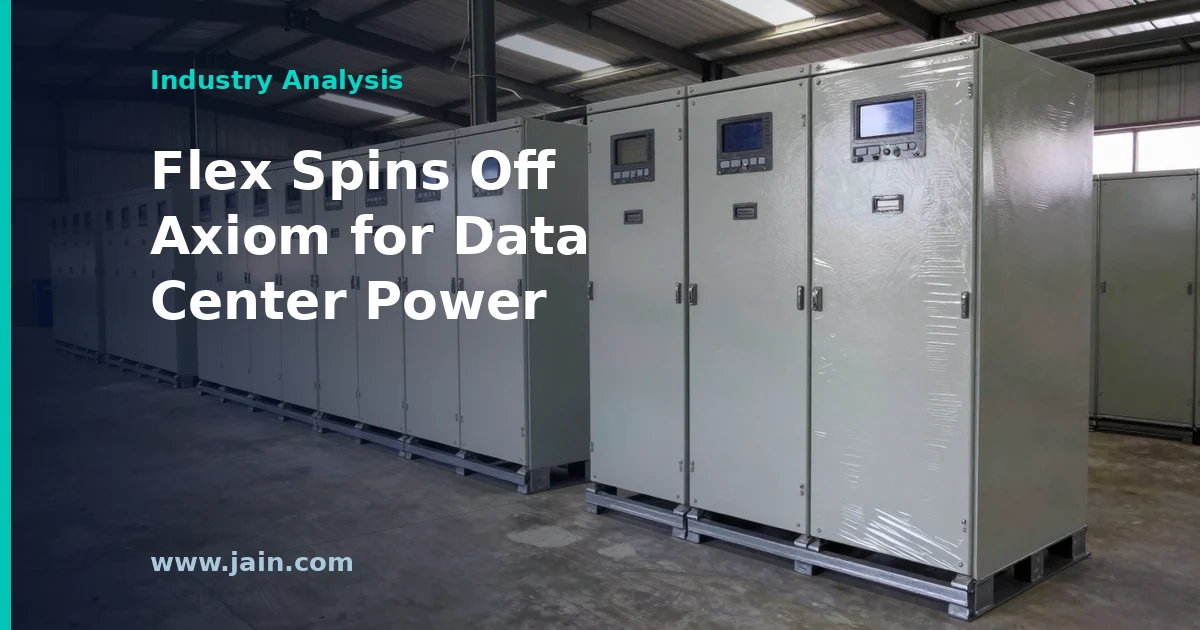
Flex, a large manufacturer that builds products for other brands, is splitting in two. Its business making power and cooling equipment for data centers, the giant buildings full of computers that run artificial intelligence tools, will become a separate company called Axiom.
On September 15, Flex named the leaders and board members for both companies. Flex’s current boss will run Axiom, and several of Axiom’s directors come from big electrical-equipment makers.
The split still needs approval from shareholders, market regulators and a court in Singapore. Flex expects to finish it in early 2027.
Flex (Nasdaq: FLEX) on September 15, 2026 unveiled Axiom Solutions International, Inc. as the name of its planned independent Cloud and Power Infrastructure company and filed a preliminary Form 10 registration statement with the U.S. Securities and Exchange Commission. A Form 10 is the document a new company files to register its shares for public trading, and it is typical of a spin-off. In a spin-off, a parent hands shares of a business unit directly to its own shareholders. In a companion announcement, also filed as Exhibit 99.1 to an 8-K dated September 15, Flex set out the expected post-separation boards of both companies, named four new directors, and said Amy B. Schwetz, most recently CFO of Flowserve, will join on October 5, 2026 and is expected to become Flex CFO after the split.
Flex expects to complete the separation in the first quarter of calendar 2027. Completion is subject to final Flex board approval, the Form 10 becoming effective, a Flex shareholder vote and approval from the Singapore High Court.
Executive Summary
The September 15 announcements move Flex’s separation plan from concept toward execution. The spin-off business now has a legal name and a registration filing, and both companies have named their leaders. Revathi Advaithi, Flex’s CEO, is expected to lead Axiom. Michael Hartung, Flex’s chief commercial officer, is expected to become CEO of the remaining Flex, which keeps the Regulated Manufacturing Services (RMS) and Integrated Technology Services (ITS) segments.
The appointments show what each company wants to be. Axiom’s board draws heavily on the electrical-equipment industry, including two Eaton veterans and a former head of electrification at ABB. That points toward competing as a power infrastructure supplier for data centers, which Flex describes as the problem of solving ‘power, heat, and scale challenges’ in the AI era. The remaining Flex board is weighted toward industrial operating and finance experience.
For investors and data center buyers, the practical result would be a dedicated power and cooling supplier that can be valued and judged separately. Flex has not yet presented many of the details that would allow that judgment, including a final capital structure and an Axiom finance chief.
The Pure-Play Bet on Data Center Power
Flex has long operated as a diversified contract manufacturer across 30 countries. Its stated reason for separating the Cloud and Power Infrastructure segment is to create focus. The forward-looking statements attached to the 8-K list the anticipated benefits as ‘enhanced strategic focus, financial flexibility, and value creation for shareholders.’ The logic is familiar. Investors who want exposure to the build-out of AI data centers, which need large amounts of electricity delivered and heat removed, may pay more for a business that does only that than for the same business inside a broader manufacturer.
That thesis is plausible, but Flex has not quantified it. Neither announcement puts a number on value creation, and Flex’s risk factors state that the benefits ‘may not be achieved or may take longer to achieve than expected.’ The strength of the pure-play case will depend on Axiom’s disclosed growth, margins and customer mix once they are tested against the market.
A Board Built From Electrical Incumbents
Axiom’s expected board shows clearly where the company intends to compete. Mark Eubanks, CEO of Brink’s, previously ran Eaton’s Electrical Products business, which Flex says had about $6 billion in annual revenue. David Johnson, CFO of Corteva, spent 29 years at Eaton, finishing in finance and operations for its Electrical Sector, and was later CFO of Atkore. Maryrose Sylvester was U.S. head of electrification at ABB. William D. Watkins, former CEO of Seagate Technology, will chair the board. Michael E. Hurlston, CEO of Lumentum, and Charles K. Stevens III, former CFO of General Motors, round it out.
Directors who helped run established electrical-products businesses bring knowledge of pricing, channels and manufacturing scale in that market. A strong board does not by itself win business, though. Whether Axiom can take share from long-established electrical suppliers is still an open question. The remaining Flex board is more of a general industrial group: George R. Oliver (former chair and CEO of Johnson Controls), Patrick J. Ward (former CFO of Cummins), Brian Yoor (former CFO of Abbott Laboratories), plus existing directors from Raytheon International, UnitedHealth Group and STATS ChipPAC. Schwetz’s background as CFO of Flowserve and Peabody Energy fits that profile.
The Governance Link Between the Two Companies
One feature deserves attention from shareholders of both companies. Advaithi is expected to be CEO of Axiom, a director on Axiom’s board and chair of the Flex board at the same time. It is common for a parent’s chief executive to move to a spun-off company. Chairing the former parent while running the new company is less routine, and it raises reasonable questions about how the two boards will handle any commercial dealings or competing interests between the companies after separation.
Flex has signaled that it is aware of the issue. It plans to appoint a Lead Independent Director of the Flex board, effective at separation. Flex has not named that person or defined the role’s authority, so investors cannot yet judge how strong a counterweight it will be.
What Still Has to Happen
The separation has several conditions. Flex is incorporated in Singapore, and the 8-K references the Singapore Companies Act. That is why the Singapore High Court must approve the transaction in addition to Flex shareholders. Flex says it will file a proxy statement on Schedule 14A to seek the shareholder vote. The Form 10 must also be declared effective, and the Flex board must give final approval. Flex expects the spin-off to be tax-free for U.S. federal income tax purposes and lists the possibility that it will not qualify as a risk.
The 8-K also discloses the pay for incoming directors Oliver and Eubanks: $90,000 in annual cash, a pro-rated share of the current restricted stock unit award, and an annual stock award worth $235,000. Oliver and Eubanks join the Flex board on September 24, 2026. Eubanks moves to Axiom’s board at separation.
Background
Flex is an Austin, Texas-based manufacturer, listed on Nasdaq and registered in Singapore, that designs, builds and manages products for other brands across 30 countries. It reports through segments that include Regulated Manufacturing Services, Integrated Technology Services and Cloud and Power Infrastructure. The last of these supplies power, cooling and IT infrastructure products that Flex says help customers speed up data center deployment.
Demand for AI computing has made electricity delivery and heat removal major constraints for data center operators. That has drawn investor attention to companies that sell power and cooling equipment. Flex’s plan to spin off Cloud and Power Infrastructure as Axiom would create a stand-alone public company focused on that market. The remaining Flex would continue as a diversified manufacturing and technology services company.
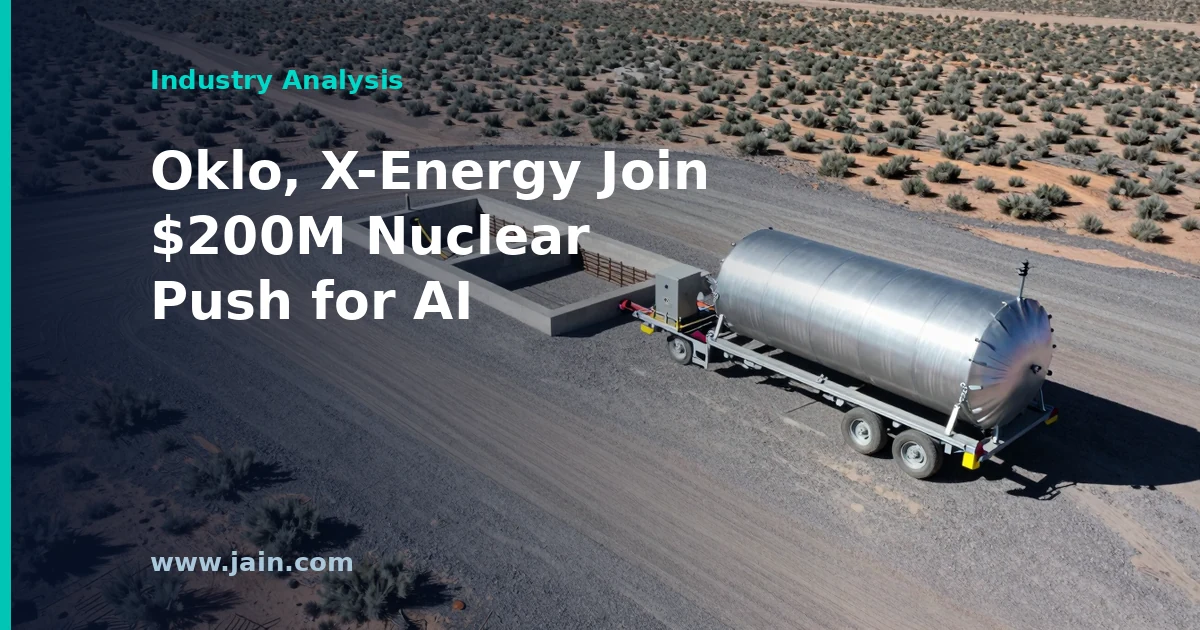
The American government is putting about $200 million into an effort to get a newer, smaller kind of nuclear power plant built faster, so it can run the giant computer warehouses behind artificial intelligence.
Two young nuclear companies, Oklo and X-Energy, have joined Microsoft and Nvidia in the program. Their share prices jumped on the news.
The catch: none of these newer reactor designs is running on a large scale in America yet. And $200 million is small next to the $17.5 billion in loans the government has offered for traditional big reactors.
Stocktwits reported on July 21, 2026, citing an internal Department of Energy (DOE) document viewed by Bloomberg, that advanced nuclear developers Oklo Inc. (NYSE: OKLO) and X-Energy Inc. (XE) are joining a $200 million federal initiative to accelerate reactor deployment for AI data centers. The program builds on earlier partnerships that already include Microsoft and Nvidia, and allocates $60 million over three years to several DOE national laboratories and academic institutions, including the University of Texas at Austin.
X-Energy shares rose as much as 12% in extended trading and Oklo as much as 9.9%. Both stocks were well down for the year at the time: Oklo by 41% and X-Energy by 27%. On September 11, Oklo filed an 8-K disclosing an at-the-market equity program that lets it sell up to $1 billion of new shares.
Executive Summary
The initiative targets three things that have kept advanced reactors off the grid: the time it takes to design a new plant, the time it takes to license it, and the time it takes to build it. It also aims to cut the number of staff future reactors need to operate. Those are the right bottlenecks to attack. First-of-a-kind nuclear projects tend to stall on engineering validation, regulatory review and construction execution, not on a lack of ideas.
The scale is modest, though. At $200 million in total, with $60 million spread over three years to labs and universities, this is a program to reduce risk and speed up development. It does not pay for construction. It sits alongside a much larger federal instrument, a $17.5 billion loan program for 10 large conventional reactors, and a policy framework, the Ratepayer Protection Pledge, that pushes big tech companies to supply their own power.
For data center operators and investors, the question is whether federal support can compress the nuclear timeline enough to matter for the current AI buildout. Oklo’s September move to line up as much as $1 billion in equity shows that most of the capital will still have to come from public markets.
Two Hundred Million Dollars Buys Speed, Not Steel
The initiative commits $60 million over three years to national laboratories and universities, an average of $20 million a year. That money pays for the work that sits upstream of construction: modeling, testing, materials and fuel data, and the technical evidence regulators need to approve a new design. Federal labs have a real comparative advantage here. They operate test facilities and hold expertise that a young reactor company would struggle to replicate privately.
Compare it with the White House’s $17.5 billion loan program supporting 10 large commercial reactors. The two tools do different jobs. Loans lower the cost of financing designs that are already understood. The $200 million initiative tries to lower the engineering and licensing risk of designs that have not yet run commercially. Neither replaces the other, and neither alone gets a first advanced reactor built.
The goal of reducing operational staffing matters more than it may sound. A nuclear plant’s ongoing costs include large security, operations and maintenance teams. If smaller advanced reactors could run with leaner crews while still meeting regulatory requirements, their economics for a single large customer, such as a data center campus, would improve.
The AI Clock Versus the Nuclear Clock
Data center demand is arriving now. The DOE projects that 300 gigawatts of new nuclear capacity will be needed by 2050 to keep pace. A gigawatt is roughly the output of one large conventional reactor. Yet commercial advanced reactors have not yet operated at scale in the United States. That gap between demand and deployment is the core tension this program is trying to resolve.
Federal money can improve the speed and quality of work that feeds into licensing, but licenses are issued by the Nuclear Regulatory Commission, which is independent of the DOE. The initiative can shorten the path to a strong application. It cannot approve one. Construction timelines depend on supply chains, skilled labor and site-specific permitting that research funding does not directly touch.
The frequently cited comparison with China deserves careful reading. China has 39 nuclear reactors under construction, according to Goldman Sachs data drawn from the World Nuclear Association. The Kobeissi Letter noted that the U.S. has no large commercial reactors under construction. Both figures describe large plants. Neither captures advanced reactor projects in design or licensing, so the comparison shows a gap in building conventional plants more than it measures the state of advanced nuclear.
The Ratepayer Pledge Creates the Buyer
Advanced nuclear developers need committed customers, and federal policy is steering tech companies toward becoming those customers. Under the Ratepayer Protection Pledge, Amazon, Google, Meta, Microsoft, OpenAI, Oracle and xAI committed to procure or build their own generation and to cover the cost of transmission grid upgrades. The goal is to shield households from rising electricity bills driven by data center growth.
That shifts the economics. Hyperscalers, the handful of companies operating the largest cloud and AI data center fleets, now carry more direct responsibility for their power supply. A carbon-free source that runs around the clock, sited near a campus, is attractive in that framework. The companies that can deliver it on a credible timeline stand to benefit.
Participation in a federal initiative is not a power purchase agreement, however. A power purchase agreement is a long-term contract to buy electricity at set terms, and it is what lenders and investors look for before funding a plant. Microsoft and Nvidia’s involvement signals interest from the demand side. Whether that turns into binding offtake for Oklo or X-Energy reactors has not been disclosed.
Markets Cheered, Then Oklo Went to the Market
The after-hours gains were real but came against steep declines for the year, 41% for Oklo and 27% for X-Energy. Twenty-five analysts had a 12-month price target of $86.50 on Oklo, 96% above its July 21 close. Targets that far above the current price reflect long-dated assumptions about when reactors reach commercial operation, which is exactly the variable this initiative is trying to shift.
On September 11, Oklo filed an 8-K announcing an equity distribution agreement with ten banks, including Goldman Sachs, BofA Securities, Citigroup, J.P. Morgan and Morgan Stanley. The agreement lets Oklo sell up to $1 billion of Class A common stock through an at-the-market program. In such a program, a company sells new shares gradually into the market at prevailing prices rather than in one large offering. Oklo will pay the agents a commission of up to 1.5%, and the shares will be issued under a shelf registration the SEC declared effective on December 4, 2025.
The filing is a reminder of the capital math. Federal programs measured in hundreds of millions reduce risk. Building reactors requires far more, and for a developer without operating plants, that money comes largely from shareholders. An at-the-market program gives Oklo flexibility on timing. Existing holders face dilution that depends on how many shares are sold and at what price. The company has sole discretion over both.
Background
Oklo and X-Energy are among a group of companies developing advanced nuclear reactors: designs smaller than the gigawatt-scale plants that make up most of the existing U.S. fleet, intended to be built faster and located closer to large energy users. Oklo, which trades on the New York Stock Exchange and reports as an emerging growth company, is developing compact fast reactors. X-Energy, whose investors include Amazon, is developing a high-temperature gas-cooled reactor design. Neither company’s reactors are yet in commercial operation.
Interest in nuclear power for data centers has grown as AI workloads push electricity demand and prices higher. Federal policy has moved on several fronts: a $17.5 billion loan program for large reactors, the Ratepayer Protection Pledge requiring major tech firms to secure their own power, and now a $200 million initiative aimed at speeding advanced reactor development, which the DOE frames against its projection of 300 gigawatts of new nuclear capacity needed by 2050.
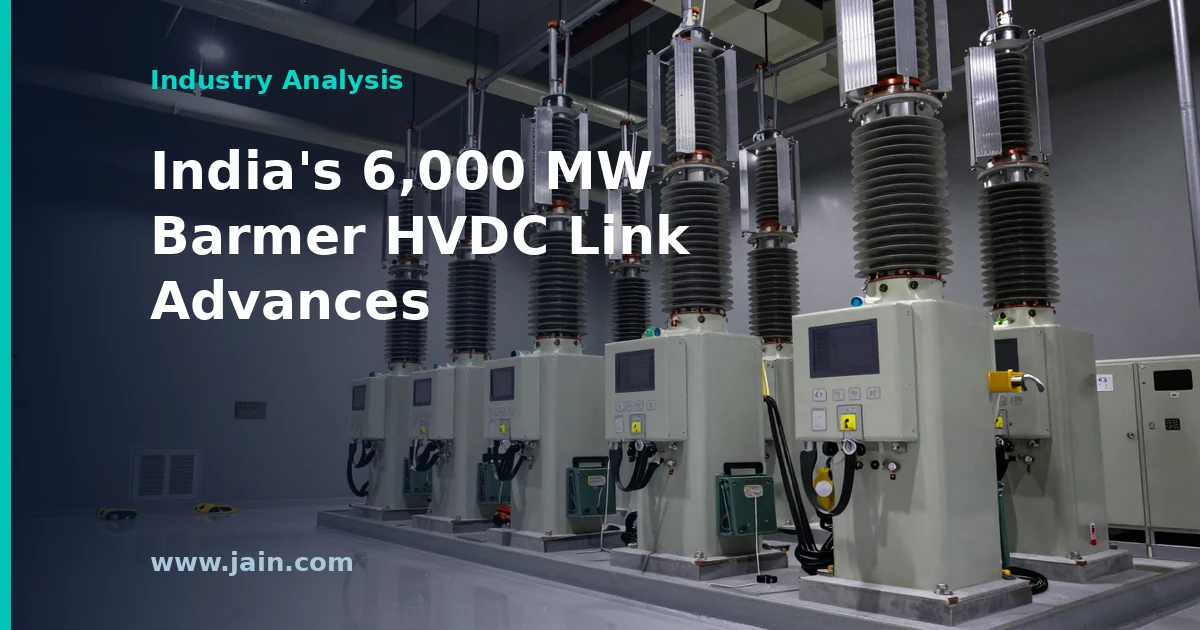
India’s state-controlled power-line company has won a project worth about 25,000 crore rupees, very roughly three billion US dollars, to build an electricity superhighway starting in Barmer, a desert district of Rajasthan crowded with solar and wind farms.
The line is designed to carry 6,000 megawatts, roughly the output of several large power stations. The Indian arm of the American company GE Vernova is reported to be the front-runner to supply the giant equipment at each end.
Why it matters: clean electricity is worthless if it cannot reach the cities, factories and data centers that need it.
Power Grid Corporation of India has secured the Barmer–South Kalamb high-voltage direct current (HVDC) transmission project, a 6,000 megawatt link valued at ₹25,000–₹26,000 crore (₹250–260 billion), Sahi Markets reported on September 7, 2026. The same report said GE Vernova T&D India emerged as the top bidder for the project’s terminal station equipment package, the converter stations that sit at either end of the line.
GE Vernova T&D India, the listed Indian subsidiary of GE Vernova, already carries an order backlog of ₹20,930 crore. Neither company has publicly confirmed the equipment award, its value or a construction schedule.
Executive Summary
The Barmer–South Kalamb award is one of the larger single transmission projects in India’s current build-out. At 6,000 megawatts, it is sized to move bulk renewable output from western Rajasthan, where land and sunshine are plentiful but local demand is modest, across long distances to consuming regions. HVDC is the technology of choice for that job because direct current loses less energy over long distances than conventional alternating current lines and lets grid operators control exactly how much power flows.
For the equipment supply chain, the significance is concentration. The terminal stations are the most technically demanding and valuable part of an HVDC system, and only a small number of manufacturers worldwide can deliver them. If GE Vernova T&D India’s reported position converts into a signed contract, it would add a substantial project to a backlog that is already more than four-fifths the size of the entire transmission scheme’s reported value.
For data center developers and other large power buyers, the story is a reminder that India’s clean-energy constraint is shifting from generation to delivery. Wind and solar capacity can be built in a few years; the transmission corridors that carry it to load centers take longer and depend on a thin supplier base.
Transmission Is Becoming the Scarce Asset
Renewable generation in India has clustered where resources are best, and Rajasthan’s Barmer region is a prime example. The problem is that the electricity is needed hundreds of kilometers away. Without enough transmission, solar and wind farms face curtailment, meaning they are ordered to cut output because the grid cannot absorb it. That makes long-distance corridors, rather than panels or turbines, the practical limit on how fast clean power reaches customers.
A 6,000 megawatt HVDC link is a direct response to that constraint. Unlike a conventional AC line, which spreads power across the network according to physics, an HVDC link behaves more like a pipeline with a valve: operators set the flow. That controllability is valuable for managing variable renewable output and for keeping regional grids stable as more intermittent supply is added.
A Narrow Supplier Base Holds Pricing Power
Converter stations, the equipment that turns alternating current into direct current and back again, are built by a small club of global manufacturers. That scarcity cuts two ways. Suppliers with local manufacturing and engineering capability, as GE Vernova T&D India has, are well placed to win work as India expands its HVDC pipeline. Buyers, meanwhile, face long lead times for transformers, valves and control systems, and limited competition on price.
A large existing backlog is both a strength and a question. The reported ₹20,930 crore order book signals demand visibility, but it also means new projects compete for the same factory slots, engineers and commissioning crews. Execution capacity, not order intake, is often what separates strong years from delayed ones in heavy electrical equipment.
What It Means for Data Center Power
India’s data center market is growing alongside rising demand for cloud and AI computing, and operators increasingly want renewable supply to meet customer sustainability targets. Most large campuses sit near major cities and connectivity hubs, not in the desert where renewable power is cheapest to generate. Corridors like Barmer–South Kalamb are what make long-distance renewable procurement, through open-access or power purchase arrangements, physically deliverable.
The project has not been tied to any specific data center or industrial customer, and it would be a stretch to read it as a data center announcement. The more measured takeaway is structural: large power buyers planning multi-year expansions in India should treat transmission timelines as a core site-selection and procurement risk, alongside land, water and fiber.
Background
India is building out large volumes of solar and wind capacity, much of it in resource-rich western states such as Rajasthan and Gujarat, far from major consumption centers. Moving that power requires new high-capacity transmission corridors, and HVDC links are increasingly used for the longest, highest-volume routes. Power Grid Corporation of India, the state-controlled central transmission utility, builds and operates much of this interstate network.
GE Vernova T&D India is the Indian-listed transmission and distribution subsidiary of GE Vernova, the energy equipment company spun off from General Electric. It manufactures and supplies grid equipment such as transformers, switchgear and HVDC systems, and it has benefited from utilities’ rising investment in grid expansion and modernization.
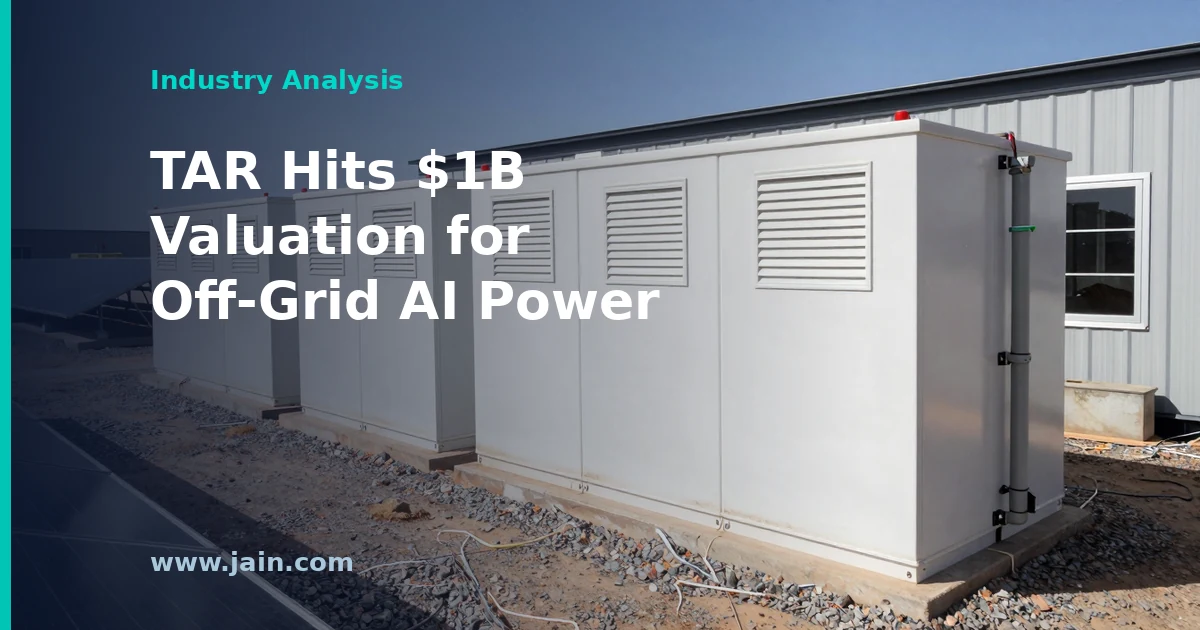
TAR, a Texas company started only this year, has raised $120 million from investors who now value it at $1 billion.
It builds private power plants for the giant computer warehouses behind artificial intelligence tools. The plants use renewable energy and huge batteries, and never plug into the public electricity grid.
Why it matters: these warehouses use so much electricity that many wait years to be connected. TAR says its approach lets them get power without competing with nearby homes and businesses for it.
Austin-based TAR has raised $120 million in Series A funding at a $1 billion post-money valuation, Pulse 2.0 reported on September 11, 2026. Spark Capital led the round. TAR was founded in 2026 by Pat Becker and Leonhard (Lenny) Soenke. It builds self-contained, modular power systems that combine renewable generation with battery storage and run independently of the electric grid, aimed at AI data centers at gigawatt scale.
The company says the money will expand its Austin headquarters and its San Francisco engineering office. It will also grow manufacturing and logistics operations in West Texas and speed up deployments already underway. Those deployments include a utility-scale project with one of the largest neoclouds, a dedicated project campus, and TAR Terminal One, a manufacturing and logistics center in West Texas.
Executive Summary
TAR’s raise is one of the clearest signs yet that investors see off-grid power for AI as a business category in its own right. It is no longer just a temporary fix for data centers waiting on a utility hookup. A company founded this year has reached unicorn status on its first institutional round by promising dedicated renewable-plus-battery generation that it designs, builds and operates itself.
The thesis rests on two claims. The first is that power, not chips, is now the binding constraint on AI computing. The second is that the fastest way to supply it is to own the whole project lifecycle and automate construction. TAR pairs energy veterans from Hut 8, AES and Vistra with robotics engineers from Zipline, GrayMatter Robotics and Lucid Motors, which suggests an attempt to treat power plant construction partly as a manufacturing problem.
What the company has not yet made public matters as much as the valuation. TAR has not disclosed installed megawatts, its customer’s name, contract terms or project timelines. The central engineering question for any off-grid system serving round-the-clock computing is how it maintains reliable supply, and TAR has not yet explained its approach.
Off-Grid Power Gets Its Own Venture Price Tag
For much of the data center boom, on-site generation has been framed as a bridge. It energizes a campus while the project waits in a utility’s interconnection queue, the line of projects awaiting approval to connect to the grid. A $1 billion post-money valuation for a company founded in 2026 suggests Spark Capital sees something more durable: a standalone category in which generation is built and run as a permanent, dedicated supply for computing.
The arithmetic is instructive. A $120 million raise at $1 billion post-money implies a pre-money valuation of roughly $880 million. TAR reached that figure without publicly disclosing completed megawatts, contracted revenue or a named customer. At that level, investors are paying for team, speed and position in a market where, as Spark’s Will Reed put it, “power is becoming the main bottleneck to scaling compute.” It is a bet on the size of the problem as much as on a track record.
The deal also points to a shift in where AI infrastructure capital goes. Energy assets have traditionally been funded by utilities, infrastructure funds and project lenders, who price them for steady, bond-like returns. A venture-style valuation for a power developer implies that some investors now treat the speed of energy delivery, and not only its cost, as a source of technology-like upside.
Owning the Whole Stack: Faster Delivery, Concentrated Risk
TAR’s strategy is vertical integration. It handles site selection, detailed engineering, procurement, logistics, civil construction, commissioning and ongoing operations itself, rather than coordinating a chain of outside contractors. The reasoning is that schedules tend to slip at the handoffs between firms. Co-founder Pat Becker said gigawatt-scale deployments (a gigawatt is a thousand megawatts, comparable to the output of a large power plant) “in tight time windows necessitate owning the full stack end-to-end.”
The company’s purpose-built deployment automation stack is meant to install generation faster, at larger scale and with less field labor than conventional construction. If it works, the limit on how fast power can be built shifts away from the supply of skilled field crews and toward factory and logistics throughput. TAR Terminal One in West Texas appears designed to supply that throughput.
The trade-off is concentration of risk. A contractor ecosystem spreads execution risk across many firms, while an integrated developer carries all of it. TAR must scale engineering, robotics, manufacturing, logistics and field operations at the same time. That is capital-intensive and operationally demanding. TAR has not yet disclosed completed projects that show its automation claims working at scale.
The Reliability Question for Renewables Plus Batteries
AI data centers run around the clock, and their customers expect very high uptime. A grid connection offers a backstop when on-site generation falls short, and an off-grid system has no such backstop. TAR describes its systems as combining renewable generation with battery storage and operating independently of the grid. The design therefore has to cover periods of weak sun or wind entirely on its own.
That problem can be solved in several ways: oversizing generation, adding longer-duration storage, or including firm backup generation. Each adds cost, equipment and land. How TAR balances these choices will largely decide whether its power competes on price and reliability with grid electricity or with gas-fired on-site plants, the other common off-grid option.
TAR’s community argument does resonate. Its systems do not draw on shared grid capacity, so the company says data center projects can add generation without competing with surrounding communities. That matters in siting debates, where the effect of very large facilities on local electricity supply and prices is a recurring concern.
Who Stands to Gain if the Model Works
Neoclouds are natural early customers. These are cloud providers that specialize in renting out GPU computing for AI, as opposed to the broad hyperscale clouds. They compete heavily on how quickly they can bring capacity online, which makes long grid timelines especially costly for them. TAR says it is already executing a utility-scale deployment with one of the largest neoclouds, a sign that its offer has found at least one buyer with urgent demand.
For utilities and grid operators, the effects are mixed. Off-grid campuses ease pressure on congested transmission lines, but they also mean large new electricity users that never become utility customers. Suppliers of batteries and generation equipment, along with West Texas manufacturing and logistics workforces, stand to benefit from any sustained buildout. TAR’s competition includes other on-site power developers and the traditional engineering and construction firms whose multi-contractor model it is explicitly positioning against.
Background
AI data centers use far more electricity than traditional facilities, and in many regions connecting a new large user to the grid means joining a long interconnection queue and waiting for new transmission and generation. That has pushed developers toward “behind-the-meter” power: generation built on or next to the site that serves the data center directly. Such projects have often been treated as temporary bridges until a grid connection arrives.
TAR, founded in 2026 in Austin, is pursuing the off-grid approach as a permanent model. It uses modular renewable generation and battery storage and manages projects end to end. Its lead investor, Spark Capital, is a venture capital firm. The company’s leadership draws on experience at energy and infrastructure companies including Hut 8, AES and Vistra, as well as robotics and hardware companies Zipline, GrayMatter Robotics and Lucid Motors.
Shanghai Electric, a large Chinese engineering company, has won its first order outside China for the giant gas-burning engines that drive power station generators. They will go into a new power plant in Malaysia.
Why it matters: the few American, European and Japanese firms that dominate this business have waiting lists stretching years, partly because artificial intelligence needs so much electricity. A new supplier promising machines from 2028 could give power-hungry countries another option, if its equipment proves itself abroad.
Shanghai Electric (SEHK: 02727, SSE: 601727) announced in a press release on September 14, 2026 that it has won the contract for Unit 3 of the Sarawak Samalaju Combined Cycle Gas Turbine (CCGT) Project in Malaysia, which the company describes as a 500 MW project. It is the Chinese manufacturer’s first overseas order for heavy-duty gas turbines, the large industrial machines used in utility-scale power plants.
The company will deliver the plant on an EPC (engineering, procurement and construction) turnkey basis and provide a 25-year long-term service agreement covering all major equipment. The customer is identified only as a Malaysian energy developer, and no contract value was given.
Executive Summary
The deal is broader than a turbine sale. Shanghai Electric says it will build the whole gas-fired plant and manufacture every core component itself: the gas turbines, the steam turbines, the generators, the heat recovery steam generators (boilers that capture hot turbine exhaust to make steam) and the air-cooled systems. It will also be the sole maintenance and service provider for 25 years, a bundle the company says puts it on par with the established leaders in heavy-duty gas turbines.
The timing matters. Demand for gas-fired generation has surged, driven in part by electricity-hungry AI data centers, and the dominant turbine makers, GE Vernova, Siemens Energy and Mitsubishi Heavy Industries, are working through backlogs that push new deliveries years out. Shanghai Electric says it can deliver new units as early as 2028 and that developers in Indonesia, Thailand, the Philippines and Vietnam have expressed strong interest. If that interest turns into orders, Chinese manufacturers could become a real alternative in a market with few suppliers.
For now this is one contract with an unnamed customer and undisclosed terms. It is a meaningful first step abroad, not yet proof of international competitiveness at scale.
A Seller’s Market Opens a Door
Heavy-duty gas turbines are among the hardest machines in the energy industry to make. They run at extreme temperatures, need advanced materials and cooling designs, and have to operate reliably for decades. Only a handful of companies build them at utility scale, which gives buyers little leverage when demand rises. Demand has risen sharply: utilities are replacing coal, balancing intermittent renewables and, increasingly, supplying power to large data center campuses. The incumbents have responded with fuller order books and longer waits for new units.
That is the opening Shanghai Electric is aiming at. Its claim that new units could ship as early as 2028 is its most commercially pointed statement, because developers who cannot secure turbines cannot build plants. For a buyer facing a multi-year wait, an earlier delivery slot can outweigh a supplier’s shorter international track record. The release does not say, however, how many 2028 slots exist or whether the Malaysian project will use one of them.
The likely early winners are developers in markets where cost and schedule matter most and where Chinese engineering and financing are already familiar. The established manufacturers are unlikely to feel much effect in the near term; one contract does not change a global order book. The bigger question is whether a credible alternative supplier eventually eases pricing power in a market that has run tight.
The Turnkey Bet: Building It and Keeping It Running
A combined cycle plant burns natural gas in a gas turbine, then uses the turbine’s hot exhaust to raise steam for a second turbine, getting more electricity from the same fuel. Shanghai Electric’s decision to make all the core parts in-house and wrap them in an EPC contract means the customer deals with a single counterparty for design, equipment, construction and integration. That simplifies coordination and puts responsibility for performance in one place.
The 25-year service agreement may be the most important piece economically. Across the industry, long-term service contracts covering inspections, replacement parts and overhauls are a large and steady source of revenue for turbine makers over a plant’s life, often more durable than the original equipment sale. Securing one on its first overseas heavy-duty project gives Shanghai Electric a recurring revenue stream and, just as valuable, a site outside China where its equipment will build an operating record.
For the customer, the trade-off cuts both ways. Single-source responsibility is simpler, but it concentrates risk: if the equipment underperforms or parts supply is disrupted, there is no second vendor to turn to for major components during the service term. The strength of that arrangement will depend on performance guarantees and penalty clauses, which have not been disclosed.
What the Track Record Does and Does Not Show
Shanghai Electric cites 103 heavy-duty units delivered, more than 21,000 MW of installed capacity from commissioned projects, and more than 1.3 million operating hours on units under its long-term service programs. For scale, a single turbine running around the clock accumulates about 8,760 hours a year, so 1.3 million hours is a substantial fleet history. Its current lineup has two principal models, rated at 300 MW and 78 MW.
Because this is the company’s first overseas heavy-duty order, that record appears to have been built mainly in its home market. Domestic experience is real engineering evidence, but international buyers and lenders typically also look at availability rates, efficiency, emissions performance and how well a supplier supports equipment far from its home base. The release gives no figures on any of those, so the claim of parity with global leaders is the company’s own assessment for now.
Southeast Asia as the Proving Ground
Southeast Asia is a logical first market. Economies across the region are growing, electricity demand is rising, and several countries are adding gas-fired capacity as they move away from coal. Malaysia has also become a major destination for data center investment, adding to pressure on its power system, although nothing in the announcement ties the Samalaju plant to data center load.
Shanghai Electric’s statement that developers in Indonesia, Thailand, the Philippines and Vietnam have shown strong interest should be read carefully: expressions of interest are not orders. Still, it points to a sales strategy of winning a reference project nearby and using it to win the next one. How smoothly Samalaju Unit 3 is built and runs will likely do more for that pipeline than any announcement.
Background
Shanghai Electric is a Chinese industrial group listed in Hong Kong (02727) and Shanghai (601727) that makes power generation equipment, including steam turbines, generators and gas turbines. Its heavy-duty gas turbine business has built a fleet of more than 100 units, mainly in its home market, and the Samalaju contract is its first heavy-duty gas turbine order outside China.
The heavy-duty gas turbine market has long been dominated by GE Vernova, Siemens Energy and Mitsubishi Heavy Industries, whose order books have lengthened as demand for gas-fired generation has grown. Samalaju is an industrial area in the Malaysian state of Sarawak on the island of Borneo, where electricity demand from industry has driven power development.
Fermi is a young company trying to build a huge private power and computing campus to run artificial intelligence systems. Its founder, Toby Neugebauer, was removed as chief executive in April but still owns about a fifth of the company.
He has now formally asked the board to hire an outside bank to test whether selling the company, or bringing in a big partner, would be worth more than going it alone. Shareholders meet October 30.
The stock has dropped about a fifth since April, a sign investors doubt the giant project will get built on schedule.
Toby Neugebauer, co-founder and largest shareholder of Fermi Inc. (Nasdaq: FRMI), stepped up pressure on the company’s board ahead of its October 30 annual meeting. Neugebauer’s group, the Fermi Founder Parties, holds approximately 22% of shares outstanding. In a statement issued September 11 via PR Newswire, the group said it sent the board a letter on September 9 and a presentation on September 10. On September 10 it also submitted a shareholder proposal under SEC Rule 14a-8. The proposal asks the board to retain an independent, nationally recognized investment bank to evaluate extraordinary transactions, including a full-value sale or a majority recapitalization with a strategic partner, and to report the results to shareholders.
Neugebauer also asked the board to voluntarily put two non-binding questions to shareholders. One would restore pre-IPO voting standards in place of a 70% supermajority adopted since April. The other would raise the company’s 2.5% ownership limit to 9.8%. The statement said Fermi shares hit an intraday low of $5.26 on September 10, down roughly 20% since Neugebauer was removed as CEO on April 17.
Executive Summary
The founder of an AI power-campus developer is using the formal shareholder-proposal process to force a question onto the agenda: is Fermi worth more as a standalone company or in a transaction? Neugebauer is careful to say he has never asked the board to sell. His proposal explicitly leaves the existing standalone plan in place and asks only that alternatives be tested against it by an independent banker. He also stated that his group is not soliciting proxies.
The fight matters beyond one company. Fermi went public in October 2025 pitching Project Matador as a private utility, with its own power, transmission and water on a single scalable campus for AI compute. Neugebauer’s critique rests on specific gaps. The one disclosed tenant lease, 222 megawatts with TensorWave, is under 5% of Fermi’s stated 4.8 gigawatts of near-term power opportunity. As of September 10, he says, supporting guarantees and project financing for that lease had not been confirmed. And the company still has no permanent outside CEO.
For investors in gigawatt-scale energy and data center developments, the episode illustrates how quickly confidence can erode. When projects are mostly still potential, the market reacts to leadership turmoil, unconfirmed financing and governance rules that limit shareholder influence.
A Modest Ask With Pointed Timing
Rule 14a-8 is the SEC mechanism that lets eligible shareholders place a proposal in a company’s proxy materials, the documents shareholders receive before voting. Such proposals are typically advisory. Even if one passes, the board is not legally required to act, though ignoring a strong vote carries reputational cost. The proposal is also narrowly drawn: hire an independent bank, test a sale or majority recapitalization against the standalone plan, and report back. A recapitalization means bringing in new capital that would change who controls the company. It is hard to argue against gathering that information in principle, which is likely the point.
The timing is deliberate. Neugebauer paused an earlier proxy contest, meaning a campaign to win shareholder votes for his own positions or nominees. He now says he expected the board to finalize counterparty agreements his team had negotiated, on the terms agreed, and that execution has stagnated instead. Rather than restart a full contest, he is using lower-cost tools: a proposal, a public letter, and a request that the board voluntarily add advisory questions. That keeps pressure on without the expense and escalation of a formal vote-solicitation campaign, while positioning him to argue later that the board refused reasonable requests.
The board’s side of the story does not appear in Neugebauer’s statement. The company has previously said it completed all five objectives of its 90-day plan, as of August 13. Shareholders will need its response to weigh the founder’s characterization of those milestones.
222 Megawatts Against a 4.8-Gigawatt Story
The core economic tension is scale. A megawatt is a unit of power capacity. A gigawatt is 1,000 megawatts, roughly the output of a large power plant. Fermi’s stated near-term power opportunity is 4.8 gigawatts, and its disclosed TensorWave lease is 222 megawatts, about 4.6% of that figure. For a company valued on the promise of a multi-gigawatt campus, the gap between contracted demand and stated potential is what investors are pricing.
Financing is the second pressure point. Neugebauer says that as of the morning of September 10, Fermi had not confirmed the guaranteed agreement it previously said would support the TensorWave lease. He also says it had not confirmed that project financing was secured. In data center development, a signed lease is only as valuable as the tenant’s credit, or the guarantee standing behind it. That credit support is often what unlocks construction loans. Until those pieces are confirmed, the lease reads as a milestone rather than de-risked revenue.
The stock-price figures in the statement also deserve a careful reading. Shares are down roughly 20% since April 17, 35% since July 2, and 20% since August 13. Taken together, those numbers imply shares traded higher in early July than on the day Neugebauer was removed. They also imply shares were near April levels by mid-August. The decline has not been a straight line from the leadership change, which complicates attributing it to any single board decision.
Governance Rules as a Valuation Lever
Two of Neugebauer’s requests concern who can own and influence Fermi. The first targets voting standards adopted since April. Amending bylaws now requires a 70% supermajority, and electing directors requires a majority of all outstanding shares. He wants to restore the standards discussed before the IPO: a majority of shares outstanding for bylaw changes, and a plurality of votes cast for directors. A plurality vote means the candidates with the most votes win, even without an outright majority. Higher thresholds make shareholder-initiated change harder to achieve, particularly when turnout is incomplete. Boards commonly defend such provisions as protection against a single large holder gaining effective control without paying other shareholders a premium. With a 22% holder in a dispute with the board, that argument is plausible here. Fermi’s own stated rationale is not included in the release.
The second request concerns Fermi’s real estate investment trust (REIT) ownership limit. REITs are tax-advantaged property companies, and they must avoid concentrated ownership under federal tax rules. For that reason their charters typically cap how much any one holder can own. Neugebauer notes that peers such as Digital Realty, Equinix and Prologis use 9.8%, while Fermi’s general limit is 2.5%. A lower cap restricts how large a position any single institution can build. That can thin out the pool of large, long-term buyers, and some investors view that as a drag on valuation. Raising it would widen the potential shareholder base. Whether that would change the stock’s trajectory more than delivering contracts and financing would is an open question.
Leadership Uncertainty and Counterparty Confidence
Neugebauer argues that counterparties considering committing billions to Project Matador want to know who is running the company. After a four-month search, Fermi named board member Lee McIntire as CEO. Neugebauer contends that the choice showed no outside candidate would take the role, and says the company itself described McIntire as a temporary solution. The first point is his inference rather than an established fact; searches end with internal appointments for many reasons. The underlying concern is still reasonable. Large tenants, lenders and equipment suppliers weigh management continuity when signing long-dated commitments.
Neugebauer’s own claims warrant scrutiny too. The contention that Fermi is a one-of-a-kind asset, and significantly undervalued, is an argument, not a demonstrated valuation. He says counterparties had agreed to terms while he led the company, but those terms have not been made public. His request that the board release all written communications with him since the IPO could clarify the record for both sides. His stake also gives him an obvious interest in a higher share price. That interest aligns with other shareholders on value, though not necessarily on control.
Background
Fermi Inc., doing business as Fermi America, went public on Nasdaq under the ticker FRMI on October 1, 2025. It was capitalized around Project Matador, which the company describes as a private utility campus. The campus would supply its own power, transmission and water for AI computing at scale, with the stated aim of avoiding added burden on public infrastructure and local ratepayers. The company is organized with a real estate investment trust ownership structure. It reports a near-term power opportunity of 4.8 gigawatts and a disclosed 222-megawatt lease with TensorWave.
Co-founder Toby Neugebauer was removed as CEO on April 17, 2026. Since then, according to Neugebauer, the board adopted a 70% supermajority to amend bylaws and a majority-of-outstanding-shares standard to elect directors. On July 2 it removed the option of a dual-path strategic process, and on August 13 it announced completion of its 90-day plan. Neugebauer launched and later paused a proxy contest. He has also publicly criticized a $375 million convertible note offering, which he tied to former CFO Miles Everson’s resignation from the board. Board member Lee McIntire has since been named CEO.