The North American Electric Reliability Corporation (NERC) has issued a Level 3 alert — the highest tier in its alert system, and one it has used only a handful of times in its history — mandating that grid entities take action to address data center load-loss events, as reported by Utility Dive on May 4, 2026. Load-loss events occur when large blocks of data center demand disconnect from the grid suddenly and simultaneously, typically during a voltage disturbance, leaving grid operators to manage an abrupt surplus of generation.
Executive Summary
NERC alerts come in three escalating levels: Level 1 advisories are informational, Level 2 recommendations ask industry to consider actions and report back, and Level 3 “Essential Action” alerts — which require approval by NERC’s board and carry mandatory reporting obligations — direct registered entities to take specific actions. By reaching for its strongest instrument short of a formal reliability standard, NERC is signaling that mass data center disconnections have moved from an academic concern to an operational risk it believes the industry must address now, not after the next major disturbance.
The timing matters. Data centers, driven heavily by AI computing demand, represent the fastest-growing category of large electric load in North America. When a routine transmission fault causes hundreds or thousands of megawatts of that load to transfer to on-site backup power in the same instant, the grid experiences the mirror image of losing a large power plant — and grid protection systems were largely designed around the latter problem, not the former. This alert effectively puts utilities, grid operators, and by extension their data center customers on notice that ride-through behavior is now a reliability obligation, not a private design choice.
Why a Level 3 Alert Is the Grid’s Equivalent of a Fire Alarm
NERC, the FERC-certified reliability organization for the North American bulk power system, issues Level 3 alerts rarely — prior uses have been reserved for systemic threats such as extreme cold weather preparedness after major winter grid failures. Unlike advisories, a Level 3 alert obligates recipients to act and to report what they have done. That distinction matters because the normal path for imposing new grid requirements — drafting and balloting a mandatory reliability standard — can take years. An Essential Action alert is the fastest mechanism NERC has to change industry behavior at scale.
Choosing that mechanism for data center load loss tells us two things. First, NERC’s technical analysis of past disturbance events has evidently convinced it that the risk is material today, at current data center penetration, rather than a projection for the 2030s. Second, it suggests NERC is unwilling to wait for the standards process — or for voluntary industry guidelines — to close the gap. The reasonable inference is that standards work will follow, with the alert serving as the bridge.
The Physics of Losing Load: Why Disconnection Is as Dangerous as a Plant Trip
Grid stability depends on generation and consumption balancing continuously. The industry has spent decades engineering around the sudden loss of a large generator. The inverse problem — sudden loss of a large load — produces the same imbalance in the opposite direction: frequency and voltage rise, and generators must ramp down quickly. Data centers are uniquely prone to causing it because they are designed for near-perfect uptime. When sensors detect a voltage sag from a routine transmission fault, uninterruptible power supply (UPS) systems and transfer switches shift the facility to batteries and generators in milliseconds. Each facility is behaving rationally; the grid experiences hundreds of rational decisions as one massive, uncontrolled event.
This is not hypothetical. NERC’s own disturbance analysis documented a 2024 event in Northern Virginia — the world’s densest data center market — in which dozens of facilities totaling roughly 1,500 MW disconnected simultaneously in response to a fault, an event NERC’s Large Loads Task Force has studied extensively since. As individual campuses grow from tens of megawatts toward gigawatt scale, a single region’s synchronized ride-through failure starts to approach the size of contingencies grids plan for when their largest nuclear units trip offline.
The Compliance Gap: NERC Regulates Utilities, Not Data Centers
There is a structural awkwardness at the heart of this alert: NERC’s authority runs to registered entities — utilities, transmission operators, balancing authorities — not to data center operators, who are simply customers. Generators have long faced mandatory ride-through requirements obliging them to stay connected through routine disturbances; comparable requirements for large loads have not existed. Any action mandated by this alert therefore has to flow through intermediaries, most likely via interconnection agreements, tariff provisions, and operating studies that utilities impose on their large-load customers.
That transmission chain creates both friction and leverage. Friction, because retrofitting ride-through behavior into existing facilities touches UPS configurations, protection settings, and uptime guarantees that operators consider core to their business and, in some cases, to their contractual service-level commitments. Leverage, because data center developers are currently queuing for grid capacity in nearly every major market — utilities negotiating multi-hundred-megawatt interconnections have more bargaining power today than at any point in memory. Expect ride-through specifications to become a standard term of large-load interconnection, and expect equipment vendors who can certify grid-friendly UPS behavior to find a receptive market.
Winners, Losers, and the Cost Question
For hyperscalers and colocation operators, the near-term cost is engineering effort and potentially revised protection settings; the longer-term risk is that ride-through obligations complicate the uptime architectures customers pay premium prices for. Facilities that can demonstrate they stay connected through disturbances may find interconnection approvals faster — a meaningful competitive edge when grid access, not land or capital, is the binding constraint on data center growth. Utilities gain a mandate they can point to when asking sophisticated customers to accept new technical requirements. The clearest beneficiaries may be power-equipment and controls vendors, since grid-aware UPS systems, smarter transfer logic, and monitoring that documents ride-through performance all become salable compliance infrastructure.
The unresolved tension is economic: someone must pay for retrofits, studies, and any incremental risk to uptime. If the costs land on data center operators, expect pushback framed around reliability commitments to their own customers. If they land on utilities, they ultimately reach ratepayers. The alert forces that negotiation to begin; it does not settle it.
Background
Data centers have become the defining load-growth story of the 2020s power sector, with AI training and inference driving interconnection requests measured in gigawatts across markets like Northern Virginia, Texas, and the Midwest. As that load concentrated, grid engineers identified an emergent failure mode: facilities built for maximum uptime disconnect en masse during routine disturbances, creating sudden supply-demand imbalances. NERC — the FERC-certified reliability regulator for the North American bulk power system — began studying the issue through disturbance reports and its Large Loads Task Force after documented multi-facility disconnection events, most prominently a roughly 1,500 MW simultaneous loss in Northern Virginia in 2024.
NERC’s alert system escalates from Level 1 advisories through Level 2 recommendations to Level 3 Essential Actions, which require board approval and mandatory response. Level 3 alerts have historically been reserved for systemic threats — notably extreme cold weather preparedness following major winter grid emergencies — making this application to data center load behavior a notable elevation of the issue.
E&E News by POLITICO reported on May 4, 2026 that the AI boom has prompted a rare formal warning of “significant risks” to the electric grid. The warning, attributed to grid operators, centers on the reliability challenges created by rapid AI data-center load growth — the surge in electricity demand from facilities built to train and run artificial-intelligence models.
Executive Summary
According to the report, the organizations responsible for keeping the lights on have moved beyond quiet concern to an explicit, on-the-record caution: the pace and scale of AI-driven data-center demand now pose “significant risks” to grid reliability. In the deliberately understated language of the power sector, where public warnings are infrequent and carefully worded, a formal statement of this kind is a notable escalation.
Why it matters: grid operators and reliability bodies are the institutions that decide whether new large loads can connect, how much generation and transmission must be built, and what margins the system must hold in reserve. When they formally flag a risk, that assessment flows into planning studies, interconnection decisions, and regulatory proceedings. For data-center developers, utilities, and the AI companies driving demand, the message is that electricity availability — not land, chips, or capital — may be the binding constraint on the buildout, and that the institutions controlling that constraint are now on notice.
Why a Formal Warning Is a Turning Point
Grid reliability institutions are structurally conservative communicators. Their public assessments are consensus documents, reviewed by member utilities and regulators, and they rarely single out a demand-side trend as a named risk. That is what makes the reported warning newsworthy: the characterization of AI data-center load growth as posing “significant risks” is the kind of language that, once issued, becomes a reference point in rate cases, interconnection disputes, and legislative hearings.
The practical effect of such warnings is less about any single blackout scenario and more about institutional permission. Utilities that want to slow-walk large interconnection requests, regulators that want to impose cost-allocation conditions on data centers, and states weighing incentives for the industry can all now cite an authoritative reliability finding. In power planning, the paper trail matters.
The Mismatch Behind the Alarm
The underlying tension is one of timescales. A large data center can be designed, financed, and built in roughly two to three years, and AI developers are announcing capacity at an unprecedented cadence. The grid assets needed to serve that load — high-voltage transmission lines, large generators, transformers — routinely take far longer to permit and construct. When demand arrives faster than supply infrastructure can, the system’s cushion shrinks, and reliability planners see exactly the kind of risk the reported warning describes.
Compounding the problem is forecasting uncertainty. Utilities plan around load forecasts, and data-center demand is uniquely hard to forecast: projects are speculative, developers often file duplicate interconnection requests in multiple territories while shopping for power, and a single hyperscale campus can rival the demand of a small city. Planners face risk in both directions — underbuilding invites shortfalls, while overbuilding for phantom load can leave other customers paying for stranded infrastructure.
Winners, Losers, and the New Power Calculus
If reliability concerns harden into policy, the advantage shifts to data-center operators who bring solutions rather than just load: projects with secured long-term power contracts, on-site or co-located generation, meaningful backup capacity, or genuinely flexible demand that can reduce consumption during grid stress. Flexibility is emerging as a currency — a data center that can curtail (temporarily reduce) its draw during peak hours is a far easier interconnection decision than one requiring firm power around the clock.
The losers in a constrained environment are late-arriving projects in saturated markets, and potentially ordinary ratepayers if the costs of grid expansion are not allocated cleanly to the loads driving it. For utilities, the moment cuts both ways: data centers represent the largest load-growth opportunity in decades — and therefore revenue — but also a source of operational and political risk if reliability suffers. How regulators referee that tension will shape power planning for the rest of the decade.
Background
For roughly two decades before the AI boom, electricity demand in the United States was essentially flat, and grid planning settled into a routine of modest, predictable adjustments. That era ended when the generative-AI wave set off a race to build data centers at unprecedented scale, pushing utilities to revise load forecasts sharply upward and filling interconnection queues — the waiting lists for connecting new facilities to the grid — across multiple regions.
Grid reliability in North America is overseen by a layered system: regional grid operators run the transmission network day to day, while reliability organizations set standards and publish periodic assessments of whether the system can meet projected demand. Those assessments had grown increasingly pointed about surging data-center load in the years before this reported warning, making the May 2026 statement the continuation — and apparent sharpening — of a trend the power sector has watched closely.
The North American Electric Reliability Corporation (NERC) — the regulatory body responsible for the reliability of the bulk power system in the United States and Canada — has issued a warning that the rapid growth of data-center electricity demand risks overtaxing the grid, according to reporting by Latitude Media published May 3, 2026. The alert places the AI-driven data-center build-out squarely among the leading reliability risks facing the North American power system.
Executive Summary
NERC is not a trade group or an advocacy organization: it is the FERC-certified Electric Reliability Organization whose standards are mandatory and enforceable for grid operators across North America. When NERC elevates a risk, utilities, regional transmission organizations, and regulators are expected to respond. The reported warning frames unchecked data-center load growth — the wave of large, concentrated electricity demand from AI and cloud facilities — as a material threat to grid reliability, not merely a planning challenge.
The significance lies less in the observation itself, which grid planners have discussed for several years, than in the messenger and the framing. Reliability warnings from NERC historically precede changes in interconnection rules, resource-adequacy requirements, and planning standards. For data-center developers and their customers, that means the era of assuming the grid will simply absorb new campus-scale loads is closing, and the terms of grid access are likely to tighten.
Why the Messenger Matters More Than the Message
Grid strain from data centers is not a new story — utilities in Virginia, Texas, Georgia, and elsewhere have reported unprecedented interconnection queues for years, and NERC’s own long-term reliability assessments have repeatedly flagged accelerating demand growth after two decades of roughly flat US electricity consumption. What changes when NERC issues a pointed warning is the institutional weight behind it. NERC’s assessments feed directly into how utilities justify infrastructure spending before state regulators and how regional grid operators set reserve requirements — the buffer of spare generating capacity kept available for peak conditions.
A reliability warning of this kind typically functions as a forcing mechanism. It gives utilities cover to demand stricter commitments from large-load customers, gives regulators grounds to scrutinize speculative interconnection requests, and gives grid operators justification to slow or condition approvals. The practical effect is that a NERC alarm tends to translate, over the following quarters, into new rules rather than remaining rhetoric.
The Core Problem: Speed, Scale, and Concentration
Data-center load is difficult for grid planners for three compounding reasons. First is speed: a large data-center campus can be built in two to three years, while new high-voltage transmission lines and large power plants routinely take seven to ten years to permit and construct. Second is scale: modern AI campuses request power in the hundreds of megawatts — a single facility can draw as much electricity as a mid-sized city. Third is concentration: developers cluster where fiber, land, and power intersect, so the demand lands on a handful of regional grids rather than spreading evenly across the country.
There is also a planning-data problem that reliability bodies have wrestled with publicly: developers frequently submit interconnection requests to multiple utilities for the same project, a practice sometimes called phantom load. Grid planners cannot easily distinguish which requests represent real, committed demand, which makes forecasting — the foundation of reliability planning — genuinely harder. A warning about “unchecked” growth is, in part, a warning about growth that planners cannot see clearly.
Winners, Losers, and the Coming Rule Changes
If NERC’s warning hardens into policy, the likely instruments are familiar: stricter financial commitments and deposits for interconnection requests, minimum-take or ramp-schedule contracts for large loads, requirements for on-site or contracted generation, and curtailment provisions that let grid operators reduce a data center’s draw during system emergencies. Each of these shifts risk from ratepayers and the grid back onto the load itself.
The relative winners in that world are developers who already control their power story — those with signed long-term supply agreements, on-site generation, flexible-load capability, or sites in regions with surplus capacity. Speculative developers banking on cheap, unconditional grid access face longer timelines and higher costs. Utilities gain leverage but also face a genuine dilemma: overbuild for demand that may not materialize and ratepayers foot the bill, or underbuild and reliability suffers. That asymmetry is precisely why an independent reliability body raising the flag matters — it pushes the debate from utility earnings calls into the formal reliability-standards process.
What a Reliability Warning Does Not Say
It is worth being precise about what a warning like this does and does not establish. It does not mean blackouts are imminent, and it does not assign blame to any individual company or project. Reliability risk is probabilistic: it means the margin between available supply and projected peak demand is narrowing faster than infrastructure is being added, raising the odds of emergency measures during extreme conditions. Nor does the warning settle the policy question of who should pay for grid upgrades — that fight is playing out state by state in rate cases and large-load tariff proceedings, and NERC’s role is to describe the risk, not to allocate its costs.
Background
NERC was formed in 1968 after the 1965 Northeast blackout and became the enforceable Electric Reliability Organization for the United States under the Energy Policy Act of 2005, with the Federal Energy Regulatory Commission (FERC) as its overseer. It publishes seasonal and long-term reliability assessments that grid operators and utilities treat as authoritative, and in recent years those assessments have tracked a historic shift: after two decades of essentially flat US electricity demand, consumption is rising again, driven by AI and cloud data centers, manufacturing reshoring, and electrification.
Data centers sit at the center of that shift because their demand is large, fast-arriving, and geographically concentrated, while the transmission and generation needed to serve them move on much slower permitting and construction timelines. The May 2026 warning reported by Latitude Media extends a line of increasingly direct statements from reliability authorities that the gap between load growth and infrastructure build-out is itself becoming a systemic risk.
President Trump has declared a national emergency covering the U.S. electric grid and moved to block certain foreign-made equipment from being installed on it, according to a report published by Utility Dive on May 2, 2026. The action is framed as a national-security measure aimed at hardware installed in the bulk power system — the high-voltage backbone that moves electricity from generators to local distribution networks.
The report available to us is a headline-level summary rather than a full text of the declaration, so the operative details — which equipment classes are covered, which countries or vendors are implicated, when restrictions take effect, and whether orders already in transit are exempt — are not established by the source. What is established: an emergency has been declared, and a prohibition on some foreign-made grid equipment is being pursued.
Executive Summary
Emergency declarations matter in the power sector because they unlock authorities that ordinary rulemaking does not. Depending on the statute invoked, a declared emergency can let federal agencies restrict procurement, direct generation to stay online, or waive certain permitting and environmental review steps. The same declaration can therefore both accelerate some projects and constrain others — which is precisely the tension for anyone buying electrical infrastructure right now.
For data-center developers, the constraint side is the one to watch. Large power transformers, medium-voltage switchgear, high-voltage breakers, and grid-tied inverters are long-lead items with a globally concentrated supply base. Any restriction that narrows the pool of qualified suppliers pushes demand toward domestic manufacturers whose order books are already committed to utilities. The binding constraint on a campus is rarely the servers; it is the substation.
The measured read is that this is a supply-side policy event with delivery-schedule consequences, not a demand-side one. It does not change how much power AI and cloud buildouts need. It changes who is legally permitted to sell the hardware that delivers it, and how long the queue is to get it.
What a Grid Equipment Lockdown Actually Touches
“Grid equipment” is a broad phrase covering a narrow set of physically enormous objects. The category most exposed is the large power transformer — a custom-built unit, often weighing hundreds of tons, that steps voltage up or down between transmission and distribution. These are not catalog items. They are engineered to a utility’s specification, built to order, and shipped by specialized heavy haul. A second category is power electronics: grid-tied inverters that convert direct current from solar and battery systems into alternating current the grid can accept, along with the control and communications gear that supervises them.
The security argument for scrutinizing this hardware is not exotic. Modern transformers and inverters contain embedded firmware, remote monitoring links, and control interfaces. A component installed on the bulk power system sits inside the trust boundary of critical infrastructure for decades. Whether the current declaration reflects a specific, documented threat or a precautionary posture is exactly what the underlying record would need to show — and the summary source available here does not show it either way. That is a gap in what has been published, not evidence for or against the policy.
The counter-consideration deserves the same seriousness. Restricting suppliers on a compressed timeline can degrade reliability through a different mechanism: utilities that cannot source replacement units carry thinner spares inventories, and thin spares turn ordinary equipment failures into extended outages. A durable policy has to weigh the security risk of a compromised component against the reliability risk of a component that cannot be obtained at all. Neither risk is hypothetical, and the release as reported does not tell us how the administration balanced them.
The Procurement Math for Data Center Developers
Data-center power procurement is a queue problem before it is a price problem. A developer signs an interconnection agreement with a utility, and that agreement typically requires new or upgraded substation equipment. Some of that equipment the utility buys; increasingly, on large campuses, the customer buys it — sometimes ordering transformers years ahead and holding them as owner-furnished equipment. That practice exists precisely because lead times for heavy electrical gear have been the industry’s chronic bottleneck for several years, well before this declaration.
Narrowing the approved supplier list reprices that queue in two ways. First, orders redirect toward domestic and allied manufacturers whose capacity is already substantially spoken for, extending waits for everyone in line. Second, buyers with the balance sheet to place speculative orders, pay expedite premiums, and absorb schedule slippage gain a relative advantage. That asymmetry favors hyperscalers and the largest developers over regional colocation operators and enterprise self-builds. The policy is neutral on its face; its practical incidence is not.
The winners are more predictable than usual. Domestic transformer and switchgear manufacturers, and firms with U.S. or allied-country assembly footprints, gain pricing power and a stronger case for capacity expansion. Whether that translates into new domestic factories depends on whether they believe the restriction will outlast the administration that issued it — a genuinely open question given that grid-equipment restrictions have been issued, suspended, and revisited across previous administrations. Manufacturers finance multi-hundred-million-dollar plants on decade horizons, not on executive actions that can be reversed by the next signature.
Interconnection Timelines and the Risk of Both Directions
The most consequential detail, and the one the reported summary does not settle, is retroactivity. If restrictions apply only to future purchase orders, developers with equipment already ordered are largely insulated and the market effect is gradual. If they reach equipment already manufactured, in transit, or installed but not yet energized, the effect is immediate and disruptive: projects near completion could face requalification, re-sourcing, or replacement of units that cost millions and take years to rebuild. The gap between those two scenarios is the difference between a manageable procurement adjustment and a wave of schedule failures.
Emergency authorities cut both ways here, which is why the declaration should not be read as purely restrictive. The same posture that constrains sourcing can also be used to expedite approvals, keep retiring generation available, or prioritize allocation of scarce equipment to critical loads. Whether data centers are treated as a critical load or as discretionary demand competing with residential and industrial customers is a policy choice that has not been publicly resolved — and it materially affects who gets a transformer first.
The practical response for anyone with capital committed to a site is unglamorous: audit the country of origin and component provenance of every long-lead electrical item on order, confirm with suppliers whether their units and subassemblies would fall inside a plausible restriction, and revisit contractual force-majeure and schedule-relief language with counsel. Those steps are cheap relative to the exposure, and they are worth taking before the operative text is fully known rather than after.
Reading a Thin Source Honestly
One editorial note is warranted. The material available for this article is a headline and a trade-press attribution, not the text of the declaration or an accompanying order. That supports reporting the fact of the action and analyzing the mechanisms it plausibly engages. It does not support claims about scope, covered nations, dollar impacts, or effective dates, and readers should treat any coverage asserting those specifics without citing the operative document with corresponding caution.
It also means the policy deserves evaluation on its published record once that record exists. Supporters will argue that supply-chain provenance in critical infrastructure is a legitimate and long-standing security concern that prior administrations of both parties have engaged with. Critics will argue that emergency authorities are a blunt instrument for a structural manufacturing problem, and that capacity is built by sustained industrial policy rather than by prohibition. Both arguments are testable against the actual order — its findings, its exemptions, and its waiver process. Neither is testable against a headline.
Background
Concern about foreign-manufactured equipment on the U.S. bulk power system predates this action. A 2020 executive order sought to restrict bulk-power-system equipment associated with foreign adversaries; it was suspended under the subsequent administration and the underlying policy question revisited, with the Energy Department separately addressing certain equipment serving critical defense facilities. The recurring theme across those efforts is that transmission-class hardware is long-lived, software-controlled, and sourced from a globally concentrated manufacturing base.
That base has been strained independently of security policy. Sustained demand from grid modernization, renewable interconnection, electrification, and — most recently — AI and cloud data-center buildouts has pushed lead times for transformers and switchgear well beyond historical norms, making electrical equipment rather than land, capital, or chips the practical gating factor on many campuses. Any policy that changes who may supply that equipment therefore lands on a market that already had little slack.
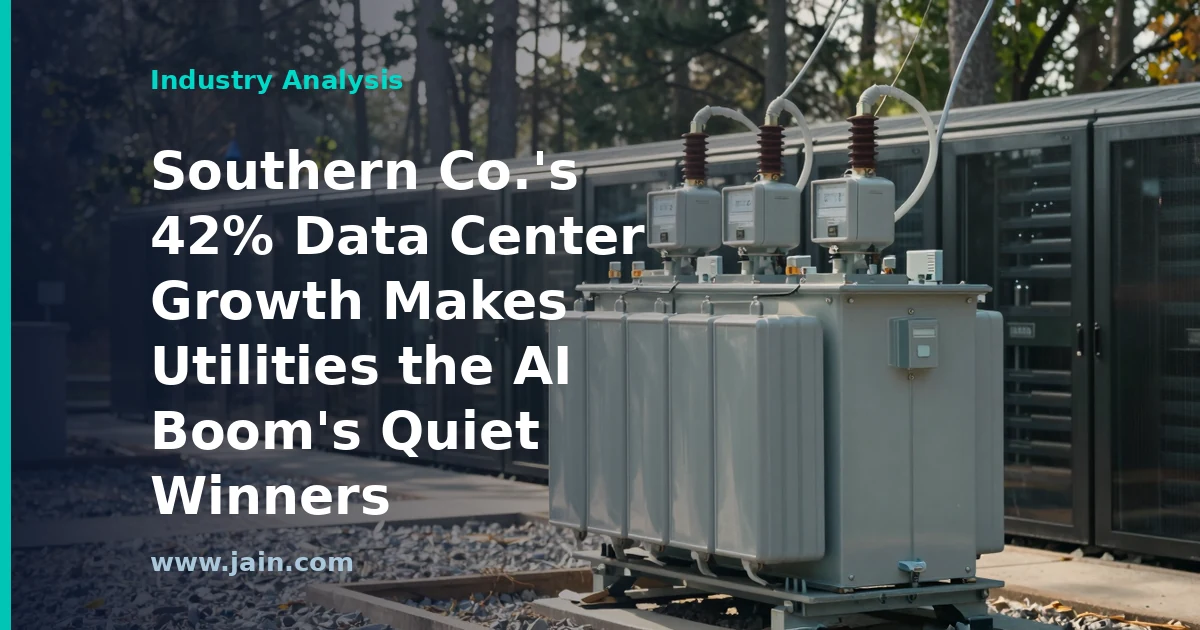
Southern Company, the Atlanta-based utility holding company whose subsidiaries include Georgia Power, Alabama Power, and Mississippi Power, reported soaring electricity sales driven by 42% growth in its data center segment, according to a May 1, 2026 report from Utility Dive. The figure stands out because it converts years of talked-about AI demand projections into a number showing up in an actual utility’s actual sales.
Executive Summary
For two years, the electricity industry has debated whether the enormous data center load forecasts attached to the AI build-out would materialize or evaporate. Southern Company’s reported 42% growth in data center electricity sales is one of the clearest signals yet that, at least in the Southeast, the demand is real, metered, and being billed. Electricity sales — as opposed to interconnection requests or load forecasts — represent power actually delivered to operating facilities.
The announcement matters beyond Southern’s own territory. Utilities have quietly become one of the most durable beneficiaries of the AI infrastructure cycle: unlike chipmakers or cloud providers, they sell a regulated, contracted product to customers who cannot easily relocate once a facility is energized. A 42% jump in one demand segment, if sustained, reshapes how regulators, investors, and data center developers should read utility growth plans across the Sun Belt.
From Forecast to Booked Revenue
The data center power story has been dogged by a credibility gap: interconnection queues across the United States are stuffed with speculative and duplicate requests, as developers file with multiple utilities for the same project. Skeptics have reasonably asked how much of the forecast load is real. Sales figures cut through that noise. When a utility reports 42% growth in data center electricity sales, it is describing megawatt-hours delivered to energized buildings and invoiced to customers — not letters of intent.
That distinction matters for how the market prices the AI build-out. Forecasts can be revised down quietly; delivered sales cannot. Southern’s number suggests that in its Southeast footprint, the pipeline of announced hyperscale and colocation projects is converting into operating load at pace. It also implies that the facilities energized in recent quarters are ramping utilization, since sales growth reflects consumption, not just connection.
Why Utilities Are the AI Build-Out’s Quiet Winners
The AI investment narrative has centered on GPU vendors and hyperscalers, but the utility position in the value chain is structurally attractive in a different way. Data centers are among the most creditworthy, longest-duration customers a utility can sign, and once built they are effectively immobile — a facility with hundreds of millions of dollars in the ground does not switch power providers. For a vertically integrated, rate-regulated utility like Southern’s subsidiaries, growing load also supports the case for new generation and transmission investment, on which regulated utilities earn an authorized return.
Southern is also unusually well positioned on supply. Its Georgia Power subsidiary completed Vogtle Units 3 and 4 — the first newly constructed nuclear reactors in the U.S. in decades — giving it firm, carbon-free baseload capacity precisely as large-load customers began demanding both reliability and clean-energy attributes. The Southeast’s combination of available land, water, fiber routes, and historically constructive regulation has made Georgia in particular one of the fastest-growing data center markets in the country.
The Ratepayer and Capacity Question
Rapid large-load growth is not an unalloyed good, and regulators know it. The central policy question is cost allocation: who pays for the new generation and grid capacity that data centers require? If a hyperscaler’s load justifies a new gas plant or transmission line and that customer later scales back, ordinary households and small businesses could be left carrying the cost. Several states, including Georgia, have been developing special rate structures and minimum-take contract terms for very large customers to insulate other ratepayers from exactly this risk.
There is also a physical question. A 42% growth rate in any demand segment tests reserve margins — the cushion of spare generating capacity utilities maintain for peak conditions. Sustained growth at anything like this pace forces choices among new gas capacity, renewables paired with storage, nuclear uprates, and demand flexibility, each with different cost, carbon, and timeline profiles. How Southern and its regulators sequence that build will determine whether today’s sales growth becomes tomorrow’s reliability headline.
What It Signals for the Data Center Market
For data center developers and tenants, the signal is double-edged. Confirmation that Southeast load is materializing validates the region’s status as a top-tier market — but it also means the easy capacity is being absorbed. As delivered load climbs, utilities gain leverage: expect longer interconnection timelines for new requests, stricter contract terms, larger upfront commitments, and less tolerance for speculative reservations. Power availability, not land or fiber, remains the binding constraint on where the next wave of AI capacity gets built.
For investors, the takeaway is that utility exposure to AI is no longer hypothetical. The sector’s traditional appeal was stability rather than growth; a demand segment compounding at double-digit rates changes that math for the handful of utilities sitting under major data center clusters — while raising the stakes on execution, since regulated returns depend on building capacity on time and on budget.
Background
Southern Company traces its roots to the early twentieth-century electrification of the American Southeast and today ranks among the largest U.S. utility holding companies, operating primarily through state-regulated subsidiaries Georgia Power, Alabama Power, and Mississippi Power. Its highest-profile recent undertaking was the expansion of Plant Vogtle in Georgia, where Units 3 and 4 — the first newly constructed nuclear reactors completed in the United States in a generation — entered service after years of delays and cost overruns, ultimately giving the company scarce firm, carbon-free capacity.
That capacity arrived just as the generative-AI boom transformed electricity demand. After roughly two decades of flat U.S. load growth, utilities began reporting surging interconnection requests from hyperscale data center developers around 2023, with Georgia emerging as a leading destination. The open question has been how much of that forecast demand would become real consumption — which is what makes delivered-sales figures like this one significant.
PJM Interconnection, the grid operator serving the largest electricity market in the United States, has reopened its interconnection queue — the formal waiting line new power plants must join before they can connect to the grid — and gas-fired generation leads the intake at 106 gigawatts (GW), according to an April 30, 2026 report by Utility Dive. The queue had been closed to new entrants for years while PJM worked through a massive backlog under reformed study rules.
Executive Summary
The reopening of PJM’s queue is one of the most consequential grid events of the decade for the data-center industry. PJM’s territory — spanning 13 states and the District of Columbia, including the Northern Virginia corridor that hosts the world’s densest concentration of data centers — has been the epicenter of the load-growth crunch. For years, developers of new generation could not even get in line, while demand forecasts climbed relentlessly on the back of AI and cloud expansion.
That 106 GW of gas-fired capacity leads the new intake is the headline signal: developers are betting that dispatchable, fuel-based generation is what the market will pay for. For context, 106 GW of proposed gas alone approaches the scale of PJM’s entire historical peak load — a striking statement of intent, even acknowledging that interconnection requests are proposals, not power plants, and that historically only a fraction of queued projects reach commercial operation.
The Queue Reopens Into a Seller’s Market
An interconnection queue is the study pipeline through which a grid operator evaluates whether a proposed generator can connect safely and what network upgrades it must fund. PJM froze new entries while it transitioned from a first-come, first-served process — which had become clogged with speculative projects — to a clustered, first-ready, first-served model. The reopening is therefore a pressure release: years of pent-up development interest arriving all at once.
The market these projects are entering is unusually favorable to generators. PJM’s recent capacity auctions have cleared at elevated prices, reflecting tightening reserve margins as older coal and gas plants retire faster than replacements arrive and as data-center load grows. High capacity prices are precisely the signal designed to attract new steel in the ground — and 106 GW of gas proposals suggests the signal is being heard.
Why Gas Leads — Economics, Not Ideology
Gas-fired turbines dominate this intake for practical reasons. They are dispatchable — able to run on demand rather than when the weather cooperates — which is what capacity markets and 24/7 data-center loads reward most. They site on relatively small footprints near existing gas pipelines and transmission. And developers can point to a revenue stack (capacity payments, energy sales, and potentially direct contracts with large loads) that pencils today.
But the gas wave faces its own bottlenecks. Turbine manufacturers are reporting multi-year order backlogs industry-wide, EPC (engineering, procurement, and construction) labor is scarce, and gas pipeline expansion in parts of PJM’s eastern footprint has historically faced permitting resistance. Proposing 106 GW is easy; procuring turbines, pipe, and crews for even a fifth of it is the hard part. The queue position is now arguably the cheapest asset in the whole development chain.
What This Means for Data-Center Developers
For hyperscalers and colocation operators stuck in multi-year utility interconnection waits, a generation-heavy queue is cautiously good news: more supply eventually means faster load interconnection and less severe capacity-price escalation. It also strengthens the case for co-location deals, in which a data center sites directly alongside a new plant and contracts for its output — a structure regulators in PJM have been actively wrestling with.
The timing mismatch remains the industry’s core problem. Data centers can be built in 18–24 months; a new combined-cycle gas plant typically takes four or more years from queue entry through studies, permitting, and construction. Even under PJM’s reformed process, the bulk of this 106 GW cannot plausibly serve load until late this decade. Buyers planning capacity for 2027–2028 should not count on this queue cycle to bail them out.
The Decarbonization Tension Nobody Should Ignore
A gas-led buildout sits uneasily beside the carbon-neutrality pledges of the very customers driving the demand. Most major cloud providers maintain public net-zero or carbon-free-energy targets, and a decade of gas additions in PJM would make those targets harder to reconcile with grid reality — unless paired with offsets, carbon capture, or an eventual nuclear and storage wave. The honest framing is that the market is prioritizing reliability and speed-to-power first and emissions second. Whether that ordering persists will depend on state policy in PJM’s footprint, federal rules, and how loudly corporate energy buyers push back through their procurement.
Background
PJM Interconnection grew out of a 1927 power pool among Pennsylvania and New Jersey utilities and today operates the largest wholesale electricity market in the United States. Its territory contains Northern Virginia’s “Data Center Alley,” which by itself consumes more data-center power than most countries. Over the past several years PJM became the poster child for the interconnection bottleneck: thousands of proposed projects — predominantly renewables in earlier cycles — languished in multi-year study backlogs, prompting a federally approved overhaul of its queue process and a temporary halt to new applications.
The reopening lands amid record demand forecasts, plant retirements, and capacity prices that have drawn political scrutiny across PJM’s member states. The resource mix of this new intake — and how much of it survives to construction — will shape the region’s reliability, emissions trajectory, and data-center growth capacity into the 2030s.
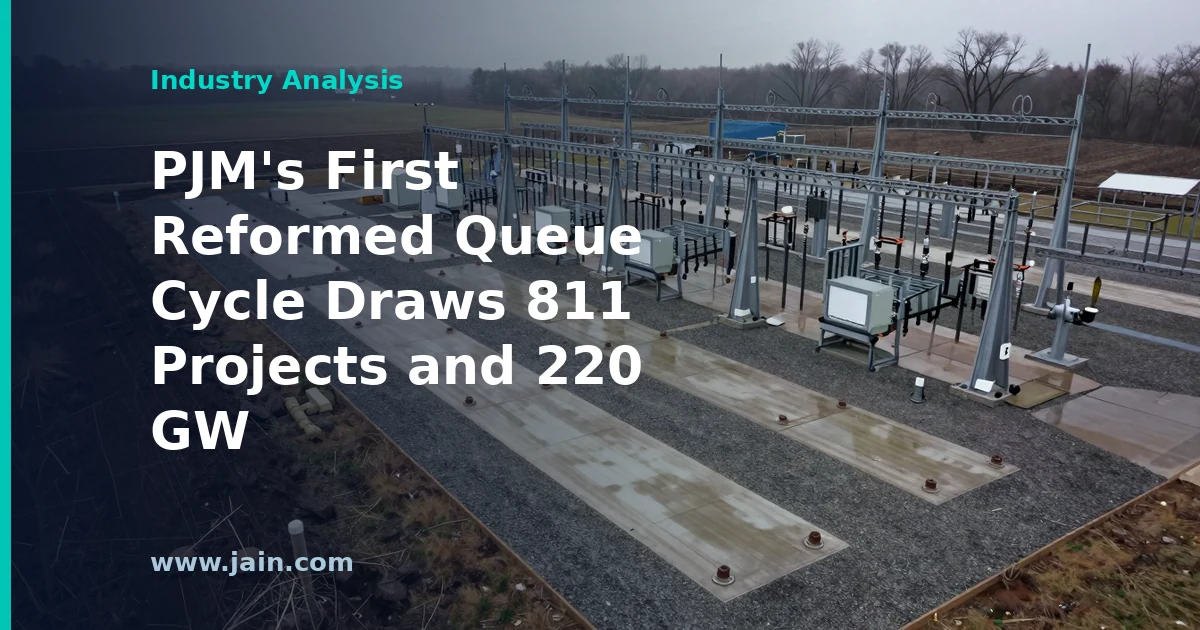
PJM Interconnection, the grid operator for the largest wholesale electricity market in the United States, has closed the application window for the first cycle of its reformed interconnection queue with 811 project applications totaling roughly 220 gigawatts (GW) of proposed capacity, according to an April 30, 2026 report in POWER Magazine. The interconnection queue is the formal process through which new power plants, storage facilities, and other resources apply to connect to the high-voltage grid.
The cycle is the first to run entirely under PJM’s overhauled “first-ready, first-served” cluster study rules, replacing the serial, first-come-first-served process that had produced multiyear backlogs.
Executive Summary
The headline numbers are striking on their own terms: 811 projects and about 220 GW of proposed capacity entered a single study cycle — a volume on the same order as the entire existing generating fleet serving PJM’s 13-state-plus-D.C. footprint. That developers are willing to post the deposits and demonstrate the site control the reformed process demands, at that scale, is a concrete market signal rather than a speculative one.
The timing matters. PJM has spent recent years warning of tightening supply as older plants retire while demand — led by AI and data center load growth concentrated in places like Northern Virginia — climbs after decades of flat consumption. A deep pipeline of proposed generation is the necessary first step toward closing that gap.
The essential caveat is that a queue application is not a power plant. Historically, only a fraction of projects that enter U.S. interconnection queues ever reach commercial operation, and the reformed process is designed to study projects faster, not to guarantee they get financed and built. The 220 GW figure measures developer appetite and process throughput — not committed steel in the ground.
A 220-GW Referendum on Electricity Demand
For most of the 2010s, U.S. electricity demand was essentially flat, and grid planning was an exercise in managing retirements and replacement. The 220 GW that flowed into PJM’s first reformed cycle reflects a different era: hyperscale data centers, AI training and inference clusters, electrified transport, and reshored manufacturing have turned load growth from a rounding error into the central planning problem in the nation’s largest power market.
Because the reformed process requires real financial commitments and demonstrated site control up front, this cycle’s volume is a cleaner demand signal than the old queue ever provided. Under the prior serial process, speculative placeholder projects could sit in line for years at little cost, inflating queue totals. A 220-GW cycle under stricter entry rules suggests developers see durable, creditworthy demand — much of it from data center operators willing to sign long-term commitments — rather than a bubble of free options.
What Queue Reform Fixed — and What It Cannot
PJM’s old process studied projects one at a time in the order they arrived, so a single stalled or withdrawn project could force costly restudies of everyone behind it. The reformed approach, approved by federal regulators as part of a broader national shift toward cluster studies, batches projects into cycles, studies them together, and allocates shared network-upgrade costs across the group. Projects that are not ready — lacking land rights or deposits — are filtered out early instead of clogging the line.
What reform cannot do is build anything. Study speed is only one bottleneck among several: transformer and switchgear lead times remain long, skilled-labor markets are tight, local permitting is contested, and network upgrade costs identified in cluster studies can still kill marginal projects. The queue’s completion rate — nationally, often cited at roughly one in five projects historically — is the number that ultimately matters, and this announcement tells us nothing about it yet.
Winners, Losers, and the Shape of the Pipeline
The reformed rules structurally favor well-capitalized developers who can post deposits, secure land early, and absorb study-phase risk — utilities, large independent power producers, and infrastructure-fund-backed platforms. Smaller and more speculative developers, who thrived under the low-cost old queue, face a higher bar. That consolidation cuts both ways: it should raise the fraction of queued projects that actually get built, but it also concentrates the development pipeline in fewer hands.
For large power buyers — data center operators above all — a deep, better-qualified queue is medium-term good news, since it is the raw material for future supply. But the near-term picture is unchanged: projects entering study now are years from commercial operation, so tight capacity conditions and elevated prices in PJM are likely to persist until this pipeline starts delivering. The gap between when demand arrives and when supply can physically connect remains the defining tension in the market.
Background
PJM traces its roots to 1927, when utilities in Pennsylvania and New Jersey first pooled their generation, and it has grown into the largest wholesale power market in North America. In the early 2020s its interconnection queue became a symbol of national gridlock: thousands of projects languished in a serial study process while wait times stretched toward half a decade, prompting a federally approved overhaul that paused new entries while PJM worked through the backlog and transitioned to clustered, readiness-based study cycles.
The reform arrives just as PJM’s supply-demand balance has tightened. Plant retirements, sharply rising data center load, and record-setting capacity market results have made the pace of new generation buildout the market’s defining question — which is why the volume of this first reformed cycle is being read as a bellwether well beyond PJM’s borders.
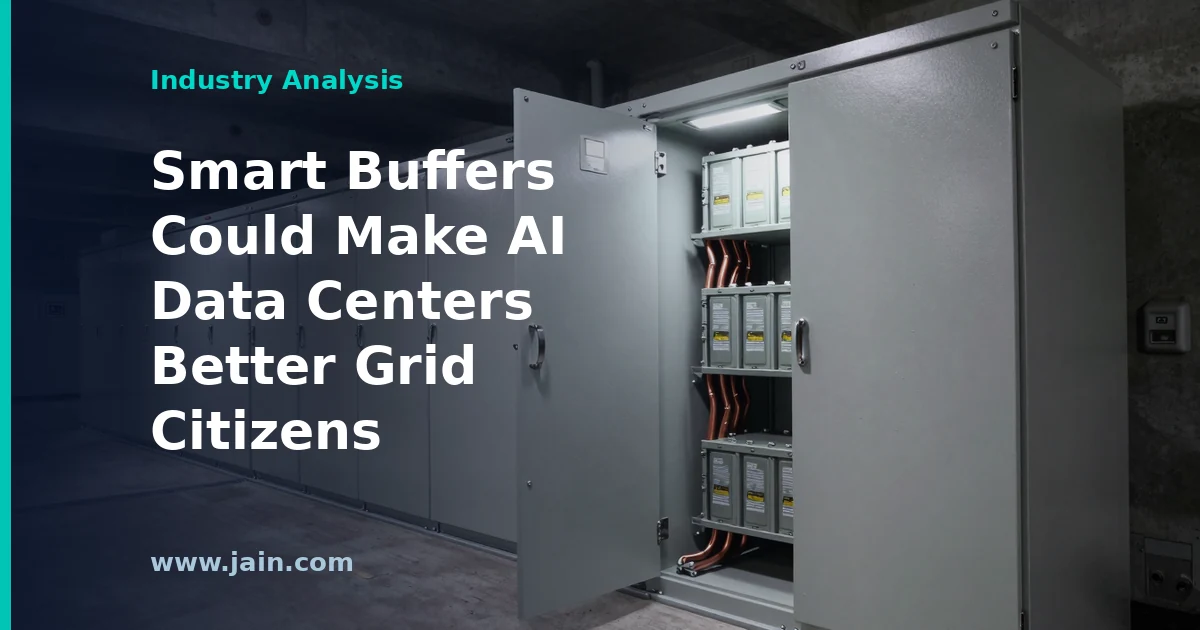
IEEE Spectrum reported on April 29, 2026 that AI data center operators are adopting “smart buffer” technologies — on-site energy storage and power-management systems that sit between the utility grid and racks of GPUs — to smooth the sharp swings in electricity demand that large AI workloads create. The framing is notable: rather than another story about AI’s appetite for power, this one covers an emerging engineering fix that could make AI facilities “better grid citizens.”
Executive Summary
The problem being solved is real and increasingly well documented. When thousands of GPUs start or pause a synchronized AI training run, a facility’s power draw can swing by tens of megawatts in seconds — behavior that looks, to a utility, less like a steady industrial customer and more like a giant load that lurches unpredictably. Grid operators plan around stable, forecastable demand; loads that spike and sag rapidly can stress local equipment, complicate frequency regulation, and slow interconnection approvals.
Smart buffering attacks the problem at the meter. By placing fast-responding energy storage and intelligent power electronics between the grid connection and the compute floor, an operator can present the utility with a flattened, predictable demand profile while the GPUs behind the buffer surge and idle as the workload demands. If the approach matures, it addresses one of the sharpest objections utilities and communities raise against new AI capacity — and could shorten the interconnection waits that have become the industry’s biggest bottleneck.
Why AI Loads Misbehave on the Grid
Traditional data centers — the kind running websites, databases, and enterprise applications — are prized utility customers precisely because their demand is boringly flat. AI training clusters break that model. A large training job synchronizes thousands of accelerators: they compute in lockstep, pause together to exchange data, and can drop to a fraction of peak power in an instant if a job checkpoints or fails. The result is a load that oscillates on timescales of seconds to minutes, at magnitudes utilities historically associated with arc furnaces or industrial motors starting up.
Utilities engineer their networks — transformers, voltage regulation, frequency response — around expected load behavior. A customer whose demand swings violently forces conservative planning: bigger margins, more spinning reserve, longer studies before a connection is approved. That conservatism shows up for data center developers as multi-year interconnection queues, which today gate AI buildouts more tightly than chips or capital do.
Buffering as a Peace Treaty With Utilities
The smart-buffer concept is conceptually simple: put a shock absorber between the grid and the GPUs. Batteries, ultracapacitors, or other fast storage charge when the compute load dips and discharge when it spikes, so the grid sees a smooth draw while the cluster behind the buffer does whatever the workload requires. Layer in intelligent controls, and the same hardware can go further — capping peak demand, riding through brief grid disturbances, or even reducing draw on request when the grid is stressed, a capability utilities call demand response.
The business logic is compelling on paper. An operator that can credibly promise a flat or flexible load profile becomes a customer utilities want rather than one they study for years. That can translate into faster interconnection, access to sites previously deemed grid-constrained, and lower demand charges — the fees utilities levy based on a customer’s peak draw. In a market where time-to-power is the dominant competitive variable, anything that compresses the utility approval cycle has direct commercial value.
The Economics Cut Both Ways
Buffering is not free. Batteries sized to absorb tens of megawatts of swing add meaningful capital cost, consume space and cooling, introduce their own fire-safety and permitting considerations, and degrade with heavy cycling — and the rapid charge-discharge duty cycle of load smoothing is exactly the kind of use that ages battery cells fastest. Operators will weigh those costs against the value of faster grid access and lower peak charges, and the answer will differ by site: buffering pencils out most clearly where the grid is congested and interconnection is the binding constraint.
There is also a partial software alternative. Some of the same smoothing can be achieved by scheduling workloads intelligently — staggering job starts, injecting dummy computation to prevent sudden power drops, or throttling training slightly during grid stress. Software costs less than batteries but sacrifices some compute efficiency and cannot deliver the instantaneous response hardware can. The likely end state is hybrid: firmware and schedulers doing coarse smoothing, with electrical buffers handling the fast transients. Vendors of batteries, power electronics, and data-center power-management software all stand to gain if buffering becomes a standard requirement rather than an exotic add-on.
A Narrative Shift Worth Watching
Coverage of AI and electricity over the past two years has been dominated by alarm: rising demand forecasts, delayed fossil-plant retirements, and disputes over who pays for grid upgrades. A story centered on data centers becoming better grid citizens signals a maturing conversation — one where the industry is expected not merely to consume power but to actively support grid stability. Regulators are already moving in this direction; several jurisdictions have proposed requiring large new loads to be curtailable or to bring their own flexibility.
The strategic implication for operators is that grid behavior is becoming a design specification, not an afterthought. Facilities engineered from day one to present flexible, well-mannered load profiles will find friendlier utilities, faster approvals, and possibly favorable tariff treatment. Those that show up asking for hundreds of firm megawatts with volatile draw will increasingly wait at the back of the queue. Buffering technology, in that light, is less a gadget than an admission ticket.
Background
The collision between AI computing and the electric grid became one of the defining infrastructure stories of the mid-2020s. Data centers historically earned reputations as ideal utility customers — large but remarkably steady loads. Generative AI changed both variables at once: individual campuses grew from tens to hundreds of megawatts, and the synchronized nature of GPU training made demand volatile in ways the grid had rarely seen from digital infrastructure. Utilities responded with longer interconnection studies, and communities with growing skepticism about hosting new facilities.
IEEE Spectrum, the flagship publication of the IEEE (the world’s largest technical professional organization for engineering), has covered this tension extensively. Its April 2026 report on smart buffering reflects the industry’s response phase: rather than simply requesting ever more firm power, operators are investing in storage, power electronics, and workload-management techniques that make AI facilities easier for grids to accommodate — a shift from consuming grid capacity to actively managing their footprint on it.
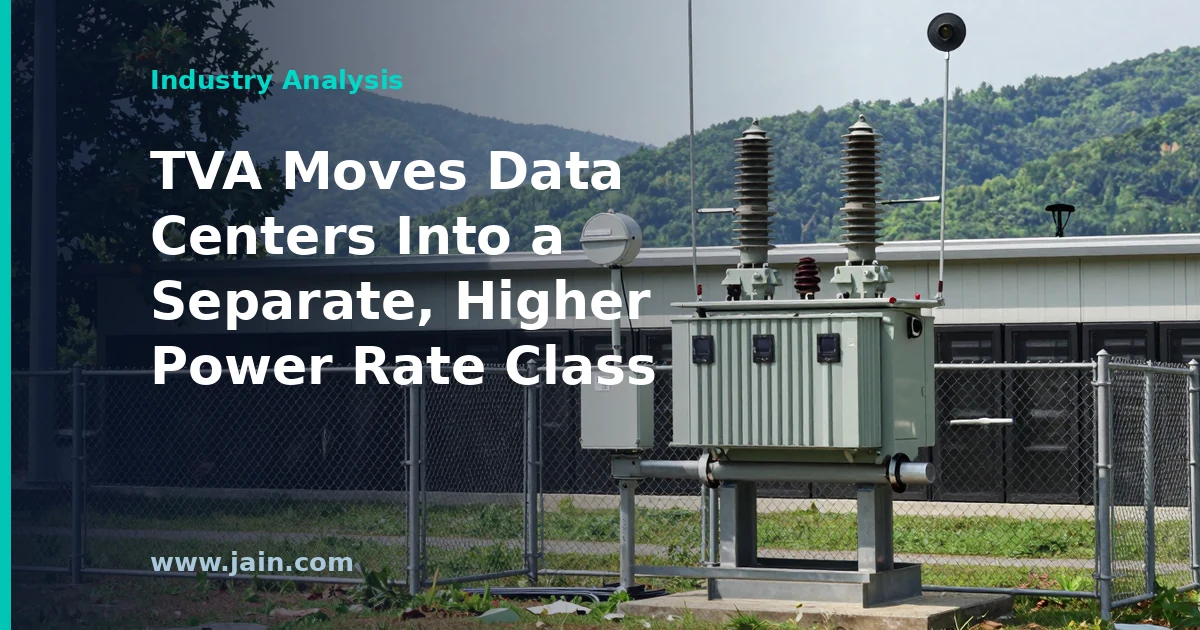
The Tennessee Valley Authority (TVA) will charge data centers more for power under a separate rate, according to an April 28, 2026 report by the Chattanooga Times Free Press. The federally owned utility, which supplies electricity across Tennessee and parts of six neighboring states, is effectively carving hyperscale computing load out of its general commercial and industrial rate structure and pricing it as its own customer class.
Executive Summary
According to the report, TVA — the largest public power provider in the United States — is establishing a distinct rate under which data centers will pay more for electricity than they would under existing industrial tariffs. A “rate class” is the category a utility assigns to groups of customers with similar usage patterns; creating a new one for data centers means the utility believes this load is different enough in size, growth, and risk to deserve its own pricing.
Why it matters: this is one of the clearest signals yet that utilities are no longer treating gigawatt-scale computing demand as ordinary industrial load. When a system as large as TVA’s formalizes a premium rate for data centers, it sets a reference point that other utilities, regulators, and public power boards across the country can cite. For operators planning campuses in the Tennessee Valley — a region that has actively courted data center investment — the cost of power, typically the largest ongoing operating expense of a data center, just became a moving target.
Pricing Hyperscale Load as Its Own Risk Category
Utilities have historically loved large industrial customers: steady, predictable consumption spreads fixed grid costs over more kilowatt-hours, which can lower rates for everyone. Data centers complicate that logic. They arrive in enormous increments, request interconnection faster than generation and transmission can be built, and — critically — a project can be cancelled or relocated after a utility has committed capital to serve it. A separate rate class is the standard regulatory tool for isolating that risk: it lets the utility recover the cost of serving data centers from data centers, rather than socializing it across households and smaller businesses.
The reported move fits a broader pattern. Utilities and regulators in several U.S. markets have been developing large-load tariffs with features like minimum-demand charges, longer contract terms, and collateral requirements. TVA formalizing a higher rate suggests the debate has shifted from whether hyperscale load should be treated differently to how much more it should pay.
What a Premium Rate Means for Data Center Economics
Electricity is usually the single largest recurring cost of operating a data center, and for AI-oriented facilities running dense, power-hungry hardware, the sensitivity is even greater. A structurally higher rate changes site-selection math: the Tennessee Valley’s traditional pitch — abundant, relatively inexpensive, largely carbon-light power from a mix that includes nuclear and hydro — becomes less differentiated if data centers pay a premium over the headline industrial rate. The report does not disclose the size of the premium, so the practical impact could range from a rounding error to a genuine deterrent.
Operators have levers in response: negotiating long-term supply agreements, bringing their own generation or storage to the table, or shifting flexible workloads to hours when the grid has spare capacity. But each of those adds complexity and capital cost, and none fully escapes a tariff that applies by customer class. The likely near-term effect is that hyperscalers press for contract structures — rather than published rates — where their scale gives them negotiating room.
A Public Power Precedent With National Reach
TVA occupies an unusual position: it is a federally owned corporation that sets its own rates through its board rather than through a state public utility commission. That autonomy means it can move faster than investor-owned utilities, whose large-load tariffs must survive contested rate cases. If TVA’s data center rate takes effect as reported, it becomes an operating precedent other utilities can point to when they argue that hyperscale customers should carry a larger share of grid-expansion costs.
There is a fairness argument on both sides worth stating plainly. Ratepayer advocates contend that residential customers should not fund transmission and generation built for a handful of technology companies. Data center operators counter that they are long-tenured, high-load-factor customers whose demand justifies infrastructure the whole region eventually benefits from, and that punitive pricing simply pushes investment — and its tax base and jobs — to neighboring territories. The reported story does not resolve which framing TVA’s rate design reflects, and the details of the tariff will determine whether it reads as prudent risk allocation or as a growth deterrent.
Background
The Tennessee Valley Authority was created by Congress in 1933 and grew into the largest public power system in the country, serving roughly ten million people through a network of local power companies. Its generation mix — including nuclear, hydroelectric, gas, and coal — and its historically competitive industrial rates helped make the Tennessee Valley a magnet for energy-intensive industry, and more recently for data center development tied to cloud and AI growth.
That growth collided with a nationwide reality: electricity demand, flat for two decades, began rising sharply as hyperscale computing facilities requested interconnections measured in hundreds of megawatts. Utilities across the U.S. responded by rethinking how such load is priced and contracted, seeking to protect other ratepayers from stranded-cost risk. TVA’s reported creation of a separate, higher data center rate places it among the most prominent utilities to formalize that shift.
On April 28, 2026, RAND — the nonprofit, nonpartisan policy research institution — published an analysis titled “How Much More Power Can the U.S. Grid Provide for AI? Projections and Policy Implications for 2030.” The work models the gap between surging AI-driven electricity demand and the grid’s realistic ability to serve it this decade, and maps the policy choices that will widen or narrow that gap.
Executive Summary
The question in RAND’s title is arguably the central resource question of the AI buildout. Data centers running artificial-intelligence workloads have become one of the fastest-growing sources of new electricity demand in the United States, and every hyperscale campus announcement ultimately depends on an answer to the same question: can the grid actually deliver the power, and by when?
What makes a RAND treatment notable is the framing. Rather than starting from what AI developers say they need — the demand-side forecasts that dominate industry discourse — the title starts from what the grid can provide, a supply-side constraint analysis. Pairing “projections” with “policy implications” signals that the answer is not a fixed number but a range whose outcome depends on decisions about generation, transmission, and interconnection that federal and state policymakers are making right now.
Because our source is the publication listing rather than the full report, this article analyzes the question RAND is posing and the market context around it, and flags below what the listing alone does not tell us about the report’s specific findings.
Why the Supply-Side Framing Matters
Most public numbers in the AI-power debate come from the demand side: forecasts of how many gigawatts AI data centers will request. Those forecasts are genuinely uncertain — utilities have reported that the same prospective data center project often applies for service in multiple territories, which can inflate aggregate demand figures if requests are summed naively. A supply-side analysis flips the question to the binding constraint: how much new load the existing fleet of power plants, transmission lines, and distribution infrastructure can absorb by 2030 under realistic buildout assumptions.
That reframing matters commercially. If credible headroom estimates exist region by region, they become a de facto siting map — telling developers where power is available and telling investors which announced projects face energization risk. It also disciplines the conversation: a project announcement is not capacity until a utility can serve it.
The Bottleneck Is Delivery, Not Just Generation
For readers new to the topic: connecting a large new power plant or a large new customer to the grid requires an engineering study process called interconnection, and in much of the country those study queues have stretched to multiple years. High-voltage transmission lines — the long-distance wires that move bulk power — routinely take the better part of a decade from proposal to operation because they cross many permitting jurisdictions. Meanwhile, a modern AI campus can be requesting hundreds of megawatts, the scale of a small city, on a two-to-three-year construction schedule.
That timing mismatch, not any absolute shortage of energy resources, is the crux of the 2030 question. It explains why data center operators are increasingly pursuing workarounds: siting at retired industrial locations with existing grid connections, contracting directly with power plants, adding on-site generation, and offering demand flexibility — agreeing to reduce draw during grid stress in exchange for faster hookups.
The Policy Levers on the Table
The “policy implications” half of RAND’s title points at a live agenda. The levers most commonly debated in this space include: reforming interconnection queues so viable projects move faster; accelerating transmission permitting and cost allocation; deciding who pays for grid upgrades triggered by large loads, a question with direct consequences for other ratepayers’ bills; and setting rules for large flexible loads and behind-the-meter generation. Each lever sits with a different actor — federal regulators, regional grid operators, state commissions — which is why national demand projections translate so unevenly into local reality.
For the infrastructure industry, the stakes cut both ways. Faster interconnection and transmission buildout expands the addressable market for data center development. But cost-allocation decisions that shift upgrade costs onto large loads change project economics, and jurisdictions that move slowly will simply watch capacity — and the tax base that comes with it — land elsewhere. An evenhanded, nonpartisan modeling effort that quantifies these tradeoffs is useful precisely because most numbers in circulation come from parties with a commercial or advocacy position.
Background
US electricity demand was roughly flat for about two decades before data centers — accelerated sharply by the generative AI boom that began in late 2022 — joined electrification and reshored manufacturing in pushing load growth back onto utility planning agendas. Since then, hyperscale campus announcements measured in the hundreds of megawatts or more have become routine, and access to power has displaced land and fiber as the primary siting constraint for the data center industry.
RAND, founded in 1948, is a nonprofit research institution known for quantitative analysis of defense, infrastructure, and technology policy. Its entry into the AI-and-grid debate adds an independent modeling voice to a discussion otherwise dominated by utilities, developers, and advocacy groups, each with a stake in how big the numbers are said to be.