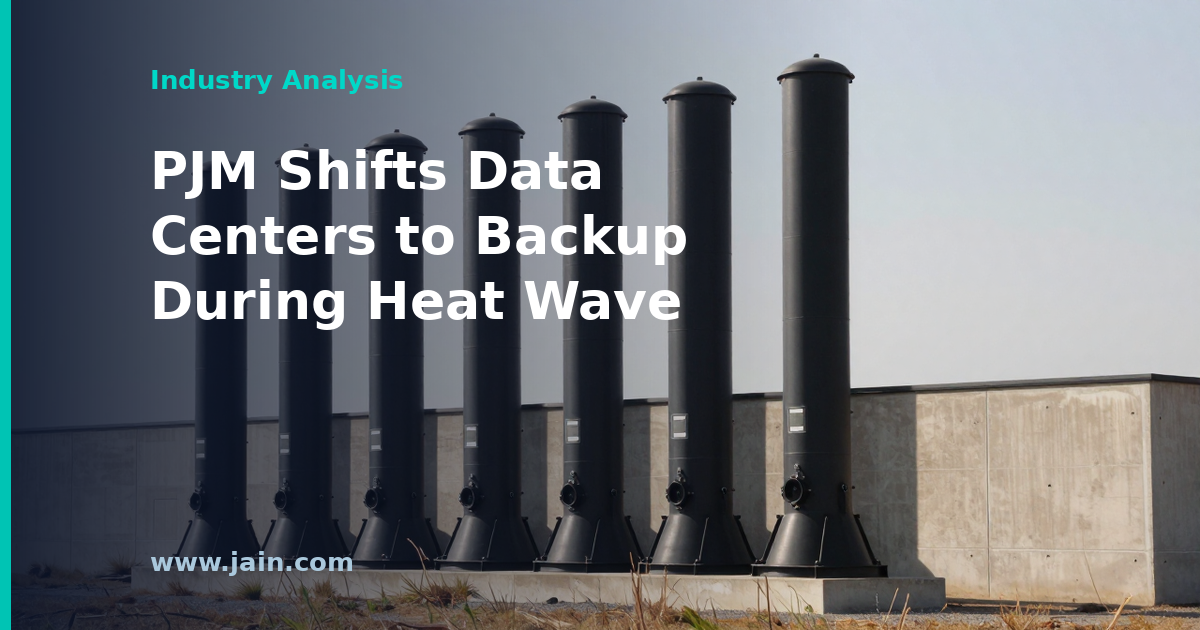
PJM Interconnection, the grid operator serving 65 million people across 13 states and DC, has received regulatory clearance to instruct data centers within its footprint to shift onto on-site backup generation during a heat-wave-driven grid emergency, according to reporting from Maryland Matters on June 29, 2026.
The mechanism turns large data-center campuses — normally treated as firm, always-on load — into a de facto peak-shaving resource for the duration of the event.
Executive Summary
The clearance matters because PJM is the single largest wholesale power market in North America and the epicenter of the data-center boom driven by AI training and inference workloads. Northern Virginia’s "Data Center Alley" alone accounts for a double-digit share of PJM’s peak demand, and interconnection queues across the footprint are dominated by hyperscale requests.
Instructing those loads to island onto diesel or gas gensets during a heat wave is a pragmatic short-term relief valve — but it also establishes a precedent that data-center power draw is negotiable in an emergency, something operators have long resisted in contract negotiations with utilities.
For hyperscalers, colocation providers, and their enterprise tenants, the near-term question is whether this becomes a one-off emergency tool or a template that regulators, utilities, and lawmakers extend into standing tariffs and interconnection conditions.
A Grid Under AI-Era Stress Finds a New Lever
PJM has spent the past two seasons warning that reserve margins are tightening faster than new generation and transmission can be built. Data-center load growth — driven overwhelmingly by AI compute — is the most-cited demand-side driver in the operator’s own capacity-market filings. Shifting even a subset of that load onto behind-the-meter generation during peak hours effectively hands PJM a demand-response resource it did not previously have access to at scale. In a market where the last few gigawatts of firm capacity now clear at record prices, that flexibility has real economic value.
The trade-off is honest but uncomfortable: the backup fleet inside large data-center campuses is typically diesel, sometimes natural gas, and it runs cleaner than an emergency peaker only in the narrowest sense. Air-quality regulators in the Mid-Atlantic have historically capped generator runtime hours precisely because concentrated diesel exhaust during heat events coincides with the worst ground-level ozone conditions. Any recurring use of this mechanism will collide with those permits.
Winners, Losers, and the New Contract Question
The immediate winner is grid reliability: keeping the lights on for residential and small-commercial customers during a heat emergency is a policy priority that overrides most other considerations. PJM itself gains optionality and political cover. Utilities in the footprint gain a talking point when regulators ask why more transmission has not been built.
Data-center operators are in a more complicated position. Publicly, most will support emergency cooperation — refusing looks bad and invites harsher intervention. Privately, the concern is that "emergency" becomes elastic. Enterprise and AI-lab tenants sign colocation and cloud contracts on the premise of firm power; if the underlying facility must periodically island, service-level agreements, insurance, and fuel-logistics assumptions all need re-examination. Expect language on grid-emergency curtailment to become a live negotiation item in 2026 renewals.
Precedent Risk Cuts Both Ways
The clearance is best understood as a precedent event rather than a single operational decision. Once a regulator has said yes to load-shifting a hyperscale campus onto backup generation during a heat wave, the harder question is what other conditions qualify: winter peaks, generation outages, transmission constraints, wildfire smoke events on the western edge of the footprint. Each expansion is defensible in isolation and cumulatively significant.
For policymakers weighing whether to court or constrain new data-center construction, the mechanism cuts both ways. Advocates can point to it as evidence that hyperscale load can be a good grid citizen. Critics can point to it as confirmation that the current build-out is already outrunning firm supply. Both readings are supported by the announcement itself; which one dominates depends on how frequently PJM has to actually use the authority.
Background
PJM Interconnection was formed in its modern regional-transmission-organization form in the late 1990s and today coordinates the movement of wholesale electricity across a footprint stretching from Illinois to New Jersey and south to North Carolina. Its capacity market, which pays generators to be available years in advance, is the primary mechanism by which the region secures firm supply.
The data-center boom of the past decade — first driven by cloud, now accelerated by AI training and inference — has concentrated unprecedented demand in Northern Virginia and secondary hubs in Ohio, Pennsylvania, and Maryland. PJM’s own load forecasts have been repeatedly revised upward, and recent capacity auctions have cleared at record prices, framing the policy backdrop for the current heat-wave clearance.
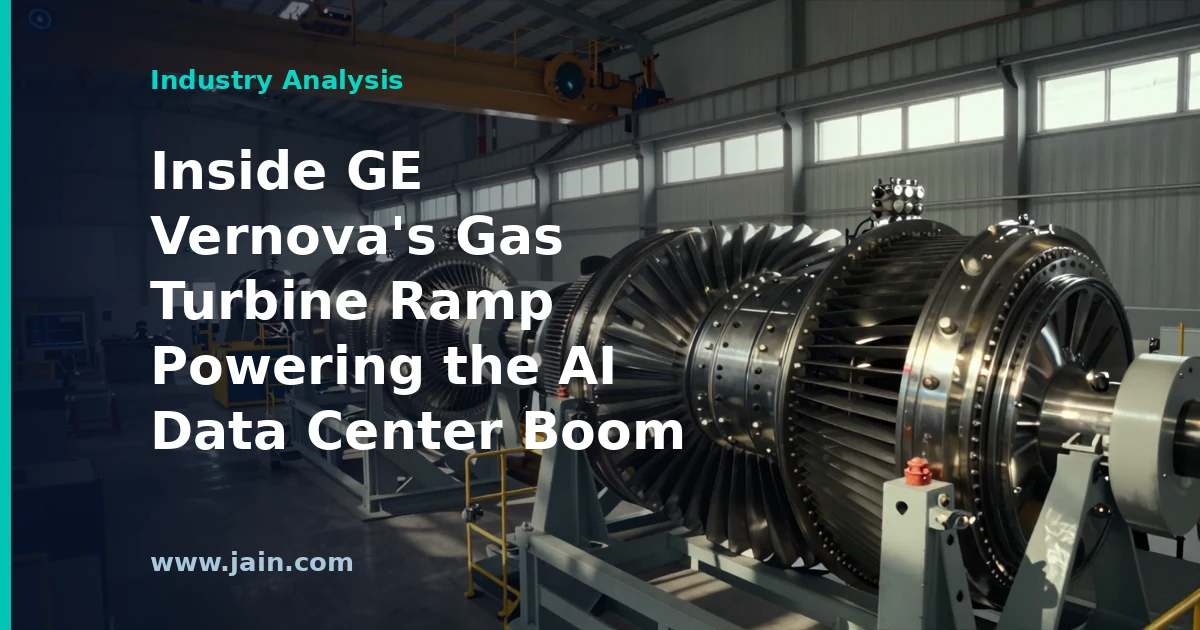
CNBC published a feature on June 28, 2026 examining how GE Vernova builds its massive heavy-duty gas turbines — the machines increasingly ordered to supply electricity for AI data centers. The piece spotlights the manufacturer at the center of one of the power industry’s sharpest demand upswings, as hyperscalers and data center developers scramble for generation capacity that the grid alone cannot deliver on their timelines.
Executive Summary
The story here is less a single announcement than a snapshot of a structural shift: gas turbines — large rotating machines that burn natural gas to spin a generator — have moved from a mature, slow-growth product line to some of the most sought-after industrial hardware in the world, and GE Vernova is one of a small handful of companies that can build the largest ones. CNBC’s look inside the company’s manufacturing operation underscores how AI data center demand has redrawn the order books of the turbine industry.
Why it matters: AI training and inference clusters need firm, around-the-clock power at scales measured in hundreds of megawatts per campus. Interconnection queues — the waiting lines to plug new loads and generators into the transmission grid — stretch for years in many U.S. markets. That mismatch has pushed utilities and data center developers toward dedicated gas-fired generation, and the turbines themselves have become the bottleneck. Whoever controls turbine manufacturing slots now holds real leverage over where and when AI capacity gets built.
The Turbine Is the New Bottleneck
For most of the past decade, the constraint on building a data center was land, fiber, or chips. In 2025 and 2026 it has increasingly been electricity — and behind electricity, the physical equipment that generates and delivers it. Heavy-duty gas turbines sit at the top of that equipment stack: they are enormous precision machines, built in specialized factories by a global oligopoly of manufacturers, and they cannot be scaled up quickly. Casting, machining, and testing the hot-section components that survive combustion temperatures is skilled, capital-intensive work with deep supplier chains.
That is why a factory tour of a turbine plant is now business news. When manufacturing slots for major power equipment are scarce, the production line itself becomes strategic infrastructure. Data center developers who once treated power generation as someone else’s problem — the utility’s — are now tracking turbine lead times the way they track GPU allocations.
Why Gas, and Why Now
Gas turbines occupy a specific niche in the AI power story: they are dispatchable (they run when you need them, unlike weather-dependent wind and solar), they can be sited close to load, and they can be permitted and built faster than nuclear. For hyperscalers facing multi-year grid interconnection queues, gas-fired plants — whether utility-built or behind-the-meter on the data center campus itself — are often the only firm-power option available on an AI-relevant timeline. Combined-cycle configurations, which recycle exhaust heat to generate additional electricity, improve the economics for facilities that run flat-out around the clock, which is exactly the load profile of an AI campus.
The trade-offs are real. Gas plants lock in decades of fuel exposure and carbon emissions at the same moment many data center operators carry public net-zero commitments. Expect continued tension between the near-term physics of AI power demand and long-term decarbonization pledges — and expect operators to pair gas with renewable procurement, carbon-capture ambitions, or framing gas as a “bridge” technology. Readers should evaluate those framings project by project rather than accepting or dismissing them wholesale.
Winners, Losers, and the Queue
The clearest winners in a turbine-constrained market are the manufacturers — GE Vernova and its few global peers — along with their component suppliers and the engineering-and-construction firms that install the machines. Utilities in data center-heavy regions gain a growth story they have not had in decades. On the other side of the ledger, smaller data center developers and enterprises without hyperscaler purchasing power risk being priced or queued out of firm generation capacity, which could concentrate AI infrastructure further among the largest players.
There is also a cyclical risk worth naming evenly: the gas turbine industry has been through boom-and-bust before, most notably when a late-1990s ordering surge was followed by a painful capacity glut. Manufacturers appear to be expanding cautiously partly because of that memory. If AI power demand forecasts prove overstated — a live debate — today’s scarcity could look different in five years. If the forecasts hold, the constraint persists and lead times stay long. Either way, the ordering decisions being made now will shape the power landscape well into the 2030s.
Background
GE Vernova became an independent public company in April 2024, when General Electric completed its split into three businesses and placed its energy operations — gas power, wind, nuclear services, and grid electrification — under the new name. The gas turbine franchise it inherited is one of the oldest and largest in the world, with an installed fleet spanning utilities and industrial operators across the globe.
The company’s independence coincided almost exactly with the generative AI infrastructure boom, which transformed electricity demand forecasts that had been flat in the U.S. for roughly two decades. That timing turned a business once viewed as a mature, declining fossil-fuel franchise into a strategic asset at the center of the AI build-out — the shift CNBC’s factory-floor feature captures.
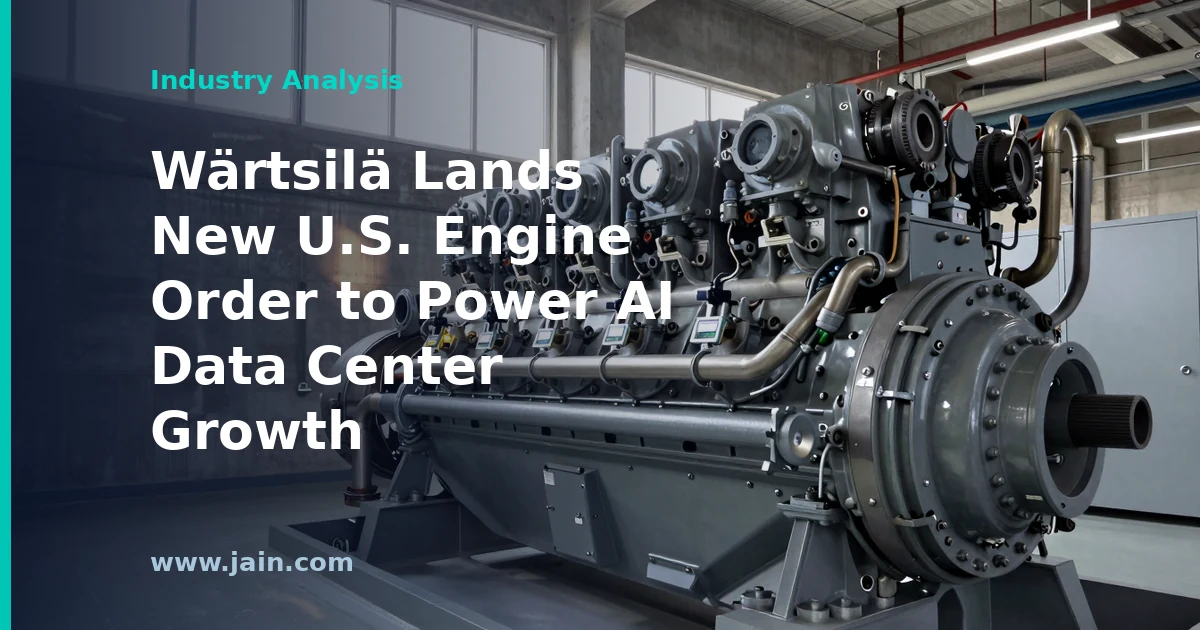
Wärtsilä, the Finnish energy and marine technology group, announced on June 28, 2026 that it has secured a new order in the United States to supply engine-based power generation supporting what the company calls the next wave of AI-driven data center growth. The announcement, distributed as a company release, positions the order within the surge of demand for on-site and grid-support power created by artificial intelligence computing facilities.
The release headline confirms the order’s existence, its U.S. location, and its data center orientation; the version of the announcement circulated via aggregators does not carry further specifics such as capacity, customer, or delivery schedule, which we flag below.
Executive Summary
The announcement is notable less for any single order than for the pattern it extends: reciprocating engine power — large, factory-built internal combustion generators that can be installed and running in months — is becoming a standard answer to the widening gap between when AI data centers need electricity and when utilities can deliver it. In much of the U.S., a new large load or generator can wait years in the interconnection queue, the utility process for studying and approving new grid connections. Data center developers racing to deploy AI capacity increasingly cannot wait, and engine plants offer a bridge: power that arrives on the developer’s schedule rather than the grid’s.
For Wärtsilä, one of the leading global suppliers of medium-speed engine power plants, the U.S. data center segment represents a growth market layered on top of its traditional utility, industrial, and grid-balancing business. The company framing this order explicitly around “AI-driven data center growth” signals that it now treats the segment as a named demand category, not incidental business.
What matters for the industry is the direction of travel: if flexible generation is the default bridge, then engine and turbine order books, gas supply logistics, and air-permitting timelines become part of the data center delivery critical path — alongside chips, land, and fiber.
The Interconnection Gap Is the Real Product
AI training and inference facilities are being planned at scales of hundreds of megawatts — comparable to small cities — and utilities in many U.S. regions cannot study, upgrade, and energize connections for loads of that size quickly. The mismatch between data center construction timelines, often 18 to 30 months, and grid timelines, often several years, has created a market for anything that closes the gap. Engine power plants fit because they are modular, factory-produced, and incremental: capacity can be added in blocks, started fast, and later kept as backup or grid-support assets once a utility connection arrives.
Wärtsilä’s order, as framed, is a data point confirming that this bridge model has moved from workaround to procurement strategy. When a major OEM headlines a U.S. order around AI data centers, it suggests buyers are specifying flexible generation at the planning stage, not scrambling for it after a queue delay.
Engines Versus Turbines Versus the Grid
The fast-power market splits mainly between reciprocating engines, which Wärtsilä and a small number of rivals supply, and gas turbines. Engines generally start faster, hold efficiency better at partial load, and tolerate frequent stop-start cycling — useful traits for a facility that may eventually shift to grid power and keep the engines for peaking or resilience. Turbines tend to win on the largest single-block capacities. Both now face extended delivery lead times as data center demand collides with utility and industrial orders, which means an OEM’s manufacturing slots have themselves become a scarce resource.
The strategic question for buyers is not engines versus grid, but sequencing: bridge generation first, interconnection later, with the on-site plant repurposed rather than stranded. Vendors that can credibly support that full lifecycle — including later conversion to balancing or backup duty, and potential future fuels — have an advantage beyond the initial sale.
What It Means for Data Center Economics
Self-supplied engine power costs more per megawatt-hour than typical utility rates once fuel, maintenance, and capital are counted. That premium is rational when the alternative is an idle, revenue-less AI facility waiting on a queue. In effect, developers are paying for schedule certainty, and the willingness to pay reveals how valuable early AI capacity is believed to be. The risks are real, however: on-site gas generation adds fuel-supply logistics, air-quality permitting, and emissions exposure, and a facility’s bridge plant can become a long-term cost if grid power arrives later than promised — or a stranded asset if the AI demand it serves shifts.
For utilities and regulators, each order like this one is also a signal: load that cannot be served promptly will increasingly self-serve, at least temporarily, which changes forecasting, gas demand, and local emissions profiles in the regions where AI construction concentrates.
Background
Wärtsilä traces its roots to 1834 in Finland and today operates two main businesses: marine propulsion and energy. Its energy arm supplies power plants built around large medium-speed reciprocating engines, along with energy storage and grid-management technology, and has historically served utilities, island grids, and industrial customers needing flexible or fast-starting capacity.
Since roughly 2024, U.S. electricity demand has resumed sustained growth for the first time in about two decades, driven substantially by AI data center construction. That demand surge, colliding with multi-year utility interconnection and transmission timelines, has created a rapidly growing market for on-site and fast-deploy generation — the market context in which this order was announced.
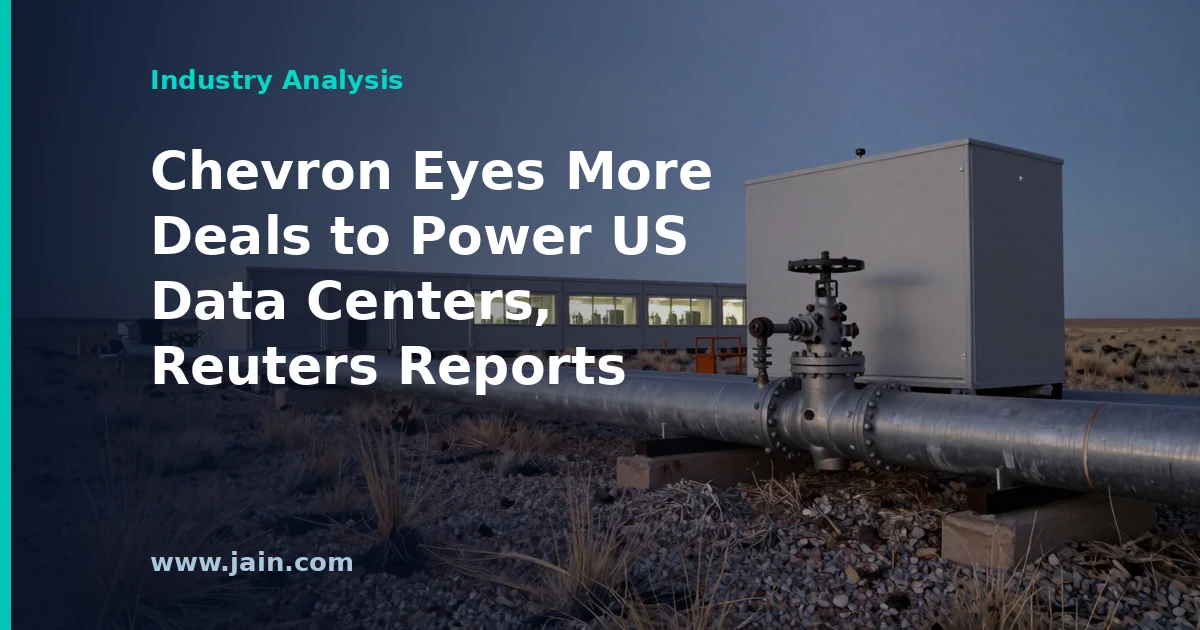
Reuters reported on June 27, 2026 that Chevron, the second-largest US oil and gas producer, is looking at more deals to supply electricity to American data centers. The report signals that Chevron intends to expand beyond its previously announced data-center power venture and treat AI-driven electricity demand as an ongoing line of business rather than a one-off experiment.
Executive Summary
According to the Reuters report, Chevron is actively seeking additional opportunities to power US data centers. The company had already staked out a position in this market: in early 2025 it unveiled a venture with investment firm Engine No. 1 and turbine maker GE Vernova to build natural-gas power plants co-located with data centers — so-called behind-the-meter generation that serves a facility directly rather than routing through the public grid — with a stated ambition of up to four gigawatts of capacity. A statement of appetite for “more deals” suggests that pipeline is progressing well enough for Chevron to widen it.
Why it matters: the binding constraint on AI infrastructure has shifted from chips to electricity. Utility interconnection queues in major US markets now stretch years, and hyperscalers and data-center developers are increasingly willing to contract directly with anyone who can deliver firm power on a faster clock. An integrated oil major brings its own fuel supply, engineering capability, and balance sheet to that problem — a combination few pure-play power developers can match.
From Barrels to Electrons: Why Oil Majors Want AI Load
Oil and gas companies have spent the past decade searching for growth businesses that fit their existing skills. Data-center power is unusually well matched: it monetizes natural gas — which Chevron produces in large volumes, particularly in the Permian Basin — through long-term contracts with creditworthy technology counterparties, and it uses project-development muscle the industry already has. Unlike many diversification bets, it does not require the company to learn an unfamiliar trade; it moves gas one step further down the value chain, from selling the fuel to selling the electricity made from it.
For Chevron, the strategic appeal is margin and duration. Spot gas prices are volatile, but a multi-year power contract with a data-center operator converts that volatility into something closer to an annuity. If AI demand projections hold, an oil major that locks in supply relationships now is positioning itself in one of the few large, growing markets for hydrocarbons in the developed world.
Behind-the-Meter Power: The Speed Play
The core product here is speed. Connecting a large new load to the grid in many US regions means joining an interconnection queue and waiting — often three to five years or more — while studies and upgrades grind forward. Behind-the-meter generation sidesteps much of that by building the power plant at the data-center site, dedicated to that customer. For an AI developer racing to energize capacity, shaving years off time-to-power can be worth paying a premium.
The trade-offs are real, though. On-site gas generation ties the facility’s economics to fuel prices and turbine availability, and gas turbines are themselves in short supply, with manufacturers reporting multi-year order backlogs. It also raises questions for local communities and regulators about emissions, water, and whether large loads that bypass the grid still contribute fairly to shared infrastructure costs. None of these is disqualifying, but each is a live negotiation in every deal of this kind.
The Competitive Field Is Crowding Fast
Chevron is not alone in this pivot. Rival Exxon Mobil has discussed plans for gas-fired plants with carbon capture aimed at data centers, and a broad set of players — independent power producers, private-equity-backed developers, nuclear operators, and the utilities themselves — are all courting the same hyperscale customers. The winners will likely be those who can credibly promise firm megawatts on the shortest timeline, which favors companies with secured turbine slots, owned fuel supply, and sites already in hand.
For data-center operators and their tenants, more competition among power suppliers is straightforwardly good news: more options, more negotiating leverage, and a wider menu of structures from full behind-the-meter islands to hybrid grid-plus-onsite designs. For utilities, it is more ambiguous — every gigawatt served behind the meter is load growth they do not capture, at a moment when load growth had finally returned to their business case.
Background
Chevron is one of the world’s largest integrated energy companies and the second-largest US oil and gas producer, with major positions in the Permian Basin of Texas and New Mexico. Like other oil majors, it has been searching for growth avenues as transportation-fuel demand matures; powering data centers emerged as a candidate in early 2025, when Chevron announced a venture with Engine No. 1 and GE Vernova to build gas-fired plants co-located with computing facilities.
The backdrop is a step-change in US electricity demand. After roughly two decades of flat consumption, AI training and cloud computing have driven forecasts of sustained load growth, while grid interconnection queues and equipment shortages slow conventional responses. That gap between demand and deliverable supply is the market opening that Chevron — and a growing list of competitors — is moving to fill.
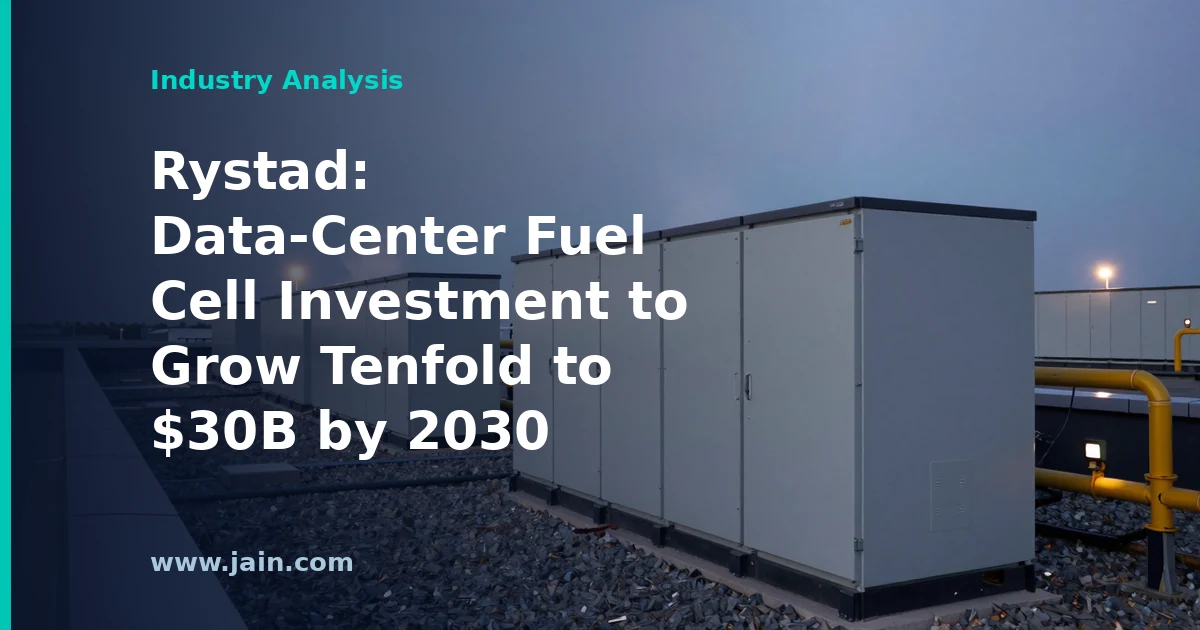
Research firm Rystad Energy projects that investment in fuel cells by data-center operators will grow roughly tenfold, reaching $30 billion by 2030, according to a report published June 26, 2026. The forecast points to on-site power generation moving from a niche backup strategy to a mainstream way of energizing new data-center capacity as connections to the electric grid grow slower and harder to secure.
Executive Summary
Rystad Energy, a Norway-based energy research and intelligence firm, has put a headline number on a trend the data-center industry has been living with for several years: when the grid cannot deliver power on the timeline a project needs, operators increasingly buy their own generation. Its new forecast calls for data-center fuel cell investment to grow tenfold by 2030, reaching $30 billion — a figure that implies today’s spending is on the order of a few billion dollars a year.
Fuel cells convert a fuel — most commonly natural gas today, potentially hydrogen in the future — directly into electricity through an electrochemical reaction rather than combustion. That gives them attractive properties for data centers: they can be deployed in modular blocks at the site, run continuously as primary power rather than just backup, and generally face lighter air-permitting burdens than combustion turbines or diesel generators. A tenfold growth call, if it materializes, would make fuel cells one of the fastest-growing categories of behind-the-meter power — generation installed on the customer’s side of the utility connection — in the broader AI-infrastructure buildout.
The Grid Queue Is the Real Story
The most important context for this forecast is not the fuel cell itself but the waiting line in front of it. In many major data-center markets, utilities and grid operators have quoted multi-year waits for large new interconnections — the formal process of hooking a big load up to the transmission system. For an AI data center whose revenue depends on being energized quickly, a delay of several years is often more costly than paying a premium for on-site generation. That inversion of economics — time-to-power mattering more than cost-per-megawatt-hour — is what turns a niche technology into a $30 billion market forecast.
Fuel cells are one of several answers to that problem, alongside gas turbines, reciprocating engines, and eventually small modular nuclear reactors. Their particular appeal is speed and siting flexibility: modular units can be added in increments as a campus grows, they operate quietly with no combustion exhaust plume, and in many jurisdictions they clear environmental permitting faster than combustion alternatives. For operators, that can compress the gap between breaking ground and serving customers.
What Tenfold Growth Would Actually Require
Growing an equipment market tenfold in roughly four years is not just a demand question — it is a manufacturing and supply-chain question. Fuel cell systems depend on specialized components and materials, and stepping up output by an order of magnitude means new factory capacity, expanded supplier networks, and trained installation and service workforces. The release headline does not indicate whether Rystad’s forecast is constrained by manufacturing capacity or is a pure demand-side projection, and that distinction matters a great deal for whether the number is achievable.
The fuel supply side deserves equal scrutiny. Most commercially deployed data-center fuel cells today run on natural gas, which means large deployments need pipeline capacity and gas contracts — their own version of an interconnection queue. Operators are effectively trading one infrastructure dependency for another. That trade often still makes sense, because gas infrastructure can frequently be expanded faster than high-voltage transmission, but it is not a free pass around the physical world.
Winners, Losers, and the Emissions Question
If the forecast is directionally right, the clearest beneficiaries are fuel cell manufacturers and the developers who package on-site generation into ready-to-run power solutions for data centers, along with gas utilities that supply the fuel. Traditional electric utilities face a more nuanced picture: behind-the-meter generation can relieve pressure on constrained grids, but it also diverts what would have been decades of steady load growth — and the revenue that comes with it — away from the regulated system.
The environmental ledger is genuinely mixed and worth stating plainly. Natural gas fuel cells emit carbon dioxide, though generally with higher electrical efficiency and far lower local air pollutants than combustion generation. Advocates point to a future switch to hydrogen as a path to low-carbon operation; skeptics note that low-carbon hydrogen remains scarce and expensive. Buyers and communities evaluating these projects should ask which fuel is actually contracted today, not which fuel is possible in principle.
A Forecast Is a Scenario, Not a Commitment
It is worth being clear about what a research-firm projection is: a modeled scenario built on assumptions about data-center demand, grid-connection timelines, technology costs, and competing options. Rystad is a well-established energy intelligence firm, but the headline figure arrives without published methodology in the source at hand. If AI capacity growth slows, if utilities accelerate interconnections, or if gas turbine supply loosens, the fuel cell number could land well short of $30 billion. Conversely, if grid queues lengthen further, it could prove conservative. The forecast is best read as a signal about the direction and seriousness of the on-site power trend, not as a precise measurement of the future.
Background
Data-center electricity demand has surged with the AI buildout, and in several major markets the ability to get grid power — not land or capital — has become the binding constraint on new capacity. That has pushed operators toward on-site generation of many kinds, from gas turbines to fuel cells, and made “time to power” a core competitive metric. Fuel cells entered the data-center world primarily as clean backup and supplemental power, with a small number of vendors building a commercial track record over the past decade; the shift Rystad describes is their promotion to primary, at-scale power for new facilities.
Rystad Energy, founded in Oslo in 2004, built its reputation on oil and gas market intelligence and has since expanded into power, renewables, and energy-transition research, making it one of the more frequently cited independent forecasters in the energy sector.
Louisiana is competing hard for data centers, the giant computer warehouses that run artificial intelligence and use enormous amounts of electricity.
Governor Jeff Landry signed an order saying such projects should lose a state tax break if they push up everyone else’s power bills.
The catch: the biggest bill on the table is a $1.8 billion Texas power plant that the state’s largest utility wants to buy, largely to serve a Meta data center. The order does not touch it. The state’s elected utility regulators decide that one, and they are leaning toward no.
Louisiana Gov. Jeff Landry signed an executive order on June 25, 2026, directing Louisiana Economic Development Secretary Susan Bourgeois to write, within 90 days, new requirements that data centers must meet to claim the state’s Data Center Sales and Use Tax Exemption, the Louisiana Illuminator reported. Under the order, data centers that cause electricity prices to rise across the grid should not qualify for the break unless other benefits outweigh the higher prices.
The order arrives amid a dispute over Entergy Louisiana’s proposed $1.8 billion purchase of the Cottonwood power plant in Newton County, Texas, a price more than three times what the plant sold for in 2024. A consultant to the Louisiana Public Service Commission attributed that increase predominantly to the power needs of Meta’s Hyperion data center in Northeast Louisiana. The order explicitly does not apply to Entergy’s generation plans.
Executive Summary
Landry’s order puts Louisiana in the group of states trying to court hyperscale data centers (the very large campuses built by major cloud and AI companies) while promising that households will not subsidize their electricity. It does this through an economic development lever: a sales tax exemption that projects must now earn by showing they will not raise grid-wide power prices, or that their benefits outweigh any increase.
The order’s reach, however, stops short of the decision that currently matters most to ratepayers. Entergy Louisiana’s plan to buy the Cottonwood plant, which consultant Lane Sisung projected would significantly raise monthly bills for the utility’s 1.1 million customers, is before the Public Service Commission, and the order states it does not limit the commission’s authority. That split between the tax lever and the rate lever is the story’s central point for anyone building, financing or siting AI infrastructure in the state.
The Order Polices a Tax Break, Not a Power Plant
The mechanism in Landry’s order is a condition on a tax incentive. Secretary Bourgeois has 90 days to set requirements for the Data Center Sales and Use Tax Exemption that balance investor interests with residents’ electricity costs. A project that raises prices across the grid is meant to lose eligibility unless its other benefits outweigh that effect. That is a gate for future incentive claims, administered by the state’s economic development agency.
The largest cost item currently in view runs through a different gate. Entergy Louisiana’s proposed $1.8 billion purchase of the Cottonwood plant in Texas, more than triple its 2024 sale price, is a generation decision regulated by the Public Service Commission. Sisung’s analysis for the commission said the price increase is predominantly attributable to power demand from Meta’s Hyperion data center, and projected significant monthly bill increases for Entergy Louisiana’s 1.1 million ratepayers if the deal proceeds. The order says it does not apply to Entergy’s generation plans and does not impair the commission’s constitutional or statutory authority.
So whether those 1.1 million customers absorb costs tied to Hyperion’s load will be settled by five elected commissioners, not by the executive order. Republicans hold a 3-2 majority on the commission and have said they are inclined to follow Sisung’s advice against approving the purchase. For developers and utilities, the practical reading is that Louisiana now has two venues for data center cost questions, and the one with direct control over rates is the commission.
Why an Incentive Condition Is Useful but Indirect
Tying a tax break to grid effects is not empty. Incentives are negotiated before a site is chosen, so a cost test attached to them can shape project terms early, for example by encouraging developers to fund their own generation or accept tariffs that assign new-capacity costs to them. That is leverage a governor has and a commission does not.
The limits are equally clear. Generation needed to serve a large new customer is typically committed through utility agreements and regulatory approvals that the incentive does not govern. Whether a project “causes energy prices to rise across the grid” is also a modeling question, and the order’s balancing test, which allows other benefits to outweigh higher prices, leaves room for judgment. How strict the rule proves to be depends on requirements that have not yet been written.
Every Side’s Claims Deserve the Same Scrutiny
Entergy and Meta have said they disagree with Sisung’s assessment, and Landry has said the Cottonwood proposal would breach promises both companies made not to shift electricity costs to ratepayers. The companies’ disagreement is a claim that needs the same testing as the consultant’s conclusion; the commission’s proceeding is where that evidence should be weighed. Entergy Louisiana CEO Phillip May attended the signing and accepted a copy of the order, while the governor said he had not changed his view on Cottonwood.
The critics’ claims also warrant scrutiny. Commissioner Davante Lewis called the event a “PR stunt” and criticized closed-door data center deals. Jackson Voss of the Alliance for Affordable Energy supported the goal but said Landry pressed the commission last year to shorten its review of Entergy’s power agreement with Meta under the governor’s Lightning Speed Initiative. The Sierra Club called the order “hollow.” The Lightning Speed critique goes to how the current cost question arose; the “hollow” charge is a prediction about rules not yet published, and it can be tested against them once they are.
What It Signals for Hyperscale Siting
For companies evaluating Louisiana, the order adds a cost-allocation test to a financial incentive that matters in site selection. Developers should expect to document grid effects when claiming the exemption, and should treat utility and commission proceedings as the place where their power costs, and who pays them, are ultimately fixed.
The episode also shows the tension facing any state pursuing AI buildout: the order describes data centers as a once-in-a-generation opportunity for rural growth while acknowledging that their power demand can raise costs for existing customers. Louisiana’s answer so far splits that problem between two institutions, and the commission’s Cottonwood decision will be the first real test.
Background
Louisiana has actively recruited large data center projects, most prominently Meta’s Hyperion campus in Northeast Louisiana, which Entergy Louisiana has agreed to supply with power. Gov. Jeff Landry’s Lightning Speed Initiative was created to accelerate permitting for Big Tech and AI investments, and the state offers a Data Center Sales and Use Tax Exemption as an incentive.
Electricity rates for Entergy Louisiana’s 1.1 million customers are set by the Louisiana Public Service Commission, an elected five-member body with constitutional authority over utilities. The commission is now reviewing Entergy’s proposed $1.8 billion Cottonwood plant purchase, the first major test of whether costs tied to data center demand will reach household bills.
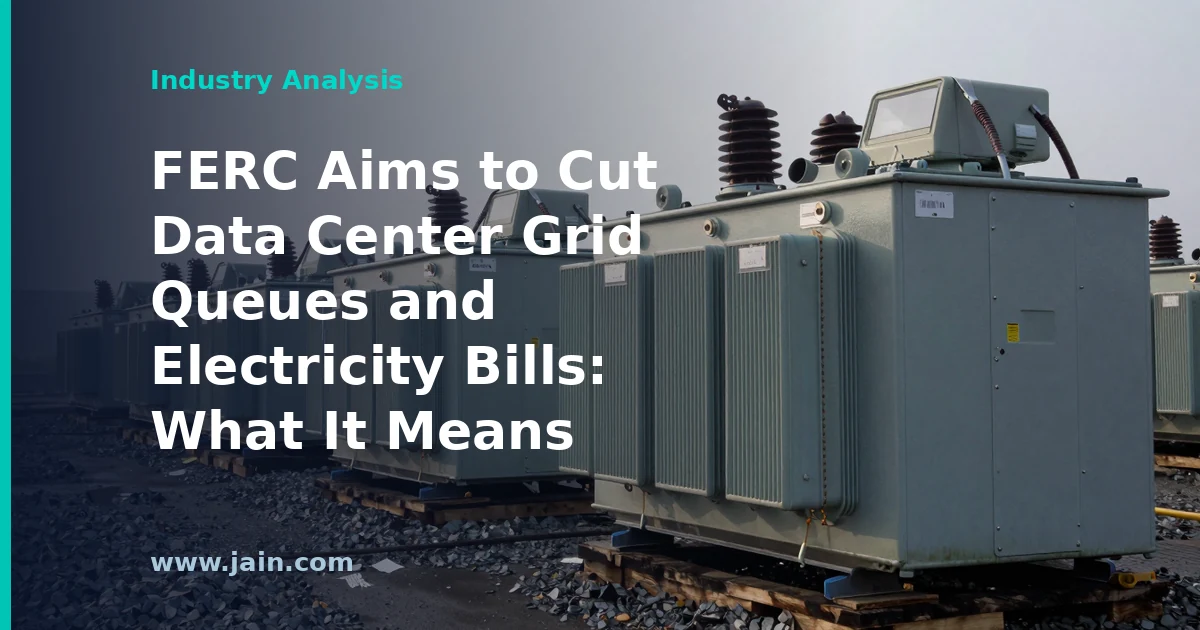
IEEE Spectrum reported on June 25, 2026, that the Federal Energy Regulatory Commission (FERC) — the U.S. agency that oversees the interstate power grid and wholesale electricity markets — aims to cut the queues that data centers face when seeking grid connections, while also containing electricity bills. The syndicated item carries only the headline, so the specific mechanism, docket, and timeline are not detailed in the material available here.
The framing itself is significant: the regulator is treating slow grid interconnection and rising consumer power costs as a single, linked problem — the two pressures the AI data center boom has placed on the U.S. electric system.
Executive Summary
According to the report, FERC is moving to shorten the waits that large new loads — chiefly AI data centers — endure before they can connect to the grid, and to do so in a way that limits the impact on ordinary electricity bills. Interconnection is the process by which a new generator or major customer is studied, assigned any needed grid-upgrade costs, and physically wired into the transmission system; the backlog of these requests is widely regarded as one of the tightest bottlenecks on U.S. data center growth.
Why it matters: hyperscale operators can erect a building in 18 to 24 months, but securing hundreds of megawatts of firm grid power can take far longer, and utilities in several regions have quoted multi-year waits. At the same time, household and business electricity prices have become politically charged in data-center-heavy regions, with debates over how much of the grid buildout ordinary ratepayers should fund. A federal move that credibly addresses both — speed and cost — would be the single biggest regulatory lever on how fast AI infrastructure can actually energize.
What is and is not substantiated: the available source confirms the regulator’s stated aim but not the instrument. Whether this is a formal rulemaking, a policy statement, or guidance to grid operators — and whether it is binding — cannot be determined from the headline alone, and readers should weight it accordingly until the underlying FERC documents are public.
Why the Interconnection Queue Is the Real Bottleneck
Every large project that wants to plug into the high-voltage grid — a solar farm, a gas plant, or increasingly a gigawatt-scale data center campus — must file an interconnection request and wait for engineering studies that determine what upgrades the grid needs and who pays for them. By the end of 2023, Lawrence Berkeley National Laboratory counted roughly 2,600 gigawatts of generation and storage capacity waiting in U.S. queues — more than double the nation’s entire installed generating fleet — with typical waits stretching toward five years from request to operation.
Data centers sit on the demand side of this equation, and large-load interconnection has historically been even less standardized than the generator process, handled utility by utility and state by state. For AI operators, the queue — not chips, land, or capital — is frequently the schedule-defining constraint. That is why a federal regulator signaling it wants to compress these timelines matters more to data center delivery dates than most technology announcements.
Two Goals in Tension: Faster Hookups and Lower Bills
Cutting queues and cutting bills pull in different directions, and the report’s pairing of them is the most analytically interesting element. Connecting multi-hundred-megawatt loads quickly often requires transmission upgrades whose costs, under traditional utility ratemaking, are spread across all customers. Consumer advocates in several data-center-heavy states have argued that households are subsidizing the grid expansion that serves hyperscale computing; utilities and data center operators counter that large, steady loads can spread fixed grid costs over more sales and put downward pressure on rates.
Both claims can be true depending on how cost allocation is structured — which is precisely the kind of question FERC decides. Mechanisms observers have debated in recent years include dedicated large-load rate classes, requirements that data centers fund their own upgrades or bring their own generation, and co-location arrangements that place computing directly at power plants. Which of these, if any, the regulator is now advancing is not specified in the available source.
What a Federal Regulator Can — and Cannot — Fix
FERC has a track record here: its Order 2023 overhauled the generator interconnection process, replacing first-come-first-served study lines with clustered, first-ready-first-served batches, backed by deposits and readiness requirements to flush speculative projects from the queue. Extending comparable discipline to large loads would be a logical next step, and FERC has also been drawn into the co-location debate through disputes over data centers sited at existing power plants.
But the agency’s jurisdiction has hard edges. States control retail rates, generation siting, and most permitting; regional grid operators run their own study processes; and no order can conjure the transformers, turbines, and skilled crews that are in genuinely short supply worldwide. A FERC action can remove procedural delay — often years of it — but the physical buildout still moves at the pace of supply chains and state approvals. Expectations should be calibrated to that split.
Winners, Losers, and What to Watch
If queue reform for large loads materializes and works, the clearest beneficiaries are hyperscalers and data center developers with projects stalled behind study backlogs, along with the transmission engineering firms and equipment suppliers that would see demand pulled forward. Utilities face a mixed outcome: faster load growth boosts their invested capital base, but tighter federal timelines and cost-assignment rules constrain how they manage it. Generation developers could gain if load and supply requests are studied more coherently together.
The unresolved variable is the ratepayer. If the regulator pairs faster interconnection with cost rules that make large loads bear the upgrades they cause, the political friction around data center power could ease; if speed comes without that discipline, bill impacts could intensify the local backlash that has already slowed projects in several markets. The details — still unpublished in the material available here — will determine which scenario unfolds.
Background
FERC is the century-old independent agency that governs the U.S. interstate grid, and interconnection reform has been its defining workstream of the 2020s. After two decades of essentially flat electricity demand, AI data centers, manufacturing, and electrification pushed load growth back onto utility planning maps around 2023–2024, colliding with queue backlogs that Lawrence Berkeley National Laboratory measured at roughly 2,600 gigawatts of waiting capacity by the end of 2023. Order 2023 tackled the generator side of the problem; large loads — the data centers themselves — remained governed by a patchwork of utility and state processes.
Through 2024 and 2025, disputes over co-locating data centers at power plants and over who pays for grid expansion made large-load policy one of the most watched dockets in U.S. energy. The June 2026 report places FERC’s next move squarely in that lineage: an attempt to standardize and speed how the grid absorbs its biggest new customers without letting the cost land on everyone else’s bill.
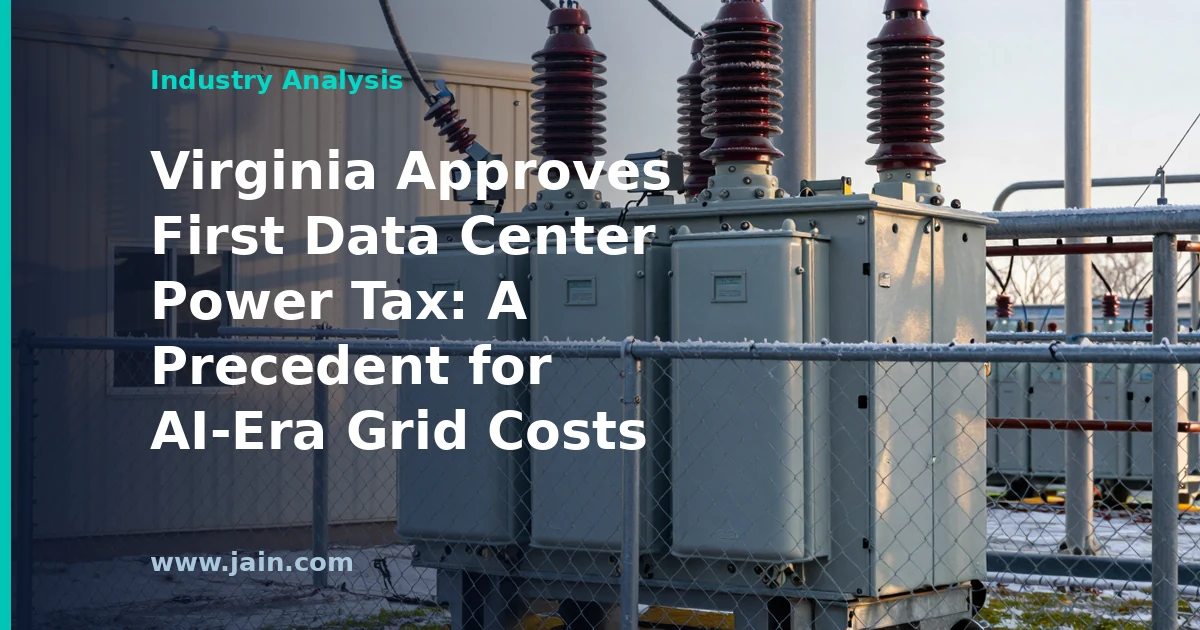
Virginia has approved what is being described as the first-ever data center power tax, according to a June 23, 2026 report from Data Center Knowledge. The measure makes Virginia — home to the largest concentration of data centers in the world — the first U.S. state to attach a dedicated levy to data center power consumption.
Details of the tax’s rate, structure, and effective date were not included in the initial report, but the “first-ever” framing marks a significant policy departure: rather than courting data centers exclusively with incentives, the state that hosts more of them than any other is now taxing the electricity they use.
Executive Summary
The significance of this measure lies less in its mechanics — which the initial reporting does not detail — than in its symbolism and its likely ripple effects. Virginia built its data center dominance in part on a generous sales-and-use tax exemption for data center equipment, a policy other states copied for two decades. A power tax moving in the opposite direction signals that the political economy of hosting data centers has shifted: the question in Richmond is no longer only how to attract capacity, but how to make that capacity pay for the grid strain it creates.
For operators, hyperscalers, and their customers, the precedent matters more than the immediate cost. Utilities and regulators across the country have been wrestling with how to allocate the enormous transmission and generation investments driven by AI-era load growth — and whether ordinary ratepayers are subsidizing them. A dedicated tax on data center power is one answer to that question, and now the largest data center market on earth has adopted a version of it. Other states weighing similar debates will be watching closely.
Because the available source is a headline-level report, the analysis below focuses on the policy context and the questions the measure raises, rather than on provisions that have not yet been publicly detailed.
Why Virginia Was Always Going to Move First
Northern Virginia — particularly Loudoun County’s “Data Center Alley” — hosts the densest cluster of data centers anywhere in the world, a position built on early internet-exchange infrastructure, proximity to federal customers, and a long-standing tax exemption on data center equipment. That concentration has made Virginia the place where the costs of the AI buildout show up first and loudest: transmission congestion, multi-year interconnection queues, land-use fights, and public concern that residential electricity bills are absorbing grid investments made largely to serve large industrial loads.
Virginia’s own legislative auditors flagged these tensions in a December 2024 study of the industry’s fiscal and energy impacts, and the General Assembly has debated data center energy policy in every session since. Seen against that backdrop, a power tax is not a bolt from the blue — it is the next step in a multi-year negotiation between a state and an industry that has become its signature economic engine and its biggest new source of electricity demand.
The Real Question: Who Pays for AI-Era Grid Growth?
Electric grids recover their costs from customers through rates, and when one customer class grows explosively — as data centers have — regulators must decide whether the new transmission lines, substations, and generation get billed to that class or spread across everyone. Consumer advocates argue that spreading the cost amounts to households subsidizing some of the world’s wealthiest companies; utilities and operators counter that large, steady loads can actually lower average system costs by spreading fixed expenses over more kilowatt-hours. Both arguments have evidentiary support in different circumstances, which is precisely why the allocation fight has been so contentious.
A tax is a blunter instrument than a rate class. Utility ratemaking assigns costs based on engineering studies of who causes them; a tax is a legislative judgment that a category of consumption should contribute more to public coffers, whatever the cost-causation math says. Whether Virginia’s measure funds grid infrastructure specifically, flows to the general fund, or offsets residential bills will determine whether it functions as genuine cost allocation or as a revenue measure wearing cost-allocation clothing. The initial reporting does not say — and that distinction is the single most important thing to watch as details emerge.
What It Means for Operators, Tenants, and Competing States
For data center operators, a per-unit levy on power lands directly on the largest line item in their operating budgets. Colocation providers will face the classic question of how much they can pass through to tenants under existing contracts; hyperscalers running their own facilities will absorb it as a marginal cost increase on Virginia capacity relative to other markets. The competitive effect depends entirely on magnitude: a modest levy on power in the market with the best fiber connectivity in the country changes few siting decisions, while a heavy one accelerates the diversification toward Ohio, Texas, Georgia, and the Carolinas that grid constraints were already driving.
Competing states now face a strategic choice of their own. Some will advertise the absence of such a tax as a recruitment tool. Others — facing identical ratepayer politics as AI load arrives on their grids — may treat Virginia’s measure as proof of concept. It is worth remembering that Virginia’s data center equipment tax exemption was copied by more than thirty states. Policy that starts in the world’s data center capital has a history of traveling.
A Precedent That Cuts Both Ways
The industry has long argued, with some justification, that data centers are exceptional taxpayers — Loudoun County’s budget depends heavily on data center property tax revenue — and that layering new levies on top risks punishing a sector for succeeding. That argument deserves a fair hearing, and it will get one in the rate cases and legislative fights ahead. But the industry has also benefited from a bargain in which states competed to reduce its tax burden while the public bore growing grid costs, and Virginia’s move suggests that bargain is being renegotiated rather than abandoned.
The measured takeaway: this is neither the end of Virginia’s data center industry nor a trivial development. It is the first formal acknowledgment, in statute, by the market that matters most, that data center power consumption is a distinct fiscal category. How the tax is structured — and whether it stabilizes the industry’s social license to operate or simply raises its costs — will determine whether operators come to see it as the price of durable acceptance or the start of an unwelcome trend.
Background
Virginia’s data center industry dates to the early internet era, when network interchange points in Northern Virginia made the region a natural home for hosting infrastructure. Over two decades, aided by a state sales-and-use tax exemption on data center equipment, Loudoun and neighboring counties grew into the world’s largest data center cluster, and data center property taxes became a pillar of local budgets. The AI boom then supercharged demand: utilities serving the region have projected sustained, historic load growth, and interconnection wait times stretched to years.
That growth turned data centers into a live political issue in Richmond. A December 2024 state legislative audit examined the industry’s fiscal benefits and energy costs, and subsequent General Assembly sessions produced a stream of bills on data center siting, ratepayer protection, and tax treatment. The power tax reported in June 2026 is the most consequential product of that debate to date — the first time the industry’s electricity consumption itself has been made a taxable category.
The federal government’s main pollution regulator said on June 10 that it will not write national environmental rules for the giant computer warehouses that run artificial intelligence. States and local towns will decide instead.
That does not mean fewer fights. Some of these sites burn natural gas on their own property to get electricity quickly. In April, civil rights and environmental groups sued the company xAI, saying it ran 57 gas-fired generators near Memphis without the pollution permits the law requires. How that case ends will decide who gets to challenge these projects in court.
US Environmental Protection Agency (EPA) Administrator Lee Zeldin said at the Politico Energy Summit on June 10, 2026, that the agency will not pursue any nationwide environmental requirements or recommendations aimed at the AI industry, Crowell & Moring reported. Zeldin acknowledged that technologies exist to reduce data centers’ water consumption and air pollution, but said deciding the right practices for each facility is a matter for states and local communities, not EPA.
The announcement follows a year of EPA actions easing permitting for power generation and data centers, and it lands amid active litigation: an April 14 Clean Air Act citizen suit by the NAACP, the Southern Environmental Law Center and Earthjustice alleging that xAI and its subsidiary MZX Tech operated 57 unpermitted portable methane gas turbines to power the Colossus 2 data center in South Memphis, and a June 16 Department of Justice motion to intervene and have that suit dismissed.
Executive Summary
EPA has taken itself out of the business of writing AI-specific environmental rules. There will be no national standard for data center water use, air emissions or cooling practices, and no federal list of recommended best practices. That removes a layer of regulation developers had reason to expect, but it does not suspend the Clean Air Act or the Clean Water Act, and it does not change the fact that most day-to-day permitting decisions sit with state and local agencies.
The practical effect is to relocate risk rather than remove it. The part of an AI campus most exposed is on-site combustion — gas turbines and backup engines that make electricity on the property — because that equipment is what triggers air permits. With no federal template, those permits will be judged against differing state and local standards, and enforcement increasingly runs through private lawsuits, as the xAI case shows.
Whether that private enforcement route stays open is now itself in question. The Department of Justice has argued that private groups cannot pursue Clean Air Act suits over the federal government’s objection. The outcome of that argument will shape the legal risk attached to fast-tracked on-site power across the industry.
Stepping Back Is Not the Same as Fewer Permits
Zeldin’s June 10 statement rules out new federal requirements and recommendations aimed at AI. It does not rewrite existing law. Data centers that burn fuel on site still fall under the Clean Air Act, and those that discharge water still fall under the Clean Water Act. New Source Review (NSR) — the Clean Air Act program requiring a permit before a large new pollution source is built — still applies. Until EPA finalizes the rule it proposed in May 2026, a major NSR permit is still required before any construction begins.
Read in sequence, EPA’s recent actions share a pattern. In May 2025 it issued guidance allowing certain emergency engines to run up to 50 hours a year in non-emergency conditions to support grid reliability for data centers. In September 2025 it gave developers flexibility to start non-emissions-related building work before obtaining a Clean Air Act permit. In May 2026 it proposed redefining when construction legally ‘begins’ so non-emitting structures can go up earlier. Each step lets the concrete and steel move faster. None of them exempts the equipment that actually emits.
Why 57 Turbines Mark Where the Risk Now Sits
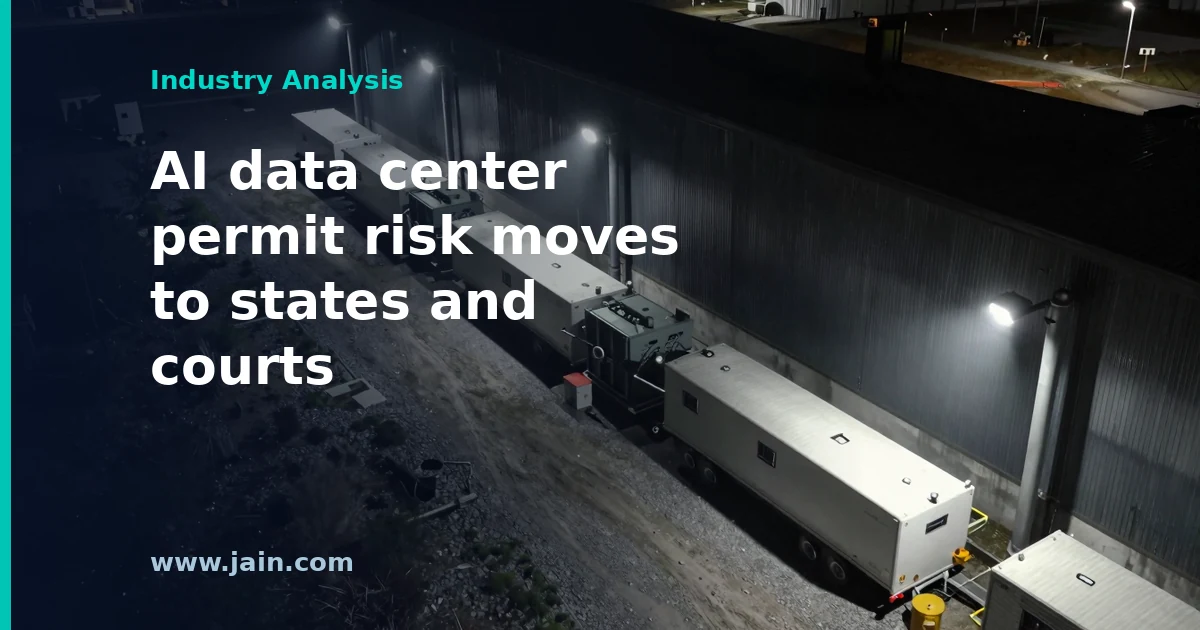
The server halls of an AI campus do not need an air permit; the generators feeding them can. That is the mechanism behind the title’s claim. When grid connections lag behind construction schedules, some developers bridge the gap with on-site gas generation, and that generation is precisely where Clean Air Act obligations bite. The citizen suit filed April 14 alleges that xAI and MZX Tech ran 57 portable methane gas turbines without required air permits to power Colossus 2 — a fleet the complaint treats as the data center’s power supply, not an ancillary backup. The allegations have not been proven in court, and the plaintiffs seek substantial penalties and cite health risks for families in South Memphis and North Mississippi.
With EPA declining to set a national standard, the questions that decide cases like this — whether equipment crosses major source thresholds (the emissions levels above which a facility needs the most demanding permits), what controls are required, how long ‘temporary’ generation may run — are answered by state air agencies and local boards, and tested by private plaintiffs in federal court. A citizen suit is a lawsuit a private party can bring to enforce a federal environmental law after giving 60 days’ notice. The people most affected are developers using on-site generation to beat grid timelines, the lenders and customers relying on those schedules, and the communities living next to the equipment.
The Justice Department’s Intervention Is the Swing Variable
On June 16, the Department of Justice moved to intervene in the xAI case and have it dismissed. Its filing argues that the suit threatens national security by seeking to cut power to AI infrastructure that supports the Department of War’s operations, and, more broadly, that the executive branch holds exclusive authority to enforce federal law, so private parties cannot pursue Clean Air Act citizen suits over the government’s objection.
If a court accepted that theory, it would sharply narrow a private right of action Congress wrote into the statute and raise separation-of-powers questions, since the executive branch would effectively decide which cases reach a judge. Crowell & Moring’s attorneys consider it unlikely the court will accept the argument. Either way, the ruling matters well beyond Memphis: it will tell developers whether federal non-enforcement actually lowers their exposure, or whether private enforcement fills the space EPA has left.
A Patchwork Rewards Early Paperwork
Without a national baseline, requirements will diverge by state and locality, and a multi-state developer will face different rules for the same turbine or cooling design. That favors operators who secure permits before breaking ground, audit whether their generation crosses major source thresholds, and treat compliance with federal law as protection against both citizen suits and a future administration that enforces more aggressively.
Zeldin’s own acknowledgment that pollution- and water-reducing technologies exist points to a hedge: voluntary adoption of measures such as closed-loop cooling, which recirculates water rather than evaporating it, may reduce the odds of state action and local opposition. The competitive edge in this environment belongs less to whoever builds fastest than to whoever can show a regulator, a neighbor or a judge that the power plant behind the data center was permitted from day one.
Background
The US Environmental Protection Agency sets national rules under laws such as the Clean Air Act and Clean Water Act, but state and local agencies issue and enforce many of the permits that apply to individual facilities. The rapid growth of AI data centers — and the electricity they need — has drawn activity from Congress, the executive branch, federal agencies and the courts, without yet producing a cohesive regulatory framework.
Since May 2025, EPA has issued a string of actions aimed at speeding data center and power plant construction, and in January 2026 it held a roundtable with the Data Center Coalition, the industry’s trade association. xAI’s Colossus 2 in South Memphis has become the most visible test of how environmental law applies to AI campuses that generate their own power on site.
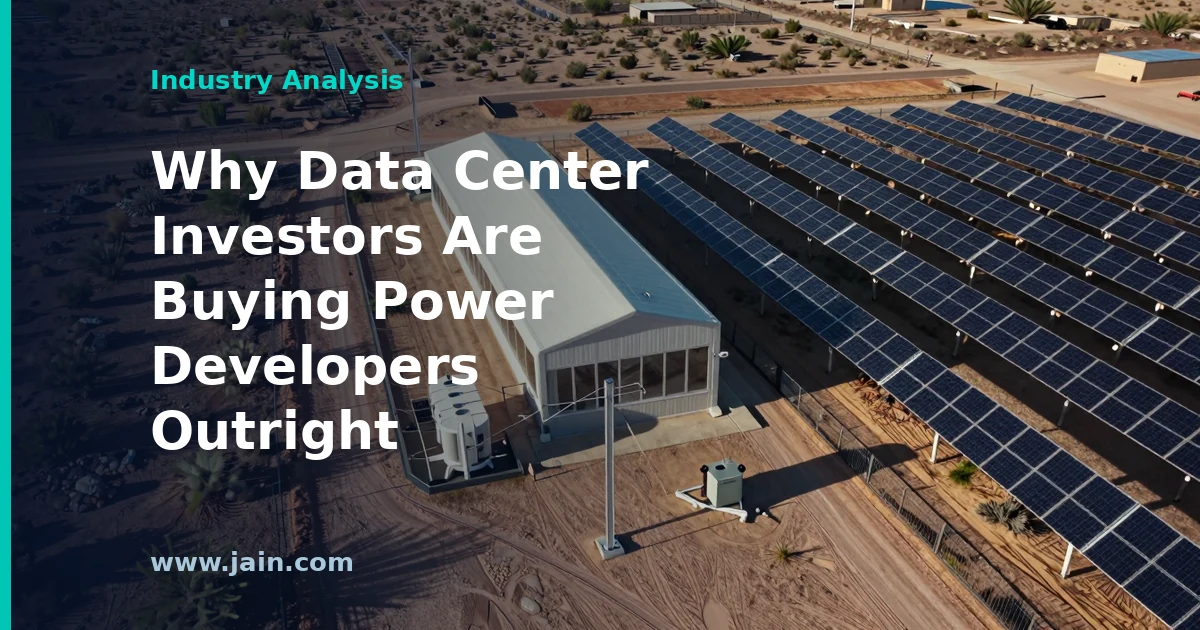
Reuters reported on June 22, 2026 that investors in data centers are acquiring power developers outright — not merely signing supply contracts with them — as competition to build new compute capacity intensifies. The report frames the trend as a race in which control of electricity generation has become as strategically important as control of the data center itself.
Executive Summary
According to Reuters, the capital behind data center construction is moving up the energy supply chain: rather than waiting in utility interconnection queues or negotiating power purchase agreements (long-term contracts to buy electricity from an independent producer), data center investors are simply buying the companies that develop power projects. Ownership gives them the pipeline of sites, permits, equipment orders, and grid connection positions that a developer has assembled — assets that have become scarce as AI-driven demand outruns the grid’s ability to deliver new supply.
The significance is structural. For decades, digital infrastructure and power generation were separate industries connected by contracts. If investors now find contracts insufficient and are acquiring generation capability outright, the boundary between the compute business and the energy business is dissolving. That changes who competes for power projects, what those projects are worth, and how quickly new data center capacity can realistically come online.
Power, Not Land or Chips, Is the Binding Constraint
A data center is, economically, a machine for converting electricity into computation. In recent years the hardest input to secure has shifted from real estate and even from processors to firm electric capacity — a guaranteed, always-available supply of megawatts. Connecting a large new load or a new power plant to the transmission grid requires passing through an interconnection queue, the utility and grid-operator study process that determines what upgrades are needed; those processes are widely understood across the industry to take years. A power developer’s real inventory is its queue positions, land control, permits, and equipment reservations. Buying the developer is a way of buying time — the years of lead work already done.
Seen that way, the behavior Reuters describes is rational sequencing. When an input is scarce and the market for it is slow, firms integrate backward into it. Railroads bought coal mines; aluminum smelters built dams. Data center capital buying power development capability is the same industrial logic applied to the AI build-out.
From Contracts to Control
The traditional instrument linking the two industries is the power purchase agreement. A PPA transfers energy and price risk, but it does not transfer control: the developer still decides which projects advance, on what schedule, and who else gets served. In a seller’s market for capacity, contract counterparties compete for the developer’s attention. Ownership removes that competition — the acquirer directs the entire pipeline toward its own loads and captures the development margin rather than paying it.
The trade-off is that data center investors are taking on a business with a very different risk profile. Power development involves permitting risk, supply chain exposure for equipment such as turbines and transformers, community opposition, and regulatory processes that money alone cannot compress. Vertical integration internalizes those risks instead of leaving them with a specialist counterparty. Whether the acquirers can manage them as well as standalone developers did is an open execution question, and the answer will vary by acquirer.
Winners, Losers, and the Ones in Between
The clearest immediate winners are power developers themselves and their backers: an asset class that was priced against utility-scale project returns is now being bid for by buyers who value it against AI infrastructure returns. Sellers of development pipelines are exiting into unusual demand. Conversely, buyers of power who lack that capital — smaller data center operators, industrial users, and potentially ordinary utility customers — face a market in which the deepest-pocketed players are locking up future supply at the source.
Utilities and grid operators sit in the middle. Well-capitalized customers willing to fund generation can accelerate supply additions, which helps everyone connected to the grid. But if acquired pipelines are steered toward dedicated or behind-the-meter service (generation wired directly to a facility rather than through the shared grid), the public grid may see less of that new supply than the raw development numbers suggest. How regulators allocate costs and capacity between hyperscale loads and everyone else was already contentious; concentrated ownership of development pipelines sharpens the question rather than settling it.
What This Signals About the AI Build-Out
Strategically, the trend is a statement about expectations. Buying a developer only makes sense if you believe demand for compute — and therefore for power — will remain strong past the multi-year horizon on which power projects are built. It is also a statement about the grid: participants with the most information about future load evidently do not expect conventional utility processes to deliver capacity fast enough, and are paying to route around the wait. Both signals are worth registering, with the usual caution that aggressive capacity bets made near the top of an investment cycle are precisely the ones that look overextended if demand growth moderates.
Background
Data centers — the facilities housing the servers behind cloud services and AI — have historically obtained electricity the way other large customers do: from utilities, supplemented by long-term purchase contracts with independent power producers. The surge in AI computing that began in the early 2020s changed the balance, pushing projected data center power demand up sharply while new generation and transmission remained slow to permit and build. Operators responded first with ever-larger contracts and reserved grid capacity; the acquisitions Reuters describes are the next step, moving from buying a developer’s output to buying the developer itself.
Reuters is a global news agency whose energy and infrastructure coverage is widely used as a market reference, and its June 2026 report distills a pattern visible across the sector rather than a single transaction.