Oregon regulators have approved a 29.7% electricity rate increase for data centers served by Portland General Electric (PGE), the state’s largest utility, as reported by Oregon Public Broadcasting on July 6, 2026. The decision is the first major rate action taken under Oregon’s landmark POWER Act, a 2025 law that directed regulators to place large energy users such as data centers into their own rate class so that the costs of serving them are not spread across households and small businesses.
Executive Summary
The approval makes Oregon one of the first states to move from debating data-center cost allocation to actually pricing it. Under the POWER Act — passed in 2025 amid rapid data-center load growth and rising residential bills — utilities must charge very large customers rates that reflect the full cost of serving them, including the new generation and transmission their demand triggers. The 29.7% figure now approved for PGE’s data-center class is the concrete output of that mandate.
Why it matters: electricity has become the gating resource for AI and cloud expansion, and the question of who funds grid upgrades — the data centers driving demand, or all ratepayers — is now the central fight in utility regulation. Oregon has produced a working template, with a specific number attached, that commissions and legislatures in Virginia, Georgia, Ohio, Texas and elsewhere are likely to study closely.
Who Pays for the AI Buildout Just Got a Concrete Answer
For most of the past century, utilities spread the cost of new infrastructure across all customers on the theory that everyone benefits from a stronger grid. Data centers broke that logic: a single hyperscale campus can demand as much power as a small city, arriving faster than utilities can build generation and wires. When those costs land in general rates, households effectively subsidize some of the world’s largest companies. Oregon’s POWER Act rejected that outcome by mandating a separate rate class — a distinct pricing category with its own cost-based rates — for large energy users.
The 29.7% increase is the first hard number to emerge from that framework. It represents a regulator’s judgment, tested through a formal rate proceeding, of what cost-causation pricing for data centers actually looks like at PGE. Whether one views the number as fair depends on the underlying cost studies, which the reporting summarized here does not detail — but the structural shift is unambiguous: growth-driven costs are being assigned to the customers driving the growth.
A Template Other States Will Study — and Contest
Regulators across the country are wrestling with the same problem, mostly through case-by-case special contracts with individual data-center customers. Oregon instead wrote the principle into statute and applied it class-wide, which offers predictability but less flexibility. Expect both sides of the national debate to cite this decision: consumer advocates as proof that ratepayer protection is achievable, and data-center developers as evidence of rising regulatory risk in some markets.
The competitive question is real. Oregon, particularly the Portland-Hillsboro area that PGE serves, built a significant data-center cluster on the strength of relatively inexpensive Northwest power and long-standing tax incentives. A nearly 30% jump in the power line-item — often the largest operating cost of a modern facility — changes site-selection math. States hungry for data-center investment may market themselves against Oregon’s approach; states worried about residential bills may copy it. Either way, the era of uniform, geography-blind data-center power pricing is ending.
The Economics Cut Both Ways
For utilities, a dedicated large-load class is double-edged. It insulates existing customers and reduces political backlash against growth, but it also raises the price of the very load that funds new investment. If data-center operators respond by self-supplying — building on-site generation, contracting directly with power producers, or siting behind other utilities — PGE could face slower load growth than planned, and the fixed costs of any already-committed infrastructure would need a home.
For operators, the decision reinforces a trend already visible across the industry: power strategy is now a first-order business function, not a facilities detail. Companies that locked in long-term supply arrangements, invested in efficiency, or diversified their geographic footprint are better positioned than those that assumed grid power would stay cheap and socialized. The Oregon decision does not end data-center growth in the state — but it prices that growth honestly, and honest prices change behavior.
Background
Oregon became a data-center destination over the past two decades thanks to relatively inexpensive Pacific Northwest power, a mild climate, strong fiber routes, and generous local tax incentives — attracting major cloud and internet companies to clusters around Hillsboro in PGE territory and along the Columbia River. As AI workloads accelerated demand in the 2020s, utilities projected unprecedented load growth while residential electric bills climbed, fueling a political backlash over who should fund grid expansion.
The POWER Act, passed in 2025, was Oregon’s answer: separate very large energy users into their own rate class and charge them the full cost of serving them. The rate decision reported here is the first major application of that law, moving the cost-allocation debate from principle to an approved price.
Texas has committed to building out its grid with 765 kilovolt (kV) transmission lines — the highest-capacity class of overhead power line used in North America — in a strategy Data Center Knowledge summarized on July 5, 2026 as “build the wires, the AI will follow.” Rather than waiting for AI data center projects to sign up first, the state’s approach is to construct extra-high-voltage backbone capacity in anticipation of that demand arriving on the ERCOT grid.
Executive Summary
The decision reported here is less about a single project than about a planning philosophy. Historically, most U.S. transmission has been built reactively: a large customer or generator commits, studies are run, and wires follow years later. Texas is inverting that sequence at the 765 kV level — the class of line capable of moving several times the power of the 345 kV circuits that have long formed the backbone of ERCOT, the grid operator serving most of Texas.
Why it matters: access to power has become the single biggest constraint on AI data center siting. A state that can credibly promise deliverable gigawatts on a known timeline gains a decisive edge in attracting capital-intensive AI campuses. But anticipatory building also shifts risk — if the forecast load arrives late, smaller than expected, or somewhere else, the cost of underused infrastructure lands on someone, and that someone is usually the ratepayer.
Why 765 kV Is a Statement, Not Just a Specification
Voltage class is the freeway-versus-farm-road question of the power grid. A 765 kV line can carry far more power than a 345 kV line over the same corridor, with proportionally lower electrical losses, which means fewer parallel lines, fewer towers, and less land consumed per delivered gigawatt. For a grid staring at data center campuses that each want hundreds of megawatts — sometimes a gigawatt or more — 765 kV is the only overhead technology that comfortably matches the scale of the ask.
Choosing it is also a signal. 765 kV projects take longer to permit and build, require specialized transformers with notoriously long lead times, and cost more up front than incremental 345 kV additions. A jurisdiction that standardizes on 765 kV is telling the market it expects load growth measured in tens of gigawatts, not incremental upticks — and that it intends to be structurally ready rather than perpetually catching up.
The Economics of Building Ahead of Demand
The core bet is that transmission, not land or fiber, is now the scarce input for AI infrastructure. Interconnection timelines — the queue a new large customer or generator waits in before it can plug into the grid — have stretched to years across much of the country. Every month of waiting is a month of idle capital for an AI developer whose chips depreciate quickly. If Texas can compress that wait by having backbone capacity already energized, it converts grid readiness directly into economic development.
The counterargument is forecast risk. AI load projections are among the most volatile numbers in the utility industry right now: they depend on chip supply, model efficiency gains, corporate capital cycles, and siting decisions that can pivot on a single tax incentive. Building wires for demand that hasn’t signed contracts means the state is, in effect, underwriting a demand forecast. If the forecast is right, the infrastructure looks prescient. If it’s wrong, Texas will have built expensive capacity whose carrying costs must still be recovered.
Winners, Losers, and Who Carries the Risk
The clearest winners are large-load customers — AI and cloud data center developers — who gain siting certainty, and the transmission utilities and equipment suppliers who get a multi-year construction pipeline. Landowners along new corridors face the familiar friction of routing and easement disputes, which 765 kV’s larger towers can intensify even as its higher capacity reduces the total number of corridors needed.
The pivotal question is cost allocation. In ERCOT, transmission costs have traditionally been spread across consumers, which works when new load broadly benefits everyone but becomes contentious when the driver is a handful of very large private customers. Whether Texas requires AI-scale loads to shoulder a larger, more direct share of the wires built substantially for them — through contribution requirements, minimum-take commitments, or special rate classes — will determine whether this build-out is remembered as smart industrial strategy or as a subsidy from households to hyperscalers. The source piece frames the bet; it does not settle who holds the downside.
What It Means Beyond Texas
Other states and grid operators are watching, because Texas is running the experiment they have avoided: proactive, speculative, extra-high-voltage expansion in a market famous for moving faster and regulating lighter than its peers. If the wires fill up with AI load on schedule, expect copycat programs and renewed pressure on slower-moving regional planning processes elsewhere. If they don’t, the episode will become the cautionary tale cited in every future transmission docket.
For the data center industry itself, the message is immediate: power-first siting is now official policy in at least one major market. Developers comparing regions will increasingly weigh not just today’s available megawatts but a grid’s demonstrated willingness to build ahead of them — and Texas has just bid aggressively on that dimension.
Background
Texas operates most of its grid through ERCOT, a system largely separate from the rest of the U.S., which allows the state to plan and permit infrastructure faster than regions governed by multi-state processes. That autonomy, combined with abundant land and energy resources, has already made Texas one of the country’s fastest-growing data center markets. The backbone of the ERCOT grid has long been built at 345 kV; standardizing new backbone corridors at 765 kV represents a step-change in the scale of power the state is preparing to move.
The backdrop is the AI infrastructure boom: since the early 2020s, demand from AI training and cloud computing has transformed electricity access from a routine utility matter into the decisive factor in where billions of dollars of data center capital lands. Grid operators nationwide have struggled with long interconnection queues — the waiting line for new large loads and generators — and Texas’s 765 kV program is a direct attempt to turn that bottleneck into a competitive advantage.
The Prince William Times reported on July 4, 2026 that a summer heat wave, layered on top of the enormous electricity appetite of the region’s data centers, pushed the regional power grid “to the brink.” The grid in question is operated by PJM Interconnection, the regional transmission organization that coordinates electricity across all or parts of 13 states and the District of Columbia — including Northern Virginia, home to the largest concentration of data centers in the world.
The report frames a collision that grid planners have warned about for years: weather-driven peak demand from air conditioning arriving at the same moment as a structural, around-the-clock load from data centers that has grown far faster than new generation and transmission have been built.
Executive Summary
According to the report, the stress event unfolded in Prince William County, Virginia and the surrounding region — the heart of “Data Center Alley,” where Prince William and neighboring Loudoun County host an unmatched density of hyperscale and colocation facilities. During a heat wave, residential and commercial air conditioning drives electricity demand to its annual peaks; data centers, unlike air conditioners, draw near-constant power day and night, so their load sits underneath the weather peak rather than replacing it.
Why it matters: grid operators plan for the single worst hour of the year. When a fast-growing baseload (data centers) raises the floor and a heat wave raises the ceiling, the margin between available supply and peak demand — the buffer that prevents emergency measures like conservation appeals or rolling outages — shrinks. A “to the brink” event is a concrete, dated data point in a debate that is often conducted in abstractions about future AI load forecasts.
A caveat on sourcing: this is a single local-newspaper account, and the headline-level material available does not specify which emergency procedures, if any, PJM invoked, what demand peaked at, or how close reserves actually came to exhaustion. Those specifics matter, and we flag them below.
The Peak Problem: Flat-Out Air Conditioning Meets Always-On Compute
Electric grids are sized for their worst hour, not their average one. In PJM territory that worst hour almost always occurs on a hot summer weekday afternoon, when tens of millions of air conditioners run simultaneously. Data centers change the arithmetic because they are effectively a new floor under demand: a large AI training or cloud facility draws a high, steady load 24 hours a day, in fair weather and foul. When a heat wave arrives, that steady draw does not politely step aside — it stacks. The result is that the same heat wave that a decade ago would have been routine can now push a region toward its limits, which is precisely the dynamic the Prince William Times describes.
For lay readers, “to the brink” typically means the grid operator is working through its escalation ladder — asking generators to defer maintenance, importing power from neighbors, calling on demand-response customers who are paid to curtail, and in the worst case shedding load (rolling blackouts). The available reporting does not tell us how far down that ladder PJM went in this event, and that distinction — between a tight day and a genuine emergency — is the difference between a warning sign and a crisis.
Northern Virginia Is the Stress Test the Rest of the Country Is Watching
Prince William County is not a random dateline. Northern Virginia is the world’s largest data center market, and the AI buildout has accelerated demand there just as it has become harder to site new transmission lines and generation. PJM’s own capacity auctions — the mechanism by which the operator procures commitments of future power supply — have cleared at sharply higher prices in recent cycles, a market signal that supply is not keeping pace with projected demand. A heat-wave near-miss in this region is therefore a preview: other fast-growing data center corridors in Texas, Georgia, Ohio, and Arizona face versions of the same squeeze.
The economics cut in several directions. Utilities and independent power producers benefit from higher capacity prices and large, creditworthy new customers. Data center operators face rising power costs and, increasingly, multi-year waits for grid connections — which is pushing some toward on-site generation, long-term nuclear and renewable contracts, and demand-flexibility commitments. Residential ratepayers, meanwhile, worry about absorbing the cost of grid upgrades driven by industrial customers, a tension that is now a live political issue in Virginia and across PJM’s footprint.
Who Bears the Risk — and Who Blinks First in the Next Heat Wave
Events like this sharpen a policy question that regulators have so far answered only partially: when supply gets tight, whose power is interruptible? Data centers have historically demanded — and paid for — extreme reliability, backed by on-site diesel or battery backup. That backup capacity is mostly idle during grid emergencies. Proposals to enroll data centers in demand-response programs, require flexible-load commitments as a condition of interconnection, or price peak consumption more aggressively all gain momentum every time a grid operator has a bad afternoon.
There is also a reputational dimension. The data center industry argues, with some justification, that it pays substantial sums into the grid and that load growth also comes from electrification of homes, vehicles, and factories. But headlines that pair “heat wave” with “data centers” and “brink” land hard with the public regardless of the precise load attribution. Operators that can document flexibility — shifting deferrable computing work away from peak hours, dispatching backup assets to support the grid — will have an easier time in siting battles than those that cannot.
Background
Northern Virginia became the world’s data center capital over two decades, thanks to early internet exchange points, cheap land, favorable tax treatment, and proximity to federal and enterprise customers. Loudoun County led the first wave; Prince William County became the frontier of the next one, with the AI boom driving proposals for ever-larger campuses. PJM Interconnection, formed from a power pool dating to 1927, operates the transmission grid across the Mid-Atlantic and parts of the Midwest and has repeatedly flagged accelerating load growth — led by data centers — as a central reliability challenge of the coming decade.
The tension surfaced well before this heat wave: PJM’s recent capacity auctions cleared at dramatically higher prices, utilities in Virginia have proposed new rate structures for large loads, and local land-use fights over data center siting in Prince William County have become some of the most contentious in the country. A dated, weather-driven stress event adds an operational exclamation point to what had largely been a forecasting debate.
The U.S. Department of Energy issued a directive on or around July 3, 2026 instructing data centers to switch to on-site backup generators during an active heat wave, so that grid electricity could be redirected to residential and commercial air conditioning demand.
The action, first reported by CNN, applies during the peak-load emergency window and treats hyperscale and colocation facilities as flexible load that can be temporarily islanded from the public grid.
Executive Summary
Federal regulators rarely intervene directly in how private data centers source their power. This order does exactly that, framing backup generators — normally reserved for outages — as a demand-response tool the government can call on during a grid emergency.
For an industry that has spent the past two years defending its rising share of national electricity consumption, the directive is a concrete signal that data-center load is now large enough to be actively managed by policymakers, not just utilities. It also raises immediate questions about emissions, fuel supply, wear on generator fleets, and who bears the incremental cost.
The CNN report is short on operational specifics. What is clear is the precedent: in a heat-driven grid crunch, the federal government has publicly told data centers to burn their own fuel so households can keep the AC on.
From Backup to Balancing Asset
Data-center backup generators — typically diesel, occasionally natural gas — are designed as insurance against utility failure. Running them proactively to relieve the grid reframes them as a demand-response resource, a category more commonly filled by industrial curtailment contracts and battery storage. The DOE’s move effectively conscripts private infrastructure into a public reliability role during an emergency window, without (based on the reporting available) a pre-existing market mechanism to compensate that role.
For operators, the economics are straightforward but uncomfortable: diesel fuel and generator hours are far more expensive per kilowatt-hour than grid power, and every runtime hour consumes maintenance life and emissions allowances. Whether those costs are reimbursed, absorbed, or passed to tenants under force-majeure or emergency-operations clauses in colocation contracts is not addressed in the source.
Policy Signal for a Power-Constrained Industry
The directive lands in the middle of an ongoing national debate over data-center power draw, particularly from AI training and inference workloads. Utility interconnection queues are years long in several regions, and multiple states are weighing tariffs and rate structures specific to large loads. An emergency order that pulls data centers off the grid on the hottest days does not solve those structural issues, but it does establish a template: when residential cooling and industrial compute compete for the same electrons, households come first.
That template has implications well beyond one heat wave. Operators planning new sites will read this as evidence that federal and state authorities are willing to treat their facilities as interruptible when the public interest demands it, which strengthens the case for on-site generation, long-duration storage, and firm behind-the-meter power. It also gives ammunition to utilities and community groups arguing that new hyperscale campuses should arrive with dedicated generation, not just a grid connection.
Environmental and Reliability Trade-offs
Shifting large facilities to diesel or gas backup during a heat wave trades one problem for another. Peak summer conditions already coincide with elevated ground-level ozone; concentrated diesel runtime in data-center clusters — northern Virginia, Dallas, Phoenix, Santa Clara — could measurably worsen local air quality on precisely the days when it is most fragile. The source does not indicate whether the order includes air-quality carve-outs, geographic targeting, or emissions monitoring.
Reliability is the other side of the ledger. Backup generators are tested regularly but not designed for sustained multi-hour or multi-day operation across an entire fleet. Fuel logistics, cooling of the generators themselves in extreme heat, and the risk of cascading failure if a facility loses backup mid-event are real engineering concerns. None of these are discussed in the reporting available, and they will determine whether the directive is remembered as a pragmatic success or a stress test that exposed hidden fragility.
Background
Data-center electricity demand has climbed sharply over the past several years as cloud computing and, more recently, AI training and inference workloads have expanded. Utilities in Virginia, Texas, Arizona, and the Pacific Northwest have publicly flagged multi-year interconnection queues for large loads, and several states have opened proceedings on tariffs and cost allocation specific to hyperscale facilities.
At the same time, summer heat waves have repeatedly pushed regional grids to the edge of their reserve margins, prompting conservation appeals and, in some cases, rolling outages. The DOE has authority to intervene in electricity emergencies but historically uses it sparingly and mostly to keep specific generators running. A directive aimed at reducing data-center load is a notable inversion of that pattern.
New Jersey’s legislature has passed a bill establishing a data center tariff and sent it to the governor for signature, Utility Dive reported on July 2, 2026. The measure targets how the electricity costs of large data centers are recovered, with the aim of shielding other utility customers from grid expenses driven by data center growth.
Executive Summary
According to Utility Dive’s July 2, 2026 report, New Jersey lawmakers have approved legislation creating a tariff framework for data centers and forwarded it to the governor. A tariff, in utility parlance, is the regulator-approved schedule of rates and terms under which a customer class buys power — so a data center tariff bill is, at its core, a decision about who pays for the wires, substations, and generation capacity that very large computing facilities require.
The move matters well beyond New Jersey. Electricity demand from data centers — especially AI-oriented facilities — has become the dominant growth story on the U.S. grid, and the costs of serving that growth have increasingly landed in debates over household utility bills. If signed, New Jersey would join a growing list of states acting to assign those costs to the data centers themselves rather than spreading them across all ratepayers. Notably, New Jersey is doing it through legislation rather than leaving the question to case-by-case utility rate proceedings.
Why Data Center Power Costs Reached the Statehouse
New Jersey sits inside PJM, the regional transmission organization that operates the grid across 13 states and procures capacity — commitments from power plants to be available — on behalf of utilities. Capacity prices in PJM have risen sharply in recent auctions, driven in part by projected data center demand, and those costs flow through to retail electric bills. That chain from AI build-out to household bill is what has turned a technical rate-design question into a live political issue in Trenton and other state capitals.
Legislators stepping in is itself significant. Rate design is normally the province of utility regulators — in New Jersey, the Board of Public Utilities — moving deliberately through contested proceedings. A statute compresses that timeline and signals that lawmakers did not want to wait for the regulatory process to allocate these costs on its own.
What a Data Center Tariff Actually Does
The core principle behind large-load tariffs is cost causation: the customer whose demand triggers new infrastructure should bear its cost. Serving a single large data center campus can require new transmission lines, substations, and capacity procurement running into significant sums. Under conventional ratemaking, much of that spending enters the utility’s general rate base and is recovered from all customers. A dedicated data center rate class changes that default.
Tariffs of this kind elsewhere have typically included features such as minimum demand charges (paying for a high share of requested capacity whether or not it is used), long contract terms, collateral requirements, and exit fees — protections against a utility building for a load that never materializes. Whether New Jersey’s bill includes these specific mechanisms is not detailed in the source report, and the final terms will determine how burdensome or benign the framework proves in practice.
Winners, Losers, and the Competitive Map
Residential and small-business ratepayers are the intended beneficiaries: the bill’s premise is that they should stop subsidizing infrastructure built for hyperscale computing. Utilities gain clearer cost-recovery rules and stronger protection against stranded investment, though they lose some flexibility in courting large customers with favorable terms. For data center developers, the calculus is mixed — a transparent tariff provides pricing certainty that ad hoc negotiations do not, but it likely raises the all-in cost of a New Jersey megawatt.
The competitive question is whether developers simply build elsewhere. New Jersey offers real advantages — proximity to New York, dense fiber routes, and a deep enterprise customer base — but neighboring PJM states compete for the same projects. The counterpoint: states including Ohio and Georgia have already adopted large-load protections through their regulators, and development there has continued. Grid cost allocation is one input among many; power availability, land, latency, and tax treatment often weigh more heavily.
The Signal to the Industry
The larger story is a shift in the default social contract around data center growth. Through the first wave of the AI boom, states competed to attract data centers with incentives; the emerging second phase pairs that welcome with conditions, particularly on energy. For hyperscalers and colocation operators, the practical takeaway is that grid-cost responsibility is becoming a standard feature of U.S. market entry, not an outlier risk. That strengthens the case for strategies the industry is already pursuing: securing generation directly, co-locating with power sources, and engaging early with regulators rather than arriving with a load request after the fact.
Background
New Jersey occupies a distinctive position in the data center landscape: adjacent to New York City, laced with dense fiber routes, and home to a long-established financial-services and enterprise colocation market. Like the rest of the PJM region, it has felt the bill impacts of surging capacity prices as data center demand — increasingly driven by AI training and inference workloads — reshapes grid planning.
The question of who pays for that growth has moved rapidly up state agendas since 2024. Utility regulators in several states have approved special rate provisions for very large loads, and legislatures have begun taking up the issue directly. New Jersey’s bill, as reported by Utility Dive, places the state among the earlier movers to address data center cost allocation by statute rather than leaving it wholly to regulatory proceedings.
Texas now leads the United States in proposed natural gas power plants intended to serve data centers, according to reporting by the Texas Tribune published July 2, 2026. The report notes that the proposed plants would emit large amounts of greenhouse gases if built.
The finding places Texas at the center of a national trend: as AI-driven data center demand outpaces what existing grids can deliver, developers are increasingly proposing dedicated, on-site or co-located gas generation rather than waiting in utility interconnection queues.
Executive Summary
The Texas Tribune’s July 2026 reporting identifies Texas as the top state for proposed power plants tied to data centers — and specifically flags the greenhouse gas consequences of that pipeline. The headline fact is simple but significant: the AI infrastructure boom is no longer just a real estate and chip story; it is a power generation story, and Texas is where the most new fossil-fueled capacity is being proposed to feed it.
Why it matters: data centers historically plugged into the existing grid and bought power like any other large customer. The scale of AI campuses — often requiring hundreds of megawatts each, comparable to a small city — has flipped that model. Developers are now proposing their own gas plants, or pairing with generation developers, to guarantee power on their construction timelines. That accelerates buildout but shifts emissions, siting, and reliability questions onto communities and regulators who are still catching up.
For the infrastructure industry, the report is a signal of where the market has moved: speed-to-power is the binding constraint on AI capacity, and Texas — with its independent grid, comparatively fast permitting, and abundant natural gas — has become the path of least resistance.
Why Texas Became the Epicenter of the Gas-for-AI Buildout
Texas offers a combination no other state matches: an independent grid operated by ERCOT (the Electric Reliability Council of Texas, which runs the grid for most of the state outside federal interconnection oversight), a deregulated energy-only power market, in-state natural gas supply from the Permian Basin, and a permitting culture that moves faster than most coastal states. For a data center developer whose customers are demanding capacity in 18–24 months rather than the five-plus years a utility interconnection can take, those attributes translate directly into revenue.
The result the Tribune documents — Texas leading the nation in proposed data-center power plants — is the logical endpoint of that competition. When the grid cannot deliver power fast enough, developers bring their own. Natural gas turbines are the default choice because they are dispatchable (they run whenever needed, unlike weather-dependent wind and solar) and can be ordered, sited, and built faster than nuclear, though turbine order backlogs have become their own bottleneck industry-wide.
The Emissions Trade-Off Behind the AI Boom
The Tribune’s framing highlights the tension the industry has been navigating for two years: the same hyperscale companies that made aggressive carbon-neutrality pledges are now, directly or through partners, driving a wave of new fossil-fueled generation. Gas plants emit roughly half the carbon dioxide of coal per unit of electricity, but a large fleet of new gas capacity running at high utilization to serve round-the-clock compute loads still represents a substantial, long-lived emissions commitment — these plants typically operate for 30 years or more.
This does not mean the criticism writes itself in only one direction. Proponents argue that new, efficient gas capacity can displace older, dirtier generation, firm up a grid that is adding record amounts of solar and storage, and that some proposed plants may be bridge solutions later paired with carbon capture or displaced by nuclear. Those arguments deserve scrutiny too: bridge claims are only as good as the retirement and conversion commitments behind them, and the release-level reporting here does not indicate such commitments exist for the Texas pipeline.
What a Proposal Pipeline Does — and Does Not — Tell Us
A crucial caveat for readers: “proposed” is doing heavy lifting in this story. Power plant proposal pipelines everywhere are inflated by speculative filings — developers reserve interconnection positions, file air permits, and announce projects to attract customers and capital, and a meaningful fraction never get built. The same phenomenon inflates data center announcement figures. Texas leading in proposals confirms where developer intent is concentrated; it does not tell us how many megawatts will actually enter service, or when.
That said, the direction is unambiguous. Even a partial realization of the Texas pipeline would reshape the state’s power market — affecting gas demand, electricity prices for other consumers, water use for cooling, and ERCOT’s planning assumptions. Texas legislators have already responded to large-load growth with new interconnection and curtailment rules for big electricity users, a sign that regulators expect the trend to persist.
Winners, Losers, and the Competitive Map
The near-term winners are clear: gas turbine manufacturers with multi-year order books, midstream companies moving Permian gas, engineering and construction firms, and landowners in transmission-adjacent counties. Data center operators who secure firm power early gain a genuine moat, because speed-to-power — not land or capital — is currently the scarcest input in AI infrastructure.
The open question is who bears the costs. Residential and industrial ratepayers may face higher prices if large loads strain the system faster than supply arrives; communities near proposed plants absorb local air-quality and water impacts; and operators themselves carry stranded-asset risk if AI demand forecasts prove overbuilt or if more efficient chips and models bend the power curve downward. Competing states — Virginia, Georgia, Ohio, Arizona — are watching whether Texas’s speed advantage outweighs its grid-reliability reputation, still shadowed by the 2021 winter storm failures.
Background
Texas has spent two decades building a reputation as the country’s most market-driven electricity system: ERCOT runs an energy-only market with no capacity payments, the state leads the nation in wind generation and has surged in utility-scale solar and batteries, and its independence from federal grid oversight speeds interconnection. That same system drew scrutiny after the February 2021 winter storm, when generation failures caused days-long blackouts — a backdrop that still colors every debate about adding large new loads.
The AI boom collided with this landscape beginning in 2023–2024, when hyperscale cloud and AI companies began announcing data center campuses at unprecedented scale and grid operators nationwide sharply raised their demand forecasts. With interconnection queues stretching years, developers turned to dedicated gas generation, and Texas — with in-state gas supply and fast permitting — emerged as the natural home for that model. The Texas Tribune’s July 2026 reporting quantifies where that trend has led: more proposed data-center power plants than any other state.
National Grid has struck a $1.75 billion deal with Joulent, according to a Data Center Knowledge report published July 1, 2026. The report frames the transaction as a response to mounting interconnection delays driven by AI data center demand — utilities, unable to connect new load fast enough through conventional build-out, are increasingly spending to acquire capacity and capability rather than queue for it.
Executive Summary
The reported transaction pairs one of the world’s largest electricity transmission and distribution operators with Joulent in a deal valued at $1.75 billion. The headline framing is the important part: the deal is attributed not to routine portfolio strategy but to AI interconnect delays — the growing backlog of requests to connect large new loads and generation to the grid, a process that in many regions now takes years.
Why it matters: if the reporting’s framing holds, this is a data point in a broader shift. Utilities have historically grown connection capacity by building — new substations, transformers, transmission lines — on regulated timelines. When AI-driven demand outruns those timelines, acquisition becomes the faster path. A $1.75 billion commitment suggests National Grid sees the capacity crunch as durable, not a passing spike. That said, the available source is a single news headline; the deal’s structure, scope, and closing conditions are not detailed in the material we can verify, and readers should treat specifics beyond the reported figure and parties with appropriate caution.
Why Buying Beats Building When the Queue Is the Bottleneck
Interconnection — the engineering and regulatory process of physically wiring a new data center, factory, or power plant into the grid — has become one of the defining constraints of the AI build-out. Studies, permitting, equipment procurement, and construction stack into multi-year waits in many markets, and lead times for critical hardware such as large power transformers and high-voltage switchgear have stretched dramatically since the early 2020s. In that environment, anything that already exists — installed equipment, an established delivery capability, a workforce, a manufacturing slot — carries a scarcity premium.
A utility that spends $1.75 billion to acquire capacity or capability it would otherwise wait years to build is making a straightforward time-for-money trade. The economics can work because the cost of delay is now enormous on both sides of the meter: hyperscale customers measure the cost of a stranded, unpowered data center shell in the millions per month, and utilities that cannot connect large customers forgo years of revenue from their fastest-growing load class.
National Grid’s Position in the AI Load Story
National Grid sits at the center of this dynamic in two major markets. It operates the high-voltage transmission network in England and Wales — where grid connection queues became a widely acknowledged national bottleneck and the subject of regulatory reform efforts — and it owns large regulated electricity and gas utilities in New York and Massachusetts, in the demand path of the US Northeast’s data center and electrification growth. Few companies feel interconnection pressure from as many directions at once.
That context makes the reported deal legible even without full details: a transmission-heavy utility facing connection backlogs on two continents has clear motives to secure capacity, equipment supply, or delivery capability by acquisition. It also carries risk. Large deals struck during a scarcity cycle can look expensive if the cycle turns — if AI load forecasts moderate or supply chains normalize, capacity bought at peak-crunch prices may earn a thinner return than capacity built patiently through the regulated process.
What $1.75 Billion Signals — and What It Doesn’t
The figure itself is the strongest signal in the reporting. Utilities are conservative, regulated businesses; a commitment of this size typically requires board conviction that the underlying driver — here, sustained AI-driven demand outpacing conventional grid expansion — will persist long enough to pay back the investment. In that sense the deal is a vote of confidence in continued data center growth, made by a party with unusually good visibility into actual connection requests rather than press-release pipelines.
What the number does not tell us is the mechanism. “Buying your way to capacity” can mean acquiring a company outright, purchasing assets, locking up equipment manufacturing capacity, or securing services under a long-term contract — and each has very different implications for competitors, regulators, and customers. The single-source material available does not specify which of these the National Grid–Joulent transaction is, what Joulent brings to the arrangement, or how the spend will be recovered. Those distinctions matter: an acquisition that removes a supplier or contractor from the open market can tighten conditions for every other utility shopping in it, while a capacity contract merely reallocates near-term supply.
Background
National Grid built its position over decades as the operator of Great Britain’s electricity transmission backbone before expanding into the US Northeast, where it serves millions of electricity and gas customers in New York and Massachusetts. In both markets it entered the mid-2020s facing an unprecedented problem: connection requests from data centers, electrified transport, and new generation arriving faster than networks could be studied, permitted, and built, prompting queue-reform efforts by regulators on both sides of the Atlantic.
The AI boom sharpened that squeeze into a defining industry constraint. Transformer and switchgear lead times stretched, hyperscale campuses began requesting connections measured in hundreds of megawatts, and ‘time to power’ displaced real estate as the data center industry’s scarcest resource — the backdrop against which a utility paying $1.75 billion to shortcut the queue becomes a rational, if notable, move.
The US government has issued an emergency order covering PJM Interconnection — the largest electric grid operator in the United States — ahead of a heatwave expected to drive electricity demand toward the edge of available supply, Reuters reported on June 30, 2026. Emergency orders of this kind allow the Department of Energy to temporarily relax normal operating constraints so that generators can run at maximum output to keep the lights on.
Executive Summary
According to the Reuters report, federal authorities acted preemptively: the order was issued as the heatwave loomed, not after the grid had already buckled. That timing matters. Emergency authority — typically exercised under Section 202(c) of the Federal Power Act, which lets the Energy Secretary direct generators to operate notwithstanding permits or other limits — was historically reserved for rare, acute crises such as hurricanes or sudden plant failures.
That such an intervention now precedes a forecastable summer weather event suggests the buffer between peak demand and available generation in PJM’s territory has grown uncomfortably thin. PJM coordinates power for roughly 65 million people across 13 states and the District of Columbia — including Northern Virginia, the densest data-center market on Earth — so an emergency footing on this grid is a material signal for the entire digital-infrastructure industry.
When Emergency Powers Become Routine Tools
An emergency order is, by design, an extraordinary instrument. It can authorize power plants to exceed environmental or operational limits, keep units scheduled for retirement running, and compel generation that market signals alone would not produce. Using it in anticipation of hot weather — one of the most predictable stresses a grid faces — indicates that ordinary market and reliability mechanisms are no longer producing enough headroom on their own. Similar orders were issued for PJM and other regions during heat events in prior summers, so the June 2026 action fits an emerging pattern rather than standing as a one-off.
The pattern is the story. Each individual order is defensible as prudent risk management; a sequence of them amounts to the federal government repeatedly bridging a structural gap between demand growth and supply additions. That gap has causes on both sides of the ledger: large thermal plants retiring faster than replacement capacity comes online, interconnection queues that delay new generation for years, and demand rising after two decades of near-flat load.
AI Load Growth Meets a Tightening Grid
PJM sits at the center of the demand-growth debate because its footprint includes Northern Virginia’s ‘Data Center Alley,’ along with fast-growing campuses in Ohio, Pennsylvania, and Maryland. Grid planners across the country have sharply raised load forecasts, driven in large part by AI-oriented data centers, electrification, and new manufacturing. PJM’s own capacity auctions — the market that pays generators to be available during peaks — have cleared at record-high prices in recent cycles, a direct financial symptom of scarcity.
A heatwave is where these abstractions become physical. Air-conditioning load peaks at exactly the moment thermal plants lose efficiency in the heat, and data-center cooling demand rises in parallel. When the margin for error narrows, operators lean on emergency tools. For the industry we cover, the lesson is blunt: electricity availability, not land or fiber, is now the binding constraint on digital-infrastructure growth in America’s largest power market.
What It Means for Data-Center Operators and Their Customers
For operators, recurring grid emergencies raise both operational and reputational stakes. Operationally, facilities in PJM territory should expect more frequent conservation appeals, demand-response calls, and scrutiny of backup-generation readiness during peak season. Reputationally, data centers are increasingly cast as the face of load growth; every emergency order sharpens public and regulatory questions about who pays for grid stress and whether large loads should be required to be curtailable or bring their own generation.
The likely winners in this environment are firms that treat power as a first-class engineering problem: those with flexible-load capability, on-site or contracted generation, long-dated capacity positions, and sites in regions with genuine surplus. The exposed parties are speculative projects counting on grid interconnection timelines and power prices that no longer reflect reality. Utilities and generators in PJM, meanwhile, gain leverage — scarcity is lucrative for whoever owns dispatchable megawatts.
Background
PJM Interconnection, founded as a utility power pool in 1927, evolved into the largest competitive wholesale electricity market in the United States, coordinating generation and transmission across the Mid-Atlantic and parts of the Midwest. Its footprint includes Northern Virginia’s data-center corridor, which has made PJM the frontline grid for AI-era load growth. Section 202(c) of the Federal Power Act gives the Department of Energy authority to order emergency generation during grid crises — a power used sparingly for decades but invoked more frequently in recent years as plant retirements, slow interconnection of new resources, and surging demand forecasts have narrowed the system’s reserve margins.
Reuters reported on June 30, 2026 that PJM Interconnection — the largest power grid operator in the United States, coordinating electricity across 13 states and the District of Columbia for roughly 65 million people — is moving toward actively managing data center demand on its system. The report signals a shift from treating data centers as ordinary customers whose consumption must simply be served, toward a framework in which the grid operator can shape when and how much power the largest new loads draw.
Details of the mechanism, timeline, and scope were not spelled out in the headline announcement, but the direction alone is consequential: PJM’s territory includes Northern Virginia’s “Data Center Alley,” the densest concentration of data centers in the world, and the region at the center of the AI-driven surge in U.S. electricity demand.
Executive Summary
According to Reuters, PJM is taking steps toward managing data center demand rather than passively absorbing it. For decades, U.S. grid planning worked on a simple premise: customers decide how much electricity they need, and the grid builds to serve it. AI data centers — single facilities that can draw hundreds of megawatts, comparable to a small city — have broken that premise. Interconnection queues are backed up, capacity prices in PJM’s markets have surged, and the gap between how fast data centers can be built (one to two years) and how fast power plants and transmission can be built (five to ten years) keeps widening.
Moving to “manage” that demand means the operator of America’s biggest wholesale power market is preparing tools — potentially ranging from voluntary demand-response participation to conditions on new large-load interconnections to curtailment provisions, though the report does not specify which — to control the timing and firmness of data center consumption. That matters far beyond PJM’s footprint: as the largest grid and the home of the world’s biggest data center cluster, PJM’s rules tend to become the template other regions study.
For the data center industry, the message is that access to the grid is no longer an unconditional entitlement. Flexibility — the ability to shift, shed, or self-supply load — is becoming a bargaining chip in getting connected at all.
From Passive Host to Active Manager
Grid operators like PJM are regional transmission organizations (RTOs): nonprofit entities that run the wholesale electricity market and the high-voltage network across their territory, under rules approved by federal regulators. Historically, their job was to forecast demand and make sure supply met it. Demand itself was treated as a given. A move toward managing data center demand inverts that relationship for the first time at this scale — the grid operator would have a say in how the largest customers consume, not just how generators produce.
The trigger is arithmetic. Load growth in PJM was essentially flat for nearly two decades; AI data centers ended that era abruptly. When a single campus can request as much power as a steel mill or a small utility’s entire service territory, and dozens of such requests arrive at once, the traditional “build to serve” model produces either reliability risk or enormous costs socialized across all ratepayers. Managing demand is the third option: make the new load itself part of the reliability solution.
The Economics of Curtailable Compute
The core idea behind demand management is that not every megawatt-hour of computing is equally urgent. AI training runs can, in principle, pause or shift in time; some workloads can migrate between facilities in different regions. If data centers agree to reduce consumption during the few dozen hours a year when the grid is most stressed, the system needs less peak capacity — which is exactly the product whose price has been surging in PJM’s capacity auctions, the market where power plants are paid to be available.
The unresolved tension is that most data center operators sell their customers uninterrupted uptime, and inference workloads serving live users are far harder to pause than training. Whether flexibility is genuinely available at scale — and at what price data center operators would sell it — is the open economic question. If PJM’s framework rewards flexible loads with faster interconnection or lower costs, it effectively creates a market price for interruptibility, and data center designs will adapt to capture it: more batteries, more on-site generation, more workload-orchestration software.
Winners, Losers, and the Ratepayer Question
Developers with flexible-by-design facilities, on-site generation, or storage stand to gain priority in a demand-managed regime. Operators marketing strict 24/7 firmness with no curtailment tolerance may face slower interconnection or higher costs. Utilities and generators face a subtler effect: managed demand blunts the extreme scarcity that has driven capacity prices up, which helps consumers but trims the windfall that scarcity was delivering to existing power plants.
For households and businesses in PJM’s 13-state footprint, the stakes are direct. Capacity costs flow into retail electricity bills, and the politics of ordinary ratepayers subsidizing infrastructure for the world’s wealthiest technology companies have grown sharp. A credible demand-management framework is partly a political instrument: it lets PJM tell states and consumers that data centers are being asked to carry reliability risk, not just impose it. Whether the framework has real teeth — mandatory obligations versus voluntary programs — will determine whether that assurance holds up.
A Template Other Grids Will Study
PJM is not acting in a vacuum. Texas’s ERCOT grid, the other major destination for large flexible loads, has been developing its own approach to interconnecting and, when necessary, curtailing very large customers. When the two biggest data center markets in the country both condition grid access on demand flexibility, it stops being an experiment and becomes the emerging national norm. Data center site selection, financing models, and colocation contracts will all have to price in a world where the grid can ask the largest computers on Earth to throttle down.
Background
PJM Interconnection, headquartered in Pennsylvania, grew from a 1927 power pool into the largest regional transmission organization in the United States, dispatching generation and running wholesale power markets across a footprint from Illinois to the mid-Atlantic. Its territory includes Northern Virginia, where decades of fiber density and proximity to federal and enterprise customers created “Data Center Alley” — the largest data center market in the world.
The generative-AI boom that accelerated from 2023 onward transformed data centers from a steady, modest slice of electricity demand into the dominant driver of U.S. load growth, ending a long era of flat consumption. PJM’s capacity auctions delivered record-high prices as demand forecasts jumped, interconnection requests piled up, and state officials began questioning who should bear the cost. The June 2026 move toward managing data center demand is the institutional response to that collision between AI’s growth curve and the grid’s construction timelines.
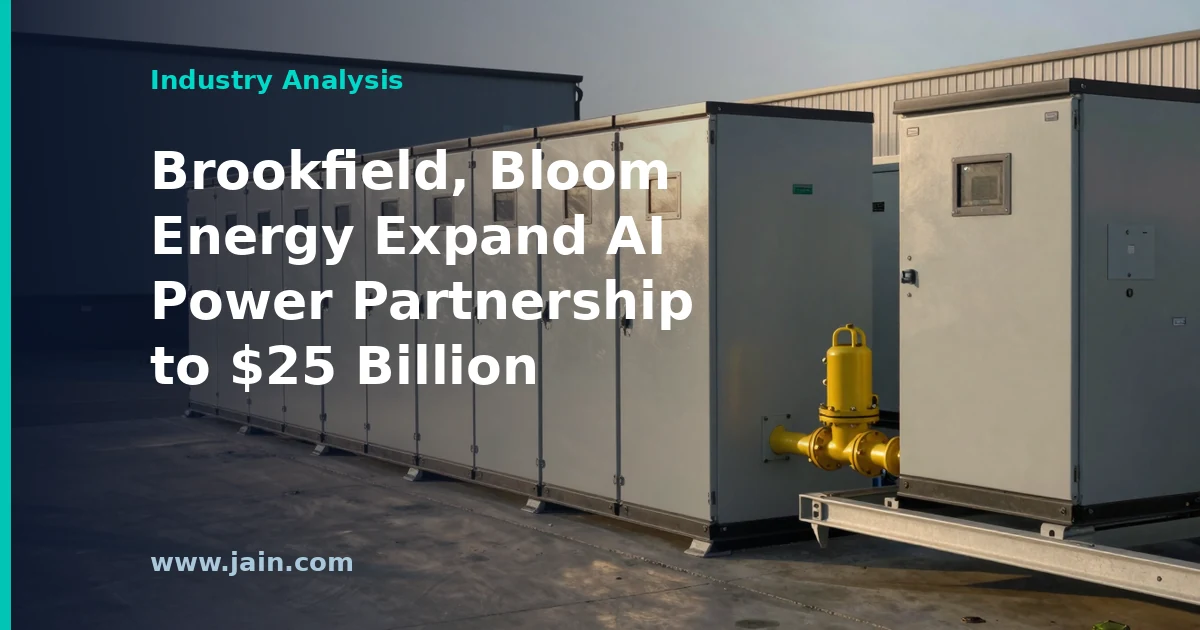
Brookfield and Bloom Energy announced on June 29, 2026 that they are expanding their AI infrastructure partnership to $25 billion — a fivefold increase over the original framework — to build and finance rapid power deployment for AI data centers. The expanded arrangement pairs Bloom’s solid oxide fuel-cell technology with Brookfield’s infrastructure capital.
Executive Summary
Bloom Energy, the fuel-cell manufacturer, and Brookfield, one of the world’s largest infrastructure investors, have scaled their partnership from an original framework — implied by the announcement’s “fivefold” language to have been on the order of $5 billion — to $25 billion. The stated purpose is to build and finance “rapid power” for AI infrastructure: on-site electricity generation that can be deployed faster than utility grid connections.
The announcement matters because electricity availability, not chips or land, has become the binding constraint on AI data-center construction. A $25 billion commitment of this shape signals that major infrastructure capital now treats on-site fuel-cell generation as a bankable asset class rather than a niche backup option. That said, the release as reported gives a headline dollar figure without megawatt targets, named customers, or deployment timelines — so the scale of actual near-term power delivery remains to be demonstrated.
Why Fuel Cells Are Jumping the Grid Queue
The core problem this partnership targets is speed. In many major data-center markets, a new facility requesting a large grid connection can wait years for utilities to build the transmission and generation needed to serve it — a delay measured in lost AI product cycles. On-site generation sidesteps that queue. Bloom’s solid oxide fuel cells convert fuel, typically natural gas, into electricity through an electrochemical reaction rather than combustion, and they arrive as factory-built modules that can be installed in months rather than the multi-year timelines of large power plants or grid upgrades.
That “speed-to-power” pitch has become the dominant selling point across the AI power market — gas turbines, batteries, and behind-the-meter deals all compete on the same axis. Fuel cells’ specific claim is modularity and siting flexibility: they are quiet, produce no combustion emissions like NOx at the point of generation, and can be permitted in places where a turbine plant could not. The trade-off is cost per megawatt-hour and dependence on fuel supply, which is why financing structure matters as much as technology.
The Capital Stack Behind the Megawatts
The division of labor is the interesting part. Bloom manufactures and services the equipment; Brookfield brings the balance sheet. In a typical arrangement of this kind, the infrastructure investor owns the generating assets and sells power or capacity to data-center operators under long-term contracts, so the data-center customer avoids a large upfront capital outlay. For Bloom, a deep-pocketed financing partner converts its technology into an offering that can compete for hyperscale-sized deals it could never finance from its own balance sheet.
For Brookfield, fuel-cell fleets serving AI campuses look like classic infrastructure: long-lived assets, contracted revenue, and a customer base — AI compute operators — currently willing to pay a premium for firm power delivered quickly. Growing the framework fivefold within roughly a year of the original announcement suggests the partners believe demand from AI builders exceeds what the initial commitment could serve. It is a strong demand signal, though announced frameworks and deployed megawatts are different things.
What a Fivefold Scale-Up Signals — and What It Doesn’t
A $25 billion figure invites careful reading. Partnership frameworks of this kind typically describe a ceiling — capital the partners intend to deploy if projects materialize — rather than contracted orders. The announcement as reported does not specify how much is committed versus targeted, how much power it represents, or over what period. Until customer contracts and megawatt figures are disclosed, the number is best understood as a statement of ambition backed by a credible financier, not a backlog.
Competitively, the deal sharpens the contest to power AI. Utilities and grid operators risk losing their largest new customers to behind-the-meter generation; gas-turbine suppliers, battery vendors, and small modular reactor developers are chasing the same load. For data-center operators, more credible power options mean more negotiating leverage — and for the industry’s critics, more scrutiny of what fuels that power. Fuel cells running on natural gas still emit carbon dioxide, so the climate profile of this buildout will depend on fuel sourcing choices the announcement does not detail.
Background
Bloom Energy, founded in 2001 and headquartered in California, went public in 2018 and built its business selling solid oxide fuel-cell “Energy Servers” to commercial, industrial, and utility customers seeking reliable on-site power. Brookfield is a global asset manager with hundreds of billions of dollars across infrastructure, renewable power, and real estate, and has been among the most aggressive institutional investors in AI-related infrastructure. The two first announced an AI-focused partnership in late 2025, part of a wider industry wave in which data-center developers turned to behind-the-meter generation — fuel cells, gas turbines, and eventually nuclear — as utility interconnection queues stretched to multiple years in key markets.