Virginia’s governor has intervened in a regulatory case that will decide how the costs of transmission upgrades tied to data center growth are divided between hyperscale customers and ordinary ratepayers, according to Inside Climate News reporting dated July 12, 2026.
The dispute sits at the intersection of the state’s booming data center economy, rising residential power bills, and a grid buildout that regulators, utilities, and large load customers are all trying to steer.
Executive Summary
Northern Virginia hosts the densest concentration of data centers on the planet, and the transmission and generation investment required to keep serving them has become one of the most consequential utility cost questions in the United States. A gubernatorial intervention signals that the case has escalated from a technical rate proceeding into a matter of state economic policy.
For the industry, the outcome will influence the true landed cost of Virginia capacity, the pace at which hyperscalers site new campuses in the commonwealth, and how other states allocate similar costs as their own AI-driven load pipelines mature. For residents, it will help decide whether utility bills continue to absorb infrastructure built primarily to serve a handful of very large customers.
The underlying source is a single news article, so specifics of the governor’s filing, the docket, and the parties’ positions are limited to what Inside Climate News reported.
Why Cost Allocation Is Suddenly a Headline Issue
Transmission cost allocation — the rules that decide which customers pay for a given wire, substation, or upgrade — used to be an obscure regulatory topic. That changed as data center load in places like Loudoun County grew faster than the grid was built to accommodate, forcing utilities to propose large capital programs on compressed timelines. When those costs are socialized across all ratepayers, residential and small-business customers effectively subsidize infrastructure whose primary driver is hyperscale demand; when they are assigned directly to the causing load, data center economics tighten and siting decisions shift. A governor’s intervention indicates the political calculus has caught up with the engineering one.
Winners, Losers, and the Cost of Ambiguity
The commercial stakes cut in several directions. Hyperscalers and colocation operators benefit when upgrade costs are broadly shared, because it keeps their power price competitive against Texas, Ohio, and emerging international markets. Incumbent utilities are somewhat indifferent to who pays so long as they can recover prudent investment, but they carry regulatory risk if allocations are later reversed. Residential ratepayers and consumer advocates are pressing for a stricter causer-pays framework. And the state itself must weigh tax base, jobs, and grid reliability against bill pressure on voters — a balance that helps explain why the executive branch is now engaged rather than leaving the matter to the State Corporation Commission alone.
Precedent Beyond Virginia
Because Virginia is the reference market for data center growth, whatever framework emerges here will be studied by regulators in PJM neighbors such as Ohio, Pennsylvania, and Maryland, and by ERCOT, MISO, and Southeast utilities facing their own large-load queues. A ruling that leans toward direct assignment could accelerate the migration of speculative projects to jurisdictions with more forgiving cost rules; a ruling that leans toward socialization could invite legislative pushback in other states where residential rate increases have already become political flashpoints. Either way, the case is likely to be cited well outside the commonwealth.
Background
Virginia, and Loudoun County in particular, has been the world’s leading data center market for more than a decade, driven by early fiber concentration, favorable tax treatment, and proximity to federal customers. The AI build-out has intensified an already tight supply picture, with utility Dominion Energy warning of sharp load growth and PJM signaling capacity constraints across the region.
Against that backdrop, state regulators, legislators, consumer advocates, and hyperscale customers have been negotiating — sometimes in public dockets, sometimes in the legislature — over how the costs of a much larger grid should be shared. The current case is the latest and most prominent flashpoint in that longer debate.
In 2025, the giant computer buildings that run cloud services and artificial intelligence used almost a quarter of all the electricity in Ireland. That is nearly as much as every home in the country put together.
Their electricity use grew five times faster than everyone else’s, even though Ireland stopped letting new ones plug into the grid around Dublin in 2021.
The lesson is that blocking new hookups did not stop buildings that were already connected from using more. Ireland now makes new sites bring their own power plants.
Data centers accounted for 23% of Ireland’s metered electricity consumption in 2025, according to Central Statistics Office (CSO) figures reported by Tom’s Hardware. Consumption rose to 7,663 gigawatt-hours (GWh) from 6,973 GWh in 2024, a 10% increase in one year, while electricity use across the rest of the economy grew about 2%. Homes, urban and rural combined, accounted for 28%.
The CSO’s newly compiled quarterly series shows data center use rising from 291 GWh in the first quarter of 2015 to 1,991 GWh in the fourth quarter of 2025, an increase of 584%. In 2015, data centers accounted for about 5% of national consumption.
Executive Summary
Ireland has roughly five million people and around 89 data centers, most of them clustered around Dublin and operated by hyperscalers (the largest cloud and platform companies, which build facilities for their own use) such as Microsoft, AWS, Google and Meta. Those facilities now draw nearly as much power as the country’s entire housing stock.
The figure matters because of what did not happen. In November 2021, Ireland’s energy regulator effectively froze new data center grid connections in the Greater Dublin Area. Consumption kept climbing through 2025 regardless. Grid operators elsewhere are weighing the same tool, and Ireland’s data shows its limits: a connection freeze controls which new projects join the grid, but it does not control how much power already-connected projects draw.
Ireland has since replaced the freeze with a rule requiring new large data centers to supply their own on-site generation and source most of their power from new renewable projects. That makes the country the clearest live test of what happens when AI-era demand outgrows a national grid.
Why a Connection Freeze Didn’t Freeze Consumption
The Commission for Regulation of Utilities (CRU) direction of November 2021 told grid operator EirGrid to stop processing standard connection applications for new data centers in the Greater Dublin Area. Developers had two options: build their own generation or move to less constrained regions. That is a control on queue entry, meaning which new sites get a grid connection at all. It is not a control on how much electricity existing sites consume.
The numbers show the gap between the two. Data center consumption rose by 690 GWh between 2024 and 2025. That is 10% growth, against 2% for everyone else, more than three years into the freeze. The most straightforward explanation is that facilities already connected, or already holding connection agreements, kept filling out their halls and drawing closer to the capacity they had secured before the freeze. A data center campus is rarely fully loaded on day one. Operators add server rooms and customers over years, and each step increases draw without any new application to EirGrid.
The quarterly data suggest this momentum has not faded. Fourth-quarter 2025 consumption of 1,991 GWh works out to roughly 7,960 GWh a year, which is above the 7,663 GWh total for 2025. Ireland therefore entered 2026 running at a higher rate than its annual average. For grid planners, the lesson is that a freeze delays the next wave of load but still leaves the grid to absorb growth that was effectively approved years earlier.
A Third of the Grid by 2026? The Arithmetic Says Not Yet
In 2024, the International Energy Agency projected that data centers could reach a third of Irish electricity consumption by 2026. The 2025 figures put that projection in context. If 23% corresponds to 7,663 GWh, national consumption was roughly 33,000 GWh. If data center use grows another 10% in 2026 and the rest of the economy grows 2%, the data center share rises to roughly 24%, not 33%. Reaching a third in 2026 would require a sharp acceleration beyond anything in the recent series.
That does not weaken the underlying trend. The share has more than quadrupled in a decade, from about 5% to 23%. But the trajectory looks like steady compounding rather than a sudden spike. The attribution to AI also needs care. Ireland’s early data center boom was built on cloud storage and social media, and generative AI is widely cited as the driver of recent growth. However, the CSO figures measure metered electricity for data centers as a category. They do not show how much of the increase came from AI training or inference compared with conventional cloud workloads.
The New Rule: Bring Your Own Power Plant
The freeze has been replaced by the CRU’s Large Energy Users (LEU) Connection Policy, introduced in late 2025. New data centers above 10 MVA (megavolt-amperes, a measure of electrical capacity; 10 MVA is a mid-sized facility) must provide 100% on-site, flexible generation to meet their demand. Within six years of operation, they must also source at least 80% of their annual electricity from new, unsubsidized renewable projects.
In practice, this moves the grid constraint inside the fence line. A developer in Ireland now also has to plan, finance and operate a power station that can cover the whole load, and then contract new wind or solar output on top of it. That raises capital costs and lengthens project timelines. It is likely to favor operators with large balance sheets, such as the hyperscalers, over smaller colocation providers that lease space to tenants. It also increases the scarcity value of capacity that was connected under the old regime, because no new Dublin site can replicate those terms.
What Other Grids Can Take From Ireland
Ireland is an extreme case because a small population is hosting infrastructure built for global cloud platforms. The same pressures are appearing elsewhere. Tom’s Hardware cites surveys projecting 26% growth in global data center electricity use this year, and reports that local opposition led to more than 75 US project cancellations in the first quarter of 2026.
For regulators considering a pause on new connections, Ireland’s data point is specific. A pause buys time to redesign connection rules, but consumption will keep rising for years as existing commitments fill up. The more durable lever appears to be the one Ireland reached next: tying new capacity to new generation, so that data center growth brings its own supply rather than drawing on the shared grid.
Background
Ireland became a European data center hub in the 2010s. Global cloud and social media companies built large campuses around Dublin, drawn by connectivity, a cool climate and an established base of technology firms. The Central Statistics Office has tracked the sector’s metered electricity use since 2015, when data centers accounted for about 5% of national demand.
As that share grew, concerns about grid adequacy led the Commission for Regulation of Utilities to issue its November 2021 direction, which effectively paused new Dublin-area connections. In late 2025, the regulator replaced the pause with the Large Energy Users Connection Policy, which requires new large facilities to bring their own flexible generation and contract new renewable supply.
New Jersey’s governor has signed a law that makes large data centers, the warehouse-sized buildings full of computers that run artificial intelligence and online services, pay for the power lines and equipment they need.
Until now, families worried those costs would land on their own electric bills. Power prices in the state have already climbed more than 16 percent since 2024.
The catch for tech companies: plugging into the grid in New Jersey now costs them more directly, and that could shape where they choose to build.
New Jersey Gov. Mikie Sherrill signed a package of energy legislation in the week of July 6, 2026, WHYY reported. The centerpiece creates a separate electricity ratepayer class for data centers and requires them to pay for the electrical and clean energy infrastructure upgrades their projects create. The goal is to keep those costs from being passed on to households and small businesses.
The package also includes a “Repeal ROE Adder” bill, which requires electric utilities to join the regional grid and bars them from charging customers an extra “bonus” for doing so. It also includes the Advanced Grid Technologies Act, which directs state utility regulators to scrutinize “supplemental” grid projects and speeds approval of projects that use advanced transmission technologies.
Executive Summary
New Jersey has written into law a principle that is fast becoming the central fight of the AI buildout: who pays when a data center needs the grid to grow. By putting data centers in their own rate class and assigning them the cost of the upgrades they trigger, the state turns what could have been a cost spread across all customers into a line item on the developer’s budget.
The political backdrop is electricity prices. Rates in New Jersey have risen more than 16% since 2024, according to a U.S. Senate committee report, and the U.S. Energy Information Administration counted 128,828 electricity shutoffs in the state in 2024. PJM Interconnection, which runs the regional grid, has cited data center growth as one reason for higher bills.
The Data Center Coalition says its members are committed to paying the full cost of the energy they use. Its concern is that the law’s structure could make New Jersey less predictable and less competitive. The details regulators write next will largely decide which side’s expectations prove right.
Grid Upgrades Move From the Shared Bill to the Project Budget
The mechanism is simple to state. A “rate class” is a group of customers that a utility bills under the same set of prices; residential, commercial and industrial users typically sit in different classes. By creating a dedicated class for data centers, New Jersey can price their energy use separately, so costs driven by data center demand stay with data centers rather than flowing into everyone else’s rates. The second provision is more consequential for builders: data centers must pay for the electrical and clean energy infrastructure upgrades they create. New substations, feeder lines and transformer capacity needed to serve a large AI campus become a cost the developer carries.
That changes the economics of choosing a site. An AI data center developer choosing between locations weighs land, fiber, water, tax treatment and, above all, how quickly and cheaply it can get power. In New Jersey, the “cheaply” part now explicitly includes the upgrade bill. Colocation operators (companies that build facilities and lease space to tenants) and the large cloud and AI companies that lease or build capacity will price that obligation into their comparisons with other locations in the PJM region. How large the effect is depends on how regulators define the new class and calculate upgrade costs, which the law’s sponsors have not yet spelled out in public.
The legislators’ case rests on household affordability. Assemblyman Dave Bailey, a sponsor, framed the bill as “preventing households and small businesses from paying for data centers to connect to the grid.” With rates up more than 16% since 2024 and six-figure shutoff counts, the state has chosen to make the connecting customer, not the existing customer base, absorb the risk of the upgrades.
The Industry’s Objection Is About Design, Not Payment
The Data Center Coalition’s response is notable for what it concedes. The trade group did not argue that data centers should avoid these costs; it said members are committed to paying the full cost of the energy they use. Its argument is that any approach should “align costs with cost causation,” meaning each customer pays for the costs it actually causes. It also argued that protections should be “evidence-based” and “grounded in specific cost risks,” warning that anything else risks “market friction” and uncertainty.
That is a fair question to put to the law, and a fair one to put back to the industry. Supporters have pointed to PJM’s view that data centers are pushing up bills, but in their public statements they have not put a figure on how much of New Jersey’s rate increase is attributable to data centers. The coalition, for its part, cited unnamed “other markets” as a workable model without saying which rules it would accept in New Jersey. Both sides agree on the principle that data centers should pay their way. The dispute is over how precisely that is measured, and whether rules written broadly in advance will deter investment that tightly targeted rules would not.
The Utility Half of the Package
The package does not target only data centers. The “Repeal ROE Adder” bill addresses a feature of utility pricing. Return on equity (ROE) is the profit rate regulators allow a utility to earn on its investments, and an “adder” is a bonus on top of that rate, in this case one tied to joining the regional grid. The law requires utilities to join and removes the extra charge to customers for doing so.
The Advanced Grid Technologies Act points in two directions at once. It tightens oversight of “supplemental” projects, the wires, poles and substations utilities build outside the regional planning process, to screen out spending that raises bills without clear need. It also speeds approval for projects using advanced transmission technologies, a broad category of equipment and software that can move more power over existing lines. For data center developers, that second provision could eventually matter as much as the cost rules: faster approval of capacity upgrades can shorten the wait for power, which is often the binding constraint on an AI project’s timeline.
A State Law Inside a Regional Grid
New Jersey sits inside PJM, a wholesale market and grid that spans multiple states. A state law can decide how costs are allocated among a utility’s retail customers. It cannot on its own change wholesale power prices set regionally or the capacity pressures PJM has flagged. The law is therefore best read as an allocation tool: it decides who absorbs the local costs of growth, not whether that growth strains the regional system.
That distinction matters for residents and investors alike. Households may be shielded from the local upgrade costs a new data center triggers. They remain exposed to regional supply-and-demand pressures and weather-driven price spikes, which also drove last winter’s bills. Developers, meanwhile, now face a clearer but potentially higher cost of entry in New Jersey than in neighboring locations with different rules.
Background
Data centers house the servers that power online services, storage and, increasingly, artificial intelligence. They have existed since the mid-20th century, but the AI boom has driven demand for larger sites and far more electricity. In the mid-Atlantic, that demand lands on the grid run by PJM Interconnection, which has linked data center growth to higher power bills.
New Jersey has seen electricity prices climb sharply. Last winter’s freezing weather added to bills, but rate increases have also been driven by an imbalance between supply and demand and slow construction of new generation. Supporters of data centers point to tax revenue, while some residents have raised concerns about air quality, water use and electricity costs.
Texas regulators have approved grid standards intended to keep large data centers online during electrical disturbances, according to reporting by E&E News by POLITICO published July 10, 2026. The measure addresses so-called ride-through behavior — whether massive computing facilities stay connected and continue drawing power during voltage or frequency dips, or abruptly disconnect and shift the shock onto the rest of the grid.
The standards make the Texas grid, operated by the Electric Reliability Council of Texas (ERCOT), the first to impose formal ride-through expectations on data centers as a class of customer — a notable reversal of the usual arrangement, in which reliability rules bind generators rather than the loads that consume their output.
Executive Summary
The announcement, as reported, is straightforward: Texas has approved standards governing how large data centers must behave when the grid experiences a disturbance, with the stated goal of keeping those facilities online rather than having them drop off en masse. “Ride-through” is grid-engineering shorthand for a connected machine’s ability to tolerate a brief sag in voltage or frequency without tripping offline — a requirement long imposed on wind and solar plants, but historically never on customers.
Why it matters: data centers have become some of the largest single points of electrical demand ever connected to power systems, and ERCOT has been the epicenter of that growth. When a facility drawing hundreds of megawatts disconnects in a fraction of a second — typically because its protective equipment or uninterruptible power supplies switch to on-site backup at the first sign of trouble — the grid suddenly has surplus power with nowhere to go, which can push frequency out of bounds and cascade into a wider event. Regulating load behavior, not just generator behavior, is a genuinely new frontier in grid reliability.
For the industry, the precedent matters more than the particulars. Texas is the most attractive data center market in the United States precisely because of speed and abundant land and energy; if even Texas concludes that large loads must accept reliability obligations as a condition of interconnection, other states and grid operators facing the same demand surge are likely to follow.
The Grid’s Newest Problem Is Demand That Vanishes
For a century, grid reliability rules have concentrated on supply: power plants must stay online through disturbances so a single fault doesn’t snowball. Large data centers invert the problem. They are engineered for near-perfect uptime of the computing inside, which means their electrical systems are hair-triggered to abandon the utility feed and jump to batteries and backup generators the instant power quality wavers. That design is rational for each individual facility and destabilizing in aggregate: if many gigawatt-scale campuses in one region flee the grid simultaneously during a routine voltage dip, the disturbance they were protecting themselves from gets dramatically worse for everyone else.
ERCOT is uniquely exposed to this dynamic. It runs a largely isolated grid with limited connections to neighboring systems, so it cannot lean on imports to absorb a sudden swing. It also hosts one of the fastest-growing concentrations of data center and other large flexible load anywhere. A ride-through standard essentially tells these facilities: your protection settings are no longer purely your private business, because your collective reflexes have become a system-level risk.
A Template Other States Will Study
Texas moving first is consistent with its recent posture. State lawmakers and the Public Utility Commission have spent the past several years building a framework for very large loads — from interconnection review to provisions allowing curtailment of big customers in emergencies — as ERCOT’s demand forecasts ballooned on data center growth. Ride-through standards are a logical next brick in that wall, and the E&E News framing — standards “to keep data centers online” — suggests regulators are positioning this as pro-reliability rather than anti-industry.
Other jurisdictions are watching the same load-loss phenomenon. Grid reliability bodies in the U.S. have publicly examined incidents in which large blocks of data center load disconnected during disturbances, and utilities in Virginia, Georgia, Arizona and elsewhere face the same concentration of hyperscale demand. Because national reliability standards for loads do not yet exist the way they do for generators, a working Texas rulebook — definitions, thresholds, compliance mechanics — becomes the natural starting draft for everyone else. First-mover regulation tends to propagate: California’s emissions rules and Virginia’s zoning fights both show how one jurisdiction’s template shapes an industry’s national playbook.
The Economics: Compliance Cost Versus Queue Position
For data center operators, ride-through compliance is mostly an engineering and procurement question: configuring uninterruptible power supply systems, protection relays, and switchgear to tolerate defined disturbances rather than instantly transferring to backup. On new builds, that is a design parameter. On existing facilities, retrofits could be more intrusive, and operators will care greatly about which facilities are grandfathered — a detail the reporting summary does not settle.
The strategic calculus, though, likely favors acceptance. The binding constraint on data center growth today is not capital but grid access — interconnection queues measured in years. A clear, uniform reliability standard gives ERCOT and utilities more confidence to connect very large loads quickly, which is worth far more to developers than the cost of compliant electrical gear. Operators who fight load-behavior rules risk slower interconnection everywhere; operators who embrace them can market themselves as grid-friendly customers, a distinction that increasingly influences which projects get powered first.
Winners, Losers, and the Fine Print
The likely winners are grid operators, who gain a tool against a novel instability risk; incumbent data center operators with modern electrical infrastructure, for whom compliance is manageable and who benefit from anything that keeps Texas interconnections moving; and vendors of power equipment — UPS systems, protection relays, grid-interface controls — who now have a regulatory driver for upgrades. The pressured parties are operators of older facilities that may need retrofits, and any tenant whose uptime guarantees assumed the freedom to disconnect at the first flicker. There is a real tension here: staying connected through a disturbance transfers some risk from the grid to the facility, and enterprise customers pay for facilities engineered to take zero chances. How the standards balance grid needs against facility-level risk tolerance is the technical heart of the rule — and exactly the kind of detail that will determine whether other states copy it verbatim or rework it.
Background
Texas has become the defining battleground for data center growth in the United States. ERCOT operates a mostly self-contained grid serving the large majority of the state, and its combination of fast interconnection, abundant land, and booming generation development has drawn an extraordinary pipeline of hyperscale computing projects, alongside crypto-mining and industrial electrification. That surge pushed ERCOT’s long-term demand forecasts sharply upward and prompted Texas lawmakers and the Public Utility Commission to construct a new regulatory framework for very large loads over the past several years, including closer scrutiny of interconnection requests and emergency-management provisions for big customers.
In parallel, grid engineers across the country have documented a novel reliability phenomenon: large blocks of data center load disconnecting from the grid nearly simultaneously during disturbances, as facility protection systems shift to on-site backup. Because reliability standards historically governed generators rather than customers, no established national rulebook addressed this load behavior — the gap the newly approved Texas standards are the first to fill.
A Brookings Institution commentary published July 10, 2026 contends that industry and utility promises to protect residential and small-business electricity customers from the cost of serving AI data centers lack the enforcement teeth needed to be credible. The piece calls on regulators and legislators to convert voluntary pledges into binding conditions.
Executive Summary
The core argument is straightforward: as hyperscale AI campuses queue up for grid interconnection, utilities and developers have offered assurances that the resulting infrastructure costs — new generation, transmission upgrades, and capacity payments — will not be socialized onto ordinary ratepayers. Brookings argues those assurances are only as strong as the mechanisms that back them.
For state public utility commissions, legislators, and the data center industry itself, the commentary reframes what has been a public-relations conversation as a regulatory design problem. Without tariff structures, cost-allocation rules, or contractual covenants that survive load forecasts going wrong, the risk of cost shift lands on households by default.
Why Pledges Alone Rarely Hold
Electricity is a shared system. When a single customer class — in this case, very large computing loads — drives new generation and transmission investment, the cost of that investment must be allocated somewhere. Utilities recover prudent investments through rates approved by state commissions, and if a large customer departs, downsizes, or renegotiates before the useful life of the asset ends, the remaining ratepayers typically absorb the stranded cost. A verbal or written pledge that this will not happen carries weight only if a tariff, contract, or regulation makes it operationally true.
Brookings’ framing is that the current moment resembles earlier episodes in utility history where load forecasts drove capital plans that later customers had to pay for. The remedy, in its view, is not to block data center growth but to make the accountability match the marketing.
What Enforcement Could Look Like
Enforcement can take several concrete forms familiar to regulatory practitioners: dedicated large-load tariffs that require the customer to underwrite the specific generation and transmission built to serve them; minimum bill or take-or-pay provisions that survive early departure; collateral or parent-company guarantees; and cost-allocation rulings that ring-fence hyperscale-driven investment from the general residential class. Each option shifts risk away from small customers, and each has trade-offs in complexity, competitiveness, and how attractive a jurisdiction remains to future investment.
The article’s contribution is less a specific policy blueprint than a call to close the gap between what is being promised in press releases and what is written in tariffs and interconnection agreements. That distinction matters because state commissions, not industry, control the enforceable side.
Winners, Losers, and Second-Order Effects
If enforceable ratepayer protections become standard, the near-term winners are residential and small-commercial customers in fast-growing data center regions, and the utilities that avoid political backlash over rising bills. The near-term losers, at least on paper, are hyperscale developers who face higher up-front commitments and potentially longer siting timelines while tariffs are litigated. In practice, well-capitalized operators generally absorb these costs; the marginal effect may be on siting geography, favoring jurisdictions with clearer rules over those with ambiguous ones.
There is also a fairness question the piece implicitly raises but does not resolve: whether existing ratepayers should share in any upside — for example, lower per-unit system costs — if hyperscale load ultimately spreads fixed costs across more kilowatt-hours. That is a legitimate counterpoint worth weighing alongside the downside protection argument.
Background
Electricity in the United States is delivered largely by regulated utilities whose rates and major investments require approval from state public utility commissions. Historically, load growth was gradual, driven by population and general economic activity. The rise of hyperscale cloud and AI computing has changed that pattern, with individual campuses requesting interconnection capacities that rival small cities and materially reshaping utility capital plans.
As bills have risen in some data center-heavy regions, policymakers, consumer advocates, and think tanks including Brookings have focused on how the costs of serving these new loads are allocated. Voluntary industry pledges to protect ordinary ratepayers have become common; the debate has now moved to whether those pledges are matched by enforceable rules.
PJM Interconnection, the largest electric grid operator in North America, set a new all-time peak-load record of 168.158 gigawatts (GW) during a heat wave, S&P Global reported on July 9, 2026. Peak load is the highest instantaneous electricity demand a grid must serve, and PJM’s footprint spans 13 states and the District of Columbia — including Northern Virginia, the densest data center market in the world.
Executive Summary
The number itself is the story: 168.158 GW is an all-time record for a grid that has operated since 1927, exceeding the prior widely cited all-time mark of roughly 165.6 GW set in the summer of 2006. Grid demand in mature economies was assumed for years to be flat or declining as efficiency gains offset growth; a new absolute record — set during a heat wave, when air conditioning load stacks on top of everything else — signals that assumption no longer holds in PJM territory.
Why it matters: PJM is where the AI infrastructure boom and the physical grid meet most directly. The region hosts the largest concentration of data centers on earth, and PJM’s own planning processes, capacity auctions, and interconnection queue have all been reshaped by projected data center growth. A record peak turns those projections into observed, metered reality — with consequences for power prices, data center siting decisions, and the pace of generation and transmission construction.
The End of Flat Demand
For roughly two decades, U.S. grid planners could count on a comfortable pattern: efficiency improvements (LED lighting, better HVAC, industrial offshoring) absorbed most economic growth, so peak demand crept along or even fell. That the previous PJM record dated to 2006 illustrates the point — the grid went nearly twenty years without needing to serve a bigger hour. A new record, driven by weather layered on structural load growth, marks a regime change. Data centers, electrification of heating and transport, and reshored manufacturing are all pushing the same direction, and data centers are the fastest-moving of the three because a single large AI campus can draw hundreds of megawatts continuously, day and night.
Heat Waves Are the Stress Test
Records like this are set when a heat wave pushes air-conditioning demand to its maximum at the same time that always-on loads — including data centers — are running flat out. Unlike residential cooling, data center load does not relent in the evening or on weekends, which raises the floor beneath every weather-driven spike. For grid operators, that changes the risk calculus: reserve margins (the buffer of spare generating capacity above expected peak) get consumed from both ends, by rising peaks and by the retirement of older coal and gas plants. PJM has publicly warned for several years that retirements were outpacing new entry; a record peak is exactly the scenario those warnings anticipated.
The Economics: Someone Pays for the Peak
Grids are built for their single highest hour, so peaks are expensive. In PJM, the cost shows up through capacity auctions — payments to generators for being available when demand spikes — and recent PJM capacity auctions have cleared at record-high prices, driven in large part by demand forecasts that data center growth dominates. Those costs flow to ratepayers across the footprint, which is why data center load growth has become a live political issue in states like Virginia, Ohio, and Pennsylvania. A verified record peak strengthens the case of utilities and generators seeking to build; it also sharpens questions from consumer advocates about who should bear the cost of infrastructure that primarily serves new industrial customers.
Winners, Losers, and the Siting Chessboard
Owners of existing dispatchable generation — gas, nuclear, and remaining coal in the PJM footprint — are clear near-term beneficiaries, since scarcity raises the value of every megawatt that can run on command. Data center developers face a more complicated picture: record peaks validate the demand they are bringing, but also lengthen interconnection timelines, raise power costs, and invite regulatory scrutiny. Expect continued interest in behind-the-meter and co-located generation, long-term nuclear power purchase agreements, and siting in less-constrained regions. For the connectivity and colocation industry broadly, grid capacity — not land, not fiber — is now the binding constraint on where digital infrastructure gets built.
Background
PJM Interconnection began in 1927 as a power pool among Pennsylvania and New Jersey utilities and grew into the largest regional transmission organization in North America, coordinating the grid and wholesale markets for 13 states and Washington, D.C. Its territory includes Northern Virginia’s “Data Center Alley,” the densest concentration of data centers in the world, which has made PJM the front line where AI-driven electricity demand meets grid reality.
For most of the 2010s, PJM demand was flat as efficiency gains offset growth, and its 2006-era peak record went unchallenged. That changed as data center construction accelerated, power plant retirements thinned reserve margins, and PJM’s capacity auctions began clearing at record prices — a trajectory that made a new all-time peak a question of when, not if.
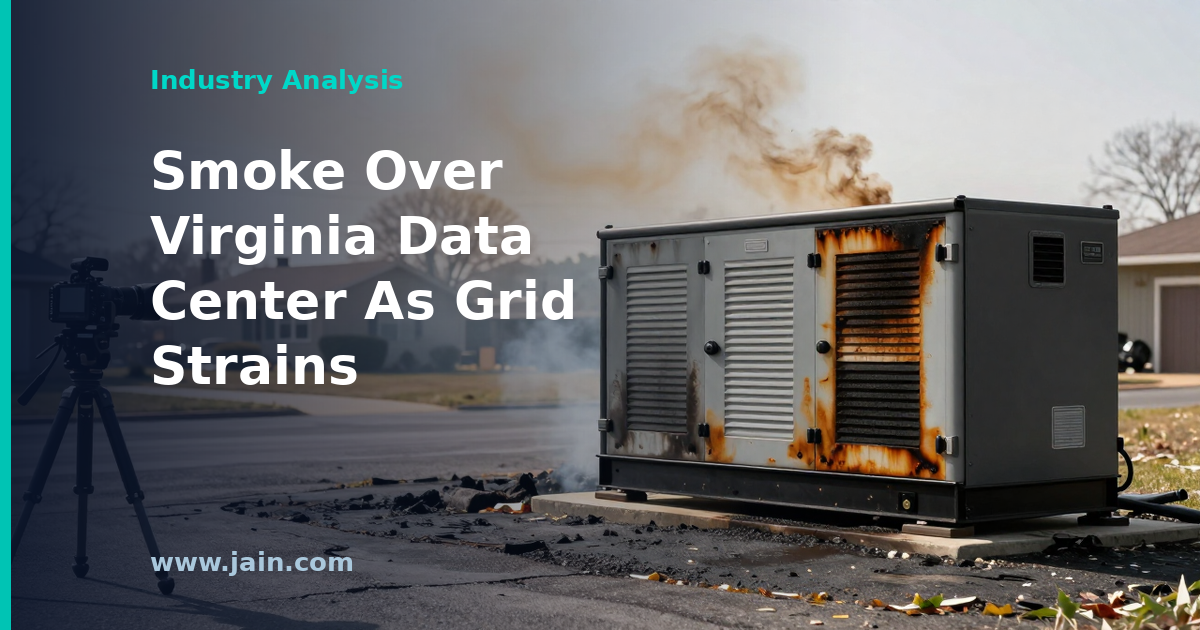
Business Insider reported that dark smoke was seen rising above a Virginia data center during a summer heat wave, at the same time PJM Interconnection — the grid operator serving the mid-Atlantic — was approaching the upper edge of its available supply. The incident occurred in the region that hosts the largest concentration of data center capacity in the world.
Executive Summary
A visible smoke event at a Virginia data center, coinciding with heat-driven stress on the PJM grid, has drawn attention to the fragility of the infrastructure that carries a large share of global internet traffic. The report does not detail the cause, the operator, or the scale of any outage, but the optics — smoke above a hyperscale campus during peak demand — are hard to ignore.
For an industry that has spent the last two years defending its power appetite in front of regulators and communities, the timing matters. Northern Virginia’s data center cluster is already the subject of intense debate over transmission buildout, ratepayer cost allocation, and permitting. A high-visibility incident during a grid emergency is the kind of event that shifts political conversations even when the technical facts turn out to be modest.
Why Loudoun County Is the Pressure Point
Northern Virginia, and Loudoun County in particular, hosts more data center capacity than any other region on Earth. That density exists because of a self-reinforcing cycle: fiber routes were built to serve early internet exchanges, cheap land and tax incentives attracted more operators, and each new campus made the next one more attractive by shortening latency between tenants. The result is a corridor where a single county’s electricity draw rivals that of a mid-sized country.
PJM Interconnection, the regional transmission organization that runs the grid across 13 states and D.C., has warned publicly for the past two years that generation retirements are outpacing new supply, and that data center growth is a major driver of load. A heat wave compresses the margin between demand and available capacity, and in that state any visible failure — smoke, sirens, a plume — reads as a system-level warning rather than a site-level problem.
The Anatomy of a Data Center Fire Risk
Smoke at a data center campus can originate from several places, and each carries different implications. Utility switchgear and transformers can fail under thermal stress, particularly when ambient temperatures push cooling systems past design points. Backup diesel generators, which typically start when grid voltage sags, can experience exhaust or lube-oil incidents when run for extended periods. Battery energy storage systems, increasingly used to bridge grid disturbances, carry their own thermal-runaway risks. Without more detail from the operator or the fire authority, the public cannot distinguish among these, and the release does not.
What is unambiguous is that data centers are designed to fail gracefully — that is the entire premise of N+1 redundancy, on-site generation, and multiple utility feeds. A visible smoke event does not, by itself, mean customer workloads went down. It does mean that at least one layer of the redundancy stack was exercised, and that the incident happened at the worst possible moment for the grid around it.
The Political Physics of a Bad Photograph
Data center operators have historically preferred to operate quietly. That posture is harder to maintain when smoke is visible from residential streets during a heat wave that has neighbors watching their thermostats. Virginia legislators have already been debating whether data center load growth should be paid for by the industry rather than socialized across residential ratepayers, and PJM’s capacity auctions have delivered sharp price increases that landed on household bills earlier this year.
None of that is caused by a single incident. But single incidents shape narratives. Operators, utilities, and regulators who want to sustain the current build-out will need to be more forthcoming — about what happened, what the redundancy actually did, and what the incident says (or does not say) about the wider grid — than the industry’s default communications posture typically allows.
What the Grid Data Actually Shows
The article’s framing — that PJM was near its limits — is worth taking seriously without overstating. Grid operators routinely run close to reserve margins during heat waves; that is what reserve margins are for. The relevant question is not whether PJM was stressed on a hot afternoon, but whether the trajectory of load growth, generator retirements, and transmission build is converging or diverging. Public filings from PJM suggest the latter, and the coincidence of a visible incident with a stressed grid gives that concern a face.
Background
Northern Virginia has been the center of gravity for the data center industry since the 1990s, when Equinix and others built exchange points that anchored transatlantic and domestic internet traffic. Loudoun County alone now hosts several gigawatts of operating capacity, with more under construction, and its tax revenue from the sector has reshaped county budgets.
PJM Interconnection, founded in 1927 as a pool among Pennsylvania and New Jersey utilities, today coordinates generation and transmission across a footprint stretching from Illinois to North Carolina. In recent capacity auctions, prices have risen sharply as generator retirements have outpaced new interconnections, a dynamic industry observers attribute in part to accelerating data center load growth.
Georgia’s utility regulators are investigating whether giant data centers, the warehouse-sized computer buildings behind artificial intelligence tools, pay their fair share of the cost of fuel for power plants.
The state has already approved new power plants with nearly five times the output of its two newest nuclear reactors, mostly to serve data centers. Consumer groups say ordinary households may be paying to get fuel to those plants, even though they are only being expanded because of data centers.
Hearings start in September. The answer could show up on Georgia power bills.
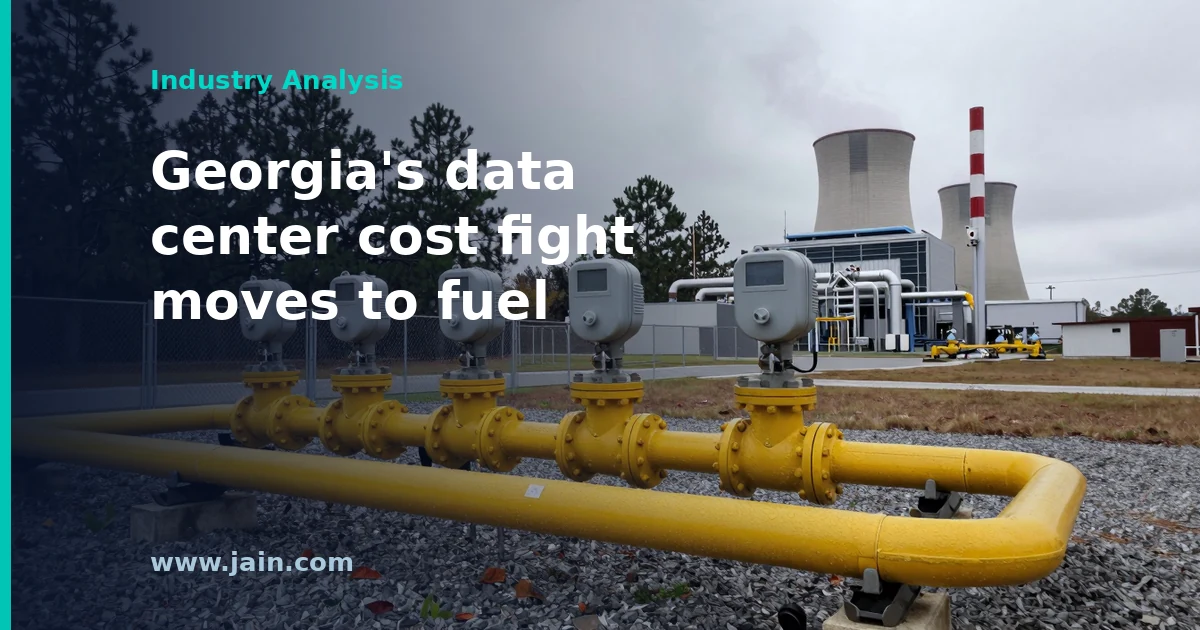
WABE reported on July 8, 2026, that the Georgia Public Service Commission has opened an investigation into how Georgia Power’s largest customers, including data centers, pay for the fuel that runs the utility’s power plants. The probe examines the Real-Time Pricing (RTP) methodology used to bill those customers for fuel. Its first round of hearings is scheduled for September.
The investigation grew out of this year’s fuel-rate proceedings for residential and small-business customers. Those proceedings ended in an agreement that lowered the fuel rate and called for a review of RTP. The probe covers Georgia Power only, not the state’s other utilities. Advocacy groups, including Georgia Conservation Voters Education Fund, welcomed the move.
Executive Summary
Georgia’s utility regulator has formally opened a question it had so far left aside in its data center policy: who pays for fuel. The commission has already approved about ten gigawatts of new generating capacity, mostly for forecast data center demand. It has also approved contract terms meant to make large customers pay for infrastructure built to serve them. The new investigation turns to operating costs, and specifically to the cost of getting fuel to newly expanded power plants.
The mechanism at issue is billing. Residential and small-business customers pay a fuel rate. Data centers and other large users pay for fuel under Real-Time Pricing. Consumer advocates argue that this split leaves other Georgians carrying costs that exist only because of data center growth. The commission will now test that argument in hearings beginning in September.
The outcome matters beyond one tariff. Georgia is one of the country’s fastest-growing markets for hyperscale data center load. How it allocates fuel costs will affect the long-run energy price data center developers face there, and the bills of the households and small businesses that share the same grid.
Georgia Already Priced the Plants. Fuel Is the Open Line.
The commission’s recent data center decisions have focused on capacity: the power plants and grid equipment needed to meet future demand. Late in 2025 it approved about ten gigawatts of new capacity to serve the higher demand Georgia Power is predicting, mostly from data centers. A gigawatt is roughly the output of a large power plant, and the approved total is nearly five times the capacity of the new nuclear reactors at Plant Vogtle. Earlier in 2025 the commission approved contract terms to help ensure that data centers and other large customers pay for infrastructure built to serve them. Georgia Power has also said it will cover costs if the predicted data center demand does not materialize.
Those measures address who pays to build. The new investigation addresses who pays to run the plants, and in particular the cost of delivering fuel to newly expanded ones. Critics raised that cost during this year’s fuel hearings as the one slipping through the cracks, and it now has a formal proceeding of its own. This is the sense in which the next who-pays fight is over fuel. The capital side of the ten-gigawatt build already has a cost-allocation framework, however contested. The fuel side is where the allocation rules are now being reopened.
The shift changes what each party has to argue about. Capacity disputes turn on demand forecasts and contract terms signed before a facility is energized. Fuel disputes turn on tariff design and cost accounting that play out over the years a plant runs. For a developer planning load in Georgia, the connection terms were the headline risk. The lifetime price of energy is now also under review. For households, fuel charges are generally passed through to customers at cost, so any shift in allocation reaches monthly bills directly. That direct link is why the issue surfaced in the residential fuel-rate case.
How Real-Time Pricing Can Split the Fuel Bill
Georgia Power’s residential and small-business customers pay for fuel through a fuel rate set in periodic proceedings before the commission. Large customers such as data centers pay for fuel under Real-Time Pricing. In general, real-time pricing tariffs charge a price that tracks the utility’s cost of producing electricity hour by hour, instead of a flat, averaged fuel charge.
Consumer advocates argue that this arrangement leaves other Georgians paying for fuel infrastructure that is being built only because of data center demand. Their reasoning runs as follows. Getting fuel to an expanded plant carries costs of its own, and those costs can be committed in advance whether or not the fuel is burned in a given hour. Suppose those costs land in the averaged fuel rate, while the largest new users pay for fuel under a methodology that does not carry them the same way. Then the customers on the averaged rate absorb them. Whether Georgia’s RTP methodology actually works this way is what the investigation is meant to establish.
The stakes grow with the buildout. The larger the share of new demand billed through RTP, the more its treatment of fuel-delivery costs matters to everyone else on the system. With roughly ten gigawatts approved largely on the strength of data center forecasts, the question stops being a narrow tariff detail. It becomes a material cost-allocation issue.
What Each Side Still Has to Show
The advocates’ concern is coherent on its mechanics. The September hearings are where it needs a figure: how much fuel-delivery cost is attributable to data center-driven expansion, and how much of that RTP customers already cover. As Ja’Mae Rooks of Georgia Conservation Voters Education Fund put it, “Georgians deserve to understand exactly who is paying for the massive growth in electricity demand from data centers, and who isn’t.” That standard applies in both directions. Establishing who is not paying requires the same cost data as establishing who is.
The burden also falls on the utility and its large customers. If RTP already recovers these costs, the hearings are the place to show it with numbers. Georgia Power’s pledge to cover costs if data center demand fails to materialize addresses a different risk: infrastructure left underused. On its face, that pledge says nothing about ongoing fuel costs when the demand does arrive.
The political setting raises the proceeding’s profile. Commission seats are on the 2026 ballot, and recent races have been framed around power bill increases. The result, though, will turn on the cost record the parties put before the commission, not on the campaign.
A Test Case Worth Watching, Not Yet a Trend
Georgia’s sequence gives other regulators a view of where cost questions surface after the first round of protections is in place. The order was capacity approvals, then contract protections for infrastructure, then a review of fuel methodology. Operating-cost allocation is harder to fix in a contract signed before a data center goes live, because it depends on how plants run and what fuel costs over many years.
This is still one utility in one state, and the investigation has reached no finding. It is too early to say that fuel allocation will become a standard battleground wherever hyperscale load is growing. What Georgia does establish is that a utility can put infrastructure cost protections in place and still leave operating-cost allocation open for review.
Background
Georgia Power, a subsidiary of Southern Company, is Georgia’s largest electric utility. It is regulated by the Georgia Public Service Commission, whose elected commissioners set the rates the utility charges. In recent years the utility completed two new nuclear reactors at Plant Vogtle, and it has since forecast large demand growth driven mostly by data centers, including hyperscale facilities used for generative AI.
To meet that forecast, the commission approved about ten gigawatts of new capacity in late 2025. Earlier that year it approved contract terms intended to make large customers pay for infrastructure built to serve them. Power costs have become a political issue in the state, with commission elections in 2026 framed around recent bill increases.
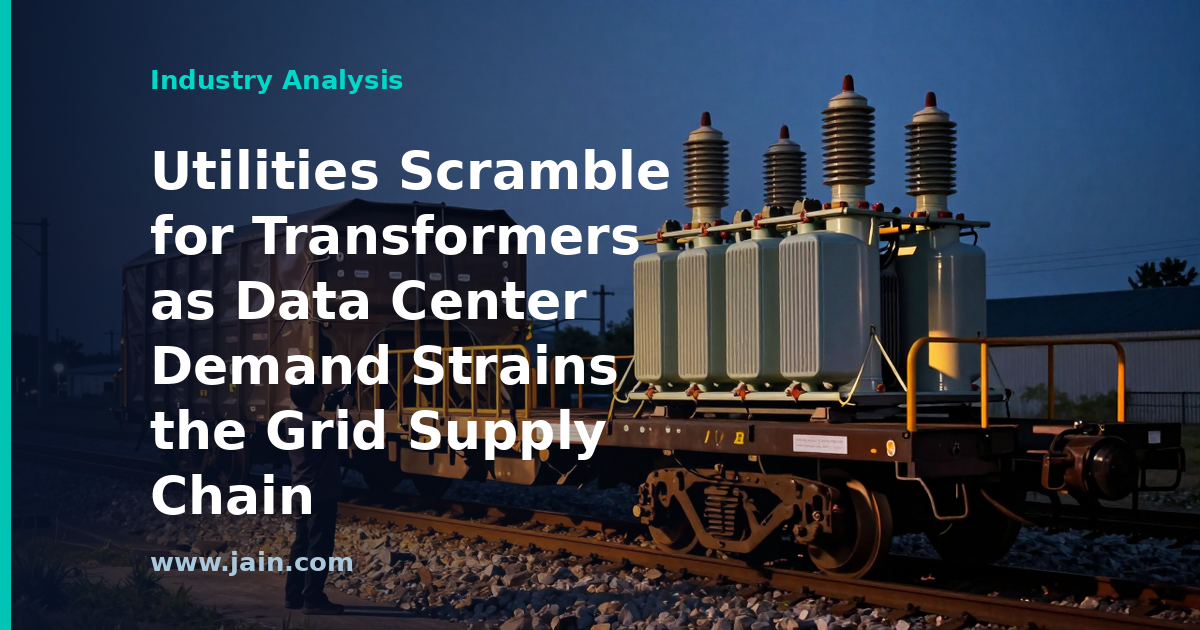
Reuters reported on July 8, 2026 that US power companies are scrambling to secure electrical equipment — the transformers, switchgear, and related grid hardware that move electricity from generators to customers — as surging demand from data centers strains available supplies. The report frames a nationwide procurement crunch: utilities that once ordered this equipment on routine replacement cycles are now competing for constrained manufacturing capacity against a wave of new large-load projects.
Executive Summary
The headline is not about a single deal or data center campus; it is about the industrial base underneath all of them. Transformers step electrical voltage up for long-distance transmission and back down for delivery, and switchgear is the apparatus that switches, protects, and isolates circuits. Neither is optional: every new data center interconnection, substation upgrade, and grid expansion needs both. Reuters’ reporting indicates that US utilities can no longer take timely delivery of this equipment for granted.
Why it matters: for the first time in decades, US electricity demand is growing meaningfully, and data centers — particularly AI-driven facilities — are a leading cause. When the equipment supply chain becomes the pacing item, it stops being a utility procurement problem and becomes a constraint on data center delivery schedules, grid reliability investment, and ultimately on how fast the AI buildout can proceed. Power availability has already emerged as the industry’s defining bottleneck; this report locates part of that bottleneck one layer deeper, in the factories that make grid components.
Why Transformers Became the Grid’s Chokepoint
Large power transformers are among the least glamorous and most consequential machines in the economy. They are heavy, highly engineered, often custom-built to a specific substation’s requirements, and produced by a relatively small number of manufacturers worldwide. Capacity to build them cannot be added quickly: it requires specialized factories, scarce materials such as grain-oriented electrical steel, and skilled workers who take years to train.
The US grid spent roughly two decades with flat electricity demand, and the supply chain sized itself accordingly — tuned for steady replacement of aging units, not for a demand shock. When data center load growth, electrification, and grid-hardening programs all began pulling on that thin manufacturing base at once, order backlogs stretched and utilities found themselves queuing for hardware. The scramble Reuters describes is the predictable result of a just-in-time supply chain meeting a step change in demand.
When Equipment Lead Times Set the Data Center Schedule
For data center developers, this crunch changes what “time to power” means. A site can have land, fiber, permits, and even a utility willing to serve it, and still wait on a transformer delivery slot. Interconnection — the process of physically and contractually tying a new load into the grid — increasingly depends less on paperwork and more on whether the required substation equipment physically exists.
That reality is reshaping behavior on both sides of the meter. Utilities are reported to be securing equipment earlier and more aggressively, which effectively shifts them from reactive procurement to strategic stockpiling. Large data center operators, for their part, have strong incentives to lock in capacity years ahead, pre-order long-lead equipment themselves, or favor sites where grid infrastructure already exists — one reason established carrier hotels and campuses with existing substation capacity have gained strategic value relative to greenfield sites.
The Economics of Scarcity: Who Absorbs the Cost
Scarcity moves pricing power toward manufacturers. Electrical-equipment makers with transformer and switchgear capacity are in an unusually strong position, and the open question is how much they will invest in expansion — factories are decade-scale bets, and executives remember the last long stretch of flat demand. Utilities, meanwhile, typically recover equipment costs through regulated rates, which means sustained price inflation in grid hardware eventually reaches ratepayers and invites regulatory scrutiny over how much of the buildout data center customers should fund directly.
Among data center players, scarcity favors scale and incumbency. Hyperscale operators can pre-purchase equipment, sign long-term supply agreements, and absorb schedule risk in ways smaller developers cannot. If the crunch persists, expect it to act as a filter: well-capitalized projects with early equipment commitments proceed, while speculative projects — announced capacity without secured power and hardware — quietly slip or die. That could rationalize an overheated development pipeline, but it also raises barriers to entry across the industry.
What Could Break the Bottleneck
Several paths out exist, none fast. Manufacturers can and do add capacity, but new production lines take years to reach output. Standardizing transformer designs — reducing the custom engineering in each order — could raise effective throughput. Utilities can extend the life of existing units, share spares, and prioritize deployments. On the demand side, data centers that bring their own generation or agree to flexible operation reduce the immediate grid equipment burden.
The honest assessment is that this is a multi-year imbalance. Equipment supply is a lagging system responding to a leading demand signal, and the gap between them is where project delays, price escalation, and strategic maneuvering will play out. For infrastructure operators, the practical takeaway is that secured power and in-hand electrical equipment are now assets in their own right, worth nearly as much as the buildings around them.
Background
For most of the 2000s and 2010s, US electricity demand barely grew, thanks to efficiency gains offsetting economic expansion. That era ended as data centers — driven most recently by AI training and inference workloads — joined manufacturing reshoring and electrification as major new sources of load. Utilities, regulators, and grid operators have spent the past several years revising demand forecasts upward and confronting the fact that generation, transmission, and the equipment supply chain were all sized for a slower world.
Concerns about transformer supply predate the AI boom — the aging of the US transformer fleet and the concentration of manufacturing capacity have been discussed in grid-security circles for years — but data center growth has converted a slow-burning replacement problem into an acute procurement race. The July 2026 Reuters report captures that shift from the utilities’ side of the table.
A company building a data center near Atlanta, a warehouse of computers of the kind that runs AI tools, planned its own small power plant next door. The plant uses 33 large engines burning diesel and natural gas.
Environmental groups say the companies started building before Georgia approved the air-pollution permits. The state has now issued formal violation notices.
Why it matters: building your own power is pitched as the fast way to get AI running. This case shows that government approval, not the equipment, decides how fast.
The Georgia Environmental Protection Division (EPD) has issued notices of violation to microgrid company VoltaGrid and data center company Serverfarm over a planned data center and on-site power plant in Covington, southeast of Atlanta. WABE reported the notices on July 7, 2026, citing the Southern Environmental Law Center (SELC), which said the agency acted after inspecting the site.
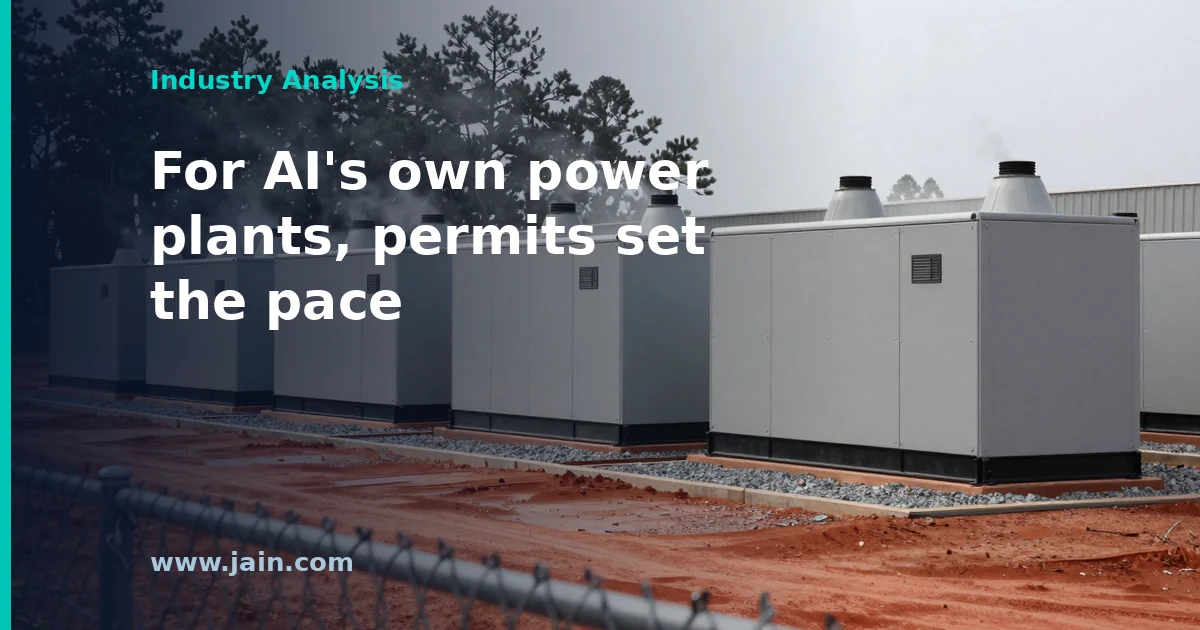
The companies have applied for state permits for a 33-engine “pop-up” power plant burning diesel and natural gas, plus backup generators for the data center. SELC, Altamaha Riverkeeper and Sustainable Newton allege construction began before those permits were issued and have asked EPD to halt it and assess penalties. VoltaGrid, Serverfarm and EPD did not reply to requests for comment.
Executive Summary
VoltaGrid’s permit application describes the Covington plant as “alternative, rapidly deployable prime power”: 33 internal-combustion engines supplying the data center directly rather than drawing from Georgia Power’s grid. It would be the first project of its kind in Georgia. The environmental groups say engines and emergency generators are already standing, some complete and some under construction, while the permit request is still in public comment.
The significance reaches beyond one site. On-site, or “behind-the-meter,” generation has become a favored answer to the grid bottleneck facing AI data centers, and it has drawn interest from Georgia officials worried about who pays for utility expansion. The Covington dispute shows where that model’s speed advantage runs out: engines can arrive quickly, but air permits under Georgia law and the federal Clean Air Act still have to come first. A notice of violation is not a final penalty, and the companies have not responded publicly. Still, the first project of this type in the state is now under scrutiny, and that sets the tone for the next ones.
Speed Is the Product, and the Permit Is the Clock
The appeal of a pop-up power plant is time. A large data center waiting on a utility can face years of transmission upgrades and new generation. Georgia Power is adding 10 gigawatts of capacity, mostly for data centers. Modular engines like the 33 in VoltaGrid’s application can be shipped, set on pads and wired up in a fraction of that time. VoltaGrid’s own filing calls the power “rapidly deployable,” and that phrase is the business case.
But 33 fuel-burning engines are a significant new source of air emissions. In Georgia they need a state air permit, which the groups say must be issued before construction starts. That permit process includes public comment, and residents have already used it to raise pollution concerns. So the deployment timeline is set by the permit, not by the equipment. The groups allege the companies tried to run both timelines at once. If EPD finds they did, the remedies the groups are requesting, a halt to “all prohibited construction activities” plus penalties, would turn any time saved into delay and legal exposure.
The people affected are specific. Developers pitching bring-your-own power have to schedule around permit decisions, not delivery dates. Data center tenants and financiers counting on an early energization date carry the risk if a regulator stops work. And a stop-work demand on the state’s first such project will likely be read by every developer planning a second one.
Why Bring-Your-Own Power Appeals in Georgia
Georgia is one of the country’s hottest data center markets. Meta already operates a large facility near Covington and Amazon is building one. Georgia Power’s 10-gigawatt expansion has drawn pushback from customers and advocates, who worry that households and small businesses will end up covering part of the cost through rates or fuel charges.
A self-supplied plant addresses that concern directly. If the data center generates its own electricity, there is no new utility infrastructure to recover from other ratepayers. That is why the idea has come up as the Georgia Public Service Commission and the legislature grapple with data center energy demand. The Covington case tests whether that policy preference survives contact with environmental permitting in practice.
The Emissions Trade-Off Does Not Disappear
Moving generation behind the meter changes who pays for power. It does not change what the power plant burns. The VoltaGrid engines would run on diesel and natural gas, and residents’ public comments focus on air pollution from those units, which would sit close to the community rather than at a distant central station. Carbon emissions remain a concern too.
Cleaner options that suit an on-site model, such as the small nuclear reactors some tech companies are pursuing, are still years away. For now, bring-your-own power for AI data centers mostly means fossil-fueled engines or turbines. That makes air permits the main regulatory checkpoint, and it is why the permitting process draws this much attention.
Weighing the Claims on Both Sides
The groups’ case rests on aerial photographs they say show completed and partly built engines and generators, and on EPD’s notices of violation, which SELC says followed an inspection. The notices carry weight because they reflect the regulator’s own finding after a site visit, not only the advocates’ reading of photos. The terms of those notices, and what exactly EPD found, have not been made public by the agency. It is also open to question whether everything visible in the photos counts as prohibited construction rather than staged equipment. The companies are the ones best placed to answer that, and they have not.
The opposition is also not framed as anti-data-center. Nancy Schulz of Sustainable Newton called Meta and Amazon good community partners and said the demand is simply to get permits before building. That framing makes the case about process compliance rather than whether data centers belong in Newton County. It is a narrower claim, and one that EPD’s eventual findings can settle.
Background
Metro Atlanta has become one of the largest data center markets in the United States, driven by demand for the computing that powers generative AI. Newton County, where Covington sits, already hosts a large Meta data center, and Amazon is building another. The boom has divided communities: some local officials welcome the investment and tax revenue, while residents and other leaders have opposed projects over electricity use, water consumption and pollution.
To meet the demand, Georgia Power is adding 10 gigawatts of generation, mostly for data centers. That has fueled debate at the Georgia Public Service Commission and in the legislature about who pays. Having data centers bring their own power has emerged as one proposed answer, and the VoltaGrid–Serverfarm project would be the first power plant of its kind in the state.