Bitdeer Technologies Group, the Nasdaq-listed bitcoin miner and mining-hardware developer, announced on May 26, 2026 that it will invest approximately $37 million to establish its first manufacturing facility in the United States, dedicated to mass-producing its own proprietary mining machines. The company’s shares rose about 14% on the news.
Executive Summary
The announcement marks a notable step in a trend the mining industry has discussed for years but rarely executed: moving hardware production onto U.S. soil. Bitcoin mining machines — specialized computers built around custom ASIC chips (application-specific integrated circuits designed to do one task, in this case bitcoin’s hashing algorithm, extremely efficiently) — have historically been designed and assembled in China and Southeast Asia. A U.S. plant puts final production of Bitdeer’s rigs inside the same borders as the large American mining fleets that deploy them.
For Bitdeer, which both operates its own mining data centers and develops its SEALMINER line of rigs, the move deepens a vertical-integration strategy: controlling the machine, not just the megawatts. The 14% share-price jump suggests investors read it as strategically meaningful, though at roughly $37 million the commitment is modest by manufacturing standards — a scale worth keeping in perspective when weighing the announcement.
Onshoring the Rig Supply Chain
The economics of bitcoin mining are dominated by two inputs: electricity and machines. U.S. miners have long controlled the first — cheap domestic power — while depending almost entirely on overseas suppliers for the second. That dependence became expensive and unpredictable as U.S. tariff policy toward Chinese-linked electronics hardened, and as shipping, customs, and export-control friction added cost and lead time to every container of rigs. A domestic production line is a direct hedge: machines assembled in the U.S. can reach U.S. deployment sites without crossing the tariff and logistics gauntlet.
It also carries an industrial-policy resonance. Reshoring advanced electronics assembly aligns with the broader U.S. push to localize technology supply chains, which can translate into goodwill with regulators and utilities — intangible but real assets for a company whose core business depends on grid access and permitting.
What $37 Million Buys — and What It Doesn’t
It is worth being precise about scale. Roughly $37 million funds a serious assembly, integration, and testing operation; it does not fund semiconductor fabrication, which requires capital measured in billions. The ASIC chips at the heart of any mining rig will still come from offshore foundries, as they do for the entire industry. What moves onshore is the downstream work: board assembly, enclosures, hashboard integration, quality testing, and logistics. That is genuinely valuable — it shortens delivery times, reduces tariff exposure on finished goods, and improves repair turnaround — but the deepest layer of the supply chain remains abroad.
The headline framing of “mass-producing proprietary machines” is therefore best read as a supply-chain restructuring, not full technological self-sufficiency. Investors and buyers should watch for disclosed production capacity figures to judge how much of Bitdeer’s fleet demand the plant can actually serve.
Vertical Integration as Competitive Strategy
Most large mining operators buy rigs from third-party giants — a market long led by China-linked manufacturers Bitmain and MicroBT. Bitdeer, whose founder previously co-founded Bitmain, is one of the few operators attempting the harder path: designing its own chips and machines while also running the data centers that consume them. If it works, the payoff is structural — capturing the manufacturer’s margin, tuning hardware to its own facilities, and insulating itself from the allocation queues and pricing power of dominant suppliers.
The risk is equally structural. Hardware development is capital-hungry and unforgiving; a rig generation that lags competitors on efficiency (measured in joules per terahash — how much energy it takes to produce a unit of computing work) can strand the investment. A U.S. factory raises the fixed-cost base, which cuts both ways: leverage if demand holds, drag if the bitcoin cycle turns.
Why the Market Cheered
A 14% single-day move on a $37 million investment says the market is pricing the signal, not the sum. The plausible reading: investors see the plant as evidence that Bitdeer’s hardware business is graduating from R&D project to commercial product line, and that the company is positioning for a world where U.S.-made mining and compute hardware commands a premium. It may also reflect optimism that manufacturing capability is transferable — companies with rig-assembly lines and power-rich data centers have optionality toward adjacent high-performance-computing and AI-infrastructure work. That optionality, however, is inference, not commitment; the announcement itself concerns mining machines.
Background
Bitdeer was spun off from Bitmain — the world’s dominant maker of bitcoin mining hardware — and listed on Nasdaq in 2023. Unlike most mining operators, which are pure consumers of third-party machines, Bitdeer runs mining data centers across multiple countries while also developing its own SEALMINER line of rigs, a vertical-integration strategy few in the industry have attempted.
The move lands amid a broader realignment of technology supply chains: U.S. tariff policy and export-control friction have made imported electronics costlier and less predictable, pushing companies across the compute-hardware spectrum to localize final assembly. Mining hardware, long an almost entirely Asia-manufactured category, has been among the most exposed.
Infrastructure investment firm I Squared Capital announced on May 26, 2026 the launch of a new United States data center platform focused on AI inference and edge colocation, backed by a $1 billion capital commitment. The announcement, distributed via Business Wire, positions the platform to serve the fast-growing market for running trained AI models close to users, rather than the massive centralized campuses where those models are built.
Executive Summary
I Squared Capital, a global infrastructure investor with a track record of building digital-infrastructure platforms from the ground up, is committing $1 billion to a US platform aimed at two intertwined markets: AI inference — the compute that answers queries after a model is trained — and edge colocation, meaning smaller data centers positioned in or near population centers where enterprises can rent space and power.
The bet matters because it stakes real capital on a specific view of where the AI buildout goes next. Most headline-grabbing investment to date has chased hyperscale training campuses measured in hundreds of megawatts, sited wherever cheap power exists. An inference-and-edge thesis argues the next wave of demand is distributed: many smaller facilities, closer to users, optimized for low latency and steady utilization rather than raw scale. If that view is right, data-center value will spread across many US metros instead of concentrating in a handful of power-rich regions.
Inference Is a Different Business Than Training
Training a large AI model is a batch job: it can run anywhere power is cheap, and users never interact with it directly. Inference is a service: every chatbot reply, search summary, and copilot suggestion is an inference call, and its economics are governed by latency (how fast a response travels to the user), utilization, and cost per query. That pushes inference capacity toward network-dense locations near people — the historic strength of colocation and edge facilities rather than remote gigawatt campuses.
By naming inference and edge together, I Squared is effectively arguing that the AI market is maturing from build-the-model to serve-the-model. Industry observers have long noted that if AI adoption follows the path of earlier computing waves, ongoing inference spending should eventually dwarf one-time training spending. A platform purpose-built for that phase is a bet on the durable, recurring part of the AI stack.
A Contrarian Read on Data-Center Geography
The prevailing US buildout has concentrated in a few power-abundant corridors — the kind of places where a utility can pledge hundreds of megawatts. Edge colocation inverts that logic: smaller footprints, more sites, and proximity to enterprises and consumers in secondary metros. The trade-off is that edge sites face urban land costs, tighter permitting, and constrained grid connections, but they can command premium pricing for low-latency capacity and are less exposed to the single-market risks of mega-campuses.
For enterprise buyers, a credible national inference-and-edge platform would offer an alternative to shipping every AI workload to a distant hyperscale region — relevant for latency-sensitive applications, data-residency requirements, and hybrid architectures that keep proprietary data close to home. For incumbent colocation providers, it signals a well-capitalized new competitor targeting exactly the niche where regional operators have historically differentiated.
What $1 Billion Buys — and What It Doesn’t
A $1 billion commitment is serious money and, at the same time, a measured entry. In today’s market, a single large hyperscale campus can absorb several billion dollars, so this commitment points toward a portfolio of smaller facilities rather than one flagship — consistent with the edge thesis. Infrastructure funds also routinely amplify equity commitments with project-level debt, so the platform’s ultimate buildout capacity could be a multiple of the headline figure, though the release itself does not say so.
I Squared has used the platform playbook before in digital infrastructure, assembling operating companies around a thesis and scaling them through acquisition and greenfield development. The open question is execution: inference-optimized facilities still need power, cooling for dense GPU racks, and — most importantly — tenants. The announcement describes a commitment and a strategy; converting that into leased, revenue-generating megawatts is a multi-year undertaking in a market where skilled operators, grid interconnection queues, and equipment lead times are all under strain.
Risks: The Edge-Inference Thesis Is Not Yet Settled
It is worth stating plainly that the distributed-inference future this platform anticipates is a forecast, not a fact. Today, a large share of inference still runs in the same hyperscale regions as training, because cloud providers concentrate their GPU fleets there and many applications tolerate tens of milliseconds of extra latency. If model efficiency improves faster than demand grows, or if hyperscalers simply extend their own regions closer to users, the addressable market for independent edge inference capacity could prove smaller than proponents expect.
None of that makes the bet unreasonable — infrastructure investing is precisely about positioning capital ahead of demand. But buyers and competitors evaluating this announcement should weigh that the release, as reported, substantiates a commitment and a strategy rather than contracted customers or operating assets.
Background
I Squared Capital is an independent infrastructure investment firm founded in 2012 and headquartered in Miami, managing capital across energy, utilities, transport, and digital infrastructure worldwide. In digital infrastructure specifically, the firm has favored a platform model — creating or acquiring an operating company around an investment thesis, then scaling it through greenfield development and bolt-on acquisitions, including prior edge data-center investments in Europe.
The announcement lands amid an unprecedented US data-center expansion driven by AI. Most capital to date has flowed to hyperscale training campuses in power-rich regions, but a growing school of thought holds that as AI applications reach mass adoption, the serving side — inference — will demand distributed, network-proximate capacity, reviving the strategic value of edge and metro colocation.
Infrastructure investor I Squared Capital has agreed to acquire data center assets from Cogent Communications for $225 million, according to a Reuters report dated May 25, 2026. The purchase anchors a new data center platform — reported at roughly $1 billion — that I Squared is positioning around artificial-intelligence inference, the day-to-day serving of AI models to users rather than the training of them.
Executive Summary
The transaction pairs a specific asset purchase with a bigger strategic wager. I Squared, a private-equity firm that specializes in infrastructure — roads, energy, and increasingly digital assets — is paying $225 million for facilities Cogent had been carrying on its books, and is using them as the foundation of a platform sized in press coverage at around $1 billion. The stated thesis is AI inference: the compute that answers queries, generates content, and runs AI features inside applications, which tends to sit closer to end users than the massive training campuses built by hyperscale cloud providers.
For Cogent, a company best known as a low-cost internet backbone and transit provider, the sale converts long-marketed real estate into cash. For the broader market, it is a data point that institutional capital now sees a distinct, investable asset class in smaller, distributed colocation sites — not just in the gigawatt-scale campuses that have dominated AI headlines. Whether inference demand materializes at these locations on the timeline investors hope is the open question the deal leaves unanswered.
Inference Is a Different Business Than Training
Most AI data center investment to date has chased training: enormous, power-hungry campuses where models are built, often in remote locations chosen for cheap land and available electricity. Inference — running the finished model every time a user asks a question — has a different profile. It is latency-sensitive, scales with user traffic rather than with model size, and in many architectures benefits from being distributed across metros closer to population centers. That is the logic behind putting inference capacity into smaller, geographically scattered facilities of the kind changing hands here.
The economics are also different. Training clusters are typically leased wholesale by a handful of very large tenants; inference capacity can, in principle, be sold in smaller increments to a broader customer base, which looks more like traditional retail colocation — renting secure, powered space to many customers. If that market develops, operators of distributed sites gain pricing power they have not had in years. If inference instead consolidates inside the hyperscalers’ own clouds, the thesis weakens. The release, as reported, does not settle which way demand is actually breaking.
A Payday for Cogent’s Conversion Thesis
Cogent acquired Sprint’s legacy wireline business from T-Mobile in 2023, a deal that brought with it a large portfolio of former telephone switching facilities across the United States. Management has spent the years since arguing that these buildings — hardened structures with existing power feeds and fiber connectivity — could be converted into sellable or leasable data centers. Skeptics noted that carrier hotels built for 1990s telecom gear are not automatically suited to modern high-density computing, and that monetization was slow to show up in reported results.
A $225 million sale to a sophisticated infrastructure buyer is the most concrete external validation of that thesis to date, though one transaction does not price the whole portfolio. It is worth being precise about what the deal does and does not prove: it shows a willing buyer at a real price for some assets, but the report does not disclose how many facilities are included, their capacity, or their condition — so extrapolating a value for Cogent’s remaining sites from this headline number would be premature.
Private Capital Moves Down-Market
I Squared’s entry continues a pattern of infrastructure funds treating digital assets — fiber, towers, and data centers — as core holdings alongside energy and transport. What is notable is the segment: rather than bidding on trophy hyperscale campuses, where competition from sovereign wealth funds and mega-funds has compressed returns, this platform targets the fragmented middle of the market. A reported $1 billion platform commitment suggests the firm intends to aggregate and upgrade additional sites, not simply hold what it bought.
The risks are equally clear. Retrofitting older facilities for AI-grade power density and cooling is capital-intensive, utility interconnection queues are long in many metros, and the platform will be competing for tenants against established colocation providers with existing sales channels and ecosystems. The strategy’s success likely depends less on the entry price than on execution: securing power upgrades, landing anchor customers, and timing capacity to a demand curve that remains genuinely uncertain.
Background
Cogent Communications built its business as an aggressive price competitor in internet transit, operating a global fiber backbone. Its 2023 acquisition of Sprint’s wireline business from T-Mobile brought hundreds of former telephone switching sites, and management has since pitched their conversion into data centers as a major source of untapped value — a claim the market has watched for proof in the form of actual sales or leases.
I Squared Capital is part of a wave of infrastructure private equity that has moved decisively into digital assets over the past decade, on the view that data centers, fiber, and towers offer the long-lived, contracted cash flows these funds seek. The AI boom has intensified that interest, first in massive training campuses and now, as this deal suggests, in the distributed facilities that may serve AI inference closer to end users.
A farm county in southeast Nebraska has put new data centers on hold for up to a year. Data centers are the huge warehouse-like buildings full of computers that run artificial intelligence.
Residents were alarmed by reports of a Google plan for a Nebraska facility that could use more than three times the electricity of the entire city of Lincoln on a hot summer day. They asked about water, power bills and heat.
A new state law now gives counties a deadline to rule on some projects. Counties without rules may pause first and write rules later.
The Otoe County Board of Commissioners in southeast Nebraska voted on Tuesday, May 19, to suspend the permits needed for a new data center for up to a year, Nebraska Public Media reported, carrying reporting by the Flatwater Free Press. Commissioner Chuck Cole said the pause is meant to give county officials time to study the issue and update county regulations.
The vote followed local concern about a Google proposal for a large Nebraska data center. According to documents shared at a private utility meeting in January, that facility could require more than triple the electricity the city of Lincoln uses during its hottest months. The proposal did not name a site. The Omaha-based energy developer Tenaska, described as a potential partner, has optioned large tracts of land in southeast Nebraska, including in Otoe and Gage counties. Gage County’s planning and zoning commission is scheduled to hold a hearing on its own moratorium in June.
Executive Summary
Otoe County has not rejected data centers. It has stopped issuing the permits for one while it writes rules it does not yet have. That distinction matters to anyone planning large AI facilities in rural America. The practical obstacle in Otoe is not a lack of electricity or land. It is the absence of a local rulebook that can answer residents’ questions about water, power costs and heat before a project arrives.
Two new Nebraska laws raise the stakes. One allows private power plants built to serve a single large industrial customer to connect to the grid. That law is widely seen as aimed at data centers and was backed by Tenaska’s CEO at a legislative hearing. The other law requires counties to rule on some projects within a fixed period. Jon Cannon of the Nebraska Association of County Officials said that deadline may prompt counties to adopt moratoriums first so they are not forced to rule without regulations in place.
Otoe is one of several signals. Madison County now requires a special permit for data centers, Gage County is weighing a pause, and, according to the report, at least 14 states have considered statewide moratoriums this year.
A Pause to Write Rules, Not a Permanent No
A moratorium is a temporary halt on a category of approvals. Otoe’s suspends data center permits for up to a year. The board framed it as time to study the issue and update its regulations, not as a verdict on the industry. Wynee Benedict, one of the residents who pushed for it, described the goal in regulatory terms: “We needed regulations on the books prior to a data center coming to this county. We don’t want to have to play catch up and regulate something that’s already here.”
Residents did not all agree. Jim Nemec supported time to study the issue but warned about the signal it sends: “Are we sending out the impression that business is closed here?” That is a fair concern. A county that pauses without a clear end date, or that uses the year to write rules nobody can meet, risks becoming a place developers skip. A county that uses the year to publish clear standards on water, noise, setbacks and power costs may become an easier place to build than one with no rules at all. Setbacks are required distances from homes or roads. The ordinance the county drafts will matter more than the vote itself.
Why AI Siting Now Runs Through the County Board
This is the core of the story. The scale being discussed in southeast Nebraska is large. The Google proposal could require more than triple Lincoln’s summer electricity use, and the organizers in Gage County said they understood it would include a private natural gas plant. At that size, a project needs the grid connection, the generation, the land and the local land-use permit. The state has now eased the power question by allowing private generation dedicated to a large customer. Tenaska has reportedly secured land options, which are contracts giving it the right to buy or lease land later. The piece still in doubt is the county permit, and in Otoe that piece is now frozen for up to a year.
The state’s new decision-deadline law pushes counties in the same direction. It was intended to stop counties from stalling projects indefinitely. But a county with no data center rules that faces a firm deadline to decide on an application has two choices: rule without standards, or pause until it has them. Cannon expects many to pause, and not only for data centers. For developers this matters a great deal. A law designed to shorten approvals could lengthen them in counties that are not ready, and in the short term the counties that are not ready are most of the rural counties where land and gas access make these projects attractive.
This should not be overstated. One county’s vote is not a statewide trend, and Cannon himself said attitudes will vary from county to county, as they have for wind and solar. But Otoe, Madison and Gage have all acted or scheduled action within weeks of each other, and all three are responding to the same prospect. That points to county zoning as the next checkpoint for rural AI campuses, alongside power and fiber.
Power Was Handled in Lincoln; Water Was Left to the Counties
Nebraska’s legislature and Gov. Jim Pillen addressed the energy question directly. The private-generation law is meant to keep large new loads from burdening existing ratepayers. Virginia shows what happens when this goes unaddressed. Joe Lerch of the Virginia Association of Counties said the state’s main utility has had to postpone connecting some new data centers for lack of power and transmission capacity.
Water got no equivalent state-level answer, and in Otoe and Gage it is the concern residents raise first. Gage County organizer Anna Wolken said the top issue would be water, because both a gas plant and a data center can draw on it. Gas plants use water for cooling, and many data centers use water to carry heat away from their servers. How much depends heavily on the cooling design. Air-based and closed-loop systems use far less than evaporative ones. Nobody involved has said publicly which approach the proposed facility would use.
A separate transparency law will require data centers to report their owners, size, location, annual electricity demand, water use and tax incentives each year. That gives county officials comparable data for future decisions. It does not help a county decide on a first project before any such reports exist, which is exactly Otoe’s situation.
What Developers Can Take From Otoe
Cannon’s advice to developers was practical: tell residents early. He described what happens when neighbors learn about a project from each other, through someone who “just signed this big contract for a right of way.” In Otoe and Gage, residents appear to have learned of the potential project through press reporting on a private utility meeting and through land options. It was not an announcement from the companies. A community that pieces a project together from secondhand reports tends to fill the gaps with worst-case assumptions.
The lesson for anyone siting AI capacity in rural areas is that the time-consuming work may be local rather than technical. That means disclosing water and cooling plans, explaining who pays for power, and engaging before the zoning agenda is set. Developers who bring those answers to a county writing its first ordinance have a chance to help set the terms. Developers who arrive afterward will be working within rules written without their input.
Background
Otoe County sits in southeast Nebraska. Its county seat is Nebraska City, south of Omaha and east of Lincoln. Like many rural counties, it has previously dealt with controversial large developments such as wind and solar farms. Its land-use rules were not written with hyperscale data centers in mind. Hyperscale refers to the very large facilities built by major cloud and AI companies.
Demand for AI computing has driven a nationwide search for sites with available land, power and water. Established hubs such as Northern Virginia have run into grid limits. Nebraska responded in 2026 with a law allowing dedicated private power generation for large customers and a separate law requiring annual public reporting on data center energy and water use.
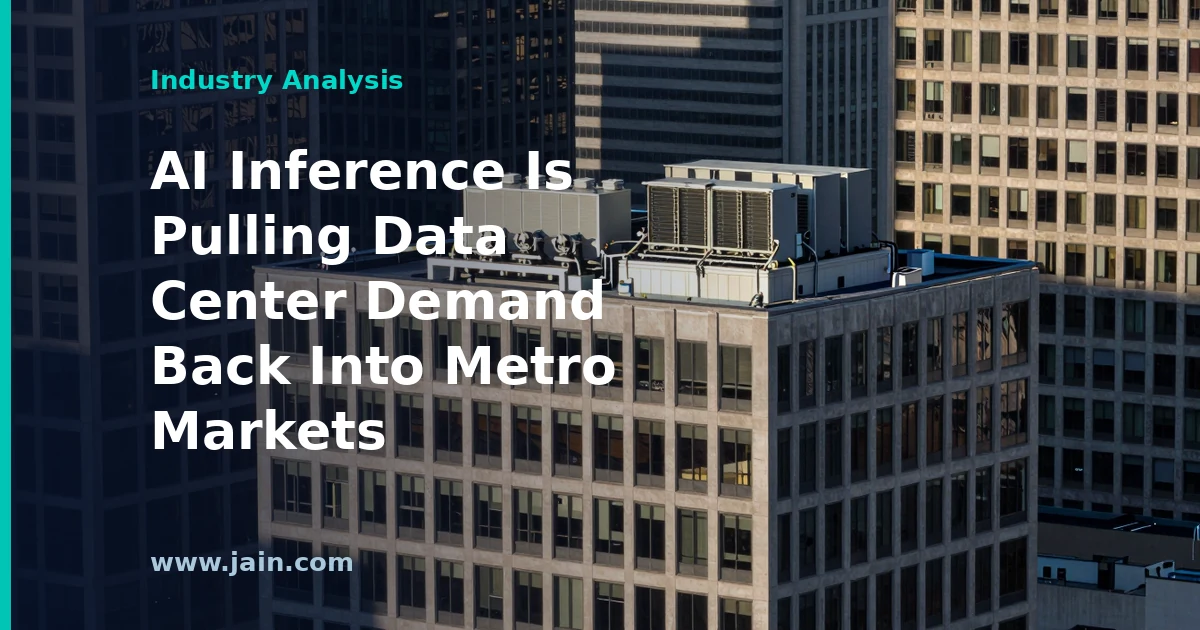
Data Center Knowledge reported on May 23, 2026, that AI inference — the day-to-day serving of trained AI models to end users — is pulling infrastructure investment back toward metro data centers, reversing years of momentum toward remote hyperscale campuses. The driver, per the report’s framing, is latency: inference workloads live and die by response time, and response time is a function of physical distance to users.
Executive Summary
The trade publication’s thesis is straightforward: the AI buildout’s first act was dominated by training — the compute-intensive process of creating models — which rewarded remote sites with cheap land and abundant power, because training does not care where it runs. The second act is inference, the phase where those models actually answer queries for businesses and consumers, and inference is latency-sensitive in a way training never was.
If the thesis holds, it matters for nearly everyone in the infrastructure value chain. Metro colocation operators, carrier hotels, and interconnection-rich urban facilities — assets many analysts treated as yesterday’s story during the gigawatt-campus land rush — would regain strategic relevance. Site-selection criteria, capital allocation, and power procurement strategies would all tilt back toward proximity to population centers, precisely where power and real estate are scarcest.
Training Built the Campuses; Inference Pays the Bills
Training and inference are economically different animals. Training is a batch job: it runs for weeks or months, consumes enormous power, and produces a model. Because no end user is waiting on it in real time, operators could chase the cheapest available megawatt — which pushed campuses into rural and exurban regions with land, transmission access, and accommodating utilities. Inference is the opposite: it is the recurring, revenue-generating workload, triggered every time a user prompts a chatbot, a copilot drafts an email, or an application calls a model behind the scenes.
As AI products mature from demos into production services, the share of total AI compute devoted to inference grows structurally. That shifts the industry’s center of gravity from “where is power cheapest?” to “where are the users?” — a question metro data centers were built to answer. The report’s framing suggests the market is beginning to price this in.
Why Latency Is Redrawing the Map
Latency — the delay between a request and its response — is bounded by physics. Data cannot travel faster than light through fiber, and every additional kilometer between user and server adds round-trip time. For a monthly batch job, that is irrelevant. For an interactive AI assistant, a fraud-check API, or a voice agent, tens of milliseconds are perceptible and, at scale, commercially meaningful.
Newer AI application patterns compound the effect. Agentic and multi-step systems chain many model calls together to complete a single task, so per-call latency multiplies. Retrieval-augmented applications shuttle data between models and enterprise systems that already live in metro colocation facilities. Placing inference capacity near users and near enterprise data reduces both delay and data-transit cost — a pull toward the very urban markets the hyperscale era had de-emphasized.
Winners, Losers, and the Assets in Between
The clearest beneficiaries of a metro revival would be operators holding interconnection-dense urban facilities: carrier hotels, established colocation campuses in major metros, and providers with existing utility relationships in constrained markets. Those assets are hard to replicate — urban land, fiber density, and grid connections accumulate over decades. Enterprises also stand to gain optionality, since inference capacity near their existing colocation footprints simplifies hybrid architectures.
This is not, however, a zero-sum reversal. Remote hyperscale campuses remain essential for training and for latency-tolerant inference, and the report’s headline says infrastructure is being pulled “back into” metros, not out of the hinterlands. The more defensible reading is bifurcation: a two-tier geography where massive remote campuses handle training and batch work while a distributed metro layer serves real-time inference. The open question is how capital gets split between the tiers — and whether metro grids can absorb their share.
The Constraint That Follows the Workload: Power
The uncomfortable irony is that inference demand is heading toward the places least prepared to power it. Major metros already contend with constrained grids, long interconnection queues, and community resistance to new data center construction. AI inference hardware, while less power-dense per site than a training cluster, still pushes rack densities well beyond what many legacy urban facilities were engineered for, often requiring liquid cooling retrofits and electrical upgrades.
That constraint cuts both ways. It limits how fast the metro shift can happen, but it also makes existing permitted, powered metro capacity more valuable — scarcity is a landlord’s friend. Expect the competition for metro megawatts, substation capacity, and retrofittable urban shells to intensify if the trend the report describes continues.
Background
Data center geography has swung on a pendulum for two decades. The early internet clustered compute in urban carrier hotels where networks met; the cloud era then pushed capacity outward to remote regions where land and power were cheap, and the AI training boom of the mid-2020s accelerated that outward push into multi-hundred-megawatt and gigawatt-scale campuses.
Data Center Knowledge, the source of this report, is a long-running trade publication covering the data center industry. Its May 2026 piece captures a question the industry has been circling as AI products move from development into production: once models are built, the economics of serving them — inference — may favor a very different map than the one training drew.
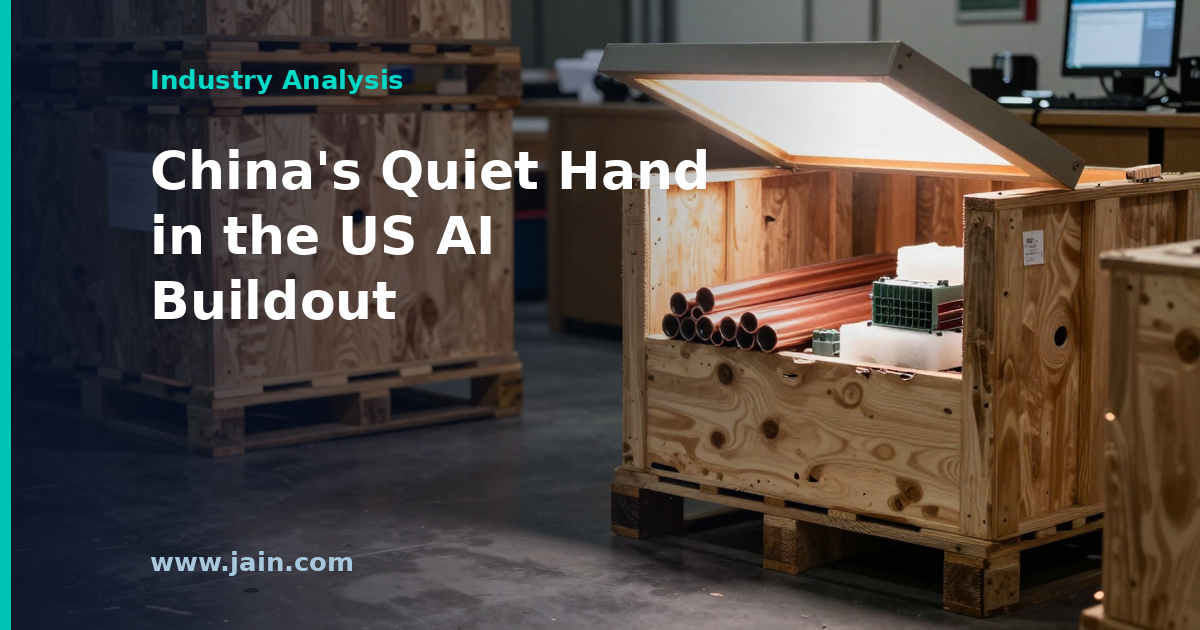
Axios reported on May 21, 2026 that Chinese-made components and materials are quietly flowing into the United States data-center construction boom, even as Washington tightens export controls on advanced chips headed the other direction. The piece frames the dependency as a geopolitical risk for the AI infrastructure now being stood up at record pace.
Executive Summary
The Axios story argues that America’s data-center surge — the physical backbone of the current AI wave — leans on a supply chain in which Chinese firms still play a meaningful, if under-discussed, role. That includes hardware, electrical gear, and construction inputs sourced directly or through intermediaries.
The reason it matters is straightforward: policymakers have spent two years hardening the outbound side of the US–China technology relationship, restricting what advanced silicon and tools American companies can sell to Chinese buyers. The inbound side of the same relationship — what the US buys to build the facilities that host AI — has drawn far less scrutiny, and the article suggests that gap is now visible in the numbers.
The Buildout Nobody Fully Sourced
Hyperscale data-center construction is a bill of materials problem as much as a real-estate problem. A single campus consumes transformers, switchgear, busways, generators, cabling, cooling coils, racks, and structural steel in volumes that already exceed what Western manufacturers can supply on the timelines operators want. When Tier-1 vendors are booked out, buyers turn to whoever can ship — and Chinese factories remain the marginal supplier for a long list of electrical and mechanical components. The Axios framing is that this quiet substitution is bigger than the industry publicly acknowledges.
None of that is inherently a scandal; global sourcing is how infrastructure gets built. It becomes a policy question when the same components sit inside facilities that host frontier AI training runs, defense workloads, or critical services, and when the exporting country is also the strategic competitor the export-control regime is designed around.
Asymmetric Controls, Symmetric Exposure
US policy since 2022 has focused almost entirely on the outbound flow: chips, chip-making equipment, and increasingly the model weights and cloud capacity that could be used to train frontier AI abroad. The inbound flow — grid-scale transformers, power distribution units, network gear, cooling hardware — has been governed by a patchwork of tariffs, Section 232 reviews, and Buy American rules that were not designed with AI infrastructure in mind.
If the Axios reporting holds, the practical implication is that America’s ability to build AI capacity is partly gated by a country it is simultaneously trying to slow down in AI. That is a fragile equilibrium: a future round of tariffs or export restrictions from either side could stretch already long lead times for the exact components operators need most.
Who Gains, Who Gets Squeezed
Western manufacturers of transformers, switchgear, and cooling equipment stand to benefit if buyers and regulators push harder on country-of-origin — but only if they can add capacity, which takes years and skilled labor that is itself in short supply. Hyperscalers with the balance sheets to pre-buy multi-year allocations from domestic and allied suppliers are best positioned; smaller colocation operators and enterprise builders, who buy in smaller lots and later in the cycle, would feel any supply squeeze first.
For AI customers, the second-order effect is schedule risk. A data-center delivery pushed from Q2 to Q4 because a Chinese-sourced transformer was reclassified or a substitute part is on allocation translates directly into delayed GPU deployments and delayed model training. In an environment where compute is the binding constraint on product roadmaps, that is a real cost.
Reading the Claim Carefully
The Axios piece is a framing article, not a forensic supply-chain audit, and the responsible read is to hold both possibilities open. It is plausible that Chinese content in US data-center construction is material and under-reported, given how opaque multi-tier supply chains are. It is also fair to ask how much of the reported exposure is finished Chinese-branded equipment versus subcomponents inside Western-branded gear, and how much is displaceable at reasonable cost versus genuinely single-sourced. Those distinctions determine whether this is a policy problem, a procurement problem, or a headline.
Background
The US data-center industry is in the middle of the largest capacity expansion in its history, driven by generative AI training and inference demand from hyperscalers and a new tier of AI-native operators. That expansion has already collided with constraints on grid interconnection, transformer supply, water, and permitting.
In parallel, the US and China have spent the past several years decoupling on advanced semiconductors, with successive rounds of US export controls on chips and chip-making tools and Chinese retaliation on critical minerals. The Axios story sits at the intersection of those two trends, arguing that the physical layer of the AI economy is still more entangled with China than the policy conversation has acknowledged.
Law firm Ropes & Gray published a 2026 outlook on data-center investment, arguing that the sector’s trajectory is being set by three intersecting forces: surging AI compute demand, hard limits on grid power, and a wave of private-equity capital flowing into digital infrastructure. The note, dated May 21, 2026, is a legal-advisory perspective aimed at sponsors, lenders, and strategic investors, not a transaction announcement.
Executive Summary
The outlook is notable less for any single data point than for the framing: Ropes & Gray, a firm that advises on a meaningful share of large digital-infrastructure transactions, is telling its client base that AI, power, and private capital are now the master variables governing deal flow. That framing shapes how term sheets get drafted, how diligence is scoped, and where sponsors are willing to plant multi-hundred-megawatt bets.
For a broader audience, the significance is that a legal advisor is publicly acknowledging what operators have been saying privately for two years: siting a data center is now a power-and-permitting problem first and a real-estate problem second. Capital is abundant; interconnection queues are not.
AI Demand as the Underwriting Case
The outlook positions AI as the demand engine underwriting new capacity. In practical terms, that means investment committees are being asked to approve builds whose economics depend on tenants — hyperscalers and large AI-native firms — signing long-dated leases at densities (kilowatts per rack) that would have looked exotic in 2022. That shift is real, but it concentrates counterparty risk: a handful of buyers now anchor a large share of pre-leased pipeline, and their capex plans can move quarter to quarter.
For lenders, the underwriting question is whether an AI-training campus retains value if a specific hyperscaler pulls back. The answer depends on power interconnect, fiber, and land — assets that outlast any single tenant — but the note is measured rather than triumphant about that resilience.
Power as the Binding Constraint
The most useful contribution of the outlook is naming power, not capital or land, as the binding constraint on 2026 growth. Interconnection queues at major utilities now stretch multiple years; substation upgrades, transmission build, and generation additions all sit on longer clocks than data-center construction itself. That inverts the traditional development sequence, where power was assumed and site selection led.
The economic consequence is a premium on shovel-ready sites with executed interconnection agreements, and a growing willingness among sponsors to co-invest in generation — behind-the-meter gas, on-site solar-plus-storage, and, in a smaller number of cases, small modular reactor offtake — to shortcut the queue. Each of those paths carries its own permitting and community-acceptance risk that the note flags without resolving.
Private-Equity Capital Flows
The third leg of the thesis is that private equity, infrastructure funds, and sovereign capital are increasingly the marginal buyer of data-center platforms, often through take-privates, minority stakes, or joint ventures with operating partners. The appeal is straightforward: contracted cash flows on twenty-year time horizons match liability profiles for pension and insurance capital better than most alternatives.
The risk, which the outlook implies rather than states, is valuation. When capital chases a scarce input — in this case, powered land — entry prices can outrun the operating economics that justified the initial thesis. That is not a prediction of a correction; it is a caution that the same forces driving deal volume also compress future returns.
Background
Data centers evolved from enterprise back-office facilities into a distinct asset class over the last fifteen years, driven first by cloud computing and, since 2023, by generative AI. The sector now attracts dedicated infrastructure funds, sovereign wealth capital, and hyperscaler self-build alongside traditional colocation operators.
Ropes & Gray is one of several major law firms — alongside peers such as Latham & Watkins, Kirkland & Ellis, and Simpson Thacher — that advise on the largest digital-infrastructure transactions. Periodic outlooks from these firms function as a barometer of where sponsor appetite and legal risk are converging.
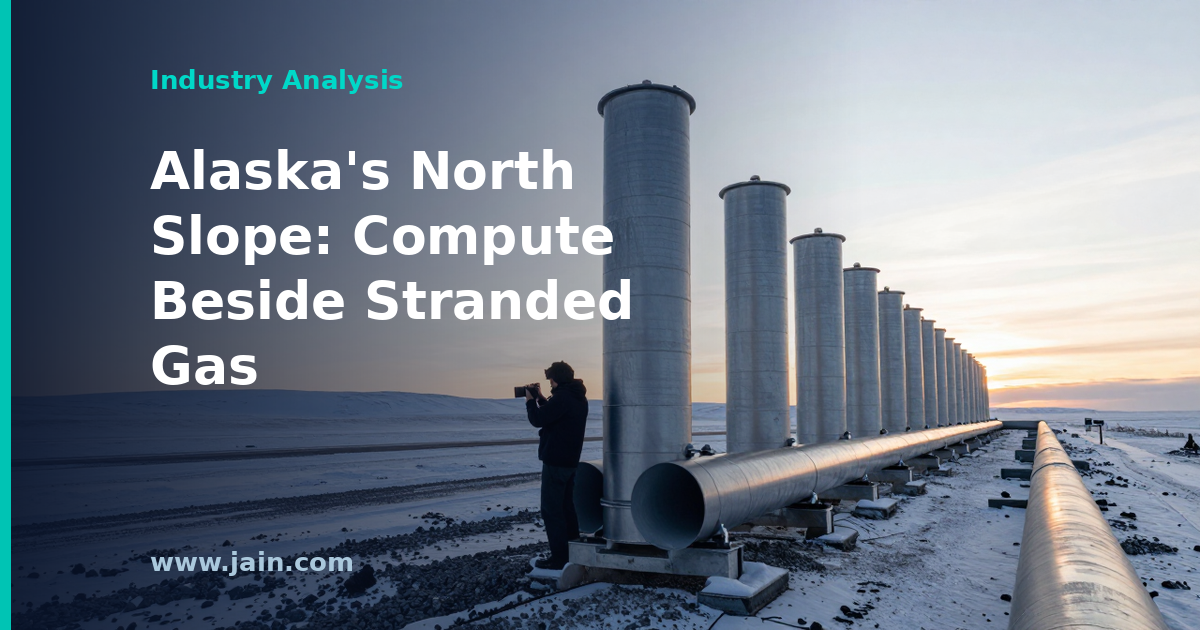
The Alaska Beacon reported on May 15, 2026 that a large data center campus could be developed on Alaska’s North Slope, the Arctic oil-producing region north of the Brooks Range. The attraction is straightforward: the North Slope sits on top of vast volumes of natural gas that currently have no route to market, and a data center is one of the few customers that can be brought to the fuel rather than the other way around.
Public detail remains limited. The report describes the concept and its setting; it does not, in the material available to us, establish a confirmed developer, a firm generating capacity, signed customers, financing or a construction schedule. Treat the project at this stage as a proposal being floated, not a committed build.
Executive Summary
For most of the industry’s history, data centers followed people and fiber. They clustered near metro interconnection points, cheap retail land and existing substations, because latency to users and access to networks mattered more than the marginal cost of a megawatt. AI training has inverted that logic. Large training clusters are batch workloads that tolerate tens of milliseconds of network delay, so their siting is increasingly decided by whichever constraint binds hardest, and right now that constraint is electricity.
A North Slope campus is the purest expression of that inversion yet proposed in the United States. There is no interconnection queue to wait in because there is no grid to interconnect to; the North Slope’s power is islanded and gas-fired, built to run oil fields. There is no transmission to build because the plan implies generating on site from gas that is otherwise reinjected into the ground for lack of a pipeline. The trade is that every other input, from construction labour to network diversity to spare parts, becomes harder and more expensive.
Whether that trade works is an empirical question, and the answer matters well beyond Alaska. If compute can be economically parked next to stranded hydrocarbons in one of the least accessible places in North America, the same argument applies to flared gas basins in Texas and North Dakota, to remote hydro in Canada and Scandinavia, and to any energy resource whose problem is distance to demand.
Power Now Picks the Site, and Everything Else Follows
The scarce input in AI infrastructure is not chips, land or capital. It is firm, contracted electricity delivered on a schedule that matches a two-to-three-year build. In established markets, utility interconnection studies and transmission upgrades routinely stretch project timelines by years, and grid operators in several U.S. regions have begun rationing large-load connections. A developer who can bypass that queue entirely buys back time, and in a market where the value of a training cluster decays with each hardware generation, time is the whole game.
Behind-the-meter generation, meaning power produced on site and never touching a public grid, is how developers are trying to buy that time. The North Slope version is behind-the-meter taken to its logical extreme: not merely bypassing a grid, but siting where none exists. That removes the interconnection risk and replaces it with construction, fuel-supply and operations risk. Those are real risks, but they are risks a private developer can price and manage, whereas an interconnection queue is a public process nobody controls.
The counterweight is that a self-generated island has no backstop. A campus tied to a large grid can lean on the system during a generator outage; an islanded campus cannot. That pushes redundancy back onto the owner in the form of extra turbines, extra spares and deeper on-site fuel and maintenance capability, all of which raise capital cost per megawatt. The economics only work if the fuel is cheap enough, and abundant enough, to pay for that redundancy several times over.
Stranded Gas Is Cheap Precisely Because It Has Nowhere to Go
North Slope fields produce large volumes of natural gas alongside oil. Because there is no pipeline carrying that gas to Lower 48 or Asian markets, most of it is reinjected into the reservoirs to maintain pressure and support oil recovery. Gas in that position is often described as stranded: physically abundant, commercially close to worthless, because its value is set by the cost of moving it to a buyer. Decades of proposals to build a gas pipeline or an LNG export project from the Slope have not produced a completed export line.
A data center changes the arithmetic by moving the buyer to the gas. That is genuinely attractive for the producer and the state, which collects royalties and taxes on production. But two cautions belong in any serious appraisal. First, gas that is currently reinjected is doing useful work supporting oil production, so diverting it is not free; it has an opportunity cost that only the field operators can quantify. Second, cheap fuel at the wellhead is not the same as a low delivered cost of power. Turbines, heat recovery, fuel treatment, Arctic-rated enclosures and a skilled operating crew all sit between the reservoir and the rack.
There is also a carbon question that buyers will ask before signing. Hyperscale tenants and their investors carry public emissions commitments, and unabated gas generation is a poor fit for them regardless of how cheap it is. A credible answer would involve carbon capture, offsets or a customer base less bound by those commitments, and none of that is settled by a project concept. The counterargument, that using gas which would otherwise be reinjected or flared is better than the alternative, is arguable but not automatic, and it will be argued.
The Arctic Build Problem: Permafrost, Logistics and Latency
Building on continuous permafrost means building on ground that must be kept frozen. Heat leaking from a structure thaws the soil beneath it and causes differential settlement, so Arctic construction relies on elevated pile foundations, thick insulating gravel pads and thermosyphons, passive devices that pull heat out of the ground in winter. A data center is a concentrated heat source, which makes thermal isolation from the ground a first-order design problem rather than a detail. None of this is unsolved, but it is expensive and slow, and the pool of contractors who have done it is small.
Logistics compound the cost. Heavy freight to the Slope moves by the Dalton Highway, by seasonal ice roads, by barge during a short open-water window or by air at a price that discourages mistakes. Labour is largely rotational and camp-housed. The upside is the climate itself: ambient air on the North Slope permits free cooling, meaning outside air can reject server heat for most or all of the year without mechanical chillers, which is a material and durable operating saving.
Networking is the input most often underestimated. Terrestrial and subsea fiber reaching the Arctic coast and running south toward Fairbanks does exist, built primarily to serve oil-field operations and remote communities, so the region is not dark. The question is capacity, route diversity and the cost of adding more, because a large campus needs multiple physically separate paths, not merely a connection. Distance from users also shapes the workload mix. Training runs and other batch jobs are viable; latency-sensitive inference serving population centres is not the natural fit.
Who Gains, Who Waits
If a project of this kind proceeds, the clearest beneficiaries are field operators with gas they cannot sell, the state and the North Slope Borough through production and property tax bases, and turbine and modular-build vendors. Alaska has spent decades looking for a second industry to sit alongside oil, and compute is one of the few candidates that does not require moving a commodity thousands of miles. Local hire and community benefit, however, depend on commitments that a concept announcement does not contain.
The parties with reason to wait are customers. A tenant signing a long lease in an islanded Arctic campus is underwriting fuel supply, construction execution, network diversity and staffing continuity in a location where a serious failure cannot be fixed quickly. That risk is priceable, but it will be priced, and the discount a tenant demands may erode much of the fuel-cost advantage that motivated the site in the first place. Competing projects in gas-rich but road-accessible basins offer a similar power-first thesis with far less logistical drag.
The honest summary is that this proposal is interesting for what it tests rather than for what it has so far demonstrated. It is a clean experiment in whether power availability alone can outweigh every other siting factor. Until capacity, financing, offtake and permits are on the record, the analysis is about the thesis, not about a project.
Background
The North Slope is Alaska’s Arctic oil province. Prudhoe Bay, discovered in 1968 and brought online with the Trans-Alaska Pipeline System in 1977, remains the anchor of a region whose economy, roads, airstrips, power plants and camps were all built around crude production. Natural gas produced alongside that oil has never had a comparable export route; successive pipeline and LNG proposals have been studied for decades without a completed export project, so most of the gas is reinjected to support oil recovery.
Connectivity arrived later and separately. Fiber built to serve oil field operations and Arctic coastal communities links parts of the region and runs south toward Fairbanks, ending the assumption that the Slope is entirely off the network map, though capacity and route diversity remain far below what large metro data center markets take for granted. Against that backdrop, the arrival of AI-driven demand for firm power has made planners across the world reconsider remote energy resources, and Alaska is now part of that conversation.
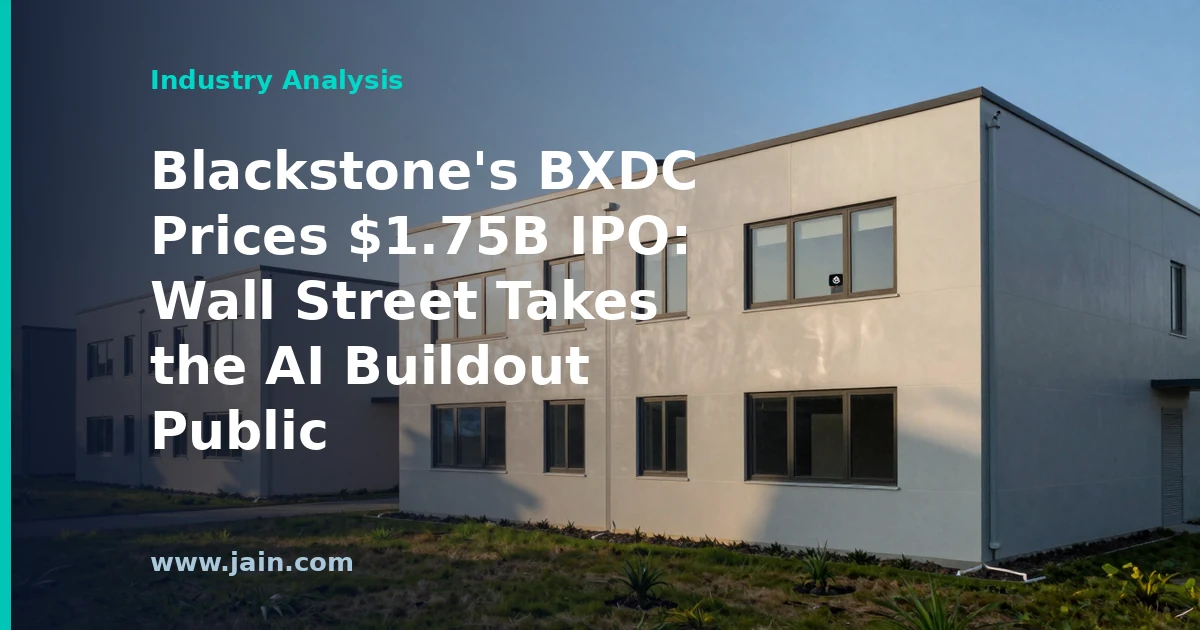
Blackstone Digital Infrastructure Trust (BXDC), a newly formed data center real estate investment trust sponsored by Blackstone, priced its initial public offering at $1.75 billion on May 15, 2026, selling shares at $20 apiece, according to IPO research firm Renaissance Capital. At that price, the deal implies roughly 87.5 million shares sold in the offering.
The listing creates one of the few new pure-play public vehicles for data center real estate in years, arriving amid an unprecedented wave of capital spending on AI computing infrastructure.
Executive Summary
The announcement itself is straightforward: a new REIT — a real estate investment trust, a structure that lets investors own income-producing property through shares and requires most taxable income to be paid out as dividends — has been formed under the Blackstone umbrella and has raised $1.75 billion from public markets at $20 per share.
Why it matters is larger than the dollar figure. Since 2021, the universe of publicly traded data center REITs has contracted sharply as private equity — Blackstone prominently among them — took operators like QTS Realty private. BXDC reverses the direction of travel: after years of private capital absorbing data center assets, one of the largest private owners is now offering public investors a way back in. That is a meaningful signal about where data center financing goes next, because the capital requirements of the AI buildout are widely understood to exceed what private funds and credit markets can comfortably carry alone.
For a first-day read, the pricing is the headline and nearly the only hard fact. The source is a single pricing notice; portfolio details, leverage, and dividend policy are not described in it, and we flag those gaps below.
The Public Data Center REIT Club Gets a New Member
For most of the last two decades, retail and institutional investors could buy data centers on the stock exchange through a half-dozen REITs. That changed abruptly in 2021, when a privatization wave — Blackstone’s roughly $10 billion take-private of QTS Realty, KKR and GIP’s acquisition of CyrusOne, and American Tower’s purchase of CoreSite — left Equinix and Digital Realty as the only major U.S. pure plays. Private owners argued, credibly, that public markets undervalued the sector and that development-heavy strategies were easier to execute away from quarterly earnings scrutiny.
BXDC’s arrival suggests the calculus has shifted. Public market appetite for anything attached to AI infrastructure is strong, and a $1.75 billion raise at pricing is a real vote of confidence. For investors, a new pure-play vehicle broadens choice in a sector where demand has been concentrated in two large incumbents plus indirect exposure through hyperscaler equities.
Why Blackstone Is Going This Direction Now
Blackstone, the world’s largest alternative asset manager, has spent years calling digital infrastructure one of its highest-conviction themes, assembling QTS in the Americas and AirTrunk in Asia-Pacific, alongside major commitments to the power and land that data centers require. The traditional private equity playbook is to buy, build, and eventually exit — and public listing is one of the classic exits.
A sponsored REIT IPO can serve several purposes at once: it recycles capital back to earlier funds, establishes a public currency that can be used for future acquisitions, and creates a permanent-capital vehicle that can keep funding development long after a private fund’s life would end. Which of these motivations dominates here is not disclosed in the pricing notice, and the answer matters — a vehicle designed primarily to fund new construction has a different risk profile than one designed primarily to monetize existing assets at favorable valuations. Prospective investors should read the prospectus with that distinction in mind.
The AI Buildout Needs More Wallets
The broader context is arithmetic. Hyperscale cloud and AI operators have signaled capital spending measured in the hundreds of billions of dollars annually, and every gigawatt of new data center capacity requires land, shells, power infrastructure, and cooling that someone must finance. Private equity, infrastructure funds, and private credit have carried much of that load, but the sums involved increasingly point toward the deepest pool available: public equity and debt markets.
In that light, BXDC looks less like a one-off transaction and more like the opening of a channel. If the offering trades well, expect other large private owners of digital infrastructure to consider similar listings. If it trades poorly, it will reinforce the argument that these assets are better held privately. Either way, the deal makes BXDC an early public-market referendum on AI infrastructure economics — dividend-paying real estate wrapped around a growth story.
What Could Complicate the Story
Data center REITs sit at the intersection of several risks that a $20 share price does not by itself resolve. Power availability has become the binding constraint on new capacity in many markets, with multi-year utility interconnection queues. Tenant concentration is structural: a handful of hyperscalers dominate leasing, which makes credit quality strong but negotiating leverage lopsided. Interest rates matter twice over — they set the discount rate on REIT dividends and the cost of the heavy debt that data center development requires.
And there is the demand question that hangs over the entire sector: current buildout plans assume sustained, rapidly growing AI workloads. That assumption may well prove correct, but a REIT built to fund the buildout is levered to it. None of this is a criticism of the offering — these are the standard risks of the asset class — but they are the framework through which the eventual prospectus disclosures should be read.
Background
Blackstone is the world’s largest alternative asset manager, with businesses spanning private equity, real estate, credit, and infrastructure. Over the past half-decade it has become one of the biggest private owners of digital infrastructure: it led the take-private of U.S. data center operator QTS Realty in 2021 in a deal valued around $10 billion, acquired Asia-Pacific hyperscale developer AirTrunk in 2024, and has invested across the power generation and transmission assets that data centers depend on.
Those privatizations were part of a broader 2021–2022 wave in which private capital removed most pure-play data center REITs from public markets, leaving Equinix and Digital Realty as the principal listed options. BXDC’s May 2026 IPO marks the first major reversal of that trend, arriving as AI-driven demand pushes the industry’s capital needs to levels that make public markets an increasingly necessary funding source.
Gallup, the U.S. polling organization, published survey results on May 14, 2026 finding that a majority of Americans oppose having an AI data center built in their local area. The finding lands in the middle of the largest data center construction boom in history, as hyperscalers and developers race to site multi-gigawatt AI campuses across the country.
Executive Summary
The headline is simple and uncomfortable for the industry: when Gallup asked Americans about AI data centers coming to their community — not AI in the abstract — most said no. Local opposition to data centers has until now been documented mostly anecdotally, through contested rezoning hearings, county moratoriums, and organized neighborhood campaigns. A national probability survey from one of the most established names in public-opinion research converts those anecdotes into a measurable, majoritarian sentiment.
That matters because the AI build-out is, at bottom, a series of local land-use decisions. Every campus needs a rezoning vote, a utility interconnection, water and grading permits, and often tax-abatement approval from elected county boards. Each of those decision points is exposed to public opinion. A documented national majority against local siting raises the political cost of every approval and hands opponents a citable statistic. Operators that have treated community relations as a check-the-box exercise now face evidence that the default public position is opposition, not indifference.
From Abstract Ambivalence to Backyard Opposition
Public-opinion research has long shown a gap between how people evaluate infrastructure in general and how they evaluate it next door — the dynamic commonly shorthanded as NIMBY, or “not in my backyard.” Power plants, transmission lines, and warehouses all poll worse locally than nationally. What is notable here is that AI data centers appear to have entered that category quickly, within roughly three years of the generative-AI investment surge. The industry’s preferred framing — data centers as quiet, low-traffic, high-tax-base neighbors — has not, on this evidence, won the argument with the median American.
The commonly cited drivers of that sentiment are well documented in local fights even where this survey’s own breakdowns are not yet available: electricity demand and its feared effect on residential rates, water consumption for cooling, construction disruption, noise from chillers and generators, and skepticism that a highly automated facility delivers many permanent jobs relative to the land and power it consumes. Whether Gallup’s respondents ranked those concerns the same way is one of the key details the topline finding does not settle.
Why a Poll Number Becomes a Permitting Problem
National sentiment does not directly block any project — county boards and utility commissions do. But local officials read polls, and challengers in local elections read them more closely. Over the past two years, U.S. jurisdictions from Northern Virginia to Georgia to Arizona have seen data center moratoriums proposed, setback and noise ordinances tightened, and tax-incentive packages contested. A Gallup majority gives every one of those efforts a legitimizing citation: opponents can now argue they represent the mainstream position rather than a vocal minority.
The practical consequences show up as time and money. Longer hearing calendars, additional impact studies, community benefit negotiations, and litigation risk all extend schedules — and in the AI era, schedule is the scarce commodity. Hyperscalers are competing on time-to-power; a six-month permitting delay can be worth more than the entire cost of a generous community package. Expect the sophisticated operators to internalize that math quickly.
Winners: Pre-Permitted Land, Friendly Jurisdictions, and Retrofits
If greenfield siting gets politically harder, the value of everything that avoids a public fight goes up. Already-zoned industrial land, campuses with existing entitlements, and jurisdictions that actively court data centers with by-right zoning become scarcer and more valuable. The same logic favors retrofitting existing industrial sites — former factories, retired power plant sites with live grid interconnections — where the community has already lived with heavy industry. Secondary markets that want the tax base gain leverage to extract better community terms, and brokers of entitled land may capture as much value as the builders themselves.
Conversely, the losers are speculative developers banking land in residential-adjacent areas on the assumption that rezoning is a formality. This survey suggests it increasingly is not. Utilities also inherit part of the problem: if the public believes data centers raise residential rates, regulators will face pressure to wall off data-center costs into separate tariff classes, a shift already underway in several states.
The Industry’s Answer Has to Be Substantive, Not Rhetorical
The tempting response to adverse polling is a messaging campaign. The durable response is changing the underlying deal: paying demonstrably full freight for grid upgrades so residential ratepayers are insulated, committing to water-neutral or air-cooled designs in stressed basins, accepting enforceable noise limits, and structuring community benefit agreements with independent verification rather than press-release pledges. Public opinion formed by lived local controversies will only be reversed by different lived outcomes. Operators that get there first convert a sector-wide headwind into a competitive moat — because in a majority-opposed environment, being the developer communities trust is a siting advantage money cannot quickly buy.
Background
The generative-AI investment surge that began in late 2022 triggered an unprecedented wave of data center construction in the United States, with hyperscale cloud providers and specialist developers announcing multi-billion-dollar, multi-gigawatt campuses at a pace the utility and permitting systems were not built for. As projects moved from established hubs into new communities, local controversies over electricity rates, water, noise, and land use multiplied — but evidence of how the broader public felt remained largely anecdotal. Gallup, the venerable U.S. polling firm, regularly measures American attitudes toward technology and economic issues; its May 2026 finding of majority opposition to local AI data center siting is among the most prominent national measurements of that sentiment to date.