Denton, a Texas city north of Dallas, is weighing a 90-day pause on new data centers. These are giant buildings full of computers that run online services and artificial intelligence.
The surprise: the pause may not reach the biggest one already there. Core Scientific’s site is built to handle 391 megawatts, about as much electricity as a sizable city uses. Its growth depends more on the city-owned power company, which sells it electricity and owns the land it wants to rent.
Residents are split between worries about the power grid and a $3 billion rise in the value of local taxable property.
Denton City Council held the first of two required public hearings on a proposed moratorium on new data center development during its Sept. 22 meeting, Community Impact reported. The moratorium would halt all new data center development and permitting in city limits for 90 days, with an option to extend for another 90. A second hearing is set for Oct. 27, and the council could vote as early as Dec. 2.
At the same meeting, city officials said Core Scientific, which operates a 391-megawatt (MW) data center in Denton, had asked Denton Municipal Electric (DME), the city-owned utility, to lease additional public land south of its facility. A second project, Qumulus AI’s 20 MW data center, is planned to start operating in 2028 but has not begun construction.
Executive Summary
Denton is moving through the legal steps to pause new data center development, a process the council started with a unanimous vote on Aug. 18. The city attorney, Mack Reinwand, told the council that “a moratorium being passed does not necessarily stop an existing project from being built out.” Whether the pause would apply to an operator expanding or needing more land to meet its agreement with the city will depend on what that project’s original submission included.
That distinction matters because Denton is not only a zoning authority. Through DME, it sells electricity to its largest data center under a power purchase agreement (PPA, a long-term contract for electricity) and owns the land that operator wants to lease. The hearing also landed days after Texas Gov. Greg Abbott ordered state environmental regulators to stop issuing new data center permits while ERCOT, the state grid operator, audits proposed projects.
For data center operators, including bitcoin miners repositioning as hosts for AI and high-performance computing, Denton shows how local, state and grid-level controls now stack on the same site. For an existing operator, the most precise controls sit with the utility, not the moratorium.
What a Moratorium Can and Cannot Reach
A moratorium is a temporary pause on accepting or processing new development applications. Denton’s version would stop new data center development and permitting in city limits as soon as it passed. That is a blunt tool aimed at what has not been built yet. The city attorney’s caution that it “does not necessarily stop an existing project from being built out” means the pause bites hardest on projects that have not yet secured approvals.
That puts the two projects in different positions. Core Scientific’s 391 MW facility is operating. Qumulus AI’s 20 MW data center has a 2028 target, according to Charlie Rosendahl, Denton’s director of development services, but has not started construction. Whether Qumulus falls under the pause depends on the same question Mayor Chris Watts raised: what was submitted, and what the city already approved. Until the council answers that, the moratorium’s practical reach is unclear at both ends.
The Utility Is Also the Landlord
The headline point rests on what DME officials said about Core Scientific. DME Assistant General Manager Chris Lutrick said Core Scientific’s PPA limits how many megawatts it can consume. Those limits are controlled by ERCOT. He also said the company “ha[s] not got there” and has not asked for more power than the contract allows. So the operator’s electrical ceiling is already set by a contract with the city’s utility and by the state grid operator, whatever the council decides on the moratorium.
Land is the second lever. Lutrick said Core Scientific asked three to four months earlier to lease public land just south of its facility. He said the company did not say how it would use that land, and that it had been renting space at a private residence to park contractor vehicles. He added that the company “never mentioned another data center.” Rosendahl said the city is not discussing future data center development while the moratorium process continues. Interim City Manager Cassey Ogden said Core Scientific had not contacted the city about leasing more land, which does not match the utility’s account.
Taken together, the city’s decisions on whether to lease that parcel and how to administer the PPA will shape the 391 MW site more precisely than a pause on new applications. For operators on municipal utilities, the city can be regulator, power supplier and landlord at once. Each role gives it a separate point of leverage.
State and Grid Controls Stack on Top
Denton’s process does not run alone. According to the same reporting, Gov. Abbott said on Sept. 21 that state environmental regulators must stop issuing new data center permits. His order expands an existing state pause while ERCOT audits proposed data center projects. Rosendahl told the council that any interconnection, meaning the physical and contractual hookup to the grid, requires a study. Loads over 75 MW also need ERCOT approval, and that category is now under closer review at the governor’s direction.
The grid itself is the backdrop. Rosendahl said recent studies show Denton’s transmission system was already running near its limits before the large data center developments came online. That gives the moratorium’s supporters a concrete argument. It also suggests that any large new load would face capacity questions even without a local pause. For developers, the practical result is three layers of review: city permitting, state permits and ERCOT interconnection approval. Any one of them can set the schedule.
A $3 Billion Tax Base Against Unanswered Questions
The trade-off residents described is real on both sides. Denton saw a $3 billion increase in property tax value from data center development, according to earlier reporting. That is a direct fiscal benefit to the city and other local taxing bodies. Opponents cited long-term community effects and grid strain. Council Member George Ferrie said the city lacks long-term data on questions such as air quality because data centers “haven’t been this dense, this present for two decades.”
Neither side’s case is settled by what was presented at the hearing. The tax figure is a documented gain, but the grid concerns are backed by the city’s own transmission findings. A 90-day pause, extendable once, is a way to buy time for those studies rather than a final verdict. For AI infrastructure investors, the signal is that Texas sites near constrained municipal grids now carry local political review as a scheduling risk alongside power and equipment lead times.
Background
Denton, a fast-growing city in the Dallas-Fort Worth area, runs its own public power utility, Denton Municipal Electric. It currently has two data center operators: Core Scientific, with a 391 MW facility already operating, and Qumulus AI, with a 20 MW project planned for 2028. The moratorium effort began with a two-minute pitch from Mayor Pro Tem Nick Stevens on May 14. The council approved the pitch June 2 and voted unanimously on Aug. 18 to start the legal process.
Core Scientific built its business on bitcoin mining and has been repositioning toward hosting AI and high-performance computing workloads, part of a wider shift among miners with large power allocations. Most of Texas is served by the ERCOT grid, which has become a central gatekeeper for large new electricity loads such as data centers.
Building a large data center is closer to building a small power station than an office block, and running late is expensive.
Green Mountain, a company that builds data centres in Norway, Germany and the United Kingdom using only renewable electricity, has brought in a software firm called Buildots. Cameras worn around the site and drones flying over it record what has actually been built, and the software compares that against the plan and flags delays early.
It is already running on two sites, in Germany and Norway, that together will draw about as much electricity as a small city.
Buildots announced on September 22 an enterprise agreement with Green Mountain, the Norwegian developer and operator of sustainable data centers, covering the rollout of its construction intelligence platform across Green Mountain’s project portfolio. The platform is already live on two projects totalling more than 100 megawatts, in Frankfurt, Germany and Stavanger, Norway, with further expansion planned.
Under the agreement, Buildots covers much of the project lifecycle, from superstructure through to fitout, combining 360-degree site cameras with drone imagery to generate progress data and early risk insights. Neither company disclosed contract value, duration, or the number of future projects covered.
Executive Summary
The commercial substance here is small in dollar terms — no value was disclosed — but the operational signal is specific. A developer that markets itself on energy efficiency and 100% renewable power has decided that the next efficiency to chase is delivery: getting megawatts finished on the date it promised them.
That reflects where the constraint has moved. In a market where land, grid connections and equipment lead times are all contested, the one variable a developer directly controls is how well it executes a build it has already financed and permitted. Green Mountain’s Chief Design & Construction Officer, David Guth, framed the outcome as a repeatable “playbook” — consistent methodology, consistent visibility, consistent outcomes — rather than a one-project tool.
For the wider sector, the deal is a data point on the adoption curve of construction intelligence: Buildots CEO Roy Danon described the category as moving “from something experimental to a must-have” among developers and colocation providers. That is a vendor’s characterisation of its own market, and the release offers no adoption statistics to test it — but the named customer list behind it is not trivial.
Why the Schedule Became the Scarce Input
A data center megawatt earns nothing until it is energized and handed over. That sounds obvious, but it has become the binding economic fact of the current buildout. Chips, transformers, switchgear and grid capacity all have queues, and a developer can do relatively little about any of them once orders are placed. What a developer does control is the twelve to thirty months between breaking ground and commissioning — and that window is where schedule slips accumulate quietly, discovered at milestone reviews rather than in the week they happen.
The mechanism Buildots sells is the compression of that discovery lag. Helmet-mounted 360-degree cameras and drone flights capture what physically exists on site; the platform compares that record against the plan and the schedule and surfaces deviations as progress data rather than as a contractor’s monthly narrative. Applied from superstructure through fitout, as this agreement specifies, it covers the phases where data center schedules actually go wrong: not the shell, but the long tail of electrical rooms, mechanical plant and cable containment that determines the energization date.
At the 100-plus megawatts already live in Frankfurt and Stavanger, the arithmetic of that lag is what makes the deal interesting. A month of undetected slip on a 100 megawatt asset is a month in which financed, permitted, powered capacity produces nothing — and, in a tight market, a month a tenant waits. The release says the platform gives Green Mountain “greater control over its capital investment” and “early visibility to protect the delivery dates that matter most.” Stripped of marketing register, that is a claim about converting schedule risk from a narrative into a measurement. The parties affected extend past the owner: general contractors whose progress claims are now checked against imagery, subcontractors sequenced around a shared view of site reality, and lenders and tenants who price a delivery date they cannot themselves inspect.
Sustainability Discipline Moves Upstream Into the Build
Green Mountain’s public identity rests on operations: 100% renewable power, world-leading energy efficiency, sites in Norway where cool climate and hydropower do much of the work. The release makes an explicit move to extend that discipline backwards into construction, with Danon tying the platform to “sustainability goals through more efficient construction.”
The logic is sound in principle. Construction waste, rework and idle plant carry a real carbon and cost load, and a facility’s embodied emissions are fixed before a single server racks up. But the release supplies no measurement of it — no tonnes avoided, no rework percentage, no reduction in schedule variance. Operational efficiency at Green Mountain is a metered, auditable claim; construction efficiency here is, so far, an argument rather than a number.
The geography is worth noting on its own. Running the same methodology across Stavanger and Frankfurt means applying one toolset to two very different delivery environments — Nordic sites with abundant renewable power and lower land pressure, and a Frankfurt market that is among Europe’s most constrained on power and permitting. A playbook that survives both is more portable than one proven in a single jurisdiction.
What This Proves About Construction Intelligence — and What It Doesn’t
Buildots describes itself as “emerging as a gold standard” for schedule-critical builds and cites Turner Construction, JE Dunn, Intel, HOCHTIEF and Bouygues among its users. Those are substantial names, and the company separately announced a $130 million funding round explicitly tied to the data center buildout. That establishes credible commercial traction.
It does not, by itself, establish the category shift Danon claims. “From experimental to must-have” is a statement about an entire buyer population, and no penetration rate, retention figure or measured outcome accompanies it. Enterprise agreements of this kind are also frequently structured as portfolio frameworks with per-project call-off — meaning “across the portfolio” can describe an option to deploy rather than a committed deployment. The two live projects are the substantiated part; “further expansion planned” is an intention.
For buyers evaluating this class of tool, the honest read is that the evidence base is one of adoption, not yet of published outcome. The question to put to any vendor in the space — Buildots included — is not how many sites are instrumented but how much schedule variance narrowed after instrumentation, measured against a comparable baseline. Neither company has published that figure for these projects.
Background
Green Mountain designs, builds and operates data centers in Norway, Germany and the United Kingdom, marketing itself on 100% renewable power and world-leading energy efficiency. Its Norwegian footprint takes advantage of hydropower and a cool climate, both of which lower the energy cost of cooling — historically one of the largest operating expenses in the sector. Its expansion into Frankfurt places it in one of Europe’s most power- and permit-constrained data center markets.
Buildots sells into a construction industry that has long struggled to measure in-progress work objectively, relying on contractor-reported percentages that are difficult for owners to verify. Its platform captures site conditions through 360-degree cameras and drones and compares them to design and schedule data. The company has raised $130 million and counts Turner Construction, JE Dunn, Intel, HOCHTIEF and Bouygues among its users, and has been expanding toward large, schedule-critical projects — of which AI-era data centers are now among the most numerous.
Equinix rents out space, electricity and network connections inside the buildings where companies keep their computers. It says it now plans to spend 5 to 7 billion dollars every year building more of them, because demand for artificial intelligence computing is climbing.
That is bridge-and-power-plant money, not server-room money. And the hard part is no longer pouring concrete. It is finding enough electricity, the heavy gear that delivers it, and the cooling for machines that run far hotter than the ones they replace.
Yahoo Finance reported that Equinix plans an annual data center buildout of $5 billion to $7 billion, citing accelerating artificial intelligence demand as the driver. Equinix is one of the largest operators of carrier-neutral data centers worldwide, and the figure describes a sustained annual rate of construction spending rather than a single project.
No individual site, market, customer or completion date accompanied the spending range. The disclosure sets a capital pace; it does not yet say where the capital lands.
Executive Summary
A $5 billion to $7 billion annual construction budget is a statement about build rate, not about any one building. For a company whose historical identity is retail colocation — selling cabinets and cross-connects to thousands of enterprises, carriers and cloud on-ramps inside dense interconnection hubs — spending at that tempo implies a different physical product: fewer, larger, denser halls built for accelerated computing.
That matters because retail colocation and artificial-intelligence-scale capacity consume capital in opposite ways. Retail capacity is built incrementally and monetised through recurring interconnection revenue that compounds as ecosystems thicken. AI-scale capacity is built in large power blocks with long lead items and is monetised mainly through space and power. Committing this much annually pushes the mix toward the second without abandoning the first.
For the rest of the market, the number functions as a pace-setter. Interconnection density is a cumulative advantage: the value of being inside a hub rises with how many networks and clouds are already there. An operator that builds through the AI cycle at this rate is also defending that density. Competitors that build more slowly risk seeing new ecosystems form somewhere else.
The Bottleneck Moves From Cabinets to Megawatts
Colocation growth used to be gated by commercial motion: sales cycles, fit-out of cabinets, provisioning of cross-connects — the short patch cables that link one tenant to another inside a facility and generate high-margin recurring revenue. Those constraints scale with people and process. At a $5 billion to $7 billion annual spend, they are no longer the binding limit. The limits become physical and external: grid interconnection, where a site waits in a utility queue for the right to draw large loads; long-lead electrical equipment such as transformers, switchgear and generators; land that already has power or a credible path to it; and the plumbing, heat-rejection and manufacturing capacity behind liquid cooling, which accelerated servers increasingly require because air cannot carry the heat away fast enough.
The mechanism is straightforward. Capital converts into revenue only when a hall is energised. If a company can deploy several billion dollars a year but its sites cannot be energised on that schedule, the money queues rather than compounds. That is why a spending number of this size is best read as a procurement commitment: to sustain it, an operator has to be placing equipment orders and power arrangements well in advance of demand it has not yet contracted.
The people affected sit downstream. Utilities and grid operators see a customer asking for large, firm, long-duration load. Electrical-equipment manufacturers and engineering and construction firms see order books extended. Cooling vendors see demand shift from air handling toward liquid distribution. And enterprise buyers of ordinary colocation may find that in the most power-constrained metros, the scarce resource they are competing for is no longer floor space but the megawatts behind it.
What a Build Rate Says That a Project Never Does
Single-project announcements are easy to make and easy to quietly defer. A recurring annual range is a harder statement, because it implies a pipeline of land, power and permits deep enough to absorb that capital every year. It also implies a funding plan that repeats annually rather than once.
This is where structure matters. Equinix operates as a real estate investment trust, a tax structure that requires distributing most taxable income to shareholders. That limits how much cash can simply be retained and recycled into construction, and pushes large sustained programmes toward some combination of debt, equity issuance, asset recycling and joint ventures with institutional partners — the model the industry has used for hyperscale-scale halls, where a partner supplies much of the capital and the operator supplies development and management.
The economics then hinge on the spread between the cost of that capital and the stabilised yield on newly built capacity. AI-scale halls generally sell power at scale with less interconnection revenue attached per megawatt than a mature retail hub produces. Building a lot of them can raise revenue while diluting the blended margin profile, unless the operator uses that capacity to pull more networks and tenants into the same campuses. Whether this spend is accretive is a question about yields and funding mix, not about the headline figure.
Interconnection Density Is the Asset Being Defended
The strategic logic behind spending through an AI cycle is not only that AI capacity is rentable. It is that where compute lands, networks follow, and where networks concentrate, the next tenant has a reason to choose the same campus. Interconnection density compounds: each additional carrier, cloud on-ramp and peering participant makes the location more valuable to the next arrival. It is slow to build and correspondingly slow to erode.
Artificial intelligence workloads complicate that picture because training clusters can sit far from population centres, chasing cheap power rather than low latency. Inference — running trained models for users — behaves more like traditional cloud traffic and rewards proximity to networks and data. An operator with existing dense hubs has a real advantage in the second category, provided it can add power-dense capacity in or near those hubs rather than only in remote, power-rich locations.
For competitors, including other large global platforms and the wholesale developers serving hyperscale demand, the practical consequence is timing. Power in the strongest metros is allocated years in advance. A rival that matches this pace later does not merely arrive late to the same opportunity; it arrives to a smaller pool of available grid capacity in exactly the places where interconnection value is highest.
Background
Equinix is one of the largest carrier-neutral data center operators in the world, with facilities across major metropolitan markets in the Americas, Europe and Asia-Pacific. Carrier-neutral means it is not owned by a telecom operator, so tenants can connect to any network present in the building. That neutrality is the foundation of its interconnection business: over decades, the densest sites accumulated carriers, internet exchanges, cloud on-ramps and enterprise tenants, each arrival making the next one more likely.
The industry’s demand base has shifted repeatedly — from enterprise server consolidation, to cloud, and most recently to accelerated computing for artificial intelligence, which consumes power at densities the previous generations of halls were never designed for. That shift has changed the economics of construction: the scarce inputs are increasingly electricity, long-lead electrical equipment and cooling capacity rather than land or building shell, and capital commitments are being made years ahead of the demand they serve.
Amazon is building a string of data centers across Pennsylvania — large buildings packed with computers that run websites, cloud services and artificial intelligence.
Pennsylvania does not charge its 6 percent sales tax on the computer equipment inside them. State budget writers expect that break to cost close to $2 billion in uncollected taxes by 2031.
Lawmakers in both parties voted this summer to end it. Neither version reached the governor’s desk. The argument is really about who helps pay for the buildings behind your chatbot.
Capital & Main reported on September 16 that Amazon has so far claimed Pennsylvania’s data center sales-and-use tax exemption at two locations, according to the state Department of Revenue, while expanding a portfolio that now includes a permit application for 36 data centers at the 4.5-gigawatt Homer City campus in southwestern Pennsylvania, a 1,300-acre site in Hazle Township, a pending site in Kline Township, and a prospective end-user role at a rezoning-denied site in Montour County. Amazon pledged $20 billion of data center investment in the state in 2025, beginning with projects in Salem Township and Falls Township.
The exemption relieves buyers of the state’s 6% sales and use tax on equipment bought, stored or used at qualifying data centers. Pennsylvania projects it will forgo $188.4 million in fiscal 2026-27 and close to $2 billion by 2031. In late June, the Democratic-controlled House and Republican-controlled Senate each passed a repeal; neither reached Governor Josh Shapiro before he signed the budget on July 12. Shapiro’s August 18 executive order left the exemption intact but conditioned it on a consent order binding operators to new siting, disclosure and energy standards.
Executive Summary
The substance here is not that a state subsidizes data centers — most do. It is the shape of this particular subsidy. Pennsylvania’s exemption attaches to equipment, and equipment is the part of a modern AI facility whose cost is rising fastest. The nonprofit research group Epoch AI estimates servers account for almost 60% of the cost of owning a one-gigawatt data center, with the remainder split across the building, network gear, energy, land, labor and water. A tax break written against that base grows with every generation of accelerators, whether or not the campus gets bigger or hires anyone else.
That is why a program appropriated at $5 million in 2016 is now projected to reach $517.2 million in fiscal 2030-31 under Shapiro’s own 2026 budget proposal — more than a hundredfold increase. It also explains why the repeal fight crossed party lines in June and why it is unresolved: the exemption has become the single largest state-level lever on data center economics in Pennsylvania, and the governor chose to attach conditions to it rather than remove it.
For anyone underwriting capacity in the PJM footprint, the operational takeaway is that Pennsylvania’s cost question has migrated. The debate that dominated 2024 and 2025 was about electricity price and interconnection. The debate now decided in Harrisburg is about the state revenue base — and it introduces a policy variable into equipment capex that most site-selection models still treat as fixed.
A Subsidy Indexed to Silicon, Not to Square Footage
Most location incentives are written against things that change slowly: assessed property value, payroll, acreage. Pennsylvania’s data center break is written against the 6% sales and use tax on equipment — servers, storage, and the gear that supports them. That distinction is the whole story. Epoch AI’s estimate that servers make up almost 60% of the cost of owning a one-gigawatt facility means the exempt share of a project’s spend is the share dominated by AI accelerators, whose unit prices have climbed faster than any other line in the stack.
The arithmetic follows mechanically. Two campuses of identical size, power draw and headcount will generate very different amounts of forgone state revenue if one is filled with general-purpose cloud servers and the other with AI training racks. The state’s own projections trace that curve: $188.4 million forgone in fiscal 2026-27, growing to a projected $517.2 million in fiscal 2030-31, against a $5 million appropriation when the program passed in 2016 — before generative AI or hyperscale campuses were part of the conversation. Nothing in the statute had to change for the cost to multiply. The compute did.
Who is affected: the state treasury, which is absorbing the growth while legislators field demands to fund public transit and close a structural deficit; developers whose pro formas capitalize a 6% equipment discount that two chambers have already voted to remove; and county tax bases that receive the land and the substation but not the largest slice of the spend. It also means the conventional local-benefit argument — that a campus pays for itself through construction and property tax — is being made about the smallest part of the capital stack.
A Program the State Cannot Meter
There is a real weakness on both sides of this argument, and it is the same weakness. When the incentive was converted from a refund to an exemption in 2021, Pennsylvania lost the ability to track exactly how much revenue it gives up when an operator claims it. The Department of Revenue confirmed Amazon has received the incentive at two locations; it did not put a dollar figure on them.
That should temper the numbers everyone is citing. The $188.4 million and the roughly $2 billion cumulative figure are budget projections, not measured losses — useful, but not audited outcomes. By the same token, claims that the exemption is a modest and self-financing inducement cannot be verified either, because the state has no per-claim ledger to check them against. Amazon’s $20 billion commitment is not a tax base: only the portion spent on qualifying equipment is exempt, and the company has not broken that out. Good policy on either side would start with disclosure, and the current design forecloses it.
Conditioning the Subsidy Instead of Ending It
Shapiro’s August 18 executive order did something more interesting than the repeal bills would have. It kept the exemption but turned it into an enforcement hook: operators claiming it must sign a consent order committing to the standards in the order, which bars state officials from signing nondisclosure agreements with operators, requires demonstrated local community support, and pushes developers toward supplying their own energy so the grid is not strained. “I want to be clear: These are not voluntary standards — these are legally binding requirements in order to operate here in the Commonwealth,” Shapiro said at the signing.
Critics argue the conditions are beside the point. “Shapiro is Pennsylvania’s governor, not Amazon’s, not Meta’s, not Microsoft’s,” said Megan McDonough of Food & Water Watch when the underlying principles were introduced in May, arguing the state should withhold support rather than regulate access to it. The counterargument is that a consent order reaches conduct a repeal never would — siting, disclosure and self-supplied power are not things the tax code addresses. The tension is genuine: repeal is cleaner and cheaper; conditioning is narrower but touches the grid and permitting questions that actually determine whether these projects get built.
The process history is the part that will keep drawing scrutiny. Heatmap reported in April, based on correspondence obtained by a Pennsylvania resident, that Amazon was shown a “feedback draft” of the plan on March 18, months before public release; that the administration had offered “exclusive early access” to fast-tracked permitting subject to a nondisclosure agreement; and that the Department of Community and Economic Development secretary had described the plan to an Amazon representative as “intended to be voluntary.” The executive order now prohibits the NDA practice. Whether pre-consultation with a major investor is ordinary policy development or preferential access is a fair question, and it is fair in both directions — states routinely test regulatory drafts with the regulated, and doing so under an NDA is what changed.
Permitting Risk May Bite Before Tax Risk Does
Look at the pipeline and a different constraint appears. State officials have identified more than 100 projects at varying degrees of certainty. Yet the Hazle Township site was denied locally last year and is under appeal; the Montour County rezoning was denied in February; Kline Township is still pending. A developer told the governor’s chief transformation and opportunity officer by email that Amazon had been “appealed in EVERY project at EVERY turn,” per Heatmap’s reporting. For a hyperscaler, a 6% equipment discount is worth real money, but it does not compound the way a two-year zoning delay does on a site whose power interconnection and construction slots are already booked.
Capital availability is clearly not the binding constraint. In an 8-K filed September 14, Amazon disclosed it had closed a sterling bond sale of £4.242 billion in aggregate public offering price across four tranches maturing 2029 through 2045, netting roughly £4.235 billion. The filing does not state a use of proceeds, and nothing in it ties the raise to Pennsylvania. What it does show is a company funding a global buildout in size at fixed coupons ranging from 5.200% to 6.650% — a cost of capital against which state-level equipment tax treatment is a meaningful but second-order input.
The practical consequence for anyone building, powering or financing this infrastructure: Pennsylvania’s attractiveness is now a function of two variables moving in opposite directions. The exemption is under bipartisan legislative pressure, with both chambers back in session and 11 scheduled session days left this year. Meanwhile the executive order raises the local-consent and self-supplied-power bar, which favors sites with generation already next door — the pattern visible at Salem Township, where Amazon Web Services construction sits adjacent to Talen Energy’s Susquehanna nuclear station. Projects that solved power first are the ones least exposed to whichever way Harrisburg moves.
Background
Pennsylvania created its data center sales and use tax incentive in 2016 with a $5 million appropriation, aiming to attract facilities housing servers and storage equipment. It was restructured from a refund into an exemption in 2021. Over the following two years the state became a focal point of the AI buildout, with officials identifying more than 100 projects at varying degrees of certainty — drawn by PJM interconnection, legacy generation sites including retired coal plants and operating nuclear units, and abundant natural gas.
Amazon announced its $20 billion Pennsylvania commitment in 2025, anchored by AI-serving campuses in Salem Township and Falls Township. Opposition has grown in parallel and across party lines, driven by electricity demand, land use and local control; hundreds of residents rallied at the state Capitol on June 23. The result is a policy fight in which repeal bills, an executive order, campaign finance scrutiny and local zoning appeals are all running at once, in an election year in which Governor Shapiro is seeking reelection.
Digital Realty, one of the world’s biggest landlords for the warehouse-sized buildings that run the internet, is teaming up with a partner to build them in Türkiye (Turkey).
These buildings, called data centers, hold the computers behind online banking, streaming, shopping and artificial intelligence tools. Building them inside a country makes apps faster for local users. It also helps companies follow local laws about where personal information must be stored.
The companies have not yet said who the partner is, how much they will spend, or when the first building will open.
MarketScreener reported that Digital Realty Trust (NYSE: DLR), the US-based data center real estate investment trust, has formed a joint venture to develop data centers in Türkiye. The move would take one of the world’s largest data center operators into a country that sits between Europe, the Middle East and Central Asia.
The partner’s identity, the planned capacity, the size of the investment, the ownership split and the construction timeline have not been made public.
Executive Summary
Digital Realty is setting up a joint venture, a jointly owned company shared with a partner, to build data centers in Türkiye. For a company whose footprint is concentrated in North America, Europe and selected emerging markets, this is a new country entry rather than an expansion of an existing campus.
The strategic logic is easy to see. Türkiye has a large domestic economy, a strong financial sector, and laws that push some personal and regulated data to be stored inside the country. Istanbul also sits on land and subsea fiber routes that link Europe with the Middle East. Those factors make local capacity attractive to cloud providers, banks, telecom carriers and, increasingly, companies deploying artificial intelligence.
What the announcement does not yet establish is scale. Without figures on megawatts (the unit used to measure how much electricity a data center can supply to its servers), investment or anchor customers, it is too early to say whether this will be a modest colocation foothold or a hyperscale-grade platform built for large cloud and AI deployments.
A Bridge Market, Not Just a New Flag
Türkiye’s appeal to data center operators rests on two things: domestic demand and geography. The country has a population of roughly 85 million people and a sizeable banking, retail and telecom sector, all of which generate data that must be stored and processed somewhere. Serving those users from inside the country cuts latency, the delay between a user’s action and a server’s response, which matters for payments, gaming, streaming and real-time applications.
Geography adds a second layer. Istanbul straddles Europe and Asia, and operators have long pitched it as a potential interconnection point for traffic moving between Europe, the Caucasus and the Middle East. Whether that promise turns into real traffic depends on carriers, internet exchanges and cloud on-ramps choosing to meet inside the new facilities. Digital Realty’s business model has leaned heavily on exactly this kind of interconnection density, so the value of a Türkiye entry will depend on its ability to attract networks, not just tenants.
Why Build With a Partner
Digital Realty has used joint ventures before when entering markets where local knowledge matters, including Brazil and India. The pattern is familiar across the industry. A local partner can bring land, relationships with power utilities and regulators, and familiarity with permitting, while the global operator brings design standards, a customer roster of multinational cloud and enterprise clients, and access to capital.
A joint venture also shares financial risk. Large data center campuses require heavy up-front spending long before rent arrives, and a partner that contributes equity reduces the capital Digital Realty must commit from its own balance sheet. The trade-off is control and economics: the parent books only a share of the returns, and governance terms such as who decides on expansion, pricing and exit can shape how the venture performs. None of those terms have been disclosed.
Power, Fiber and Fault Lines
Every modern data center project now lives or dies on electricity. AI servers draw far more power per rack than traditional enterprise equipment, and they often require liquid cooling rather than air. A Türkiye campus aimed at AI workloads would need both a large, reliable grid connection and a path to add more capacity over time. The availability and price of that power, and how much of it can be sourced from renewables to meet customer sustainability targets, will be central to its competitiveness.
Two further risks are specific to the market. Türkiye has experienced high inflation and sharp currency swings in recent years, which complicates long-term pricing; operators in such markets commonly seek contracts indexed to or denominated in hard currencies, but local customers may resist. The country is also seismically active, so site selection, structural engineering and geographic redundancy between facilities will be part of any serious customer’s due diligence.
Sovereignty Rules Could Decide the AI Question
Data sovereignty, the principle that data is subject to the laws of the country where it is collected or stored, is a strong driver of in-country capacity. Türkiye’s personal data protection law restricts how personal information can leave the country, and the rules governing cross-border transfers were revised in 2024. Sector regulations, particularly in banking, have long required certain systems to be kept inside Türkiye.
Those rules create steady demand from regulated industries regardless of AI. The open question is whether large-scale AI training and inference follows. Training frontier models tends to concentrate in places with abundant, cheap power, while inference, the day-to-day running of AI applications for users, benefits from being close to those users and inside their legal jurisdiction. A Türkiye platform is better positioned for the second category, and its success with AI is likely to hinge on whether global cloud providers and local enterprises choose to run AI services in-country rather than serving Turkish users from European hubs.
Background
Digital Realty Trust, founded in 2004 and headquartered in Austin, Texas, is one of the largest data center owners in the world. Its 2020 acquisition of Interxion significantly expanded its European footprint, and it has entered other markets through joint ventures and acquisitions, including Brazil, India and South Africa. The company earns revenue by leasing data center space, power and interconnection to cloud providers, network carriers and enterprises.
Türkiye’s data center market has historically centered on Istanbul, serving domestic banks, telecom operators and enterprises. Demand for in-country capacity has been supported by the country’s personal data protection law and sector rules that require certain data and systems to remain in Türkiye, alongside growing use of cloud services and, more recently, artificial intelligence.
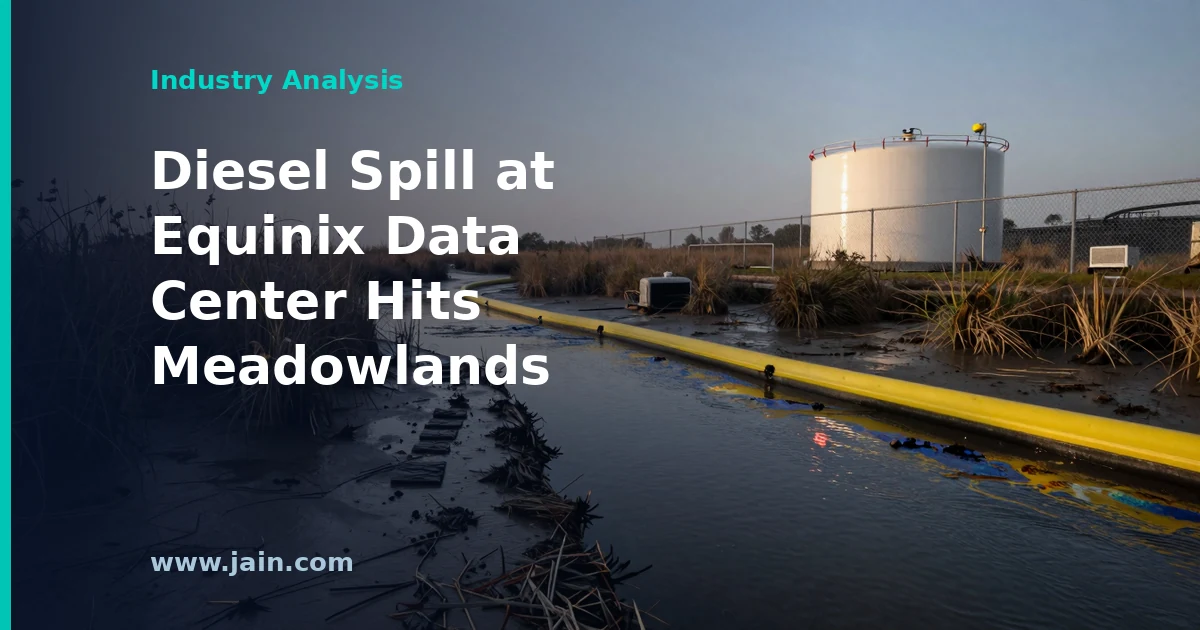
About 5,000 gallons of diesel fuel leaked from a storage tank at a large computer facility in Secaucus, New Jersey. That is roughly half of what a fuel tanker truck carries. It ran into a small creek that feeds the Hackensack River.
The facility belongs to Equinix, which rents space to companies that run websites and online services. Cleanup crews are vacuuming fuel out of the water. State officials say the fuel did not reach the river.
It matters because buildings like this often store large amounts of fuel for emergency generators, and nearly 100 New Jersey towns have already banned new ones.
About 5,000 gallons of diesel fuel spilled from a storage tank at the Equinix data center in Secaucus, New Jersey, and flowed into Anderson Creek, a tributary of the Hackensack River, Gothamist reported on September 14, 2026. That figure comes from the New Jersey Department of Environmental Protection (DEP). Equinix said the leak was detected on Friday evening, September 11. It has hired the environmental services contractor Clean Harbors to handle remediation.
DEP spokesperson Larry Hajna said the creek is small and narrow where the spill occurred and that the fuel was contained before it reached the river. Crews are expected to work at the site for several days. Hackensack Riverkeeper Bill Sheehan and Secaucus Mayor Michael Gonnelli have both called for the state to pursue a natural resource damages claim against the company.
Executive Summary
A fuel-tank leak at one of the New York metro area’s long-established data center sites has become an environmental cleanup and a political flashpoint. Contractors placed a boom (a floating barrier) across Anderson Creek to hold the diesel in place, and vacuum trucks have been pulling a fuel-and-water mixture out for treatment and disposal offsite. Equinix said it will conduct a full investigation and is committed to resolving the situation quickly.
The incident matters beyond Secaucus for two reasons. First, it shows a physical risk that rarely comes up in discussions of data center growth. Many facilities keep large volumes of diesel on site so that emergency generators can run during grid outages. As power availability tightens and operators lean harder on on-site backup, that fuel is a real environmental liability. Second, the spill lands in a state where close to 100 municipalities have enacted local bans on new data centers and activists are pressing the governor for a statewide moratorium.
Local officials were measured about the facility’s history. Gonnelli said the Secaucus site had operated for 25 years without issues, and Sheehan acknowledged that data centers have been in the Meadowlands for decades without causing problems. The open questions are what caused this failure, how much fuel is recovered, and whether the state seeks penalties or restoration funding.
The Diesel Behind the Cloud
Data centers are usually described in terms of servers, fiber and electricity. Their resilience also depends on something far older: fuel. To stay online through a utility outage, most large facilities keep diesel generators, along with on-site storage tanks sized to run them for hours or days. Equinix has not said what the leaking tank supplied, but backup generation is the most common reason a data center stores diesel in quantity.
That fuel is normally managed under spill-prevention rules. Typical safeguards include double-walled tanks, secondary containment berms, leak detection and regular inspections. Because roughly 5,000 gallons reached a creek, at least one of those layers did not hold. Whether the cause was a tank failure, a fueling or transfer error, damaged piping or a containment gap will determine whether this was an isolated equipment problem or a warning about practices across a fleet of aging sites.
Grid Stress Raises the Stakes on Backup Power
The industry’s appetite for power has grown quickly with AI workloads, and utilities in several regions have warned about constrained capacity. Generators exist to cover emergencies. But when grids run tight, operators may test them more often, keep larger fuel reserves, or run them during demand-response events, when utilities ask big users to cut grid consumption. Each of these puts more diesel on site and increases handling.
Nothing reported so far ties this spill to increased generator use or to AI demand, and it would be unfair to draw that link without evidence. The broader point still holds for buyers and investors. The environmental risk in data center portfolios is not just carbon emissions or water use. It also includes the ordinary, local hazard of storing and moving large volumes of fuel near waterways, and that exposure grows as backup power becomes more central to operations.
What a Damages Claim Could Mean
Sheehan wants New Jersey to pursue a natural resource damages claim. That is a legal mechanism under which a polluter pays to restore harmed ecosystems, separate from cleanup costs or fines. He pointed to a 1994 barge spill that put 310,000 gallons of caustic soda into the Hackensack River, which he said led to dedicated funding for the restoration of Lincoln Park in Jersey City. Mayor Gonnelli said he supports that push. The DEP said it did not yet have information on potential fines or enforcement.
Timing makes this more sensitive than a typical industrial spill. The Hackensack River was placed on the federal Superfund list, the program for the country’s most contaminated sites, in 2022, and a major cleanup is approaching. For Equinix, the direct financial exposure from remediating a contained spill is likely modest for a company of its size. The reputational and regulatory cost in a state actively debating limits on data centers could be harder to quantify.
A Flashpoint in New Jersey’s Data Center Debate
Opponents of data center expansion quickly cited the spill. Ben Dziobek of Climate Revolution Action Network argued that data center problems, including pollution, grid strain and higher electric bills, do not stop at municipal borders and warrant state action. Governor Mikie Sherrill’s office declined to comment and referred questions to the DEP.
Every side’s claims deserve a fair test. This single incident, at a site local officials say ran cleanly for a quarter century, does not by itself show that data centers are environmentally unsafe. Nor does it settle the argument over electricity prices, which the spill does not bear on. At the same time, the industry’s assurances that its facilities are low-impact neighbors depend on safeguards like fuel containment actually working. Equinix’s investigation findings, and whether it shares them, will matter for more than one creek.
Background
Equinix is one of the world’s largest colocation data center operators. It rents secure space, power, cooling and network interconnection to enterprises, cloud providers and network carriers, and it trades on Nasdaq under the ticker EQIX. Its Secaucus facility sits in the New Jersey Meadowlands, a longtime hub for data centers serving the New York financial and media markets. Local officials say the site has operated there for about 25 years.
The Meadowlands are a network of wetlands, creeks and tidal waterways feeding the Hackensack River, which was designated a federal Superfund site in 2022 after decades of industrial pollution. New Jersey has become a battleground over data center growth. Close to 100 municipalities have enacted local bans on new facilities, and advocacy groups are pressing for a statewide moratorium, citing pollution, grid strain and electricity costs.
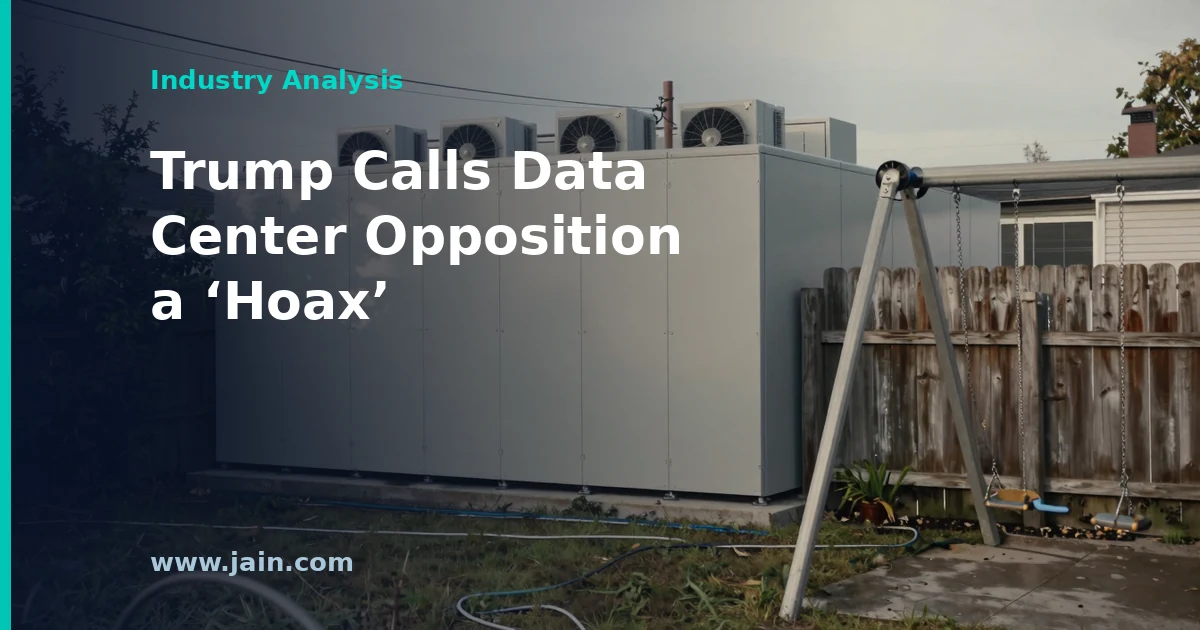
President Trump says resistance to the giant computer warehouses that power artificial intelligence is a ‘hoax’ and part of a ‘sick conspiracy.’ He made the remarks during a phone call with the head of Nvidia, the company whose chips run most of these facilities.
Why it matters to you: these buildings use as much electricity as a small city, and many neighbors worry about higher power bills, water use and noise. Those local fights are usually decided by town and state officials, not the president, so the remarks raise the temperature without settling the argument.
President Donald Trump called opposition to data centers a ‘hoax’ and said there is a ‘SICK conspiracy’ against artificial intelligence and data centers, according to reports from the Associated Press and CNBC. CNBC reported that the remarks came during a phone call with Nvidia CEO Jensen Huang at the All-In Summit, a technology and investing conference. The AP reported that the president also described AI risks as a ‘hoax.’
Executive Summary
The president has publicly placed the White House on the side of the AI build-out in one of the most active local policy fights in the United States: whether communities should accept very large data centers, the warehouse-scale buildings full of servers that train and run AI models. Opponents in many areas have raised concerns about strain on the electricity grid, water consumption, noise, land use and whether ordinary households end up paying for grid upgrades through their utility bills.
The remarks matter less for what they change legally than for what they signal. Most data center approvals run through county zoning boards, state utility regulators and local water authorities, and a presidential statement does not alter those processes. But framing the opposition as a conspiracy, delivered alongside the CEO of the world’s most important AI chip supplier, raises the political stakes for developers, utilities and local officials at a moment when several states are writing tougher rules for large power users.
A National Voice in a Local Fight
Data center siting is decided close to the ground. A developer typically needs a zoning approval from a county or municipality, an agreement with the local utility to connect to the grid, and in many cases water permits and tax-incentive deals negotiated with state or local economic development agencies. None of those decisions sits with the White House, which means the president’s remarks function primarily as political signaling rather than policy.
That signaling still has consequences. It tells developers the administration views the build-out as a national priority, and it may encourage federal agencies to favor faster permitting where they do have authority, such as on federal land or for projects requiring federal environmental review. It also risks nationalizing what have often been nonpartisan local debates, where opponents and supporters alike include residents across the political spectrum.
Testing the Claims on Both Sides
The concerns raised by local opponents are, for the most part, measurable. How much power a facility will draw, what share of grid upgrade costs it will pay, how much water its cooling system consumes, and how much tax revenue it generates after incentives can all be documented and checked. Describing those concerns collectively as a ‘hoax’ does not engage with the specifics, and a community weighing a project that would add a large new electricity load has legitimate reasons to ask those questions.
The same scrutiny applies to opposition claims. Water use, for example, varies widely depending on cooling design; some facilities use closed-loop or air-based systems that consume far less than evaporative cooling, and blanket claims about data centers draining aquifers do not hold for every project. Likewise, whether opposition in a given place is grassroots or organized is an empirical question. It can be answered with evidence such as funding disclosures, shared messaging or coordinated filings, and neither the ‘conspiracy’ label nor the ‘concerned residents’ label settles it on its own.
What It Means for Nvidia and the Builders
Nvidia’s growth depends on customers being able to build and power the facilities that house its chips. Local permitting delays and grid connection backlogs, the long waitlists utilities keep for large new power users, are among the practical limits on how fast AI capacity can come online. Public support from the White House is a tailwind for the sector’s political standing, but it does not add transmission lines, generating capacity or zoning approvals.
For developers, the risk is that polarization makes local approvals harder rather than easier. Officials who might have negotiated conditions such as community benefit agreements, dedicated power supply or water limits may face more pressure to take a side. The companies most likely to fare well are those that can show, project by project, that they are paying for their own grid impact and meeting local environmental conditions.
The Electricity Bill Question
The most politically durable concern is cost to ordinary ratepayers. When a utility builds new substations, transmission or generation to serve a large facility, regulators must decide how those costs are divided between the new customer and existing households and businesses. Several states have moved toward requiring very large power users to commit to long-term contracts or cover more of the upfront grid investment.
That is where the debate is likely to be decided, in utility commission proceedings rather than in speeches. The industry’s strongest argument is not that opposition is illegitimate but that well-structured tariffs can make data centers pay their own way. Whether that holds up will depend on the details states adopt.
Background
The rapid growth of artificial intelligence has triggered a construction boom in large data centers across the United States, driven by technology companies racing to secure computing capacity. These facilities require substantial and continuous electricity, and in many regions their projected demand has pushed utilities to plan new generation and transmission for the first time in years.
That boom has produced local resistance in a growing number of communities, where residents and officials have questioned grid impacts, water use, noise and tax incentives. State legislatures and utility regulators have responded with new rules on how large power users connect to the grid and share costs. Nvidia, as the leading supplier of AI chips, sits at the center of the build-out, and the administration has repeatedly framed AI infrastructure as a national economic and strategic priority.
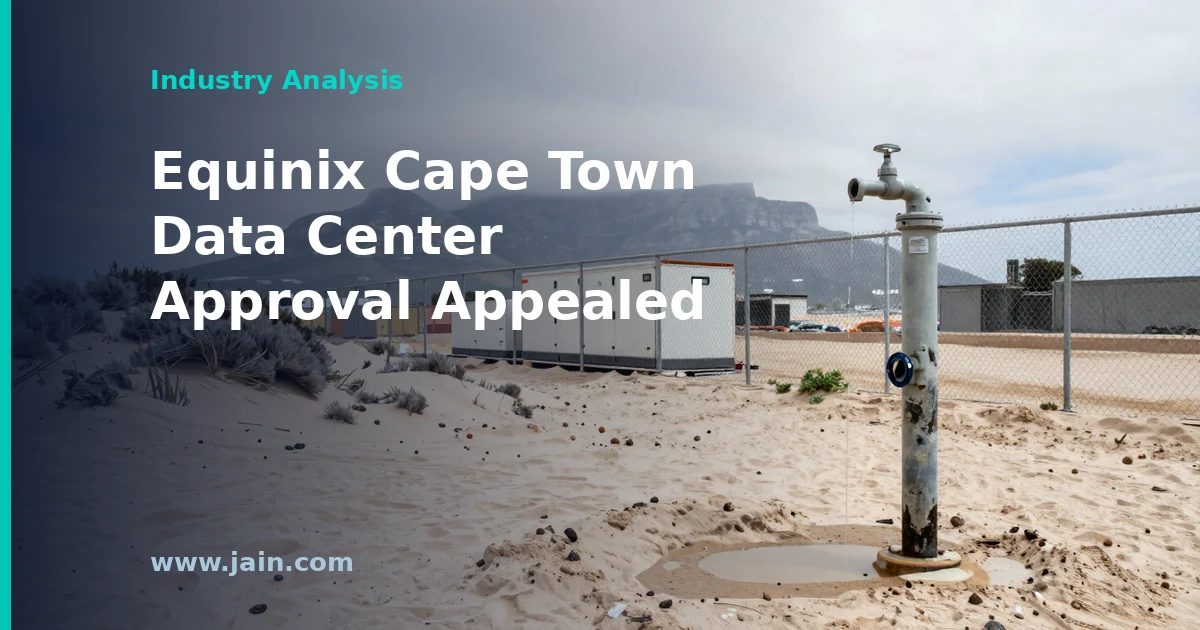
Two campaign groups are trying to overturn Cape Town’s approval of two very large Equinix data centers near the city’s airport. Data centers are warehouse-sized buildings full of computers that run cloud storage, websites and artificial intelligence.
The site could draw about 170 megawatts of electricity, comparable to the round-the-clock demand of a sizeable town. Critics say the approval came without clear figures on water and power use, in a city that nearly ran out of water in 2018.
Equinix says it owns the land but has not yet filed detailed building plans.
Housing Assembly and the UK-based organization Foxglove have appealed a municipal approval for two large Equinix data centers planned for the King Air Industria industrial area near Cape Town International Airport, Benin Web TV reported, citing the Financial Times. The project is estimated at roughly 170 megawatts (MW) of capacity on a site of about 122,500 square meters. Cape Town’s municipal planning tribunal approved it in July despite objections.
The appellants say the approval rested on insufficient detail about water consumption, electricity demand, backup diesel generators, emissions and noise, and they want a new assessment before the project proceeds. Equinix confirmed it has acquired the land. It said no detailed development plan has been submitted yet and that it will continue talking with stakeholders if the project moves forward.
Executive Summary
The appeal puts one of the largest publicly discussed data center proposals in Africa’s most developed data center market under formal review. The objection does not claim the campus is inherently unacceptable. It argues that the city approved the project before anyone had quantified the resources it would consume. If the appeal succeeds, developers may have to submit a new application or provide more information before development continues.
The case matters beyond one site. South Africa holds about 70% of Africa’s data center capacity, according to Financial Times estimates, and that growth is driven by cloud services and artificial intelligence workloads. The South African Human Rights Commission told the Associated Press it has received more than 250 submissions in a consultation on how data centers affect water, electricity, land and communities. For operators, the Cape Town appeal is an early test of how much resource disclosure regulators and communities will expect, and at what stage of a project they will expect it.
An Approval Granted Before the Blueprint
The dispute contains a timing tension. The planning tribunal approved two data centers in July, but Equinix says no detailed development plan has been submitted. Large developments often move through stages: land-use or zoning consent first, then detailed site and building plans. At those later stages, designs for cooling, power connections and backup generation become concrete. An early-stage approval can be legitimate while still leaving the resource questions unanswered.
That is the gap the appellants are targeting. Their argument is essentially about sequencing: the water, electricity, diesel and noise numbers should be on the table before the city commits, not after. Equinix’s position points the other way. It says it is not yet at the detailed-plan stage and would continue engaging stakeholders if the project advances. The appeal will likely turn on which standard the municipal process requires at the approval stage.
Water, Power and Diesel in a City That Remembers Day Zero
Each resource concern maps to a real engineering choice. Data centers shed heat. Evaporative cooling uses less electricity but consumes water, while closed-loop and air-based systems use little water but more power. In Cape Town, where the 2018 “Day Zero” scare brought the city close to turning off municipal taps, the water side of that trade-off is politically sensitive. The electricity side is sensitive too, in a country whose national grid has long struggled with supply.
Backup diesel generators are the less-discussed issue. Operators install them so servers keep running during grid outages. Where the grid is unreliable, generators may run more often than in markets where they are rarely used, which raises the emissions and noise questions the appellants cite. The site sits in an industrial area near an airport, which may shape how noise is assessed. Emissions and fuel storage still need their own analysis.
Scrutiny Is Becoming a Market-Wide Cost
The Human Rights Commission’s consultation shows that the debate in South Africa is broadening from individual permits to how the whole sector is regulated. For developers, that raises the likely cost of permitting: more studies, more disclosure, longer timelines and more exposure to appeal. Operators that can document low-water cooling, credible power sourcing and limited generator use may find approvals easier to defend. Those that cannot may face delays.
Customers have a stake too. Cloud providers, enterprises and network operators that rely on South Africa as the continent’s main data center hub need capacity to arrive on schedule. A longer, more contested approval path in Cape Town could shift demand toward sites with clearer permits or delay the capacity growth the market expects.
Fair Questions for Both Sides
The appellants’ core request, quantified resource data before final commitment, is a reasonable planning principle. Their case would be stronger with specifics: which thresholds or disclosures would satisfy them, and whether full data can realistically exist before detailed designs do. Calling for a new assessment is different from showing that the project’s impacts would be unacceptable, and the reported objections so far focus on missing information rather than demonstrated harm.
Equinix’s statement is also limited. Saying no detailed plan has been filed explains the absence of numbers but does not provide any. The 170 MW estimate has not been confirmed as the company’s own figure, and it has not described cooling technology, power sourcing or backup arrangements for the site. Early voluntary disclosure of design intentions would give the tribunal, the appellants and the public a factual basis for the debate.
Background
Equinix is a US-based, publicly traded digital infrastructure company that operates data centers and interconnection hubs worldwide, where networks, cloud providers and enterprises connect directly to each other. It entered African markets through its 2022 acquisition of West African operator MainOne and has since expanded its presence on the continent, including in South Africa.
South Africa is Africa’s largest data center market. Cape Town and Johannesburg host most of the continent’s capacity, alongside major cloud regions. The country’s growth has come with resource concerns: Cape Town’s near-miss with running out of municipal water in 2018 and the national grid’s long-running supply problems have made water and electricity central to public debate over large new energy users.
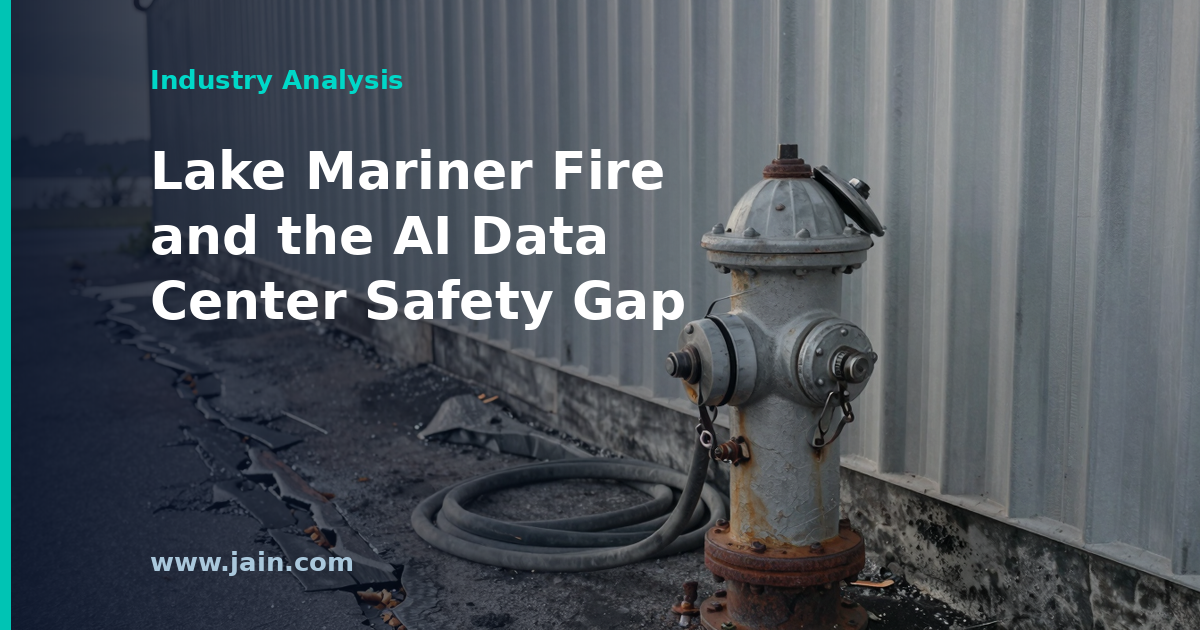
In early June, a building caught fire at a large computer facility in upstate New York, built on the site of a retired coal plant. Firefighters arrived to find no working fire alarm, no built-in system to put out flames, and three fire hydrants that did not work.
The paperwork listing which chemicals were burning had, the owner said, burned in the fire itself. The fire chief said his crew went in blind.
The site is being converted from mining digital currency to running artificial intelligence — the same conversion happening at dozens of sites nationwide.
Crypto Briefing reported that firefighters from the Barker Fire Department responded in early June to a fire in an unfinished building at TeraWulf’s Lake Mariner campus in Somerset, New York, and found no functioning fire alarm, no suppression system and three hydrants that did not work. According to TeraWulf, the safety data sheets that would have identified the chemicals producing the heavy black smoke had burned up in the fire. Fire Chief Steve Matisz said his crew went into the building “kind of blind,” and that he was unsure what to make of the claim that the safety sheets had been destroyed. “It’s been a difficult situation,” Matisz said.
Lake Mariner sits on the site of a retired coal plant that TeraWulf (Nasdaq: WULF) began operating in 2022 for Bitcoin mining and is now converting to artificial intelligence and high-performance computing workloads, targeting a combined 500 to 750 megawatts across several buildings by the end of 2026. Tenants include Core42 and Fluidstack. Post-incident discussions reportedly included plans for additional hydrants and improved storage of safety data sheets. No regulatory follow-up or investigative action has been publicly reported.
Executive Summary
The facts as reported are narrow — one fire, one building still under construction, one rural fire department — but they touch three things that matter across the AI build-out: whether life-safety systems are in service before a building is finished, whether a site’s water supply can actually deliver, and whether anyone outside the company checks. A megawatt is a unit of electrical demand; a campus rated at several hundred megawatts draws power on the scale of a small city, and it concentrates that energy inside a handful of buildings packed with electrical gear, batteries and, increasingly, liquid cooling.
What makes Lake Mariner a useful case is not that TeraWulf is unusual. It is that TeraWulf is typical. A retired coal plant with an existing grid connection is among the most sought-after assets in the industry right now, because the interconnection queue — the waiting line to attach new load to the electrical grid — runs years long almost everywhere else. Buying speed by inheriting a brownfield site also means inheriting its fire mains, its hydrants and its water pressure.
For tenants such as Core42 and Fluidstack, and for the customers behind them, the operational question raised here is not about one fire. It is about what construction-phase safety looks like at a campus racing toward 500 to 750 megawatts by the end of next year, and what an insurer, a lender or a lease counterparty is told when something goes wrong.
Construction Is the Most Dangerous Phase of a Data Center’s Life
A finished data center is one of the better-protected buildings in commercial real estate: detection on every ceiling, suppression plumbed and pressurised, and a fire alarm panel that is tested, certified and monitored before the first server is energised. A data center under construction is a different building entirely. Suppression piping is often installed but not charged. Detection is often wired but not commissioned. Combustible packaging, temporary power, insulation and hot work — welding, cutting, grinding — all sit in the same shell at once. That is why the industry treats the construction window as a distinct risk class with its own controls, rather than assuming a partly built facility is a slightly less protected finished one.
The reported conditions at Lake Mariner map onto exactly that window: an unfinished building, no functioning alarm, no suppression. None of that is inherently a code violation — requirements phase in as construction progresses, and there is a legitimate period in any project when systems exist but are not yet live. What the account does not establish, and what would determine whether this was routine or a lapse, is which protections were required at that stage and which were merely absent. That is a question about the project’s fire-protection plan, and it is answerable only by the company and the authority having jurisdiction.
Brownfield Speed Comes With Borrowed Plumbing
The three dead hydrants are the detail with the longest reach. Converted industrial sites — retired coal, steel, paper, aluminium — are attractive because the heavy electrical infrastructure is already there and the grid connection already exists. But the fire-water infrastructure is inherited too, and it was engineered for the plant that used to be there, under a maintenance regime that ended when that plant did. Private hydrants on a large campus are the owner’s responsibility to flow-test and maintain, not the municipality’s. When three of them do not work, the failure is usually not the fire itself but everything that did not happen in the years before it.
The response profile compounds this. Repurposed heavy-industrial land tends to be rural, which means the responding department may be small, volunteer or both, with tanker shuttles rather than an urban grid of reliable pressurised mains. The specific failure the chief described — going in without knowing what was burning, because the safety data sheets were reportedly inside the building that was on fire — is the one that pre-incident planning exists to prevent. Chemical inventories are meant to be duplicated off-site and shared with the responding department in advance, precisely so that a fire cannot destroy the document that explains itself. That the post-incident discussion reportedly turned to additional hydrants and better storage of those sheets suggests the gap was recognised.
The Risk Is Priced Somewhere, Even If It Is Not Disclosed
Fires during construction are covered by builder’s risk policies, and completed data centers are among the most heavily underwritten assets in the market — insurers inspect them, set conditions and price on the strength of protection systems. A loss during construction is not merely an expense; it becomes part of the underwriting file for the campus, and it can shape terms on renewal and on the buildings not yet built. Where a company is financing a rapid build-out, insurance terms and lender conditions are a real cost line, not a footnote.
There is also a schedule dimension. TeraWulf is targeting 500 to 750 megawatts across several buildings at Lake Mariner by the end of 2026, with tenants already signed. Lease agreements in this market typically carry delivery dates, and a delivery date missed by construction damage is a commercial event as well as a safety one. Nothing in the reported account establishes that this fire affected the schedule, the tenants or the target — but those are the specific channels through which a construction-phase fire reaches investors, and they are the ones worth watching.
Who Checks, and When
The reported absence of publicly known regulatory follow-up is the part that generalises furthest beyond this one campus. Data center fire safety is enforced locally — by building departments, fire marshals and code officials — and the enforcement capacity of a small jurisdiction is not always matched to a multi-hundred-megawatt industrial conversion arriving inside a few years. That is a structural feature of how the AI build-out has distributed itself: toward places with cheap land, existing grid capacity and, often, modest municipal staffing.
It is worth being precise about what can and cannot be concluded. That no follow-up has been publicly reported is not evidence that none occurred; investigations are frequently non-public until they conclude, and some are never announced at all. The fair reading is narrower and still useful: three months after an incident at a campus of this scale, the public record contains a fire chief’s account and little else. For a sector asking communities to host enormous new industrial loads, that asymmetry between the size of the facility and the visibility of its oversight is itself a thing to watch.
Background
TeraWulf (Nasdaq: WULF) started as a Bitcoin miner, a business whose economics turn almost entirely on the price of electricity. That pushed the industry toward the same places utilities and heavy industry once favoured: sites with large, already-permitted grid connections. Lake Mariner, on the grounds of a retired coal plant in Somerset, New York, is a textbook example, and TeraWulf has operated it since 2022.
The rise of artificial intelligence turned those assets into something more valuable. Training and running large models requires dense clusters of specialised chips, and the binding constraint on building them is power — specifically, how quickly a site can attach hundreds of megawatts to the grid. Former mining campuses already have that, which is why so many miners are converting into landlords, leasing capacity to compute providers rather than mining coins themselves. TeraWulf’s Core42 and Fluidstack tenancies at Lake Mariner, alongside a target of 500 to 750 megawatts by the end of 2026, place it squarely in that transition. The conversion also changes the building: denser electrical gear, more batteries and increasingly liquid cooling, all of which raise the stakes on fire protection.
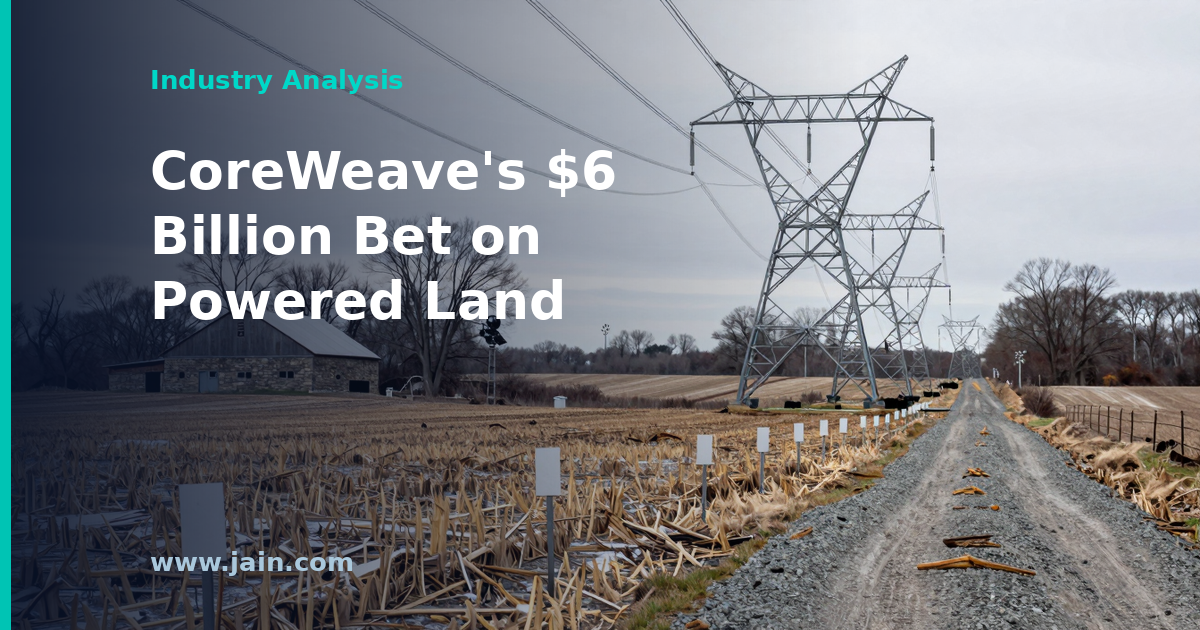
The artificial intelligence company CoreWeave is building a $6 billion computing campus in Lancaster County, Pennsylvania — farm country about halfway between Philadelphia and Harrisburg.
What buyers are really chasing is not the dirt but the electricity. Land that already has a big power hookup has sold for more than $8 million an acre in some markets.
Farmland nearby drew more than 50 purchase offers in a single year. Some owners are selling; others have legally locked their land to farming only.
Why care? These campuses use enough electricity to run a small city, and states are now arguing over who pays for the wires.
StartupHub.ai reported, drawing on CNBC’s segment Inside The Real Estate Rush Behind AI, that CoreWeave is building a $6 billion data center campus in Lancaster County, Pennsylvania, less than 20 miles from Mount Joy farmland that attracted more than 50 purchase offers in a single year. Lancaster’s draw, according to that account, is a reliable electrical grid, state incentives and a Mid-Atlantic position within reach of several major metropolitan areas.
The project lands in the middle of a national scramble for what the industry calls powered land — sites that already have, or can plausibly obtain, large-scale grid connections. Investors spent nearly $6 billion on U.S. land earmarked for future data centers in the first half of 2026, up 79% year over year and roughly 27% of all spending on development sites. The United States already hosts more than 4,700 data centers.
Executive Summary
For CoreWeave, the significance of Lancaster is not the headline number but the change in posture it implies. The company grew by renting: it filled other operators’ buildings with graphics processing units — the specialized chips that train and run artificial intelligence models — and sold that capacity by the hour. A campus of its own, at $6 billion of committed capital, moves it a long way toward being the landlord rather than the tenant.
That shift concentrates a set of risks the company previously paid someone else to carry. Whoever owns the site owns the interconnection queue — the waiting list utilities maintain for connecting large new loads to the grid — along with the substation costs, the zoning fight, the water permit and the timing risk if energization slips. It also captures the margin that a third-party operator would otherwise take, and gains control over how quickly the next building goes up.
The wider market context is unforgiving on both counts. Amazon, Alphabet, Microsoft and Meta spent over $167 billion combined in the second quarter of 2026, up 79% year over year, which sets the pace CoreWeave has to match to stay relevant. At the same time, Pennsylvania Governor Josh Shapiro has said that of more than 100 data center proposals in the state, only five hold permits to operate — a reminder that announced capital and delivered capacity are separated by a queue that is currently very long.
From Renting Racks to Owning the Substation
The economics of a specialist artificial intelligence cloud have always been awkward. Chips depreciate on a schedule measured in a handful of years; buildings and electrical infrastructure amortize over decades. A company that leases space pays a spread to the landlord and inherits the landlord’s delivery schedule, which in a market this tight is the binding constraint on growth. Owning the campus removes the spread and, more importantly, removes the queue-jumping problem: you are no longer waiting for someone else to decide which tenant gets the next 50 megawatts.
The trade is that development risk stops being a line item in someone else’s business. Site work, transformer procurement, interconnection studies and permitting all move onto the builder’s balance sheet, and none of them are hourly-billable until the first customer racks go live. The release notes that near-term power shortages already add a year simply to assess distribution to a site — a delay that costs nothing to a tenant and a great deal to an owner carrying $6 billion of committed spend.
Scale gives some perspective on the commitment. The campus’s stated cost is roughly equal to what every investor in the United States combined spent buying data center land in the first half of 2026 — different categories of spending, since one figure is construction and the other is raw acreage, but a useful marker of how much a single project now weighs against an entire national land market.
Powered Land Is the Asset; Dirt Is the Wrapper
The premium in this market attaches to electricity, not acreage. Sites with large power access have exceeded $8 million per acre in Northern Virginia and the Northeast, and the industry needs an estimated 40,000 acres of such land to meet growth through 2030. That is the whole thesis in one sentence: land is abundant, grid capacity is not, and the price gap between the two is where developers are making their money.
It is also where the risk sits. Speculators frequently buy before they know whether permits or power will arrive, and the release is blunt about the consequence — if power does not materialize, the land stays illiquid. Boise Valley values have reached 15 times pre-pandemic levels on the strength of Micron’s two fabrication plants and a large Meta campus 10 to 15 miles away, and brokers there expect much of the remaining farmland to convert to industrial use within five to seven years. Those expectations are underwritten by an assumption about utility delivery, not by signed interconnection agreements.
The speculative posture is visible in how developers are building. Idaho developer Mike Adler, who controls 1,000 acres and $1 billion of real estate and is expanding from 1.9 million to 4.6 million square feet, says 62% of his current Boise Valley projects are spec builds — constructed before any tenant signs a lease. That is a rational bet when demand outruns supply. It is also the classic structure through which a slowdown in one sector transmits into a regional property market.
The Rules Are Being Written While the Concrete Cures
Two governors have moved in the same direction from different angles. Shapiro signed an August executive order intended to block cost pass-throughs to residents and limit water use, alongside his observation that only five of more than 100 Pennsylvania proposals hold operating permits. In Texas, Governor Greg Abbott has directed regulators to require data centers to fully fund their own electric infrastructure. Both are answers to the same political question: when a single campus draws load comparable to a city, who pays for the wires?
The direction of travel matters for anyone underwriting these projects. U.S. electricity consumption is projected to rise nearly 2% annually through 2030 — more than twice the rate of the prior decade — and the incremental demand is concentrated in exactly the large-load interconnections regulators are now scrutinizing. A rule that shifts substation and transmission costs onto the developer does not stop projects; it raises the effective cost per megawatt and rewards operators with the balance sheet to absorb it. That favors the largest builders and squeezes thinly capitalized speculators holding options on unpowered ground.
What the Boom Looks Like at Ground Level
Around Mount Joy, the conflict is a zoning question with a long horizon. Bobby Thompson and Michelle Kennedy, who have farmed there for decades, placed an easement on their land — a permanent legal restriction limiting it to farming — while neighbors have applied to rezone for an industrial park. Both are legitimate uses of private property rights, and the outcome will be settled parcel by parcel rather than by any single decision.
The downstream economics are real and already measurable. Air Filter Superstore, which supplies the kind of filtration these facilities consume in volume, grew from under $10 million in annual revenue before 2020 to more than triple that, expanding from 7,000 square feet to over 30,000 after investing about $1 million. Multiply that across electrical contractors, mechanical suppliers and site trades and you have the local case for approval. Micron’s plan to invest $250 billion in the United States through 2035 suggests the industrial demand behind those suppliers is not a one-year phenomenon.
The caution is that supplier expansion, spec construction and land repricing are all leveraged to the same assumption — that hyperscaler capital expenditure keeps compounding. A 79% year-over-year increase from the four largest spenders is a powerful signal, but it is a growth rate, not a floor. Communities weighing tax base against farmland, and vendors sizing warehouses against forecast orders, are implicitly taking a view on how long that rate holds.
Background
CoreWeave began as a cryptocurrency mining operation before repurposing its expertise in dense, power-hungry computing into a cloud business built on graphics processing units. It listed publicly in 2025 and scaled principally as a tenant, installing its hardware in facilities owned by third-party data center operators — an asset-light approach that let it grow quickly without carrying construction risk.
The market it operates in has been reshaped by the electricity constraint. As artificial intelligence workloads pushed rack power densities far beyond traditional cloud computing, the scarce input stopped being land or even chips and became grid interconnection. U.S. electricity consumption is projected to rise nearly 2% annually through 2030, more than twice the previous decade’s rate, and that demand is concentrating in a handful of regions with available capacity — pulling multibillion-dollar industrial projects into farm counties in Pennsylvania, Idaho and elsewhere, and prompting state governments to rewrite the rules on who pays for the grid upgrades they require.
Sources
Source: CoreWeave $6 billion Lancaster data center — StartupHub.ai’s account of the Lancaster campus and the national competition for powered land, drawing on CNBC’s segment Inside The Real Estate Rush Behind AI.