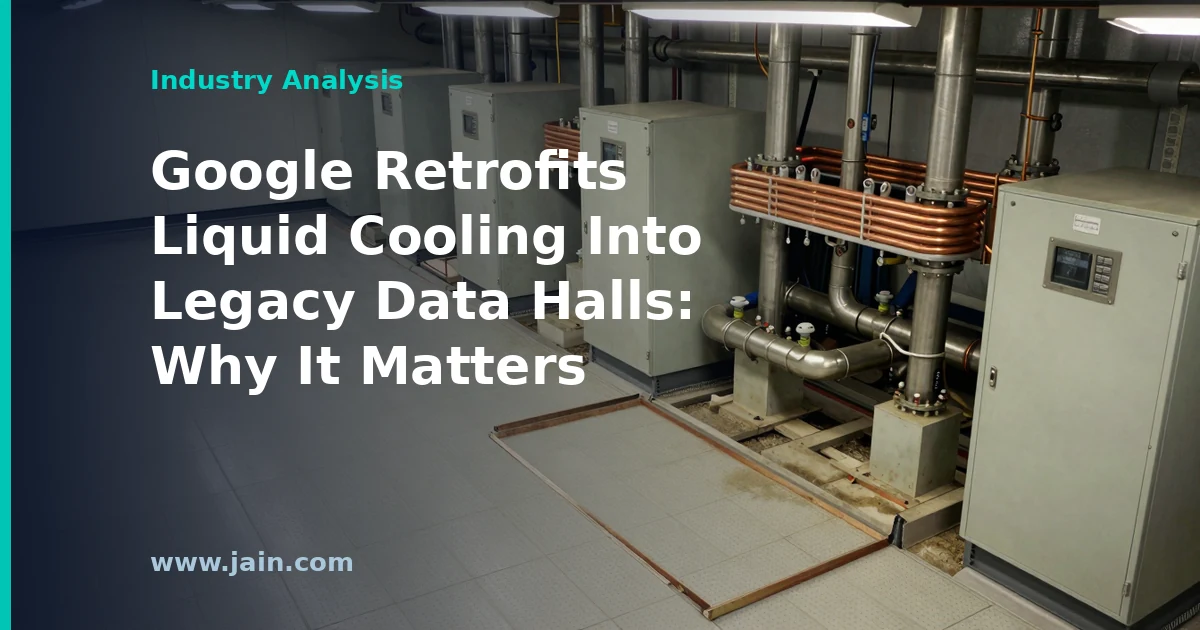
A June 16, 2026 report from the Data Center Richness newsletter on Substack says Google is bringing liquid cooling into its legacy data halls — retrofitting existing, originally air-cooled facilities rather than confining liquid cooling to newly built AI campuses. The report positions the move as a marker that liquid cooling is graduating from a specialty technology for new AI construction into something operators must engineer into buildings that already exist.
Executive Summary
According to the report, Google — one of the world’s largest data center operators — is extending liquid cooling beyond greenfield construction and into older data halls in its existing fleet. Liquid cooling circulates fluid close to (or directly across) hot silicon instead of relying on chilled air, and it has become the default answer for the extreme heat produced by modern AI accelerators.
The significance is less about any single facility and more about direction of travel. Until recently, the industry’s working assumption was that liquid cooling arrives with new buildings designed around it, while legacy halls carry on with air. If a hyperscaler of Google’s scale is instead threading liquid into buildings that were never designed for it, that suggests demand for accelerator capacity is outrunning the pace of new construction — and that existing real estate, with its already-secured power and grid connections, is too valuable to leave running at air-cooled densities.
One caveat up front: this is a single analyst-newsletter report, not a detailed Google engineering disclosure. The headline claim is clear; the scope, sites, methods, and timeline behind it are not spelled out in the source material available.
From Greenfield Exception to Fleet-Wide Expectation
For most of the past two decades, data center cooling meant moving air: chilled air pushed through raised floors or hot-aisle containment, absorbing heat from servers and carrying it away. Liquid cooling — whether direct-to-chip cold plates that sit on processors or full immersion of hardware in dielectric fluid — was a niche reserved for supercomputers. AI changed the math. Modern accelerator racks concentrate far more heat in far less space than air can economically remove, so new AI facilities are now routinely designed liquid-first.
The retrofit story flips the remaining assumption. If liquid cooling only lived in new builds, older halls would gradually become second-class assets, suitable only for lighter workloads. Retrofitting says the opposite: the industry’s installed base is being upgraded in place. For an operator with Google’s fleet size, even partial retrofits could unlock meaningful accelerator capacity without waiting years for new construction.
Why Retrofit When You Can Build New? Power and Time
The economics here are straightforward even without disclosed figures. The scarcest resources in data center development today are grid power and time — utility interconnections and permits for new campuses can take years in major markets. A legacy data hall already has land, a building, a grid connection, and delivered megawatts. Converting some of that hall to liquid cooling lets an operator redeploy existing power toward denser, higher-value AI capacity on a much shorter clock than greenfield construction allows.
Retrofits are not free or trivial, though. Liquid cooling in an air-designed building typically means adding coolant distribution units (the pumping and heat-exchange gear that moves fluid between facility water systems and server cold plates), new piping runs, leak detection, and floor-loading and maintenance procedures the original design never contemplated — often while neighboring racks keep serving live traffic. The engineering challenge of doing this in production facilities is precisely why a credible report of Google doing it at fleet scale is notable.
What It Signals for the Rest of the Market
Hyperscaler practice tends to become industry expectation. If Google normalizes liquid retrofits, colocation providers and enterprise operators will face the same question from their customers: can your existing halls take liquid-cooled racks, or only your new ones? Operators who can answer yes gain a way to monetize older buildings at AI-era densities; those who cannot may see legacy space reprice downward relative to liquid-ready capacity.
The supplier picture shifts too. A retrofit wave would expand the addressable market for cooling-distribution hardware, piping, quick-disconnect fittings, and specialized integration services well beyond the new-construction pipeline — because the installed base of air-cooled data halls worldwide is vastly larger than any single year’s new builds. At the same time, air cooling is not disappearing: the bulk of general-purpose computing still runs comfortably on air, and most retrofits produce hybrid halls where liquid and air coexist. The realistic near-term future is mixed-mode facilities, not a wholesale replacement.
Background
Google operates one of the world’s largest data center fleets and has long treated infrastructure engineering as a competitive advantage, publishing influential work on efficiency and custom hardware. It was an early hyperscale adopter of liquid cooling, deploying it at scale with its TPU v3 AI chips in 2018 — years before the generative-AI boom made the technology an industry-wide priority.
Across the wider market, the surge in AI computing since 2023 has pushed rack power densities far beyond what conventional air cooling handles economically, making liquid cooling standard in new AI construction. The unresolved question has been what happens to the enormous installed base of air-cooled facilities — which is exactly the question a credible hyperscaler retrofit program begins to answer.
Elemental Impact, a nonprofit climate-technology investor, has launched a Data Center Innovation Initiative that will provide up to $5 million in funding for cooling technologies that reduce energy and water consumption in data centers. The announcement, reported June 15, 2026 by the trade publication Natural Refrigerants, positions the initiative squarely at the intersection of the AI-driven data center boom and growing scrutiny of the industry’s resource footprint.
Executive Summary
The headline commitment is modest by data center standards — up to $5 million — but the target is one of the industry’s most consequential engineering problems. Cooling is typically among the largest energy loads in a data center after the IT equipment itself, and many facilities also rely on evaporative systems that consume significant volumes of water. Technologies that cut both at once address the two resource concerns that most often put data center projects in conflict with host communities and utilities.
The initiative’s framing in a natural-refrigerants publication is itself a signal: it suggests interest in cooling approaches built on refrigerants such as CO2, ammonia, or hydrocarbons, which avoid the high-global-warming-potential fluorinated gases (HFCs) that regulators in the U.S. and elsewhere are phasing down. For a nonprofit investor like Elemental Impact, the play is catalytic — using relatively small, early money to help promising cooling technologies reach commercial deployment faster than conventional venture or infrastructure capital would carry them.
Cooling Is Where Efficiency Gains Are Still on the Table
A data center’s power draw splits between the computing hardware and the overhead needed to keep it running — chiefly cooling and power distribution. Operators measure this with power usage effectiveness (PUE), the ratio of total facility power to IT power, and the gap between an average facility and a best-in-class one is largely a cooling story. As AI accelerators push rack densities far beyond what traditional air cooling was designed for, the industry is being forced toward liquid cooling, advanced heat rejection, and smarter refrigeration cycles anyway. Funding aimed at this transition arrives with the market already moving in its direction.
Water is the quieter half of the problem. Evaporative cooling saves electricity precisely by consuming water, so operators often face a trade-off between energy efficiency and water efficiency. Technologies that genuinely reduce both — rather than shifting the burden from one resource to the other — are the harder engineering target, and the initiative’s dual framing suggests that is the bar Elemental Impact intends to set.
What $5 Million Can and Cannot Do
Five million dollars does not build data center infrastructure; a single large facility can represent hundreds of millions or billions in capital expenditure. But that comparison misses how catalytic capital works. Early-stage cooling hardware faces a well-known commercialization gap: pilots are expensive, data center operators are conservative buyers who rarely gamble uptime on unproven equipment, and the revenue that would fund a first deployment depends on having done a first deployment. Philanthropic and nonprofit capital is one of the few tools designed to absorb exactly that risk.
The realistic measure of success for an initiative this size is not megawatts cooled but proof points created — field data, reference customers, and validated performance claims that let follow-on investors and buyers commit with confidence. That leverage effect is the standard theory of change for organizations like Elemental Impact, which has spent years funding climate technologies through the awkward stage between lab and market.
The Regulatory Tailwind Behind Natural Refrigerants
The venue for the announcement matters. Conventional cooling systems have long depended on fluorinated refrigerants with high global warming potential, and those chemicals are now being phased down under the international Kigali Amendment and, in the United States, the AIM Act. Natural refrigerants — carbon dioxide, ammonia, propane, and similar substances — sidestep that regulatory curve entirely, but they bring their own engineering challenges around pressure, toxicity, or flammability that have slowed adoption in data centers.
If the initiative channels money toward natural-refrigerant cooling for data centers specifically, it is betting that regulatory pressure plus AI-era density demands will finally pull these systems into a market that has historically been cautious about them. That is a defensible bet, though the announcement as reported does not detail how prescriptive the initiative will be about refrigerant choice.
Winners, Losers, and Who Should Pay Attention
The most direct beneficiaries are early-stage cooling companies that need pilot funding and credibility. Data center operators benefit indirectly: a broader menu of proven, efficient cooling options lowers operating costs and eases the permitting and community-relations friction that increasingly delays projects over power and water concerns. Utilities and water authorities in data center markets gain, too, if efficiency gains materialize at scale.
The competitive question is whether small, mission-driven funding can move faster than the incumbents. Major cooling vendors and hyperscale operators are investing heavily in their own thermal management roadmaps. A $5 million initiative will not outspend them — but it can back approaches those incumbents consider too early or too unconventional, which is historically where nonprofit climate capital has earned its keep.
Background
Elemental Impact, previously known as Elemental Excelerator, is a nonprofit investing platform that has spent more than a decade funding climate technologies across energy, transportation, water, and industry, with an emphasis on getting first deployments into the ground alongside community partners. The data center initiative extends that model into digital infrastructure at a moment when the sector’s growth has made its energy and water footprint a mainstream policy issue.
Data center cooling itself is in the middle of a generational transition: AI accelerators are pushing power densities beyond what conventional air cooling handles economically, while refrigerant regulations and water scarcity are constraining the traditional fixes. That convergence has turned thermal management — long a back-of-house discipline — into one of the most actively funded corners of data center technology.
Vertiv, the NYSE-listed data center power and cooling vendor, announced a deal to acquire ThermoKey, an Italy-based heat-exchanger manufacturer, in a move the company frames as expanding its AI data center cooling capabilities. The announcement was reported on June 14, 2026; Vertiv’s shares slipped on the news. Financial terms were not detailed in the source report.
Executive Summary
The acquisition extends a clear pattern: as AI compute densities climb, the large data center infrastructure vendors are buying their way down the thermal supply chain rather than relying on third-party component makers. Heat exchangers — the coils and dry coolers that ultimately move server heat into outside air or water loops — are an unglamorous but capacity-constrained link in every cooling system, whether air-cooled or liquid-cooled.
For Vertiv, owning that link means more control over lead times, cost, and engineering integration at a moment when hyperscalers and colocation operators are ordering thermal equipment years ahead. The market’s muted reaction — shares slipped on the announcement — is a reminder that investors are weighing acquisition spending and integration risk against the strategic logic, particularly with no publicly detailed deal terms to anchor the math.
Why Heat Exchangers Matter in the AI Era
Every watt a GPU consumes becomes heat that must be rejected outdoors. Whatever technology sits at the rack — air handlers, rear-door heat exchangers, or direct-to-chip liquid cooling — the chain ends at heat-rejection hardware: coils, dry coolers, and condensers of the kind ThermoKey manufactures. As rack densities move from tens of kilowatts toward 100 kW and beyond, that heat-rejection stage scales in direct proportion, and it is built from metal, fabrication capacity, and factory floor space that cannot be conjured quickly.
By acquiring a heat-exchanger maker outright, Vertiv converts a supplier relationship into owned capacity. That matters less in a slack market and enormously in a tight one — and the AI buildout has made thermal equipment a long-lead-time item across the industry.
Vertical Integration Follows the GPU Buildout
This deal fits a broader consolidation wave. Vertiv itself has been assembling a fuller thermal stack for years, including its 2023 move on liquid-cooling specialist CoolTera, and competitors across the cooling landscape have pursued similar component-level acquisitions. The strategic logic is consistent: hyperscale customers increasingly want one accountable vendor for an integrated thermal chain, from the cold plate on the chip to the dry cooler on the roof, with matched controls and warranties.
For independent component makers, that creates a squeeze. Remaining suppliers may find their largest customers are now also their competitors’ owners — which historically pushes further consolidation, as remaining independents either scale up, specialize, or sell.
Reading the Share-Price Slip
The headline pairing — an expansion deal and a stock decline on the same day — deserves an even-handed reading. A slip on acquisition news is common and can reflect many things: general market movement, questions about price paid, or wariness about integration workload during a demand boom. Without disclosed terms, none of these can be confirmed from the source material, and a one-day move is a weak signal of a deal’s long-term merit.
What can be said is that investors are applying more scrutiny to AI-infrastructure spending across the board in 2026, and vendors announcing acquisitions now carry the burden of showing how each deal converts into margin or capacity rather than merely into breadth. Vertiv’s task is to demonstrate that owning heat-exchanger manufacturing shortens its lead times or improves its unit economics in ways customers and shareholders can measure.
Background
Vertiv became an independent company in 2016 when private equity firm Platinum Equity carved Emerson Network Power out of Emerson Electric, and it listed on the NYSE in 2020. It has since ridden the data center construction wave as one of the leading suppliers of the power distribution, thermal management, and enclosure systems that sit around the servers themselves, competing with firms such as Schneider Electric and a field of specialist cooling vendors.
The AI boom that accelerated in 2023 transformed cooling from a mature, slow-growth product line into a strategic battleground. Heat-exchanger manufacturing — historically a fragmented, regional business serving HVAC and industrial refrigeration as well as data centers — has become a supply chain chokepoint, setting the stage for component-level acquisitions like this one.
Amazon says the buildings that run its websites, apps and artificial intelligence services use about one-seventh the water of a typical facility of their kind.
The main trick is letting the computers run warmer. Outside air cools the buildings about 90% of the time. Water is used only when it is hotter than about 85 degrees Fahrenheit outside.
This matters because these buildings are multiplying, and their neighbors want to know how much local water they take. The open question is whether the newest artificial intelligence chips, which Amazon says needed a new kind of liquid cooling, will let that approach last.
Amazon said in a June 11, 2026 post on its About Amazon site that its global data center operations used 0.12 liters of water per kilowatt-hour (L/kWh) in 2025. The company puts that at more than seven times better than an industry average of 0.84 L/kWh and says it is a 52% improvement since 2021. It withdrew about 2.5 billion gallons of water across its global data center footprint in 2025.
Amazon credits two things for the result. The first is free-air cooling, which it uses about 90% of the time. The second is higher server temperature limits, so that evaporative cooling runs only when outside air is above roughly 85°F. The company also said it is 75% of the way to its 2030 water-positive goal and that it runs 26 facilities on 100% reclaimed water, with 130 more contracted.
Executive Summary
Amazon has published a headline water-efficiency figure for its data centers: 0.12 liters of water for every kilowatt-hour of energy in 2025. It set that against an industry average of 0.84. The company explains how it got there. It relies on outside air for most cooling, uses evaporative cooling only in the hottest hours, and has spent several years raising the temperatures its servers are allowed to run at. It says this cut water use without raising hardware failure rates.
The figure matters because water has become one of the main local questions asked of new data center campuses. Amazon’s explanation also shows that water efficiency is a set of engineering trade-offs, not a fixed property of a building. The company chose to use some water on hot days rather than run chillers, which it says need 25% to 35% more electricity at the moments the grid is most stressed.
Two things are harder to assess. One is the comparison itself: Amazon did not publish how the 0.84 average was built or on what basis each peer’s figure is measured. The other is the future. Amazon says denser AI chips already required a custom liquid cooling system, so the air-first approach behind the 7x figure now has to hold up as AI capacity grows.
The Water Number Is Really a Temperature Number
Amazon’s 0.12 liters per kilowatt-hour did not come from a new water technology. It came from deciding how rarely to use water at all. About 90% of the time, Amazon says, its data centers use free-air cooling. Outside air is drawn past the servers and pushed back out, with no water involved. Water comes into play only through evaporative cooling. In that process, hot air passes through a water-soaked medium and cools by five to 10 degrees as the water evaporates. Amazon now switches that on only when outside air exceeds roughly 85°F.
That threshold is the lever. Every degree of heat the servers can tolerate removes hours from the evaporative season, so raising operating temperatures cuts water use directly. Amazon’s own evidence is specific:
Two identical data centers on the same campus, one running hotter, differed by about 50% in water use.
Northern Virginia, its largest region by IT load (the power drawn by the computing equipment itself), cut water use 42% year over year while demand grew.
Thousands of hours of campus data showed no increase in failure rates at the higher temperatures.
Those results fit the 52% efficiency improvement Amazon reports since 2021.
The same logic is why this is a test for AI-era cooling. The approach depends on air being able to carry heat away from the servers. Amazon itself says denser, more powerful AI chips required a completely custom liquid cooling system. It has not said how much of its fleet now runs that way, whether those systems rely on evaporative water on hot days, or how a growing share of AI capacity will move the 0.12 figure. The air-first playbook behind the 7x gap was proven on the fleet Amazon has run since 2021. Whether it carries over to high-density AI halls is the next data point to watch.
Water or Watts: The Trade Behind the Ratio
Amazon is explicit that a low water number is partly a choice about electricity. The alternative it names is chillers, which work like giant air conditioners and, by Amazon’s figures, typically need 25% to 35% more electricity. The timing of that extra load is the problem. It arrives in the hottest hours, when household air conditioning is already straining the grid. Amazon concluded it is better to spend some water on those days than to add power demand at the peak.
That is a defensible engineering position, and it cuts against a simple reading of water metrics. An operator could report a lower water ratio by running chillers, which shifts the burden onto the grid and, depending on how that electricity is generated, onto water used off site. Conversely, a site that uses more water may be sparing a stressed grid. For utilities and local planners, the useful question is how much water and how much power a campus uses together at the peak hour, not either one in isolation.
Amazon did not quantify the grid side of its trade. It has not said how much peak demand evaporative cooling avoids across its fleet, or how many hours a year its sites in hot regions exceed 85°F. Without those figures, the argument rests on the chiller penalty range alone.
Why 0.12 and 0.84 Are Hard to Line Up
Liters per kilowatt-hour is the industry’s standard water-efficiency ratio, often called water usage effectiveness. It divides the water used for cooling by the energy consumed by the IT equipment. Amazon describes it as water per unit of compute, but the denominator is energy, not work done. A fleet running more efficient chips gets more computing out of each kilowatt-hour, and the metric does not capture that in either direction.
The 7x claim depends entirely on the 0.84 industry average. Amazon’s chart cites sustainability reports and blogs from Microsoft, Google and Meta alongside its own report. The company did not publish how 0.84 was derived: which operators it covers, how they were weighted, or whether each figure measures water withdrawn (taken from a source) or water consumed (evaporated and not returned). Large operators do not all report water the same way, so a like-for-like reading requires knowing which basis each number uses.
Scope matters too. Amazon’s absolute figure, about 2.5 billion gallons in 2025, is a withdrawal number for its global data center footprint. The 2% year-over-year decline it cites applies only to sites it owns and operates directly. The company did not say whether the 0.12 ratio is based on withdrawal or consumption, or whether leased facilities are included. None of that makes the claim wrong. It does mean the 7x multiple is Amazon’s own calculation rather than a figure a reader can reproduce from peers’ reports.
Replenishment and Reclaimed Water Carry the Local Story
Efficiency is only half of Amazon’s water case. The company has committed to being water positive by 2030, meaning it returns more water to communities than its data center operations use. It says it is 75% of the way there, returning 3 gallons for every 4 used in 2025. It has announced more than 50 projects that are expected to return over 5.8 billion gallons a year once fully implemented, which is more than twice its 2025 withdrawals. Examples include:
storing Columbia River winter flows in an aquifer in Hermiston, Oregon;
a runoff pipeline in Pina del Ebro, Spain;
watershed restoration near Guadalajara, Mexico.
Replenishment is an accounting balance. Its value to a given town depends on whether the returned water lands in the same basin the data center draws from. Reclaimed water addresses the local question more directly, because it replaces drinking water with treated wastewater at the site itself. Amazon says 26 facilities already run on 100% reclaimed water, more than any other cloud provider, and 130 more are contracted. It has also funded infrastructure and helped with permitting for programs in Mississippi, Hong Kong and Indonesia. If those 130 facilities come online, reclaimed supply may matter as much to neighbors as the headline efficiency ratio.
Background
Amazon operates one of the world’s largest data center fleets, mostly to run Amazon Web Services (AWS), its cloud computing business. Data centers convert nearly all the electricity they use into heat, and removing that heat is where most of their water goes. The industry commonly measures water efficiency as liters of water per kilowatt-hour of IT energy, a ratio known as water usage effectiveness, or WUE.
Amazon has committed to being water positive by 2030 and has expanded its use of reclaimed water from wastewater treatment plants. Amazon says data centers account for less than 0.5% of global industrial water use. Still, where a campus draws its water matters to the surrounding community, and Amazon says its water team is particularly focused on water-scarce areas.
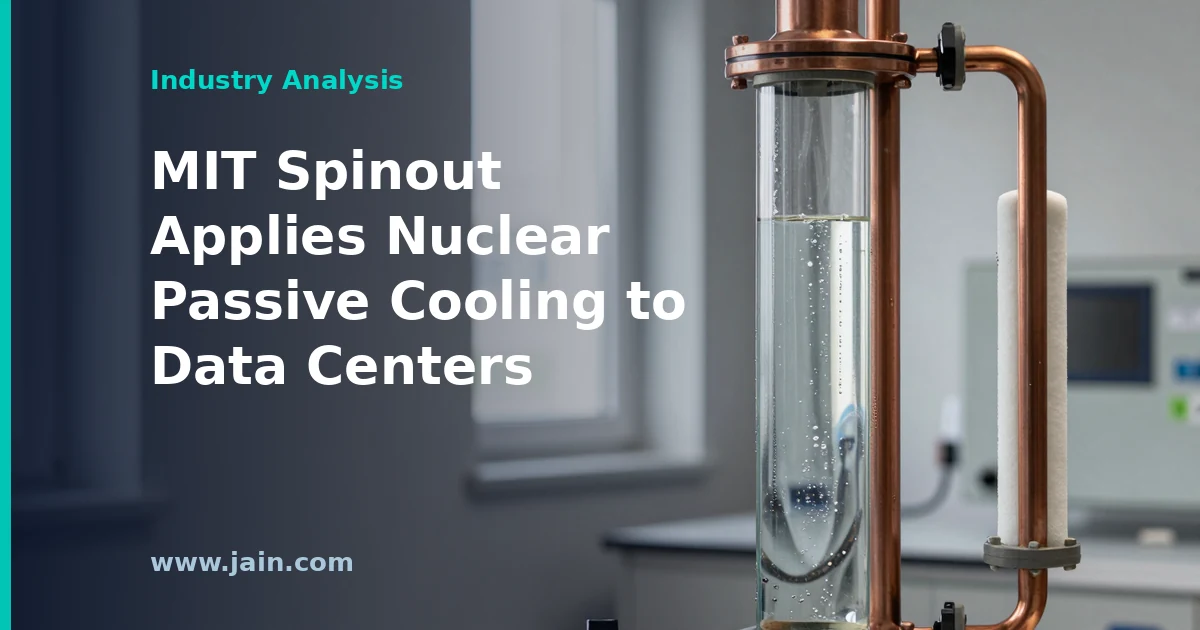
MIT News reported on June 9, 2026, that a startup spun out of the university is commercializing a data-center cooling system inspired by the passive heat-removal designs used in nuclear reactors, with the stated goal of making data centers more sustainable by reducing the energy — and, per the editorial framing, the water — that cooling consumes.
The syndicated release available to us carried the headline and framing but few technical or commercial specifics; we analyze the concept on its merits and flag what remains unsubstantiated below.
Executive Summary
The announcement matters because cooling is one of the largest costs — in electricity, in water, and increasingly in permitting friction — of operating a data center. A system that borrows from nuclear engineering’s passive-safety playbook, where heat is removed by natural physical forces rather than powered machinery, is aimed squarely at that cost. In a reactor, passive cooling means hot fluid rises and cooler fluid sinks, circulating heat away without pumps; the appeal for data centers is the same: fewer energy-hungry moving parts between the hot chip and the outside air.
The timing is not accidental. AI training and inference hardware has pushed per-rack power to levels that conventional air cooling struggles to handle, and communities hosting data centers are scrutinizing water withdrawals from evaporative cooling systems. Any credible technology that reduces both the electric and water bills of heat rejection will get a hearing from operators.
What the source material does not yet establish is whether this particular system works at commercial scale: no performance figures, customer deployments, funding details, or timelines were available in the release we reviewed. The physics pedigree is real; the commercial case is, for now, a thesis.
From Reactor Safety to Server Racks
Nuclear plants pioneered passive cooling for a stark reason: a reactor must shed heat even when the power fails. Designs built on natural circulation exploit the fact that heated fluid becomes less dense and rises while cooled fluid sinks, creating a self-sustaining loop that moves heat with no pumps, no fans, and no operator action. Decades of licensing scrutiny have made these principles among the most carefully validated in thermal engineering.
A data center’s problem is gentler — servers fail safely when they overheat, reactors do not — but structurally similar: concentrated heat that must move continuously to the outdoors. Today that journey is powered at nearly every step, by server fans, chilled-water pumps, compressors, and cooling towers. A passive or semi-passive loop that lets buoyancy or phase change do part of that work attacks the electricity bill directly, and if it rejects heat without evaporating water, it attacks the water bill too. The startup’s bet, as framed by MIT News, is that reactor-grade thermal design can be repackaged at data-center price points.
Why Cooling Is the Data Center’s Second Power Bill
For a typical facility, the electricity that does computing is only part of the meter; a meaningful share of total load goes to moving heat, which is why the industry obsesses over power usage effectiveness (PUE) — the ratio of total facility power to IT power. Every point of cooling overhead removed either cuts operating cost or frees grid capacity for more servers, and grid capacity is currently the scarcest input in the AI buildout.
Water is becoming the second constraint. Many large facilities cool cheaply by evaporating water, and withdrawals have become a flashpoint in drought-prone regions, slowing permits and souring community relations. A technology that credibly reduces both energy and water use would not just trim costs — it would widen the map of places a data center can be built. That is the strategic prize behind this announcement, and it explains why a cooling story from a university lab merits industry attention.
A Crowded Race, and a Conservative Customer
The spinout is not entering an empty field. Direct-to-chip liquid cooling is already shipping at scale from established vendors, immersion cooling has committed adopters, and rear-door heat exchangers are a common retrofit. Most of these still depend on pumped loops and mechanical chillers, so a passive approach is differentiated in principle — but it must prove it can handle the extreme heat density of modern AI racks, where natural circulation alone has historically been hardest to apply.
The harder obstacle may be cultural. Data-center operators are deeply conservative buyers: uptime is the product, and unproven thermal systems are among the last things they will gamble on. The path for a startup here almost always runs through small pilot deployments, published performance data, and partnerships with equipment incumbents or colocation providers willing to host a proving ground. None of those milestones is evidenced in the material released so far, which is normal for a lab-to-market story at this stage — but it defines exactly what to watch for next.
Background
Data-center cooling has been through several generations: raised-floor air cooling, hot/cold aisle containment, evaporative economization, and most recently liquid cooling driven by AI accelerators whose heat output overwhelms air. Each generation traded capital cost against energy and water consumption, and the AI era has sharpened that trade-off — power and water availability now routinely determine where facilities can be built at all.
Nuclear engineering, meanwhile, spent decades perfecting passive heat removal for safety reasons, producing some of the most rigorously validated thermal designs in existence. The MIT spinout profiled here sits at the intersection of those two histories, part of a broader wave of university-born startups applying energy-sector engineering to computing infrastructure.
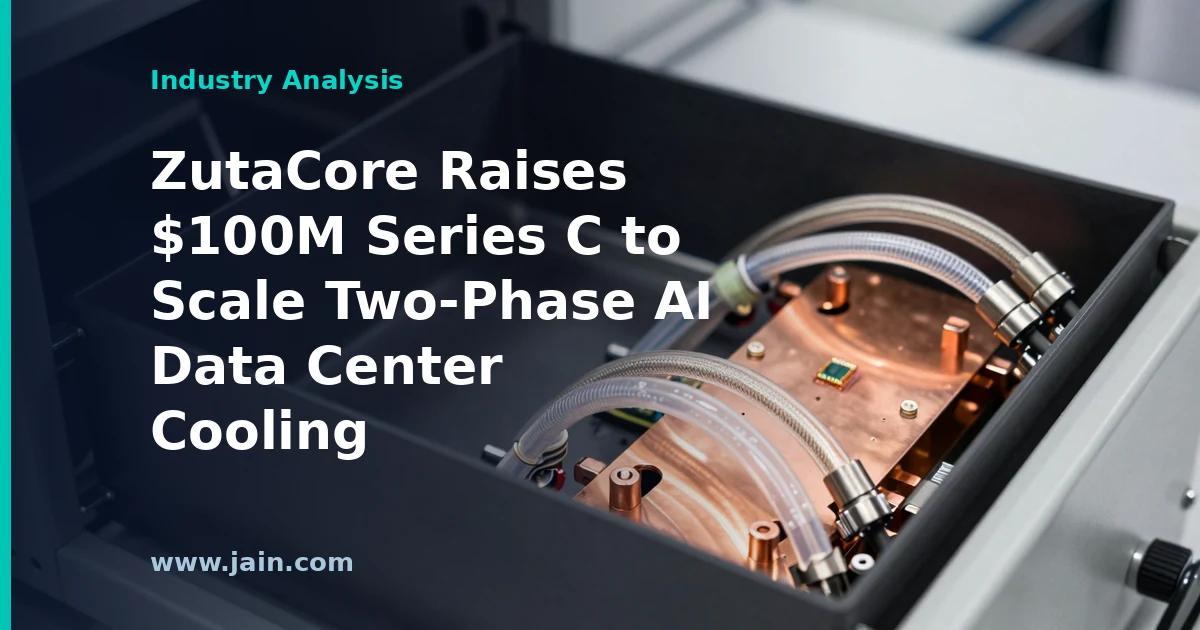
ZutaCore, a developer of two-phase, direct-to-chip liquid cooling technology, has raised a $100 million Series C round to expand its cooling platform for AI data centers, according to a report published by Pulse 2.0 on June 6, 2026. The reported purpose of the raise is to scale the company’s platform as AI workloads push rack power densities beyond what air cooling can handle.
Executive Summary
The headline fact is simple: ZutaCore has secured $100 million in Series C funding to expand its AI data center cooling platform. At that size, the round places ZutaCore among the better-capitalized independent players in liquid cooling, a segment that has moved from niche engineering concern to strategic infrastructure category in roughly three years.
Why it matters: modern AI accelerators draw hundreds of watts per chip, and racks packed with them can reach power densities that air-based cooling physically cannot dissipate economically. That has turned the cooling layer — cold plates, coolant distribution units, dielectric fluids, and the engineering services around them — into one of the most actively funded niches in data center infrastructure. A $100 million commitment to a two-phase cooling specialist signals that investors believe the transition to liquid cooling is durable, and that there is room in the market beyond the largest incumbent thermal vendors.
Capital Keeps Flooding the Cooling Layer
Cooling used to be a line item buyers negotiated down. In the AI build-out it has become a gating constraint: if you cannot remove the heat, you cannot deploy the chips, no matter how much power or floor space you have. That inversion explains why investors have poured money into thermal specialists across every approach — single-phase cold plates, immersion tanks, rear-door heat exchangers, and two-phase systems like ZutaCore’s. A $100 million Series C for a company focused specifically on the AI cooling problem fits squarely into that pattern and suggests the funding window for the category remained open as of mid-2026.
The strategic logic for investors is that cooling vendors sit at a chokepoint. Every generation of AI accelerator raises thermal design power — the amount of heat a chip is engineered to shed — and each increase expands the addressable market for liquid cooling retrofits and new builds alike. The risk, equally, is that a crowded field of well-funded competitors compresses margins before any single vendor achieves scale.
What Two-Phase Cooling Actually Is — and Why It Is Contested Ground
Most liquid cooling deployed today is single-phase direct-to-chip: water or a water-glycol mix flows through a cold plate bolted to the processor, absorbs heat, and carries it away without changing state. Two-phase cooling instead uses an engineered dielectric fluid — a liquid that does not conduct electricity — that boils on contact with the hot chip. The phase change from liquid to vapor absorbs far more energy per unit of fluid than simple warming does, which is the core efficiency argument for the approach. ZutaCore has long positioned its platform around this waterless, two-phase principle, marketing it as eliminating the risk of water leaks onto expensive electronics.
The counterarguments are practical rather than theoretical. Two-phase systems are mechanically more complex, the specialty fluids cost more than water, and the fluorinated chemistries commonly used in the category face growing regulatory scrutiny in several jurisdictions. Meanwhile single-phase cold plates have become the default choice for the current generation of AI racks because hyperscalers understand water. ZutaCore’s raise is, implicitly, a bet that as chip power keeps climbing, the physics advantage of phase change wins share back from the simpler incumbent approach. The release, as reported, does not detail how the company plans to argue that case to buyers.
Winners, Losers, and the Consolidation Question
If the round accelerates ZutaCore’s manufacturing and deployment capacity, the immediate beneficiaries are data center operators seeking alternatives to water-based cooling — particularly in facilities where water usage or leak risk is a board-level concern. Chipmakers benefit from any credible expansion of thermal headroom, since cooling capability directly constrains how they can specify future products.
The open competitive question is whether independent cooling specialists remain independent. The thermal management sector has seen sustained acquisition interest from large industrial and infrastructure players, and a well-funded specialist with differentiated technology is a natural target. A Series C of this size can be read two ways: as fuel for a run at standalone scale, or as valuation-building ahead of eventual consolidation. The reporting available does not indicate which trajectory ZutaCore’s investors have in mind.
Background
ZutaCore is a specialist in waterless, two-phase, direct-to-chip liquid cooling, an approach it has promoted for years as a safer and denser alternative to water-based cold plates. The company sells the hardware and supporting infrastructure that let standard servers shed heat through a dielectric fluid that vaporizes on the processor, and it has positioned that platform squarely at the AI data center market as accelerator power consumption has climbed.
The broader context is a rapid industry transition: liquid cooling moved from a high-performance-computing niche to mainstream AI infrastructure in the mid-2020s, drawing venture capital, private equity, and acquisition interest across cold plate, immersion, and two-phase vendors alike. ZutaCore’s Series C lands in the middle of that capital wave.
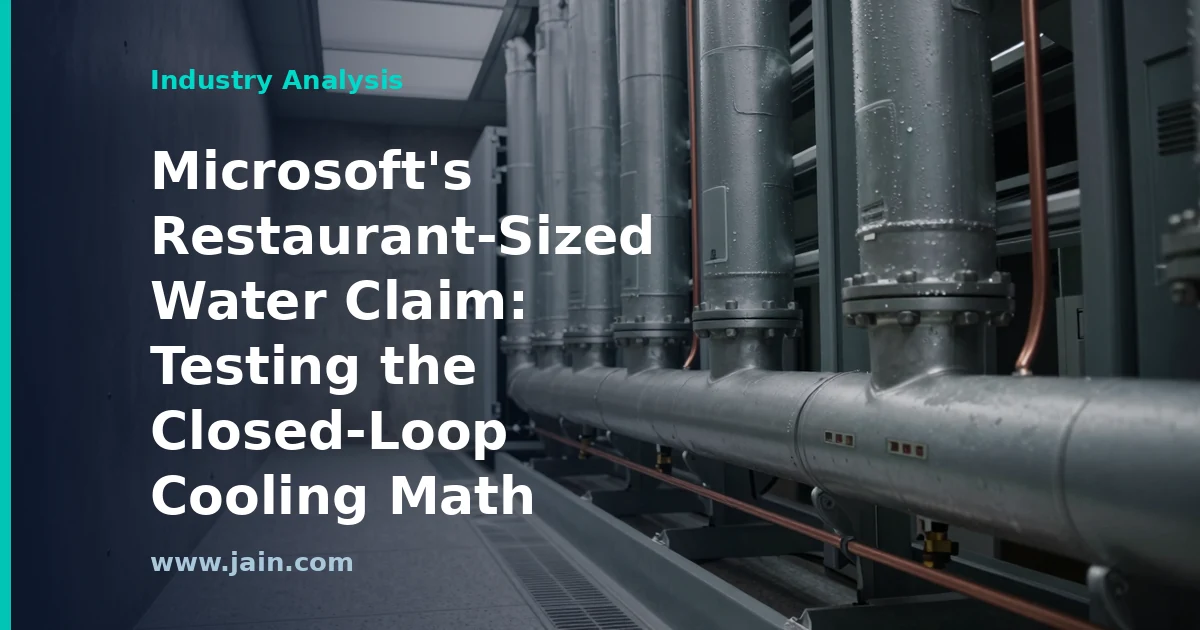
Microsoft’s chief executive said the company’s newest AI data centers consume as little water annually as a typical restaurant, crediting a closed-loop cooling design that recirculates the same fluid indefinitely rather than evaporating fresh water to reject heat. The claim, reported June 3, 2026, positions the design as a step-change from conventional facilities that can draw millions of gallons per year.
Executive Summary
The comparison is striking by design: restaurants are among the most water-intensive small businesses people intuitively understand, and equating a hyperscale AI facility to one reframes the water debate around data centers. The engineering behind the claim is real and well understood — closed-loop (or liquid-to-chip, sealed-circuit) cooling fills the system once and rejects heat to the outside air through dry coolers or chillers, eliminating the continuous evaporation that makes traditional cooling towers thirsty.
Why it matters: water has become a genuine siting constraint for AI infrastructure. Communities from the American Southwest to drought-prone regions abroad have pushed back on data center projects over aquifer draw, and utilities increasingly ask about consumptive water use before power. If Microsoft can credibly demonstrate restaurant-scale water budgets at gigawatt-scale campuses, it changes the permitting conversation for the whole industry.
The caveat: the claim as reported applies to new facilities built to the closed-loop design, not Microsoft’s existing fleet, and the reported remarks do not specify how many sites qualify, how the restaurant benchmark is defined, or whether the figure counts the water embedded in the extra electricity that dry heat rejection typically requires.
The Engineering Is Credible — the Accounting Is the Question
Closed-loop cooling is not a moonshot; it is a design choice with known trade-offs. In a conventional data center, cooling towers chill water by evaporating a portion of it — that evaporation is the “consumption” that shows up in the millions-of-gallons figures. A sealed circuit avoids this entirely: coolant is filled at commissioning, circulates across cold plates or heat exchangers at the servers, and dumps heat to ambient air. On-site water use then falls to domestic needs — restrooms, humidification, kitchens — which is plausibly restaurant-scale.
The honest question is boundary-drawing. Site water use is only one ledger. Dry heat rejection generally consumes more electricity than evaporative cooling, especially in hot climates, and most grid electricity has its own water footprint at the power plant. A facility that saves water on site but draws more thermally generated power may shift consumption upstream rather than eliminate it. The reported remarks, as relayed, do not say whether Microsoft’s restaurant comparison is site-only or includes that indirect water. Neither answer would be wrong — but they are very different claims.
Water Is Becoming the Second Currency of AI Siting
For years, the binding constraint on data center development was power: megawatts available, interconnection queue position, substation timelines. Water has quietly become the second gate. Local opposition to AI campuses increasingly centers on aquifer and municipal-supply impacts, and several jurisdictions now require consumptive-use disclosures in permitting. A hyperscaler that can walk into a county hearing with a restaurant-equivalent water budget has a materially easier approval path — and that is worth real money in schedule terms, since permitting delay is often costlier than construction premium.
This creates competitive dynamics beyond Microsoft. If closed-loop designs become the de facto community expectation, operators running evaporative plants may face pressure to retrofit or to defend designs that were unremarkable five years ago. Cooling vendors, dry-cooler manufacturers, and liquid-cooling integrators stand to gain; regions that marketed abundant water as a siting advantage lose a differentiator.
Marketing Benchmarks Deserve the Same Scrutiny as Critics’ Numbers
The water debate around AI has featured loose numbers on all sides — viral estimates of water “per chatbot query” have often rested on contested assumptions, and industry rebuttals have sometimes cherry-picked their best sites. A restaurant comparison is vivid but imprecise: restaurant water use varies enormously by size and type, and the reported claim does not state which benchmark Microsoft used. The fair posture is symmetrical skepticism. Critics’ worst-case figures should be tested against actual metered data; Microsoft’s best-case figure should be tested against fleet-wide averages, third-party verification, and the full indirect footprint. Until per-site water data is published, both the alarm and the reassurance rest partly on trust.
Background
Microsoft is one of the largest builders of AI infrastructure in the world, expanding data center capacity at historic pace to serve AI training and cloud workloads. The company has long publicized environmental commitments — including goals around water stewardship — and in recent years began promoting data center designs that minimize or eliminate evaporative water use, as rising rack densities pushed the industry from air cooling toward liquid cooling.
The water question grew alongside the AI boom: as hyperscale campuses multiplied in water-stressed regions, consumptive use became a flashpoint in local permitting battles and media coverage. The June 2026 remarks land in that context — an industry seeking to prove that AI growth and water stewardship are compatible, before regulators decide the question for it.
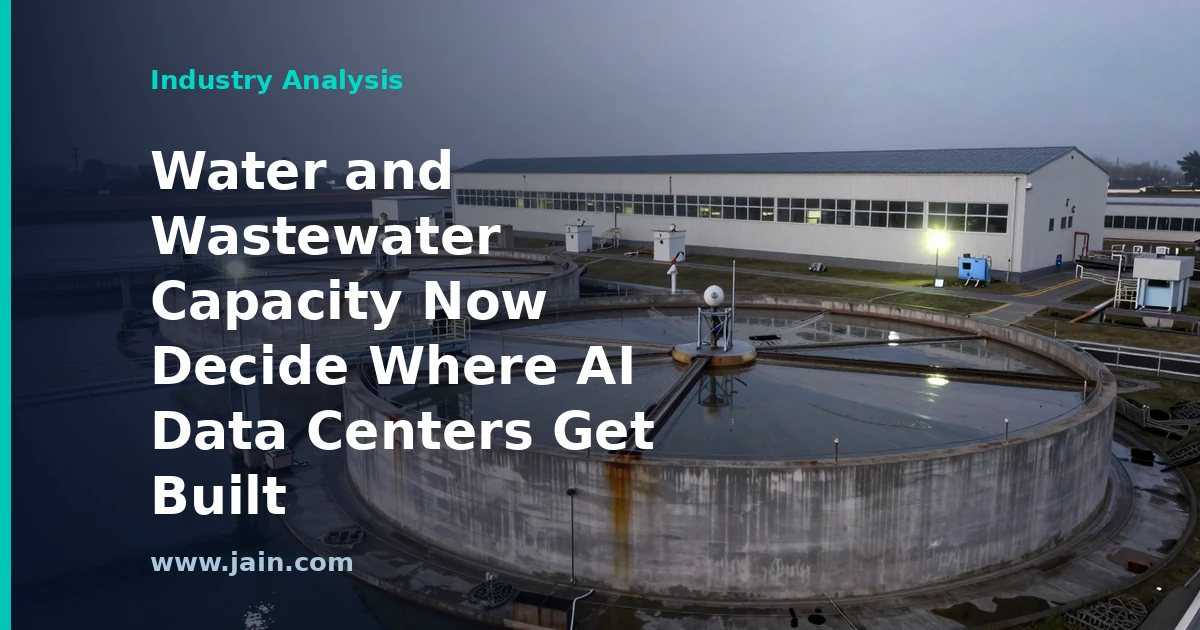
Data Center Knowledge reported on May 30, 2026 that water and wastewater capacity have joined — and in some markets now rival — electrical power as the decisive factors in where AI data centers can be built. The report’s framing marks a shift in an industry that has spent the past several years describing its siting problem almost entirely in megawatts.
Executive Summary
The report argues that the availability of water for cooling, and just as importantly the capacity of municipal systems to accept the water a facility discharges, now determine whether an AI data center project is viable at a given site. That is a meaningful reframing: since the AI buildout accelerated, the industry conversation has centered on grid interconnection queues and power procurement, with water treated as a secondary sustainability metric rather than a gating constraint.
Why it matters: if water and wastewater capacity are genuine go/no-go criteria, the map of viable AI data center locations changes. Sites with abundant power but strained water or sewer systems lose ground, while regions with underused water and treatment infrastructure gain a new selling point. It also pulls a different set of actors — water utilities, sewer authorities, and municipal planners — into negotiations that were previously dominated by electric utilities.
From Megawatts to Gallons: A New Siting Calculus
For most of the AI infrastructure boom, the binding constraint has been electricity: how many megawatts a utility can deliver, and how fast. Water has been discussed mostly in sustainability reports. The shift Data Center Knowledge describes — water as a siting decision, not a disclosure line item — reflects how AI-scale facilities actually work. High-density computing throws off enormous heat, and many cooling designs, particularly evaporative systems, consume large volumes of water to reject that heat to the atmosphere. A campus that can secure power but not water is still an unbuildable campus.
Wastewater is the less obvious half of the equation, and arguably the more interesting one. Water that runs through cooling systems and is not evaporated must go somewhere, often into municipal sewer systems as industrial discharge. Treatment plants are sized for the communities they serve; a single large industrial user can consume capacity a municipality planned to allocate over decades of residential growth. Discharge from cooling systems can also be warmer and more mineral-concentrated than household wastewater, which treatment plants must be equipped to handle. A town can have a river next door and still lack the permits, pipes, and treatment headroom to host an AI campus.
Winners, Losers, and the New Bargaining Table
If this framing holds, the winners are jurisdictions that can offer both power and water headroom — including regions with cooler climates that reduce cooling demand, or with industrial water infrastructure left over from manufacturing that has since departed. Water utilities and engineering firms that design treatment and reuse systems gain leverage and business. The relative losers are water-stressed markets that have competed for data centers on power and tax incentives alone, and developers holding land banks in places where the sewer authority, not the electric utility, turns out to be the limiting party.
For operators, the economics push toward designs that trade water for electricity or capital: closed-loop liquid cooling, dry coolers, and water recycling all reduce consumption but raise power draw or upfront cost. That trade-off means water scarcity does not just move projects — it changes their engineering and their operating cost profile. Expect water-use effectiveness (WUE), the industry’s ratio of water consumed per unit of computing energy, to get the same contractual and public scrutiny that power-use effectiveness (PUE) received a decade ago.
What the Framing Does and Does Not Establish
A note of even-handedness: the source available to us is a report headline and premise, not a dataset. The claim that water now “decides” siting is directionally consistent with well-documented industry trends — public disputes over data center water use in drought-affected regions, and the growth of water-positive pledges from major cloud providers — but the strength of the claim varies by market. In cool, wet regions with modern treatment plants, water may barely register as a constraint; in arid, fast-growing metros it can be decisive. Readers should treat “water decides siting” as an increasingly common condition, not a universal law, and ask for market-specific evidence — permit denials, moratoria, or utility capacity studies — before generalizing.
Background
Since the generative AI boom began in late 2022, data center development has grown at a pace that strained electric grids, making interconnection queues and power procurement the industry’s defining bottleneck. Water surfaced periodically as a flashpoint — community disputes over data center water consumption in drought-affected regions drew attention, and major cloud providers responded with public water-stewardship and replenishment pledges — but it was generally treated as a reputational issue rather than a siting gate.
Data Center Knowledge, the trade publication behind the report, has covered the industry’s infrastructure constraints throughout the buildout. Its framing of water and wastewater as decisive siting factors reflects the arrival of AI-scale campuses whose cooling demands, and whose discharge volumes, exceed what many municipal systems were designed to accommodate.
Data Center Dynamics has published a comparison of the two competing approaches to direct-to-chip liquid cooling — single-phase, where a liquid coolant absorbs heat and stays liquid, and two-phase, where the coolant boils at the chip and carries heat away as vapor — framed around a single question: which is right for AI data centers in 2026?
That the trade press is treating this as a live, unsettled debate is itself the news. As AI accelerators push per-chip power beyond what air can remove, direct-to-chip liquid cooling has moved from exotic to expected, and the industry has not yet converged on which of the two variants will define the next generation of facilities.
Executive Summary
Direct-to-chip liquid cooling puts a cold plate in contact with the processor and runs coolant through it, removing heat far more efficiently than blowing air across a heatsink. Within that category, two architectures are competing. Single-phase systems circulate a liquid — typically treated water or a water-glycol mix — that warms up as it passes over the chip and is cooled elsewhere. Two-phase systems use an engineered dielectric fluid that boils directly on the cold plate; the phase change from liquid to vapor absorbs a large amount of heat at a nearly constant temperature, and the vapor is condensed back to liquid to repeat the cycle.
The choice matters because it is not easily reversible. Coolant chemistry, pressure ratings, manifolds, coolant distribution units, and facility water loops are all designed around one approach or the other. An operator committing today to a multi-hundred-megawatt AI campus is effectively placing a bet on which architecture will best handle the chips of 2028 and beyond — and on which supply chain, service model, and regulatory environment will mature fastest.
The DCD piece lands at the moment this bet has become unavoidable. Air cooling handled decades of servers; single-phase liquid is handling today’s AI racks; the open question is whether tomorrow’s thermal densities force the industry through a second transition to two-phase — or whether single-phase engineering keeps stretching to meet the need.
Why the Question Exists at All
For most of computing history, this debate would have been academic. Air cooling was cheap, well understood, and sufficient. AI training hardware broke that equilibrium: modern accelerators concentrate so much power in so little silicon that the limiting factor is no longer the data center’s chillers but the last few millimeters between the chip surface and the coolant. Direct-to-chip designs attack exactly that bottleneck, which is why they have become the default assumption for new AI builds.
Single-phase direct-to-chip won the first round largely on familiarity. Water-based cooling loops are a known quantity — data center engineers, plumbers, and component suppliers have decades of experience with pumps, valves, and leak management for liquid water. Two-phase systems promise something physically compelling in exchange for novelty: boiling a fluid absorbs latent heat, meaning the coolant can soak up substantially more energy without a large temperature rise, and it does so uniformly across the hottest parts of the chip.
The Engineering Trade-Offs, Plainly Stated
Single-phase’s strengths are operational. The fluids are inexpensive and benign, the components are commodity, leaks are messy but manageable, and the industry’s existing skills transfer directly. Its weakness is headroom: as chips run hotter, single-phase designs must push more liquid, faster, through smaller channels, and must manage the temperature gradient across the cold plate — the chip’s inlet edge runs cooler than its outlet edge, which complicates thermal design as power climbs.
Two-phase inverts that profile. Boiling heat transfer offers high performance and near-isothermal operation — the whole cold plate sits close to the fluid’s boiling point — which is attractive precisely where single-phase strains. But the costs are real: engineered dielectric fluids are far more expensive than water, systems must manage vapor and pressure rather than simple liquid flow, servicing a sealed two-phase loop is a different discipline, and several candidate fluids belong to chemical families (such as PFAS-related compounds) facing regulatory scrutiny in major markets. A technically superior heat-transfer mechanism does not automatically win if its fluid supply or compliance picture is uncertain.
Who Wins and Loses on Each Path
If single-phase continues to stretch, the winners are incumbents: established cooling vendors, existing supply chains, and operators who have already deployed water-based loops and want continuity. Chip designers absorb more of the burden, engineering packages and cold plates to live within single-phase limits. If two-phase becomes necessary, the advantage shifts toward specialist fluid and systems companies, and toward operators willing to build new competencies early — with the corresponding risk of backing immature technology.
There is also a middle path worth naming: hybrid facilities, where single-phase handles the bulk of the load and two-phase (or other advanced techniques) is reserved for the hottest components or highest-density halls. Many operators will likely hedge this way rather than commit wholesale, which suggests the 2026 answer to “which is right?” may genuinely be “both, in different places” — an unsatisfying but rational outcome for an industry making thirty-year infrastructure bets on three-year chip roadmaps.
What This Means for the Broader Market
The cooling decision cascades outward. Coolant choice affects how much heat a facility can reject to the outside world and at what temperature, which shapes heat-reuse opportunities and water consumption. It affects colocation providers, who must decide which architecture to offer tenants whose hardware they do not control. And it affects the retrofit market: the vast installed base of air-cooled data centers faces different conversion economics depending on which liquid architecture prevails. Standardization efforts — common connectors, fluid specifications, and safety practices — will matter as much as raw thermal performance in determining which camp scales fastest.
Background
Data centers spent decades cooled almost entirely by air: chilled air pushed through raised floors and hot aisles, with per-rack power low enough that fans and heatsinks sufficed. The AI buildout broke that model. Training clusters pack accelerators drawing unprecedented power into dense racks, pushing the industry through its biggest thermal transition since the mainframe era — first to rear-door heat exchangers and now to liquid brought directly to the chip.
Data Center Dynamics, the publication behind this comparison, is a long-running trade outlet covering data center design and operations. That its editorial attention has moved from whether to liquid-cool to which liquid architecture to choose reflects how quickly direct-to-chip cooling has become the baseline assumption for AI infrastructure — and how much unresolved engineering debate still sits beneath that baseline.
Modine Manufacturing has signed a cooling solutions agreement valued at $4 billion with a hyperscale data center customer, as reported by BizTimes Milwaukee on May 27, 2026. The agreement centers on direct-to-chip liquid cooling — technology that removes heat from processors through cold plates mounted directly on the silicon — and ranks among the largest single cooling-infrastructure commitments ever disclosed.
The customer was not named in the report, and details such as contract duration, delivery schedule, and the split between hardware, installation, and services were not disclosed.
Executive Summary
The announcement matters for two reasons. First, the sheer size: $4 billion for cooling alone would have been implausible only a few years ago, when cooling was a modest slice of data center capital budgets dominated by air-handling equipment. A commitment of this scale signals that liquid cooling has become a first-order line item in hyperscale AI buildouts, driven by processor power densities that air cooling cannot economically serve.
Second, the counterparty structure: a single hyperscale customer writing a multi-billion-dollar cooling commitment suggests the largest cloud and AI operators are now locking up thermal-management supply the way they already lock up power, land, and chips. For Modine — a century-old thermal-management company headquartered in Racine, Wisconsin — an agreement of this magnitude is potentially transformative relative to its historical revenue base, though how the value converts to recognized revenue over time is not yet clear from the report.
Cooling Graduates From Line Item to Mega-Contract
Direct-to-chip cooling circulates liquid coolant through cold plates that sit directly on top of processors, carrying heat away far more efficiently than blowing chilled air across server racks. The technology exists because modern AI accelerators draw so much power — and concentrate it in so little space — that traditional air cooling hits physical and economic limits. As rack densities climb from tens of kilowatts toward 100 kilowatts and beyond, liquid cooling shifts from an exotic option to a requirement.
A $4 billion commitment to a single cooling vendor is the clearest evidence yet of that shift. Hyperscalers historically procured cooling equipment project by project, from a fragmented field of suppliers. Consolidating that spend into one long-horizon agreement mirrors how they already contract for power and semiconductors: secure capacity early, at scale, before competitors do. If that procurement pattern spreads, the cooling industry’s competitive dynamics change — scale, manufacturing capacity, and balance-sheet strength start to matter as much as thermal engineering.
What the Deal Could Mean for Modine
Modine is best known as a legacy thermal-management manufacturer — its roots are in vehicle radiators — that has spent recent years repositioning toward data center cooling through its climate-solutions business and its Airedale data center cooling brand. A $4 billion agreement would be large relative to what mid-cap industrial suppliers typically book across multiple years, which is precisely why the announcement drew attention beyond the trade press.
The caveat is that headline contract values and recognized revenue are different things. The report does not say whether the $4 billion represents a firm purchase obligation, a framework agreement with volume expectations, or a ceiling contingent on the customer’s buildout pace. Investors have learned from other AI-infrastructure announcements that multi-year framework deals can be revised as deployment schedules shift. Until Modine discloses the structure, the number is best read as a statement of intended scale rather than booked backlog.
An Unnamed Customer and the Concentration Question
Hyperscale operators routinely require anonymity from suppliers, so the customer’s absence from the report is normal practice, not a red flag. But it leaves open a question that matters for assessing the deal: customer concentration. A supplier whose order book is dominated by one buyer gains scale but inherits that buyer’s capital-spending cycle. If the customer slows its AI data center buildout — for reasons ranging from power availability to shifts in AI demand — the supplier feels it directly.
The flip side is validation. Hyperscalers qualify cooling vendors through demanding technical and reliability reviews, because a cooling failure in a liquid-cooled AI cluster can take down hardware worth far more than the cooling system itself. Winning a commitment of this size implies Modine cleared that bar at scale, which itself is a competitive signal to the rest of the market.
The Competitive Ripple Across the Cooling Market
The direct-to-chip market has been contested by a mix of large incumbents and specialists, and a deal of this size resets expectations for what winning looks like. Rivals will face pressure to demonstrate comparable manufacturing capacity and to pursue their own anchor agreements with major operators. For buyers below hyperscale size — enterprises and smaller cloud providers — the concern runs the other way: if the biggest customers lock up vendor capacity, lead times and pricing for everyone else could tighten.
There is also an upstream effect. Direct-to-chip systems depend on coolant distribution units, quick-disconnect fittings, cold plates, and pumps — components with their own supply chains. A $4 billion program implies significant component demand over its life, which tends to pull investment into that supplier tier. The unanswered question is timing: without a disclosed delivery schedule, it is impossible to gauge how quickly that demand arrives.
Background
Modine Manufacturing is a Wisconsin-based thermal-management company whose history stretches back over a century, beginning with radiators for early automobiles. Like several legacy industrial firms, it has pivoted toward data center cooling as that market’s growth outpaced its traditional vehicle business, building out a climate-solutions portfolio that includes the Airedale data center cooling brand and, more recently, liquid-cooling capabilities aimed at AI workloads.
The backdrop is a structural shift in data center design. The AI buildout that accelerated from 2023 onward pushed rack power densities beyond what air cooling can serve, making liquid cooling — and direct-to-chip systems in particular — one of the fastest-growing segments of data center infrastructure spending.