Category: Cooling Infrastructure

  • Frore’s 35% Tokens-per-Watt Claim Turns GPU Hotspots Into an AI Power Lever

    Frore’s 35% Tokens-per-Watt Claim Turns GPU Hotspots Into an AI Power Lever

    TL;DR · 30-second read

    The Short Version

    A California company called Frore Systems says it can get up to about a third more work out of the chips that run artificial intelligence, without using more electricity.

    The trick is cooling. These chips get extremely hot in a few tiny spots, and when they overheat they slow themselves down. Frore places small pieces of diamond, which moves heat better than metal, right over those spots.

    Why it matters: electricity is now the scarcest ingredient in building artificial intelligence. Squeezing more from the same power could mean fewer new buildings. Frore has not yet published independent test results or named customers.

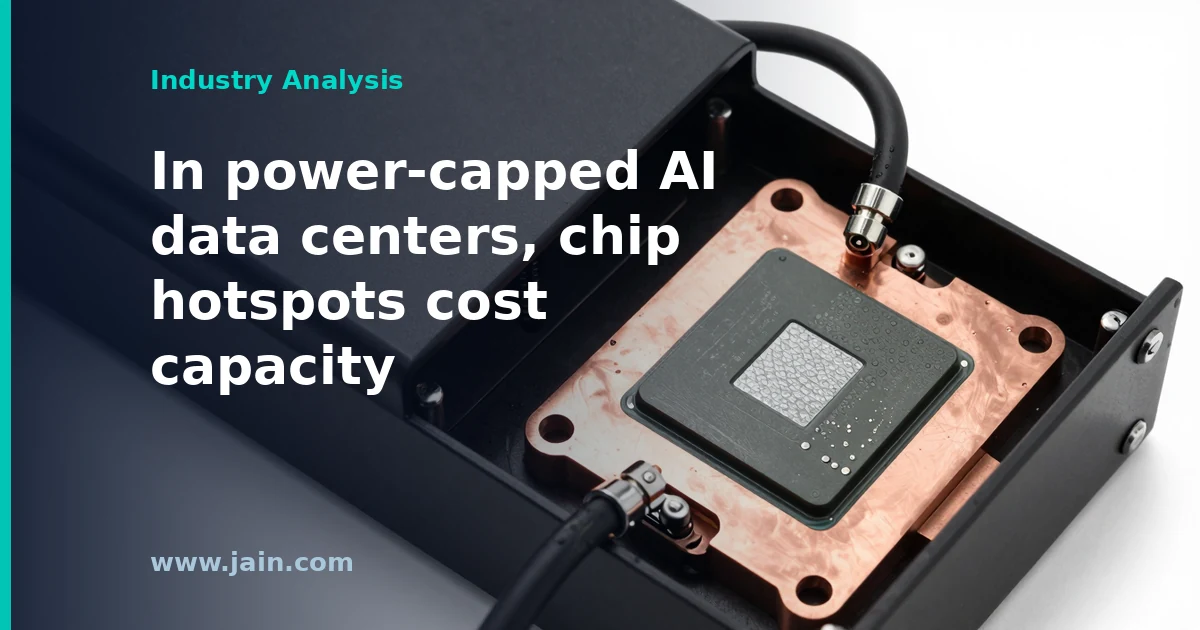
    Frore Systems announced LiquidJet Diamond on October 8, 2026, in San Jose, California. The product is a liquid-cooling coldplate (the metal block that sits on a chip and carries heat away into circulating fluid) with diamond wafers built into its base, positioned directly over the hottest regions of a GPU. Frore says the design cools hotspots of up to 770 watts per square centimeter and delivers 30–35% more AI tokens per watt than a conventional skived coldplate.

    The company will demonstrate LiquidJet and LiquidJet Diamond cooling a 2,300-watt NVIDIA Rubin GPU, along with its LiquidJet Nexus integrated coldplate system for half-height compute trays, at the OCP Global Summit in San Jose, October 12–16, 2026.

    Executive Summary

    LiquidJet Diamond extends Frore’s existing LiquidJet coldplate, which uses what the company calls a 3D ultra short-loop multi-stage design customized to each GPU’s power map. Frore says the base product lowers die temperature by 12°C, worth 25% more tokens per watt, and the diamond spreader lowers hotspot temperature a further 10°C, lifting the gain to 35%. Against a skived coldplate, it claims over 150% higher maximum hotspot power density, 75% higher heat transfer efficiency, a GPU running 16–22°C cooler, and a drop-in upgrade path.

    The significance lies in the framing rather than the hardware alone. Frore is arguing that in AI data centers capped by grid connections and transformer capacity, chip temperature is a capacity variable: a cooler chip produces more useful output from the same fixed power budget. If the numbers hold up under customer testing, cooling moves from a facilities cost line to a revenue lever.

    The headline claim of up to 35% higher profitability, however, rests on a chain of assumptions about demand, pricing and component cost that Frore has not detailed, and the performance figures have not yet been independently validated.

    Why a Few Square Millimeters Can Set a Data Center’s Output

    A modern AI accelerator does not heat evenly. Some regions of the die, the slab of silicon doing the computation, run much hotter than others. A chip protects itself by slowing down when its hottest point crosses a temperature limit, a behavior known as thermal throttling, and hotter silicon also leaks more electrical current that does no useful work. Both effects mean the temperature of the worst spot on the chip, not the average temperature of the rack, can determine how much computing each watt buys.

    That is the mechanism behind Frore’s numbers. The base LiquidJet design cuts die temperature by 12°C, which Frore equates to 25% more tokens per watt. Tokens are the chunks of text an AI model reads or writes, so tokens per watt is a rough measure of useful AI output per unit of electricity. Adding diamond, which conducts heat far better than copper, directly over the hotspots cuts hotspot temperature a further 10°C and lifts the claimed gain to 35%. Frore says the diamond version handles hotspot power density more than 150% higher than a skived coldplate, a statement about peak heat concentrated in a small area rather than total heat removed.

    The reason that ratio matters is the constraint Frore itself names: utility interconnection (the queue to connect a site to the grid), transformer capacity and on-site power delivery cap what an AI facility can draw. In a building whose power is fixed, more tokens per watt is effectively added capacity without a new substation. Chief executive Seshu Madhavapeddy makes that case directly, saying that with 35% more tokens from the same resources, hyperscalers “would reach their growth goals faster with fewer AI Factories.” The operators most exposed are those deploying the newest, highest-power GPUs, where hotspot density climbs fastest.

    From Tokens per Watt to Profit Takes Several Assumptions

    The release headline promises up to 35% higher profitability; the body says tokens per watt and revenue rise 35%, “with the increased revenue flowing directly to profit.” Each step in that chain carries conditions. Extra tokens only become revenue if there are buyers for them at the same price. Extra throughput only materializes if the GPU is limited by heat rather than by memory bandwidth, networking or software. And the gain only flows straight to profit if the diamond coldplate costs no more over its life than the part it replaces, a figure Frore has not published.

    The temperature figures also mix measures. The 12°C reduction refers to die temperature and the additional 10°C to hotspot temperature; their sum, 22°C, matches the top of the 16–22°C range Frore quotes for a cooler GPU, and the 30–35% tokens-per-watt range suggests results vary by chip and workload. “Up to” marks 35% as the best case. The baseline matters too: “traditional skived coldplates” covers a wide range of designs, and the size of any improvement depends on which one is being compared.

    None of this makes the direction implausible. Cooler silicon generally runs faster and wastes less power, and hotspot-targeted cooling is a logical response to rising chip power. The open question is magnitude under real data center conditions, which is what customer qualification testing exists to establish.

    The Harder Claim Is Manufacturing at Hyperscale

    Frore positions LiquidJet between two incumbent approaches. Skiving, in which thin fins are carved from a copper block, is mature and cheap but, Frore argues, cannot deliver the precision today’s GPUs demand. Electrochemical additive manufacturing (ECAM), a form of 3D metal printing, offers design freedom but, in Frore’s telling, cannot meet hyperscaler quality, reliability, volume or timelines. Frore says it combines semiconductor-fabrication precision with high-volume manufacturing, with production operations in Taiwan.

    Size is part of the pitch. Frore cites die areas ranging from 1,488 mm² for NVIDIA Blackwell Ultra to 46,225 mm² for the Cerebras Wafer-Scale Engine, roughly 30 times larger, and claims its process is the only one able to support the power, performance and size requirements of such chips. Its LiquidJet Nexus system goes further, integrating multiple coldplates and eliminating hoses, connectors and manifolds to enable half-height (½U) compute trays, which would mean fewer potential leak points and denser servers.

    If those claims survive qualification, the pressure falls on suppliers of skived coldplates and on 3D-printing approaches competing for the same high-end sockets. The “seamless drop-in upgrade” claim is commercially important because it lowers switching costs, but hyperscale buyers typically qualify cooling hardware over long cycles, and a component that sits directly on a multi-thousand-dollar GPU faces a high bar for reliability evidence.

    Background

    Frore Systems built its reputation on AirJet, a solid-state active air-cooling chip used in consumer, industrial and Internet-of-Things devices, including a concept ultra-slim notebook unveiled with Lenovo. The company, which describes itself as an AI industry unicorn, has since moved into data center liquid cooling with LiquidJet and LiquidJet Nexus, and earlier published a report, “Chip to Chiller,” arguing that heat costs AI facilities a large share of their compute capacity.

    The broader market context is a shift from air cooling to direct-to-chip liquid cooling as AI accelerators have climbed into the thousands of watts per chip. With grid interconnection and transformer capacity now limiting how fast AI data centers can grow, suppliers across the thermal stack are increasingly pitching their products on output per watt rather than on cooling alone. The OCP Global Summit, run by the Open Compute Project industry consortium, is a key venue where hyperscalers evaluate such hardware.

    Sources

    Source: LiquidJet Diamond Coldplates can increase AI Factory profitability by up to 35% — Frore Systems’ announcement of its diamond-spreader liquid-cooling coldplate for AI GPUs, distributed via PR Newswire.

  • SKF’s MBx Bearing Aims at Data Center Chiller Lead Times, Not Just 30–40% Savings

    SKF’s MBx Bearing Aims at Data Center Chiller Lead Times, Not Just 30–40% Savings

    TL;DR · 30-second read

    The Short Version

    Data centers, the buildings full of computers behind every app and website, get very hot. Giant cooling machines called chillers keep them running.

    Swedish manufacturer SKF makes parts that let the spinning heart of those machines float on magnets, with no oil and no rubbing. It says this design can cut energy use by up to 30 to 40 percent compared with older designs.

    The newer twist: SKF redesigned the part so factories can build it faster, because data center demand for these machines is growing.

    SKF, the Gothenburg, Sweden-based bearing maker, announced on October 7, 2026 that it will launch its new MBx active magnetic bearing series for high-speed chillers at Chillventa 2026, the refrigeration and heat-pump trade fair in Nuremberg, Germany, running October 13–15. SKF says the MBx is designed to optimize cost while maintaining performance, using automatic winding and a modular design that enables semi-automated production, faster assembly, shorter lead times and more production capacity for its high-speed motors to meet growing demand from the data center chiller market.

    SKF will also show its new CeraDrive hybrid ceramic bearings and a new Extreme super-precision bearing platform rated for speeds up to 120,000 rpm. The company says its broader magnetic-bearing drive offering delivers energy efficiency improvements of up to 30–40% compared with conventional technologies.

    Executive Summary

    SKF is pitching three bearing technologies at compressor and chiller manufacturers, the companies that build the large cooling machines used in data centers and heat pumps. The headline product is MBx, a new active magnetic bearing, meaning a system that holds a spinning shaft in place with controlled magnetic fields so it never touches a surface and needs no lubricating oil.

    What stands out is how SKF describes the MBx’s purpose. Its stated innovations are manufacturing ones: automatic winding, a modular design, semi-automated production and faster assembly, aimed explicitly at reducing lead times and expanding capacity for the data center chiller market. The efficiency figure in the release, up to 30–40%, describes SKF’s integrated oil-free drive offering against unspecified conventional technologies rather than a new gain from MBx itself.

    For data center operators and the chiller makers that supply them, that framing matters. It suggests SKF sees the near-term opportunity in its customers’ ability to get enough oil-free drivetrains, quickly and at the right cost, not only in squeezing out further efficiency.

    The New Part Is a Manufacturing Story

    Read closely, the MBx announcement is less about a performance breakthrough than about production. SKF says the bearing is “designed to optimize cost while maintaining performance” and lists its innovations as automatic winding (machine-wound electromagnet coils rather than more labour-intensive methods) and a modular design that enables semi-automated production and faster assembly. The company states the purpose directly: to help reduce lead times and expand production capacity of SKF high-speed motors “to meet growing demand from the data center chiller market.”

    That is a meaningful signal about where SKF thinks friction lies in this market, in the commercial sense rather than the mechanical one. A centrifugal chiller, the type of large cooling machine common in big data center plants, is built around its compressor, and an oil-free compressor is built around its motor and bearing system. If that drivetrain is slow to source or expensive to produce, it constrains how many oil-free chillers a manufacturer can ship. And a data center cannot bring capacity online without the cooling plant to support it. SKF has not said its lead times are currently a problem for customers, but it has chosen to make shortening them the headline benefit of its new product.

    The people most directly affected are chiller and compressor manufacturers deciding whose magnetic-bearing systems to design around. Downstream, data center developers and their engineering contractors care about two outcomes: whether oil-free chillers become cheaper relative to conventional units, and whether delivery schedules for cooling equipment get shorter. SKF’s release claims progress on the inputs to both, without yet quantifying either.

    Why Oil-Free Matters in a Data Center Chiller

    Conventional compressor bearings are rolling or sliding contacts that need oil, and that oil has to be pumped, filtered, monitored and eventually replaced. In a refrigeration circuit, oil can also migrate into heat exchangers, where it can degrade heat transfer. Magnetic bearings remove the contact and the oil entirely: the shaft is levitated, sensors track its position thousands of times a second, and a digital controller adjusts the magnetic fields to keep it centred.

    SKF argues this reduces wear, maintenance and unplanned downtime, and that is the point that resonates with data center operators. Cooling is one of the few systems whose failure can force IT equipment to throttle or shut down, so operators design chiller plants with redundancy and treat maintenance windows carefully. Fewer wearing parts and no oil system mean fewer things that can fail and fewer reasons to take a unit offline.

    SKF positions itself as a full-stack supplier here: high-speed motors levitated on magnetic bearings, the bearings themselves, digital controllers, variable-speed drives (electronics that let the compressor run at whatever speed the cooling load requires), condition monitoring and engineering services. For a chiller maker, buying an integrated drivetrain can shorten its own development time; the trade-off is deeper dependence on a single supplier.

    Reading the 30–40% Efficiency Claim

    The release’s most quotable number is that SKF’s integrated magnetic-bearing offering delivers “energy efficiency improvements of up to 30–40% compared with conventional technologies.” Two qualifiers matter. “Up to” marks the top of a range, not a typical result. And the baseline, “conventional technologies,” is not defined: the gain from replacing an older fixed-speed, oil-lubricated compressor would be expected to be larger than the gain over a modern variable-speed unit.

    Efficiency at the chiller also does not translate one-for-one into data center energy savings. Chillers are one component of a cooling plant that includes pumps, cooling towers, air handlers and, in many climates, free-cooling modes that bypass the compressor for part of the year. The real-world benefit depends on the site’s climate, load profile and plant design.

    SKF’s broader framing, that around 20 percent of the world’s energy consumption goes to overcoming friction, is a company claim offered as context for its business rather than a specific figure for cooling. It is a reasonable reminder that rotating machinery is everywhere in infrastructure, but it should not be read as an estimate of savings available in data centers.

    Ceramics and Extreme Speeds Fill Out the Portfolio

    SKF is not betting only on magnetic levitation. It will also show hybrid ceramic bearings, including a new optimized CeraDrive series, for chillers, heat pumps, steam compressors, motors, fans and pumps. Ceramic rolling elements are electrically insulating, which matters in motors fed by variable-speed drives, where stray electrical currents can pass through and pit conventional steel bearings. SKF also says the ceramics support high-speed operation when lubrication conditions are demanding.

    The new Extreme super-precision platform targets high-speed centrifugal compressors in chillers, heat pumps and mechanical vapour recompression systems (which compress steam to reuse its heat). SKF quotes capabilities of up to 120,000 rpm, a speed factor of 2.4 million ndm (a bearing-industry measure combining diameter and rotation speed), ring contact pressure up to 2.8 GPa and turbine-side temperatures up to 200°C.

    Offering both magnetic and advanced rolling-element bearings lets SKF serve compressor designers whichever architecture they choose, from premium oil-free machines to cost-sensitive designs that still need high speed. Commercially, that hedges SKF against any single design winning out across the cooling market.

    Background

    SKF is a Gothenburg-based industrial group known primarily for bearings, the components that let shafts rotate smoothly in everything from cars to factory machinery. It describes its core business as reducing friction in rotating systems and claims that around 20 percent of the world’s energy consumption goes to overcoming friction. Beyond conventional bearings, SKF sells high-speed motors levitated on magnetic bearings, active magnetic bearings, digital controllers, variable-speed drives, condition monitoring and engineering services.

    Data center growth has turned cooling into a strategic concern for operators. SKF notes that as data center capacity expands, cooling places increasing demands on energy systems, pushing chiller and compressor makers to deliver more cooling capacity while limiting energy use, maintenance and complexity. Oil-free centrifugal compressors built on magnetic bearings are one way manufacturers have addressed that, and suppliers of their drivetrains, including SKF, are now competing on cost and production capacity as well as performance.

    Sources

    Source: SKF to showcase new technologies for energy-efficient and reliable cooling at Chillventa 2026, SKF’s announcement of its MBx magnetic bearing series, CeraDrive hybrid ceramic bearings and Extreme super-precision bearing platform, distributed via PR Newswire on October 7, 2026.

  • Vertiv’s Second Fluid-Services Deal Since 2025 Bets AI Coolant Loops Need Lifelong Care

    Vertiv’s Second Fluid-Services Deal Since 2025 Bets AI Coolant Loops Need Lifelong Care

    TL;DR · 30-second read

    The Short Version

    The newest AI computers run so hot that many are cooled with liquid piped right to the chips, a bit like a car’s radiator. That liquid has to stay clean, free of air bubbles and chemically balanced. If it doesn’t, the cooling quietly gets worse and parts wear out.

    Vertiv, a big maker of power and cooling equipment for data centers, is buying King Environmental Services, an Irish company that specializes in exactly that upkeep. It is Vertiv’s second such purchase in under a year. Looking after the coolant is becoming an ongoing job, not a one-time setup.

    Vertiv Holdings (NYSE: VRT), which makes power and cooling equipment for data centers, has agreed to acquire King Environmental Services Ltd. (KES). KES is headquartered near Dublin, Ireland, and provides fluid management, commissioning and load-testing services for high-density, liquid-cooled data centers across Europe, the Middle East and Africa (EMEA). Zawya carried the announcement on October 5, 2026.

    Financial terms were not disclosed, and Vertiv said they are not expected to be material to its results. The deal is expected to close in the fourth quarter of 2026. It follows Vertiv’s December 2025 acquisition of PurgeRite, which the company describes as the foundation of its fluid management business in North America.

    Executive Summary

    Vertiv is buying a specialist field-services firm rather than a product line. KES flushes, filters, treats and validates the liquid that circulates through cooling systems. It also runs thermal load tests on liquid cooling infrastructure and electrical load tests on critical power systems before a facility goes live. Vertiv says the deal extends its “thermal management services capabilities” into EMEA and supports its strategy of serving customers “across the thermal chain.”

    The significance is in the pattern and the scope. This is the second fluid-management acquisition Vertiv has named in roughly ten months, after PurgeRite in North America. The scope Vertiv describes runs well past installation day, covering “monitoring, maintenance and lifecycle optimization.” That is a statement about where Vertiv expects work and revenue to sit in liquid-cooled AI data centers: in the ongoing care of the coolant loop, not only in the hardware that carries it.

    The Coolant Has Become Equipment That Needs Servicing

    Air-cooled data centers move heat with fans and air handlers. Liquid-cooled AI halls instead pump a water-based coolant through cold plates mounted on the chips, then through coolant distribution units (pumps and heat exchangers) that pass the heat to the building’s water system. Vertiv’s announcement lists what goes wrong in that loop: contamination, trapped air, corrosion, improper chemistry and flow imbalances. Each reduces heat-transfer efficiency, degrades equipment and creates risk both at startup and in operation. The fluid’s condition changes over time, which makes it a component to be maintained, not plumbing to be installed and forgotten.

    That mechanism explains why Vertiv describes KES’s scope in lifecycle terms: “system preparation, performance validation, monitoring, maintenance and lifecycle optimization.” It also says outright that “beyond initial commissioning, customers need lifecycle fluid management services.” CEO Gio Albertazzi framed it this way: “the performance of cooling and power infrastructure will depend as much on execution in the field as on engineering and system design.” Every liquid-cooled rack adds piping and fluid volume. That fluid must be flushed and validated before go-live, then sampled, treated and balanced for as long as the facility runs. Work of that kind recurs; it does not end at handover.

    The people affected are the operators of AI data centers, whose uptime depends on fluid quality, and the tenants leasing that capacity. Also affected are the mechanical contractors and independent specialists who have historically done flushing and commissioning as project work. One caveat applies: Vertiv has not disclosed how much of this business is recurring maintenance versus one-time commissioning. The recurring-service thesis is clearly stated in the company’s strategy, but not yet shown in numbers.

    Two Deals, Two Regions, One Template

    PurgeRite gave Vertiv a fluid management base in North America; KES is meant to do the same for EMEA. Two acquisitions by one company do not make an industry trend. They do show a deliberate geographic build-out of the same capability, by a supplier whose equipment already sits inside the cooling loops these teams service. KES’s Dublin-area base puts it in one of Europe’s established data center markets.

    KES also brings load testing. Thermal load testing uses heat-generating equipment to simulate a full room of running servers, so operators can confirm the cooling performs before costly AI hardware arrives. Electrical load testing does the equivalent for backup and critical power systems. Finding a flow imbalance or a power fault before the servers are installed is far cheaper than finding it afterward. Vertiv’s pitch is that one “single accountable partner” can handle commissioning, testing, fluid management and ongoing operations, plus compliance with regional rules on fluid handling, treatment and disposal.

    A Small Price, a Clear Signal and a Neutrality Question

    Vertiv says the terms are not material to its financial results. That suggests KES is small next to Vertiv’s business, and that this is a purchase of capability and footprint rather than revenue. Experienced field teams, local regulatory know-how and a safety record take years to build, and buying them is the faster route into a region. Vertiv’s own risk disclosures name the obvious exposure: keeping KES’s management and key employees, and maintaining its customer and supplier relationships, after the deal closes.

    There is a fair question for buyers too. Commissioning is often valued as an independent check on what a vendor delivered. When the company supplying cooling equipment also validates and maintains it, customers may reasonably ask how independence is preserved. Vertiv’s single-partner model offers clear accountability. Whether customers weigh that above independent verification is something the market, not the announcement, will settle.

    Background

    Vertiv, headquartered in Westerville, Ohio, and listed on the New York Stock Exchange, supplies power, cooling and IT infrastructure, along with software, analytics and services, to data centers, communication networks and commercial and industrial facilities. It does business in more than 130 countries.

    The shift behind this deal is the rise of liquid cooling. As AI and high-performance computing workloads push more heat into each rack, air alone struggles to remove it, and operators increasingly pipe coolant directly to the hardware. That makes the condition of the fluid, along with the testing and upkeep of the systems that carry it, a factor in uptime. Field services such as commissioning and fluid maintenance are becoming a larger part of how cooling suppliers compete.

    Sources

    Source: Vertiv announces agreement to acquire King Environmental Services Ltd., expanding global fluid management services: Zawya’s publication of Vertiv’s October 5, 2026 announcement of its agreement to acquire Ireland-based KES.

  • Castrol CORE’s 150-Country Network Recasts AI Coolant as a Lifecycle Service

    Castrol CORE’s 150-Country Network Recasts AI Coolant as a Lifecycle Service

    TL;DR · 30-second read

    The Short Version

    Castrol, best known for motor oil, is now selling a full package to keep the computers behind artificial intelligence from overheating.

    Those chips run so hot that many buildings now cool them with liquid instead of fans. Castrol says it will help design those cooling systems, supply the fluid, test it, and look after it for years, backed by service teams in more than 150 countries.

    This matters because a cooling failure can knock very expensive computers offline. Castrol is wagering that customers would rather pay one company to own that risk.

    Castrol announced on September 29, 2026, from Singapore, the launch of Castrol CORE, an end-to-end thermal management offer for data centers, in a release distributed through PR Newswire. The package combines Castrol’s cooling fluid technology with testing, new design capabilities, and support through deployment, commissioning, operation and maintenance. It is backed by Castrol labs in the UK, US, Germany and China, joint labs across Asia, and a service-provider network covering more than 150 countries.

    Castrol says its cooling technology has been tested and validated by leading chip and hardware makers including NVIDIA and Intel. It has completed a proof-of-concept program with an unnamed major data center operator in China and is working with other global operators on similar projects.

    Executive Summary

    Castrol CORE is Castrol’s move from selling cooling fluid to selling responsibility for how that fluid performs over a facility’s life. Rather than supplying a product that operators must integrate with hardware from other vendors, Castrol says it will act as a single point of contact, coordinating a network of partners in products, infrastructure, design and services. The company attributes the shift to its own industry study, which it says found rising demand for integrated thermal management, plus concerns about supply chains and the high cost of failures.

    The launch matters because liquid cooling, circulating fluid close to or around hot chips instead of relying on air, is becoming a standard requirement for AI and high-performance computing. When cooling moves from fans to fluids, the chemistry of the fluid becomes part of the uptime equation. A supplier that tests and monitors that fluid on site, across more than 150 countries, is offering something closer to an operational guarantee than a commodity.

    What Castrol has not disclosed is how much of this is already contracted. It names no customers, deployed capacity, pricing or performance commitments, so CORE is best read as a clear statement of strategy with one completed pilot behind it.

    Why a Coolant Maker Is Selling Accountability

    The core of the announcement is a change in what the customer is paying for. Castrol says CORE covers the full lifecycle, from early design and specification through deployment, commissioning, operation and maintenance, and that its service network in more than 150 countries enables ongoing testing, validation and on-site monitoring to reduce the risk of costly interruptions. That is the mechanism behind the headline: the fluid is no longer the whole product. It is the anchor for a recurring relationship built around keeping the cooling loop healthy.

    This follows from how liquid cooling works. In an air-cooled hall, a failing fan is a swappable part. In a liquid-cooled system, the fluid’s condition, including contamination, degradation or incompatibility with pumps, seals and cold plates, can affect every server on the loop. Castrol’s own study, it says, flagged the high cost of failures as a major industry concern. A supplier that samples and validates fluid on site throughout a facility’s life is effectively selling a reduction in that risk, and the geographic reach of the service network is what makes that promise credible for operators with sites on several continents.

    The people most affected are data center operators and the engineering firms that design their facilities. For operators, a single interlocutor could simplify procurement and clarify who is responsible when something goes wrong. For design and integration firms, a fluid supplier moving upstream into design is a new participant in work they have typically led. Castrol frames this as partnership, saying CORE brings together specialists across products, infrastructure, design and services, but the balance of who leads a project will depend on terms it has not yet published.

    What Chipmaker Validation Does and Does Not Establish

    Castrol’s strongest technical claim is that its cooling technology has been tested and validated by leading chip and hardware makers, including NVIDIA and Intel. For buyers, validation from the companies whose processors are being cooled carries real weight, because running an unapproved fluid can raise questions about hardware compatibility and support.

    The claim is also broad. Castrol does not specify which products or platforms were validated, whether the fluids are for direct-to-chip cooling (where liquid flows through plates mounted on processors) or immersion cooling (where servers sit submerged in a non-conductive fluid), or what the validation tested. Operators evaluating CORE will want that detail, since compatibility with one generation of hardware does not automatically carry over to the next.

    Asia-Pacific as the Proving Ground

    Castrol has set up a regional data center design team in Asia-Pacific, supported by local specialists, and describes the region as adopting new cooling infrastructure quickly. Its one disclosed field result is a completed proof-of-concept program with a leading data center operator in China, with similar projects now under way with global operators.

    A proof of concept demonstrates that the approach can work in a real facility; it is not a commercial rollout. The combination of a Singapore launch, an Asian design team, joint labs across Asia and a China pilot suggests Castrol sees the region as its early market for the integrated model. Whether CORE scales from pilots into multi-site contracts is the question that will determine whether the service shift is a strategy or a business.

    The Trade-Off in One-Stop Cooling

    Integrated offers solve a real coordination problem, but they shift risk in both directions. For Castrol, taking on design and lifecycle responsibility means absorbing some of the liability that previously sat with integrators and operators, and managing a partner network it does not fully control. For customers, a single supplier simplifies accountability but can raise switching costs if fluids, monitoring and design are tightly bundled.

    Castrol also says CORE is a platform that should gradually extend its thermal management offering beyond data centers. That signals the company views thermal management as a growth line in its own right, not a side market for lubricants, though it has not said which applications come next or on what timeline.

    Background

    Castrol is one of the world’s largest lubricant brands, with more than 127 years of experience formulating fluids for automotive, marine, industrial and energy applications. Its data center work sits within a dedicated Data Centers and Thermal Management division, led globally by president Peter Huang, who says customers are looking for experienced partners to handle the full range of thermal challenges rather than another standalone product.

    The broader context is the rise of liquid cooling. As AI and high-performance computing push chip heat output higher, operators are adopting systems that use specialized fluids to carry heat away from processors. That has turned fluid suppliers into participants in data center design and operations, a role Castrol is now formalizing with CORE.

    Sources

    Source: Castrol lance « Castrol CORE », une offre intégrée de gestion thermique destinée aux centres de données (Castrol launches Castrol CORE, an integrated thermal management offer for data centers), Castrol’s announcement of its end-to-end data center cooling offer, distributed via PR Newswire on September 29, 2026.

  • Vertiv’s 2nd Fluid-Services Deal in Under 10 Months: AI Cooling Risk Sits at Handover

    Vertiv’s 2nd Fluid-Services Deal in Under 10 Months: AI Cooling Risk Sits at Handover

    TL;DR · 30-second read

    The Short Version

    Vertiv, an American company that makes the power and cooling equipment inside data centers, is buying King Environmental Services, a Dublin firm whose crews clean, fill and test the liquid cooling systems used by artificial intelligence computers.

    Those chips run so hot that many new buildings pipe liquid right to them, much like a car’s radiator. A little dirt or trapped air in the pipes can overheat very expensive machines.

    It is Vertiv’s second purchase of this kind in under a year. The bet: the hard part is getting the plumbing right on day one.

    Vertiv Holdings Co (NYSE: VRT) said on September 24, 2026 that one of its wholly owned subsidiaries has signed a definitive agreement to acquire King Environmental Services Ltd. (KES), a fluid management, commissioning and load-testing specialist founded in 2002 and headquartered near Dublin, Ireland, with hubs in North Dublin and Frankfurt. Vertiv disclosed the deal in an 8-K filed the same day, with its press release furnished as Exhibit 99.1.

    The transaction is expected to close in the fourth quarter of 2026. Vertiv did not disclose financial terms and said the deal is not expected to be material to its financial results. It follows Vertiv’s December 2025 acquisition of PurgeRite, which the company describes as the foundation of its North American fluid management business.

    Executive Summary

    Vertiv is extending into Europe, the Middle East and Africa (EMEA) a services line it began building in North America less than a year ago: preparing, cleaning, balancing and testing the liquid loops that carry heat away from high-density AI servers. KES brings pipework flushing, filtration and water treatment, testing, adjusting and balancing (TAB, the process of tuning flow so every branch of a cooling system gets the fluid it was designed for), and large-scale thermal and electrical load testing, in which heaters and load banks stand in for real servers so a facility can be proven before it goes live.

    The deal is small by Vertiv’s own account, but the pattern is the story. Two consecutive fluid-management acquisitions, PurgeRite and now KES, put Vertiv’s capital into field crews rather than factories. CEO Gio Albertazzi framed the rationale directly: as computing density rises, cooling and power performance “will depend as much on execution in the field as on engineering and system design.”

    For data-center builders and operators in Europe, the practical consequence is that one of the largest thermal equipment vendors now intends to own the commissioning and lifecycle fluid work around its systems, offering what it calls a single accountable partner from construction through operation.

    Why Liquid Cooling Risk Concentrates at Handover

    Air-cooled data centers are forgiving: if a fan underperforms, the room runs a little warmer. Direct liquid cooling is less forgiving. Heat moves from chips into a closed loop of treated water or coolant, and Vertiv’s own description of what can go wrong is specific: contamination, trapped air, corrosion, improper chemistry and flow imbalances can reduce heat-transfer efficiency, degrade equipment and create commissioning and operational risks. Every one of those failure modes is introduced or caught in the same window, when a newly built system is flushed, filled, balanced and brought under load for the first time.

    That window is the handover between construction and live operation, and it is exactly where KES sits. The company describes itself as bridging construction and live operation, validating that cooling systems are clean, balanced, design-compliant and ready for AI workloads, including through thermal load testing before a facility enters service. PurgeRite plays the equivalent role for Vertiv in North America. Buying two such firms in under ten months, December 2025 and September 2026, is a clear signal of where Vertiv believes customer risk now sits: not in whether a coolant distribution unit or cold plate works on a test bench, but in whether the loop around it was installed and prepared correctly on site.

    This matters to three groups. Operators carry the downtime risk if a contaminated loop fouls hardware. General and mechanical contractors carry schedule risk if commissioning uncovers problems late. And hardware vendors carry reputational risk when a field problem is blamed on their equipment. Vertiv’s pitch of “a single accountable partner for commissioning, testing, fluid management and ongoing operations” is aimed squarely at that last point, collapsing a chain of hand-offs into one party that owns the outcome.

    A Small Check With a Strategic Signal

    Vertiv says the deal is not expected to be material to its results, and it furnished the announcement under Item 7.01, the Regulation FD disclosure item, in its September 24 8-K. In plain terms, this is a capability purchase, not a revenue purchase. Vertiv is buying people, procedures, regional permits and an operating footprint that would take years to build organically.

    The economics also point toward recurring work. The release stresses that beyond initial commissioning, customers need lifecycle fluid management for availability, thermal performance and equipment longevity. Fluid chemistry drifts, filters load up and systems get expanded, so a firm that commissions a loop is well placed to maintain it. For an equipment maker, attaching a service relationship to each installed liquid-cooling system is a way to stay involved long after the hardware sale.

    Vertiv’s own risk language underlines what it is really acquiring. Among the transaction risks listed in the release are its ability to maintain relationships with KES’s customers and suppliers and to retain KES management and key employees. In a field-services business, those relationships and people are the asset.

    What EMEA Adds, and What Remains to Be Proven

    KES operates from North Dublin and Frankfurt, two established European data-center hubs, and serves customers across EMEA. The release also highlights compliance with regional fluid handling, treatment and disposal requirements, a less glamorous but real advantage: treated coolant is a regulated waste stream, and a firm with local disposal routes and regulatory familiarity removes friction that a North American team would face entering the market.

    The broader claims deserve a measured reading. Vertiv describes “significant customer benefits” and KES’s “strong reputation” but offers no figures on KES’s headcount, number of projects, load-testing capacity or customer base, so the scale of the European execution capacity being added cannot yet be assessed. Reach is also a fair question: two hubs in Ireland and Germany can serve a lot of Europe, but supporting the Middle East and Africa at the same standard is a different logistical task.

    There is also a structural question for buyers. Commissioning has traditionally been valued partly for its independence from the equipment supplier. When the firm validating a cooling system is owned by the company that made parts of it, operators may want clarity on how test results, disputes and non-Vertiv equipment are handled. That is not a criticism of either company; it is the natural question any procurement team will ask as vendors move deeper into services.

    Background

    Vertiv, headquartered in Westerville, Ohio, and doing business in more than 130 countries, supplies power, thermal management and IT infrastructure equipment and services for data centers, communication networks and commercial and industrial facilities. As AI and high-performance computing push more heat into each server rack, operators are increasingly adopting liquid cooling, in which coolant is piped to or near the chips instead of relying only on moving air through the room.

    Liquid cooling shifts a new kind of work onto construction sites and operations teams: the cleaning, filling, balancing and ongoing treatment of cooling loops. Vertiv entered that business in North America with its December 2025 acquisition of PurgeRite. KES, founded in 2002, has specialized in the same class of work in Europe and serves customers across EMEA from North Dublin and Frankfurt.

    Sources

    Source: Vertiv Announces Agreement to Acquire King Environmental Services Ltd., Expanding Global Fluid Management Services, Vertiv’s announcement of its planned acquisition of the Dublin-based fluid management and load-testing firm.

    Primary sources: Vertiv Holdings Co Form 8-K, filed September 24, 2026 (SEC EDGAR); Exhibit 99.1 to Vertiv’s September 24, 2026 8-K: press release on the King Environmental Services acquisition.

  • Modine’s 300 Openings Put AI Cooling Output on a Hiring Curve, Not a Construction One

    Modine’s 300 Openings Put AI Cooling Output on a Hiring Curve, Not a Construction One

    TL;DR · 30-second read

    The Short Version

    A factory near Milwaukee wants up to 300 new workers. It builds giant cooling systems for data centers, the warehouse-sized buildings full of computers that run websites and artificial intelligence tools.

    Pay starts at $23 an hour, about $47,800 a year full-time. No factory experience is needed, and training happens on the job.

    The surprising part is that the building opened a year ago. What the company needs now is people to run a second shift. Every one of those computer buildings needs cooling before it can switch on, so this hiring helps decide how fast they arrive.

    Modine (NYSE: MOD), the Racine, Wisconsin-based thermal management company, said on September 23, 2026 that it is hiring for up to 300 long-term manufacturing positions at its data center cooling plant in Franklin, Wisconsin. The roles span first and second shifts. Production assembler pay starts at $23 an hour, second shift earns an extra $1 an hour, and benefits begin on day one. A walk-in hiring fair runs September 24 from 4 to 7 p.m., and a billboard campaign across the Milwaukee area will run while hiring continues over the coming months.

    The 153,000-square-foot Franklin plant opened in September 2025 and makes Modine’s Airedale data center cooling systems. The announcement comes a week before Modine completes the spin-off of its Performance Technologies business into a combination with Gentherm, which is expected to close October 1.

    Executive Summary

    Modine’s announcement is a hiring notice, but it also shows where the company is in its data center cooling expansion. In July 2025 Modine announced added U.S. capacity for Airedale cooling products across plants in Franklin, Wisconsin; Grand Prairie, Texas; Grenada, Mississippi; and Jefferson City, Missouri. The Franklin building has now been operating for a year. Modine says the next step is people: “We’re now at a point where we need a larger, committed workforce,” said Karen Sutherland, Vice President of Human Resources for Data Centers, Americas.

    That matters to anyone who depends on cooling equipment arriving on schedule. Once a plant exists, its output is set mainly by how many shifts it can staff and how quickly new workers become productive. Modine is recruiting mostly people without manufacturing experience and training them on the job. The speed of that process will shape how quickly the Franklin plant converts demand into shipped units.

    The timing adds a corporate dimension. Filings made September 17 show Modine separating its Performance Technologies business on October 1. The company that remains, which Modine has said will be renamed Modexus Solutions, will be smaller and more concentrated on businesses like Airedale.

    The Building Is Done. The Shifts Are Not.

    A factory’s output comes down to three things: floor space, the hours that space is in use, and the productivity of the people working in it. Modine settled the first in September 2025, when it opened the 153,000-square-foot Franklin plant dedicated to Airedale data center cooling systems. This week’s announcement concerns the other two. Modine says the up-to-300 new hires will “help ramp up production to meet increasing demand,” and it is hiring across both first and second shifts, paying a $1-an-hour premium to fill the later one.

    A second shift is usually the fastest and cheapest way to raise output from an existing plant. It needs no new permits, no construction, and no new utility connection. It needs people, and in Modine’s own words that is the requirement it has now reached. For the Franklin plant, the pace of growth now depends mainly on recruiting and training. Construction timelines matter less at this stage. This is the plain meaning of the title. Floor space in Franklin is fixed at 153,000 square feet, and extra output from it has to come from staffing more hours.

    This affects data center developers and operators who are waiting on cooling equipment. A cooling supplier’s plant footprint is only a rough proxy for its delivery capacity. Shift coverage and workforce experience are closer measures. For Modine’s investors, the hiring pace becomes a leading indicator of whether Franklin can turn demand into revenue at the rate the company expects. Modine has not published any output targets for the plant.

    What $23 an Hour and No Experience Required Signal

    At $23 an hour and 40-hour weeks, a starting assembler earns about $47,800 a year before overtime, or about $49,900 on second shift. If all 300 positions were filled at the starting rate on full-time hours, base wages alone would come to roughly $14.4 million a year, before benefits and shift premiums. This is an illustrative calculation from the release’s figures, not a number Modine disclosed. Still, it shows that the ramp represents a meaningful recurring cost commitment.

    The recruiting approach says more than the wage does. Modine says most entry-level roles need no prior manufacturing experience and that it provides on-the-job training. That widens the pool of applicants, but it also means new hires start at the bottom of a learning curve. Output per worker is likely to rise over months, not immediately. A walk-in fair with on-the-spot interviews and a Milwaukee-area billboard campaign point to hiring at volume. Modine also describes the roles as long-term. Hiring a permanent workforce rather than temporary labor suggests Modine expects demand to last, although that is the company’s own characterization and it has not tied the roles to a disclosed order book.

    A Smaller Modine, More Concentrated on Cooling

    The hiring announcement arrives days before a major change in Modine’s structure. According to an 8-K and the joint Gentherm–Modine release filed September 17, Modine will spin off its Performance Technologies business and merge it into Gentherm in a Reverse Morris Trust. In this structure, a unit is distributed to shareholders and immediately merges with another company, generally so the separation can be tax-free. The record date is September 28, and the distribution and merger are both expected October 1, 2026. Former SpinCo holders are expected to own about 43.6% of the combined company.

    The filings also revise the cash side of the deal. Because falling overlap between Modine and Gentherm shareholders will increase the exchange ratio, Gentherm expects to issue about 2,902,466 additional shares. To offset that, the cash distribution to Modine before the merger is expected to fall from $210 million to $159 million, and Gentherm will pay its own shareholders a special dividend of about $58.35 million. The companies describe the adjustment as economically neutral, and final figures will be set at closing.

    The Airedale data center cooling business stays with Modine. After October 1 it becomes a larger share of a smaller company, which Modine has said will be renamed Modexus Solutions. That raises the importance of execution at plants like Franklin. The analyst and investor day scheduled for November 18, 2026 is the next natural occasion for the company to put numbers on capacity, staffing and demand.

    Background

    Modine has worked in thermal management for more than 100 years. It is headquartered in Racine, Wisconsin, employs more than 11,000 people, and operates in North America, South America, Europe and Asia. It has reported two segments, Climate Solutions and Performance Technologies. Performance Technologies is being separated and combined with Gentherm on October 1, 2026, and the remaining company is due to be renamed Modexus Solutions. Modine’s data center cooling products are sold under the Airedale brand.

    Data center cooling is the equipment that removes heat from server halls: chillers, air handlers and related systems that keep computing hardware within safe operating temperatures. As U.S. data center construction has grown, suppliers have added manufacturing capacity. Modine’s July 2025 expansion across four U.S. plants, including the Franklin facility that opened in September 2025, is its part of that buildout.

    Sources

    Source: Continued Growth in Data Center Cooling Business Drives 300 Open Roles — Modine’s September 23, 2026 announcement of up to 300 manufacturing positions at its Franklin, Wisconsin Airedale plant.

    Primary sources: Modine Form 425 (Form 8-K), filed September 17, 2026; Exhibit 99.1 to Form 425: Gentherm and Modine joint press release, September 17, 2026; Modine Form 8-K, filed September 17, 2026; Exhibit 99.1 to Form 8-K: Gentherm and Modine joint press release, September 17, 2026.

  • AI Density Without a New Build: OData’s $630M Liquid Cooling Retrofit in Brazil, Mexico

    AI Density Without a New Build: OData’s $630M Liquid Cooling Retrofit in Brazil, Mexico

    TL;DR · 30-second read

    The Short Version

    The computer chips that run artificial intelligence get so hot that blowing cold air over them is no longer enough. The fix is to pipe liquid right up to the chip.

    OData, a data center operator active across Latin America, is spending 630 million dollars to add that liquid plumbing to two buildings it already runs, one in Brazil and one in Mexico. The work has started.

    Why it matters: the region can host the newest, hottest artificial intelligence machines by upgrading buildings that already exist, instead of waiting years for new ones to be built.

    Data Center Dynamics reported that OData is installing DeltaFlow, a proprietary liquid cooling system developed by its parent company Aligned Data Centers with the power and cooling vendor Munters, at its SP04 data center in Brazil and its QR03 facility in Mexico. The project is priced at $630 million across the two sites, and phase one installation and testing is already underway at both.

    Both facilities already run Aligned’s Delta Cubed air cooling system. DeltaFlow will let them operate as hybrid halls — air cooling for conventional servers, liquid cooling for the high-density racks that AI accelerators require. The DeltaFlow units are manufactured at Munters’ plant in Araucária, in the Brazilian state of Paraná.

    Executive Summary

    This is a retrofit, not a groundbreaking. OData is adding direct liquid cooling — coolant carried to a plate sitting on the processor itself, rather than chilled air pushed across a room — to two data centers that are already built, already powered and already in service. That distinction is the whole economic argument. Liquid cooling is what allows a rack to draw the tens of kilowatts that AI accelerators consume, and the fastest route to that capability is almost always a building that already exists.

    The $630 million figure is unusually large for a project described in terms of cooling, which suggests scope well beyond swapping chillers: retrofits of this type typically pull in electrical distribution, floor loading, piping, heat rejection and controls. The release does not break the number down, and it does not state how much liquid-cooled capacity the spend produces.

    The second thread is manufacturing. DeltaFlow is built at a Munters factory in Paraná, inside Brazil. Long-lead mechanical equipment has been one of the more stubborn schedule constraints in data center construction, and supplying a Brazilian deployment from a Brazilian plant removes ocean freight and customs from that path.

    The Retrofit Is the Point

    OData’s two target sites are not new. The release states that both already operate Aligned’s Delta Cubed air cooling, and that DeltaFlow will enable them to run as hybrid air-and-liquid facilities catering to high-density AI racks. In plain terms: the buildings were designed for servers that a stream of cold air could keep in range, and they are being upgraded for servers that it cannot. A modern AI accelerator rack concentrates heat in a volume where moving enough air becomes impractical and expensive long before it becomes impossible, which is why coolant is brought to the chip instead.

    What that changes operationally is the pacing item. A new data center is gated by land, permits, construction and — most painfully in the current cycle — a grid connection, the queue to get utility power delivered to the site. A retrofit inherits all of those. The gate becomes mechanical installation and commissioning inside a shell that already has power, floor, network and security in place. That is measured in a fit-out schedule rather than a development schedule, and it is the reason a hybrid upgrade can put dense capacity into a market faster than any greenfield project competing for the same customer.

    The people this reaches are buyers in Brazil and Mexico who want to train or serve AI models on machines physically located in the region — for latency, for data residency, or simply because capacity elsewhere is spoken for. The release confirms the capability is coming and that work has begun. It does not say how many megawatts of liquid-cooled capacity results, or what rack density in kilowatts the halls will support, so the size of that advantage cannot yet be measured from the outside.

    $630 Million Is a Building Number, Not a Chiller Number

    The figure is given for the project across both sites, without itemisation. It is worth being precise about what a cooling retrofit actually involves, because the headline number only makes sense at that scope. Introducing liquid cooling into a live air-cooled hall generally touches the electrical distribution feeding denser racks, the structural loading of the floor, the piping and manifolds that carry coolant, the heat rejection plant outside the building, the water or refrigerant management behind it, and the control systems that have to run two cooling regimes at once without either interfering with the other — all while the existing customers stay online.

    What is substantiated here is a capital commitment of a stated size, a named technology, two named facilities and work that has begun. What is not substantiated is the unit economics. Without a capacity figure, there is no cost per megawatt, and cost per megawatt is precisely the number that would tell a buyer or an investor whether upgrading beats building. That is a disclosure question for OData and Aligned, not a flaw in the underlying project.

    There is a strategic read in how the system is sourced. Aligned designed DeltaFlow itself, with Munters, rather than buying merchant coolant distribution units off a catalogue. For a group operating across several countries, a single in-house platform means common spares, common training and a repeatable commissioning process — real advantages when you are staffing facilities in four national markets. The trade-off is concentration: the platform’s roadmap, and the factory behind it, become a dependency.

    The Factory in Paraná Is Part of the Infrastructure Story

    DeltaFlow is manufactured at Munters’ plant in Araucária, Paraná, in southern Brazil. That detail does more work than it first appears to. Across the industry, the binding constraint on data center schedules has repeatedly been long-lead mechanical and electrical equipment rather than chips or capital. Supplying a Brazilian deployment from a Brazilian factory takes ocean freight, port handling and import clearance out of the critical path for at least one of the two sites.

    Mexico is still a cross-border shipment, so the benefit is not symmetrical. But the same production line and the same platform serve both, and Munters’ Keith Dunnavant framed the company’s global manufacturing footprint as what allows it to support Aligned and OData as they expand across Latin America. A manufacturing presence in-region also tends to bring service technicians and spare parts inventory with it, which matters more for liquid systems than air ones: a leak or a pump failure in a liquid loop is a faster-moving problem than a failed fan.

    Neither company has quantified the plant’s output or said whether any of it is reserved for this project, so the supply-chain advantage is directional rather than measured.

    What It Signals About Latin American Colocation

    OData was founded in 2015 by the Brazilian private equity firm Patria Investments and acquired by Aligned Data Centers in May 2023. It runs facilities in Chile, Colombia, Brazil and Mexico with more in development. This deployment is, in effect, technology transfer from a North American operator into a regional platform it now owns — the same pattern the company followed with Delta Cubed on the air side.

    OData chief executive Ricardo Alário described the goal as establishing DeltaFlow as the market benchmark for liquid cooling in the region. That is an ambition rather than a disclosed market position, and it should be read as one. What the announcement does establish is concrete and checkable: a stated sum, two identified sites, a named manufacturing source and construction in progress. What it does not establish is demand. No anchor customer, pre-lease or contracted capacity has been disclosed, and a retrofit can be built ahead of committed tenants as easily as behind them.

    For competing operators in the same two markets, the practical effect is that rack density moves onto the specification sheet. Once one regional provider can quote liquid-cooled halls, requests for proposals start asking every provider what they can support per rack — and the answer for an air-only site is a hard ceiling that no amount of floor space compensates for.

    Background

    OData was founded in 2015 by Patria Investments, a Brazilian private equity firm, and grew into one of the region’s larger colocation platforms — operators that lease space, power and cooling to companies that prefer not to run their own facilities. Aligned Data Centers, a US operator known for developing its own cooling technology rather than buying it, acquired OData in May 2023. OData now runs facilities in Chile, Colombia, Brazil and Mexico with further sites in development, and has been the route by which Aligned’s in-house systems reach Latin American markets: the same two data centers receiving DeltaFlow already run Aligned’s Delta Cubed air cooling.

    The wider context is the shift in what a data center has to physically accommodate. For two decades, racks drew a few kilowatts each and chilled air sufficed. AI accelerators have pushed rack power an order of magnitude higher, past the point where air can economically carry the heat away. That has made cooling — historically an engineering afterthought to power and space — a gating factor on whether a given building can host AI workloads at all, and it has turned retrofits of existing, already-powered facilities into one of the faster routes to new AI-capable capacity.

    Sources

    Source: OData to deploy Aligned’s DeltaFlow liquid cooling system at Brazil and Mexico data centers — reporting on the $630 million deployment of Aligned’s DeltaFlow liquid cooling at OData’s SP04 facility in Brazil and QR03 facility in Mexico, including comment from OData and Munters.

  • Two Degrees Decide Whether an AI Cooling Unit Is 5 MW or 3 MW — and How Many You Buy

    Two Degrees Decide Whether an AI Cooling Unit Is 5 MW or 3 MW — and How Many You Buy

    TL;DR · 30-second read

    The Short Version

    Artificial intelligence runs inside warehouse-sized buildings packed with computers that get extremely hot. Getting that heat out has become one of the hardest and costliest parts of building them.

    On September 19 in Santa Clara, California, the Italian air-conditioning maker Clivet showed a new range of cooling equipment built for those buildings, including its largest heat-removal unit yet.

    The catch is in the fine print. That unit only reaches full strength if operators let the cooling water run slightly warmer. Ask it for water two degrees colder and it carries about 40 percent less heat — so you need more machines, and more floor space to put them on.

    Clivet said in a September 19 press release that it made the global debut of its next-generation magnetic levitation compressor at AI Infra Summit 2026 in Santa Clara, California, under a “DUO POWER BOOST” theme. The compressor uses a dual-rotor, two-stage architecture in which each rotor and impeller varies speed independently to suit different flow rates and pressure ratios.

    Alongside it, the company showed a data center cooling portfolio spanning air-cooled magnetic levitation chillers, a “magnetic CDU” that merges the cooling source with liquid-cooling distribution, high-capacity coolant distribution units, fan walls and terminal units. The largest CDU on display is rated up to 3 MW at a 3K approach temperature difference or 5 MW at 5K, with predictive control holding temperature fluctuation within ±0.5°C and key components replaceable online. Clivet also staged a joint power-and-cooling coordination demonstration with CLOU, which supplied energy storage and power delivery.

    Executive Summary

    This is a product debut rather than a contract announcement: no customer, no order book, no ship date. What makes it worth reading closely is a single line in the specification. The same coolant distribution unit — the box that takes heat from the water loop running through server racks and hands it to the building’s chilled-water system — is rated at 3 MW or 5 MW depending on nothing more than how close the two water temperatures are allowed to get.

    That gap, called the approach temperature difference, is normally treated as a plumbing detail. At AI rack densities it is a capacity decision. A two-kelvin change in the specification moves roughly 2 MW of heat rejection per unit, which translates directly into how many CDUs an operator buys, how much floor space they consume and how much pipework threads the room.

    The wider signal is a European HVAC manufacturer re-pointing core product lines — chillers, compressors, air handling — at AI thermal loads, and pairing them with an energy-storage partner so that power and cooling arrive as one conversation. Clivet has disclosed an architecture and a capacity envelope. It has not disclosed efficiency ratings, availability, pricing or a single deployment.

    The Spec Sheet, Not the Steel, Sets the Megawatts

    Read the CDU rating again: up to 3 MW at 3K approach temperature difference, or 5 MW at 5K. Approach temperature is the gap between the facility water a chiller plant delivers and the warmer technology-side water that actually circulates through cold plates on the processors. A heat exchanger’s duty scales with the temperature difference driving it, so widening the approach from 3K to 5K — a factor of 1.67 — lifts the rating from 3 MW to 5 MW, also a factor of 1.67. The ratings track heat-exchanger physics almost exactly. Nothing inside the cabinet changed.

    The operational consequence is the part buyers underestimate. An operator whose chip vendor mandates cold inlet water, and who therefore specifies a tight 3K approach, is buying a 3 MW machine at the price and footprint of a 5 MW one. Sizing a 30 MW hall needs ten units instead of six, with the extra floor area, valve sets, pipe runs, commissioning hours and maintenance headcount that go with them. Conversely, an operator who can accept warmer technology-side water recovers roughly 67 percent more capacity per unit — and typically unlocks more free-cooling hours upstream, because warmer facility water lets the chiller’s compressors idle for more of the year.

    That uplift is not free, and Clivet’s release does not price it. Moving 5 MW instead of 3 MW through the same unit means proportionally more flow at a given temperature rise, which means pump power, larger secondary pipework and higher pressure drop. Flow rates, pump curves and pressure-drop figures were not published. The honest reading is that the 5 MW headline number is real but conditional, and the condition is set by the silicon vendor’s inlet temperature limit, not by the cooling vendor.

    Why Magnetic Levitation, and Why the Compressor Is the Announcement

    A magnetic levitation compressor spins its impellers on magnetic bearings rather than oil-lubricated ones. Removing oil removes a chronic efficiency tax: over time, oil migrates into heat exchangers and films the tube walls, degrading heat transfer in exactly the equipment whose job is heat transfer. Oil-free machines also tolerate frequent starts and hold efficiency well at part load — which matters because a data center chiller plant almost never runs at design load.

    Clivet’s specific claim is architectural. The DUO POWER BOOST design puts two rotors in a two-stage compression path and lets each vary speed independently, so the machine can trade flow against pressure ratio as ambient conditions and IT load move. In principle that widens the efficient operating envelope, which is the right target for a facility whose load profile swings with training runs and whose lift changes with the seasons.

    What is substantiated here is a design description. What is not substantiated is performance. The release contains no coefficient of performance, no part-load efficiency figure such as IPLV or NPLV, no capacity range for the chillers, no refrigerant, no sound data and no third-party certification. Those are the numbers a consulting engineer actually specifies against, and until they exist the compressor is an architecture rather than a comparable product.

    Selling Power and Cooling as One Problem

    The joint demonstration with CLOU — energy storage and power delivery on one side, thermal management on the other — is commercially more interesting than it looks. Clivet’s own framing is that power configuration, thermal design, space layout and maintenance planning have to be settled together in a project’s earliest stages. That is a fair description of where high-density projects slip: the electrical and mechanical designs are often procured by different teams on different schedules, and the mismatch surfaces at commissioning.

    Packaging across that boundary is a recognisable vendor strategy in this market, and it is a response to buyer behaviour rather than a technical breakthrough. Operators building AI halls increasingly want a single party accountable for the megawatt from the switchgear to the cold plate, because integration risk is what delays revenue.

    The limits should be stated plainly. What was shown was a coordinated demonstration, not a disclosed commercial arrangement. Neither company published a joint product, a reference architecture, a territory split, an exclusivity term or a customer that has bought the combination. Until one of those appears, this is a booth, not a venture.

    A European HVAC Line Re-Aimed at AI Heat

    The portfolio’s shape is the story for the wider industry. Clivet showed facility-side air-cooled chillers, a magnetic CDU that folds the cooling source and the liquid distribution loop into one machine, high-capacity CDUs for secondary-side distribution, fan walls and terminal units — coverage from outdoor heat rejection to the rack. That is a general-purpose comfort-and-process HVAC catalogue being re-cut for a single vertical, and it puts Clivet into a tier already crowded with Vertiv, Schneider Electric’s Motivair, Boyd, nVent, Munters and Modine.

    The magnetic CDU is the genuinely differentiated item in the list, because combining chiller and distribution in one enclosure removes an interface — and interfaces are where commissioning time and finger-pointing live. It also concentrates risk, which is presumably why the release stresses online replacement of key components and ±0.5°C predictive control. Tight temperature stability matters for cold-plate systems because dew point and thermal cycling both sit close to the operating envelope; a loop that overshoots risks condensation on cold plates or stress on solder joints.

    For buyers, the practical takeaway is that the competitive question in this tier is no longer whether a vendor offers liquid cooling. It is whose ratings survive the approach temperature their silicon demands, and who will put efficiency and availability numbers behind the architecture.

    Background

    Clivet is an Italian heating, ventilation and air-conditioning manufacturer based in Feltre, in the Veneto region, and has been majority-owned by China’s Midea Group since 2016. Its traditional business spans chillers, heat pumps and air-handling equipment for commercial and industrial buildings — a catalogue it is now re-aiming at data centers, where thermal design has become a primary constraint on how much computing capacity a building can hold.

    AI Infra Summit, held in Santa Clara in the heart of Silicon Valley, has become a gathering point for the supply chain behind AI buildout: chips, power, networking and increasingly cooling. The shift to direct-to-chip liquid cooling has drawn in vendors from adjacent markets — industrial refrigeration, automotive thermal, building HVAC — because a coolant distribution unit is, at bottom, a pump, a heat exchanger and a controller, all of which these companies already build at scale. What they must prove to data center buyers is uptime, serviceability and certified performance, which is why the specification sheet, not the stage demonstration, is where these launches are ultimately judged.

    Sources

    Source: DUO POWER BOOST: Clivet Debuts Next-Gen Magnetic Levitation Technology and AI Cooling Portfolio at AI Infra Summit 2026 — the company’s September 19, 2026 announcement detailing its magnetic levitation compressor architecture, CDU capacity ratings and a joint power-and-cooling demonstration with CLOU.

  • Modine Takes $51M Less Cash to Keep Its Data-Center Cooling Pivot Tax-Free

    Modine Takes $51M Less Cash to Keep Its Data-Center Cooling Pivot Tax-Free

    TL;DR · 30-second read

    The Short Version

    • Modine, a century-old Wisconsin maker of heating and cooling equipment, is splitting off its vehicle parts business and merging it into another company, Gentherm.
    • To keep the split free of a large tax bill, Modine will collect about $51 million less cash than planned: $159 million instead of $210 million.
    • Gentherm’s existing owners get a one-time payment of about $1.90 per share to balance things out.
    • What remains of Modine will focus on cooling the huge computer buildings that run the internet and online services.

    Modine Manufacturing (NYSE: MOD) and Gentherm (NASDAQ: THRM) on September 17, 2026 revised the terms of their pending combination, under which Modine spins off its Performance Technologies business and merges it into a Gentherm subsidiary. Gentherm now expects to issue about 2,902,466 additional shares in the merger. To offset that, the cash Modine receives from the spun-off business falls from $210 million to $159 million, and Gentherm will pay its existing shareholders a special dividend of about $58.35 million, or an estimated $1.90 per share. Stock Titan first reported the revised terms.

    Modine set September 28, 2026 as the record date for the spin-off. The distribution and merger are expected to close on October 1, 2026. After closing, legacy Gentherm shareholders are expected to own about 56.4% of the combined company, and former Modine shareholders about 43.6%.

    Executive Summary

    The update is a mechanical adjustment, but it shows what Modine will accept to keep its restructuring intact. The merger agreement contains a provision designed to preserve the tax-free treatment of parts of the deal for Modine and its shareholders. That provision has now been triggered, so Modine’s shareholders receive more Gentherm stock and Modine the company receives $51 million less cash at closing.

    This matters for data-center infrastructure because of what Modine becomes afterward. In a September 10 release, Modine said it will rename itself Modexus Solutions, a thermal management company serving data center cooling, commercial HVAC (heating, ventilation and air conditioning) and refrigeration. The company that will sell chillers and cooling systems into data halls will start its new life with less deal cash than it had planned. In exchange, it avoids the tax exposure the adjustment mechanism exists to prevent.

    Both companies describe the adjustment as economically neutral. The final exchange ratio, cash reduction and dividend will be set at closing and may differ from the current estimates.

    Why Modine Accepts $51 Million Less at Closing

    The deal is a Reverse Morris Trust. In this structure, a company spins a division off to its own shareholders and that division immediately merges with another company, which can let the parent shed the business without a corporate tax bill on the separation. Tax treatment for these deals broadly depends on the parent’s shareholders ending up with enough of the combined company. The joint release says the adjustment turns principally on how many investors are treated as holding both Gentherm and SpinCo stock just before the merger.

    That overlap has shrunk. According to the joint release, trading in both stocks since the merger agreement was signed reduced the number of shared holders. The agreement’s mechanism therefore raises the exchange ratio, the number of Gentherm shares each SpinCo share converts into, by roughly 2.9 million shares in total. Those extra shares go to Modine’s shareholders. To keep the negotiated split of value in place, Modine the corporation takes a 24% smaller cash distribution: $159 million instead of $210 million.

    The trade-off is clear from the order of the terms. Protecting the tax-free status of the separation takes priority over the size of the cash payment. For a company repositioning around data-center cooling, a clean exit from its vehicle-related business matters more than the last $51 million of proceeds.

    What the Cooling Company Carries Out of the Deal

    After closing, Modine will be a narrower business. Its September 10 release describes the future Modexus Solutions as serving ‘high-growth markets, including data center cooling, commercial HVAC and refrigeration.’ It will keep the MOD ticker, and CEO Neil Brinker and CFO Mick Lucareli will stay in place. Shareholders will vote on the name change within three months of closing.

    Data-center cooling is capital- and capacity-hungry. Suppliers compete on manufacturing footprint, lead times and engineering for denser, hotter server racks. Cash from a divestiture is one of the cleaner ways to fund that. The revision leaves Modine with less of it: $159 million instead of $210 million. Modine’s shareholders keep the value as Gentherm stock, but that value sits in an automotive-focused company, not in the cooling business.

    The companies have not said how the lower proceeds change Modine’s capital plans, if at all. Operators and investors watching Modine’s data-center capacity should look for that answer at its next disclosures, not assume the reduction is immaterial.

    Who Absorbs the Adjustment

    Each group is made whole in a different currency. Modine shareholders receive more Gentherm shares but are expressly excluded from the special dividend on those shares. Legacy Gentherm shareholders receive about $1.90 per share in cash, payable October 7 and only if the merger closes, to compensate for dilution from the added shares.

    The combined Gentherm keeps $51 million inside SpinCo that would otherwise have gone to Modine, then pays out about $58.35 million to its legacy holders. On the current estimates, the combined company ends up with a few million dollars less cash than under the original terms, while Modine absorbs the full $51 million reduction. The two offsets together total roughly $109 million against about 2.9 million additional shares.

    The companies say the adjustment has ‘a neutral effect on the economics of the transaction.’ That holds at the level of total value. It does not mean each corporate balance sheet is unaffected, and the balance sheet that shrinks most is the one aimed at data-center cooling.

    Background

    Modine, headquartered in Racine, Wisconsin, has made heating and cooling technology for more than 100 years and employs more than 13,000 people. It has been reshaping its portfolio toward what it calls high-growth thermal markets, most visibly cooling for data centers, where rising server power density makes heat removal a central design constraint.

    Gentherm, based in Novi, Michigan, supplies thermal and comfort technologies, mainly to the automotive industry. Combining it with Modine’s Performance Technologies business gives Gentherm a larger vehicle-related platform. Modine keeps its climate, HVAC and data-center cooling operations under the planned Modexus Solutions name.

    Sources

    Source: Gentherm–Modine (NYSE: MOD) deal adds special cash payout for Gentherm shareholders, Stock Titan’s summary of Modine’s revised spin-merger terms.

    Primary sources: Modine Form 425, filed September 17, 2026; Gentherm and Modine joint press release (Exhibit 99.1 to Form 425), September 17, 2026; Modine Form 8-K, filed September 17, 2026; Gentherm and Modine joint press release (Exhibit 99.1 to Form 8-K), September 17, 2026; Modine Form 425, filed September 10, 2026; Modine to Become Modexus Solutions (Exhibit 99.1), September 10, 2026.

  • Munters Bets on Virginia to Shorten Data Center Cooling Lead Times

    Munters Bets on Virginia to Shorten Data Center Cooling Lead Times

    TL;DR · 30-second read

    The Short Version

    The machines that stop computer warehouses from overheating are hard to get right now. Munters, a Swedish company that makes that cooling equipment, has finished enlarging its factory in Daleville, Virginia.

    The site is now about the size of ten football fields and employs close to 600 people. It has started building chillers, the large refrigeration units that cool whole buildings. Until now those were shipped in from Italy.

    Why it matters: computers running artificial intelligence get very hot, and waiting for cooling gear is one reason new data centers open late.

    Munters said in a September 11 release distributed by PR Newswire that it has inaugurated an expanded campus for data center cooling in Daleville, Virginia, adding manufacturing, training and testing space. The site covers 565,000 square feet, employs close to 600 people, and is the largest of five dedicated manufacturing facilities inside the company’s Data Center Technologies business worldwide.

    The expansion lets Munters build every product in its data center cooling range at one address: air-side economizers, the patented SyCool Split, computer room air handling units, fan coil arrays, coolant distribution units, and now chillers, which were previously produced in Italy. The campus also houses the Munters Service Academy, new production test stands, and a chiller laboratory with an environmental chamber.

    Executive Summary

    The announcement is less about a building than about where a building sits. Munters has moved chiller assembly from Italy to a site a few hours’ drive from the densest concentration of data centers on earth, and it can now produce its entire cooling portfolio in one place rather than splitting production across continents.

    That matters because mechanical plant has become a gating item for artificial intelligence buildouts. A chiller is a large, heavy, custom-configured machine. Ocean freight, customs, currency swings and trans-Atlantic scheduling all sit between an order and a commissioned data hall, and none of them respond to urgency. Manufacturing on the same landmass as the customer removes weeks of that friction and makes change orders cheaper to absorb.

    The strategic logic is sound and the physical facts are specific. The performance claims attached to it are not. Munters describes its Circlemiser chiller as greatly reducing energy consumption and total required power versus typical air-cooled chillers, but publishes no percentage, baseline or test condition alongside that statement. Buyers should treat the factory as substantiated and the efficiency claim as a directional marketing position awaiting data.

    Geography Is the Product

    Daleville is in southwestern Virginia, near Roanoke and well outside the Northern Virginia cluster that hosts the world’s largest agglomeration of data centers. That distance is a feature. Land and labor are cheaper away from the cluster, while the finished equipment is still a domestic truck haul from the campuses that will consume it, rather than a port call.

    The freight economics of cooling equipment are unlike those of servers. A rack of compute is dense, valuable and air-freightable. A chiller is bulky, comparatively low in value per cubic meter, and moves by sea. Shifting Circlemiser production from Italy to Virginia therefore converts a multi-week international logistics chain into a domestic one, and removes a layer of tariff and currency exposure from the delivered price. For a developer whose revenue starts only when a hall is energized, schedule certainty on mechanical plant is worth real money.

    There is a second, quieter advantage. Cooling systems for large campuses are rarely catalog items. When engineering, manufacturing, testing and service training sit on one site, a design change can be resolved in a corridor conversation rather than across a seven-hour time difference. That compression of the iteration loop is the part of co-location that does not show up in a square-footage figure.

    One Roof, Air Through Liquid

    The portfolio list in the announcement is worth unpacking, because it maps the whole transition the industry is living through. Air-side economizers pull in outside air when it is cool enough, letting a facility idle its compressors and save power. Computer room air handling units, known as CRAHs, push chilled air through the room. Fan coil arrays do similar work closer to the equipment. These are the tools of the air-cooled era, and they still cool the overwhelming majority of installed capacity.

    Coolant distribution units, or CDUs, belong to the next era. They are the pump-and-heat-exchanger boxes that push liquid coolant directly to chips, which is how the densest artificial intelligence racks shed heat that air can no longer carry away fast enough. Chillers sit underneath both approaches, producing the chilled water that feeds air handlers and liquid loops alike.

    Building all of it in one factory is a hedge against an uncertain mix. No one knows precisely how quickly liquid cooling will displace air, or what share of a given campus will be hybrid. A manufacturer that can flex between the two without retooling a second site carries less risk than one that has bet a plant on a single architecture. The commercial question is whether that flexibility comes with the throughput a hyperscale order actually requires, and the announcement does not quantify capacity.

    Demand Is Evidently Not the Constraint

    Munters has told investors that order intake in the April-to-June quarter rose 137 percent, driven by strong demand in Data Center Technologies and its AirTech business, and separately announced an order worth roughly 2.0 billion Swedish kronor from a United States colocation provider for a modular artificial intelligence cooling solution. Capacity expansions generally follow backlog, and a backlog of that shape explains this one.

    The same quarterly communication was headlined around exceptional demand alongside external headwinds currently affecting profitability, which is the more instructive half of the picture. Order growth of that magnitude is expensive to serve. Ramping a new production line, qualifying a chiller laboratory, staffing test stands and training a service organization all consume cash before the first unit ships. Investors should expect the Daleville expansion to weigh on margins before it helps them, and should watch conversion of backlog into delivered revenue rather than intake alone.

    There is also a customer-concentration question embedded in any business growing this way. Large colocation and hyperscale orders are lumpy. A vendor that builds capacity against a small number of very large commitments is exposed if one of those programs slips, and artificial intelligence buildout schedules have proven willing to slip.

    The Scarce Input Is Trained People

    The presence of the Munters Service Academy on the expanded campus is a more revealing detail than the square footage. Frank Pellegrino, the incoming president of the business area, framed manufacturing setup as only part of the equation and pointed to skilled people, technical knowledge and service capability. That is an accurate description of where the sector’s real bottleneck has migrated.

    Liquid cooling changes the skills required in a data hall. Pumped coolant, quick-disconnect fittings and leak detection are not the same discipline as ducted air, and the installed base of technicians trained on the older approach is much larger than the base trained on the newer one. A vendor that trains its own service workforce, and its customers’ staff, controls a resource that cannot be bought with capital on a short timeline.

    For Botetourt County, close to 600 jobs in precision mechanical manufacturing is a meaningful anchor, and it places industrial employment in a part of Virginia that has not captured much of the data center boom’s direct benefit. Whether the expansion adds materially to that headcount is not stated. The figure given is the current workforce, not a hiring target.

    Background

    Munters is a Swedish climate-technology company, headquartered in Stockholm and publicly listed, that builds equipment for controlling temperature and humidity across industries. Its Data Center Technologies unit has grown into one of the sector’s more prominent specialist cooling suppliers as computing density has risen, and it operates five dedicated manufacturing facilities for that business globally. Daleville is the largest of them.

    Virginia has been the center of gravity for American data center development for more than two decades, with Northern Virginia hosting the largest concentration of capacity in the world. The artificial intelligence buildout has strained the supply chain that serves it. Chips draw attention, but the unglamorous mechanical inputs, chillers, air handlers, switchgear and transformers, have become the practical limit on how quickly capacity comes online. Placing manufacturing close to that demand is a response to the problem rather than a solution to it, and several equipment vendors have moved in the same direction.

    Sources

    Source: Munters completes expansion of data center cooling campus in Daleville, Virginia — the company’s September 11, 2026 announcement detailing the expanded campus, its product lines and the start of local chiller production.