The United Arab Emirates is building huge computer centers for artificial intelligence. Those buildings are only useful if information can move quickly between them and the rest of the world.
etisalat, the country’s 50-year-old phone and internet company, says it will make its connections to other countries about 25 times bigger by 2030. Think of a two-lane road becoming a fifty-lane highway.
The company has not yet said what this will cost or exactly which new routes it will build.
etisalat announced on October 6, 2026, in a release distributed via PR Newswire, a project to expand its international connectivity capacity from 20 terabits per second (Tbps, or 20 trillion bits per second) to more than 500 Tbps by 2030, a roughly 25-fold increase. The launch in Abu Dhabi was witnessed by Sheikh Mansour bin Zayed Al Nahyan, the UAE’s Vice President and Deputy Prime Minister, in his capacity as Chairman of the Emirates Investment Authority, the group’s principal shareholder.
The company says the project will add diverse international routes with a low-latency design, and that it is aimed at the needs of UAE AI campuses, global cloud providers and the group’s own businesses across the 38 countries where it operates.
Executive Summary
etisalat’s announcement attaches a hard number to a question that usually gets less attention than chips and power: how much data can actually move in and out of a country that wants to be an AI hub. The group’s chairman, Jassem Mohamed Bu Ataba Alzaabi, framed the jump from 20 Tbps to more than 500 Tbps as a response to growing global data processing and data flows, explicitly naming the UAE’s AI campuses and global cloud providers as the users it is built for.
The project is described as the first major undertaking under a new group strategy built around four business lines: telecommunications, AI and enterprise solutions, infrastructure, and fintech. It was launched alongside the start of etisalat’s 50th anniversary celebrations.
What matters for the industry is the framing. By treating international bandwidth as a prerequisite for AI ambitions rather than a by-product of them, etisalat is signaling that a data center campus in the Gulf is only as useful as the routes connecting it to customers, data and partner clouds elsewhere. The target, baseline and deadline are stated; the cost, specific routes and partners are not.
A Compute Hub Is Only as Useful as Its Exits
The core logic of the announcement sits in one line from the group chairman: the increase is meant to meet the requirements of the UAE’s AI campuses, global cloud providers, and the group’s businesses and customers across its markets. That is an admission that compute built inside the UAE is not primarily a domestic product. AI campuses that serve international customers, and global cloud providers that run regions in the country, depend on moving large volumes of data across borders: datasets coming in, model outputs and services going out, and copies of data replicated between regions for backup and redundancy.
Against that demand, the stated baseline is 20 Tbps of international capacity. etisalat’s own plan implies that figure is too small for the AI build-out the country is pursuing, since it is targeting a 25-fold increase within roughly four years. The operational consequence is straightforward: if data center floor space and processors arrive faster than international routes, campuses risk being limited by how much they can send and receive rather than by how much they can compute. Racks without routes out serve a smaller market.
Who is affected follows directly. Developers and tenants of UAE AI campuses need confidence that connectivity will scale with their deployments; global cloud providers weighing capacity in the region need low-latency paths to their other regions; and etisalat’s customers in its 38 markets, which the release puts at more than 250 million, sit on the other end of many of those links.
Route Diversity Is the Resilience Argument
The release stresses not just more capacity but more varied routes, with an architecture designed for low latency, meaning less delay between sending data and its arrival. Diversity matters because international traffic from the Gulf travels over a limited set of submarine cables and cross-border land paths. When traffic is concentrated on a few corridors, a single fault or disruption can affect a large share of a country’s external capacity.
For AI and cloud customers, that turns route diversity into a commercial requirement as much as a technical one. Service-level commitments, disaster recovery plans and sovereignty rules all depend on knowing that traffic can be rerouted without severe slowdowns. The chairman linked the project directly to the UAE’s digital sovereignty, suggesting that control over how and where data leaves the country is part of the design goal, not only raw throughput.
A Clear Target, an Unpriced Plan
Taken on its own terms, the announcement is specific where many infrastructure pledges are not: it gives a baseline (20 Tbps), a target (more than 500 Tbps) and a deadline (2030). It also comes with visible backing, launched in the presence of the chairman of the group’s principal shareholder and positioned as the opening project of a new corporate strategy.
What the release does not substantiate is how the target will be met. It names no investment figure, no specific cable systems or land routes, no construction partners and no interim milestones. Because capacity on international routes can be added both by building new paths and by upgrading equipment on existing ones, a large headline multiple can mean very different levels of capital spending and physical construction. Until etisalat details that mix, the 500 Tbps figure is best read as a firm statement of intent and a useful signal of how the UAE’s AI planners view connectivity, rather than a costed program.
Background
etisalat is the UAE-based telecommunications group that is marking its 50th anniversary in 2026. Its principal shareholder is the Emirates Investment Authority, and the group says it operates in 38 countries with more than 250 million customers. Readers may know the group by the e& brand it adopted in 2022; its anniversary announcement describes the group continuing under the etisalat name as it repositions itself as an AI-driven telecom company.
The UAE has made artificial intelligence a national priority and is positioning itself as a global hub for advanced technology, including large AI data center campuses and regions operated by global cloud providers. Those facilities rely on international connectivity, the submarine cables and cross-border land routes that carry data between the country and the rest of the world, which is the capacity etisalat now aims to expand roughly 25-fold.
Nokia, the Finnish company behind much of the equipment that runs phone and internet networks, is teaming up with satellite company ICEYE. Together they plan to build communication satellites that governments control themselves. The goal is to keep soldiers, border guards and emergency crews connected when ground networks are knocked out. The first satellites are planned for 2028.
The satellites will not change Nokia’s finances soon. Investors currently pay about 77 times the company’s yearly profit for its shares. That price leans on Nokia more than tripling the profit it keeps from each euro of sales, mostly through software, cloud and artificial-intelligence networking, not satellites.
Simply Wall St reported that ICEYE and Nokia Oyj have announced a partnership to build secure, sovereign broadband satellite communication systems in low Earth orbit (LEO) for governments. The systems target defense, border security, emergency services and disaster response, and the first satellites are planned for launch in 2028. The pairing combines Nokia’s secure networking and defense-focused portfolio with ICEYE’s sovereign satellite mission expertise.
The partnership lands against a demanding set of expectations for Nokia. Consensus estimates assume 4.8% annual revenue growth over three years, an operating profitability shift from 3.4% to 11.2%, and earnings rising from €702.0 million today to €2.6 billion by 2029. The shares trade at 76.6 times current earnings.
Executive Summary
Nokia and ICEYE are building sovereign broadband satellite systems for governments: networks a state can own and control rather than rent from a commercial provider. These systems are meant to keep working when traditional terrestrial networks are unavailable or compromised. The first launches are planned for 2028, which puts the partnership squarely in the category of long-dated strategic positioning rather than near-term revenue.
That timing is what makes the deal analytically interesting. Nokia’s valuation already assumes a large earnings recovery by 2029. The satellites arrive too late to do much of that work. Whatever justifies a 76.6x price-to-earnings multiple (the share price divided by a year of per-share profit) has to come from margin repair in Nokia’s existing network, cloud and software businesses. This includes the cloud and AI domains where Nokia competes as a challenger.
For government buyers and network planners, the more durable signal is architectural. Sovereignty requirements that have shaped terrestrial fiber and mobile procurement are now being written into the satellite layer as well.
Sovereignty Moves From the Ground Into Orbit
Governments have spent years tightening control over the networks that carry sensitive traffic. That has meant specifying who builds them, who operates them and where the data travels. The Nokia and ICEYE partnership extends that logic upward. A sovereign LEO system is a constellation of satellites orbiting relatively close to Earth, operated under a government’s own control. It gives defense, border and emergency agencies a communications path that does not depend on ground infrastructure that may be damaged, congested or compromised.
In practice, such a system works as a resilient alternate route. It carries traffic between field units and core networks when fiber or mobile backhaul (the links that connect local sites to the wider network) is unavailable. For planners, this means sovereign requirements no longer stop at the edge of the terrestrial network. A government that insists on controlled fiber and controlled mobile cores will increasingly expect the same of its satellite links. Vendors that can offer both layers under one security model gain an advantage in those procurements.
Nokia’s contribution is its secure networking and defense portfolio. ICEYE brings sovereign satellite mission expertise. The combination is coherent on paper. The practical test will be whether the two can deliver an integrated system that governments buy as a single sovereign capability.
Why 2028 Satellites Cannot Carry a 76.6x Multiple
Consider the mechanism behind Nokia’s valuation. Current profit is €702.0 million on a 3.4% margin, and the shares trade at 76.6 times those earnings. The US Communications industry, by comparison, trades at 25.7x. Consensus forecasts close that gap through earnings growth, not satellites. They project revenue of €23.5 billion and earnings of €2.6 billion by 2029, with margins reaching 11.2%. On those forecasts, matching analyst scenarios would put Nokia on 22.0x earnings in 2029.
That is a near-quadrupling of profit within roughly three years. The ICEYE satellites are not scheduled to launch until 2028. Even on schedule, an initial constellation entering service that late can contribute little to 2029 earnings. Viewed against the forecasts, the partnership is best read as an early option on government-grade connectivity, not a visible earnings driver in the next few years. Consensus fair-value work still points to a 21% potential downside from the current price. In other words, even the full forecast margin recovery does not obviously support today’s multiple.
Per-share math makes the bar higher still. Forecasts assume the share count rises 3.42% a year for three years, which spreads any profit increase across more stock. The figures are discounted at a 7.87% rate to reach today’s implied value. For investors, the conclusion is straightforward. The satellite deal adds strategic breadth, but the multiple depends on margin expansion elsewhere.
Where the Margin Has to Come From: Cloud, Software and AI
To reach 11.2% margins, Nokia’s higher-margin segments and software-heavy offerings must carry more weight in the portfolio. Those include Network Infrastructure, Cloud and Network Services, and patent licensing. The recent Zain KSA rollout of Nokia Deepfield Cloud Intelligence illustrates the model. This network analytics software gives operators visibility and control when traffic spikes or incidents hit critical services. Recurring software and analytics revenue of this kind can lift the margin mix if execution holds.
Nokia’s position in these markets cuts both ways. The company is a challenger in some cloud and AI domains. If competitors offer similar analytics at lower prices or with deeper hyperscaler partnerships (ties to the giant cloud operators such as those building AI data centers), Nokia may capture less of the benefit. The most optimistic published scenario leans hard on exactly this AI exposure. It projects revenue of €26.1 billion and earnings of €3.5 billion by 2029, assuming faster cloud and AI adoption. The gap between that case and the €2.6 billion consensus is, in effect, the AI networking question.
The Mobile Drag Beneath the Story
The near-term swing factor remains Mobile Networks, a segment facing competition and flat demand. Investors are watching for faster growth in cloud, fiber and private wireless to offset that pressure. Currency headwinds, pricing pressure, market share loss and earnings volatility are all live risks to the forecast path. None of these is addressed by a satellite program that begins launching in 2028. The ICEYE deal broadens what Nokia can sell to governments, but the investment case over the next three years still rests on the terrestrial and software businesses.
Background
Nokia Oyj is a Finland-based supplier of mobile, fixed and cloud network solutions, selling into North and Latin America, Greater China, India, Asia Pacific, Europe, the Middle East and Africa. Its business spans Mobile Networks, Network Infrastructure, Cloud and Network Services, and a patent licensing operation. Mobile Networks has faced competition and flat demand, so the company’s growth ambitions increasingly center on cloud, fiber, private wireless and software.
Low Earth orbit constellations have become a major focus of the communications industry because they can deliver broadband-like service from space. Governments, meanwhile, have pushed for sovereign control over the networks that carry defense and emergency traffic. The Nokia and ICEYE partnership sits where these two trends meet.
Only about one in three people in Africa used the internet last year. In the rest of the world, it is closer to three in four.
The United States government’s overseas investment arm plans to buy a stake in WIOCC Group, a company that lays internet cables under the sea and across land in more than 30 African countries, and runs the buildings that store and move the data. A pan-African development bank and a Saudi infrastructure investor are backing it too.
The price has not been made public, and lawmakers in Washington must be notified before the deal can close.
WIOCC Group announced on September 22, 2026 that the U.S. International Development Finance Corporation (DFC) intends to join Africa Finance Corporation (AFC) and Vision International Investment Company (Vision Invest) as an investor in the company. The announcement, issued from New York on behalf of AFC, followed a roundtable AFC hosted on the sidelines of the Global Africa Business Initiative’s Unstoppable Africa event, held alongside the UN General Assembly.
The combined investment is earmarked for WIOCC Group’s terrestrial and subsea networks, its data centre capacity and its broader digital infrastructure platform. WIOCC Group operates in more than 30 African countries and has been trading since 2008. No investment amount, ownership percentage or valuation was disclosed, and DFC’s participation remains subject to further steps before commitment and closing, including congressional notification.
Executive Summary
The transaction puts three very different pools of capital on one cap table: a pan-African multilateral investor, a Saudi infrastructure developer, and the investment arm of the United States government. What they are buying into is not compute. It is the layer underneath it — undersea cables, long-haul and metro fibre, and carrier-neutral data centres, meaning facilities that host any operator’s equipment without competing for their customers.
The framing in the announcement is explicitly about artificial intelligence and cloud demand, but the numbers cited describe a access problem rather than a processing one. The International Telecommunication Union figure quoted puts 35.7% of Africa’s population online in 2025 against a 73.6% global average — a gap of nearly 38 percentage points. UNCTAD’s projection of a US$4.8 trillion global AI market by 2033 is paired, in the same announcement, with that body’s warning that AI capability and digital infrastructure remain concentrated in a small number of countries and companies.
What matters for the industry is the reclassification. Fibre, subsea systems and data centres are being underwritten here the way roads, ports and power plants are — as strategic infrastructure with a long payback, rather than as telecom credit. What the announcement does not do is put a figure, a capacity number, a customer or a date against that intent.
Why the Constraint Is Reach, Not Chips
The headline number in this announcement is 35.7%. That is the share of Africa’s population the ITU recorded as using the internet in 2025, against a global average of 73.6%. Hold that next to what the money is actually going toward: terrestrial networks, subsea cables, data centre capacity, and the platform that ties them together. Accelerators, GPUs and compute clusters appear nowhere in the list. That is not an oversight — it is the sequence in which this infrastructure has to be built.
The mechanism is straightforward once you separate the layers. AI capacity is only useful if traffic can reach it cheaply and quickly. A cloud region needs a subsea landing station to reach the rest of the world, long-haul fibre to carry traffic inland, metro fibre to reach the cities where users are, and neutral interconnection points where networks meet and exchange traffic. Where those layers are thin, compute placed on the continent has an expensive route to its users, and users have an expensive route to compute hosted elsewhere. Latency and transit cost, not silicon availability, are what determine whether an African workload runs locally or in Europe.
This is not a claim that chips are irrelevant. It is a claim about where capital binds first, and about who is affected downstream. Carriers buying wholesale capacity, enterprises pricing cloud egress, content and streaming providers weighing whether to cache locally, and hyperscalers deciding whether a market justifies a region all sit behind the same constraint. WIOCC’s own chief executive frames the use of proceeds as accelerating data centre deployment and consolidation, expanding open-access terrestrial fibre, and investing in new subsea assets — three transport-and-hosting moves, no compute commitments among them.
Development Finance Stops Pricing Fibre as Telecom Risk
AFC chief executive Samaila Zubairu made the reclassification explicit: just as transport corridors enable trade and energy networks power industry, fibre, data centres and subsea cables are now essential infrastructure. That is the language of a project finance desk, not a telecom credit committee, and it matters because the two price risk very differently. AFC has invested over US$19 billion across 36 African countries since 2007 in energy, natural resources, heavy industry, transport and telecommunications; this deal moves digital infrastructure firmly into the first category rather than leaving it in the last.
The economics behind that shift are unforgiving and well understood by anyone who has financed a cable. Subsea systems and data centres carry almost all their cost up front and earn it back over fifteen to twenty-five years, and an open-access wholesale model — selling capacity to all comers rather than bundling it into retail service — earns slowly by design, because its margin discipline is the point. Equity from investors who can tolerate that horizon is typically what makes commercial debt behind it financeable at all. An expanded shareholder base of development, sovereign-linked and multilateral capital is therefore a balance sheet event before it is a construction event.
The practical consequence for the market is competitive rather than charitable. Open-access capacity lowers the cost for every other operator to reach the same markets, which compresses wholesale transit pricing and improves the business case for anyone contemplating a landing or a region. That is a benefit to WIOCC’s competitors as much as to WIOCC, and it is the standard argument for why public capital is placed at this layer.
The Hyperscaler Sentence, and What It Does Not Commit To
The most quoted line in the announcement will be DFC’s. Conor Coleman, the agency’s chief of staff and head of investments, said the platform will support American and allied partner companies seeking to grow in the market, including U.S. hyperscalers and the broader American technology ecosystem. DFC describes itself as central to U.S. economic statecraft, with a mandate that includes securing supply chains. Read plainly, that is industrial policy applied to connectivity, and the three-flag investor group — African, Saudi and American — is itself the story the parties want told.
It is worth being precise about what that sentence establishes and what it does not. Substantiated by the announcement: the investor set, the intent, the categories of spend, WIOCC’s presence in more than 30 countries, and the market context the ITU and UNCTAD figures supply. Not substantiated: any hyperscaler customer, contract, anchor tenancy or committed capacity. A stated willingness to serve a class of customer is a demand thesis, not demand.
Nor is this closed. DFC’s participation is explicitly subject to further steps before commitment and closing, including congressional notification. Announced intent from a government investor carries real signalling weight for co-investors and lenders, but it is not funded capital, and the distinction is the one buyers and counterparties should hold onto until a closing is confirmed.
Background
WIOCC has operated in Africa since 2008, building out from wholesale subsea and terrestrial capacity into a group that now spans metro fibre, carrier-neutral data centres and open-access platform services across more than 30 countries. The open-access model it runs — selling capacity to all operators on equal terms rather than reserving it for a retail arm — is the structure most African markets have leaned on to bring down the cost of international bandwidth.
Africa Finance Corporation was established in 2007 as a multilateral infrastructure investor and now counts 48 member countries, with more than US$19 billion invested across 36 African countries in energy, natural resources, heavy industry, transport and telecommunications. Vision Invest is a Saudi infrastructure investment and development company active in energy transition, digital infrastructure, transport and logistics, and social infrastructure, with holdings across five continents. The addition of DFC brings the investment arm of the U.S. government alongside both.
Corning makes the hair-thin glass strands that carry internet traffic around the world. Verizon has agreed to buy billions of dollars of them.
Corning’s share price rose about 7 percent on the news.
Lumentum, which makes the lasers that push light down those strands, rose about 11 percent, even though it is not part of the deal.
Why it matters: the artificial intelligence building boom is soaking up the world’s supply of optical glass, so phone and internet companies now have to line up years ahead to get theirs.
Seeking Alpha reported that Corning shares rose roughly 7% on a multibillion-dollar optical fiber supply agreement with Verizon, and a report from finance.biggo.com put the same-day gain in Lumentum Holdings at about 11% as the news pulled up the wider optical complex. Corning supplies optical fiber, cable and connectivity hardware; Verizon is one of the largest buyers of that equipment in the United States.
Corning’s own most recent current report with the Securities and Exchange Commission, an 8-K filed September 4, does not describe the agreement. It discloses instead that Chief Financial Officer Edward A. Schlesinger will speak at the Citi 2026 Global TMT Conference on September 9 at 8:10 a.m. Eastern, and that he expects to discuss recent business performance, progress on the company’s Springboard plan, and market trends and demand drivers across its businesses. That appearance is management’s first scheduled opportunity to put numbers and duration around the Verizon relationship in front of investors.
Executive Summary
A long-dated fiber purchase agreement between a glass maker and a carrier would once have been a routine procurement story. It is not being read that way now. Optical fiber has become a contested input, and the reason is the enormous volume of cable being consumed inside artificial intelligence data centers, where thousands of accelerators are stitched together with optical links rather than copper. Every meter of preform, draw tower time and cabling capacity committed to that market is capacity not available to a telephone company building fiber to homes.
Against that backdrop, a multiyear commitment from Verizon does two things for Corning. It locks in volume against a fixed manufacturing base, which is what makes capacity expansion financeable. And it signals to the market that carriers no longer assume fiber will be there when they want it at the price they expect, which is a change in bargaining posture from the last decade.
The more revealing market reaction was Lumentum’s. Lumentum does not sell the glass Verizon is buying. Its move reflects investors treating optical capacity of any kind as a single AI infrastructure exposure, which is a thesis about the sector rather than a fact about the contract.
Glass Became a Bottleneck Before Anyone Called It One
Optical fiber starts as a glass preform, a cylinder of ultra-pure silica that is heated and drawn into a strand thinner than a human hair, then coated, stranded and jacketed into cable. The process is capital-intensive and slow to scale: draw towers are purpose-built, the plants are large, and adding capacity is a multiyear commitment rather than a quarterly adjustment. Supply is therefore inelastic in exactly the situations where demand spikes.
Artificial intelligence training clusters are one of those situations. Interconnecting large numbers of accelerators requires far more optical links per rack than a traditional cloud deployment, and the cabling runs inside and between buildings on a campus consume fiber in quantities that used to belong to metropolitan network projects. That demand lands on the same industrial base that serves carriers. A hyperscale operator willing to sign for volume years out competes directly with a telephone company doing the same, and both are bidding for the output of a small number of qualified suppliers.
A large carrier agreement is the visible consequence. When supply is comfortable, buyers keep purchasing flexible and short. When it is not, they trade flexibility for certainty and sign long. That trade is the actual news here, more than any single dollar figure.
Why Verizon Signs Long, and What Corning Gets
Verizon has spent years pushing fiber deeper into its network, both to reach homes directly and to feed the wireless sites that carry mobile and fixed-wireless traffic. Its move to combine with Frontier Communications extends that footprint substantially, and a larger footprint means a larger, more predictable annual appetite for cable. Carriers with build targets and regulatory or competitive deadlines cannot afford a supply gap in year three of a five-year program.
For Corning, the value of a committed multiyear volume is not only revenue. It is the planning input that justifies keeping capacity hot and, if needed, adding to it. Optical Communications is Corning’s largest business, and the company has framed its growth ambitions publicly under the Springboard plan that its chief financial officer is scheduled to discuss at the Citi conference. A named anchor customer with a long horizon is the kind of evidence that plan needs.
The relationship is not new. Corning and Verizon announced a multiyear purchase agreement in 2017 valued at up to roughly a billion dollars, under which Verizon committed to buy substantial annual fiber volumes. What has changed is the competitive context around the renewal. In 2017 a carrier was securing favorable terms from a supplier with capacity to fill. In 2026 the supplier has an alternative buyer with deeper pockets and less price sensitivity, and both sides know it.
The Lumentum Move Is a Thesis, Not a Contract
Lumentum rose more than Corning did on a deal it is not a party to. That deserves scrutiny rather than celebration. Lumentum’s business is in lasers, optical components and the transceiver modules that convert electrical signals into light at each end of a link. Corning’s is in the glass in between, plus the cable and connectivity hardware around it. A carrier buying outside-plant fiber for a residential build does not, by that act, buy Lumentum’s datacom modules.
There is a defensible version of the read-across. If the deal is taken as confirmation that optical demand is broad rather than concentrated in a few AI campuses, then the whole photonics supply chain should carry a higher expected utilization, and component makers with exposure to data center interconnect benefit from the same underlying traffic growth. That argument is reasonable. It is also unverified by anything in this announcement, and it is worth separating from the parts of the story that rest on a signed agreement.
For readers who buy rather than trade, the practical signal is the same either way: the pricing and lead-time environment for optical capacity is tightening, and procurement teams should assume the seller’s leverage has improved.
Where the Upcycle Could Break
Fiber has burned optimistic investors before. In 2023 and 2024, carriers across North America and Europe worked down inventory they had bought during the previous supply scare and cut capital spending at the same time, and optical revenue at the major suppliers fell sharply despite unchanged long-run traffic growth. Purchase agreements did not prevent that, because most such agreements are volume frameworks rather than unconditional obligations to take delivery on a schedule.
The specific risks to watch are familiar. Carrier capital budgets are set annually and can be cut. Higher-count cable designs and denser packing let a buyer deliver the same route miles with less glass over time. Competing suppliers in Asia have capacity and price incentives to take share when Western capacity is committed elsewhere. And an artificial intelligence build cycle that slows would release capacity back into the merchant market quickly.
None of this argues the demand is illusory. It argues that a headline value spread over an undisclosed number of years, with undisclosed minimums, is not the same thing as booked revenue, and that the market’s willingness to reprice adjacent companies on the announcement is a measure of sentiment as much as of fundamentals.
Background
Corning has been a materials company since 1851 and produced the first low-loss optical fiber in 1970, the invention that made long-distance optical communication practical. Optical Communications is now its largest segment, selling fiber, cable, connectors and data center connectivity hardware to telecom carriers, cable operators, and increasingly to hyperscale and colocation operators building artificial intelligence capacity. Its results have historically tracked carrier capital spending cycles closely, which has made the business both large and volatile.
Verizon is one of the largest telecommunications operators in the United States and one of the largest single purchasers of optical equipment in the market. Its fiber strategy serves two purposes at once: delivering broadband directly to homes and businesses, and carrying traffic back from the wireless sites that support mobile and fixed-wireless service. Lumentum sits in a different part of the same supply chain, supplying the lasers and optical modules used at each end of a link, with substantial exposure to data center interconnect demand.
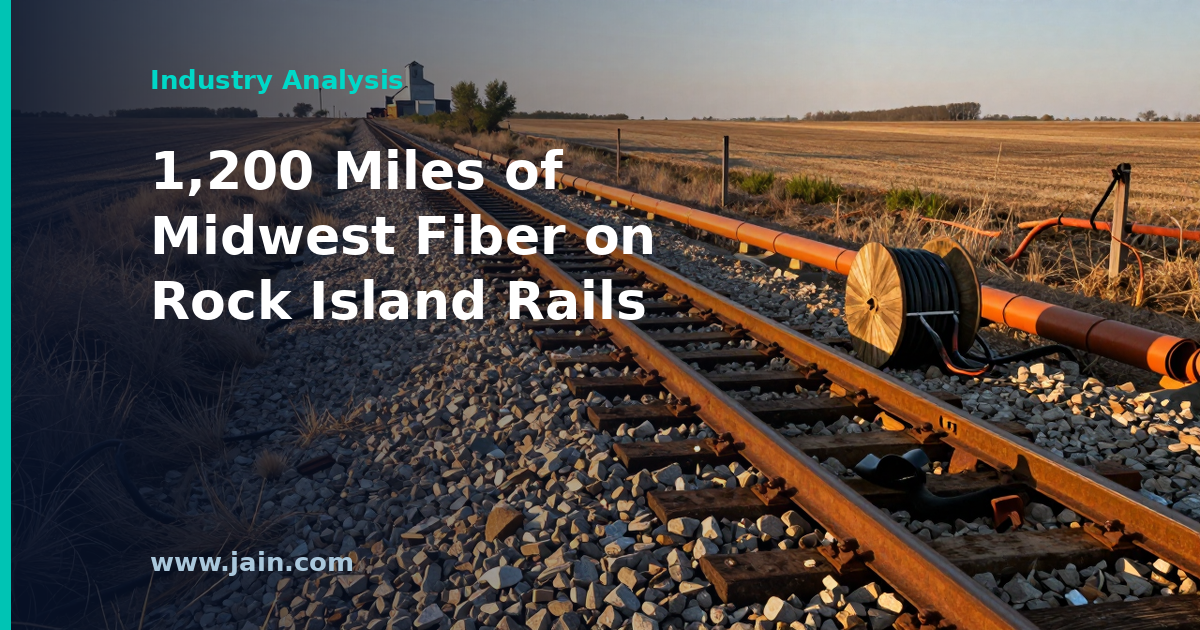
Midwest Fiber Networks (MWFN) and Midwest Fiberpath, LLC, together with Fiberpath partner Hawkeye Land Co., announced on August 27, 2026 an agreement to develop and commercialize approximately 1,200 miles of fiber corridors connecting Chicago, Omaha, Minneapolis and Kansas City. The announcement was issued from Glendale, Wisconsin and Cedar Rapids, Iowa.
Under the agreement, MWFN becomes the key provider supporting commercialization and delivery of connectivity services across Hawkeye’s right-of-way corridor, with planned offerings spanning conduit, dark fiber and scalable lit services for carriers, hyperscalers, data centers, enterprises, utilities, and public- and private-sector organizations. Construction is anticipated to begin in Spring 2027; the parties say the project is in advanced engineering and materials procurement, with shipments scheduled before the end of 2026.
Executive Summary
The headline number is 1,200 miles of long-haul fiber route across the middle of the country. The more interesting number may be 106 — the count of Midwest counties in four states where Hawkeye Land Co. says it holds the exclusive, perpetual right to grant easements along former Rock Island Railroad corridors. That includes rail corridors running from Council Bluffs to Joliet and from Minneapolis to Kansas City. In long-haul fiber, the hardest thing to buy is not glass or conduit; it is a continuous, legally clean path across hundreds of separate landowners and jurisdictions. This agreement is essentially an attempt to convert a 40-year-old land-rights portfolio into a telecom platform.
Why it matters: the AI buildout is pushing compute into secondary and tertiary markets — places chosen for power availability and land, not for network density. Those sites are only as useful as the routes that connect them, and in the Midwest a large share of legacy long-haul capacity funnels through Chicago. A route system with north–south and east–west legs that meet somewhere in the middle of Iowa rather than in Cook County changes the shape of what buyers can procure, and gives network planners a genuinely distinct path to price against.
What is not yet established: the release discloses no capital cost, no financing structure, no anchor customers, no conduit or fiber counts, and no in-service date. It describes an agreement and an intent, backed by a stated procurement position. Those are meaningful signals — materials orders are harder to fake than a press release — but they are not the same as a funded, contracted build. Buyers should treat this as a credible route under development, not as available inventory.
Route Diversity Is the Quiet Half of the AI Buildout
Most coverage of AI infrastructure focuses on the compute: the campuses, the megawatts, the cooling. The connectivity layer gets less attention because it is less photogenic, but it constrains the same outcomes. A training cluster needs to ingest and checkpoint enormous datasets; an inference site needs low, predictable latency to the users and applications it serves. Both need to reach the interconnection points where carriers and cloud providers exchange traffic. Put a facility in a secondary market with cheap land and available power, and you have solved the expensive problem while creating a new one — the site is stranded unless multiple physically separate fiber paths reach it.
“Route diversity” is the industry term for that separation. Two circuits sold as redundant are only redundant if they ride different physical paths; if both traverse the same bridge, the same conduit bank, or the same metro chokepoint, one backhoe or one building fire takes out both. In the Midwest, a great deal of legacy long-haul was engineered to converge on Chicago, historically the region’s dominant interconnection hub. That concentration is efficient until it isn’t. The announced corridor is pitched squarely at this problem, and the endpoint pairs Hawkeye names — Council Bluffs to Joliet, Minneapolis to Kansas City — describe an east–west leg and a north–south leg that cross well outside the Chicago metro.
It is worth being precise about the claim, though. Chicago is explicitly one of the four markets the corridor connects, and the Council Bluffs–Joliet leg terminates in the Chicago area. The value proposition is not “avoid Chicago”; it is “reach Chicago on a path other people are not using, and reach Minneapolis or Kansas City without going through Chicago at all.” That is a narrower but more defensible pitch, and it is the one that matters to a network planner filling out a diversity matrix.
The Asset Is the Right-of-Way, Not the Glass
Fiber cable is a commodity. Splicing crews are a commodity. Continuous, permitted, long-term access to a linear path across four states is not. Hawkeye Land Co. has been in the business of selling crossing and longitudinal easements along former Rock Island corridors since 1985, which means the entitlement work that usually dominates a greenfield long-haul schedule — negotiating with hundreds of landowners, counties and agencies, one parcel at a time — is substantially pre-solved. That is the economic core of this deal, and Hawkeye’s CEO Rick Stickle framed it in exactly those terms, calling the partnership “the highest and best” use of the company’s property rights.
The structure also explains the division of labor. Hawkeye holds the land rights but is not a telecom operator. Fiberpath is positioned as the corridor platform developer — a managed right-of-way system built for blank conduit and dense fiber deployments. MWFN brings the operating side: regional carrier relationships, service delivery, and the customer-facing commercial motion. Each party contributes the thing it would otherwise have to spend years and considerable capital acquiring. That is a sensible structure, and it is a common one in digital infrastructure, where land-rights holders increasingly partner rather than build.
The risk in this shape is coordination. Three parties, three balance sheets, and revenue that arrives over decades in the form of long-dated capacity contracts. The release does not describe how economics are shared, whether MWFN’s role is exclusive, or what happens if one party wants to sell. None of that is unusual to withhold, but all of it affects how much confidence a large customer can place in a 20-year commitment on this route.
Three Products, Three Different Businesses
The announced service set — conduit, dark fiber, and lit services — reads as one offering but is really three businesses with different capital profiles and different buyers. Empty conduit is the rawest form: a buried plastic pipe a customer can blow its own cable through, typically sold to hyperscalers and large carriers who want to control their own fiber and upgrade it on their own schedule. Dark fiber is unlit strand: the customer supplies the optical electronics and gets full control of capacity, latency and encryption, which is why it appeals to operators building at scale. Lit services are finished bandwidth — the provider runs the equipment and sells a circuit at a stated speed.
The economics run in the opposite direction from the sophistication. Conduit and dark fiber sales, often structured as long-term indefeasible-right-of-use agreements with substantial payment up front, are how corridor projects fund construction; they convert future revenue into present cash at the moment it is most needed. Lit services carry higher margins over time but require ongoing equipment investment, network operations, and a sales motion into a fragmented enterprise market. A route system that can sell all three has more ways to monetize each mile — but the first and largest deals almost always come from the conduit and dark-fiber end, which is exactly where hyperscaler demand currently sits.
What Is Substantiated, and What Is Framing
Two things in this release carry real weight. First, the Hawkeye rights are specific and checkable: an exclusive, perpetual easement-granting position across named corridors, held and commercially exercised for more than 40 years. Second, the procurement statement — advanced engineering and materials shipments scheduled before the end of 2026, ahead of a Spring 2027 construction start — implies committed spending. Companies do not typically order long-lead fiber and conduit materials for routes they are not serious about.
Other elements are framing rather than fact. This release does not mention AI at all; the AI positioning comes from a companion Fiberpath announcement describing the same 1,200 miles as a “center-noded, multi-direction AI backbone.” That is a legitimate market read — AI demand is genuinely reshaping long-haul procurement — but readers should note it is the same asset described twice for two audiences, not two separate developments. Similarly, phrases like “key provider supporting the commercialization” describe a commercial role without defining its scope or exclusivity.
An even-handed summary: this is a well-structured deal built on an unusually strong underlying asset, announced at the agreement stage with normal commercial confidentiality. It is not thin marketing — there is a real land-rights position and a stated procurement commitment behind it. It is also not yet a proven route. The distance between “agreement to advance” and “lit and sellable” is measured in years, and the milestones that would close that gap have not been published.
Background
The Chicago, Rock Island and Pacific Railroad ceased operations in 1980, and its corridors were broken up and sold. Hawkeye Land Co. was formed in 1985 around a durable piece of that estate: the exclusive, perpetual right to grant easements along the former Rock Island corridors across 106 Midwest counties in four states. For four decades that position has generated revenue from utilities and municipalities buying crossing and longitudinal easements. Railroad rights-of-way have long been prime telecom real estate for the same reason they were good railroad routes — they are straight, continuous, gently graded, and already assembled.
The current interest in Midwest long-haul reflects where compute is going. Power availability, land cost and cooler climates have pushed data center development into Iowa, Nebraska, Wisconsin and the Dakotas, away from the coastal and Northern Virginia clusters. Those sites need long-haul routes that did not exist when the region’s fiber map was drawn around Chicago in the late 1990s and early 2000s. Several developers are now trying to monetize legacy linear rights-of-way to serve that demand; this agreement is one of them.
Charter Communications (NASDAQ: CHTR) announced on August 20, 2026 that it has completed its acquisition of Cox Communications and its concurrent merger with Liberty Broadband, creating what it describes as the nation’s leading broadband and video company. Cox Enterprises received roughly $5 billion in exchangeable partnership units, $6 billion in convertible preferred units carrying a 6.875% coupon, and about $4 billion in cash, and now owns approximately 26% of the combined company on a fully diluted basis. Alex Taylor, CEO of Cox Enterprises, becomes Charter’s Chairman.
The Spectrum brand, pricing, and packaging will launch in all former Cox markets in mid-September, and Spectrum is immediately offering Cox internet customers a free mobile line for one year. Roughly $12 billion of Cox debt and finance leases remains outstanding at Charter subsidiaries.
Executive Summary
The twin closings resolve two long-running structural questions in US cable at once. The Cox transaction folds the largest family-owned cable operator into Charter’s partnership structure, extending the Spectrum footprint to 45 states. The Liberty Broadband merger collapses John Malone’s holding-company stake into direct Charter ownership: Liberty shareholders received 0.236 Charter shares per Liberty share, Charter retired the 38.6 million shares Liberty held, and the swap actually reduced Charter’s share count by about 4.7 million shares while cleaning up a decade-old ownership overhang.
For customers and communities, Charter is promising a rapid rebrand — Spectrum pricing in all Cox markets by mid-September — plus service commitments phased in over the next year and a workforce transition over 18 months, including a fully US-based customer service function and a $20-per-hour starting wage. For the broader connectivity market, the deal concentrates last-mile broadband, enterprise fiber (via Cox’s Segra unit), and managed cloud services (via RapidScale) under one operator at a moment when cable is defending its core business against fiber overbuilders and fixed wireless.
The release frames the transaction as benefiting “customers, local communities, employees and shareholders.” Some of those benefits are concrete and dated; others are marketing framing that will only be testable once Spectrum’s actual Cox-market pricing lands in September.
Scale Is the Strategy — and the Defense
Charter CEO Chris Winfrey’s framing is candid by press-release standards: regional providers are now “competing with national and even global connectivity and entertainment companies,” and scale is the response. Cable’s traditional local-monopoly economics have eroded as fiber builders and mobile carriers selling fixed wireless access — home broadband delivered over 5G networks — compete for the same households. Adding Cox’s markets gives Charter more households over which to spread programming costs, network investment, and its mobile offering, which resells capacity while offloading traffic onto its roughly 45 million WiFi access points.
The immediate customer-facing move — a free mobile line for a year for Cox internet customers — shows the playbook. Mobile bundling raises switching costs: a household with two or three Spectrum mobile lines attached to its internet plan is far less likely to churn to a fiber or fixed-wireless rival. Whether the mid-September launch of Spectrum’s “simple and transparent pricing” leaves former Cox customers paying less overall is the claim to watch; the release promises “greater value and more opportunities to save” but publishes no rate card, and the $1,000 savings guarantee is asserted without its qualifying terms.
The Deal Economics: Equity-Heavy, but Not Debt-Free
The Cox consideration is structured to keep the family invested rather than cashed out: about 33.6 million exchangeable partnership units (roughly $5 billion implied value), $6 billion of convertible preferred units paying a 6.875% coupon, and only about $4 billion in cash. In aggregate Charter issued the equivalent of just over 46 million shares, leaving Cox Enterprises with approximately 26% of the combined company and the chairmanship. That is a strong signal of alignment — but it also creates a dominant strategic shareholder alongside Advance/Newhouse, which retains its two board seats. Governance now runs through an amended stockholders’ agreement with preemptive rights and voting caps.
On the liability side, approximately $12 billion of Cox debt and finance leases remains outstanding at Charter subsidiaries, and the 6.875% preferred coupon is a real ongoing cost in a business that is capital-intensive by nature. The Liberty side is comparatively tidy: Charter assumed about $840 million of net debt to be repaid shortly after closing and $180 million of preferred equity, while the share retirement actually shrank the float. The release does not disclose synergy targets, integration costs, or pro forma leverage — the numbers analysts will most want.
The Enterprise and Backhaul Layer: Segra and RapidScale
Buried beneath the consumer messaging is the piece most relevant to infrastructure operators: Charter now controls Cox Business alongside Segra, Cox’s super-regional fiber provider serving commercial enterprise and carrier customers, and RapidScale, its managed cloud services arm. Fiber backhaul — the high-capacity middle-mile links that connect cell sites, enterprise campuses, and data centers to internet exchange points — is a market where carrier diversity directly affects pricing and resilience. Consolidating a super-regional fiber player into the largest cable footprint changes the negotiating landscape for wholesale buyers in those regions.
For data center operators and carriers that buy transport from multiple providers, the practical questions are whether Segra continues to operate as a carrier-neutral-friendly wholesale seller, and whether combined Spectrum Business/Cox Business go-to-market changes enterprise pricing. The release says businesses “of all sizes” will benefit but offers no specifics on wholesale strategy, Segra’s operating independence, or network integration plans — all material to anyone with backhaul contracts in the affected regions.
Integration Risk on an Aggressive Clock
Charter has set unusually specific public deadlines: Spectrum’s full product suite in all Cox markets by mid-September, customer service commitments (24/7 US-based support, same-day technician dispatch for pre-5pm requests, credits for outages over two hours) within a year, and the full workforce-model conversion — including returning Cox’s customer service function entirely to the US — within 18 months. Rebranding and repricing millions of customer relationships in weeks is operationally demanding; billing migrations and packaging changes are historically where cable integrations generate churn and complaint spikes.
The employee proposition is one of the release’s more concrete sections: a $20 minimum starting wage, medical coverage for part-time as well as full-time staff, a 401(k) match up to 6%, tuition-free degree programs, and an employee stock purchase plan with RSU matching. These are verifiable commitments with numbers attached. What the release does not address is whether overlapping corporate, network, or back-office functions will see consolidation — a standard question in any merger of this size that the document simply leaves unasked.
Background
Charter Communications, operating under the Spectrum brand, is one of the largest US cable broadband and video providers, built up through the 2016 acquisitions of Time Warner Cable and Bright House Networks — a deal in which Advance/Newhouse contributed its operations to Charter’s partnership and took board seats it retains today. Liberty Broadband, chaired by cable investor Dr. John Malone, had been Charter’s anchor strategic shareholder since first investing more than a decade ago; the merger announced in late 2024 collapses that holding-company structure. Cox Communications, part of the Cox Enterprises family business, was the largest privately held US cable operator, and the combination announced in May 2025 marks the Cox family’s shift from sole owner to Charter’s largest shareholder.
The transactions close against a broadband market in transition: cable operators face sustained competitive pressure from telecom fiber builds and fixed wireless access, and have leaned on mobile bundling and rural expansion to defend subscriber bases — the strategic backdrop Charter’s leadership explicitly cites in justifying the deal’s scale.
Two of the undersea internet cables that link Australia to the rest of the world stopped working off Perth on the same weekend. Only 16 such cables connect the entire country.
At the same time, a tanker ship managed from the United Arab Emirates was tracked sailing back and forth in loops over the protected strip of seabed where the cables lie. The cable company says this could be coincidence and has asked federal police to investigate.
The bigger problem is that the cables had no built-in fault sensors. Nobody can say what broke them until a repair crew physically inspects them.
The Maritime Executive reported on August 13, 2026, that fiber operator Subco lost two subsea cables back-to-back over the preceding weekend. Both breaks occurred inside a government-designated cable protection zone off Perth, Western Australia. At about the same time, a UAE-managed product tanker (a ship that carries refined fuels) sailed an unusual racetrack pattern over the charted cable area and crossed it several times. Security consultancy Windward independently validated the vessel’s presence and identity.
Subco founder and CEO Bevan Slattery said the ship’s activity may be a coincidence. He nonetheless urged the Australian Federal Police to investigate urgently and said this could be the second such incident in a federally declared cable protection zone. The cables had no automatic diagnostic systems, so Subco will not know the root cause, including whether an anchor was dragged across the seabed, until it arranges a physical inspection.
Executive Summary
Australia’s international connectivity runs through 16 subsea cables, and two of them went down together off Perth. The breaks happened in a zone where anchoring and certain fishing are restricted precisely to protect cables. A tanker was moving back and forth overhead at the time, and surface conditions were benign. That combination made the operator raise the possibility of a security incident rather than treat the outage as routine maintenance.
The more consequential detail is operational. Because the cables lacked automatic diagnostics, Subco cannot yet tell an accidental anchor drag from deliberate interference. Anchor drag alone causes about a third of cable breaks worldwide, according to the International Cable Protection Committee. Until a repair ship reaches the fault, investigators, insurers, customers and policymakers have to act without knowing which kind of event this was.
For anyone running data centers or cloud services that depend on international routes, the difference matters. An accident is a random event that route diversity absorbs. A deliberate act can recur and can target several cables at once, and that changes how much redundancy is enough.
Two Out of Sixteen Is Not a Rounding Error
Subsea cables carry the overwhelming majority of intercontinental data traffic. That includes the traffic that lets Australian businesses reach cloud regions and AI services hosted overseas, and lets local data centers serve customers across the Indian Ocean and Asia. With just 16 cables linking Australia to the world, losing two at once removes a significant share of the country’s international paths. The Maritime Executive described that as a substantial security event.
Geography sharpens the problem. Perth is Australia’s western gateway, and cables landing there take routes toward Asia and the Middle East that east-coast systems do not. When two breaks cluster in the same protected corridor, traffic has to shift onto fewer routes. That can mean longer paths, higher latency (the delay data experiences in transit) and less spare capacity if anything else fails before repairs are complete.
The Real Gap: Nobody Can Yet Say What Happened
The detail that should concern infrastructure operators most is that Subco’s cables had no automatic diagnostic systems. Without them, the operator knows the cables stopped carrying light but not why. It has to send a vessel to locate the fault, lift the cable and examine the damage before it can distinguish an anchor strike from a snag, a fishing gear incident or deliberate cutting. Until then, the circumstantial evidence is all anyone has: back-to-back breaks, a ship making multiple crossings in a racetrack pattern, and calm surface conditions that remove bad weather as an easy explanation.
This attribution delay has direct consequences for data center and cloud operators. Resilience planning for subsea routes has traditionally assumed faults are independent accidents. Under that assumption, buying capacity on two or three diverse cables makes a simultaneous outage very unlikely. That math weakens if breaks can be deliberate and coordinated, because a single actor can hit several cables in one corridor, as two breaks in one protection zone illustrates. An operator that cannot tell which kind of event it is facing cannot tell whether its redundancy is adequate. It also cannot tell whether the same corridor is safe to rely on while repairs proceed.
The same gap slows everyone downstream. Police cannot easily build a case, insurers cannot assign a cause, and governments cannot calibrate a response. Slattery asked the Australian Federal Police to move urgently, and the physical evidence on the seabed is what any investigation will ultimately depend on.
Weighing the Evidence on Both Sides
The case for concern is real but circumstantial. The vessel’s track and timing match the breaks, Windward validated its identity and presence, and Slattery noted this could be the second incident in a federally declared zone. Researchers are also warning about the broader pattern. ASPI’s David Brewster told ABC that many recent cable cuts in Europe and around Taiwan were, in his view, fairly obviously the work of Russia and China. A new review from the Australian National University’s National Security College concludes that state actors appear to be probing cable infrastructure in peacetime so they could degrade connectivity quickly at the start of a conflict.
The case for caution is equally worth stating. Slattery himself twice said the ship’s behavior may be a coincidence. Anchor drag is a common, ordinary cause of cable damage. Brewster’s remarks concerned incidents elsewhere, not this one, and he acknowledged it is difficult to be certain in some cases. A tanker managed from the UAE is not evidence of any state’s involvement. Unusual vessel movements can have commercial or navigational explanations that have not yet been aired. The fair reading is that the incident warrants investigation, not that its cause is known.
What Operators and Buyers Should Take From It
For cable owners, the lesson is that monitoring is now part of the security posture, not just a maintenance convenience. Fault-location and fiber-sensing systems that can flag disturbances as they happen would shorten the window in which an event goes unexplained. Tracking vessel behavior over protection zones as it happens would help too. Protection zones deter accidental damage by lawful mariners, but they do not stop a ship that ignores them. Enforcement depends on noticing quickly.
For data center and enterprise buyers of international capacity, the practical questions are about correlation, not just redundancy. Are the backup routes physically separate from the primary ones, or do they share the same seabed corridor or landing point? How quickly can capacity be restored, and how many repair vessels are available in the region? Those answers now matter as much as headline bandwidth.
Background
Subsea cables are bundles of optical fiber laid along the seabed that carry most of the world’s intercontinental internet and data traffic. They are built to last decades but are physically exposed. Ship anchors and fishing gear are the most common causes of damage, and repairs require specialized vessels that are in limited supply. Australia’s geographic isolation makes it unusually dependent on a small number of these systems, and the government declares cable protection zones off major landing points to restrict risky activity near them.
Subco is an Australian subsea cable operator founded by Bevan Slattery, a long-time builder of Australian digital infrastructure. Concern about deliberate cable damage has grown since a series of incidents in the Baltic Sea and around Taiwan over the past several years. Security researchers there have pointed to state actors seeking disruption while keeping deniability, and that context is why every unexplained break now draws closer scrutiny.
Nvidia, the company whose chips run most of today’s artificial intelligence, is the main customer for 16 new fiber-optic cable routes that Zayo is building across the United States.
These cables are bundles of glass strands buried underground that carry data between cities. Zayo is laying them where there is enough electricity for the giant computer warehouses that AI needs.
A rival network company says new long-distance cable usually loses money. Zayo’s answer was to sign a very large customer before digging. Neither company has said what it costs.
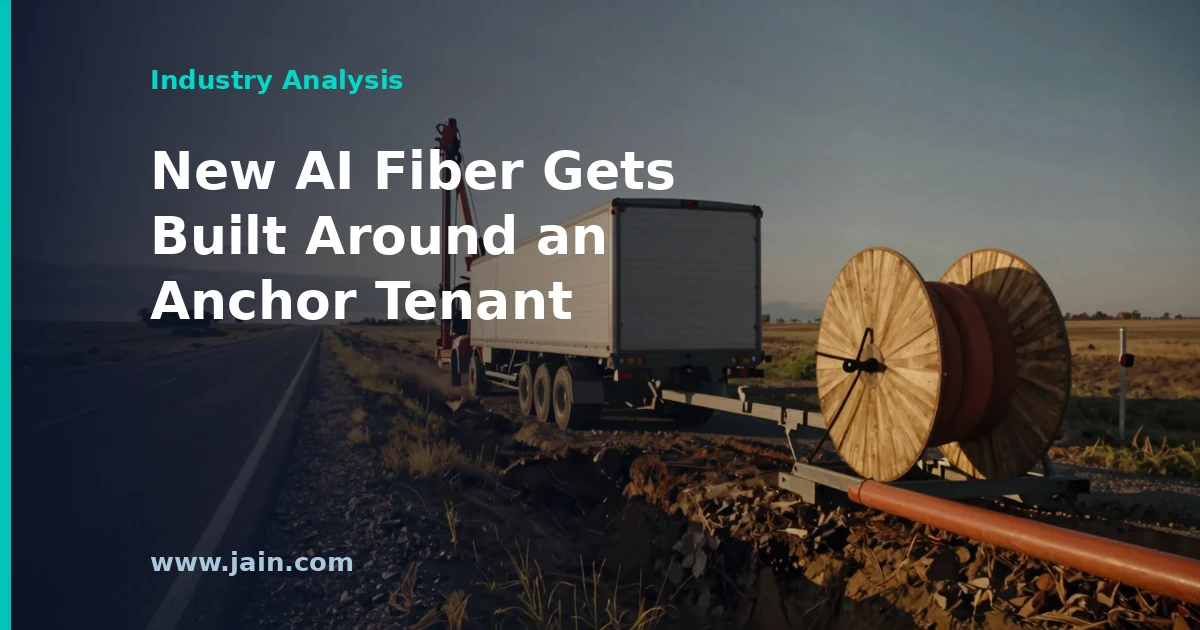
Zayo Group has confirmed that Nvidia is the anchor tenant behind the “monster deal” it first described in April, when chief product and strategy officer Bill Long said the company was building 8,000 more route miles of fiber. Zayo executives told Fierce Network on August 7 that, in partnership with Nvidia, Zayo is building 16 new long-haul fiber routes in high-growth AI corridors across the U.S.: six entirely new (greenfield) routes and ten overbuilds that add fiber along existing Zayo paths. Nvidia is also leasing fiber on eight other Zayo long-haul routes that already had enough capacity.
The program runs for several years, with the first routes expected as early as 2027 and the full set by 2030. Zayo declined to disclose the cost of the build or how much Nvidia is investing, saying only that it is “good business with an attractive return profile.”
Executive Summary
The world’s dominant AI chip supplier has become the named anchor customer for one of the largest new long-haul fiber builds in the United States. Long-haul fiber is the cable that links cities and regions, as opposed to the metro fiber inside a single city. Nvidia’s involvement spans 24 Zayo routes in total: six new, ten upgraded and eight leased as they stand.
The announcement matters because it arrived the same week Lumen Technologies’ CFO, Chris Stansbury, said the economics of building new long-haul routes “stink” and that Lumen had walked away from several such deals. Lumen’s one exception, a Seattle-to-Minneapolis route called NorthLine, works financially because a partner is sharing it. Zayo’s Nvidia deal follows the same pattern. New intercity fiber for AI is getting built where a large, committed customer underwrites the route before construction begins.
Zayo also says the routes were chosen by mapping where electrical power is available for future data centers, and that the conduit is sized well beyond Nvidia’s own needs. That makes the build relevant to every data center developer and cloud operator siting capacity along these corridors.
Why an Anchor Tenant Changes the Math
Building a new long-haul fiber route is expensive long before it earns anything. Zayo’s executives described what the work involves: dealing with hundreds of municipalities, regulators and permitting bodies, and coordinating multiple construction contractors. The money goes out during construction, while lease revenue arrives gradually over years. If a route is built on speculation and demand arrives slowly, the builder pays to finance an asset that is sitting idle.
Lumen’s comments show this risk plainly. Stansbury said Lumen has “stepped away from a number of deals” because shareholder returns on greenfield routes are “awful.” Yet Lumen is building NorthLine because a partner, which it has not named, makes “the economics for that actually very good.” Zayo’s position rests on the same mechanism. With Nvidia committed as anchor tenant across 16 new or upgraded routes plus eight existing ones, Zayo starts construction with a large share of demand already contracted. It describes the result as an attractive return. The two companies reach opposite verdicts on greenfield fiber in general, but they agree on the condition that makes it work: a committed buyer before the trench is dug.
This is a pattern in two data points, not a law of the market. Zayo also argues that its experience building new routes over the past seven or eight years gives it a cost and execution edge competitors lack. Because neither the cost nor Nvidia’s commitment has been disclosed, outsiders cannot check the return claim. What they can see is that the one greenfield build each company is pursuing has a large partner behind it.
Fiber Is Now Following the Power Map
Long said Zayo began seeing sharply higher long-haul demand about two years ago, in the form of orders for far higher fiber counts than before. The company responded by analysing where electrical power was available across the U.S. and concluding that those corridors were where bulk fiber would be needed. Bulk fiber means large quantities of strands sold to a few big users rather than small circuits sold to many.
This reverses the traditional logic of long-haul networks, which were drawn between population centers and internet exchange points. AI data centers need hundreds of megawatts of electricity, and that power is scarcer than land or fiber, so it now decides where these facilities go. Fiber is being planned to meet them there. For developers, a site with both secured power and a new high-count fiber route nearby becomes more valuable. For utilities and regional economic planners, a new route can signal that data center projects are expected to follow.
Built Bigger Than One Customer
Zayo CEO Steve Smith said popular routes will carry at least 1,728 fibers, and that the conduit going into the ground can support up to 20,000. Conduit is the protective pipe that cables are pulled through, and it can be filled with more fiber over time. Long said Nvidia wanted a build package that would serve “the rest of the ecosystem” as well as its own use.
For Zayo, oversizing the conduit turns an anchor-backed build into a multi-tenant asset. Pulling additional cable through existing conduit is typically far cheaper than new trenching, so every later customer on the route improves returns on the original construction. Cloud providers, newer GPU-cloud operators and other carriers would all be potential buyers. The main risk is timing. With completion stretching to 2030, the build depends on AI data center demand in these corridors holding up for years.
Mostly Upgrades, Not Blank-Slate Builds
Of the 24 routes Nvidia is using, only six are true greenfield builds. Ten are overbuilds on existing Zayo fiber, and eight needed no new construction at all. Overbuilds can typically draw on existing paths and permissions, which reduces permitting risk and cost compared with new routes. That mix suggests the deal leans heavily on Zayo’s existing footprint. It also suggests the greenfield portion, which Lumen called hardest to finance, is the smaller share of the program.
Background
Zayo Group is a U.S. fiber infrastructure provider that sells bandwidth and bulk fiber to carriers, cloud providers and large enterprises. Its executives say it has been the only company building new long-haul routes at scale in the U.S. over the past seven or eight years. It has also grown through acquisitions, including a $4.25 billion fiber deal with Crown Castle. Zayo reports that AI has driven a sharp rise in long-haul demand, with customers ordering much higher fiber counts than in the past.
Nvidia is the leading supplier of the processors used to train and run AI models, and its customers are building large data centers wherever power is available. Lumen Technologies, formerly CenturyLink, operates one of the largest U.S. fiber networks and competes with Zayo for AI-driven long-haul demand.
Verizon, best known for phone service, will supply Google with unused fiber-optic cable in a deal worth more than $1 billion. Fiber-optic cables are glass lines that carry internet traffic as pulses of light.
Google needs the cable to link its data centers, the warehouse-sized buildings full of computers that run artificial intelligence. Those buildings must constantly swap huge amounts of data.
The surprise is that much of this cable was laid for an older internet. Artificial intelligence has turned it into something worth a fortune, and Verizon says more deals worth billions are coming this year.
Verizon Communications has signed a dark fiber agreement with Alphabet’s Google worth more than $1 billion, Quartz reported. CEO Dan Schulman disclosed the deal on Verizon’s second-quarter earnings call on Friday, July 24, 2026. Under the agreement, Verizon will provide dark fiber to connect Google’s data centers.
Schulman said Verizon expects to announce additional AI infrastructure agreements by year-end that would generate multiple billions of dollars in revenue over the next several years. Verizon shares rose more than 3% in Friday’s opening trade, and Alphabet’s Class A shares gained about 1%.
Executive Summary
Verizon is selling Google access to dark fiber, meaning optical cable with no transmission equipment attached, which Google will light with its own gear to link its data centers. The disclosed value is more than $1 billion. Schulman called the announcement “consequential” and a preview of where Verizon’s revenue trajectory is headed.
The deal matters beyond one contract. Schulman argued that Verizon’s long-haul and metro fiber, originally built for a different technological era, now fits precisely what is needed to connect AI data centers, compute clusters and geographic regions. If he is right, fiber routes already in the ground are becoming a strategic input to AI buildouts, alongside power and chips, and carriers holding those routes gain a new class of long-term customer.
What remains unproven is scale. One deal is disclosed; the “multiple billions” are a forecast. The year-end pipeline is what will show whether this is a durable revenue line or a single large transaction.
Why Fiber Built for Another Era Now Sells as AI Infrastructure
Dark fiber is the rawest form of network capacity a carrier can sell: strands of glass with no lasers or routers attached. The buyer installs its own optical equipment at each end, decides how much data to push through, and upgrades on its own schedule. For a company like Google, that means the capacity between its sites is set by its own engineering choices rather than by a carrier’s service tiers, which is why large cloud operators favor it for their most important links.
AI changes how much those links matter. Large AI workloads increasingly span multiple buildings and regions, so data centers must move enormous volumes of data between one another. Schulman’s claim is that Verizon’s network, though built for an earlier era, fits “precisely” what is needed to link AI data centers, compute clusters and geographic regions. The operational point is that the glass itself is rarely the scarce part. The scarce parts are the installed routes, rights-of-way and permits, which take years to assemble and which an incumbent carrier already holds. A more-than-$1 billion commitment from Google is a concrete price signal that those existing routes now carry AI-era value.
That reprices assets across the industry. Other owners of long-haul fiber now have a public comparable for what a hyperscaler will commit. Data center developers have another reason to weigh proximity to established fiber corridors alongside power availability. And for hyperscalers, leasing proven routes is one way to connect new campuses without waiting on new construction.
A Billion-Dollar Headline Without the Fine Print
Markets took the news seriously. Verizon stock rose more than 3% at Friday’s open, a notable move for a large, mature telecom carrier, and Alphabet’s Class A shares gained about 1%. Investors appear to be reading the deal as evidence that Verizon can earn growth revenue from assets it already owns, rather than only from its consumer wireless business.
The economics are harder to judge than the headline. “More than $1 billion” does not say over how many years that value is earned, how many route miles or strands are involved, or whether payment is largely upfront or spread across the term. Dark fiber deals can carry attractive margins when the cable is already in the ground, but Verizon has not said how much new construction, such as short connecting routes to Google’s sites, the agreement requires. Those details determine whether this is a high-margin monetization of sunk investment or a capital project with a customer attached.
The Year-End Test for Verizon’s AI Pitch
Schulman framed Google as the beginning, not the peak. He said additional agreements expected by year-end would generate multiple billions of dollars in revenue over the next several years, describing them as stable, extended-term arrangements with some of the most technically rigorous customers in infrastructure. That is a specific, checkable commitment, and it will define how the Google deal is judged.
There are structural limits to watch. Dark fiber inventory is finite: a strand provided to one customer is not available to another, so sustained growth eventually depends on how much spare capacity Verizon holds on the routes AI customers want, or on building more. Hyperscalers also have alternatives, including other fiber owners and their own construction, which will shape pricing. None of this undercuts the Google deal; it frames the question of whether a network built for an earlier era can supply AI demand at the scale Schulman describes.
Background
Verizon Communications is one of the largest US telecom carriers, known mainly for wireless and broadband service. It also owns long-haul fiber connecting cities and regions and metro fiber within urban areas. Schulman, now CEO, argues that this network, originally built for a different technological era, suits the connectivity needs of AI data centers.
Google, owned by Alphabet, is one of the hyperscalers building large-scale AI infrastructure. As AI computing spreads across multiple campuses and regions, the network links between data centers have become a strategic requirement. Large cloud operators commonly buy dark fiber on long-term agreements and light it with their own equipment, keeping control of capacity and upgrades.
Two companies behind the cables inside the giant computer buildings that run artificial intelligence have signed a ten-year deal. Molex, a maker of connectors, will supply its customers with glass-fiber cable made by Prysmian, one of the world’s biggest cable makers.
Prysmian says it will spend $1.43 billion to more than double how much fiber it makes in the United States, adding about 600 American jobs. The money reaches all the way back to the first step: making the glass rods that fiber strands are pulled from.
Artificial intelligence runs on light moving through these hair-thin threads, and big buyers now want supply promised a decade ahead.
Molex and Prysmian have entered a 10-year supply agreement to expand fiber connectivity for AI data centers, Lightwave reported on July 21, 2026. Under the arrangement, hyperscalers (the largest cloud and internet operators) and data center builders can secure Prysmian fiber cable supply through Molex.
Alongside the agreement, Prysmian will invest $1.43 billion to extend fiber cable production at U.S. plants, including the glass preform stage, which it says will more than double its domestic fiber capacity. The company expects to create 1,000 jobs worldwide, 600 of them at U.S. manufacturing sites.
Executive Summary
The deal pairs a connectivity specialist with one of the world’s largest cable manufacturers for a decade. Molex CEO Joe Nelligan called it “a strategic expansion in the U.S., bringing increased capacity to support the growing demand for data center solutions.” Prysmian CEO Massimo Battaini said the agreement and capacity investments “strengthen our leadership in data centers.”
What makes the announcement more than a distribution tie-up is where the money goes. Prysmian’s investment reaches upstream to preform, the glass that every strand of fiber is drawn from. That is the step that determines whether new cable capacity is real or merely a reshuffling of existing output, and it is why a ten-year term makes sense for both sides.
For data center buyers, the agreement adds another source of fiber connectivity in a market where Corning has already signed a string of large partnerships. For Prysmian, it marks a push from grid, long-haul and submarine cable into the fiber that runs inside data centers, a segment it forecasts will add $11 billion of value through 2035.
Why AI Fiber Capacity Starts at the Glass Preform
Optical fiber begins as a preform: a thick rod of ultra-pure glass that is heated and drawn into strands thinner than a human hair, which are then bundled and jacketed into cable. The sequence matters. A manufacturer can add cabling lines, but unless it buys glass from someone else, the amount of fiber it can ship is capped by how much preform it can make. So the most telling detail in this announcement is not the $1.43 billion figure itself but where it is spent: extending U.S. production “including the glass preform stage,” with the stated result of more than doubling Prysmian’s domestic fiber capacity.
Doubling fiber output without more preform would simply move the constraint one step upstream. Glass-making capacity is a long-lived asset, and a commitment of this size is easier to underwrite against a long contract than against spot orders. The ten-year term lines up with that logic, and with Prysmian’s own planning horizon, which runs to 2035.
The people affected are those who buy connectivity for AI clusters, where large numbers of processors and switches are linked by fiber. Customers who source through Molex gain access to supply backed by new glass capacity rather than a reallocation of existing cable. The broader lesson for buyers is practical: a fiber or connectivity supply promise is only as firm as the preform behind it, and where a supplier’s glass comes from is now a fair question in any procurement discussion.
Molex Turns Itself Into a Route to Fiber Supply
Molex is best known for connectors, not glass. The agreement repositions it as a channel through which hyperscalers can lock in fiber cable, with both companies stressing “supply chain optionality and resilience through diversified sourcing” and improved lead-time reliability. The company describes the deal as one pillar of a broader global strategy to scale fiber cable supply, which suggests Molex intends to add further sources rather than rely on one.
The more interesting fit is with Molex’s work on co-packaged optics (CPO), which places optical connections directly beside a processor or switch chip instead of in pluggable modules at the edge of the equipment. That shortens the electrical path, which matters as AI systems push more data between chips. Molex recently completed its acquisition of Teramount, a fiber-to-chip connectivity provider, and has expanded its CPO interconnect toolkit. A vendor that controls both the connection at the chip and a long-term supply of the cable leading to it can offer customers a more complete package than either piece alone.
Corning Has Already Drawn the Map
Molex and Prysmian are following a pattern rather than inventing one. Corning has secured multi-billion-dollar partnerships across nearly every layer of the AI connectivity chain: a service provider (Lumen), cloud and data center operators (Amazon and Meta), GPU maker NVIDIA, chip designer Broadcom and connector maker US Conec. The common thread is fiber producers tying their manufacturing to the companies that design, buy and install AI infrastructure, years in advance.
For buyers, a second vertically linked supply chain is useful in its own right: it provides an alternative, and with it some negotiating leverage, when demand is outrunning manufacturing. For Prysmian, the agreement extends a business built on power grid cable, long-haul digital links and submarine telecom into the “inside” data center market, which it expects to grow with modernization cycles for performance and energy efficiency, AI-driven architecture changes and higher fiber density.
What the Numbers Do and Do Not Establish
Several figures in the announcement are firm commitments: a ten-year agreement, a $1.43 billion investment, a doubling-plus of U.S. fiber capacity, and 1,000 expected jobs, 600 of them in the U.S. Others are forecasts. Prysmian values the data center segment at $11 billion on an incremental basis through 2035 compared with 2025, including $1 billion of yearly revenue from 2031. That is a projection of market opportunity, not contracted business.
The capacity claim is also relative. “More than double” is measured against a current baseline that has not been quantified publicly, so the absolute amount of new fiber, and how much of it is earmarked for Molex customers, cannot yet be calculated. That does not weaken the direction of the deal; it limits how precisely anyone can size it.
Background
Prysmian is one of the world’s largest cable makers, operating 112 manufacturing facilities in 50 countries, including more than 20 plants in North America. Its U.S. footprint includes optical fiber plants in Claremont and Lexington and a submarine cable facility under development in Somerset, Massachusetts. Historically its data center business has centered on energy and long-distance digital connections, such as grid cables and long-haul fiber, rather than cabling inside the building.
Molex is a connectivity manufacturer led by CEO Joe Nelligan. It has been building out co-packaged optics interconnect products and recently completed its acquisition of fiber-to-chip specialist Teramount. Demand for fiber inside data centers is being driven by modernization cycles aimed at performance and energy efficiency, AI-driven changes in system architecture and rising fiber density, the same forces behind Corning’s recent partnerships with cloud providers, chipmakers and connector firms.