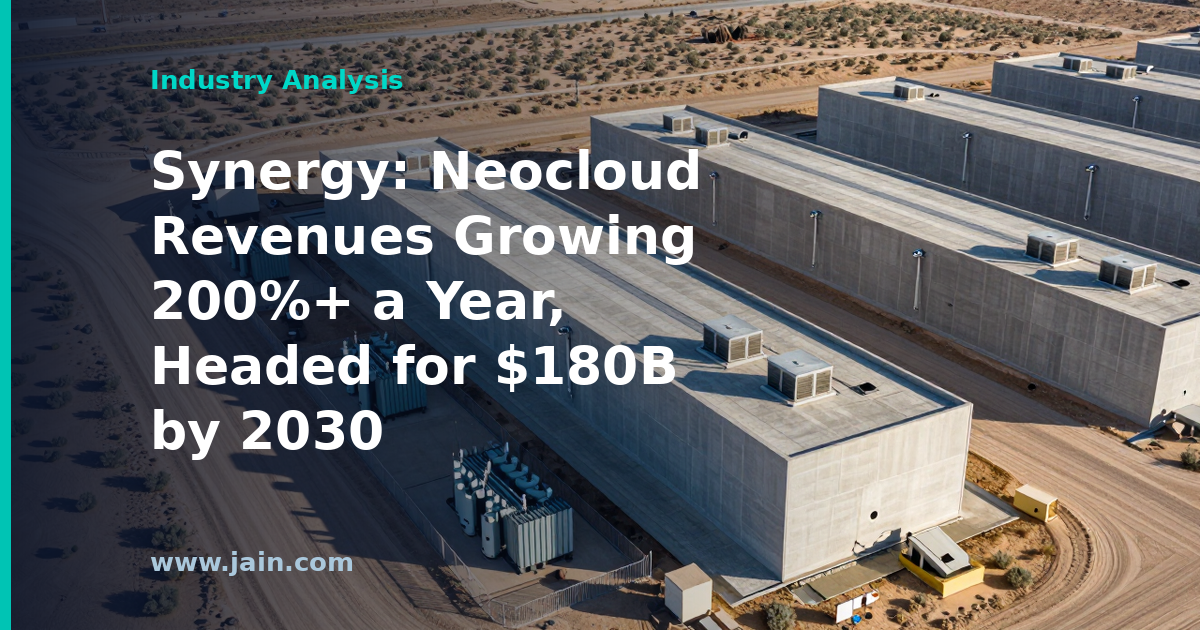
Synergy Research Group reported on August 17, 2026 that “neoclouds” — the emerging tier of specialized GPU cloud providers built for AI workloads — are currently growing revenues at more than 200% per year. On that trajectory, Synergy forecasts the segment will reach $180 billion in annual revenues by 2030.
Executive Summary
Synergy Research Group, a market intelligence firm that has tracked cloud and data center markets for decades, put a striking pair of numbers on one of the fastest-moving corners of the infrastructure industry: neocloud providers are more than tripling their revenues each year, and the category is projected to become a $180 billion market by 2030.
The forecast matters because it treats neoclouds not as a temporary arbitrage on scarce GPUs, but as a durable market tier alongside the hyperscale clouds. If Synergy is right, a business model that barely existed three years ago will, within four years, rival the size of the entire global colocation industry — with all the capital, power, and data center demand that implies. It is worth noting the syndicated item we reviewed carries the headline figures but not Synergy’s full methodology, so the underlying assumptions deserve scrutiny alongside the projection itself.
What a Neocloud Is — and Why the Category Exists
“Neocloud” is the industry’s shorthand for cloud providers built specifically around GPU compute for artificial intelligence — renting out clusters of accelerators for model training and inference rather than offering the sprawling general-purpose service catalogs of AWS, Microsoft Azure, or Google Cloud. Commonly cited players in the category include CoreWeave, Lambda, Nebius, and Crusoe, though Synergy’s specific inclusion list is not visible in the syndicated item.
The category exists because AI demand outran what the traditional clouds could supply. Training frontier models requires dense, tightly networked GPU clusters, exotic power and cooling footprints, and pricing models closer to industrial capacity contracts than to on-demand virtual machines. Specialists that could secure GPUs, power, and data center space quickly found a seller’s market waiting for them.
The Economics Behind 200% Growth
Growth above 200% per year is extraordinary, but the arithmetic behind it is straightforward: the segment started from a small base, and demand for AI compute currently exceeds supply. When capacity sells out before it is built, revenue growth tracks how fast a provider can energize new data center capacity — which is why the neocloud story is inseparable from the power and data center construction booms.
The harder question is margin durability. Neocloud economics rest on expensive, fast-depreciating hardware, heavy debt financing in many cases, and — for several prominent players — revenue concentrated in a small number of very large AI customers. A $180 billion revenue projection says the market will be big; it does not by itself say the businesses in it will be uniformly profitable. Investors should distinguish between the size of the pie and the quality of any individual slice.
Winners, Losers, and the Hyperscaler Question
For data center operators, utilities, and connectivity providers, the forecast is almost unambiguously bullish: neoclouds are among the largest lessees of wholesale data center capacity and the most aggressive buyers of power. A tier growing toward $180 billion in revenue implies sustained demand for the physical layer beneath it — sites, substations, fiber, and cooling.
For the hyperscalers, the picture is more nuanced. Neoclouds are simultaneously competitors for AI workloads and, in some well-publicized arrangements across the industry, suppliers of capacity to the hyperscalers themselves. Whether the big clouds ultimately reabsorb this demand as their own GPU fleets scale, or the neocloud tier keeps a permanent structural advantage in speed and specialization, is the central competitive question the next few years will answer.
Can the Curve Hold to 2030?
Extending any 200% growth rate for years produces implausible numbers, and Synergy’s own forecast implies significant deceleration: a market compounding at 200% would blow far past $180 billion by 2030 from almost any plausible base. Read properly, the projection assumes today’s hypergrowth cools into merely strong growth — a reasonable but assumption-laden path.
The risks to the curve are the familiar ones for AI infrastructure: whether enterprise AI spending keeps converting into paid compute at current rates, whether power availability constrains buildouts, how quickly GPU generations depreciate, and whether customer concentration turns any single buyer’s pullback into a segment-wide shock. None of these invalidate the forecast; all of them are the difference between the projection and the outcome.
Background
The neocloud category rose to prominence after 2023, when generative AI demand created acute scarcity in GPU compute and a wave of specialists — several of them former cryptocurrency miners repurposing power-rich sites — pivoted to renting AI capacity. The segment has since attracted tens of billions of dollars in capital and become one of the largest sources of demand in the data center leasing market. Synergy Research Group, which has long published the benchmark market-share data for cloud infrastructure services, tracking the rise of AWS, Microsoft, and Google, now treats this GPU-specialist tier as a distinct market worth forecasting in its own right — itself a signal of how the AI buildout is restructuring cloud economics.
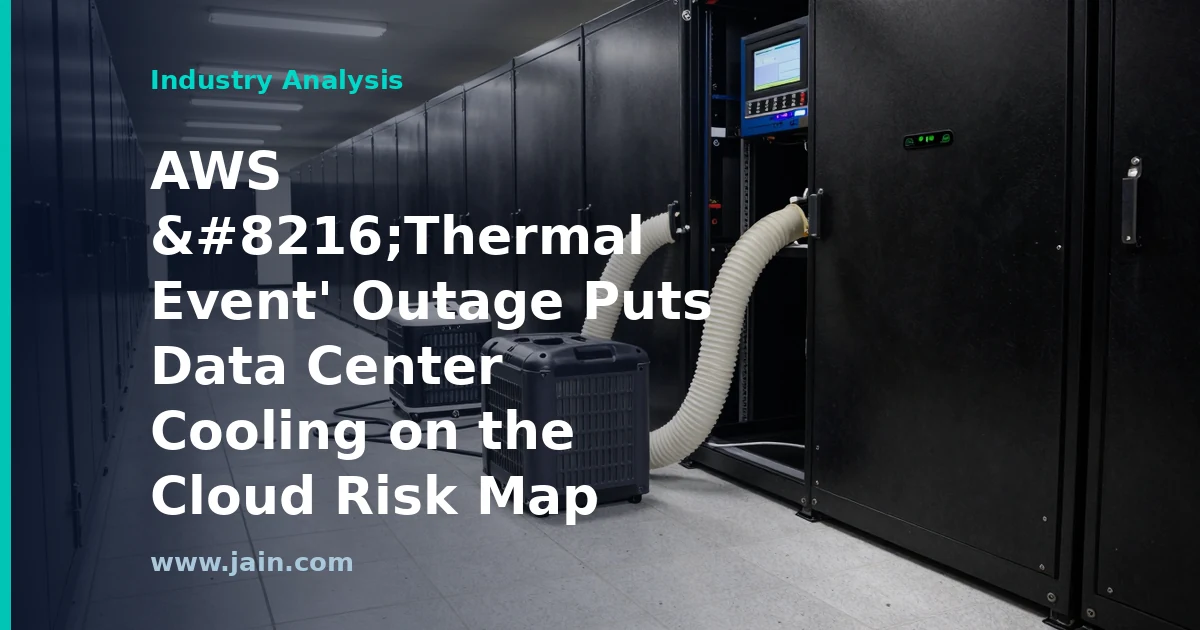
Amazon Web Services suffered a data center outage that the company attributed to a “thermal event,” according to a May 9, 2026 report from CRN. At the time of the report, some AWS services were still impacted, indicating recovery was ongoing rather than complete when the cause was disclosed.
The disclosure was notably spare: the phrase “thermal event” confirms a cooling- or heat-related failure inside an AWS facility, but the public reporting available at publication did not detail which region was hit, how many customers were affected, or how long full restoration would take.
Executive Summary
The world’s largest cloud provider experienced a facility-level outage traced not to software, networking, or a cyberattack, but to heat. A “thermal event” is industry shorthand for a situation in which a data center’s cooling systems can no longer remove heat as fast as the IT equipment produces it, forcing servers to throttle or shut down to protect themselves. That this occurred at AWS — an operator with deep engineering resources and decades of operational experience — is the story.
It matters because the physics of cloud computing are changing. Modern servers, especially those built for artificial intelligence workloads, draw far more power per rack than the equipment data centers were designed around a decade ago, and every watt consumed becomes heat that must be removed. Cooling has quietly moved from a background utility to one of the most consequential single points of failure in cloud infrastructure.
For enterprises, the incident is a prompt to treat facility-level physical risk — cooling and power, not just software bugs — as a first-class input to cloud architecture and continuity planning. For the industry, it is a data point in a pattern: as densities rise, thermal margins shrink, and the cost of a cooling failure grows with every server packed into the room.
What a ‘Thermal Event’ Actually Means
Data centers are, at their core, heat-management machines. Every server converts electricity into computation and, unavoidably, into heat; chillers, cooling towers, air handlers, and increasingly liquid-cooling loops carry that heat away. When any link in that chain fails — a chiller trips, a pump loses power, a control system misbehaves, or outside conditions exceed design assumptions — temperatures inside the data hall can climb within minutes. Servers respond by throttling performance and then shutting down to avoid permanent damage.
The phrase “thermal event” confirms the failure mode without revealing the failure cause. It could reflect mechanical breakdown, a power interruption to cooling equipment, a controls fault, or environmental stress. Each has different implications for how preventable the incident was, and the public reporting at the time did not say which applied. What the phrase does establish is that physical infrastructure, not code, took cloud services down — a category of failure that no amount of software redundancy inside a single facility can fully paper over.
Why Cooling Is Now a Top-Tier Reliability Risk
For most of the cloud era, the outages that made headlines were logical: configuration errors, DNS problems, cascading software failures. Cooling rarely featured because thermal margins were generous — racks drawing a few kilowatts left plenty of headroom. That headroom is disappearing. AI accelerators and dense compute have pushed rack power demands up sharply across the industry, and higher density means a cooling interruption becomes critical faster, with less time for operators to respond before equipment protection kicks in.
The economics cut both ways. Operators pack facilities densely because space, power, and capital are expensive, but density concentrates risk: one cooling plant now underpins far more revenue-generating compute than it once did. The industry’s shift toward liquid cooling addresses heat removal at the chip level yet introduces new mechanical dependencies — pumps, loops, coolant distribution units — each a component that can fail. The engineering trend line points one direction: thermal management is becoming more complex precisely as the tolerance for its failure shrinks.
The Customer’s Dilemma: Redundancy Is a Design Choice, Not a Default
Cloud providers, AWS included, architect their platforms around Availability Zones — physically separate facilities within a region — precisely so that a single-building failure like a thermal event need not become a customer outage. But that protection only applies to workloads customers have deliberately architected to span zones, and the fact that “some services” remained impacted when CRN reported suggests the blast radius extended beyond any one customer’s choices.
The practical lesson for buyers is uncomfortable but familiar: the shared-responsibility model extends to physical risk. Enterprises that treat a single cloud region — or a single zone — as infinitely reliable are making an implicit bet on someone else’s chillers. Incidents like this one argue for testing failover paths rather than assuming them, and for asking providers harder questions about facility-level dependencies that sit beneath the abstractions. It also strengthens the case, for the most critical workloads, of multi-region or hybrid designs whose costs were once hard to justify.
Transparency as a Competitive Variable
Two words — “thermal event” — carried the entire public explanation at the time of the report. That is consistent with how hyperscalers typically communicate mid-incident, and there are defensible reasons for early caution: root causes genuinely take time to establish. But the information asymmetry is real. Customers making architecture and procurement decisions cannot weigh a risk they cannot see, and cooling-plant design, maintenance posture, and thermal headroom are precisely the details cloud providers disclose least.
How AWS follows up matters more than the initial phrasing. The company has historically published detailed post-event summaries for major incidents, and a substantive account of what failed and what will change would convert this outage into usable information for the market. Absent that, enterprises are left to price the risk blind — and the industry loses a chance to learn from a failure at one of its most sophisticated operators.
Background
Amazon Web Services, launched in 2006, is the largest cloud infrastructure provider in the world, operating dozens of regions composed of multiple Availability Zones — physically separate data center facilities engineered so that a failure in one need not take down the others. Enterprises, governments, and a large share of the consumer internet run on its platform, which is why even partial AWS disruptions ripple widely and draw immediate scrutiny.
Data center cooling, meanwhile, has shifted from a background utility to a strategic constraint across the industry. Rising rack power densities — accelerated by the AI buildout — have pushed operators toward higher-capacity cooling designs, including liquid cooling, while simultaneously narrowing the time margin between a cooling interruption and equipment shutdown. Facility-level physical failures now sit alongside software faults among the principal threats to cloud availability.