A South Korean company called FuriosaAI, which designs computer chips for running artificial intelligence, has installed its equipment in a large rented data center in Lisbon, Portugal.
Almost all artificial intelligence today runs on chips from one American company, Nvidia. FuriosaAI wants to offer European businesses and governments another option, one that keeps their data physically inside Europe.
If challengers like this gain ground, Europeans could get more choice over who powers their artificial intelligence and where their information lives.
BigGo Finance reported that FuriosaAI, a Seoul-based designer of AI accelerator chips, has deployed inference servers at an Equinix data center in Lisbon, Portugal. The company is targeting Europe’s sovereign AI market: organizations that want AI workloads to run on infrastructure located, and legally governed, inside Europe.
No deployment size, power capacity, customer names, launch date or commercial terms have been made public.
Executive Summary
FuriosaAI is placing its own inference hardware inside Equinix, one of the world’s largest colocation providers. Inference is the everyday work of running a trained AI model to answer questions or generate text, as opposed to training the model in the first place. Colocation means renting space, power and network connections in a shared data center rather than building one.
The move matters because it follows a pattern: chip challengers to Nvidia are using neutral, well-connected colocation sites as showrooms and on-ramps to regional markets. For European buyers weighing data residency rules and concerns about dependence on a single supplier, a locally hosted non-Nvidia option is worth watching. How significant this particular deployment is depends on details the companies have not yet disclosed.
Inference Is Where Challengers Can Compete
Training frontier AI models remains overwhelmingly an Nvidia business, anchored by its CUDA software ecosystem and years of developer familiarity. Inference is a different contest. Once a model is trained, operators care most about cost per query, latency and electricity use, and those metrics give specialized chips room to argue their case. FuriosaAI’s pitch, like that of several rivals, centers on running popular open models efficiently rather than matching Nvidia across every workload.
The economics favor that focus. Inference demand grows with every deployed chatbot, search feature and enterprise assistant, and it runs continuously rather than in one-off training runs. A chip that meaningfully lowers power per query can matter more to a data center operator’s bills than raw peak performance. Whether FuriosaAI’s hardware delivers that advantage at production scale is the claim buyers will want to verify with their own models.
Colocation as a Market-Entry Shortcut
For a hardware startup, building data centers across Europe is out of reach. Placing servers in an Equinix facility provides immediate access to power, cooling, security and, crucially, direct network connections to the enterprises, cloud providers and carriers already housed there. Prospective customers can test the hardware with low latency, without shipping equipment to their own sites or committing to a new cloud vendor.
Equinix benefits too. Colocation providers increasingly compete on the ecosystems they host, and a range of accelerator options gives tenants reasons to stay and expand. Chips marketed on power efficiency may also fit more easily into existing data halls than the densest GPU clusters, which increasingly require liquid cooling retrofits. That is a practical advantage if it holds, though no power or rack-density figures have been published for this deployment.
What Sovereign AI Actually Means Here
Sovereign AI has become a broad label covering data residency, legal jurisdiction, operational control and supply-chain independence. European demand is real, shaped by GDPR, the EU AI Act and public-sector reluctance to depend entirely on US platforms. A deployment on Portuguese soil addresses the first of those concerns: data can stay in the EU.
The other dimensions are less clear-cut. The chips come from a South Korean designer, the facility is operated by a US-headquartered company, and advanced chip manufacturing remains concentrated in Asia. None of that disqualifies the offering, since few AI stacks anywhere are fully domestic, but buyers should ask which layer of sovereignty is being delivered. Diversifying away from a single dominant chip supplier is itself a form of resilience that some European buyers value, regardless of where that supplier is based.
Why Lisbon, and What It Signals
Lisbon is not one of Europe’s traditional data center hubs of Frankfurt, London, Amsterdam, Paris and Dublin, where power and land constraints have tightened. Portugal offers a strong renewable electricity mix and sits at a landing point for subsea cables linking Europe with Africa, the Americas and beyond. For AI inference, which benefits from proximity to users but not necessarily to the largest hubs, secondary markets with available power are increasingly attractive.
The choice may also reflect pragmatism: a smaller market can offer faster access to capacity and a less crowded field. The trade-off is a thinner local customer base than in the core hubs, so the deployment’s commercial value will depend on whether it serves as a pan-European access point or mainly a regional one.
Background
FuriosaAI was founded in Seoul in 2017 to design dedicated AI accelerators. It is one of a cohort of chip startups trying to capture part of the fast-growing inference market, where efficiency and cost can matter more than the raw training performance that made Nvidia dominant. Its current product line centers on its RNGD inference chip, marketed for running large language models with lower power consumption.
Equinix is among the largest colocation and interconnection providers globally, operating data centers across dozens of metropolitan areas. Its facilities are valued less for floor space than for the density of networks, clouds and enterprises connected inside them. In Europe, demand for sovereign AI, meaning AI infrastructure kept within European jurisdiction, has grown alongside regulation and concerns about dependence on non-European technology providers.
Hut 8, a company that started out mining bitcoin, has filed plans with Texas for a $399 million computer building near Corpus Christi. It would cover about as much floor space as 11 football fields.
The building is part of a much larger site built to run artificial intelligence systems, tied to about $20 billion in long-term deals involving chipmaker Nvidia and the artificial intelligence companies Lambda and Anthropic.
Why it matters: sites like this use as much electricity as a city, and Texas is now asking whether its power grid and water supply can keep up.
Construction Review reported on September 15, 2026 that Hut 8 Corp. has submitted state filings for a $399 million, 657,130-square-foot data center at its Beacon Point campus in Nueces County near Corpus Christi, Texas. The facility is designed for artificial intelligence training and inference workloads and is linked to 704 megawatts of contracted capacity that the report values at nearly $20 billion in long-term contracts. Nvidia leases the facility, according to the report, in an arrangement under which Lambda supplies AI computing power to Anthropic.
The filing lands while Texas Governor Greg Abbott has ordered a full audit of the state grid and a temporary halt to new large-load connections until developers confirm land rights, permits, water use and financial backing. The project is under regulatory review.
Executive Summary
Hut 8 has moved Beacon Point from a capacity figure to a building. The $399 million state filing describes a single large facility, purpose-built for AI rather than general-purpose colocation (renting space, power and cooling to many tenants), inside a campus whose contracted value is put at roughly $20 billion. For a company with roots in bitcoin mining, the filing is a tangible step in turning secured power into long-term, contracted AI infrastructure revenue.
The announcement matters for two reasons. First, it shows how AI capacity is now being assembled: a site developer controls land and power, a chipmaker leases the building, a cloud provider sells computing time, and an AI lab consumes it. Second, it collides directly with Texas’s new scrutiny of data centers. Contracted megawatts are only valuable if the grid can deliver them, and the state’s verification demands on land, permits, water and financing now sit squarely in Beacon Point’s path.
What $399 Million Buys, and What It Does Not
The $399 million figure is a construction value for one facility, not the price of the campus. Divided across 657,130 square feet, it works out to roughly $607 per square foot. Divided across 704 megawatts, it is under $600,000 per megawatt, which is unlikely to represent the full cost of delivering that much AI-ready power once electrical systems, cooling, grid upgrades and computing hardware are counted. Readers should treat the filing as a marker of physical progress on one building rather than a measure of total capital at stake.
The $20 billion number is a different kind of metric again: the value of long-term contracts attached to the capacity, not a construction budget. Spread across 704 megawatts, that is roughly $28 million of contracted value per megawatt, a figure that implies multi-year commitments. The distinction matters, because contract value speaks to revenue potential while construction value speaks to what must be built and financed first.
A Layered Deal That Spreads Roles and Concentrates Exposure
As described, Beacon Point runs through a chain of parties. Hut 8 develops the campus, Nvidia holds the lease and provides chips, Lambda sells computing capacity, and Anthropic is the end consumer of that capacity. This kind of structure is increasingly common in AI infrastructure: each party takes the slice of risk it is best placed to carry, and the developer gains a creditworthy tenant rather than betting on speculative demand.
The same structure also concentrates exposure. Each link depends on the next. If AI demand from a single end user shifts, or contract terms are renegotiated anywhere along the chain, the effects flow back to the landlord. For Hut 8, the strength of the arrangement ultimately rests on the specific lease terms with its direct counterparty, which have not been published. The reported figures also describe both a 704-megawatt contracted capacity and a 700-megawatt campus, and the relationship between this one building and the campus-wide total is not spelled out.
Texas Is Changing the Rules for Big Power Users
Texas has been a magnet for data centers because of available land and a grid, run by ERCOT (the Electric Reliability Council of Texas), that historically connected large customers comparatively quickly. That advantage is now under pressure. ERCOT’s interconnection queue, the waiting list of projects seeking a grid connection, holds hundreds of gigawatts of data center requests, more than the state’s entire peak demand. Many of those requests will never be built, but regulators cannot easily tell which.
The governor’s audit and connection pause is effectively a filter: prove you have the land, permits, water and money, or wait. For well-capitalized projects with real tenants, that filter could help by clearing speculative requests from the queue. For every project, it adds time and uncertainty. A 704-megawatt load needs substantial grid upgrades and firm power supply commitments, and water consumption for cooling is explicitly on the evaluation list. Beacon Point’s contracts give it a stronger story than a speculative filing, but contracts do not substitute for delivered electricity.
Who Gains, and What Could Slow It
If Beacon Point clears review, Hut 8 gains a flagship example of the developer model it has been pursuing, and the Corpus Christi area gains a major construction project and a long-lived industrial facility. Nvidia and Lambda gain dedicated capacity at a time when power-ready sites are scarce. The broader signal for the industry is that land and power alone are no longer enough in Texas; verifiable financing, permits and resource plans are becoming the price of admission.
The main risks are timing and resources. A prolonged pause, costly grid upgrades, or water constraints could push back energization, the point at which a site receives power and starts earning. Local stakeholders will reasonably want clarity on water use and grid impact, while the companies will want certainty that contracted revenue materializes on schedule. Both sets of questions deserve answers backed by specifics rather than headline figures.
Background
Hut 8 Corp. built its business on bitcoin mining, an activity that requires large amounts of cheap, reliable electricity. That experience in securing power and sites has become valuable as artificial intelligence drives demand for data centers that can draw hundreds of megawatts. Like several former miners, Hut 8 has been repositioning toward developing and leasing power-ready infrastructure for AI and high-performance computing customers.
AI data center deals increasingly involve several layers of participants: site developers, chipmakers, specialist AI cloud providers and AI labs. Texas has been a leading destination for these projects, but the scale of demand has strained the ERCOT grid’s planning process, prompting state leaders to demand proof of land, permits, water and financing before connecting new large loads.
WhiteFiber, a company that rents out computing power for artificial intelligence, is spending $60 million on two properties in North Carolina to build more data centers, which are warehouses full of computers. The sites are expected to come with enough electricity for tens of thousands of homes, and that much power is increasingly hard to get.
It already has customers. A 10-year deal worth about $865 million has started paying, and the company has signed more than $550 million in other contracts since May.
The catch: it still loses money, $15 million last quarter, and it issued new shares, so each existing share now owns a smaller slice of the company.
WhiteFiber, Inc. (WYFI), an operator of AI data centers and GPU cloud services, attached an investor presentation to an 8-K filed with the SEC on September 14, 2026. Minichart’s summary of the presentation reported that on August 16 the company signed a definitive agreement to buy two North Carolina industrial properties, designated NC-2 and NC-3, for $60 million in cash. The sites are expected to provide at least 60 MW of initial gross electrical capacity, with potential for roughly 198 MW over time. Confirmation of that capacity is a closing condition, and closing is expected in the fourth quarter of 2026.
The presentation also reported more than $550 million of new cloud contract value booked since May 2026. Billing has begun at the NC-1 campus under Nscale’s 10-year, 40 MW lease, which is worth about $865 million. WhiteFiber described a pipeline of roughly 1.5 GW, completed an August exchange that retired about 86% of its 2031 convertible notes, and reported a second-quarter net loss of $15.0 million.
Executive Summary
WhiteFiber’s September investor update shows a company reorganizing around contracted, long-duration revenue. At its core is the Nscale anchor lease at NC-1. That single contract averages about $86.5 million a year over its term, which is close to the company’s entire $94.5 million of combined revenue for the twelve months ended June 30. Around it sit five disclosed cloud contracts and a sixth undisclosed one, spread across Canada, Iceland, Paris and WhiteFiber’s own U.S. fleet.
The $60 million North Carolina purchase is the physical follow-through. WhiteFiber is using its backlog as the case for buying powered land before it has binding tenants, and it says non-binding letters of intent backed by investment-grade credit are in hand. The strategy is coherent. The open questions are about execution. Revenue depends on construction, GPU deliveries and customer acceptance. Net losses widened year over year, and the note exchange added about 6.3 million shares.
From GPU Renter to Landlord
WhiteFiber has two businesses. One rents GPU computing capacity by the hour or by contract, which is its cloud services business. The other leases data center space and power to other AI companies, which is its data center business. Cloud is still the larger segment, with $79.6 million of trailing-twelve-month revenue against $15.0 million from data centers. The data center line, however, grew 10.7 times from FY2024, and the Nscale lease is set to change the mix sharply once it ramps.
The economics of that shift are the story. A 10-year lease for 40 MW of IT load gives visibility that hourly GPU rental cannot. IT load is the power available to customers’ servers. Gross capacity, by contrast, also covers cooling and other building overhead. WhiteFiber says Phase 1 of NC-1 is fully contracted and that Duke Energy has completed work to deliver the initial 54 gross MW. Management believes the site could eventually reach 200 gross MW. If it does, NC-1’s current tenant would occupy only part of a campus that already has a utility relationship, which is a meaningful advantage when grid connections are the industry’s main bottleneck.
The presentation says initial billing began in the third quarter and that full revenue contribution is expected in the same quarter as the facility reaches contractual capacity. That timing is still subject to deployment, commissioning and customer acceptance. Whether the ramp lands on schedule is the near-term test investors will watch in the next quarterly report.
Buying Power, Not Just Buildings
At $60 million for a minimum of 60 MW of initial gross capacity, WhiteFiber is paying roughly $1 million per initial megawatt for NC-2 and NC-3. That falls to about $300,000 per megawatt if the full 198 MW materializes. The price covers the properties, not the fit-out. Turning industrial buildings into AI-ready halls with high-density power and liquid or advanced cooling costs far more than the land. The acquisition is best read as an option on scarce, electrified sites rather than as the full cost of new capacity.
Two structural protections stand out. First, the power capacity has to be confirmed as a condition of closing, so WhiteFiber should not end up owning sites without the electricity it is paying for. Second, the sites are about 55 miles from NC-1, which could let the company reuse staff, contractors and regional know-how. The target of initial ready-for-service capacity in the third quarter of 2027 is aggressive for conversions of this kind, and it depends on the deal closing on time in late 2026.
Demand support is real but not yet binding. WhiteFiber cites non-binding letters of intent backed by investment-grade credit from prospective customers. That is a stronger signal than a speculative build. It is still short of a signed lease like Nscale’s at NC-1.
How Solid Is $550 Million of Cloud Backlog?
The five disclosed contracts total about $538 million, and the unpresented July win of roughly $16 million brings the figure above $550 million. The contracts differ considerably. Terms run from two years (Hyperbolic / Modal Labs, about $17 million) to five years (the Paris deployment, over $160 million, and a Canada inference contract, about $88 million). Prime Intellect’s roughly $165 million three-year deal is the largest single item. Averaged evenly across their terms, the five contracts would add up to around $150 million a year at full run rate. That figure is simple arithmetic, not company guidance.
Most of this backlog requires new hardware: NVIDIA B300 systems in Canada and VR200 systems for WhiteFiber’s first Vera Rubin deployment in the U.S. The capital cost of those GPUs is the central economic question. The Paris contract is the most de-risked on the page, with an investment-grade customer, customer prepayments and project-level financing. The Hyperbolic / Modal Labs deal is the least capital-intensive because it uses H200s already in the fleet and needs no new GPU spending.
Contract length matters because GPU generations turn over quickly. A three-year contract on current-generation hardware can recover a large share of the equipment cost within the term. What the systems earn afterward is harder to predict. The revenue-sharing upside on the Canada inference contract adds potential gains, and it also means that part of that contract’s value depends on the customer’s success.
The Balance Sheet Behind the Build
The August note exchange raised about $298.5 million in net proceeds from new $310 million 2032 convertible notes. WhiteFiber spent roughly $118.5 million in cash to retire about 86% of its 2031 notes, leaving around $180 million net. It also issued about 6.3 million shares, roughly 16% of the 38.85 million basic shares outstanding afterward. The conversion price on about 91% of the principal involved is set at a 25% premium to a $27.07 reference price. Separately, WhiteFiber holds a zero-strike call on 5.91 million shares, bought in January 2026 for about $120 million. Arrangements of that kind are generally used to offset dilution.
The operating picture shows growth ahead of profit. Second-quarter revenue rose about 54% to $28.8 million, and adjusted EBITDA increased to $5.5 million from $3.3 million. Over the same period the net loss widened to $15.0 million from $8.8 million, which included a $5.0 million impairment of capitalized software. That pattern is common for infrastructure companies spending ahead of contracted revenue. It does mean the company’s expansion depends on continued access to capital markets and project financing.
Background
WhiteFiber is a New York-headquartered AI infrastructure company that went public in 2025 after being carved out of Bit Digital. It runs two lines of business: GPU cloud services, which rent high-end NVIDIA computing capacity to AI developers, and data center services, which lease powered space to other AI operators. Its footprint spans Canada, Iceland, the United States and a Paris region deployment, with its flagship owned campus, NC-1, in North Carolina.
WhiteFiber belongs to a group of so-called neoclouds, specialist GPU providers that have grown alongside demand for AI training and inference. Across the sector, the limiting factor has shifted from chips to electricity, because utility grid connections can take years to secure. Companies that control powered sites are therefore increasingly able to sign long-term contracts. WhiteFiber’s 10-K for 2025 was filed on March 26, 2026, and its 10-Q for the second quarter on August 12, 2026.
Bitdeer, a company that got its start mining bitcoin, is betting heavily on renting out powerful computers used to build and run artificial intelligence.
It signed a 10-year deal for a new building in southern Malaysia that will use enough electricity to run tens of thousands of homes. If the building earns what a similar Bitdeer site does, it could bring in about $1.1 billion a year.
That yearly figure is about two-thirds of what the whole company is worth on the stock market today. The catch: the power does not switch on until the second half of 2027.
Bitdeer Technologies Group’s AI cloud division, Bitdeer AI, has signed a 10-year service agreement for A202, a 65.1-megawatt data center in Johor Bahru, Malaysia, Cryptopolitan reported. The facility sits on the same campus as Bitdeer AI’s existing 21.7MW A201 site, bringing the campus to 86.8MW of critical IT load (the power available to the computing equipment itself, excluding cooling and other overhead). Power is expected in the third quarter of 2027, and the addition lifts Bitdeer AI’s secured AI cloud capacity to about 206.5MW, roughly 59% of its target of up to 350MW by the first quarter of 2028.
Bitdeer expects A202 to generate revenue per megawatt similar to its A102 facility, where contracts covering the next five years carry more than $800 million in expected revenue across 9.5MW. Applied to A202’s size, that works out to about $1.1 billion a year, the figure Cryptobriefing highlighted, while blockchain.news reported that the deal pushes Bitdeer’s AI pipeline toward $7 billion. Shares were quoted at $11.97, for a market capitalization of about $1.64 billion, though Stocktwits reported the stock slipped as a broader tech sell-off weighed on the sector.
Executive Summary
Bitdeer’s A202 agreement is the company’s largest single capacity addition in Southeast Asia and its clearest signal yet that a business built on bitcoin mining intends to become a long-term provider of AI computing. The 65.1MW facility is designed for liquid-cooled, rack-scale NVIDIA systems, including the GB300 NVL72 and the upcoming Vera Rubin platform, and will support both GPU cloud services (renting access to AI chips) and data-hosting workloads.
What makes the announcement significant is the combination of scale and funding model. Bitdeer says it aims to have customer prepayments cover more than half of the capital spending for each facility, with the rest financed from contracted and operating cash flow. If that works, the company can grow its AI business without leaning as heavily on new debt or share issuance. If demand or prepayments fall short, the revenue math behind the headline numbers becomes considerably less certain.
For the wider market, the deal adds another data point that operators with existing land, power and cooling infrastructure are competing hard for the next generation of AI hardware, and that Johor remains a focal point for that capacity in Southeast Asia.
The Revenue Math Behind the $1.1 Billion Figure
The headline revenue number is a derived estimate, not a disclosed contract value. Bitdeer’s A102 facility has more than $800 million in expected revenue over five years across 9.5MW, which is roughly $17 million per megawatt per year. Bitdeer says it expects A202 to earn similar revenue per megawatt; multiplied across 65.1MW, that yields approximately $1.1 billion annually once the facility is fully running.
That per-megawatt figure is high because GPU cloud is a different business from traditional data center leasing. A landlord that rents out space, power and cooling earns rent on the building. A GPU cloud operator also owns the chips and sells computing time on them, so revenue per megawatt is far higher, but so is the capital required. The comparison with Bitdeer’s roughly $1.64 billion market capitalization is striking, but it sets potential future revenue against current equity value and says nothing about the hardware costs, operating expenses or margins behind that revenue.
The estimate also rests on an assumption that A202 pricing will match A102’s. A102 is a 9.5MW deployment with contracts covering five years; A202 is nearly seven times larger, arrives in late 2027 on newer hardware, and sits inside a 10-year agreement. Pricing for AI computing can shift quickly as new chip generations arrive and supply catches up with demand.
Prepayments as the Financing Engine
Bitdeer’s stated plan is for upfront customer payments to cover more than half of each facility’s capital spending. Prepayment-funded buildouts have clear appeal: they reduce the need to raise outside capital, and a customer willing to pay in advance is signaling genuine commitment. For a company whose legacy business is exposed to bitcoin price swings, that is a meaningful source of discipline.
The trade-off is concentration risk. Prepayment structures typically depend on a small number of large customers with the balance sheets to pay ahead, and the remaining funding depends on contracted and operating cash flow materializing on schedule. Over a 10-year horizon, the hardware inside A202 will likely be refreshed at least once, raising the question of who funds the next generation of chips after GB300 and Vera Rubin systems age.
The Brownfield Advantage in Johor
A202 is being built on land Bitdeer AI already controls, next to the existing A201 facility. That lets the company extend power, liquid-cooling and network infrastructure it has already built, which Bitdeer says should shorten the time to full operation. In an industry where grid connections and specialized cooling are often the slowest parts of a project, expanding an existing campus is a genuine competitive edge.
Liquid cooling matters here because rack-scale systems like the GB300 NVL72 pack so much computing power into a single rack that air cooling cannot remove the heat effectively. Facilities built for these systems are scarcer than general-purpose data center space, which supports CFO Michael G. Potter’s claim that demand for “liquid-cooled, rack-scale AI Cloud capacity” for 2027 is outpacing supply. The claim is backed by A102 having been fully booked before it was energized; A201, by contrast, is in advanced negotiations rather than signed contracts.
From Miner to AI Landlord: Halfway There
With 206.5MW secured across Malaysia, Norway and the United States, Bitdeer is about 59% of the way toward its target of up to 350MW of AI-ready capacity by early 2028. Status as a preferred NVIDIA Cloud Partner gives it credibility in hardware allocation, a practical advantage when the newest systems are in short supply.
The company is running a hybrid model rather than abandoning mining, which keeps an existing revenue stream but also means two capital-hungry businesses competing for the same balance sheet. The market’s reaction captured the tension: a transformative-sounding pipeline, but a share price still moving with sentiment across the broader technology sector. Investors will judge the pivot less on secured megawatts than on how many of those megawatts turn into signed, paying contracts.
Background
Bitdeer Technologies Group is listed on Nasdaq under the ticker BTDR. It began as a bitcoin mining operation founded by Jihan Wu, the former CEO of Bitmain, one of the best-known makers of bitcoin mining machines. Like several miners, Bitdeer has sought to repurpose its experience securing large amounts of power and running dense computing facilities toward AI infrastructure, placing that effort in a separate division, Bitdeer AI, while continuing to mine.
Bitdeer AI’s capacity spans Malaysia, Norway and the United States, and the company has been named a preferred NVIDIA Cloud Partner. Its Malaysian campus is in Johor Bahru, across the causeway from Singapore, a location that has drawn significant data center investment as demand for AI computing in Southeast Asia has grown.
Iron Mountain, a company best known for storing paper records in secure warehouses, has signed a deal with a Saudi state-run bank that lends to small businesses and families.
The bank will use Iron Mountain’s artificial intelligence software to read and sort the paperwork behind small-business loans. That is the forms and statements a loan officer would otherwise check by hand.
It shows a records company trying to become a technology company. It also shows banks handing sensitive customer files to automated systems. The price and length of the deal were not announced.
Iron Mountain (NYSE: IRM) has signed an agreement with Saudi Arabia’s Social Development Bank. Under the deal, Iron Mountain’s InSight DXP platform, which uses artificial intelligence to process documents, will sit at the center of the bank’s lending workflows for small and medium-sized enterprises (SMEs), Simply Wall St reported on September 13, 2026.
No contract value, duration, or deployment timeline was given. The announcement comes after a weak stretch for the stock. Shares fell 11.01% over the past 30 days and 8.79% over 90 days, but are still up 38.37% year to date.
Executive Summary
This is a software and services agreement, not a data center lease. InSight DXP is Iron Mountain’s platform for ingesting, classifying and extracting information from documents. In lending, that means applications, financial statements, identity records and supporting paperwork. The bank has made this platform central to how it handles SME loan processing, which is a document-heavy workflow in any market.
The deal matters for two reasons. First, it is a concrete example of a Gulf financial institution putting AI into a core, regulated process rather than a pilot or back-office experiment. Second, it supports Iron Mountain’s effort to be valued as a digital and infrastructure business rather than a traditional records-storage company. Investors are already pricing in much of that shift. The stock trades at 81.9 times earnings, against a 25.5x average for North American specialized real estate investment trusts (REITs).
What has not been disclosed matters as much as what has. Nobody has said where the bank’s data will be processed, how large the engagement is, or whether any Iron Mountain data center capacity is part of it.
A Software Deal, Not a Data Hall
Iron Mountain operates both a physical data center business and a digital solutions business, so the difference is worth stating clearly. As reported, this agreement concerns InSight DXP, an intelligent document processing platform. It is not a lease of power, space or cooling in an Iron Mountain facility. Intelligent document processing combines optical character recognition (turning scans into text) with machine-learning models that classify documents and pull out fields such as names, income figures or registration numbers. The goal is to cut the manual review that slows loan approvals.
That makes the deal a different kind of revenue from a wholesale data center contract. Software and processing agreements tend to be smaller in headline value than multi-megawatt leases. They can, however, be stickier: once a lender rebuilds its loan workflow around a platform, switching costs rise. The commercial significance therefore depends on details not yet disclosed, including volumes, pricing model and term.
Gulf Lenders Are Buying AI With Data Control in Mind
Saudi Arabia has been pushing to expand SME lending and to digitize government services. A development lender automating loan paperwork fits that direction. Loan files are among the most sensitive data a bank holds, though. Saudi Arabia’s personal data protection regime and banking supervision set expectations for how such data is stored and transferred. For any foreign technology provider, where processing happens and who can access it are central commercial questions, not afterthoughts.
This is where Iron Mountain’s hybrid profile could be an advantage. A vendor that offers both document processing and physical, secure infrastructure can in principle offer in-country or tightly controlled deployments. Neither company has said how this deployment is architected, however. It would be premature to describe the deal as sovereign AI capacity. The fair reading is narrower: it shows regulated Gulf institutions are willing to put AI tooling into core workflows, and a buyer with those priorities may well want local hosting options.
From Boxes to Bytes: The Repositioning Bet
Iron Mountain says it serves more than 240,000 customers in 61 countries, including about 95% of the Fortune 1000. That installed base, built on physical records storage, is the foundation of its digital strategy. Customers whose paper archives it already holds are natural prospects for digitization, AI extraction and, eventually, data center services. The most-followed investor narrative on the stock credits robust double-digit growth in the Data Center and Digital Solutions segments, driven by AI, cloud and unstructured data management.
A single development-bank contract does not change the company’s revenue mix. What it does is give the digital pitch a named international reference customer in financial services, a sector where proof points carry weight. Competitors in document AI range from large cloud platforms to specialist automation vendors. Iron Mountain’s argument has to rest on trust, compliance and chain of custody, not on the models alone.
The Valuation Already Assumes the Pivot Works
The market has rewarded the repositioning. Total shareholder return is 23.18% over one year and 100.14% over three years. The recent pullback, however, suggests announcements like this one are no longer lifting the shares on their own. Estimates vary widely: the popular narrative puts fair value at $146.10 versus a last close of $115.18, implying the stock is 21.2% undervalued, while an earnings-multiple view points to a fair P/E ratio of 42.4x, roughly half the current 81.9x.
Both views can hold at once. If digital and data center growth compounds as bulls expect, today’s multiple may compress as earnings catch up. If data center competition intensifies or refinancing costs rise on a leveraged balance sheet, the multiple could carry most of the downside. Deals like the Social Development Bank agreement are useful evidence, but only once their scale is visible.
Background
Iron Mountain built its business on storing physical records, including paper files, backup tapes and archives, for corporations and governments. Over the past decade it has expanded into data centers and digital services, arguing that its existing relationships with records-heavy customers give it a head start in digitizing and managing their information. It operates as a real estate investment trust, a structure that typically requires paying out most taxable income as dividends and tends to rely on debt to fund growth.
In Saudi Arabia, the government has made small-business growth and digital public services priorities of its economic diversification agenda. Development lenders such as the Social Development Bank play a central role in financing entrepreneurs and small firms. That makes loan processing efficiency, and the secure handling of applicant data, a practical concern for these institutions.
Broadcom, one of America’s biggest chipmakers, reported sales that nearly doubled from a year earlier. It also predicted its artificial intelligence chip business will roughly quadruple by 2028. Its stock still slipped about 3%.
One worry: much of that future growth depends on just three buyers. Those are Google and the chatbot makers OpenAI and Anthropic. If any of them spends less, Broadcom feels it fast.
Broadcom’s chips power many of the artificial intelligence tools people now use. That makes its fortunes a rough gauge of whether the spending boom lasts.
Broadcom reported fiscal third-quarter results on September 2 and filed its quarterly report (a 10-Q) with the SEC on September 10, covering the three months ended August 2, 2026. Morningstar reported that the shares fell 3% after the release, even though, by Morningstar’s calculation, the August-quarter results implied 86% year-on-year growth and October-quarter guidance implied 93%.
Management also issued an outlook running through 2028. It calls for artificial intelligence revenue to quadruple from 2026 levels and for non-GAAP earnings per share, a measure that excludes items such as acquisition-related charges, to nearly triple to $30. Broadcom said OpenAI and Anthropic will become its two largest customers starting in 2027. It also pointed to a multiyear agreement with Google covering its custom AI chips.
Executive Summary
On paper, this was an exceptional report. Broadcom designs custom AI accelerators, which are chips built to one customer’s specification rather than sold off the shelf. It told investors that demand for them will keep compounding for at least two more years. The company supplies Google’s eighth-generation inference TPU, the tensor processing unit Google uses to run trained AI models for users. It expects enormous volume ramps at OpenAI and Anthropic. Morningstar, which rates the stock five stars with a $650 fair value estimate, said the 2028 guidance beat its own model.
The muted stock reaction is the more interesting signal. Morningstar noted the shares had fallen nearly 30% since the previous quarter. It read that decline as the market pricing in a risk that Broadcom misses its 2028 targets or that growth slows afterward. Long-dated guidance, however bullish, asks investors to trust a handful of customers’ spending plans years in advance. For many investors, that trust now comes with conditions: which customers, on what terms, and at what profitability.
For the wider infrastructure market, Broadcom’s outlook is a direct read on how aggressively the largest AI developers intend to build out computing capacity. It also shows how much of that capacity will run on custom silicon rather than general-purpose GPUs.
Great Numbers, Skeptical Market
Broadcom’s guidance is unusually specific and unusually far out. Most chip companies guide one quarter ahead. Broadcom put figures on 2028: AI revenue up fourfold from 2026 and roughly $30 of non-GAAP earnings per share. Morningstar calls the guidance credible and argues underlying AI infrastructure demand will keep rising through 2030. The market’s reaction was more cautious. A 3% post-earnings dip followed a slide of nearly 30% since the prior quarter.
That gap between guidance and share price reflects a familiar tension in AI hardware. Investors reward growth, but they discount growth that depends on a few enormous purchase decisions. When a company’s outlook already assumes a quadrupling, even strong confirmation can fail to move the stock. The debate shifts from whether demand exists to whether it holds beyond the guided window, and at what price.
Morningstar’s valuation shows how much future growth is embedded in its $650 estimate. That figure implies adjusted price-to-earnings multiples of 56 times fiscal 2026 and 34 times fiscal 2027, falling to 22 times on 2028 estimates. Put simply, the estimate looks reasonable only if the 2028 earnings arrive.
Diversifying Away From Google, Into Frontier Labs
Google has long been Broadcom’s anchor customer in custom accelerators. Two developments this quarter complicate that picture. First, Google split its TPU program: Broadcom supplies the inference chip, while MediaTek won the training chip, which is used to build the models in the first place. Morningstar argues the inference part is higher in volume and complexity. Still, the split shows that even Broadcom’s largest customer is willing to multisource.
Second, Broadcom expects OpenAI and Anthropic to overtake Google as its biggest customers from 2027. That diversifies Broadcom away from a single buyer. It also shifts exposure toward frontier-model developers, whose infrastructure budgets depend on how their own businesses and funding evolve. Morningstar acknowledges investors may worry about this spending but argues it is supported by improving AI model economics. That claim will be tested over the next two years rather than settled by this report.
Morningstar assigns Broadcom a High Uncertainty Rating and names customer concentration as its primary risk. The AI accelerator business rests on a handful of high-spending customers. Shifts in any one customer’s spending patterns can swing results and sentiment.
The Margin Question Behind the Growth
Broadcom is known for profitability. Morningstar credits it with free cash flow margins consistently above 40%, meaning over 40 cents of every revenue dollar becomes cash after capital spending. It projects free cash flow exceeding $50 billion a year by fiscal 2027. Much of that reputation was built on a mix of networking chips and infrastructure software, including VMware, acquired in 2023.
As custom accelerators grow to dominate revenue, investors will want to know whether profitability holds as the mix changes. Custom chips are negotiated with a few very large buyers who have real bargaining power, as Google’s decision to bring in MediaTek suggests. Morningstar’s bear case also flags moderating growth in Broadcom’s legacy software lines. That makes the economics of the AI business more important to the overall margin picture, not less.
None of this contradicts the demand story. It explains why demand alone may no longer be enough: investors are asking what each dollar of AI revenue is worth, not just how many dollars are coming.
Supply, Debt and Leadership
Broadcom depends heavily on TSMC to manufacture its chips, so any capacity constraint could limit how quickly it ships to customers. Morningstar believes Broadcom would be a priority TSMC customer because of its scale and long relationship. Even so, a quadrupling of AI revenue requires a matching step-up in manufacturing allocation.
The balance sheet looks manageable. As of October 2025, Broadcom held $16 billion in cash against $65 billion of gross debt, roughly half tied to VMware. Its gross debt-to-adjusted EBITDA ratio fell from 3.5 times after the deal to 1.5 times by the end of fiscal 2025. EBITDA stands for earnings before interest, taxes, depreciation and amortization. Leadership is a longer-term consideration. Morningstar identifies CEO Hock Tan as integral to Broadcom’s acquisition and operating strategy; he is contracted with the company through 2030, within the window in which the AI ramp is meant to play out.
Background
Broadcom is a semiconductor and infrastructure software company led by CEO Hock Tan, who has built it largely through acquisitions run for high efficiency. The largest recent deal was the 2023 purchase of virtualization software maker VMware. Broadcom reports revenue from products and from subscriptions and services, across the Americas, Asia Pacific and EMEA. In recent years its growth engine has become custom AI accelerators: chips it co-designs with large technology companies, beginning with Google’s TPU program.
Custom silicon has become a major alternative to off-the-shelf GPUs for companies spending heavily on AI computing. Its appeal is performance and cost tuned to one customer’s workloads. Broadcom’s traditional networking chips and VMware software still generate substantial cash flow, but the AI chip business is now the primary driver of its valuation. Its results are therefore closely watched as a barometer for AI infrastructure spending.
Palantir, a company that sells data-analysis software to large organizations, has picked Nebius, a company that rents out powerful computers for artificial intelligence, as its preferred partner for running that work.
The pitch: businesses can train their own artificial intelligence on their own private data, using machines they control, instead of handing that data to a big tech provider.
Nebius’s stock jumped on the news. Neither company has said how much money is involved or exactly when it starts.
On September 8, 2026, Palantir Technologies and Nebius Group announced a strategic partnership under which Palantir named Nebius its preferred sovereign AI infrastructure partner. According to the joint press release, which Nebius furnished to the SEC in a Form 6-K the same day, Palantir will bring Nebius compute and inference endpoints inside the Palantir enterprise perimeter after an integration period. Eligible Palantir commercial customers will then be able to run and adapt open AI models on Nebius infrastructure. The companies also said they will work together to deploy new compute capacity for Palantir customers, including modular data centers at sites where power is already available.
Seeking Alpha reported that Nebius shares rose about 8% following the announcement, bringing their year-to-date gain to roughly 175%. Neither company disclosed financial terms, capacity commitments, or a timeline.
Executive Summary
The Nebius–Palantir partnership pairs a neocloud with an enterprise software platform. A neocloud is a newer cloud provider built mainly to rent out GPU capacity for AI. The deal gives Nebius something pure infrastructure providers often lack: a direct channel into large commercial organizations that already run Palantir’s Foundry and AIP software. For Palantir, it adds a named compute layer to what it calls its Sovereign AI Operating System. That system is pitched to customers who want to train models on proprietary data without giving up control of the data, the models, or the hardware they run on.
The announcement matters because it tests a central question for GPU capacity providers: can they move beyond selling compute by the hour and capture a share of the higher-margin software relationship? The release answers only part of that question. Nebius gains preferred status and placement inside Palantir’s environment. Palantir, however, keeps the authorization, isolation, and data layer, which is the part customers interact with day to day. How revenue is split, and how much capacity is involved, has not been disclosed.
Distribution, Not Just Capacity
Most neoclouds compete on how quickly they can bring GPUs online and how cheaply they can rent them. That is a hard business to differentiate. Hardware is largely sourced from the same supplier, and large AI labs negotiate aggressively on price. The Palantir arrangement gives Nebius a different kind of asset: placement inside a software platform that enterprise buyers have already approved, integrated, and budgeted for. In enterprise IT, getting onto an approved-vendor list can take longer than building a data center. Being embedded in a platform the customer already trusts shortens that path considerably.
The joint release frames Palantir’s choice around Nebius being built for AI from the ground up, with infrastructure and software designed together, rather than adapted from general-purpose computing. That claim reflects how the partners describe their choice. It is not an independent benchmark. It does, however, match the positioning neoclouds have used against the large hyperscalers (Amazon Web Services, Microsoft Azure, Google Cloud), whose AI offerings sit alongside broad general-purpose cloud businesses.
Who Captures the Software Value?
The editorial question is whether this deal moves Nebius up the stack. The honest answer is: partially. Under the announced structure, Palantir’s AIP, Ontology, Foundry, and Apollo provide what the release calls the authorization and isolation layer. That is the governance and data-modeling software that decides who can see what and how models are applied to business operations. Nebius supplies the compute and inference endpoints underneath. Inference endpoints are the services that run a trained model and return its answers. In that arrangement, Palantir owns the customer-facing software relationship, and Nebius becomes a preferred engine inside it.
That still has value for Nebius. Inference is recurring, usage-driven demand. It tends to be more durable than one-off training runs, and enterprise customers who fine-tune open models on their own data will need to keep running them. But the term used is “preferred,” not “exclusive.” Nothing in the release prevents Palantir from adding other infrastructure partners later. The release also does not indicate whether Nebius bills customers directly or is paid through Palantir. That distinction largely determines how much of the economics Nebius actually captures.
Sovereignty as a Commercial Product
“Sovereign AI” has typically meant national governments wanting AI infrastructure under domestic control. This announcement applies the idea to companies instead. The release describes offering commercial organizations that have not previously had a sovereign option a way to run their own models on trusted infrastructure. In practice, that means an enterprise can take an open model, whose weights are publicly available, adapt it with proprietary data, and keep both the data and the resulting model. The alternative is sending that data to a closed model hosted by a third party.
The release explicitly targets Palantir’s commercial customers. It does not mention government or defense workloads, even though Palantir has deep roots in government. Any expansion into public-sector use would likely require separate security accreditations. Palantir CEO Alex Karp said Palantir’s ontology and Nebius’s infrastructure “will undergird the sovereignty our partners are demanding.” Nebius CEO Arkady Volozh said organizations need “both the performance of large-scale AI infrastructure and control over their data and models.” The release also claims that domain-adapted open models can outperform general-purpose closed models for specific uses. That is plausible for narrow tasks, but it is an assertion rather than a demonstrated result.
Modular Builds and the Power Question
The most operationally concrete line in the announcement concerns speed to capacity. The companies said they will use modular data-center deployments at sites where power is already available. Modular data centers are prefabricated units that can be installed far faster than a conventional purpose-built facility. The emphasis on existing power reflects a constraint across the industry: grid connections for large new loads can take years to secure. Sites with power already in place are among the scarcest assets in AI infrastructure.
This approach reduces some risks and introduces others. Modular deployments can serve customers faster, but they are typically smaller than campus-scale builds. They also depend on securing GPUs, cooling, and network connectivity at each location. The release names no sites, megawatt figures, or deployment schedule. Until those details appear, the capacity commitment is best read as a stated intention, not a quantified plan.
Background
Nebius Group N.V. is an Amsterdam-headquartered AI cloud company listed on Nasdaq under the ticker NBIS. It emerged from the 2024 restructuring of Yandex N.V. after that company divested its Russia-based businesses. Founder and CEO Arkady Volozh co-founded Yandex. Nebius describes itself as building a full-stack platform for AI development, from data and model training to production deployment. It is part of the neocloud cohort of GPU-focused providers that has grown rapidly alongside demand for AI compute. As a foreign private issuer, it reports material events to the SEC on Form 6-K.
Palantir Technologies, listed on Nasdaq as PLTR, built its reputation on data-integration software for government and defense agencies and has since expanded into commercial markets. Its Foundry, Ontology, Apollo, and AIP products let organizations model their operations, manage data access, and apply AI to business workflows. The Nebius partnership extends that software into a named compute layer that Palantir markets as sovereign AI.
Two buildings north of Fargo, North Dakota are nearly finished, and together they are bigger than the largest building in the state, an Amazon warehouse two miles away. About 1,800 workers are on site.
The buildings will hold computers that run artificial intelligence, and they will draw about as much electricity as a small city. The local council approved the project in September 2025, and part of it is supposed to be running by the end of this year.
The company building it, Applied Digital, has not said which businesses will rent the space.
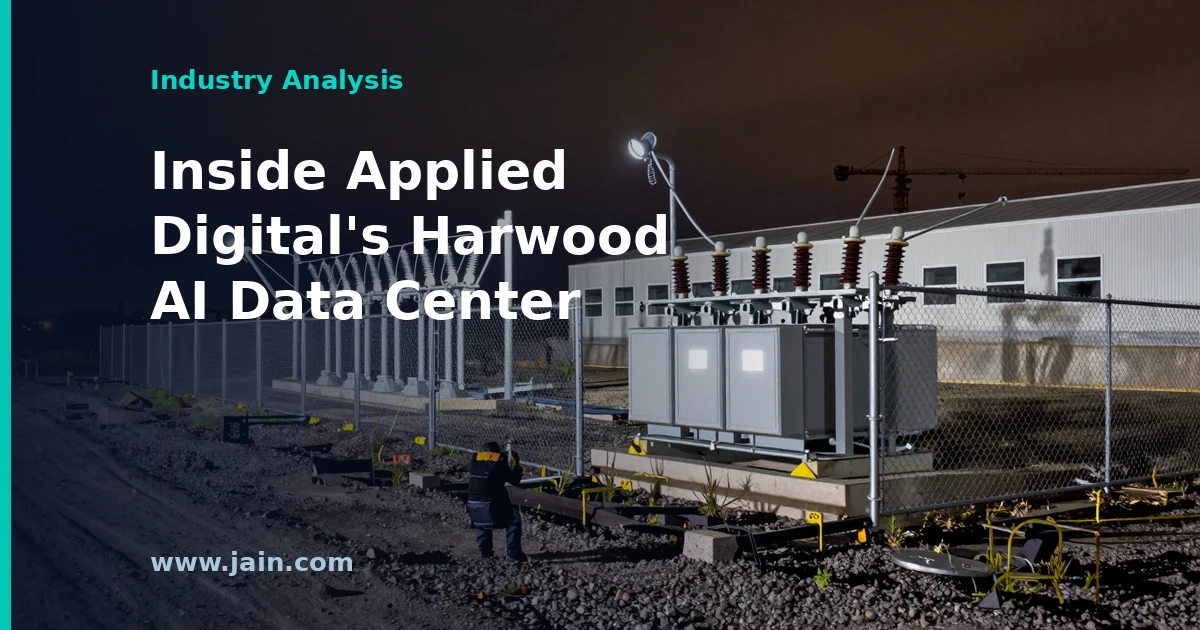
InForum reported that Applied Digital’s Polaris Forge 2 campus in Harwood, North Dakota is nearing completion, with roughly 1,800 workers finishing two buildings of 907,000 square feet each. The Harwood City Council approved the $3 billion project on September 10, 2025. Part of the campus is on pace to become operational by the end of 2026, with the remainder opening in early 2027, according to Nick Phillips, Applied Digital’s executive vice president of public affairs and real estate acquisition.
The site is a 280-megawatt facility drawing power from Cass County Electric, and Applied Digital is paying $112 million for the substation and transmission upgrades that serve it. The company has not disclosed which companies will occupy the buildings. It expects 200 to 250 permanent employees once the campus opens, on 400 acres of which about 300 have been graded.
Executive Summary
Harwood is Applied Digital’s third North Dakota project, after Jamestown and the Polaris Forge 1 campus at Ellendale, with a fourth under construction near Center. Ellendale, announced in late 2024, is partially operational. The pattern across all four is the same wager: build large blocks of power-dense capacity in a cold, cheap-power state and race to energize them while demand for artificial intelligence compute outruns supply.
What makes Harwood worth studying is the calendar. From a municipal approval on September 10, 2025 to first operational capacity at the end of 2026 is roughly fifteen months for a 280-megawatt campus. In a market where developers routinely quote three to five years between site control and delivered power, that interval is the entire product. “Time to power” is the industry’s shorthand for how long a tenant waits between signing and switching on machines, and it has become the variable that decides which sites win contracts.
The unresolved half of the story is commercial rather than physical. Steel, generators, cooling loops and a substation are visible and verifiable. Leases are not. Applied Digital has not named a tenant for Harwood, has not disclosed how much of the 280 megawatts is contracted, and has not detailed how the $3 billion build is financed. Those omissions do not undermine the construction progress, but they determine whether the speed converts into revenue.
Fifteen Months From Vote to Volts
The construction detail in the account is mostly a lesson in sequencing. Eight generator rooms in each building hold twelve units apiece, which is 96 generators per building and 192 across the campus, a level of on-site backup that signals a design intended for tenants who will not tolerate interruption. Roughly 86,000 electrical connections and several miles of copper cable have to be terminated and tested before any of it carries load. Workers wear helmets with augmented reality systems that check whether components are installed in the right place and whether crews are tracking to schedule, which is less a gadget than an admission that verification, not fabrication, is the thing most likely to slip.
Phillips describes the split inside each building as about 25% data halls and 75% supporting systems. That ratio is the clearest single indicator of how the economics have shifted. In a conventional enterprise facility, the computer room dominates the floor plan. In a building designed for dense artificial intelligence racks, the electrical rooms, switchgear, uninterruptible power supply gear and cooling plant swallow three-quarters of the envelope. Applied Digital is not really building a warehouse for servers. It is building a power conversion and heat rejection plant that happens to have servers in the middle of it.
The arithmetic underlines the point. If 280 megawatts is measured at the computers, spread across roughly 453,000 square feet of data hall, that is on the order of 600 watts per square foot, an order of magnitude above the densities most existing commercial data centers were designed for. Applied Digital has not specified whether the 280-megawatt figure is the load delivered to equipment or the total drawn from the utility, and the distinction changes that number materially. Either way, the campus is firmly in the density range that only recently became buildable at scale.
The $112 Million Sentence
The most consequential figure in the account is not the $3 billion headline but the $112 million Applied Digital says it will pay for the substation and transmission upgrades. That is roughly $400,000 per megawatt of connection, and it is the developer, not the utility’s other customers, footing the bill. Grid connection cost allocation is the live political question in nearly every jurisdiction now absorbing large computing loads, because the alternative structure, in which network upgrades are socialized across the rate base, is what makes residents worry about their bills. Harwood drew protesters on exactly that concern.
Applied Digital’s counter-claim is that its facilities do not raise electricity bills, and Phillips cited more than $46 million in savings for customers across North Dakota and South Dakota since the Ellendale project began. The underlying mechanism is plausible in principle: a very large, very steady customer spreads a utility’s fixed costs across more kilowatt-hours, which can lower the per-unit cost everyone pays. But the claim as stated is not yet verifiable by a reader. It does not identify which utility’s customers, over which period, measured against which counterfactual, or whether the figure is an avoided increase rather than a reduction. Those are answerable questions, and regulated utilities generally have to answer them in rate proceedings.
It is worth being precise about what each side is arguing, because they are not arguing about the same thing. The savings claim is retrospective and concerns Ellendale. The objection at Harwood is prospective and concerns what happens when a second large load lands on a different distribution system. A past result under one set of contracts does not settle the future question, and neither does a protest settle whether the mechanism works. The $112 million commitment is the strongest evidence Applied Digital has offered that it intends to carry its own interconnection costs, which is the part of the dispute that can actually be documented.
Air, Not Water, and Why North Dakota Rewards That Choice
Cooling is where siting logic becomes visible. Branden Cummins, the company’s civil structure architecture superintendent, described a closed loop that circulates fluid through six data halls in each building, carries it to the roof, and uses large fans to shed the heat before recirculating it. Because the loop is sealed, Applied Digital says water consumption will be comparable to a household. That is a meaningful claim in an industry now facing real scrutiny over evaporative cooling, which chills equipment by boiling away water and can consume millions of gallons a year at this scale.
The trade is not free. Rejecting heat to air rather than to evaporating water costs electricity for fans, and the penalty grows with ambient temperature. In a Texas or Arizona summer, that penalty is severe enough that many operators accept the water consumption instead. In eastern North Dakota, where cold hours dominate the year, the fan energy penalty is small and the water savings are close to pure gain. The closed loop is not primarily an environmental gesture; it is the design that the climate makes cheapest, and the environmental benefit follows from the geography.
Noise and setback receive the same treatment. Silencing equipment and sound barriers on the generator plant, with the nearest home about half a mile away and the town of Harwood more than a mile off, reflect a siting choice made before mitigation was needed. Developers increasingly buy distance rather than engineer around its absence, because generator testing and rooftop fan arrays are the two complaints most likely to follow a facility through its operating life.
A Builder Without a Named Tenant
Applied Digital is a merchant developer, meaning it builds capacity and then leases it, as opposed to a hyperscaler building for its own use. That model turns on a single question: how much of the capacity is committed before it is energized. The company has not disclosed which companies will occupy Harwood. Until it does, an observer cannot distinguish between a campus built against signed leases and one built on conviction about demand.
The local economics are more legible. Roughly 1,800 construction workers will give way to 200 to 250 permanent employees, a ratio close to eight to one that is typical of the sector and worth stating plainly: data centers are enormous construction projects and modest employers. The durable local benefit is tax base rather than payroll. Polaris Forge 1 at Ellendale paid about $4.3 million in property tax for 2026, Harwood is receiving no tax incentives or abatements according to the company, and Phillips estimated Applied Digital would become the largest single taxpayer in the state by 2029, while acknowledging that Harwood’s own assessment is not yet estimated because the building is not finished.
The absence of abatements is the notable item. Large data centers are frequently recruited with property tax exemptions that hollow out the fiscal case communities were sold, and a project that forgoes them changes the arithmetic for the county. It also suggests the developer’s binding constraint was schedule rather than subsidy. When capacity delivered in 2026 is worth materially more than the same capacity delivered in 2029, a year of negotiation over abatements costs more than the abatements are worth.
Background
Applied Digital is a Texas-based developer that builds and leases data center capacity rather than operating computing services itself, a model the industry calls merchant development. Its North Dakota expansion began with a facility in Jamestown, followed by the Polaris Forge 1 campus at Ellendale announced in late 2024 and now partially operational, the Harwood project approved in September 2025, and a fourth site under construction near Center, about 40 miles northwest of Bismarck.
The expansion tracks a broader shift in where computing gets built. Training and running large artificial intelligence models requires racks that consume several times the power of conventional servers, which has turned electrical capacity, rather than fiber or floor space, into the binding constraint on the industry. Developers have responded by moving to regions with available generation, cold climates that reduce cooling costs, and utilities able to energize large loads quickly. That has brought industrial-scale construction to rural communities with no prior exposure to it, along with recurring local debates over electricity rates, noise, water and tax base that Harwood has seen in full.
Sources
Source: An inside look at the Harwood data center as it nears completion — InForum’s report from Applied Digital’s Polaris Forge 2 construction site in Harwood, North Dakota, with detail on schedule, power, cooling, staffing and taxes from company executives.
The chips that run artificial intelligence are not held up by the factories that print them. They are held up by the assembly step at the end, where a processor and its memory are bonded onto a single slab so they can talk to each other fast enough.
Taiwan Semiconductor Manufacturing Company owns most of the world’s capacity for that step. Analysts in Taiwan say it plans to roughly double that capacity by 2028. Until it does, anyone building an artificial intelligence data center is standing in a queue. Intel is selling a rival method, and smaller assembly firms are absorbing the overflow.
Wccftech, citing a Taiwanese media report that quotes analysts, said TSMC plans to expand its chip-on-wafer-on-substrate (CoWoS) advanced packaging capacity to 260,000 wafers per month by the end of 2028, roughly double the approximately 130,000 wafers per month the same forecast puts it at by the end of 2026. The expansion is said to center on TSMC’s Arizona campus and its AP7 packaging facility in Taiwan.
The same forecast estimates that Intel’s competing EMIB-T packaging, converted into CoWoS-equivalent 12-inch wafer terms, could reach 15,000 to 20,000 wafers per month in 2027 and 40,000 to 45,000 in 2028, and says the CoWoS shortage has pushed work toward other packaging firms including Amkor, UMC and ASE. TSMC has not published a capacity target of its own. In a Form 6-K filed with the Securities and Exchange Commission on September 10, the company reported August 2026 consolidated revenue of NT$514.81 billion, up 53.3 percent from a year earlier.
Executive Summary
Advanced packaging is the step where a logic die and its stacks of high-bandwidth memory are mounted together onto a shared substrate so they behave as one component. CoWoS is TSMC’s version, and it is the packaging used for the accelerators that fill AI data centers. For roughly three years it, rather than leading-edge wafer manufacturing, has been the narrowest point in the supply chain for those parts.
A doubling of that capacity by 2028 would be the single largest change to AI hardware availability that any one company can make. It would not, however, double accelerator output in a straight line. Package sizes are growing, the newest designs consume more interposer area and more memory stacks per unit, and a wafer of packaging substrate therefore yields fewer finished accelerators each generation than it did the year before. Capacity that doubles against demand that also rises per unit is not the same as supply that doubles.
TSMC’s own disclosure does not address packaging capacity. What its September 10 filing does show is demand running hot: August revenue rose 53.3 percent year over year, and revenue for the first eight months of 2026 was up 39.3 percent. That is consistent with a company selling everything it can finish, which is the condition under which a capacity forecast of this kind becomes credible without being confirmed.
The Bottleneck Moved Downstream
For most of the history of the chip industry, the scarce resource was the front end: photolithography tools, leading-edge wafer starts, yield on a new process node. Packaging was the cheap, unglamorous back end. AI accelerators inverted that. A modern accelerator is not one chip but an assembly, a large logic die surrounded by stacks of memory, all sitting on a silicon interposer threaded with vertical connections called through-silicon vias. The density of those connections is what delivers the memory bandwidth the workload needs. That assembly step is CoWoS, and there is no abundant substitute for it.
The practical consequence for anyone financing a data center is that wafer capacity is no longer the number to watch. A foundry can start more wafers than it can finish into packages, and unfinished silicon does not train models. The forecast of 130,000 wafers per month at the end of 2026 rising to 260,000 by the end of 2028 is, in effect, a two-year schedule for how quickly the industry can convert build-ready halls into loaded racks.
Read it with care, though. Interposer area per accelerator has been climbing with every generation as designers add memory stacks and reticle-stitched logic. If the average package consumes meaningfully more of a wafer in 2028 than it does today, unit output grows by considerably less than the wafer count suggests. Doubling the input is a ceiling on supply growth, not a promise of it.
Arizona Can Print the Chips but Cannot Finish Them
The most operationally interesting detail in the forecast is geographic. Wafers produced at TSMC’s Arizona campus are flown to Taiwan to be packaged, because the packaging capacity sits on the island. Siting part of the expansion in Arizona alongside the AP7 facility in Taiwan would begin to close that loop, turning an American fab from a wafer source into something closer to a finished-component source.
That matters for reasons beyond logistics. A round trip across the Pacific adds days of cycle time and a customs and freight cost to every high-value wafer, and it means that the resilience argument for building fabs outside Taiwan is currently incomplete. A domestic fab whose output must still transit Taiwan to become a usable product does not remove the concentration risk that justified it. TSMC’s own filing shows the Arizona entity is treated as a significant subsidiary, with parent guarantees extended to TSMC Arizona among other affiliates, but the filing says nothing about packaging there.
For data center operators and the governments underwriting them, this is the question worth asking of any onshoring announcement: does the site produce a wafer or a shippable part? Until packaging follows fabrication, the answer for Arizona remains the former.
Intel’s EMIB-T and the Value of a Second Source
Intel’s EMIB-T takes a different architectural route. Instead of building the whole assembly on a large silicon interposer, it embeds small silicon bridges inside the organic substrate and places the logic and memory dies on top. Less silicon is used, which can mean lower cost and fewer of the handling and warpage problems that come with very large interposers, but the approach historically trades away some of the interconnect density that the largest, most bandwidth-hungry designs demand.
The forecast puts EMIB-T at 40,000 to 45,000 CoWoS-equivalent wafers per month by 2028. Against 260,000, that is a meaningful second source rather than a competitive threat, on the order of a sixth of the leader’s volume. The claim that it suits custom accelerators of the kind Google and Amazon design is plausible on architecture, since in-house cloud silicon is generally tuned for a known workload and a known cost target rather than for maximum bandwidth per package. It is also unverified: neither Intel nor any cloud provider has announced such an arrangement.
The spillover to Amkor, UMC and ASE follows the same logic. When the preferred supplier is sold out, work migrates to whoever can perform an adjacent version of it, and outsourced assembly and test firms have been the natural landing place. Buyers get optionality and a check on pricing. The risk is that second-source packaging is not a drop-in substitute. Requalifying a part on a different packaging architecture is an engineering program, not a purchase order, and the customers best placed to do it are the ones designing their own silicon.
What Is Substantiated and What Is Not
The demand side of this story rests on disclosed figures. TSMC’s September 10 filing with the Securities and Exchange Commission reports August consolidated revenue of NT$514.81 billion, a 10.1 percent increase on July and 53.3 percent on August 2025, with the first eight months of 2026 up 39.3 percent year over year. Growth at that rate at TSMC’s scale is difficult to explain without sustained AI accelerator demand behind it.
The supply side is a forecast, not a commitment. The 260,000 figure, the 130,000 baseline, the Arizona and AP7 split and the EMIB-T range all come from analysts rather than from the companies. None of the three firms named has published a packaging capacity target, a capital budget attached to one, or a schedule. Analyst capacity models in this industry have a reasonable track record on direction and a poorer one on timing, because packaging expansions depend on tool delivery, cleanroom construction and qualification cycles that slip quietly.
The sober reading is that the direction is well supported and the magnitude is an estimate. Treat 2028 as the earliest plausible date for materially looser accelerator supply, treat the doubling as a ceiling rather than a plan of record, and treat any procurement model that assumes it as carrying schedule risk that TSMC has not underwritten.
Background
TSMC is the world’s largest contract chip manufacturer, building processors designed by other companies. It commercialised CoWoS in the 2010s as a niche technique for high-performance parts, long before AI accelerators turned it into the scarcest resource in the industry. Today the packaging step determines how many finished accelerators reach the market, because a logic die without its memory bonded alongside it is not a usable product.
The competitive response has come from two directions. Intel has pushed its own bridge-based packaging as part of its foundry ambitions, targeting customers who want a supplier outside Taiwan or a lower-cost assembly for custom silicon. Outsourced assembly and test firms such as Amkor, ASE and UMC have absorbed work that TSMC cannot schedule. None of this has yet changed the basic shape of the market, in which one company’s packaging line sets the pace at which AI data centers can be filled.
A Greek energy company and an American turbine maker want to build a $1.5 billion artificial intelligence data centre at the port of Mombasa, Kenya.
The unusual part: it would generate its own electricity on a barge floating in the harbour, burning imported natural gas, and never plug into Kenya’s national power network at all. That sidesteps blackouts and the long wait to get connected.
If it is approved and built, East Africa would gain the kind of heavy computing power that today sits mostly in Europe and America. Kenyan regulators have not yet said yes.
Construction Review reported that Greek multinational Amaco Energy Group has partnered with US energy equipment and services company GE Vernova on Project HERCULES, a proposed $1.5 billion (roughly KSh 194.2 billion) artificial intelligence data centre at the Port of Mombasa, Kenya. Under the arrangement, GE Vernova gas turbines would be integrated into an Amaco power barge, an unmotorised floating platform housing a power plant, that supplies the campus with electricity and cooling.
The facility is designed to run entirely off-grid on offshore liquefied natural gas, with power scalable from an initial 60 to 100 megawatts up to 1,000 megawatts, and with the option to export surplus electricity to Kenya’s national network near the Mariakani substation. The project sits in the Port of Mombasa and Dongo Kundu ecosystem, is listed as proposed and pending regulatory approval, and is estimated to take about 28 months to build once approved.
Executive Summary
Project HERCULES is best understood not as a data centre that happens to have a power plant, but as a power project that has found a customer. The blueprint evolved from an earlier liquefied natural gas-to-power transmission proposal registered in 2024. In its current form, the generation, the cooling and the compute halls are bundled into a single floating architecture moored inside the port, with GE Vernova supplying the turbines and electrification equipment.
That structure is a direct answer to the constraint that has slowed large computing campuses across much of Africa. Land is available, subsea fibre has landed, and capital is willing. What is scarce is firm, reliable power delivered on a developer’s schedule rather than a utility’s. By declining to connect at all, Amaco converts a multi-year grid question into a procurement and permitting question it can largely control.
The trade is real but not free. An off-grid campus becomes its own utility: it carries fuel price exposure, it must build its own redundancy because there is no network to fall back on, and it must satisfy Kenyan energy, environmental and port regulators before any of it exists. Nothing has been approved, no customer has been named, and the financing behind the headline number has not been described.
When the Grid Is the Bottleneck, Bring Your Own
In mature markets, the queue to connect a large electrical load to the national network, known in the industry as the interconnection queue, has become the single longest item on a data centre schedule. In much of sub-Saharan Africa the problem takes a different shape: the wait can be shorter, but the delivered power is less firm, and a campus full of high-density servers cannot absorb unplanned outages. The Amaco framing is explicit on this point. Bypassing the grid, it argues, removes downtime tied to supply shortages rather than merely hedging against it.
Inverting the sequence has a commercial logic that goes beyond reliability. A developer who owns generation can commit to an energisation date, and an energisation date is what an anchor tenant is actually buying. The cost is that the developer becomes a power company. Fuel must be contracted and shipped, turbines must be maintained, and the redundancy that a utility connection normally provides has to be built into the platform itself. A campus that is genuinely 100 percent islanded has no external backstop, so its reserve margin is a design choice with a capital cost attached.
The Barge Is the Product
An unmotorised power barge is built in a shipyard and towed to its mooring. That matters more than it sounds. Shipyard fabrication trades unpredictable on-site civil works for a controlled construction environment, which is one plausible route to the stated 28-month build. It also makes the asset relocatable in principle, and it places the plant on water, which simplifies the heat rejection problem that dominates dense computing. The release describes direct cooling integrated into the same floating structure, though the specific method is not detailed.
The capacity range published for the project spans from an initial 60 to 100 megawatts to an eventual 1,000 megawatts. That is more than a tenfold spread, and it should be read as a statement of modular ambition rather than a committed build. The $1.5 billion valuation is not tied in the announcement to any particular point on that range. Anyone sizing the opportunity, whether a lender, a turbine supplier or a prospective tenant, needs to know which phase the figure buys, because the answer determines whether this is a large regional facility or the first slice of something hyperscale.
Landing Where the Cables Land
Mombasa’s strategic case rests on geography. It is East Africa’s principal arrival point for international subsea fibre-optic cables, the undersea trunk lines that carry almost all intercontinental internet traffic. Putting compute next to a cable landing station shortens the path between regional users and the machines serving them, and it makes local data residency possible for customers whose regulators or contracts require it. The project also targets industrial synergy with the neighbouring ARISE Coast Integrated Industrial Park inside the 3,000-acre Dongo Kundu Special Economic Zone, which offers a second class of power offtake alongside the servers.
The demand question is more nuanced than the connectivity story suggests. Large-scale artificial intelligence training is relatively indifferent to latency and gravitates to wherever power is cheapest. What benefits from proximity is inference, the stage where a trained model actually answers queries, along with sovereign and enterprise hosting for governments, banks and telecom operators that want their data inside national borders. Those are credible markets, but they are being contested. The announcement itself notes that other countries, Ethiopia among them, are pursuing the same regional hub position.
Who Gains, and What Has to Be True
For GE Vernova, spun out of General Electric in 2024, the appeal is straightforward. Gas turbines have become one of the few technologies that can add firm generation at computing-campus timescales, and a floating deployment extends that market to places where onshore siting is difficult. For Amaco, the repositioning is the more interesting move: a gas-to-power scheme from 2024 has been recast with artificial intelligence demand as its anchor load, which is a considerably more bankable story than selling electrons into a constrained transmission system. The proposed surplus export near the Mariakani substation adds a second revenue line and, just as usefully, gives Kenyan authorities a reason to see the project as a contributor rather than an enclave.
Three conditions have to hold. Imported liquefied natural gas must be priced competitively enough that the campus can quote power rates a regional customer will accept, since fuel, not hardware, dominates the operating cost of a gas-fired site. Regulatory approval must cover energy licensing, environmental consent and port anchoring rights simultaneously, and the announcement places the project firmly at the discussion stage with Kenyan authorities and financiers. And the stated future conversion to hydrogen should be treated as design optionality rather than a near-term plan, because it depends on a fuel supply chain that does not yet exist at this scale anywhere.
Background
Amaco Energy Group is a Greek multinational energy firm. Its Mombasa plan did not begin as a computing project: the blueprint evolved from an earlier liquefied natural gas-to-power transmission proposal registered in 2024, since recast around artificial intelligence demand as the anchor load. GE Vernova is the energy equipment and services company spun out of General Electric in 2024, whose gas turbine business has become central to a global race to add firm generation quickly enough for data centre construction schedules.
Kenya has spent a decade positioning itself as East Africa’s digital gateway, and Mombasa is the physical hinge of that claim because the region’s international subsea fibre-optic cables come ashore there. The country is also building out the Dongo Kundu Special Economic Zone, a 3,000-acre industrial area near the port overseen in part through the Kenya Ports Authority. Competition for the regional hub position is active, with Ethiopia among the countries pursuing similar ambitions.