Nebius, the Amsterdam-headquartered AI infrastructure company, announced on April 30, 2026 that it has agreed to acquire Eigen AI, a deal the company says will strengthen Nebius Token Factory — its managed platform for running AI models in production — as a “frontier inference platform.” Financial terms were not disclosed in the announcement.
Executive Summary
The announcement is short on detail but clear in direction: Nebius is buying its way further up the stack. Token Factory is the company’s inference service — inference being the work of actually running a trained AI model to answer queries, as opposed to the one-time job of training it. By acquiring Eigen AI, Nebius signals that it wants to compete on the software and efficiency of serving models, not only on the raw GPU capacity underneath.
That matters because inference is where the AI infrastructure market’s recurring revenue increasingly lives. Training runs are lumpy, contract-driven, and dominated by a handful of frontier labs; inference demand grows with every application that puts a model in front of end users. A GPU cloud that can serve tokens more efficiently than rivals can either undercut them on price or keep the margin — and an in-house optimization team is one of the few durable ways to get that edge.
Inference Is Becoming the Real Battleground
For the past several years, the headline numbers in AI infrastructure have come from training: giant clusters, multi-year capacity contracts, gigawatt campuses. But training is a capital-intensive land grab with a small set of customers. Inference — serving billions of model queries a day — is the volume business, and its economics are decided by software as much as hardware. Techniques like smart request batching, caching, and model-serving optimizations can multiply how many tokens a given GPU produces per second, which translates directly into cost per query.
Nebius framing the deal around making Token Factory a “frontier inference platform” tells you where it thinks the fight is heading. Frontier-scale models are expensive to serve, and the providers who serve them cheapest — without sacrificing latency or reliability — will win the workloads of AI application companies that live and die on unit economics.
Vertical Integration in the AI Cloud Race
Nebius belongs to the cohort often called neoclouds — specialist GPU cloud providers that grew up renting accelerator capacity, distinct from hyperscalers like AWS, Microsoft Azure, and Google Cloud. The strategic risk for any neocloud is commoditization: if all you sell is access to the same Nvidia hardware everyone else buys, price competition eventually erodes margins. The escape route is moving up the stack into managed platforms, and inference services are the most natural rung.
Acquiring an inference-focused company rather than building everything internally is a classic vertical-integration play: own the layer that differentiates your commodity input. Hyperscalers and inference-API specialists are pursuing the same layer, so the competitive logic is straightforward — Nebius needs Token Factory to be more than a thin wrapper around GPUs, and buying specialized talent and technology is faster than growing it.
Buy Versus Build, and What a Thin Release Does and Does Not Establish
It is worth being precise about what the announcement substantiates. It establishes that Nebius has agreed to acquire Eigen AI and that Nebius intends the deal to bolster Token Factory’s inference capabilities. It does not disclose a purchase price, Eigen AI’s size, its customers, or the specific technology being acquired — so any claim about how much this improves Token Factory’s performance or economics is, for now, unverifiable from the source material. “Strengthening” language in an acquisition release is aspiration until integration results show up in benchmarks, pricing, or customer wins.
Still, the pattern is credible. Across the industry, inference-optimization teams — often small groups with deep expertise in GPU kernels, serving engines, and scheduling — have become prized acquisition targets, because a handful of engineers can move serving costs by double-digit percentages. If Eigen AI fits that profile, the deal is less about revenue than about capability: the acqui-hire economics of the AI era, where talent density in a narrow specialty commands strategic premiums.
Background
Nebius Group emerged in 2024 from the restructuring of Yandex N.V., the Dutch holding company that divested its Russian assets and refocused on AI infrastructure, resuming trading on Nasdaq that year. Since then, Nebius has expanded aggressively — building GPU data-center capacity in Europe and the United States and signing large capacity agreements, including a multibillion-dollar GPU deal with Microsoft announced in September 2025. Token Factory, launched in late 2025, is its managed inference platform and a centerpiece of its push beyond raw compute rental into higher-margin platform services, of which the Eigen AI acquisition is the latest step.
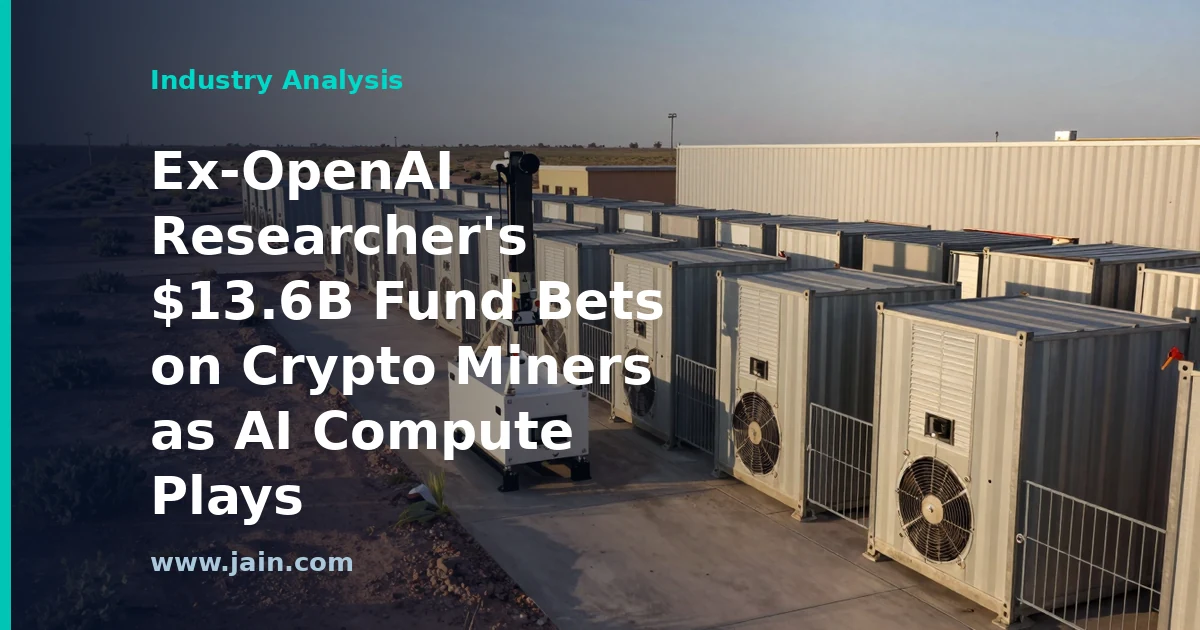
Leopold Aschenbrenner, the former OpenAI researcher behind the widely read “Situational Awareness” essay, has built his AI-focused investment fund to roughly $13.6 billion and is placing a significant bet on cryptocurrency mining companies, according to an April 29 CoinDesk report. The wager is not on bitcoin itself, but on what miners already own: large, energized, grid-connected industrial sites that can be repurposed for AI computing.
Executive Summary
According to CoinDesk, Aschenbrenner’s fund — reported at approximately $13.6 billion in assets — is allocating capital to publicly traded crypto miners as part of a broader AI infrastructure thesis. The logic is straightforward: training and running large AI models requires enormous amounts of electricity delivered to a single campus, and the queue to get new large-scale power connections from U.S. utilities now stretches years. Bitcoin miners spent the last decade acquiring exactly those connections.
The move matters because it signals that sophisticated AI-native capital increasingly views the data center race as a power race. If the scarce asset is an energized site rather than chips or software, then companies holding hundreds of megawatts of contracted power — even ones built for an entirely different business — become strategic real estate. Several miners have already begun converting capacity to AI and high-performance computing hosting, and a large dedicated fund leaning into that trade could accelerate the sector’s transformation.
Power, Not Chips, Is the Chokepoint
For most of the AI boom, the story was about GPU scarcity — the specialized chips that train and run large models. By 2026, the constraint has visibly shifted upstream to electricity. A modern AI campus can draw hundreds of megawatts, comparable to a mid-sized city, and utilities cannot energize new connections of that size quickly. Interconnection queues, substation equipment lead times, and transmission upgrades routinely add years to a project schedule.
Bitcoin miners are an accident of history in this picture. To chase cheap electricity, they spent years locking up power contracts and building electrical infrastructure at industrial scale, often in locations other industries ignored. A miner’s site may lack the cooling, networking, and reliability engineering an AI facility needs — but it has the one thing that cannot be bought quickly: an energized grid connection. Aschenbrenner’s reported bet is a concentrated expression of that arbitrage.
The Conversion Trade and Its Economics
The financial case for miner-to-AI conversion rests on a valuation gap. Mining revenue is volatile, tied to bitcoin’s price and periodic “halving” events that cut mining rewards. AI hosting, by contrast, can be sold under multi-year contracts to well-capitalized customers, which markets typically reward with higher and steadier valuations. A miner that converts a site from speculative crypto revenue to contracted AI revenue can, in principle, re-rate substantially — and several miners that announced AI hosting deals in 2024 and 2025 saw exactly that kind of market response.
The conversion itself is not trivial. AI workloads demand dense liquid cooling, high-bandwidth networking, and far higher uptime standards than mining, which tolerates interruptions. Retrofit costs per megawatt can approach greenfield data center costs. The trade works best where the site’s power capacity is large, expandable, and located acceptably close to fiber routes — which is why investors in this theme tend to price the power asset, not the existing buildings.
A Hedge Fund as an Infrastructure Signal
Aschenbrenner is a distinctive figure to be making this bet. He left OpenAI in 2024 and published “Situational Awareness,” a lengthy essay arguing that AI capabilities — and the industrial buildout behind them — would scale far faster than consensus expected. His fund was founded explicitly to invest around that thesis, and its reported growth to $13.6 billion suggests substantial institutional appetite for it. When a fund built on an aggressive AI-scaling worldview concentrates on power-holding companies, it is effectively a public forecast: that demand for energized capacity will outrun supply for years.
For the infrastructure industry, the second-order effects are worth watching. Capital flowing into miners raises the price of power-rich sites for everyone, including traditional data center developers and hyperscale cloud providers pursuing the same locations. It may also pull marginal mining capacity out of crypto and into AI, tightening both markets. None of that requires the fund’s specific stock picks to be right; the flow itself moves prices.
What Could Go Wrong
The risks are real on both sides of the trade. If AI infrastructure demand moderates — because model efficiency improves faster than expected, or because financing conditions tighten — miners that pivoted may hold half-converted sites with neither strong crypto economics nor anchor AI tenants. Conversion timelines have already slipped at some operators, and AI customers demand delivery guarantees that mining-era organizations are not always built to meet.
There is also concentration risk inherent in a large fund pressing a single macro thesis. A $13.6 billion vehicle moving in and out of a relatively small universe of mining equities can move those markets on entry and exit alike. Investors reading this news as validation of the miner-conversion theme should remember that a prominent buyer is evidence of conviction, not proof of outcome.
Background
Leopold Aschenbrenner worked on OpenAI’s safety-focused research before departing in 2024, then published “Situational Awareness: The Decade Ahead,” a book-length essay forecasting rapid AI scaling and a trillion-dollar industrial buildout of computing and power. He launched an investment fund to trade that worldview, and its reported growth to $13.6 billion by April 2026 made it one of the more closely watched AI-thesis vehicles in public markets.
Bitcoin miners, meanwhile, entered the AI era almost by accident. Built to chase cheap electricity, the industry accumulated gigawatts of contracted, grid-connected capacity across North America. As AI demand collided with multi-year utility interconnection queues from 2023 onward, those sites acquired a second life: several miners struck AI and high-performance computing hosting deals, and the sector increasingly trades as power-infrastructure real estate rather than pure crypto exposure.
Sherwood News reports that bitcoin mining economics “have gone from bad to worse,” and that mining companies are responding by pivoting their businesses — or selling assets outright — to survive. According to the report, publicly traded miners on investor watchlists, including names such as Riot Platforms and Hut 8, are redirecting attention from pure hashrate growth toward converting their power-rich sites into AI data-center capacity.
The story, published April 29, 2026, frames the shift not as opportunistic diversification but as a survival response: when the core business of minting bitcoin no longer covers its costs for many operators, the land, power contracts, and electrical infrastructure miners control become more valuable serving artificial-intelligence workloads than mining rigs.
Executive Summary
The announcement here is really a diagnosis: the economics of industrial-scale bitcoin mining have deteriorated to the point that pivoting and selling are now mainstream strategies, not edge cases. Bitcoin mining profitability is a squeeze between three variables — the price of bitcoin, the total computing power competing on the network (which rises relentlessly), and the cost of electricity. When the spread between what a miner earns per unit of computing power and what it pays for energy compresses, weaker operators run out of room. Sherwood’s reporting says that spread has kept compressing.
Why it matters to the infrastructure industry: bitcoin miners collectively control one of the scarcest assets in technology today — large blocks of grid-connected power with substations, transformers, and cooling already in place. AI data-center developers routinely wait years for utility interconnections. A distressed miner with hundreds of megawatts energized is, from an AI developer’s perspective, a shortcut through the single longest item on the construction schedule. That is why the pivot is happening, and why acquirers are circling the sellers.
The unresolved question is execution. A mining shed and an AI data center share a power feed and little else. Whether watchlist miners can finance and deliver true high-density AI facilities — or whether they simply become land-and-power sellers to better-capitalized buyers — will separate the survivors from the exits.
Why Mining Economics Keep Getting Worse
Bitcoin’s protocol is deliberately unforgiving. Roughly every four years, a “halving” cuts the new-coin reward miners receive in half, mechanically slashing industry revenue per unit of work unless the bitcoin price doubles to compensate. Meanwhile, network hashrate — the total computing power competing for those rewards — tends to grow as new, more efficient machines come online, which dilutes every incumbent’s share. The result is a treadmill that speeds up on a schedule: costs are largely fixed in electricity and debt service, while revenue per terahash structurally declines.
Sherwood’s “bad to worse” framing captures the position of miners caught between those forces without a low-cost energy advantage. In commodity industries — and bitcoin mining is one, producing an identical product where the only durable edge is cost — deteriorating unit economics do not punish everyone equally. They sort the industry into low-cost survivors, distressed sellers, and pivots. The report indicates all three categories are now visible.
The Real Asset Was Always the Power
The pivot toward AI data centers rests on a simple arbitrage. AI training and inference facilities need enormous amounts of electricity delivered through utility-scale interconnections — agreements with grid operators that can take years to secure. Bitcoin miners spent the last cycle acquiring exactly those assets, often in power-rich regions, because cheap electricity was their business model. A miner’s site with an energized substation can be worth more as an AI campus shell than it ever earned mining.
But the conversion is not cosmetic. Mining facilities are typically air-cooled warehouses running hardware that tolerates heat and interruption; AI data centers demand dense power distribution, liquid or precision cooling, redundant systems, and uptime guarantees written into contracts. The capital cost per megawatt of a genuine AI facility is a large multiple of a mining build-out. That gap is precisely why some miners pivot while others sell: the pivot requires capital and data-center operating credibility that a distressed balance sheet may not support.
Winners, Losers, and the Middle
The likely winners are miners holding large, well-located power positions and enough financial flexibility to either fund conversions or strike partnerships with hyperscalers and AI cloud providers on favorable terms. Buyers of distressed sites also win: acquiring energized capacity is faster than greenfield development. Utilities and communities hosting these sites may see steadier, longer-term tenants, since AI facilities sign multi-year commitments in a way price-sensitive mining loads generally do not.
The losers are miners with small sites, expensive power, or leveraged balance sheets — operators whose assets are not distinctive enough to attract AI tenants and whose mining margins no longer cover obligations. For them, “pivot or sell” can shade into “sell at whatever the market offers.” Investors should also note a subtler risk in the middle: a miner that announces an AI strategy has not yet built one. The industry has an incentive to rebrand faster than it can execute, and the market has at times rewarded the announcement before the revenue.
What This Means for the Broader Data-Center Market
Every mining megawatt that converts to AI use adds supply to a data-center market defined by power scarcity — but not always where AI customers most want it. Mining sites were chosen for cheap power, not proximity to network hubs or enterprise demand, so converted capacity will suit some workloads (large-scale training, which tolerates remote locations) better than others (latency-sensitive inference near population centers). The pivot wave is therefore additive to AI infrastructure supply, but selectively so.
It also serves as a market signal. When an entire adjacent industry concludes its power portfolio earns more serving AI than its original purpose, it confirms how deep the demand for energized capacity runs. The countervailing question — one worth asking of the AI build-out with the same rigor applied to mining — is what happens to converted sites if AI infrastructure demand ever cools. Assets that have been repurposed once can be repurposed again, but the capital sunk into the conversion cannot.
Background
Industrial bitcoin mining grew through the early 2020s into a public-company sector, with operators such as Riot Platforms and Hut 8 raising capital to build warehouse-scale facilities wherever electricity was cheap — Texas, the U.S. Midwest, Canada, and beyond. The business model was a leveraged bet on bitcoin’s price against relentlessly rising network competition and scheduled halvings that cut mining rewards in half roughly every four years, most recently in April 2024.
As generative AI ignited unprecedented demand for grid-connected data-center capacity, the industry discovered that miners’ real strategic asset was their power portfolios rather than their mining machines. Core Scientific’s high-profile agreements to host AI computing marked an early template, and by 2026 the question facing much of the sector had become not whether to engage with AI infrastructure, but whether each miner would be a converter, a landlord, or a seller.
Market research firm Dell’Oro Group has published analysis describing a growing “memory tax” on AI infrastructure — the rising share of system cost attributable to high-bandwidth memory (HBM) and DRAM in AI servers and accelerators. The note, surfaced April 27, 2026, frames memory as an increasingly material and often under-examined component of AI capital spending.
Executive Summary
Dell’Oro Group, an analyst firm that tracks data center and telecom infrastructure markets, is calling attention to memory — specifically HBM, the stacked memory packaged alongside AI accelerators, and conventional DRAM used in servers — as a fast-growing cost component in AI infrastructure. The “memory tax” framing suggests that as AI models and the clusters that train and serve them grow, memory is consuming a larger slice of every infrastructure dollar.
The framing matters because most public discussion of AI capital expenditure centers on GPUs and, increasingly, on power and data center construction. If memory costs are rising as a share of the bill of materials — the itemized cost of the components inside a server — then budget models built around accelerator pricing alone will understate the true cost of AI capacity. That has implications for cloud providers, enterprises buying AI servers, and the memory suppliers positioned to benefit.
Readers should note what is available here: a headline and thesis from a recognized analyst firm, without the underlying figures, forecast horizon, or methodology visible in the source material. The direction of the claim is consistent with the widely reported tightness in memory supply driven by AI demand, but the magnitude is not substantiated in what we can see.
Why Memory Became a Line Item Worth Naming
AI accelerators are unusual among chips in that their usefulness is bounded as much by memory as by raw compute. Training and serving large models requires moving enormous volumes of data to the processor quickly, which is why modern accelerators are packaged with HBM — DRAM dies stacked vertically and connected to the processor over a very wide, short interface. HBM is expensive to manufacture, supply is concentrated among a small number of suppliers (SK hynix, Samsung, and Micron are the established producers), and each new accelerator generation ships with more of it.
Conventional DRAM matters too: the host servers around the accelerators, plus the storage and networking tiers of an AI cluster, all consume memory. When one demand source — AI — pulls hard on a supply chain with long lead times and few producers, prices tend to rise across the board. Dell’Oro’s “memory tax” label captures the effect from the buyer’s side: a cost that arrives embedded in system prices whether or not the buyer itemizes it.
Who Pays, and Who Collects
If memory’s share of AI system cost is growing, the immediate beneficiaries are the memory manufacturers, for whom HBM commands substantially better margins than commodity DRAM historically has. Accelerator vendors sit in the middle: memory is a cost input to their products, but strong demand has so far allowed system prices to carry it. The buyers — hyperscale cloud providers, AI labs, and enterprises — absorb the tax directly in capital expenditure, and indirectly it flows into the price of cloud GPU capacity and AI services.
There is a second-order effect worth watching. Rising memory prices do not stay confined to AI hardware. General-purpose servers, storage systems, and consumer devices draw on the same DRAM supply base, so a sustained AI-driven squeeze can raise costs for infrastructure buyers who are not purchasing AI systems at all. For data center operators and IT planners, that argues for treating memory pricing as a market variable in refresh budgets, not a constant.
An Analyst Thesis, Not a Dataset — Yet
It is worth being precise about the evidentiary weight of what has surfaced. Dell’Oro is an established infrastructure research firm, and the thesis aligns with observable market conditions. But the material visible here is a headline-level framing: it does not disclose how large the memory share of AI system cost currently is, how fast it is growing, or over what forecast period. “Growing” is directionally plausible and quantitatively unverified in this source.
That distinction matters for anyone using the claim to make decisions. A memory share that rises from, say, a modest slice to a dominant one would reshape supplier negotiations and cloud pricing; a gradual drift would be a planning footnote. Until the underlying figures are public, the responsible reading is that memory costs deserve a named line in AI infrastructure budgets — and that the size of that line needs data the summary does not provide.
Background
The AI infrastructure buildout that accelerated from 2023 onward has been discussed mostly in terms of GPUs, power, and data center construction, but every AI accelerator ships with a large complement of high-bandwidth memory, and every cluster consumes conventional DRAM in its servers and supporting systems. Memory is a historically cyclical market dominated by a small number of manufacturers — SK hynix, Samsung, and Micron — and AI demand has become a defining force in its current cycle.
Dell’Oro Group, founded in the 1990s and based in Silicon Valley, publishes recurring research on data center capex, servers, and network infrastructure. Its analysts’ framing of trends — in this case, memory as a “tax” on AI infrastructure — often shapes how vendors and buyers talk about market economics before detailed figures circulate publicly.
An entity calling itself the Transatlantic Investment Group announced on April 27, 2026 a €50 billion AI data center and innovation campus in Croatia. The announcement describes the project as the largest investment in Croatian history and among the largest private U.S. investments in Europe. Beyond that headline framing, the release provides few operational details — no named site, power figure, timeline, or anchor tenant.
Executive Summary
The announcement positions Croatia — an EU, eurozone, and Schengen member on the Adriatic — as the destination for one of the largest AI infrastructure commitments ever declared in Europe. A €50 billion figure, if realized, would place the project in the same conversation as the multi-hundred-billion-euro wave of AI campus announcements that has swept the U.S. and, increasingly, Europe and the Gulf since 2024.
Why it matters: hyperscale AI buildout is going global. Power, land, and permitting constraints in Europe’s established data center markets — Frankfurt, London, Amsterdam, Paris, Dublin — have pushed developers toward secondary markets, and a commitment of this size in Croatia would be the strongest signal yet that the frontier has moved to Southeast Europe. But the announcement, as published, is a statement of intent. The distance between a declared figure and energized capacity is measured in grid connections, financing closes, and construction phases — none of which are detailed here. Readers should treat this as a significant claim awaiting substantiation, not a shovel-ready project.
Why Croatia? The Logic of AI’s Geographic Spillover
Europe’s traditional data center hubs are effectively full. Utilities in Dublin and Amsterdam have restricted new grid connections for large facilities, and Frankfurt and London face similar power and land pressure. That has redirected capital toward markets that can offer three things at once: available power, developable land, and EU regulatory standing. Croatia checks the third box cleanly — it is inside the EU single market, the eurozone, and Schengen — which matters for data sovereignty rules that push European enterprises and governments to keep AI workloads on EU soil.
The strategic framing as a “private U.S. investment in Europe” also fits a broader pattern: American capital funding AI capacity abroad, both to serve regional demand and to diversify away from congested U.S. power markets. For Croatia, a country whose economy leans heavily on tourism, an anchor investment in digital infrastructure would be transformative — which is precisely why the announcement’s superlatives deserve careful measurement against what has actually been committed.
What €50 Billion Buys — and What an Announcement Doesn’t
At current costs, hyperscale AI capacity runs very roughly in the tens of millions of euros per megawatt once you include the chips inside. A €50 billion program therefore implies gigawatt-class ambitions — a campus that would rank among the largest in Europe and consume electricity on the scale of a sizable city. Nothing in the announcement explains where that power comes from, and in AI infrastructure, power is the project. Grid interconnection queues, not capital, are the binding constraint almost everywhere.
Industry observers have also learned to discount announcement figures. Across the sector, headline commitments are typically phased over a decade, contingent on demand, and structured so that early phases are a small fraction of the total. That is not a criticism of this project specifically — it is how large campuses are legitimately built — but it means the meaningful milestones to watch are land acquisition, a signed grid agreement, a financing close, and a named hyperscale or AI-lab tenant. None appear in the source material.
Winners, Losers, and the Regional Ripple
If even a first phase proceeds, the beneficiaries are identifiable: Croatia’s grid operator and power producers (who would need to expand generation and transmission), regional construction and electrical trades, European chip-adjacent suppliers of cooling and power equipment, and connectivity providers building fiber routes to link the Adriatic to Frankfurt, Milan, and Vienna. An “innovation campus” component, if real, could seed a local AI workforce — though such components are also the easiest part of an announcement to promise and the last to be funded.
The competitive question is who this capacity would serve. Europe’s AI compute demand is growing, and the EU has actively courted large-scale AI infrastructure through initiatives like its AI gigafactory push. But Croatia would be competing with Spain, the Nordics, and Southern European markets that offer abundant renewables and established subsea connectivity. A project of this scale succeeds or fails on tenant demand, and the announcement names none.
Background
Croatia joined the European Union in 2013 and adopted both the euro and Schengen membership in 2023, completing its integration into the EU single market. Its economy has historically leaned on tourism and shipping, with a small but growing technology sector; it has not previously hosted hyperscale data center capacity, which in Europe has concentrated in the so-called FLAP-D markets — Frankfurt, London, Amsterdam, Paris, and Dublin.
That concentration is now breaking up. Power and land constraints in the established hubs, EU data sovereignty rules encouraging in-region AI capacity, and Brussels-backed initiatives to attract large-scale AI computing have pushed developers toward Southern and Eastern Europe. The Croatian announcement, if substantiated, would be the largest expression of that shift to date.
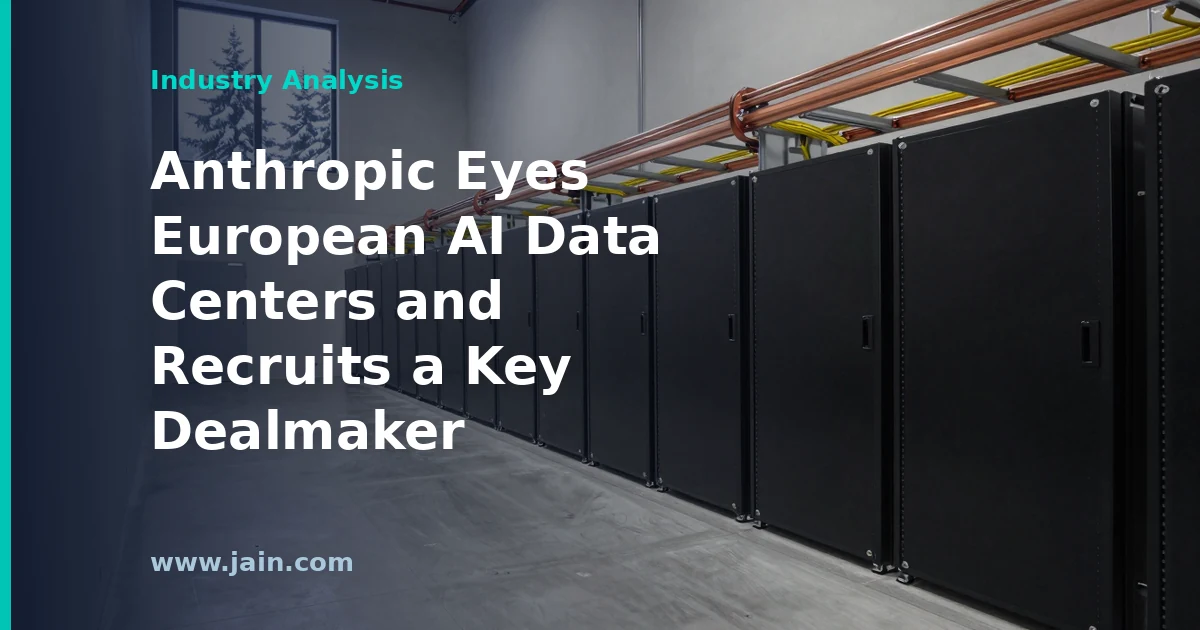
Anthropic, the AI lab behind the Claude family of models, is pursuing a push into European AI data centers and is recruiting for a key dealmaking role to drive it, according to a CNBC report published April 26, 2026. The report signals that Anthropic intends to secure compute capacity in Europe directly, rather than relying solely on its cloud partners — though no sites, capacity figures, or financial commitments have been disclosed.
Executive Summary
According to CNBC, Anthropic is working to expand its AI data center footprint in Europe and is hiring for a senior dealmaker position to lead infrastructure negotiations. A “dealmaker” hire in this context typically means someone who structures large, complex transactions — capacity leases, joint ventures, land and power agreements — rather than a conventional corporate development role.
The move matters because it marks a broader industry shift: frontier AI labs, which historically consumed compute through hyperscale cloud providers, are increasingly acting like infrastructure buyers in their own right. If Anthropic contracts European capacity directly, it becomes a new class of anchor tenant — or even developer — in a market already straining under power and land constraints. For data center operators, utilities, and governments courting AI investment, that changes who sits across the negotiating table.
From Tenant to Buyer: Frontier Labs Are Changing Seats at the Table
Until recently, the division of labor in AI infrastructure was clean: labs trained models, cloud providers built and operated the data centers. Anthropic has historically run its workloads on partner infrastructure, backed by deep compute relationships with Amazon and Google. Recruiting a dedicated dealmaker for a European push suggests the company wants direct agency over where its capacity sits and on what terms — the same trajectory other frontier labs have followed as training and inference demand outgrew what standard cloud contracts comfortably deliver.
The economics explain the shift. AI compute is now the dominant cost line for a frontier lab, and multi-year capacity commitments are effectively infrastructure finance decisions. Negotiating directly with data center developers, power providers, and governments can secure capacity earlier and potentially on better terms than consuming it through an intermediary — but it also requires skills labs did not traditionally employ: site selection, power procurement, and structured real-estate-style dealmaking. A dealmaker hire is the organizational tell that this capability is being built in-house.
Why Europe: Sovereignty Demand Meets a Supply-Constrained Market
Europe is a logical but difficult target. On the demand side, European enterprises and public-sector buyers increasingly want AI workloads processed in-region — a mix of data-protection law, the EU AI Act’s compliance regime, and a broader political push for “sovereign AI” capability. A lab that can offer European customers inference served from European soil holds a genuine commercial and regulatory advantage over one that cannot.
On the supply side, however, Europe’s prime data center markets — Frankfurt, London, Amsterdam, Paris, Dublin — are among the most power-constrained in the world, with grid-connection queues stretching years and some jurisdictions having imposed moratoria on new builds. That scarcity is precisely why a dealmaker matters: available large-scale capacity in Europe is won through early, creative transactions — secondary markets, powered-land deals, partnerships with utilities — not by placing an order. Anthropic entering that hunt adds a well-capitalized bidder to an already competitive field.
Ripple Effects: Operators, Hyperscalers, and Governments
For European data center operators and developers, a frontier lab shopping directly is attractive: AI labs sign large, long-duration commitments that can anchor entire campuses and underwrite new construction. Utilities and grid operators face the harder version of the same news — more gigawatt-scale demand arriving in systems already juggling electrification and renewable-integration timelines.
For the hyperscalers, the picture is nuanced rather than adversarial. Anthropic’s cloud partnerships remain central to its compute story, and a European buildout could well be executed with or through those partners. But every direct deal a lab signs shifts some negotiating leverage and some margin away from the cloud intermediary. Governments, meanwhile, gain a new courtship target: expect member states competing for AI investment to treat frontier labs, not just hyperscalers, as strategic accounts.
Background
Anthropic was founded in 2021 by former OpenAI researchers and has grown into one of the leading frontier AI labs, best known for its Claude models. Its compute has historically come through deep partnerships with Amazon — which has committed roughly $8 billion in investment — and Google, both of which also serve as cloud infrastructure providers for its training and inference workloads.
The European data center market it is now reportedly entering is large but supply-constrained: the established FLAP-D hubs (Frankfurt, London, Amsterdam, Paris, Dublin) face power scarcity and permitting friction, pushing new AI capacity toward secondary markets such as the Nordics, Iberia, and Southern Europe. European policymakers, for their part, have been actively courting AI infrastructure investment as part of a broader push for regional AI capability.
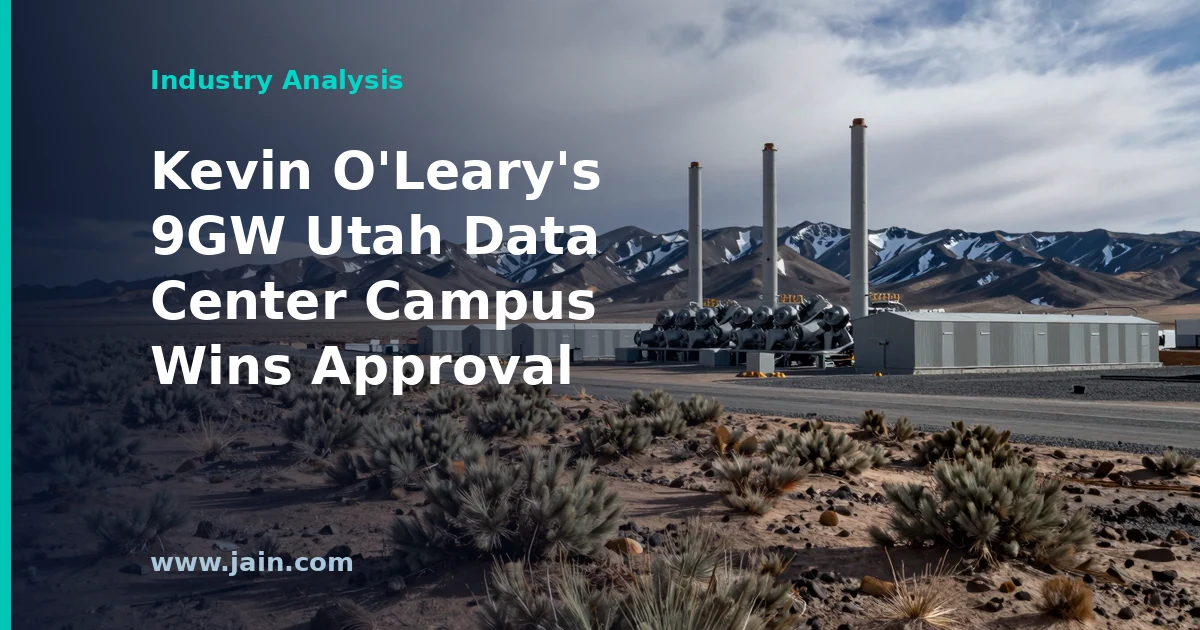
A 9-gigawatt AI data center campus backed by investor Kevin O’Leary has been approved in Utah, according to an April 26, 2026 report from Tom’s Hardware. The project is described as generating and consuming more than twice the amount of power the entire state of Utah currently uses — placing it among the largest data center developments ever announced anywhere in the world.
Executive Summary
The headline fact is the scale: 9 gigawatts is not a data center in any conventional sense — it is a power project with computing attached. For perspective, 9GW is roughly the output of nine large nuclear reactors, and the report frames it as more than double Utah’s entire statewide electricity draw. Notably, the report says the campus will generate as well as consume that power, which signals a behind-the-meter model: building dedicated generation on site rather than asking the regional grid to supply it.
The second fact is the word “approved.” Some jurisdictional body has said yes to something — but at headline level, the report does not specify which approval this is: land-use zoning, an air-quality permit, a generation license, or a state economic-development agreement. In mega-project development, each of those is a different gate, and clearing the first one is a long way from moving dirt. What is substantiated here is an approval milestone for an extraordinarily ambitious plan; what is not yet substantiated is financing, customers, a construction timeline, or the generation technology behind the 9GW figure.
A Power Plant First, a Data Center Second
The most telling detail in the report is that the campus will “generate and consume” its power. AI campuses at gigawatt scale have collided with a hard constraint across the United States: utility interconnection queues — the waiting lines to connect large new loads to the grid — now stretch years in many regions. Developers who cannot wait are going behind the meter, building their own gas turbines, and in some proposals nuclear or geothermal capacity, dedicated to the site. A 9GW self-generation plan sidesteps the queue but inherits a different set of problems: gas turbine order books are backed up years, fuel supply must be contracted at enormous volume, and on-site generation still typically requires air-quality permits and some grid tie for backup and startup power.
For lay readers, the practical meaning is this: the binding constraint on AI infrastructure has shifted from chips and buildings to electricity. Projects are now sized and sited around where power can be created, not where fiber or customers happen to be. Utah — with land, gas access, and a development-friendly posture — fits that new map.
What “Approved” Does and Does Not Mean
Approval is a genuine milestone; it is also the cheapest one. The industry has spent the past two years in an announcement race, with proposed multi-gigawatt campuses in the U.S., Canada, and the Gulf states collectively promising far more capacity than the supply chain — turbines, transformers, switchgear, chips, and skilled labor — can deliver on the advertised timelines. Analysts increasingly distinguish between announced gigawatts and energized gigawatts, and the gap between the two is wide. Kevin O’Leary himself previously announced a separate multi-gigawatt AI data center park in Alberta, Canada, which illustrates the pattern: high-profile backers can secure land and early approvals quickly, while the capital-intensive middle of the project — measured in tens of billions of dollars for a campus this size — takes years and committed tenants to close.
None of that makes the Utah project unserious. It makes it unproven, which is the honest status of nearly every gigawatt-class announcement at the approval stage. The credible test will be what follows: named anchor tenants, equipment orders, and financing commitments, not renderings.
Winners, Losers, and the Utah Question
If the campus advances, the near-term winners are clear: turbine and electrical-equipment manufacturers with the scarcest order slots, construction and trades labor in Utah, and the state’s tax base. Hyperscalers and AI labs hungry for capacity gain another potential supply option in a market where powered land is the scarcest commodity. The open question is who bears the risks. Behind-the-meter gas generation at this scale raises air-quality and emissions questions; data centers in the arid West raise water and cooling questions; and residents near any 9GW generation complex will have views on all of it. A project sized at more than twice the state’s current consumption will, fairly or not, become a referendum on how Utah wants to participate in the AI buildout — and community sentiment has already slowed or stopped large data center proposals in other states. Developers who engage those concerns early, with specific commitments on emissions, water, and grid impact, have fared better than those who lead with the gigawatt number.
Background
The AI boom has turned electricity into the data center industry’s scarcest input. Training and running large AI models requires dense clusters of power-hungry chips, and since 2023 developers have raced to secure “powered land” — sites where gigawatt-scale electricity can be delivered or built. With utility interconnection queues stretching years, a new class of power-first campuses has emerged that builds its own generation on site, and announced capacity across North America and the Gulf now far outstrips what has actually been energized.
Kevin O’Leary, the investor and Shark Tank personality behind O’Leary Ventures, entered this race with a previously announced multi-gigawatt AI data center park in Alberta, Canada. The Utah campus extends that playbook to the U.S. at even larger scale: at 9GW, the approved plan would exceed the entire current power draw of the state that will host it — a first even by the standards of this buildout.
CoinDesk reported on April 25, 2026 that Leopold Aschenbrenner — a former OpenAI researcher who left the lab and became one of the most-watched voices on AI’s trajectory — is directing his roughly $13.6 billion investment vehicle toward crypto mining companies as a way to gain exposure to AI computing infrastructure. The report frames the miners not as bets on bitcoin, but as bets on the power-rich sites and industrial facilities miners control.
Executive Summary
According to CoinDesk, Aschenbrenner’s fund — an AI-focused vehicle now reported at $13.6 billion — is making sizable wagers on publicly traded crypto miners. The logic, as the framing suggests, is that mining companies hold exactly the assets the AI buildout is starved for: contracted electrical capacity, energized substations, industrial land, and operational teams accustomed to running dense computing at scale.
If accurate, this is one of the clearest third-party endorsements yet of the ‘miner-to-AI pivot’ — the industry-wide shift in which bitcoin miners convert or lease their facilities for GPU-based AI workloads. When a prominent AI-native investor allocates institutional capital to that thesis, it signals that the constraint on AI growth is increasingly seen as megawatts and real estate, not chips or models. That reading matters to anyone building, buying, or financing data center capacity.
Why an AI Fund Buys Bitcoin Miners
The trade only makes sense once you see what miners actually own. Training and serving large AI models requires enormous, uninterrupted electricity — and in most markets, new grid interconnections (the utility approvals and hardware needed to draw large power loads) now take years to secure. Crypto miners spent the last cycle locking up precisely those scarce inputs: power purchase agreements, high-capacity substations, cooling-ready industrial shells, and land near cheap generation.
That makes a miner’s equity a potential shortcut to AI capacity. Rather than waiting in an interconnection queue, an AI tenant or investor can access energized megawatts that already exist. Several miners have publicly repositioned themselves along these lines in recent years, converting sites to host GPU computing or signing long-term hosting deals with AI customers. An allocation of this reported size treats that conversion story as investable at institutional scale, not just as a narrative individual miners tell.
The Signal Value of $13.6 Billion
Aschenbrenner is not a generic fund manager; he is best known for his time at OpenAI and for widely circulated writing arguing that AI capabilities — and the industrial buildout behind them — will scale faster than most institutions expect. An investor whose public identity is built on taking AI scaling seriously choosing miners as an expression of that view tells the market where he believes the bottleneck sits: in physical infrastructure and power, the layer beneath the chips.
For data center operators and power developers, that is a meaningful validation. It implies continued appetite from capital markets to fund energized capacity wherever it can be found — including unconventional sources like mining fleets. It also raises the competitive temperature: if converted mining sites become a mainstream way to add AI capacity, they compete with traditional colocation and hyperscale development on speed-to-power, an axis where purpose-built facilities have historically been slow.
The Risks the Thesis Carries
The pivot is not free. Bitcoin mining facilities are engineered for cheap, interruptible, low-redundancy computing; AI training and inference customers typically demand higher reliability, denser networking, and far more sophisticated cooling. Converting a mining site to credible AI-grade infrastructure requires substantial new capital per megawatt, and not every site — or every management team — will make that leap successfully. Investors are, in effect, underwriting a construction and re-engineering project wrapped inside an equity.
There is also two-sided market risk. Miner share prices still move with bitcoin, so an AI thesis expressed through miners inherits crypto volatility it never wanted. And on the AI side, demand for compute is widely assumed but not contractually guaranteed at every site; a slowdown in AI capital spending would hit conversion-story miners harder than incumbents with signed long-term tenants. Concentrated bets by high-profile funds can also crowd a trade, bidding up the very assets whose scarcity made them attractive.
Winners, Losers, and the Rest of the Stack
The immediate beneficiaries of this kind of capital flow are miners with large contracted power positions and credible AI hosting plans — their cost of capital falls as investors reprice their real estate. Utilities and power developers near those sites gain a motivated, well-funded customer class. Traditional data center operators face a more crowded market for AI capacity, but also a rising tide: the same scarcity argument that justifies buying miners justifies premium pricing for any operator who already controls energized space.
The losers, if the thesis holds, are those betting that the power bottleneck resolves quickly — and, potentially, latecomer investors if conversion economics disappoint. The honest summary is that this reported allocation is a strong directional signal about where sophisticated AI capital sees scarcity, not proof that every miner-to-AI conversion will pay off.
Background
Aschenbrenner worked at OpenAI before departing and publishing an influential 2024 essay series on AI scaling, then launched an investment fund built around the thesis that AI’s growth would drive a historic industrial buildout. Over the same period, the crypto mining sector went through its own transformation: after bitcoin’s 2024 halving squeezed mining margins, a wave of miners began repurposing their power-rich facilities for AI computing, with several signing multi-year hosting deals or converting sites outright to GPU data centers.
By early 2026, the ‘miner as AI landlord’ story had moved from novelty to established strategy, with capacity-hungry AI firms competing for any site with large amounts of secured electricity. The reported allocation covered here sits at the intersection of those two arcs — an AI-native fund treating the mining sector’s converted infrastructure as a core way to own the physical layer of the AI economy.
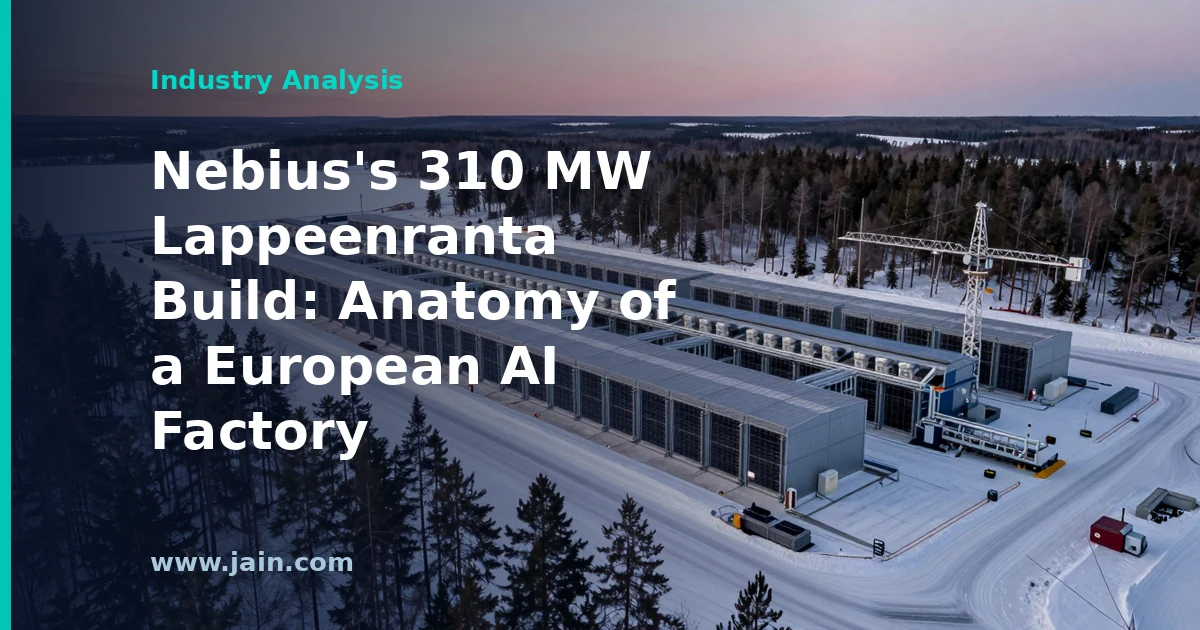
A project profile published April 25, 2026 by Northwise Project details a 310 megawatt (MW) data center in Lappeenranta, Finland attributed to Nebius Group, the Amsterdam-headquartered AI infrastructure company that trades on Nasdaq under the ticker NBIS. The report frames the facility as an “AI factory” — a data center purpose-built for training and running artificial-intelligence models rather than for general-purpose computing.
At 310 MW, the Lappeenranta site would sit firmly in the top tier of European data center projects by power capacity, and would extend Nebius’s existing Finnish footprint, anchored by its long-running campus in Mäntsälä.
Executive Summary
The headline fact is the number: 310 MW of power capacity dedicated to AI computing in a single Finnish location. Power capacity — the electricity a facility can draw and convert into computation — has become the standard yardstick for AI infrastructure because modern graphics processing units (GPUs) are constrained less by floor space than by the megawatts available to feed and cool them. A conventional enterprise data center might draw a few megawatts; 310 MW is the scale at which a facility can host tens of thousands of accelerators and compete for the largest AI training workloads.
The location is just as telling as the size. Finland offers a cool climate that slashes cooling costs, a grid that is among Europe’s most carbon-free, political stability inside the EU, and — in Nebius’s case — years of accumulated operating experience in the country. Lappeenranta, a university city in southeastern Finland, adds a local energy-engineering talent base.
What the profile does not settle is equally important: it is a single third-party report, and details on timeline, phasing, investment, power contracts, and customers are not substantiated in the source material. The scale claim is specific, but readers should treat the project’s parameters as reported rather than independently confirmed.
Why Finland Keeps Winning AI Capacity
Finland has quietly become one of Europe’s most competitive destinations for compute-intensive infrastructure, and the reasons are structural rather than promotional. Cooling is one of the largest operating costs in a data center, and Finland’s climate allows “free cooling” — using outside air or nearby water — for much of the year. The Finnish grid is also unusually clean, drawing heavily on nuclear, hydro, and wind, which matters both for operating economics and for AI customers facing sustainability reporting obligations in the EU.
Nebius knows this terrain better than most entrants. Its Mäntsälä campus, inherited from the company’s pre-2024 corporate history, is well known in the industry for piping waste heat from servers into the local district heating network — turning a cost center into community energy. A second, far larger Finnish site would suggest the company is doubling down on a playbook it has already proven, rather than experimenting in an unfamiliar market.
What 310 MW Actually Buys
For readers outside the industry: data centers are sized by power, not square footage, because electricity is the true scarce input. A 310 MW facility operates on a different plane from traditional colocation sites. Individual AI server racks now draw 100 kilowatts or more — ten times the density of conventional racks — so hundreds of megawatts translate into the tens of thousands of GPUs needed to train frontier-scale models.
The “AI factory” framing is more than marketing shorthand. Purpose-built AI facilities differ from general-purpose data centers in their electrical distribution, liquid-cooling infrastructure, and network fabric, which must move enormous volumes of data between GPUs at very low latency. Retrofitting a legacy facility to these specifications is often harder than building new — which is why the current AI cycle is producing greenfield gigascale campuses rather than expansions of existing colocation stock.
Nebius and the Neocloud Race
Nebius belongs to a category investors have taken to calling “neoclouds”: companies that rent GPU capacity for AI workloads, competing with the hyperscale clouds on price, availability, and specialization. The strategic logic of a 310 MW owned site is vertical integration — controlling land, power, and buildings rather than leasing from wholesale data center providers should yield structurally lower cost per GPU-hour, which is the metric on which this market ultimately competes.
The risk side of that logic is capital intensity. Facilities at this scale require investment in the billions of dollars before revenue arrives, and the GPU rental market is young, with demand concentrated among a relatively small set of AI labs and enterprises. A purpose-built AI factory is a leveraged bet that today’s extraordinary demand for training and inference capacity persists through the multi-year window it takes to permit, build, and fill such a site. That bet may well pay off — but it is a bet, and the source material offers no visibility into how this one is financed or contracted.
Europe’s Sovereignty Subtext
A gigascale AI facility on EU soil lands in the middle of Europe’s “sovereign AI” debate — the push to ensure European companies and governments can access frontier compute under European jurisdiction rather than depending entirely on U.S.-based capacity. An Amsterdam-headquartered operator building hundreds of megawatts in Finland fits that narrative neatly, and European AI startups and public-sector buyers are an obvious customer constituency.
Whether the project actually serves that market, or is absorbed by one or two large anchor tenants, is not something the source addresses. The distinction matters: a facility serving broad European demand changes the region’s compute landscape; a facility pre-committed to a single large customer changes one company’s supply chain. Both are legitimate businesses, but they have different implications for European AI buyers watching capacity announcements with interest.
Background
Nebius Group took its current form in 2024, when Yandex N.V. — the Dutch holding company of the Russian internet group — sold its Russia-based businesses and rebuilt itself around international assets, including a data center in Mäntsälä, Finland. Rebranded as Nebius and relisted on Nasdaq under the ticker NBIS in October 2024, the company positioned itself as a European-rooted provider of AI cloud infrastructure, backed by partnerships in the Nvidia ecosystem and an aggressive data center expansion program across Europe and beyond.
The broader backdrop is a global scramble for AI compute. Training and serving large AI models requires unprecedented concentrations of GPUs and electricity, and power availability has replaced land or fiber as the industry’s gating resource. The Nordics — with cool climates, clean grids, and supportive municipalities — have become one of the main theaters for this build-out, and Finland in particular has converted those advantages into a steady pipeline of hyperscale and AI-specialized projects.
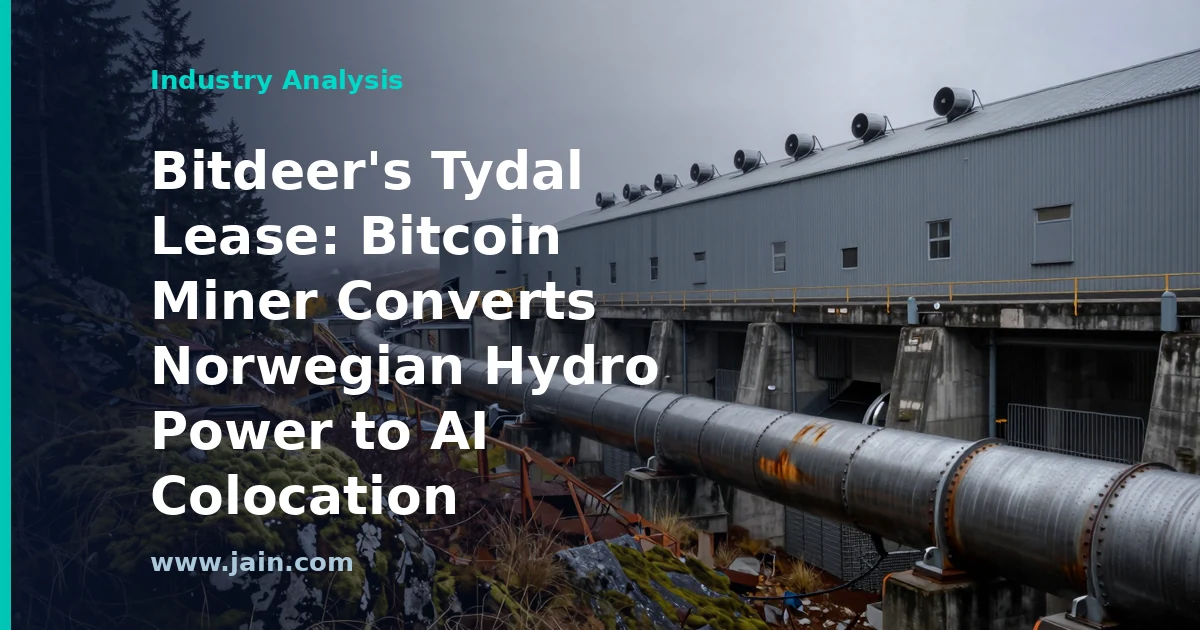
Bitdeer Technologies Group, the Nasdaq-listed bitcoin mining and data center company, has signed a colocation lease covering an AI data center at its site in Tydal, Norway, according to an April 24, 2026 report from Blockspace Media. Colocation means Bitdeer will act as landlord and facility operator, leasing powered, cooled data center space to a tenant that installs its own computing equipment.
The deal marks a concrete step in Bitdeer’s effort to convert part of its hydro-powered Norwegian footprint — originally built to mine bitcoin — into longer-duration AI infrastructure revenue.
Executive Summary
The announcement is notable less for its size — key commercial terms were not disclosed in the source report — than for what it represents: a signed lease, not a strategy slide. Over the past two years, most large bitcoin miners have announced intentions to pivot toward AI and high-performance computing (HPC), but the market has learned to distinguish between aspirational capacity announcements and executed contracts with tenants. A colocation lease at Tydal puts Bitdeer in the smaller group with a binding commercial agreement.
Tydal sits in central Norway, a region with abundant hydroelectric generation, a cool climate that reduces cooling costs, and historically low industrial power prices. Those attributes made it attractive for bitcoin mining; they are arguably more valuable for AI workloads, where customers pay a substantial premium per megawatt over what mining economics can support. For Bitdeer, swapping volatile, bitcoin-price-linked mining revenue for contracted lease income changes the character of the business — closer to a data center REIT than a commodity producer.
For the broader industry, the deal is another data point that the miner-to-AI conversion trend is producing real transactions, particularly at sites with cheap, clean, already-secured power.
Why Miners Are Becoming Landlords
The economic logic of the miner-to-AI pivot is straightforward: the scarcest input in AI infrastructure today is not chips but energized data center capacity — sites with grid connections, substations, and permits already in hand. Bitcoin miners spent a decade accumulating exactly that. Securing a new large-scale grid connection in most Western markets can take years; a miner with an operating site can, in principle, offer a tenant powered space far sooner.
The revenue math strengthens the case. Bitcoin mining revenue per megawatt is capped by network economics and falls with every halving of mining rewards, while AI tenants — cloud providers, GPU-cloud startups, and enterprises — have shown willingness to sign multi-year leases at rates mining cannot match. Converting a site from mining to AI colocation typically requires significant re-engineering, since AI servers demand far higher rack densities, more sophisticated cooling, and stricter reliability standards than mining rigs. But where the power and land are already in place, the conversion cost is generally lower than greenfield construction.
Norway’s Quiet Advantage in the AI Buildout
Norway rarely features in headlines dominated by Virginia, Texas, and the Gulf states, but it holds a strong hand: electricity that is overwhelmingly hydroelectric, among the lowest industrial power prices in Europe, a cold climate that allows free-air cooling for much of the year, and political stability. For AI customers facing sustainability reporting requirements — particularly European enterprises subject to EU disclosure rules — hydro-powered capacity carries genuine commercial value, not just marketing value.
The counterweights are real, too. Norway is far from the major European population centers, which adds network latency — a concern for user-facing AI inference, though far less so for model training, which tolerates distance well. Norwegian grid operators have also grown more selective about allocating power to data centers, and transmission constraints between Norway’s regions mean cheap power is not uniformly available. A site like Tydal, with an existing connection, is therefore more valuable than a map of Norwegian hydro resources might suggest.
Colocation Versus the GPU-Cloud Gamble
Bitdeer’s choice of a colocation lease — rather than buying GPUs and selling computing capacity itself — is a meaningful strategic signal. Miners pursuing the pivot face a fork: the asset-light path (lease space to a tenant who owns the chips) or the asset-heavy path (borrow to buy GPUs and operate a cloud). The colocation route earns lower headline revenue per megawatt but avoids the two biggest risks of the GPU-cloud model: rapid hardware depreciation as new chip generations arrive, and customer concentration in a market where a handful of AI labs dominate demand.
A lease also gives investors something mining never could: contracted, forecastable cash flow. How much credit Bitdeer earns for that depends on terms the report does not disclose — tenant identity and creditworthiness, lease duration, and who funds the conversion capital expenditure. Those details, more than the existence of the lease itself, will determine how the deal is ultimately judged.
What It Means for the Competitive Landscape
Each executed miner-to-AI deal tightens the market for the remaining players. Sites with cheap, clean power and existing interconnection are a finite inventory, and tenants signing leases today are effectively optioning that inventory ahead of rivals. For traditional data center operators, miners converting capacity represent new competition from an unexpected direction — though one that must still prove it can meet enterprise reliability expectations, which are far stricter than mining’s tolerance for downtime.
For other miners, the signal is double-edged. Successful conversions validate the strategy, but they also raise the bar: as more signed leases accumulate across the sector, companies still marketing unconverted ‘AI-ready’ capacity without tenants will face sharper investor questions about why their sites have not attracted commitments.
Background
Bitdeer Technologies Group went public on Nasdaq in 2023 and grew into one of the larger publicly traded bitcoin mining operators, building power-intensive computing facilities in markets with inexpensive electricity — including hydro-rich Norway. Bitcoin mining ties revenue directly to the cryptocurrency’s price and to network ‘halvings’ that cut mining rewards roughly every four years, pushing miners to seek steadier income from their energy assets.
Since the generative-AI boom began straining global data center supply, miners collectively controlling gigawatts of secured grid capacity have emerged as unexpected suppliers of AI infrastructure. Several have signed high-profile AI hosting and colocation agreements, and investors now reward executed contracts far more than announced ambitions — the context in which Bitdeer’s Tydal lease lands.