Category: AI Infrastructure

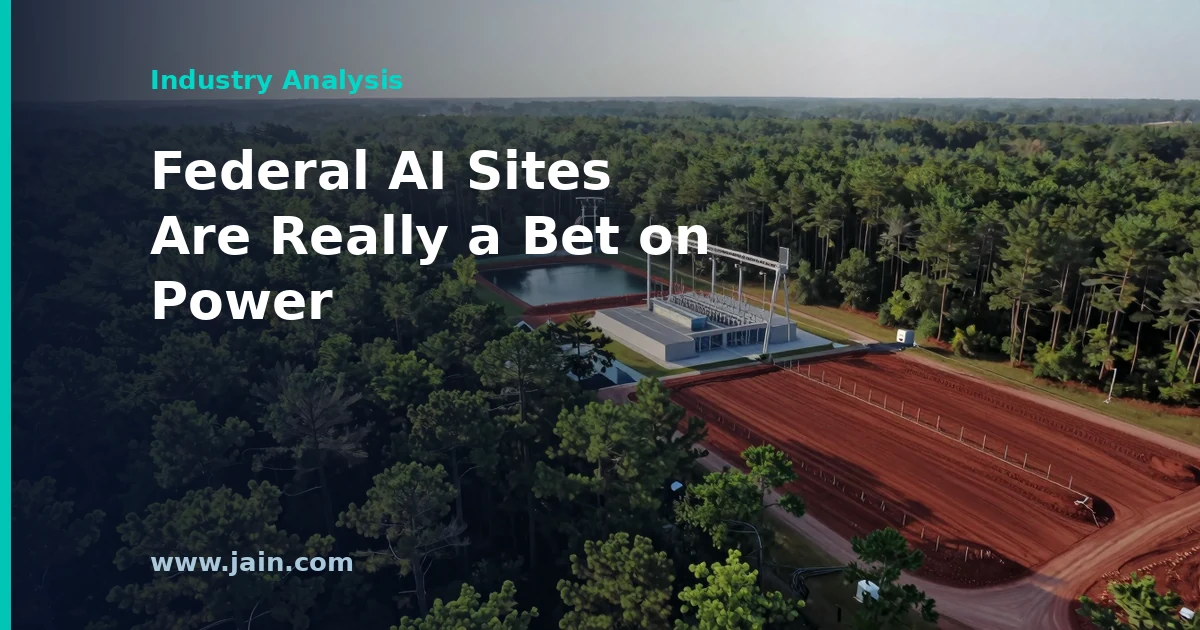
  • Savannah River Pick Shows DOE’s 16 AI Sites Are a Power Bet, Not Just a Land Deal

    Savannah River Pick Shows DOE’s 16 AI Sites Are a Power Bet, Not Just a Land Deal

    TL;DR · 30-second read

    The Short Version

    The United States government is opening some of its own land to companies that want to build the huge computer warehouses that run artificial intelligence. One of the first chosen sites is in South Carolina, at a lab that supports the nation’s nuclear weapons work.

    The twist: these projects are meant to come with their own power plants. The biggest artificial intelligence facilities can need as much electricity as a large power plant produces, and building power on-site is meant to keep that cost off ordinary households’ bills.

    Engineering firm Amentum was picked to build it. No price, size or start date has been announced.

    Microgrid Knowledge reported on July 20, 2026 that the National Nuclear Security Administration (NNSA), part of the U.S. Department of Energy (DOE), has selected Virginia-based engineering firm Amentum to develop a co-located artificial intelligence data center and on-site power generation project at the Savannah River National Laboratory site in South Carolina. The selection followed a competitive request for proposals that DOE began last year, after identifying 16 federal sites it judged could host AI data centers paired with their own energy infrastructure.

    The effort, formally the Savannah River Site Artificial Intelligence Infrastructure and Energy Generation Project, has no announced timeline, generating technology, capacity or cost. DOE says the project could meet its own electricity needs without shifting large costs to utility customers and could also increase the power available to the grid.

    Executive Summary

    NNSA has named Amentum to lead construction of both an AI data center and the power plant that would feed it, on federal land at one of the country’s principal nuclear security sites. It is a concrete step in DOE’s program to put AI computing on government property, and the first selection at Savannah River under that program.

    The significance lies less in the land than in the pairing. DOE did not simply offer acreage; it screened its sites for their ability to host data centers together with co-located generation, and it justified the Savannah River project on the grounds that it would not push large grid-upgrade costs onto utility customers. That makes federal sites a potential route around the slowest and most politically sensitive part of AI buildout: getting enough electricity to the building.

    What has been announced is a selection and a scope, not a financed, sized project. The generating technology, megawatt capacity, tenant, financing and schedule are all still undisclosed, so the model’s claims about cost and grid benefits remain untested.

    Sixteen Sites, One Condition: Bring the Power

    DOE’s list of 16 federal sites was not a catalogue of empty lots. According to the department, it identified sites that could support AI data centers paired with co-located energy infrastructure. The Savannah River award makes that pairing explicit: generation is in the project’s official name, and Amentum is contracted to build the power supply alongside the data center rather than to plug into whatever the local utility can provide.

    The reason is the grid connection itself. A large new electricity user normally joins the grid through an interconnection process, in which the utility studies whether its lines and power plants can serve the new load and what must be built if they cannot. At AI scale, those upgrades are substantial: industry projections cited in the coverage put future AI server racks at up to 1 megawatt each and the largest AI campuses at around 1 gigawatt, roughly the output of a large power plant. When a utility builds for a customer that size, the question of who pays tends to fall on its other customers. DOE’s stated case for Savannah River answers that directly, saying the project could generate its own needs “without shifting huge costs to utility customers.”

    That is where federal land earns its place. A large, secured, government-controlled site offers space, a single landowner and an existing security perimeter for putting generation right next to the load, which many sites closer to population centers struggle to offer. The trade-off is engineering: AI training creates wide, fast swings in power demand, and a self-supplied site has less grid backing to absorb them. Whatever generation Amentum ultimately builds will need to be designed around that volatility, which makes the power system as central to the project as the data center it serves.

    Why a Nuclear Security Site, and Why Amentum

    NNSA Administrator Brandon Williams framed the award as a way to “move faster, apply innovative technologies, and make productive use of federal land while maintaining our commitment to mission delivery.” That last clause matters. Savannah River hosts sensitive defense work, and any private-sector partner operating there has to coexist with it. Amentum already does; it was selected earlier this year to provide design and engineering services for the site’s Tritium Finishing Facility, which supports the nuclear weapons program.

    That existing footprint is a competitive advantage that is hard to replicate. Contractors that already understand federal security, procurement and site operations are positioned to win the first wave of these awards, while conventional data center developers may find their route onto federal land runs through partnerships with such firms. Amentum and NNSA say they will collaborate on expanding private-sector partnerships in the project, which leaves room for tenants, financiers or generation owners still to be named.

    What Is Settled, and What Still Rests on “Could”

    The announcement establishes a selection made through a competitive process, a defined scope covering both compute and generation, and a named site. Those are real commitments of intent from a federal agency. The headline benefits are conditional, however: the project could meet its own electricity needs, and it could increase power available to the grid. Williams himself called it a “proposed partnership.”

    Until the parties disclose the generation type, capacity and commercial structure, the ratepayer-protection claim cannot be measured. Its value depends on details not yet public: whether the site stays connected to the grid for backup, who pays for that connection, and on what terms any surplus power is sold. The first projects under DOE’s program will set the template for the remaining sites, so those terms will matter well beyond South Carolina.

    Background

    The Savannah River Site in South Carolina is a Department of Energy complex overseen by the National Nuclear Security Administration, the DOE agency responsible for nuclear weapons and nuclear security. Its national laboratory supports defense programs including tritium production. Amentum, a Virginia-based firm spun out of AECOM about six years ago, ranks as the second-largest U.S. government services contractor behind Leidos and was already working at the site on the Tritium Finishing Facility.

    The award sits within a wider federal push to use government land for AI infrastructure. DOE identified 16 of its sites as candidates for data centers paired with their own power, and Energy Secretary Chris Wright has described the AI race as “the next Manhattan project.” The pressure behind that push is electricity: an analysis by the Penn State Institute of Energy and the Environment projects AI’s share of global electricity use could rise from 4% to 20% by 2035.

    Sources

    Source: Amentum to Develop Co-Located AI Data Center and Power Infrastructure at Savannah River National Laboratory (Microgrid Knowledge, July 20, 2026): NNSA selects Amentum to build an AI data center with on-site power generation at the Savannah River Site.

  • Fireworks’ $1.5B Round Shows AI Inference Is Now a Layer Above the GPU Clouds

    Fireworks’ $1.5B Round Shows AI Inference Is Now a Layer Above the GPU Clouds

    TL;DR · 30-second read

    The Short Version

    A young company called Fireworks just raised $1.5 billion from investors. It doesn’t invent its own artificial intelligence. It runs freely available artificial intelligence programs for other businesses, using computer chips spread across more than a dozen cloud companies.

    Its yearly sales pace reportedly jumped from $100 million to over $1 billion in 16 months. Shopify and Twilio took four to five years to make the same climb.

    Why it matters: the money in artificial intelligence isn’t only going to chipmakers and tech giants. The middleman who keeps these systems fast and cheap is now big enough to fund on its own.

    Fireworks, the training and inference platform for open-weight AI models, has raised a $1.5 billion Series D, according to Bessemer Venture Partners, which said on July 17, 2026 that it had joined the round as an existing investor. Bessemer said Fireworks has passed $1 billion in annual recurring revenue (ARR), up from $100 million 16 months earlier. It also said the company processes about 43 trillion tokens a day. Tokens are the word-fragments AI models read and write.

    The company runs on more than a dozen cloud providers across over 20 regions. It is a first-party partner shipping natively inside Microsoft Foundry on Azure. It is led by CEO Lin Qiao, who led the Meta engineering organization that built the PyTorch framework, and by President George Hu, who joined in April 2026.

    Executive Summary

    Fireworks does not sell a chatbot or a proprietary model. It runs other people’s open-weight models, and the fine-tuned versions customers build on them, as fast and as cheaply as possible. It charges by the token. A $1.5 billion round for that business, at more than $1 billion in ARR, is a large bet that inference is a market of its own. Inference means running a trained model to answer requests, and on this bet it is neither a feature of the chip clouds nor of the model labs.

    For infrastructure operators, the important detail is the architecture. Fireworks describes its platform as a virtual GPU cloud. It pools graphics processors from more than a dozen providers and sits between those providers and the enterprises consuming AI. The more demand flows through layers like this, the more GPU owners compete as suppliers to software platforms rather than selling directly to end customers.

    The growth figures are striking. So far, though, they are headline numbers without the detail needed to judge durability. That detail includes margins, customer concentration, how much capacity is contracted, and how ARR is defined for a usage-based business.

    A Platform That Sits Above the Chips

    What Fireworks sells is not compute capacity in the usual sense. Its platform is described as a virtual GPU cloud. That is software pooling graphics processors (GPUs, the chips that do most AI work) from more than a dozen cloud providers in over 20 regions. On top sits a proprietary inference engine that decides how to run each model at maximum speed and efficiency. Customers buy output, measured in tokens, not servers. At roughly 43 trillion tokens a day and more than $1 billion in ARR, that software layer is now a business of real scale. The $1.5 billion Series D finances it as one.

    That is the operational shift. In the familiar cloud model, whoever owned the machines owned the customer. In this model, GPU owners become suppliers. Those owners include hyperscalers (the largest cloud providers, such as Azure) and neoclouds (newer GPU-specialist clouds). The platform holds the customer relationship, decides where each workload runs, and keeps the margin from running it efficiently. Bessemer states the ambition directly: Fireworks wants to be the software layer that abstracts away inference running on “heterogeneous silicon, hyperscalers, neoclouds, and air-gapped environments” — the inference platform “running on every GPU in the world.”

    For GPU cloud and data center operators, this cuts both ways. An aggregator pools demand from thousands of customers, which can make it a large and steady buyer of capacity. But demand routed through a multi-cloud layer is also portable: it can move toward whichever provider offers the best price, availability or location. The Microsoft relationship shows the layer can coexist with hyperscalers rather than simply competing with them. Azure distributes Fireworks natively through Foundry. Still, this is one company’s round. It shows the independent inference layer can be financed at scale, not yet that it will hold its margin once hyperscalers price their own inference services against it.

    Open Models Move the Spend From the Model to the Serving

    The investment thesis rests on a claim about models, not chips. Open-weight models, whose trained parameters are published for anyone to run, now match closed frontier models on the workloads most enterprises care about, at a fraction of the cost. On that premise, enterprises will increasingly post-train an open model on their own proprietary data instead of paying per call for a closed API. They would, in Bessemer’s phrase, stop wanting to “rent” their core intelligence.

    If that premise holds, value shifts toward whoever serves and tunes those open models well. Fireworks’ pitch is that it does both in one place. Its platform combines fine-tuning and reinforcement learning (methods for adapting a model with examples and feedback) with production serving. Every interaction can feed the next version of a customer’s model. That combination also creates switching costs. A customer whose tuned model, data pipelines and serving setup all live on one platform has reasons to stay. That stickiness is what justifies valuing the layer as more than a GPU reseller.

    The load-bearing premise, however, is asserted rather than demonstrated. No benchmarks or customer workloads accompany the claim that open models match frontier quality. The answer will vary by task. Buyers weighing an open-model strategy should test it on their own workloads rather than assume parity.

    What the Growth Numbers Establish, and What They Don’t

    Growth from $100 million to more than $1 billion in ARR in 16 months is, by Bessemer’s comparison, a climb that took Twilio and Shopify four to five years. It establishes that demand for hosted open-model inference is very large right now. For a usage-based business, however, ARR usually annualizes current consumption. It can fall if customers optimize their prompts, switch to smaller models, or move volume to another provider. That makes it a different quantity from contracted subscription revenue.

    Revenue is also not margin. A platform built on capacity drawn from other clouds has to pay for that capacity. Its economics depend on how many tokens its engine can produce per GPU-hour relative to what it pays for that hour. The inference engine is the core asset for that reason: efficiency is the margin. The broader market figures cited alongside the round are context, not evidence about Fireworks. They include hyperscaler capital spending of more than $800 billion in 2026 and token consumption expected to rise more than 30-fold by the end of the decade, and no source is given for either projection.

    Background

    Fireworks was founded by engineers who built and scaled PyTorch at Meta, the open-source framework on which much of today’s AI software is built. CEO Lin Qiao led that engineering organization. The company positions itself as a training and inference platform for open-weight models. It combines a proprietary inference engine, a multi-cloud GPU pool and tools for fine-tuning and reinforcement learning. Bessemer Venture Partners was already an investor before the Series D.

    The round lands as AI spending shifts from building models toward running them. Enterprises that first used closed frontier-model APIs are weighing open models they can tune on private data and serve more cheaply. A growing set of providers now competes to run those models: hyperscalers, GPU-specialist neoclouds and independent inference platforms.

    Sources

    Source: Fireworks raises $1.5B Series D for open model inference – Bessemer Venture Partners: Bessemer’s announcement of its participation in Fireworks’ Series D and its investment thesis.

  • Japan’s 27,500-GPU National AI Factory Is Really a 140-Megawatt Power Project

    Japan’s 27,500-GPU National AI Factory Is Really a 140-Megawatt Power Project

    TL;DR · 30-second read

    The Short Version

    Japan’s government is backing a giant computer center, built with chipmaker NVIDIA and a Japanese company called Noetra, to train artificial intelligence for robots, factories and hospitals.

    It will hold 27,500 of NVIDIA’s newest high-end chips and be able to draw 140 megawatts of electricity, roughly what a small city uses.

    The chips get the headlines, but lining up that much power and cooling is the harder job. The announcement does not yet say where it will be built, when, or who is paying.

    NVIDIA announced on July 16, 2026 that it is working with Noetra Corp. to build an NVIDIA Vera Rubin “AI factory” in Japan with 13,750 Vera CPUs and 27,500 Rubin GPUs, delivering 140 megawatts of data center capacity on NVIDIA’s DSX reference platform and Spectrum-X Ethernet networking. The facility will provide the computing foundation for the FRONTia Project, a program launched by Japan’s Ministry of Economy, Trade and Industry (METI) to develop multimodal foundation models for robotics and “physical AI.”

    NVIDIA calls it the world’s first national AI infrastructure for physical AI. Noetra will share the pretrained weights of its models with Japanese developers and enterprises, alongside NVIDIA’s open model families and software libraries.

    Executive Summary

    The announcement pairs a state industrial program with a single, very large training cluster. METI’s FRONTia Project sets the mission: build reliable multimodal foundation models (large AI models that learn from text, images, video and sensor data together) that can underpin robots, digital twins and industrial automation. Noetra will build and run the hardware, and NVIDIA supplies the full stack from chips and racks to networking and software.

    It matters for two reasons. First, it is an explicit bet that Japan’s manufacturing base, and the real-world industrial data it generates, can be turned into a competitive advantage in AI for machines that act in the physical world. Japan’s AI Robotics Strategy targets more than 30% of a global AI robotics market it estimates at $133 billion by 2040. Second, the size of the build means this is a utility-scale infrastructure project as much as a computing one: 140 megawatts is the scale of a large hyperscale campus, and the announcement leaves open where that power and the cooling to go with it will come from.

    The Unit That Matters Is the Megawatt

    The headline numbers are chips, but the figure that governs how this project gets built is 140 megawatts. Divide it by 27,500 GPUs and the facility is provisioned at roughly 5 kilowatts per GPU once cooling, networking, storage and power-conversion losses are counted. The release describes the build as Vera Rubin NVL72 racks, which pair 72 GPUs with 36 CPUs, the same 2-to-1 ratio as the 27,500 and 13,750 figures announced. That works out to roughly 380 racks sharing 140 megawatts, or about 365 kilowatts of facility capacity per rack. The release does not separate IT load from cooling and overhead, so the per-rack draw at the chip level will be lower. Even so, the order of magnitude is far beyond the 10 to 20 kilowatts a conventional enterprise rack uses.

    Density at that level has direct operational consequences. Air cannot remove that much heat, so racks of this class are liquid-cooled, which means pumps, heat exchangers and a heat-rejection plant sized for a small power station’s output. A 140-megawatt load also needs a high-voltage grid connection and on-site substation capacity, which in most markets are the longest-lead items in any data center schedule. NVIDIA itself frames the platform this way: its DSX reference design is pitched on raising “token throughput per megawatt,” a metric that treats power, not silicon, as the scarce input.

    For NVIDIA as a named partner, securing the GPUs is the part most within the project’s control. Site selection, grid interconnection, permitting and cooling construction are the parts that determine when the factory actually trains its first model. The parties most affected are the utility that serves the site, the electrical and mechanical contractors, and cooling-equipment suppliers. The release names none of them.

    What “National” Means in This Model

    The novel element is less the hardware than the arrangement around it. METI supplies the policy mandate through FRONTia, Noetra builds and operates the cluster, and the output is intended as a shared national asset. Pretrained model weights will be “broadly available” to domestic developers and enterprises. That is closer to how governments treat roads or research reactors than to a commercial GPU cloud, where capacity is rented by the hour to whoever pays.

    The “world’s first national AI infrastructure” claim deserves a careful reading. Japan already operates government-backed AI computing, such as the ABCI supercomputer run by the national research institute AIST, and METI has previously subsidized domestic cloud providers to expand GPU capacity. The release qualifies its claim in the body text as the first national AI infrastructure “for physical AI.” That narrower framing, a national-scale system dedicated to robotics and industrial foundation models, is more defensible than the headline version.

    Physical AI and the 2040 Target

    “Physical AI” refers to models that perceive and act in the real world: robots on a factory line, autonomous logistics systems, digital twins that simulate a plant before it is changed. Training them is data-hungry in a different way from chatbots, because they need video, sensor and motion data from real industrial settings. METI’s pitch is that Japan’s manufacturers hold exactly that data and that pooling it around a common model gives domestic firms a head start they could not buy individually. Noetra’s CEO, Hironobu Tamba, makes the same argument: these are “challenges no single company can solve alone.”

    The link from one cluster to a 30% global market share by 2040 is a long one, and the release does not attempt to draw it. The $133 billion figure is an estimate attached to a policy goal, not a forecast tied to this facility. The release says the factory will support trillion-parameter-scale models “as the AI factory expands,” which suggests a phased build. The claims of “lower token costs” and “breakthrough AI performance” are likewise unquantified.

    Who Gains From the Full-Stack Design

    The project is NVIDIA end to end: Vera CPUs, Rubin GPUs, BlueField data processing units, Spectrum-X Ethernet, and the Nemotron, Cosmos, Isaac GR00T and NeMo software that will ship alongside Noetra’s models. For Japanese developers, that means a ready toolchain and a common starting point, which lowers the cost of building robotics applications. It also means the national physical-AI ecosystem will be built on one vendor’s architecture from the silicon upward, a trade-off between speed and supplier diversity that sovereign AI programs worldwide are weighing. Choosing Ethernet rather than InfiniBand for the cluster fabric fits a wider industry move toward standards-based networking at scale, which may make it easier to find operators and engineers who can run it.

    Background

    Japan has pursued AI computing as industrial policy for several years, building government research systems and subsidizing domestic cloud providers to expand GPU capacity. METI’s AI Robotics Strategy, released in March 2026, sharpened that focus on robotics and physical AI, where Japan’s manufacturing base gives it a large pool of real-world industrial data. FRONTia is METI’s vehicle for turning that strategy into shared foundation models.

    NVIDIA has been promoting “sovereign AI,” national AI capacity built within a country’s borders, as a major market alongside its hyperscale cloud customers. Vera Rubin is its next-generation platform after Blackwell, pairing Vera CPUs with Rubin GPUs in dense, liquid-cooled NVL72 racks, and DSX is its reference design for building complete AI data centers around that hardware.

    Sources

    Source: Japan Government, Industrial Leaders and NVIDIA Launch the World’s First National AI Infrastructure (NVIDIA Newsroom, July 16, 2026). NVIDIA and Noetra announce a 140-megawatt Vera Rubin AI factory for METI’s FRONTia physical AI project.

  • Crusoe and Lancium Plan 1.0 GW AI Data Center in Childress, Texas

    Crusoe and Lancium Plan 1.0 GW AI Data Center in Childress, Texas

    Crusoe and Lancium announced plans for a 1.0 gigawatt (GW) artificial-intelligence data center campus in Childress, Texas, a small city in the state’s panhandle region served by the ERCOT power grid.

    The joint announcement, dated July 14, 2026, positions the site as a hyperscale-class AI compute campus, though the release itself provides only a headline-level description of the project.

    Executive Summary

    The Crusoe-Lancium announcement adds another gigawatt-scale AI campus to a Texas pipeline that has become the epicenter of North American data center growth. A 1.0 GW site is roughly the electrical footprint of a mid-sized city, and building one for AI training and inference workloads reflects the scale at which frontier model operators and their infrastructure partners are now planning.

    The pairing is notable on its own terms. Crusoe operates AI cloud infrastructure and has historically emphasized co-locating compute with abundant or otherwise stranded energy. Lancium specializes in “controllable load” data center designs intended to flex consumption in response to grid conditions. Together, the two companies are marketing a Childress campus that, at least conceptually, blends AI-optimized halls with a grid-friendly load profile.

    What the announcement does not resolve is arguably more important than what it discloses: capital structure, anchor tenants, interconnection queue position, water use, and construction phasing are all absent from the public headline.

    Why Childress, and Why Now

    Childress sits in the Texas panhandle, a region rich in wind generation and, increasingly, solar — but historically light on data center load. Developers have been pushing west and north out of the traditional Dallas-Fort Worth and Austin corridors in search of two things: available transmission capacity and land at prices that pencil for gigawatt campuses. A 1.0 GW footprint is difficult to interconnect anywhere on ERCOT quickly, but the panhandle’s generation surplus and long-distance transmission lines make it a plausible venue for large loads that can tolerate some siting distance from major metros.

    The timing tracks with a broader industry pattern. Hyperscale AI announcements in 2025 and 2026 have shifted from megawatt-scale expansions to gigawatt-scale campuses, reflecting both the power density of modern AI accelerators and the strategic value of securing capacity years ahead of demand.

    Controllable Load Meets AI Compute

    Lancium’s core pitch has been that data centers can be designed as “controllable load resources” — facilities that ramp consumption up or down to help balance a renewables-heavy grid, in exchange for lower effective power costs and faster interconnection. Historically, that model has been an easier fit for cryptocurrency mining than for latency-sensitive cloud workloads. Applying it to AI compute is more nuanced: training runs are batch-like and can, in principle, tolerate curtailment windows, while inference is closer to real-time and typically cannot.

    Neither company has publicly detailed how the Childress campus will split those workload types, or how curtailment obligations would flow through to tenants. That is a material question. If the campus behaves like a conventional 24/7 hyperscale load, the interconnection story is one thing; if it genuinely flexes, it is a different — and potentially more grid-constructive — proposition.

    Winners, Losers, and What Is Actually Substantiated

    The announcement, as issued, substantiates two things: that Crusoe and Lancium have publicly committed to the project’s existence and its nameplate scale, and that Childress has been chosen as the location. It does not substantiate a construction start date, a power-on date, an anchor customer, a capital partner, or a specific mix of on-site versus grid-supplied generation. Readers should treat 1.0 GW as a stated design intent, not a delivered capacity.

    If the project proceeds as announced, the near-term beneficiaries are the local tax base, regional construction trades, and equipment vendors ranging from switchgear manufacturers to liquid-cooling suppliers. Longer term, incumbent Texas colocation operators face increased competition for transmission upgrades and skilled labor. Ratepayers and grid operators face a familiar set of questions about who pays for interconnection upgrades and how quickly load can be absorbed without stressing reliability margins.

    Background

    Crusoe began as an operator known for using otherwise-flared natural gas to power computing, and has since repositioned around AI cloud infrastructure and large-scale training campuses. Lancium, founded in Texas, has focused on designing data centers as flexible grid participants — an approach shaped by the state’s high share of variable renewable generation and its independent grid operator, ERCOT.

    The broader context is a multi-year surge in AI compute demand that has pushed data center announcements from tens of megawatts to hundreds and now over a thousand. Texas, and the panhandle in particular, has emerged as a preferred venue because of transmission-connected wind and solar surpluses, available land, and comparatively fast large-load interconnection processes.

    Source: Crusoe and Lancium Announce 1.0 Gigawatt AI Data Center Campus in Childress, Texas — joint corporate announcement of a planned hyperscale AI campus in the Texas panhandle.

  • 3M and Microsoft Partner on AI Data Center Materials

    3M and Microsoft Partner on AI Data Center Materials

    On July 14, 2026, 3M and Microsoft announced a strategic partnership focused on advancing AI data center infrastructure and enterprise transformation. The announcement was carried on Microsoft’s own newsroom (Microsoft Source).

    The headline positions the collaboration around AI-era infrastructure — a domain where 3M has historically supplied materials, adhesives, films and thermal management products, and where Microsoft is one of the world’s largest hyperscale operators.

    Executive Summary

    The release frames a tie-up between an industrial materials incumbent and a hyperscale cloud operator at a moment when AI compute is straining the physical envelope of data centers. Power density per rack, heat rejection, and materials that can survive higher junction and coolant temperatures have all become gating factors for GPU deployments.

    What is substantiated in the headline is intent: a strategic partnership, AI data center infrastructure as the target, and enterprise transformation as a secondary theme. What is not yet substantiated — at least in the excerpt available to us — is scope: which 3M product lines, which Microsoft facilities, on what timeline, and under what commercial structure.

    For readers evaluating the announcement, the useful posture is neither dismissal nor hype. Materials science is a genuine bottleneck for AI infrastructure, and 3M has relevant portfolios. Whether this specific partnership delivers meaningful capacity or is primarily a marketing framing will depend on details the release, as published, does not spell out.

    Why Materials Suddenly Matter to Hyperscalers

    For most of the cloud era, hyperscale data centers were an integration problem: racks of commodity servers, air cooling, and steady incremental efficiency gains. AI training and inference clusters have changed the physics. Modern GPU accelerators dissipate hundreds to over a thousand watts each, and racks are moving from the 10–20 kW range typical of general-purpose cloud toward 50–100 kW and beyond. At those densities, the materials in contact with silicon — thermal interface materials, dielectric fluids for immersion cooling, cold-plate seals, and vapor-barrier films — become first-order engineering constraints rather than commodity inputs.

    3M’s historical relevance here is real: the company has long supplied fluorinated dielectric fluids used in two-phase immersion cooling, thermal interface products, and specialty films and tapes used inside servers and networking gear. Microsoft, for its part, has publicly experimented with immersion cooling in prior years. A partnership badged as targeting AI data center infrastructure sits squarely in this well-established technical overlap, even if the announcement itself does not enumerate specific product families.

    What a Strategic Partnership Actually Buys

    "Strategic partnership" is one of the more elastic phrases in corporate communications. In practice, such arrangements range from joint marketing and preferred-supplier status at the light end, to co-development agreements, capacity reservations, and equity or offtake commitments at the heavy end. The release headline as available does not disclose where on that spectrum this deal sits.

    For 3M, a formal alignment with a top-three hyperscaler is commercially valuable regardless of the exact contract structure: it validates its materials portfolio for AI workloads at a moment when the company has been repositioning after divesting parts of its business and navigating environmental litigation around per- and polyfluoroalkyl substances (PFAS). For Microsoft, tying a materials supplier more closely into its infrastructure roadmap is consistent with a broader hyperscaler trend of pushing further down the stack — into custom silicon, custom racks, and now, plausibly, custom materials specifications.

    Enterprise Transformation: The Ambiguous Second Leg

    The headline also references enterprise transformation, a phrase that in Microsoft’s usage typically implies Azure adoption, Microsoft 365, and Copilot-branded AI products. Read literally, it suggests 3M is also a customer — modernizing its own IT and manufacturing operations on Microsoft’s stack — not only a supplier.

    Two-way arrangements of this kind are common in hyperscaler deal-making: the supplier commits materials or capacity, and in return standardizes on the buyer’s cloud and AI platforms. Whether that reciprocity is present here, and on what scale, is not stated in the available excerpt. Buyers and investors should treat the enterprise-transformation framing as a signal to look for future disclosures around Azure commitments or Copilot deployments at 3M.

    Risks and Open Questions on Both Sides

    Any materials-heavy AI infrastructure story now runs into the PFAS question. Several of the dielectric and thermal fluids historically associated with immersion cooling belong to fluorochemical families that are under increasing regulatory scrutiny in the United States and European Union. 3M has publicly stated it intends to exit PFAS manufacturing by the end of 2025. A partnership announced in mid-2026 targeting AI infrastructure therefore raises a legitimate, non-inflammatory question: what chemistries are in scope, and how does the roadmap reconcile with that exit commitment? The release excerpt does not answer this.

    On Microsoft’s side, the risk is narrative. Hyperscalers have announced many AI-era infrastructure partnerships in the past two years — with utilities, nuclear developers, chipmakers, and cooling specialists. Each individually is plausible; collectively, they can create an impression of capacity certainty that specific contracts may not yet support. The measured read is that this announcement adds one more supplier relationship to that mosaic, and its weight will be visible only when product-level or facility-level detail follows.

    Background

    3M is a diversified U.S. industrial company whose materials science portfolio has long included products used inside data centers — thermal interface materials, films, adhesives, filtration and, historically, dielectric fluids associated with immersion cooling. The company has been repositioning in recent years, including a stated intent to exit PFAS manufacturing by the end of 2025 amid regulatory and litigation pressure.

    Microsoft is among the top three hyperscale cloud operators globally and has publicly committed to a large multi-year build-out to support AI training and inference workloads. That build-out has surfaced physical constraints — power, cooling, and materials — that were secondary concerns in the pre-AI cloud era, prompting a wave of supplier and infrastructure partnerships across the industry.

    Source: 3M and Microsoft announce strategic partnership to advance AI data center infrastructure and enterprise transformation — Microsoft Source, July 14, 2026.

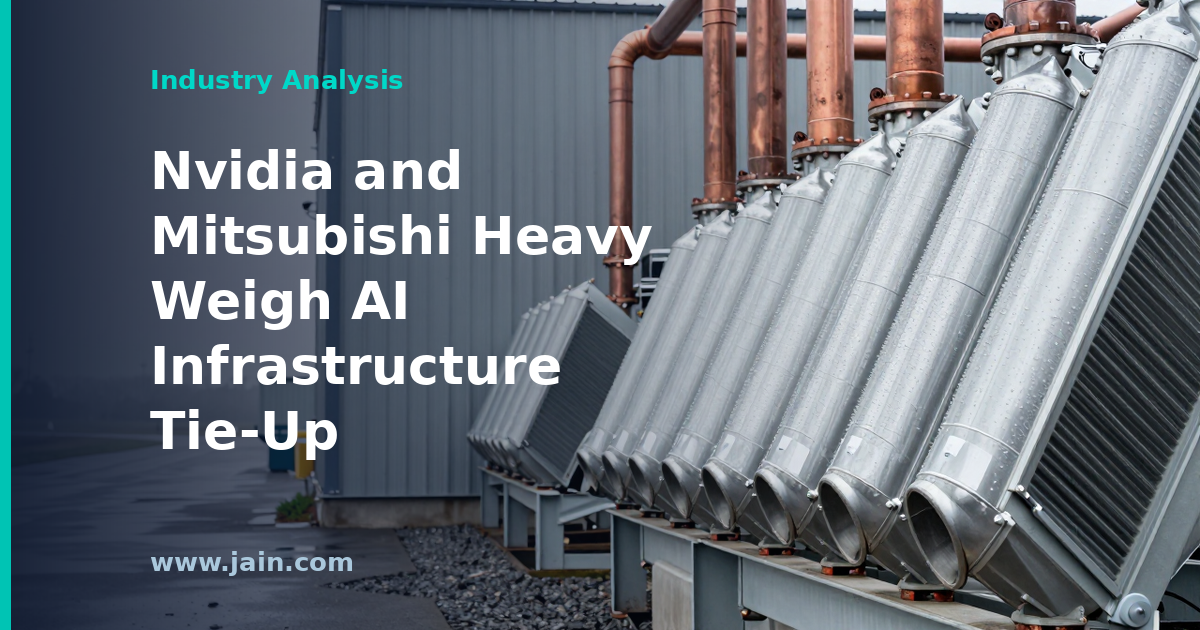
  • Nvidia and Mitsubishi Heavy Reportedly Weigh AI Data Center Cooling and Power Tie-Up

    Nvidia and Mitsubishi Heavy Reportedly Weigh AI Data Center Cooling and Power Tie-Up

    Nvidia and Japan’s Mitsubishi Heavy Industries are reportedly in early discussions about collaborating on cooling and power infrastructure for AI data centers, according to a July 13, 2026 Seeking Alpha report surfaced via Google News.

    The item is a brief report of external reporting; no formal announcement, deal value, timeline, or product scope has been confirmed by either company.

    Executive Summary

    The reported talks would pair the dominant supplier of AI accelerators with one of the world’s largest heavy-engineering conglomerates, whose portfolio spans gas turbines, HVAC systems, and industrial cooling. On paper, the fit is obvious: AI clusters built around Nvidia’s highest-end GPUs are pushing rack densities and heat loads well past what conventional air-cooled data centers were designed to handle, and grid interconnection queues in key markets are measured in years rather than months.

    What matters for readers is less the headline than the pattern. Chipmakers are increasingly reaching upstream into the physical plant — power generation, thermal management, on-site energy — because compute deployment is now gated by megawatts and cooling capacity, not silicon supply. Whether this specific pairing produces a concrete product, a joint venture, or nothing at all remains unclear from the available reporting.

    Why a Chip Company Cares About Chillers

    Modern AI training racks can dissipate 100 kilowatts or more — an order of magnitude above traditional enterprise servers — and next-generation GPU platforms are pushing hotter still. At those densities, air cooling stops being economical and liquid cooling, whether direct-to-chip cold plates or full immersion, becomes mandatory. Mitsubishi Heavy’s industrial thermal and HVAC businesses are the kind of scaled manufacturing base that a chip vendor would want aligned with its reference designs, so that when a customer buys a rack, the cooling loop is engineered, warrantied, and shippable at the same cadence as the servers.

    The power side of the reported discussion is equally telling. Mitsubishi Heavy builds gas turbines and is active in nuclear and hydrogen-adjacent equipment. Data center developers in the United States, Japan, and Europe are increasingly signing behind-the-meter or on-site generation deals because utility interconnection timelines cannot keep pace with hyperscaler expansion plans. A relationship with a turbine manufacturer is one way to shorten that critical path.

    Strategic Logic, With Caveats

    For Nvidia, the strategic prize is deployment velocity: every month a customer waits for power or cooling is a month of deferred GPU revenue and a window for a rival platform. For Mitsubishi Heavy, aligning with the dominant AI compute vendor could pull its industrial equipment into a growth market with unusually inelastic demand. Both narratives are plausible, and both have been used to explain similar chatter around other equipment makers over the past 18 months.

    The measured read, however, is that a report of exploratory talks is not a partnership. Neither company has published terms, and Seeking Alpha itself is aggregating reporting rather than breaking primary news. Readers should treat the item as a signal of direction — chip vendors seeking closer ties to power and thermal OEMs — rather than as a confirmed commercial arrangement.

    Winners, Losers, and the Middle of the Stack

    If a formal collaboration materializes and yields co-engineered reference designs, the pressure would land squarely on independent liquid-cooling specialists and on power-equipment competitors that lack a chip-vendor relationship. Colocation operators would likely welcome a validated, warrantied stack because it reduces integration risk on the largest deals. Hyperscalers, who tend to prefer multi-sourcing and their own custom designs, may care less at the design level but still benefit from a deeper supplier bench.

    The counter-scenario is that talks fizzle, or produce only a narrow marketing arrangement. That outcome would be consistent with how many announced infrastructure partnerships have played out — press coverage first, meaningful shipments much later, if at all. Either way, the underlying constraint is real: AI infrastructure is now a power-and-cooling problem as much as a semiconductor one.

    Background

    Nvidia is the dominant supplier of graphics processing units used for AI training and inference, and its data center segment has become the fastest-growing business in enterprise compute. Its accelerators are the reference platform for most large-model training clusters, which has made the physical constraints of deploying them — power, cooling, real estate — the industry’s binding bottleneck.

    Mitsubishi Heavy Industries is a diversified Japanese engineering conglomerate with more than a century of history in power generation, thermal equipment, aerospace, and industrial machinery. Its portfolio includes gas turbines, HVAC systems, and nuclear-related equipment, giving it multiple potential entry points into the data center power-and-cooling stack.

    Source: Nvidia, Mitsubishi Heavy mull team up for AI data center cooling, power: report – Seeking Alpha — brief report of exploratory discussions between the two companies on AI data center infrastructure, aggregated via Google News.

  • Meta Plans Billions for First Canadian AI Data Center, Its Largest Outside the U.S.

    Meta Plans Billions for First Canadian AI Data Center, Its Largest Outside the U.S.

    Meta is planning a multibillion-dollar investment in its first AI data center in Canada, according to a July 2026 report from Broadband Breakfast. The project is described as the largest data center Meta has built outside the United States, extending the company’s aggressive AI infrastructure expansion beyond its home market for the first time at flagship scale.

    Executive Summary

    The reported plan marks two firsts at once: Meta’s first data center in Canada, and its first time siting a facility of this magnitude — described as its largest outside the U.S. — beyond American borders. Meta has spent the past several years pouring capital into AI-optimized data centers, the specialized facilities packed with GPU accelerators (the chips that train and run large AI models) that underpin its Llama model family and AI products across Facebook, Instagram, and WhatsApp.

    Why it matters: hyperscalers — the handful of companies that build computing infrastructure at global scale — have concentrated their largest AI campuses inside the United States, where most of their power deals and construction pipelines already sit. A flagship-scale commitment to Canada suggests the constraints that matter most in AI buildouts, chiefly access to large blocks of electric power and developable land, are now strong enough to pull top-tier projects across the border. For the North American data center market, that is a meaningful signal about where the next wave of capacity may land.

    Why Canada Is Suddenly on the Hyperscale Map

    AI data centers are, before anything else, power projects. Training and serving large models requires hundreds of megawatts of continuous electricity — the load of a small city — and in many established U.S. markets, utilities are quoting multi-year waits for new grid connections. Canada offers what constrained U.S. hubs increasingly cannot: available generation capacity in several provinces, large tracts of industrial land, and a cool climate that reduces the cost of removing heat from dense computing halls. Cooling can consume a substantial share of a data center’s energy, so free cooling from cold ambient air is a genuine economic advantage, not a marketing point.

    Canada has hosted data centers for years, but mostly modest facilities serving domestic cloud and content needs. What the reported Meta project would change is the tier: a build described as the company’s largest outside the U.S. would put Canada into direct competition with the established international heavyweights — Ireland, the Nordics, Singapore — for flagship hyperscale investment.

    The Economics of a Multibillion-Dollar Build

    “Billions” in a data center context typically spans land, construction, electrical and cooling plant, and — the largest and fastest-growing line item — the AI computing hardware inside. For host communities, these projects bring a familiar trade-off: a surge of construction employment and long-term tax revenue, but a comparatively small permanent workforce, since modern data centers run with lean operations teams. The bigger local question is usually electricity: who supplies the power, on what terms, and whether the load arrives with new generation attached or competes with existing ratepayers for what is already on the grid.

    For the supplier ecosystem — utilities, electrical contractors, cooling vendors, fiber carriers, and construction firms — a project of this scale is a multi-year revenue anchor. Canadian connectivity providers would also benefit: hyperscale campuses pull long-haul fiber investment toward them, improving network economics for the surrounding region.

    What a U.S.-Anchored AI Buildout Going North Signals

    Meta’s AI infrastructure spending has been overwhelmingly domestic, and U.S. policy debate has often framed AI data centers as a national strategic asset. Choosing Canada for a record international build suggests that practical constraints — power availability, permitting timelines, land, and cost — are beginning to outweigh the convenience of building at home. Other hyperscalers face the same constraints, so if this project proceeds, it is reasonable to expect competitors to look harder at Canadian sites as well.

    There is also a sovereignty dimension. Canadian governments and enterprises have grown more vocal about wanting AI capacity on Canadian soil, both for data-residency compliance (rules requiring certain data to stay in-country) and for assurance that domestic AI development does not depend entirely on foreign infrastructure. A Meta facility would not by itself resolve those concerns — it would be Meta’s capacity, serving Meta’s workloads — but it would expand the skilled workforce, supplier base, and grid infrastructure that any future Canadian AI capacity would draw on.

    A Headline-Stage Announcement, Read Carefully

    It is worth being direct about the sourcing: this is a single dated report, and the available material confirms the broad strokes — Meta, Canada, billions, largest outside the U.S. — without the operational details that determine whether and when such a project delivers. Announced data center investments are directional commitments, and their scope and schedule routinely shift with power negotiations, permitting, and demand. The reported plan is a credible signal of intent from a company with a long record of completing large builds, but the substantive test will be the milestones that follow: a confirmed site, a grid interconnection agreement, and construction start.

    Background

    Meta Platforms — parent of Facebook, Instagram, and WhatsApp — has built and operated its own hyperscale data centers since opening its first facility in Prineville, Oregon in 2011, and now runs a global fleet spanning the U.S., Europe, and Asia. Since the generative AI boom began, the company has redirected tens of billions of dollars in annual capital spending toward AI-optimized facilities to train its open-weight Llama models and serve AI features across its apps, placing it among the largest data center builders in the world.

    Canada, despite abundant power in several provinces and a favorable climate, has historically attracted mid-sized cloud and enterprise data centers rather than flagship hyperscale campuses, which concentrated in the U.S., Ireland, the Nordics, and Singapore. A record-scale Meta build would mark a change in Canada’s standing in that global site-selection hierarchy.

    Source: Meta Plans Billions for First AI Data Center in Canada, Largest Outside the U.S. — Broadband Breakfast report on Meta’s planned multibillion-dollar Canadian AI data center, July 12, 2026.

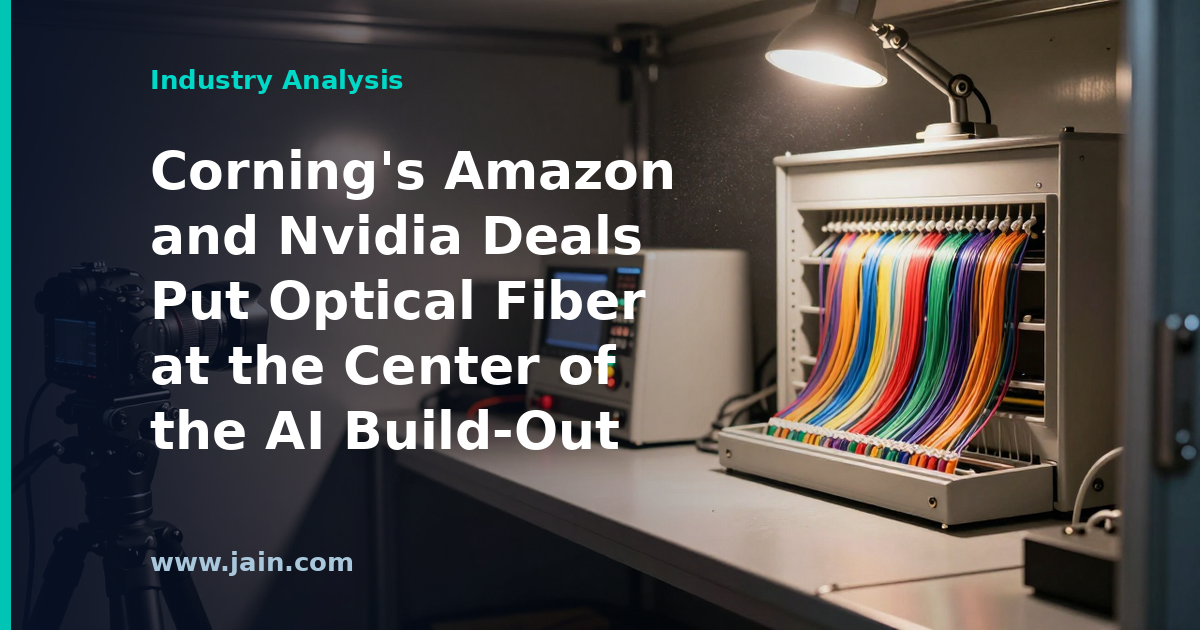
  • Corning’s Amazon and Nvidia Deals Put Optical Fiber at the Center of the AI Build-Out

    Corning’s Amazon and Nvidia Deals Put Optical Fiber at the Center of the AI Build-Out

    Corning Incorporated (NYSE: GLW), the U.S. glass and optical-fiber maker, has landed a supply deal with Amazon and a tie-up with Nvidia to support AI-driven fiber expansion, according to a Yahoo Finance report dated July 11, 2026. The report identifies the two partners and the AI-infrastructure context but discloses no financial terms, volumes, or timelines.

    Executive Summary

    According to the report, Corning has secured two of the most consequential names in AI infrastructure as partners: Amazon, the largest cloud provider through AWS, and Nvidia, whose GPUs power the bulk of AI training clusters. The pairing matters because it spans both ends of the optical market — a hyperscale buyer locking in fiber supply for data-center construction, and a chipmaker whose networking roadmap increasingly depends on optics engineered into the systems themselves.

    The deeper signal is about scarcity. For three years the AI build-out narrative has centered on GPUs, then power, then land and cooling. Deals like these suggest the industry is now moving down the stack to connectivity: the millions of fiber strands that stitch tens of thousands of accelerators into a single usable computer. When buyers of Amazon’s and Nvidia’s scale contract directly with a fiber manufacturer, it typically means they no longer trust the spot market to deliver.

    Fiber Is the Layer the AI Boom Forgot to Price In

    An AI data center is, in networking terms, unlike anything the cloud era built. Traditional cloud facilities connect servers that mostly work independently; AI training clusters must make thousands of GPUs behave like one machine, which requires every accelerator to talk to every other at extreme speed. That drives fiber consumption per megawatt to multiples of what conventional data centers use — dense mesh fabrics of optical links inside the building, plus long-haul routes connecting campuses into distributed training networks.

    Corning has been positioning for this shift for some time. In 2024 it struck a widely reported agreement with Lumen Technologies that reserved roughly 10% of its global fiber capacity to interconnect AI data centers — an early sign that fiber, a product long treated as a commodity, was becoming something buyers reserve years ahead. A reported Amazon deal would extend that pattern from carriers to the hyperscalers themselves.

    What Amazon and Nvidia Each Want — and Why It’s Not the Same Thing

    Amazon’s interest is straightforward supply security. AWS has committed to one of the largest capital programs in corporate history, building AI campuses that each require enormous quantities of fiber-optic cable, connectors, and pre-terminated assemblies. Contracting directly with the manufacturer hedges against the lead-time blowouts that hit transformers and switchgear, and can lock in pricing before competitors absorb capacity.

    Nvidia’s angle is architectural. As GPU clusters scale, the copper links traditionally used for short connections run out of reach and power budget, pushing the industry toward optics integrated ever closer to the chip — including co-packaged optics, where the optical components sit in the same package as the switch silicon. Nvidia has publicly built a silicon-photonics ecosystem around its networking platforms, and Corning has previously been named among its optics partners. A deepened tie-up would suggest fiber makers are moving up the value chain, from selling cable to co-engineering the optical guts of AI systems.

    Winners, Losers, and What the Report Actually Establishes

    If the deals are as described, Corning gains something rare for a components maker: demand visibility anchored to the two most creditworthy names in AI. Other fiber and connectivity suppliers — Prysmian, CommScope, Fujikura, Sumitomo — face a market where marquee demand is being locked up bilaterally, which can lift the whole sector’s pricing but also concentrates the best volumes with the leader. Buyers without such agreements, including telecom carriers and enterprises mid-way through their own fiber projects, may face longer lead times if AI demand absorbs available capacity.

    That said, the source material here is thin: a headline confirming that deals exist, not what they contain. No dollar values, durations, capacity commitments, or product scope are disclosed. Supply agreements in this industry range from binding take-or-pay contracts to loose framework arrangements that generate headlines but little guaranteed revenue. Until terms emerge — in an SEC filing, an earnings call, or a detailed release — the prudent reading is directional: fiber is now strategic enough that Amazon and Nvidia negotiate for it directly, and that fact alone is meaningful.

    Background

    Corning invented the first commercially viable low-loss optical fiber in 1970 and has remained one of the world’s largest fiber producers through every connectivity cycle since — the dot-com fiber glut, fiber-to-the-home, and the cloud data-center era. Its optical communications segment sells fiber, cable, and pre-connectorized hardware to carriers and, increasingly, to hyperscale data-center operators.

    The AI era reframed that business. Beginning around 2024, Corning began striking capacity-reservation agreements tied explicitly to AI data-center interconnection, including its Lumen Technologies deal, and was named among the partners in Nvidia’s silicon-photonics ecosystem. The reported Amazon and Nvidia deals of July 2026 continue that trajectory: fiber shifting from commodity purchase to strategically contracted supply.

    Source: Corning (GLW) Lands Amazon Deal And Nvidia Tie Up For AI Fiber Expansion — Yahoo Finance report, July 11, 2026, on Corning’s reported AI-related agreements with Amazon and Nvidia.

  • Goldman Sachs: AI Capex Pivots Toward Inference and Enterprise Use

    Goldman Sachs: AI Capex Pivots Toward Inference and Enterprise Use

    Goldman Sachs published a note dated July 10, 2026 arguing that AI investment is rotating from headline-grabbing training clusters toward inference workloads and broader enterprise adoption. The bank frames the shift as a maturing phase of the AI capital cycle rather than a slowdown.

    Executive Summary

    The Goldman Sachs view, as summarized in the release, is that the marginal AI dollar is increasingly directed at inference — the runtime serving of trained models to end users and applications — and at enterprise deployments that put those models to work inside businesses. Training remains significant, but the growth vector is moving.

    For infrastructure operators, that framing matters because inference and enterprise AI have a different physical and economic profile than training. They favor latency-sensitive placement, steadier utilization curves, and integration with existing corporate data — all of which reshape where capacity is built, how it is cooled and powered, and which vendors capture the spend.

    What ‘Shift to Inference’ Actually Means for Infrastructure

    Training a large model is a bursty, capital-intensive event: tens of thousands of accelerators wired together, run flat-out for weeks, tolerant of remote siting as long as power and interconnect are cheap. Inference — the act of answering a user’s query with a trained model — is the opposite. It runs continuously, scales with usage, and rewards proximity to users and to enterprise data. If Goldman’s read is right, the next tranche of AI capex will look less like one giant campus in a remote grid pocket and more like distributed capacity closer to demand.

    That has second-order consequences the note itself does not spell out. Metro data centers, edge sites, and existing enterprise colocation footprints become more strategically valuable. Networking — low-latency fiber between inference points, users, and data gravity centers — becomes a first-class concern rather than a training-cluster afterthought.

    Enterprise Adoption Changes the Buyer

    A capex signal tied to enterprise adoption implies a different customer mix than the hyperscaler-and-frontier-lab spending that has dominated headlines. Enterprises buy differently: they care about data residency, regulatory posture, integration with existing systems, and predictable unit economics. They are also more sensitive to total cost of ownership than to raw peak FLOPS.

    If that customer base grows as the note suggests, the winners are likely to include vendors and operators that can package AI capacity as a consumable service — with governance, observability, and support — rather than raw GPU hours. It also expands the addressable market for private cloud, sovereign cloud, and hybrid deployments where the model runs near the data.

    Reading the Capex Signal With Appropriate Caution

    Analyst notes are directional, not deterministic. Goldman is describing a rotation in how AI dollars are spent, not a retreat from AI spending overall, and the release as summarized does not quantify the magnitude, timing, or geographic distribution of that rotation. It is fair to ask what data underpins the call — enterprise deal flow, hyperscaler capex disclosures, chip shipment mix — and how much of the shift is already priced into infrastructure equities.

    The same scrutiny applies to the counter-narrative. Claims that training demand is peaking have been made before and repeatedly revised as new model generations arrived. A durable inference-led phase would still coexist with periodic training surges tied to frontier releases. Buyers planning multi-year builds should treat the shift as a change in mix, not a substitution.

    Background

    AI infrastructure spending accelerated sharply from 2023 onward, dominated by large training clusters built by hyperscalers and frontier model developers. That phase concentrated capital in a small number of very large sites optimized for dense accelerator deployments, cheap power, and high-bandwidth interconnect.

    As foundation models have matured and enterprise pilots have moved toward production, industry attention has increasingly turned to inference — the runtime side of AI — and to the operational, data, and governance challenges of deploying models inside businesses. Goldman’s July 2026 note sits within that broader transition, articulating a capex signal that many operators and vendors have been positioning for.

    Source: AI Investment Is Shifting as Inference, Enterprise Adoption Accelerate – Goldman Sachs — Goldman Sachs note dated July 10, 2026 describing a rotation in AI capital spending toward inference workloads and enterprise adoption.

  • Amazon’s $25B Bond Sale Shows AI Buildout Reshaping Debt Markets

    Amazon’s $25B Bond Sale Shows AI Buildout Reshaping Debt Markets

    Amazon has launched a $25 billion bond sale to help fund its artificial-intelligence infrastructure buildout, according to a report published by SiliconANGLE on July 6, 2026. The offering ranks among the largest corporate debt raises of the year and is aimed squarely at the data centers, chips, and power capacity behind Amazon’s AI ambitions.

    Executive Summary

    The announcement itself is simple: Amazon is borrowing $25 billion in the investment-grade bond market, and the stated purpose is AI infrastructure. What makes it significant is what it says about scale. Bond sales of this size were once reserved for blockbuster acquisitions; here, the “acquisition” is compute — data center campuses, accelerator chips, networking, and the electricity to run them.

    It also confirms a structural shift in how the AI buildout is financed. The largest cloud providers, long famous for funding expansion out of their own operating cash flow, are increasingly turning to debt markets because annual capital spending has grown beyond what even their formidable cash generation comfortably covers. When the world’s biggest companies must borrow tens of billions to keep pace, AI infrastructure stops being just a technology story and becomes a fixed-income story — one that credit investors, utilities, and data center operators all have a stake in.

    From Cash Machine to Serial Borrower

    For most of the cloud era, hyperscalers — the handful of companies operating cloud platforms at global scale, such as Amazon, Microsoft, and Google — were net generators of cash. Capital expenditure was enormous but sat inside operating cash flow, so bond issuance was occasional and opportunistic. The AI cycle broke that pattern. Late 2025 saw a wave of jumbo hyperscaler bond deals, including a roughly $15 billion Amazon offering — its first major issuance in years — and even larger raises by peers. A $25 billion follow-on just months later suggests this is not a one-off top-up but a financing model: recurring, large-scale debt issuance to fund a multi-year infrastructure program.

    That model is rational. Debt is well suited to long-lived physical assets — buildings, substations, cooling plants — and investment-grade borrowers of Amazon’s standing can raise it cheaply relative to the returns they project on AI services. The open question is duration matching: much of AI capex is not thirty-year buildings but accelerator chips (specialized AI processors) that may be economically competitive for only a handful of years. Borrowing long against assets that depreciate fast is a bet that AI revenue arrives on schedule.

    Big Enough to Move the Bond Market

    A $25 billion deal is not just large for Amazon; it is large for the market it lands in. Offerings at this scale absorb a meaningful share of investment-grade demand in the weeks they price, influence credit spreads (the extra yield investors demand over government bonds) for other issuers, and increase the weight of technology names in bond indexes that pension funds and insurers track. In effect, AI infrastructure is becoming an asset class within corporate credit — a bundle of quasi-utility bonds backed by the cash flows of cloud computing.

    That has two second-order effects. First, it gives fixed-income investors — a far larger pool of capital than equity or venture markets — direct exposure to the AI buildout, which deepens the funding available for it. Second, it concentrates risk: if AI demand disappoints, the losses would no longer be confined to stock prices but would show up in credit portfolios that are meant to be the conservative part of institutional balance sheets. Nothing in this offering suggests distress — Amazon remains among the strongest credits in the market — but scale itself changes the risk picture.

    Where the $25 Billion Actually Goes

    “AI infrastructure” is shorthand for a long supply chain. Bond proceeds at this scale ultimately flow to chipmakers, to construction firms building data center shells, to electrical and cooling equipment vendors, to fiber and networking suppliers, and to utilities contracting new generation and transmission. For the data center industry, sustained debt-funded hyperscaler capex is demand visibility: it signals that orders for land, power, and capacity should continue well beyond the current fiscal year.

    It also sharpens the competitive divide. Operators and regions that can deliver powered land — sites with grid connections, water or alternative cooling, and permits already in hand — are positioned to capture this spending. Those that cannot will watch it flow elsewhere. And because the hyperscalers can borrow at scale that colocation providers and smaller developers cannot match, cheap debt access itself becomes a competitive moat in the infrastructure race.

    The Sustainability Question

    The measured way to read this deal is as a confidence signal with a caveat. Amazon borrowing $25 billion says its leadership expects AI demand to justify the capacity — companies do not typically lever up to build assets they expect to idle. The caveat is that the entire industry is making a correlated version of the same bet, financed increasingly with borrowed money. If AI monetization compounds as projected, these bonds will look like textbook infrastructure finance. If it stalls, the sector will be servicing debt on capacity that arrived ahead of revenue.

    History offers both comfort and warning. The fiber overbuild of the late 1990s was also debt-financed infrastructure ahead of demand; the capacity was eventually used, but not before wiping out many of its financiers. The difference this time is balance-sheet quality: the borrowers are among the most profitable companies ever to exist, with diversified revenue outside AI. That is a genuine buffer — but it is a buffer, not a guarantee.

    Background

    Amazon operates Amazon Web Services (AWS), the world’s largest cloud computing platform and the profit engine that has historically funded the company’s expansion. For most of the cloud era, Amazon and its hyperscale peers paid for data center growth out of operating cash flow, issuing bonds only occasionally. The generative-AI boom that accelerated from 2023 onward changed the math: annual capital budgets across the largest cloud providers climbed into the tens and then hundreds of billions of dollars, driven by AI chips, new data center campuses, and power procurement.

    By late 2025 that spending had spilled into the bond market, with several of the largest technology companies — Amazon among them — launching some of the biggest corporate debt offerings on record to fund AI infrastructure. The $25 billion sale reported in July 2026 continues that shift, cementing debt markets as a core funding channel for the AI buildout rather than an occasional supplement.

    Source: Amazon launches $25B bond sale to fund AI infrastructure — SiliconANGLE’s July 6, 2026 report on Amazon’s $25 billion investment-grade bond offering aimed at funding its AI infrastructure expansion.