
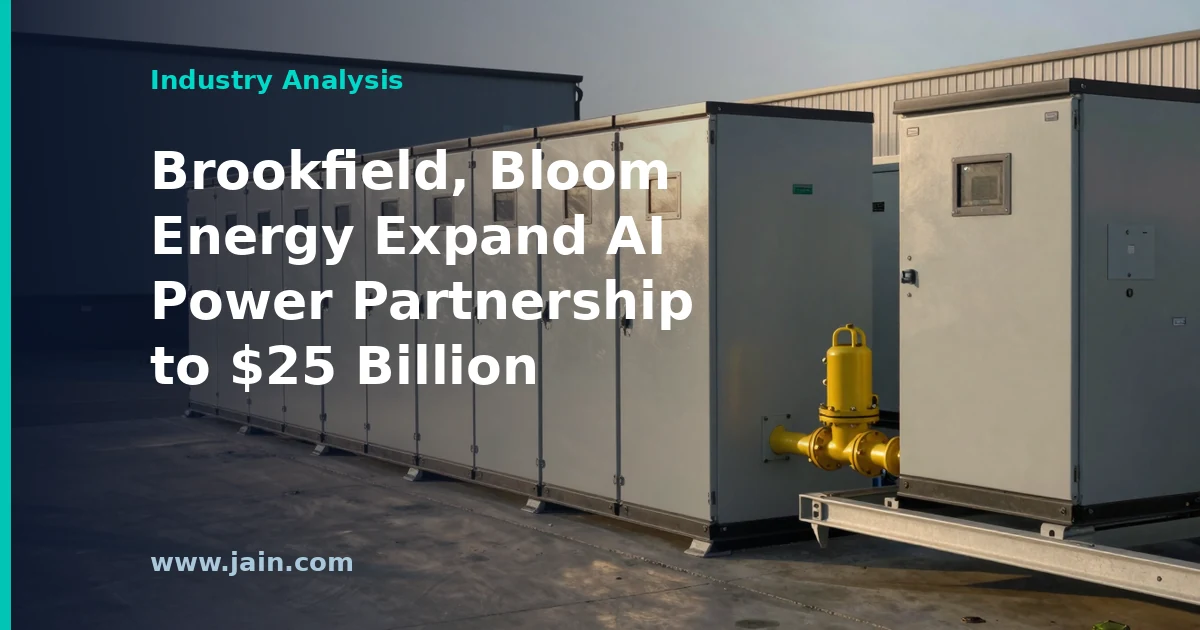
Brookfield and Bloom Energy announced on June 29, 2026 that they are expanding their AI infrastructure partnership to $25 billion — a fivefold increase over the original framework — to build and finance rapid power deployment for AI data centers. The expanded arrangement pairs Bloom’s solid oxide fuel-cell technology with Brookfield’s infrastructure capital.
Executive Summary
Bloom Energy, the fuel-cell manufacturer, and Brookfield, one of the world’s largest infrastructure investors, have scaled their partnership from an original framework — implied by the announcement’s “fivefold” language to have been on the order of $5 billion — to $25 billion. The stated purpose is to build and finance “rapid power” for AI infrastructure: on-site electricity generation that can be deployed faster than utility grid connections.
The announcement matters because electricity availability, not chips or land, has become the binding constraint on AI data-center construction. A $25 billion commitment of this shape signals that major infrastructure capital now treats on-site fuel-cell generation as a bankable asset class rather than a niche backup option. That said, the release as reported gives a headline dollar figure without megawatt targets, named customers, or deployment timelines — so the scale of actual near-term power delivery remains to be demonstrated.
Why Fuel Cells Are Jumping the Grid Queue
The core problem this partnership targets is speed. In many major data-center markets, a new facility requesting a large grid connection can wait years for utilities to build the transmission and generation needed to serve it — a delay measured in lost AI product cycles. On-site generation sidesteps that queue. Bloom’s solid oxide fuel cells convert fuel, typically natural gas, into electricity through an electrochemical reaction rather than combustion, and they arrive as factory-built modules that can be installed in months rather than the multi-year timelines of large power plants or grid upgrades.
That “speed-to-power” pitch has become the dominant selling point across the AI power market — gas turbines, batteries, and behind-the-meter deals all compete on the same axis. Fuel cells’ specific claim is modularity and siting flexibility: they are quiet, produce no combustion emissions like NOx at the point of generation, and can be permitted in places where a turbine plant could not. The trade-off is cost per megawatt-hour and dependence on fuel supply, which is why financing structure matters as much as technology.
The Capital Stack Behind the Megawatts
The division of labor is the interesting part. Bloom manufactures and services the equipment; Brookfield brings the balance sheet. In a typical arrangement of this kind, the infrastructure investor owns the generating assets and sells power or capacity to data-center operators under long-term contracts, so the data-center customer avoids a large upfront capital outlay. For Bloom, a deep-pocketed financing partner converts its technology into an offering that can compete for hyperscale-sized deals it could never finance from its own balance sheet.
For Brookfield, fuel-cell fleets serving AI campuses look like classic infrastructure: long-lived assets, contracted revenue, and a customer base — AI compute operators — currently willing to pay a premium for firm power delivered quickly. Growing the framework fivefold within roughly a year of the original announcement suggests the partners believe demand from AI builders exceeds what the initial commitment could serve. It is a strong demand signal, though announced frameworks and deployed megawatts are different things.
What a Fivefold Scale-Up Signals — and What It Doesn’t
A $25 billion figure invites careful reading. Partnership frameworks of this kind typically describe a ceiling — capital the partners intend to deploy if projects materialize — rather than contracted orders. The announcement as reported does not specify how much is committed versus targeted, how much power it represents, or over what period. Until customer contracts and megawatt figures are disclosed, the number is best understood as a statement of ambition backed by a credible financier, not a backlog.
Competitively, the deal sharpens the contest to power AI. Utilities and grid operators risk losing their largest new customers to behind-the-meter generation; gas-turbine suppliers, battery vendors, and small modular reactor developers are chasing the same load. For data-center operators, more credible power options mean more negotiating leverage — and for the industry’s critics, more scrutiny of what fuels that power. Fuel cells running on natural gas still emit carbon dioxide, so the climate profile of this buildout will depend on fuel sourcing choices the announcement does not detail.
Background
Bloom Energy, founded in 2001 and headquartered in California, went public in 2018 and built its business selling solid oxide fuel-cell “Energy Servers” to commercial, industrial, and utility customers seeking reliable on-site power. Brookfield is a global asset manager with hundreds of billions of dollars across infrastructure, renewable power, and real estate, and has been among the most aggressive institutional investors in AI-related infrastructure. The two first announced an AI-focused partnership in late 2025, part of a wider industry wave in which data-center developers turned to behind-the-meter generation — fuel cells, gas turbines, and eventually nuclear — as utility interconnection queues stretched to multiple years in key markets.
Source: Brookfield and Bloom Energy Expand AI Infrastructure Partnership to $25 Billion — Bloom Energy announcement, June 29, 2026, reporting a fivefold expansion of the companies’ AI power partnership.