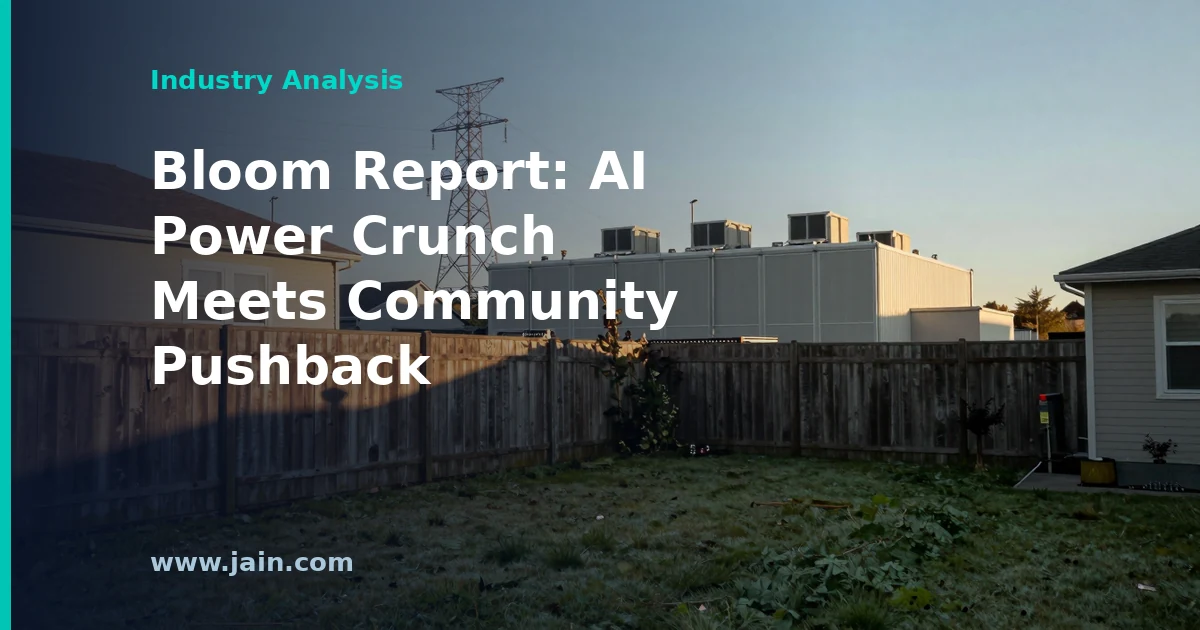
Bloom Energy has published a report arguing that continued expansion of AI data centers depends on operators addressing two intertwined constraints in parallel: electricity supply and local community acceptance. The report, released in June 2026, frames the two issues as inseparable rather than sequential.
Executive Summary
The fuel-cell maker’s central thesis is that the AI buildout cannot be solved by megawatts alone. Even where generation, transmission, or on-site power can be procured, projects increasingly stall on zoning, noise, water, and land-use objections from neighbors and municipalities. Conversely, community outreach without a credible power plan is equally insufficient.
For an industry accustomed to treating power and permitting as separate workstreams, the framing is a nudge toward integrated planning. It also, unsurprisingly, positions Bloom’s distributed on-site generation product as a natural fit for that integrated approach — a commercial interest readers should weigh alongside the analysis.
Why ‘Power And Community’ Is The Real Bottleneck
For most of the cloud era, data center siting followed a familiar recipe: cheap land, fiber, tax incentives, and a utility willing to sign an interconnect. AI workloads have broken that recipe. A single hyperscale AI campus can now request hundreds of megawatts — comparable to a small city — on timelines that outpace utility planning cycles measured in years. Bloom’s report reframes this as a two-variable problem: neither raw generation nor social license alone is sufficient, and progress on one without the other tends to collapse the project.
That framing matters because the industry has historically optimized for the technical variable and treated community relations as public affairs. When a substation upgrade takes five years and a rezoning fight can add two more, the bottleneck is whichever constraint binds first — and increasingly, both bind simultaneously.
Winners, Losers, And The Distributed-Generation Pitch
The report’s logic favors technologies that can be sited close to load, deployed quickly, and configured to reduce visible community impact — a description that fits Bloom’s solid-oxide fuel cells, but also natural-gas peakers, on-site solar-plus-storage, and eventually small modular reactors. Utilities that can offer flexible, phased interconnection may win share from those that cannot. Operators willing to co-locate generation with compute gain optionality against constrained grids.
The losers, if the thesis holds, are projects that assume grid capacity will materialize on hyperscaler timelines, and jurisdictions that treat every large load as a windfall without offering a permitting path. It is worth noting that the report comes from a vendor whose products directly address the problem it describes; that does not make the diagnosis wrong, but readers should treat the prescription as one option among several.
Community Concerns Are Not A Communications Problem
The more substantive point in the report — to the extent the summary conveys it — is that community opposition is being driven by material impacts: water use for cooling, diesel backup emissions, noise from chillers and generators, truck traffic during construction, and property-value anxieties. These are engineering and siting questions, not messaging questions. Treating them as PR problems has, in several high-profile cases, hardened opposition rather than defused it.
For buyers and investors, the implication is that due diligence on new capacity should include the permitting posture and neighbor relations of a site, not just its power and fiber. A campus with signed interconnects but an organized opposition can be as delayed as one with willing neighbors and no transformer.
Background
Bloom Energy, founded in 2001 and headquartered in San Jose, makes solid-oxide fuel cells that generate electricity on-site from natural gas, biogas, or hydrogen. Its customers include large enterprises and, increasingly, data center operators seeking alternatives to constrained grid interconnection.
The wider context is a global surge in AI training and inference demand that has pushed data center power requests to levels utilities did not plan for. In the United States in particular, several regions have seen multi-year queues for large interconnects, prompting operators to explore on-site and behind-the-meter generation, direct utility partnerships, and, in some cases, relocation to more permissive jurisdictions.