
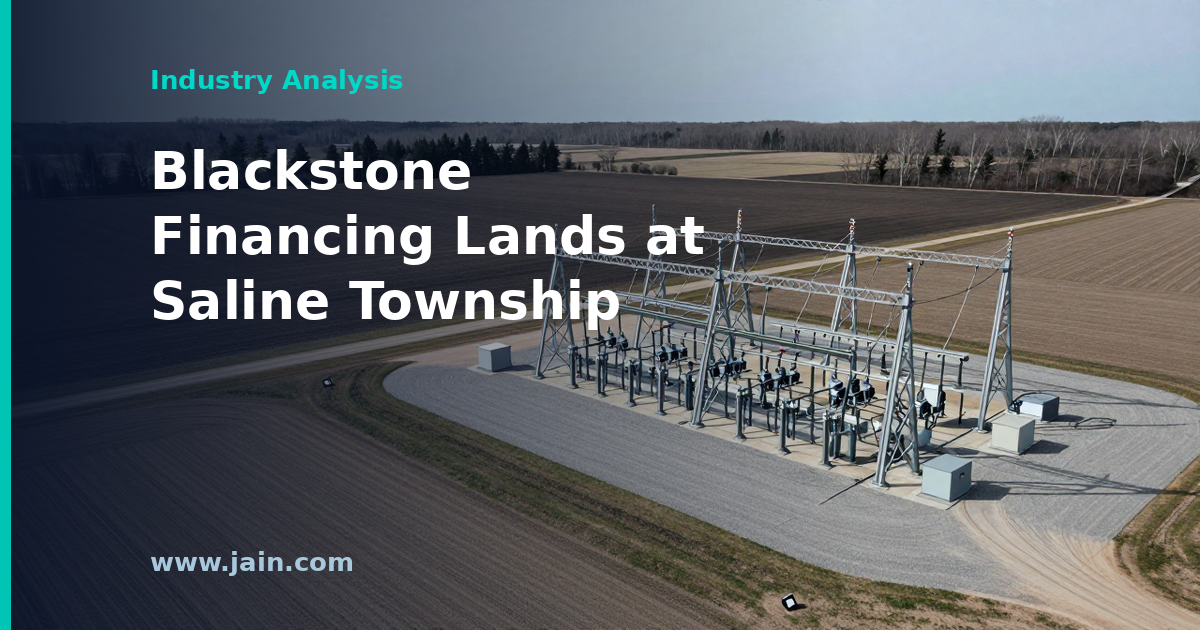
MLive reported on April 25, 2026 that the large data center campus planned for Saline Township, in Washtenaw County, Michigan, has secured financing through Blackstone, the world’s largest alternative-asset manager and a major private-credit lender. Saline Township is a rural farming community roughly south of Ann Arbor, and the site has been the subject of local debate since the project was first proposed.
The report is headline-level. The coverage available to us does not state the size of the facility, the amount or structure of the financing, the identity of the anchor tenant, or the construction schedule. What is established is the fact of a financing commitment from a private-capital provider rather than from a bank syndicate or a utility-led arrangement.
Executive Summary
A financing close is the moment a data center stops being a land-use argument and becomes a construction project. Site control, zoning approvals and power studies can all exist without a single dollar of committed capital; a lender writing a check is the first hard signal that a third party with money at risk believes the project will generate cash. That is why this particular disclosure matters more than its length suggests.
The identity of the lender matters as much as the event. Blackstone has become one of the largest financiers of digital infrastructure through its credit and real-assets platforms, and its involvement places Saline Township inside a broader shift: the capital funding America’s AI-era compute buildout is increasingly private credit — money lent directly by asset managers — rather than utility balance sheets, investment-grade bonds, or traditional construction lending. Private credit moves faster, tolerates more complexity, and prices that flexibility into the interest rate.
The consequence is a redistribution of risk. When a regulated utility builds generation and transmission for a large customer, cost overruns and demand shortfalls can end up in rate cases, where regulators decide how much lands on other ratepayers. When a private lender funds a merchant campus, the first loss sits with the sponsor’s equity and the lender’s loan. Which of those two models Saline Township follows is the single most consequential question the reporting does not yet answer.
Why a Private-Credit Lender, Not a Utility, Is the Story
For most of the last century, the entity that financed heavy electrical load in a place like Washtenaw County was the local utility. It raised capital, built the wires and the plants, and recovered the cost from customers over decades under a regulator’s supervision. The model was slow, but it was durable, and it socialized risk across a large base of ratepayers who had little say in the matter.
Data centers built for artificial-intelligence workloads do not fit that rhythm. The demand signal arrives in months, not decades, and it is concentrated in a handful of hyperscale buyers whose plans can change. Private credit — non-bank lending in which asset managers lend directly from their own funds — has filled the gap because it can underwrite an idiosyncratic asset quickly, structure around construction milestones, and accept collateral that a bank credit committee would struggle with. The borrower pays for that speed in spread.
The trade is real in both directions. A sponsor who takes private credit gets certainty of execution and avoids the political timeline of a rate case. It also accepts covenants, tighter reporting, and a lender that can enforce quickly if lease-up or delivery slips. Reading Blackstone’s involvement as validation of the Saline Township site is reasonable; reading it as a guarantee of completion is not, because financing commitments are typically conditioned on milestones that have not been disclosed here.
The Capital Structure Decides Who Eats the Power Risk
Whether a campus of this scale is financially safe depends less on the headline amount than on what sits behind it. Two structures dominate the sector. In the first, the developer signs long-term leases with a creditworthy tenant before drawing debt; the lender is effectively underwriting the tenant’s credit, and power costs are passed through under the lease. In the second — a merchant or speculative build — the developer takes capacity risk, betting that demand will appear at attractive rates. The interest cost of the two differs sharply, and so does the consequence of being wrong.
Power is where those structures are tested. A large campus needs a firm interconnection, a tariff that sets what it pays per megawatt-hour, and often a commitment to pay for a minimum volume whether or not the servers are drawing it. That last provision — a take-or-pay or minimum-demand charge — is the mechanism by which regulators try to ensure that a large customer, not the general ratepayer base, funds the network upgrades built on its behalf. Whether such terms exist here, and how strict they are, is not in the reporting.
The winners in the current arrangement are relatively easy to identify: landowners who sell into a rising market, contractors and electrical trades, lenders earning wide spreads on secured assets, and local governments that collect property tax on very expensive equipment. The exposed parties are harder to see in advance. They include equity holders if AI compute demand normalizes before the campus is leased, and residential ratepayers if grid investment is later judged to have been undersubscribed by its intended customer. Neither outcome is predictable from a financing headline, which is exactly why the terms matter.
Michigan’s Calculation: Tax Base Now, Load Growth Later
Michigan has actively courted data center investment as part of a broader effort to attract capital-intensive industry, and southeast Michigan offers a genuine set of advantages: cool climate for much of the year, abundant fresh water in the Great Lakes basin, existing transmission built for a manufacturing economy that has shrunk, and proximity to engineering talent around Ann Arbor and Detroit. Those are structural, not promotional.
The fiscal case for a rural township is also real but narrow. A hyperscale campus generates substantial property tax relative to farmland and comparatively few permanent jobs — typically technicians, security and facilities staff, against a much larger but temporary construction workforce. Communities that evaluate these projects as employment engines are usually disappointed; those that evaluate them as tax-base plays are usually not, provided the assessment holds and abatements are modest. The distinction is worth making plainly because it is where local expectations most often go wrong.
The longer-term question for Michigan is load. Adding gigawatt-scale demand to a grid changes generation planning, transmission queues and reserve margins for everyone connected to it. That can be managed well — with large-load tariffs, staged energization, and on-site or contracted generation — or managed poorly. The financing announcement tells us capital has arrived. It tells us nothing about which of those paths the electricity side is on.
A Contested Site, and How to Read Both Sides
The Saline Township project has drawn organized local opposition, as most large rural data center proposals now do. Residents raise farmland conversion, water use, noise from cooling equipment, traffic during construction, and the durability of tax promises. These are legitimate, checkable questions, and dismissing them as reflexive opposition would be lazy — several of them have been substantiated at other sites, particularly noise complaints near residential parcels.
The same standard applies to opposition claims. Water consumption varies by an order of magnitude depending on whether a facility uses evaporative cooling or a closed-loop design, so a figure quoted without the cooling architecture attached is not informative. Ratepayer-impact estimates depend entirely on the tariff, which is a public document once filed. And in a national debate where template campaigns circulate between communities, it is fair to ask of any local group — as of any developer — who is speaking, what the specific local evidence is, and whether the numbers cited come from this project’s filings or from someone else’s. Asking is not an accusation, and there is no basis here for speculating about anyone’s funding.
The most even-handed reading is that both sides are currently arguing about a project whose material terms are not public. The developer has not, in the reporting available, published capacity, water design, or power arrangements; opponents cannot fully assess impact without them. A financing close usually precedes more disclosure, not less, because lenders require documentation that eventually surfaces in permits and utility filings. That is where the argument should be settled.
Background
Blackstone is the world’s largest alternative-asset manager, with major platforms in real estate, infrastructure and private credit. It has become one of the most significant financiers of digital infrastructure globally, lending to and owning data center assets as demand from cloud and artificial-intelligence workloads has outpaced what traditional bank and utility financing could supply on the required timeline.
Saline Township sits in Washtenaw County, southeast Michigan, an agricultural community adjacent to a metropolitan corridor with legacy industrial transmission. Large data center proposals in such places have become a recurring national pattern over the past several years: developers seek land, power and water at rural prices near urban fiber, while residents weigh tax revenue against land use, noise and grid effects. The Saline Township project has been locally contested since it was proposed, and the April 2026 financing report is the point at which the debate moved from land-use approvals toward committed capital.
Source: Massive data center in Saline Township secures financing through Blackstone — MLive.com. Local reporting that the Saline Township, Michigan data center campus has secured financing through Blackstone; terms were not detailed in the coverage available.