
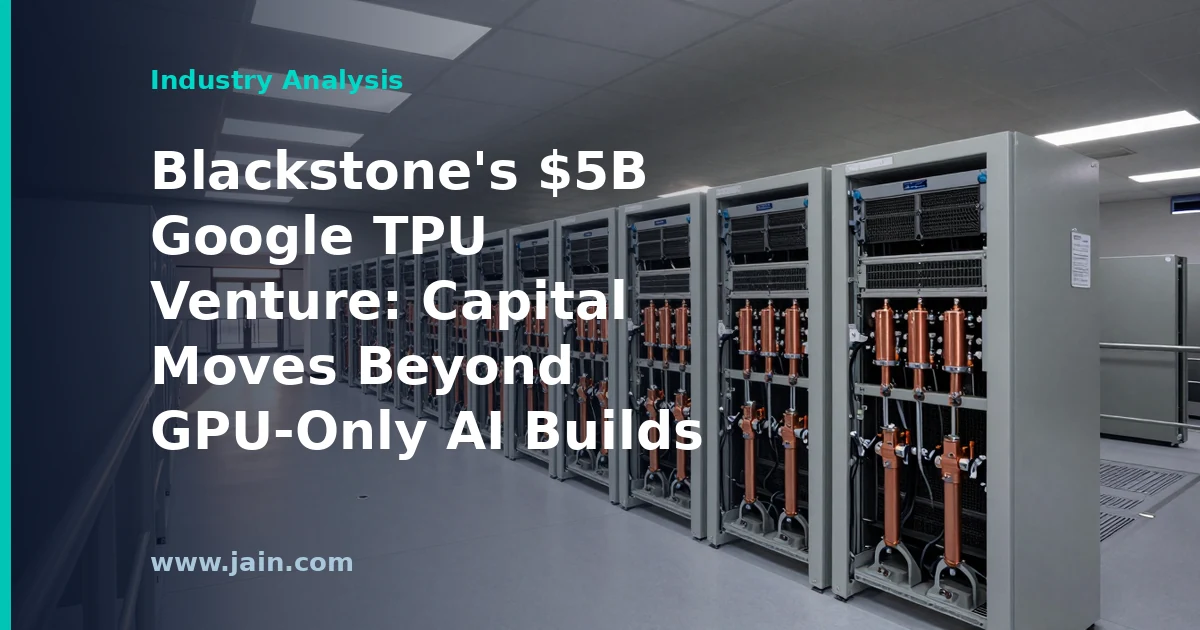
Blackstone, the world’s largest alternative asset manager, will invest $5 billion in an AI infrastructure venture with Google, with the resulting capacity powered by Google’s Tensor Processing Units (TPUs) rather than the Nvidia graphics processing units (GPUs) that have dominated AI build-outs to date, according to a CNBC report published May 18, 2026.
Executive Summary
The announcement pairs one of the deepest pools of private capital with the only hyperscaler that designs and deploys its own AI accelerator at scale. Blackstone’s $5 billion commitment funds infrastructure — the data center capacity, power, and systems needed to run AI workloads — while Google contributes its TPU silicon, custom chips it has refined over roughly a decade to train and serve machine-learning models.
Why it matters: nearly every headline AI infrastructure deal of the past three years has been, implicitly or explicitly, an Nvidia GPU deal. A marquee private-equity firm underwriting billions against TPU-based capacity is a meaningful vote of confidence that alternative accelerators can anchor institutional-grade infrastructure investment — and a signal that the financing market for AI compute is beginning to diversify beyond a single chip vendor.
The First Big Check Written Against Non-Nvidia Silicon
AI infrastructure finance has grown enormously, but it has grown narrowly: lenders and equity investors have overwhelmingly underwritten deals where the collateral and the revenue engine are Nvidia GPUs. That concentration has been rational — Nvidia’s CUDA software ecosystem and resale liquidity made its chips the safest asset to finance — but it has also made the entire capital stack a leveraged bet on one supplier. Blackstone committing $5 billion against TPU-powered capacity is the clearest sign yet that sophisticated capital now sees a second underwritable accelerator. TPUs are application-specific chips Google designed for the mathematics of neural networks; they lack the open resale market of GPUs, which is precisely why a partnership with Google — the designer, operator, and most likely demand backstop — is the structure that makes the risk financeable.
For the broader market, the precedent may matter more than the dollars. If TPU capacity can attract institutional capital on infrastructure terms, similar structures become imaginable around other custom silicon. That would gradually loosen the financing chokepoint that has funneled most AI investment through a single vendor’s order book.
Blackstone’s Compounding Digital Infrastructure Thesis
This deal extends a strategy Blackstone has pursued aggressively since taking data center operator QTS private in 2021 in a transaction valued around $10 billion — then one of the largest data center acquisitions ever. Under Blackstone’s ownership, QTS became a vehicle for hyperscale expansion, and the firm has repeatedly identified AI infrastructure — data centers and the power to run them — as one of its highest-conviction themes. A venture with Google fits the pattern: Blackstone supplies capital at a scale few can match, and captures returns from the physical layer of AI regardless of which models or applications ultimately win.
The economics of such ventures typically hinge on tenancy: infrastructure returns are attractive when long-term, creditworthy commitments stand behind the capacity. Google’s involvement suggests — though the report does not confirm — that Google itself or its cloud customers would utilize the TPU capacity, which would make this closer to a pre-leased infrastructure play than a speculative build. The announcement does not disclose the venture’s structure, so that remains an inference rather than a fact.
Winners, Losers, and the Accelerator Question
Google is an obvious beneficiary: external capital lets it scale TPU deployment faster than its own capital-expenditure budget alone would allow, and every TPU-anchored venture strengthens the case that its silicon is a genuine alternative for AI workloads, not just an internal cost-saver. For Nvidia, one $5 billion venture is immaterial to near-term demand — its chips remain heavily supply-constrained — but the directional message is unwelcome: the largest infrastructure investors are actively building expertise in financing non-Nvidia compute. Data center developers, power providers, and cooling vendors win either way; TPUs, like GPUs, are power-dense accelerators that need substantial electricity and advanced thermal management.
The risks are real, too. TPU capacity is only as valuable as demand for TPU workloads, and that demand is concentrated in Google’s own ecosystem and a handful of large AI developers. If the software world remains standardized on Nvidia’s tooling, TPU infrastructure could face a narrower tenant pool than comparable GPU builds — a concentration risk any underwriter of this deal will have had to price.
Background
Google introduced TPUs in the mid-2010s to run its own machine-learning workloads more efficiently than off-the-shelf chips allowed, and has since iterated through multiple generations while making them available to outside customers through Google Cloud. TPUs are the most mature in-house AI accelerator program among the hyperscalers, all of whom have pursued custom silicon to reduce dependence on Nvidia. Blackstone, for its part, has spent the past half-decade positioning itself as a dominant financier of digital infrastructure — anchored by its roughly $10 billion take-private of QTS in 2021 — on the thesis that AI’s appetite for compute and power represents a generational infrastructure build-out.
Source: Blackstone to invest $5 billion in AI infrastructure venture with Google, powered by TPU chips — CNBC report, May 18, 2026, on Blackstone’s planned $5 billion TPU-powered AI infrastructure venture with Google.