
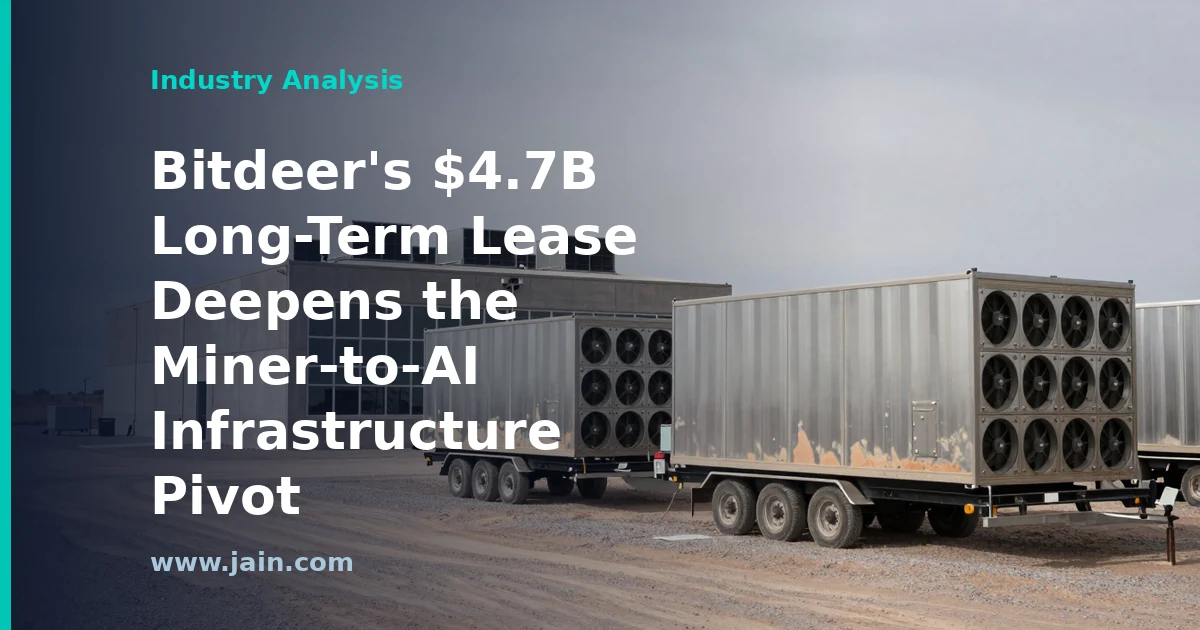
Bitdeer Technologies, the Nasdaq-listed bitcoin mining and digital infrastructure company, has entered a long-term data center lease valued at $4.7 billion, according to a report published April 30, 2026. The company frames the agreement as an expansion of its artificial intelligence infrastructure business — one of the largest single capacity commitments yet disclosed in the ongoing migration of crypto-mining operators into the AI data center market.
Executive Summary
The announcement, carried via TradingView, is short on operational detail but large in headline value: $4.7 billion committed under a long-term lease structure tied to AI infrastructure. Long-term leases — multi-year contracts in which one party commits to pay for data center capacity over the life of the agreement — are the currency of the AI buildout, because they convert speculative capacity into bankable, contracted cash flows that lenders and investors can underwrite.
For Bitdeer, a company built on bitcoin mining, a commitment of this scale matters because it shifts the company’s center of gravity. Mining revenue is volatile, tied to bitcoin’s price and network difficulty. AI infrastructure leases, by contrast, resemble traditional data center economics: contracted terms, identifiable counterparties, and revenue visibility measured in years rather than block rewards. A $4.7 billion figure, if executed as described, would place Bitdeer among the more consequential converts in the miner-to-AI transition.
From Bitcoin Mines to AI Campuses
Bitdeer’s move follows a pattern that has reshaped the crypto-mining sector: companies that spent years assembling large-scale power access and industrial sites for bitcoin mining are repurposing those assets for AI computing. The logic is straightforward. The scarcest input in AI infrastructure today is not chips but energized, grid-connected capacity — sites where hundreds of megawatts of power are already secured and permitted. Bitcoin miners happen to own exactly that.
Several large miners have already signed multi-billion-dollar, multi-year agreements to host AI and high-performance computing workloads, and the market has generally rewarded those pivots with valuations closer to data center operators than to commodity miners. A $4.7 billion long-term lease would signal that Bitdeer intends to compete in that same lane, not merely experiment at the edges of it.
Why Long-Term Leases Are the Deal Structure of the AI Buildout
A long-term lease does two things at once. For the capacity provider, it converts an industrial asset into a stream of contracted revenue that can support debt financing — critical, because retrofitting mining sites into AI-grade facilities is capital intensive, requiring denser power delivery, liquid or advanced air cooling, and far more resilient electrical infrastructure than mining rigs need. For the capacity buyer, it locks up scarce power and space ahead of competitors in a market where lead times for new grid connections can run to years.
The headline number deserves careful reading, however. In deals of this type, the quoted value typically represents total contract value across the full lease term, not annual revenue or an upfront payment. Without the term length disclosed, $4.7 billion could imply very different annual economics — a distinction that matters enormously for assessing the deal’s true weight.
The Real Asset Is Power
Whichever side of the lease Bitdeer occupies, the transaction underscores that access to electricity has become the defining constraint of the AI era. Utilities across major markets face multi-year interconnection queues, and hyperscalers and AI cloud providers have shown they will pay premium, long-duration commitments to secure energized capacity now rather than wait for new construction. Companies holding large existing power allocations — a category that prominently includes bitcoin miners — have found themselves holding strategic real estate.
That dynamic cuts both ways. The premium on power access exists precisely because supply is constrained; as utilities and developers bring new capacity online over the coming years, the scarcity value embedded in today’s deals could compress. Long-term contracts signed at the peak of scarcity may look either prescient or expensive in hindsight, depending on which side of the lease one sits.
Execution and Concentration Risks
The risks in miner-to-AI conversions are well documented across the sector. Retrofitting facilities to AI specifications routinely runs over budget and behind schedule, because AI workloads demand redundancy, cooling density, and network architecture that mining sites were never designed for. Counterparty concentration is the second concern: many of these long-term leases depend on a single tenant or customer, so the credit quality and durability of that counterparty effectively determines the value of the contract.
For a company in transition, there is also a strategic tension. Capital and management attention committed to AI infrastructure is capital not deployed in mining — and if the AI buildout slows or the counterparty falters, the company has repositioned itself around a contract rather than an operating business. None of this makes the deal unwise; it makes the undisclosed details decisive.
Background
Bitdeer Technologies emerged from the bitcoin mining industry’s consolidation around large-scale, professionally operated data centers. Spun off from mining-hardware giant Bitmain in 2021 and founded by Bitmain co-founder Jihan Wu, the company listed on Nasdaq in 2023 and built its business on three legs: mining bitcoin for its own account, hosting other miners’ machines, and selling cloud-based hash power. It operates industrial-scale facilities across multiple continents and has invested in developing its own mining chips.
The broader market context is the collision of two trends: bitcoin mining’s thinning margins after successive halvings, and explosive demand for AI computing capacity that has outrun the electric grid’s ability to serve it. That collision has turned miners’ power portfolios into strategic assets and produced a wave of multi-billion-dollar agreements converting mining sites into AI infrastructure — the wave this lease places Bitdeer squarely within.
Source: Bitdeer expands AI infrastructure with long-term $4.7B data center lease — report published via TradingView, April 30, 2026, announcing Bitdeer’s $4.7 billion long-term data center lease.