
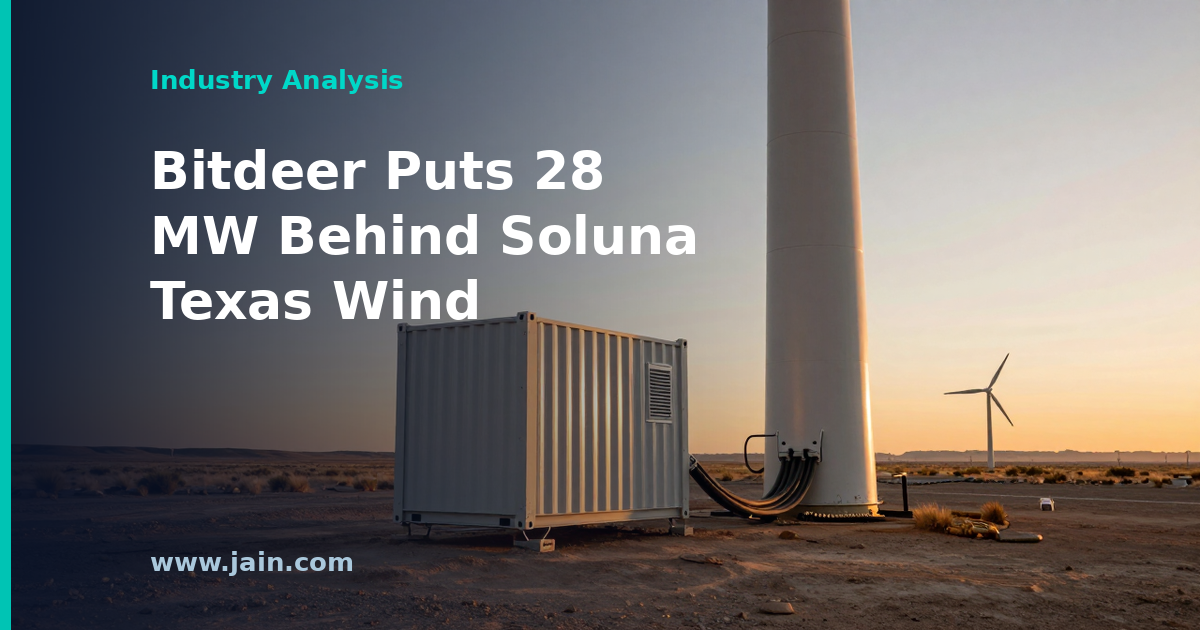
Bitcoin mining operator Bitdeer will deploy 28 megawatts (MW) of mining capacity at a Soluna Holdings wind-powered site in Texas, according to a June 4, 2026 report by ForkLog. The arrangement pairs Bitdeer’s application-specific mining hardware with electricity generated at Soluna’s co-located Texas wind facility.
Executive Summary
The announcement is modest in scale — 28 MW is a fraction of a typical hyperscale data-center campus — but it is a clean illustration of a business model that has become a fixture of the U.S. power market: bitcoin miners acting as flexible offtakers for renewable generation that the grid cannot always absorb.
For Soluna, whose stated strategy is to co-locate compute loads with wind and solar assets in transmission-constrained regions, the deployment adds a paying tenant to existing infrastructure. For Bitdeer, it is incremental hashrate at a site whose marginal power cost should be low precisely because the underlying wind energy is often curtailed. Neither company disclosed contract length, pricing, or revenue-share terms in the source material.
Stranded Wind, Willing Buyer
West and South Texas produce more wind power than local transmission lines can always evacuate to demand centers. When the grid operator, ERCOT, cannot move the electrons, wind farms either curtail output or accept negative prices to keep turbines spinning. Bitcoin miners — which can start, stop, and modulate consumption in seconds — are among the few loads willing to sit next to that generation and buy the surplus. The Bitdeer–Soluna deployment is a textbook example of that pairing at 28 MW, roughly the draw of a mid-sized industrial park.
The economic logic is straightforward: mining revenue is set by the global bitcoin price and network difficulty, but the cost side is dominated by electricity. A site that can source curtailed wind at a deep discount to grid retail rates has a structural margin advantage, provided the operator can tolerate the intermittency.
What This Says About the Post-Halving Miner Playbook
Following bitcoin’s April 2024 halving, block rewards dropped to 3.125 BTC, compressing miner gross margins and forcing operators to hunt for the cheapest available power. Publicly traded miners have responded by signing behind-the-meter deals with independent power producers, buying distressed sites, and — as here — plugging into renewables developers that need a compute anchor tenant. Bitdeer, which is Nasdaq-listed and was spun out of Bitmain, has been methodically expanding its self-mining fleet alongside its hosting and cloud-hashrate businesses.
Soluna, for its part, is a small-cap public company whose thesis is that co-located data compute makes marginal renewable projects financeable. Every incremental megawatt under contract validates that thesis to its own investors, even if the absolute numbers remain small relative to utility-scale peers.
Winners, Losers, and the AI Overhang
The immediate winners are the two counterparties and, arguably, the wind farm’s original developer, which gains a more predictable revenue floor. Ratepayers in ERCOT are largely indifferent at this scale, though critics of behind-the-meter mining argue that adding flexible load anywhere on the grid changes wholesale price formation in ways that deserve scrutiny.
The looming variable is AI. Hyperscalers and neocloud operators are now competing with miners for the same combination of cheap power, fast interconnect, and permissive siting. AI training clusters generally pay more per megawatt-hour than mining and demand higher uptime, which could crowd miners off the best sites over time. A 28 MW mining build today is defensible; whether the same footprint gets renewed at 2029 pricing, when a GPU tenant might be willing to pay a premium for the same substation capacity, is an open question.
Background
Texas has become the center of gravity for U.S. bitcoin mining, driven by abundant wind and solar generation, a deregulated ERCOT market, and permissive local siting. Curtailment of West Texas wind — power that the grid physically cannot deliver to load centers — created an opening for flexible industrial consumers, and bitcoin miners, whose loads can ramp in seconds, filled it.
Soluna Holdings has built its strategy around this dynamic, developing modular compute sites next to renewable projects. Bitdeer, spun out of mining-hardware giant Bitmain and listed on Nasdaq in 2023, has grown by combining its own mining fleet with hosting and cloud-hashrate products, and by seeking low-cost power in the U.S., Norway, Bhutan, and elsewhere.
Source: Bitdeer to deploy 28 MW of bitcoin mining at Soluna’s Texas wind site – ForkLog — trade-press item reporting Bitdeer’s 28 MW mining deployment at a Soluna wind-powered Texas site.