Author: Deepak Jain

  • Bitdeer’s Tydal Lease: Bitcoin Miner Converts Norwegian Hydro Power to AI Colocation

    Bitdeer’s Tydal Lease: Bitcoin Miner Converts Norwegian Hydro Power to AI Colocation

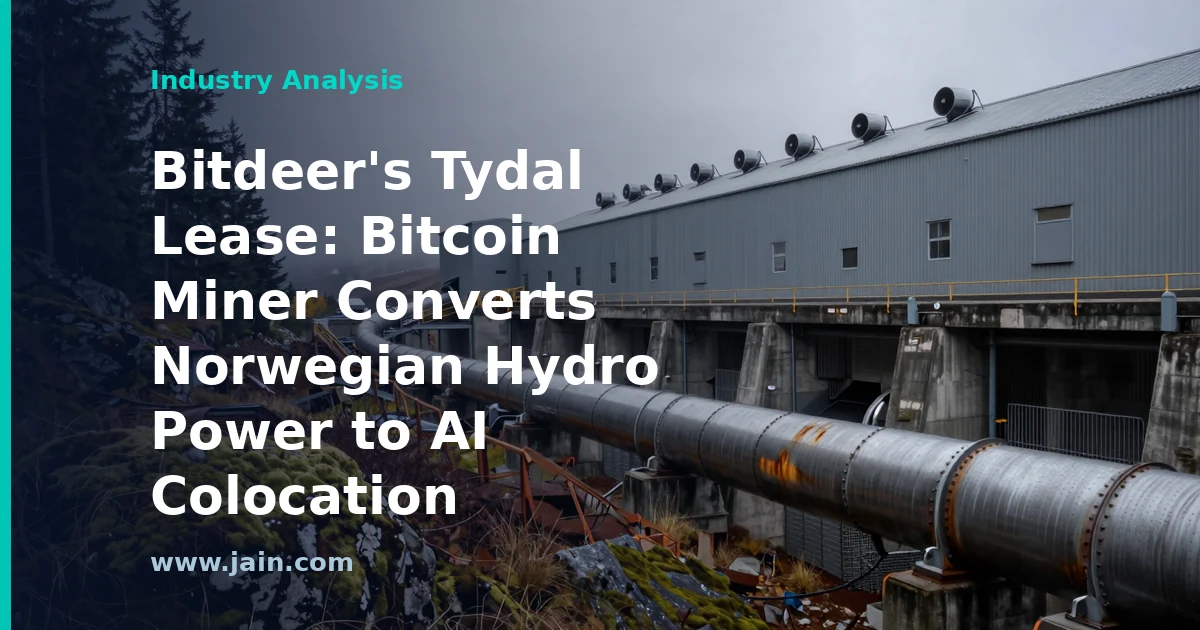
    Bitdeer Technologies Group, the Nasdaq-listed bitcoin mining and data center company, has signed a colocation lease covering an AI data center at its site in Tydal, Norway, according to an April 24, 2026 report from Blockspace Media. Colocation means Bitdeer will act as landlord and facility operator, leasing powered, cooled data center space to a tenant that installs its own computing equipment.

    The deal marks a concrete step in Bitdeer’s effort to convert part of its hydro-powered Norwegian footprint — originally built to mine bitcoin — into longer-duration AI infrastructure revenue.

    Executive Summary

    The announcement is notable less for its size — key commercial terms were not disclosed in the source report — than for what it represents: a signed lease, not a strategy slide. Over the past two years, most large bitcoin miners have announced intentions to pivot toward AI and high-performance computing (HPC), but the market has learned to distinguish between aspirational capacity announcements and executed contracts with tenants. A colocation lease at Tydal puts Bitdeer in the smaller group with a binding commercial agreement.

    Tydal sits in central Norway, a region with abundant hydroelectric generation, a cool climate that reduces cooling costs, and historically low industrial power prices. Those attributes made it attractive for bitcoin mining; they are arguably more valuable for AI workloads, where customers pay a substantial premium per megawatt over what mining economics can support. For Bitdeer, swapping volatile, bitcoin-price-linked mining revenue for contracted lease income changes the character of the business — closer to a data center REIT than a commodity producer.

    For the broader industry, the deal is another data point that the miner-to-AI conversion trend is producing real transactions, particularly at sites with cheap, clean, already-secured power.

    Why Miners Are Becoming Landlords

    The economic logic of the miner-to-AI pivot is straightforward: the scarcest input in AI infrastructure today is not chips but energized data center capacity — sites with grid connections, substations, and permits already in hand. Bitcoin miners spent a decade accumulating exactly that. Securing a new large-scale grid connection in most Western markets can take years; a miner with an operating site can, in principle, offer a tenant powered space far sooner.

    The revenue math strengthens the case. Bitcoin mining revenue per megawatt is capped by network economics and falls with every halving of mining rewards, while AI tenants — cloud providers, GPU-cloud startups, and enterprises — have shown willingness to sign multi-year leases at rates mining cannot match. Converting a site from mining to AI colocation typically requires significant re-engineering, since AI servers demand far higher rack densities, more sophisticated cooling, and stricter reliability standards than mining rigs. But where the power and land are already in place, the conversion cost is generally lower than greenfield construction.

    Norway’s Quiet Advantage in the AI Buildout

    Norway rarely features in headlines dominated by Virginia, Texas, and the Gulf states, but it holds a strong hand: electricity that is overwhelmingly hydroelectric, among the lowest industrial power prices in Europe, a cold climate that allows free-air cooling for much of the year, and political stability. For AI customers facing sustainability reporting requirements — particularly European enterprises subject to EU disclosure rules — hydro-powered capacity carries genuine commercial value, not just marketing value.

    The counterweights are real, too. Norway is far from the major European population centers, which adds network latency — a concern for user-facing AI inference, though far less so for model training, which tolerates distance well. Norwegian grid operators have also grown more selective about allocating power to data centers, and transmission constraints between Norway’s regions mean cheap power is not uniformly available. A site like Tydal, with an existing connection, is therefore more valuable than a map of Norwegian hydro resources might suggest.

    Colocation Versus the GPU-Cloud Gamble

    Bitdeer’s choice of a colocation lease — rather than buying GPUs and selling computing capacity itself — is a meaningful strategic signal. Miners pursuing the pivot face a fork: the asset-light path (lease space to a tenant who owns the chips) or the asset-heavy path (borrow to buy GPUs and operate a cloud). The colocation route earns lower headline revenue per megawatt but avoids the two biggest risks of the GPU-cloud model: rapid hardware depreciation as new chip generations arrive, and customer concentration in a market where a handful of AI labs dominate demand.

    A lease also gives investors something mining never could: contracted, forecastable cash flow. How much credit Bitdeer earns for that depends on terms the report does not disclose — tenant identity and creditworthiness, lease duration, and who funds the conversion capital expenditure. Those details, more than the existence of the lease itself, will determine how the deal is ultimately judged.

    What It Means for the Competitive Landscape

    Each executed miner-to-AI deal tightens the market for the remaining players. Sites with cheap, clean power and existing interconnection are a finite inventory, and tenants signing leases today are effectively optioning that inventory ahead of rivals. For traditional data center operators, miners converting capacity represent new competition from an unexpected direction — though one that must still prove it can meet enterprise reliability expectations, which are far stricter than mining’s tolerance for downtime.

    For other miners, the signal is double-edged. Successful conversions validate the strategy, but they also raise the bar: as more signed leases accumulate across the sector, companies still marketing unconverted ‘AI-ready’ capacity without tenants will face sharper investor questions about why their sites have not attracted commitments.

    Background

    Bitdeer Technologies Group went public on Nasdaq in 2023 and grew into one of the larger publicly traded bitcoin mining operators, building power-intensive computing facilities in markets with inexpensive electricity — including hydro-rich Norway. Bitcoin mining ties revenue directly to the cryptocurrency’s price and to network ‘halvings’ that cut mining rewards roughly every four years, pushing miners to seek steadier income from their energy assets.

    Since the generative-AI boom began straining global data center supply, miners collectively controlling gigawatts of secured grid capacity have emerged as unexpected suppliers of AI infrastructure. Several have signed high-profile AI hosting and colocation agreements, and investors now reward executed contracts far more than announced ambitions — the context in which Bitdeer’s Tydal lease lands.

    Source: Bitdeer signs colocation lease for Tydal, Norway AI data center — Blockspace Media report, April 24, 2026, on Bitdeer’s lease agreement converting hydro-powered Norwegian capacity to AI colocation.
  • 800VDC and the Megawatt Rack: How High-Voltage DC Reshapes Data Center Cooling

    800VDC and the Megawatt Rack: How High-Voltage DC Reshapes Data Center Cooling

    Data Center Dynamics has published an analysis of 800-volt direct current (800VDC) power distribution and its knock-on effects for data center cooling, examining the infrastructure evolution and operational impact of the architecture now being proposed for next-generation AI racks. The piece lands as the industry debates how facilities designed around alternating current (AC) and 54-volt in-rack distribution adapt to rack power densities approaching a megawatt.

    Executive Summary

    The subject is a plumbing-and-wiring story with strategic stakes: as AI accelerator racks climb toward megawatt-class power draws, the conventional approach — converting utility AC power through multiple stages down to low-voltage DC inside the rack — runs into hard physical limits on copper, conversion losses, and space. Moving distribution to 800VDC, an approach publicly championed by NVIDIA and partners across the power-electronics ecosystem for its next-generation rack designs, promises fewer conversion stages, dramatically thinner conductors, and higher end-to-end efficiency.

    The DCD analysis focuses on the less-discussed second-order effect: what this does to cooling. Every watt saved in power conversion is a watt of heat that never has to be removed, but the racks 800VDC enables are so dense that liquid cooling becomes a prerequisite rather than an option. Power architecture and thermal architecture, historically designed by separate teams against separate budgets, are converging into a single engineering problem — and operators, colocation providers, and equipment vendors will all feel the shift.

    Why a Power Story Is Really a Cooling Story

    In a data center, electricity and heat are two views of the same quantity: essentially all power delivered to IT equipment leaves as heat that the cooling plant must reject. Every stage of power conversion — utility voltage to distribution voltage, AC to DC, high DC to the roughly one volt a chip core actually uses — wastes a slice of energy as heat, often inside the white space where cooling is most expensive. Collapsing conversion stages with 800VDC distribution reduces that parasitic load. But the same architecture exists to feed racks far denser than air can handle: at hundreds of kilowatts per rack and beyond, direct-to-chip liquid cooling with cold plates, coolant distribution units (CDUs), and facility water loops stops being an exotic option and becomes the baseline design.

    That coupling changes how facilities get engineered. Busbar routing, cold-plate manifolds, leak detection, and serviceability now compete for the same rack volume. The DCD piece’s framing — implications, infrastructure evolution, operational impact — reflects a real shift in the industry conversation from “can we power it” to “can we power and cool it as one integrated system.”

    What Actually Changes Between 54 Volts and 800

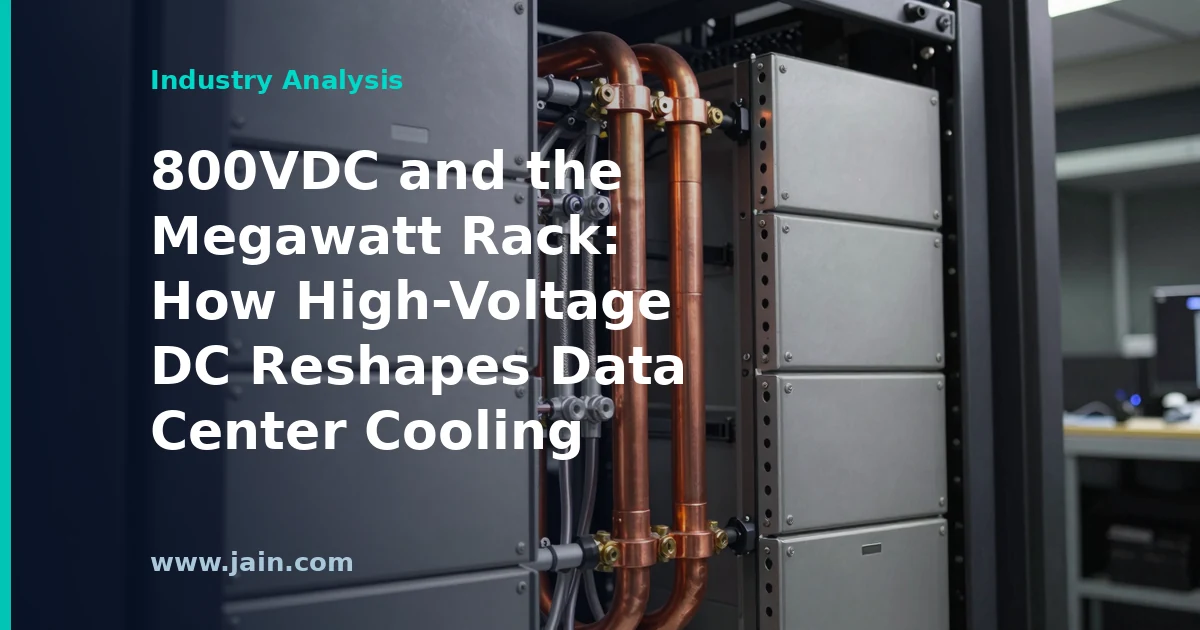
    Today’s high-density AI racks typically distribute power internally at around 54 volts DC over copper busbars. Power scales with voltage times current, so at fixed voltage, a megawatt rack demands enormous current — and current is what sizes conductors, connectors, and their resistive losses. Raising distribution to 800VDC cuts the current for the same power by an order of magnitude, which is why the approach shrinks copper requirements and frees rack space for compute and cooling hardware. It also moves bulky AC-to-DC conversion equipment out of the rack into dedicated infrastructure, a further gift of space and a relocation of its heat.

    For the thermal engineer, the ripple effects are concrete: less conversion loss inside the rack, but far more total heat per rack; new hot components (DC converters, solid-state protection devices) in new places; and coolant loops that must be designed around high-voltage conductors with appropriate creepage, isolation, and leak-response assumptions. None of this is unsolvable — electric vehicles and utility-scale solar have normalized high-voltage DC engineering — but it is genuinely new practice for most data center operations teams.

    The Operational Bill: Skills, Safety, and Serviceability

    The quiet cost of the transition is human. Data center technicians are trained on AC systems and low-voltage DC; 800VDC introduces different arc-flash behavior, different lockout and protection practices, and different failure modes, now interleaved with pressurized liquid-cooling loops in the same enclosure. Procedures for a coolant leak near an energized 800V busbar have to be written, trained, and drilled before the first rack lands. Vendors will point to sealed, engineered systems; operators will reasonably ask who is qualified to service them and on what schedule.

    There is also a monitoring and commissioning dimension. When power and cooling are co-designed, so must be their telemetry: a CDU fault and a DC bus fault can each cascade into the other’s domain within seconds at megawatt densities. Operators evaluating 800VDC-era equipment should scrutinize integration of electrical and thermal controls as closely as the headline efficiency figures.

    Winners, Losers, and the Retrofit Question

    The clearest beneficiaries are power-electronics and liquid-cooling suppliers, which gain a generational replacement cycle, and hyperscale builders designing greenfield AI factories where the whole electrical-thermal stack can be specified at once. The harder position belongs to operators of existing facilities: buildings engineered around air cooling, AC distribution, and 10–30 kW racks cannot simply be re-declared 800VDC-ready. Some will retrofit power and cooling in tandem; others will find their most valuable asset is grid connection and land rather than the building itself.

    For colocation providers and enterprise buyers, the pragmatic takeaway is sequencing. 800VDC is a roadmap item tied to next-generation rack platforms, not a description of most 2026 deployments — but cooling and electrical decisions made today have 15-to-20-year design lives. Facilities being planned now should at minimum preserve optionality: structural allowances for liquid loops, space for DC plant, and staff development that anticipates high-voltage practice.

    Background

    Data center power delivery has evolved in steps: from AC distribution to the server, to rack-level busbars at 12 and then 54 volts DC, each change driven by rising density. The AI buildout broke the curve — accelerator racks jumped from tens of kilowatts to hundreds, with roadmaps pointing toward a megawatt per cabinet, forcing the industry to revisit both how power reaches silicon and how heat leaves it. In 2025, NVIDIA and a wide ecosystem of power and cooling partners publicly outlined 800VDC distribution for next-generation rack platforms, borrowing high-voltage DC practice from electric vehicles and utility-scale solar.

    Data Center Dynamics, the trade publication behind the source analysis, has tracked the parallel rise of liquid cooling from niche to necessity. The convergence of those two threads — high-voltage power and liquid thermal management as one co-designed system — is the backdrop for this piece and for facility design decisions now being made with multi-decade consequences.

    Source: 800VDC data center cooling: Implications, infrastructure evolution and operational impact — Data Center Dynamics analysis of how 800-volt DC power architecture reshapes data center cooling design and operations, published April 24, 2026.

  • Utah Hyperscale Campus Nears Approval With Power Needs Exceeding the Entire State

    Utah Hyperscale Campus Nears Approval With Power Needs Exceeding the Entire State

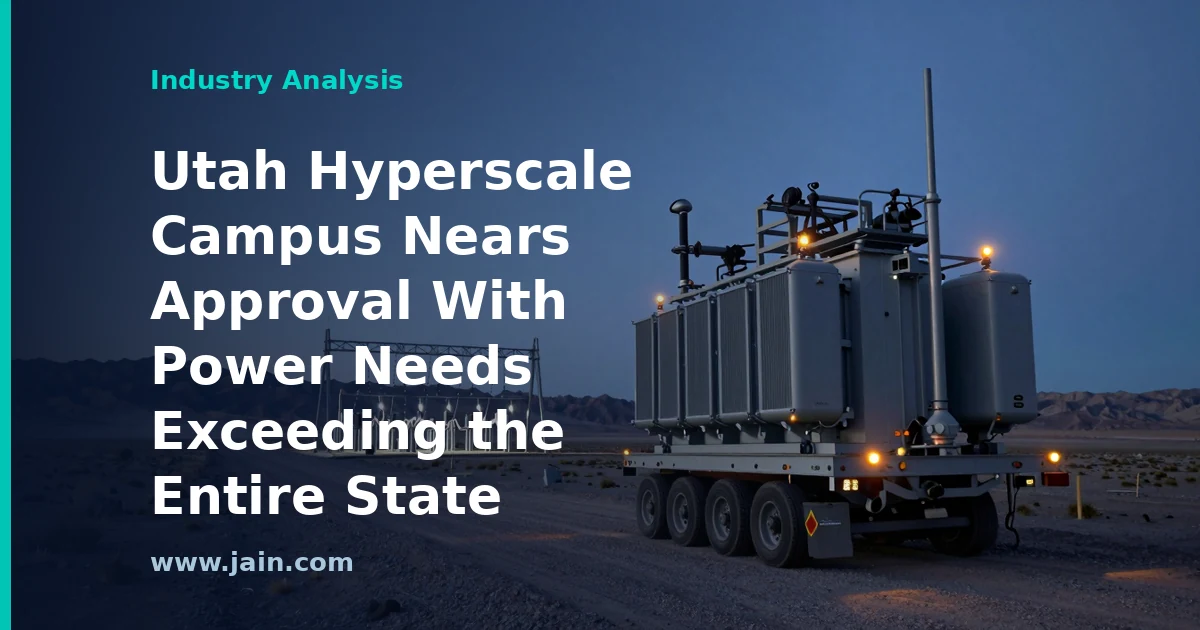
    A proposed hyperscale data center project in Utah is nearing final approval, according to an April 24, 2026 report by The Salt Lake Tribune. The defining fact of the project is its scale: it is expected to both generate and consume more power than the entire state of Utah — a single campus whose energy footprint would exceed that of the roughly 3.5 million residents, industries, and cities around it.

    Executive Summary

    The announcement matters less for its location than for what it says about the trajectory of AI infrastructure. “Hyperscale” once described data centers in the tens of megawatts; this project is described as exceeding an entire state’s power production and consumption, which places it in a different category altogether — closer to a purpose-built energy district than a traditional data center.

    Equally telling is the phrase “generate and consume.” The project is not simply a large load waiting for a utility hookup; it is expected to produce its own power at state-exceeding scale. That reflects a broader industry shift: when grid interconnection queues stretch for years, the largest AI developers increasingly bring their own generation rather than wait for the grid to catch up.

    With final approval reportedly near, the project is a live test of how states weigh the economic development promise of AI campuses against questions about energy, water, land, and who ultimately bears the costs.

    When One Campus Outweighs a State Grid

    The comparison in the headline is the story. A state’s power system is the aggregate of every home, factory, farm, and city within its borders, built out over a century. A single campus expected to exceed that total implies a facility measured in gigawatts — thousands of megawatts — rather than the tens or low hundreds of megawatts that defined “hyperscale” even five years ago. For readers outside the industry: one gigawatt is roughly the output of a large nuclear reactor, and AI training clusters are now being planned in multiples of that unit.

    This is the practical consequence of the AI compute race. Training and serving frontier AI models consumes electricity at industrial scale, and the constraint on building more capacity has shifted from chips and buildings to power. Projects are now sited where energy can be produced or delivered, and their announcements are increasingly described in energy terms first and computing terms second — exactly as this one is.

    Generate and Consume: The Rise of Self-Powered Campuses

    The report’s framing — that the project would generate as well as consume state-exceeding power — points to on-site or dedicated generation. This has become the defining pattern of the largest AI campuses. Utility interconnection queues in much of the U.S. run three to seven years, and no traditional utility planning cycle anticipated single customers requesting gigawatts. Developers who cannot wait are building “behind-the-meter” generation: power plants constructed alongside or within the campus, serving it directly.

    Self-generation changes the risk calculus for everyone involved. For the developer, it trades grid dependence for fuel, permitting, and construction risk. For the incumbent utility and its ratepayers, it can be a relief — the load largely pays its own way — or a complication, depending on how the campus interacts with the shared grid for backup, water, and transmission. Which of these applies here is not specified in the source, and it is the single most important detail for assessing the project’s local impact.

    Why Utah

    Utah has quietly been a data center state for over a decade: it hosts major existing facilities including Meta’s Eagle Mountain campus and the federal government’s Bluffdale data center, and the Intermountain Power installation near Delta has long exported Utah-generated electricity at scale. The state offers comparatively inexpensive land, a dry climate favorable to certain cooling designs, and a regulatory environment that has historically courted large industrial projects.

    But a project of this magnitude tests that hospitality in new ways. Water for cooling in an arid state, air-quality implications of any fossil-fueled generation, transmission siting, and the sheer land footprint all become state-level policy questions rather than county zoning matters. The fact that the project is “nearing final approval” indicates it has so far navigated that process — though the source does not detail what conditions, if any, approval carries.

    The Economics Nobody Has Priced Yet

    Multi-gigawatt campuses imply capital costs in the tens of billions of dollars when computing hardware is included, recovered only if demand for AI compute stays on its current trajectory for years. That is a genuine open question for the industry: these are among the largest private infrastructure bets in American history, and their payback depends on AI adoption curves that remain projections, not guarantees.

    For host states, the bargain is also unsettled. Data centers bring construction jobs, property tax base, and prestige, but comparatively few permanent jobs per dollar invested, and their energy and water demands are permanent. States like Utah that approve state-scale campuses early will generate the case studies — favorable or cautionary — that the rest of the country uses to negotiate.

    Background

    Utah has been part of the U.S. data center map for over a decade, hosting Meta’s Eagle Mountain campus, the federal government’s Bluffdale facility, and the Intermountain Power installation near Delta, which has long generated Utah power at export scale. But the AI era has redefined what a large project looks like: campuses once measured in tens of megawatts are now proposed in gigawatts, with developers increasingly building dedicated generation rather than waiting years in utility interconnection queues. A project expected to exceed an entire state’s power production and consumption represents the outer edge of that trend as of early 2026.

    Source: ‘Hyperscale’ data center project in Utah — expected to generate and consume more power than entire state — nears final approval — The Salt Lake Tribune, April 24, 2026, via Google News.

  • US Advisory Warns of Active Cyber Threats to Programmable Logic Controllers

    US Advisory Warns of Active Cyber Threats to Programmable Logic Controllers

    An advisory circulated in the United States on April 24, 2026 — and relayed to the healthcare sector by the American Hospital Association — warns of active cyber threats targeting programmable logic controllers (PLCs), the ruggedized industrial computers that automate physical processes in power systems, water treatment, manufacturing, and building plants.

    “Active” is the operative word: the alert concerns ongoing threat activity against operational technology (OT), not a theoretical vulnerability disclosure. Details on specific vendors, exploits, and attributed actors were not included in the headline-level report available at publication time.

    Executive Summary

    The advisory puts PLCs — devices most executives have never seen but every facility depends on — back at the center of the critical-infrastructure security conversation. A PLC is a small industrial computer that reads sensors and drives equipment: it opens valves, starts pumps, switches breakers, and modulates chillers. When a PLC is compromised, the consequence is not stolen data but altered physical behavior in a plant.

    The fact that the American Hospital Association amplified the warning underscores how broad the exposed population is. Hospitals, water utilities, factories, and data centers all run on the same classes of controllers, often installed years ago, sometimes reachable from the internet, and frequently protected by default or weak credentials. For infrastructure operators, the practical significance is less about any single exploit and more about the recurring pattern: US agencies keep finding real adversaries probing the industrial control layer.

    Because the underlying advisory text was not available in the source report, this article treats the specifics as open questions and focuses on the well-established context: what PLCs do, why they are attacked, and what asset owners can verify today.

    Why PLCs Are the Soft Underbelly of Critical Infrastructure

    PLCs were engineered for reliability in harsh environments, not for hostile networks. Many speak industrial protocols such as Modbus that were designed decades ago with no authentication — any device that can reach the controller on the network can often issue it commands. Patch cycles are slow because taking a controller offline can mean halting a production line or a treatment process, so known vulnerabilities persist in the field far longer than in the IT world.

    Compounding this, a meaningful number of controllers end up directly exposed to the internet — connected for remote maintenance convenience and then forgotten. Public search engines for connected devices make finding them trivial. That combination of weak-by-design protocols, slow patching, and accidental exposure is why advisories about PLC threats recur: the attack surface changes slowly even as attacker interest grows.

    The Data Center Angle: Power and Cooling Run on OT

    Data center operators sometimes assume OT warnings are a problem for utilities and factories. They are not. Behind every raised floor sits an industrial control layer — building management systems, chiller plants, cooling towers, computer-room air handlers, switchgear, generator controllers, and fuel systems — much of it orchestrated by PLCs and similar controllers. An attacker who manipulates cooling setpoints or power transfer logic can take down IT workloads without ever touching a server.

    The economics cut both ways. Defending OT is genuinely hard: segmentation projects are disruptive, and controller replacement is capital-intensive. But the cost of an OT-driven outage — thermal shutdown, breached availability SLAs, damaged equipment — dwarfs the cost of the basics: knowing what controllers you have, removing them from direct internet reachability, and changing default credentials. Advisories like this one tend to shift that calculus inside customer security questionnaires, so providers with mature OT programs gain a quiet competitive edge.

    From Stuxnet to Water Utilities: A Track Record, Not a Hypothetical

    PLC attacks have a documented history. Stuxnet demonstrated in 2010 that manipulating controllers can physically destroy equipment. More recently, in late 2023, US agencies warned that attackers had compromised internet-exposed Unitronics PLCs at multiple US water utilities — opportunistic intrusions that exploited exposure and default passwords rather than exotic zero-days. That precedent matters when reading a 2026 alert about “active” threats: history suggests the most common path to a PLC is not sophisticated exploitation but an exposed device with a guessable credential.

    The healthcare distribution channel is telling in its own right. Hospitals depend on building automation for air handling, medical gas, and backup power — the same controller ecosystem as everyone else. Sector-agnostic device threats increasingly get sector-specific amplification, which is a reasonable model: the device population is shared, but the operational consequences and remediation resources differ by industry.

    Background

    Programmable logic controllers date to the late 1960s, when they replaced racks of electromechanical relays in factories, and they remain the workhorse of industrial automation worldwide. Because they were designed for closed plant networks, many industrial protocols carry no authentication or encryption — a legacy that became a liability as plants, buildings, and utilities connected to corporate networks and the internet.

    US government warnings about controller-level threats have grown steadily more frequent, spanning water systems, energy, manufacturing, and building automation, with the 2023 wave of attacks on internet-exposed water-utility PLCs a notable recent precedent. For infrastructure operators — including data centers, whose power and cooling plants sit atop this same control layer — the April 2026 advisory is best read as another data point in a sustained trend: the industrial control plane is now a contested space, and basic OT hygiene is the price of admission.

    Source: Advisory warns of active cyber threats to programmable logic controllers — American Hospital Association report on a US advisory concerning active threats to industrial PLCs, published April 24, 2026.

  • Google Breaks Ground in Kronstorf: Austria Joins the Map

    Google Breaks Ground in Kronstorf: Austria Joins the Map

    Google has begun construction on a data center in Kronstorf, a municipality in the Linz-Land district of Upper Austria, according to a groundbreaking announcement posted to the Google Cloud Press Corner and distributed on 23 April 2026. The item marks the start of physical work on the site.

    The release as circulated is a headline announcement. It does not, in the version distributed through news syndication, state the campus size, planned power capacity, capital commitment, construction timeline, staffing, or whether the facility will underpin a new Google Cloud region for Austria.

    Executive Summary

    Groundbreaking is the point at which a data center stops being a land holding and becomes a construction project. For a hyperscaler — an operator running compute at global scale, such as Google, Amazon Web Services, Microsoft or Meta — it normally implies that land control, planning permission and, critically, a grid connection agreement are already settled. Those are the hard parts. Steel and concrete are comparatively easy.

    The significance of Kronstorf is geographic more than technical. Europe’s data center industry has historically concentrated in five markets known as FLAP-D: Frankfurt, London, Amsterdam, Paris and Dublin. Those markets are now constrained less by demand than by electricity — grid connection queues, local moratoria and planning resistance have pushed new capacity outward into secondary markets with available power. Upper Austria, sitting on a hydro-heavy generation mix and on fiber routes between Munich, Vienna and northern Italy, fits that pattern.

    What the announcement does not do is tell buyers anything actionable. Google has not, as far as the distributed release states, committed to a launch date or to an Austrian cloud region. Enterprises with Austrian data residency requirements should treat this as an encouraging signal about Google’s intentions, not as a procurement input.

    Why Austria, and Why Now

    The proximate driver of hyperscale expansion into new European markets is power availability, not proximity to customers. Latency between Kronstorf and Frankfurt is a rounding error for most workloads; the difference that matters is whether a transmission operator can deliver tens of megawatts on a schedule the builder can plan around. In several established hubs it cannot. Dublin’s grid operator has restricted new data center connections in the Greater Dublin area for years, and Amsterdam imposed a construction pause that reshaped Dutch development. Frankfurt and London face their own queue and land pressures.

    Austria offers a different profile. Its electricity generation is unusually hydro-weighted by European standards, which is attractive both for carbon accounting and for price stability relative to gas-linked markets. Upper Austria is an industrial region with existing heavy-load infrastructure — the kind of grid that was built for manufacturing and can, in principle, be repurposed for compute. Kronstorf sits between Linz and Steyr, close to that industrial corridor.

    None of this is stated in the release. It is the standard site-selection logic of the sector, and it is the most plausible reading of the decision. Readers should hold it as inference, not as a company claim.

    What a Groundbreaking Actually Signals

    Announcements of this kind are frequently over-read in both directions. A groundbreaking is a stronger signal than a land purchase or a memorandum of understanding: capital has been committed, contractors are mobilised, and the permitting and interconnection work that typically consumes years has largely concluded. Hyperscalers do not break ground on sites they intend to abandon, and the sunk cost from this point forward rises steeply.

    It is a weaker signal than a service commitment. Large data center builds commonly run two to four years from groundbreaking to first customer traffic, and campuses are usually delivered in phases, with later buildings contingent on demand and on the operator’s capital plan at the time. A groundbreaking therefore says a facility is being built; it does not say when it will serve traffic, at what capacity, or which Google products will run on it.

    The distinction matters most for the question of a Google Cloud region in Austria. A physical data center and a published cloud region are related but separate things — regions require multiple availability zones, a defined service catalogue and a launch commitment. The release, as distributed, does not make that commitment, and the absence should not be filled in by assumption.

    Winners, Losers, and the Local Ledger

    The clearest beneficiaries are Austrian enterprises and public-sector bodies with data residency obligations, who gain a credible prospect of in-country hyperscale capacity, and the regional construction and electrical trades, who capture the build phase — the largest and shortest-lived share of employment any data center generates. Local landowners and the municipal tax base typically benefit as well.

    The competitive read is that Google is buying optionality in the DACH region rather than responding to a single anchor customer. Microsoft and AWS both hold established positions in German-language markets, and Vienna already hosts commercial colocation from international operators. Entering Austria with owned capacity changes Google’s cost structure and its sovereignty story simultaneously — owned facilities are cheaper at scale than leased ones and easier to make claims about.

    The costs land locally and are worth stating plainly rather than defensively. Large sites consume grid capacity, land and, depending on the cooling design, water; operational employment is modest relative to capital deployed. Communities that raise these points are asking legitimate questions, and the honest answer is that this release provides no basis to evaluate them in either direction. When Google publishes capacity, cooling method and water sourcing, those figures should be tested — and so should any counter-claims made about them.

    Reading a Thin Announcement Fairly

    It would be unfair to characterise this release as evasive. Groundbreaking announcements are ceremonial by convention across the industry, and operators routinely withhold capacity figures for competitive and security reasons. Google’s more detailed European disclosures have historically followed at launch rather than at first excavation.

    It would be equally unfair to present the announcement as more than it is. What is substantiated: construction has started at Kronstorf, and Google is the party announcing it. What is not substantiated by the release text: megawatts, euros, jobs, dates, cooling design, power procurement, and any regional service commitment. Coverage that supplies those numbers should be checked against a primary source.

    For infrastructure buyers, the practical posture is patience. Treat Kronstorf as evidence of Google’s medium-term intent in Central Europe, factor it into three-to-five-year architecture planning, and revisit when the operator publishes a launch date or a region announcement.

    Background

    Google operates a global network of owned data centers supporting Search, YouTube, Workspace and Google Cloud, with a substantial European footprint including sites in Ireland, the Netherlands, Belgium, Finland and Denmark. Its cloud business competes with Amazon Web Services and Microsoft Azure, where physical proximity and in-country capacity increasingly matter for regulated customers subject to data residency rules.

    Austria has hosted commercial colocation and enterprise data centers for years, largely concentrated around Vienna, but has not been a primary hyperscale construction market. The wider shift of European capacity toward secondary markets has been driven principally by electricity: as grid connections in Dublin, Amsterdam and Frankfurt became constrained, operators moved toward regions with spare transmission capacity and favourable generation mixes. Upper Austria, with its hydro-heavy power supply and existing industrial grid, sits squarely in that category.

    Source: Google Breaks Ground on Data Center in Kronstorf, Austria – Google Cloud Press Corner — Google’s groundbreaking announcement for a data center site in Upper Austria, published 23 April 2026.

  • AI Turns Cooling Into the Defining Constraint of Data Center Design

    AI Turns Cooling Into the Defining Constraint of Data Center Design

    Data Center Knowledge reported on April 23, 2026 that cooling has moved to the forefront of data center design challenges, driven by the power density of AI computing. The trade publication’s framing captures a shift the industry has been living through: thermal management, once a back-of-house engineering detail, now shapes where facilities are built, how they are architected, and how quickly they can serve AI demand.

    Executive Summary

    The report’s core argument is structural rather than incremental: artificial intelligence has changed the physics of the data hall. Traditional enterprise servers could be cooled with chilled air pushed through raised floors and contained aisles. AI training and inference clusters concentrate far more electrical power — and therefore far more heat — into each rack than air can economically remove, forcing designers to treat heat rejection as a first-order constraint alongside power availability and land.

    Why it matters: when cooling becomes the binding constraint, it stops being a line item and starts being a strategy. Choices between air, direct-to-chip liquid cooling (circulating coolant through cold plates mounted on processors), rear-door heat exchangers, and immersion systems now determine a facility’s compatibility with next-generation chips, its water and energy footprint, and its retrofit economics. Operators, colocation providers, and their customers are all repricing those decisions in real time.

    When Air Runs Out of Headroom

    Air cooling served the industry for decades because server heat loads were modest and evenly distributed. AI accelerators break that model: they pack extraordinary computation — and heat — into small silicon footprints, and operators deploy them in dense clusters to keep chip-to-chip communication fast. Past a certain density, moving enough air through a rack becomes physically impractical and economically punishing, because fan energy and airflow engineering costs rise steeply while cooling effectiveness plateaus.

    Liquid is the natural successor because water and engineered coolants carry heat far more efficiently than air. But switching thermal mediums is not a component swap. It changes piping, floor loading, leak detection, maintenance procedures, and the skills a facilities team needs. That is why the trade press now describes cooling as a design challenge rather than an operations task: the decision has to be made before concrete is poured, and it constrains everything after.

    The Retrofit Divide: Winners and Losers

    The shift creates a two-tier market. New builds designed liquid-ready from day one can court the highest-value AI tenants. Older facilities — the majority of the world’s installed base — face a harder calculus: retrofitting liquid cooling into a live building is disruptive and expensive, but declining to retrofit risks ceding AI workloads entirely and competing for a shrinking pool of conventional enterprise demand.

    The beneficiaries are visible across the supply chain: cooling equipment manufacturers, mechanical engineering firms, and colocation providers with modern, high-density-capable inventory. The squeezed parties are operators of legacy stock and, potentially, customers who signed long leases in facilities that cannot follow the density curve. For buyers of data center capacity, a facility’s thermal architecture is becoming as important a diligence question as its power contract.

    Cooling as a Sustainability and Siting Question

    Cooling choices also carry environmental and community consequences. Evaporative systems trade energy efficiency for water consumption — a sensitive issue in drought-prone regions where many data center clusters sit. Closed-loop liquid systems can reduce water draw and, in some designs, make waste heat recoverable for district heating or industrial reuse. As municipalities scrutinize data center growth, thermal design is increasingly part of the permitting and public-acceptance conversation, not just the engineering one.

    That elevates cooling from a cost center to a siting variable. A design that minimizes water use or enables heat reuse can be the difference between a fast permit and a contested one — a dynamic worth watching as AI capacity expansion collides with local resource politics.

    Background

    For most of the industry’s history, data center design was governed by power and space, with cooling treated as a solved problem: chilled air, raised floors, and hot-aisle containment handled the modest, evenly distributed heat of enterprise servers. The AI buildout that accelerated after 2022 broke that assumption. Training and serving large models requires dense clusters of power-hungry accelerator chips, and each hardware generation has pushed per-rack heat loads further beyond what air-based systems were designed to handle.

    The result has been a rapid industry pivot toward liquid-based thermal architectures — direct-to-chip cold plates, rear-door heat exchangers, and immersion systems — and a re-sorting of the market between facilities that can host high-density AI workloads and those that cannot. Trade coverage like this Data Center Knowledge report reflects a consensus that has hardened across operators, chipmakers, and engineers: cooling is no longer downstream of design; it is design.

    Source: AI Pushes Cooling to the Forefront of Data Center Design Challenges — Data Center Knowledge’s April 23, 2026 report on how AI rack densities are making thermal management a primary data center design constraint.

  • Wisconsin Regulators Say Data Centers Must Pay the Full Cost of Their Power

    Wisconsin Regulators Say Data Centers Must Pay the Full Cost of Their Power

    Wisconsin utility regulators have taken the position that data centers must cover the full cost of the energy infrastructure their facilities require, according to an April 23, 2026 report from Wisconsin Watch. The stance addresses the central fight of the data center boom: whether households and small businesses end up subsidizing the power plants, substations, and transmission lines built to serve a handful of very large computing campuses.

    The report’s headline frames the position as a directive — data centers, not the general body of ratepayers, bear the cost of their own demand. The underlying details of the proceeding, and how “full cost” will be defined and enforced, are not spelled out in the source material available to us.

    Executive Summary

    As reported by Wisconsin Watch on April 23, 2026, Wisconsin regulators have signaled that data centers seeking grid connections in the state must bear the full cost of their energy needs. In utility ratemaking terms, this is a cost-allocation principle: when a single customer’s demand forces the construction of new generation or grid capacity, that customer — rather than the shared pool of ratepayers — should pay for it.

    It matters because Wisconsin has become one of the Midwest’s most active data center markets, anchored by Microsoft’s multi-billion-dollar campus in Mount Pleasant and a pipeline of other announced projects. Each hyperscale campus can demand hundreds of megawatts — on the scale of a small city — and someone must pay for the infrastructure that serves it.

    The bigger significance is precedential. Regulators in many states are wrestling with the same question, and several utilities have proposed special tariffs for very large customers. A clear “you demand it, you pay for it” stance from a state actively courting data center investment offers a template others can copy — and a test of whether such terms slow investment or simply formalize what serious developers already expect to pay.

    The Cost-Allocation Fight Behind Every Data Center Boom

    Regulated utilities recover the cost of new infrastructure through rates approved by state commissions, and those costs are typically spread across all customer classes. That model works when growth is broad and gradual. It strains when one customer class — hyperscale data centers — arrives suddenly and demands capacity additions measured in gigawatts. If a utility builds a power plant or transmission line primarily for one campus and the project later shrinks or cancels, the leftover cost, known as a stranded asset, can land on everyone else’s bills.

    That risk is why “who pays” has become the defining regulatory question of the AI infrastructure cycle. Consumer advocates warn of cross-subsidization — ordinary ratepayers underwriting corporate compute. Utilities and developers counter that large loads can spread fixed grid costs over more sales and put downward pressure on rates if structured well. The Wisconsin position, as reported, comes down firmly on the side of insulating the general ratepayer.

    Why Wisconsin Is a Bellwether

    Wisconsin is not a legacy data center hub like Northern Virginia, which makes its posture instructive: it is a state actively attracting new hyperscale investment while setting terms at the front end rather than repairing cost shifts after the fact. Microsoft’s Mount Pleasant development, announced in 2024, put the state on the hyperscale map, and Wisconsin utilities have since proposed rate structures aimed at very large customers — typically featuring long-term contract commitments and minimum payments so that infrastructure built for a data center is paid for by that data center even if its plans change.

    A regulatory endorsement of full cost responsibility strengthens the utilities’ hand in structuring those deals and gives economic developers a cleaner pitch: growth without a ratepayer backlash. States competing for the same projects will watch whether Wisconsin’s pipeline holds up under these terms.

    What “Full Cost” Could Mean in Practice

    The phrase sounds simple; the implementation is not. Full cost responsibility can be enforced through several mechanisms: dedicated rate classes for very large loads, up-front contributions toward interconnection and grid upgrades, minimum demand charges that guarantee revenue regardless of actual usage, contract terms of a decade or more, and exit fees or collateral that protect against a project walking away mid-build. Each mechanism allocates a different slice of risk between the developer, the utility, and its shareholders.

    The definitional boundaries matter enormously. Does “full cost” cover only the local wires and substations, or a share of new generation? Does it apply to grandfathered projects or only new applicants? A principle announced by regulators becomes real only when it is written into approved tariffs and signed contracts, and the reported material does not yet show that level of detail.

    Winners, Losers, and the National Template

    Residential and small-business ratepayers are the clearest intended beneficiaries — the policy exists to keep their bills from absorbing data center-driven costs. Well-capitalized hyperscalers can generally live with full-cost terms; they already sign long-term commitments in other markets, and predictable rules can be preferable to political uncertainty. The squeeze falls on thinner-capitalized or speculative projects, which lose the ability to socialize their risk. Utilities get growth with less rate-case blowback, though they take on more counterparty risk concentrated in a few very large contracts.

    If Wisconsin’s stance holds and investment continues anyway, the template argument writes itself: states can welcome AI infrastructure without asking captive ratepayers to underwrite it. If projects visibly divert to states with softer terms, expect a counter-narrative that strict cost allocation costs jobs and tax base. Either outcome will be cited in commission dockets across the country.

    Background

    Wisconsin’s arrival as a data center state dates largely to 2024, when Microsoft announced a multi-billion-dollar campus in Mount Pleasant, southeast Wisconsin — on land once slated for the Foxconn manufacturing project — followed by further large-load proposals elsewhere in the state. That growth pushed Wisconsin utilities to propose rate structures for very large customers designed to ensure new infrastructure is paid for by the customers who require it.

    Nationally, the surge in AI-driven electricity demand has made cost allocation the central issue in utility regulation. State commissions, consumer advocates, utilities, and hyperscale developers are negotiating who bears the cost — and the risk — of the biggest grid build-out in decades, and headline positions like Wisconsin’s are being watched as potential templates.

    Source: Wisconsin regulators: Data centers must cover full cost of their energy needs — Wisconsin Watch report, April 23, 2026, on Wisconsin regulators’ position that data centers must bear the full cost of the energy infrastructure they require.

  • Cyber Agencies Warn of China-Linked Covert Relay Networks Targeting Infrastructure

    Cyber Agencies Warn of China-Linked Covert Relay Networks Targeting Infrastructure

    According to an Industrial Cyber report dated April 23, 2026, cybersecurity agencies have flagged the use of covert networks by China-linked threat actors to support espionage and offensive cyber operations. The warning centers on relay infrastructure — chains of compromised or rented devices that hide where an attack actually comes from — a technique that has become a signature of state-linked campaigns against critical infrastructure.

    Executive Summary

    The reported advisory adds official weight to a trend that incident responders have been tracking for several years: state-linked operators no longer attack from infrastructure that can be neatly attributed and blocked. Instead, they route operations through covert relay networks — sometimes called operational relay box (ORB) networks — built from compromised small-office routers, Internet-of-Things devices, and leased virtual private servers scattered across many countries and providers.

    Why it matters: when malicious traffic arrives from an ordinary residential router in the defender’s own region, IP-reputation lists and geographic blocking lose much of their value. For operators of data centers, networks, and industrial systems, the warning is effectively a message that detection must shift from “where is this traffic from?” to “what is this traffic doing?” — a harder and more expensive posture to run.

    What a Covert Relay Network Actually Is

    A covert relay network is a mesh of intermediary devices — hacked home and small-business routers, unpatched edge appliances, IoT hardware, and short-lived rented servers — that an operator chains together so that each intrusion appears to originate from an innocuous, frequently rotating address. The technique is not new; anonymization proxies are decades old. What has changed is industrialization: reporting on China-linked activity in recent years describes purpose-built relay infrastructure operated at scale and shared across multiple intrusion sets, which makes attribution slower and takedowns less durable.

    For lay readers, the analogy is a getaway car swapped every few blocks. Blocking the last car seen tells you little about the driver, and there is always another car. That is precisely why agencies escalate from private industry reporting to public advisories: the countermeasure is not a blocklist but a change in defensive doctrine.

    Why Critical Infrastructure Is the Stated Concern

    The pairing of “espionage” and “offensive operations” in the reported warning is significant. Prior joint advisories from U.S. and allied agencies — most prominently the 2024 warnings about the actor tracked as Volt Typhoon — alleged that China state-sponsored operators were pre-positioning inside energy, water, communications, and transportation networks, using living-off-the-land techniques that generate little malware for defenders to find. Covert relay networks are the delivery layer for that style of campaign: quiet access, maintained over long periods, held potentially for disruption rather than immediate theft.

    Beijing has consistently denied state involvement in such campaigns, and attribution in cyberspace is probabilistic rather than courtroom-certain. A fair reading is that the agencies are describing a technique and an assessed linkage; the underlying evidence typically remains classified, which is a genuine limitation for anyone trying to independently verify the claims.

    The Uncomfortable Position of Network and Hosting Providers

    Relay networks are built from other people’s equipment. That places router vendors, hosting companies, and connectivity providers in the middle of the story whether they like it or not. End-of-life routers that no longer receive patches are prime recruitment targets, and legitimately leased virtual servers give relay operators clean, paid-for footholds. Expect continued pressure on vendors to ship secure-by-design defaults and enforce end-of-life transparency, and on providers to strengthen abuse detection and know-your-customer practices for infrastructure rentals.

    For colocation and cloud operators, there is a dual exposure: their customers are targets of these campaigns, and their platforms can be abused as relay nodes. Egress monitoring, rapid abuse response, and hardening of management planes are becoming table stakes rather than differentiators.

    What Defenders Can Realistically Do

    The honest implication of this warning is that source-based filtering is a weakening control. Defenses that still work include behavioral analytics that flag unusual logins and lateral movement regardless of origin, aggressive patching and replacement of end-of-life edge devices, network segmentation between IT and operational technology, and logging retention long enough to support the slow forensic work that relay obfuscation forces. None of this is novel advice — which is itself the point. Agencies issue advisories like this when known best practices remain widely unimplemented, particularly among smaller utilities and industrial operators with thin security budgets.

    Background

    Warnings about China-linked targeting of critical infrastructure have escalated steadily through the mid-2020s. In 2024, U.S. agencies and international partners publicly alleged that the state-sponsored actor tracked as Volt Typhoon had maintained long-term access inside U.S. energy, water, communications, and transportation networks using living-off-the-land techniques, and researchers began documenting large operational relay box (ORB) networks — obfuscation meshes built from compromised routers and rented servers — supporting Chinese cyber operations. Beijing has denied state involvement throughout.

    The reported April 2026 advisory sits in that lineage: rather than announcing a new intrusion, it elevates the enabling infrastructure — covert relay networks — to a named, official concern, signaling that agencies view origin-obfuscation itself as a strategic problem for defenders of critical systems.

    Source: Cybersecurity agencies flag use of covert networks by China-linked actors for espionage, offensive operations — Industrial Cyber’s April 23, 2026 report on an agency warning about relay-network obfuscation in state-linked cyber operations.

  • Bitcoin Miners’ AI Pivot: When Capex Outruns Revenue 15-to-1

    Bitcoin Miners’ AI Pivot: When Capex Outruns Revenue 15-to-1

    Bitcoin mining companies are collectively investing billions of dollars to convert and expand their facilities for artificial-intelligence and high-performance computing (HPC) workloads, according to an April 2026 report carried by TradingView. The striking figure in the headline: the sector’s AI-related capital expenditure is outpacing the revenue those AI operations currently generate by roughly 15-to-1.

    The report frames the pivot as an industry-wide phenomenon spanning the class of publicly traded miners that includes names such as TeraWulf (WULF) and Riot Platforms (RIOT), which have been repositioning energized data-center sites originally built for cryptocurrency mining toward GPU-based compute.

    Executive Summary

    The announcement is less a single company’s news than a sector-level snapshot: bitcoin miners, squeezed by the economics of their core business, are betting their balance sheets on becoming AI infrastructure providers. Capital expenditure — the money spent building data halls, buying cooling and electrical equipment, and preparing sites for GPU tenants — is running at roughly fifteen times the revenue the AI segments are bringing in today.

    That ratio matters because it quantifies the leap of faith underway. Data-center construction is a spend-first, earn-later business, so a wide gap between investment and current revenue is normal early in a buildout. But a 15-to-1 gap sustained across an entire sector of companies that historically financed themselves through volatile bitcoin proceeds raises a sharper question: can these firms carry the spending long enough for contracted AI revenue to arrive?

    For the broader digital-infrastructure market, the answer will shape who supplies the next wave of AI capacity — and who ends up selling distressed sites to better-capitalized players.

    Why Miners Are Racing Into AI

    The pivot is rooted in assets, not sentiment. Bitcoin miners own something the AI boom desperately needs: large, already-energized sites with grid interconnections, substations, and industrial-scale power contracts in place. Securing new utility power for a data center can take years; miners already have it. Converting a mining site to HPC use lets them monetize that scarce head start.

    At the same time, the core mining business has become structurally harder. Bitcoin’s periodic “halving” events cut the block rewards miners earn for the same work, and competition keeps pushing up the computing power required to win those rewards. AI hosting offers what mining never could: multi-year contracts with creditworthy tenants and revenue that does not swing with a cryptocurrency price. The strategic logic is sound. The question the 15-to-1 figure raises is whether the execution is affordable.

    Reading the 15-to-1 Gap

    A capex-to-revenue ratio of 15-to-1 is not automatically alarming — it is partly a timing artifact. AI data centers follow a J-curve: enormous upfront spending on construction, electrical gear, and cooling, followed by revenue that only begins once tenants move in and ramps over the life of a lease. Early in a buildout, the ratio is always lopsided. Traditional data-center developers run the same math, but usually with pre-leased capacity and cheap, secured financing behind it.

    What makes the miners’ version riskier is who is doing the spending. These are companies whose historical cash flows came from an asset with extreme price volatility, whose cost of capital is higher than that of investment-grade data-center REITs (real estate investment trusts), and several of which are converting sites on the promise of future tenancy rather than fully contracted demand. A 15-to-1 gap backed by signed long-term leases is a construction schedule; the same gap backed by expected demand is a wager. The report, as summarized, does not break down how much of the sector’s spend falls in each category — and that distinction is the whole ballgame.

    The Financing Strain Behind the Buildout

    Billions in capex must be funded from somewhere, and miners have essentially four levers: cash from mining operations, selling bitcoin holdings, issuing new shares, or taking on debt — including convertible notes, which are loans that can turn into stock. Each carries a cost. Equity issuance dilutes existing shareholders; debt adds fixed obligations to businesses with historically variable income; selling bitcoin reduces the treasury cushion that has often reassured investors during downturns.

    The sector precedent that makes this real rather than theoretical: miners have gone through bankruptcy restructurings before when leverage met a downturn, and the survivors’ pivot to AI hosting was in part a search for steadier ground. If AI revenue ramps on schedule, today’s spending converts into long-lived contracted cash flows and the ratio compresses rapidly. If tenant demand arrives slower than construction bills, the same companies face refinancing at whatever terms the market offers a capital-hungry, pre-revenue AI landlord. That asymmetry — not the pivot itself — is the strain worth watching.

    Winners, Losers, and the Capacity Question

    If the buildout succeeds, the clearest winners are AI tenants — hyperscalers and GPU-cloud operators — who gain powered capacity years faster than greenfield development could deliver it, plus the equipment vendors and contractors paid regardless of outcome. Miners that convert successfully effectively transform into data-center companies and may earn the valuation multiples that go with steadier revenue.

    The losers in a stumble scenario are concentrated: shareholders absorbing dilution, and lenders to projects that miss their lease-up targets. But even failure has a second-order winner — established data-center operators and infrastructure funds, who would be natural buyers of energized sites at a discount. In that sense, the capacity being built is likely to serve the AI market either way; what the 15-to-1 gap really determines is who owns it when it does.

    Background

    Bitcoin miners are industrial-scale data-center operators that historically earned revenue by running specialized computers to secure the bitcoin network in exchange for newly issued coins. The business is capital-intensive and hostage to bitcoin’s price and to protocol-driven halvings that periodically cut rewards. After a bruising downturn cycle that pushed several operators into restructuring, the AI boom presented the sector with an unexpected second act: the power capacity and energized sites miners had assembled became strategically valuable to AI companies facing multi-year waits for new grid connections.

    Beginning in the mid-2020s, a wave of publicly traded miners — including TeraWulf and Riot Platforms among the larger names — announced conversions of mining capacity to GPU-based high-performance computing, in some cases anchored by long-term hosting agreements with AI cloud providers. The April 2026 report examined here is a snapshot of how far that spending has run ahead of the revenue it is meant to create.

    Source: Bitcoin miners pour billions into AI as capex outpaces revenue 15-to-1 — TradingView-carried report, April 23, 2026, on the sector-wide gap between bitcoin miners’ AI infrastructure spending and their current AI revenue.

  • CISA Flags Three More Cisco Flaws as Actively Exploited

    CISA Flags Three More Cisco Flaws as Actively Exploited

    The U.S. Cybersecurity and Infrastructure Security Agency (CISA) has confirmed that three additional Cisco networking device vulnerabilities are being actively exploited, according to reporting published on 22 April 2026 by Cybersecurity Dive. The confirmation is the mechanism CISA uses to move a flaw from “theoretically dangerous” to “known to be used by attackers in the wild.”

    The practical effect is immediate for two groups: U.S. federal civilian agencies, which are bound by directive to remediate catalogued vulnerabilities by a set deadline, and the far larger population of enterprise, carrier and data center operators who use the catalog as a de facto triage list. The available source material is a headline-level summary; it does not itself specify which Cisco products, software versions or vulnerability identifiers are involved.

    Executive Summary

    CISA’s confirmation adds three more Cisco networking flaws to the pool of vulnerabilities with observed real-world exploitation. That designation matters because it changes the calculus for defenders. A vulnerability with a high severity score but no evidence of use can often wait for the next maintenance window. A vulnerability that attackers are already using cannot, because every hour of delay is measured against an adversary who has working code today.

    The reason this lands on an infrastructure publication rather than only a security one is placement. Cisco equipment frequently sits at the network edge — the routers, firewalls, VPN concentrators and switches that form the boundary between an organisation’s internal network and the public internet. That is precisely the gear that data centers, colocation providers, carriers and enterprises depend on for connectivity, and precisely the gear that is hardest to take offline for an unscheduled patch.

    It is also worth stating plainly what this announcement is not. A KEV listing is a statement that exploitation has been observed. It is not, on its own, a statement about how widespread that exploitation is, who is behind it, or whether any particular organisation has been affected. Treating the confirmation as an urgent triage signal is correct; treating it as evidence of a mass compromise event goes beyond what has been established.

    Why the Network Edge Keeps Returning to the Emergency List

    Edge network devices have become one of the most attractive targets in enterprise computing, and the reasons are structural rather than accidental. These appliances are internet-facing by design — a VPN concentrator that cannot be reached from the internet cannot terminate remote-worker sessions. They hold credentials, routing tables and traffic in cleartext at the point of decryption. And they sit upstream of nearly everything else, so an attacker who controls the edge does not need to defeat the controls behind it.

    They are also comparatively dark. Most organisations run endpoint detection software on laptops and servers, generating a continuous stream of telemetry that a security team can query. Purpose-built network appliances typically run closed operating systems that do not accept third-party agents. Defenders see syslog output and interface counters, not process trees. An intruder who establishes persistence in the firmware of a firewall can be very difficult to spot with the tools most organisations already own.

    This is why the pattern recurs. The 2023 mass compromise of Cisco IOS XE web management interfaces and the ArcaneDoor campaign against Cisco security appliances disclosed in 2024 were separate events with separate causes, but both illustrated the same underlying economics: a single working exploit against a widely deployed edge platform yields disproportionate access. Nothing in the current disclosure links these three flaws to those earlier campaigns, and it would be wrong to assume a connection. The category of risk, however, is the same one.

    What “Actively Exploited” Actually Establishes

    It is worth applying the same scrutiny to a government advisory that one would apply to a vendor press release. CISA’s catalog has a specific evidentiary bar: reliable evidence that a vulnerability has been exploited in the wild. That bar is meaningful and it is not trivially met. But it is a threshold test, not a measurement. Confirmation that exploitation occurred is compatible with a single narrowly targeted intrusion by a well-resourced state actor and equally compatible with commodity scanning at internet scale. Those two scenarios call for materially different responses.

    The publicly available material here does not distinguish between them. It does not indicate whether the three vulnerabilities are chained together, whether any require prior authentication, whether exploitation grants full device control or something narrower, or whether patched software is already available for all affected versions. Each of those variables changes the urgency and the remediation path substantially. Readers should be cautious of coverage — from any direction — that fills those blanks with inference.

    The defensible reading is procedural. If an organisation runs the affected platforms, the catalog entry is an instruction to verify version, apply the fix or documented mitigation, and check for signs of prior access. That instruction holds regardless of how the underlying campaign is eventually characterised, which is the practical virtue of the catalog as a triage mechanism.

    The Cost of Patching Infrastructure You Cannot Reboot

    The uncomfortable operational truth is that emergency patching of network infrastructure is expensive in ways that patching a fleet of laptops is not. A core router reload is a service interruption. High-availability pairs reduce but do not eliminate the risk, because failover itself can drop stateful sessions and because both members of a pair usually need the same update. In a colocation or carrier environment, those interruptions are governed by service level agreements with financial consequences, and change windows are often contractually constrained to specific overnight hours.

    The result is a genuine tension between two legitimate obligations: availability commitments to customers and security obligations to those same customers. Organisations with mature change management, tested rollback procedures and accurate asset inventories absorb an out-of-cycle patch cycle in days. Organisations without them discover during the incident that they do not know precisely which software versions are running where — and inventory gaps, not patch availability, are usually the binding constraint on response time.

    There is a second-order cost that is easy to underestimate. If a vulnerability permits persistence that survives patching, remediation is not patching but rebuilding: credential rotation, configuration review, and in some cases firmware reimaging or hardware replacement. Whether that applies here is unknown from the available material, but it is the question that determines whether this is a weekend of work or a quarter of it, and it is the first thing an operator should try to establish from the vendor’s own advisory.

    Market Consequences: Concentration Cuts Both Ways

    Cisco remains one of the largest suppliers of enterprise and service provider networking equipment, and that scale is the reason its vulnerabilities become industry events rather than vendor events. Concentration in critical infrastructure produces correlated risk: when a single platform is deeply embedded across banks, hospitals, carriers and government agencies, one exploit chain has systemic reach. This is a property of market structure, not a criticism of any particular engineering organisation — the same dynamic would apply to whichever vendor held the equivalent position.

    Concentration also has a defensive upside that is often ignored in the immediate coverage. A large installed base funds substantial security engineering, attracts sustained researcher attention, and supports a coordinated disclosure and patching apparatus that smaller vendors cannot match. Vulnerabilities found in widely deployed products are more likely to be found at all, and more likely to be fixed quickly once found. The relevant comparison for a buyer is not “a vendor with disclosed flaws versus a vendor without” but “a vendor whose flaws are found and fixed versus one whose flaws are found quietly by someone else.”

    For buyers and investors, the durable signal is therefore not the existence of these three entries but the response characteristics around them: time from discovery to patch, clarity of advisories, availability of compromise-detection guidance, and whether fixes reach older supported releases rather than only the newest. Those metrics differentiate vendors over multiple years. A single catalog addition, in a market where every major network vendor has appeared in the same catalog, does not.

    Background

    CISA established the Known Exploited Vulnerabilities catalog in November 2021 under Binding Operational Directive 22-01, replacing the previous practice of prioritising patches primarily by severity score. The premise was that severity ratings measure potential impact while exploitation evidence measures actual risk, and that defenders with finite maintenance windows should address the flaws attackers are demonstrably using first. Federal civilian agencies must remediate catalogued entries by assigned deadlines; the catalog has since been adopted far more broadly as a prioritisation standard across private industry.

    Cisco has been one of the dominant suppliers of enterprise and service provider networking equipment for decades, with routers, switches, firewalls and VPN platforms embedded across carriers, data centers, financial institutions and government networks. That installed base makes its products both a persistent target for well-resourced adversaries and a focus of intensive security research. The recurring pattern of internet-facing network appliances becoming intrusion vectors is an industry-wide condition rather than a single-vendor one, driven by the fact that this equipment must be reachable to do its job while running closed operating systems that resist conventional monitoring.

    Source: CISA confirms exploitation of 3 more Cisco networking device vulnerabilities — Cybersecurity Dive, 22 April 2026, reporting CISA’s addition of three further Cisco networking flaws to its Known Exploited Vulnerabilities catalog.