Author: Deepak Jain

  • Everyone Is Watching the $1.07M Fine. The AI Power Risk Is the 45-Day Clock.

    Everyone Is Watching the $1.07M Fine. The AI Power Risk Is the 45-Day Clock.

    TL;DR · 30-second read

    The Short Version

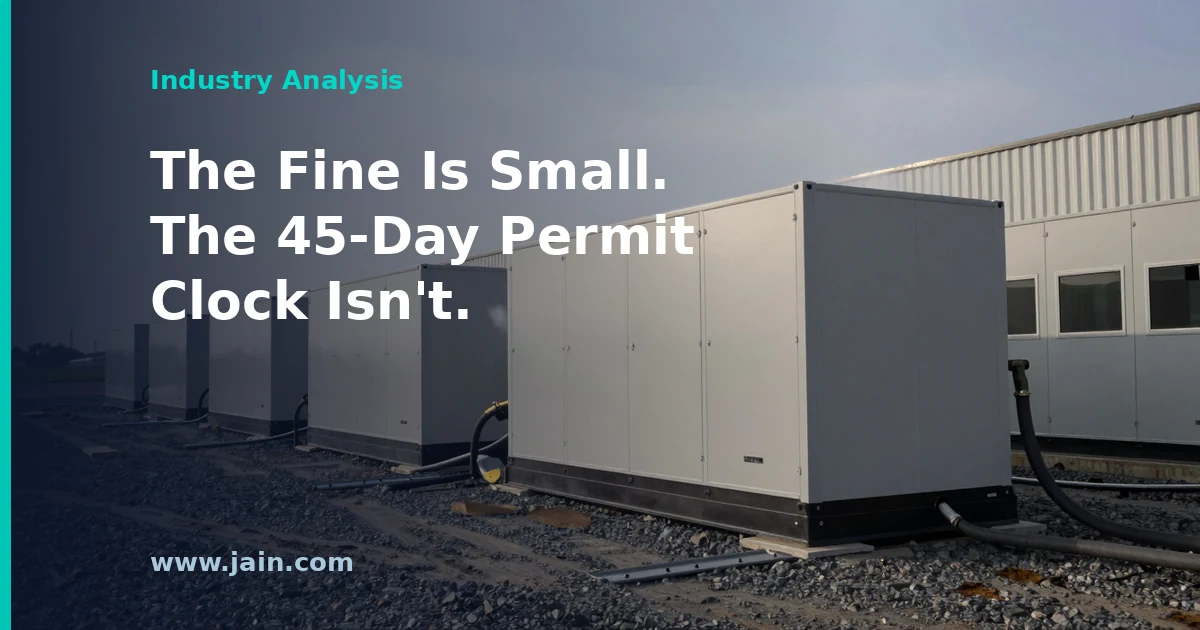
    New Jersey fined the builder of an artificial intelligence data center in the town of Vineland a record $1.07 million for running 62 portable power generators without pollution permits.

    Split across the generators, that is about $17,000 each. Neighbors called it pocket change. The real threat is a deadline: get the permits within 45 days or switch the generators off.

    The site supplies computing power for a $33 billion deal involving Microsoft, so losing its power source would be a far bigger problem than the fine.

    New Jersey has fined DataOne a record $1.07 million for running 62 unpermitted portable generators at its AI data center construction site in Vineland. The state also ordered the company to obtain air permits within 45 days or stop using the units. Tom’s Hardware reported the action on September 25, 2026, citing The New York Times. State inspectors found the generators powering the facility in late July. DataOne supplies computing capacity to Nebius, which Microsoft signed to a $33 billion deal.

    Residents have raised several other complaints:

    • the construction, without a permit, of a 1.5-million-gallon liquefied natural gas (LNG) tank;
    • night-time noise reaching homes within half a mile;
    • little public consultation before the project began.

    DataOne disputed the fine. It said it will apply for air permits for the temporary generators and is moving from portable turbines to fuel cells.

    Executive Summary

    The penalty is modest against the scale of the project. Spread across 62 generators, it comes to roughly $17,300 per unit, a point residents made bluntly. The 45-day order is what carries operational weight. Generators that were powering the site must be permitted by state regulators in that window or switched off. That puts a regulatory decision, not a construction milestone, on the critical path for a facility tied to one of the larger AI capacity contracts in the market.

    The case matters beyond Vineland. On-site generation, often called bridge power, lets developers bring their own electricity instead of waiting for a utility connection, and it is an increasingly common way to get AI capacity online quickly. New Jersey’s action and the earlier dispute over unpermitted turbines at SpaceXAI’s Colossus 2 site in Memphis point to the same limit: the workaround only moves as fast as the air-permit process allows.

    Why the 45-Day Clock Outweighs the $1.07 Million

    Divide $1.07 million by 62 generators and the penalty works out to about $17,300 per unit. Next to a $33 billion capacity contract, that is a rounding error. Residents said so directly. Longtime Vineland resident Steve Brown called it “a drop in the bucket,” and Tiffany Leone-Vespa argued the fine should have applied to each generator. As a financial deterrent, a penalty of this size does little to change the calculation behind what Brown described as a “don’t ask for permission, just ask for forgiveness later” approach.

    The shutdown order is a different kind of lever. New Jersey told DataOne to meet its permitting requirements and to stop running the generators if permits are not granted within 45 days. Inspectors found those units powering the facility. If the permits do not come through, DataOne has to replace that power on a schedule set by regulators rather than by its own construction plan. The replacement could be utility supply, the fuel cells it says it is adopting, or other permitted equipment. For a company whose product is computing capacity, a power gap is a delivery problem, not an accounting line.

    That exposure runs down a contract chain. DataOne supplies Nebius, and Nebius supplies Microsoft. The company has said it will apply for the permits. Whether regulators can review and grant them inside the window is the operative question, and it matters far more to the project’s timeline than the size of the fine.

    Bring-Your-Own Power Comes With a Permit Attached

    AI developers are bringing their own power because utility connections for very large new loads can take years, while trailer-mounted turbines and generators can be delivered and running in weeks. When a data center is built to rent out expensive AI processors, every month without power is lost revenue.

    The trade-off is that fuel-burning equipment emits pollutants such as nitrogen oxides, along with noise. That is why states require air permits, which are licenses that set emission limits, operating hours and monitoring for combustion equipment. At 62 units, a temporary generator fleet starts to resemble a small power plant, and it draws the scrutiny that comes with one. Noise complaints from homes within half a mile show the effects are felt locally, not just on paper.

    Memphis offers the closest comparison. SpaceXAI’s unpermitted turbines at Colossus 2 led to a lawsuit, and the Department of Justice asked the court to dismiss it on the grounds that the site “supports mission-critical operations.” The company ultimately agreed to remove the unpermitted turbines. It said the process would take more than a year as replacement plants totaling 1.2 gigawatts come online. Both cases end with temporary generation giving way to permanent, permitted supply. What differs is who sets the pace: more than a year in Memphis, 45 days in Vineland.

    Fuel Cells, an LNG Tank and the Replacement Question

    DataOne’s stated fix is to move from portable turbines to fuel cells. Fuel cells generate electricity through a chemical reaction rather than combustion. They are generally quieter and emit fewer local pollutants, so they address both of the neighbors’ main complaints. They still need fuel, most commonly natural gas, and they would have to match the output the 62 units were providing. DataOne has not said how much capacity it plans to install, who will supply it, or when it will be running.

    The 1.5-million-gallon LNG tank is a separate exposure. Liquefied natural gas is gas cooled until it becomes a liquid so it can be stored in bulk, and on-site storage at that scale is one way to fuel generation where pipeline supply is limited. DataOne has not explained what the tank is for. Residents say it was built without a permit, which could make its status a second regulatory question alongside the generators.

    Community Consent Is Now Part of the Power Plan

    According to residents, they learned a data center was going up in their neighborhood only after Microsoft announced its deal with Nebius. They raised concerns at a February town hall, citing satellite imagery that showed “some type of unit” on site. Inspectors had found no generators during a December visit, then found 62 in late July. When the units first arrived remains unclear, and so does how long they ran before enforcement.

    Both sides deserve a fair reading. DataOne’s commitment to seek permits and move to cleaner equipment points in the direction regulators want. Residents’ argument that a flat fine is too small for a well-capitalized operator is a legitimate question about how penalties are designed, including whether they should scale per unit. For developers, the lesson is practical. Permitting and early community engagement cost time up front, but enforcement mid-construction imposes a deadline the developer does not control.

    Background

    Nebius is an AI cloud company, sometimes called a neocloud, that rents out computing capacity built on graphics processors, the chips used to train and run AI models. It is headquartered in Amsterdam, listed on Nasdaq, and emerged in 2024 from the restructuring of Yandex’s international business. Its $33 billion deal with Microsoft makes it a major capacity supplier to one of the largest buyers of AI computing. DataOne is the developer contracted to provide computing capacity for that arrangement at Vineland, in southern New Jersey.

    AI data centers draw far more electricity than traditional facilities, and utility connections for large new loads can take years. Many developers now use on-site generation such as gas turbines, engines or fuel cells as bridge power until grid supply is ready. Under the federal Clean Air Act framework, states require air permits for fuel-burning equipment above certain size thresholds. Operating without one exposes a site to fines and orders to shut the equipment down.

    Sources

    Source: New Jersey hits Microsoft-linked AI data center with record fine for 62 unpermitted power generators, issues 45-day shutdown deadline — site tied to $33 billion deal also built illegal 1.5M-gallon fuel tank: Tom’s Hardware on New Jersey’s $1.07 million fine and 45-day permit deadline for DataOne’s Vineland AI data center.

  • Mercuria’s $250M Zambia Bet Funds Wires, Not Just Plants—What AI Sites Need First

    Mercuria’s $250M Zambia Bet Funds Wires, Not Just Plants—What AI Sites Need First

    TL;DR · 30-second read

    The Short Version

    A giant Swiss energy trading firm, Mercuria, has agreed to put 250 million US dollars into an African electricity company called Exergy, based in Zambia.

    The money pays for power plants and for the high-voltage lines that carry electricity across the country and to its neighbors. It is one of the biggest private investments Zambia’s power sector has seen.

    Why care? Big computer centers for artificial intelligence need huge, steady supplies of electricity. Without power lines, they cannot be built. Deals like this come first.

    Mercuria, the Geneva-based energy and commodities group, and Exergy, an Africa-focused integrated energy investor, signed a US$250 million financing deal in Lusaka on September 25, 2026. The companies call it one of the largest private capital commitments to Zambia’s power sector. It is also Mercuria’s first move into the region’s power market.

    Subject to regulatory approvals, the money will fund generation and transmission projects run by two Exergy subsidiaries, Lunzua Power Company and Lusitu Transmission and Distribution Company. The companies say several of those projects are already underway. Exergy’s pipeline is positioned against Zambia’s national target of 10,000 megawatts of supply by 2031.

    Executive Summary

    This deal is more than a power-plant financing. Exergy is organized around the full electricity chain. Lunzua generates power. Lusitu builds transmission and distribution lines, the high-voltage wires that move power from plants to users. A third subsidiary, Kanona, trades power and balances surplus against shortfall. Mercuria’s capital goes to the first two, and its trading know-how supports the third.

    This matters to the data center industry because large computing facilities get sited where firm, deliverable power already exists. Firm power means supply that runs around the clock and does not drop when one plant does. Zambia has opened its electricity market so independent companies can build, trade and sell power. A private platform that owns generation, owns the wires and trades across borders is the kind of grid scaffolding any large, constant electricity user would need in place first.

    Neither company names data centers as a customer. The demand they cite comes from mining, agriculture, manufacturing, tourism and industry. The data center relevance is a question of sequence. Power and transmission are built years ahead of the buildings that consume them.

    Why the Wires Matter More Than the Megawatts

    Headlines about energy investment usually count generation capacity, meaning how many megawatts a new plant can produce. For a data center operator, generation is necessary but not enough. A facility running AI workloads draws a large, nearly constant load, 24 hours a day. It needs that power delivered over transmission lines with enough capacity and redundancy to survive a plant outage or a dry season. Transmission is often where large-load projects stall, because new lines take years to plan, permit and build.

    The Mercuria–Exergy structure addresses both halves. Lusitu Transmission and Distribution is a named recipient of the funds alongside Lunzua’s generation projects. Exergy is also developing a transmission highway linking Zambia to the East African power market. Kanona, the trading arm, balances surplus and deficit positions, which in practice is how an independent supplier firms up output for a customer who cannot tolerate gaps. Put together, that is the operational sequence a hyperscaler, meaning one of the largest cloud operators, or any big colocation developer would look for before committing to a site: generation, then deliverability, then the ability to cover shortfalls through trade.

    The enabling condition is Zambia’s open-access reform, which both companies credit. Open access lets independent generators and transmission owners reach customers without routing everything through a single state utility. That makes contracting directly for power, the model data center operators use in most mature markets, at least structurally possible. It does not mean such contracts exist yet. Neither company claims they do.

    A Commodity Trader Moves Into Grid Assets

    Mercuria is best known for trading crude oil, gas, power and metals across more than 50 countries. Its entry here is as a long-term capital provider. It says Zambia’s stability, growth plan and regional position justified the commitment. Exergy, for its part, says it values Mercuria’s market view of how power, metals and trade connect as highly as the capital itself.

    That pairing has a clear logic. Zambia’s economy is closely tied to mining, and mines are among the most power-hungry customers in the region. A trader with a metals book and a power book has a direct interest in reliable electricity where the metals are produced. Mercuria also frames private capital as working alongside, not replacing, the development finance institutions (DFIs) and development banks that have traditionally funded African power.

    The claim to watch is Exergy’s statement that the deal shows global partners can finance African energy at scale on commercial terms. That may prove true. However, the terms have not been disclosed: whether the money is debt or equity, the cost of capital, and any guarantees involved. Until they are, the claim is an assertion rather than a demonstrated benchmark other investors can price against.

    Sizing $250 Million Against a 10,000-Megawatt Goal

    US$250 million is large for a single private commitment to one country’s power sector. It is modest against a national target of 10,000 megawatts by 2031. The companies say only that the pipeline will contribute to that goal. They do not say how many megawatts this tranche delivers. Readers should treat the deal as one building block, not a solution to Zambia’s supply needs.

    The regional angle may be the more durable asset. Zambia borders eight countries, sits inside the Southern African Power Pool, and has growing links to East and Central Africa. Interconnection lets a country import power when domestic supply falls short and export it when there is surplus. For any future large-load customer, that spreads risk across more than one national system. The same logic underpins Mission 300, the World Bank and African Development Bank initiative to connect 300 million Africans to electricity by 2030, which Exergy says its cross-border ambitions support.

    Background

    Zambia is a landlocked Southern African country whose economy leans heavily on mining. Exergy’s announcement refers to the country’s past energy troubles. The government’s Grow Zambia agenda targets 10,000 megawatts of supply by 2031. Reforms that opened the electricity market to independent producers and traders have created room for private platforms like Exergy, which spans generation, transmission and trading through its Lunzua, Lusitu and Kanona subsidiaries.

    Mercuria is one of the world’s largest independent energy and commodities groups. Historically, African power infrastructure has been financed largely by development finance institutions and development banks. Mercuria’s commitment reflects its stated view that private capital should play a larger role alongside that model. Regional efforts such as the Southern African Power Pool and Mission 300 aim to connect more of the continent’s grids and people to reliable electricity.

    Sources

    Source: Mercuria and Exergy Energy Sign US$250 Million Investment Deal to Accelerate African Power Projects. Joint announcement of Mercuria’s financing for Exergy’s generation and transmission pipeline in Zambia.

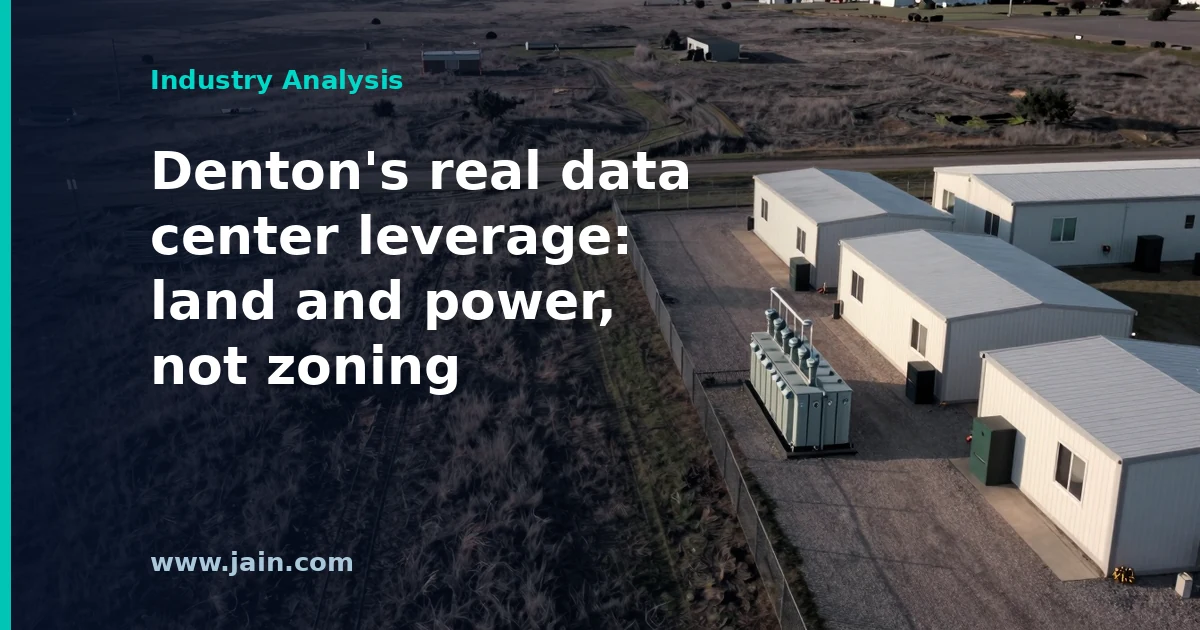
  • Core Scientific’s 391 MW Shows Denton’s AI-Era Leverage Is Land and Power, Not Zoning

    Core Scientific’s 391 MW Shows Denton’s AI-Era Leverage Is Land and Power, Not Zoning

    TL;DR · 30-second read

    The Short Version

    Denton, a Texas city north of Dallas, is weighing a 90-day pause on new data centers. These are giant buildings full of computers that run online services and artificial intelligence.

    The surprise: the pause may not reach the biggest one already there. Core Scientific’s site is built to handle 391 megawatts, about as much electricity as a sizable city uses. Its growth depends more on the city-owned power company, which sells it electricity and owns the land it wants to rent.

    Residents are split between worries about the power grid and a $3 billion rise in the value of local taxable property.

    Denton City Council held the first of two required public hearings on a proposed moratorium on new data center development during its Sept. 22 meeting, Community Impact reported. The moratorium would halt all new data center development and permitting in city limits for 90 days, with an option to extend for another 90. A second hearing is set for Oct. 27, and the council could vote as early as Dec. 2.

    At the same meeting, city officials said Core Scientific, which operates a 391-megawatt (MW) data center in Denton, had asked Denton Municipal Electric (DME), the city-owned utility, to lease additional public land south of its facility. A second project, Qumulus AI’s 20 MW data center, is planned to start operating in 2028 but has not begun construction.

    Executive Summary

    Denton is moving through the legal steps to pause new data center development, a process the council started with a unanimous vote on Aug. 18. The city attorney, Mack Reinwand, told the council that “a moratorium being passed does not necessarily stop an existing project from being built out.” Whether the pause would apply to an operator expanding or needing more land to meet its agreement with the city will depend on what that project’s original submission included.

    That distinction matters because Denton is not only a zoning authority. Through DME, it sells electricity to its largest data center under a power purchase agreement (PPA, a long-term contract for electricity) and owns the land that operator wants to lease. The hearing also landed days after Texas Gov. Greg Abbott ordered state environmental regulators to stop issuing new data center permits while ERCOT, the state grid operator, audits proposed projects.

    For data center operators, including bitcoin miners repositioning as hosts for AI and high-performance computing, Denton shows how local, state and grid-level controls now stack on the same site. For an existing operator, the most precise controls sit with the utility, not the moratorium.

    What a Moratorium Can and Cannot Reach

    A moratorium is a temporary pause on accepting or processing new development applications. Denton’s version would stop new data center development and permitting in city limits as soon as it passed. That is a blunt tool aimed at what has not been built yet. The city attorney’s caution that it “does not necessarily stop an existing project from being built out” means the pause bites hardest on projects that have not yet secured approvals.

    That puts the two projects in different positions. Core Scientific’s 391 MW facility is operating. Qumulus AI’s 20 MW data center has a 2028 target, according to Charlie Rosendahl, Denton’s director of development services, but has not started construction. Whether Qumulus falls under the pause depends on the same question Mayor Chris Watts raised: what was submitted, and what the city already approved. Until the council answers that, the moratorium’s practical reach is unclear at both ends.

    The Utility Is Also the Landlord

    The headline point rests on what DME officials said about Core Scientific. DME Assistant General Manager Chris Lutrick said Core Scientific’s PPA limits how many megawatts it can consume. Those limits are controlled by ERCOT. He also said the company “ha[s] not got there” and has not asked for more power than the contract allows. So the operator’s electrical ceiling is already set by a contract with the city’s utility and by the state grid operator, whatever the council decides on the moratorium.

    Land is the second lever. Lutrick said Core Scientific asked three to four months earlier to lease public land just south of its facility. He said the company did not say how it would use that land, and that it had been renting space at a private residence to park contractor vehicles. He added that the company “never mentioned another data center.” Rosendahl said the city is not discussing future data center development while the moratorium process continues. Interim City Manager Cassey Ogden said Core Scientific had not contacted the city about leasing more land, which does not match the utility’s account.

    Taken together, the city’s decisions on whether to lease that parcel and how to administer the PPA will shape the 391 MW site more precisely than a pause on new applications. For operators on municipal utilities, the city can be regulator, power supplier and landlord at once. Each role gives it a separate point of leverage.

    State and Grid Controls Stack on Top

    Denton’s process does not run alone. According to the same reporting, Gov. Abbott said on Sept. 21 that state environmental regulators must stop issuing new data center permits. His order expands an existing state pause while ERCOT audits proposed data center projects. Rosendahl told the council that any interconnection, meaning the physical and contractual hookup to the grid, requires a study. Loads over 75 MW also need ERCOT approval, and that category is now under closer review at the governor’s direction.

    The grid itself is the backdrop. Rosendahl said recent studies show Denton’s transmission system was already running near its limits before the large data center developments came online. That gives the moratorium’s supporters a concrete argument. It also suggests that any large new load would face capacity questions even without a local pause. For developers, the practical result is three layers of review: city permitting, state permits and ERCOT interconnection approval. Any one of them can set the schedule.

    A $3 Billion Tax Base Against Unanswered Questions

    The trade-off residents described is real on both sides. Denton saw a $3 billion increase in property tax value from data center development, according to earlier reporting. That is a direct fiscal benefit to the city and other local taxing bodies. Opponents cited long-term community effects and grid strain. Council Member George Ferrie said the city lacks long-term data on questions such as air quality because data centers “haven’t been this dense, this present for two decades.”

    Neither side’s case is settled by what was presented at the hearing. The tax figure is a documented gain, but the grid concerns are backed by the city’s own transmission findings. A 90-day pause, extendable once, is a way to buy time for those studies rather than a final verdict. For AI infrastructure investors, the signal is that Texas sites near constrained municipal grids now carry local political review as a scheduling risk alongside power and equipment lead times.

    Background

    Denton, a fast-growing city in the Dallas-Fort Worth area, runs its own public power utility, Denton Municipal Electric. It currently has two data center operators: Core Scientific, with a 391 MW facility already operating, and Qumulus AI, with a 20 MW project planned for 2028. The moratorium effort began with a two-minute pitch from Mayor Pro Tem Nick Stevens on May 14. The council approved the pitch June 2 and voted unanimously on Aug. 18 to start the legal process.

    Core Scientific built its business on bitcoin mining and has been repositioning toward hosting AI and high-performance computing workloads, part of a wider shift among miners with large power allocations. Most of Texas is served by the ERCOT grid, which has become a central gatekeeper for large new electricity loads such as data centers.

    Sources

    Source: Denton officials weigh data center moratorium during first public hearing (Community Impact). Coverage of Denton City Council’s Sept. 22 hearing on a 90-day data center moratorium and Core Scientific’s request for more utility land.

  • Applied Digital’s $270M Brookwood Pledge Makes Local Terms Part of AI Campus Cost

    Applied Digital’s $270M Brookwood Pledge Makes Local Terms Part of AI Campus Cost

    TL;DR · 30-second read

    The Short Version

    A company called Applied Digital plans to spend $3.2 billion on a huge building full of computers for artificial intelligence near Brookwood, a town in Alabama. At full size it would have about as much floor space as 20 American football fields. It should start running in 2028.

    The notable part is the deal with the town. Applied Digital promised to pay the local area $270 million over 20 years. That is on top of an estimated $131 million in taxes, even though only about 100 people will work there permanently.

    Applied Digital has confirmed that Delta Forge 2, a $3.2 billion, 210MW AI data center, will be built on a 1,300-acre site near Brookwood in Alabama’s Tuscaloosa County, Data Center Dynamics reported on September 25, 2026. The campus is planned at 1.2 million square feet at full build-out, with operations expected to begin in 2028. The tenant is an unnamed customer that Applied Digital describes as an “investment grade hyperscaler,” meaning one of the very large cloud and AI platform operators.

    The company is committing $270 million in community benefits payments to the Tuscaloosa County Economic Development Authority over 20 years, alongside an estimated $131 million in tax revenue for the area. The project is expected to support up to 1,000 construction jobs and 100 permanent roles. The Tuscaloosa Thread reported that the county board approved incentives for the project unanimously.

    Executive Summary

    Applied Digital said in June that it had signed a customer for a new 210MW data center, but it did not say where. Naming Brookwood completes a basic picture of the project: a customer, a site, a budget, a target date and local approval. It also puts a campus on the company’s map outside North Dakota, where its Polaris Forge 1 and 2 campuses sit.

    The most informative number is not the $3.2 billion headline. It is the $270 million community payment. That is roughly 8% of the stated investment and larger than the project’s estimated tax contribution. For a facility with 100 permanent jobs, the negotiated fiscal package, more than employment, is what the host community receives in return. That makes the local agreement a real cost of bringing AI capacity online, one that developers have to budget for alongside land, power and construction.

    The $270 Million Pledge Is a Line Item, Not a Gesture

    Applied Digital’s commitment of $270 million over 20 years to the Tuscaloosa County Economic Development Authority is large enough to register in the project’s economics. Against the $3.2 billion stated investment, it is roughly 8%. Spread across 210MW of capacity, it comes to about $1.3 million per megawatt. Averaged over two decades, it is about $13.5 million a year, although the company has not said whether payments are level, front-loaded or tied to construction milestones.

    The pledge is also larger than the other fiscal figure attached to the project, an estimated $131 million in tax revenue. The period behind that tax estimate was not specified, so the two numbers are not a strict like-for-like comparison. Still, of the two local benefits disclosed, the negotiated payment is the bigger one, not the ordinary tax base. For site selection, that changes the calculation. When a county’s approval comes with a multi-decade cash commitment on this scale, the community agreement becomes part of the cost of delivering capacity. It has to be priced into the lease the same way power and construction are.

    Three groups are affected. Other developers pitching large AI campuses to rural and suburban counties may now find this package used as a reference point in negotiations. Local economic development authorities gain a contracted revenue stream instead of relying only on assessed taxes, which can be reduced by abatements. The tenant’s lease pricing ultimately has to cover the developer’s full cost of delivering the site.

    Why Capital-Heavy, Job-Light Projects Pay Their Way in Cash

    A $3.2 billion project that supports 100 permanent roles represents about $32 million of investment per permanent job. That ratio is typical of large data centers. Most of the spending goes to buildings, electrical equipment and cooling systems, not payroll. The up-to-1,000 construction jobs are substantial, but they are temporary by definition.

    This is the mechanism behind the size of the payment. Traditional economic development deals trade tax incentives for jobs. A data center cannot offer many jobs, so it offers direct fiscal commitments instead. Brookwood mayor Joe Barger’s comments point in that direction. The mayor framed the project around “strengthening our schools” and benefits “for generations to come,” which reflects a long-term revenue case more than a hiring case. The unanimous board vote suggests the county found the exchange acceptable. The value of the incentives the county granted in return has not been published, so the net fiscal benefit cannot yet be calculated.

    A Portfolio Built on a Few Very Large Tenants

    Applied Digital, founded in 2021 as Applied Blockchain, now reports a contracted portfolio of five AI Factory campuses totaling 1.4GW of critical IT load. Critical IT load is the power available to servers and networking gear, excluding cooling and other facility needs. The company reports approximately 2.15GW of grid-connected utility power behind that portfolio. The gap of roughly 750MW is the extra electricity a site must secure to run cooling and other facility systems and to keep some headroom. Securing grid power, not just signing tenants, is the harder half of this business.

    Chairman and CEO Wes Cummins called Delta Forge 2 part of “repeatable AI infrastructure delivered at scale.” Part of that claim is supported by disclosed facts: multiple campuses under contract, one tenant named (CoreWeave at Polaris Forge 1), and repeat business from one customer. The same high-investment-grade hyperscaler that signed at Delta Forge 1 also took 300MW at Polaris Forge 3. The company’s statement that it has a “proven track record of delivering on our commitments to our host communities” is not accompanied by delivered-capacity or payment-history figures. Much of the portfolio is concentrated in a small number of unnamed hyperscale tenants. That concentration brings strong credit, but it also means the business depends heavily on a few counterparties.

    What Has to Go Right by 2028

    Delta Forge 2’s 2028 start follows Polaris Forge 3, where initial operations are targeted for August 2027. That puts overlapping large builds on the company’s schedule. Hitting both dates depends on things not addressed in the announcement: the utility and grid connection for a 210MW load in Tuscaloosa County, procurement of long-lead electrical equipment, and financing for a project of this size. The move to Alabama widens the company’s geographic reach, but it also means building a new set of utility, contractor and permitting relationships far from its North Dakota base.

    Background

    Applied Digital was founded in 2021 as Applied Blockchain and has repositioned itself as a developer of data centers for artificial intelligence and high-performance computing. It builds large campuses and leases them to a small number of major tenants. Its Polaris Forge 1 campus in Ellendale, North Dakota, is set to be leased to CoreWeave. Polaris Forge 2 in Harwood, North Dakota, is largely committed to an unnamed investment-grade hyperscaler. Polaris Forge 3, on 600 acres in an unnamed northern state, will provide 300MW to the same hyperscaler that signed at Delta Forge 1, with initial operations targeted for August 2027.

    AI data centers differ from conventional ones mainly in power density. Training and running large AI models requires far more electricity per rack of servers, so developers compete on how much grid power they can secure and how quickly. That has made site selection a negotiation over power, land and local fiscal terms, as much as over proximity to users.

    Sources

    Source: Applied Digital reveals $3.2bn Delta Forge 2 AI data center will be built in Alabama (Data Center Dynamics). Location, scale, timeline and community commitments for Applied Digital’s 210MW Brookwood campus.

    Additional coverage: County Board Unanimously OKs Incentives for $3.2 Billion Applied Digital Data Center in Brookwood (Tuscaloosa Thread); $3.2 Billion AI Data Center Campus Announced in Brookwood (WBMA); Applied Digital confirms $3.2 billion data center campus in Brookwood (WBRC); Applied Digital confirms Brookwood data center (WBRC); Massive $3.2B AI data center coming to Brookwood (WVTM Channel 13).

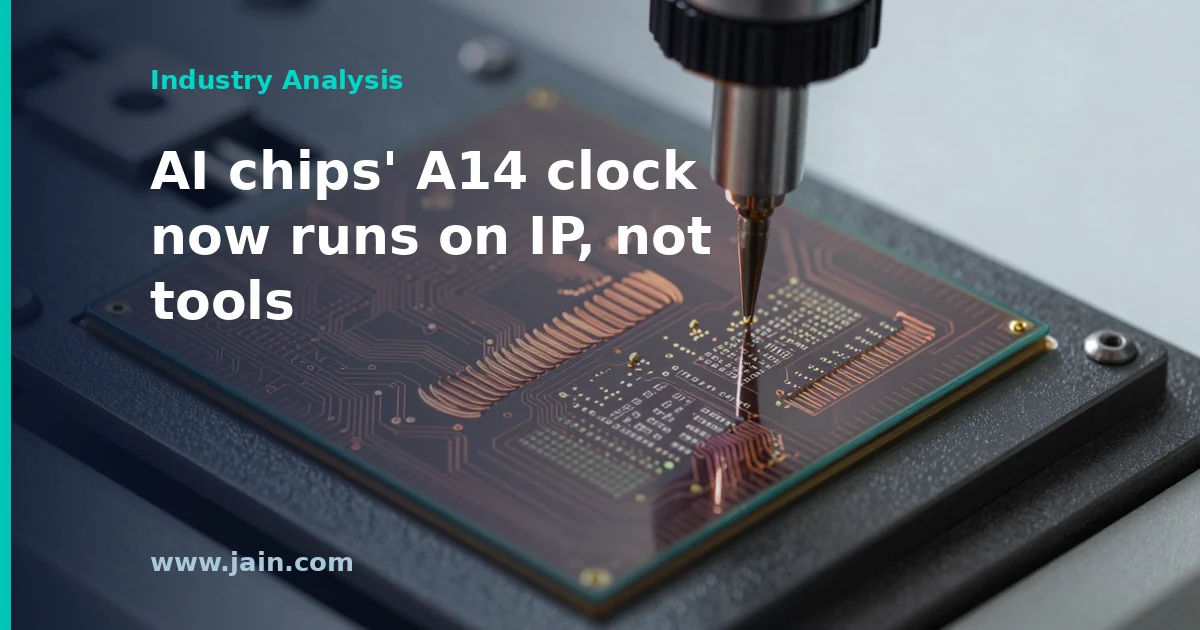
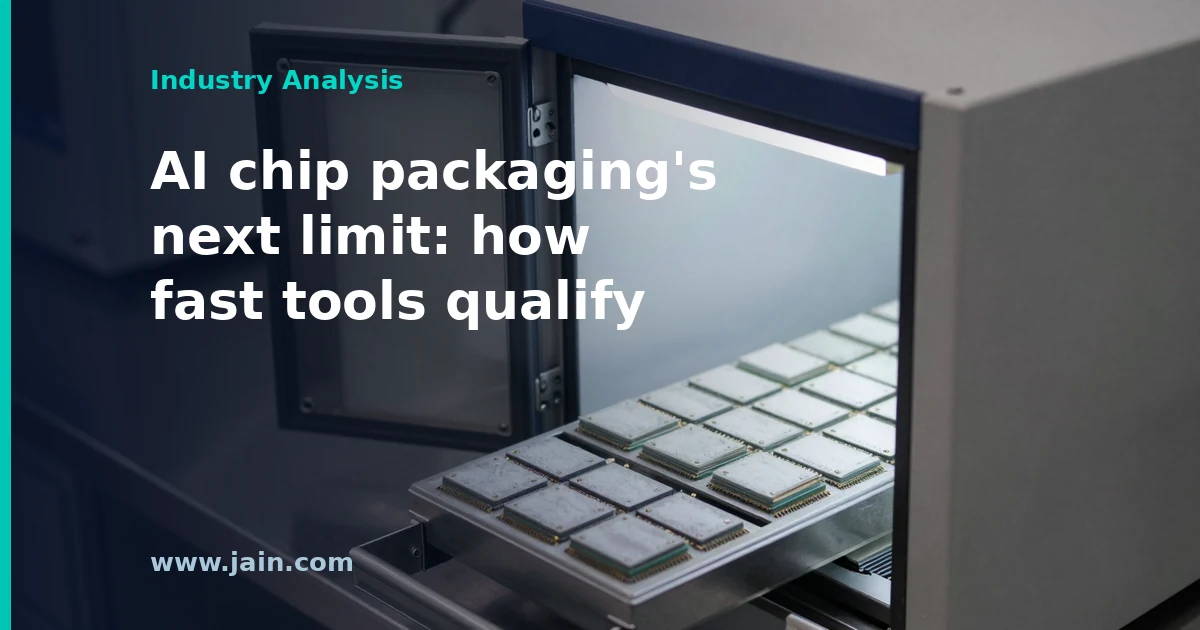
  • Cadence’s 2.5x A14 Gain Is in Analog Layout; AI Chip Timing Now Rides on IP

    Cadence’s 2.5x A14 Gain Is in Analog Layout; AI Chip Timing Now Rides on IP

    TL;DR · 30-second read

    The Short Version

    Before a new computer chip can be made, engineers draw and redraw its design in specialized software. Cadence, which makes that software, says its tools are now approved for the next, even smaller manufacturing process at Taiwan Semiconductor Manufacturing Company, the world’s biggest contract chipmaker.

    Cadence says one tricky part of the job now needs up to two and a half times fewer redraws. That could speed up the custom artificial intelligence chips that giant cloud companies build. The catch: many ready-made parts Cadence sells for such chips are still unfinished, and some are not due until the end of this year.

    Cadence Design Systems announced on September 23 an expanded partnership with TSMC, according to the company’s release as published by Wccftech. Cadence’s digital full flow, signoff flow and custom/analog flows are now certified for TSMC’s A16 and A14 process technologies, and its analog, digital and signoff flows are certified for N2P. Cadence says Virtuoso Studio’s automated layout generation and design migration to A16 and A14 reduces design iterations by up to 2.5x.

    On intellectual property (IP) — pre-designed circuit blocks that chipmakers license rather than build themselves — Cadence reported a UCIe-64G chiplet interface taped out on A14, LPDDR6 memory-interface IP in development, and A14 foundation and mixed-signal IP expected in Q4 2026. It also cited support for TSMC’s SoW-X wafer-scale flow with hundreds of chiplets, a UALink demonstration on N3P, and design-services firm Global Unichip Corp. (GUC) as a customer.

    Executive Summary

    Tool certification is the gate that lets chip designers commit real products to a new manufacturing process. It means TSMC has validated Cadence’s software against its A14 and A16 design rules and models, so the layouts, timing and power numbers the tools produce can be trusted to match what the fab will build. Cadence has now cleared that gate for its digital, signoff and custom/analog flows on both nodes.

    It matters because the next generation of custom AI accelerators — the chips hyperscalers design in-house to run alongside or instead of merchant GPUs — will migrate to these nodes, and the time between a node becoming available and silicon shipping in volume is set by tools, IP and packaging together. Cadence’s headline 2.5x figure is narrower than it first reads: it applies to automated custom and analog layout and migration, and it is stated as an upper bound.

    The more consequential detail is in Cadence’s own status table. With tools certified, most of its A14 IP is still in development, with foundation and mixed-signal blocks due in Q4 2026. For design teams relying on that IP, the A14 schedule question has moved from software qualification to IP readiness. On the manufacturing side, TSMC’s latest 6-K shows its board approved US$16,035 million for advanced-technology capacity machinery in August — the fab is spending; design-side readiness determines how quickly customers can use it.

    The 2.5x Applies to Analog Layout, Not the Whole Chip

    Cadence ties its “up to 2.5X” reduction in iterations specifically to Virtuoso Studio’s design-rule-correct layout generation and automated design migration to A16 and A14 — the custom and analog side of the flow. Analog circuits handle continuous electrical signals rather than ones and zeros: the transceivers that move data off a chip, the physical interfaces to memory, clocking and power-management blocks. Digital logic can largely be re-mapped to a new node by synthesis and place-and-route software; analog layouts have traditionally been redrawn by specialists at each node, because exact transistor placement affects how the circuit behaves.

    That makes analog a sensible target for automation. “Design-rule-correct” means the generated layout already obeys the foundry’s geometric rules on spacing and widths, cutting the draw-check-fix loop that consumes much of a migration. Shortening the workstream that scales worst with headcount is a real gain. But Cadence does not state the baseline — fewer iterations than which previous method, on which designs — and “up to” marks a best case. No comparable multiplier is claimed for the digital full flow, where most of an AI accelerator’s transistors sit.

    For anyone estimating time to market, the 2.5x is a figure about iterations in one workstream, not a claim that chips ship 2.5 times sooner. Cadence’s own summary of the benefit — “faster time to market and improved PPA” (power, performance and area) — is not quantified.

    Tools Are Certified; the A14 IP Ladder Is Still Being Climbed

    Semiconductor IP climbs a ladder before customers trust it: designed, taped out (sent to the fab to make test chips), tested in the lab when silicon returns, then characterized — measured across voltage and temperature so its behavior is documented. Cadence’s UCIe-64G chiplet interface shows that ladder across nodes in a single announcement: characterized on N3P, in the lab on N2P, taped out on A14.

    On A14 itself, the list is mostly future tense. UCIe-64G is taped out. LPDDR6 IP is in development. Artisan foundation IP — standard cells, the basic logic building blocks, plus GPIO and memory compilers — and mixed-signal IP are in development and expected in Q4 2026. Other HPC and AI memory IP and chiplet protocols have been “prioritized for development.” HBM4/4E and PCIe 7.0 appear in Cadence’s broader portfolio without an A14 status.

    That is the mechanism behind the headline. A custom AI accelerator is mostly compute logic, but it cannot ship without the interfaces that connect it to high-bandwidth memory, sibling chiplets and the network — precisely the analog and mixed-signal blocks still in progress on A14. With certified tools in hand, a design team relying on Cadence’s A14 IP now faces a different schedule question: not whether the software is qualified, but when each block reaches proven silicon. Teams can source some blocks from TSMC or other IP vendors — Synopsys has announced its own TSMC partnership on agentic AI and advanced design — so this is a statement about Cadence-based flows and about where the gating item has moved, not a ceiling on the whole market.

    Packaging Is Where the AI System Gets Assembled

    The announcement gives as much space to packaging as to transistors. Cadence says its tools support TSMC’s SoW-X system-on-wafer flow with hundreds of chiplets and millions of bumps (microscopic solder connections), and CoWoS-L-style packages five times the reticle size. The reticle is the largest area a lithography scanner prints in one exposure, which effectively caps the size of a single die; a 5x-reticle package combines the silicon of several maximum-size dies in one module. A certified die-to-die auto-routing flow targets UCIe requirements across CoWoS architectures.

    Cadence also cites TSMC-COUPE, a photonic engine that converts electrical signals to light close to the chip, enabled with its 224G SerDes IP and aligned with UALink, UltraEthernet, ESUN and co-packaged optics (CPO). These are the links that turn individual accelerators into clusters, and their readiness shapes what data center operators will be powering, cooling and cabling. Cadence discloses no power or thermal figures for these designs.

    TSMC’s capital decisions point the same way. In a 6-K filed September 24, TSMC reported that its board approved US$16,035 million for advanced-technology capacity machinery, US$4,791 million for advanced packaging, mature and/or specialty capacity, and US$8,616 million for real estate and capitalized leased assets in August. The filing does not isolate packaging from the combined category or allocate spending by node, so it supports the direction of travel rather than any A14-specific conclusion.

    Who Gains From Shorter Node Ramps

    The most direct beneficiaries are the firms that build custom accelerators for hyperscalers. GUC, named as a customer, delivers custom silicon for AI accelerators and hyperscale systems on TSMC’s leading-edge nodes. Its senior vice president, Louis Lin, said success on N3P and N2P depends on tightly optimized execution, “especially when working with the early‑adopters where schedule risk is highest.” His remarks address N3P and N2P; the announcement names no A14 customer.

    For hyperscalers, being early on a new node matters because each generation aims to deliver more computing per watt, which compounds across fleets of data center racks. But the constraints stack — certified tools, proven IP, packaging capacity, wafer capacity — and a design moves at the pace of the slowest. On A14, Cadence has cleared the first and is partway through the second.

    Some claims need more support before buyers can weigh them: the UALink demonstration is described as “industry-leading” without published bandwidth, latency or power data, and “agentic AI chip design flows” are named but not defined. Both are marketing language until measured results follow.

    Background

    Chips are designed with electronic design automation (EDA) software — the programs engineers use to describe, lay out and verify circuits before a factory builds them. Cadence Design Systems and Synopsys are the two largest EDA suppliers, and both also license IP blocks such as memory and chiplet interfaces. TSMC, the largest contract chipmaker, manufactures chips designed by other companies, including many AI accelerators; its leading-edge roadmap runs from N3 and N2 to A16 and A14.

    Every new process requires design tools and IP to be requalified before customers can commit products to it, which is why certification announcements cluster around each node. Hyperscalers increasingly design custom AI accelerators, often with design-services partners such as GUC, and those chips are now assembled from multiple chiplets in advanced packages — TSMC’s 3DFabric family, including CoWoS and SoIC — making packaging and die-to-die links as important to the schedule as transistor density.

    Sources

    Source: Cadence Locks In TSMC A14 Tool Certification, Cutting Design Iterations By 2.5X As It Races Toward Agentic AI Chips — Cadence’s announcement of A14/A16/N2P tool certification, new IP and 3DFabric support. Also referenced: Synopsys and TSMC Partner to Accelerate AI Systems Innovation with Agentic AI and Advanced Design.

    Primary sources: Taiwan Semiconductor Manufacturing Company, Form 6-K filed 2026-09-24 (report for the month of August 2026, including board-approved capital appropriations).

  • CleanSpark’s AI Pivot Costs 7.875% to Fund, Even With Meta Guaranteeing Rent

    CleanSpark’s AI Pivot Costs 7.875% to Fund, Even With Meta Guaranteeing Rent

    TL;DR · 30-second read

    The Short Version

    CleanSpark, a company best known for mining bitcoin, is borrowing about $2.3 billion to finish a huge building full of computers for artificial intelligence. The tenant is a company owned by Meta, the parent of Facebook and Instagram, and Meta itself guarantees 20 years of rent.

    Even with that promise, lenders are charging nearly 8% interest, or about $179 million a year.

    Why so expensive? The building is not scheduled to start paying rent until late 2027, and lenders are betting it gets finished. That interest rate shows what it costs a bitcoin company to become a landlord for artificial intelligence.

    On September 18, 2026, CleanSpark (Nasdaq: CLSK) said in an 8-K that its wholly owned subsidiary CSDC Finance I, LLC had priced $2.276 billion of 7.875% senior secured notes due 2031 at 98.5% of face value. The deal is expected to close on September 25. It is larger than the $2.227 billion CleanSpark proposed a day earlier. The notes were sold privately to large institutional investors under Rule 144A and to non-U.S. buyers under Regulation S.

    The proceeds will finish building CleanSpark’s Sandersville Facility, reimburse the company for equity it has already put into the project, and fund debt service reserves. The investor presentation CleanSpark furnished on September 17 describes Sandersville as a 175 MW AI data center campus. It is leased for 20 years to Anviran, LLC, a wholly owned Meta subsidiary, and Meta guarantees the rent and operating expenses. First-phase rent is targeted for Q4 2027.

    Executive Summary

    CleanSpark has raised project-level debt for its first large AI hosting campus, and the price is specific: a 7.875% coupon, sold at a 1.5-point discount. The notes are secured by first-priority liens on the Sandersville project and the issuer’s equity, a completion guarantee from CleanSpark backs them, and part of the proceeds funds cash reserves for interest payments. Behind all of that sits a 20-year triple-net lease guaranteed by Meta, a company the presentation values at about $1.7 trillion.

    The notable feature is the gap between the tenant and the terms. Meta’s credit is not in question. The coupon and the protective package reflect what is still unfinished: a building that is not scheduled to earn rent until late 2027, owned by a sponsor that is moving from bitcoin mining into data center development. For operators trying to turn mining power into AI capacity, this deal is a concrete, disclosed reference point for what that conversion costs to finance.

    Meta Signed the Lease. Lenders Still Priced the Build.

    On paper, Sandersville is about as strong a credit story as a data center gets. The investor presentation CleanSpark furnished on September 17 describes these terms:

    • a 20-year base lease with Anviran, LLC, a Meta subsidiary, plus two five-year extension options;
    • Meta itself as guarantor of rent and operating expenses;
    • a triple-net structure, meaning the tenant covers taxes, insurance and upkeep;
    • a 3% annual rent escalator;
    • about $6.6 billion of base-term contract value.

    To underline the tenant’s strength, the presentation cites Meta’s $117 billion of first-half 2026 revenue.

    Even so, the notes carry a 7.875% coupon, the fixed annual interest rate. They were also sold at 98.5 cents on the dollar, which by rough estimate lifts investors’ effective yield to a little over 8%. Bondholders also received three protections. They hold first-priority liens on substantially all assets of the issuer and its guarantor subsidiary, plus the issuer’s equity. Reserves funded from the proceeds cover debt service. And CleanSpark gives a completion guarantee, a promise to supply more money if the proceeds cannot finish the facility on time. Each protection guards against the same thing. The question is not whether Meta can pay. It is whether the building gets delivered.

    The timeline explains why. First-phase rent is targeted for Q4 2027, so interest accrues for more than a year before rent arrives, and the lease pays only once the capacity exists. For a bitcoin miner moving into AI hosting, a lease with a hyperscaler (one of the giant cloud and internet platforms) turns megawatts into something lenders will finance. It does not, on its own, earn the borrowing costs of the investment-grade tenant. Construction and sponsor risk sit in between. In this deal, CleanSpark carries the construction risk directly through its guarantee.

    The Per-Megawatt Math Behind $2.276 Billion

    The presentation puts development cost at about $11.9 million per megawatt of critical IT load, which is the power delivered to the servers themselves, not counting cooling and building overhead. For 175 MW, that implies roughly $2.1 billion. At 98.5% of face value, $2.276 billion of notes raises about $2.24 billion before fees, which is more than that implied total cost. That fits the stated uses: finishing the build, reimbursing CleanSpark’s prior equity contributions, and funding reserves. In practice, the debt is sized to fund close to the whole project, and CleanSpark recovers part of what it has already spent.

    Annual interest on the notes comes to about $179 million, or roughly $1.0 million per megawatt per year. Net operating income (NOI) is rent minus operating expenses, and under a triple-net lease it is nearly all of the rent. CleanSpark projects average NOI of about $330 million a year, or roughly $1.9 million per megawatt. That covers interest about 1.8 times on average. The early years are thinner. The presentation’s schedule shows NOI of about $220 million in 2028, the first full rent year, which covers interest about 1.2 times, before the escalator widens the margin.

    The resizing is worth noticing. CleanSpark proposed $2.227 billion on September 17 and priced $2.276 billion the next day. At the 98.5% price, the larger deal raises slightly more than the original principal target. The extra $49 million of face value more than offsets the discount. CleanSpark has not said why it changed the size. Either way, the issuer now pays 7.875% on the larger amount.

    What 7.875% Means for Miners Sitting on Megawatts

    CleanSpark says it controls more than 1.8 GW of power, land and data centers. Sandersville’s 175 MW of IT load is less than a tenth of that figure. The comparison is only rough, because IT megawatts and grid megawatts are measured differently. The company’s own forward-looking disclaimers list the risks of converting mining sites into data centers: permitting and utility constraints, construction delays, cost overruns, financing, supply chains and tenant performance. Sandersville is where that list first meets billions of dollars of committed capital.

    The 2031 maturity matters as much as the coupon. The notes come due about four years after targeted rent start, while the lease runs 20 years. If the campus is delivered and paying rent by then, the construction risk that shaped this coupon will be gone, which could support cheaper refinancing. That outcome still depends on rates and credit markets in 2031. The refinancing risk moves to a later date; it does not disappear.

    For other miners pursuing the same path, this is one data point, not a trend. It shows that an investment-grade lease plus secured, project-level debt can fund a full AI build, at this price and with the parent still responsible for completion. Three groups are affected. CleanSpark shareholders get part of their equity back but take on a contingent obligation. Noteholders hold a claim on a single asset. Other operators now have a public benchmark that their own conversions will be compared against.

    Background

    CleanSpark, based in Las Vegas and listed on Nasdaq as CLSK, built its business on bitcoin mining. It now describes itself as a data center developer that controls more than 1.8 GW of power, land and data centers across the United States. Its investor materials describe an evolving strategy: expanding into data center development, high-performance computing and AI, including by converting some of its bitcoin mining sites into data centers for other uses.

    The move follows a wider pattern. Bitcoin miners hold what AI developers most need: land with large grid connections already in place. Turning a mining site into an AI data center, however, takes a different class of building, with heavier cooling, redundant power and stricter uptime requirements. It also takes financing on a different scale. That is why Sandersville’s financing terms draw attention well beyond CleanSpark itself.

    Sources

    Source: Is CleanSpark (CLSK) Undervalued On Its New 7.875% Notes And Expansion Plans? (Yahoo Finance), coverage of CleanSpark’s new senior secured notes and data center expansion.

    Primary sources: CleanSpark Form 8-K filed September 18, 2026; CleanSpark, Inc. Announces Pricing of $2.276 Billion of Senior Secured Notes (Exhibit 99.1); CleanSpark Form 8-K filed September 17, 2026; Sandersville Investor Presentation, September 2026 (Exhibit 99.1); CleanSpark, Inc. Announces Proposed Offering of $2.227 Billion of Senior Secured Notes (Exhibit 99.2).

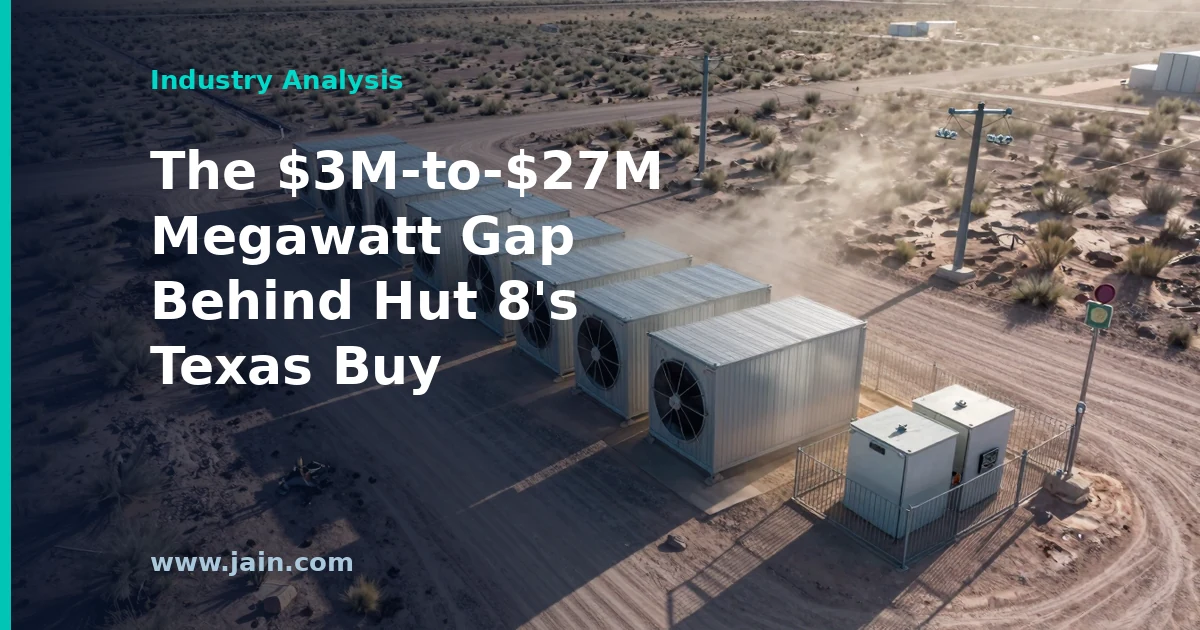
  • Hut 8’s $140M Poolin Win Tests AI Power’s $3M-to-$27M-per-Megawatt Gap

    Hut 8’s $140M Poolin Win Tests AI Power’s $3M-to-$27M-per-Megawatt Gap

    TL;DR · 30-second read

    The Short Version

    Hut 8, a company that mines bitcoin and builds computer centers, won a bankruptcy auction for two Texas computer sites with a $140 million offer. A judge still has to approve the sale on September 29.

    The prize is the electricity. Power-ready space at crypto miners has been valued at less than one-ninth of what similar space fetches once an artificial intelligence company rents it. Buying sites that already exist can mean skipping a crowded line to connect to the Texas grid.

    The catch: Hut 8 has not said how much power the sites have, and the Texas governor just ordered a pause on permits for these facilities.

    Hut 8 has won the bankruptcy auction for Poolin’s two Texas data centers, the Pyote and Tarbush sites, with a $140 million bid, Bitbo reported on September 24, 2026, citing court records. The sale still requires approval from the U.S. Bankruptcy Court for the District of New Jersey, which has scheduled a hearing for September 29.

    The sites would add to the roughly 1.5 gigawatts of power capacity Hut 8 already controls in Texas across operating and development-stage sites. The result arrives days after Texas Governor Greg Abbott directed the Texas Commission on Environmental Quality to halt data-center permits until ERCOT, the state’s main grid operator, completes an audit.

    Executive Summary

    Hut 8 placed the winning $140 million bid for two Texas data centers being sold out of Poolin’s bankruptcy. If the court approves the sale on September 29, the Pyote and Tarbush sites join a Texas portfolio of about 1.5 gigawatts that Hut 8 already has operating or in development.

    The deal matters because grid access has become one of the scarcest inputs for both AI data centers and bitcoin mining in Texas. Data centers now account for 87% of ERCOT’s large-load queue, which totals 410 gigawatts, according to CoinShares. An existing site whose power arrangements come with it is a way to acquire capacity without starting at the back of that line.

    Whether $140 million is cheap or expensive cannot yet be judged. Data-center capacity is priced per megawatt, and the megawatt capacity of Pyote and Tarbush has not been disclosed. The purchase also lands just as Texas has paused data-center permitting, which could either raise the value of sites that already hold permits or slow any plan to convert them.

    The $3M-to-$27M Megawatt Gap Behind the Bid

    Data-center capacity is priced per megawatt, meaning the amount of electrical power a site can deliver to the computers inside it. Two recent market marks bracket what sites like Pyote and Tarbush could be worth. At the low end, the energized but unleased capacity of some listed bitcoin miners is valued at less than $3 million per megawatt. At the high end, three fully leased AI facilities in Northern Virginia recently sold for about $27 million per megawatt. Between those two marks sits the cost of moving from one to the other: converting a mining site to AI-grade infrastructure runs roughly $8 million to $15 million per megawatt.

    Stacking those figures shows where the value is. Power at the miner mark plus conversion comes to about $11 million to $18 million per megawatt, against a $27 million mark for leased AI capacity. The residual, roughly $9 million to $16 million per megawatt on these numbers, is what a buyer captures only if it converts the site and signs a tenant. The comparison is directional rather than precise. Northern Virginia is a more mature data-center market, the Virginia sales were of finished and leased buildings, and Texas sites differ in power, land and permitting.

    Where the $140 million lands on that ladder depends on a figure that has not been published: the sites’ capacity. The arithmetic is simple. If Pyote and Tarbush together carry more than about 47 megawatts, Hut 8 bid less per megawatt than the sub-$3 million mark for miner capacity. If they carry less, the bid priced in a premium to that mark, effectively paying in advance for part of the conversion upside. In either case, the auction tests how much buyers will pay for a position on the gap before any tenant exists.

    Buying Around a 410-Gigawatt Queue

    ERCOT’s large-load queue is the line of big electricity customers asking to connect to the Texas grid. CoinShares puts its total at 410 gigawatts, with data centers making up 87% of it. A gigawatt is 1,000 megawatts. A new project joins that line and waits for grid studies and upgrades before it can draw power. An existing data center lets a buyer start further up the line, provided its grid connection and power agreements survive the change of ownership. That is the core case for buying distressed sites: the asset is the interconnection as much as the buildings.

    Governor Abbott’s September 21 directive to halt data-center permits until ERCOT completes an audit, alongside reviews of grid and water impacts, cuts both ways for this deal. If the pause applies only to new applications, sites that already hold their permits become scarcer relative to demand, which strengthens the case for buying over building. If expanding or converting an existing facility requires new or amended permits, the pause could reach Pyote and Tarbush too and delay any AI conversion until the audit concludes.

    On August 10, Hut 8 said it welcomed state scrutiny focused on grid reliability, local resources and community impacts. That statement predates the permit pause. How the company paces its Texas expansion against the audit is now an operational question as well as a policy one.

    A Small Check Against a Large Book

    For Hut 8, $140 million is modest. In the second quarter the company reported 949 megawatts of contracted IT capacity, worth an estimated $26.6 billion in base-term contracts, and said it had secured $7.5 billion in investment-grade financing so far. The bid equals less than 2% of that financing. For a developer at this scale, the binding constraint looks less like capital and more like power that can be connected and permitted, which is what a bankruptcy auction can offer.

    CoinShares estimates AI work can earn about $1.5 million in annual profit per megawatt, compared with $0.5 million for bitcoin mining. That tripling explains the pull toward conversion. On the same figures, though, the extra $1 million per megawatt a year takes roughly 8 to 15 years to repay an $8 million to $15 million conversion, before financing costs. The economics therefore rest on long, contracted leases, which is why a leased Virginia megawatt trades at many times an unleased one and why Hut 8 reports contracted capacity and contract value rather than raw megawatts alone.

    Mining Distress Is Supplying the Sites

    The second quarter was hard on miners. Bitcoin ended June at $58,400, while listed miners faced a weighted-average cash cost of about $75,500 per coin, which left the sector below breakeven overall. Conditions improved by mid-August as bitcoin recovered and a stronger hash price, the expected revenue per unit of computing power, pushed most operators back above cash breakeven. Stretches like that test weaker balance sheets, and assets that change hands through court processes are one result.

    The likely beneficiaries are creditors and estates selling energized sites, because the pool of bidders now includes developers who value power for AI, not only for mining. Listed miners whose capacity carries sub-$3 million marks could see those marks revisited if more auctions clear at higher per-megawatt prices. One auction is a single data point, though. The September 29 hearing, and any disclosure of the sites’ capacity, will say more about the market than the headline price does.

    Background

    Hut 8 is a publicly traded company (Nasdaq: HUT) that began in bitcoin mining and has built a large data-center business alongside it, reporting 949 megawatts of contracted IT capacity in the second quarter and about 1.5 gigawatts of operating or development-stage power capacity in Texas. Poolin is best known in bitcoin mining as a mining-pool operator. Its two Texas data centers, Pyote and Tarbush, are being sold through a bankruptcy proceeding in the U.S. Bankruptcy Court for the District of New Jersey.

    Texas has become a center of both bitcoin mining and AI data-center development because of its large, largely self-contained grid run by ERCOT. Demand to connect has surged, with data centers making up most of ERCOT’s large-load queue. That has made sites with existing power connections valuable and drawn closer scrutiny from state officials over grid reliability and water use.

    Sources

    Source: Hut 8 Wins Poolin’s Texas Data Centers With $140M Bid (Bitbo), on Hut 8’s winning bankruptcy-auction bid for Poolin’s Pyote and Tarbush sites and the Texas market context around it.

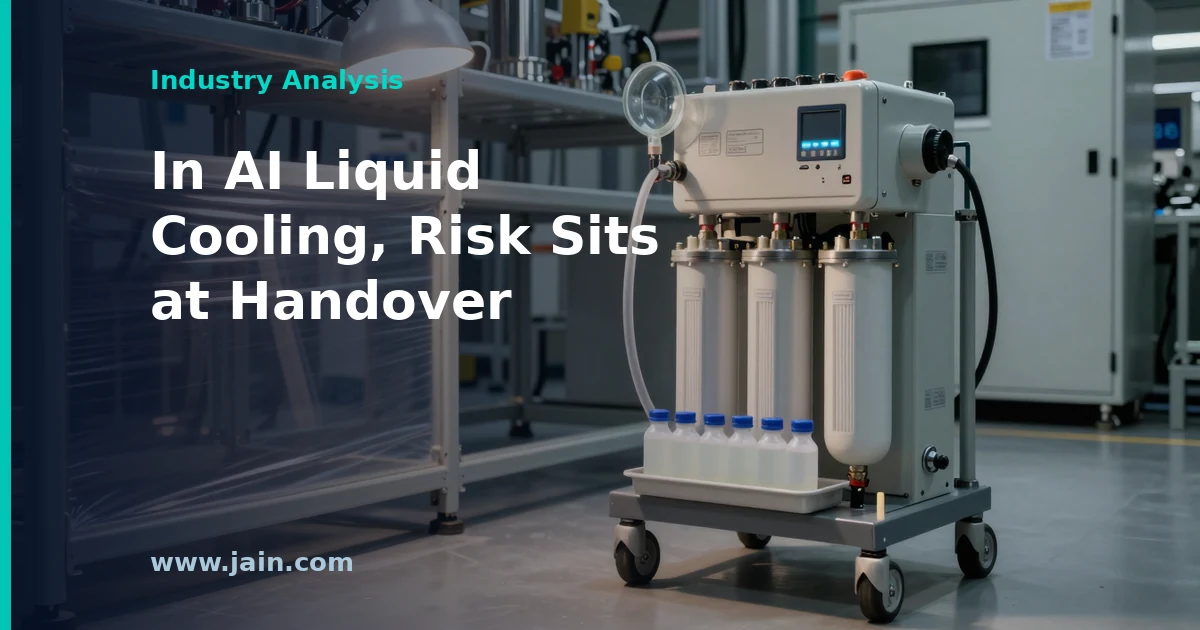
  • Vertiv’s 2nd Fluid-Services Deal in Under 10 Months: AI Cooling Risk Sits at Handover

    Vertiv’s 2nd Fluid-Services Deal in Under 10 Months: AI Cooling Risk Sits at Handover

    TL;DR · 30-second read

    The Short Version

    Vertiv, an American company that makes the power and cooling equipment inside data centers, is buying King Environmental Services, a Dublin firm whose crews clean, fill and test the liquid cooling systems used by artificial intelligence computers.

    Those chips run so hot that many new buildings pipe liquid right to them, much like a car’s radiator. A little dirt or trapped air in the pipes can overheat very expensive machines.

    It is Vertiv’s second purchase of this kind in under a year. The bet: the hard part is getting the plumbing right on day one.

    Vertiv Holdings Co (NYSE: VRT) said on September 24, 2026 that one of its wholly owned subsidiaries has signed a definitive agreement to acquire King Environmental Services Ltd. (KES), a fluid management, commissioning and load-testing specialist founded in 2002 and headquartered near Dublin, Ireland, with hubs in North Dublin and Frankfurt. Vertiv disclosed the deal in an 8-K filed the same day, with its press release furnished as Exhibit 99.1.

    The transaction is expected to close in the fourth quarter of 2026. Vertiv did not disclose financial terms and said the deal is not expected to be material to its financial results. It follows Vertiv’s December 2025 acquisition of PurgeRite, which the company describes as the foundation of its North American fluid management business.

    Executive Summary

    Vertiv is extending into Europe, the Middle East and Africa (EMEA) a services line it began building in North America less than a year ago: preparing, cleaning, balancing and testing the liquid loops that carry heat away from high-density AI servers. KES brings pipework flushing, filtration and water treatment, testing, adjusting and balancing (TAB, the process of tuning flow so every branch of a cooling system gets the fluid it was designed for), and large-scale thermal and electrical load testing, in which heaters and load banks stand in for real servers so a facility can be proven before it goes live.

    The deal is small by Vertiv’s own account, but the pattern is the story. Two consecutive fluid-management acquisitions, PurgeRite and now KES, put Vertiv’s capital into field crews rather than factories. CEO Gio Albertazzi framed the rationale directly: as computing density rises, cooling and power performance “will depend as much on execution in the field as on engineering and system design.”

    For data-center builders and operators in Europe, the practical consequence is that one of the largest thermal equipment vendors now intends to own the commissioning and lifecycle fluid work around its systems, offering what it calls a single accountable partner from construction through operation.

    Why Liquid Cooling Risk Concentrates at Handover

    Air-cooled data centers are forgiving: if a fan underperforms, the room runs a little warmer. Direct liquid cooling is less forgiving. Heat moves from chips into a closed loop of treated water or coolant, and Vertiv’s own description of what can go wrong is specific: contamination, trapped air, corrosion, improper chemistry and flow imbalances can reduce heat-transfer efficiency, degrade equipment and create commissioning and operational risks. Every one of those failure modes is introduced or caught in the same window, when a newly built system is flushed, filled, balanced and brought under load for the first time.

    That window is the handover between construction and live operation, and it is exactly where KES sits. The company describes itself as bridging construction and live operation, validating that cooling systems are clean, balanced, design-compliant and ready for AI workloads, including through thermal load testing before a facility enters service. PurgeRite plays the equivalent role for Vertiv in North America. Buying two such firms in under ten months, December 2025 and September 2026, is a clear signal of where Vertiv believes customer risk now sits: not in whether a coolant distribution unit or cold plate works on a test bench, but in whether the loop around it was installed and prepared correctly on site.

    This matters to three groups. Operators carry the downtime risk if a contaminated loop fouls hardware. General and mechanical contractors carry schedule risk if commissioning uncovers problems late. And hardware vendors carry reputational risk when a field problem is blamed on their equipment. Vertiv’s pitch of “a single accountable partner for commissioning, testing, fluid management and ongoing operations” is aimed squarely at that last point, collapsing a chain of hand-offs into one party that owns the outcome.

    A Small Check With a Strategic Signal

    Vertiv says the deal is not expected to be material to its results, and it furnished the announcement under Item 7.01, the Regulation FD disclosure item, in its September 24 8-K. In plain terms, this is a capability purchase, not a revenue purchase. Vertiv is buying people, procedures, regional permits and an operating footprint that would take years to build organically.

    The economics also point toward recurring work. The release stresses that beyond initial commissioning, customers need lifecycle fluid management for availability, thermal performance and equipment longevity. Fluid chemistry drifts, filters load up and systems get expanded, so a firm that commissions a loop is well placed to maintain it. For an equipment maker, attaching a service relationship to each installed liquid-cooling system is a way to stay involved long after the hardware sale.

    Vertiv’s own risk language underlines what it is really acquiring. Among the transaction risks listed in the release are its ability to maintain relationships with KES’s customers and suppliers and to retain KES management and key employees. In a field-services business, those relationships and people are the asset.

    What EMEA Adds, and What Remains to Be Proven

    KES operates from North Dublin and Frankfurt, two established European data-center hubs, and serves customers across EMEA. The release also highlights compliance with regional fluid handling, treatment and disposal requirements, a less glamorous but real advantage: treated coolant is a regulated waste stream, and a firm with local disposal routes and regulatory familiarity removes friction that a North American team would face entering the market.

    The broader claims deserve a measured reading. Vertiv describes “significant customer benefits” and KES’s “strong reputation” but offers no figures on KES’s headcount, number of projects, load-testing capacity or customer base, so the scale of the European execution capacity being added cannot yet be assessed. Reach is also a fair question: two hubs in Ireland and Germany can serve a lot of Europe, but supporting the Middle East and Africa at the same standard is a different logistical task.

    There is also a structural question for buyers. Commissioning has traditionally been valued partly for its independence from the equipment supplier. When the firm validating a cooling system is owned by the company that made parts of it, operators may want clarity on how test results, disputes and non-Vertiv equipment are handled. That is not a criticism of either company; it is the natural question any procurement team will ask as vendors move deeper into services.

    Background

    Vertiv, headquartered in Westerville, Ohio, and doing business in more than 130 countries, supplies power, thermal management and IT infrastructure equipment and services for data centers, communication networks and commercial and industrial facilities. As AI and high-performance computing push more heat into each server rack, operators are increasingly adopting liquid cooling, in which coolant is piped to or near the chips instead of relying only on moving air through the room.

    Liquid cooling shifts a new kind of work onto construction sites and operations teams: the cleaning, filling, balancing and ongoing treatment of cooling loops. Vertiv entered that business in North America with its December 2025 acquisition of PurgeRite. KES, founded in 2002, has specialized in the same class of work in Europe and serves customers across EMEA from North Dublin and Frankfurt.

    Sources

    Source: Vertiv Announces Agreement to Acquire King Environmental Services Ltd., Expanding Global Fluid Management Services, Vertiv’s announcement of its planned acquisition of the Dublin-based fluid management and load-testing firm.

    Primary sources: Vertiv Holdings Co Form 8-K, filed September 24, 2026 (SEC EDGAR); Exhibit 99.1 to Vertiv’s September 24, 2026 8-K: press release on the King Environmental Services acquisition.

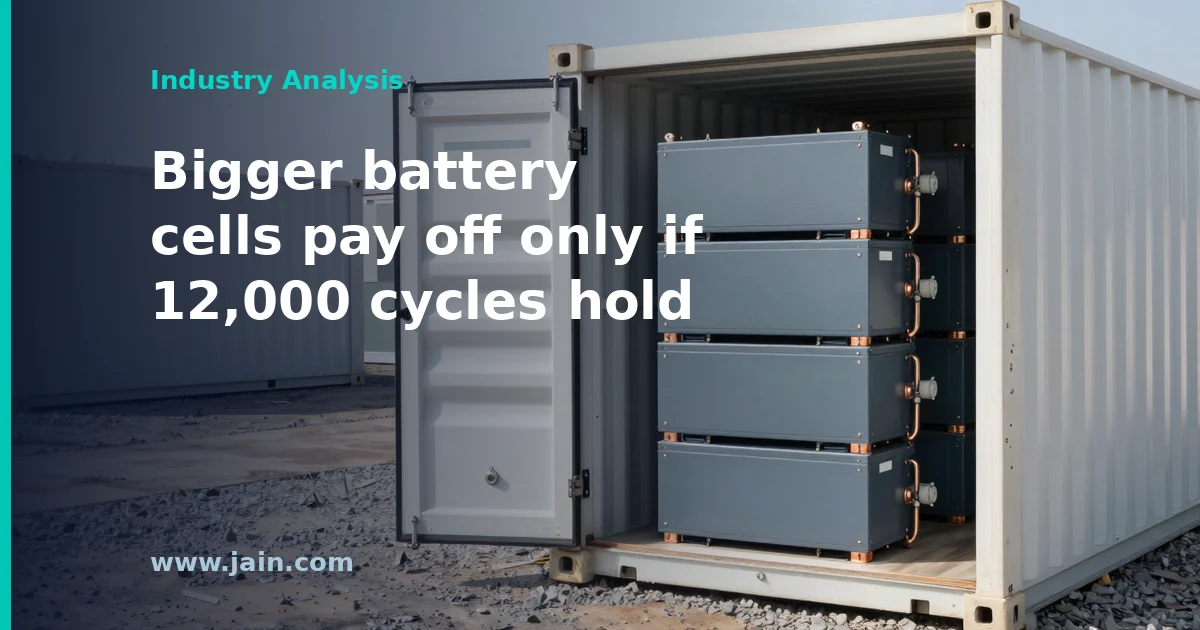
  • For AI-Era Grid Storage, Pylontech’s 601 Ah Cell Makes 12,000 Cycles the Number to Verify

    For AI-Era Grid Storage, Pylontech’s 601 Ah Cell Makes 12,000 Cycles the Number to Verify

    TL;DR · 30-second read

    The Short Version

    A Chinese battery maker, Pylontech, has started mass-producing unusually large battery cells. Cells are the building blocks inside the giant batteries that power companies use to store electricity.

    Bigger cells mean fewer pieces to wire together, so each battery can hold more in less space. The company says each cell can be charged and drained more than 12,000 times, enough for one cycle a day for over 30 years.

    That lifespan promise, more than the size, decides whether these batteries are cheap over their lifetime. Big batteries also help power grids keep up as artificial intelligence data centers push electricity demand higher.

    Pylontech (688063:SH) began serial production of 588 Ah and 601 Ah prismatic lithium iron phosphate (LFP) cells on September 21 at its plant in Hefei, China. The company announced the milestone in a release distributed via PR Newswire on September 23. The cells are designed for large, grid-scale battery energy storage systems (BESS). Prismatic means the cells are flat, rectangular blocks rather than cylinders.

    Pylontech says cumulative output of the new cells has already passed 100 MWh. The cells will go into its next-generation PyOcean storage systems, rated at 6.25 MWh and 8 MWh. For the 601 Ah cell, the company cites an energy density of 425.8 Wh/l, a cycle life above 12,000 cycles and 96.5% energy efficiency.

    Executive Summary

    Pylontech has moved its largest energy-storage cells from development into serial production at an automated line in Hefei. The pitch is straightforward. A bigger cell means fewer cells and fewer electrical connections per system, which the company says allows a more compact design, simpler assembly and lower costs over a system’s operating life. The first products to use the cells are PyOcean units of 6.25 MWh and 8 MWh.

    For anyone building or financing power capacity, including capacity for AI-driven load growth, the cell size is the least decisive number here. Larger cells reduce the parts count once, at construction. Cycle life and efficiency determine how much energy a system delivers over the years that construction cost is spread across. Pylontech’s claim of more than 12,000 cycles at 96.5% efficiency is therefore the figure that matters most. It is also the figure that production volumes of around 100 MWh cannot yet prove in the field.

    Bigger Cells Shrink the Parts Count, Not Just the Box

    Amp-hours (Ah) measure how much electric charge a cell holds. For cells of the same chemistry and voltage, doubling the amp-hours doubles the stored energy. A storage system built on 601 Ah cells therefore needs roughly half as many cells as one built on cells of half that capacity for the same total energy. It also needs correspondingly fewer busbars, welds and bolted joints tying them together. Pylontech says this is the point: fewer cells and connections allow a more compact design, simpler assembly and lower lifetime costs. The 6.25 MWh and 8 MWh PyOcean systems are where buyers should look for that claim to show up in real hardware.

    The 425.8 Wh/l figure is volumetric energy density, meaning how many watt-hours fit in a liter of cell. Denser cells help, but at system level the gain is diluted by cooling equipment, fire suppression, power electronics and required spacing. Footprint still matters to developers wherever pad space is limited or expensive, such as sites next to substations and large industrial loads.

    Size alone is unlikely to be a lasting advantage. Several Chinese cell makers are pursuing the same 500-plus amp-hour class. What will separate suppliers is manufacturing yield, consistency from cell to cell, and field performance data.

    Why 12,000 Cycles Matters More Than 601 Ah

    The economics of a storage battery come down to a ratio. The numerator is what it costs to build and run. The denominator is how much energy it delivers over its life. Larger cells trim the numerator once, at construction. Cycle life and efficiency set the denominator for every year afterward. The arithmetic behind Pylontech’s claim is simple. At one full cycle a day, 12,000 cycles works out to about 33 years. At two cycles a day, it is about 16 years. Whether the cells outlast the rest of the system, or become the limiting component, shapes replacement costs and project returns.

    The headline number needs context that Pylontech has not supplied. Cycle life is always measured under specific conditions: how deeply the cell is discharged, at what temperature, at what charge rate, and down to what remaining capacity before the cell counts as worn out. Without those conditions, 12,000 cycles cannot be compared cleanly with rival cells. Lenders, insurers and project owners typically price degradation through warranty terms, so the warranty attached to PyOcean systems will say more than the lab figure.

    The 96.5% energy efficiency figure means about 3.5% of the energy passing through the cell is lost, mostly as heat, on each round trip. Whole-system efficiency will be lower once inverters, transformers and thermal management are included. For a battery cycled daily to buy power cheaply and sell it when prices are high, small efficiency differences compound into meaningful revenue over decades. That makes this figure, alongside cycle life, the one that developers and financiers should test hardest.

    Where AI Load Meets Grid Batteries

    Pylontech markets these cells for grid-scale storage and has not tied them to data centers. The link to AI infrastructure is indirect but real. Grid operators facing new large loads, including AI data centers, use batteries to shift solar output into evening hours, hold reserves for sudden supply drops, and relieve congested lines while new transmission is built. Standalone systems like Pylontech’s 200 MW/400 MWh Ningxia project, which connect to the grid rather than to a single power plant, do exactly this kind of work.

    A data center operator weighing on-site storage has different priorities from a utility. That storage might provide backup, or it might let the operator agree to reduce grid draw at peak times in exchange for a faster connection. In either case, a denser, simpler system helps on a constrained campus. For that buyer, though, the deciding questions are fire-safety certification, warranty terms and degradation over the facility’s life. Those questions bring the analysis back to the 12,000-cycle claim rather than the cell size.

    From 100 MWh to Project Scale

    Serial production is a milestone, but the ramp is the real test. More than 100 MWh of cumulative output is a meaningful start. It equals about twelve 8 MWh PyOcean units, and it is a quarter of the capacity of the single Ningxia project. Pylontech’s reference projects show it has delivered at scale, including a 120 MW/240 MWh system in Yangzhou, Jiangsu province, the Ningxia installation and projects in Europe. The company has not said whether those projects use the new cells.

    The factory details carry more weight than they might appear to. Pylontech says key stages in Hefei are fully automated, using more than 120 industrial robots and 180 intelligent production devices. A manufacturing execution system (MES), software that logs process and quality data at each step, gives every cell a traceable record. For owners, traceability means a failing cell can be tied back to its production batch. That shortens failure investigations and strengthens warranty claims, which matters as much to a lender as the cycle-life figure itself.

    Background

    Pylontech is a Chinese lithium battery company listed in Shanghai under the code 688063. Internationally it is best known for battery packs used in homes and small businesses. It has been pushing into large-scale storage, the multi-megawatt systems that utilities and developers connect to the grid, with reference projects in Jiangsu, Ningxia and Europe. Its Hefei plant, where the new cells are made, is highly automated.

    Lithium iron phosphate (LFP) has become the dominant chemistry for stationary storage because it is thermally stable and long-lived. Across the industry, cell makers have been racing to build larger cells so that each storage container holds more energy with fewer parts. Grid-scale batteries are one of the tools utilities use to integrate renewable power and absorb new demand, including demand from data centers.

    Sources

    Source: Pylontech rozpoczyna seryjną produkcję ogniw LFP 588 Ah i 601 Ah do systemów magazynowania energii, Pylontech’s September 23, 2026 release announcing serial production of 588 Ah and 601 Ah LFP cells in Hefei, China.

  • Everyone Counts AI Packaging Capacity. TSMC’s 2029 Hub Targets Qualification Time

    Everyone Counts AI Packaging Capacity. TSMC’s 2029 Hub Targets Qualification Time

    TL;DR · 30-second read

    The Short Version

    The chips behind AI tools like chatbots are not just manufactured. They are also assembled: several chips are placed side by side or stacked, then wired together into one package. How well that assembly works now affects how fast new AI chips can ship.

    TSMC, the Taiwanese company that makes many of the world’s AI chips, is building a center in southern Taiwan to test new assembly machines and materials before they reach the factory floor. The goal is to catch problems early, instead of fixing them while production is already running.

    Do not expect quick results. The center is due to open in late 2029.

    Kaohsiung’s Baipu Industrial Park broke ground on September 21, 2026. SemiVision reported that TSMC will anchor the park with an advanced-packaging training and validation center. The center is not a production line. It is a facility where TSMC and its suppliers will jointly develop, test and qualify packaging equipment and materials. Earlier plans put TSMC’s initial site at roughly three hectares with two buildings, and operations are expected to begin around the fourth quarter of 2029.

    The park covers about 88.7 hectares, including roughly 53 hectares of industrial land. Around 25 hectares of that are expected to focus on advanced back-end semiconductor equipment and related supply chains. Official estimates suggest the park could eventually generate around NT$300 billion in annual output and more than 4,000 jobs.

    Executive Summary

    TSMC’s Baipu center is built around a reconfigurable “Mini-Loop” validation platform. It will not house a complete CoWoS production line. Instead, selected process modules will be assembled, tested and swapped out as technologies change. CoWoS (Chip-on-Wafer-on-Substrate) is TSMC’s technique for placing an AI processor next to stacks of high-bandwidth memory (HBM) inside a single package, and it sits at the core of today’s AI accelerators.

    The significance lies in what TSMC is separating out. It is moving equipment and materials validation out of its production fabs and into a dedicated site shared with suppliers. Validation is the work of proving that a new tool or material performs reliably enough for mass production. The move is a bet that AI chip supply increasingly depends on how quickly new packaging tools and materials can be qualified, and not only on how many packaging lines exist.

    For suppliers, the promise is earlier entry into TSMC’s development cycle. For AI chip designers, the payoff, if it comes, is fewer surprises when new package designs reach volume production. Neither benefit is expected before late 2029.

    Why the Gating Step Is Qualification Time, Not Floor Space

    Front-end chipmaking, the step where transistors are patterned onto wafers, relies on equipment giants such as ASML, Applied Materials, Lam Research and Tokyo Electron. These companies run large R&D organizations and global field-service teams that help get new tools qualified. Advanced packaging has no equivalent bench strength. Many back-end equipment suppliers are much smaller, yet a long list of technologies is changing at the same time:

    • CoWoS itself
    • Hybrid bonding, which fuses chips copper-to-copper without solder bumps
    • Thermocompression bonding (TCB)
    • Temporary bonding and debonding
    • Wafer and panel handling
    • Automated optical inspection and metrology
    • Underfill, dielectric and thermal materials

    The product cadence on top of that is accelerating. NVIDIA, AMD, Broadcom and custom AI chip (ASIC) developers keep introducing new architectures. HBM is moving from HBM3E toward HBM4 and beyond. Package size, die count, interconnect density and heat load are all rising together. The practical result is that one generation of equipment may not finish qualification before the next product generation arrives. Historically, some packaging tools were still being modified after installation, with engineers tuning them while production was already underway. A line that is being debugged is not yielding at full rate.

    Baipu is TSMC’s structural answer: move troubleshooting upstream, so that equipment, material and integration problems surface before mass production. This is why capacity counts alone understate the constraint. A packaging plant full of tools that are not yet qualified for the next package design cannot ship the next accelerator. Two groups are most exposed. The first is accelerator designers, whose launch timing depends on new package formats. The second is smaller back-end toolmakers, who have lacked a place to prove their equipment at the pace TSMC’s customers now demand.

    The Mini-Loop Is a Capital-Efficiency Choice

    A fixed, full-scale experimental packaging line would require heavy capital expenditure. Because 3D IC, CoWoS, HBM and chiplet architectures are evolving quickly, that line’s configuration could be outdated within a few years. The Mini-Loop concept avoids this. TSMC brings in only the module that needs validating, tests it, modifies it, and then reconfigures for the next job. The validation infrastructure evolves with each technology generation instead of being written off along with the previous one.

    The trade-off is fidelity. A modular loop tests modules. Some integration problems only appear when every step runs together at volume, and those may still surface in production. How much time Baipu actually saves will depend on two things: how TSMC bridges that gap, and whether validation results at Baipu carry directly into production qualification or must be partly repeated in the fabs.

    From Equipment Vendor to Co-Development Partner

    The conventional sequence runs like this: the customer sets a specification, the supplier builds the tool, the tool is installed in the fab, qualification begins, and then the equipment is modified in response to feedback. Baipu aims to put customers, equipment makers, materials companies and research organizations into the same development loop before mass production begins. In that loop, equipment fixes can happen immediately, and materials can move straight into another design of experiments (DOE, a structured test matrix). Software, automation, process recipes and metrology can all be tuned in parallel.

    This is a different advantage from simple proximity. Being near TSMC saves shipping and service time. Entering its development cycle early lets a supplier help shape the specification instead of chasing it. The groundbreaking drew companies from across the stack: TSMC, ASE, Foxconn, ASPEED, WinWay, King Slide, Gudeng, C SUN, Grand Process Technology, Scientech, AblePrint, HIWIN and Gallant Precision Machining. Attendance does not confirm investment. The first phase is expected to include validation work linked to TSMC and its suppliers, along with Foxconn AI-related R&D and manufacturing. A later phase could support further advanced-packaging expansion, including requirements from companies such as ASE.

    Kaohsiung presents Baipu as one link in a southern-Taiwan corridor:

    • Nanzih: advanced semiconductor manufacturing
    • Renwu: packaging and test
    • Ciaotou: materials and critical components
    • Gangshan and Lujhu: existing precision-machinery, metal-processing and fastener industries that the city hopes to pull into the equipment supply chain

    If that works, the regional advantage would not rest on any single fab. It would rest on how tightly manufacturing, packaging, equipment and qualification can iterate over short physical distances.

    What a 2029 Opening Means for Today’s AI Supply

    With operations expected around the fourth quarter of 2029, Baipu sits outside the window of current packaging constraints. Tools and materials qualified there would serve product generations well beyond today’s HBM3E-based parts. Buyers of AI accelerators should not read Baipu as near-term relief. It is an investment in the rate at which packaging technology can change over the following years.

    The headline economic figures are NT$300 billion in annual output and more than 4,000 jobs. These are park-wide official estimates, not TSMC commitments, and they say little about the metric that matters most to the industry: how much shorter qualification cycles actually become. No such target has been published. The argument that time-to-qualification is becoming the gating factor is coherent and fits the direction of packaging technology. Its payoff, however, will only be measurable in how many Baipu-validated tools reach production lines at TSMC, ASE or other manufacturers.

    Background

    TSMC (Taiwan Semiconductor Manufacturing Company) manufactures chips designed by other companies. In the AI era, its role has extended from wafer fabrication into advanced packaging. Packaging is the step where multiple chips, such as a processor and stacks of high-bandwidth memory, are combined into a single package. Technologies such as CoWoS, hybrid bonding and 3D IC stacking have made packaging a performance-critical part of AI accelerators, and HBM, substrates, thermal management, metrology and automation have become increasingly interdependent.

    Southern Taiwan is a focal point of that build-out. Kaohsiung’s semiconductor base already spans Nanzih, Renwu and Ciaotou. The city is positioning Baipu Industrial Park, which broke ground in September 2026, as both an advanced semiconductor equipment and materials validation hub and an AI advanced-manufacturing base.

    Sources

    Source: Beyond Capacity Expansion: TSMC Builds an Advanced Packaging Validation Hub in Kaohsiung (SemiVision), an analysis of TSMC’s planned advanced-packaging validation center at Kaohsiung’s Baipu Industrial Park.