Author: Deepak Jain

  • Cummins to Supply Natural Gas Generators for Large-Scale West Texas Data Centers

    Cummins to Supply Natural Gas Generators for Large-Scale West Texas Data Centers

    Cummins announced on June 15, 2026 that its natural gas generators will power large-scale data centers in West Texas. The announcement, issued by the engine and power-systems maker itself, confirms a supply arrangement for on-site power generation but does not disclose the customer, the number of units, the total generating capacity, or the delivery schedule.

    Executive Summary

    Cummins, the Indiana-based manufacturer best known for diesel engines and generator sets, says its natural gas generators have been selected to power large-scale data center development in West Texas. Stripped to its substantiated core, the announcement establishes three facts: the vendor (Cummins), the fuel (natural gas), and the setting (large-scale data centers in West Texas). Everything else — megawatts, dollars, dates, and the developer’s name — is left unstated.

    Even so, the deal is worth attention because of what it represents. Data center developers are increasingly buying their own power plants rather than waiting years for utility interconnections, and West Texas — with abundant natural gas, cheap land, and a congested grid — has become the proving ground for that model. A generator manufacturer announcing data-center-scale natural gas orders is a data point in one of the most consequential shifts in how digital infrastructure gets energized.

    Why Data Centers Are Buying Their Own Power Plants

    The traditional model — build a data center, plug it into the utility grid — is breaking down under AI-era demand. Requests for new grid connections in fast-growing markets can take several years to fulfill, because utilities must study, permit, and build transmission lines and substations before energizing a large new load. For developers racing to deliver capacity to cloud and AI tenants, that queue is often the single longest item on the schedule.

    On-site generation — sometimes called behind-the-meter power, because it sits on the customer’s side of the utility meter — collapses that timeline. Reciprocating natural gas generators of the kind Cummins builds can be manufactured, shipped, and commissioned far faster than a transmission project, and they can be added in increments as a campus grows. What was once purely backup equipment, sized to ride through rare outages, is increasingly being specified as primary or bridge power that runs for thousands of hours a year.

    West Texas: Abundant Gas, Strained Wires

    West Texas is a logical setting for this model. The region sits atop the Permian Basin, one of the most productive oil and gas regions in the world, where natural gas is plentiful and pipeline infrastructure is dense. Land is inexpensive, and the area already hosts substantial wind and solar development. What the region lacks is transmission: moving power across the Texas grid, operated by ERCOT (the Electric Reliability Council of Texas), is constrained by long distances and congested lines.

    For a data center developer, that combination — fuel at the wellhead, but a bottlenecked grid — makes on-site gas generation attractive. Rather than exporting the region’s energy as electrons over strained wires, the data center effectively moves the demand to the fuel. The announcement does not say whether these facilities will also seek grid connections later, a common strategy in which on-site generation serves as a bridge until utility service arrives.

    What It Means for Cummins and the Genset Market

    For Cummins, data-center demand is reshaping a business that historically sold generators as insurance. Backup generators run perhaps a few dozen hours a year; prime-power installations run continuously, which means more units, larger service contracts, and steadier parts revenue. Major engine and turbine makers across the industry have reported stretched lead times for large power equipment as data-center orders stack up, so a manufacturer publicizing a West Texas win is competing for position in a genuinely supply-constrained market.

    The competitive backdrop matters too. Data center developers weighing on-site power can choose among reciprocating gas engines, gas turbines, and, eventually, small modular nuclear or fuel-cell options. Reciprocating engines like Cummins’ occupy a middle ground: faster to deploy and more modular than turbines, though generally better suited to incremental capacity than to single gigawatt-scale blocks. Which architecture wins at a given site depends on scale, gas supply, and air-permitting headroom — none of which this announcement details.

    The Trade-Offs the Headline Skips

    Natural gas generation is cleaner than the diesel that has long dominated data-center backup — it burns with lower particulate and sulfur emissions — but it is still a fossil-fuel source with carbon dioxide and nitrogen oxide emissions, and large installations require air-quality permits from Texas regulators. Hyperscale tenants with public net-zero commitments will want to know whether gas-powered campuses fit their carbon accounting, whether the plants are bridge or permanent solutions, and whether the equipment can later run on lower-carbon fuels.

    Reliability cuts the other way: a well-designed fleet of gas generators with firm fuel supply can rival or exceed grid reliability, and it insulates the tenant from ERCOT’s scarcity-priced energy market during extreme weather. The honest framing is that on-site gas is a pragmatic trade — speed and control in exchange for emissions and fuel-price exposure — and this release, as circulated, makes the case for the first half without quantifying the second.

    Background

    Founded in 1919 in Columbus, Indiana, Cummins built its reputation on diesel engines for trucks and heavy equipment, and its power systems division has long been a leading supplier of standby generator sets for data centers, hospitals, and industry. In recent years the company has expanded its natural gas engine lineup as customers seek lower-emission alternatives to diesel.

    The backdrop is a historic surge in electricity demand from AI and cloud computing that has outpaced utilities’ ability to connect new loads. Texas has emerged as a leading destination for this buildout, and West Texas in particular — sitting atop the Permian Basin’s gas supply but far from major transmission corridors — has become a testbed for data centers that generate their own power on-site rather than waiting for the grid.

    Source: Cummins Natural Gas Generators to Power Large Scale Data Centers in West Texas — company announcement dated June 15, 2026, stating that Cummins natural gas generators will power large-scale data center development in West Texas.

  • Oracle-Linked Breach Exposes Higher-Ed Client Data: Third-Party Risk in Focus

    Oracle-Linked Breach Exposes Higher-Ed Client Data: Third-Party Risk in Focus

    On June 15, 2026, GovTech — a publication covering technology in state, local, and education government — reported that a cyber attack on Oracle exposed data belonging to the company’s higher-education clients. Oracle supplies universities with core administrative software, including enterprise resource planning (ERP) and student information systems.

    The syndicated report available to us does not specify which Oracle product was compromised, how many institutions were affected, how many records were exposed, or who carried out the attack. Those details, if published, appear only in the full original article.

    Executive Summary

    The headline fact is narrow but significant: an attack tied to Oracle, one of the largest enterprise software vendors in the world, exposed data belonging to colleges and universities that rely on its platforms. When a breach occurs at a vendor rather than at an individual campus, the exposure fans out across every customer whose data the vendor holds — a dynamic security professionals call third-party or supply-chain risk.

    Higher education is especially sensitive to this failure mode. Universities concentrate decades of student, employee, and financial records inside a small number of enterprise platforms, and most institutions have far smaller security teams than the vendors they depend on. A vendor-side incident therefore turns one intrusion into a sector-wide notification, remediation, and liability event.

    Because the available source material is limited to a headline and publication date, this article treats the incident’s scope, mechanism, and attribution as open questions. What we can analyze with confidence is the structural picture: why attacks on enterprise software platforms keep reaching higher education, and what buyers of critical SaaS infrastructure should take from another entry in that pattern.

    Why Higher Education Sits Downstream of Vendor Risk

    Universities run on a remarkably short list of administrative platforms. Oracle’s PeopleSoft Campus Solutions has for decades been one of the dominant student information systems — the software of record for admissions, enrollment, grades, and financial aid — while Oracle’s ERP and human-capital products handle payroll, procurement, and HR at many institutions. The practical consequence is concentration: a compromise at the vendor or platform layer can touch dozens or hundreds of institutions at once, without any of those campuses making an individual security mistake.

    That concentration is not irrational. Few universities can build or secure such systems themselves, and a major vendor’s security program typically exceeds what any single campus could fund. But it changes the shape of the risk. Instead of many small, independent targets, the sector presents a few large, high-value ones — and when one is breached, the affected institutions are largely passengers: they must notify students and regulators for an incident that occurred on infrastructure they do not control.

    A Recurring Pattern of Pressure on Enterprise Platforms

    The June 2026 report lands against a documented backdrop. In 2025, Oracle dealt with several security events: an incident involving legacy Oracle Health (formerly Cerner) systems that affected healthcare customers, contested claims of a breach of legacy Oracle Cloud authentication servers, and — most consequentially — a large extortion campaign in late 2025 in which the Cl0p ransomware group exploited a vulnerability in Oracle E-Business Suite to steal data from many corporate and institutional customers, universities among them. Whether the incident GovTech reported in June 2026 is connected to any of these is not established by the material available to us, and we do not assume it.

    What the pattern does establish is a strategic shift by attackers: rather than breaching organizations one at a time, sophisticated groups increasingly target the platforms that aggregate many organizations’ data — file-transfer tools, ERP suites, identity systems. Each successful campaign of this kind has produced victim counts in the dozens to hundreds. For defenders, this means the perimeter that matters is increasingly the vendor’s, not their own.

    The Economics and Accountability of SaaS Concentration

    Vendor-side breaches expose an unresolved accountability gap. The institution owns the legal duty to protect student records — under FERPA (the U.S. federal student-privacy law), the Gramm-Leach-Bliley Act’s safeguards rule for financial-aid data, and state breach-notification statutes — but the vendor controls the systems where the failure occurred. Contracts allocate some of this through security addenda, breach-notification clauses, and liability caps, yet those caps are often small relative to the real cost of credit monitoring, legal exposure, and reputational harm across an affected student body.

    For buyers of critical SaaS infrastructure, the practical lesson is not to retreat from cloud platforms — self-hosted systems at under-resourced institutions have historically fared worse — but to price vendor risk explicitly: demand timely breach notification and forensic transparency in contracts, minimize the sensitive data retained in each platform, and maintain an inventory of exactly which records sit with which vendor so that response does not begin with discovery. Incidents like this one tend to strengthen the negotiating position of customers who ask for those terms.

    Background

    Oracle is one of the world’s largest enterprise software companies, and its footprint in higher education runs deep: PeopleSoft, which Oracle acquired in 2005, became the administrative backbone of many universities, and Oracle has since pushed those customers toward its cloud ERP and student-system offerings. That installed base makes Oracle a systemically important vendor to the education sector — and a correspondingly attractive target.

    The broader context is a multi-year surge in attacks on the platform layer of enterprise IT. Campaigns against file-transfer tools and ERP suites — including the late-2025 Cl0p campaign exploiting Oracle E-Business Suite — demonstrated that compromising one vendor’s software can yield data from hundreds of downstream organizations. Higher education, with its rich records and constrained security budgets, has repeatedly appeared on the victim lists of such campaigns.

    Source: Cyber Attack on Oracle Exposes Data of Higher-Ed Clients — GovTech report, June 15, 2026, on an Oracle-linked breach affecting higher-education customers.

  • Tensordyne Bets Logarithmic Math Can Beat Nvidia at AI Inference Efficiency

    Tensordyne Bets Logarithmic Math Can Beat Nvidia at AI Inference Efficiency

    Chip startup Tensordyne is claiming that its processors, built around logarithmic arithmetic rather than conventional floating-point math, can run AI inference workloads with order-of-magnitude efficiency gains over Nvidia’s GPUs, according to a report published by IEEE Spectrum on June 15, 2026. The company is positioning its architecture as an answer to the power and cost crunch facing AI data centers.

    Executive Summary

    The core of Tensordyne’s pitch is a mathematical substitution. In a logarithmic number system, the multiplication operations that dominate AI computation can be replaced with far simpler addition, which in silicon translates to smaller circuits, less energy per operation, and less heat. Tensordyne argues that applying this technique at scale lets its chips serve AI models — the inference side of AI, where a trained model answers queries — at a fraction of the energy Nvidia’s general-purpose GPUs require.

    Why it matters: inference, not training, is becoming the dominant AI workload as deployed models serve billions of queries, and the electricity to run it is the scarcest resource in the data center industry. If any challenger can credibly deliver a step-change in performance per watt, it changes the economics of AI capacity planning. The critical caveat is that these are vendor claims reported around the company’s own comparisons; the coverage available does not include independent, standardized benchmark results, and history counsels patience — many architecturally clever chips have failed to dent Nvidia’s position for reasons that had little to do with arithmetic.

    Why Inference Efficiency Is the New Battleground

    The AI hardware market is bifurcating. Training frontier models remains a game of massive GPU clusters, but the recurring cost of AI is inference — every chatbot reply, every copilot suggestion, every recommendation is an inference call. As deployment scales, operators discover that their limiting factor is rarely chip supply alone; it is megawatts. Utilities are quoting multi-year waits for new grid connections, and data center operators increasingly evaluate silicon in terms of tokens per joule rather than raw speed.

    That reframing is precisely the opening challengers like Tensordyne are targeting. A chip that does the same inference work in a tenth of the power does not just cut the electricity bill; it multiplies how much AI capacity fits inside an existing power envelope, an existing cooling plant, and an existing building. For colocation and cloud providers, efficiency gains at the chip level cascade through the entire facility design.

    How Logarithmic Math Changes the Arithmetic

    The idea exploits a property taught in every algebra class: in the logarithmic domain, multiplication becomes addition. Neural networks are, computationally, mostly enormous grids of multiply-accumulate operations. Hardware multipliers are among the largest, most power-hungry blocks on an AI chip, while adders are small and cheap. Represent numbers as logarithms, and the expensive multiplications collapse into inexpensive additions — the transistor count and energy per operation drop substantially.

    The catch, and the reason this decades-old idea has not already taken over, is that addition becomes the hard operation in the log domain, and converting between representations can introduce accuracy loss. Any practical logarithmic chip lives or dies on how cleverly it handles those two problems without degrading model output quality. Tensordyne’s claim is essentially that it has engineered around them well enough for production AI models; the available reporting frames this as the company’s differentiating bet rather than an independently settled result.

    The Moat Is Software, Not Just Silicon

    Even granting the hardware claims, Nvidia’s dominance rests as much on its CUDA software ecosystem as on its chips. Every mainstream AI framework, serving stack, and optimization library targets Nvidia first. A challenger must make thousands of existing models run correctly and performantly on a novel number format — a compiler and tooling problem that has humbled well-funded rivals. Buyers evaluating alternative silicon consistently report that porting friction, not peak benchmark numbers, decides deployments.

    Tensordyne also enters a crowded field. Inference-focused challengers such as Groq and Cerebras, hyperscalers’ in-house chips like Google’s TPUs and Amazon’s Inferentia, and Nvidia’s own rapid cadence of more efficient GPU generations all compete for the same efficiency narrative. An order-of-magnitude claim is measured against a moving target: by the time a startup’s silicon ships in volume, Nvidia’s comparison point has usually advanced. That does not invalidate the approach, but it compresses the window in which a static advantage stays compelling.

    Background

    Tensordyne is one of a wave of semiconductor startups attacking the AI inference market with specialized architectures, betting that purpose-built silicon can undercut general-purpose GPUs on cost and power. The logarithmic-arithmetic approach it champions has a long academic history in signal processing but has rarely reached commercial AI silicon, largely because of accuracy and conversion challenges.

    The market context is stark: Nvidia holds a commanding share of AI accelerators, and AI’s growth has collided with electricity availability, making performance per watt the industry’s defining metric. Prior challengers have found that unseating an incumbent requires not just better hardware but a mature software stack, manufacturing scale, and customers willing to port their models — hurdles that have proven higher than the silicon itself.

    Source: Tensordyne’s Wild Log Math Aims to Leave Nvidia’s AI Chips In the Dust — IEEE Spectrum report on Tensordyne’s logarithmic-arithmetic chips and their claimed efficiency advantage over Nvidia GPUs for AI inference.

  • Bloom Report: AI Power Crunch Meets Community Pushback

    Bloom Report: AI Power Crunch Meets Community Pushback

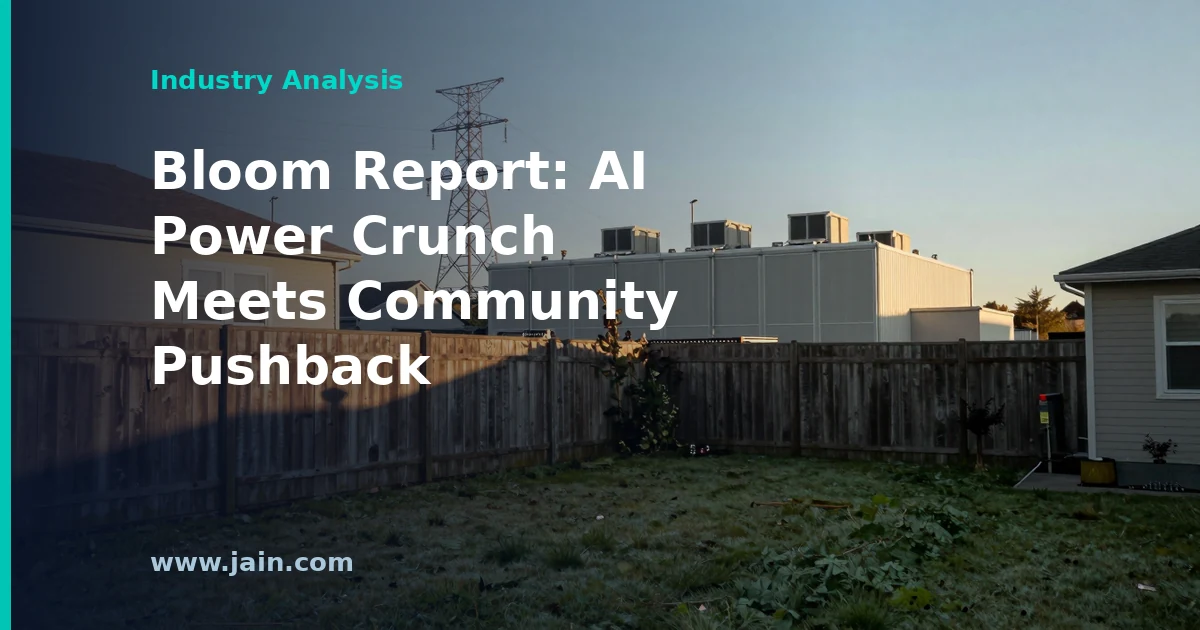
    Bloom Energy has published a report arguing that continued expansion of AI data centers depends on operators addressing two intertwined constraints in parallel: electricity supply and local community acceptance. The report, released in June 2026, frames the two issues as inseparable rather than sequential.

    Executive Summary

    The fuel-cell maker’s central thesis is that the AI buildout cannot be solved by megawatts alone. Even where generation, transmission, or on-site power can be procured, projects increasingly stall on zoning, noise, water, and land-use objections from neighbors and municipalities. Conversely, community outreach without a credible power plan is equally insufficient.

    For an industry accustomed to treating power and permitting as separate workstreams, the framing is a nudge toward integrated planning. It also, unsurprisingly, positions Bloom’s distributed on-site generation product as a natural fit for that integrated approach — a commercial interest readers should weigh alongside the analysis.

    Why ‘Power And Community’ Is The Real Bottleneck

    For most of the cloud era, data center siting followed a familiar recipe: cheap land, fiber, tax incentives, and a utility willing to sign an interconnect. AI workloads have broken that recipe. A single hyperscale AI campus can now request hundreds of megawatts — comparable to a small city — on timelines that outpace utility planning cycles measured in years. Bloom’s report reframes this as a two-variable problem: neither raw generation nor social license alone is sufficient, and progress on one without the other tends to collapse the project.

    That framing matters because the industry has historically optimized for the technical variable and treated community relations as public affairs. When a substation upgrade takes five years and a rezoning fight can add two more, the bottleneck is whichever constraint binds first — and increasingly, both bind simultaneously.

    Winners, Losers, And The Distributed-Generation Pitch

    The report’s logic favors technologies that can be sited close to load, deployed quickly, and configured to reduce visible community impact — a description that fits Bloom’s solid-oxide fuel cells, but also natural-gas peakers, on-site solar-plus-storage, and eventually small modular reactors. Utilities that can offer flexible, phased interconnection may win share from those that cannot. Operators willing to co-locate generation with compute gain optionality against constrained grids.

    The losers, if the thesis holds, are projects that assume grid capacity will materialize on hyperscaler timelines, and jurisdictions that treat every large load as a windfall without offering a permitting path. It is worth noting that the report comes from a vendor whose products directly address the problem it describes; that does not make the diagnosis wrong, but readers should treat the prescription as one option among several.

    Community Concerns Are Not A Communications Problem

    The more substantive point in the report — to the extent the summary conveys it — is that community opposition is being driven by material impacts: water use for cooling, diesel backup emissions, noise from chillers and generators, truck traffic during construction, and property-value anxieties. These are engineering and siting questions, not messaging questions. Treating them as PR problems has, in several high-profile cases, hardened opposition rather than defused it.

    For buyers and investors, the implication is that due diligence on new capacity should include the permitting posture and neighbor relations of a site, not just its power and fiber. A campus with signed interconnects but an organized opposition can be as delayed as one with willing neighbors and no transformer.

    Background

    Bloom Energy, founded in 2001 and headquartered in San Jose, makes solid-oxide fuel cells that generate electricity on-site from natural gas, biogas, or hydrogen. Its customers include large enterprises and, increasingly, data center operators seeking alternatives to constrained grid interconnection.

    The wider context is a global surge in AI training and inference demand that has pushed data center power requests to levels utilities did not plan for. In the United States in particular, several regions have seen multi-year queues for large interconnects, prompting operators to explore on-site and behind-the-meter generation, direct utility partnerships, and, in some cases, relocation to more permissive jurisdictions.

    Source: AI Data Center Growth Hinges on Solving Both Power Constraints and Community Concerns, Bloom Energy Report Finds — Bloom Energy report frames power supply and community acceptance as inseparable constraints on AI data center expansion.

  • Vertiv Buys ThermoKey as AI Cooling Supply Chains Consolidate

    Vertiv Buys ThermoKey as AI Cooling Supply Chains Consolidate

    Vertiv, the NYSE-listed data center power and cooling vendor, announced a deal to acquire ThermoKey, an Italy-based heat-exchanger manufacturer, in a move the company frames as expanding its AI data center cooling capabilities. The announcement was reported on June 14, 2026; Vertiv’s shares slipped on the news. Financial terms were not detailed in the source report.

    Executive Summary

    The acquisition extends a clear pattern: as AI compute densities climb, the large data center infrastructure vendors are buying their way down the thermal supply chain rather than relying on third-party component makers. Heat exchangers — the coils and dry coolers that ultimately move server heat into outside air or water loops — are an unglamorous but capacity-constrained link in every cooling system, whether air-cooled or liquid-cooled.

    For Vertiv, owning that link means more control over lead times, cost, and engineering integration at a moment when hyperscalers and colocation operators are ordering thermal equipment years ahead. The market’s muted reaction — shares slipped on the announcement — is a reminder that investors are weighing acquisition spending and integration risk against the strategic logic, particularly with no publicly detailed deal terms to anchor the math.

    Why Heat Exchangers Matter in the AI Era

    Every watt a GPU consumes becomes heat that must be rejected outdoors. Whatever technology sits at the rack — air handlers, rear-door heat exchangers, or direct-to-chip liquid cooling — the chain ends at heat-rejection hardware: coils, dry coolers, and condensers of the kind ThermoKey manufactures. As rack densities move from tens of kilowatts toward 100 kW and beyond, that heat-rejection stage scales in direct proportion, and it is built from metal, fabrication capacity, and factory floor space that cannot be conjured quickly.

    By acquiring a heat-exchanger maker outright, Vertiv converts a supplier relationship into owned capacity. That matters less in a slack market and enormously in a tight one — and the AI buildout has made thermal equipment a long-lead-time item across the industry.

    Vertical Integration Follows the GPU Buildout

    This deal fits a broader consolidation wave. Vertiv itself has been assembling a fuller thermal stack for years, including its 2023 move on liquid-cooling specialist CoolTera, and competitors across the cooling landscape have pursued similar component-level acquisitions. The strategic logic is consistent: hyperscale customers increasingly want one accountable vendor for an integrated thermal chain, from the cold plate on the chip to the dry cooler on the roof, with matched controls and warranties.

    For independent component makers, that creates a squeeze. Remaining suppliers may find their largest customers are now also their competitors’ owners — which historically pushes further consolidation, as remaining independents either scale up, specialize, or sell.

    Reading the Share-Price Slip

    The headline pairing — an expansion deal and a stock decline on the same day — deserves an even-handed reading. A slip on acquisition news is common and can reflect many things: general market movement, questions about price paid, or wariness about integration workload during a demand boom. Without disclosed terms, none of these can be confirmed from the source material, and a one-day move is a weak signal of a deal’s long-term merit.

    What can be said is that investors are applying more scrutiny to AI-infrastructure spending across the board in 2026, and vendors announcing acquisitions now carry the burden of showing how each deal converts into margin or capacity rather than merely into breadth. Vertiv’s task is to demonstrate that owning heat-exchanger manufacturing shortens its lead times or improves its unit economics in ways customers and shareholders can measure.

    Background

    Vertiv became an independent company in 2016 when private equity firm Platinum Equity carved Emerson Network Power out of Emerson Electric, and it listed on the NYSE in 2020. It has since ridden the data center construction wave as one of the leading suppliers of the power distribution, thermal management, and enclosure systems that sit around the servers themselves, competing with firms such as Schneider Electric and a field of specialist cooling vendors.

    The AI boom that accelerated in 2023 transformed cooling from a mature, slow-growth product line into a strategic battleground. Heat-exchanger manufacturing — historically a fragmented, regional business serving HVAC and industrial refrigeration as well as data centers — has become a supply chain chokepoint, setting the stage for component-level acquisitions like this one.

    Source: Vertiv Expands AI Data Center Cooling With ThermoKey Deal And Shares Slip — Yahoo Finance report, June 14, 2026, on Vertiv’s acquisition of heat-exchanger maker ThermoKey.

  • New National Security Memorandum Orders Hardened Cybersecurity for Military Systems

    New National Security Memorandum Orders Hardened Cybersecurity for Military Systems

    President Trump has signed a National Security Memorandum aimed at strengthening the cybersecurity of U.S. military and intelligence systems, according to a June 14, 2026 report from Homeland Security Today. The directive targets the government’s most sensitive networks — the classified and mission systems that fall outside the rules governing ordinary civilian federal IT.

    Details of the memorandum’s specific requirements, deadlines, and funding were not included in the source report, so the scope of the mandate beyond its stated goal — hardened defenses for military and intelligence systems — remains to be confirmed from the document itself.

    Executive Summary

    A National Security Memorandum (NSM) is a presidential directive used to steer national security policy across the Department of Defense and the intelligence community. This one, per the Homeland Security Today report, orders a strengthening of cybersecurity for military and intelligence systems — the category the government formally calls national security systems, which operate under their own rulebook separate from civilian agency networks.

    The announcement matters for two reasons. First, national security systems carry the country’s most consequential data — weapons control, intelligence collection, command and control — and are the highest-value targets for state-sponsored attackers. Second, presidential directives in this space tend to cascade outward: past directives of this kind translated into binding technical requirements for agencies and, eventually, into procurement obligations for the contractors and infrastructure providers that build and host these systems.

    What is not yet clear is how prescriptive this memorandum is. The public reporting available at publication confirms the signing and the goal, but not the mechanisms — whether it sets new technical baselines, new deadlines, new reporting duties, or new authorities. That distinction will determine whether this is a significant operational shift or a reaffirmation of existing policy.

    What a National Security Memorandum Can Actually Do

    Presidential directives come in different weights. Executive orders on cybersecurity, such as the landmark 2021 order on improving the nation’s cybersecurity, generally bind civilian agencies. National security systems — networks handling classified information or supporting military and intelligence missions — are deliberately carved out and governed through separate instruments, with the National Security Agency serving as the designated national manager for their security. An NSM is the standard vehicle for directing change in that classified domain, which is exactly why this format was used here.

    The practical effect of an NSM depends on its plumbing: whether it directs specific agencies to issue binding operational directives, sets measurable deadlines, and assigns oversight. The 2022 memorandum known as NSM-8, for example, gave national security systems concrete timelines for adopting multifactor authentication and encryption and required agencies to report cross-domain systems to the NSA. If the new memorandum follows that pattern, agencies and their contractors will see enforceable requirements; if it is primarily a statement of priorities, its effect will depend on follow-on implementation guidance.

    Why Military and Intelligence Networks Are a Distinct Problem

    Hardening national security systems is a different engineering challenge from securing ordinary enterprise IT. These environments include air-gapped classified enclaves, decades-old weapons platforms that cannot simply be patched, and cross-domain solutions that move data between networks of different classification levels — each a specialized attack surface. The Department of Defense has been pursuing a zero trust architecture, a security model that assumes no user or device is trusted by default, with a stated target of implementation across the department by fiscal 2027. A new presidential directive landing in mid-2026 arrives squarely in the execution window of that effort.

    The threat context is well established even where this memorandum’s text is not. State-sponsored intrusion campaigns against U.S. defense networks and defense industrial base companies have been publicly documented by U.S. agencies for years, and the compromise of contractors — rather than the classified networks themselves — has repeatedly proven to be the softer entry point. Any serious hardening directive has to reckon with that supply chain reality, which is why observers will look closely at whether this NSM extends obligations to contractors and cleared cloud providers.

    Follow the Procurement: Who Stands to Gain

    Directives of this kind reliably move money, even when they arrive without new appropriations. Requirements for stronger identity controls, encryption modernization, network segmentation, and continuous monitoring translate into demand for the vendors that supply those capabilities — and into compliance burdens for the defense contractors that must meet them. Providers of classified-capable cloud regions, secure colocation, and accredited connectivity sit upstream of all of it: hardened systems still need hardened facilities, power, and network paths to run on.

    The cautionary note is timing. Federal cybersecurity mandates historically outpace the budgets attached to them, and implementation across the intelligence community and military services can stretch years past initial deadlines. Buyers and investors should treat the memorandum as a directional signal about sustained federal demand for defense-grade security infrastructure, not as a near-term revenue event — at least until implementing directives, budget requests, and contract vehicles make the requirements concrete.

    Background

    U.S. federal cybersecurity policy runs on two parallel tracks. Civilian agency networks answer to the Cybersecurity and Infrastructure Security Agency and directives like the 2021 executive order on improving the nation’s cybersecurity, which mandated zero trust adoption and software supply chain standards. National security systems — the classified and mission networks of the military and intelligence community — follow a separate track: the 2022 directive NSM-8 extended equivalent-or-stronger standards to those systems and reinforced the NSA’s role as their national manager.

    The June 2026 memorandum continues a two-decade pattern of successive administrations tightening requirements on this second track as state-sponsored cyber operations against defense targets have escalated. For the infrastructure industry, that pattern has steadily expanded the market for defense-grade security: accredited cloud regions, secure facilities, encrypted connectivity, and the compliance regimes — such as CMMC for defense contractors — that govern who may build and operate systems touching sensitive government data.

    Source: Trump Signs National Security Memorandum to Strengthen Cybersecurity of Military and Intelligence Systems — Homeland Security Today report, June 14, 2026, on a presidential directive ordering hardened cybersecurity for U.S. military and intelligence systems.

  • MS-ISAC Enters Uncertain Era After Funding Cut and Member Exodus

    MS-ISAC Enters Uncertain Era After Funding Cut and Member Exodus

    The Multi-State Information Sharing and Analysis Center (MS-ISAC) — the primary cyber threat-sharing hub for US state, local, tribal, and territorial governments — has entered what Cybersecurity Dive describes as an uncertain new era after losing its federal funding and thousands of member organizations, according to a June 14, 2026 report.

    The organization, operated by the nonprofit Center for Internet Security (CIS), spent roughly two decades as a free, federally supported service before its cooperative-agreement funding through the Cybersecurity and Infrastructure Security Agency (CISA) was cut in 2025, forcing a pivot to a fee-based membership model that many members have evidently declined to join.

    Executive Summary

    For most of its existence, MS-ISAC functioned as something close to a public utility for government cybersecurity: any state agency, county, city, school district, or tribal government could join at no cost and receive threat intelligence, incident-response support, and network monitoring, with the bill largely picked up by the federal government. That arrangement ended when federal support was withdrawn in 2025, and CIS moved the service to paid membership.

    The reported result — thousands of member organizations gone — matters because an information-sharing organization’s value is a function of its network. Every member that drops out is both a blind spot in the collective picture and, potentially, a softer target. State and local governments run elections, water systems, 911 dispatch, courts, and schools; they are also among the most frequent victims of ransomware, precisely because so many of them lack the budget and staff for standalone security programs.

    The open question as of mid-June 2026 is whether a smaller, self-funded MS-ISAC can sustain the same defensive footprint — and what happens to the organizations that used to depend on it and now, apparently, go without.

    From Public Good to Paid Service — and Why That Math Is Hard

    Shared threat intelligence has the economics of a public good: it is expensive to produce, nearly free to distribute, and most valuable when everyone participates. Federal funding solved the free-rider problem by simply paying for universal access. A fee-based model reintroduces it, and with a cruel twist known as adverse selection: the organizations most likely to drop out are the small, resource-poor ones — rural counties, small school districts, modest municipal utilities — which are exactly the entities least able to replace the service on their own and among the most attractive targets for ransomware crews.

    None of this means CIS made the wrong call; a nonprofit cannot indefinitely underwrite a national service out of its own reserves once its primary funder exits. But the reported loss of thousands of members suggests the transition is playing out the way the economics would predict. The membership that remains will skew toward larger, better-funded governments, which changes what the shared data represents.

    The Collective-Defense Network Effect Runs in Reverse

    An ISAC — an Information Sharing and Analysis Center — works because one member’s incident becomes every member’s early warning. A phishing campaign spotted against one county clerk’s office can be blocked at ten thousand others within hours. That flywheel spins both ways: as membership shrinks, the sensor network shrinks, detection gets slower, and the value proposition for remaining members weakens, which can encourage further departures. Managed defensively, a smaller ISAC can still deliver real value to a committed core; managed poorly, shrinkage becomes self-reinforcing.

    There is also a national-visibility cost that lands on the federal government itself. MS-ISAC historically served as the aggregation point through which federal agencies understood what was happening across tens of thousands of state and local networks. Fewer members means a dimmer picture — for everyone, including the agencies that cut the funding.

    Who Fills the Gap

    Three candidates stand out. First, states themselves: the “whole-of-state” model, in which a state CISO extends security services, monitoring, and grant money downward to counties, cities, and schools, has been gaining momentum for years and now has a stronger forcing function. Second, commercial vendors: managed detection and response (MDR) providers, threat-intelligence platforms, and security-focused hosting and connectivity providers will compete for budget that once didn’t need to exist, though public-sector procurement cycles and thin budgets make this a slow, uneven substitution. Third, CISA’s own free services — vulnerability scanning, advisories, regional advisors — which remain available but were never designed to replicate an ISAC’s peer-to-peer sharing fabric.

    For infrastructure and security providers, this is a genuine market signal: the public-sector demand for outsourced security operations just grew, involuntarily. The risk is that the gap gets filled unevenly — well-funded jurisdictions buy their way to coverage while the long tail of small governments simply absorbs more risk.

    Background

    MS-ISAC was established in the early 2000s and grew, under the nonprofit Center for Internet Security, into the designated cyber threat-sharing and defense hub for US state, local, tribal, and territorial (SLTT) governments — a sector spanning tens of thousands of organizations, most of them too small to staff full security teams. Membership was free, underwritten by federal cooperative-agreement funding channeled through the Department of Homeland Security and later CISA, and the center became a fixture of national cyber defense, particularly as ransomware attacks on cities, counties, and school districts escalated through the 2020s.

    That model unraveled in 2025 when federal funding was withdrawn amid broader cuts to CISA programs, pushing CIS to a fee-based membership structure. The June 2026 reporting marks a milestone in that transition: the organization survives, but with thousands fewer members and an open question about who now watches over the jurisdictions that left.

    Source: MS-ISAC enters uncertain new era after losing federal funding and thousands of members — Cybersecurity Dive report, June 14, 2026, on the threat-sharing center’s post-federal-funding transition.

  • Nvidia’s AI Inference Chip Share Appears to Be Rising, Defying Challenger Narrative

    Nvidia’s AI Inference Chip Share Appears to Be Rising, Defying Challenger Narrative

    The Information reported on June 14, 2026 that Nvidia’s share of the AI inference chip market appears to be rising. The headline finding cuts against a widely held industry expectation: that the shift of AI workloads from model training toward day-to-day inference would open the door to cheaper, specialized alternatives and gradually dilute Nvidia’s dominance.

    The report’s underlying data and figures sit behind The Information’s paywall, so the specific share numbers, timeframe, and methodology were not available in the syndicated headline. What is notable is the direction of the claim itself — share rising, not merely holding.

    Executive Summary

    For two years, the standard bear case on Nvidia has gone like this: training new AI models demands the most powerful, flexible chips — Nvidia’s home turf — but inference, the act of actually running a trained model to answer queries, is a more predictable, cost-sensitive workload where custom chips from cloud providers and startups could undercut GPUs. As inference grows to dominate total AI compute spend, the theory went, Nvidia’s grip would loosen.

    The Information’s report suggests the opposite may be happening: even as inference becomes the larger workload, Nvidia appears to be gaining share within it. If accurate, that matters enormously, because inference is the recurring, revenue-generating side of AI — every chatbot reply, every AI-assisted search, every coding suggestion is an inference event. Winning inference means winning the long tail of AI economics, not just the up-front build-out.

    The caveat is equally important: ‘appears to be rising’ is a hedged formulation, and without the report’s underlying figures, buyers and investors should treat this as a directional signal to test against their own deployment data rather than a settled fact.

    Inference Was Supposed to Be the Open Flank

    In AI infrastructure, ‘training’ means teaching a model from massive datasets — a bursty, brutally demanding job — while ‘inference’ means serving the finished model to users, millions of times a day. Because inference workloads are more repetitive and predictable, they are in principle easier to serve with purpose-built silicon: chips designed to do one thing cheaply rather than everything well. That logic is exactly why Google built its TPUs, Amazon built Inferentia and Trainium, Microsoft developed Maia, and a wave of startups raised billions to attack the inference market specifically.

    A report that Nvidia’s inference share is rising, then, is not a routine data point — it challenges the core mechanism by which competitors expected to gain ground. It suggests that whatever advantages custom chips hold on paper, buyers deploying real inference fleets at scale are still, on the margin, choosing GPUs.

    Why the Moat May Be Software, Not Silicon

    The most plausible explanation for durable GPU share in inference is not raw chip performance but the surrounding ecosystem. Nvidia’s CUDA software platform, and the inference-serving stack built on top of it, lets teams deploy new model architectures quickly. In a period when leading models change every few months, flexibility has real economic value: a custom chip optimized for last year’s model architecture can become a stranded asset when the industry pivots to a new one.

    There is also a fleet-management argument. Operators who own large GPU installations for training can redeploy the same hardware for inference as demand shifts, keeping utilization high. A mixed fleet of GPUs plus several custom accelerators, by contrast, fragments capacity and multiplies engineering overhead. None of this makes custom silicon unviable — hyperscalers continue to deploy their own chips internally at scale — but it helps explain why the merchant market, where chips are sold to third parties, may be consolidating around the incumbent.

    What Rising Share Would Mean for the Rest of the Market

    If Nvidia is gaining inference share, the squeezed parties are the merchant challengers — chip startups and rival semiconductor firms selling inference accelerators to enterprises and neoclouds — more than the hyperscalers, whose custom chips mostly serve their own internal workloads and are measured by different economics. For chip startups, inference was the beachhead market; a rising incumbent share shortens their runway and raises the bar for differentiation on price-performance.

    For buyers of AI infrastructure — enterprises, cloud customers, and the data centers that house this equipment — the practical implication is continuity: power densities, cooling requirements, and networking architectures will keep following Nvidia’s roadmap, and supply allocation from a single dominant vendor remains a planning risk. A more competitive inference market would have given buyers pricing leverage; this report suggests that leverage is not materializing yet.

    How Much Weight Can One Headline Carry?

    It is worth being precise about what has and has not been established. The Information is a subscription outlet with a strong track record on AI-industry reporting, but the syndicated headline alone — ‘appears to be rising’ — carries visible hedging, and the definition of the market matters greatly. A share measured in revenue will favor Nvidia’s premium pricing; a share measured in deployed inference volume might tell a different story, especially if hyperscalers’ internal chips are excluded. Until the methodology is visible, the fair reading is that the custom-silicon disruption thesis is arriving more slowly than predicted — not that it has been refuted.

    Background

    Nvidia became the dominant supplier of AI computing hardware on the strength of its graphics processing units (GPUs), which proved ideally suited to the parallel math behind modern AI, and its CUDA software ecosystem, which made those chips the default target for AI developers. Its data center business grew into one of the largest revenue engines in the semiconductor industry during the generative-AI build-out that began in late 2022.

    From early in that boom, cloud providers and startups invested heavily in custom AI accelerators — Google’s TPU line being the longest-running example — with inference widely identified as the segment where alternatives would gain traction first. The June 2026 report from The Information lands directly on that fault line, suggesting the incumbent is consolidating rather than ceding the inference market.

    Source: Nvidia’s Share of AI Inference Chip Market Appears to Be Rising — The Information, June 14, 2026, reporting an apparent rise in Nvidia’s share of the AI inference chip market.

  • 1.8 Billion Gallons a Year Shows Why AI Data Center Siting Is Becoming an Aquifer Issue

    1.8 Billion Gallons a Year Shows Why AI Data Center Siting Is Becoming an Aquifer Issue

    TL;DR · 30-second read

    The Short Version

    Data centers, the huge buildings full of computers behind apps and artificial intelligence, run hot, and many use water to cool down. A very large one can use about as much water in a year as a medium-sized town.

    Now the people who drill wells and study underground water are weighing in. Their national association wants builders to say where their water comes from and to consider cooling with the ground instead.

    Many communities rely on underground water, so what counts is what one building does to one town’s supply.

    Environmental Leader reported on June 12, 2026 that the National Ground Water Association (NGWA) has released a position paper on data centers and groundwater, along with a three-part series in its trade magazine, Water Well Journal. The association wants policymakers, regulators and developers to build groundwater sustainability into siting, permitting and operations, including clear disclosure of water sources and water use.

    NGWA also says it strongly supports evaluating and implementing geothermal systems and other low-water-use technologies for cooling. It cites estimates of about 110 million gallons a year for a midsize data center and up to 1.8 billion gallons for a large hyperscale facility, the very large class of site built for major cloud and AI operators.

    Executive Summary

    A national trade body for water well contractors, groundwater scientists and engineers, and equipment suppliers has taken a formal position on data center growth. NGWA’s paper, developed by its Data Center Task Force, argues that expansion must protect the aquifers (underground water-bearing rock and sediment) that communities and ecosystems rely on. It asks for groundwater to be considered at the siting and permitting stages, not only once a facility is running.

    The announcement matters because of who is speaking and where it directs attention. Much of the data center water debate has been framed around national totals. The people who drill and monitor wells work at the scale of a specific formation and its neighboring users, which is where a single large facility’s demand would be felt.

    The paper is a position, not a rule, and NGWA named no developer or regulator that has adopted it. Its practical weight depends on whether permitting authorities and data center builders take up its disclosure and technology recommendations.

    Why a 1.8-Billion-Gallon Site Changes the Question

    The US Department of Energy estimate cited by NGWA puts total on-site data center water consumption at 17 billion gallons in 2023, and projects that it could double or even quadruple by 2028. That implies a range of about 34 billion to 68 billion gallons. Spread across more than 5,400 US data centers, the 2023 total sounds manageable, at roughly 3 million gallons per site, although the two counts come from different years.

    The facility-level estimates from the Environmental and Energy Study Institute look very different. A midsize site at 110 million gallons a year would use about 300,000 gallons a day on average, while a large hyperscale site at 1.8 billion gallons would use about 4.9 million. At that top-end rate, about ten facilities would match the entire 2023 national on-site figure. Those numbers do not reconcile neatly. Either use is heavily concentrated in a small share of sites, many facilities use little water on-site, or the estimates measure different things. In each case, the national average tells a county planner very little about the project in front of them.

    This is the mechanism behind the aquifer argument. An aquifer is a local resource with its own recharge rate and its own neighboring wells, so a steady draw of several million gallons a day is assessed against that formation, not against a national total. The people most affected are permitting authorities, nearby well owners and developers whose site selection could depend on the answer. There is an important limit: a large site’s water does not necessarily come from groundwater, since it may be supplied by a utility or surface sources. That is why NGWA’s request for disclosure of water sources is central to its position.

    Geothermal Is a Promising Claim That Still Needs Numbers

    NGWA describes geothermal systems and other low-water-use technologies as scalable solutions that can significantly reduce, or eliminate, consumptive water use, meaning water that is evaporated or otherwise not returned to its source. The principle is familiar: rather than evaporating water to shed heat, a geothermal system moves heat into the ground. As AI workloads concentrate more heat in each server rack, any option that decouples cooling from water use will draw attention.

    The announcement, however, offers no performance data, cost range or example of a data center operating this way at hyperscale. Scalability is the claim most in need of evidence, because a large facility rejects heat continuously and the ground around a site can absorb only so much of it over time. Land area, drilling costs and local geology would all shape the answer. Design matters too: a sealed closed-loop system differs from an open-loop one that pumps groundwater, and the latter would keep the aquifer directly in play.

    It is also fair to note that NGWA’s task force includes well contractors and suppliers of groundwater technology, who would have a professional stake in geothermal work. That does not weaken the underlying hydrogeology, and the same expertise is what makes the group credible on the topic. It does mean that buyers should ask for the same site-specific evidence they would expect from any cooling vendor.

    Disclosure Would Be the Nearer-Term Pressure on Developers

    Of NGWA’s requests, disclosure of water sources and water use may prove the most immediately actionable, because it needs no new cooling technology. If permitting bodies adopted such expectations, developers could face groundwater questions earlier in site selection, when changing the location or the cooling design is still possible.

    Disclosure alone would not settle the debate, because a useful figure has to specify what is being counted. Withdrawal and consumption are different measures, annual averages can obscure hot-weather peaks, and the Department of Energy’s on-site estimates by definition exclude water used elsewhere, such as at power plants. Lower water use can also carry an energy trade-off, since some low-water cooling designs draw more electricity. NGWA itself frames the coming years as critical for both water and energy demand, so the two should be weighed together.

    Background

    The National Ground Water Association, based in Westerville, Ohio, represents professionals across the groundwater field, including contractors, scientists, engineers, suppliers and manufacturers. NGWA president Seth Kellogg, a senior principal geologist at Geosyntec Consultants Inc., said that “groundwater professionals must play an important role in ensuring long-term water sustainability is a key consideration in the rapid growth of data centers.”

    Data centers house the servers behind cloud computing and AI services, and those servers generate heat that must be removed continuously. Some cooling methods rely on water, while others use far less of it but may have different energy and cost profiles. With US facility counts already above 5,400, that design choice is increasingly tied to local questions about water supply.

    Sources

    Source: Groundwater Pros Step Into Data Center Cooling Debate, on the National Ground Water Association’s position paper and Water Well Journal series on data centers and groundwater.

  • Goldman’s $5.3 Trillion AI Capex Math Shows Why Bond Buyers’ Limits Will Matter

    Goldman’s $5.3 Trillion AI Capex Math Shows Why Bond Buyers’ Limits Will Matter

    TL;DR · 30-second read

    The Short Version

    The biggest technology companies are expected to spend about $5.3 trillion on artificial intelligence and the huge computer buildings behind it by 2030. That forecast jumped by $800 billion after just one round of quarterly results.

    Goldman Sachs says a practical problem is coming: big lenders can only hold so much debt from the same few companies. So more of the money is likely to come from private investment funds.

    Why it matters: who pays for the AI boom, and at what price, could shape how fast it gets built.

    Goldman Sachs Research said on June 12, 2026 that private markets are likely to play a growing role in financing data centers, as hyperscalers (the largest technology companies leading the AI buildout) are expected to make a combined $5.3 trillion in capital expenditures from 2025 through 2030. That estimate stood at $4.5 trillion before first-quarter earnings reports.

    Private infrastructure funds raised a record $221 billion in 2025 and could exceed $3 trillion in assets under management by 2030, according to the analysis by Amanda Lynam, the firm’s chief credit strategist in Goldman Sachs Research.

    Executive Summary

    The central argument concerns the capacity of public debt markets more than the appetite for AI. Hyperscalers already account for a large share of new corporate borrowing. As the same few issuers sell ever-larger amounts of debt, they gain weight in widely tracked bond indices and can run into the limits investors set on exposure to any one company.

    Lynam expects those constraints to become “somewhat more binding in coming years,” while acknowledging that their magnitude is “still heavily debated.” At a minimum, she argues, they will affect decisions about exposure and pricing. Private infrastructure and real estate funds, which together held about $1 trillion in uninvested capital, are the natural complement.

    The forecast also carries its own caution: hyperscaler capex estimates are growing meaningfully faster than actual data center construction. The size and timing of long-term financing needs therefore remain open, even as the direction of travel toward a broader capital base looks clear.

    Why Bond Buyers’ Limits Will Matter

    A corporate bond index is a benchmark many investors track. When a handful of companies issue large amounts of debt, their weight in that benchmark rises, and portfolios tracking it can end up holding more of those names than their managers may want. Some investors also operate under formal concentration limits, which cap exposure to a single borrower. Once those limits come into play, a borrower may still find buyers, but the pool of willing buyers can narrow and the price of the debt can change.

    The numbers explain why this has moved up the agenda. Goldman’s estimate of hyperscaler capital spending from 2025 through 2030 rose from $4.5 trillion to $5.3 trillion around a single earnings season, an increase of $800 billion. Lynam’s team has already noted borrowers tapping investment-grade debt and private asset markets, across a variety of structures and currencies. That diversification is consistent with companies widening their funding base before any single market becomes a constraint.

    The claim has limits. The $5.3 trillion figure measures spending, not borrowing, so it does not by itself show how much must be raised externally. Goldman also stops short of predicting a hard ceiling, describing constraints that affect “nuanced decisions around exposure and pricing” at the very least. The practical takeaway for hyperscaler treasurers and bond investors is a likely negotiation over terms, not a sudden shortage of credit.

    Private Capital Is Large, but It Is Not All for Data Centers

    Private infrastructure funds held just over $1.7 trillion in assets as of September 2025, including almost $400 billion in dry powder, meaning capital committed by investors but not yet deployed. Private real estate funds held $2.1 trillion, including $600 billion of dry powder. Combined, that uninvested capital comes to about $1 trillion, or less than a fifth of the projected $5.3 trillion in spending.

    Even that comparison flatters the available capacity, because neither pool is reserved for AI. Infrastructure funds also invest in energy security and other themes, and real estate funds have their own wider mandates. The projected rise above $3 trillion in infrastructure assets is also conditional: it assumes growth returns close to the 16% to 17% annual pace seen for much of 2012 to 2021, up from roughly 11.5% a year from 2021 to 2024.

    The more defensible reading is that private markets can complement public debt markets rather than replace them. Fundraising data support the momentum: as of May 2026, 695 infrastructure funds were seeking an aggregate $555 billion, about two and a half times 2025’s record total. Those are targets rather than closed commitments, however, and fundraising has been concentrated among experienced managers, which suggests the benefits may not be evenly shared.

    A Capital Stack Split by Asset

    A capital stack is the mix of debt and equity that pays for a project. In data centers, Goldman’s analysis points to a stack that crosses traditional categories because land, operational networks, power, buildings, and equipment touch different asset classifications. Digital infrastructure funds have increasingly been classed as infrastructure rather than real estate over the past decade, and the line between the two fund types continues to blur.

    Lynam argues that combined long-term financing capacity matters more than category names. For developers and operators, that suggests a wider set of potential capital partners. For allocators, it raises a practical question: an investor holding both infrastructure and real estate funds could accumulate more data center exposure than either label implies.

    Investor demand has its own logic. Institutions cite diversification, income, and inflation protection as top reasons for allocating to infrastructure, and the category returned 12.8% last year, behind only private equity and venture capital among private market categories. Largest-fund fundraising periods have also shortened, from 13 to 18 months on average in 2018 to 2021 to 7 to 12 months from 2022 through the third quarter of 2025.

    Estimates Are Moving Faster Than Concrete

    The most useful caution sits near the end of the analysis. “For now, the growth in hyperscaler capex estimates is meaningfully outpacing the growth in actual data center construction,” Lynam writes, adding that the metric “warrants close monitoring for an estimate on the long-term financing needs.”

    Private data center construction has accelerated, and a significant backlog of projects has not yet entered construction. For lenders and fund managers, that gap affects timing. Capital raised against a forecast still has to find projects that are ready to build, while a backlog that converts quickly could bring financing needs forward. Construction starts may therefore be a more grounded signal of real funding demand than the headline capex estimate.

    Background

    Data centers are the specialized buildings that house the servers, networking gear, and power and cooling systems behind cloud services and AI. Financing them has become more complex as their scale has grown, because a single campus can involve land, buildings, power, networks, and equipment, each of which may appeal to different kinds of investors.

    Private infrastructure funds pool money from institutional investors to buy and finance long-lived assets. The market grew roughly 11.5% a year from 2021 to 2024, after annual growth of about 16% to 17% for much of 2012 to 2021, based on Preqin data. Over the past decade, digital infrastructure funds have increasingly been categorized as infrastructure rather than real estate.

    Sources

    Source: Private Markets Are Expected to Have a Growing Role in Data Center Financing, Goldman Sachs Research’s analysis of private capital’s role in the AI and data center buildout.