On May 7, 2026, CNBC reported that shares of Akamai Technologies surged roughly 20% after the company posted quarterly earnings and disclosed a $1.8 billion AI infrastructure deal. The headline pairing — an earnings beat narrative and a large AI-branded contract — was enough to produce one of the stock’s sharpest single-day moves in years.
Details of the deal itself, including the customer, the contract length, and how the $1.8 billion figure is measured, were not spelled out in the report summary, making the market reaction as notable as the disclosed facts.
Executive Summary
Akamai, best known as the company that pioneered the content delivery network (CDN) — the globally distributed layer of servers that speeds up websites and video by caching content close to users — is now being valued, at least for a day, as an AI infrastructure company. A $1.8 billion deal figure attached to AI infrastructure is large by Akamai’s historical contract standards, and the ~20% share-price response suggests investors see it as evidence of a genuine second act rather than a one-off.
The strategic significance is bigger than one contract. AI ‘inference’ — the work of running an already-trained model to answer queries, as opposed to the massive centralized job of training it — is widely expected to become the dominant, recurring cost of AI. Inference rewards low latency and proximity to users, which is precisely the asset CDN operators have spent decades building. This deal is an early, dollar-denominated data point for the thesis that edge networks can capture a meaningful slice of AI spending long dominated by hyperscale cloud providers and GPU ‘neocloud’ specialists.
That said, the public record here is thin: a headline number, a stock move, and an earnings print. What the deal actually obligates, over what period, and at what margin remains unstated — and those details determine whether this is a turning point or a well-timed press moment.
From Cache to Compute: A Second Act Decades in the Making
Akamai has reinvented itself before. Founded in 1998 out of MIT to solve web congestion, it built one of the world’s most distributed server networks, then layered a substantial security business on top of it, and in 2022 acquired cloud provider Linode to add general-purpose computing. The through-line is a single physical asset: thousands of points of presence wired close to end users. An AI inference business is the logical next tenant for that real estate — the servers change from caching video to running models, but the geographic advantage is the same.
The strategic question has always been whether that advantage is monetizable at scale, or whether AI spending would remain concentrated in a handful of giant centralized data centers. A $1.8 billion figure — if it represents committed customer revenue — would be the strongest public evidence yet that at least one large buyer believes distributed inference is worth paying for. The market’s 20% re-rating says investors are willing to extend that belief to the whole franchise.
Why Inference Economics Could Favor Distributed Networks
Training a frontier AI model is a centralized, power-hungry project measured in gigawatts and months. Inference is the opposite: billions of small, latency-sensitive requests arriving from everywhere, all day, forever. For chatbots, voice agents, translation, fraud scoring, and video analysis, shaving tens of milliseconds by serving the request near the user materially improves the product. That is the same physics that made CDNs valuable, and it is why edge operators argue the inference market will fragment geographically even as training consolidates.
There is also a cost argument. Inference does not always need the newest, scarcest GPUs; a distributed fleet of mid-range accelerators running close to demand can undercut centralized capacity that carries hyperscaler margins and long-haul network costs. If Akamai can fill its existing footprint with inference workloads, the incremental economics could be attractive — the network, facilities, and customer relationships are already paid for. The unproven part is utilization: an inference fleet only earns those economics if demand actually shows up across hundreds of locations rather than pooling in a few metros.
What $1.8 Billion Does — and Does Not — Tell Us
Headline contract values in infrastructure deserve scrutiny regardless of who announces them. A $1.8 billion deal could be a multi-year total contract value recognized over five or more years, a capacity reservation with usage-based true-ups, or something structured differently — each implies a very different annual revenue impact for a company of Akamai’s size. The reporting available at publication does not say which, nor does it identify the customer, and a deal this large is by definition concentrated: one counterparty’s fortunes and renewal decision matter enormously.
The same even-handedness applies to the skeptics’ case. A 20% single-day move on a deal without disclosed terms can look like AI-headline enthusiasm — but it coincided with an earnings report, so the market was plausibly repricing the whole business, not just one contract. The honest reading as of May 7, 2026: the deal is a substantiated, material fact; the interpretation that edge players are now structural winners in AI is a reasonable thesis this deal supports but does not yet prove.
Competitive Ripples: Hyperscalers, Neoclouds, and the Rest of the Edge
If distributed inference contracts of this size become repeatable, several markets shift. Hyperscale clouds (AWS, Microsoft Azure, Google Cloud) would face price and latency competition at the edge of the network they largely ceded to CDNs. GPU neoclouds — specialists that rent raw AI compute — would face a rival that bundles compute with a global delivery and security network. And Akamai’s CDN peers, along with data center operators with many small regional facilities, gain a template: the deal implicitly re-prices every well-distributed footprint as potential AI infrastructure.
For enterprise buyers, more credible suppliers is straightforwardly good news — inference pricing has been set in a sellers’ market. The caveat is execution risk: operating AI infrastructure at the edge means securing accelerator supply, power, and cooling across many sites, disciplines where hyperscalers have a decade of hard-won scar tissue. Winning the deal is the beginning of that test, not the end.
Background
Akamai Technologies was founded in 1998 by MIT researchers to solve early-web congestion and grew into the archetypal content delivery network, at one point carrying a substantial share of global web traffic across tens of thousands of distributed servers. As CDN pricing commoditized through the 2010s, Akamai diversified into web and API security, which became a major revenue pillar, and then into cloud computing with its 2022 acquisition of developer-favorite Linode.
The AI boom initially concentrated infrastructure spending in massive centralized training campuses built by hyperscalers and GPU specialists. By 2025–2026, attention was shifting toward inference — the ongoing cost of actually serving AI to users — reopening the question of whether distributed, latency-optimized networks would claim a structural role in AI economics. Akamai’s May 2026 deal disclosure landed squarely in that debate.
Cybersecurity Dive reported on May 7, 2026 that Anthropic’s Claude — one of the most widely used commercial AI models — was used in an attempted compromise of a water utility in Mexico. The report describes an attempted intrusion rather than a confirmed breach, but it places a name-brand AI assistant at the center of an attack on critical infrastructure: the systems that treat and deliver drinking water.
Few operational details were available at publication — the utility was not named, the attacker was not identified, and the specific role Claude played in the operation was not spelled out in the material available to us.
Executive Summary
The reported incident matters less for what happened — an attempt, apparently unsuccessful — than for what it represents. Security researchers have warned for several years that general-purpose AI models would lower the barrier to entry for cyberattacks by helping less-skilled actors with reconnaissance, phishing, and malicious code. A reported attempt against a water utility moves that concern from the abstract to a sector where failure has physical, public-health consequences.
It also continues a pattern in which AI developers themselves surface the misuse. Anthropic has previously published threat intelligence describing attackers abusing its models, including AI-assisted intrusion campaigns disclosed in 2025. When the tool being misused is a commercial product with usage monitoring, the vendor becomes an unusual new node in the detection chain — one that traditional network defenders never had.
For infrastructure operators, the practical takeaway is not that AI created a new class of vulnerability, but that it compresses the time and skill needed to exploit the old ones. Water utilities — often small, thinly staffed, and running legacy control systems — are precisely where that compression bites hardest.
Why Water Utilities Are the Soft Underbelly of Critical Infrastructure
Water and wastewater systems are among the most fragmented critical-infrastructure sectors anywhere in the world: thousands of operators, many serving small populations on municipal budgets, with cybersecurity often handled part-time or not at all. Their industrial control systems — the SCADA and PLC equipment that opens valves, doses chemicals, and runs pumps (collectively called operational technology, or OT) — were frequently designed decades ago with no assumption of internet exposure. Recent years have brought intrusions at U.S. water authorities and repeated government advisories urging the sector to harden remote access and segment control networks.
An attempt against a Mexican utility fits that global pattern rather than breaking it. Attackers, whether criminal or state-aligned, probe where defenses are thinnest, and water systems combine high public impact with comparatively low security maturity. The nationality of the target matters less than the target class: if AI-assisted tooling is being pointed at water systems anywhere, operators everywhere should assume they are in scope.
What “AI-Assisted” Actually Changes for Attackers
It is worth being precise about what an AI model can and cannot contribute to an intrusion. Models like Claude do not conjure novel exploits out of nothing, and vendors build safeguards intended to refuse plainly malicious requests. What AI demonstrably does is accelerate the unglamorous majority of attack work: researching a target organization, drafting convincing phishing lures, writing and debugging scripts, and triaging technical information at a speed a lone operator could not match. Anthropic’s own prior threat reporting, along with disclosures from other AI vendors, has described attackers using models in exactly these supporting roles — and, in the most serious 2025 disclosures, orchestrating substantial portions of intrusion campaigns with agentic AI tooling.
The economic effect is a lower skill floor and a higher operational tempo. Attacks that once required a competent team can increasingly be attempted by fewer, less-skilled people. For defenders, that shifts the threat model: the question is no longer whether a sophisticated adversary might target a small utility, but how many unsophisticated ones now can. The reported incident, notably, was an attempt — a reminder that AI assistance does not guarantee success, and that basic controls still decide outcomes.
The AI Vendor’s Dilemma: Dual-Use Tools and Public Disclosure
This story also illustrates an emerging norm in which the AI company is both the abused platform and, frequently, the reporting party. A commercial model with centralized usage monitoring gives its vendor visibility that no firewall vendor or ISP has: the attacker’s actual working process. That visibility carries obligations — to detect misuse, disrupt it, and disclose it — and headlines like this one are the cost of transparency. A vendor that publicizes abuse of its own product accepts reputational risk that a silent competitor avoids, which is why disclosure practices deserve encouragement rather than punishment by headline.
The available reporting does not specify who detected this attempt or how, and that distinction matters. If the vendor caught it, that validates model-level monitoring as a defensive layer. If the utility or a third party caught it, that says more about conventional defenses holding. Either way, the incident will sharpen debate about what AI companies owe critical-infrastructure operators: proactive victim notification, indicator sharing, and coordination with national cyber authorities are all plausibly on the table.
What Infrastructure Operators Should Take From This
None of the defensive fundamentals change because an attacker used AI; they simply become less optional. Segmenting IT networks from OT networks, eliminating direct internet exposure of control equipment, enforcing multi-factor authentication on remote access, and monitoring for anomalous activity remain the controls that turn attempts into non-events. What changes is the assumed frequency and polish of attacks: phishing emails get better, reconnaissance gets faster, and the long tail of small utilities that relied on obscurity loses that protection.
For the broader infrastructure industry — data centers, network operators, and the vendors who serve utilities — the incident reinforces a commercial reality as much as a technical one: demand for OT security services, managed detection, and secure-by-design control systems is being driven by a threat environment that AI is measurably accelerating.
Background
Anthropic, founded in 2021 by former OpenAI researchers, develops the Claude family of AI models and has positioned itself around AI safety — including a practice of publicly disclosing misuse of its own products. In 2025 the company published threat intelligence describing attackers using Claude in intrusion campaigns, part of a broader industry reckoning with the dual-use nature of capable AI systems.
The water sector, meanwhile, has spent years near the top of critical-infrastructure risk assessments. Thousands of small operators run aging industrial control systems on tight budgets, and governments in the U.S. and elsewhere have issued repeated warnings about intrusions targeting water authorities. The convergence of those two storylines — commodity AI capability and a chronically under-defended sector — is the context in which this reported incident lands.
NVIDIA and IREN Limited announced a strategic partnership on May 7, 2026, aimed at accelerating the deployment of up to 5 gigawatts (GW) of AI infrastructure. IREN, a Nasdaq-listed data center operator that pivoted from Bitcoin mining to AI cloud services, becomes one of the largest publicly named partners in NVIDIA’s growing web of direct infrastructure alliances.
The announcement, issued through NVIDIA’s newsroom, frames the deal as a build-out acceleration pact; the headline figure is capacity — power, not dollars — and the companies did not disclose financial terms in the material reviewed here.
Executive Summary
The world’s dominant AI chipmaker and one of the fastest-rising ‘neocloud’ operators — companies that build GPU-packed data centers and rent the computing power out — have formalized a partnership targeting up to 5GW of AI infrastructure. For scale, 5GW is roughly the output of five large nuclear reactors and exceeds the total data center capacity of most major metropolitan markets today.
Why it matters: NVIDIA has been steadily moving beyond selling chips into shaping who gets to build the facilities that consume them — through investments, supply commitments, and named partnerships with operators like CoreWeave and now IREN. A GPU vendor putting its name directly behind a gigawatt-scale buildout compresses the traditional separation between component supplier and infrastructure developer.
For IREN, NVIDIA’s public endorsement is arguably as valuable as any commercial term: it signals priority access to scarce GPUs, the binding constraint for every AI cloud operator, and validates the company’s multi-year pivot from cryptocurrency mining to AI compute.
The Chipmaker Becomes the Kingmaker
Historically, semiconductor vendors sold components and let customers worry about buildings, power, and financing. That model is inverting. NVIDIA has taken equity stakes in GPU cloud providers, arranged supply priority for favored partners, and now attaches its name to a 5GW deployment target with a single operator. When allocation of the scarcest input in the AI economy — leading-edge GPUs — flows through strategic partnerships, the vendor effectively chooses which infrastructure players scale and which wait in line.
This has real market-structure consequences. Operators inside NVIDIA’s partnership perimeter can raise capital more cheaply, because lenders and investors treat GPU access as the key execution risk. Operators outside it face a harder story. The deal is therefore best read not just as an IREN milestone but as another data point in NVIDIA’s construction of a vertically aligned ecosystem — one that competitors, regulators, and hyperscale customers are all watching closely.
Why IREN: Power First, Chips Second
IREN’s core asset is not silicon — it is secured electrical capacity. The company, which began as Bitcoin miner Iris Energy, spent years assembling large, renewables-oriented power positions, including a multi-gigawatt development hub in West Texas and hydro-powered sites in British Columbia. In today’s market, grid interconnection queues stretch years and available power — not capital or land — is the gating factor for AI data centers. An operator holding contracted gigawatts is holding the scarce complement to NVIDIA’s scarce GPUs.
The partnership logic is symmetrical: NVIDIA needs credible places to deploy the chips it sells in enormous volumes; IREN needs assured chip supply to monetize its power pipeline. IREN’s late-2025 multi-billion-dollar AI cloud contract with Microsoft — reported at roughly $9.7 billion — had already demonstrated hyperscaler demand for its capacity. A named NVIDIA partnership adds the supply-side anchor.
Reading ‘Up to 5 Gigawatts’ Carefully
The phrase ‘up to’ is doing significant work. A 5GW ceiling is an ambition, not a contracted delivery schedule, and the announcement as reviewed does not specify phasing, capital commitments, or who funds what. Building 5GW of AI-grade data centers would plausibly require investment on the order of hundreds of billions of dollars across facilities, chips, and grid upgrades over many years — commitments far beyond what a partnership press release itself establishes.
That is not a criticism unique to this deal; it is the standard grammar of AI infrastructure announcements in this cycle, where headline gigawatt and dollar figures routinely describe multi-year aspirations. The substantiated core here is narrower but still meaningful: NVIDIA has publicly designated IREN a strategic deployment partner at a scale ceiling few operators can claim. Investors and customers should track converted megawatts — energized, GPU-filled capacity under contract — rather than announced ceilings.
Winners, Losers, and the Financing Question
Winners, if the buildout converts: IREN, whose cost of capital and customer pipeline both improve; power-rich regions like West Texas that host the load; and NVIDIA itself, which locks in demand visibility for future GPU generations. Under pressure: mid-tier colocation and cloud players without vendor alignment, and any operator whose business case assumed GPU scarcity would ration competitors’ growth.
The open question is who carries the balance-sheet risk. GPU-backed infrastructure depreciates fast — accelerator generations turn over roughly every one to two years — and neocloud operators fund buildouts with debt secured against chips and customer contracts. If AI compute pricing softens before this capacity earns out, the pain lands on whoever financed the gap between announcement and cash flow. The release, as reviewed, does not say how that risk is allocated between the partners.
Background
IREN began life in 2018 as Iris Energy, an Australian-founded Bitcoin miner that differentiated itself by siting operations on low-cost, renewable-heavy power in British Columbia and later Childress, Texas. It listed on Nasdaq in 2021, and as AI demand exploded it converted its power-first playbook into an AI cloud business, buying NVIDIA GPUs and building high-density data centers — a pivot capped by a reported multi-billion-dollar cloud contract with Microsoft in late 2025.
NVIDIA, meanwhile, has evolved from graphics chipmaker into the central supplier of AI computing and, increasingly, an active architect of the infrastructure layer: investing in cloud partners, steering GPU allocation, and publicly backing large deployments. This partnership sits squarely in that pattern — a chip vendor underwriting, at least reputationally, a gigawatt-scale buildout.
Cerebras Systems announced on 6 May 2026 that it is making inference on Kimi K2.6 — a trillion-parameter-class large language model from Moonshot AI — available to enterprise customers on its wafer-scale hardware. The announcement positions Cerebras as a route for companies that want to run a frontier-scale open-weight model without assembling their own GPU fleet.
The material available with the announcement is essentially the headline claim. Cerebras has not published, in the source reviewed here, the pricing, sustained throughput, context length, regional availability or capacity commitments that would let a buyer compare the offer directly against GPU-based inference providers.
Executive Summary
The substance of the news is straightforward: a specialist silicon vendor is putting a very large open-weight model in front of enterprise buyers on its own accelerators. The strategic question underneath it is larger. For most of the current AI build-out, the marginal dollar went into training — the one-time, capital-heavy process of creating a model. Spending is now shifting toward inference, the repeated act of running that model to answer requests, which behaves less like a construction project and more like a utility with a per-token meter attached.
That shift changes which hardware properties matter. Training rewards raw arithmetic throughput across enormous clusters. Generating text one token at a time rewards something different: how fast a machine can move model weights to its compute units. Cerebras builds a processor the size of an entire silicon wafer and keeps weights in fast on-chip memory rather than in the off-chip high-bandwidth memory GPUs rely on, an architecture aimed squarely at that bottleneck.
Whether that translates into better economics — not just faster demos — is unresolved by this announcement. Speed per token and cost per token are different metrics, and a trillion-parameter model stresses memory capacity in a way that cuts against wafer-scale’s main advantage. Enterprises evaluating the offer should treat it as a credible architectural bet that has not yet been priced in public.
Inference Is Becoming the Data Center’s Recurring Bill
Training a frontier model is a project: it has a start date, a budget and an end. Inference is an operating expense that scales with usage and never stops. As enterprises move AI features from pilots into products, the cost centre migrates from the training run to the serving fleet, and the buying criteria migrate with it — from peak cluster performance to cost per million tokens, tail latency and the ability to hold capacity when demand spikes.
This matters for the reasoning and agentic workloads enterprises are now deploying. A model that thinks step by step before answering emits a long chain of intermediate tokens the user never sees. If generation runs at a modest rate, a query that produces thousands of hidden tokens becomes a wait measured in tens of seconds — which rules out interactive use. Token generation speed stops being a benchmark curiosity and becomes the difference between a product and a demo.
That is the market Cerebras is aiming at, and it is a defensible one. It is also a narrower claim than it first appears: being fastest at generating tokens does not automatically mean being cheapest, because cost depends on how many concurrent requests a system can serve while staying fast. The announcement does not address that trade-off.
The Wafer-Scale Bet: Bandwidth Over Everything Else
Conventional accelerators are cut from a silicon wafer into many small chips, each paired with stacks of high-bandwidth memory (HBM) that hold the model’s weights. Every token generated requires reading those weights across that memory interface, so the interface, not the arithmetic units, usually sets the pace. Cerebras takes the opposite approach: it leaves the wafer whole, producing a single processor roughly the size of a dinner plate, and stores weights in memory distributed across the die itself. On-chip memory is dramatically faster to reach than off-chip memory, which is why the architecture has produced striking token-per-second figures on open models.
The catch is capacity. On-chip memory is fast but comparatively scarce per unit of silicon, while HBM is slower but plentiful. A trillion-parameter model is precisely the case where that asymmetry bites, because all of the model’s weights must be resident somewhere before a request can be served. Serving one at wafer scale implies spreading the model across multiple systems and moving activations between them — which reintroduces exactly the kind of interconnect cost the architecture was designed to avoid.
None of this makes the approach unworkable; Cerebras has run large models this way before, and mixture-of-experts designs help by activating only a fraction of parameters for any given token. But it means the headline claim — trillion-parameter inference — is where the engineering difficulty is concentrated, not where it is resolved. The disclosure that would settle the economics is how many systems constitute one serving instance, and the announcement does not provide it.
An Open-Weight Model Changes the Procurement Conversation
Kimi K2.6 comes from Moonshot AI, a Chinese lab whose K2 family has been released with open weights — the trained parameters are published, so anyone with sufficient hardware can run the model themselves. That property is what makes this announcement possible at all: a hardware vendor cannot offer a proprietary frontier model as a service, but it can offer an open one, and open weights have become the mechanism by which non-Nvidia silicon reaches enterprise buyers.
For buyers, open weights cut in two directions. They reduce lock-in, because the same model can in principle be moved between providers or brought in-house, which makes a specialist accelerator less of a one-way door. They also shift the governance question from the model’s origin to the serving arrangement: where inference physically runs, who retains prompts and outputs, and what the licence permits commercially. A model developed in one jurisdiction and served on infrastructure in another is a common and legitimate arrangement, but it is one enterprise compliance teams will want documented rather than assumed.
It is fair to note the competitive asymmetry this creates. Open releases from Chinese labs have given Western hardware challengers a supply of frontier-class models they would otherwise lack, while proprietary US models remain concentrated on GPU infrastructure. That is a genuine structural feature of the market, and it is worth stating without treating either the models or their provenance as inherently suspect.
Winners, Losers and the Benchmark Problem
If the offering performs as positioned, the clearest beneficiaries are enterprises with latency-sensitive AI products who currently face long queues for GPU capacity, and Cerebras itself, which has publicly disclosed heavy revenue concentration in a small number of customers and needs a broad enterprise base to diversify. Rival specialists pursuing similar high-speed inference strategies face more direct comparison. Incumbent GPU vendors are not meaningfully threatened by a single model launch, but they are affected by the general argument that inference and training may not want the same silicon.
The losers, if any, are harder to identify from an announcement this thin. A serving offer is only as good as its capacity, and capacity is a function of how much wafer-scale hardware exists and is deployed — a supply constraint that specialist vendors have historically found harder to solve than performance.
Buyers should also be alert to the benchmark problem. Tokens per second for a single request, cost per million tokens at realistic concurrency, and latency at the 99th percentile under load are three different numbers, and vendor materials across this entire market tend to lead with whichever is most flattering. That is not a criticism unique to Cerebras. It is the reason independent, workload-specific evaluation remains the only reliable basis for a purchasing decision here.
Background
Cerebras Systems, founded in 2016, took a contrarian approach to AI hardware: rather than dicing a silicon wafer into many chips, it manufactures a single processor spanning nearly the whole wafer, with memory and compute distributed across the surface. Successive generations of its Wafer Scale Engine have targeted first training and, more recently, high-speed inference sold as a cloud service. The company filed publicly to list its shares in 2024 and, in doing so, disclosed a heavy dependence on a small number of customers — a concentration that a broad enterprise inference business would help address.
Moonshot AI is a Chinese AI lab whose Kimi K2 family arrived as one of the largest openly released model lines available, built as a mixture of experts — a design in which only a subset of the model’s parameters is activated for any given token, making very large models cheaper to run than their headline parameter count suggests. Open-weight releases of this kind have become the principal way that alternative accelerator vendors gain access to frontier-scale models, since proprietary models are generally tied to their developers’ own infrastructure.
American Electric Power is publicly weighing withdrawal from two of the country’s largest wholesale power markets — PJM Interconnection and the Southwest Power Pool — citing the slow pace at which new generation gets studied, approved and connected to the grid, according to a report published by Utility Dive on 6 May 2026.
AEP is among the largest transmission owners in PJM and a long-standing SPP member through its Oklahoma, Arkansas, Louisiana and Texas operating companies. The available source material is headline-level: it indicates AEP is examining an exit, not that the company has filed a withdrawal notice with federal regulators or set a date.
Executive Summary
Regional transmission organizations, or RTOs, are the independent bodies that run the high-voltage grid and wholesale power markets across most of the eastern United States. Utilities join them voluntarily, and once inside, they hand over control of transmission planning and the queue that determines when new power plants can plug in. AEP saying out loud that it may leave two of them is unusual. Utilities have migrated between RTOs before, but a large incumbent threatening to step outside organized markets entirely is a governance event, not a routine filing.
The stated grievance is generation interconnection: the multi-year engineering and cost-allocation process every new power plant must clear before it can energize. Queues across the country have lengthened as developers filed far more projects than the grid can absorb, and as demand forecasts — driven heavily by data centers and industrial electrification — moved faster than the studies designed to serve them. For a utility trying to build or contract generation to match load growth in Ohio, Indiana, Virginia, West Virginia and Oklahoma, the queue is the bottleneck between a signed customer and a served customer.
What matters for buyers of digital infrastructure is not whether AEP ultimately leaves. It is that a utility of this size considers the market structure itself a liability worth reopening. Data centers are sited on ten- to twenty-year horizons; the assumption that the rules governing power supply are stable for that period is now a live question in a meaningful part of the eastern grid.
Two Markets, One Complaint — and What That Implies
The most analytically interesting feature of the report is that AEP names both PJM and SPP. These are very different institutions. PJM coordinates a largely restructured, competitive footprint across the Mid-Atlantic and parts of the Midwest, where merchant generators compete and a capacity market pays for future reliability. SPP spans mostly vertically integrated territory in the Plains and South, where utilities still own their generation and recover costs through state rate cases. If the same utility finds the interconnection process unworkable in both, the diagnosis pointing only at PJM’s design is incomplete.
That cuts in two directions, and both deserve equal scrutiny. It strengthens the argument that queue processing is a systemic failure of the current model rather than one operator’s mismanagement — a fair reading. It also weakens the implicit premise that leaving would solve the problem, because a utility outside an RTO still runs an interconnection process under federal rules, still needs system impact and facilities studies, and still faces the same constrained supply of turbines, transformers, high-voltage breakers and skilled labor that is throttling projects industry-wide. Neither AEP nor the RTOs have, in the material available, shown how much of the delay is queue administration versus physical supply chain. That distinction is the whole argument, and it is unresolved.
What Leaving an RTO Actually Requires
Exit is not a decision a utility makes alone. Withdrawal from an RTO typically requires approval from the Federal Energy Regulatory Commission, compliance with notice provisions in the RTO’s governing agreements, and in practice the acquiescence of state regulators in every state where the utility operates — states that have their own views on reliability, rates and whether their consumers benefit from a larger market. FERC has historically been attentive to whether a departure strands costs on the members left behind, and obligations for transmission projects already approved under regional plans generally do not evaporate on the way out.
Then there is the operational bill. An RTO provides centralized dispatch, reserve sharing across a wide area, and a resource adequacy framework. A departing utility must replicate those functions or buy them, either by running its own balancing authority or joining another market. It also inherits seams — the friction at the borders between neighboring grids, where power that used to flow on a single set of rules now needs contracts, scheduling and duplicated reserves. Seams cost real money and, historically, are the argument that built RTOs in the first place. Precedent from past migrations, such as the moves of several Midwestern utilities from MISO into PJM last decade, suggests a timeline measured in years, not quarters.
None of that makes the threat empty. A large transmission owner signalling that the exit math is being run changes the bargaining table inside RTO stakeholder processes, where votes are weighted and reform packages are negotiated among generators, load-serving entities, states and consumer advocates. Observers are entitled to ask whether this is leverage, intent, or both — and to note that leverage is a legitimate governance tool, not a scandal. The honest answer is that the available reporting does not distinguish between them.
The Data Center Angle Is Real but Frequently Misstated
Two clarifications matter here. First, the process AEP is reportedly complaining about is generation interconnection — plugging power plants in — which is a separate queue from large load interconnection, the process a hyperscale campus goes through to plug demand in. Developers care about both, because a load request is only as good as the supply behind it, but they are governed by different rules and different disputes.
Second, the geography deserves precision. Northern Virginia’s Data Center Alley sits in Dominion Energy’s service territory, not AEP’s, so an AEP withdrawal would not remove Loudoun County from PJM. What it would do is shrink the footprint across which PJM plans transmission, shares reserves and allocates costs — and a smaller pool changes the arithmetic for everyone still inside, including the utilities serving the Alley. AEP’s own data center exposure is concentrated elsewhere: central Ohio, which has attracted substantial hyperscale and semiconductor investment, plus growing interest across Appalachian Power’s Virginia and West Virginia footprint and Indiana Michigan Power’s territory.
For site selection, the practical effect is a new diligence line item. A campus reaching commercial operation in 2030 or later, in AEP territory, may be energized under a market structure, capacity obligation and cost-allocation regime different from the one modelled at underwriting. That is not a reason to avoid the region; central Ohio’s fundamentals — land, fiber, water, workforce, existing anchor tenants — are unchanged. It is a reason to price structural risk explicitly rather than assume it away.
Winners, Losers and the Claims That Remain Unproven
If AEP stayed and secured faster queue treatment, the winners would be its own generation plans and the customers waiting on them, and the loser would be the principle that all developers queue on equal terms — a principle merchant generators and independent power producers defend precisely because it protects them from incumbent preference. If AEP left, it would gain control over the sequencing of its own build-out and lose the reserve-sharing and market-depth benefits of a wide area. Consumers could plausibly land on either side depending on whether seams costs exceed the value of faster capacity additions. Anyone claiming certainty about that outcome, in either direction, is ahead of the evidence.
The RTOs have a defensible record to point to. Both operate under FERC Order 2023, which replaced serial, project-by-project studies with cluster analysis and first-ready, first-served rules, and PJM has stood up expedited pathways for shovel-ready projects. It is reasonable for PJM and SPP to argue that reforms adopted only recently have not had time to show results. It is equally reasonable for a utility facing near-term load commitments to say that a reform which pays off in 2029 does not help a customer energizing in 2027. Both claims can be true; neither is proven by assertion.
The fair-minded conclusion is narrow. This is a credible signal of strain in RTO governance from a participant with standing to know, reported at a level of detail too thin to adjudicate. It should raise the priority of queue reform on every regulator’s docket. It should not, on this evidence, be read as a verdict that PJM or SPP have failed, nor as a commitment by AEP to go anywhere.
Background
American Electric Power is one of the largest electric utility holding companies in the United States, headquartered in Columbus, Ohio, operating regulated utilities across a footprint that stretches from Michigan and Ohio through Appalachia into Oklahoma, Arkansas, Louisiana and Texas. That geography is unusual: it straddles three separate wholesale market structures — PJM in the east, SPP in the west, and ERCOT in Texas — which gives the company direct comparative experience of how different market designs handle new generation.
PJM and SPP both emerged from the federal push in the late 1990s and 2000s to separate grid operation from utility ownership and create competitive wholesale markets. The bargain was that utilities would cede control of transmission planning and dispatch in exchange for a larger, more efficient pool. That bargain has come under strain since 2023 as electricity demand began growing again after two decades of flat consumption, driven substantially by data centers, and as interconnection queues filled with more projects than could be studied or built. The result is a widening gap between how quickly load can be signed and how quickly supply can be connected — the gap at the centre of AEP’s reported complaint.
S&P Global reported on May 6, 2026 that surging power demand from US data centers is testing the sustainability targets of both the electric utilities that serve them and the hyperscale cloud companies that operate them. The analysis frames a growing tension at the heart of the AI build-out: electricity consumption from data centers is rising faster than clean-energy supply is being added to the grid.
Executive Summary
The core of the S&P Global analysis, as reflected in its headline finding, is a collision between two commitments the industry made in different eras. Utilities and hyperscale operators — the largest cloud and AI platform companies — spent the last decade setting public decarbonization goals, from renewable procurement pledges to net-zero roadmaps. Those goals were set before the current wave of AI-driven data center construction dramatically changed electricity demand forecasts across US utility territories.
Why it matters: when demand grows faster than carbon-free generation can be permitted, financed, and interconnected, something gives. Either new load gets served by existing fossil generation and new gas capacity, pushing emissions targets out of reach, or load growth itself gets constrained by interconnection queues and utility caution. Either outcome reshapes the economics of data center siting, power procurement, and the credibility of corporate climate commitments — which is why a ratings and market-intelligence firm like S&P Global is watching it.
Two Sets of Promises, One Grid
Utilities and hyperscalers made their sustainability commitments to different audiences — regulators and investors on one side, customers and shareholders on the other — but both sets of promises draw on the same physical grid. A utility that pledged to retire coal plants and cut carbon intensity now faces load-growth forecasts that argue for keeping dispatchable generation online longer. A cloud operator that pledged to match its consumption with carbon-free energy now needs far more of that energy than its original models assumed. The S&P Global framing — demand “testing” targets — captures the fact that neither side has formally abandoned its goals, but both are under measurable strain.
For lay readers, the mechanism is simple: data centers are among the few loads that run at high utilization around the clock. Solar and wind are intermittent, meaning they produce only when weather allows. Matching a 24/7 load with intermittent supply requires overbuilding renewables, adding storage, or leaning on always-available sources — nuclear, hydro, geothermal, or fossil gas. The first three are slow and capital-intensive to expand; gas is fast but carbon-emitting. That is the whole tension in one paragraph.
The Economics of Serving New Load
Utilities generally welcome large new customers because load growth spreads fixed costs over more kilowatt-hours and justifies rate-base investment, the regulated asset spending on which utilities earn returns. But data center load arrives lumpy and fast — a single campus can demand as much power as a small city — and the transmission, substation, and generation investment to serve it takes years to build. Regulators must decide who bears the cost and the risk if forecast demand does not materialize, a question that has become central to rate cases in data center–heavy states.
For hyperscalers, the strain shows up in procurement. Power purchase agreements for new renewable projects, once a reliable tool for matching growth with clean supply, now compete with interconnection backlogs and rising equipment and financing costs. The practical result across the industry has been a broadening of the procurement toolkit — longer-dated contracts, interest in nuclear and next-generation firm power, and on-site or co-located generation — because annual renewable matching alone no longer keeps pace with load.
Winners, Losers, and Repriced Risk
If the S&P Global thesis holds, the beneficiaries are owners of existing firm, low-carbon generation — nuclear plants above all — along with developers who control grid interconnection positions and utilities in regions with spare transmission capacity. Markets and sites that can actually deliver power on data center timelines gain pricing leverage. The squeezed parties are late-arriving developers facing multi-year interconnection queues, and ratepayer advocates worried that infrastructure costs for serving digital-industry load could shift onto households if regulatory structures are not designed carefully.
There is also a reputational ledger. Corporate climate targets are voluntary, but they are priced into ESG ratings, financing terms, and procurement relationships. A hyperscaler that visibly misses or restates a sustainability target pays a credibility cost; a utility that delays coal retirements to serve data centers invites regulatory and community pushback. The measured takeaway is not that either group’s targets were insincere, but that targets set under one demand forecast are now being stress-tested by a very different one — and how each company responds will differentiate the sector.
Background
US data centers spent two decades growing steadily while efficiency gains kept their share of national electricity use roughly flat — a balance that broke when the generative-AI investment cycle began driving unprecedented orders for power-dense computing capacity. Utilities across data center–heavy regions have since raised long-term demand forecasts substantially, ending an era in which US electricity demand was assumed to be essentially flat.
That earlier flat-demand era is also when today’s sustainability commitments were made: hyperscalers became the world’s largest corporate buyers of renewable energy, and utilities filed resource plans built around coal retirements and emissions reduction. S&P Global, a major ratings and market-intelligence firm, has been tracking how the new demand outlook interacts with those inherited commitments — the tension its May 2026 analysis distills.
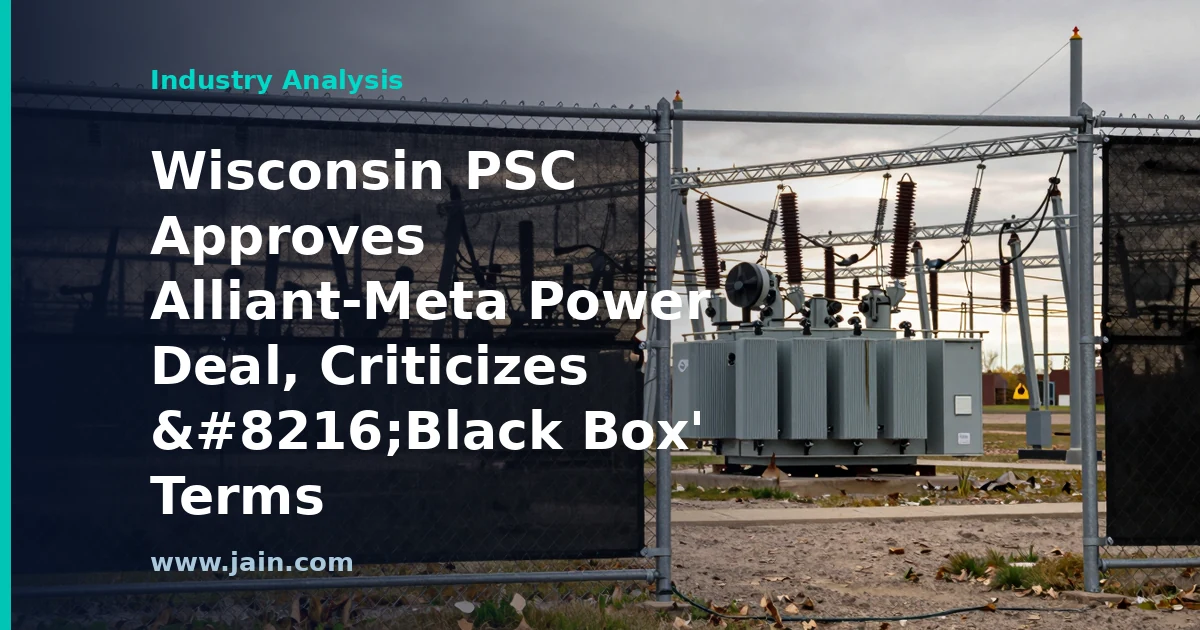
The Public Service Commission of Wisconsin has approved a power-supply arrangement between Alliant Energy and Meta to serve a planned data center in the utility’s Wisconsin territory, according to Wisconsin Watch reporting published May 6, 2026. Commissioners signed off on the deal but publicly criticized its ‘black box’ approach — a reference to confidential contract terms that keep key details, including those bearing on ordinary ratepayers, out of public view.
Executive Summary
State approval of a utility-hyperscaler power contract is normally a routine milestone. What makes this one notable is the regulators’ own commentary: the commission approved the Alliant-Meta arrangement while simultaneously faulting how much of it is shielded from public scrutiny. That dual message — yes to the deal, no to the process — captures the bind facing utility commissions across the country as AI data centers arrive with unprecedented power demands and equally unprecedented confidentiality requirements.
For the data center industry, the approval clears a regulatory hurdle for one of Wisconsin’s marquee technology projects. For utilities and their customers, the ‘black box’ criticism is the more consequential signal: commissioners are telegraphing that future large-load contracts may face demands for greater transparency, standardized tariff structures, or explicit ratepayer-protection findings before they get a vote.
Approve Now, Object Later: What a Split Verdict Signals
Regulators rarely attach public criticism to a deal they are approving. When they do, it usually means they concluded the underlying project serves the state’s interest — jobs, tax base, grid investment — but want to put the utility and its counterparties on notice for the next filing. The ‘black box’ language, as reported by Wisconsin Watch, suggests commissioners felt they were asked to vote on an arrangement whose economics they could describe to the public only in outline. That is an uncomfortable position for a body whose core mandate is protecting captive ratepayers, the households and small businesses who cannot shop for another electric utility.
The practical takeaway for developers and utilities is that approval-with-a-rebuke is a warning shot, not a victory lap. Commissions in several states have begun moving from one-off confidential contracts toward published large-load tariffs — standardized rate schedules for very big customers — precisely because case-by-case secrecy erodes public confidence. Wisconsin’s commissioners appear to be signaling sympathy with that direction, even as they let this deal proceed.
Who Pays for the Grid AI Needs?
The central economic question in any hyperscale power deal is cost allocation: does the data center pay the full cost of the generation, transmission, and distribution built to serve it, or do some costs land in the general rate base that all customers fund? Special contracts typically include minimum-take commitments, exit fees, and contributions toward infrastructure, but when those terms are confidential, outside parties cannot verify that the protections are adequate. That verification gap — not any specific allegation of subsidy — is what a ‘black box’ complaint is really about.
The stakes are larger than one contract. A single hyperscale campus can draw hundreds of megawatts, comparable to a small city, and utilities nationwide are proposing major generation and grid buildouts on the strength of data center demand forecasts. If a big customer later scales back, cancels, or negotiates better terms, stranded costs can migrate to everyone else’s bills. Transparent, verifiable contract structures are the primary tool regulators have to prevent that outcome — which is why their absence draws pointed language even from commissioners voting yes.
Wisconsin’s Bid for the AI Buildout
Wisconsin has emerged as a genuine contender in the Midwest data center race. Microsoft is developing a major campus in Mount Pleasant in We Energies territory, and Meta has publicly committed to a large data center project in Alliant Energy’s service area, announced in late 2025. Competitive electricity, available land, water, fiber routes, and an aggressive economic-development posture have put the state on hyperscaler shortlists that once defaulted to Virginia, Ohio, or Iowa.
That competitive dynamic cuts both ways in regulatory proceedings. States courting these projects have an incentive to accommodate confidentiality, since hyperscalers guard site economics closely and can take their capital elsewhere. But the same growth concentrates demand risk on local utilities and their customers. The commission’s approach here — approve the project, criticize the opacity — is an attempt to hold both goals at once, and other state commissions facing similar filings will likely study how Wisconsin manages that balance.
Background
The approval lands amid a national surge in data center electricity demand driven by AI computing, which has made utility commissions unlikely gatekeepers of the technology buildout. Wisconsin’s share of that surge includes Microsoft’s multi-billion-dollar campus in Mount Pleasant and Meta’s late-2025 announcement of a major data center in Alliant Energy’s service territory — the project behind this power deal. Meta, the parent of Facebook and Instagram, operates one of the world’s largest data center fleets and typically negotiates dedicated energy arrangements, often paired with renewable-power procurement, for each new campus.
Special contracts between utilities and very large customers have existed for decades, but the scale of AI-era loads has intensified scrutiny of them. Regulators in several states have questioned whether confidential, negotiated deals adequately insulate ordinary customers from the cost of new generation and grid capacity built for a single tenant — the same tension the Wisconsin commission voiced in this decision.
Industrial cybersecurity firm Dragos has warned that large language models (LLMs) from OpenAI and Anthropic — the class of AI systems behind ChatGPT and Claude — were used in a cyber-attack against critical infrastructure, according to a report published by Infosecurity Magazine on May 6, 2026. The disclosure places frontier AI tools directly inside an attack on the operational technology (OT) world: the industrial control systems that run power grids, water treatment, pipelines, and manufacturing.
Executive Summary
According to the report, Dragos — one of the best-known specialists in securing industrial control systems — says commercial frontier LLMs were used in the course of an attack on critical infrastructure. If borne out in detail, this would be among the first publicly flagged cases tying named frontier-model providers to a real-world intrusion in the OT domain, rather than in ordinary IT networks.
The significance is less about any single incident and more about the trajectory it confirms: general-purpose AI assistants can compress the time, skill, and cost required to research targets, write malicious tooling, and navigate unfamiliar industrial environments. For operators of data centers, utilities, and connectivity infrastructure, the warning is a signal that AI-assisted adversaries should now be part of baseline threat modeling — while readers should also note that, at headline level, the report leaves the technical specifics of how the models were used unconfirmed.
AI Lowers the Barrier to Industrial Attacks
Attacks on operational technology have historically demanded rare expertise: knowledge of protocols like Modbus and DNP3, familiarity with vendor-specific controllers, and patience to map physical processes. That scarcity of skill has been an unofficial defense. LLMs erode it. A capable general-purpose model can explain an unfamiliar protocol, draft scripts, translate documentation, and troubleshoot errors on demand — for an attacker as readily as for an engineer.
That is why a warning from Dragos specifically matters. The firm’s entire focus is the OT threat landscape, and its naming of frontier models signals that AI-assisted tradecraft has crossed from IT espionage — where AI-enabled campaigns had already been documented by the model providers themselves — into the systems that keep physical infrastructure running.
What “LLMs Used in an Attack” Can Actually Mean
The phrase covers a wide spectrum, and the distinction matters enormously. At the mild end, attackers use AI for reconnaissance, phishing text, or code assistance — an efficiency gain, not a new capability. At the severe end, models orchestrate portions of an intrusion with limited human input, a pattern Anthropic itself publicly documented in late 2025 when it disclosed disrupting a state-linked campaign that abused its Claude models for largely automated espionage.
The headline-level report does not establish where on that spectrum this incident sits, whether provider safeguards were bypassed (for example through jailbreaking or posing as legitimate security testers), or whether the models materially changed the outcome versus merely accelerating it. Readers should hold that uncertainty: “AI was used” is not yet “AI was decisive.” Equally, the involvement of a provider’s model in an attack is not evidence of negligence by that provider — every widely available tool, from scanners to cloud accounts, gets abused.
The Defender’s Dilemma — and the Vendor Lens
For infrastructure operators, the practical implications are concrete. AI-assisted attackers iterate faster, so detection and response windows shrink. The fundamentals become more valuable, not less: segmenting OT networks from IT, monitoring industrial protocols for anomalies, controlling remote access, and rehearsing manual-operation fallbacks. Defenders are also adopting AI for log triage and anomaly detection, setting up a genuine capability race on both sides of the wire.
Fair scrutiny cuts in both directions. Dragos sells OT security products and services, so dramatic warnings align with its commercial interests — a reason to ask for technical specifics, not a reason to dismiss the claim. The firm has a long track record of credible, evidence-based industrial threat reporting, and the warning is consistent with disclosures the AI providers themselves have made about abuse of their models. The right posture is to treat the claim as plausible and important, and to press for the incident details that would let operators act on it.
Background
Dragos was founded in 2016 by former U.S. intelligence-community analysts, including CEO Robert M. Lee, and has built its reputation on tracking threat groups that target industrial control systems — publishing widely cited analyses of incidents like the attacks on Ukraine’s power grid. Its warnings carry unusual weight in the OT security community precisely because the firm rarely deals in hypotheticals.
The AI-abuse backdrop was already forming before this report: through 2024 and 2025, OpenAI and Anthropic each published threat-intelligence reports documenting state-linked and criminal actors misusing their models, and in November 2025 Anthropic disclosed disrupting an espionage campaign in which its Claude models automated substantial portions of intrusion work. The Dragos warning, as reported on May 6, 2026, marks the extension of that trend to the critical-infrastructure domain.
North Carolina legislators have introduced an AI infrastructure bill that would push hyperscale data centers to shoulder the electricity system costs their load creates, according to a 5 May 2026 report from Data Center Knowledge. The measure places North Carolina among a growing set of states moving “large-load” cost allocation out of utility commission dockets and into statute.
The available source is headline-level: it establishes that such a bill has been proposed and that hyperscale cost recovery is its target. It does not, in the material we reviewed, supply a bill number, sponsor list, megawatt threshold, contract terms, or a legislative calendar. This analysis therefore treats the policy direction as reported and the mechanics as open questions.
Executive Summary
The proposal addresses a problem that has moved quickly from technical to political: when a single data center campus requests hundreds of megawatts, the utility must build transmission lines, substations and generation to serve it. Those assets are paid for over decades through rates charged to every customer. If the campus is delayed, downsized or shut down, the bill does not disappear — it shifts to households and existing businesses. “Cost causation,” the regulatory principle that the party creating a cost should bear it, is the framework North Carolina is reportedly trying to codify.
This matters because North Carolina is not a marginal market. Its low industrial power prices, data center sales-tax exemption and existing hyperscale footprint have made it a repeat destination for large campuses. A statutory cost-allocation regime in a top-tier state signals that the era of negotiating each large load quietly with a utility, case by case, is narrowing.
For operators, the practical question is not whether they will pay — large customers already pay substantial demand charges — but how much risk they must pre-commit to and for how long. Minimum-take obligations, multi-year contract terms, collateral and exit fees are the levers that determine whether a state’s rules are a manageable cost of doing business or a reason to site the next campus elsewhere.
Why Cost Causation Became a Statehouse Fight
Regulated electric utilities are, in effect, planning institutions. They forecast demand years out, build generation and wires against that forecast, and recover the capital through rates approved by a state commission. The model works when load grows predictably. AI-era data center requests break that assumption in two directions at once: individual projects are enormous relative to a utility’s existing peak, and the interconnection queue is full of speculative requests that may never be built.
Utilities have responded with “phantom load” screening and large-load tariffs designed to separate serious projects from optionality-shopping. But those instruments are negotiated inside regulatory proceedings that most voters never see. When residential bills rise for any reason — fuel costs, storm recovery, capacity additions — data centers become the visible explanation, whether or not they are the arithmetic one. Legislation is what happens when that political pressure outruns the docket process.
The industry has a serious counterargument that deserves to be stated plainly: large, flat, high-load-factor customers can improve system utilization and spread fixed costs across more kilowatt-hours, which can put downward pressure on everyone’s rates. That is genuinely true when the load materializes and stays. The entire policy question is what happens when it does not — and who is holding the asset.
Three States, Three Instruments
Oregon’s POWER Act is the clearest existing template. It directs that very large energy users — data centers and cryptocurrency operations above a defined megawatt threshold — be placed in their own customer class with dedicated long-term contract terms, so that the costs of serving them are recovered from them rather than blended into general rates. The mechanism is structural: create a separate class, then let the commission set terms for that class.
New Jersey’s approach has centered on a tariff mandate — instructing regulators to establish a distinct rate schedule for high-density load, which leaves more design discretion with the board while fixing the obligation in law. North Carolina’s reported bill sits somewhere in this family, but the reporting available does not specify which instrument it uses. The distinction is not academic. A separate-class statute changes who a customer legally is; a tariff-directive statute changes what a customer pays under rules regulators still write.
Comparing the three exposes the real design variables: the megawatt trigger, whether existing and already-announced projects are grandfathered, the minimum-take percentage, contract duration, credit and collateral requirements, and the exit fee if a customer walks. Two states can adopt the same headline principle and produce very different investment climates depending on where those dials are set.
Who Gains, Who Pays, and Who Hedges
The clearest winners from codified cost allocation are ratepayer advocates and, less obviously, incumbent operators with signed interconnection agreements. Grandfathering provisions — common in this legislation — convert an existing position into a durable cost advantage over a new entrant facing minimum-take obligations and collateral posting. Rules that raise the price of entry protect whoever is already inside.
The clearest losers are speculative developers holding land and queue positions without a committed tenant. A statutory minimum-take regime prices optionality directly, which is arguably the policy’s point. Utilities occupy an ambiguous position: they gain revenue certainty and reduced stranded-asset exposure, but lose flexibility to structure bespoke deals for anchor customers they want to attract.
The predictable hedge is to go around the tariff entirely. Behind-the-meter generation, on-site gas, fuel cells and co-located generation reduce a campus’s exposure to regulated rates — and correspondingly reduce its contribution to the shared system it still relies on for backup and reliability. Whether North Carolina’s bill addresses standby service and backup rates for self-supplied campuses is one of the more consequential details not visible in the source reporting.
The Case For and Against Legislating It
The argument against writing this into statute is real. Utility commissions have staff, evidentiary records and the ability to adjust terms as load forecasts change; legislatures have none of that and revise slowly. A megawatt threshold that is sensible in 2026 may be poorly calibrated by 2030, and statutory language is harder to fix than a tariff sheet.
The argument for it is equally real. Commission proceedings can be captured by the sophistication gap between utilities, hyperscalers and thinly-resourced consumer advocates, and they produce outcomes that are legally reversible in the next rate case. Legislation delivers durability, which is precisely what a developer underwriting a fifteen-year asset wants — even a developer who dislikes the specific terms.
The measured read is that predictability may matter more to capital than stringency. Operators can price a known minimum-take obligation. What they cannot price is a jurisdiction where the rules are relitigated every eighteen months. If North Carolina’s bill produces clear, stable terms, it may prove less damaging to the state’s competitiveness than opponents suggest and less protective of ratepayers than supporters claim.
Background
North Carolina has hosted large data center investment since the late 2000s, when major cloud and platform companies built campuses in the state’s western foothills, drawn by inexpensive power, cool-season climate and a state sales-and-use tax exemption for qualifying facilities. That footprint has since expanded toward the Charlotte region and the Research Triangle. Electricity service across most of the state is provided by vertically integrated regulated utilities whose rates and resource plans are approved by the North Carolina Utilities Commission.
The AI buildout changed the scale of the ask. Individual campus requests now arrive measured in hundreds of megawatts, comparable to serving a mid-sized city, and often on timelines far shorter than the multi-year cycles required to build generation and transmission. Utilities in several states have responded with dedicated large-load tariffs featuring long contract terms and minimum-take provisions. Oregon and New Jersey moved the question into legislation, and North Carolina’s proposed bill would extend that pattern to one of the Southeast’s most active data center markets.
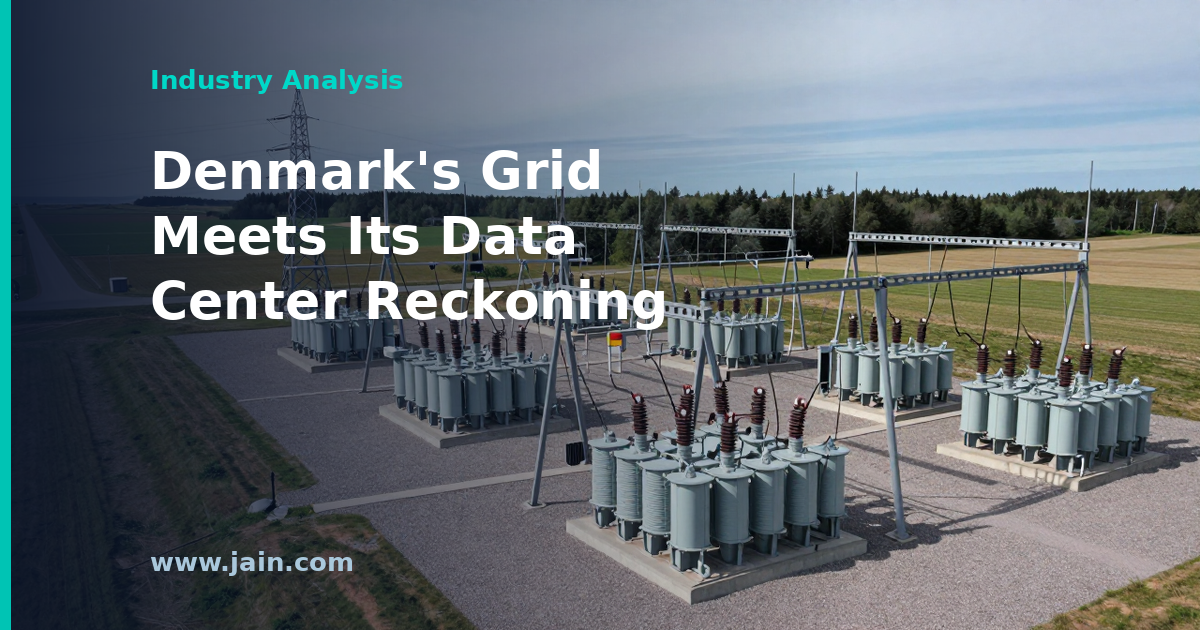
CNBC reports that Denmark is confronting a data center reckoning as its electricity grid struggles to keep pace with demand from new and planned compute campuses. The story frames Denmark — long marketed as a cool-climate, renewable-rich destination for hyperscale sites — as an early warning for the wider European market.
Executive Summary
Denmark built its data center pitch on wind power, fiber connectivity, and a stable regulatory climate. According to CNBC’s May 5, 2026 reporting, that pitch has now collided with a physical limit: the grid itself. Surging load from AI training clusters and cloud expansion is arriving faster than transmission and generation can be built to serve it.
The significance is less about one country and more about a pattern. When a small, wealthy, wind-heavy grid begins turning away or slow-walking data center load, it signals that Europe’s compute buildout is entering a capacity-constrained phase where power availability — not land, tax breaks, or fiber — decides who gets to build and when.
From Marketing Advantage to Physical Constraint
For roughly a decade, Nordic countries sold themselves as the natural home for hyperscale compute: cold air for free cooling, abundant wind and hydro, and grids with historically high renewable penetration. Denmark in particular attracted anchor tenants on that narrative. The CNBC framing suggests the narrative has aged faster than the infrastructure. Interconnection — the physical and contractual act of tying a new large load into the transmission system — is now a multi-year exercise in many European jurisdictions, and Denmark appears to be joining that queue-bound club.
The economics shift accordingly. When power is the binding constraint, the value of a permitted, energized site rises sharply relative to a greenfield parcel with only a land option. Developers holding older, already-connected sites gain leverage; newcomers face longer development cycles and more expensive grid upgrades passed through in connection fees.
The AI Load Curve Is Not the Cloud Load Curve
Traditional cloud regions grew in relatively predictable megawatt increments. AI training campuses do not. A single modern training hall can request tens to hundreds of megawatts at a single point of interconnection, with utilization profiles that are peakier and less flexible than a general-purpose cloud zone. Grids planned around gradual electrification of transport and heat were not sized for step-change industrial loads landing in single postcodes.
That mismatch is what turns a growth story into a reckoning. It is not that Denmark lacks renewable generation in aggregate; it is that moving power from where wind blows to where a proposed campus wants to plug in requires transmission that takes years to permit and build. In the interim, either the load waits, the grid operator constrains it, or fossil balancing quietly rises to keep the system stable.
Winners, Losers, and the New Site-Selection Playbook
Operators with existing energized capacity in Denmark and neighboring markets benefit from scarcity pricing on colocation and wholesale power capacity. Hyperscalers with the balance sheet to co-invest in transmission or to sign long-tenor renewable PPAs (power purchase agreements — long-term contracts to buy electricity from a specific generator) can still move forward, but on the utility’s timeline. Smaller enterprises and AI startups without that leverage are pushed toward secondary markets or toward renting capacity rather than building it.
Regulators and policymakers face their own trade-off. Restricting new data center load protects households and existing industry from grid stress and price spikes, but risks ceding a strategically important slice of the AI economy to jurisdictions willing to build faster. The Danish debate, as CNBC frames it, is a preview of choices Ireland, the Netherlands, and parts of Germany have already had to make explicitly.
What Substantiated, What Is Not
The reporting substantiates the direction — grid stress from data center demand in Denmark — more than any specific quantified ceiling. Readers should treat headline claims of “overwhelmed” grids as a description of pipeline pressure and interconnection backlog rather than active blackouts. The useful takeaway is directional: European compute siting is repricing around power, and Denmark is a visible early data point rather than a singular crisis.
Background
Denmark, along with Sweden, Norway, and Finland, spent the 2010s courting hyperscale data center investment on the strength of cool weather, renewable generation, and connectivity to mainland Europe. Anchor projects from major U.S. cloud providers helped establish the region as a credible alternative to the FLAP-D markets (Frankfurt, London, Amsterdam, Paris, Dublin).
By the mid-2020s, that same set of European markets began hitting grid constraints as electrification of transport, heating, and industry collided with a step-change in compute demand from AI. Ireland’s moratorium in the Dublin area and the Netherlands’ national siting restrictions were the first public signals; Denmark’s current situation extends that pattern into the Nordics themselves.