Two companies that make the memory chips inside phones, laptops and the giant computer warehouses behind artificial intelligence plan to spend $31 billion expanding their factories in Japan through 2032.
The surprising part is the calendar. Demand from artificial intelligence can jump within months, but a chip factory takes years to build, equip and get running smoothly. So the extra storage this money buys will arrive in stages over the next six years or so, not whenever technology companies happen to need it.
That timing helps decide how much storage costs and how fast new supply shows up.
SanDisk and Kioxia plan to invest $31 billion to expand memory chip production in Japan through 2032, scanx.trade reported. The two companies are long-time partners in NAND flash, the type of memory chip that stores data inside solid-state drives (SSDs), smartphones and memory cards, and have jointly operated fabrication plants (fabs) in Japan since the early 2000s.
Executive Summary
The plan is one of the largest multi-year commitments of capital to flash memory manufacturing announced by the two partners, and it lands at a moment when AI data centers are consuming growing volumes of high-capacity storage for training data, model checkpoints and the retrieval systems that feed AI models at inference time.
What makes the announcement analytically interesting is less the headline total than its end date. A spending horizon running to 2032 means the additional capacity will come online in phases dictated by how quickly cleanrooms can be built or refitted, manufacturing tools installed and new chip generations brought to acceptable yields. Buyers planning AI storage in the next two years will largely be served by capacity decisions already in motion, not by the later stages of this plan.
The $31 billion figure also cannot yet be converted into a volume of storage. How the money divides between new wafer capacity and upgrades to existing lines, and when each phase produces output, will determine its real effect on supply and pricing.
A 2032 End Date Puts AI Storage on a Fab Clock
AI data center projects are typically planned and energized in phases measured in quarters: servers ordered, power contracted, halls fitted out. Flash memory supply moves differently. Before a new wafer of memory ships, cleanroom space has to be built or converted, deposition and etch tools have to be delivered and installed, and each new generation of 3D NAND (chips built by stacking memory cells in vertical layers) has to be ramped until enough chips on each wafer work. A plan stretching to 2032 sequences those steps across roughly six years.
Simple arithmetic illustrates the pacing. If the $31 billion were spread evenly from now through 2032, it would amount to roughly $4 billion to $5 billion a year. That is substantial, but it is a flow, not a lump. The rate at which the money is spent, and the order in which tools arrive, determines when extra storage reaches the market. A surge in AI storage demand in 2027 cannot be met faster than the fab schedule allows, however large the total commitment.
The people most exposed to that mismatch are cloud providers, colocation operators and enterprises sizing storage for AI clusters, along with the SSD makers who sell to them. For them, the practical implication is that flash availability is set years in advance. Long-term supply agreements and early procurement become the tools for managing the gap between how quickly AI demand can shift and how slowly memory capacity can follow.
Why $31 Billion Does Not Translate Directly Into Capacity
In NAND manufacturing, capital spending serves two different purposes. Some of it builds new wafer capacity: more fab space and more tools processing more silicon. Much of it funds technology transitions, moving existing lines to chips with more stacked layers so that each wafer yields more gigabytes. Both raise output, but at very different costs and on different timelines. Until the partners disclose how the plan divides between the two, the headline figure says how much will be spent, not how much storage it will produce.
The memory industry’s history also argues for reading the total as an envelope rather than a fixed schedule. Flash has gone through repeated cycles in which capacity added during strong demand led to oversupply and falling prices. Multi-year programs in this sector have historically been paced to market conditions, and a plan with a distant end date leaves room to accelerate or slow. That flexibility is prudent for the manufacturers; for buyers, it means the plan’s effect on prices will depend on execution choices made year by year.
Concentration in Japan Cuts Both Ways
Keeping the expansion in Japan builds on the partners’ existing manufacturing base at Yokkaichi in Mie Prefecture and Kitakami in Iwate Prefecture, where shared infrastructure, trained workforces and supplier ecosystems lower the cost of adding capacity. It also aligns with Japan’s broader push to rebuild domestic semiconductor manufacturing.
Concentration carries risk as well. A 2022 contamination incident disrupted output at the joint venture’s plants, a reminder that a large share of global flash supply sitting in a few locations can turn a local problem into a market-wide shortage. Large storage buyers that value supplier diversity will weigh this plan alongside capacity decisions by Samsung, SK hynix and Micron, which will shape total market supply at least as much as any single program.
Background
SanDisk and Kioxia, which was known as Toshiba Memory until 2019, have been partners in flash memory manufacturing since the early 2000s, sharing investment in and output from fabs at Yokkaichi and Kitakami in Japan. SanDisk was acquired by Western Digital in 2016 and re-emerged as the standalone Sandisk Corporation in February 2025, while Kioxia listed on the Tokyo Stock Exchange in December 2024.
The NAND flash market is dominated by a handful of manufacturers, including Samsung, SK hynix and Micron alongside the SanDisk-Kioxia partnership. It is known for pronounced boom-and-bust cycles, and demand from AI data centers for high-capacity solid-state drives has become an increasingly important driver of the industry’s investment decisions.
Bitdeer, a company best known for bitcoin mining, has signed customers for most of a new artificial intelligence computing center in Malaysia. The site draws about as much electricity as a small town, and those customers are expected to pay more than $1.7 billion over five years.
The surprise is the rate. For the same amount of electricity, this business brings in roughly nine times what Bitdeer earns simply renting building space and power to a tenant in Norway.
The catch: Bitdeer generally has to supply the costly computer chips itself, and some of its borrowing costs 13% a year.
Bitdeer AI, the AI cloud unit of Nasdaq-listed Bitdeer Technologies Group (BTDR), announced off-take commitments covering more than 70% of its 21.7-megawatt (MW) A201 data center in Malaysia, with more than $1.7 billion in expected revenue over five years, Investing.com and MarketScreener reported. An off-take commitment is a customer’s contractual promise to buy a set amount of capacity over a fixed term.
The deal follows a 6-K filed September 29, in which Bitdeer told US regulators that Bitdeer AI had already sold out the roughly 9.5MW A102 site in Malaysia in August on five-year commitments, and that its Norwegian subsidiary had signed a separate colocation lease worth about $4.7 billion over 16 years.
Executive Summary
On its face this is a contract announcement: roughly 15MW of AI computing capacity in Malaysia, sold forward for five years. The more useful number is what it implies per megawatt. Spread evenly, $1.7 billion over five years on about 15MW comes to roughly $22 million of revenue per megawatt per year.
Bitdeer’s own filings provide an unusually clean comparison. Its Tydal, Norway colocation deal, disclosed in the same 6-K, is expected to earn an average of $2.4 million per IT megawatt per year. The same company, selling power-backed capacity two different ways, is booking roughly nine times more revenue per megawatt when it sells finished AI compute rather than space, power and cooling.
That gap is the story. It shows where the revenue in AI infrastructure sits for a company with power but no hyperscale customers of its own, and it also shows the trade-off: the higher top line comes with GPU purchases, shorter terms and far less of the landlord-style margin Bitdeer projects in Norway.
The Math: Roughly $22 Million per Megawatt-Year
Start with the disclosed figures. More than 70% of 21.7MW is at least 15.2MW. More than $1.7 billion over five years is at least $340 million a year. Dividing one by the other gives roughly $22 million per contracted megawatt per year. Because both figures are floors (more than 70%, more than $1.7 billion), the true rate could move modestly in either direction, but the order of magnitude holds.
Now set that beside Tydal. In its 6-K, Bitdeer said the Norway colocation lease runs at an average of about $202 per kilowatt per month, or $2.4 million per IT megawatt per year, with electricity reimbursed separately by the tenant. Colocation means renting out a powered, cooled building; the tenant brings its own servers. AI cloud means renting out the computing itself, usually by the GPU-hour or under reserved contracts, with the provider owning the servers. Comparing $22 million with $2.4 million, Malaysia generates roughly nine times the revenue per megawatt.
Two caveats keep this honest. Bitdeer has not said whether 21.7MW refers to IT load (power delivered to servers) or gross site capacity, and AI cloud pricing typically bundles electricity into the service. Neither caveat closes a ninefold gap. The bulk of the difference is the hardware and software layer sitting on top of the power.
Revenue Density Is Not Margin
The operational conclusion runs the other way from the headline number. At Tydal, Bitdeer estimates a net operating income margin of about 90%, because a landlord’s main costs are the building and its upkeep. At A201, Bitdeer AI must supply the accelerators, networking and storage that generate the $22 million, and that equipment is where most of the capital in an AI cloud goes. A five-year commitment tries to match contract length to the working life of that hardware, so the question for margins is how much of each megawatt’s revenue goes toward paying off the servers before the contract ends.
That makes financing the real constraint on how far this model scales. Bitdeer’s interim financial statements show $373.5 million of principal on its asset-collateralized loans from BIT Group due within twelve months of June 30, 2026, at an effective interest rate of 13.0% for the first half of the year, plus $375 million of 5.00% convertible notes issued in February. Buying GPUs for revenue this dense can pay back quickly, but only if the contracted customers keep paying for the full term.
Two Business Models, One Power Portfolio
Bitdeer is now running both models side by side. In Norway, it is a landlord: 121 IT MW leased to one tenant for 16 years, backed by about $1.3 billion in letters of credit, a form of bank guarantee. In Malaysia, it is a cloud operator: small sites of 9.5MW and 21.7MW sold on five-year terms. The first model trades revenue per megawatt for duration and credit quality; the second trades duration for density.
Against a total portfolio the company puts at roughly 3.0 gigawatts, including 742MW of existing and pipeline capacity in Milam County, Texas, the Malaysian sites are a small slice by power. They matter as a price signal. For a former bitcoin miner deciding how to use each additional megawatt, the choice is between a long, low-risk lease and a short, capital-heavy compute business earning several times more. Bitdeer’s filings suggest it intends to keep doing both.
Background
Bitdeer Technologies Group is a Cayman Islands company listed on the Nasdaq under the symbol BTDR. Its business spans bitcoin self-mining, cloud hash rate, mining-rig sales, hosting and, more recently, AI cloud services, all of which appear as separate revenue lines in its interim financial statements. Like several large bitcoin miners, it controls substantial power capacity, which it now says totals about 3.0 gigawatts across sites in the US, Norway, Bhutan, Ethiopia, Malaysia and elsewhere.
AI workloads need that same scarce resource, grid power, which is why miners have been repurposing capacity for AI. They generally do so in one of two ways: leasing powered buildings to AI tenants as colocation landlords, or buying GPUs and selling compute directly. Bitdeer is doing both, with a large 16-year lease in Norway and smaller five-year AI cloud contracts in Malaysia.
A new generation of encryption is coming, built to withstand future quantum computers that could one day crack today’s codes.
The catch: stronger locks can mean more work for the equipment that handles every connection, including the chatbots and other artificial intelligence services businesses now run.
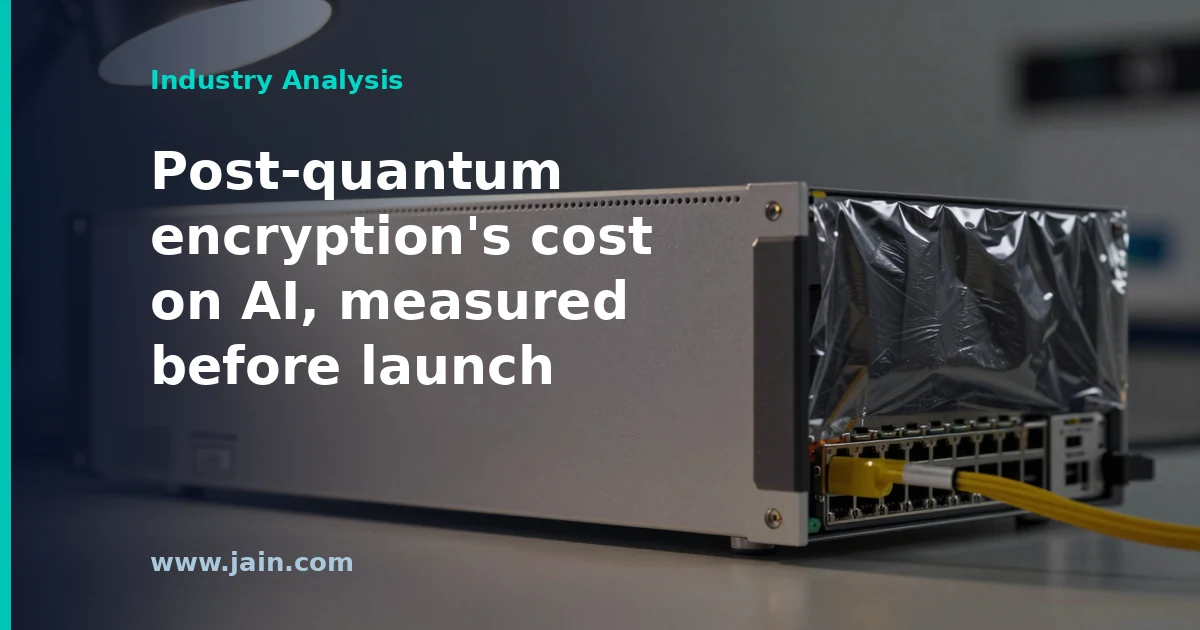
VIAVI, a maker of network testing gear, released a pizza-box-sized machine that floods networks with realistic, quantum-safe encrypted traffic, so companies can find out whether the new locks slow things down before customers notice.
VIAVI Solutions (NASDAQ: VIAV) introduced the CyberFlood CF50 on September 29, 2026, a one-rack-unit (1U) test appliance that generates realistic encrypted application traffic at up to 100 gigabits per second (100G) to test application performance, security controls, AI inference and large language model (LLM) services. VIAVI said the CF50 includes native support for post-quantum cryptography (PQC), delivers TLS performance 1.75 times that of its nearest competitor, and has the industry’s lowest power consumption in its class.
The CF50 is aimed at network equipment manufacturers, systems integrators and service providers, and sits below the existing CyberFlood CF1000, which VIAVI targets at large enterprises that need the highest performance.
Executive Summary
The CF50 is a traffic generator: it impersonates large numbers of users and applications so that engineers can see how firewalls, gateways, load balancers and AI services behave under load before real customers arrive. What distinguishes it, by VIAVI’s account, is that it combines three things in a small box: Layer 4-7 traffic (traffic that looks like real applications rather than raw data packets), security assessment, and AI inference testing, with post-quantum encryption built in.
That combination matters because two infrastructure transitions are happening at once. Organizations are putting AI inference, the step where a trained model answers requests, into production over encrypted connections, and they are preparing to move those connections to quantum-resistant encryption. Both place new demands on the same security equipment. A tester that can generate both kinds of traffic turns the question of whether post-quantum encryption slows AI services into something a lab can measure rather than something operations teams discover after launch.
The headline performance claims, 1.75X TLS performance and lowest power consumption, are VIAVI’s own, and the company has not published the competitor, metric or test conditions behind them. The practical value of the launch rests less on those superlatives than on whether PQC and AI inference traffic can be exercised together at realistic scale.
Post-Quantum Encryption Is a Performance Question, Not Just a Security One
Post-quantum cryptography replaces the mathematical methods that protect today’s encrypted connections with algorithms designed to resist future quantum computers. The US standards body NIST published its first post-quantum standards in 2024, and the pressure to adopt them comes partly from the risk that adversaries are recording encrypted traffic now in order to decrypt it later. The trade-off is that post-quantum key exchanges use considerably larger keys than the methods they replace, which means more data and more computation each time an encrypted TLS session is set up. TLS is the protocol behind the padlock in a browser and behind most API traffic.
That cost does not fall evenly. It lands on the devices that terminate or inspect encryption at scale: next-generation firewalls, secure web gateways, load balancers and the Zero Trust architectures (security designs that verify every connection rather than trusting anything inside the network perimeter) that VIAVI’s announcement names. AI inference traffic runs through exactly this equipment. A user query to an LLM-powered service is typically an encrypted request that passes security controls before it reaches the model and after the answer comes back, and inference services are judged heavily on responsiveness. Any added handshake overhead or reduced connection capacity shows up directly as latency or as a need for more security hardware.
This is where the CF50 changes the workflow. VIAVI says the appliance generates encrypted and mixed application traffic up to 100G with native PQC support, and separately offers AI inference and LLM testing. For the network equipment makers, integrators and service providers VIAVI is targeting, that means the performance impact of switching a firewall or gateway to post-quantum TLS can be measured against realistic application and AI traffic in the lab, before deployment. The overhead becomes a number that goes into sizing and procurement decisions rather than a surprise in production. How fully that promise holds depends on whether both traffic types can run in the same test, which VIAVI’s announcement implies but does not spell out.
What the 1.75X and Lowest-Power Claims Do and Do Not Establish
VIAVI states that the CF50’s TLS performance is 1.75 times that of the nearest competitor and that it has the industry’s lowest power consumption. Both claims are plausible marketing for a product in a competitive test-and-measurement category, and both are unverified. The company has not named the competitor or product compared, specified whether the metric is new connections per second, concurrent sessions or encrypted throughput, stated whether the comparison used classical or post-quantum cipher suites, or published a wattage figure.
Those distinctions matter to buyers. A tester that leads on encrypted throughput may not lead on handshake rate, and handshake rate is where post-quantum overhead concentrates. A power figure matters for labs with constrained rack power, but lowest-in-class means little without knowing the class. The quote from Mauricio Sanchez of Dell’Oro Group supports the general case for realistic pre-deployment testing of AI and encrypted workloads. It does not address the CF50’s specific performance figures, and readers should not treat it as independent validation of them.
A Smaller Box Widens Who Can Afford This Kind of Testing
High-scale encrypted traffic testing has traditionally required large chassis systems and specialist operators. The CF50 packs the capability into 1U, a single standard rack slot about 1.75 inches tall, and replaces a Windows desktop client with a web interface. VIAVI also includes automated goal-seeking, which ramps load until a device under test reaches its limit, MITRE ATT&CK frameworks, a public catalog of real-world attacker techniques used to check whether security controls detect them, and repeatable traffic-mix testing.
The commercial logic is to extend enterprise-scale testing below the tier served by the CF1000 to smaller equipment vendors and integrators. If the portability and price hold up, more of the security and networking supply chain can test post-quantum and AI-traffic performance in-house rather than relying on vendor datasheets. VIAVI has not disclosed pricing, so the cost-effectiveness claim, like the performance claims, awaits specifics.
Background
VIAVI Solutions, based in Chandler, Arizona, is a test-and-measurement and optical technology company. Its test products are used to validate data center, communications network and security infrastructure, and it also supplies resilient positioning, navigation and timing systems for military, aerospace, railway and first-responder communications, alongside optical technologies for anti-counterfeiting, consumer electronics and automotive markets.
CyberFlood is VIAVI’s line of application and security test platforms, which emulate large numbers of users and applications to measure how networks and security devices perform. Before the CF50, the line’s flagship was the CF1000 for large enterprises. The new model arrives as organizations move AI inference into production and begin preparing encrypted connections for the transition to post-quantum cryptography.
Castrol, best known for motor oil, is now selling a full package to keep the computers behind artificial intelligence from overheating.
Those chips run so hot that many buildings now cool them with liquid instead of fans. Castrol says it will help design those cooling systems, supply the fluid, test it, and look after it for years, backed by service teams in more than 150 countries.
This matters because a cooling failure can knock very expensive computers offline. Castrol is wagering that customers would rather pay one company to own that risk.
Castrol announced on September 29, 2026, from Singapore, the launch of Castrol CORE, an end-to-end thermal management offer for data centers, in a release distributed through PR Newswire. The package combines Castrol’s cooling fluid technology with testing, new design capabilities, and support through deployment, commissioning, operation and maintenance. It is backed by Castrol labs in the UK, US, Germany and China, joint labs across Asia, and a service-provider network covering more than 150 countries.
Castrol says its cooling technology has been tested and validated by leading chip and hardware makers including NVIDIA and Intel. It has completed a proof-of-concept program with an unnamed major data center operator in China and is working with other global operators on similar projects.
Executive Summary
Castrol CORE is Castrol’s move from selling cooling fluid to selling responsibility for how that fluid performs over a facility’s life. Rather than supplying a product that operators must integrate with hardware from other vendors, Castrol says it will act as a single point of contact, coordinating a network of partners in products, infrastructure, design and services. The company attributes the shift to its own industry study, which it says found rising demand for integrated thermal management, plus concerns about supply chains and the high cost of failures.
The launch matters because liquid cooling, circulating fluid close to or around hot chips instead of relying on air, is becoming a standard requirement for AI and high-performance computing. When cooling moves from fans to fluids, the chemistry of the fluid becomes part of the uptime equation. A supplier that tests and monitors that fluid on site, across more than 150 countries, is offering something closer to an operational guarantee than a commodity.
What Castrol has not disclosed is how much of this is already contracted. It names no customers, deployed capacity, pricing or performance commitments, so CORE is best read as a clear statement of strategy with one completed pilot behind it.
Why a Coolant Maker Is Selling Accountability
The core of the announcement is a change in what the customer is paying for. Castrol says CORE covers the full lifecycle, from early design and specification through deployment, commissioning, operation and maintenance, and that its service network in more than 150 countries enables ongoing testing, validation and on-site monitoring to reduce the risk of costly interruptions. That is the mechanism behind the headline: the fluid is no longer the whole product. It is the anchor for a recurring relationship built around keeping the cooling loop healthy.
This follows from how liquid cooling works. In an air-cooled hall, a failing fan is a swappable part. In a liquid-cooled system, the fluid’s condition, including contamination, degradation or incompatibility with pumps, seals and cold plates, can affect every server on the loop. Castrol’s own study, it says, flagged the high cost of failures as a major industry concern. A supplier that samples and validates fluid on site throughout a facility’s life is effectively selling a reduction in that risk, and the geographic reach of the service network is what makes that promise credible for operators with sites on several continents.
The people most affected are data center operators and the engineering firms that design their facilities. For operators, a single interlocutor could simplify procurement and clarify who is responsible when something goes wrong. For design and integration firms, a fluid supplier moving upstream into design is a new participant in work they have typically led. Castrol frames this as partnership, saying CORE brings together specialists across products, infrastructure, design and services, but the balance of who leads a project will depend on terms it has not yet published.
What Chipmaker Validation Does and Does Not Establish
Castrol’s strongest technical claim is that its cooling technology has been tested and validated by leading chip and hardware makers, including NVIDIA and Intel. For buyers, validation from the companies whose processors are being cooled carries real weight, because running an unapproved fluid can raise questions about hardware compatibility and support.
The claim is also broad. Castrol does not specify which products or platforms were validated, whether the fluids are for direct-to-chip cooling (where liquid flows through plates mounted on processors) or immersion cooling (where servers sit submerged in a non-conductive fluid), or what the validation tested. Operators evaluating CORE will want that detail, since compatibility with one generation of hardware does not automatically carry over to the next.
Asia-Pacific as the Proving Ground
Castrol has set up a regional data center design team in Asia-Pacific, supported by local specialists, and describes the region as adopting new cooling infrastructure quickly. Its one disclosed field result is a completed proof-of-concept program with a leading data center operator in China, with similar projects now under way with global operators.
A proof of concept demonstrates that the approach can work in a real facility; it is not a commercial rollout. The combination of a Singapore launch, an Asian design team, joint labs across Asia and a China pilot suggests Castrol sees the region as its early market for the integrated model. Whether CORE scales from pilots into multi-site contracts is the question that will determine whether the service shift is a strategy or a business.
The Trade-Off in One-Stop Cooling
Integrated offers solve a real coordination problem, but they shift risk in both directions. For Castrol, taking on design and lifecycle responsibility means absorbing some of the liability that previously sat with integrators and operators, and managing a partner network it does not fully control. For customers, a single supplier simplifies accountability but can raise switching costs if fluids, monitoring and design are tightly bundled.
Castrol also says CORE is a platform that should gradually extend its thermal management offering beyond data centers. That signals the company views thermal management as a growth line in its own right, not a side market for lubricants, though it has not said which applications come next or on what timeline.
Background
Castrol is one of the world’s largest lubricant brands, with more than 127 years of experience formulating fluids for automotive, marine, industrial and energy applications. Its data center work sits within a dedicated Data Centers and Thermal Management division, led globally by president Peter Huang, who says customers are looking for experienced partners to handle the full range of thermal challenges rather than another standalone product.
The broader context is the rise of liquid cooling. As AI and high-performance computing push chip heat output higher, operators are adopting systems that use specialized fluids to carry heat away from processors. That has turned fluid suppliers into participants in data center design and operations, a role Castrol is now formalizing with CORE.
Equinix, one of the world’s largest renters of data center space (the buildings full of computers that run websites and apps), is testing new electrical equipment from Schneider Electric inside a working facility.
The equipment is the heavy-duty switching gear that takes power from the grid and routes it safely into a building. Today it is usually custom-built for each site, which is slow. Schneider says its version uses one standard design controlled by software, and can be ordered and built up to three times faster.
The catch is timing. Most buyers will not be able to get it until 2028.
Equinix is piloting Schneider Electric’s newly launched software-defined medium-voltage (MV) switchgear inside a live colocation data center, Data Centre Magazine reported on September 29, 2026. Schneider unveiled the system at its YOTTA 2026 event in Las Vegas, running September 28-30, and describes it as the world’s first fully software-defined MV switchgear.
Schneider says the design allows up to three times faster ordering and manufacturing, up to two times faster commissioning and onsite acceptance testing, and upgrades with zero operational downtime. Pilot programs will continue through 2027, with broader availability expected from 2028.
Executive Summary
Medium-voltage switchgear is the equipment that receives power from the utility side and distributes and protects it before it is stepped down for use inside a building. It is typically engineered to order, meaning each lineup is designed for a specific site. Schneider Electric’s new product replaces that bespoke approach with standardized hardware whose functions are set and updated in software, including over-the-air updates that add features without physical modification.
Equinix’s role is to prove the concept where it counts: in an operating colocation facility, where multiple customers share infrastructure and reliability expectations leave little room for experimentation. Greg Metcalf, Equinix’s Senior Director of Global Data Center Design and Innovation, framed the value around standardization “for multiple use cases.”
The significance is less the software itself than what it enables. If power distribution gear can be ordered as a standard product rather than designed per site, one of the slower steps in bringing data center capacity online could shorten. That benefit, however, is on a 2028 horizon for most buyers.
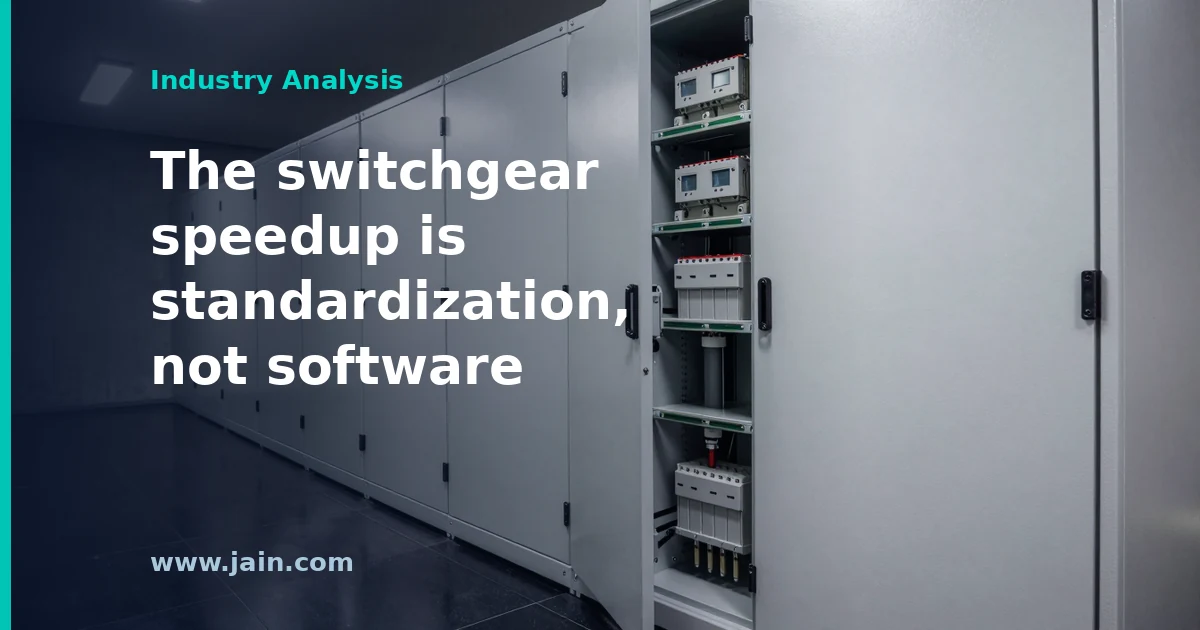
The Speedup Comes From Standardization
Schneider’s own explanation of the problem points to the mechanism. Traditional MV systems are engineered to order, which the company says leads to long lead times, complex procurement and limited scalability. The first change it lists is that standardized hardware platforms replace bespoke designs. Software is the tool that makes this possible: if protection settings, logic and features live in configurable software, one physical platform can serve configurations that previously needed distinct engineering. The claimed result is up to three times faster ordering and manufacturing.
That is why the headline claim is best read as a bet on off-the-shelf power equipment. An engineered-to-order product cannot be meaningfully ordered until a site’s electrical design is settled. A standardized one can, in principle, be ordered earlier, built in larger runs and configured closer to installation. For operators, that turns switchgear selection from a line item into a schedule decision: the lead time on this equipment helps determine when a data hall can be energized and sold.
Both executives emphasized this point. Metcalf cited “increased standardisation for multiple use cases,” while Melton Chang, Executive Vice President of Schneider’s Power Systems Division, said customers can “standardise across regions.” For a multi-market operator such as Equinix, a single qualified design deployable in many countries is a procurement advantage that compounds with every new build.
Why a Live Colocation Site Matters
Colocation facilities rent space, power and cooling to many tenants under one roof, so shared electrical infrastructure is difficult to take offline. That context gives Schneider’s “zero operational downtime” upgrade claim practical weight. Changes to conventional switchgear often require planned outages or physical work; changes delivered through software, if they work as described, avoid negotiating maintenance windows across many customers.
Chang put the broader pressure plainly: “Data centres are being asked to build faster than traditional power infrastructure can move.” The current construction wave, much of it tied to AI workloads, has made power equipment timing a visible constraint. A pilot in a working facility is the credible way to show that a new approach to critical power does not trade reliability for speed.
Software in the Power Path Raises New Questions
Moving function into software also moves risk. Switchgear performs protection: it detects faults and interrupts current to keep equipment and people safe. Over-the-air updates to devices in that role require rigorous change control, validation and cybersecurity, and the announcement does not describe how Schneider addresses them. The lifecycle layer adds further connectivity, with embedded analytics and AI-powered predictive maintenance through Schneider’s EcoCare Services.
The performance claims also need context. “Up to” three times faster ordering and “up to” two times faster commissioning are ceilings, not averages, and no baseline lead time accompanies them. Buyers will want to know how those figures translate into weeks saved on an actual project.
2028 Is the Date That Counts
Pilots run through 2027 and broader availability is expected from 2028, so near-term data center builds will largely rely on conventional gear. Schneider’s plan to extend the architecture across its MV portfolio, including PremSet and the AirSeT range (GM, RM and SM AirSeT), signals a portfolio-wide shift rather than a single product. For operators planning capacity for the later part of the decade, the Equinix pilot is an early reference point worth watching; for projects breaking ground now, it is not yet an option.
Background
Equinix is a global colocation operator, renting data center space, power and cooling to many customers in shared facilities and connecting them to networks and cloud providers. Because it builds in many markets, repeatable designs that can be deployed across regions are central to how it expands capacity.
Schneider Electric makes power distribution and energy management equipment, including medium-voltage switchgear lines such as PremSet and AirSeT. Its Software Defined Energy strategy aims to separate system intelligence from hardware so that power infrastructure can be updated through software rather than rebuilt. The software-defined MV switchgear, launched at YOTTA 2026 in Las Vegas, is the first product under that approach to be tested in a live data center.
An independent testing group ran nine cloud firewalls through the same set of real attacks. A cloud firewall is the software gatekeeper that screens traffic before it reaches a company’s systems in the cloud.
Results ranged from blocking nearly everything to scoring zero. The built-in firewalls from Amazon and Microsoft scored zero on the test’s protection measure. Four products from specialist security companies scored above 99.7 percent.
The lesson: having a firewall is not the same as being protected. That matters more as companies let automated artificial intelligence assistants pass information to each other inside their networks.
On September 29, 2026, CyberRatings.org, a non-profit cybersecurity testing organization based in Austin, Texas, published its 2026 Cloud Network Firewall (CNFW) results, with testing carried out by NSS Labs. Nine products were evaluated. Four earned a Recommended rating, and each scored 99.7% or higher in Security Effectiveness: Fortinet FortiGate, HPE Juniper Networking vSRX, Palo Alto Networks VM-Series and Versa Networks Next Generation Firewall.
Check Point CloudGuard posted the highest score at 99.95% but was rated Neutral because of its above-average price per Mbps. AWS Network Firewall and Microsoft Azure Firewall each scored 0% and were rated Caution. Google Cloud Platform NGFW Enterprise (77.45%) and Cisco Secure Firewall Threat Defense Virtual (66.10%) were also rated Caution. The reports are free on the CyberRatings.org website.
Executive Summary
The headline finding is the spread. Products sold into the same category and tested under identical conditions landed anywhere from 0% to 99.95% on the same security measure. In practice, the label “cloud firewall” says little about what a product will stop. The specific product, and how it handles disguised and encrypted traffic, does.
The results also split along a line many cloud buyers care about. The firewalls built into cloud platforms were far less consistent than dedicated third-party products, which were deployed on Amazon Web Services for the test. Native firewalls are the path of least resistance for many teams because they are already inside the cloud account. CyberRatings’ advice is to treat them as a baseline, not a finish line, and to validate them before relying on them as a primary control.
The organization also flagged a forward-looking concern. AI models and agentic workflows, meaning software agents that take actions and call other agents, are expected to consume more network resources and require larger, more complex firewall policies. That includes more “east-west” traffic moving between internal systems. As that traffic grows, how well a firewall inspects it becomes a larger share of an organization’s actual exposure.
Native Convenience Versus Tested Protection
Of the nine products, the four rated Recommended all came from dedicated security vendors, and all cleared 99.7% Security Effectiveness. The three native offerings from the major cloud platforms scored 0% (AWS), 0% (Microsoft Azure) and 77.45% (Google Cloud). The split is not purely native versus third-party, though. Cisco’s virtual firewall, a third-party product, scored 66.10% and was also rated Caution. The more accurate reading is that results vary widely by product. Among the natives, none reached the level of the top group.
This matters because native firewalls have real structural advantages. They are billed through the same cloud account, managed through the same console and require no separate virtual appliance. For a team under deadline, that often decides the purchase. The test results suggest that convenience and protection are separate questions, and buyers should answer both rather than assume the first settles the second.
The ratings also weigh cost. Check Point scored highest of all at 99.95% but received a Neutral rating because of its above-average price per Mbps, a measure of cost per megabit per second of inspected throughput. A top score with a middling rating shows the ratings are a value judgment, not only a ranking of effectiveness. Buyers with different budgets or throughput needs may reasonably weigh that trade-off differently.
Why AI Agent Traffic Raises the Stakes of the Pick
The case for the title rests on three facts from the results. First, CyberRatings expects local AI models and agentic workflows to consume more network resources and to drive “larger, more complex policies, including east-west agent-to-agent traffic.” East-west traffic moves between systems inside a network, as opposed to north-south traffic entering or leaving it. Agents that call tools, query data stores and hand work to other agents generate exactly this kind of internal chatter. That means more flows, and more rules governing them, pass through whatever firewall sits in the path.
Second, the test showed how much depends on evasion handling. Evasions are techniques that disguise malicious traffic so inspection misses it. NSS Labs used 5,004 evasion attacks spanning 43 techniques across OSI Layers 3, 4 and 7: the network addressing layer, the transport layer that manages connections, and the application layer where web and API traffic lives. The organization notes that a single successful evasion can enable an entire class of exploits or malware. A firewall that is strong on average but weak against one evasion technique is therefore not partly protective against that class. It may not be protective at all.
Third, CyberRatings tells buyers to require TLS inspection, the ability to decrypt and inspect encrypted traffic, because a firewall that cannot do this leaves a substantial blind spot. Agent-to-agent and API traffic is commonly encrypted. Put together, more internal traffic, more complex policies and a large share of encrypted flows make the gap between a 99.7% product and a 0% product more consequential. The groups most affected are platform and security teams running AI workloads in public clouds, particularly those that have defaulted to the firewall their cloud provider supplies. The test did not measure AI traffic directly. The conclusion is an extrapolation from how the tested weaknesses interact with the traffic patterns CyberRatings expects agents to create.
Reading a 0% Score Carefully
A 0% Security Effectiveness score is striking, and it deserves precise interpretation rather than amplification. It reflects performance under one specific methodology, NSS Labs Cloud Network Firewall Test Methodology v4.1. That methodology used real-world exploits, evasions, malware, false-positive samples and sustained enterprise traffic loads. It measures how a product performed as configured for that test, at that point in time. It does not describe every possible deployment, and cloud providers frequently update their services.
CyberRatings itself points to that dynamism. Its first recommendation to buyers is to test regularly, because continuous delivery pipelines let vendors ship fixes quickly but can also introduce regressions that quietly erode protection. The same logic cuts both ways: a low score today can improve, and a high score is not permanent. The organization’s advice to hold vendors accountable, and to treat a lack of transparency as a red flag, applies to every product on the list, including the Recommended ones.
The practical takeaway is modest and concrete. Organizations relying on a native cloud firewall as their primary network control should validate exploit blocking, malware blocking, evasion resistance and TLS inspection against their own requirements. They should not treat the presence of the service as evidence of protection.
Background
CyberRatings.org is a non-profit membership organization that publishes independent ratings of security products, with NSS Labs generating its test results and reports. NSS Labs methodologies evaluate products against real-world attacks, evasions, malware and false-positive samples under sustained traffic loads. The resulting ratings of Recommended, Neutral and Caution combine protection results with value considerations such as price.
Organizations running workloads in public clouds generally choose between two kinds of network firewall. One is the native service offered by the cloud provider, such as AWS Network Firewall, Azure Firewall or Google Cloud NGFW. The other is a third-party vendor’s virtual firewall deployed inside the cloud account. Native services integrate closely with the provider’s billing and management tools. Third-party products often mirror features that security teams already run in their own data centers.
AMD, one of the biggest makers of the chips that run artificial intelligence, is buying World Labs, a young company whose software can build realistic, explorable three-dimensional worlds from a sentence, a photo or a video.
AMD is paying about $8.2 billion, all in its own shares rather than cash. World Labs’ co-founder, the prominent researcher Fei-Fei Li, becomes AMD’s chief scientist.
The bet behind the price is that to design tomorrow’s chips, a chipmaker needs to understand tomorrow’s artificial intelligence from the inside.
Advanced Micro Devices has agreed to acquire World Labs Technologies, a developer of spatial-intelligence AI models, for approximately $8.2 billion, to be paid entirely in AMD common stock. In an 8-K filed September 28, AMD disclosed that it signed the merger agreement on September 26. The price is subject to customary adjustments, and the number of shares is not yet fixed: it will be set by AMD’s 10-day volume-weighted average share price ending two trading days before closing.
World Labs builds models that create, reconstruct and simulate interactive 3D environments from text, images and video, and it develops technology for robot learning and simulation. Benzinga reported that co-founder and CEO Fei-Fei Li will join AMD as executive vice president and chief scientist. AMD shares were up 0.08% at $608.38 in after-hours trading on Monday.
Executive Summary
AMD is paying $8.2 billion in stock for a research team and its models, not for a chip product, a factory or a customer base. AMD’s stated rationale is explicit. CEO Lisa Su said that building compute platforms for the next generation of AI “requires a deep understanding of how models are evolving,” and that World Labs’ insight will be used to “develop the hardware, software and systems that will power the next generation of AI and strengthen the open AI ecosystem.”
That framing matters to anyone who builds or buys AI infrastructure. Accelerator roadmaps are set years ahead, so a chipmaker is always betting on what the workloads of the future will look like. AMD is now paying for a first-hand view of one frontier class of workload: 3D world generation, simulation and robot training. The move puts AMD on the same path Nvidia has taken, from selling silicon toward owning more of the software and model layers that generate demand for it.
What AMD has not yet shown is how that insight turns into products, what World Labs earns today, or when the deal closes. The strategic logic is coherent. The return on $8.2 billion is still undemonstrated.
Why a Chipmaker Is Buying a Model Lab
An AI accelerator is the specialised processor that trains and runs AI models. Designing one means committing years in advance to specific choices: how much memory sits next to the compute, how fast chips talk to each other, which numerical formats get dedicated hardware. Each choice is a wager on what models will need by the time the silicon ships. Get it wrong, and a chip can be fast on paper but poorly matched to the software customers actually run.
AMD’s announcement argues directly that owning model research reduces that risk. Su’s statement ties the acquisition to understanding “how models are evolving” and then feeding that understanding into hardware, software and systems. On that reading, the $8.2 billion is mainly a price for an internal source of workload signal. World Labs’ team, led by Li as AMD’s new chief scientist, becomes an in-house customer that pushes AMD’s platforms with frontier models and reports back where they fall short.
The choice of World Labs points to a specific category of demand. Generating and simulating interactive 3D environments, and training robots inside those simulations, is a different workload from text chatbots. If AMD believes spatial and physical AI will be a meaningful share of future data center compute, owning a lab at that frontier gives its chip architects earlier and more direct evidence than waiting for customers to report problems. That affects AMD’s accelerator roadmap first, and then the cloud providers and data center operators who decide which hardware to deploy.
Following Nvidia Up the Stack, With an ‘Open’ Twist
Nvidia’s lead in AI has never rested only on chips. It has paired hardware with a deep software layer and has released its own models and tools for robotics and simulation, the same territory World Labs works in. The more of that stack a vendor controls, the more it shapes which workloads exist and how well they run on its hardware. AMD’s purchase moves it in the same direction, from supplying accelerators toward influencing the demand for them.
AMD is framing the move differently, as a way to “strengthen the open AI ecosystem.” That fits AMD’s long-running pitch as the more open alternative, built around its open-source ROCm software stack. The phrase also raises a question AMD has not yet answered: whether World Labs’ models will be released openly, optimised for AMD hardware, or kept as internal research tools. Each option sends a different signal to AMD’s customers.
That signal matters because AMD’s biggest accelerator buyers include cloud providers and AI developers who build their own models. A chip supplier that also owns a well-known model lab walks a line between learning from the frontier and competing with the customers it sells to. Nvidia has managed this tension so far. How AMD manages it will depend on choices it has not yet disclosed.
An All-Stock Price Tag With a Moving Share Count
Paying in stock rather than cash lets AMD make an $8.2 billion acquisition without drawing down its balance sheet. The cost falls instead on existing shareholders, through dilution. According to the 8-K, the share count will be set by AMD’s volume-weighted average price over the 10 trading days ending two days before closing. As a rough illustration only, at Monday’s after-hours price of about $608, $8.2 billion would work out to roughly 13.5 million shares. The actual figure will move with the stock.
The shares will be issued privately to World Labs’ stockholders under Section 4(a)(2) and Regulation D exemptions, not through a public offering. That is a standard route for paying the owners of a privately held company in stock. The market’s first reaction was muted: a 0.08% after-hours move. That suggests investors see the deal as manageable in size relative to AMD, with the payoff still to be proven.
That caution seems justified on the available disclosures. The announcement includes no World Labs revenue, no product integration plan and no timeline. The case for the price rests on Su’s strategic argument and on the calibre of the team. Both may prove sound, but neither is yet a financial result.
Background
AMD, headquartered in Santa Clara, California, makes CPUs, graphics processors and Instinct accelerators for AI data centers, where it is the main challenger to Nvidia. AMD has built its data center AI pitch around competitive hardware paired with ROCm, its open-source software stack, and presents itself as the open alternative in a market where Nvidia’s hardware-plus-software ecosystem dominates.
World Labs is a privately held AI company co-founded by Fei-Fei Li, a Stanford computer scientist known for creating ImageNet. The company focuses on spatial intelligence: models that generate and simulate interactive 3D worlds, and tools for training robots in simulation. That field sits where AI research meets robotics, and a growing share of it depends on large-scale data center compute.
Many programmers and office workers now use artificial intelligence assistants that act on their own. They edit code, open files and pass data to other systems, using the same logins and permissions as the person who installed them.
Noma, a New York security company, launched software that finds these assistants on company laptops, decides what each one may do, and blocks risky actions as they happen.
The bigger shift: companies are moving from asking “is this tool approved?” to “is this specific action allowed?” An assistant might be allowed to read a database but not delete it.
On September 28, 2026, Noma Security announced in a release distributed via PR Newswire that it has extended its AI agent security platform to employee endpoints, meaning the laptops and desktops where staff work. The new capabilities find AI agents, MCP servers and skills running on managed machines. They place those assets under access control and apply runtime protection through Noma’s AI Detection and Response (AI-DR) layer. MCP servers are connectors built on the Model Context Protocol that let agents reach databases, repositories and applications. Skills are packaged instructions that agents load for specific tasks.
Noma says coverage spans agents including Claude Code, Claude Cowork, Cursor, Codex, Windsurf, Kiro, Antigravity and OpenClaw. It works through tools companies already run: endpoint detection and response (EDR) software, mobile device management (MDM) software, agent hooks, AI and MCP gateways, and SDKs. Noma also says it plans to bring its Agent Boundaries feature to the endpoint, without giving a date.
Executive Summary
Noma’s announcement targets a specific problem. AI agents installed by individual employees inherit that employee’s credentials and can chain actions together across a session, such as reading files, calling tools and changing systems, without a human approving each step. Noma’s pitch is that the laptop, not the cloud, is where these agents are multiplying fastest and where security teams have the least visibility.
The product has three layers. Discovery reads local evidence to build a live inventory. Access Control assigns every agent, MCP server and skill a status of approved, needs review or blocked, and ties it to the responsible employee’s identity. AI-DR watches behavior at runtime and can alert, steer, block, mask data or hand an action to a human.
The release’s most important idea is stated in one line: “Approving an agent is not enough.” That marks a change in how enterprises govern AI tools. Deciding once whether an app is allowed is giving way to deciding, continuously, which individual actions an allowed agent may take.
Why the Laptop Became the Blind Spot
Enterprise AI security so far has concentrated on systems the company builds or buys centrally: homegrown applications on cloud AI platforms, and SaaS agent builders run through IT. Coding and productivity agents took a different route. Developers and business users often install them directly, the same way unsanctioned SaaS apps once spread before IT caught up. By the time security notices, the agent already holds the user’s access to source code, production infrastructure, documents and internal data.
MCP servers and skills widen that reach. Each connector adds new tools an agent can call, and each skill adds new instructions it can follow. Noma’s argument is that this exposure “already exists before any attacker is ever involved.” The risk is not only malicious code. It is also a legitimate tool doing something broader than intended, with credentials nobody scoped for it.
From Approving Apps to Governing Actions
The headline shift is visible in how Noma structures control. Its release names at least eight agents from several vendors: Claude Code, Claude Cowork, Cursor, Codex, Windsurf, Kiro, Antigravity and OpenClaw. An approve-or-block decision per application does not scale across that many tools, each with its own connectors and update cycle. Noma instead governs at five levels: the agent, the MCP server, the skill, the individual tool and the specific action. Its example is precise. Read access can stay broadly available while create, update and delete operations are limited to a smaller group.
The runtime layer extends the same logic across time. Noma says its Contextual Policies correlate prompts, tool calls, tool responses, data access and identity across a full session. The goal is to catch threats that “develop across a sequence of otherwise permitted actions.” This is the core of the argument. Every step can be individually allowed while the sequence is harmful, for example an approved database tool turning a routine task into mass deletion. To support the claim that sanctioned tools can misbehave, Noma cites a security researcher’s finding that xAI’s Grok Build coding assistant uploaded tracked repositories and full Git history to the provider’s cloud after being told not to open files.
The people affected are concrete. Security teams gain a registry and policy engine keyed to user and group identity from the company’s identity provider. Developers and business users may see new review states, write restrictions, or human-approval steps inserted mid-session. Agent vendors face customers who expect hooks and telemetry detailed enough to support action-level enforcement.
Riding on EDR and MDM: The Deployment Bet
Noma does not install a new heavyweight agent on every laptop. It connects through EDR or MDM tools already deployed and reads configuration files, skills directories, connector history and running processes. Enforcement runs through agent hooks, gateways and SDKs. That lowers adoption friction, a real advantage in enterprises wary of adding more endpoint software.
The trade-off is dependency. Discovery depends on what existing EDR and MDM tools can see. Inline blocking depends on how much control each agent’s hooks expose. The release frames inventory around managed devices, which leaves personal and unmanaged machines outside the described scope. The approach also places Noma alongside two sets of possible competitors: EDR vendors that already sit on the endpoint, and agent vendors that could build governance controls into their own products.
What the Release Substantiates, and What It Does Not
The functional description is specific. It names detectors (prompt injection, sensitive data leakage, tool poisoning, scope violations, behavioral drift), enforcement modes, and data sources. Security buyers can test claims at that level of detail.
The commercial claims are less specific. “Market-leading,” “widely adopted by Fortune 500 customers,” “hundreds of AI-DR policies” and work with “dozens of Fortune 500 security teams” are not quantified or tied to named customers. The release gives no detection accuracy, false-positive rates or performance impact for inline blocking. Agent Boundaries is described as planned, with no timeline. None of this undercuts the product’s premise, but buyers will need proof-of-concept results rather than the announcement to judge effectiveness.
Background
Noma Security is a New York-based company that sells an AI and agent security platform for large enterprises. Before this announcement, the company described coverage across homegrown AI applications built on AWS Bedrock, Azure AI Foundry and Databricks, SaaS agent platforms such as Microsoft Copilot Studio and Salesforce AgentForce, and prebuilt agents like Claude Code, Cursor and GitHub Copilot on developer machines. Its backers include Evolution Equity Partners, Ballistic Ventures, Glilot Capital, Cyber Club London, Databricks Ventures and SVCI. The company says Gartner has recognized it as a leader in AI trust, risk and security management (AI TRiSM).
The wider market context is the rapid spread of autonomous AI agents. These tools do more than suggest text: they take actions such as editing code, querying databases and operating SaaS apps. The Model Context Protocol has become a common way to connect agents to outside tools. That has made the question of what an agent is permitted to do a security and governance problem, not only a productivity one.
Oracle, the business software giant, holds about $664 billion in signed contracts to rent out computing power for artificial intelligence. It only gets paid once the buildings that house those computers are finished and switched on.
A huge New Mexico site built for OpenAI faces local objections over water and air, and a setback on the gas pipeline meant to power it. Banks have struggled to resell $18 billion of loans for the site at full price, and Oracle’s shares fell 3.5% on fears of delay.
The lesson: a promise of future business is only as good as the construction schedule behind it.
Oracle shares fell 3.5% on concerns about data center delays, TradingView reported. The pressure centers on Project Jupiter, a New Mexico data center that is part of Oracle’s AI infrastructure expansion with OpenAI. The Financial Times reported, as relayed by Reuters, that about $18 billion of loans tied to the project were quoted at 89 to 91 cents on the dollar, and that banks had struggled to distribute the debt to other investors as concerns about Oracle’s leverage grew.
Jupiter faces local opposition over water and air quality, and a proposed natural-gas pipeline to serve it has suffered a regulatory setback. Insider Monkey, summarizing Oracle’s latest figures, set those problems against a remaining contract backlog of $664 billion, fiscal 2026 capital spending of $55.7 billion and $125.3 billion of borrowings as of August 31.
Executive Summary
Oracle has no shortage of AI demand. Its remaining performance obligations, meaning revenue it has contracted but not yet earned, reached $664 billion, up $209 billion year over year. Cloud infrastructure revenue rose 121% to $7.4 billion in the first quarter of fiscal 2027. The question the market is now asking is when that backlog becomes cash. That depends on physical sites being permitted, powered and energized on schedule.
Project Jupiter shows how that dependency can bite. Opposition over water and air quality and a setback on a gas pipeline have raised questions about the site’s development. The $18 billion of debt behind it is being quoted below face value. S&P downgraded Oracle in July to one notch above junk, and Oracle’s spending already runs well ahead of its cash generation: free cash flow was negative $23.7 billion in fiscal 2026. At that point, schedule risk at a single campus becomes a balance-sheet question.
This matters beyond Oracle. The episode shows that for a heavily committed AI builder, investors and lenders are pricing delivery dates, not just contract totals. It also shows who else carries that risk: lenders holding the project debt, the customer waiting for capacity, and investors in Oracle’s securities.
A Backlog Is a Delivery Schedule, Not a Bank Balance
Remaining performance obligations, often shortened to RPO, are revenue a company has signed contracts for but not yet recognized. Recognition happens as the service is delivered. For a cloud provider renting out AI computing, delivery means racks of GPUs running in an energized building. Oracle’s $664 billion of RPO dwarfs the $11.6 billion of cloud revenue it booked in its latest quarter. Most of that backlog therefore sits in future periods, and it cannot arrive faster than the capacity that delivers it.
That is the mechanism behind the headline. A signed contract fixes the size of the opportunity but not its timing. When a site like Jupiter meets opposition over water and air quality, or a pipeline it needs for power hits a regulatory setback, the contract still stands. But the revenue stream shifts right on the calendar. The 3.5% share decline TradingView attributed to delay concerns came despite a backlog that grew by $209 billion in a year. For Oracle, the market is weighing build dates alongside contract totals, and it is treating the delivery schedule as the variable that determines what the backlog is worth today.
The effect is sharpest for a company whose costs are already committed. A backlog funded out of spare cash flow can absorb a slipped date. A backlog funded with borrowed money pays interest on the gap.
Costs Run on a Calendar; Revenue Waits for Power
Oracle’s spending has moved far ahead of its cash generation. Capital expenditures, the money spent on buildings, servers and equipment, rose to $55.7 billion in fiscal 2026 from $21.2 billion a year earlier. The result was negative free cash flow of $23.7 billion. First-quarter fiscal 2027 capex alone was $28.5 billion, and Oracle expects full-year spending to exceed the prior year’s. The company raised $43 billion of debt and $5 billion of equity in fiscal 2026 and expects about $40 billion of additional debt and equity financing in fiscal 2027.
Leases add a second layer. As of August 31, Oracle carried $34.6 billion of recognized operating lease liabilities plus $288 billion of additional data center lease commitments expected to begin between fiscal 2027 and fiscal 2029. Those commitments give Oracle capacity, but they also fix a schedule of obligations. The margin data already shows the strain: Oracle’s cloud and software margin percentage declined in the latest quarter as higher infrastructure expenses supported cloud growth. When a site is late, costs such as financing, early lease payments and pre-purchased equipment can arrive before the capacity produces revenue. That squeezes margin further.
What Jupiter’s Discounted Debt Signals Down the Chain
A loan quoted at 89 to 91 cents on the dollar means a holder selling $100 of it would receive roughly $89 to $91. Banks often underwrite large project loans intending to sell much of them on. When distribution stalls, they hold more of the risk themselves, and the discount tells future lenders what compensation the market now requires. Two separate concerns are bundled into that price. One is site-level: permits, water, air quality and a gas pipeline. The other is sponsor-level: Oracle’s leverage, which S&P flagged by downgrading the company in July to one notch above junk, the lowest rung of investment grade.
Those risks reach beyond Oracle’s shareholders. Lenders holding the Jupiter loans are exposed to the site’s schedule. OpenAI, as the customer the expansion serves, depends on the capacity arriving when planned. Investors in Oracle’s debt are exposed to the financing needs any delay would enlarge. A Reuters Breakingviews commentary ran under the headline “Oracle freakout exposes fragile data center boom.” The evidence here, though, is one project at one company with an unusually leveraged balance sheet. Whether other builders face the same repricing is a question this episode raises but does not settle.
The Offsets Are Real, but They Also Run on Delivery
There is a genuine counterweight. Oracle said $75 billion of its large AI contracts involve customers prepaying for GPUs or supplying the GPUs themselves. That substantially reduces the capital Oracle must raise for AI data centers, and it shifts part of the chip bill to the parties that want the capacity. Cloud infrastructure revenue more than doubling in a quarter also shows that backlog is converting.
Even so, customer-funded chips still need a building, power and cooling to go into. The customer funding eases the equipment side of the ledger. It does not remove the permitting and power risk that has put Jupiter under scrutiny. The balanced reading is that Oracle’s demand is well documented and its financing model is adapting. What the market is now testing is whether the build schedule can keep pace with the contracts.
Background
Oracle built its business on database and enterprise software and has spent recent years turning Oracle Cloud Infrastructure into a major supplier of AI computing, competing with the largest cloud providers, often called hyperscalers. Its fiscal year ends May 31. Its proxy statement filed September 25 lists Safra Catz, Clayton Magouyrk and Michael Sicilia each as a principal executive officer during fiscal 2026, reflecting a change at the top during the year.
AI data centers pack thousands of power-hungry GPUs, the specialized chips used to train and run AI models, into buildings that need large, dependable electricity supplies and cooling. That makes power availability, water use and local permitting central to how fast capacity can be delivered. Project Jupiter in New Mexico, part of Oracle’s expansion with OpenAI, is one of the sites where those constraints now intersect with the company’s financing.
Hut 8, a company that builds the huge, power-hungry buildings that run artificial intelligence, has lined up a $1.07 billion line of credit from 12 banks.
The surprising part is what much of it can be used for. Before a building goes up, power companies and equipment makers want deposits. This deal lets a bank’s written promise to pay stand in for that cash, so the company’s own money is not sitting idle.
It is a reminder that building for artificial intelligence costs serious money long before any computer is switched on.
Hut 8 Corp. (Nasdaq, TSX: HUT) announced on September 28, 2026 that it has closed a $1.07 billion, four-year senior secured revolving credit facility provided by a syndicate of 12 lenders. J.P. Morgan was lead left arranger, bookrunner and administrative agent; Citi, Goldman Sachs and Morgan Stanley were joint lead arrangers and joint bookrunners.
Borrowings are priced at the Secured Overnight Financing Rate (SOFR) plus 150 to 200 basis points depending on Hut 8’s debt-to-market-capitalization ratio, starting at SOFR plus 175. The facility carries a letter-of-credit sublimit of $1.07 billion intended to cover interconnection deposits and obligations to utilities and equipment vendors.
Executive Summary
A revolving credit facility, or revolver, works like a corporate credit card with a very high limit: the company can draw, repay and draw again for the life of the agreement. Hut 8’s new $1.07 billion revolver sits at the parent company level and is secured by company assets, and Hut 8 says it can be drawn as needed and repaid without prepayment penalties.
The detail that sets this facility apart is its letter-of-credit sublimit, which equals the full $1.07 billion. A letter of credit is a bank’s guarantee that it will pay a counterparty if the borrower does not. Hut 8 says it will use these to satisfy collateral requirements during site development, including grid interconnection deposits and obligations to utilities and equipment vendors, reducing the need to post cash.
The facility is designed to complement, not replace, the $7.5 billion of non-recourse, investment-grade project financing Hut 8 has already arranged for construction at its River Bend and Beacon Point AI data center campuses. The revolver covers the earlier, riskier stretch of a campus’s life; the project debt takes over once a site is further along.
The Letter-of-Credit Line Is the Real Story
Headlines naturally focus on the $1.07 billion total, but the operationally significant number is the letter-of-credit sublimit set at the same $1.07 billion. Before an AI data center campus can be built, a developer typically has to secure its place in a utility’s interconnection process, the queue and engineering studies that determine when and how a site connects to the grid, and reserve long-lead equipment. Hut 8’s release says both utilities and equipment vendors impose collateral requirements at this stage.
Posting that collateral in cash means money that could fund construction instead sits in escrow for months or years. A letter of credit gives the utility or vendor the same assurance, backed by a bank, while Hut 8 keeps its cash. Because the sublimit matches the full facility, the entire commitment can in principle be deployed as guarantees rather than loans, though in a typical revolver any letters of credit issued reduce what remains available to borrow. The release does not say how much has been issued so far.
For Hut 8, this is a capital-efficiency measure that directly targets the pre-construction phase. For the utilities and equipment makers on the other side of these obligations, it means their security comes from a syndicate of large banks rather than the balance sheet of a single developer.
Two Layers of Debt for Two Stages of a Campus
CFO Sean Glennan described the logic plainly: the revolver lets Hut 8 fund projects through development while it determines the optimal timing and structure for long-term, non-recourse financing as they de-risk. Non-recourse project debt is repaid from a specific project’s cash flows, and lenders generally cannot pursue the parent company if the project fails. That kind of financing is usually available only once a project has contracts, power and a construction path in place.
The revolver fills the gap before that point. Hut 8’s $7.5 billion of fully amortizing project financing for River Bend and Beacon Point, meaning debt that is paid down to zero over its life rather than refinanced, handles construction. The parent-level facility handles the earlier stage, when a site is still acquiring interconnection rights and equipment slots. Treating development as a recurring activity with a standing funding line, rather than financing each site from scratch, is the structural shift here.
That 12 lenders, led by four of the largest US banks, committed to a four-year corporate facility suggests they are comfortable underwriting Hut 8’s development activity on an ongoing basis. It is one facility at one company, however, and it does not by itself establish how lenders view former bitcoin miners as a group.
A Borrowing Cost Linked to the Share Price
The pricing grid ties Hut 8’s margin to its consolidated total debt-to-market-capitalization ratio. In practical terms, the company’s borrowing cost moves with both its debt load and its stock market value. If Hut 8 adds project debt or its shares fall, the ratio rises and the margin can step up toward SOFR plus 200 basis points; if its market value grows faster than its debt, the margin can move toward 150.
This is worth noting because the release frames the facility as non-dilutive, meaning it raises money without issuing new shares. That is accurate for the borrowing itself, but the cost of that borrowing remains exposed to equity markets. Hut 8’s own forward-looking statements list declining equity valuations and tightening lending standards among the financing risks it faces.
The secured structure is also a reminder of where the company stands today. Hut 8 describes an investment-grade corporate profile as something it continues to pursue. Investment-grade companies often borrow on an unsecured basis, so this facility reflects progress on access to capital rather than arrival at that goal.
Background
Hut 8 Corp., listed on Nasdaq and the Toronto Stock Exchange, describes itself as an energy infrastructure platform integrating power, digital infrastructure and compute for energy-intensive workloads such as AI, high-performance computing and ASIC compute, the specialized chips used in bitcoin mining. Like several companies that grew up in bitcoin mining, Hut 8 has leaned on its experience securing large amounts of power to move into AI data center development.
Its flagship AI projects are the River Bend and Beacon Point campuses, backed by $7.5 billion of fully amortizing, non-recourse, investment-grade project financing. The new revolver adds a corporate-level funding layer for the development work that precedes that project-level debt.