Author: Deepak Jain

  • AWS Power Fault in Northern Virginia: A Limited Outage, A Systemic Warning

    AWS Power Fault in Northern Virginia: A Limited Outage, A Systemic Warning

    Amazon Web Services experienced power issues at its us-east-1 cloud region in Northern Virginia, causing what was described as a limited outage, according to a report published by Data Center Dynamics on 9 May 2026. us-east-1 is AWS’s oldest and largest region and sits inside the world’s most concentrated cluster of data centers.

    The report characterises the disruption as contained rather than region-wide. Beyond the fact of a power-related fault and a limited service impact, the available source material does not establish the root cause, the number of facilities or availability zones affected, the duration, or the list of services and customers involved.

    Executive Summary

    The headline event is small. A power problem at one of the many buildings that make up AWS’s us-east-1 region in Northern Virginia produced an outage that was reported as limited in scope — the kind of incident that, on most days, resolves before it reaches a board-level conversation.

    The significance is structural rather than dramatic. Cloud regions are engineered so that a single building’s failure is absorbed by neighbouring availability zones, which are physically separate facilities with independent power and cooling. That design works, and the word “limited” is evidence that it worked here. But it works by assuming that failures stay inside one electrical failure domain, and the economics of the current build cycle are pushing more compute, at higher power density, into a smaller geographic footprint than the design assumption ever contemplated.

    This incident is also distinct from the earlier thermal event reported at the same region — a different physical subsystem, a different failure mode. Two unrelated infrastructure faults at the same campus in a short window do not prove a pattern, but they do make the question worth asking plainly: as Northern Virginia absorbs an unprecedented volume of AI-era load, is the reliability of the electrical distribution layer keeping pace with the density it now has to serve?

    “Limited” Is the Most Important Word in the Report

    Public cloud regions are not single buildings. A region such as us-east-1 is a collection of availability zones — clusters of data centers deliberately separated by distance and served by independent power feeds, generators and cooling plant — so that one physical failure cannot take down the whole. Customers who spread an application across two or three zones are, in principle, buying insurance against exactly the event reported here.

    So when a report says a power issue caused a limited outage, the most defensible reading is that the containment architecture did its job. That is a genuinely favourable data point for AWS, and it deserves to be stated as clearly as any criticism. The customers who felt real pain were most likely those running single-zone workloads, or workloads with a hidden single-zone dependency they did not know about — a database primary, a licence server, a queue — pinned to the affected facility.

    The caveat is that “limited” is a description of outcome, not of margin. It does not tell you whether the fault was two layers away from cascading or one. Without a root-cause account, outside observers cannot distinguish a well-contained failure from a lucky one, and that distinction is the whole substance of a reliability assessment.

    Electrical Distribution Is the Failure Domain That Ignores the Blueprint

    Data center resilience is usually discussed in terms of redundancy — spare generators, spare chillers, spare network paths. In practice, the layer that most often defeats redundancy is the electrical distribution path between the utility feed and the server: the switchgear that transfers load between sources, the uninterruptible power supplies that bridge the seconds before generators start, the breakers and busways that carry power down the row. These components are shared by design. Redundancy at the source does not help if the shared element downstream is the thing that fails.

    That layer is under more stress than it was five years ago, for straightforward physical reasons. AI training and inference racks draw substantially more power per square metre than the general-purpose servers most of Northern Virginia’s older halls were designed for. Higher density means higher fault currents, more transfer events, more thermal load on switchgear, and less electrical headroom for the operator to hide a marginal component behind. Nothing in the available reporting says that density caused this particular fault — but density is the reason the industry should treat power distribution incidents as leading indicators rather than routine noise.

    The commercial consequence is that reliability spend is shifting. The marginal dollar of resilience capex is moving away from the generator yard and toward monitoring, thermal imaging, arc-flash mitigation and predictive maintenance on medium-voltage gear — unglamorous work that shows up in operating costs rather than in an announcement.

    Northern Virginia’s Concentration Premium Has a Concentration Bill

    Loudoun County and its neighbours host the densest concentration of data center capacity anywhere in the world, and that concentration exists for good reasons. Decades of fibre investment mean the region has unmatched network interconnection; the sheer mass of tenants creates a peering ecosystem that makes traffic cheaper and faster to exchange there than almost anywhere else; and land, historically, was available at scale. Customers keep choosing us-east-1 because it is the cheapest, best-connected and most feature-complete region AWS operates.

    The same gravity produces correlated risk. When a single geography hosts an outsized share of a hyperscaler’s oldest and busiest region, local events — a substation fault, a transmission constraint, a weather event, a distribution failure inside one campus — acquire national consequence. This is not a criticism unique to AWS; every operator that has clustered in the corridor faces the same arithmetic, and the utility serving the region faces it too.

    The likely winners from a steady drip of Northern Virginia incidents are the alternative markets that have been marketing themselves on power availability and land: Ohio, Georgia, Texas, the Upper Midwest, and secondary metros with spare grid interconnection. The likely losers are workloads that are contractually or technically stranded in one region — often for data-gravity or egress-cost reasons rather than architectural ones. Every such incident makes the internal business case for regional diversification slightly easier to write.

    What This Should and Should Not Change for Buyers

    A single contained outage is not a reason to re-architect an estate. It is a reasonable prompt to test whether the resilience you are paying for is the resilience you actually have. The common gap is not the absence of multi-zone deployment but the presence of an unnoticed single-zone dependency inside an otherwise distributed system — and that gap is only ever found by deliberate failure testing, not by reading an architecture diagram.

    For procurement teams, the useful questions are contractual as well as technical. Service level agreements for cloud compute generally pay out in service credits, which compensate for the cost of the service rather than the cost of the disruption; that asymmetry is standard across the industry and is worth understanding before an incident rather than after. Buyers with genuinely low tolerance for regional failure should be pricing a second region as an operating cost, not treating it as an optional upgrade.

    For investors, the read-through is measured. Incidents of this size do not move demand for cloud capacity, and there is no evidence in the source material of financial or customer impact. The signal to watch is not any single event but whether the operating cost of running very dense capacity in a constrained corridor rises faster than the pricing that corridor can support.

    Background

    Amazon Web Services launched its first commercial cloud services in 2006, and Northern Virginia — designated us-east-1 — was its founding region. It remains the largest and most feature-rich AWS region: new services typically appear there first, pricing is often lowest, and it is the default in much AWS tooling, which concentrates workloads there by inertia as much as by choice.

    The surrounding corridor, centred on Loudoun County and often called Data Center Alley, is the densest concentration of data center capacity in the world. It grew from 1990s fibre investment that made the area a primary internet interconnection point, and every subsequent wave — colocation, public cloud, and now AI training and inference — has reinforced the cluster. That density delivers real performance and cost advantages to tenants, while making local power supply and distribution a matter of national infrastructure significance.

    Source: AWS experiences power issues at Northern Virginia cloud region, causing limited outage — Data Center Dynamics reports a power-related fault at AWS’s us-east-1 region resulting in a limited service outage.
  • Anthropic’s Mythos and the AI Cyberthreat Debate: What Changed for Defenders?

    Anthropic’s Mythos and the AI Cyberthreat Debate: What Changed for Defenders?

    CNBC reported on May 9, 2026 that the arrival of Anthropic’s Mythos — the restricted-access tier of its new Claude 5 model family, offered to approved organizations without the dual-use safety measures applied to the generally available Claude Fable 5 — triggered what the outlet characterized as a cybersecurity “hysteria.” Security experts quoted in the report pushed back on the alarm, arguing that AI-assisted cyberthreats did not begin with this release: the capabilities driving concern were, in their view, already present in the threat landscape.

    Executive Summary

    The story here is less a product announcement than a collision of narratives. Anthropic’s two-tier release — Fable 5 for general availability with additional safeguards on dual-use capabilities, and Mythos 5, the same underlying model without those measures, restricted to approved organizations — was designed as a controlled way to ship frontier capability. Instead, the existence of a “less-safeguarded” tier became a lightning rod for fears that powerful AI is about to supercharge cybercrime.

    The experts CNBC spoke with offered a corrective that matters for anyone running infrastructure: attackers were already using AI — and plenty of non-AI tooling — before Mythos existed, and the defensive to-do list has not fundamentally changed. That framing does not make frontier models irrelevant to security; it relocates the question from “is a new superweapon loose?” to “how fast is attacker productivity improving, and are defenses keeping pace?” That second question is the one that determines budgets, architectures, and outcomes.

    What Mythos Actually Is — and Isn’t

    Mythos is not a separate, more dangerous model in the sense the alarmed coverage implied. By Anthropic’s own description, Claude Fable 5 and Claude Mythos 5 share the same underlying model; the difference is that Fable 5 ships to everyone with additional safety measures around dual-use capabilities — abilities useful to both defenders and attackers, such as vulnerability analysis — while Mythos 5 is available without those measures only to organizations Anthropic approves. In plain terms: the capability exists either way, and the question is who gets the unfiltered version.

    That structure is genuinely novel as policy. Rather than a binary choice between “release everything” and “withhold everything,” it treats model access like other controlled dual-use technology — think export-controlled security tooling — where vetting substitutes for blanket restriction. Whether that gating works depends entirely on details the public record doesn’t yet show: who qualifies, how vetting is done, and what prevents leakage from approved organizations.

    The ‘Already Here’ Argument

    The experts’ core claim — that the threat predates Mythos — rests on an uncomfortable truth about the current landscape. Attackers have had access to capable AI for years: earlier frontier models with imperfect safeguards, jailbreak techniques that bypass those safeguards, and open-weight models that ship with no enforcement mechanism at all. Phishing lures, reconnaissance, and malware development assistance did not need a 2026-vintage model to become practical.

    If that’s right, Mythos represents an increment on an existing curve, not a discontinuity. The practical consequence is that panic pegged to a single product launch misallocates attention. The steady, compounding improvement in attacker productivity — faster recon, more convincing social engineering at scale, quicker exploit development — was underway before this release and will continue regardless of how any one vendor gates access. Defenders planning around a single “AI threat event” are planning around the wrong shape of problem.

    What Defenders Should Actually Do

    For enterprises and infrastructure operators, the actionable takeaway is unglamorous: the controls that blunt AI-accelerated attacks are the same ones that blunt conventional attacks, executed with less tolerance for lag. Phishing-resistant authentication matters more when lures are machine-written and flawless. Patch velocity matters more when the window between disclosure and exploitation is shrinking. Segmentation and monitoring matter more when intrusions move faster once inside.

    There is also a genuine defensive upside in the same technology. The dual-use capabilities that raise concern — code analysis, vulnerability discovery — are precisely what security teams can use for triage, log analysis, and finding their own bugs before adversaries do. A tiered-access model like Mythos is, at least in intent, a mechanism for putting the strongest version of those capabilities in defenders’ hands specifically. Data center and network operators, who sit in the blast radius of any large-scale attack campaign, should evaluate that opportunity as seriously as they weigh the risk.

    The Hysteria Question — Interrogating Both Narratives

    CNBC’s framing invites scrutiny in both directions, and it deserves it. The alarm narrative should be pressed for evidence: are there documented incidents attributable to Mythos-class capability, or is the fear anticipatory? Anticipatory concern is legitimate — waiting for confirmed harm before acting is poor risk management — but it should be labeled as such, and it is worth asking who benefits from amplifying it, since a heightened threat narrative serves security vendors’ marketing as readily as it serves genuine caution.

    The reassurance narrative deserves the same treatment. “The threat was already here” can be true and still understate the marginal impact of stronger models; incumbents in the security industry have their own interest in framing AI risk as familiar territory their existing products already cover. And Anthropic’s own gating decision is an implicit acknowledgment that unrestricted access carries risk worth managing. The even-handed reading of the available material: the release changed the access-control landscape more than the threat landscape, and both the panic and the shrug are only partially supported by what has been publicly demonstrated.

    Background

    Anthropic, founded in 2021 by former OpenAI researchers, built its identity around AI safety while shipping successively more capable Claude models — a tension every frontier lab faces as models gain skills useful to attackers and defenders alike. With the Claude 5 family, the company formalized a new answer: split the release into Fable 5, generally available with added safeguards on dual-use capabilities, and Mythos 5, the same model without those measures, restricted to approved organizations. The cybersecurity community has meanwhile debated AI-enabled threats since at least the arrival of capable chatbots in 2022–2023, with each model generation reigniting the argument over whether AI meaningfully changes the offense-defense balance or merely speeds up familiar attacks.

    Source: Anthropic’s Mythos set off a cybersecurity ‘hysteria.’ Experts say the threat was already here — CNBC report (May 9, 2026, via Google News) on the security community’s reaction to Anthropic’s restricted Mythos model tier.

  • AWS ‘Thermal Event’ Outage Puts Data Center Cooling on the Cloud Risk Map

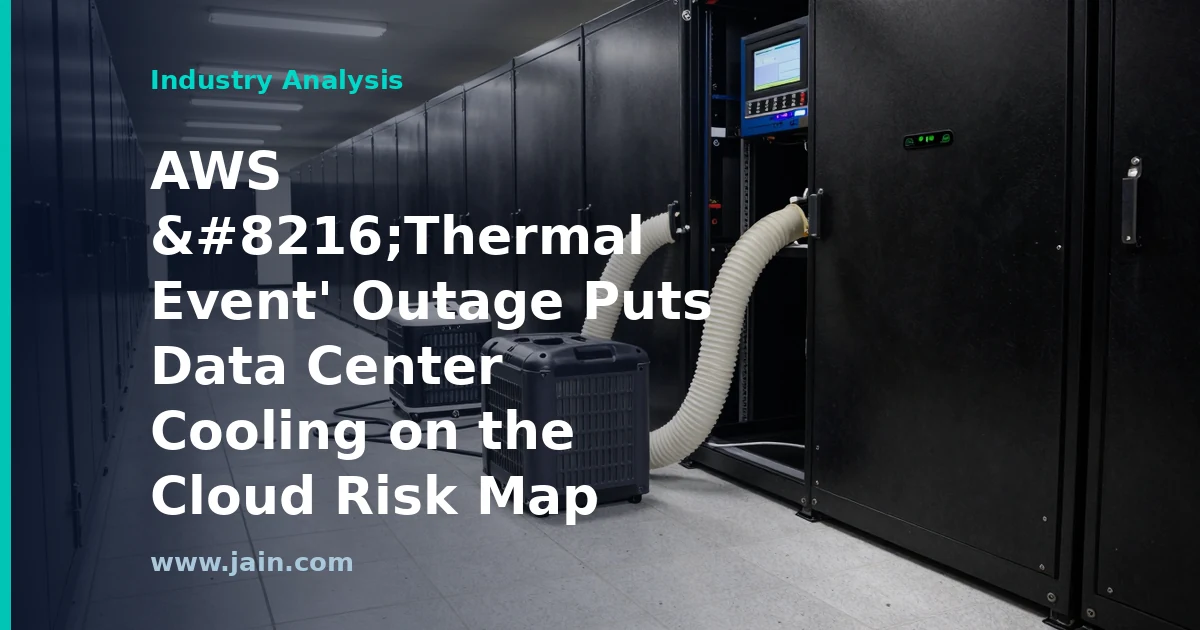
    AWS ‘Thermal Event’ Outage Puts Data Center Cooling on the Cloud Risk Map

    Amazon Web Services suffered a data center outage that the company attributed to a “thermal event,” according to a May 9, 2026 report from CRN. At the time of the report, some AWS services were still impacted, indicating recovery was ongoing rather than complete when the cause was disclosed.

    The disclosure was notably spare: the phrase “thermal event” confirms a cooling- or heat-related failure inside an AWS facility, but the public reporting available at publication did not detail which region was hit, how many customers were affected, or how long full restoration would take.

    Executive Summary

    The world’s largest cloud provider experienced a facility-level outage traced not to software, networking, or a cyberattack, but to heat. A “thermal event” is industry shorthand for a situation in which a data center’s cooling systems can no longer remove heat as fast as the IT equipment produces it, forcing servers to throttle or shut down to protect themselves. That this occurred at AWS — an operator with deep engineering resources and decades of operational experience — is the story.

    It matters because the physics of cloud computing are changing. Modern servers, especially those built for artificial intelligence workloads, draw far more power per rack than the equipment data centers were designed around a decade ago, and every watt consumed becomes heat that must be removed. Cooling has quietly moved from a background utility to one of the most consequential single points of failure in cloud infrastructure.

    For enterprises, the incident is a prompt to treat facility-level physical risk — cooling and power, not just software bugs — as a first-class input to cloud architecture and continuity planning. For the industry, it is a data point in a pattern: as densities rise, thermal margins shrink, and the cost of a cooling failure grows with every server packed into the room.

    What a ‘Thermal Event’ Actually Means

    Data centers are, at their core, heat-management machines. Every server converts electricity into computation and, unavoidably, into heat; chillers, cooling towers, air handlers, and increasingly liquid-cooling loops carry that heat away. When any link in that chain fails — a chiller trips, a pump loses power, a control system misbehaves, or outside conditions exceed design assumptions — temperatures inside the data hall can climb within minutes. Servers respond by throttling performance and then shutting down to avoid permanent damage.

    The phrase “thermal event” confirms the failure mode without revealing the failure cause. It could reflect mechanical breakdown, a power interruption to cooling equipment, a controls fault, or environmental stress. Each has different implications for how preventable the incident was, and the public reporting at the time did not say which applied. What the phrase does establish is that physical infrastructure, not code, took cloud services down — a category of failure that no amount of software redundancy inside a single facility can fully paper over.

    Why Cooling Is Now a Top-Tier Reliability Risk

    For most of the cloud era, the outages that made headlines were logical: configuration errors, DNS problems, cascading software failures. Cooling rarely featured because thermal margins were generous — racks drawing a few kilowatts left plenty of headroom. That headroom is disappearing. AI accelerators and dense compute have pushed rack power demands up sharply across the industry, and higher density means a cooling interruption becomes critical faster, with less time for operators to respond before equipment protection kicks in.

    The economics cut both ways. Operators pack facilities densely because space, power, and capital are expensive, but density concentrates risk: one cooling plant now underpins far more revenue-generating compute than it once did. The industry’s shift toward liquid cooling addresses heat removal at the chip level yet introduces new mechanical dependencies — pumps, loops, coolant distribution units — each a component that can fail. The engineering trend line points one direction: thermal management is becoming more complex precisely as the tolerance for its failure shrinks.

    The Customer’s Dilemma: Redundancy Is a Design Choice, Not a Default

    Cloud providers, AWS included, architect their platforms around Availability Zones — physically separate facilities within a region — precisely so that a single-building failure like a thermal event need not become a customer outage. But that protection only applies to workloads customers have deliberately architected to span zones, and the fact that “some services” remained impacted when CRN reported suggests the blast radius extended beyond any one customer’s choices.

    The practical lesson for buyers is uncomfortable but familiar: the shared-responsibility model extends to physical risk. Enterprises that treat a single cloud region — or a single zone — as infinitely reliable are making an implicit bet on someone else’s chillers. Incidents like this one argue for testing failover paths rather than assuming them, and for asking providers harder questions about facility-level dependencies that sit beneath the abstractions. It also strengthens the case, for the most critical workloads, of multi-region or hybrid designs whose costs were once hard to justify.

    Transparency as a Competitive Variable

    Two words — “thermal event” — carried the entire public explanation at the time of the report. That is consistent with how hyperscalers typically communicate mid-incident, and there are defensible reasons for early caution: root causes genuinely take time to establish. But the information asymmetry is real. Customers making architecture and procurement decisions cannot weigh a risk they cannot see, and cooling-plant design, maintenance posture, and thermal headroom are precisely the details cloud providers disclose least.

    How AWS follows up matters more than the initial phrasing. The company has historically published detailed post-event summaries for major incidents, and a substantive account of what failed and what will change would convert this outage into usable information for the market. Absent that, enterprises are left to price the risk blind — and the industry loses a chance to learn from a failure at one of its most sophisticated operators.

    Background

    Amazon Web Services, launched in 2006, is the largest cloud infrastructure provider in the world, operating dozens of regions composed of multiple Availability Zones — physically separate data center facilities engineered so that a failure in one need not take down the others. Enterprises, governments, and a large share of the consumer internet run on its platform, which is why even partial AWS disruptions ripple widely and draw immediate scrutiny.

    Data center cooling, meanwhile, has shifted from a background utility to a strategic constraint across the industry. Rising rack power densities — accelerated by the AI buildout — have pushed operators toward higher-capacity cooling designs, including liquid cooling, while simultaneously narrowing the time margin between a cooling interruption and equipment shutdown. Facility-level physical failures now sit alongside software faults among the principal threats to cloud availability.

    Source: AWS Data Center Outage Caused By ‘Thermal Event,’ Some Services Still Impacted — CRN’s May 9, 2026 report on an AWS facility outage attributed to a cooling-related failure, with some services still recovering at publication.

  • SEC Presses for Clarity on How AI Data Centers Are Financed

    SEC Presses for Clarity on How AI Data Centers Are Financed

    The U.S. Securities and Exchange Commission — the federal agency that polices what public companies must tell investors — is pressing companies to spell out how their artificial-intelligence data center buildouts are being paid for, according to a Bloomberg Tax report published on May 8, 2026.

    The report is headline-level: it signals a regulatory focus on the financing structures behind AI compute capacity, rather than on the projects themselves. No specific companies, dollar figures, deadlines or enforcement actions are described in the source material available to us.

    Executive Summary

    The substance of the story is narrow but consequential. Regulators are not questioning whether AI data centers should be built; they are questioning whether investors can tell, from public filings, who is actually on the hook when they are. That is a disclosure question, and disclosure questions tend to arrive before accounting questions, which in turn tend to arrive before repricing.

    It matters because the current buildout is being funded through a wider mix of instruments than the last data center cycle. Alongside ordinary corporate debt and equity, capacity is being financed through special-purpose vehicles (separate legal entities created to hold a single project and its debt), joint ventures, long-dated leases, prepaid capacity contracts and vendor financing, in which a supplier helps fund the customer that buys its equipment. Each of these can sit at, near, or entirely off the balance sheet depending on structure and judgment.

    For infrastructure buyers, the practical read is that counterparty diligence is about to get more informative and more demanding. If issuers respond by disclosing more about guarantees, residual-value obligations and consolidation decisions, everyone in the supply chain — from landlords to power providers — gets a clearer view of who bears risk in a downturn. That is a net positive for the industry, even if it is uncomfortable for individual balance sheets in the short run.

    Why Financing Structure Is Now an Infrastructure Question

    Data centers have always been capital-intensive, but the AI cycle has changed the shape of the capital. A conventional colocation facility could be underwritten against a diversified tenant base and a long operating history. A purpose-built AI campus is often underwritten against a small number of very large contracts, expensive and rapidly depreciating accelerators, and power interconnection timelines measured in years. That combination pushes sponsors toward structures that isolate risk: put the asset and its debt in a separate vehicle, sign a lease rather than buy, or let the equipment vendor carry part of the financing burden.

    None of that is inherently improper. Project finance exists precisely because large, long-lived assets are easier to fund when their risks are ring-fenced, and the same techniques built power plants, pipelines and toll roads for decades. The disclosure question is different from the propriety question: it asks whether a reader of the financial statements can identify the obligations that remain with the parent even after the asset has been moved elsewhere. Guarantees, residual-value backstops, minimum-volume commitments and reconsolidation triggers are the details that decide whether a structure genuinely transfers risk or merely relocates its label.

    For laypeople, the intuition is simple. If a company builds a warehouse with borrowed money, the debt is obvious. If it instead signs a fifteen-year lease on a warehouse built by someone else, the economics can be nearly identical while the presentation is not. Accounting rules have narrowed that gap considerably over the past decade, but judgment still governs consolidation of variable-interest entities and the classification of complex, multi-party arrangements.

    Circularity, Vendor Financing and the Question Regulators Tend to Ask

    The structure that attracts the most supervisory attention in any capital cycle is the one where a supplier’s revenue depends on financing the supplier provides. Vendor financing is a legitimate and long-standing commercial tool — it accelerates adoption of expensive technology and it is common in telecom, aviation and semiconductor equipment. It also creates an information problem: revenue recognized today may be funded by credit that the vendor itself extended, which means the vendor’s earnings quality is partly a function of its customer’s future ability to pay.

    An investor cannot assess that risk without knowing its size and terms. Nor can a lender to the same ecosystem. This is where a disclosure push does more useful work than a rule change would: it does not prohibit anything, it simply asks the parties to state clearly what they have committed to. The critical caveat, and it applies to the skeptics as much as to the issuers, is that the existence of vendor financing in a sector is not by itself evidence of a problem. Aggregate exposure, tenor, collateral and concentration determine whether a practice is prudent or fragile, and those figures are exactly what is not yet public.

    Equally, industry pushback deserves the same scrutiny. The argument that AI demand is contracted far into the future is a claim about counterparty durability, not just about demand: a twenty-year capacity commitment is worth what the signer can pay. Both the bullish and the bearish narratives around the buildout currently rest on data that a stronger disclosure regime would make checkable, which is a reasonable argument in favor of the SEC’s reported interest regardless of which narrative one finds more persuasive.

    Who Gains and Who Absorbs the Cost

    The likeliest winners from clearer disclosure are the operators with conventional, well-capitalized balance sheets and long track records — mainly the large hyperscale platforms and the established REIT-structured wholesale providers, whose funding is already visible and whose cost of capital is set in liquid public markets. If the market can more easily distinguish transparent structures from opaque ones, the premium for transparency widens. Lenders, insurers and power utilities that must underwrite decade-long commitments also benefit, because their diligence currently relies heavily on private information.

    The cost falls on smaller and newer sponsors, particularly those whose economics depend on structuring rather than on scale. Additional disclosure raises compliance expense, lengthens deal timelines and can narrow the pool of financing techniques that survive investor scrutiny. That is not the same as saying such sponsors are doing anything wrong; it means the burden of a disclosure regime is not distributed evenly, and consolidation pressure in the middle tier of the market is a plausible second-order effect.

    For enterprise buyers of capacity, the sensible response is procedural rather than dramatic. Contracts for AI capacity should be read as credit exposures: ask who owns the facility, who owns the equipment inside it, which entity signs the service agreement, what recourse exists to a parent, and what happens to a tenant’s rights if the project vehicle is restructured. Those questions were always worth asking. A disclosure push simply makes the answers easier to obtain — and makes it more conspicuous when a counterparty declines to give them.

    Background

    The current AI buildout is the largest wave of data center construction on record by capital committed, and it has coincided with a broadening of how that capital is raised. Traditional corporate debt and equity now sit alongside project-level structures borrowed from the power and infrastructure world: joint ventures, special-purpose vehicles, asset-backed issuance, long-dated leases and prepaid capacity agreements. The underlying assets are also unusual — accelerator hardware depreciates far faster than the buildings housing it, while the power and land beneath it may hold value for decades.

    Regulatory attention to financing structure is a recurring feature of large capital cycles rather than a novelty. Accounting and disclosure regimes for leases and for consolidating off-balance-sheet entities have been tightened repeatedly over the past two decades, generally after periods in which structures outpaced the reporting conventions describing them. A disclosure push during an expansion, rather than after a contraction, is the comparatively benign version of that pattern.

    Source: SEC Calls for Clear Disclosure About AI Data Center Financing — Bloomberg Tax, May 8, 2026, reporting regulatory pressure on companies to explain how AI data center buildouts are funded.

  • Trump Order Targets Foreign Tech in US Power Grid

    Trump Order Targets Foreign Tech in US Power Grid

    The Trump administration is advancing measures to bar foreign technology considered a national-security risk from the US bulk-power system, according to a Nextgov/FCW report dated May 8, 2026. The move revives and extends earlier executive efforts to police the origins of transformers, inverters, control systems and other grid-connected equipment.

    Executive Summary

    Washington is again training its regulatory attention on the electric grid’s supply chain. The reported action would restrict the use of equipment from designated foreign adversaries in US power infrastructure, echoing a 2020 executive order that was paused and then partially unwound before returning to the policy agenda.

    For data-center operators, the stakes are practical rather than abstract. High-voltage transformers, medium-voltage switchgear, battery inverters and grid-tied controls increasingly determine whether new capacity comes online on schedule. Any rule that narrows the pool of eligible suppliers reshapes procurement, lead times and cost curves for hyperscale and colocation builds alike.

    What ‘Risky Foreign Technology’ Actually Means

    The phrase is broad by design. In earlier iterations, US officials focused on bulk-power equipment sourced from countries designated as foreign adversaries, with particular concern about large power transformers and digital control systems that could be remotely accessed or tampered with. The underlying worry is that embedded firmware, software updates or hardware backdoors in critical grid equipment could be exploited during a conflict or crisis.

    For a lay reader, the concern is less about a single dramatic hack than about slow, quiet dependence. If a handful of foreign vendors supply components that sit inside substations for thirty or forty years, replacing them later is expensive and disruptive. Regulators appear to be trying to prevent that lock-in from deepening while alternatives still exist.

    Direct Line to Data-Center Power

    Data centers do not run on abstractions; they run on transformers, switchgear and increasingly on-site generation. The industry is already contending with multi-year lead times for large transformers and constrained global manufacturing capacity. A rule that narrows sourcing options, even at the margin, tightens an already tight market and raises the premium on domestic and allied-country supply.

    Operators building AI-scale campuses should expect procurement teams to be asked new questions: Where was this transformer wound? Whose firmware runs the relay? Is the inverter vendor on a restricted list? Compliance overhead is real, but the bigger operational risk is discovering late in a project that a specified component is no longer eligible.

    Winners, Losers and Second-Order Effects

    Domestic manufacturers of transformers, switchgear and inverters stand to benefit if the policy sticks and is enforced consistently. Allied suppliers in Europe, Japan, South Korea and Canada are likely secondary beneficiaries. The clearest losers would be Chinese-origin equipment makers and, indirectly, US buyers who had been counting on lower-cost imports to hold down capital budgets.

    The second-order effect is timing. Even a well-intentioned rule can slow projects if the domestic industrial base cannot expand fast enough to absorb displaced demand. That risk deserves scrutiny on its own merits, separate from the security rationale.

    An Even-Handed Read of the Politics

    Supply-chain security in the grid is not a partisan invention; both the 2020 Trump executive order and subsequent Biden-era reviews concluded that the sector had exposure worth addressing. Where reasonable people differ is on scope, speed and how narrowly to define ‘risky.’ Overly broad rules can raise costs without proportionate security gains; overly narrow ones can leave gaps. The forthcoming details, not the headline, will determine which category this action falls into.

    Background

    Concerns about foreign-made equipment in the US grid escalated in May 2020, when the first Trump administration issued Executive Order 13920 declaring a national emergency over bulk-power system supply chains. That order was suspended early in the Biden administration pending review, and subsequent policy focused on voluntary guidance, prohibited-transaction rules for specific equipment and expanded domestic manufacturing incentives.

    In parallel, US utilities and data-center developers have wrestled with a global shortage of large power transformers, lead times that can stretch past two years, and rapid load growth driven by AI, electrification and reshoring. Those pressures form the practical backdrop against which any new sourcing restrictions will be judged.

    Source: Trump admin moves to block risky foreign technology from US power grid – Nextgov/FCW — reporting on federal action to restrict adversary-linked equipment in the US electric grid.

  • ERCOT Targets December Completion for Texas Governor’s Data Center Audit

    ERCOT Targets December Completion for Texas Governor’s Data Center Audit

    The Electric Reliability Council of Texas (ERCOT), the operator of the grid serving most of the state, said it plans to complete an audit of data centers ordered by the governor by December, according to a May 8 report from Houston Public Media. The commitment puts a public deadline on one of the most closely watched regulatory reviews of AI-era electricity demand in the United States.

    Executive Summary

    ERCOT has attached a timeline to a politically charged assignment: auditing the data centers connecting to, or seeking to connect to, the Texas grid. The review was directed by the governor’s office, and ERCOT now says it expects to finish the work by December. While the report offers few details on the audit’s scope or methodology, the deadline itself is meaningful — it tells developers, utilities, and investors that the current period of ambiguity around large-load treatment in Texas has an end date.

    The stakes are hard to overstate. Texas has become one of the world’s most active data center markets, drawn by comparatively fast interconnection, abundant land, and a deregulated power market. But that same openness has produced an interconnection queue crowded with speculative large-load requests, and state officials have grown increasingly focused on separating real projects from phantom ones — and on understanding what AI-scale demand means for a grid that must also keep the lights on for 27 million Texans.

    Why a Grid Operator Is Auditing Its Own Customers

    Grid operators do not normally audit the businesses that buy power across their wires. That ERCOT is doing so — at a governor’s direction — reflects how much data centers have changed the load-planning problem. A traditional factory or subdivision adds demand in predictable, modest increments. A single AI data center campus can request as much power as a mid-sized city, and developers routinely file interconnection requests at multiple sites while intending to build at only one. The result is a planning fog: the grid operator cannot easily tell how much of the demand in its queue is real, which makes every downstream decision — transmission buildout, generation adequacy, reliability modeling — harder.

    An audit, in this context, is essentially a truth-finding exercise. If ERCOT can establish which projects are financed, contracted, and actually advancing, it can plan against genuine demand rather than paper demand. For serious developers, that is arguably good news: credible projects benefit when speculative ones stop distorting the queue and inflating the apparent scarcity of grid capacity.

    The December Deadline Sets a Clock for the Market

    Deadlines discipline both regulators and markets. By committing to finish by December, ERCOT is signaling that developers and capital allocators should expect findings — and potentially policy consequences — on a knowable schedule rather than an open-ended one. Regulatory uncertainty is itself a cost: projects in the ERCOT queue must decide whether to commit capital now or wait to see whether the audit reshapes interconnection rules, cost allocation, or curtailment expectations for large flexible loads.

    The likelier near-term effect is informational. Audit findings could give Texas policymakers their first authoritative picture of AI-driven load growth in the state, which in turn feeds legislative and regulatory processes already underway. Texas lawmakers have in recent sessions moved to give regulators more visibility into and authority over very large loads, and an audit completed in December would land squarely in the window when such policies are being refined and implemented.

    Texas as the Test Case for AI Load Governance

    ERCOT’s situation is distinctive: its grid is largely isolated from the rest of the country, meaning it cannot lean on neighboring regions when supply runs short. That isolation, which contributed to the severity of the February 2021 winter storm blackouts, makes Texas unusually sensitive to demand growth that outpaces generation and transmission. It also makes Texas the natural test case for a question every U.S. grid region now faces: how should the power system verify, prioritize, and integrate enormous new computing loads?

    Other states and regional grid operators are watching. If the Texas audit produces a workable framework — for instance, distinguishing committed projects from speculative ones, or clarifying expectations for load flexibility during grid stress — versions of it will likely be replicated elsewhere. If it becomes a bottleneck that slows legitimate development, that too will be instructive, and competing markets will use it in their pitches to site-selection teams.

    Winners, Losers, and the Cost of Scrutiny

    For well-capitalized operators with signed customers and real construction schedules, tighter scrutiny is mostly upside: it thins out queue competition and firms up the planning environment. For speculative land-and-power plays that bank megawatt allocations to flip later, an audit is an existential threat. Utilities and transmission developers gain a clearer demand signal to build against. Ratepayer advocates get a lever for a question they have pressed nationally: who pays for the grid upgrades that giant loads require? The audit will not settle that question, but the data it produces will shape how Texas answers it.

    Background

    Texas has become one of the most active data center markets in the world, propelled by the AI boom’s demand for computing capacity and by the state’s comparative advantages: land, energy resources, a competitive wholesale power market, and interconnection timelines faster than many other U.S. regions. ERCOT, which operates the grid serving most of the state, has watched its large-load interconnection queue swell with data center requests — a mix of committed projects and speculative filings that is difficult to disentangle.

    Grid reliability carries particular political weight in Texas. The February 2021 winter storm caused days-long blackouts and made the ERCOT grid a permanent subject of legislative attention. Since then, state officials have pursued greater oversight of both supply and demand, including measures targeting very large electricity users. The governor’s data center audit, which ERCOT now says it will complete by December, is the latest expression of that scrutiny as AI-driven load growth accelerates.

    Source: ERCOT says it plans to complete governor’s data center audit by December — Houston Public Media report, May 8, 2026, on ERCOT’s timeline for the Texas governor’s audit of data center grid loads.

  • OpenAI’s GPT-5.5-Cyber: Trusted Access Becomes a Template for Dual-Use AI Security

    OpenAI’s GPT-5.5-Cyber: Trusted Access Becomes a Template for Dual-Use AI Security

    On May 8, 2026, OpenAI announced GPT-5.5 and a cyber-specialized variant, GPT-5.5-Cyber, under the banner of “scaling trusted access for cyber.” The framing signals two moves at once: a frontier model tuned for cybersecurity work, and a distribution model that gates the most sensitive capabilities behind some form of vetting rather than open availability.

    The announcement positions OpenAI in the growing market for AI-assisted security operations — and squarely in the middle of the industry’s hardest dual-use question: how to put offensive-grade security capability in defenders’ hands without simultaneously arming attackers.

    Executive Summary

    The core of the announcement, as titled, is a pairing: GPT-5.5 as a general frontier model, and GPT-5.5-Cyber as a specialization aimed at cybersecurity tasks, with access to the cyber variant “scaled” through a trusted-access program rather than released uniformly to all customers. In plain terms, trusted access means the vendor decides who qualifies to use the most capable version — typically security teams, researchers, and organizations that pass some screening — instead of shipping the same capability to every API key.

    Why it matters: cybersecurity is the clearest dual-use domain in AI. The same model that triages vulnerabilities, writes detection rules, or reverse-engineers malware for a defender can, in principle, accelerate the same work for an attacker. Until now, frontier labs have mostly handled this with blanket refusals or usage policies. A named, productized trusted-access tier is a different approach — it treats capability gating as a distribution and go-to-market design, not just a safety filter.

    If the model works commercially, it sets a template competitors are likely to follow: specialized high-capability variants for sensitive domains, sold through vetted channels. That has real implications for who gets access to top-tier AI security tooling — and who is left using general-purpose models.

    The Dual-Use Problem Finally Gets a Product Answer

    Security capability in AI models is inherently symmetric. Finding a vulnerability is the same cognitive task whether you intend to patch it or exploit it; writing a proof-of-concept exploit is standard practice for legitimate penetration testers and a weapon in other hands. Frontier labs have struggled with this symmetry: refuse too much and the model is useless to the defenders who need it most, refuse too little and the vendor becomes an accelerant for attackers.

    Trusted-access gating is the middle path, and it is not a new idea in security — it mirrors how the industry already handles exploit databases, commercial penetration-testing frameworks, and vulnerability disclosure programs, where capability is real but access is credentialed. What is notable is a major AI lab formalizing that structure around a named model variant. The announcement’s title alone — “scaling” trusted access — suggests OpenAI believes it has a vetting process that can grow beyond a small pilot, which has historically been the hard part.

    Gated Distribution as Business Model

    There is a commercial logic here beyond safety. A gated, specialized model is naturally an enterprise product: it sells to security operations centers, managed security providers, incident-response firms, and government-adjacent buyers who can pass vetting and pay for differentiated capability. That segments the market — the general model for everyone, the cyber variant at presumably enterprise terms for qualified buyers — and it creates a moat that pure model quality does not, because the vetting infrastructure, compliance posture, and trust relationships are themselves hard to replicate.

    The likely winners are larger security organizations that clear the bar and gain leverage over stretched analyst teams. The losers, at least relatively, are independent researchers, small consultancies, and defenders in less-resourced regions, for whom vetting processes tend to be slower and costlier. Access criteria therefore become a competitive and even an equity question: security research has long depended on independent researchers, and a world where top-tier tooling requires institutional credentials changes who can do that work.

    A Template Others Were Already Converging On

    OpenAI is not moving in a vacuum. Frontier labs broadly have published preparedness or responsible-scaling frameworks that treat cyber capability as a tracked risk category, and the industry has been inching toward tiered access for sensitive capabilities. A shipped product with trusted-access gating turns that abstract governance conversation into a concrete precedent — one that regulators, enterprise buyers, and competing labs will now reference. Expect procurement teams to start asking every AI vendor a version of the same question: what do you gate, and how do you decide who gets in?

    For the infrastructure side of the industry — data centers, network operators, cloud and hosting providers — the practical takeaway is nearer-term: AI-assisted attacks and AI-assisted defense are both professionalizing. Organizations that host and connect critical workloads should assume adversaries will use whatever general-purpose capability remains open, and should evaluate whether gated defensive tooling belongs in their own security stack rather than treating this as a distant lab-policy story.

    Background

    OpenAI, founded in 2015 and best known for ChatGPT and the GPT model line, has moved steadily from general-purpose chat assistants toward specialized, enterprise-oriented offerings. Its GPT-5 generation, introduced in 2025, anchored a period in which frontier labs increasingly segmented models by capability tier and use case, while publishing risk frameworks that single out cyber capability as a category requiring special handling.

    The surrounding market has been converging on the same question from two directions: security vendors racing to embed AI copilots into detection and response products, and AI labs deciding how much raw security capability to expose and to whom. A formal trusted-access program for a cyber-specialized frontier model sits at the intersection of those two races — part product launch, part governance experiment.

    Source: Scaling Trusted Access for Cyber with GPT-5.5 and GPT-5.5-Cyber — OpenAI’s May 8, 2026 announcement of GPT-5.5 and a gated, cybersecurity-specialized model variant.

  • Nvidia Backs IREN’s 5 GW Pipeline as Bitcoin Miners Become AI Data Center Plays

    Nvidia Backs IREN’s 5 GW Pipeline as Bitcoin Miners Become AI Data Center Plays

    Nvidia is placing what Data Center Knowledge describes as a massive AI infrastructure bet on IREN, the Nasdaq-listed data center operator formerly known as Iris Energy, and its roughly 5 gigawatt (GW) power pipeline. IREN began life as a renewable-powered bitcoin miner and has been repositioning its sites for AI computing.

    The report, published May 8, 2026, frames the move as part of a broader pattern: the world’s dominant AI chip maker is increasingly underwriting former cryptocurrency miners as vehicles for deploying its GPUs at scale.

    Executive Summary

    The significance here is less about any single transaction and more about what Nvidia’s endorsement confers. In today’s AI buildout, the binding constraint is no longer chips — it is energized land: sites with grid interconnection agreements, substations, and megawatts ready to draw. Bitcoin miners spent years accumulating exactly that, and IREN’s claimed 5 GW pipeline is among the largest such positions held by any former miner.

    Nvidia backing a partner is a well-established playbook — the company took an equity stake in GPU cloud provider CoreWeave, itself a former Ethereum miner, before CoreWeave’s rise to prominence. Support from Nvidia typically signals preferential access to scarce GPU allocations, which in turn helps a company raise capital and sign customers. For IREN, that halo could be worth as much as any cash involved.

    A caveat readers should hold onto: the available source material is a headline-level report, and it does not spell out the structure of Nvidia’s commitment — whether equity, chip supply priority, purchase commitments, or some combination. We flag what is and is not substantiated throughout.

    Why Nvidia Underwrites Its Own Customers

    Nvidia sells the picks and shovels of the AI gold rush, but picks are useless without mines — physical data centers with power, cooling, and fiber. By backing infrastructure operators, Nvidia expands the universe of buyers who can actually deploy its chips, diversifies demand beyond a handful of hyperscale cloud providers (Microsoft, Amazon, Google), and gains negotiating leverage against those same hyperscalers, who are all designing in-house AI silicon.

    The strategy has precedent and critics alike. Supporting CoreWeave paid off handsomely. But analysts have raised fair questions about circularity when a chip vendor’s investment flows back to it as chip purchases: revenue is real, yet the demand signal is partly self-generated. Without the deal terms disclosed, one cannot say how much of that concern applies here — which is precisely why the terms matter.

    Power Is the Moat: The Logic of the Bitcoin-to-AI Pivot

    A gigawatt is roughly the output of a large nuclear reactor; 5 GW is enough electricity for several million homes. Grid interconnection queues in the United States now routinely run five years or more, so a company holding approved connections and built substations owns something money cannot quickly buy. That is the asset bitcoin miners stumbled into: they built low-cost, high-density power infrastructure when nobody else wanted it.

    The pivot is not trivial, however. Bitcoin mining tolerates cheap, interruptible power and minimal redundancy; AI training and inference customers demand high uptime, liquid cooling for dense GPU racks, and enterprise-grade networking. Converting a mining site into an AI-grade facility means substantial re-engineering and capital — typically an order of magnitude more per megawatt than the original mining buildout. IREN, which runs sites on renewable-heavy grids in Texas and British Columbia, has been investing in exactly this conversion, but the pace and cost of that transition are where execution risk lives.

    Reading the 5 GW Number Carefully

    “Pipeline” is a term of art in data center development, and it deserves scrutiny wherever it appears — from IREN or any competitor. A pipeline typically blends operating capacity, sites under construction, and land with power applications in varying stages of approval. The operating fraction is usually a small share of the headline figure. The report does not break down how much of IREN’s 5 GW is energized today versus contracted, queued, or aspirational.

    That distinction determines the economics. Energized megawatts can generate AI revenue within quarters; queued megawatts may be years and billions of dollars away. Nvidia’s backing suggests the company has seen enough to be confident, but investors should want the same breakdown Nvidia presumably received: megawatts by status, by site, and by expected energization date.

    Winners, Losers, and the Competitive Ripple

    If Nvidia’s model of anointing power-rich partners continues, the winners are miners with large, well-located, transferable power portfolios — and the electricity-rich regions that host them. Traditional data center developers, who must start interconnection processes from scratch, face a compressed timeline disadvantage. Hyperscalers gain another supply option but also another Nvidia-aligned competitor for the same GPUs.

    The losers may be smaller miners without convertible assets, and potentially the bitcoin-mining business lines themselves, as boards conclude AI hosting offers steadier, contract-backed returns than volatile block rewards. For enterprise buyers of AI compute, more supply entering the market from converted mining sites should, over time, ease pricing and availability — assuming these conversions deliver true data-center-grade reliability.

    Background

    IREN was founded in 2018 as Iris Energy and listed on Nasdaq in 2021 as a renewable-powered bitcoin miner, later rebranding as IREN to reflect a broader data center ambition. Like several large miners, it responded to the post-2022 AI boom by redirecting its power-rich sites toward GPU computing, buying Nvidia hardware and marketing AI cloud services alongside its mining business.

    The backdrop is an industry-wide land rush: AI demand has outstripped the electric grid’s ability to connect new data centers, turning companies with secured megawatts into acquisition and partnership targets. Nvidia, whose GPUs power most AI training, has repeatedly used investments and partnerships — most famously with CoreWeave — to cultivate infrastructure partners beyond the major cloud providers.

    Source: Nvidia Places Massive AI Infrastructure Bet on IREN’s 5 GW Pipeline — Data Center Knowledge report, May 8, 2026, on Nvidia’s backing of IREN’s AI data center expansion.

  • S&P Global Raises AI Infrastructure Forecast After 2025 Results Beat Expectations

    S&P Global Raises AI Infrastructure Forecast After 2025 Results Beat Expectations

    S&P Global, the ratings and market-intelligence firm, reported that AI infrastructure results for 2025 topped its expectations and, on the strength of those results, has upgraded its forecast for the sector. The announcement, published May 7, 2026, signals that one of the most closely watched independent forecasters now sees more AI-driven data center, compute, and power investment ahead than it previously modeled.

    Executive Summary

    Forecast upgrades come in two flavors: those driven by sentiment and those driven by results. S&P Global’s revision belongs to the second category — the firm says actual 2025 outcomes in AI infrastructure exceeded what its prior models anticipated, and it has raised its outlook accordingly. That distinction matters. A results-based upgrade means the checks cleared: capital was deployed, capacity was delivered or contracted, and revenue showed up in reported financials rather than in investor-day slideware.

    For the infrastructure ecosystem — data center operators, connectivity providers, power utilities, and the vendors that supply them — an independent forecaster moving its baseline upward extends the planning horizon for an already historic buildout. It also raises the stakes: the higher the consensus forecast climbs, the more painful any eventual shortfall in demand, power availability, or financing would be. The syndicated headline, however, carries no figures, so the size of the beat and the magnitude of the upgrade remain to be read in the underlying report.

    An Upgrade Anchored in Results, Not Hype

    Throughout the AI investment cycle, skeptics have argued that spending projections rest on circular enthusiasm — model builders forecasting demand for their own models. What distinguishes this announcement is its direction of inference: S&P Global is looking backward at 2025 actuals and concluding its earlier numbers were too low. When realized results outrun a forecast, the forecaster faces a choice between treating the beat as a one-time pull-forward of demand or as evidence the underlying trend is steeper. By upgrading, S&P Global has chosen the second interpretation.

    That said, extrapolation is exactly how forecasters get caught at cycle peaks. Strong 2025 results confirm that money was spent and capacity absorbed; they do not by themselves prove that the returns on that spending will justify the next round. Readers should distinguish between the fact of the beat — which is evidence — and the upgraded projection, which remains a model.

    What More Capex Means for Power and Land

    AI infrastructure is shorthand for a physical supply chain: chips, servers, the data centers that house them, the fiber that connects them, and — increasingly the binding constraint — the electricity that powers them. A raised forecast implies more of all of it. For data center markets already contending with multi-year utility interconnection queues, transformer lead times, and community pushback on siting, an upgraded demand outlook translates directly into more competition for powered land and grid capacity.

    For utilities and power developers, a higher independent forecast strengthens the case for generation and transmission investment that regulators must approve. For enterprise and colocation buyers, it points the other way: sustained demand above prior expectations tends to keep vacancy low and pricing firm, meaning tenants who deferred capacity decisions waiting for the market to loosen may be waiting longer than they planned.

    Winners, Losers, and the Widening Gap

    A rising forecast does not lift all boats equally. Operators with secured power, entitled land, and access to capital can convert an upgraded outlook into pre-leased expansion. Smaller players without those ingredients face the same rising input costs — power, equipment, construction labor — without the contracted revenue to offset them. The upgrade also sharpens the divide between markets: regions that can deliver megawatts on credible timelines will absorb a disproportionate share of the incremental demand the new forecast implies.

    The risk ledger deserves equal attention. Every upward revision embeds assumptions about continued hyperscaler spending, stable financing conditions, and AI applications generating enough end-customer revenue to sustain the cycle. If any of those assumptions weakens, capacity ordered against the upgraded forecast could arrive into a softer market. S&P Global’s own ratings business exists precisely because leverage built in good times gets tested in bad ones — a useful lens to apply to its market forecasts as well.

    Background

    The AI infrastructure buildout accelerated sharply after generative AI reached mass adoption, with hyperscale cloud providers and AI developers committing historic sums to chips, data centers, and power. Throughout 2024 and 2025, a running debate pitted those who saw the spending as a durable platform shift against those who warned of overbuild, with independent forecasters like S&P Global serving as referees between the narratives.

    S&P Global occupies an unusual vantage point in that debate: its ratings arm evaluates the creditworthiness of the utilities, data center operators, and technology firms doing the spending, while its market-intelligence arm models the demand itself. When a firm with exposure to both sides of the ledger raises its outlook based on realized results, it carries more weight than promotional projections — which is precisely why the details behind this upgrade merit close reading.

    Source: AI infrastructure results in 2025 top expectations, forecast upgraded — S&P Global, announcing an upgraded AI infrastructure forecast after 2025 sector results exceeded the firm’s expectations.

  • Johnson Controls Q2 Sales Rise 8% on Data Center Cooling Demand

    Johnson Controls Q2 Sales Rise 8% on Data Center Cooling Demand

    Johnson Controls, one of the world’s largest building-technology and HVAC companies, reported an 8% year-over-year increase in sales for its fiscal second quarter, with data center cooling demand cited as a principal driver, according to a May 7, 2026 report by Facilities Dive. Because Johnson Controls’ fiscal year ends in September, its second quarter covers roughly January through March 2026.

    Executive Summary

    The headline number — 8% sales growth at a company of Johnson Controls’ scale — is notable less for its size than for its attribution. When a diversified industrial that sells everything from fire-suppression systems to building controls credits data center cooling as the engine of a quarter, it quantifies something the industry has sensed for two years: AI-driven data center construction has become a primary demand source for the industrial HVAC sector, not a niche vertical.

    Cooling is the second-largest consumer of power and capital in a data center after the IT equipment itself, because nearly every watt a server draws becomes heat that must be removed. As hyperscale operators — the companies running the largest cloud and AI facilities — race to add capacity, the vendors who make chillers, air handlers, and thermal-management systems are seeing that race show up directly in their revenue lines. Johnson Controls’ quarter is one of the cleaner public data points yet on how large that effect has become.

    From Building Controls to AI Infrastructure Supplier

    Johnson Controls has spent recent years narrowing its portfolio toward commercial buildings and applied HVAC — the large, engineered cooling systems used in campuses, hospitals, and data centers — including divesting its residential and light-commercial HVAC business to Bosch and acquiring Silent-Aire, a maker of modular cooling and hyperscale data center equipment, in 2021. A quarter in which data center cooling is called out as the growth driver suggests that repositioning is doing what it was designed to do: concentrate the company’s exposure where capital spending is heaviest.

    That matters for how investors and customers should read the company. Johnson Controls is increasingly priced and evaluated not as a building-products conglomerate but as a supplier to AI infrastructure buildouts — a category that commands different growth expectations, and different scrutiny, than traditional construction-linked HVAC.

    The Economics of the Cooling Boom

    Data center cooling is attractive business for industrial vendors for structural reasons. The equipment is large, engineered-to-order, and often sold with long-term service contracts — chillers (machines that produce chilled water to absorb heat from server halls) run continuously for decades and require ongoing maintenance. Hyperscale projects are also ordered in fleets rather than units, which fills factory backlogs years ahead and gives manufacturers unusual visibility and pricing power compared with the one-building-at-a-time commercial construction cycle.

    The industry is simultaneously navigating a technology transition. As AI chips grow denser, air cooling reaches physical limits, and liquid cooling — circulating coolant directly to the chips or their racks — is taking a growing share of new deployments. That transition is an opportunity for incumbents with liquid-capable portfolios and a risk for anyone whose installed strength is concentrated in legacy air-based systems. The source report does not break down how much of Johnson Controls’ growth came from which technology, a distinction that matters for judging how durable the growth is.

    A Rising Tide Across the Vendor Field

    Johnson Controls is not alone in reporting data-center-driven strength; the same demand wave has lifted results across thermal-management and power-equipment vendors, and competitors such as Vertiv, Carrier, Trane Technologies, Schneider Electric, Munters, and Daikin all compete for slices of the same buildouts. The significance of this quarter is corroborative: each vendor that attributes measurable growth to data centers adds evidence that hyperscale capital spending is flowing through to the industrial supply chain broadly, rather than pooling with one or two specialists.

    For data center operators and enterprises planning capacity, the flip side of vendor prosperity is procurement reality: strong vendor demand typically means longer lead times and firmer pricing for large cooling equipment. Buyers who plan orders early, standardize designs, and lock delivery slots hold the advantage in a seller’s market.

    The Concentration Question

    The risk embedded in an 8% quarter driven by one end market is the same as its appeal: concentration. Data center demand is ultimately a derivative of a handful of hyperscalers’ AI capital-expenditure decisions. If AI infrastructure spending decelerates — because of monetization pressure, power-availability constraints, or efficiency gains that reduce cooling intensity per unit of compute — the vendors that re-oriented toward this vertical would feel it quickly. Nothing in the source report suggests that is imminent, but a growth story built on one customer class deserves to be monitored as one.

    The even-handed reading: this quarter substantiates real, current demand flowing to a major HVAC vendor. It does not, by itself, establish how long the cycle runs, and the headline-level detail available leaves the durability question open.

    Background

    Johnson Controls traces its roots to 1885, when Warren S. Johnson commercialized the electric room thermostat, and grew over the following century into one of the world’s largest building-technology companies, spanning HVAC equipment (including the York chiller brand), building automation, and fire and security systems after its 2016 merger with Tyco. In recent years the company has deliberately narrowed toward commercial and engineered building systems, selling its residential and light-commercial HVAC business to Bosch and investing in data center capabilities, most visibly through the 2021 acquisition of hyperscale cooling specialist Silent-Aire.

    That repositioning coincided with the AI infrastructure boom, in which data center construction — and the power and cooling systems it requires — became one of the fastest-growing capital-spending categories in the global economy, reshaping demand for the entire industrial HVAC sector.

    Source: Data center cooling drives Johnson Controls’ Q2 sales up 8% — Facilities Dive report (May 7, 2026) on Johnson Controls’ fiscal second-quarter results and the role of data center cooling demand.