Eight leading U.S. communications companies, among them Comcast, announced on May 17, 2026 the formation of the C2 ISAC, a new Information Sharing and Analysis Center intended to strengthen cybersecurity collaboration across the communications sector. The body will serve as a venue for member firms to exchange cyber threat intelligence relevant to the networks that carry the nation’s voice, video, and data traffic.
Executive Summary
The announcement establishes a dedicated, industry-run clearinghouse for cyber threat information among major U.S. communications providers. An ISAC — an Information Sharing and Analysis Center — is a nonprofit membership organization through which companies in a critical-infrastructure sector pool indicators of compromise, attacker tradecraft, and defensive practices, so that an intrusion detected on one network can inform defenses on all the others.
The move matters because communications networks sit underneath essentially every other critical sector: finance, healthcare, energy, and government all ride on carrier infrastructure. It also arrives after a period in which U.S. telecommunications networks drew sustained attention from state-sponsored intrusion campaigns, making the case for faster, structured intelligence exchange among carriers considerably less abstract than it once was. That said, the announcement as distributed is brief, and key operational details — the full membership roster, governance, funding, and how C2 ISAC relates to existing communications-sector sharing bodies — are not spelled out in the material we reviewed.
Why Telecom Threat Sharing Is Having a Moment
The timing of a new communications-sector ISAC is not hard to read. Over the past two years, publicly disclosed intrusion campaigns attributed to state-sponsored actors — most prominently the Salt Typhoon operation revealed in late 2024 — showed that multiple major U.S. carriers could be compromised by the same adversary, using related techniques, over an extended period. When several competitors are being probed by one well-resourced attacker, the security of each network partly depends on what the others have already seen. Structured sharing converts one company’s painful discovery into every member’s early warning.
For lay readers: threat intelligence in this context means concrete technical artifacts — malicious IP addresses, malware signatures, the specific sequences of actions attackers take inside a network — plus analysis of who is attacking and why. Shared quickly, it lets a defender look for an intruder before that intruder reaches them.
Where C2 ISAC Fits in an Existing Ecosystem
The ISAC model is well established: sector-specific centers have operated since the late 1990s, with the financial sector’s FS-ISAC often cited as the benchmark. The communications sector has historically coordinated through government-adjacent structures, including the long-running Communications ISAC function associated with the National Coordinating Center for Communications. A new, carrier-founded body suggests the major providers want an industry-owned vehicle with its own governance and, presumably, its own operational tempo.
That raises a fair structural question that applies to any new sharing body, not to these companies specifically: does a new center consolidate effort or fragment it? The value of an ISAC scales with the breadth and candor of participation. If C2 ISAC becomes the primary venue where the largest carriers share at depth, it could raise the bar for the whole sector. If it operates in parallel with existing channels without clear division of labor, members could face duplicated processes and diluted signal. The announcement text we reviewed does not address this relationship.
The Economics of Cooperating With Competitors
Communications is a fiercely competitive business, and cybersecurity has sometimes been treated as a differentiator rather than a commons. ISACs work because they carve security out of the competitive arena: members compete on price, coverage, and service, but not on whether each other’s networks get breached. There is also a legal scaffold that makes this workable — the Cybersecurity Information Sharing Act of 2015 established liability protections for companies exchanging cyber threat indicators, addressing the antitrust and disclosure fears that historically chilled cooperation.
The economics favor the members, too. Duplicating threat-hunting effort eight times over is expensive; pooling it is cheaper and better. For eight firms of this scale, even modest reductions in attacker dwell time — the period an intruder operates undetected — translate into materially lower incident costs and less regulatory exposure. The open question, common to all ISACs, is free-riding: sharing bodies tend to have a few prolific contributors and many quiet consumers. Governance and culture, not press releases, determine which way that goes.
What Would Count as Success
A fair test for C2 ISAC, a year in, would look like this: Is machine-speed indicator sharing actually operating, or is exchange limited to periodic meetings? Has membership broadened beyond the founding eight to regional carriers and smaller providers, who are often the softest targets and whose networks interconnect with everyone else’s? And is there evidence — even anonymized — that shared intelligence shortened a real incident? None of this is knowable at launch, and it would be unfair to demand it of a day-one announcement. But those are the measures by which the sector, its enterprise customers, and regulators should eventually judge the effort, and the founders would strengthen their case by committing to report against them.
Background
Information Sharing and Analysis Centers date to a 1998 U.S. presidential directive encouraging each critical-infrastructure sector to build a private-sector hub for exchanging threat information; the financial industry’s FS-ISAC, founded in 1999, became the model most others emulate. The communications sector — the carriers, cable operators, and network providers whose infrastructure underlies nearly every other industry — has historically coordinated through the National Coordinating Center for Communications and its associated ISAC function, alongside direct work with federal agencies such as CISA and the FCC.
Pressure on the sector intensified after late 2024, when the Salt Typhoon espionage campaign revealed deep, sustained compromises across multiple major U.S. telecommunications providers. Those disclosures prompted congressional scrutiny, federal guidance on hardening carrier networks, and renewed debate about whether existing sharing arrangements moved fast enough — the backdrop against which eight major firms have now stood up an industry-owned center of their own.
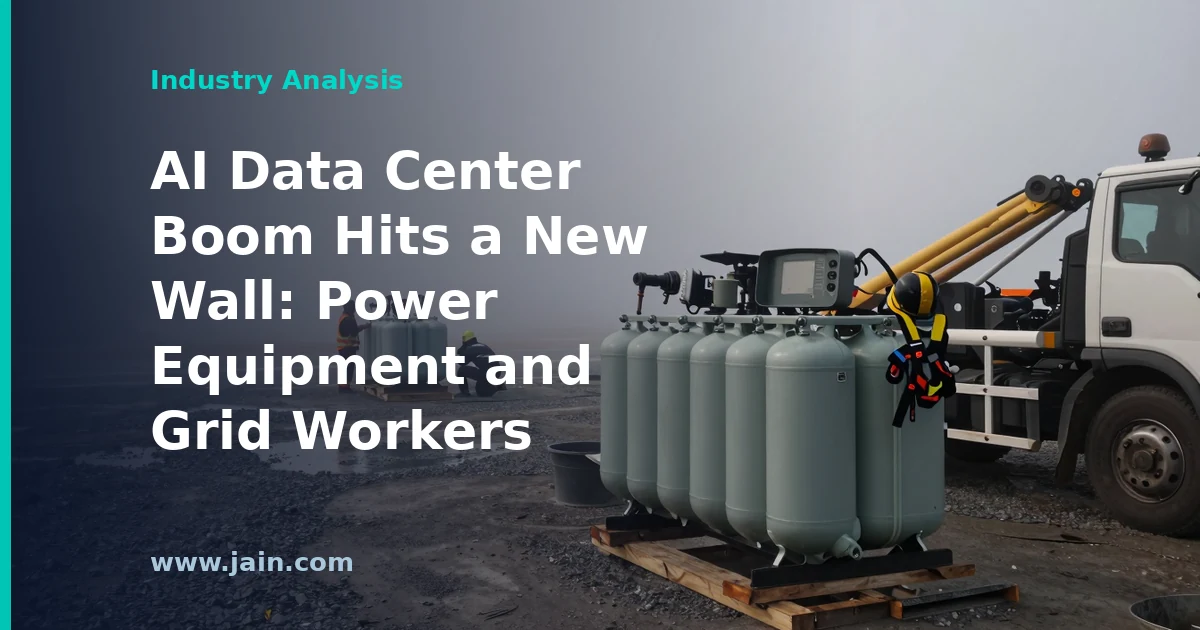
Reuters reported on May 17, 2026 that the ongoing rush to build data centers — driven above all by AI computing demand — is worsening shortages of power equipment and of the skilled workers needed to build and connect electrical infrastructure. The report frames the industry’s constraint as no longer just the availability of electricity itself, but the transformers, switchgear, and trained grid workforce required to deliver it.
Executive Summary
The headline finding is a shift in where the AI infrastructure bottleneck sits. For the past several years, the dominant question in data center development has been access to megawatts — whether utilities can supply enough electricity to power ever-larger campuses. Reuters’ reporting points to a second-order problem: even where power generation exists on paper, the physical equipment that moves electricity (transformers, switchgear, high-voltage cable) and the people qualified to install and energize it (electricians, linemen, substation engineers) are in increasingly short supply, and data center demand is making both shortages worse.
This matters because equipment and labor constraints behave differently from generation constraints. A power plant shortfall is a capacity planning problem that utilities and regulators can see coming years ahead. Equipment lead times and workforce gaps are supply chain and demographic problems — they compound quietly, hit every project in the queue at once, and cannot be solved quickly by spending more money, because factories and apprenticeship pipelines take years to expand. For anyone planning, financing, or buying data center capacity, the practical effect is the same: schedules stretch, and the projects that secured equipment and crews early hold a widening advantage.
The Bottleneck Has Moved Down the Stack
Data center development has always been a race through sequential constraints: land, then fiber, then power, and now the electrical hardware and hands that turn a power allocation into an energized facility. A utility commitment to deliver megawatts is only the first step — that electricity still has to pass through high-voltage transformers, substations, and switchgear before a single server boots. Reuters’ framing suggests the industry has cleared enough of the megawatt question, at least in some markets, to expose the layer beneath it.
This is a meaningful change in how projects fail or slip. A site with signed power agreements can still sit idle waiting for a transformer delivery or a qualified crew to commission a substation. Because these inputs are procured late in a project’s life but have long lead times, the mismatch tends to surface after significant capital is already committed — the most expensive place in a project to discover a delay.
Why Equipment Shortages Are Hard to Fix Quickly
Large power transformers and switchgear are not commodity products. They are engineered-to-order equipment built in a limited number of factories worldwide, with specialized inputs like electrical steel and, critically, their own skilled manufacturing workforces. When demand surges — from data centers, but also from grid modernization, electrification, and renewable interconnection all competing for the same order books — manufacturers cannot simply add shifts. Expanding capacity means new plants and new trained workers, both multi-year undertakings.
The result is a queue that rewards incumbency and scale. Hyperscale operators and large utilities can place framework orders years ahead and absorb price increases; smaller developers and municipal utilities wait longer and pay more. If the Reuters reporting is right that data center demand is actively worsening the shortage, the competitive gap between well-capitalized builders and everyone else — including utilities buying replacement equipment for ordinary grid maintenance — likely widens before it narrows.
The Workforce Problem Is Demographic, Not Cyclical
The second shortage Reuters identifies — grid workers — is in some ways the harder one. Electricians, linemen, and substation technicians are trained through apprenticeships that take years, and the utility workforce in the United States has been aging toward retirement for over a decade. A demand spike from data center construction lands on a labor pool that was already thinning for structural reasons.
Unlike equipment, labor cannot be stockpiled or ordered ahead. Builders can and do bid up wages to pull crews toward their projects, but that reallocates a fixed pool rather than growing it — and it raises costs for utilities and other construction sectors drawing on the same trades. The durable fixes are training pipelines, union apprenticeship expansion, and making grid trades attractive careers, none of which pays off inside a single project’s timeline. For the industry, that means workforce constraints should be treated as a persistent planning input, not a temporary tightness that clears next quarter.
What It Means for Buyers, Builders, and the Grid
For enterprises and AI companies buying capacity, the practical takeaway is that delivery dates carry more risk than headline megawatt figures. A provider’s real differentiator is increasingly its position in equipment queues and its access to qualified construction and commissioning labor — questions worth asking directly during procurement. Operators with existing powered shells, spare substation capacity, or long-standing utility and contractor relationships can deliver on timelines that new entrants cannot match.
For the broader grid, there is a fairness dimension regulators will have to manage: data centers competing for scarce transformers and crews are competing, in part, with the routine reliability work utilities perform for everyone else. How that tension is priced and prioritized — who pays for grid upgrades, whose projects move first — is becoming one of the central policy questions of the AI buildout. It deserves scrutiny from both directions: utilities and communities are right to ask whether data center growth is crowding out other needs, and developers are right to note that their demand is also financing grid investment that would otherwise struggle for funding.
Background
Data centers are the industrial facilities that house computing hardware, and the surge in AI workloads since 2023 has pushed their power requirements from tens of megawatts per site toward campus-scale demands that rival heavy industry. That growth first collided with electricity generation and transmission capacity, making utility power agreements a gating factor for new projects. The electrical supply chain behind those agreements — transformer manufacturing, switchgear production, and the skilled-trades workforce that installs them — was already strained before the AI boom by aging grid infrastructure, electrification, and renewable energy buildouts. Reuters’ May 2026 reporting captures the point where data center demand and those pre-existing strains visibly compound.
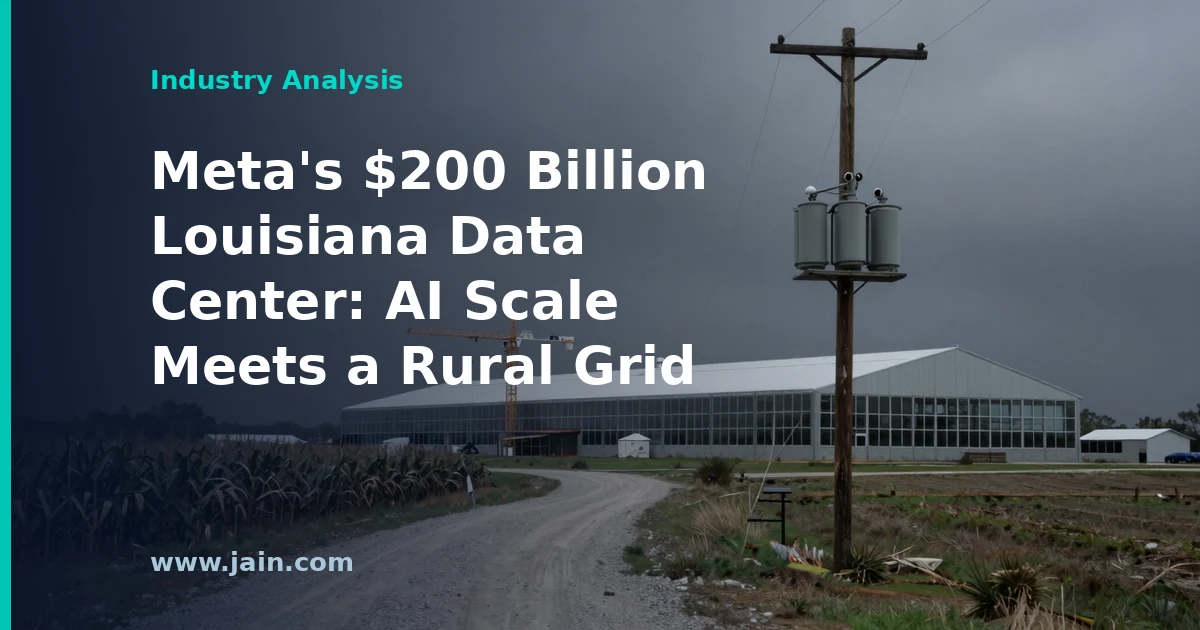
Bloomberg reports that Meta’s data center campus in rural Louisiana — the AI supercomputing site the company calls Hyperion — now represents a commitment on the order of $200 billion, a figure that would make it the largest single data-center investment ever reported. The project, located in Richland Parish in northeast Louisiana, began as a $10 billion announcement in December 2024 and has grown alongside Meta’s escalating artificial-intelligence ambitions.
The May 17 report frames the build as transformative for the surrounding rural region, where a campus designed to scale toward multiple gigawatts of computing power is reshaping the local economy, the electric grid, and the land itself.
Executive Summary
The headline number is staggering even by hyperscale standards. When Meta first announced the Richland Parish project, its roughly $10 billion price tag and four-million-square-foot footprint already made it the company’s largest data center. A $200 billion figure — twenty times the original commitment — reflects how quickly the economics of frontier AI have escalated: the cost of a leading AI campus is no longer set by buildings and land but by the accelerator chips, networking, and power infrastructure packed inside them, refreshed on a fast cycle.
Why it matters: a single company concentrating that much capital at a single rural site is a new phenomenon in American infrastructure. It tests the capacity of a regional utility (Entergy Louisiana is building new gas-fired generation to serve the load), the absorptive capacity of a small rural parish, and the balance sheets of even the world’s most profitable companies. Meta has already turned to outside capital for this site, including a reported joint-venture financing arrangement with Blue Owl Capital — a sign that AI infrastructure at this scale is becoming its own asset class.
The caveat: the source is a single report, and it does not spell out what the $200 billion covers — committed construction capital, cumulative spending including chips over the site’s life, or a long-range projection. Those distinctions matter enormously, and we flag them below.
From $10 Billion to $200 Billion in Eighteen Months
Meta announced the Richland Parish campus in December 2024 as a $10 billion, four-million-square-foot facility — at the time, the largest in its fleet. By mid-2025, CEO Mark Zuckerberg had rebranded the site as Hyperion and described plans to scale it toward five gigawatts of computing capacity, part of a stated intent to spend hundreds of billions of dollars on AI infrastructure. A $200 billion characterization of the site is therefore less a sudden announcement than the visible endpoint of a steady escalation.
The driver is the changed composition of data-center cost. In a conventional facility, the building and electrical plant dominate. In an AI campus, the servers and GPUs (the specialized chips that train and run AI models) can represent the large majority of total investment — and unlike the building, they are replaced every few years. That is how a single site’s lifetime cost can plausibly reach twelve figures, and it is also why headline totals for AI campuses should be read carefully: they often blend one-time construction with years of recurring hardware spending.
What a Gigawatt-Class Campus Asks of a Rural Grid
Richland Parish is farm country in one of the poorer corners of Louisiana. A campus targeting multiple gigawatts — a gigawatt is roughly the output of a large power plant, enough for hundreds of thousands of homes — cannot draw on spare capacity, because rural grids do not carry spare capacity at that scale. Entergy Louisiana’s answer has been new natural-gas generation built substantially to serve this one customer, an arrangement approved by state regulators.
That model raises questions every state hosting hyperscale AI now faces. Who bears the cost if the load does not materialize or the customer leaves early — the company, or ratepayers? What happens to local reliability while multi-year grid upgrades catch up to the load? And how does a build dependent on new gas plants square with Meta’s long-standing renewable-energy commitments? These are not gotcha questions; they are the standard underwriting questions for single-customer generation, and the answers sit in regulatory filings and contract terms that headline coverage rarely reaches.
The Economics of Concentrating $200 Billion at One Site
Even for Meta, which generates tens of billions of dollars in annual free cash flow, this scale of spending strains a corporate balance sheet. The company’s reported use of joint-venture and private-credit financing for Hyperion — bringing in outside investors such as Blue Owl to own and fund data-center assets Meta then uses — signals a broader industry shift: AI infrastructure is being financed like power plants and pipelines, with long-lived structures and external capital, rather than expensed casually from operating profits.
Concentration is the risk that comes with it. A single-site bet of this magnitude assumes AI demand keeps compounding, that the chips installed are not stranded by faster successors, and that power arrives on schedule. The winners if it works: Meta, which gets training capacity rivals must match; Louisiana, which collects taxes and jobs; and the contractors, utilities, and lenders in the build chain. The losers if it doesn’t are harder to name in advance — which is precisely why the financing structures, and who holds which risk, deserve as much attention as the square footage.
Rural Transformation Cuts Both Ways
For Richland Parish, the project brings thousands of construction workers, a permanent operational workforce Meta originally described in the hundreds of jobs, and a tax base transformation few rural counties ever see. It also brings housing pressure, road and water demands, and a local economy newly tethered to one company’s AI strategy — a dependency small communities historically know from mills and plants, with mixed long-term results.
The fair reading is that both the boosters and the skeptics have real evidence. The investment, employment, and utility upgrades are concrete. So are the open questions about what the region retains if AI economics shift. Communities negotiating with hyperscalers elsewhere will study Louisiana’s terms closely — which makes transparency about those terms a matter of more than local interest.
Background
Meta operates one of the world’s largest data-center fleets, built over two decades to serve Facebook, Instagram, and WhatsApp. The generative-AI race changed the shape of that fleet: training frontier AI models requires enormous clusters of GPU chips concentrated at single sites with gigawatt-scale power. In 2025 Meta reorganized its AI efforts around ‘superintelligence’ and announced titan-scale campuses — Hyperion in Louisiana and Prometheus in Ohio — while raising capital spending to historic levels and signaling that hundreds of billions of dollars would follow.
The December 2024 Louisiana announcement landed in Richland Parish, a rural farming area, accompanied by state incentives and an Entergy plan for new gas-fired generation. The project has since become a national reference case for how AI infrastructure interacts with rural grids, utility regulation, and small-town economies.
POWER Magazine published an analysis on May 16, 2026, arguing that so-called phantom data centers — speculative, duplicative, or abandoned requests for grid connections at facilities that may never be built — did not break the U.S. power grid’s planning process. Its headline thesis is blunter: the flood of questionable megawatt requests proved the interconnection system was already broken before the AI-era demand surge arrived to stress it.
Executive Summary
The piece lands in the middle of one of the most consequential debates in energy and digital infrastructure: how much of the enormous projected data center load on utility books is real. Utilities and grid operators across the country have reported unprecedented volumes of large-load interconnection requests — the formal applications a big customer files to connect to the grid — driven by the AI build-out. A meaningful but unquantified share of those requests is widely believed to be speculative: the same project shopped to multiple utilities at once, or land plays filed to reserve capacity cheaply.
POWER Magazine’s framing matters because it shifts the blame from the applicants to the process. If a planning system can be swamped by requests that cost little to file, take years to study, and require little proof of commitment, the vulnerability was structural — phantom load merely exposed it. For an industry whose credibility with regulators and the public increasingly depends on accurate demand forecasts, that distinction shapes what the fix should be.
What a Phantom Megawatt Is — and Why It Ends Up on the Books
An interconnection request is not a binding order for power; in most jurisdictions it has historically been a cheap option. A developer scouting sites can file requests with several utilities for the same prospective campus, keep every option open while negotiating land, chips, and capital, and walk away from all but one — or all of them. Each of those filings, however, can enter a utility’s load forecast and transmission-study pipeline as if it were a real future customer.
The result is a compounding distortion. Study queues lengthen for everyone, including projects that are fully financed and ready to build. Forecasts inflate, which feeds into decisions about new generation, transmission lines, and rate cases. And because utilities cannot easily distinguish a committed hyperscale campus from a land speculator’s placeholder, the honest answer to “how much data center load is coming” becomes genuinely unknowable from the queue alone.
The Queue Was Broken Before AI Showed Up
The article’s central claim — that phantom load revealed rather than caused the breakdown — fits the longer history. Interconnection processes were designed for an era of slow, predictable load growth, with first-come-first-served study sequences, modest deposits, and few readiness screens. Generator interconnection queues showed the same failure mode years earlier, when speculative renewable projects piled up and forced regulators toward cluster studies and stiffer milestone requirements. Large-load interconnection, by contrast, has remained far less standardized, leaving each utility to improvise its own defenses.
Seen that way, data centers are the stress test, not the disease. Any process that prices a multi-hundred-megawatt reservation at close to zero will attract free options in a land rush; AI simply supplied the land rush. The implication is uncomfortable for utilities and developers alike: tightening screens on data centers without reforming the underlying study process would treat the symptom that made the problem visible.
Who Pays When the Forecast Is Wrong in Either Direction
Phantom load creates a two-sided planning risk. If utilities build generation and wires for demand that evaporates, the cost of that overbuild lands in rate base — the pool of investment that ordinary electricity customers repay over decades. If utilities discount the queue too aggressively and real projects materialize, the grid is short, prices spike, and serious data center customers face multi-year connection delays that push investment to other regions or into on-site generation.
That asymmetry explains the emerging middle path many utilities and regulators are pursuing: making the request itself carry real commitment. Larger deposits, demonstrated site control, staged payments tied to milestones, and contractual minimum-take obligations all convert a free option into a priced one. Developers with real projects generally have reason to support such screens, because they clear the queue of competitors who were never going to build — though they also raise the cost of legitimate early-stage flexibility.
Background
The AI infrastructure build-out has made data centers the dominant story in U.S. electricity demand, ending decades of roughly flat load growth. Utilities in many regions now report interconnection requests from prospective data center customers that dwarf their historical planning assumptions, and those figures flow into generation plans, transmission proposals, and rate cases. POWER Magazine, a long-running trade publication covering the power generation and delivery sector, has tracked the resulting tension: grid planners must commit capital years ahead of demand, using a queue that mixes committed hyperscale campuses with speculative placeholders. Generator interconnection went through a similar speculative pile-up in the renewables boom, prompting regulators to overhaul study processes — a precedent now shaping the debate over how to handle large loads.
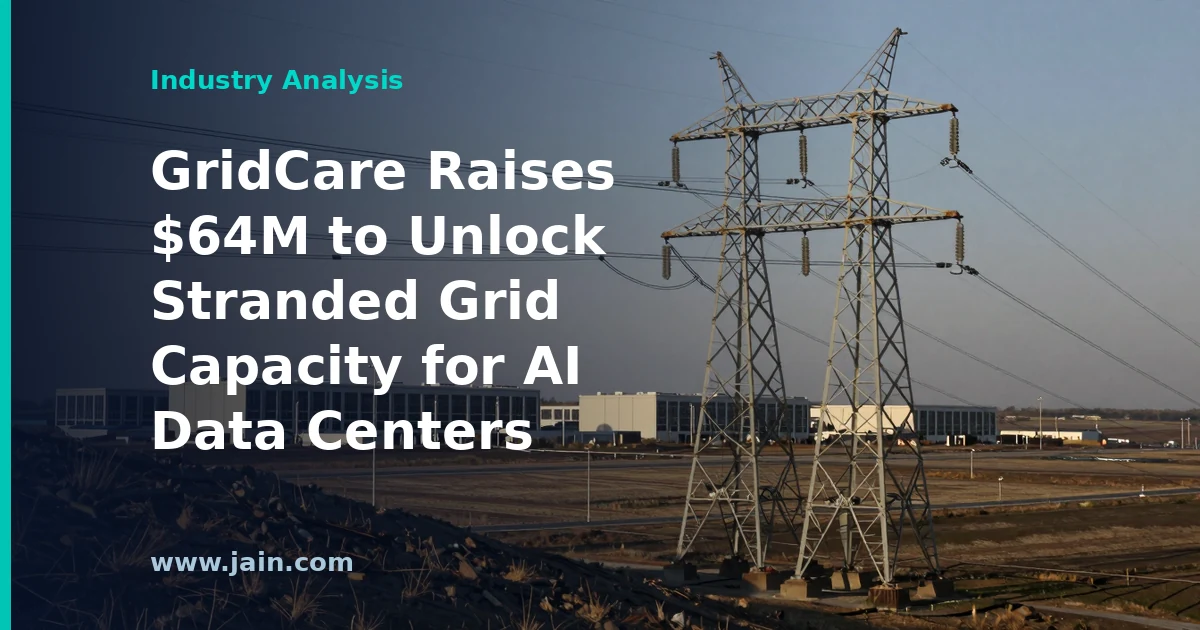
GridCare, a Palo Alto-based grid-software startup, has raised $64 million to accelerate the connection of AI data centers to the electric grid, according to a SiliconANGLE report published May 16, 2026. The company’s pitch is to identify “stranded” capacity — grid headroom that already exists but sits unused most hours of the year — and match it with data-center developers who would otherwise wait years in utility interconnection queues.
Executive Summary
The announcement itself is brief: a $64 million raise aimed at speeding up AI data-center projects. The report, as circulated, does not name the investors, the round’s structure, or a valuation. What makes the round worth analyzing is the problem it targets. The single biggest constraint on AI infrastructure buildout in the United States is no longer chips or capital — it is access to electric power, and specifically the multi-year queue to connect large new loads to the grid.
GridCare’s approach inverts the usual answer to that problem. Rather than building new generation or new transmission — both slow — it uses software to find places where the existing grid has spare room, then structures deals in which the data center agrees to flex its consumption during the relatively few hours when the grid is genuinely constrained. If that model works at scale, it converts a five-year infrastructure problem into a months-long contracting problem. A $64 million round suggests investors believe the thesis has moved past the pilot stage, though the public announcement offers little evidence either way — a gap we detail below.
Why the Interconnection Queue Became AI’s Bottleneck
Every large new electricity user or generator must apply to connect to the grid, and the utility or regional grid operator must study whether the connection would overload wires and transformers. That process — the interconnection queue — has become the choke point of the AI era. Lawrence Berkeley National Laboratory has tracked roughly 2,600 gigawatts of generation and storage stuck in U.S. queues, and wait times for large projects commonly stretch five years or more. Data centers seeking hundreds of megawatts of new load face similar studies, similar upgrade bills, and similar timelines.
For AI developers, that timeline is intolerable. Model-training capacity is a competitive weapon measured in quarters, not decades, which is why hyperscalers have turned to behind-the-meter gas turbines, nuclear power-purchase agreements, and sites in far-flung jurisdictions. Any company that can credibly compress grid access from years to months is selling exactly what the market’s most aggressive buyers want most.
The Stranded-Capacity Thesis
The grid is engineered for its worst hour — the summer evening peak when air conditioning, industry, and households all draw at once. The rest of the year, much of that capacity idles. GridCare’s argument, made publicly since it emerged in 2025, is that this latent headroom is enormous; the company has claimed more than 100 gigawatts could be unlocked nationally. The catch is that a data center can only use that headroom if it gets out of the way during the constrained hours — by throttling workloads, drawing on batteries, or running on-site generation for a small fraction of the year.
The economics can be attractive for every party. The utility monetizes an asset it already built and spreads fixed costs over more sales, which can put downward pressure on rates for other customers. The data center trades a modest flexibility obligation for years of saved time — and in AI economics, time-to-power is often worth more than the cost of the flexibility. The hard part is trust and verification: utilities need enforceable guarantees that the load will actually curtail when called, because the consequence of a broken promise is overloaded equipment, not a missed earnings estimate. Software that can model, contract, and verify that behavior is the actual product being financed here.
A Crowded Race Around the Queue
GridCare is not alone in attacking time-to-power. Competitors come from several directions: developers building behind-the-meter gas or geothermal generation, battery vendors marketing “bridge power,” utilities themselves rolling out flexible-interconnection tariffs, and grid-analytics firms courting the same utility relationships. Regulators are moving too — federal and state proceedings on large-load interconnection are actively reshaping the rules GridCare must operate within, which is both a tailwind (flexibility is gaining formal recognition) and a risk (a tariff change can rewrite the business model overnight).
The structural advantage of the stranded-capacity approach is that it requires no new steel in the ground; its structural weakness is that it depends on utility cooperation, and utilities adopt new commercial models slowly. The likely winners of this period are parties on both sides of the deal: utilities that learn to monetize flexibility, and data-center developers that treat power procurement as a portfolio rather than betting on a single path. The losers are projects that queued up conventionally and now watch flexible newcomers connect first.
What $64M Signals — and What It Doesn’t
A round of this size, roughly a year after the company’s reported seed financing, implies investors saw commercial traction worth underwriting. But it is worth being precise about what the public announcement substantiates: a funding amount and a stated purpose. It does not, as circulated, disclose customers, megawatts under contract, utility partnerships, or revenue. Venture funding validates a thesis’s attractiveness to investors, not its operational success. The evidence that matters — signed interconnection agreements and data centers energized ahead of queue timelines — will come from utility filings and customer announcements, not from the size of the round.
Background
GridCare is a Palo Alto-based startup that emerged from stealth in 2025 with a reported $13.5 million seed round, led by founder and CEO Amit Narayan — who previously founded AutoGrid, a grid-flexibility software company acquired by Schneider Electric in 2022. GridCare’s founding claim is that over 100 gigawatts of usable capacity is hiding in plain sight on the U.S. grid, accessible to data centers willing to be flexible.
The company operates against the backdrop of a historic grid bottleneck: Lawrence Berkeley National Laboratory has tracked roughly 2,600 gigawatts of projects waiting in U.S. interconnection queues, and the surge in AI data-center demand since 2023 has made time-to-power the defining constraint of the buildout. Regulators, utilities, and hyperscalers are all converging on flexibility — the idea that new loads can connect faster if they yield during peak hours — as one of the few near-term answers.
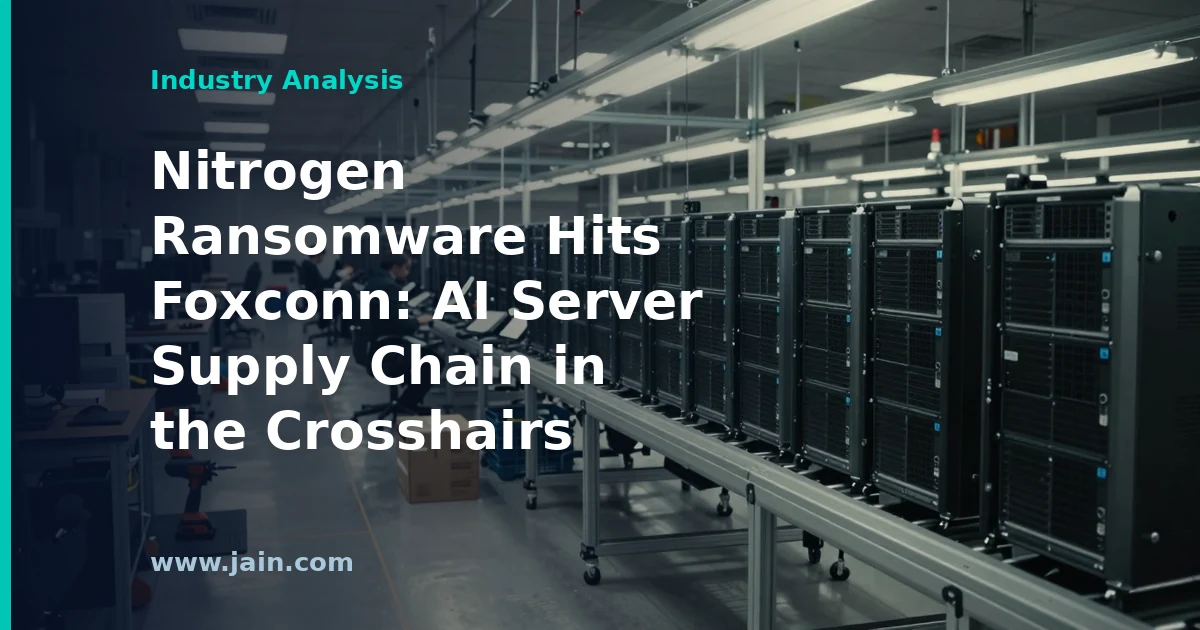
Foxconn, the Taiwanese contract-manufacturing giant that assembles a large share of the world’s consumer electronics and AI servers, has been named as the victim of a cyberattack attributed to the Nitrogen ransomware group, according to a May 2026 report in Cyber Magazine. Foxconn — formally Hon Hai Precision Industry — is the world’s largest electronics manufacturer, which makes any successful intrusion into its environment a supply-chain story as much as a security story.
Public details of the incident remain limited: the report centers on Nitrogen’s claim of responsibility, and at the time of writing the scope of the breach, the systems affected, and any operational impact have not been independently detailed.
Executive Summary
The reported breach pairs a familiar attacker playbook with an unusually consequential target. Nitrogen is a ransomware operation that security researchers have tracked in recent years, associated with intrusion campaigns that begin quietly — often through deceptive downloads or compromised access — and end in encryption, data theft, or both. Foxconn, its claimed victim, sits at the center of global electronics production, from smartphones to the GPU-dense server racks powering the AI buildout.
Why it matters: ransomware against a manufacturer of this scale is not just an IT incident. Contract manufacturers run on thin margins, tight production schedules, and deep integration with customers’ logistics systems. Even a contained breach raises questions about production continuity, the exposure of customer and design data, and the resilience of a supply chain that much of the technology industry — including the AI infrastructure sector — depends on.
Equally important is what has not been established. A ransomware group’s claim is an allegation until the victim confirms it or evidence is verified. The available reporting does not yet document what data was taken, whether production was disrupted, or what Foxconn’s response has been. Readers should hold both facts in mind: the target is enormously significant, and the publicly verified details are thin.
Why Manufacturers Keep Ending Up on Ransom Notes
Manufacturing has consistently ranked among the most-attacked sectors in ransomware incident data, and the economics explain why. A factory that stops producing loses money by the hour, and restarting complex assembly lines is far harder than rebooting an office network. That gives attackers leverage: the cost of downtime can dwarf the ransom demand, creating pressure to pay quickly. Manufacturers also run a mix of modern IT and older operational technology (OT) — the industrial control systems that run production equipment — which is often difficult to patch and was rarely designed with hostile networks in mind.
Contract manufacturers like Foxconn add a further layer of attractiveness. They hold not just their own data but their customers’ — product designs, component specifications, order volumes, and logistics details for some of the world’s most valuable brands. For a double-extortion group, which steals data before encrypting systems and threatens to publish it, that customer data is the real prize: it multiplies the number of parties with something to lose.
The AI Server Supply Chain Raises the Stakes
Foxconn’s role has evolved well beyond consumer electronics. The company has become a major assembler of AI servers — the GPU-packed systems that cloud providers and enterprises are racing to deploy. That business runs hot: demand outstrips supply, delivery schedules are tight, and every week of slippage ripples through data center construction timelines and cloud capacity plans downstream.
This is the context that makes the Nitrogen claim resonate beyond Foxconn itself. The AI infrastructure boom has concentrated enormous economic value in a relatively small number of manufacturing and logistics chokepoints. An attacker does not need to breach a chipmaker or a hyperscaler to touch the AI economy; compromising an assembler, a component supplier, or a logistics system can be enough. For data center operators and cloud buyers, the incident is a reminder that supply-chain risk assessments should extend to the cybersecurity posture of manufacturing partners, not just their production capacity.
Foxconn Has Been Here Before
This is not the first time Foxconn has appeared in a ransomware headline. In 2020, attackers using DoppelPaymer ransomware hit a Foxconn facility in Ciudad Juárez, Mexico, and in 2022 the LockBit group claimed an attack on its Tijuana operations. Neither incident, by public accounts, caused lasting global disruption — a point that cuts both ways. It suggests a company of Foxconn’s scale can absorb and contain regional incidents, but repeated targeting also shows that a manufacturer with hundreds of facilities and a vast workforce presents an attack surface that is effectively impossible to make airtight.
The pattern also illustrates how ransomware groups treat prior victims: a company that has been breached before is often probed again, by different crews, on the theory that complexity breeds recurring gaps. For defenders, the lesson is that incident response cannot end at recovery — each event is intelligence about where the perimeter is soft.
Reading Ransomware Claims with Discipline
A note of caution belongs in any analysis of this incident: ransomware groups have strong incentives to exaggerate. Naming a famous victim generates publicity, pressures the target, and burnishes the group’s reputation with affiliates. There have been past cases across the industry where claimed breaches proved smaller than advertised — stolen data from a subsidiary or supplier presented as a crown-jewels haul, or old data recycled as new.
That does not mean the claim is false; it means the burden of proof matters. The questions that determine this incident’s real severity — what was accessed, whether production systems were touched, and what data if any was exfiltrated — can only be answered by Foxconn’s own disclosure or by verified evidence. Until then, the sober reading is that a credible threat group has claimed a very high-value target, and the claim warrants attention without embellishment.
Background
Foxconn, the trade name of Taiwan’s Hon Hai Precision Industry, grew from a components maker founded in 1974 into the world’s largest electronics contract manufacturer, employing hundreds of thousands of workers across facilities in Asia, the Americas, and Europe. It is best known as Apple’s principal iPhone assembler, but its customer list spans much of the global electronics industry, and in recent years it has become a major manufacturer of AI servers — the GPU-dense systems at the heart of the data center buildout.
The company’s scale has made it a recurring ransomware target: a DoppelPaymer attack struck its Ciudad Juárez, Mexico facility in 2020, and LockBit claimed an attack on its Tijuana operations in 2022. The Nitrogen group named in the current incident is a more recent entrant among extortion crews tracked by security researchers, and its claim against Foxconn — if borne out — would rank among its most prominent targets to date.
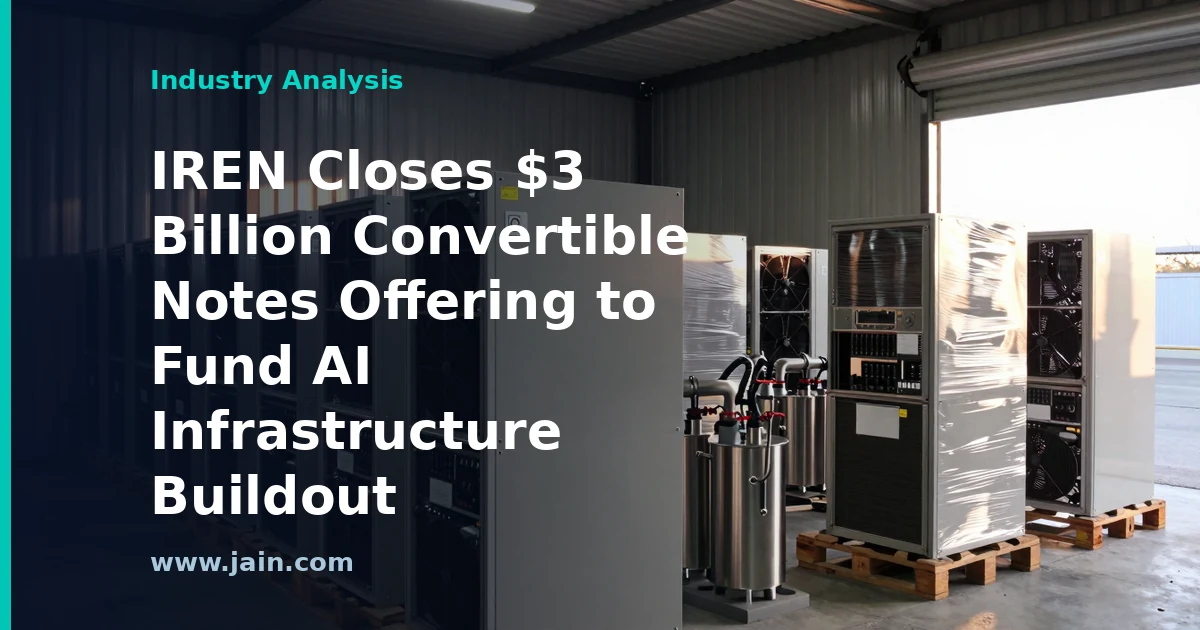
IREN, the publicly traded bitcoin miner repositioning itself as an AI infrastructure company, has closed a $3 billion convertible notes offering, according to a report from The Block dated May 16, 2026. The raise ranks among the largest capital events yet for a company making the miner-to-AI transition.
Convertible notes are debt instruments that can later be exchanged for shares, letting companies borrow at lower interest rates in exchange for potential future dilution. For IREN, the proceeds arrive as the company accelerates its push into AI compute and data center capacity.
Executive Summary
The headline fact is simple: $3 billion in fresh capital, closed, for a company that began life mining bitcoin and now markets itself as an AI infrastructure provider. Capital at that scale is not raised to sustain a mining operation — it is raised to build data centers, buy GPUs, and sign the power and construction commitments that AI compute demands. The offering’s closure, rather than mere announcement, means the money is in hand.
Why it matters: the miner-to-AI pivot has been the dominant strategic story in the bitcoin mining sector for over two years, but most pivots have been announced in press releases rather than financed in capital markets. A closed $3 billion convertible offering is a market verdict of sorts — institutional buyers were willing to lend against IREN’s AI story at convertible terms. It suggests the pivot narrative, at least for the largest and most credible miners, has graduated from concept to bankable strategy.
That said, the report is brief, and the substantive details that determine whether this is cheap or expensive capital — coupon, conversion premium, hedging arrangements, and specific use of proceeds — are not spelled out in the source. Readers should treat the raise as a strong signal of momentum while withholding judgment on its economics.
From Mining Rigs to GPU Halls: Why the Pivot Attracts Capital
Bitcoin miners and AI data center operators need the same scarce ingredients: large blocks of grid power, industrial land, cooling, and the operational muscle to run energy-dense facilities. Miners spent a decade securing exactly those assets, often in power-rich regions where capacity was cheap. When AI demand exploded and grid interconnection queues stretched to five years or more in many markets, energized megawatts became the bottleneck — and miners suddenly held an asset the AI industry desperately wants.
The pivot is not automatic, however. A mining facility is engineered for cheap, interruptible, low-redundancy compute; an AI data center serving enterprise or hyperscale customers typically requires far higher reliability, denser networking, and liquid cooling. Converting one into the other is a genuine construction project, not a rebranding exercise. That is precisely why a raise of this magnitude is the tell: $3 billion is conversion-and-buildout money.
The Economics of Convertible Debt in an AI Land Rush
Convertible notes have become the financing instrument of choice for capital-hungry compute companies. The logic is straightforward: a company with a volatile, high-momentum stock can borrow at a much lower cash interest cost than straight debt would demand, because lenders are partly paid in the option to convert into equity if the stock rises. For shareholders, the trade-off is potential dilution down the road.
For a company straddling bitcoin mining and AI — two of the most volatility-prone narratives in public markets — convertibles are arguably the only large-scale debt market reliably open. Traditional project finance lenders want long-term contracted revenue; a miner mid-pivot often cannot yet show it. The willingness of convertible buyers to absorb $3 billion of IREN paper says the market is pricing meaningful upside into the equity, but it also means the company is, in effect, pre-selling a slice of that upside to fund the buildout.
Winners, Losers, and the Sorting of the Mining Sector
The miner-to-AI transition is sorting the sector into tiers. Companies with large, well-located power portfolios and access to capital markets can finance real conversions; smaller miners without either are left competing in a bitcoin mining business whose economics tighten with every halving — the programmed event that cuts mining rewards roughly every four years. A raise like this one widens that gap: capital compounds, because funded buildouts attract customers, and customer contracts attract cheaper follow-on capital.
For the broader data center industry, well-capitalized former miners are becoming genuine competitors for AI workloads, particularly in the cost-sensitive middle of the market. Incumbent operators retain advantages in reliability track record and enterprise relationships, but the energized-power advantage is real, and $3 billion buys a lot of construction.
What a Closed Raise Does and Does Not Prove
It is worth being precise about what this announcement substantiates. It proves investor appetite: sophisticated buyers committed $3 billion. It does not, by itself, prove customer demand for IREN’s AI capacity, the economics of its contracts, or the timeline on which the capital becomes revenue-generating infrastructure. The AI infrastructure boom has featured both genuinely contracted buildouts and speculative capacity built ahead of demand, and a financing headline cannot distinguish between them. The next meaningful data points will be customer agreements, deployment milestones, and disclosed note terms — not the raise itself.
Background
IREN began as Iris Energy, an Australian-founded bitcoin miner that listed publicly and built a portfolio of power-intensive data center sites, emphasizing access to low-cost and renewable energy. Like much of the mining sector, it faced the structural squeeze of bitcoin’s halving cycle, which periodically cuts mining revenue, just as the generative AI boom created enormous demand for exactly the kind of powered data center capacity miners control.
Over the past two years, the miner-to-AI pivot has become the defining strategic story of the sector, with a handful of large operators securing AI and high-performance computing deals while smaller players remained pure miners. Capital markets have increasingly rewarded the pivot, and large convertible note offerings have become the sector’s signature financing tool for funding GPU purchases and data center conversion at scale.
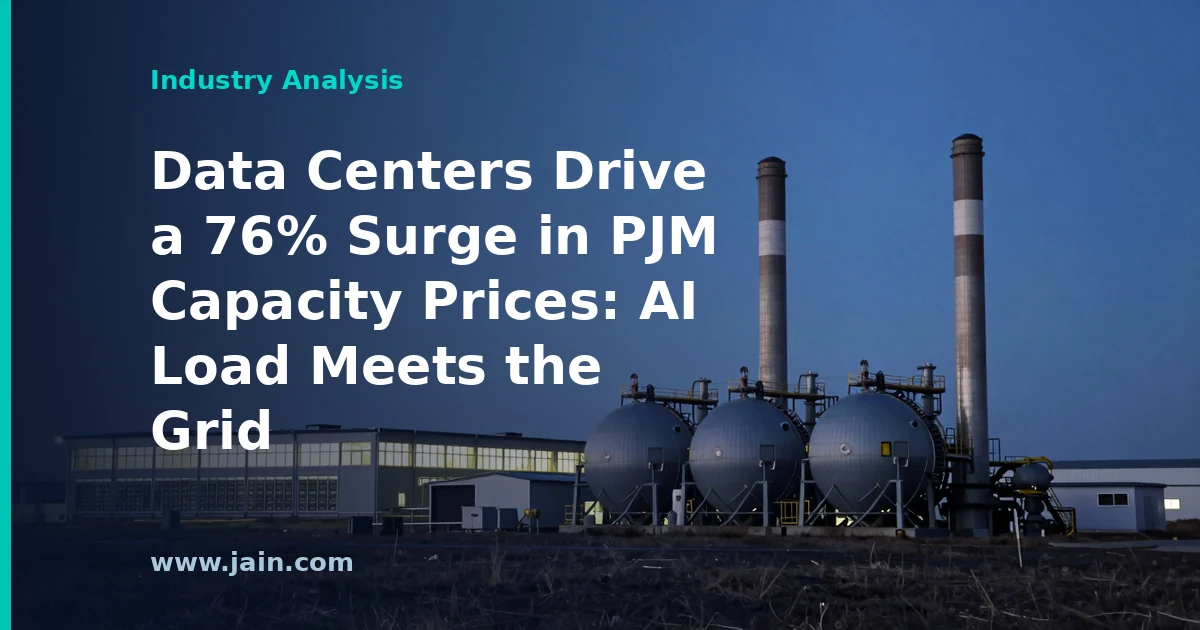
Capacity prices in PJM Interconnection — the regional transmission organization that operates the largest wholesale electricity market in the United States — have surged 76%, and reporting by E&E News (POLITICO) on May 16, 2026 identifies data center demand as the principal driver. PJM coordinates power across 13 states and the District of Columbia, serving roughly 65 million people, so a price move of this size in its capacity market ripples directly into the electric bills of a substantial share of the American population.
Capacity prices are not the price of energy itself; they are what the market pays generators simply to be available during the hours of highest demand. A 76% jump in that availability premium is the market’s way of saying that spare headroom on the grid is getting scarce — and the reporting attributes that scarcity chiefly to the wave of AI-driven data center construction concentrated in PJM’s footprint.
Executive Summary
The reported 76% surge in PJM capacity prices is arguably the most concrete, dollar-denominated evidence to date that AI infrastructure buildout is stressing the US power system. Forecasts of data center load growth have circulated for two years; a capacity auction result is different. It is a binding market outcome — real money that electricity suppliers must pay, and ultimately recover from customers, because demand is growing faster than dependable supply.
The mechanism matters. PJM procures capacity through auctions held in advance of each delivery year: generators offer their availability, and the auction clears at the price needed to cover forecast peak demand plus a reserve margin. When large new loads such as hyperscale data centers enter the forecast while older power plants retire and new ones queue slowly for interconnection, the supply-demand balance tightens and the clearing price rises. A 76% increase indicates that tightening is now severe, not incremental.
For the infrastructure industry, the signal cuts both ways. It validates the scale of AI demand that data center operators have been describing — but it also raises the operating cost of every facility in the region, hands utilities and consumer advocates a concrete number to organize around, and increases the likelihood of regulatory intervention in how large loads connect to and pay for the grid.
What a Capacity Price Actually Measures
Capacity markets are insurance markets for the grid. Separate from the energy market, where power is bought and sold as it is consumed, a capacity auction pays generators a fixed amount — typically quoted per megawatt-day — to guarantee they will be available when the system hits its peak. The clearing price is therefore a pure scarcity signal: it reflects how much spare, dependable generating capacity exists relative to forecast peak demand, years before that peak arrives.
That is what makes a 76% surge more telling than any demand forecast. Forecasts can be revised; auction results are settled commitments backed by penalties for non-performance. When the availability premium jumps this sharply, it means the market — with real capital at stake — has concluded that the cushion between peak demand and dependable supply in PJM is thinning quickly. Attribution of the surge to data centers puts a name on the demand side of that squeeze.
Why AI Load Lands So Hard on PJM
PJM’s territory includes Northern Virginia, the densest concentration of data centers on Earth, along with fast-growing markets in Ohio, Pennsylvania, and the Chicago area. Data center load has characteristics that stress a capacity market more than most growth: facilities are large — a single AI campus can draw as much power as a mid-sized city — they run near-continuously rather than peaking with the weather, and they arrive in clusters on compressed construction timelines measured in a couple of years.
Supply cannot respond at that speed. New gas turbines face multi-year equipment backlogs, renewable and storage projects sit in long interconnection queues, and coal units continue to retire on schedules set years ago. Capacity auctions exist precisely to signal when this mismatch is forming, and the reported surge suggests the signal has moved from amber to red. In that sense the price is doing its job — the open question is whether investment in new generation can respond before the cost of scarcity compounds.
Who Pays, and Who Benefits
Capacity costs flow through electricity suppliers to virtually all retail customers, spread across households, businesses, and industry regardless of who caused the demand growth. That socialization of costs is the political flashpoint: a homeowner in Baltimore or Columbus pays part of the premium created, in large part, by hyperscale computing facilities they may never see. Expect this number to feature in rate cases, state legislative hearings, and the ongoing debate over whether large loads should face special tariffs or bring-your-own-generation requirements.
On the other side of the ledger, existing generators — particularly gas, nuclear, and other dispatchable plants that can pledge dependable capacity — are clear beneficiaries, and higher capacity revenue is exactly the incentive the market design uses to attract new entry and keep existing plants online. Data center developers face a more nuanced picture: higher power costs raise operating expenses, but a market that rewards firm capacity also strengthens the case for the on-site generation, storage, and long-term supply deals that many operators are already pursuing.
A Price Signal With Policy Consequences
Sharp capacity price increases rarely stay contained within market design circles. When the driver is identifiable — here, data centers — regulators and politicians gain a specific target for cost-allocation reform. Proposals already circulating across US grid regions include dedicated rate classes for very large loads, requirements that new data centers fund transmission upgrades, and co-location arrangements that pair facilities directly with power plants. A 76% surge gives all of those efforts fresh momentum in PJM’s 13 states.
For the broader AI infrastructure economy, the strategic takeaway is that power availability — not land, fiber, or chips — is consolidating as the binding constraint on growth in established markets. Operators that secured capacity, interconnection positions, or generation partnerships early hold an appreciating asset. Those planning new facilities in PJM territory now face higher costs, longer utility timelines, and a more contentious public environment — pressures that are already redirecting some development toward regions with more available headroom.
Background
PJM Interconnection began as a power pool of Pennsylvania, New Jersey, and Maryland utilities and grew into the largest grid operator in the United States, running wholesale energy and capacity markets across 13 states and the District of Columbia. Its capacity construct, the Reliability Pricing Model, procures guaranteed generating capacity through auctions held in advance of each delivery year — a design meant to keep enough dependable supply online as the generation fleet changes.
For most of the 2010s, flat demand and cheap shale gas kept PJM capacity prices low. That era ended as AI and cloud growth transformed data centers into the region’s dominant new load — anchored by Northern Virginia, the world’s largest data center market — while coal retirements and slow interconnection queues constrained supply. Capacity auctions in the mid-2020s began registering that squeeze with sharply higher clearing prices, of which the 76% surge reported in May 2026 is the latest and among the starkest examples.
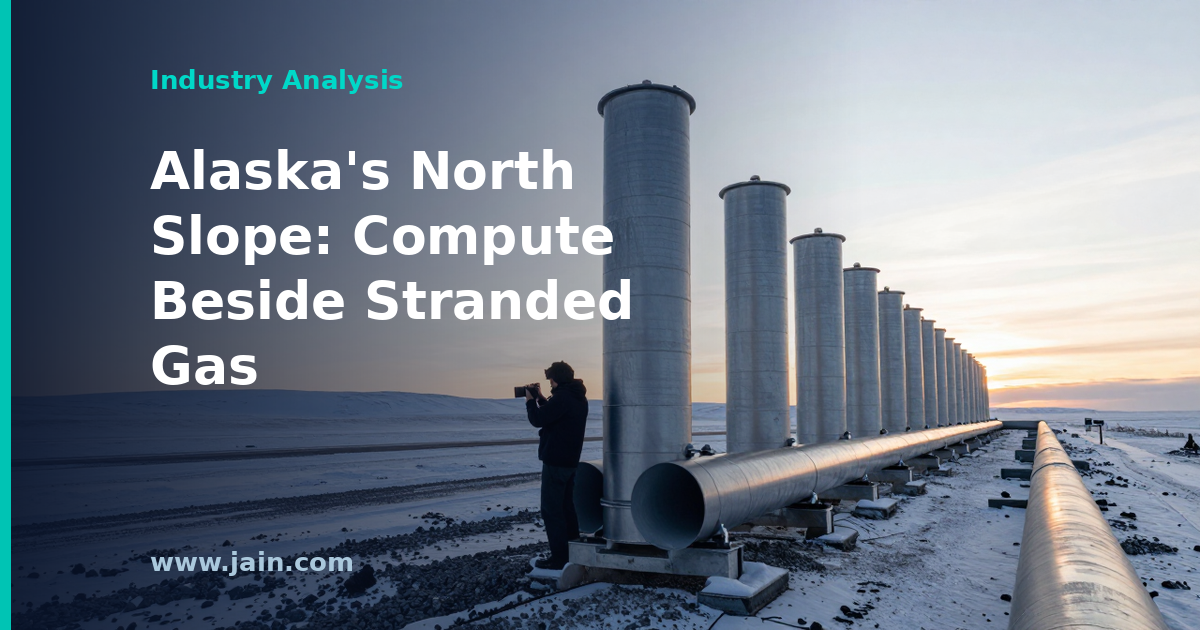
The Alaska Beacon reported on May 15, 2026 that a large data center campus could be developed on Alaska’s North Slope, the Arctic oil-producing region north of the Brooks Range. The attraction is straightforward: the North Slope sits on top of vast volumes of natural gas that currently have no route to market, and a data center is one of the few customers that can be brought to the fuel rather than the other way around.
Public detail remains limited. The report describes the concept and its setting; it does not, in the material available to us, establish a confirmed developer, a firm generating capacity, signed customers, financing or a construction schedule. Treat the project at this stage as a proposal being floated, not a committed build.
Executive Summary
For most of the industry’s history, data centers followed people and fiber. They clustered near metro interconnection points, cheap retail land and existing substations, because latency to users and access to networks mattered more than the marginal cost of a megawatt. AI training has inverted that logic. Large training clusters are batch workloads that tolerate tens of milliseconds of network delay, so their siting is increasingly decided by whichever constraint binds hardest, and right now that constraint is electricity.
A North Slope campus is the purest expression of that inversion yet proposed in the United States. There is no interconnection queue to wait in because there is no grid to interconnect to; the North Slope’s power is islanded and gas-fired, built to run oil fields. There is no transmission to build because the plan implies generating on site from gas that is otherwise reinjected into the ground for lack of a pipeline. The trade is that every other input, from construction labour to network diversity to spare parts, becomes harder and more expensive.
Whether that trade works is an empirical question, and the answer matters well beyond Alaska. If compute can be economically parked next to stranded hydrocarbons in one of the least accessible places in North America, the same argument applies to flared gas basins in Texas and North Dakota, to remote hydro in Canada and Scandinavia, and to any energy resource whose problem is distance to demand.
Power Now Picks the Site, and Everything Else Follows
The scarce input in AI infrastructure is not chips, land or capital. It is firm, contracted electricity delivered on a schedule that matches a two-to-three-year build. In established markets, utility interconnection studies and transmission upgrades routinely stretch project timelines by years, and grid operators in several U.S. regions have begun rationing large-load connections. A developer who can bypass that queue entirely buys back time, and in a market where the value of a training cluster decays with each hardware generation, time is the whole game.
Behind-the-meter generation, meaning power produced on site and never touching a public grid, is how developers are trying to buy that time. The North Slope version is behind-the-meter taken to its logical extreme: not merely bypassing a grid, but siting where none exists. That removes the interconnection risk and replaces it with construction, fuel-supply and operations risk. Those are real risks, but they are risks a private developer can price and manage, whereas an interconnection queue is a public process nobody controls.
The counterweight is that a self-generated island has no backstop. A campus tied to a large grid can lean on the system during a generator outage; an islanded campus cannot. That pushes redundancy back onto the owner in the form of extra turbines, extra spares and deeper on-site fuel and maintenance capability, all of which raise capital cost per megawatt. The economics only work if the fuel is cheap enough, and abundant enough, to pay for that redundancy several times over.
Stranded Gas Is Cheap Precisely Because It Has Nowhere to Go
North Slope fields produce large volumes of natural gas alongside oil. Because there is no pipeline carrying that gas to Lower 48 or Asian markets, most of it is reinjected into the reservoirs to maintain pressure and support oil recovery. Gas in that position is often described as stranded: physically abundant, commercially close to worthless, because its value is set by the cost of moving it to a buyer. Decades of proposals to build a gas pipeline or an LNG export project from the Slope have not produced a completed export line.
A data center changes the arithmetic by moving the buyer to the gas. That is genuinely attractive for the producer and the state, which collects royalties and taxes on production. But two cautions belong in any serious appraisal. First, gas that is currently reinjected is doing useful work supporting oil production, so diverting it is not free; it has an opportunity cost that only the field operators can quantify. Second, cheap fuel at the wellhead is not the same as a low delivered cost of power. Turbines, heat recovery, fuel treatment, Arctic-rated enclosures and a skilled operating crew all sit between the reservoir and the rack.
There is also a carbon question that buyers will ask before signing. Hyperscale tenants and their investors carry public emissions commitments, and unabated gas generation is a poor fit for them regardless of how cheap it is. A credible answer would involve carbon capture, offsets or a customer base less bound by those commitments, and none of that is settled by a project concept. The counterargument, that using gas which would otherwise be reinjected or flared is better than the alternative, is arguable but not automatic, and it will be argued.
The Arctic Build Problem: Permafrost, Logistics and Latency
Building on continuous permafrost means building on ground that must be kept frozen. Heat leaking from a structure thaws the soil beneath it and causes differential settlement, so Arctic construction relies on elevated pile foundations, thick insulating gravel pads and thermosyphons, passive devices that pull heat out of the ground in winter. A data center is a concentrated heat source, which makes thermal isolation from the ground a first-order design problem rather than a detail. None of this is unsolved, but it is expensive and slow, and the pool of contractors who have done it is small.
Logistics compound the cost. Heavy freight to the Slope moves by the Dalton Highway, by seasonal ice roads, by barge during a short open-water window or by air at a price that discourages mistakes. Labour is largely rotational and camp-housed. The upside is the climate itself: ambient air on the North Slope permits free cooling, meaning outside air can reject server heat for most or all of the year without mechanical chillers, which is a material and durable operating saving.
Networking is the input most often underestimated. Terrestrial and subsea fiber reaching the Arctic coast and running south toward Fairbanks does exist, built primarily to serve oil-field operations and remote communities, so the region is not dark. The question is capacity, route diversity and the cost of adding more, because a large campus needs multiple physically separate paths, not merely a connection. Distance from users also shapes the workload mix. Training runs and other batch jobs are viable; latency-sensitive inference serving population centres is not the natural fit.
Who Gains, Who Waits
If a project of this kind proceeds, the clearest beneficiaries are field operators with gas they cannot sell, the state and the North Slope Borough through production and property tax bases, and turbine and modular-build vendors. Alaska has spent decades looking for a second industry to sit alongside oil, and compute is one of the few candidates that does not require moving a commodity thousands of miles. Local hire and community benefit, however, depend on commitments that a concept announcement does not contain.
The parties with reason to wait are customers. A tenant signing a long lease in an islanded Arctic campus is underwriting fuel supply, construction execution, network diversity and staffing continuity in a location where a serious failure cannot be fixed quickly. That risk is priceable, but it will be priced, and the discount a tenant demands may erode much of the fuel-cost advantage that motivated the site in the first place. Competing projects in gas-rich but road-accessible basins offer a similar power-first thesis with far less logistical drag.
The honest summary is that this proposal is interesting for what it tests rather than for what it has so far demonstrated. It is a clean experiment in whether power availability alone can outweigh every other siting factor. Until capacity, financing, offtake and permits are on the record, the analysis is about the thesis, not about a project.
Background
The North Slope is Alaska’s Arctic oil province. Prudhoe Bay, discovered in 1968 and brought online with the Trans-Alaska Pipeline System in 1977, remains the anchor of a region whose economy, roads, airstrips, power plants and camps were all built around crude production. Natural gas produced alongside that oil has never had a comparable export route; successive pipeline and LNG proposals have been studied for decades without a completed export project, so most of the gas is reinjected to support oil recovery.
Connectivity arrived later and separately. Fiber built to serve oil field operations and Arctic coastal communities links parts of the region and runs south toward Fairbanks, ending the assumption that the Slope is entirely off the network map, though capacity and route diversity remain far below what large metro data center markets take for granted. Against that backdrop, the arrival of AI-driven demand for firm power has made planners across the world reconsider remote energy resources, and Alaska is now part of that conversation.
Cybersecurity Dive reported on May 15, 2026 that frontier artificial intelligence models are tipping the long-standing offense-defense balance in cybersecurity toward adversaries, allowing attackers to compress reconnaissance, phishing, and exploit-development cycles faster than most enterprise defenders can adapt.
The piece frames the shift as structural rather than episodic, arguing that the same large models available to defenders are being weaponized more effectively — and more cheaply — by opportunistic and organized threat actors.
Executive Summary
For two decades the cybersecurity industry has repeated a familiar refrain: defenders must be right every time, attackers only once. Frontier AI — the newest, largest general-purpose models — sharpens that asymmetry by lowering the skill floor for offensive tradecraft while raising the coordination cost of defense.
The Cybersecurity Dive report positions this as a posture problem, not merely a tooling problem. Enterprise security programs built around signature detection, human-scale triage, and quarterly control reviews are being asked to defend against adversaries who iterate at machine speed.
The stakes are not academic. If the balance is indeed tipping, chief information security officers face a budgeting and architecture decision — invest in AI-native defense now, or absorb a widening probability of successful intrusion — with implications for cyber insurance, board reporting, and regulatory exposure.
Why the Balance Is Shifting Now
Offense has always enjoyed a cost advantage in cybersecurity because attackers pick the time, place, and technique while defenders must cover every asset continuously. Frontier AI amplifies that edge in three concrete ways: it drafts convincing spear-phishing lures in any language, it summarizes public code and vulnerability disclosures into working proof-of-concept exploits, and it automates the tedious middle steps of an intrusion — enumeration, lateral movement planning, log evasion — that used to require a skilled human operator. Each of those tasks used to gate an attack; none of them do anymore.
Defenders can, in principle, run the same models. In practice they run into friction the attackers do not: data-governance reviews, model-risk committees, false-positive tolerances measured in single digits, and integration with brittle legacy tooling. The technology is symmetric; the organizational ability to deploy it is not.
What Changes for Enterprise Security Posture
The practical implication is that time-to-detect and time-to-respond — the industry’s core operational metrics — need to fall by an order of magnitude to keep pace. That is unlikely to happen through staffing. It requires automating tier-one and tier-two analyst work, letting models triage alerts, draft containment actions, and hand humans a decision rather than a queue. Vendors from the endpoint, SIEM, and identity segments are all racing to package this as “AI SOC” offerings; buyers should expect heavy marketing and uneven substance.
Identity is the pressure point. Once phishing scales cheaply and convincingly, credential compromise becomes the default initial access vector, and every downstream control — network segmentation, data loss prevention, privileged access — inherits that risk. Phishing-resistant authentication (hardware keys, passkeys, device-bound credentials) stops being a nice-to-have and becomes the minimum viable perimeter.
Winners, Losers, and the Middle
Well-capitalized enterprises with mature security programs will spend their way to parity, absorbing AI-native detection into existing operations. Small businesses that rely on managed service providers will inherit whatever their MSP deploys, for better or worse. The uncomfortable middle is the mid-market: large enough to be targeted, too small to staff a 24/7 AI-augmented security operations center, and often locked into multi-year contracts with tools built for a slower threat model.
For infrastructure providers — data centers, connectivity carriers, cloud platforms — the shift concentrates demand for inference capacity on the defensive side, and elevates the importance of platform-level security controls that customers cannot easily replicate themselves. Confidential computing, hardware-rooted identity, and network-level anomaly detection all become more valuable when the customer’s own security team is outpaced.
A Note on the Framing
The claim that frontier AI is decisively tipping the balance deserves scrutiny in both directions. Defenders have historically overestimated the pace of offensive innovation — every generation of tooling, from Metasploit to commodity ransomware kits, was forecast to overwhelm defenses and did not fully do so. At the same time, dismissing the shift as vendor marketing understates a real change in the marginal cost of a competent attack. The honest read is that the balance has moved, the magnitude is not yet measurable, and organizations that wait for definitive metrics will be measuring their own incidents.
Background
Cybersecurity Dive is a trade publication covering enterprise information security, incident response, regulation, and vendor developments for a professional audience of security leaders. It reports on both offensive trends and defensive market shifts.
The broader context for this story is the arrival, since 2023, of general-purpose AI models capable enough to assist with software engineering and research tasks. Security researchers on both sides of the fence have been documenting how those capabilities translate to offensive tradecraft, and enterprise security programs have been adapting — unevenly — to a threat environment where the marginal cost of a competent attack is falling.