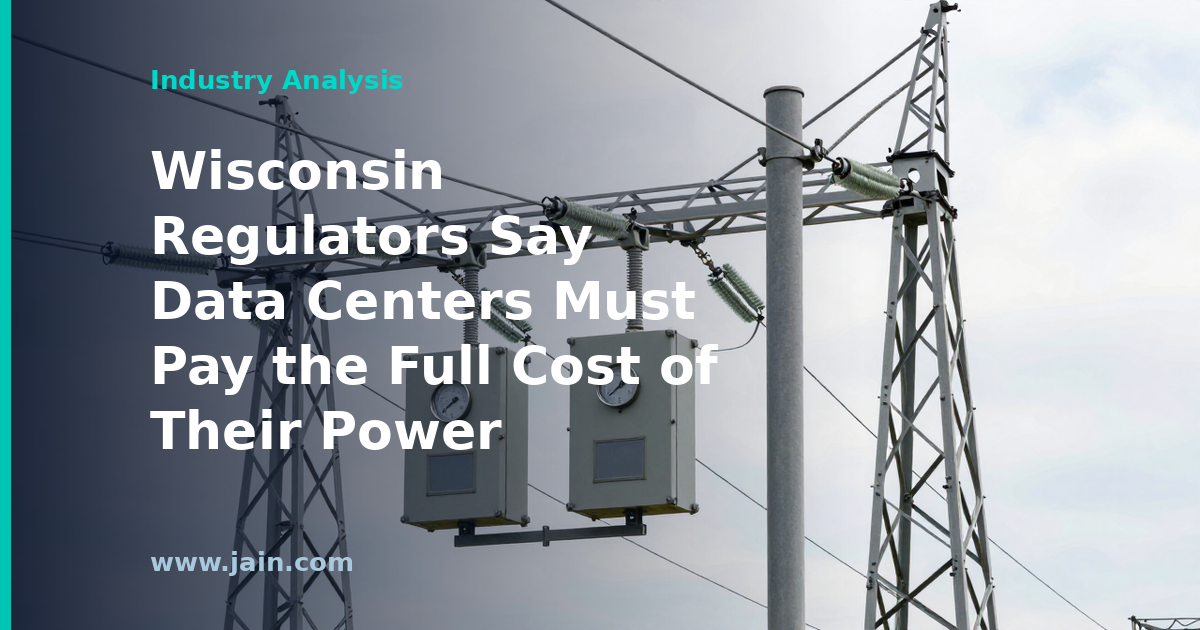
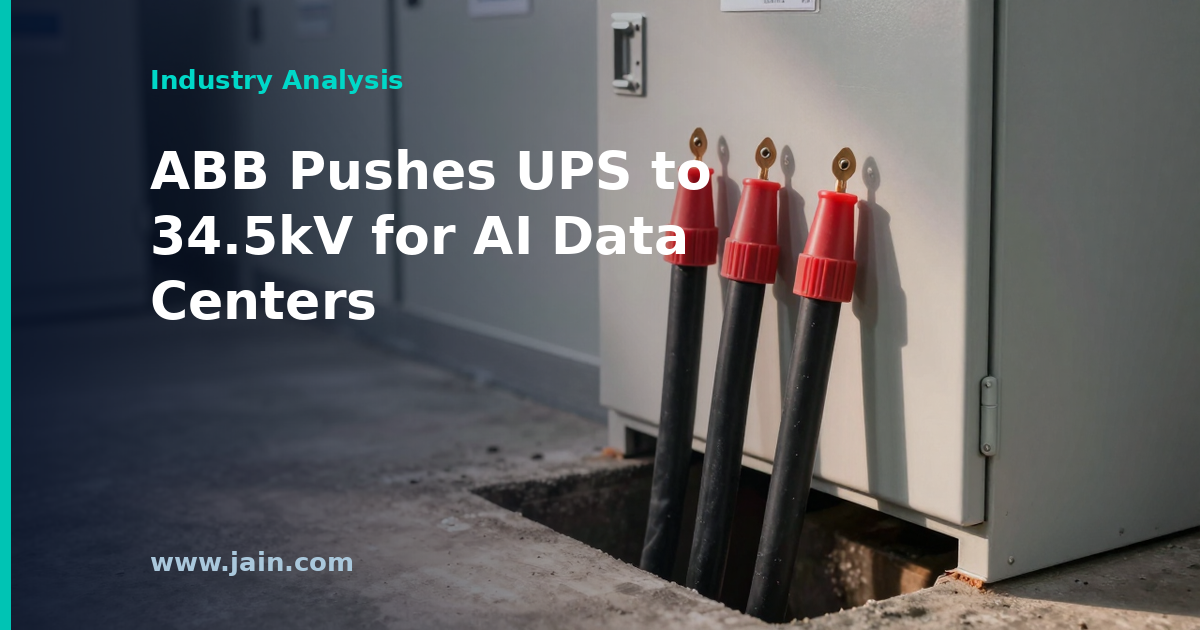
Wisconsin utility regulators have taken the position that data centers must cover the full cost of the energy infrastructure their facilities require, according to an April 23, 2026 report from Wisconsin Watch. The stance addresses the central fight of the data center boom: whether households and small businesses end up subsidizing the power plants, substations, and transmission lines built to serve a handful of very large computing campuses.
The report’s headline frames the position as a directive — data centers, not the general body of ratepayers, bear the cost of their own demand. The underlying details of the proceeding, and how “full cost” will be defined and enforced, are not spelled out in the source material available to us.
Executive Summary
As reported by Wisconsin Watch on April 23, 2026, Wisconsin regulators have signaled that data centers seeking grid connections in the state must bear the full cost of their energy needs. In utility ratemaking terms, this is a cost-allocation principle: when a single customer’s demand forces the construction of new generation or grid capacity, that customer — rather than the shared pool of ratepayers — should pay for it.
It matters because Wisconsin has become one of the Midwest’s most active data center markets, anchored by Microsoft’s multi-billion-dollar campus in Mount Pleasant and a pipeline of other announced projects. Each hyperscale campus can demand hundreds of megawatts — on the scale of a small city — and someone must pay for the infrastructure that serves it.
The bigger significance is precedential. Regulators in many states are wrestling with the same question, and several utilities have proposed special tariffs for very large customers. A clear “you demand it, you pay for it” stance from a state actively courting data center investment offers a template others can copy — and a test of whether such terms slow investment or simply formalize what serious developers already expect to pay.
The Cost-Allocation Fight Behind Every Data Center Boom
Regulated utilities recover the cost of new infrastructure through rates approved by state commissions, and those costs are typically spread across all customer classes. That model works when growth is broad and gradual. It strains when one customer class — hyperscale data centers — arrives suddenly and demands capacity additions measured in gigawatts. If a utility builds a power plant or transmission line primarily for one campus and the project later shrinks or cancels, the leftover cost, known as a stranded asset, can land on everyone else’s bills.
That risk is why “who pays” has become the defining regulatory question of the AI infrastructure cycle. Consumer advocates warn of cross-subsidization — ordinary ratepayers underwriting corporate compute. Utilities and developers counter that large loads can spread fixed grid costs over more sales and put downward pressure on rates if structured well. The Wisconsin position, as reported, comes down firmly on the side of insulating the general ratepayer.
Why Wisconsin Is a Bellwether
Wisconsin is not a legacy data center hub like Northern Virginia, which makes its posture instructive: it is a state actively attracting new hyperscale investment while setting terms at the front end rather than repairing cost shifts after the fact. Microsoft’s Mount Pleasant development, announced in 2024, put the state on the hyperscale map, and Wisconsin utilities have since proposed rate structures aimed at very large customers — typically featuring long-term contract commitments and minimum payments so that infrastructure built for a data center is paid for by that data center even if its plans change.
A regulatory endorsement of full cost responsibility strengthens the utilities’ hand in structuring those deals and gives economic developers a cleaner pitch: growth without a ratepayer backlash. States competing for the same projects will watch whether Wisconsin’s pipeline holds up under these terms.
What “Full Cost” Could Mean in Practice
The phrase sounds simple; the implementation is not. Full cost responsibility can be enforced through several mechanisms: dedicated rate classes for very large loads, up-front contributions toward interconnection and grid upgrades, minimum demand charges that guarantee revenue regardless of actual usage, contract terms of a decade or more, and exit fees or collateral that protect against a project walking away mid-build. Each mechanism allocates a different slice of risk between the developer, the utility, and its shareholders.
The definitional boundaries matter enormously. Does “full cost” cover only the local wires and substations, or a share of new generation? Does it apply to grandfathered projects or only new applicants? A principle announced by regulators becomes real only when it is written into approved tariffs and signed contracts, and the reported material does not yet show that level of detail.
Winners, Losers, and the National Template
Residential and small-business ratepayers are the clearest intended beneficiaries — the policy exists to keep their bills from absorbing data center-driven costs. Well-capitalized hyperscalers can generally live with full-cost terms; they already sign long-term commitments in other markets, and predictable rules can be preferable to political uncertainty. The squeeze falls on thinner-capitalized or speculative projects, which lose the ability to socialize their risk. Utilities get growth with less rate-case blowback, though they take on more counterparty risk concentrated in a few very large contracts.
If Wisconsin’s stance holds and investment continues anyway, the template argument writes itself: states can welcome AI infrastructure without asking captive ratepayers to underwrite it. If projects visibly divert to states with softer terms, expect a counter-narrative that strict cost allocation costs jobs and tax base. Either outcome will be cited in commission dockets across the country.
Background
Wisconsin’s arrival as a data center state dates largely to 2024, when Microsoft announced a multi-billion-dollar campus in Mount Pleasant, southeast Wisconsin — on land once slated for the Foxconn manufacturing project — followed by further large-load proposals elsewhere in the state. That growth pushed Wisconsin utilities to propose rate structures for very large customers designed to ensure new infrastructure is paid for by the customers who require it.
Nationally, the surge in AI-driven electricity demand has made cost allocation the central issue in utility regulation. State commissions, consumer advocates, utilities, and hyperscale developers are negotiating who bears the cost — and the risk — of the biggest grid build-out in decades, and headline positions like Wisconsin’s are being watched as potential templates.
According to an Industrial Cyber report dated April 23, 2026, cybersecurity agencies have flagged the use of covert networks by China-linked threat actors to support espionage and offensive cyber operations. The warning centers on relay infrastructure — chains of compromised or rented devices that hide where an attack actually comes from — a technique that has become a signature of state-linked campaigns against critical infrastructure.
Executive Summary
The reported advisory adds official weight to a trend that incident responders have been tracking for several years: state-linked operators no longer attack from infrastructure that can be neatly attributed and blocked. Instead, they route operations through covert relay networks — sometimes called operational relay box (ORB) networks — built from compromised small-office routers, Internet-of-Things devices, and leased virtual private servers scattered across many countries and providers.
Why it matters: when malicious traffic arrives from an ordinary residential router in the defender’s own region, IP-reputation lists and geographic blocking lose much of their value. For operators of data centers, networks, and industrial systems, the warning is effectively a message that detection must shift from “where is this traffic from?” to “what is this traffic doing?” — a harder and more expensive posture to run.
What a Covert Relay Network Actually Is
A covert relay network is a mesh of intermediary devices — hacked home and small-business routers, unpatched edge appliances, IoT hardware, and short-lived rented servers — that an operator chains together so that each intrusion appears to originate from an innocuous, frequently rotating address. The technique is not new; anonymization proxies are decades old. What has changed is industrialization: reporting on China-linked activity in recent years describes purpose-built relay infrastructure operated at scale and shared across multiple intrusion sets, which makes attribution slower and takedowns less durable.
For lay readers, the analogy is a getaway car swapped every few blocks. Blocking the last car seen tells you little about the driver, and there is always another car. That is precisely why agencies escalate from private industry reporting to public advisories: the countermeasure is not a blocklist but a change in defensive doctrine.
Why Critical Infrastructure Is the Stated Concern
The pairing of “espionage” and “offensive operations” in the reported warning is significant. Prior joint advisories from U.S. and allied agencies — most prominently the 2024 warnings about the actor tracked as Volt Typhoon — alleged that China state-sponsored operators were pre-positioning inside energy, water, communications, and transportation networks, using living-off-the-land techniques that generate little malware for defenders to find. Covert relay networks are the delivery layer for that style of campaign: quiet access, maintained over long periods, held potentially for disruption rather than immediate theft.
Beijing has consistently denied state involvement in such campaigns, and attribution in cyberspace is probabilistic rather than courtroom-certain. A fair reading is that the agencies are describing a technique and an assessed linkage; the underlying evidence typically remains classified, which is a genuine limitation for anyone trying to independently verify the claims.
The Uncomfortable Position of Network and Hosting Providers
Relay networks are built from other people’s equipment. That places router vendors, hosting companies, and connectivity providers in the middle of the story whether they like it or not. End-of-life routers that no longer receive patches are prime recruitment targets, and legitimately leased virtual servers give relay operators clean, paid-for footholds. Expect continued pressure on vendors to ship secure-by-design defaults and enforce end-of-life transparency, and on providers to strengthen abuse detection and know-your-customer practices for infrastructure rentals.
For colocation and cloud operators, there is a dual exposure: their customers are targets of these campaigns, and their platforms can be abused as relay nodes. Egress monitoring, rapid abuse response, and hardening of management planes are becoming table stakes rather than differentiators.
What Defenders Can Realistically Do
The honest implication of this warning is that source-based filtering is a weakening control. Defenses that still work include behavioral analytics that flag unusual logins and lateral movement regardless of origin, aggressive patching and replacement of end-of-life edge devices, network segmentation between IT and operational technology, and logging retention long enough to support the slow forensic work that relay obfuscation forces. None of this is novel advice — which is itself the point. Agencies issue advisories like this when known best practices remain widely unimplemented, particularly among smaller utilities and industrial operators with thin security budgets.
Background
Warnings about China-linked targeting of critical infrastructure have escalated steadily through the mid-2020s. In 2024, U.S. agencies and international partners publicly alleged that the state-sponsored actor tracked as Volt Typhoon had maintained long-term access inside U.S. energy, water, communications, and transportation networks using living-off-the-land techniques, and researchers began documenting large operational relay box (ORB) networks — obfuscation meshes built from compromised routers and rented servers — supporting Chinese cyber operations. Beijing has denied state involvement throughout.
The reported April 2026 advisory sits in that lineage: rather than announcing a new intrusion, it elevates the enabling infrastructure — covert relay networks — to a named, official concern, signaling that agencies view origin-obfuscation itself as a strategic problem for defenders of critical systems.
Bitcoin mining companies are collectively investing billions of dollars to convert and expand their facilities for artificial-intelligence and high-performance computing (HPC) workloads, according to an April 2026 report carried by TradingView. The striking figure in the headline: the sector’s AI-related capital expenditure is outpacing the revenue those AI operations currently generate by roughly 15-to-1.
The report frames the pivot as an industry-wide phenomenon spanning the class of publicly traded miners that includes names such as TeraWulf (WULF) and Riot Platforms (RIOT), which have been repositioning energized data-center sites originally built for cryptocurrency mining toward GPU-based compute.
Executive Summary
The announcement is less a single company’s news than a sector-level snapshot: bitcoin miners, squeezed by the economics of their core business, are betting their balance sheets on becoming AI infrastructure providers. Capital expenditure — the money spent building data halls, buying cooling and electrical equipment, and preparing sites for GPU tenants — is running at roughly fifteen times the revenue the AI segments are bringing in today.
That ratio matters because it quantifies the leap of faith underway. Data-center construction is a spend-first, earn-later business, so a wide gap between investment and current revenue is normal early in a buildout. But a 15-to-1 gap sustained across an entire sector of companies that historically financed themselves through volatile bitcoin proceeds raises a sharper question: can these firms carry the spending long enough for contracted AI revenue to arrive?
For the broader digital-infrastructure market, the answer will shape who supplies the next wave of AI capacity — and who ends up selling distressed sites to better-capitalized players.
Why Miners Are Racing Into AI
The pivot is rooted in assets, not sentiment. Bitcoin miners own something the AI boom desperately needs: large, already-energized sites with grid interconnections, substations, and industrial-scale power contracts in place. Securing new utility power for a data center can take years; miners already have it. Converting a mining site to HPC use lets them monetize that scarce head start.
At the same time, the core mining business has become structurally harder. Bitcoin’s periodic “halving” events cut the block rewards miners earn for the same work, and competition keeps pushing up the computing power required to win those rewards. AI hosting offers what mining never could: multi-year contracts with creditworthy tenants and revenue that does not swing with a cryptocurrency price. The strategic logic is sound. The question the 15-to-1 figure raises is whether the execution is affordable.
Reading the 15-to-1 Gap
A capex-to-revenue ratio of 15-to-1 is not automatically alarming — it is partly a timing artifact. AI data centers follow a J-curve: enormous upfront spending on construction, electrical gear, and cooling, followed by revenue that only begins once tenants move in and ramps over the life of a lease. Early in a buildout, the ratio is always lopsided. Traditional data-center developers run the same math, but usually with pre-leased capacity and cheap, secured financing behind it.
What makes the miners’ version riskier is who is doing the spending. These are companies whose historical cash flows came from an asset with extreme price volatility, whose cost of capital is higher than that of investment-grade data-center REITs (real estate investment trusts), and several of which are converting sites on the promise of future tenancy rather than fully contracted demand. A 15-to-1 gap backed by signed long-term leases is a construction schedule; the same gap backed by expected demand is a wager. The report, as summarized, does not break down how much of the sector’s spend falls in each category — and that distinction is the whole ballgame.
The Financing Strain Behind the Buildout
Billions in capex must be funded from somewhere, and miners have essentially four levers: cash from mining operations, selling bitcoin holdings, issuing new shares, or taking on debt — including convertible notes, which are loans that can turn into stock. Each carries a cost. Equity issuance dilutes existing shareholders; debt adds fixed obligations to businesses with historically variable income; selling bitcoin reduces the treasury cushion that has often reassured investors during downturns.
The sector precedent that makes this real rather than theoretical: miners have gone through bankruptcy restructurings before when leverage met a downturn, and the survivors’ pivot to AI hosting was in part a search for steadier ground. If AI revenue ramps on schedule, today’s spending converts into long-lived contracted cash flows and the ratio compresses rapidly. If tenant demand arrives slower than construction bills, the same companies face refinancing at whatever terms the market offers a capital-hungry, pre-revenue AI landlord. That asymmetry — not the pivot itself — is the strain worth watching.
Winners, Losers, and the Capacity Question
If the buildout succeeds, the clearest winners are AI tenants — hyperscalers and GPU-cloud operators — who gain powered capacity years faster than greenfield development could deliver it, plus the equipment vendors and contractors paid regardless of outcome. Miners that convert successfully effectively transform into data-center companies and may earn the valuation multiples that go with steadier revenue.
The losers in a stumble scenario are concentrated: shareholders absorbing dilution, and lenders to projects that miss their lease-up targets. But even failure has a second-order winner — established data-center operators and infrastructure funds, who would be natural buyers of energized sites at a discount. In that sense, the capacity being built is likely to serve the AI market either way; what the 15-to-1 gap really determines is who owns it when it does.
Background
Bitcoin miners are industrial-scale data-center operators that historically earned revenue by running specialized computers to secure the bitcoin network in exchange for newly issued coins. The business is capital-intensive and hostage to bitcoin’s price and to protocol-driven halvings that periodically cut rewards. After a bruising downturn cycle that pushed several operators into restructuring, the AI boom presented the sector with an unexpected second act: the power capacity and energized sites miners had assembled became strategically valuable to AI companies facing multi-year waits for new grid connections.
Beginning in the mid-2020s, a wave of publicly traded miners — including TeraWulf and Riot Platforms among the larger names — announced conversions of mining capacity to GPU-based high-performance computing, in some cases anchored by long-term hosting agreements with AI cloud providers. The April 2026 report examined here is a snapshot of how far that spending has run ahead of the revenue it is meant to create.
The U.S. Cybersecurity and Infrastructure Security Agency (CISA) has confirmed that three additional Cisco networking device vulnerabilities are being actively exploited, according to reporting published on 22 April 2026 by Cybersecurity Dive. The confirmation is the mechanism CISA uses to move a flaw from “theoretically dangerous” to “known to be used by attackers in the wild.”
The practical effect is immediate for two groups: U.S. federal civilian agencies, which are bound by directive to remediate catalogued vulnerabilities by a set deadline, and the far larger population of enterprise, carrier and data center operators who use the catalog as a de facto triage list. The available source material is a headline-level summary; it does not itself specify which Cisco products, software versions or vulnerability identifiers are involved.
Executive Summary
CISA’s confirmation adds three more Cisco networking flaws to the pool of vulnerabilities with observed real-world exploitation. That designation matters because it changes the calculus for defenders. A vulnerability with a high severity score but no evidence of use can often wait for the next maintenance window. A vulnerability that attackers are already using cannot, because every hour of delay is measured against an adversary who has working code today.
The reason this lands on an infrastructure publication rather than only a security one is placement. Cisco equipment frequently sits at the network edge — the routers, firewalls, VPN concentrators and switches that form the boundary between an organisation’s internal network and the public internet. That is precisely the gear that data centers, colocation providers, carriers and enterprises depend on for connectivity, and precisely the gear that is hardest to take offline for an unscheduled patch.
It is also worth stating plainly what this announcement is not. A KEV listing is a statement that exploitation has been observed. It is not, on its own, a statement about how widespread that exploitation is, who is behind it, or whether any particular organisation has been affected. Treating the confirmation as an urgent triage signal is correct; treating it as evidence of a mass compromise event goes beyond what has been established.
Why the Network Edge Keeps Returning to the Emergency List
Edge network devices have become one of the most attractive targets in enterprise computing, and the reasons are structural rather than accidental. These appliances are internet-facing by design — a VPN concentrator that cannot be reached from the internet cannot terminate remote-worker sessions. They hold credentials, routing tables and traffic in cleartext at the point of decryption. And they sit upstream of nearly everything else, so an attacker who controls the edge does not need to defeat the controls behind it.
They are also comparatively dark. Most organisations run endpoint detection software on laptops and servers, generating a continuous stream of telemetry that a security team can query. Purpose-built network appliances typically run closed operating systems that do not accept third-party agents. Defenders see syslog output and interface counters, not process trees. An intruder who establishes persistence in the firmware of a firewall can be very difficult to spot with the tools most organisations already own.
This is why the pattern recurs. The 2023 mass compromise of Cisco IOS XE web management interfaces and the ArcaneDoor campaign against Cisco security appliances disclosed in 2024 were separate events with separate causes, but both illustrated the same underlying economics: a single working exploit against a widely deployed edge platform yields disproportionate access. Nothing in the current disclosure links these three flaws to those earlier campaigns, and it would be wrong to assume a connection. The category of risk, however, is the same one.
What “Actively Exploited” Actually Establishes
It is worth applying the same scrutiny to a government advisory that one would apply to a vendor press release. CISA’s catalog has a specific evidentiary bar: reliable evidence that a vulnerability has been exploited in the wild. That bar is meaningful and it is not trivially met. But it is a threshold test, not a measurement. Confirmation that exploitation occurred is compatible with a single narrowly targeted intrusion by a well-resourced state actor and equally compatible with commodity scanning at internet scale. Those two scenarios call for materially different responses.
The publicly available material here does not distinguish between them. It does not indicate whether the three vulnerabilities are chained together, whether any require prior authentication, whether exploitation grants full device control or something narrower, or whether patched software is already available for all affected versions. Each of those variables changes the urgency and the remediation path substantially. Readers should be cautious of coverage — from any direction — that fills those blanks with inference.
The defensible reading is procedural. If an organisation runs the affected platforms, the catalog entry is an instruction to verify version, apply the fix or documented mitigation, and check for signs of prior access. That instruction holds regardless of how the underlying campaign is eventually characterised, which is the practical virtue of the catalog as a triage mechanism.
The Cost of Patching Infrastructure You Cannot Reboot
The uncomfortable operational truth is that emergency patching of network infrastructure is expensive in ways that patching a fleet of laptops is not. A core router reload is a service interruption. High-availability pairs reduce but do not eliminate the risk, because failover itself can drop stateful sessions and because both members of a pair usually need the same update. In a colocation or carrier environment, those interruptions are governed by service level agreements with financial consequences, and change windows are often contractually constrained to specific overnight hours.
The result is a genuine tension between two legitimate obligations: availability commitments to customers and security obligations to those same customers. Organisations with mature change management, tested rollback procedures and accurate asset inventories absorb an out-of-cycle patch cycle in days. Organisations without them discover during the incident that they do not know precisely which software versions are running where — and inventory gaps, not patch availability, are usually the binding constraint on response time.
There is a second-order cost that is easy to underestimate. If a vulnerability permits persistence that survives patching, remediation is not patching but rebuilding: credential rotation, configuration review, and in some cases firmware reimaging or hardware replacement. Whether that applies here is unknown from the available material, but it is the question that determines whether this is a weekend of work or a quarter of it, and it is the first thing an operator should try to establish from the vendor’s own advisory.
Market Consequences: Concentration Cuts Both Ways
Cisco remains one of the largest suppliers of enterprise and service provider networking equipment, and that scale is the reason its vulnerabilities become industry events rather than vendor events. Concentration in critical infrastructure produces correlated risk: when a single platform is deeply embedded across banks, hospitals, carriers and government agencies, one exploit chain has systemic reach. This is a property of market structure, not a criticism of any particular engineering organisation — the same dynamic would apply to whichever vendor held the equivalent position.
Concentration also has a defensive upside that is often ignored in the immediate coverage. A large installed base funds substantial security engineering, attracts sustained researcher attention, and supports a coordinated disclosure and patching apparatus that smaller vendors cannot match. Vulnerabilities found in widely deployed products are more likely to be found at all, and more likely to be fixed quickly once found. The relevant comparison for a buyer is not “a vendor with disclosed flaws versus a vendor without” but “a vendor whose flaws are found and fixed versus one whose flaws are found quietly by someone else.”
For buyers and investors, the durable signal is therefore not the existence of these three entries but the response characteristics around them: time from discovery to patch, clarity of advisories, availability of compromise-detection guidance, and whether fixes reach older supported releases rather than only the newest. Those metrics differentiate vendors over multiple years. A single catalog addition, in a market where every major network vendor has appeared in the same catalog, does not.
Background
CISA established the Known Exploited Vulnerabilities catalog in November 2021 under Binding Operational Directive 22-01, replacing the previous practice of prioritising patches primarily by severity score. The premise was that severity ratings measure potential impact while exploitation evidence measures actual risk, and that defenders with finite maintenance windows should address the flaws attackers are demonstrably using first. Federal civilian agencies must remediate catalogued entries by assigned deadlines; the catalog has since been adopted far more broadly as a prioritisation standard across private industry.
Cisco has been one of the dominant suppliers of enterprise and service provider networking equipment for decades, with routers, switches, firewalls and VPN platforms embedded across carriers, data centers, financial institutions and government networks. That installed base makes its products both a persistent target for well-resourced adversaries and a focus of intensive security research. The recurring pattern of internet-facing network appliances becoming intrusion vectors is an industry-wide condition rather than a single-vendor one, driven by the fact that this equipment must be reachable to do its job while running closed operating systems that resist conventional monitoring.
ABB has introduced a 34.5kV version of its HiPerGuard medium-voltage uninterruptible power supply, announced on 22 April 2026. The company positions the product as connecting directly to a medium-voltage grid feed, eliminating conversion steps between the utility connection and the data center’s power train, and says the result is lower power costs for AI data centers.
At 34.5kV, the unit sits at the top of the medium-voltage distribution class commonly used by North American utilities. The announcement is a product-capability disclosure rather than a customer deployment: the material published alongside the headline does not name sites, buyers, delivery dates or measured efficiency gains.
Executive Summary
An uninterruptible power supply is the equipment that keeps a data center’s servers running through a grid disturbance, bridging the seconds or minutes until generators take over. Conventionally, that equipment lives at low voltage — typically a few hundred volts — which means utility power arriving at medium voltage must first be stepped down through transformers, then protected, then distributed. Every one of those stages costs a percentage of the power passing through it, and each percentage becomes heat that must itself be cooled.
ABB’s claim with the 34.5kV HiPerGuard is that the UPS can sit further upstream, taking the medium-voltage feed directly and removing conversion stages from the chain. The commercial argument is straightforward: fewer stages mean fewer losses, less transformer and switchgear capacity to buy, and less floor space consumed by electrical rooms that could otherwise hold revenue-generating IT equipment.
The timing matters more than the voltage number. AI training and inference racks have moved from tens of kilowatts to the hundreds, with megawatt-scale racks on vendor roadmaps. At those densities the electrical distribution system, not the building shell, becomes the constraint. Medium-voltage UPS is one of several architectural responses to that constraint — and this announcement is a claim about a direction of travel that the released material does not yet quantify.
Voltage Is the New Density Lever
Power density in data centers has historically been solved by moving air and water more cleverly. That era is ending. When a single rack draws hundreds of kilowatts, the limiting factor shifts to how much current the distribution system can carry without unmanageable conductor sizes, losses and fault energy. Physics is unhelpful here: for a given amount of power, halving current requires doubling voltage, and copper cost and resistive loss scale with current, not with power.
Raising the voltage at which protected power is handled is therefore one of the few structural levers available. Doing it at the UPS means the medium-voltage feed can travel deeper into the facility before being stepped down close to the load, shortening the low-voltage runs that dominate conductor spend. It also compresses the equipment chain: each transformation stage carries its own footprint, maintenance regime, failure modes and efficiency penalty. Removing stages removes all four at once.
The counterpoint worth stating plainly is that this is a re-architecture, not a component swap. Medium-voltage equipment brings different clearance requirements, different arc-flash considerations, different qualification standards for the technicians who work on it, and a smaller pool of contractors able to commission it. Operators who adopt it are trading one set of engineering problems for another, and the trade only pays at scale.
Where the Savings Actually Come From
The headline frames the benefit as lower power costs. In a data center’s cost structure, electrical losses are compounded rather than linear: a watt lost in a transformer or rectifier is a watt bought from the utility and also a watt of heat that the cooling plant must remove, at further energy cost. Small efficiency percentages at the front of the power chain therefore multiply through the operating budget over a facility life measured in decades.
The capital side may matter as much. Eliminating conversion stages means fewer step-down transformers, less associated switchgear, and less electrical room area — space that, in a market where construction timelines and grid connections are the binding constraints, converts directly into deployable IT capacity per site. For operators who cannot get more megawatts from their utility, extracting more usable compute from the megawatts already contracted is the highest-value optimization available.
None of that is quantified in the material accompanying this announcement. There is no published efficiency figure, no comparison baseline, no total-cost-of-ownership model and no pricing. The mechanism ABB describes is sound engineering and widely understood in the industry; the specific magnitude of the benefit is, on the evidence released so far, an assertion rather than a demonstrated result. Buyers should treat it accordingly and ask for the numbers.
A Crowded Answer to a Real Problem
ABB is not alone in reading the AI power problem this way. Medium-voltage UPS lines, solid-state transformer research, and the broader industry push toward higher-voltage direct-current distribution inside the rack are all attacking the same bottleneck from different points in the chain. Chip and system vendors have been pushing rack-level power architectures upward in voltage for similar reasons. These approaches are complementary rather than mutually exclusive — a facility could plausibly take medium voltage deep into the hall and then distribute at high-voltage DC to the racks.
The likely winners are hyperscale and large colocation operators building new capacity, where greenfield design allows the electrical architecture to be chosen rather than retrofitted, and where volume justifies training staff on medium-voltage practice. The likely losers are smaller enterprise sites and retrofit projects, which carry the complexity without the scale to amortize it. For ABB, the strategic value is defending a position in the electrification supply chain against competitors selling into the same buildings.
The risk to watch is supply chain rather than technology. Medium-voltage switchgear, transformers and related equipment have been in constrained supply across the electrical industry, with lead times that already shape data center schedules. A product that reduces the count of such components could ease that pressure; one that simply relocates demand to a differently scarce component would not. The announcement does not address lead times or manufacturing capacity.
Background
ABB is a long-established electrification and automation supplier whose portfolio spans switchgear, transformers, drives and power protection. Its HiPerGuard line is a medium-voltage UPS family aimed at large industrial and data center loads, positioned against the conventional approach of stepping utility power down to low voltage before it reaches protection equipment.
The market context is the rapid escalation of data center power requirements driven by AI workloads. As rack densities climb, operators face constrained utility connections, long grid interconnection queues and shortages of electrical equipment. That has pushed power architecture — historically a settled part of data center design — back into active competition among vendors, with voltage levels, conversion topologies and distribution schemes all under reconsideration.
Bitdeer Technologies Group, the Nasdaq-listed bitcoin mining and computing-infrastructure company, has signed a $400 million AI cloud computing agreement tied to its facility in Malaysia, according to an April 22, 2026 report carried by TradingView. The report did not name the customer or disclose the contract’s duration.
The deal adds Bitdeer to the growing list of cryptocurrency miners converting power-rich sites originally built for hashrate — the raw computing throughput used to mine bitcoin — into contracted revenue from GPU-based AI services.
Executive Summary
The announcement, as reported, is straightforward: a $400 million AI cloud computing deal anchored to Bitdeer’s Malaysia facility. What makes it notable is less the single contract than the pattern it extends. Bitcoin miners control two assets the AI industry is starved for — secured grid power and industrial buildings engineered for dense computing — and one by one they are repurposing those assets to serve AI customers, whose workloads pay steadier and often better returns than mining volatile cryptocurrency.
For Bitdeer specifically, a contracted AI deal of this size would shift a meaningful slice of its business from merchant exposure — where revenue swings with bitcoin’s price and mining difficulty — toward committed customer revenue, the model investors reward in the data center sector. It also plants a flag in Southeast Asia, a region that has rapidly become a preferred destination for AI capacity serving Asia-Pacific demand.
The caveat is that the headline figure is nearly all we have. The report does not disclose the counterparty, contract length, GPU types or quantities, or delivery timeline — the variables that determine whether $400 million is transformative or merely respectable. We assess what can and cannot be concluded below.
The Miner-to-AI Conversion Playbook Keeps Compounding
Bitcoin mining and AI computing look similar from the parking lot — warehouses full of humming machines — but they are very different businesses. Mining revenue is merchant: it rises and falls with the price of bitcoin and with network difficulty, and every four years the protocol’s “halving” cuts the block reward miners earn. AI cloud revenue, by contrast, is typically contracted: a customer commits to pay for GPU capacity over a defined term, giving the operator predictable cash flow it can borrow against.
That difference explains why miners across the sector have been converting sites. The scarce inputs for AI infrastructure right now are grid interconnection, power capacity, and shells that can support dense racks — precisely what miners already own. A $400 million commitment, if it carries a multi-year term, is the kind of backlog that changes how the market values an operator: from a leveraged bet on bitcoin into an infrastructure company with visible revenue.
Why Malaysia Is on the AI Map
The location matters. Malaysia — particularly the Johor region adjacent to Singapore — has emerged in recent years as one of the fastest-growing data center markets in the world, absorbing demand that land- and power-constrained Singapore cannot host. Operators there benefit from comparatively available power, industrial land, and proximity to Singapore’s connectivity ecosystem, making it a natural landing zone for AI capacity serving Asia-Pacific customers.
An AI cloud contract anchored to a Malaysian site suggests customers are increasingly comfortable placing GPU workloads in the region rather than defaulting to the United States. For regional enterprises and AI developers, in-region capacity means lower latency and simpler data-residency compliance — the rules governing where data may legally be stored and processed. For operators like Bitdeer, it means competing in a market with structurally better power availability than many Western metros, though also with intensifying local competition.
What $400 Million Does — and Doesn’t — Tell Us
Headline contract values in AI cloud deals require careful reading. The economics depend on variables the report does not disclose: the term over which the $400 million is earned, whether payments are firm take-or-pay commitments or usage-based estimates, who supplies the GPUs and on whose balance sheet they sit, and when capacity actually comes online. A firm multi-year commitment from a creditworthy counterparty is bankable backlog; a usage-based projection is an aspiration.
There is also counterparty risk to weigh. The GPU cloud market has seen deals where the customer is itself a thinly capitalized AI startup whose ability to pay depends on its own future fundraising. Until the customer is identified, the quality of this revenue cannot be assessed — a caution that applies to this deal exactly as it applies to similar announcements across the sector, and one that says nothing negative about Bitdeer specifically. It is simply what the disclosure so far leaves open.
Winners, Losers, and What to Watch
If the conversion trend continues at this pace, the winners are miners holding large secured-power portfolios, the equipment vendors selling them GPUs and cooling, and Asia-Pacific AI customers gaining in-region capacity. The pressure lands on traditional data center developers, who now compete for AI tenants against converts that acquired their power years ago at mining-era prices, and on smaller miners without the balance sheets to fund GPU fleets, since AI conversion demands capital expenditure far beyond a mining retrofit.
For Bitdeer, the questions to watch are execution questions: how quickly the Malaysia capacity is energized and delivered, whether this contract is followed by others, and how the company funds the GPUs behind it. Contracted revenue is only as good as the operator’s ability to deliver the capacity on schedule.
Background
Bitdeer was founded by Jihan Wu, the co-founder of mining-hardware maker Bitmain, and spun off as an independent company before listing on Nasdaq in 2023. It operates large-scale computing facilities across several countries, historically devoted to bitcoin mining — a business whose revenue depends on cryptocurrency prices and on periodic ‘halvings’ that cut mining rewards. Like several peers, Bitdeer began building an AI and high-performance computing arm as GPU demand surged, offering cloud access to accelerated computing from its own data centers.
The backdrop is a structural shortage of AI-ready infrastructure. Power interconnection and dense-computing facilities take years to develop, so operators that already hold them — including former mining sites — have found eager AI customers. Malaysia, particularly the corridor near Singapore, has become one of the principal beneficiaries of that demand in Asia-Pacific.
The United States and allied governments have issued a joint warning that hackers linked to the Chinese state are disguising cyberattacks by routing them through “covert network” botnets — fleets of compromised internet-connected devices that make hostile traffic appear to come from ordinary, innocuous sources. The warning, reported by Cybersecurity Dive on April 22, 2026, represents a coordinated, multi-government attribution effort rather than a single agency’s finding.
Executive Summary
A joint advisory from US and allied cybersecurity authorities alleges that China-linked threat actors are using covert botnet infrastructure to obscure the origin of state-directed intrusions. A botnet is a network of hijacked devices — often home and small-office routers, cameras, and other poorly secured edge equipment — that attackers control remotely. Used as relay infrastructure, a botnet lets an attacker’s traffic emerge from residential and business IP addresses in the victim’s own region, rather than from servers traceable to a foreign operator.
The significance is twofold. First, joint multi-nation attribution advisories are deliberate diplomatic and defensive instruments: governments generally publish them only when the evidentiary picture is strong enough to share and the activity is serious enough to warrant public exposure. Second, the technique described strikes at a core assumption of network defense — that malicious traffic looks foreign or anomalous. When an attack arrives via a compromised router in a nearby suburb, geographic blocking and IP-reputation filtering lose much of their value.
For operators of data centers, networks, and critical services, the practical message is that perimeter trust based on source address is increasingly unreliable, and that unmanaged edge devices — anyone’s edge devices — are now strategic assets in state conflict.
Why Botnet Relays Defeat Traditional Defenses
Most network defense still leans on reputation: block traffic from known-bad IP ranges, flag connections from unexpected countries, trust what looks local. Covert relay botnets invert that model. By proxying attacks through thousands of compromised consumer and small-business devices, an operator makes each intrusion attempt appear to originate from a legitimate residential ISP address — often in the same country, sometimes the same city, as the target. Each device may be used briefly and then rotated, so blocklists chase addresses that are already abandoned.
The advisory’s framing — a “covert network” — suggests infrastructure built for stealth and persistence rather than the noisy, high-volume botnets historically used for spam or denial-of-service floods. That distinction matters: a quiet relay network is harder to detect precisely because it is not doing anything visibly disruptive most of the time.
Attribution as Policy: What a Joint Advisory Signals
Public, multi-government attribution is a comparatively recent tool of statecraft. When several allied agencies sign a single document naming a state actor, they are doing three things at once: sharing technical indicators with defenders, imposing reputational cost on the accused state, and signaling to their own critical-infrastructure sectors that the threat is assessed as serious at the national level. Beijing has consistently denied involvement in state-sponsored intrusion campaigns, and readers should note that public advisories typically summarize conclusions rather than publish the full underlying evidence — a genuine limitation of the format, even when the analysis behind it is extensive.
The pattern is nonetheless consistent with several years of Western advisories describing China-linked groups that favor stealth, living-off-the-land techniques (using a system’s own legitimate tools rather than detectable malware), and pre-positioning inside critical infrastructure rather than immediate disruption.
The Edge-Device Problem Nobody Owns
Covert botnets exist because the internet’s edge is saturated with devices that are unpatched, unmonitored, and often past end-of-support: home routers, IP cameras, network-attached storage, VPN appliances. No single party is accountable for them — consumers don’t patch, many vendors stop shipping updates, and ISPs have limited visibility into customer equipment. That accountability gap is now a national-security externality: every neglected router is potential relay infrastructure for someone else’s intelligence service.
Expect this advisory to add momentum to policy efforts around device security — secure-by-design commitments, software support lifecycles, and labeling schemes — because the demand side of the covert-network economy can only be constrained by shrinking the supply of hijackable devices.
What Infrastructure Operators Should Take From This
For enterprises, carriers, and data-center operators, the actionable lesson is architectural: treat source IP address as weak evidence of anything. Defenses that hold up against relay networks are behavioral and identity-based — anomaly detection on authentication patterns, phishing-resistant multi-factor authentication, network segmentation that limits lateral movement, and logging rich enough to reconstruct an intrusion after the fact. Operators of fleets of edge equipment — including hosting and connectivity providers — also sit on the other side of the problem: their unmanaged or end-of-life gear can become part of the covert network itself, making patch discipline and device retirement a matter of ecosystem hygiene, not just self-protection.
Background
Public attribution of state-sponsored cyber operations has become a standard instrument of Western policy over the past decade, with the US and partners such as the UK, Canada, Australia, and New Zealand increasingly issuing joint advisories rather than unilateral statements. Since 2023, a series of such advisories has focused on China-linked groups accused of infiltrating critical infrastructure using stealthy techniques, including botnets built from end-of-life routers used as relay infrastructure. China has denied these allegations throughout.
The underlying enabler is the enormous installed base of consumer and small-business network devices that receive few or no security updates. Security researchers have long warned that this unmanaged edge constitutes ready-made anonymization infrastructure for any sophisticated actor willing to compromise it at scale.
Microsoft has announced an A$25 billion investment in Australia spanning AI infrastructure, security, and skills — a commitment the company frames as a deepening of its decades-long presence in the country. At roughly US$16 billion depending on exchange rates, it ranks among the largest single-country AI infrastructure commitments any hyperscaler has announced to date.
The announcement, published April 22, 2026 via Microsoft’s official news channel, packages three workstreams under one headline figure: physical AI and cloud infrastructure, cybersecurity capability, and workforce skilling. Detailed breakdowns of how the money divides across those three pillars were not included in the material reviewed here.
Executive Summary
The announcement matters for scale and for what it says about the direction of hyperscaler capital. A$25 billion is a step-change from Microsoft’s previous headline commitment to Australia — the A$5 billion infrastructure and skilling package announced in October 2023 — and it lands in the middle of a global race in which cloud providers are striking country-level ‘sovereign AI’ arrangements that bundle data centers, security cooperation, and training programs into a single political and commercial package.
For Australia, the pledge signals continued confidence that the country will be a regional AI hub despite well-documented constraints on power availability and construction capacity. For the broader industry, it reinforces a pattern: AI infrastructure spending is increasingly announced as multi-year, multi-billion-dollar national commitments rather than individual facility builds — a format that makes headlines easy and verification hard. The substance will be in the details that follow: sites, megawatts, timelines, and how much of the figure represents genuinely new spending.
From A$5 Billion to A$25 Billion in Under Three Years
Microsoft’s October 2023 Australian commitment — A$5 billion over two years for hyperscale data center expansion, a cyber partnership with the Australian Signals Directorate, and skilling programs — was, at the time, described as the company’s largest investment in its 40-year history in the country. An A$25 billion figure roughly quintuples that headline number, and the tripartite structure (infrastructure, security, skills) mirrors the 2023 template closely. That continuity suggests this is an expansion of an existing playbook rather than a new strategic direction.
The escalation tracks the industry-wide surge in AI capital expenditure. Hyperscalers have collectively guided toward hundreds of billions of dollars in annual capex, and country-level announcements of this size have appeared across the US, UK, Japan, India, and the Gulf states. Australia’s inclusion at the A$25 billion tier moves it firmly into the first rank of national AI buildout destinations — a meaningful shift for a market of roughly 27 million people.
Why Australia: The Sovereign AI Logic
‘Sovereign AI’ — the idea that nations need AI compute, models, and data handled within their own borders and legal jurisdiction — has become the organizing frame for hyperscaler expansion outside the United States. Australia is a natural candidate: a Five Eyes intelligence ally, a stable regulatory environment, strong government cloud adoption, and a geography that makes it a serving point for the broader Asia-Pacific region. Bundling a security component into the package speaks directly to that sovereignty narrative, positioning Microsoft not merely as a vendor but as a national-capability partner.
The economics cut both ways, however. Australia has among the higher data center construction and energy costs in the Asia-Pacific, its east-coast grid is in the middle of a complex energy transition, and skilled construction and electrical labor is in short supply — the same constraints that have slowed AI buildouts elsewhere. A commitment of this size implies substantial new power demand, and how that demand is met will shape both the project’s timeline and its public reception.
Security and Skills: The Softer Two-Thirds of the Triad
Infrastructure dollars are relatively easy to audit — buildings and servers either exist or they don’t. Security and skills commitments are harder to measure, and the material reviewed here does not quantify either. Microsoft’s prior Australian security work centered on threat-intelligence sharing with the Australian Signals Directorate under the MACS (Microsoft-Australian Signals Directorate Cyber Shield) initiative; a continuation or expansion of that model would be the natural reading, but that is inference, not disclosure.
Skills programs serve a dual function in announcements like this: they address a genuine constraint — every market building AI infrastructure faces shortages of data center technicians, electricians, and cloud engineers — and they broaden the political constituency for the investment beyond the suburbs that host the facilities. The test, as with all skilling pledges, is whether the programs produce certified, employed workers at measurable scale, something that historically has been reported unevenly across the industry.
Reading a Headline Number Honestly
Multi-year country commitments deserve scrutiny on three questions, and they apply here as they would to any vendor’s announcement. First, over what period is the A$25 billion spread? A figure spent over four years is a very different signal from one spread over ten. Second, how much is incremental versus a re-badging of spending already planned or announced — including the 2023 A$5 billion program? Third, what counts toward the total: land, construction, and hardware clearly do, but security operations and training programs are operating expenses of a different character, and blending them inflates comparability with pure infrastructure figures.
None of this makes the commitment less real — Microsoft has a track record of delivering data center capacity in Australia, where it has operated cloud regions since 2014. It simply means the number is a ceiling on ambition, not a receipt. Investors, policymakers, and competitors will get the true picture from planning applications, grid connection requests, and construction awards over the coming quarters, not from the announcement itself.
Background
Microsoft is one of the world’s three dominant cloud providers and has operated in Australia since the 1980s, opening its first Australian Azure cloud regions in 2014 and serving government workloads through dedicated Canberra-based capacity. In October 2023 the company announced what was then its largest Australian investment — A$5 billion over two years for hyperscale data center expansion, a cyber-defense partnership with the Australian Signals Directorate, and digital skilling programs — a template this new announcement appears to extend at five times the headline scale.
The announcement arrives amid an unprecedented global surge in AI infrastructure spending, with hyperscalers collectively committing hundreds of billions of dollars annually to data centers, chips, and power. Country-level ‘sovereign AI’ packages — combining compute, security cooperation, and workforce development — have become the standard vehicle for that expansion outside the United States, and Australia’s combination of political stability, alliance relationships, and regional position makes it a recurring destination.
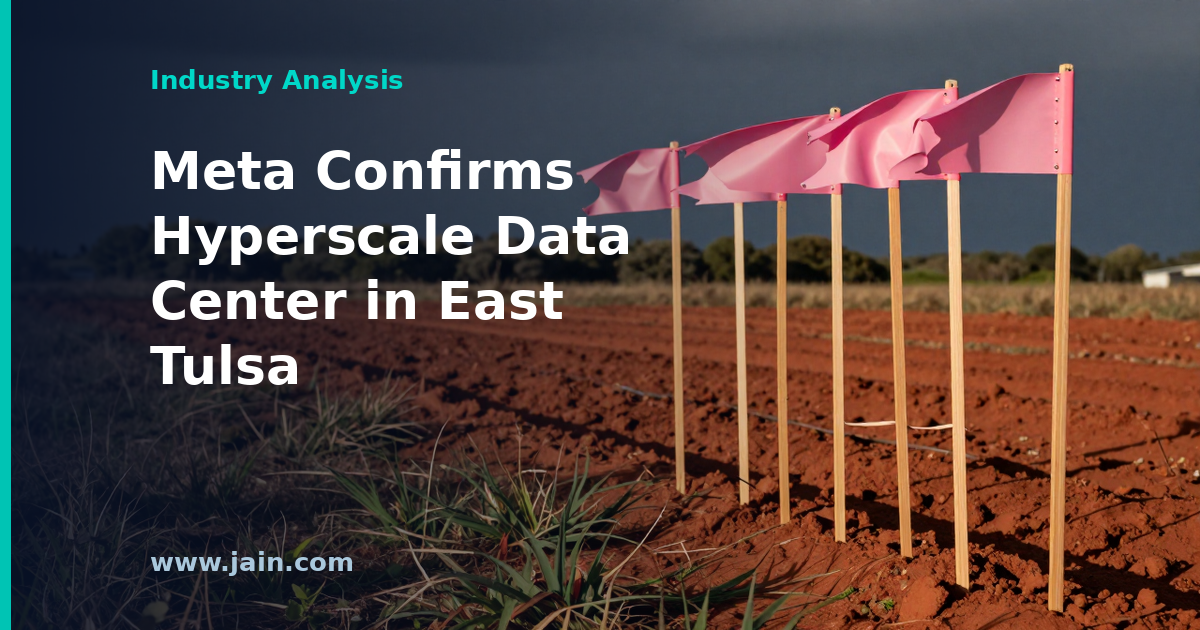
Meta has confirmed that it will operate a hyperscale data center in east Tulsa, Oklahoma, according to the Tulsa World on 21 April 2026. The confirmation resolves the identity of the operator behind a large industrial computing project in the city’s eastern industrial corridor.
The report establishes the operator and the general location. It does not, in the material available to us, attach a published megawatt figure, capital investment number, employment commitment, construction schedule or incentive package to the project — all of which remain the substantive questions for Tulsa residents, ratepayers and suppliers.
Executive Summary
The news is the confirmation itself. Large data center projects are routinely assembled under placeholder corporate names and non-disclosure agreements while land is optioned, utility service is negotiated and incentives are cleared; the operator’s name is often the last thing to surface. Meta putting its name to an east Tulsa campus turns a speculative local story into a fixed point that utilities, contractors, county assessors and competing site selectors can now plan around.
It matters because “hyperscale” is not a small industrial category. A single modern hyperscale campus can become one of the largest electricity customers in its host utility’s territory, reshaping load forecasts, transmission planning and the economics of new generation for everyone else on the system. Whatever this specific site’s final size, its arrival changes the planning assumptions in northeastern Oklahoma.
It also matters for Oklahoma’s position in the national compute map. The state already hosts one of Google’s long-running campuses at Pryor, roughly an hour from Tulsa. A second major operator in the same region begins to look less like an isolated deal and more like a cluster — with the labor pool, contractor base and transmission attention that clusters attract, and the concentration risks that come with them.
What “Hyperscale” Confirms — and What It Doesn’t
“Hyperscale” describes an operating model, not a unit of measurement. It means a facility built and run at the scale of the largest cloud and platform companies: standardized building templates, tens of thousands of servers, custom networking, and power delivered at transmission voltage rather than the distribution voltage a typical factory takes. It says nothing precise about how many megawatts the site will draw or how many buildings will eventually stand on it.
That distinction matters here because the confirmation carries no published capacity figure. Industry framing around new campuses has drifted toward gigawatt-class language — a gigawatt being roughly the output of a large power plant, or the demand of a mid-sized city — and the largest recent US announcements have been in that range. But an unstated capacity is an unstated capacity. The honest reading on 21 April 2026 is that Meta has confirmed an operator and a location, and that anyone quoting a wattage for east Tulsa is extrapolating from the industry’s recent pattern rather than from the announcement.
The same caution applies in the other direction. Absence of a headline number is not evidence the project is modest; hyperscale campuses are typically phased, with each phase authorized against demand that does not yet exist when ground breaks. The realistic expectation is a site that grows in steps over years, with the final footprint set by demand and by how much power the local grid can actually deliver.
Tulsa’s Grid Math: PSO, SPP and the Wind Belt
Tulsa is served by Public Service Company of Oklahoma, an American Electric Power subsidiary, inside the Southwest Power Pool — the regional grid operator covering much of the central plains. That footprint has two relevant characteristics. It has abundant wind generation, which has historically made Oklahoma power cheap and carbon-light on an annual-average basis, and it has the classic wind-region problem that supply peaks when the wind blows rather than when a data center is drawing its steady, around-the-clock load.
Hyperscale load is close to flat: high utilization, day and night, largely indifferent to weather. Marrying that profile to a wind-heavy system means firm capacity, storage, transmission upgrades, or some combination — and the question of who pays for them is the central regulatory issue in nearly every large-load interconnection in the country right now. Utilities increasingly seek special large-load tariffs with minimum take obligations and exit fees, precisely so that if a campus is cancelled or shrinks, the infrastructure built for it does not land on residential bills.
Nothing in the confirmation tells us which structure applies here. That is the thing worth watching: the utility filings and any state regulatory dockets will disclose more about the real terms of this project than any ribbon-cutting will. If the arrangement is well designed, a very large customer paying full freight for its own upgrades can spread fixed system costs across more kilowatt-hours and mildly benefit other ratepayers. If it is poorly designed, the transfer runs the other way. Both outcomes are common enough that the question is not rhetorical.
Water, Land and the Terms of the Bargain
Water is the second recurring flashpoint, and it turns almost entirely on cooling design. Evaporative cooling is efficient with electricity but consumes water continuously; closed-loop and air-cooled designs consume far less water while drawing more power for the same heat rejection. Operators have moved toward lower-water designs in dry regions, and several publish water-use figures, but a design choice for east Tulsa has not been stated. Tulsa’s municipal supply comes from northeastern Oklahoma reservoirs and is not the constrained desert supply that has made this a crisis issue elsewhere — which lowers the temperature of the question without settling it.
On the fiscal side, Oklahoma has long used sales-tax exemptions on qualifying computing equipment and local property-tax abatements to compete for capital-intensive facilities. These tools work as intended: they lower the effective cost of the single most expensive input in a data center, the servers and electrical plant. They also produce the familiar asymmetry that makes such deals contentious. Construction employment is large and temporary — often well over a thousand trades workers at peak on a big campus — while permanent operations staffing at even very large sites is measured in the low hundreds. The durable local benefit is usually the property tax base after abatements expire, plus utility revenue and construction spending, not headcount.
That is an argument to be had on specifics, and the specifics have not been published. A fair assessment of this deal requires the abatement schedule, the assessed valuation assumptions, any clawback provisions, and the wage and hiring commitments. Until those are on the table, both boosterish jobs claims and blanket assertions that the community gets nothing are running ahead of the evidence.
A Second Oklahoma Cluster, and Who Gains From It
The clearest beneficiaries are regional and immediate: electrical and mechanical contractors, civil and earthworks firms, switchgear and transformer suppliers, fiber builders, and the trades unions and training pipelines that staff them. Data center construction is unusually equipment-heavy and schedule-driven, which tends to pull skilled labor from a wide radius and bid up local rates for the duration. Tulsa’s existing industrial and aerospace workforce is a reasonable base for that.
The second-order winner is Oklahoma’s site-selection story. Google’s long presence at Pryor gave the state a reference customer; a Meta campus near Tulsa gives it two independent validations, which is what site selectors for the next tenant actually look for. Clusters compound — transmission gets built, permitting staff get experienced, suppliers open local branches. The corresponding risk is concentration: a region that leans on a handful of very large loads inherits their capital cycles, and the AI build-out that is driving current demand is not guaranteed to hold its present pace.
The parties with the most at stake and the least information right now are residential and commercial ratepayers, and the neighborhoods nearest the site. Their exposure runs through utility tariffs, transmission cost allocation, construction traffic and noise, and the local tax base. Those are all decided in public proceedings — utility commission filings, county assessor records, municipal permits — and that is where scrutiny is best directed, by supporters and critics alike.
Background
Meta operates a global fleet of company-built data centers supporting its social platforms and, increasingly, large-scale AI training and inference. Like other hyperscalers, it typically develops campuses in phases on large rural or industrial parcels chosen for power availability, land, fiber routes and tax treatment, and it has expanded that program substantially through the current AI infrastructure cycle.
Oklahoma has competed for these projects on cheap land, a wind-heavy generation mix within the Southwest Power Pool, and long-standing tax exemptions for computing equipment. Google’s Pryor campus in the MidAmerica Industrial Park has been the state’s anchor example for over a decade. Tulsa itself brings an industrial and aerospace workforce and a metro-scale utility system, which is what distinguishes it from the small rural sites that have hosted most recent hyperscale announcements in the region.
Publicly traded bitcoin mining companies have reduced their collective hashrate — the computational power they dedicate to mining bitcoin — by 13.4%, according to an April 21, 2026 report from Bitbo, a bitcoin data and analytics outlet. The report frames the decline not as distress but as a strategic shift: AI revenue is “taking over” as these companies redirect their power capacity and facilities toward artificial-intelligence computing workloads.
Executive Summary
The headline number is striking because hashrate has historically been the metric public miners competed on. Growing it signaled health; shrinking it signaled trouble. A double-digit collective cut across the public-miner cohort, presented alongside rising AI revenue, suggests the industry’s scoreboard is changing: megawatts under contract to AI customers now matter more to these companies than exahashes pointed at the bitcoin network.
Why it matters: public miners control something AI companies desperately need — large, energized data center sites with utility-scale power already connected. If miners are voluntarily retiring or redirecting 13.4% of their mining compute, that is among the clearest quantitative signals yet that the economics of AI hosting are outcompeting bitcoin mining for the same electrons. The caveat: the source is a single headline figure, and the report as circulated does not detail which companies cut how much, over what window, or how much AI revenue is actually flowing.
The Scoreboard Is Changing From Exahashes to Megawatts
For most of the public mining sector’s history, hashrate growth was the core investor pitch — more machines, more chances to win bitcoin block rewards. A 13.4% collective cut would once have read as capitulation. In 2026 it reads differently: mining rigs are single-purpose machines, but the infrastructure around them — high-capacity grid interconnections, substations, cooling, and permitted industrial sites — is exactly what AI data center developers spend years trying to assemble. Redirecting that capacity to AI tenants converts a volatile commodity business into something closer to contracted data center leasing.
The economic logic is straightforward. Bitcoin mining revenue is unpredictable: it depends on bitcoin’s price, on network difficulty (which rises as competitors add machines), and on halving events — the roughly four-yearly programmed cuts to mining rewards, most recently in April 2024. AI compute hosting, by contrast, is typically sold under multi-year contracts to creditworthy counterparties. Companies in this cohort, including TeraWulf and Riot Platforms, have spent the past two years publicly repositioning themselves as power-rich data center platforms rather than pure-play miners.
Why AI Tenants Want Mining Sites
The binding constraint on AI infrastructure buildout is not chips but power — specifically, energized capacity available now rather than after a five-plus-year utility interconnection queue. Bitcoin miners are among the few industrial operators holding hundreds of megawatts of already-connected capacity that can be reallocated quickly. That scarcity is what makes a miner’s site more valuable as an AI campus than as a mine, at least at the margin the 13.4% figure captures.
Conversion is not free, however. Mining facilities are typically air-cooled sheds built for cheap, fault-tolerant hardware; AI training and inference clusters demand far higher reliability, denser networking, and increasingly liquid cooling. The winners in this transition will be the miners whose sites justify that retrofit capital — large contiguous power blocks, strong fiber routes, cooperative utilities — and who can finance the conversion. Sites without those attributes may find the AI pivot is easier to announce than to execute.
What a Shrinking Public Hashrate Means for Bitcoin
A 13.4% cut by public miners does not mean the bitcoin network shrank by that amount — public companies are only a portion of global hashrate, and private and overseas operators can absorb the share they give up. If total network difficulty holds or falls, remaining miners actually earn slightly more per machine, partially offsetting the exodus. The more durable implication is structural: the best-capitalized, most transparent operators are signaling that the marginal megawatt earns more serving AI workloads than mining bitcoin. If that spread persists, capacity will keep migrating, and bitcoin mining could increasingly concentrate among operators with the very cheapest power and nothing better to do with it.
Background
Public bitcoin miners emerged as a listed-equity sector during the 2020–2021 bull market, raising billions to build warehouse-scale facilities whose defining asset was cheap, large-scale power. The April 2024 halving cut mining rewards in half just as AI demand exploded, and the sector discovered its grid connections were worth more than its mining rigs: Core Scientific’s landmark hosting agreements with AI cloud provider CoreWeave in 2024 established the template, and peers including TeraWulf, Riot Platforms, Hut 8, and Iren followed with AI and high-performance-computing strategies of their own.
By early 2026 the question was no longer whether miners would pivot but how fast and how completely. Aggregate statistics like a 13.4% public-miner hashrate reduction offer one of the first sector-wide measurements of that migration actually showing up in mining capacity, rather than just in investor presentations.