An entity calling itself the Transatlantic Investment Group announced on April 27, 2026 a €50 billion AI data center and innovation campus in Croatia. The announcement describes the project as the largest investment in Croatian history and among the largest private U.S. investments in Europe. Beyond that headline framing, the release provides few operational details — no named site, power figure, timeline, or anchor tenant.
Executive Summary
The announcement positions Croatia — an EU, eurozone, and Schengen member on the Adriatic — as the destination for one of the largest AI infrastructure commitments ever declared in Europe. A €50 billion figure, if realized, would place the project in the same conversation as the multi-hundred-billion-euro wave of AI campus announcements that has swept the U.S. and, increasingly, Europe and the Gulf since 2024.
Why it matters: hyperscale AI buildout is going global. Power, land, and permitting constraints in Europe’s established data center markets — Frankfurt, London, Amsterdam, Paris, Dublin — have pushed developers toward secondary markets, and a commitment of this size in Croatia would be the strongest signal yet that the frontier has moved to Southeast Europe. But the announcement, as published, is a statement of intent. The distance between a declared figure and energized capacity is measured in grid connections, financing closes, and construction phases — none of which are detailed here. Readers should treat this as a significant claim awaiting substantiation, not a shovel-ready project.
Why Croatia? The Logic of AI’s Geographic Spillover
Europe’s traditional data center hubs are effectively full. Utilities in Dublin and Amsterdam have restricted new grid connections for large facilities, and Frankfurt and London face similar power and land pressure. That has redirected capital toward markets that can offer three things at once: available power, developable land, and EU regulatory standing. Croatia checks the third box cleanly — it is inside the EU single market, the eurozone, and Schengen — which matters for data sovereignty rules that push European enterprises and governments to keep AI workloads on EU soil.
The strategic framing as a “private U.S. investment in Europe” also fits a broader pattern: American capital funding AI capacity abroad, both to serve regional demand and to diversify away from congested U.S. power markets. For Croatia, a country whose economy leans heavily on tourism, an anchor investment in digital infrastructure would be transformative — which is precisely why the announcement’s superlatives deserve careful measurement against what has actually been committed.
What €50 Billion Buys — and What an Announcement Doesn’t
At current costs, hyperscale AI capacity runs very roughly in the tens of millions of euros per megawatt once you include the chips inside. A €50 billion program therefore implies gigawatt-class ambitions — a campus that would rank among the largest in Europe and consume electricity on the scale of a sizable city. Nothing in the announcement explains where that power comes from, and in AI infrastructure, power is the project. Grid interconnection queues, not capital, are the binding constraint almost everywhere.
Industry observers have also learned to discount announcement figures. Across the sector, headline commitments are typically phased over a decade, contingent on demand, and structured so that early phases are a small fraction of the total. That is not a criticism of this project specifically — it is how large campuses are legitimately built — but it means the meaningful milestones to watch are land acquisition, a signed grid agreement, a financing close, and a named hyperscale or AI-lab tenant. None appear in the source material.
Winners, Losers, and the Regional Ripple
If even a first phase proceeds, the beneficiaries are identifiable: Croatia’s grid operator and power producers (who would need to expand generation and transmission), regional construction and electrical trades, European chip-adjacent suppliers of cooling and power equipment, and connectivity providers building fiber routes to link the Adriatic to Frankfurt, Milan, and Vienna. An “innovation campus” component, if real, could seed a local AI workforce — though such components are also the easiest part of an announcement to promise and the last to be funded.
The competitive question is who this capacity would serve. Europe’s AI compute demand is growing, and the EU has actively courted large-scale AI infrastructure through initiatives like its AI gigafactory push. But Croatia would be competing with Spain, the Nordics, and Southern European markets that offer abundant renewables and established subsea connectivity. A project of this scale succeeds or fails on tenant demand, and the announcement names none.
Background
Croatia joined the European Union in 2013 and adopted both the euro and Schengen membership in 2023, completing its integration into the EU single market. Its economy has historically leaned on tourism and shipping, with a small but growing technology sector; it has not previously hosted hyperscale data center capacity, which in Europe has concentrated in the so-called FLAP-D markets — Frankfurt, London, Amsterdam, Paris, and Dublin.
That concentration is now breaking up. Power and land constraints in the established hubs, EU data sovereignty rules encouraging in-region AI capacity, and Brussels-backed initiatives to attract large-scale AI computing have pushed developers toward Southern and Eastern Europe. The Croatian announcement, if substantiated, would be the largest expression of that shift to date.
Market research firm Dell’Oro Group has published analysis describing a growing “memory tax” on AI infrastructure — the rising share of system cost attributable to high-bandwidth memory (HBM) and DRAM in AI servers and accelerators. The note, surfaced April 27, 2026, frames memory as an increasingly material and often under-examined component of AI capital spending.
Executive Summary
Dell’Oro Group, an analyst firm that tracks data center and telecom infrastructure markets, is calling attention to memory — specifically HBM, the stacked memory packaged alongside AI accelerators, and conventional DRAM used in servers — as a fast-growing cost component in AI infrastructure. The “memory tax” framing suggests that as AI models and the clusters that train and serve them grow, memory is consuming a larger slice of every infrastructure dollar.
The framing matters because most public discussion of AI capital expenditure centers on GPUs and, increasingly, on power and data center construction. If memory costs are rising as a share of the bill of materials — the itemized cost of the components inside a server — then budget models built around accelerator pricing alone will understate the true cost of AI capacity. That has implications for cloud providers, enterprises buying AI servers, and the memory suppliers positioned to benefit.
Readers should note what is available here: a headline and thesis from a recognized analyst firm, without the underlying figures, forecast horizon, or methodology visible in the source material. The direction of the claim is consistent with the widely reported tightness in memory supply driven by AI demand, but the magnitude is not substantiated in what we can see.
Why Memory Became a Line Item Worth Naming
AI accelerators are unusual among chips in that their usefulness is bounded as much by memory as by raw compute. Training and serving large models requires moving enormous volumes of data to the processor quickly, which is why modern accelerators are packaged with HBM — DRAM dies stacked vertically and connected to the processor over a very wide, short interface. HBM is expensive to manufacture, supply is concentrated among a small number of suppliers (SK hynix, Samsung, and Micron are the established producers), and each new accelerator generation ships with more of it.
Conventional DRAM matters too: the host servers around the accelerators, plus the storage and networking tiers of an AI cluster, all consume memory. When one demand source — AI — pulls hard on a supply chain with long lead times and few producers, prices tend to rise across the board. Dell’Oro’s “memory tax” label captures the effect from the buyer’s side: a cost that arrives embedded in system prices whether or not the buyer itemizes it.
Who Pays, and Who Collects
If memory’s share of AI system cost is growing, the immediate beneficiaries are the memory manufacturers, for whom HBM commands substantially better margins than commodity DRAM historically has. Accelerator vendors sit in the middle: memory is a cost input to their products, but strong demand has so far allowed system prices to carry it. The buyers — hyperscale cloud providers, AI labs, and enterprises — absorb the tax directly in capital expenditure, and indirectly it flows into the price of cloud GPU capacity and AI services.
There is a second-order effect worth watching. Rising memory prices do not stay confined to AI hardware. General-purpose servers, storage systems, and consumer devices draw on the same DRAM supply base, so a sustained AI-driven squeeze can raise costs for infrastructure buyers who are not purchasing AI systems at all. For data center operators and IT planners, that argues for treating memory pricing as a market variable in refresh budgets, not a constant.
An Analyst Thesis, Not a Dataset — Yet
It is worth being precise about the evidentiary weight of what has surfaced. Dell’Oro is an established infrastructure research firm, and the thesis aligns with observable market conditions. But the material visible here is a headline-level framing: it does not disclose how large the memory share of AI system cost currently is, how fast it is growing, or over what forecast period. “Growing” is directionally plausible and quantitatively unverified in this source.
That distinction matters for anyone using the claim to make decisions. A memory share that rises from, say, a modest slice to a dominant one would reshape supplier negotiations and cloud pricing; a gradual drift would be a planning footnote. Until the underlying figures are public, the responsible reading is that memory costs deserve a named line in AI infrastructure budgets — and that the size of that line needs data the summary does not provide.
Background
The AI infrastructure buildout that accelerated from 2023 onward has been discussed mostly in terms of GPUs, power, and data center construction, but every AI accelerator ships with a large complement of high-bandwidth memory, and every cluster consumes conventional DRAM in its servers and supporting systems. Memory is a historically cyclical market dominated by a small number of manufacturers — SK hynix, Samsung, and Micron — and AI demand has become a defining force in its current cycle.
Dell’Oro Group, founded in the 1990s and based in Silicon Valley, publishes recurring research on data center capex, servers, and network infrastructure. Its analysts’ framing of trends — in this case, memory as a “tax” on AI infrastructure — often shapes how vendors and buyers talk about market economics before detailed figures circulate publicly.
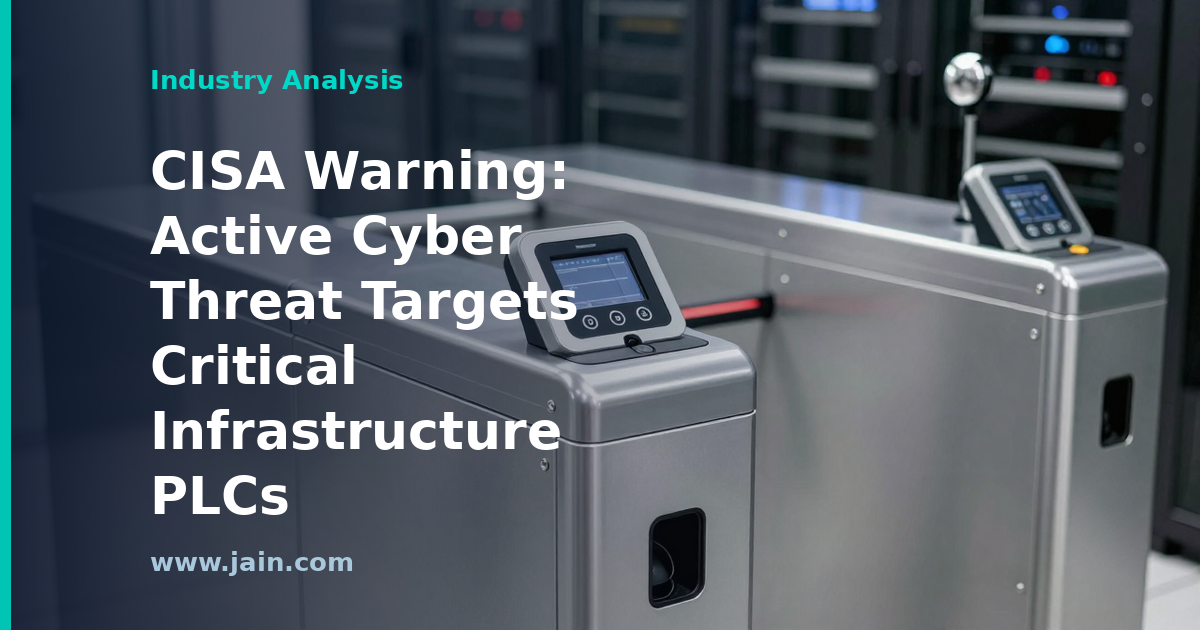
U.S. federal authorities have issued a warning about an active cyber threat targeting critical infrastructure, according to an April 27, 2026 report from Fox Business. The advisory centers on programmable logic controllers (PLCs) — the ruggedized industrial computers that directly operate physical equipment such as pumps, valves, breakers, and chillers across the power, water, and facility-cooling systems the country depends on.
The key word is active: this is framed not as a theoretical vulnerability disclosure but as a warning about attacks currently underway against operational technology (OT), the layer of computing that touches the physical world.
Executive Summary
The reported advisory warns that attackers are actively targeting the control-system layer of American critical infrastructure. PLCs sit at the bottom of that stack: they read sensors and command machinery, often using decades-old protocols that were designed for reliability on closed networks, not for authentication on the open internet. When a PLC is compromised, the consequence is not stolen data — it is the potential manipulation of physical processes like water treatment chemistry, electrical switching, or the cooling plant that keeps a data hall alive.
For operators of data centers, utilities, and industrial facilities, an advisory of this kind matters even when it is short on public detail. Federal agencies generally reserve “active threat” language for cases where compromise activity has actually been observed, and prior advisories in this vein — most notably the late-2023 wave of attacks on internet-exposed PLCs at U.S. water utilities — were followed by confirmed intrusions at real facilities. The prudent reading is that internet-reachable, weakly authenticated controllers are being probed and, in some cases, accessed right now.
Based on the material available, however, readers should note that the Fox Business report is a brief news item, and the specifics — which agency issued the warning, which sectors or device vendors are affected, and whether any disruption has occurred — are not spelled out in the source. Our analysis below separates what the warning signals from what remains unverified.
The OT Layer Is Where Cyber Risk Becomes Physical Risk
Most cybersecurity coverage concerns information technology (IT): servers, laptops, email, databases. Operational technology is different. A PLC is a small industrial computer, typically bolted inside an electrical cabinet, that runs a fixed control program — open this valve when the tank hits a setpoint, start this pump, trip this breaker. PLCs and the human-machine interfaces (HMIs) that supervise them were engineered for uptime measured in decades, in an era when the control network was assumed to be physically isolated.
That assumption has quietly eroded. Remote-monitoring requirements, vendor maintenance access, and cost pressure have connected many control networks — directly or indirectly — to the internet. Security researchers routinely find thousands of controllers reachable online with default or absent passwords. An advisory about “active” attacks on this layer is therefore credible on its face: the attack surface is real, well documented, and historically exploited.
Why This Warning Should Resonate in the Data Center Industry
Data centers are usually discussed as the thing being protected, but every data center is itself an industrial facility. Building management systems, chiller plants, computer-room air handlers, generators, switchgear, and uninterruptible power supplies are all orchestrated by the same class of controllers this advisory concerns. A facility can have immaculate IT security and still be exposed through a BMS controller a mechanical contractor connected to the internet for convenience.
The dependency also runs outward. A data center’s availability ultimately rests on the utility grid and, for cooling, often on municipal water. An attack that degrades a regional utility degrades every facility downstream of it. This is why OT threat advisories are relevant to cloud and colocation buyers, not just plant engineers: the resilience story a provider tells should extend below the operating system, into the physical plant and the controllers that run it.
The Economics of an Unfixable-by-Patching Problem
OT security is hard for structural reasons, not because operators are careless. Controllers frequently cannot be patched without shutting down the process they run, and many run vendor firmware that no longer receives updates at all. Replacement cycles for industrial equipment run fifteen to thirty years, so devices designed before modern security practices will remain in service well into the 2040s. The practical playbook — inventory every device, remove direct internet exposure, segment control networks from corporate networks, require multi-factor authentication on remote access, and monitor for anomalous commands — is compensating architecture, not a patch.
That reality shapes the market response. Each federal warning of this kind tends to accelerate spending on network segmentation, OT-specific monitoring, and secure remote access, and to sharpen insurer and regulator attention on control-system hygiene. For infrastructure operators, the cost of that program is increasingly best understood not as discretionary security spend but as a component of availability engineering — the same budget line as redundant power and cooling.
What the Report Substantiates — and What It Doesn’t
Even-handedly: the source here is a brief news report of a federal warning, and it leaves most operational detail unstated. It does not, in the material we reviewed, identify the issuing agency by name, attribute the activity to a specific actor, enumerate affected vendors or sectors, or confirm any successful disruption. The pattern is consistent with prior joint advisories from U.S. cyber agencies about internet-exposed controllers, but consistency is not confirmation.
What the warning does establish is direction: the U.S. government judged the threat to the control-system layer serious enough to warn publicly and to characterize it as active. Operators should treat the underlying advisory — not press coverage of it — as the actionable document, and pull the technical indicators and mitigations directly from the issuing agency once identified.
Background
Warnings about cyberattacks on industrial control systems have escalated steadily over the past decade. Stuxnet demonstrated around 2010 that malicious code could physically damage industrial equipment, and subsequent incidents — attacks on Ukraine’s power grid in 2015 and 2016, the 2021 tampering attempt at a Florida water treatment plant, and the late-2023 compromises of internet-exposed PLCs at multiple U.S. water utilities — moved the threat from theory to record. U.S. agencies led by CISA have responded with a cadence of joint advisories urging operators to disconnect controllers from the public internet and harden remote access.
The April 2026 warning arrives amid that trajectory and amid unprecedented growth in physical infrastructure itself: the AI-driven data center buildout is adding enormous new electrical and cooling capacity, all of it orchestrated by the same operational-technology layer this advisory concerns. As the footprint of controller-run infrastructure grows, so does the attack surface — which is why federal OT warnings increasingly speak to the digital-infrastructure industry as much as to traditional utilities.
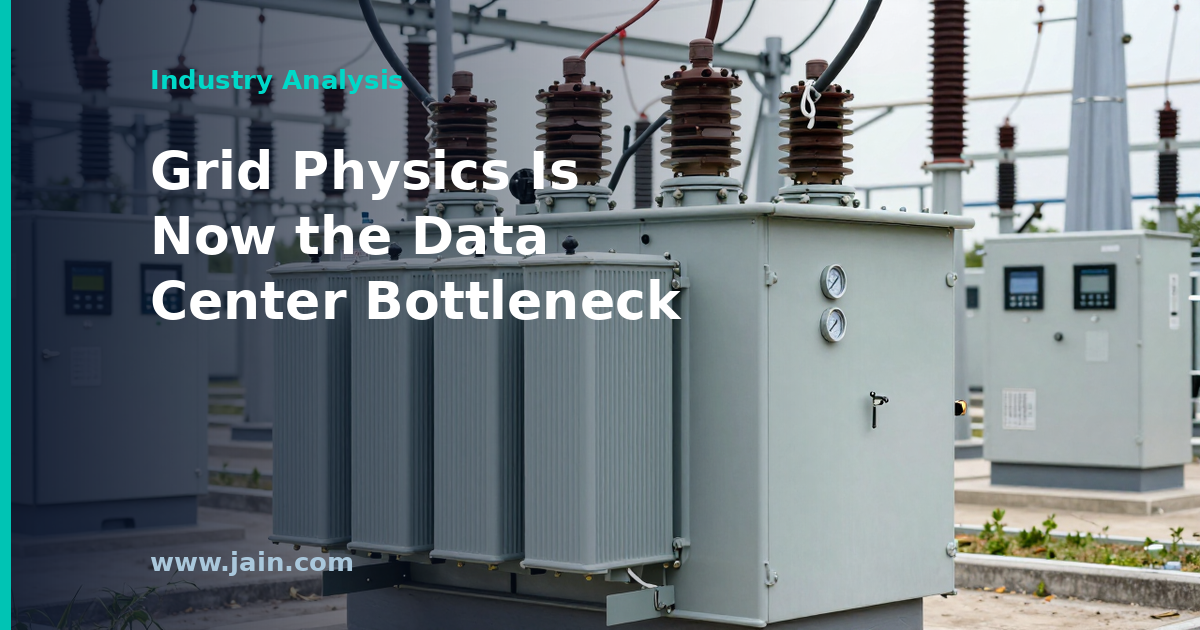
Latitude Media reports that the physical realities of the electric grid are “setting in” for the data center development pipeline. The April 26, 2026 piece frames a shift the industry has been circling for two years: the constraint on new AI-driven data center capacity is increasingly not capital, land, or chips, but whether the grid can physically deliver the power — and how long interconnection and transmission upgrades take.
Executive Summary
The report’s core observation is that the announced data center pipeline — the sum of projects developers have declared — is colliding with what the transmission system can actually serve. Interconnection (the formal process of connecting a large new load or generator to the grid) and transmission capacity (the physical ability of high-voltage lines to move power to a given location) operate on utility timescales measured in years, while hyperscale demand has been announced on timescales measured in quarters.
Why it matters: if grid physics is the binding constraint, then the familiar metrics of the buildout — megawatts announced, acres acquired, capital committed — stop predicting what actually gets energized and when. Siting strategy shifts from “where is land and fiber” to “where is deliverable power,” and the advantage moves to players who secured interconnection positions early or who can bring their own generation.
Announced Megawatts Are Not Energized Megawatts
A recurring pattern in this cycle is the gap between the announced pipeline and deliverable capacity. A developer can buy land, order equipment, and issue a press release in months; a utility must study the new load’s effect on the surrounding network, plan any needed substation and transmission upgrades, and build them — a sequence that routinely runs on multi-year timelines. The Latitude Media framing, that physical realities are “setting in,” suggests the market is starting to discount announcements accordingly. For readers of industry news, the practical takeaway is to treat energization dates, not announcement dates, as the real milestone.
Why Transmission Is the Hard Constraint
Transmission is unforgiving because it is physics plus process. Physically, a high-voltage line can carry only so much power before thermal and stability limits bind, and a concentrated gigawatt-scale load changes flows across an entire region, not just one feeder. Procedurally, upgrades require engineering studies, regulatory approvals, cost-allocation fights over who pays, and often new rights-of-way. None of these steps compresses easily with money. That is what distinguishes this bottleneck from earlier ones like GPU supply or land: you cannot pay a premium to make load-flow studies and line construction happen in a quarter.
Winners: Whoever Holds Deliverable Power
If interconnection position is the scarce asset, several groups benefit. Incumbent data center operators with existing utility relationships and already-energized capacity hold something new entrants cannot quickly replicate. Sites with surplus deliverable power — including brownfield industrial locations with legacy grid infrastructure — gain value relative to greenfield land. And “bring your own power” strategies, from on-site generation to co-location with existing plants, move from novelty to mainstream consideration, though they introduce their own permitting, fuel, and regulatory questions. Conversely, late-arriving developers whose projects sit deep in interconnection queues face the risk that their capacity arrives after the demand it was meant to serve has been placed elsewhere.
The Siting Map Is Being Redrawn
For two decades, data center geography followed fiber routes, tax incentives, and cheap land. A grid-constrained era redraws that map around electrical headroom: regions with spare transmission capacity, faster-moving utilities, or generation-rich locations become competitive even without a legacy data center cluster. This also raises a policy dimension — utilities and regulators must decide how much speculative load to plan for, and how to protect other ratepayers from paying for infrastructure serving projects that may not materialize. How that risk gets allocated will shape which regions court this demand and which slow-walk it.
Background
Data center development historically treated electricity as a routine input: sites were chosen for fiber connectivity, land cost, and tax treatment, and utilities absorbed the load growth without drama. The AI buildout that accelerated from 2023 onward broke that assumption, with individual campuses proposed at power levels comparable to heavy industry and developers announcing capacity far faster than grid infrastructure has historically been built.
By 2026 the conversation across the industry had shifted from chip supply and capital availability to power delivery — interconnection queues, transformer and equipment lead times, and transmission planning. The Latitude Media piece discussed here sits in that context: an energy-sector publication documenting the moment when the announced pipeline meets the grid’s physical and procedural limits.
Vertiv, one of the largest suppliers of data center power and cooling infrastructure, has acquired Strategic Thermal Labs, a liquid cooling vendor, according to an April 26, 2026 report from Channel Dive. Financial terms and the scale of the target were not disclosed in the report.
The deal adds another liquid cooling specialist to Vertiv’s thermal management portfolio at a moment when AI computing is pushing rack power densities beyond what conventional air cooling can practically handle.
Executive Summary
The announcement itself is brief: Vertiv has bought a liquid cooling company. But the context is what matters. Liquid cooling — circulating fluid directly to hot components, or immersing hardware in it, rather than blowing chilled air across servers — has moved in just a few years from a niche technique to a central requirement for AI data centers. Racks built for AI accelerators draw many times the power of traditional enterprise racks, and the heat they produce increasingly exceeds what air can remove economically, or at all.
Vertiv has been assembling liquid cooling capability for years, and its largest competitors have been doing the same through their own acquisitions. Strategic Thermal Labs is the latest specialist to be absorbed into a major platform. For data center operators, the pattern points toward a market where liquid cooling is sold as part of an integrated infrastructure stack — power, racks, coolant distribution, and heat rejection from one vendor — rather than as a standalone specialty product.
What the report does not tell us is significant: no purchase price, no revenue or headcount figures for Strategic Thermal Labs, and no detail on which products or technologies motivated the deal. The strategic logic is clear; the economics are not yet visible.
Why Liquid Cooling Became a Must-Own Technology
For decades, data centers were cooled almost entirely by air: chillers and air handlers pushed cold air to server intakes and carried the exhaust heat away. That model works well when each rack draws modest power. AI changes the arithmetic. Racks packed with GPUs and other accelerators concentrate far more power — and therefore far more heat — into the same physical footprint, and at the densities modern AI hardware demands, air cooling becomes inefficient, then impractical.
Liquid is a far better heat conductor than air, which is why the industry has shifted toward direct-to-chip cold plates (metal plates with fluid channels mounted on processors) and, in some designs, full immersion cooling. Chip roadmaps from the major accelerator vendors increasingly assume liquid cooling as the default, meaning every serious data center infrastructure supplier needs credible liquid cooling products to stay relevant in AI buildouts. That makes specialist firms with proven technology natural acquisition targets.
Consolidation Follows the Thermal Money
This acquisition fits an established pattern rather than starting a new one. Vertiv previously bought coolant distribution specialist CoolTera to strengthen its liquid cooling line. Rival Schneider Electric acquired liquid cooling maker Motivair; electronics manufacturer Flex bought cold-plate specialist JetCool. The large infrastructure platforms are racing to own the full thermal chain — from the cold plate on the chip, through coolant distribution units, to the heat rejection equipment outside the building — because hyperscale and colocation customers increasingly want that chain engineered and warrantied as one system.
For the remaining independent liquid cooling vendors, consolidation cuts both ways. Acquisition interest validates their technology and offers a path to scale manufacturing quickly. But competing against integrated giants for large AI projects becomes harder, since those buyers value single-vendor accountability when a cooling failure can idle tens of millions of dollars of computing hardware. The likely trajectory is a market with a handful of full-stack thermal platforms and a shrinking field of independents serving specialized niches.
What Vertiv Gains — and What Remains Unproven
For Vertiv, the strategic appeal of bolt-on liquid cooling acquisitions is straightforward: they can add engineering talent, patents, and product lines faster than internal development, in a market where speed matters because AI capacity is being contracted years ahead. Thermal management is also attractive business territory — it is specified early in a data center’s design and generates ongoing service revenue over the facility’s life.
That said, the report substantiates very little beyond the fact of the deal. Without disclosed terms or information about Strategic Thermal Labs’ size, technology focus, or customer base, it is impossible to judge whether this is a significant capability acquisition or a small technology and talent tuck-in. Acquisitions in fast-moving hardware categories also carry integration risk: specialist engineering teams do not always thrive inside large product organizations, and overlapping product lines can create rationalization decisions that unsettle existing customers. Those are open questions, not criticisms — but they are the questions on which the deal’s value will ultimately turn.
Background
Vertiv traces its roots to Emerson Network Power, the data center infrastructure arm of Emerson Electric, which was spun off and renamed Vertiv in 2016. The company supplies the physical backbone of data centers — uninterruptible power supplies, power distribution, racks, and thermal management — and has ridden the AI infrastructure boom as one of its most direct beneficiaries, since every megawatt of new AI computing requires matching power and cooling equipment.
The liquid cooling market it is buying into has grown rapidly alongside AI deployment. A field once dominated by small specialists serving supercomputing labs is consolidating quickly as hyperscale AI buildouts turn liquid cooling into mainstream, high-volume business — a shift that has made those specialists prime acquisition targets for infrastructure giants like Vertiv, Schneider Electric, and large electronics manufacturers.
A 9-gigawatt AI data center campus backed by investor Kevin O’Leary has been approved in Utah, according to an April 26, 2026 report from Tom’s Hardware. The project is described as generating and consuming more than twice the amount of power the entire state of Utah currently uses — placing it among the largest data center developments ever announced anywhere in the world.
Executive Summary
The headline fact is the scale: 9 gigawatts is not a data center in any conventional sense — it is a power project with computing attached. For perspective, 9GW is roughly the output of nine large nuclear reactors, and the report frames it as more than double Utah’s entire statewide electricity draw. Notably, the report says the campus will generate as well as consume that power, which signals a behind-the-meter model: building dedicated generation on site rather than asking the regional grid to supply it.
The second fact is the word “approved.” Some jurisdictional body has said yes to something — but at headline level, the report does not specify which approval this is: land-use zoning, an air-quality permit, a generation license, or a state economic-development agreement. In mega-project development, each of those is a different gate, and clearing the first one is a long way from moving dirt. What is substantiated here is an approval milestone for an extraordinarily ambitious plan; what is not yet substantiated is financing, customers, a construction timeline, or the generation technology behind the 9GW figure.
A Power Plant First, a Data Center Second
The most telling detail in the report is that the campus will “generate and consume” its power. AI campuses at gigawatt scale have collided with a hard constraint across the United States: utility interconnection queues — the waiting lines to connect large new loads to the grid — now stretch years in many regions. Developers who cannot wait are going behind the meter, building their own gas turbines, and in some proposals nuclear or geothermal capacity, dedicated to the site. A 9GW self-generation plan sidesteps the queue but inherits a different set of problems: gas turbine order books are backed up years, fuel supply must be contracted at enormous volume, and on-site generation still typically requires air-quality permits and some grid tie for backup and startup power.
For lay readers, the practical meaning is this: the binding constraint on AI infrastructure has shifted from chips and buildings to electricity. Projects are now sized and sited around where power can be created, not where fiber or customers happen to be. Utah — with land, gas access, and a development-friendly posture — fits that new map.
What “Approved” Does and Does Not Mean
Approval is a genuine milestone; it is also the cheapest one. The industry has spent the past two years in an announcement race, with proposed multi-gigawatt campuses in the U.S., Canada, and the Gulf states collectively promising far more capacity than the supply chain — turbines, transformers, switchgear, chips, and skilled labor — can deliver on the advertised timelines. Analysts increasingly distinguish between announced gigawatts and energized gigawatts, and the gap between the two is wide. Kevin O’Leary himself previously announced a separate multi-gigawatt AI data center park in Alberta, Canada, which illustrates the pattern: high-profile backers can secure land and early approvals quickly, while the capital-intensive middle of the project — measured in tens of billions of dollars for a campus this size — takes years and committed tenants to close.
None of that makes the Utah project unserious. It makes it unproven, which is the honest status of nearly every gigawatt-class announcement at the approval stage. The credible test will be what follows: named anchor tenants, equipment orders, and financing commitments, not renderings.
Winners, Losers, and the Utah Question
If the campus advances, the near-term winners are clear: turbine and electrical-equipment manufacturers with the scarcest order slots, construction and trades labor in Utah, and the state’s tax base. Hyperscalers and AI labs hungry for capacity gain another potential supply option in a market where powered land is the scarcest commodity. The open question is who bears the risks. Behind-the-meter gas generation at this scale raises air-quality and emissions questions; data centers in the arid West raise water and cooling questions; and residents near any 9GW generation complex will have views on all of it. A project sized at more than twice the state’s current consumption will, fairly or not, become a referendum on how Utah wants to participate in the AI buildout — and community sentiment has already slowed or stopped large data center proposals in other states. Developers who engage those concerns early, with specific commitments on emissions, water, and grid impact, have fared better than those who lead with the gigawatt number.
Background
The AI boom has turned electricity into the data center industry’s scarcest input. Training and running large AI models requires dense clusters of power-hungry chips, and since 2023 developers have raced to secure “powered land” — sites where gigawatt-scale electricity can be delivered or built. With utility interconnection queues stretching years, a new class of power-first campuses has emerged that builds its own generation on site, and announced capacity across North America and the Gulf now far outstrips what has actually been energized.
Kevin O’Leary, the investor and Shark Tank personality behind O’Leary Ventures, entered this race with a previously announced multi-gigawatt AI data center park in Alberta, Canada. The Utah campus extends that playbook to the U.S. at even larger scale: at 9GW, the approved plan would exceed the entire current power draw of the state that will host it — a first even by the standards of this buildout.
Anthropic, the AI lab behind the Claude family of models, is pursuing a push into European AI data centers and is recruiting for a key dealmaking role to drive it, according to a CNBC report published April 26, 2026. The report signals that Anthropic intends to secure compute capacity in Europe directly, rather than relying solely on its cloud partners — though no sites, capacity figures, or financial commitments have been disclosed.
Executive Summary
According to CNBC, Anthropic is working to expand its AI data center footprint in Europe and is hiring for a senior dealmaker position to lead infrastructure negotiations. A “dealmaker” hire in this context typically means someone who structures large, complex transactions — capacity leases, joint ventures, land and power agreements — rather than a conventional corporate development role.
The move matters because it marks a broader industry shift: frontier AI labs, which historically consumed compute through hyperscale cloud providers, are increasingly acting like infrastructure buyers in their own right. If Anthropic contracts European capacity directly, it becomes a new class of anchor tenant — or even developer — in a market already straining under power and land constraints. For data center operators, utilities, and governments courting AI investment, that changes who sits across the negotiating table.
From Tenant to Buyer: Frontier Labs Are Changing Seats at the Table
Until recently, the division of labor in AI infrastructure was clean: labs trained models, cloud providers built and operated the data centers. Anthropic has historically run its workloads on partner infrastructure, backed by deep compute relationships with Amazon and Google. Recruiting a dedicated dealmaker for a European push suggests the company wants direct agency over where its capacity sits and on what terms — the same trajectory other frontier labs have followed as training and inference demand outgrew what standard cloud contracts comfortably deliver.
The economics explain the shift. AI compute is now the dominant cost line for a frontier lab, and multi-year capacity commitments are effectively infrastructure finance decisions. Negotiating directly with data center developers, power providers, and governments can secure capacity earlier and potentially on better terms than consuming it through an intermediary — but it also requires skills labs did not traditionally employ: site selection, power procurement, and structured real-estate-style dealmaking. A dealmaker hire is the organizational tell that this capability is being built in-house.
Why Europe: Sovereignty Demand Meets a Supply-Constrained Market
Europe is a logical but difficult target. On the demand side, European enterprises and public-sector buyers increasingly want AI workloads processed in-region — a mix of data-protection law, the EU AI Act’s compliance regime, and a broader political push for “sovereign AI” capability. A lab that can offer European customers inference served from European soil holds a genuine commercial and regulatory advantage over one that cannot.
On the supply side, however, Europe’s prime data center markets — Frankfurt, London, Amsterdam, Paris, Dublin — are among the most power-constrained in the world, with grid-connection queues stretching years and some jurisdictions having imposed moratoria on new builds. That scarcity is precisely why a dealmaker matters: available large-scale capacity in Europe is won through early, creative transactions — secondary markets, powered-land deals, partnerships with utilities — not by placing an order. Anthropic entering that hunt adds a well-capitalized bidder to an already competitive field.
Ripple Effects: Operators, Hyperscalers, and Governments
For European data center operators and developers, a frontier lab shopping directly is attractive: AI labs sign large, long-duration commitments that can anchor entire campuses and underwrite new construction. Utilities and grid operators face the harder version of the same news — more gigawatt-scale demand arriving in systems already juggling electrification and renewable-integration timelines.
For the hyperscalers, the picture is nuanced rather than adversarial. Anthropic’s cloud partnerships remain central to its compute story, and a European buildout could well be executed with or through those partners. But every direct deal a lab signs shifts some negotiating leverage and some margin away from the cloud intermediary. Governments, meanwhile, gain a new courtship target: expect member states competing for AI investment to treat frontier labs, not just hyperscalers, as strategic accounts.
Background
Anthropic was founded in 2021 by former OpenAI researchers and has grown into one of the leading frontier AI labs, best known for its Claude models. Its compute has historically come through deep partnerships with Amazon — which has committed roughly $8 billion in investment — and Google, both of which also serve as cloud infrastructure providers for its training and inference workloads.
The European data center market it is now reportedly entering is large but supply-constrained: the established FLAP-D hubs (Frankfurt, London, Amsterdam, Paris, Dublin) face power scarcity and permitting friction, pushing new AI capacity toward secondary markets such as the Nordics, Iberia, and Southern Europe. European policymakers, for their part, have been actively courting AI infrastructure investment as part of a broader push for regional AI capability.
The US government has issued a warning about an active cyber threat targeting critical infrastructure, with programmable logic controllers (PLCs) — the ruggedized industrial computers that directly operate pumps, breakers, valves and cooling equipment — at the center of the concern, according to an April 26, 2026 Fox Business report. The alert comes from the Cybersecurity and Infrastructure Security Agency (CISA), the Department of Homeland Security unit responsible for defending the systems that keep power, water and communications running.
The report describes the threat as active — meaning adversaries are currently attempting or conducting intrusions, not merely capable of them. Details on attribution, affected vendors and confirmed victims were not included in the initial coverage.
Executive Summary
According to the report, CISA is warning that threat actors are actively targeting operational technology (OT) — the layer of industrial control systems that sits between software and physical machinery — across US critical infrastructure sectors. PLCs matter because they are the last digital step before a physical action: a compromised email server leaks data, but a compromised PLC can shut off a pump, trip a breaker or disable a chiller.
For operators of power systems and data centers, the warning lands on a well-documented weak spot. Many PLCs in the field run with default credentials, lack modern authentication, and were designed for isolated networks that have since been bridged to corporate IT and the internet for remote monitoring. When CISA flags active targeting of this equipment, the practical message is that exposure that was theoretically risky yesterday is being probed today.
It is worth being precise about what the initial coverage does and does not establish. The existence of a federal warning is reported; the specific advisory, the threat actor behind the activity, the vulnerabilities exploited and whether any disruption has occurred are not detailed in the source. Operators should treat the report as a prompt to consult CISA’s published advisories directly rather than act on secondhand characterizations.
Why PLCs Are the Soft Underbelly of Critical Infrastructure
A programmable logic controller is a small industrial computer that reads sensors and drives equipment on a fixed loop — open this valve, start that fan, trip this breaker. They are built for reliability and longevity, not security: units installed 15 or 20 years ago are still in service, many with no authentication, unencrypted protocols, and firmware that is rarely if ever updated. Security researchers have called this class of exposure “insecure by design,” because the weaknesses are features of the product era, not bugs that a patch can remove.
The attack path is usually mundane. Adversaries do not need exotic exploits when internet-scanning tools can find PLCs and their human-machine interfaces exposed directly online, often protected by a default password printed in the vendor manual. That is why prior US government advisories on OT threats have emphasized basics — take devices off the public internet, change default credentials, segment networks — rather than sophisticated countermeasures. An “active threat” warning against this backdrop suggests someone is systematically working through that exposed population.
The Data-Center Angle: OT Risk Is Not Just a Utility Problem
Data-center operators sometimes read critical-infrastructure warnings as a power-and-water problem. That is a mistake. A modern data center is itself a dense OT environment: building management systems, chillers, computer-room air handlers, generators, transfer switches and uninterruptible power supplies are all orchestrated by PLCs and adjacent controllers. An attacker who cannot touch a single server can still take a facility down — or force a thermal shutdown — by manipulating the cooling plant.
The interdependence runs both ways. Data centers are among the fastest-growing loads on the US grid, and their availability depends on the same utility OT systems the warning implicates. A regional grid disruption caused by an OT intrusion becomes every colocation tenant’s outage. That shared fate is why federal warnings of this kind deserve attention across the infrastructure stack, not just inside utilities’ security teams.
What “Active” Changes — and What It Doesn’t
Government cyber warnings span a wide range, from generic threat awareness to specific incident-driven alerts with indicators of compromise. The word “active” pushes toward the serious end: it implies observed adversary operations, not hypothetical capability. Recent history supports taking such language literally. In late 2023, US water utilities had Unitronics PLCs defaced by an Iran-linked group exploiting default passwords, and through 2024 and 2025 US agencies repeatedly warned that state-sponsored actors — most prominently the China-linked group tracked as Volt Typhoon — had pre-positioned inside US critical-infrastructure networks for potential future disruption.
What the initial report does not change is the economics of the defense. OT security spending has historically lagged IT security because control systems were assumed to be isolated, and because taking a production PLC offline to patch it carries real operational cost. The honest reading of a headline-level report is that it confirms direction — attackers continue to move toward the physical layer — without yet telling operators which specific products or protocols to triage first. That specificity has to come from the underlying CISA advisory itself.
The Operator Playbook: Boring, Proven, and Still Not Done
The mitigations for PLC-targeting campaigns have been remarkably consistent across a decade of advisories: inventory every controller and its network path; remove OT devices from direct internet exposure; put remote access behind VPNs with multi-factor authentication; change default and shared credentials; segment OT networks from IT with monitored boundaries; and maintain tested manual-operation and restoration procedures so a cyber event does not automatically become a physical outage.
The persistent gap is not knowledge but execution — asset inventories are incomplete, legacy gear cannot support modern authentication, and maintenance windows are scarce. For executives, the actionable question this warning raises is not “are we compliant?” but “if CISA named our PLC vendor tomorrow, could we locate every affected unit within a day?” Organizations that cannot answer yes have their next quarter’s OT security priority already defined.
Background
CISA was established in 2018 as the Department of Homeland Security’s lead agency for defending civilian critical infrastructure, and industrial control systems have been a steady focus of its advisory output. The threat it tracks has escalated visibly: the 2021 Colonial Pipeline ransomware attack showed how IT intrusions can halt physical operations, the late-2023 Unitronics incidents showed hacktivists compromising water-utility PLCs through default passwords, and joint advisories in 2024 warned that the China-linked group Volt Typhoon had quietly pre-positioned inside US energy, water and communications networks.
Against that backdrop, PLC-focused warnings are less a new development than an intensifying pattern. The installed base of industrial controllers — millions of devices across utilities, manufacturing and building systems, many designed before cybersecurity was a requirement — represents one of the longest-tail risk remediation problems in US infrastructure, because the equipment often outlives both its vendor support and the network assumptions it was built on.
MLive reported on April 25, 2026 that the large data center campus planned for Saline Township, in Washtenaw County, Michigan, has secured financing through Blackstone, the world’s largest alternative-asset manager and a major private-credit lender. Saline Township is a rural farming community roughly south of Ann Arbor, and the site has been the subject of local debate since the project was first proposed.
The report is headline-level. The coverage available to us does not state the size of the facility, the amount or structure of the financing, the identity of the anchor tenant, or the construction schedule. What is established is the fact of a financing commitment from a private-capital provider rather than from a bank syndicate or a utility-led arrangement.
Executive Summary
A financing close is the moment a data center stops being a land-use argument and becomes a construction project. Site control, zoning approvals and power studies can all exist without a single dollar of committed capital; a lender writing a check is the first hard signal that a third party with money at risk believes the project will generate cash. That is why this particular disclosure matters more than its length suggests.
The identity of the lender matters as much as the event. Blackstone has become one of the largest financiers of digital infrastructure through its credit and real-assets platforms, and its involvement places Saline Township inside a broader shift: the capital funding America’s AI-era compute buildout is increasingly private credit — money lent directly by asset managers — rather than utility balance sheets, investment-grade bonds, or traditional construction lending. Private credit moves faster, tolerates more complexity, and prices that flexibility into the interest rate.
The consequence is a redistribution of risk. When a regulated utility builds generation and transmission for a large customer, cost overruns and demand shortfalls can end up in rate cases, where regulators decide how much lands on other ratepayers. When a private lender funds a merchant campus, the first loss sits with the sponsor’s equity and the lender’s loan. Which of those two models Saline Township follows is the single most consequential question the reporting does not yet answer.
Why a Private-Credit Lender, Not a Utility, Is the Story
For most of the last century, the entity that financed heavy electrical load in a place like Washtenaw County was the local utility. It raised capital, built the wires and the plants, and recovered the cost from customers over decades under a regulator’s supervision. The model was slow, but it was durable, and it socialized risk across a large base of ratepayers who had little say in the matter.
Data centers built for artificial-intelligence workloads do not fit that rhythm. The demand signal arrives in months, not decades, and it is concentrated in a handful of hyperscale buyers whose plans can change. Private credit — non-bank lending in which asset managers lend directly from their own funds — has filled the gap because it can underwrite an idiosyncratic asset quickly, structure around construction milestones, and accept collateral that a bank credit committee would struggle with. The borrower pays for that speed in spread.
The trade is real in both directions. A sponsor who takes private credit gets certainty of execution and avoids the political timeline of a rate case. It also accepts covenants, tighter reporting, and a lender that can enforce quickly if lease-up or delivery slips. Reading Blackstone’s involvement as validation of the Saline Township site is reasonable; reading it as a guarantee of completion is not, because financing commitments are typically conditioned on milestones that have not been disclosed here.
The Capital Structure Decides Who Eats the Power Risk
Whether a campus of this scale is financially safe depends less on the headline amount than on what sits behind it. Two structures dominate the sector. In the first, the developer signs long-term leases with a creditworthy tenant before drawing debt; the lender is effectively underwriting the tenant’s credit, and power costs are passed through under the lease. In the second — a merchant or speculative build — the developer takes capacity risk, betting that demand will appear at attractive rates. The interest cost of the two differs sharply, and so does the consequence of being wrong.
Power is where those structures are tested. A large campus needs a firm interconnection, a tariff that sets what it pays per megawatt-hour, and often a commitment to pay for a minimum volume whether or not the servers are drawing it. That last provision — a take-or-pay or minimum-demand charge — is the mechanism by which regulators try to ensure that a large customer, not the general ratepayer base, funds the network upgrades built on its behalf. Whether such terms exist here, and how strict they are, is not in the reporting.
The winners in the current arrangement are relatively easy to identify: landowners who sell into a rising market, contractors and electrical trades, lenders earning wide spreads on secured assets, and local governments that collect property tax on very expensive equipment. The exposed parties are harder to see in advance. They include equity holders if AI compute demand normalizes before the campus is leased, and residential ratepayers if grid investment is later judged to have been undersubscribed by its intended customer. Neither outcome is predictable from a financing headline, which is exactly why the terms matter.
Michigan’s Calculation: Tax Base Now, Load Growth Later
Michigan has actively courted data center investment as part of a broader effort to attract capital-intensive industry, and southeast Michigan offers a genuine set of advantages: cool climate for much of the year, abundant fresh water in the Great Lakes basin, existing transmission built for a manufacturing economy that has shrunk, and proximity to engineering talent around Ann Arbor and Detroit. Those are structural, not promotional.
The fiscal case for a rural township is also real but narrow. A hyperscale campus generates substantial property tax relative to farmland and comparatively few permanent jobs — typically technicians, security and facilities staff, against a much larger but temporary construction workforce. Communities that evaluate these projects as employment engines are usually disappointed; those that evaluate them as tax-base plays are usually not, provided the assessment holds and abatements are modest. The distinction is worth making plainly because it is where local expectations most often go wrong.
The longer-term question for Michigan is load. Adding gigawatt-scale demand to a grid changes generation planning, transmission queues and reserve margins for everyone connected to it. That can be managed well — with large-load tariffs, staged energization, and on-site or contracted generation — or managed poorly. The financing announcement tells us capital has arrived. It tells us nothing about which of those paths the electricity side is on.
A Contested Site, and How to Read Both Sides
The Saline Township project has drawn organized local opposition, as most large rural data center proposals now do. Residents raise farmland conversion, water use, noise from cooling equipment, traffic during construction, and the durability of tax promises. These are legitimate, checkable questions, and dismissing them as reflexive opposition would be lazy — several of them have been substantiated at other sites, particularly noise complaints near residential parcels.
The same standard applies to opposition claims. Water consumption varies by an order of magnitude depending on whether a facility uses evaporative cooling or a closed-loop design, so a figure quoted without the cooling architecture attached is not informative. Ratepayer-impact estimates depend entirely on the tariff, which is a public document once filed. And in a national debate where template campaigns circulate between communities, it is fair to ask of any local group — as of any developer — who is speaking, what the specific local evidence is, and whether the numbers cited come from this project’s filings or from someone else’s. Asking is not an accusation, and there is no basis here for speculating about anyone’s funding.
The most even-handed reading is that both sides are currently arguing about a project whose material terms are not public. The developer has not, in the reporting available, published capacity, water design, or power arrangements; opponents cannot fully assess impact without them. A financing close usually precedes more disclosure, not less, because lenders require documentation that eventually surfaces in permits and utility filings. That is where the argument should be settled.
Background
Blackstone is the world’s largest alternative-asset manager, with major platforms in real estate, infrastructure and private credit. It has become one of the most significant financiers of digital infrastructure globally, lending to and owning data center assets as demand from cloud and artificial-intelligence workloads has outpaced what traditional bank and utility financing could supply on the required timeline.
Saline Township sits in Washtenaw County, southeast Michigan, an agricultural community adjacent to a metropolitan corridor with legacy industrial transmission. Large data center proposals in such places have become a recurring national pattern over the past several years: developers seek land, power and water at rural prices near urban fiber, while residents weigh tax revenue against land use, noise and grid effects. The Saline Township project has been locally contested since it was proposed, and the April 2026 financing report is the point at which the debate moved from land-use approvals toward committed capital.
Maine Governor Janet Mills has vetoed legislation described as a landmark data center ban, according to an April 25, 2026 report from the Maine Morning Star. The bill would have made Maine the first U.S. state to impose a statewide moratorium on new data center development — a sharp escalation of a siting fight that has, until now, played out mostly at the town and county level.
The veto keeps Maine formally open to data center projects and hands the industry a notable, if narrow, victory in the first statewide test of the moratorium movement.
Executive Summary
The significance of this veto extends well beyond Maine, a state that has never been a major data center market. Legislatures across the country have been debating how to respond to the wave of AI-driven data center construction — its electricity demand, its water use, its tax treatment, and its effect on ratepayers. Maine’s bill was the movement’s most aggressive expression: not stricter permitting or ratepayer protections, but a statewide halt. Mills’ veto establishes the first precedent for how a governor responds when that idea actually reaches a desk.
For the industry, the takeaway is double-edged. A moratorium passed a state legislature — proof the backlash has matured from zoning-board resistance into statewide lawmaking. But it also failed at the executive branch, suggesting that even in states with little economic stake in the sector, governors are reluctant to slam the door entirely. How durable that reluctance proves — and whether Maine’s legislature attempts an override — will shape the template other states copy.
From Zoning Boards to Statehouses
Data center opposition is not new, but its venue is changing. For years, siting fights were hyper-local: individual towns and counties passing zoning restrictions or temporary building pauses while they studied noise, land use, and utility impacts. A statewide moratorium — a legislated pause on an entire category of development across a state’s whole territory — is a categorically different instrument, and Maine’s bill appears to be the first of its kind to clear a legislature.
That escalation matters because state-level action changes the risk calculus for developers. A hostile town can be routed around; a hostile state cannot. Site selectors already screen states on power availability, tax incentives, and permitting speed. If moratorium bills become a live possibility, legislative risk joins that screening list — and states seen as wobbly may be quietly dropped from shortlists long before any bill passes.
Why a Governor Blinked at a Ban
The reported veto is consistent with a pattern visible across state politics: even leaders sympathetic to concerns about energy demand and ratepayer costs tend to resist outright prohibitions on investment. A moratorium forecloses future tax base, construction employment, and the option value of attracting projects on the state’s own terms. For a governor, signing the nation’s first statewide ban also carries signaling risk — branding the state as closed to a technology sector into which capital is flowing at historic rates.
The source report does not include Mills’ stated rationale, so the specific reasoning here is unconfirmed. But the structural logic is worth noting: vetoing a moratorium is not the same as endorsing unregulated growth. Governors in several states have paired resistance to bans with support for targeted measures — cost-allocation rules that shield residential ratepayers, or minimum efficiency standards. Whether Maine pursues that middle path is one of the most important open questions the veto leaves behind.
Maine as an Unlikely Bellwether
Maine is a curious venue for the first statewide test. It is a small New England market with high electricity prices, a constrained regional grid, and no significant hyperscale footprint — precisely the profile of a state with little to lose from a moratorium and, arguably, little to attract without one. That is what makes the veto instructive: if a ban could not survive the executive branch in a state with minimal industry presence, its odds look longer in states where data centers already anchor local tax bases.
The counter-reading deserves equal weight. The bill’s passage shows that in states where the industry has no built-in constituency — no employees, no host-community payments, no utility revenue on the table — a moratorium can command a legislative majority. As AI-driven load growth pushes developers into new geographies beyond Virginia, Texas, and Arizona, they will increasingly encounter exactly these constituency-free states. Maine may be less an outlier than an early sample of the terrain ahead.
The Template for the Fights to Come
Both sides of the siting debate will study this sequence. For moratorium advocates, the lesson is that legislative passage is achievable but insufficient; veto-proof margins or governors’ races become the real battleground. For the industry, the lesson is that goodwill cannot be assumed — the case for data centers now has to be made state by state, with concrete commitments on grid costs, water, and local benefit, rather than relying on the sector’s momentum.
The practical winners in the near term are developers with optionality: those able to shift projects toward states offering regulatory certainty. The losers are harder to name from this report alone — it is not clear any specific Maine project was pending. The broader risk is a patchwork: a national map where the rules for building digital infrastructure diverge sharply by state, complicating the long-term planning that grid operators and hyperscalers both depend on.
Background
Data center siting has become one of the most contested land-use questions in the U.S. as AI workloads drive a historic construction boom, with projects measured in hundreds of megawatts of electricity demand. Opposition that began at zoning boards — over noise, water, and land — has increasingly moved into state legislatures, which have debated tax-incentive rollbacks, ratepayer protections, and disclosure requirements.
Maine had largely sat outside this boom: a small, energy-constrained New England state without a meaningful data center footprint. Its legislature nonetheless produced what was reported as the nation’s first statewide moratorium bill, and Governor Janet Mills — the state’s Democratic governor since 2019 — vetoed it in April 2026, creating the first executive-branch precedent in the statewide moratorium debate.
Source: Gov. Mills vetoes landmark data center ban — Maine Morning Star report, April 25, 2026, on the veto of what was described as the first statewide data center moratorium bill in the U.S.