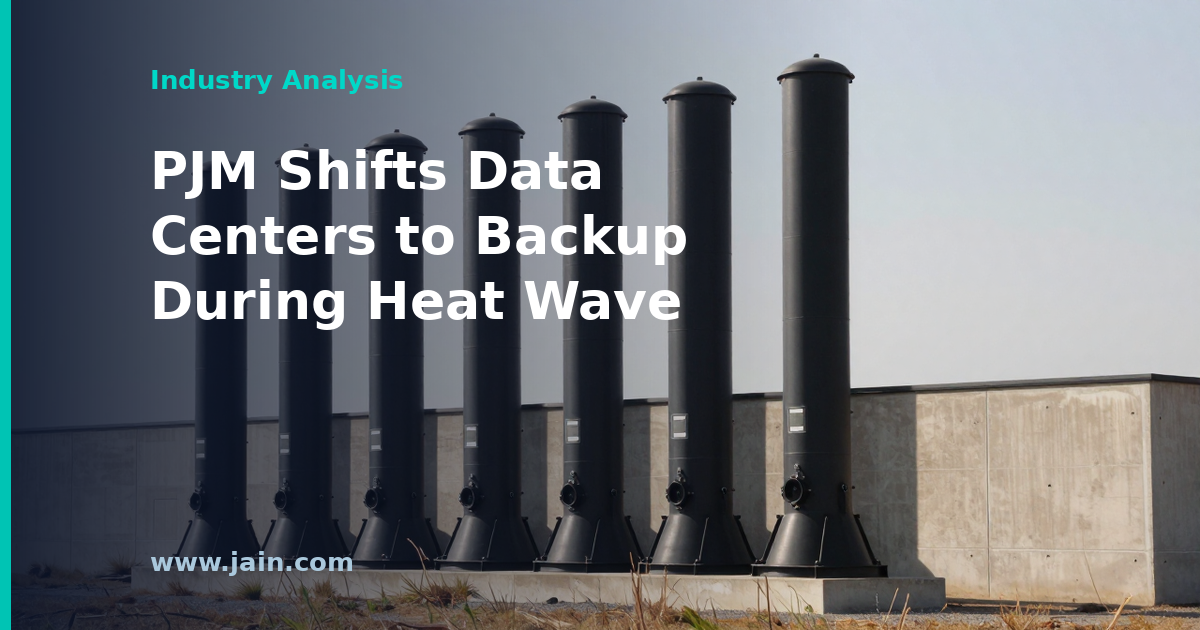
PJM Interconnection, the grid operator serving 65 million people across 13 states and DC, has received regulatory clearance to instruct data centers within its footprint to shift onto on-site backup generation during a heat-wave-driven grid emergency, according to reporting from Maryland Matters on June 29, 2026.
The mechanism turns large data-center campuses — normally treated as firm, always-on load — into a de facto peak-shaving resource for the duration of the event.
Executive Summary
The clearance matters because PJM is the single largest wholesale power market in North America and the epicenter of the data-center boom driven by AI training and inference workloads. Northern Virginia’s "Data Center Alley" alone accounts for a double-digit share of PJM’s peak demand, and interconnection queues across the footprint are dominated by hyperscale requests.
Instructing those loads to island onto diesel or gas gensets during a heat wave is a pragmatic short-term relief valve — but it also establishes a precedent that data-center power draw is negotiable in an emergency, something operators have long resisted in contract negotiations with utilities.
For hyperscalers, colocation providers, and their enterprise tenants, the near-term question is whether this becomes a one-off emergency tool or a template that regulators, utilities, and lawmakers extend into standing tariffs and interconnection conditions.
A Grid Under AI-Era Stress Finds a New Lever
PJM has spent the past two seasons warning that reserve margins are tightening faster than new generation and transmission can be built. Data-center load growth — driven overwhelmingly by AI compute — is the most-cited demand-side driver in the operator’s own capacity-market filings. Shifting even a subset of that load onto behind-the-meter generation during peak hours effectively hands PJM a demand-response resource it did not previously have access to at scale. In a market where the last few gigawatts of firm capacity now clear at record prices, that flexibility has real economic value.
The trade-off is honest but uncomfortable: the backup fleet inside large data-center campuses is typically diesel, sometimes natural gas, and it runs cleaner than an emergency peaker only in the narrowest sense. Air-quality regulators in the Mid-Atlantic have historically capped generator runtime hours precisely because concentrated diesel exhaust during heat events coincides with the worst ground-level ozone conditions. Any recurring use of this mechanism will collide with those permits.
Winners, Losers, and the New Contract Question
The immediate winner is grid reliability: keeping the lights on for residential and small-commercial customers during a heat emergency is a policy priority that overrides most other considerations. PJM itself gains optionality and political cover. Utilities in the footprint gain a talking point when regulators ask why more transmission has not been built.
Data-center operators are in a more complicated position. Publicly, most will support emergency cooperation — refusing looks bad and invites harsher intervention. Privately, the concern is that "emergency" becomes elastic. Enterprise and AI-lab tenants sign colocation and cloud contracts on the premise of firm power; if the underlying facility must periodically island, service-level agreements, insurance, and fuel-logistics assumptions all need re-examination. Expect language on grid-emergency curtailment to become a live negotiation item in 2026 renewals.
Precedent Risk Cuts Both Ways
The clearance is best understood as a precedent event rather than a single operational decision. Once a regulator has said yes to load-shifting a hyperscale campus onto backup generation during a heat wave, the harder question is what other conditions qualify: winter peaks, generation outages, transmission constraints, wildfire smoke events on the western edge of the footprint. Each expansion is defensible in isolation and cumulatively significant.
For policymakers weighing whether to court or constrain new data-center construction, the mechanism cuts both ways. Advocates can point to it as evidence that hyperscale load can be a good grid citizen. Critics can point to it as confirmation that the current build-out is already outrunning firm supply. Both readings are supported by the announcement itself; which one dominates depends on how frequently PJM has to actually use the authority.
Background
PJM Interconnection was formed in its modern regional-transmission-organization form in the late 1990s and today coordinates the movement of wholesale electricity across a footprint stretching from Illinois to New Jersey and south to North Carolina. Its capacity market, which pays generators to be available years in advance, is the primary mechanism by which the region secures firm supply.
The data-center boom of the past decade — first driven by cloud, now accelerated by AI training and inference — has concentrated unprecedented demand in Northern Virginia and secondary hubs in Ohio, Pennsylvania, and Maryland. PJM’s own load forecasts have been repeatedly revised upward, and recent capacity auctions have cleared at record prices, framing the policy backdrop for the current heat-wave clearance.
Hackers breached a Department of Homeland Security information-sharing network, according to a Nextgov/FCW report published June 29, 2026 citing people familiar with the matter. The network is used to coordinate cyber threat intelligence across federal agencies and with private-sector partners.
Public details are limited. The report does not identify the attackers, the duration of access, or the specific data affected, and DHS has not publicly detailed remediation steps as of publication.
Executive Summary
An intrusion into a DHS information-sharing platform is, by definition, a compromise of the plumbing the federal government uses to warn industry about other compromises. Even absent confirmed data loss, a breach of a threat-sharing channel raises questions about the integrity of indicators, advisories, and coordination that downstream defenders rely on.
For operators of critical infrastructure — data centers, carriers, cloud providers, utilities — the practical concern is trust in the feed. If adversaries had visibility into what defenders were sharing, they could learn which of their tools and techniques had been detected, and by whom. That informational asymmetry, if it occurred, would be more consequential than any single stolen document.
As of the June 29 report, the scope, attribution, and dwell time are not public. The story is significant less for what it confirms than for the category of system involved.
Why A Threat-Sharing Breach Is Different
Information-sharing networks exist so that a compromise at one organization becomes a warning at every other. They aggregate indicators of compromise (IOCs) — file hashes, IP addresses, domains, tactics — from federal agencies, sector-specific ISACs (Information Sharing and Analysis Centers), and private companies. A breach of that pipe is not the same as a breach of a single agency’s email: it potentially exposes what the defender community collectively knows and does not know.
The strategic value to an attacker is visibility into detection. Knowing which of your malware samples have been catalogued, which infrastructure has been burned, and which techniques have been attributed lets an adversary rotate tooling before defenders notice. That is a durable operational advantage even if no classified material was taken.
The Trust Question For Industry Consumers
Critical infrastructure operators subscribe to DHS and CISA feeds precisely because government has visibility private companies do not. If a sharing platform is compromised, downstream consumers face a temporary integrity problem: were indicators altered, suppressed, or seeded with noise? The answer usually turns out to be no, but the question has to be asked and answered before the feed can be trusted at the same weight.
Practically, this is where mature security programs lean on defense in depth: multiple feeds, internal telemetry, and vendor threat intelligence that does not depend on a single government source. The incident, whatever its scope, is a reminder that no single feed should be a single point of failure in a detection program.
Attribution And Restraint
Early reporting on federal breaches often outpaces confirmed facts. Attribution to a nation-state actor, in particular, tends to leak before formal assessments, and initial scoping estimates frequently move by an order of magnitude in either direction as forensic work proceeds. Readers and buyers should treat the current picture as preliminary.
What is fair to say now: a breach of a coordination system is inherently more concerning per byte than a breach of a general-purpose network, and the government’s disclosure cadence on this incident will itself be a data point about how the current administration handles federal cyber incidents.
Background
The Department of Homeland Security has operated cyber information-sharing programs for well over a decade, with CISA — established in 2018 — now serving as the primary hub for coordination with industry. These programs range from unclassified indicator exchanges with private companies to more restricted channels among federal agencies and cleared partners.
The premise of threat sharing is collective defense: adversaries reuse tooling and infrastructure, so a detection at one organization can protect many. That premise depends on the integrity of the sharing platforms themselves, which is what makes an intrusion into such a system a distinctive category of incident.
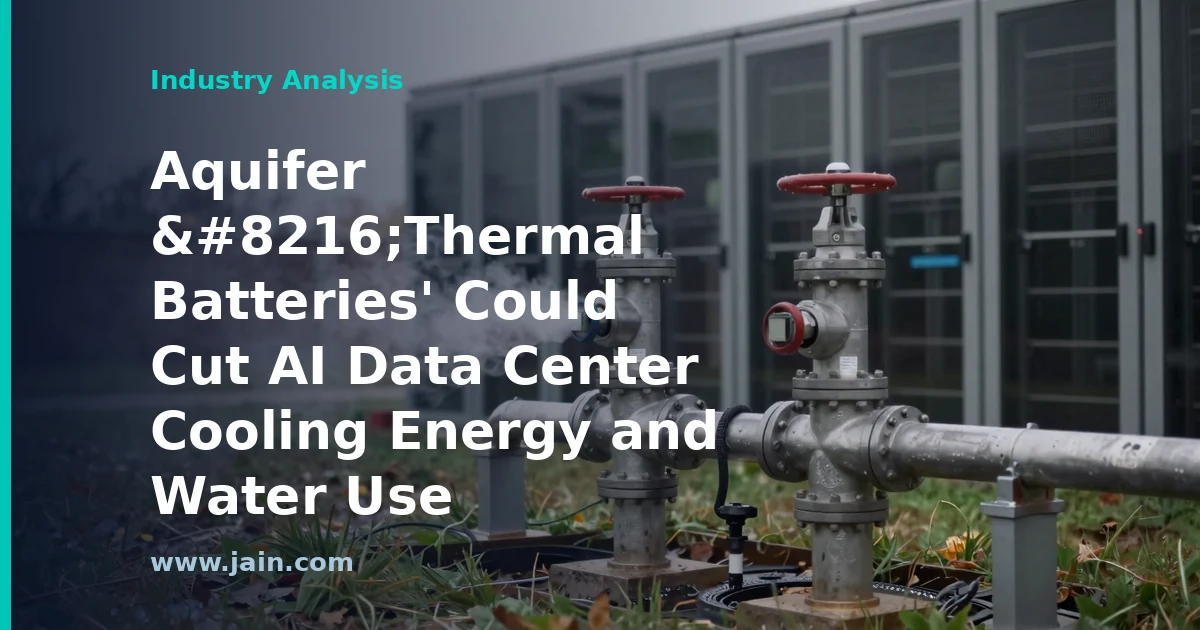
Research publicized June 29, 2026 via Tech Xplore suggests that aquifers — naturally occurring layers of water-bearing rock underground — could serve as ‘thermal batteries’ for data centers, storing heat and cold across seasons. According to the report, the approach may reduce the cooling energy AI data centers consume and cut their water use, two of the industry’s fastest-growing environmental pressure points.
Executive Summary
The announcement is a research finding, not a product launch: scientists propose using aquifer thermal energy storage — pumping water underground to bank cold in one season and withdraw it in another — as a way to offset the enormous cooling loads created by AI computing. The headline claim is twofold: lower cooling energy demand and reduced water consumption compared with conventional approaches such as evaporative cooling, which loses large volumes of water to the atmosphere by design.
Why it matters: cooling is one of the largest non-compute energy costs in a data center, and water use has become a siting and permitting flashpoint in drought-prone regions. AI accelerators run hotter and denser than traditional servers, magnifying both problems. A storage-based approach that shifts cooling work to underground reservoirs — rather than burning electricity on chillers or evaporating potable water in real time — would attack both constraints at once. The open question, which the source headline’s own careful ‘may cut’ phrasing acknowledges, is whether the technique scales from research findings to the round-the-clock, high-density heat loads of production AI facilities.
Why Cooling Is the Quiet Crisis of the AI Buildout
Every watt a server consumes becomes heat that must be removed, and AI hardware has pushed rack power densities far beyond what legacy air-cooling systems were built for. Operators today choose among imperfect options: mechanical chillers, which are reliable but electricity-hungry; evaporative cooling, which trades electricity for significant water consumption; and liquid cooling, which moves heat efficiently at the rack but still needs somewhere to reject it. Cooling efficiency is captured in metrics like PUE (power usage effectiveness — total facility power divided by computing power), and shaving it has direct economic value at AI campus scale.
Water has arguably become the more politically sensitive constraint. Data center water consumption has drawn scrutiny from communities and regulators in water-stressed regions, and several jurisdictions now weigh water impact in permitting decisions. A cooling architecture that credibly reduces both energy and water use addresses the industry’s two most visible externalities simultaneously — which explains why a research result, rather than a commercial deployment, is drawing attention.
How an Aquifer Becomes a Battery
Aquifer thermal energy storage, often abbreviated ATES, is conceptually simple: use paired wells to circulate groundwater, storing thermal energy in the aquifer itself. In winter, cheap ambient cold is banked underground; in summer, that stored cold is withdrawn to absorb data center heat, with the warmed water returned to a separate zone of the aquifer for later use or dissipation. The ‘battery’ framing is apt — the aquifer shifts cooling capacity across time, much as an electrical battery shifts energy from cheap hours to expensive ones.
The underlying technique is not new. ATES has been deployed for decades in district heating and cooling systems, particularly in the Netherlands, where favorable geology and supportive regulation made it routine for buildings. What the new research explores is its application to a much harder customer: data centers, whose heat output is continuous, dense, and growing. Because the water circulates in a closed loop underground rather than evaporating into the air, the approach could sidestep the consumptive water losses that make evaporative cooling controversial.
Who Wins If It Works — and What Stands in the Way
The clearest beneficiaries would be operators in regions with suitable aquifer geology and strong seasonal temperature swings, where winter cold can be banked cheaply. Utilities and grid planners would welcome anything that flattens data center cooling load, since peak cooling demand coincides with summer grid stress. Drilling, geothermal, and groundwater engineering firms would gain a new market adjacent to the booming data center construction sector.
The obstacles are equally concrete. ATES only works where the geology cooperates — the right aquifer depth, permeability, and low natural groundwater flow — which makes it a siting-dependent solution, not a universal one. Groundwater is heavily regulated nearly everywhere, and injecting warmed water underground raises legitimate environmental review questions about thermal plumes and water chemistry. And AI’s heat load is continuous rather than seasonal, so an aquifer system would likely supplement, not replace, conventional cooling. None of these hurdles is disqualifying, but each stands between a promising research finding and a bankable design that a hyperscaler would commit to.
Background
Data center cooling has evolved through waves of pressure: from raised-floor air cooling, to hot/cold aisle containment, to economizers and evaporative systems, and most recently to direct liquid cooling as AI accelerators pushed rack densities beyond what air can handle. Each wave traded among the same three currencies — electricity, water, and capital — and the AI buildout has sharpened all three constraints at once, with water use in particular becoming a community and permitting issue in water-stressed markets.
Aquifer thermal energy storage sits within a broader family of underground thermal techniques, alongside borehole storage and geothermal heat pumps. ATES matured in northern Europe over several decades as a building heating-and-cooling technology; the research reported here represents an attempt to carry that mature concept into the much more demanding environment of AI computing infrastructure.
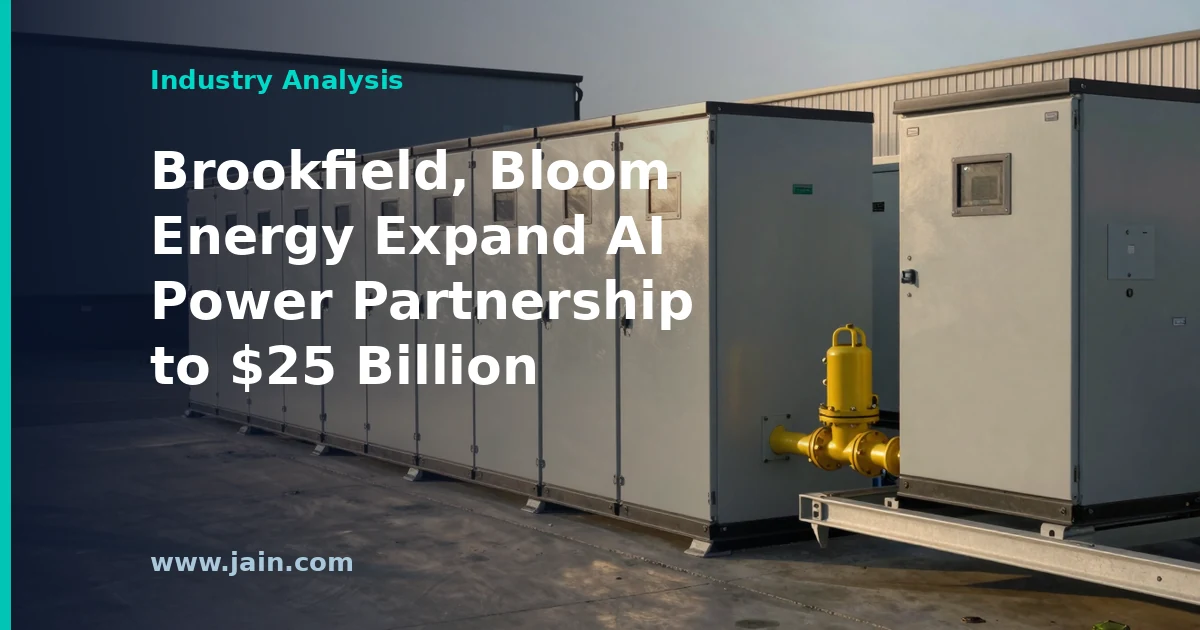
Brookfield and Bloom Energy announced on June 29, 2026 that they are expanding their AI infrastructure partnership to $25 billion — a fivefold increase over the original framework — to build and finance rapid power deployment for AI data centers. The expanded arrangement pairs Bloom’s solid oxide fuel-cell technology with Brookfield’s infrastructure capital.
Executive Summary
Bloom Energy, the fuel-cell manufacturer, and Brookfield, one of the world’s largest infrastructure investors, have scaled their partnership from an original framework — implied by the announcement’s “fivefold” language to have been on the order of $5 billion — to $25 billion. The stated purpose is to build and finance “rapid power” for AI infrastructure: on-site electricity generation that can be deployed faster than utility grid connections.
The announcement matters because electricity availability, not chips or land, has become the binding constraint on AI data-center construction. A $25 billion commitment of this shape signals that major infrastructure capital now treats on-site fuel-cell generation as a bankable asset class rather than a niche backup option. That said, the release as reported gives a headline dollar figure without megawatt targets, named customers, or deployment timelines — so the scale of actual near-term power delivery remains to be demonstrated.
Why Fuel Cells Are Jumping the Grid Queue
The core problem this partnership targets is speed. In many major data-center markets, a new facility requesting a large grid connection can wait years for utilities to build the transmission and generation needed to serve it — a delay measured in lost AI product cycles. On-site generation sidesteps that queue. Bloom’s solid oxide fuel cells convert fuel, typically natural gas, into electricity through an electrochemical reaction rather than combustion, and they arrive as factory-built modules that can be installed in months rather than the multi-year timelines of large power plants or grid upgrades.
That “speed-to-power” pitch has become the dominant selling point across the AI power market — gas turbines, batteries, and behind-the-meter deals all compete on the same axis. Fuel cells’ specific claim is modularity and siting flexibility: they are quiet, produce no combustion emissions like NOx at the point of generation, and can be permitted in places where a turbine plant could not. The trade-off is cost per megawatt-hour and dependence on fuel supply, which is why financing structure matters as much as technology.
The Capital Stack Behind the Megawatts
The division of labor is the interesting part. Bloom manufactures and services the equipment; Brookfield brings the balance sheet. In a typical arrangement of this kind, the infrastructure investor owns the generating assets and sells power or capacity to data-center operators under long-term contracts, so the data-center customer avoids a large upfront capital outlay. For Bloom, a deep-pocketed financing partner converts its technology into an offering that can compete for hyperscale-sized deals it could never finance from its own balance sheet.
For Brookfield, fuel-cell fleets serving AI campuses look like classic infrastructure: long-lived assets, contracted revenue, and a customer base — AI compute operators — currently willing to pay a premium for firm power delivered quickly. Growing the framework fivefold within roughly a year of the original announcement suggests the partners believe demand from AI builders exceeds what the initial commitment could serve. It is a strong demand signal, though announced frameworks and deployed megawatts are different things.
What a Fivefold Scale-Up Signals — and What It Doesn’t
A $25 billion figure invites careful reading. Partnership frameworks of this kind typically describe a ceiling — capital the partners intend to deploy if projects materialize — rather than contracted orders. The announcement as reported does not specify how much is committed versus targeted, how much power it represents, or over what period. Until customer contracts and megawatt figures are disclosed, the number is best understood as a statement of ambition backed by a credible financier, not a backlog.
Competitively, the deal sharpens the contest to power AI. Utilities and grid operators risk losing their largest new customers to behind-the-meter generation; gas-turbine suppliers, battery vendors, and small modular reactor developers are chasing the same load. For data-center operators, more credible power options mean more negotiating leverage — and for the industry’s critics, more scrutiny of what fuels that power. Fuel cells running on natural gas still emit carbon dioxide, so the climate profile of this buildout will depend on fuel sourcing choices the announcement does not detail.
Background
Bloom Energy, founded in 2001 and headquartered in California, went public in 2018 and built its business selling solid oxide fuel-cell “Energy Servers” to commercial, industrial, and utility customers seeking reliable on-site power. Brookfield is a global asset manager with hundreds of billions of dollars across infrastructure, renewable power, and real estate, and has been among the most aggressive institutional investors in AI-related infrastructure. The two first announced an AI-focused partnership in late 2025, part of a wider industry wave in which data-center developers turned to behind-the-meter generation — fuel cells, gas turbines, and eventually nuclear — as utility interconnection queues stretched to multiple years in key markets.
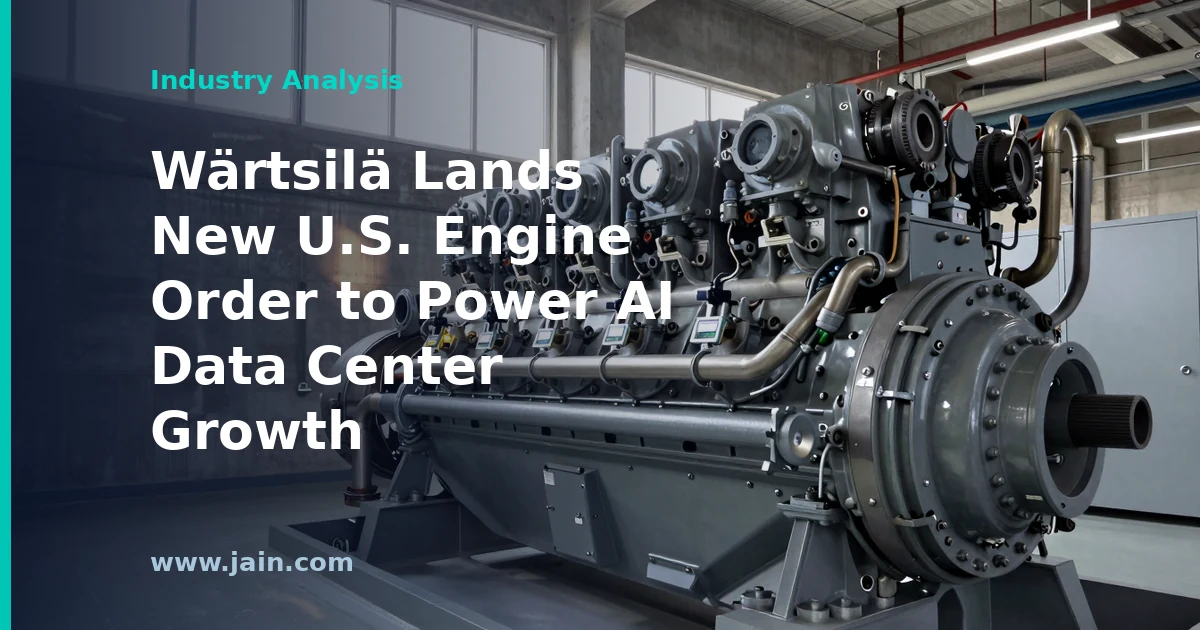
Wärtsilä, the Finnish energy and marine technology group, announced on June 28, 2026 that it has secured a new order in the United States to supply engine-based power generation supporting what the company calls the next wave of AI-driven data center growth. The announcement, distributed as a company release, positions the order within the surge of demand for on-site and grid-support power created by artificial intelligence computing facilities.
The release headline confirms the order’s existence, its U.S. location, and its data center orientation; the version of the announcement circulated via aggregators does not carry further specifics such as capacity, customer, or delivery schedule, which we flag below.
Executive Summary
The announcement is notable less for any single order than for the pattern it extends: reciprocating engine power — large, factory-built internal combustion generators that can be installed and running in months — is becoming a standard answer to the widening gap between when AI data centers need electricity and when utilities can deliver it. In much of the U.S., a new large load or generator can wait years in the interconnection queue, the utility process for studying and approving new grid connections. Data center developers racing to deploy AI capacity increasingly cannot wait, and engine plants offer a bridge: power that arrives on the developer’s schedule rather than the grid’s.
For Wärtsilä, one of the leading global suppliers of medium-speed engine power plants, the U.S. data center segment represents a growth market layered on top of its traditional utility, industrial, and grid-balancing business. The company framing this order explicitly around “AI-driven data center growth” signals that it now treats the segment as a named demand category, not incidental business.
What matters for the industry is the direction of travel: if flexible generation is the default bridge, then engine and turbine order books, gas supply logistics, and air-permitting timelines become part of the data center delivery critical path — alongside chips, land, and fiber.
The Interconnection Gap Is the Real Product
AI training and inference facilities are being planned at scales of hundreds of megawatts — comparable to small cities — and utilities in many U.S. regions cannot study, upgrade, and energize connections for loads of that size quickly. The mismatch between data center construction timelines, often 18 to 30 months, and grid timelines, often several years, has created a market for anything that closes the gap. Engine power plants fit because they are modular, factory-produced, and incremental: capacity can be added in blocks, started fast, and later kept as backup or grid-support assets once a utility connection arrives.
Wärtsilä’s order, as framed, is a data point confirming that this bridge model has moved from workaround to procurement strategy. When a major OEM headlines a U.S. order around AI data centers, it suggests buyers are specifying flexible generation at the planning stage, not scrambling for it after a queue delay.
Engines Versus Turbines Versus the Grid
The fast-power market splits mainly between reciprocating engines, which Wärtsilä and a small number of rivals supply, and gas turbines. Engines generally start faster, hold efficiency better at partial load, and tolerate frequent stop-start cycling — useful traits for a facility that may eventually shift to grid power and keep the engines for peaking or resilience. Turbines tend to win on the largest single-block capacities. Both now face extended delivery lead times as data center demand collides with utility and industrial orders, which means an OEM’s manufacturing slots have themselves become a scarce resource.
The strategic question for buyers is not engines versus grid, but sequencing: bridge generation first, interconnection later, with the on-site plant repurposed rather than stranded. Vendors that can credibly support that full lifecycle — including later conversion to balancing or backup duty, and potential future fuels — have an advantage beyond the initial sale.
What It Means for Data Center Economics
Self-supplied engine power costs more per megawatt-hour than typical utility rates once fuel, maintenance, and capital are counted. That premium is rational when the alternative is an idle, revenue-less AI facility waiting on a queue. In effect, developers are paying for schedule certainty, and the willingness to pay reveals how valuable early AI capacity is believed to be. The risks are real, however: on-site gas generation adds fuel-supply logistics, air-quality permitting, and emissions exposure, and a facility’s bridge plant can become a long-term cost if grid power arrives later than promised — or a stranded asset if the AI demand it serves shifts.
For utilities and regulators, each order like this one is also a signal: load that cannot be served promptly will increasingly self-serve, at least temporarily, which changes forecasting, gas demand, and local emissions profiles in the regions where AI construction concentrates.
Background
Wärtsilä traces its roots to 1834 in Finland and today operates two main businesses: marine propulsion and energy. Its energy arm supplies power plants built around large medium-speed reciprocating engines, along with energy storage and grid-management technology, and has historically served utilities, island grids, and industrial customers needing flexible or fast-starting capacity.
Since roughly 2024, U.S. electricity demand has resumed sustained growth for the first time in about two decades, driven substantially by AI data center construction. That demand surge, colliding with multi-year utility interconnection and transmission timelines, has created a rapidly growing market for on-site and fast-deploy generation — the market context in which this order was announced.
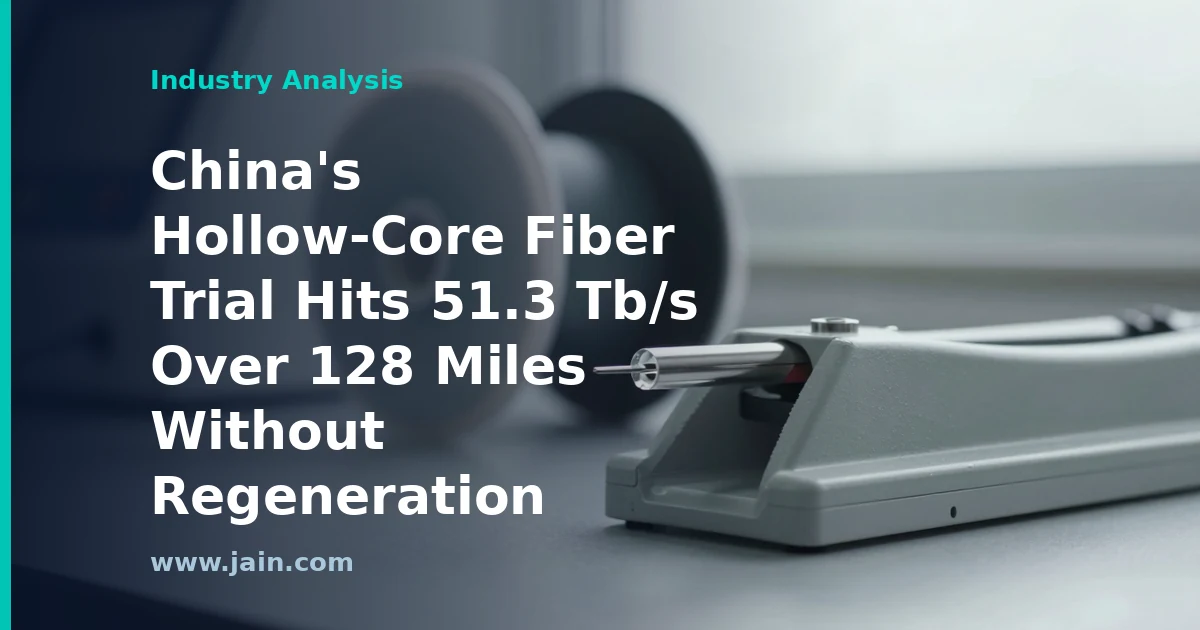
Researchers in China have reported a hollow-core optical fiber trial carrying 51.3 terabits per second over 128 miles (roughly 206 kilometers) without signal regeneration, according to a report published by Tom’s Hardware on June 28, 2026. The result is framed as a milestone targeting the networking bottlenecks created by the AI era’s explosive demand for data movement.
Executive Summary
The headline achievement combines three things that have historically been difficult to deliver at once in hollow-core fiber: very high aggregate capacity (51.3 Tb/s), meaningful terrestrial distance (128 miles), and the absence of signal regeneration — the electronic or optical boosting stations that long-haul links normally require. Hollow-core fiber guides light through an air-filled channel rather than solid glass, and its traditional weakness has been signal loss over distance. Demonstrating a multi-terabit link at this reach without regeneration attacks that weakness directly.
Why it matters: AI training and inference clusters are increasingly distributed across multiple data centers, and the links between those facilities are becoming a first-order design constraint alongside power and cooling. Hollow-core fiber promises both lower latency — light travels faster through air than through glass — and headroom for higher optical power, which together address exactly the bottleneck the report cites. A credible long-distance, high-capacity trial from China also signals that the hollow-core race is now genuinely global, not a Western-led curiosity.
Why Hollow-Core Fiber Is Suddenly Strategic
Conventional optical fiber sends light through a solid glass core. That works remarkably well, but it imposes two physical taxes. First, light moves about a third slower through glass than through air, which adds latency on every mile of a route. Second, intense light interacting with glass produces nonlinear distortions that cap how much optical power — and ultimately how much data — a single fiber can carry. Hollow-core fiber replaces the glass core with a precisely engineered air channel, so light travels faster and interacts far less with the material around it. For latency-sensitive users (financial trading was the earliest adopter) and for operators trying to push more terabits through existing conduit, those properties are directly monetizable.
The AI buildout has sharpened the case. Training runs increasingly span multiple data centers because no single site can secure enough power, and inference traffic is pushing metro and regional networks harder. When facilities tens or hundreds of miles apart must behave like one computer, every microsecond of round-trip time and every terabit of cross-site bandwidth counts. That is the ‘AI-era networking bottleneck’ this trial is aimed at, and it is the same logic that has driven hyperscaler interest in the technology in the West.
What 51.3 Tb/s Over 128 Miles Actually Demonstrates
The historically fatal flaw of hollow-core fiber was attenuation: early designs lost signal so quickly that links of even a few miles were impractical. Recent generations of antiresonant designs have brought loss down toward — and by some published accounts below — that of conventional fiber, but most headline demonstrations have involved either short distances, modest capacities, or laboratory spools rather than realistic spans. A 128-mile unregenerated link at 51.3 Tb/s, if borne out in the technical details, would indicate loss and signal-quality performance good enough for real regional routes, such as links between data center campuses or metro areas, without intermediate amplification stops.
The caveats matter, though. A trial is not a product. The report, as circulated, does not detail whether the fiber was deployed in field conditions or tested on spooled fiber in a controlled setting, what error rates were achieved, or how many wavelength channels produced the aggregate figure. These distinctions separate a genuine deployment milestone from a strong laboratory result, and the source material does not settle them. Both readings are consistent with what has been reported.
A Global Race, Not a Western One
Hollow-core fiber development has been most visibly associated with Western efforts — notably UK-rooted research that led to commercial deployments by a major US hyperscaler in its own network. A prominent Chinese result at this scale confirms that the technology is now a field of international competition, with implications beyond engineering. Optical fiber and the components around it (amplifiers, transceivers, cabling) are strategic supply-chain items, and nations building sovereign AI infrastructure have every incentive to develop domestic capability in next-generation transmission. For the broader market, competition tends to accelerate maturation and push down costs; for individual vendors, it compresses the window in which early leadership can be converted into commercial advantage.
The Road From Trial to Deployed Network
Even accepting the result at face value, several hard steps stand between a record trial and hollow-core fiber as routine infrastructure. Manufacturing hollow-core fiber at volume, with consistent quality and at a cost that competes with mass-produced conventional fiber, remains an industry-wide challenge. Field practicalities — splicing, connecting hollow-core to conventional fiber at network boundaries, cabling that protects the delicate microstructure, and keeping moisture and contaminants out of the air core — all add cost and complexity that trials rarely capture. Operators will also weigh whether the latency and capacity gains justify overbuilding routes that already have serviceable conventional fiber. The most likely early market is exactly where this trial points: new, high-value routes between AI data centers, where latency and bandwidth translate directly into compute efficiency and where builders are already spending at unprecedented levels.
Background
Hollow-core fiber has been researched for decades, but for most of that history its high signal loss confined it to niche, short-distance uses. A wave of design breakthroughs in the 2010s and 2020s — particularly antiresonant fibers that guide light in an air core surrounded by carefully arranged glass membranes — cut attenuation to levels approaching, and by some published accounts surpassing, conventional fiber. That progress turned commercial: Microsoft acquired hollow-core specialist Lumenisity in 2022 and has since deployed the fiber in parts of its own network, citing latency and capacity benefits for cloud and AI workloads.
The demand backdrop is the AI infrastructure buildout. As training clusters outgrow single facilities and inference traffic scales, data-center interconnect — the high-capacity links between sites — has become a critical constraint alongside power and cooling. That is the market context in which a 51.3 Tb/s, 128-mile unregenerated hollow-core trial, reported from China in June 2026, lands as more than a laboratory curiosity.
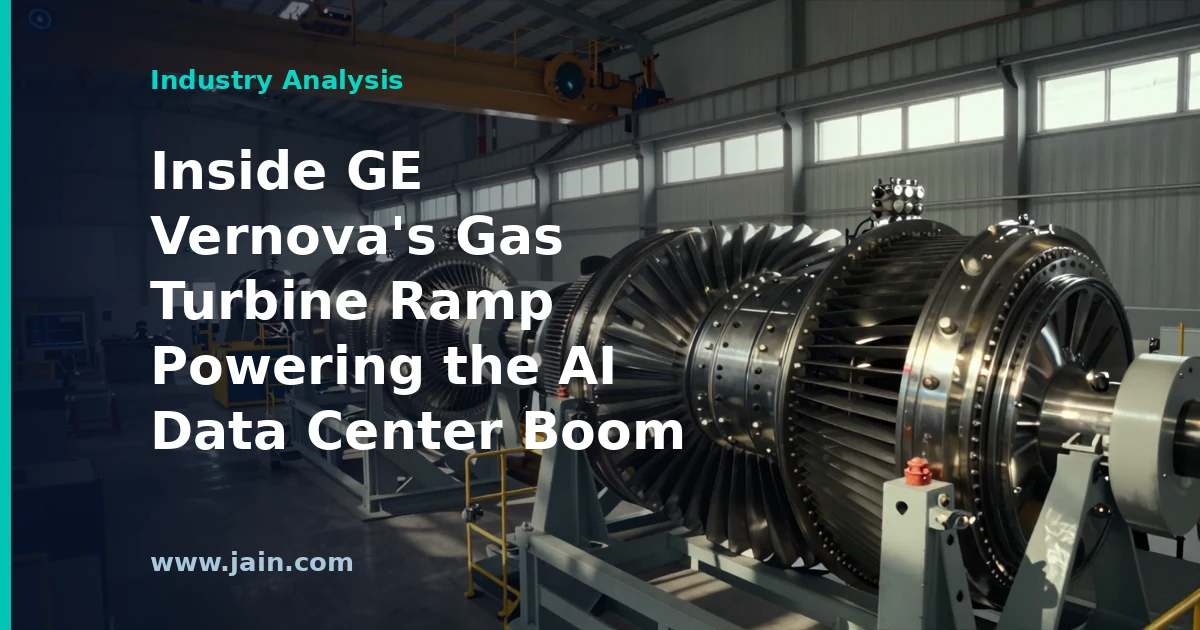
CNBC published a feature on June 28, 2026 examining how GE Vernova builds its massive heavy-duty gas turbines — the machines increasingly ordered to supply electricity for AI data centers. The piece spotlights the manufacturer at the center of one of the power industry’s sharpest demand upswings, as hyperscalers and data center developers scramble for generation capacity that the grid alone cannot deliver on their timelines.
Executive Summary
The story here is less a single announcement than a snapshot of a structural shift: gas turbines — large rotating machines that burn natural gas to spin a generator — have moved from a mature, slow-growth product line to some of the most sought-after industrial hardware in the world, and GE Vernova is one of a small handful of companies that can build the largest ones. CNBC’s look inside the company’s manufacturing operation underscores how AI data center demand has redrawn the order books of the turbine industry.
Why it matters: AI training and inference clusters need firm, around-the-clock power at scales measured in hundreds of megawatts per campus. Interconnection queues — the waiting lines to plug new loads and generators into the transmission grid — stretch for years in many U.S. markets. That mismatch has pushed utilities and data center developers toward dedicated gas-fired generation, and the turbines themselves have become the bottleneck. Whoever controls turbine manufacturing slots now holds real leverage over where and when AI capacity gets built.
The Turbine Is the New Bottleneck
For most of the past decade, the constraint on building a data center was land, fiber, or chips. In 2025 and 2026 it has increasingly been electricity — and behind electricity, the physical equipment that generates and delivers it. Heavy-duty gas turbines sit at the top of that equipment stack: they are enormous precision machines, built in specialized factories by a global oligopoly of manufacturers, and they cannot be scaled up quickly. Casting, machining, and testing the hot-section components that survive combustion temperatures is skilled, capital-intensive work with deep supplier chains.
That is why a factory tour of a turbine plant is now business news. When manufacturing slots for major power equipment are scarce, the production line itself becomes strategic infrastructure. Data center developers who once treated power generation as someone else’s problem — the utility’s — are now tracking turbine lead times the way they track GPU allocations.
Why Gas, and Why Now
Gas turbines occupy a specific niche in the AI power story: they are dispatchable (they run when you need them, unlike weather-dependent wind and solar), they can be sited close to load, and they can be permitted and built faster than nuclear. For hyperscalers facing multi-year grid interconnection queues, gas-fired plants — whether utility-built or behind-the-meter on the data center campus itself — are often the only firm-power option available on an AI-relevant timeline. Combined-cycle configurations, which recycle exhaust heat to generate additional electricity, improve the economics for facilities that run flat-out around the clock, which is exactly the load profile of an AI campus.
The trade-offs are real. Gas plants lock in decades of fuel exposure and carbon emissions at the same moment many data center operators carry public net-zero commitments. Expect continued tension between the near-term physics of AI power demand and long-term decarbonization pledges — and expect operators to pair gas with renewable procurement, carbon-capture ambitions, or framing gas as a “bridge” technology. Readers should evaluate those framings project by project rather than accepting or dismissing them wholesale.
Winners, Losers, and the Queue
The clearest winners in a turbine-constrained market are the manufacturers — GE Vernova and its few global peers — along with their component suppliers and the engineering-and-construction firms that install the machines. Utilities in data center-heavy regions gain a growth story they have not had in decades. On the other side of the ledger, smaller data center developers and enterprises without hyperscaler purchasing power risk being priced or queued out of firm generation capacity, which could concentrate AI infrastructure further among the largest players.
There is also a cyclical risk worth naming evenly: the gas turbine industry has been through boom-and-bust before, most notably when a late-1990s ordering surge was followed by a painful capacity glut. Manufacturers appear to be expanding cautiously partly because of that memory. If AI power demand forecasts prove overstated — a live debate — today’s scarcity could look different in five years. If the forecasts hold, the constraint persists and lead times stay long. Either way, the ordering decisions being made now will shape the power landscape well into the 2030s.
Background
GE Vernova became an independent public company in April 2024, when General Electric completed its split into three businesses and placed its energy operations — gas power, wind, nuclear services, and grid electrification — under the new name. The gas turbine franchise it inherited is one of the oldest and largest in the world, with an installed fleet spanning utilities and industrial operators across the globe.
The company’s independence coincided almost exactly with the generative AI infrastructure boom, which transformed electricity demand forecasts that had been flat in the U.S. for roughly two decades. That timing turned a business once viewed as a mature, declining fossil-fuel franchise into a strategic asset at the center of the AI build-out — the shift CNBC’s factory-floor feature captures.
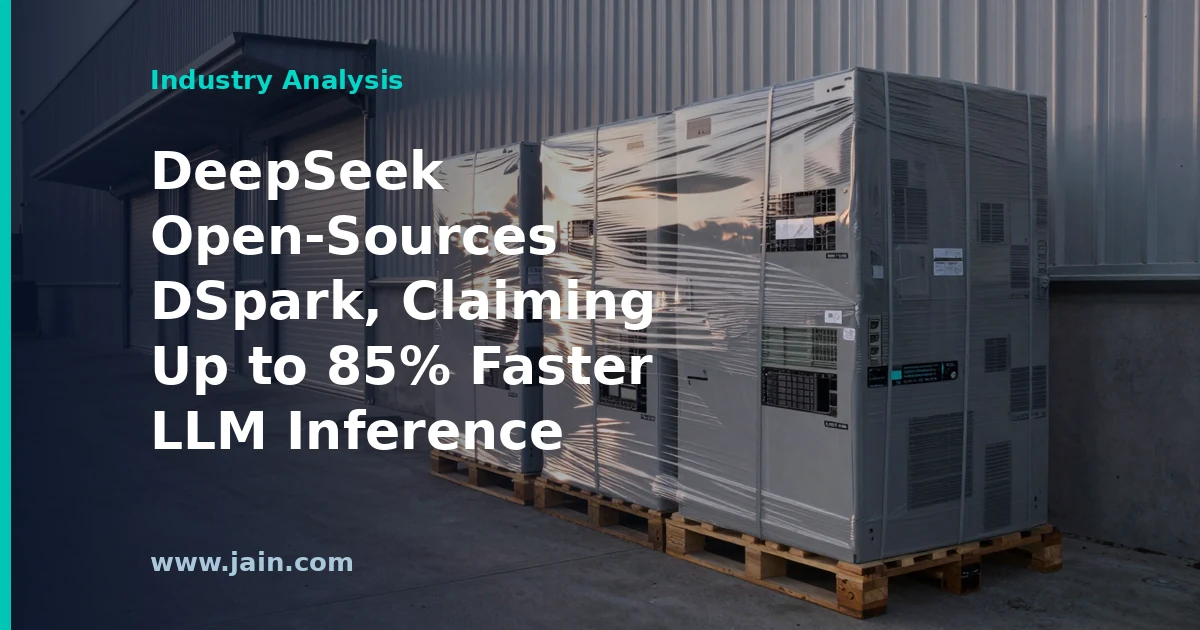
DeepSeek, the Hangzhou-based AI lab known for its unusually efficient open-weight models, has released DSpark, an open-source framework that it says can accelerate large language model (LLM) inference — the process of actually running a trained model to answer queries — by up to 85%, according to a VentureBeat report published June 28, 2026.
The release continues DeepSeek’s pattern of publishing its internal efficiency tooling openly rather than keeping it proprietary, and lands at a moment when inference, not training, has become the dominant cost line for companies serving AI at scale.
Executive Summary
The announcement is straightforward on its face: DSpark is an inference framework, it is open source, and the headline claim is a speedup of “up to 85%.” What makes it noteworthy is who is making the claim. DeepSeek built its reputation on doing more with less — its earlier model releases were credited with achieving frontier-class results at a fraction of the compute budgets reported by Western rivals — so an efficiency claim from this lab gets taken more seriously than the average vendor benchmark.
If the speedup holds up under independent testing, the implications run well beyond one company’s software stack. Inference speed translates almost directly into serving cost: a model that answers queries faster on the same hardware serves more users per GPU, which means fewer GPUs, less power, and less data center capacity per unit of AI demand. Because DSpark is open source, any operator — hyperscaler, neocloud, or enterprise running models in-house — can in principle adopt it without a licensing negotiation.
The important caveat is that “up to 85%” is a ceiling, not an average, and the report available at publication does not detail the workloads, models, or hardware behind the number. That distinction should shape how buyers and investors read the news.
Inference Is Where the Money Now Goes
For the first years of the generative AI boom, the eye-watering costs were in training — the one-time process of teaching a model from massive datasets. That has flipped. Once hundreds of millions of people are querying models daily, the recurring cost of inference dwarfs the one-time cost of training, and it scales with every new user and every longer conversation. This is why the industry’s optimization energy has shifted to serving: techniques with names like speculative decoding, quantization, and KV-cache management all exist to squeeze more answers out of each GPU-hour.
An 85% speedup, if achieved on realistic workloads, is not an incremental gain in this context. Serving capacity is the binding constraint for many AI providers, and GPUs remain supply-limited and expensive. Software that meaningfully raises throughput per chip is functionally equivalent to manufacturing more chips — without the fab, the lead time, or the export-control exposure that hardware carries.
DeepSeek’s Open-Source Playbook, Continued
DeepSeek has a track record here. The lab, spun out of the Chinese quantitative hedge fund High-Flyer, shook global markets in early 2025 when its R1 reasoning model demonstrated that frontier-adjacent capability did not require frontier-scale budgets. It followed up by open-sourcing chunks of its internal infrastructure code — low-level GPU kernels and communication libraries — rather than treating them as trade secrets. DSpark fits that pattern: release the tooling, let the ecosystem adopt it, and compete on the pace of research rather than on locked-down software.
The strategic logic is worth spelling out. Open-sourcing inference tooling commoditizes the serving layer, which pressures companies whose business model depends on proprietary serving efficiency, while costing DeepSeek little — its own advantage lies upstream, in model quality and training efficiency. It also builds developer mindshare globally at a time when Chinese AI labs face restricted access to top-end accelerators, making software efficiency a competitive necessity as much as a virtue.
What Cheaper Inference Means for Infrastructure Operators
A natural first read is that faster inference is bearish for GPU and data center demand: if each chip does 85% more work, you need fewer chips and fewer megawatts. History suggests the opposite usually happens. Efficiency gains in computing have repeatedly triggered what economists call the Jevons paradox — when something gets cheaper, consumption expands enough to more than offset the savings. Cheaper inference makes previously uneconomic AI applications viable: always-on agents, AI in low-margin consumer products, long-context document processing at scale.
For data center operators and connectivity providers, the more defensible conclusion is that efficiency software shifts demand rather than shrinking it. Lower serving costs favor deployment breadth — more applications, more regions, more inference happening closer to users — which tends to benefit distributed capacity and network infrastructure even if it moderates the growth rate of any single mega-campus. Operators planning around raw GPU scarcity should note that the scarcity premium softens every time the software stack gets meaningfully better.
Reading an ‘Up To’ Claim Responsibly
The 85% figure deserves the same scrutiny any vendor benchmark gets, and the fact that DSpark is open source cuts in its favor: the code can be tested independently, which is more than can be said for closed serving stacks making similar claims. Still, inference speedups are notoriously workload-dependent. Gains that appear on one batch size, sequence length, or model architecture can shrink dramatically on another, and the report available at publication does not specify the conditions behind the headline number.
The practical test is adoption. The inference-serving field already has entrenched open-source incumbents — frameworks like vLLM and NVIDIA’s TensorRT-LLM ecosystem have large communities and production track records. DSpark’s real-world impact will be measured not by its launch benchmark but by whether major serving operations fold it, or its techniques, into production over the following quarters. DeepSeek’s prior open-source releases were rapidly picked apart and partially absorbed by the community; that is the most likely path here too, even if the framework itself does not displace incumbents wholesale.
Background
DeepSeek emerged from High-Flyer, a Chinese quantitative hedge fund, and stunned the AI industry in January 2025 when its R1 model matched much of the reasoning performance of leading Western systems at a reported fraction of the training cost — an announcement that briefly wiped hundreds of billions of dollars from AI-linked stocks as investors reassessed how much compute frontier AI truly requires. The lab has since maintained a strategy of releasing open-weight models and open-source infrastructure tooling, positioning efficiency as its core identity.
The inference-serving market it is now entering more forcefully has its own history: open-source frameworks such as vLLM (from UC Berkeley researchers) and NVIDIA’s TensorRT-LLM became the workhorses of production LLM serving as the industry’s cost center shifted from training models to running them for hundreds of millions of users. Every meaningful gain in serving efficiency ripples outward into GPU procurement, data center planning, and the unit economics of AI products.
Investor Stanley Druckenmiller has disclosed new equity positions in three publicly traded bitcoin miners — Hut 8, Riot Platforms and Bitdeer — according to a Yahoo Finance report dated June 27, 2026. All three companies have been actively repositioning parts of their energized data center footprints toward artificial intelligence and high-performance computing workloads.
Executive Summary
The disclosure matters less for its dollar size, which the source does not quantify, than for the pattern: a well-known macro investor concentrating on three miners that share a common pivot story. Hut 8, Riot Platforms and Bitdeer each control large blocks of contracted power and operational data center sites — assets that have become scarce in a market where AI training and inference demand is running ahead of grid interconnection queues.
For readers outside finance, a stake disclosure of this kind does not commit the manager to a long-term view, nor does it validate any specific company’s execution. It does, however, mark that a discretionary investor with a long macro track record sees enough upside in the miner-to-AI trade to take exposure to all three names rather than pick a single winner.
Why Miners Are Suddenly AI Real Estate Plays
Bitcoin miners spent the last decade acquiring something the AI industry now urgently needs: interconnected sites with signed power contracts, substations, cooling, and the permits to operate at hundreds of megawatts. Building that stack from scratch in the United States or Canada today typically takes three to seven years, dominated by utility interconnection studies rather than construction. Miners already have the electrons, even if their existing buildings were designed for air-cooled ASIC racks rather than liquid-cooled GPU clusters.
That gap — energized land versus AI-ready halls — is the core of the investment thesis. Retrofitting a mining shed for high-density GPU compute is expensive and technically demanding, but it is faster and cheaper than winning a new interconnection. Investors buying the miner-to-AI story are effectively paying for optionality on power, with bitcoin revenue as a floor while sites are converted or leased.
Three Companies, Three Different Bets
Grouping Hut 8, Riot and Bitdeer together is convenient but glosses over meaningful differences. Hut 8 has publicly pursued a diversified compute strategy that includes managed services and AI-oriented capacity. Riot Platforms has historically emphasized scale in Texas mining, with more recent signals toward HPC hosting. Bitdeer combines self-mining, hosting and its own ASIC design, with sites across multiple jurisdictions.
A basket approach — taking positions in all three rather than one — is consistent with an investor who believes the theme will work but is uncertain which operator will convert power into AI revenue most efficiently. It also spreads exposure across different regulatory regimes, customer mixes, and balance sheets, each of which will matter more than the bitcoin price if AI hosting becomes the primary revenue line.
What A 13F-Style Signal Does and Does Not Mean
Position disclosures by well-known investors routinely move share prices, and coverage of this kind tends to be read as endorsement. It is worth being precise about what such a filing conveys: it is a snapshot of holdings as of a past date, without cost basis, without hedges, and without the manager’s forward intent. A stake can be trimmed or exited before the market ever sees the next disclosure.
For infrastructure buyers evaluating these operators as potential AI capacity providers, the more relevant questions are contractual: what tenants have signed, at what power price, on what term, and with what service-level commitments around uptime and density. Those data points, not fund flows, determine whether a converted mining site is a credible enterprise-grade colocation offering.
Background
Publicly traded bitcoin miners emerged as a distinct equity category after 2017, scaling rapidly through the 2020-2021 crypto cycle by locking in long-term power contracts, often in Texas, the U.S. Midwest, Canada and Scandinavia. The 2024 bitcoin halving compressed mining margins and coincided with an unprecedented surge in AI compute demand, prompting several miners to publicly reposition energized sites toward AI and high-performance computing hosting.
Hut 8, Riot Platforms and Bitdeer are three of the most-watched names in that transition. Institutional investor attention to the group has grown as hyperscalers and AI-native tenants search for sites where power is already contracted, since new utility interconnections in North America can take years to secure.
Microsoft is claiming water positivity across its data center operations, according to a June 27, 2026 report from Data Center Dynamics. Water positivity means an operator replenishes more water to stressed watersheds than its facilities consume — a milestone Microsoft first committed to reaching by 2030 when it announced its water-positive pledge in 2020.
The claim spans one of the world’s largest cloud footprints, and it arrives at a moment when AI-driven capacity growth has put data center water consumption under intense public and regulatory scrutiny. The available report is headline-level, so the scope, accounting method, and verification behind the claim remain to be detailed.
Executive Summary
Microsoft has publicly positioned its data center operations as water positive — consuming less water, net of replenishment projects, than it returns to the watersheds where it operates. If the claim holds up under scrutiny, it would represent the first time a hyperscale cloud operator has asserted that its fleet, as a whole, has crossed that line, and it would land years ahead of the company’s stated 2030 target.
Why it matters: water has become the second front, after power, in the fight over data center siting. Communities from Arizona to the Netherlands have pushed back on facilities that draw millions of gallons for evaporative cooling, and regulators increasingly ask for water commitments alongside grid commitments. A credible water-positive benchmark from the market’s second-largest cloud provider would reset expectations for every operator negotiating a site — including colocation and wholesale providers who compete for the same land, power, and permits.
The operative word is credible. Water positivity is an accounting construct, not a physical description of any single site, and its value depends entirely on scope, measurement, and where the replenishment actually happens. The source reporting available at publication does not yet answer those questions, and they are the right ones to ask of any operator making a similar claim.
What “Water Positive” Actually Means — and What It Doesn’t
Water positivity is a ledger claim: over a defined period, the volume of water an operator restores — through wetland restoration, leak-repair programs, irrigation efficiency projects, aquifer recharge, and similar investments — exceeds the volume its operations consume. Consumption here typically means water evaporated or otherwise not returned to the source, which for data centers is dominated by evaporative cooling, the technique of cooling air or water by letting some of it evaporate, trading water for large electricity savings.
What the construct does not mean is that any individual data center stopped drawing water. A facility in a drought-stressed basin can keep consuming while the corporate ledger balances with a restoration project elsewhere. That is not inherently bad-faith accounting — carbon markets work on a similar logic — but water is far more local than carbon. A gallon replenished in one river basin does nothing for the aquifer under a different one. The strongest version of a water-positive claim is basin-matched: replenishment in the same watersheds where consumption happens, weighted toward the most stressed ones. Whether Microsoft’s claim is basin-matched is exactly the kind of detail the headline-level reporting leaves open, and it is the difference between a milestone and a marketing line.
The Cooling Economics Behind the Claim
Data centers face a three-way trade among water, energy, and capital. Evaporative cooling is cheap and energy-efficient but water-hungry. Closed-loop and air-cooled designs eliminate most on-site water consumption but raise electricity use or capital cost, and in hot climates they can strain the power budget that operators are already fighting to secure. Microsoft has spent several years publicizing designs that move toward zero-water cooling for new builds, alongside efficiency metrics like WUE — water usage effectiveness, the liters of water consumed per kilowatt-hour of IT load.
A fleet-level water-positive result, if achieved early, most plausibly reflects three levers working together: newer builds consuming less per megawatt, replenishment portfolios scaling faster than consumption, and — the uncomfortable variable — how fast AI capacity growth adds consumption to the denominator. The AI buildout cuts both ways here. High-density AI halls increasingly use direct liquid cooling, which circulates coolant in a closed loop and can actually reduce on-site water consumption per unit of compute, but the sheer volume of new capacity can swamp per-unit gains. Any operator’s water math in 2026 is a race between those two curves.
A Benchmark With Teeth — If the Methodology Is Public
The industry consequence of this claim depends less on Microsoft than on procurement. Enterprise cloud buyers and public-sector tenders already ask for carbon disclosures; a hyperscaler asserting water positivity gives sustainability teams a new line item to demand from every provider. Google and Amazon have announced their own 2030-era water goals, so competitive pressure to demonstrate progress — not just pledge it — will rise. Colocation operators, who often lack the balance sheet for large replenishment portfolios, may feel the squeeze most: their water story is largely their cooling design, not an offsetting ledger.
For communities and regulators, the useful move is to treat the claim as an invitation to standardize. Today there is no universally accepted audit standard for water positivity comparable to the frameworks maturing around carbon. Claims are only comparable across operators if consumption scope (owned versus leased capacity, construction water, upstream power-generation water), replenishment crediting rules, and basin matching are disclosed. An early, well-documented claim from a market leader could seed that standard. A thinly documented one would invite the same greenwashing skepticism that has dogged renewable energy certificates — and would make life harder for operators doing the work rigorously.
Background
Microsoft is one of the world’s largest data center operators, running cloud infrastructure across dozens of countries to serve its Azure, Microsoft 365, and AI businesses. In 2020 the company pledged to become water positive by 2030 as part of a broader sustainability program that also targets carbon-negative operations, and it has since promoted lower-water cooling designs for new facilities alongside a portfolio of watershed replenishment projects.
The claim lands in an industry racing to build AI capacity while facing growing scrutiny over resource consumption. Water has joined electricity as a gating factor for new data center permits, and no common audit standard yet exists for corporate water-positivity claims — which makes the methodology behind any such announcement as consequential as the announcement itself.