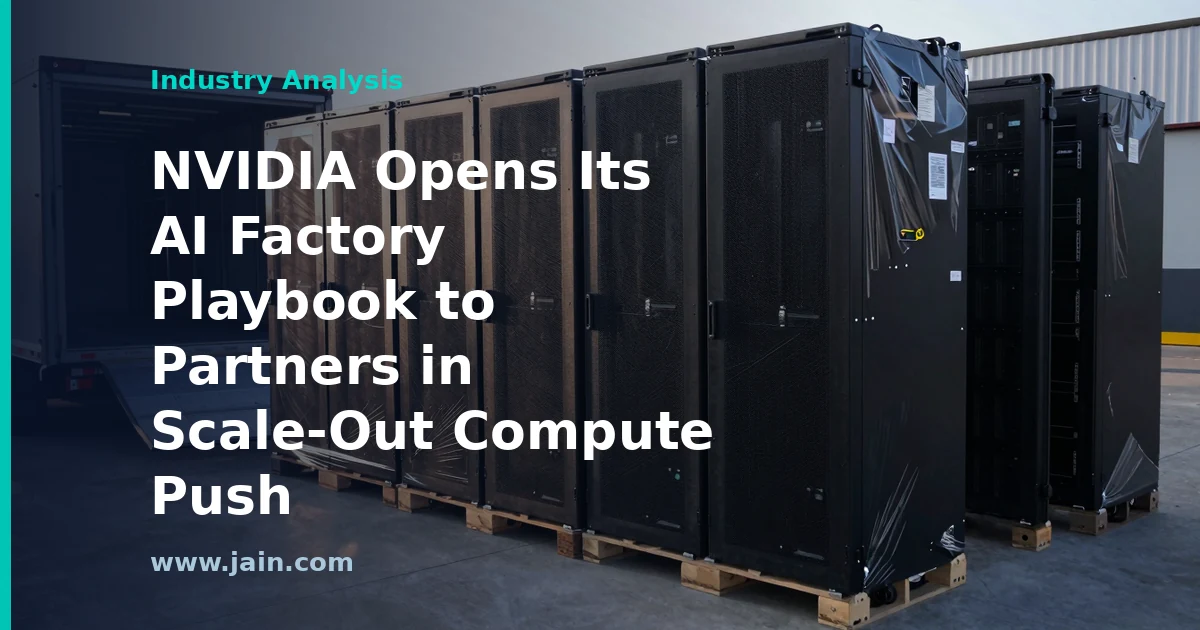
On July 2, 2026, NVIDIA published a blog post titled “NVIDIA Unlocks AI Compute at Scale, Inviting Partners to Power the AI Infrastructure Buildout.” The framing is direct: the world’s dominant supplier of AI accelerators is positioning its partner ecosystem — not just its own products — as the engine of the next phase of AI data center construction.
The syndicated release available to us carries the headline and framing but few operational specifics, so this article analyzes what that positioning signals and flags what the announcement, as distributed, does not substantiate.
Executive Summary
NVIDIA’s announcement extends a theme the company has been building for several years: that AI computing is no longer bought as individual chips or servers but as “AI factories” — entire data centers engineered end to end to turn electricity and data into AI model output. The July 2026 post signals that NVIDIA wants partners — cloud providers, data center operators, system builders and enterprises — to carry that model forward at a scale larger than any single company can build alone.
Why it matters: the constraint on AI growth has shifted from chip supply toward land, power, capital and construction capacity. An invitation to partners is an acknowledgment that the buildout’s next phase depends on the broader infrastructure industry — the operators who own sites, substations and customer relationships. For that industry, the strategic question is what “unlocking” means in practice: reference designs, software licensing, supply allocation, financing support, or something else. The headline alone does not say, and that distinction determines who benefits and how much.
From Chip Vendor to Infrastructure Architect
NVIDIA’s language — “AI compute at scale,” “AI infrastructure buildout” — reflects a deliberate repositioning that predates this announcement. The company popularized the term “AI factory” to describe a data center designed as a single integrated machine: accelerators, high-speed networking, system software and orchestration tools sold as a validated whole rather than as parts. In plain terms, NVIDIA increasingly behaves less like a component supplier and more like an architect that hands builders a full set of blueprints.
Opening that playbook to partners is the logical next step. NVIDIA does not own land, power contracts or construction crews at the scale the AI buildout demands. Its partners — hyperscale clouds, specialized GPU cloud providers, colocation operators and server makers — do. An ecosystem strategy lets NVIDIA’s designs propagate through other people’s capital and real estate, which multiplies its footprint without multiplying its balance sheet.
Why Partners, and Why Now
The timing tracks the industry’s binding constraints. By mid-2026, the practical bottlenecks in AI infrastructure were power availability, grid interconnection queues, cooling for ever-denser racks, and the sheer construction lead time of large facilities — problems that sit squarely in the domain of data center operators and utilities, not chipmakers. Inviting partners to “power the buildout” is, read plainly, a recognition that NVIDIA’s growth now depends on other companies’ ability to deliver megawatts and buildings on schedule.
There is also a demand-side logic. A broader partner base diversifies NVIDIA’s revenue beyond a handful of hyperscale buyers, reaches enterprises and governments that want AI capacity in their own regions or facilities, and seeds regional “sovereign AI” deployments. Each partner that standardizes on NVIDIA’s factory design also standardizes on its software stack — historically the stickiest part of the company’s franchise.
Winners, Risks and the Economics of the Buildout
If the program is substantive, the likely beneficiaries are infrastructure holders: colocation and wholesale data center operators with contracted power, GPU-cloud providers seeking supply and validation, and system integrators who assemble certified designs. For enterprise buyers, more qualified partners should mean more places to procure AI capacity without building it themselves.
The risks are equally concrete. Partners who build to one vendor’s blueprint concentrate their capital on that vendor’s product cycle; each new chip generation can compress the economics of the last. Utilization risk — building capacity ahead of proven demand — sits with the partner, not with NVIDIA. And a partner-led buildout raises the industry-wide question of whether capacity additions are pacing real workload growth or outrunning it. None of this makes the strategy unsound, but the release’s framing places the rewards up front and leaves the risk allocation to be inferred.
Background
Founded in 1993 and best known for inventing the modern graphics processing unit, NVIDIA transformed over two decades into the central supplier of AI computing. Its CUDA software platform, introduced in 2006, made GPUs programmable for general-purpose work, and the deep-learning boom of the 2010s and the generative-AI surge that followed made its data center business the company’s dominant segment — and NVIDIA, at points, the most valuable public company in the world. Along the way it acquired Mellanox for high-speed networking and expanded into full systems, positioning itself as a seller of complete “AI factories” rather than chips alone.
The July 2026 announcement lands in a market defined less by chip scarcity than by physical constraints: power availability, grid interconnection queues and multi-year construction timelines for the data centers that house AI hardware — the context in which an invitation to infrastructure partners carries its weight.
Cybersecurity Dive reported on July 1, 2026 that a majority of surveyed cybersecurity workers say they have been directed to keep a security breach quiet rather than disclose it. The finding, drawn from an industry survey the outlet cited, spans practitioners across the profession rather than a single company or sector.
Executive Summary
The headline claim is stark: more than half of cybersecurity professionals in the survey say they have, at some point, been instructed to conceal a breach. If accurate, that behavior sits in direct tension with regulatory disclosure regimes, customer contracts, cyber insurance conditions, and the fiduciary duties boards owe shareholders.
For enterprise buyers of cloud, connectivity, and managed security services, the report reframes a familiar question. It is no longer only whether a vendor can detect and contain an incident, but whether the vendor’s culture and governance will actually surface one when it happens. That is a procurement and audit issue as much as a technical one.
Concealment Culture Meets a Disclosure Era
The last three years have layered new disclosure obligations on top of old ones. The U.S. Securities and Exchange Commission requires public companies to report material cyber incidents within four business days. The European Union’s NIS2 directive tightens reporting for critical infrastructure operators. State breach notification laws and sector rules for health care, banking, and telecoms add further triggers. A survey suggesting that most practitioners have been pressured to bury an incident implies a structural mismatch between what the rules require and what internal incentives reward.
The mismatch is easy to explain. Disclosure invites regulatory scrutiny, litigation, customer churn, and share-price impact. Silence, by contrast, is cheap in the short term and only expensive if the concealment is later exposed. Absent enforcement that is fast and predictable, rational actors under quarterly pressure will sometimes choose silence, and rank-and-file security staff will feel the weight of that choice.
What Buyers, Insurers, and Boards Should Actually Ask
For enterprise customers, the practical takeaway is that generic assurances about incident response are not enough. Contracts should specify notification triggers, timelines, and the identity of the executive who owns the decision to notify. Right-to-audit clauses, independent forensic requirements, and clear whistleblower protections for the vendor’s security staff all become more meaningful in light of a finding like this one.
Cyber insurers face a related problem. Policies typically require prompt notification of incidents; systematic concealment inside insured organizations undermines the actuarial basis of the product. Boards, meanwhile, should be asking their chief information security officers a direct question on the record: have you or your team ever been asked to withhold information about an incident, and what would you do if you were? The answer, and how freely it is given, is itself a governance signal.
Reading the Survey With Appropriate Skepticism
The finding deserves scrutiny in both directions. Self-reported survey data on sensitive workplace behavior is prone to selection bias: practitioners who have experienced pressure to conceal are more motivated to respond, and the definition of “pressure” can stretch from an explicit order to an ambiguous hallway conversation. Without the underlying methodology, sample frame, and question wording, the headline number is directional rather than definitive.
At the same time, dismissing the finding because the methodology is thin would be its own error. Multiple prior industry surveys, regulator enforcement actions, and post-breach litigation have documented cases in which disclosure was delayed or shaped for reasons that had little to do with investigative integrity. The honest reading is that the survey is a signal worth investigating, not a verdict, and that the burden now sits with both the researchers to publish their method and with enterprises to test the claim inside their own walls.
Background
Cybersecurity Dive is a trade publication covering enterprise security, regulation, and incident response. Industry surveys of security practitioners have become a recurring genre, often used to surface workplace and governance issues that formal disclosures do not capture. The findings typically inform how regulators, insurers, and boards frame their next round of questions to management.
The broader context is a decade of expanding breach notification law, from early U.S. state statutes to GDPR in 2018, the SEC’s 2023 incident disclosure rule, and NIS2 in the EU. Each regime has raised the legal cost of silence, even as commercial incentives to stay quiet remain strong.
According to a July 1, 2026 report by The Information, OpenAI has discovered a new technique to cut its inference costs — the cost of running trained AI models to answer user queries — roughly in half. The report, surfaced via Google News, offers few public technical details, but the headline claim alone is significant: inference is the dominant recurring expense of operating large AI services at scale.
Executive Summary
The Information reports that OpenAI has found a way to halve inference costs. Inference — the compute consumed every time a model generates a response — is distinct from training, the one-time (though enormous) cost of building a model. As AI products reach hundreds of millions of users, inference has become the larger and faster-growing line item, and the one that determines whether AI services can ever be sold profitably at mass-market prices.
If the reported claim holds across OpenAI’s production workloads, it matters far beyond one company. Inference cost per query is the denominator in nearly every AI business model, and it also drives how much data-center capacity, power, and silicon the industry believes it needs. A genuine 50% reduction would ripple through capacity forecasts, chip demand assumptions, and cloud pricing. What is publicly available so far, however, is a headline and attribution to a single outlet — the technique itself, its scope, and its verification remain undisclosed. Readers should treat the magnitude as reported, not confirmed.
Inference Is Where AI Economics Are Won or Lost
Training a frontier model is a capital project; serving it is an operating expense that scales with every user and every query. For a company operating at OpenAI’s scale, inference compute is widely understood to be the largest recurring cost of the business. That is why efficiency work — better model architectures, quantization (running models at lower numerical precision), caching, batching, and smarter routing of queries to smaller models — has become as strategically important as raw capability gains.
A 50% cost reduction, if real and durable, changes the unit economics of every product built on the platform. Features that were too expensive to offer free users become viable. Margins on paid tiers widen, or prices fall to win share. Either way, the historical pattern in computing is consistent: when the cost of a unit of compute drops, providers do not pocket the savings for long — competition passes them through.
Cheaper Inference Rarely Means Less Infrastructure
A natural first reading is that halving inference costs halves the data-center capacity AI requires. History argues the opposite. This is the Jevons paradox — the economic observation, dating to 19th-century coal markets, that efficiency gains tend to increase total consumption of a resource, because lower cost unlocks new demand. Cheaper inference makes it economical to embed AI in more products, run longer reasoning chains, serve more users, and process more modalities like video and voice.
For data-center operators, connectivity providers, and power planners, the practical takeaway is that efficiency breakthroughs shift the composition of demand more than they shrink it. Inference-optimized capacity — which prizes power efficiency, proximity to users, and network performance over the raw density of training clusters — becomes relatively more valuable. Announcements like this one strengthen, rather than undercut, the case for distributed inference-serving footprints.
Winners, Losers, and the Silicon Question
Who benefits depends on what the technique actually is, which the public reporting does not say. A software-level advance (better serving algorithms, sparsity, or distillation) would be broadly replicable and would compress costs industry-wide over time — good for AI application builders and enterprise buyers, more ambiguous for chipmakers whose demand forecasts assume ever-growing compute per query. A hardware-dependent advance tied to specific accelerators would instead concentrate advantage in whoever controls that silicon.
For competitors — Anthropic, Google, Meta, and open-model providers — the report raises the efficiency bar. Inference cost per token has become a headline competitive metric alongside benchmark scores. For enterprise buyers, the sensible posture is patience: if the largest AI provider has found a way to halve its serving costs, downstream API price reductions have historically followed within quarters, and procurement teams negotiating long-term AI contracts should factor that trajectory in.
Background
OpenAI, founded in 2015 and best known for ChatGPT, operates one of the largest AI services in the world and has been a primary driver of the surge in demand for GPUs, data-center capacity, and power since 2023. The company’s spending on compute — for both training new models and serving existing ones — is central to debates about AI economics, because analysts have long questioned whether revenue from AI products can outpace the cost of delivering them.
Efficiency work is not new: the industry has steadily driven down cost per token through techniques like quantization, distillation, and better serving software, while The Information has built a track record of detailed reporting on OpenAI’s internal finances. What makes this report notable is the claimed magnitude — a one-time halving, rather than incremental gains — arriving amid historically large infrastructure commitments across the AI sector.
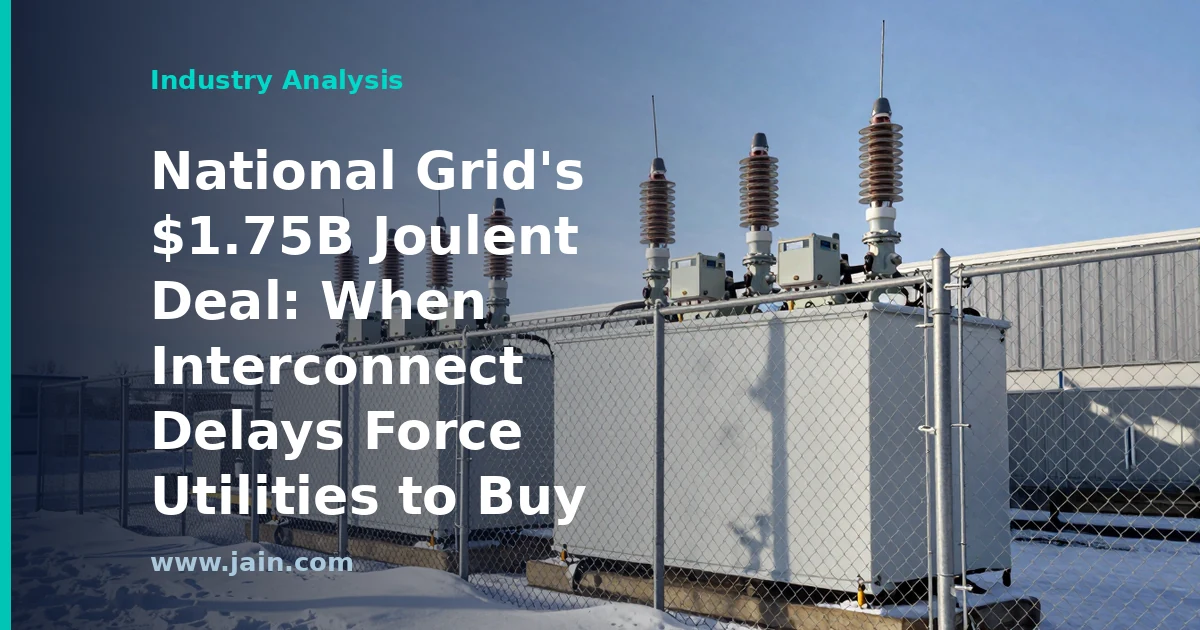
National Grid has struck a $1.75 billion deal with Joulent, according to a Data Center Knowledge report published July 1, 2026. The report frames the transaction as a response to mounting interconnection delays driven by AI data center demand — utilities, unable to connect new load fast enough through conventional build-out, are increasingly spending to acquire capacity and capability rather than queue for it.
Executive Summary
The reported transaction pairs one of the world’s largest electricity transmission and distribution operators with Joulent in a deal valued at $1.75 billion. The headline framing is the important part: the deal is attributed not to routine portfolio strategy but to AI interconnect delays — the growing backlog of requests to connect large new loads and generation to the grid, a process that in many regions now takes years.
Why it matters: if the reporting’s framing holds, this is a data point in a broader shift. Utilities have historically grown connection capacity by building — new substations, transformers, transmission lines — on regulated timelines. When AI-driven demand outruns those timelines, acquisition becomes the faster path. A $1.75 billion commitment suggests National Grid sees the capacity crunch as durable, not a passing spike. That said, the available source is a single news headline; the deal’s structure, scope, and closing conditions are not detailed in the material we can verify, and readers should treat specifics beyond the reported figure and parties with appropriate caution.
Why Buying Beats Building When the Queue Is the Bottleneck
Interconnection — the engineering and regulatory process of physically wiring a new data center, factory, or power plant into the grid — has become one of the defining constraints of the AI build-out. Studies, permitting, equipment procurement, and construction stack into multi-year waits in many markets, and lead times for critical hardware such as large power transformers and high-voltage switchgear have stretched dramatically since the early 2020s. In that environment, anything that already exists — installed equipment, an established delivery capability, a workforce, a manufacturing slot — carries a scarcity premium.
A utility that spends $1.75 billion to acquire capacity or capability it would otherwise wait years to build is making a straightforward time-for-money trade. The economics can work because the cost of delay is now enormous on both sides of the meter: hyperscale customers measure the cost of a stranded, unpowered data center shell in the millions per month, and utilities that cannot connect large customers forgo years of revenue from their fastest-growing load class.
National Grid’s Position in the AI Load Story
National Grid sits at the center of this dynamic in two major markets. It operates the high-voltage transmission network in England and Wales — where grid connection queues became a widely acknowledged national bottleneck and the subject of regulatory reform efforts — and it owns large regulated electricity and gas utilities in New York and Massachusetts, in the demand path of the US Northeast’s data center and electrification growth. Few companies feel interconnection pressure from as many directions at once.
That context makes the reported deal legible even without full details: a transmission-heavy utility facing connection backlogs on two continents has clear motives to secure capacity, equipment supply, or delivery capability by acquisition. It also carries risk. Large deals struck during a scarcity cycle can look expensive if the cycle turns — if AI load forecasts moderate or supply chains normalize, capacity bought at peak-crunch prices may earn a thinner return than capacity built patiently through the regulated process.
What $1.75 Billion Signals — and What It Doesn’t
The figure itself is the strongest signal in the reporting. Utilities are conservative, regulated businesses; a commitment of this size typically requires board conviction that the underlying driver — here, sustained AI-driven demand outpacing conventional grid expansion — will persist long enough to pay back the investment. In that sense the deal is a vote of confidence in continued data center growth, made by a party with unusually good visibility into actual connection requests rather than press-release pipelines.
What the number does not tell us is the mechanism. “Buying your way to capacity” can mean acquiring a company outright, purchasing assets, locking up equipment manufacturing capacity, or securing services under a long-term contract — and each has very different implications for competitors, regulators, and customers. The single-source material available does not specify which of these the National Grid–Joulent transaction is, what Joulent brings to the arrangement, or how the spend will be recovered. Those distinctions matter: an acquisition that removes a supplier or contractor from the open market can tighten conditions for every other utility shopping in it, while a capacity contract merely reallocates near-term supply.
Background
National Grid built its position over decades as the operator of Great Britain’s electricity transmission backbone before expanding into the US Northeast, where it serves millions of electricity and gas customers in New York and Massachusetts. In both markets it entered the mid-2020s facing an unprecedented problem: connection requests from data centers, electrified transport, and new generation arriving faster than networks could be studied, permitted, and built, prompting queue-reform efforts by regulators on both sides of the Atlantic.
The AI boom sharpened that squeeze into a defining industry constraint. Transformer and switchgear lead times stretched, hyperscale campuses began requesting connections measured in hundreds of megawatts, and ‘time to power’ displaced real estate as the data center industry’s scarcest resource — the backdrop against which a utility paying $1.75 billion to shortcut the queue becomes a rational, if notable, move.
The US Department of Homeland Security said it is investigating a cyber breach at an information-sharing network, Reuters reported on July 1, 2026. The networks DHS operates in this category exist to move cyber threat intelligence — indicators of compromise, vulnerability alerts, incident details — between the federal government and thousands of private-sector and state and local participants.
Beyond confirming an active probe, DHS has released few details: the agency has not publicly named the specific network, described what data may have been accessed, or attributed the intrusion to any actor.
Executive Summary
According to Reuters, DHS confirmed it is probing a cyber breach at an information-sharing network — one of the systems through which the US government and private industry exchange threat intelligence. Information-sharing networks are, in plain terms, the group chat of American cyber defense: when one participant sees an attack, the details are pushed to everyone else so they can block it before it reaches them.
That is what makes this incident notable regardless of its ultimate scope. A breach of a threat-sharing platform is not just another federal IT compromise; it strikes the mechanism that the entire public-private defense model depends on. Such systems can hold sensitive submissions from companies, contact rosters of security personnel, and a running picture of what defenders know — and don’t know — about active threats.
The disclosure itself is thin. As of the July 1 report, there is a confirmed investigation and little else on the public record. The honest summary is: something happened to a system that exists to help everyone else respond when something happens, and the details that would establish severity — which network, what data, which actor, how long — remain unanswered.
The Watchtower Becomes the Target
Threat information-sharing networks are unusually attractive targets precisely because of what they aggregate. A typical platform of this kind carries indicators of compromise (the technical fingerprints of attacks), early vulnerability warnings, and in some cases incident reports that identify which organizations were hit and how. An adversary with access to that stream gains something rare: visibility into what defenders collectively know. They can see which of their tools have been burned, which intrusions have been detected, and which have not.
There is also a quieter asset inside these systems — the participant directory. Sharing networks connect security officers across critical infrastructure sectors, and a roster of those people, their organizations, and their communication channels is valuable raw material for targeted phishing and social engineering. Even if no threat data was taken, a compromised membership list would have real downstream consequences.
None of this is yet established in the DHS case; the report confirms an investigation, not a scope. But it explains why a breach at this particular kind of system draws more attention than its size alone might warrant.
Trust Is the Product
The US model of cyber defense is voluntary at its core. Companies are encouraged — through liability protections established in the Cybersecurity Information Sharing Act of 2015 and through programs run by DHS’s Cybersecurity and Infrastructure Security Agency (CISA) — to hand the government sensitive details about attacks they experience. The implicit bargain is that the government protects what it is given. Participation rates in federal sharing programs have historically been a persistent challenge, with companies citing exactly this concern: what happens to our data once it leaves our hands?
A confirmed breach, even a limited one, tests that bargain. The practical risk is a chilling effect — companies quietly sharing less, later, or through informal channels instead — which degrades the common operating picture for everyone. How DHS handles the next phase matters as much as the intrusion itself: prompt notification of affected participants and a transparent accounting of what was exposed is how sharing regimes retain members after incidents. It is worth noting the system worked in one respect: the breach was detected and publicly acknowledged, which is the behavior these programs ask of their own members.
Confirmation Without Detail: Reading a Thin Disclosure Fairly
It is worth being explicit about how little is substantiated here. The public record, per Reuters, consists of DHS confirming a probe. There is no named network, no attribution, no timeline, no data inventory. Early-stage breach disclosures are often thin for legitimate reasons — investigators avoid tipping off an intruder who may still have access, and premature scoping statements frequently have to be retracted. Thin disclosure at day one is normal practice, not evidence of concealment.
The counterweight is precedent. Federal security agencies have been breached before — CISA itself confirmed in 2024 that it took systems offline after attackers exploited Ivanti VPN flaws — and in past incidents the eventual scope sometimes exceeded initial characterizations. The fair posture for now is neither alarm nor dismissal: treat the confirmation as significant because of what the target is, and treat the severity as genuinely unknown until DHS says more. For enterprises that participate in federal sharing programs, the prudent interim assumption is that anything submitted to a government platform could someday be part of a breach scope, and to calibrate submissions and internal exposure accordingly.
Background
The Department of Homeland Security has anchored the US government’s cyber partnership with industry since the mid-2000s, a role concentrated since 2018 in its Cybersecurity and Infrastructure Security Agency (CISA). The model is deliberately collaborative rather than mandatory: the Cybersecurity Information Sharing Act of 2015 gave companies liability protections for handing threat data to the government, and DHS built the plumbing to move it — including the Homeland Security Information Network (HSIN) for sensitive-but-unclassified collaboration and CISA’s Automated Indicator Sharing service for machine-speed exchange of attack indicators.
Those systems serve thousands of participants across critical infrastructure sectors, from utilities and banks to state and local governments. Federal networks have been high-value targets throughout: the 2015 Office of Personnel Management breach, the 2020 SolarWinds campaign, and 2024 intrusions affecting CISA’s own systems all demonstrated that the agencies coordinating US cyber defense are themselves squarely in adversaries’ sights.
Reuters reported on June 30, 2026 that PJM Interconnection — the largest power grid operator in the United States, coordinating electricity across 13 states and the District of Columbia for roughly 65 million people — is moving toward actively managing data center demand on its system. The report signals a shift from treating data centers as ordinary customers whose consumption must simply be served, toward a framework in which the grid operator can shape when and how much power the largest new loads draw.
Details of the mechanism, timeline, and scope were not spelled out in the headline announcement, but the direction alone is consequential: PJM’s territory includes Northern Virginia’s “Data Center Alley,” the densest concentration of data centers in the world, and the region at the center of the AI-driven surge in U.S. electricity demand.
Executive Summary
According to Reuters, PJM is taking steps toward managing data center demand rather than passively absorbing it. For decades, U.S. grid planning worked on a simple premise: customers decide how much electricity they need, and the grid builds to serve it. AI data centers — single facilities that can draw hundreds of megawatts, comparable to a small city — have broken that premise. Interconnection queues are backed up, capacity prices in PJM’s markets have surged, and the gap between how fast data centers can be built (one to two years) and how fast power plants and transmission can be built (five to ten years) keeps widening.
Moving to “manage” that demand means the operator of America’s biggest wholesale power market is preparing tools — potentially ranging from voluntary demand-response participation to conditions on new large-load interconnections to curtailment provisions, though the report does not specify which — to control the timing and firmness of data center consumption. That matters far beyond PJM’s footprint: as the largest grid and the home of the world’s biggest data center cluster, PJM’s rules tend to become the template other regions study.
For the data center industry, the message is that access to the grid is no longer an unconditional entitlement. Flexibility — the ability to shift, shed, or self-supply load — is becoming a bargaining chip in getting connected at all.
From Passive Host to Active Manager
Grid operators like PJM are regional transmission organizations (RTOs): nonprofit entities that run the wholesale electricity market and the high-voltage network across their territory, under rules approved by federal regulators. Historically, their job was to forecast demand and make sure supply met it. Demand itself was treated as a given. A move toward managing data center demand inverts that relationship for the first time at this scale — the grid operator would have a say in how the largest customers consume, not just how generators produce.
The trigger is arithmetic. Load growth in PJM was essentially flat for nearly two decades; AI data centers ended that era abruptly. When a single campus can request as much power as a steel mill or a small utility’s entire service territory, and dozens of such requests arrive at once, the traditional “build to serve” model produces either reliability risk or enormous costs socialized across all ratepayers. Managing demand is the third option: make the new load itself part of the reliability solution.
The Economics of Curtailable Compute
The core idea behind demand management is that not every megawatt-hour of computing is equally urgent. AI training runs can, in principle, pause or shift in time; some workloads can migrate between facilities in different regions. If data centers agree to reduce consumption during the few dozen hours a year when the grid is most stressed, the system needs less peak capacity — which is exactly the product whose price has been surging in PJM’s capacity auctions, the market where power plants are paid to be available.
The unresolved tension is that most data center operators sell their customers uninterrupted uptime, and inference workloads serving live users are far harder to pause than training. Whether flexibility is genuinely available at scale — and at what price data center operators would sell it — is the open economic question. If PJM’s framework rewards flexible loads with faster interconnection or lower costs, it effectively creates a market price for interruptibility, and data center designs will adapt to capture it: more batteries, more on-site generation, more workload-orchestration software.
Winners, Losers, and the Ratepayer Question
Developers with flexible-by-design facilities, on-site generation, or storage stand to gain priority in a demand-managed regime. Operators marketing strict 24/7 firmness with no curtailment tolerance may face slower interconnection or higher costs. Utilities and generators face a subtler effect: managed demand blunts the extreme scarcity that has driven capacity prices up, which helps consumers but trims the windfall that scarcity was delivering to existing power plants.
For households and businesses in PJM’s 13-state footprint, the stakes are direct. Capacity costs flow into retail electricity bills, and the politics of ordinary ratepayers subsidizing infrastructure for the world’s wealthiest technology companies have grown sharp. A credible demand-management framework is partly a political instrument: it lets PJM tell states and consumers that data centers are being asked to carry reliability risk, not just impose it. Whether the framework has real teeth — mandatory obligations versus voluntary programs — will determine whether that assurance holds up.
A Template Other Grids Will Study
PJM is not acting in a vacuum. Texas’s ERCOT grid, the other major destination for large flexible loads, has been developing its own approach to interconnecting and, when necessary, curtailing very large customers. When the two biggest data center markets in the country both condition grid access on demand flexibility, it stops being an experiment and becomes the emerging national norm. Data center site selection, financing models, and colocation contracts will all have to price in a world where the grid can ask the largest computers on Earth to throttle down.
Background
PJM Interconnection, headquartered in Pennsylvania, grew from a 1927 power pool into the largest regional transmission organization in the United States, dispatching generation and running wholesale power markets across a footprint from Illinois to the mid-Atlantic. Its territory includes Northern Virginia, where decades of fiber density and proximity to federal and enterprise customers created “Data Center Alley” — the largest data center market in the world.
The generative-AI boom that accelerated from 2023 onward transformed data centers from a steady, modest slice of electricity demand into the dominant driver of U.S. load growth, ending a long era of flat consumption. PJM’s capacity auctions delivered record-high prices as demand forecasts jumped, interconnection requests piled up, and state officials began questioning who should bear the cost. The June 2026 move toward managing data center demand is the institutional response to that collision between AI’s growth curve and the grid’s construction timelines.
Realty Income, one of the largest net-lease real estate investment trusts (REITs) in the United States, announced on June 30, 2026 a programmatic joint venture with Cloud Capital and an unnamed global institutional investor to invest in hyperscale data centers. The venture launches with initial seed assets valued at over $6 billion.
A programmatic joint venture is a standing framework for repeated investments over time, rather than a one-off deal — meaning the partners intend the $6 billion starting portfolio to be a foundation, not a ceiling.
Executive Summary
The announcement, distributed via PR Newswire, pairs a blue-chip income REIT with a data center-focused partner and institutional money to pursue hyperscale facilities — the massive, single-tenant campuses leased by cloud and AI platforms. At more than $6 billion in seed assets, this is among the larger data center capital formations announced by a traditional net-lease landlord, and it extends Realty Income’s earlier, more tentative steps into the sector.
Why it matters: the AI data center buildout has so far been financed largely by hyperscalers’ own balance sheets, specialist developers, private credit, and infrastructure funds. A programmatic vehicle anchored by a REIT best known for freestanding retail properties suggests the asset class has matured enough — in lease structure, tenant credit, and perceived durability — for conservative, income-oriented real estate capital to commit at scale. It also gives hyperscale developers and tenants another deep-pocketed buyer for stabilized assets, which can accelerate capital recycling across the industry.
Why Net-Lease Capital Is Converging on Hyperscale
Realty Income built its franchise on net leases — agreements where the tenant, not the landlord, pays taxes, insurance, and maintenance — signed with creditworthy tenants for long terms. Hyperscale data centers, typically leased in whole to a single cloud or AI platform for a decade or more, fit that template closely: long duration, investment-grade counterparties, and predictable cash flow. For a REIT whose traditional retail and industrial pipeline offers limited growth, data centers are one of the few property types with both scale and secular demand.
The structural fit works in the other direction too. Hyperscale developers need to recycle capital: building a campus ties up billions, and selling or partially selling stabilized facilities to income investors frees cash for the next project. A programmatic buyer with institutional backing gives the development side of the industry a reliable exit, which in turn supports the pace of the overall AI buildout.
The Programmatic Structure: Capital-Light Growth and Shared Risk
The choice of a programmatic joint venture, rather than direct balance-sheet acquisitions, is telling. In a JV, Realty Income can deploy less of its own equity per asset, share risk with partners, and potentially earn management fees — growing exposure to the sector without concentrating its balance sheet in a single property type. The inclusion of a global institutional investor, though unnamed in the announcement, indicates that pension-scale or sovereign-scale capital is comfortable underwriting hyperscale real estate alongside a public REIT.
The trade-off is that JV economics are more complex than wholly owned real estate. Ownership percentages, governance rights, and fee arrangements — none of which are detailed in the release — determine how much of the venture’s income actually reaches Realty Income shareholders. Investors will want those specifics before judging how meaningful $6 billion of seed assets is to the REIT’s earnings.
A $6 Billion Signal for the AI Financing Stack
The scale matters beyond one company. Industry estimates have consistently put the cost of the AI data center buildout in the hundreds of billions of dollars over the coming years — more than hyperscalers and specialist developers can comfortably self-fund. Each new pool of institutional capital that enters the sector lowers the financing bottleneck. A vehicle seeded at over $6 billion, structured for repeat investment, is a concrete data point that real estate allocators now treat AI infrastructure as a core holding rather than a speculative bet.
Winners from this shift include hyperscale tenants (more landlord competition for their leases), developers (deeper exit markets), and the power and construction ecosystem that feeds the buildout. The open question is pricing: as more conservative capital chases the same stabilized assets, acquisition yields compress, and late entrants risk paying peak prices for facilities whose long-term value depends on continued AI demand.
Risks the Lease Structure Cannot Fully Absorb
Long leases with strong tenants mitigate, but do not eliminate, the sector’s risks. Hyperscale assets are highly concentrated bets on a small set of tenants, and a single-tenant building is only as resilient as that tenant’s commitment to the site. Technology risk is real as well: rapid changes in chip density and cooling requirements can age a facility’s design faster than a 15-year lease runs. And power — securing it, pricing it, and defending it politically — has become the binding constraint on the industry. None of these risks argue against the deal; they define what disciplined underwriting in this venture must get right.
Background
Realty Income is an S&P 500 net-lease REIT with a decades-long record built on single-tenant properties — convenience stores, drugstores, grocery, and industrial facilities — leased on long-term contracts where tenants bear most operating costs. In recent years the company has diversified beyond U.S. retail, including earlier moves into data center investment alongside established sector operators, as traditional net-lease markets offered limited room for a company of its size to grow.
The hyperscale data center sector, meanwhile, has become one of the most capital-hungry corners of real estate. Demand from cloud computing and, since 2023, generative AI has driven a wave of multi-billion-dollar campus developments financed by hyperscaler balance sheets, specialist developers, infrastructure funds, and private credit. Programmatic ventures pairing operators with institutional capital have become a standard mechanism for funding that expansion.
Etched, a startup building chips specialized for AI inference, has emerged from stealth with $800 million in funding and unveiled a working chip, according to a June 30, 2026 report by Data Center Dynamics. The announcement positions the company as one of the best-capitalized challengers to general-purpose GPUs in the fast-growing market for running — rather than training — AI models.
Executive Summary
The headline facts are two: a very large capital raise, and functional silicon. In the chip industry those milestones matter in combination. Hundreds of startups have raised money on architectural promises; far fewer have demonstrated a working chip, the point at which a design has survived the multi-year, multi-hundred-million-dollar gauntlet of tape-out and fabrication. An $800 million round — among the largest ever disclosed for an AI chip startup — signals that investors believe Etched has cleared that bar.
Why it matters: the economics of AI are shifting from training (building models) to inference (serving them to users), which recurs with every query and now dominates many operators’ compute bills. Etched’s core thesis, articulated publicly since 2024, is that a chip hard-wired for the transformer architecture underlying today’s large language models can deliver dramatically better throughput per dollar and per watt than a flexible GPU. If that holds in production, it pressures the pricing of incumbent accelerators and reshapes data center power and cooling planning. The release, as reported, does not yet prove it holds.
Inference Is Where the Money Now Flows
Training a frontier AI model is a one-time (if enormous) expense; inference — actually answering user queries — is a cost incurred billions of times a day, forever. As AI products reach mass adoption, inference has become the dominant and recurring line item in operators’ compute budgets, and every percentage point of efficiency compounds. That is the market Etched is aiming at, and it explains investor appetite: a supplier that meaningfully cuts the cost per generated token addresses one of the largest and fastest-growing spend categories in technology.
It also explains the timing. GPU supply has been constrained and expensive throughout the AI boom, and the power those GPUs draw has become the binding constraint on data center construction. Any credible chip that promises more inference per megawatt speaks directly to the industry’s scarcest resource.
The Specialization Bet: What an ASIC Gains and Risks
Etched builds what the industry calls an ASIC — an application-specific integrated circuit. Where a GPU is a general-purpose parallel processor that can run almost any AI architecture, Etched’s design bakes the transformer architecture directly into the silicon, spending its transistor budget on exactly one workload. The company has previously claimed this yields order-of-magnitude gains in throughput. The gain is real in principle — specialization has repeatedly beaten generality in mature workloads, from Bitcoin mining to video encoding — but it carries a matching risk: if the dominant model architecture shifts away from transformers, a transformer-only chip has nowhere to go, while a GPU simply runs the new thing.
Etched’s implicit wager is that transformers are now infrastructure, stable enough to hard-wire. Several years into the transformer era, with every major frontier model still built on the architecture, that wager looks stronger than it did at the company’s founding. But it remains a wager, and buyers weighing multi-year deployments will price that architectural lock-in accordingly.
$800 Million Buys Credibility, Not Victory
Leading-edge chip development routinely consumes hundreds of millions of dollars per generation before a single unit ships in volume, which is why the AI accelerator field has narrowed to companies with either deep pockets or hyperscaler patrons. An $800 million round puts Etched in rare company among independents and funds the unglamorous phase ahead: yield ramp, volume manufacturing, server integration, and — critically — software. Nvidia’s real moat is less its silicon than CUDA, the software ecosystem that millions of developers already use. Every challenger, from Groq to Cerebras to the hyperscalers’ in-house chips, has learned that a fast chip without a mature software stack and cloud availability wins benchmarks but not budgets.
One framing note deserves scrutiny: Etched has not been literally unknown — the company publicly announced a $120 million Series A in mid-2024 and marketed its Sohu chip concept openly. The ‘stealth’ language in the reported headline most plausibly refers to the silence surrounding its silicon progress since then. That distinction matters, because the genuinely new, load-bearing claim here is the working chip — and as reported, it arrives without published benchmarks, customer names, or availability dates.
What It Means for Data Center Operators and Buyers
For data center operators, credible inference ASICs change capacity math. Higher throughput per watt means more revenue-generating tokens per megawatt of grid connection — the metric that increasingly governs siting and construction decisions. For enterprise buyers, a well-funded second source of inference compute is leverage in GPU negotiations even before a single Etched server ships. The practical near-term effect of announcements like this one is often pricing pressure on incumbents rather than immediate displacement; displacement requires the proof points this release does not yet contain.
Background
Etched was founded in 2022 by a group of Harvard dropouts and stepped into public view in June 2024 with a $120 million Series A and an audacious pitch: its Sohu chip would abandon GPU-style flexibility and etch the transformer architecture — the mathematical structure behind essentially all modern large language models — directly into silicon, claiming order-of-magnitude throughput gains over contemporary GPUs. At the time the company had no working chip, and skeptics noted both the architectural lock-in risk and the graveyard of past AI chip challengers.
The intervening two years transformed the market it targets. Inference spending overtook training as the growth engine of AI compute, power availability became the industry’s defining constraint, and hyperscalers validated the specialization thesis by pouring billions into their own custom inference silicon. Etched’s reported $800 million raise and working chip land in that context: a market actively searching for alternatives to GPU economics, but one that has also repeatedly shown how hard it is to convert a fast chip into a shipping business.
The US government has issued an emergency order covering PJM Interconnection — the largest electric grid operator in the United States — ahead of a heatwave expected to drive electricity demand toward the edge of available supply, Reuters reported on June 30, 2026. Emergency orders of this kind allow the Department of Energy to temporarily relax normal operating constraints so that generators can run at maximum output to keep the lights on.
Executive Summary
According to the Reuters report, federal authorities acted preemptively: the order was issued as the heatwave loomed, not after the grid had already buckled. That timing matters. Emergency authority — typically exercised under Section 202(c) of the Federal Power Act, which lets the Energy Secretary direct generators to operate notwithstanding permits or other limits — was historically reserved for rare, acute crises such as hurricanes or sudden plant failures.
That such an intervention now precedes a forecastable summer weather event suggests the buffer between peak demand and available generation in PJM’s territory has grown uncomfortably thin. PJM coordinates power for roughly 65 million people across 13 states and the District of Columbia — including Northern Virginia, the densest data-center market on Earth — so an emergency footing on this grid is a material signal for the entire digital-infrastructure industry.
When Emergency Powers Become Routine Tools
An emergency order is, by design, an extraordinary instrument. It can authorize power plants to exceed environmental or operational limits, keep units scheduled for retirement running, and compel generation that market signals alone would not produce. Using it in anticipation of hot weather — one of the most predictable stresses a grid faces — indicates that ordinary market and reliability mechanisms are no longer producing enough headroom on their own. Similar orders were issued for PJM and other regions during heat events in prior summers, so the June 2026 action fits an emerging pattern rather than standing as a one-off.
The pattern is the story. Each individual order is defensible as prudent risk management; a sequence of them amounts to the federal government repeatedly bridging a structural gap between demand growth and supply additions. That gap has causes on both sides of the ledger: large thermal plants retiring faster than replacement capacity comes online, interconnection queues that delay new generation for years, and demand rising after two decades of near-flat load.
AI Load Growth Meets a Tightening Grid
PJM sits at the center of the demand-growth debate because its footprint includes Northern Virginia’s ‘Data Center Alley,’ along with fast-growing campuses in Ohio, Pennsylvania, and Maryland. Grid planners across the country have sharply raised load forecasts, driven in large part by AI-oriented data centers, electrification, and new manufacturing. PJM’s own capacity auctions — the market that pays generators to be available during peaks — have cleared at record-high prices in recent cycles, a direct financial symptom of scarcity.
A heatwave is where these abstractions become physical. Air-conditioning load peaks at exactly the moment thermal plants lose efficiency in the heat, and data-center cooling demand rises in parallel. When the margin for error narrows, operators lean on emergency tools. For the industry we cover, the lesson is blunt: electricity availability, not land or fiber, is now the binding constraint on digital-infrastructure growth in America’s largest power market.
What It Means for Data-Center Operators and Their Customers
For operators, recurring grid emergencies raise both operational and reputational stakes. Operationally, facilities in PJM territory should expect more frequent conservation appeals, demand-response calls, and scrutiny of backup-generation readiness during peak season. Reputationally, data centers are increasingly cast as the face of load growth; every emergency order sharpens public and regulatory questions about who pays for grid stress and whether large loads should be required to be curtailable or bring their own generation.
The likely winners in this environment are firms that treat power as a first-class engineering problem: those with flexible-load capability, on-site or contracted generation, long-dated capacity positions, and sites in regions with genuine surplus. The exposed parties are speculative projects counting on grid interconnection timelines and power prices that no longer reflect reality. Utilities and generators in PJM, meanwhile, gain leverage — scarcity is lucrative for whoever owns dispatchable megawatts.
Background
PJM Interconnection, founded as a utility power pool in 1927, evolved into the largest competitive wholesale electricity market in the United States, coordinating generation and transmission across the Mid-Atlantic and parts of the Midwest. Its footprint includes Northern Virginia’s data-center corridor, which has made PJM the frontline grid for AI-era load growth. Section 202(c) of the Federal Power Act gives the Department of Energy authority to order emergency generation during grid crises — a power used sparingly for decades but invoked more frequently in recent years as plant retirements, slow interconnection of new resources, and surging demand forecasts have narrowed the system’s reserve margins.
The US House of Representatives passed a bill to help small, local electric companies defend against hackers. These include rural power cooperatives, which are owned by the customers they serve, and city-owned utilities.
The bill allows up to $250 million over five years. That averages about $50 million a year, spread across the whole country. It is permission to spend, not money in the bank yet.
Why care? The huge computer warehouses behind artificial intelligence run on the same power grid as everyone else, and these small utilities say they have the fewest people guarding it.
On June 29, 2026, the U.S. House of Representatives passed the Rural and Municipal Utility Cybersecurity Act, a bipartisan bill from Rep. Mariannette Miller-Meeks (IA-01) and Rep. Jennifer McClellan (VA-04), according to a press release from Miller-Meeks’ office. The bill reauthorizes the Rural and Municipal Utility Advanced Cybersecurity Grant and Technical Assistance Program and authorizes $250 million over five years to help rural electric cooperatives and municipal utilities deploy cybersecurity technology, share threat information and respond to incidents.
The bill passed alongside three other grid-security measures from the House Energy & Commerce Committee, has the backing of the National Rural Electric Cooperative Association and the American Public Power Association, and now moves to the Senate.
Executive Summary
The House has voted to extend a federal program that gives grants and technical help to the smallest operators on the U.S. electric grid: rural electric cooperatives, which are member-owned, and municipal utilities, which are owned by cities and towns. The authorization is $250 million over five years, an average of $50 million a year if spread evenly.
The premise, stated plainly in the release, is that these utilities face the same sophisticated threats as large investor-owned utilities while operating with limited cybersecurity staff and budgets. That makes them the segment of the grid where defensive capacity is thinnest by the sponsors’ own account.
For the data center and AI infrastructure industry, the bill matters less for its dollar figure than for what it signals: Congress is treating the security of the entire power delivery chain, not only its largest nodes, as a national concern at a time when electricity reliability has become a gating factor for computing buildout. Whether the money actually flows depends on the Senate and, later, on appropriators.
A $250 Million Ceiling, Not a $250 Million Check
The most important word in the release is “authorizes.” In federal budgeting, an authorization sets the maximum Congress permits a program to spend; the actual dollars are decided separately each year through appropriations bills. An authorization of $250 million over five years therefore establishes a ceiling of roughly $50 million a year on average, not a guaranteed stream of grants. Programs are routinely funded below their authorized levels, and some are not funded at all in a given year.
The bill also has not become law. It passed the House and now needs Senate action, which Miller-Meeks urged be swift, followed by the President’s signature. Until then, utilities planning security upgrades cannot budget around the reauthorized program, and the practical effect on any given cooperative or municipal system remains prospective.
Measured against the problem the release describes, the scale is modest. A national pool averaging $50 million a year is meant to support grants, technical assistance and information sharing across every eligible rural and municipal utility in the country. That is a meaningful subsidy for a small utility that has no dedicated security team, but it is not sized to remake the security posture of an entire segment of the grid on its own.
Why the Least-Resourced Utilities Matter to AI’s Power Supply
The release never mentions data centers or artificial intelligence, so the connection has to be drawn carefully. What the release does establish is a resource gap: rural cooperatives and municipal utilities “often operate with limited cybersecurity personnel and resources despite serving millions of Americans and supporting critical infrastructure,” and they face “the same sophisticated cyber threats with far fewer resources.” By the sponsors’ own framing, these are the parts of the grid where cyber defense is thinnest.
That matters to AI infrastructure because computing capacity is ultimately limited by reliable electricity. Data center developers searching for available power increasingly look beyond the largest utility territories, and wherever a facility connects, its uptime depends on the security of the utility delivering its electricity. A campus’s own firewalls do nothing if the operational systems of the utility serving it are compromised. The mechanism is straightforward: the security of a data center’s power supply is bounded by the security of the utility that supplies it, and the bill targets the class of utility that its sponsors say is least equipped.
The link should not be overstated. A breach at a small distribution utility typically affects its own service territory rather than cascading across the national grid, and how much data center load sits on cooperative or municipal systems is not quantified in the release. The relevance to any specific operator therefore depends on where its facilities are sited. For operators served by these utilities, however, the program’s success is a direct input to their own reliability risk.
One Bill in a Four-Part Grid-Security Package
Energy & Commerce Chairman Brett Guthrie described the measure as one of “four bills” addressing security planning, Department of Energy leadership for confronting threats, tools for utilities, and collaboration between grid operators and the federal government. Read together, the package treats grid cybersecurity as a portfolio of planning, leadership, funding and information-sharing problems rather than a single funding gap.
That framing aligns with how large power consumers already think about risk. A grant for a small utility’s security software is most valuable when paired with timely threat intelligence and a clear federal point of contact during an incident. The release does not detail the other three bills, so how they fit together in practice remains to be seen as they move through the Senate.
The support of the National Rural Electric Cooperative Association and the American Public Power Association is notable but expected, since their members are the intended recipients. Their backing indicates that eligible utilities see demand for the program; it is not independent evidence of how effective the grants have been to date.
What Power Buyers and Developers Should Watch
For companies siting data centers or other large loads, the practical takeaway is to treat a utility’s cybersecurity posture as part of site diligence, alongside capacity, interconnection timelines and rates. Questions about whether a prospective utility has participated in federal cyber programs, what monitoring it runs on its operational systems and how it shares threat information are reasonable to raise early.
For investors and policy watchers, the next markers are Senate action and, if the bill becomes law, the appropriations figure attached to it. Those two steps, not the House vote, will determine whether the $250 million authorization turns into money in the hands of utilities.
Background
The Rural and Municipal Utility Advanced Cybersecurity Grant and Technical Assistance Program is administered by the U.S. Department of Energy and was established under the 2021 bipartisan infrastructure law to help smaller utilities improve their cyber defenses. The June 2026 House bill would reauthorize it for another five years.
Rural electric cooperatives and municipal utilities make up a large share of U.S. utilities by count, though each is typically much smaller than an investor-owned utility. Their limited scale often means they have few or no dedicated cybersecurity staff, a gap federal programs like this one aim to close as grid threats and electricity demand both grow.