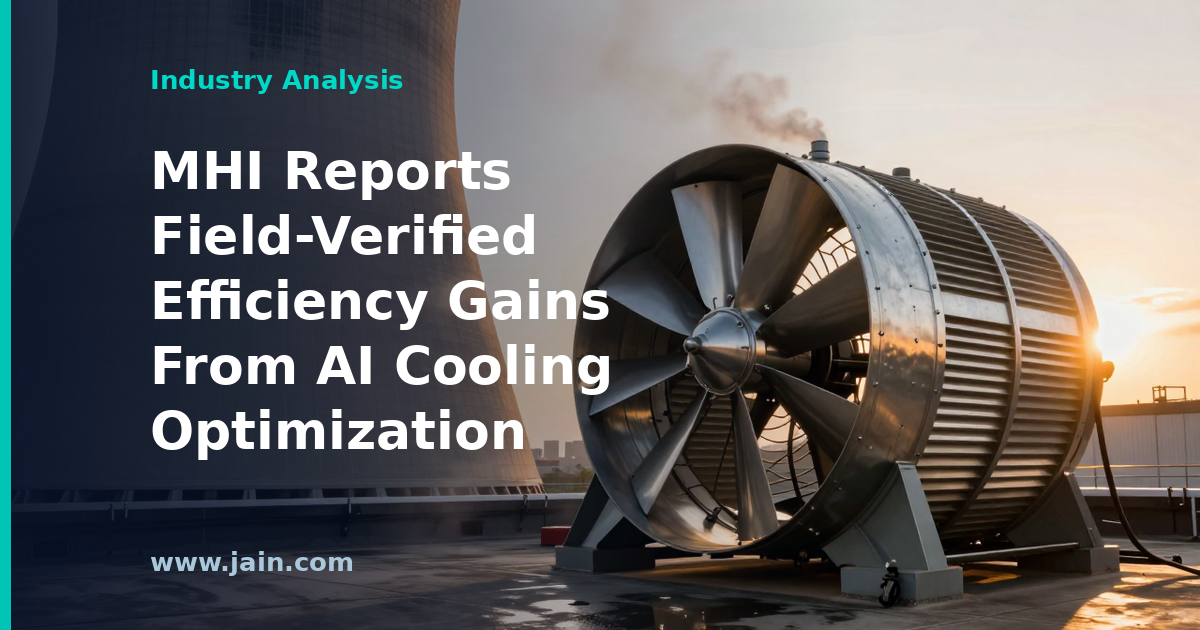
Mitsubishi Heavy Industries (MHI) announced on July 9, 2026 that it has demonstrated energy-efficiency improvements through cooling optimization in an operational data center. Rather than a lab simulation or a controlled test bed, the demonstration ran in a live facility — the setting where cooling systems must respond to real, fluctuating IT loads.
Executive Summary
MHI, the Japanese heavy-industry group whose portfolio spans power generation, HVAC and thermal systems, says it has shown measurable energy-efficiency improvements by optimizing cooling in a data center that was actively serving production workloads. The approach centers on smarter control of cooling equipment — adjusting how chillers, air handlers and airflow respond to actual conditions rather than running at conservative fixed settings.
The announcement matters for a simple reason: cooling is one of the largest non-IT consumers of electricity in a data center, and it is one of the few places where efficiency gains can be captured without touching the servers themselves. With AI workloads pushing rack power densities sharply higher, operators are looking hard at control-layer optimization as a way to cut operating costs and free up power capacity. A field demonstration in a live facility — as opposed to vendor modeling — is the kind of evidence buyers increasingly demand, though the syndicated version of this release does not carry the underlying figures, which readers should verify against MHI’s full publication.
Why a Live-Facility Demonstration Matters
Cooling-optimization claims are easy to make in simulation and hard to prove in production. A real data center has messy thermal behavior: IT load rises and falls with customer demand, outside temperatures swing by season and hour, and no operator will tolerate a control experiment that risks overheating servers. Demonstrating gains in an operational facility means the system had to deliver savings while respecting those constraints — which is why field verification is the credibility bar for this product category.
That said, a single-site demonstration is evidence, not proof of general applicability. Results depend heavily on the baseline: a facility with poorly tuned cooling will show dramatic improvement from almost any optimization, while a well-run site will show far less. The commercial question is not whether MHI improved one building, but how transferable the method is across climates, cooling architectures and load profiles — something only multi-site data can answer.
Cooling Is the Biggest Efficiency Lever Left
In most data centers, cooling is the largest energy consumer after the IT equipment itself, which is why the industry’s standard efficiency metric — PUE, or power usage effectiveness, the ratio of total facility power to IT power — is largely a measure of cooling overhead. Servers get more efficient with every silicon generation, but the facility side improves only when operators invest in it. Control-layer optimization is attractive because it can often be applied to existing equipment: the chillers stay, the software running them gets smarter.
The economics have sharpened as AI infrastructure scales. Grid connections are constrained in many markets, so every kilowatt not spent on cooling is a kilowatt available for revenue-generating compute. For operators facing multi-year waits for new power capacity, efficiency gains at the cooling layer function as found capacity — frequently at a fraction of the cost of new construction.
MHI Enters a Crowding Field
MHI is not alone here. AI-assisted cooling control has been pursued by hyperscalers internally and by facility-equipment and building-management vendors for several years, and the space now includes established cooling manufacturers, controls specialists and software startups. MHI’s differentiation, if it holds, comes from owning the equipment side: a company that builds chillers and thermal systems can integrate control optimization more deeply than a software-only vendor, and can stand behind the combined result.
For MHI, the strategic logic is also defensive. As liquid cooling, heat reuse and AI-driven operations reshape data center thermal design, equipment makers that offer only hardware risk being commoditized while the value migrates to the control and services layer. A demonstrated optimization capability positions MHI to sell outcomes — efficiency, capacity headroom — rather than just machines. Whether that translates into a commercial product with published pricing and guarantees is the next thing to watch.
Background
Mitsubishi Heavy Industries is a diversified Japanese engineering group whose thermal-systems businesses build chillers, HVAC and industrial cooling equipment — the physical machinery that data center cooling optimization software ultimately controls. Like other established equipment makers, MHI has been extending from hardware into the control and services layer as data center operators demand measurable efficiency outcomes rather than standalone machines.
The push comes amid a broader industry squeeze: AI-driven demand has data center construction booming while grid power in major markets is scarce, making energy efficiency both a cost issue and a capacity issue. Cooling, as the largest non-IT energy consumer in most facilities, has become the primary battleground, with hyperscalers, controls vendors and equipment manufacturers all pursuing AI-assisted optimization of the thermal plant.
PJM Interconnection, the largest electric grid operator in North America, set a new all-time peak-load record of 168.158 gigawatts (GW) during a heat wave, S&P Global reported on July 9, 2026. Peak load is the highest instantaneous electricity demand a grid must serve, and PJM’s footprint spans 13 states and the District of Columbia — including Northern Virginia, the densest data center market in the world.
Executive Summary
The number itself is the story: 168.158 GW is an all-time record for a grid that has operated since 1927, exceeding the prior widely cited all-time mark of roughly 165.6 GW set in the summer of 2006. Grid demand in mature economies was assumed for years to be flat or declining as efficiency gains offset growth; a new absolute record — set during a heat wave, when air conditioning load stacks on top of everything else — signals that assumption no longer holds in PJM territory.
Why it matters: PJM is where the AI infrastructure boom and the physical grid meet most directly. The region hosts the largest concentration of data centers on earth, and PJM’s own planning processes, capacity auctions, and interconnection queue have all been reshaped by projected data center growth. A record peak turns those projections into observed, metered reality — with consequences for power prices, data center siting decisions, and the pace of generation and transmission construction.
The End of Flat Demand
For roughly two decades, U.S. grid planners could count on a comfortable pattern: efficiency improvements (LED lighting, better HVAC, industrial offshoring) absorbed most economic growth, so peak demand crept along or even fell. That the previous PJM record dated to 2006 illustrates the point — the grid went nearly twenty years without needing to serve a bigger hour. A new record, driven by weather layered on structural load growth, marks a regime change. Data centers, electrification of heating and transport, and reshored manufacturing are all pushing the same direction, and data centers are the fastest-moving of the three because a single large AI campus can draw hundreds of megawatts continuously, day and night.
Heat Waves Are the Stress Test
Records like this are set when a heat wave pushes air-conditioning demand to its maximum at the same time that always-on loads — including data centers — are running flat out. Unlike residential cooling, data center load does not relent in the evening or on weekends, which raises the floor beneath every weather-driven spike. For grid operators, that changes the risk calculus: reserve margins (the buffer of spare generating capacity above expected peak) get consumed from both ends, by rising peaks and by the retirement of older coal and gas plants. PJM has publicly warned for several years that retirements were outpacing new entry; a record peak is exactly the scenario those warnings anticipated.
The Economics: Someone Pays for the Peak
Grids are built for their single highest hour, so peaks are expensive. In PJM, the cost shows up through capacity auctions — payments to generators for being available when demand spikes — and recent PJM capacity auctions have cleared at record-high prices, driven in large part by demand forecasts that data center growth dominates. Those costs flow to ratepayers across the footprint, which is why data center load growth has become a live political issue in states like Virginia, Ohio, and Pennsylvania. A verified record peak strengthens the case of utilities and generators seeking to build; it also sharpens questions from consumer advocates about who should bear the cost of infrastructure that primarily serves new industrial customers.
Winners, Losers, and the Siting Chessboard
Owners of existing dispatchable generation — gas, nuclear, and remaining coal in the PJM footprint — are clear near-term beneficiaries, since scarcity raises the value of every megawatt that can run on command. Data center developers face a more complicated picture: record peaks validate the demand they are bringing, but also lengthen interconnection timelines, raise power costs, and invite regulatory scrutiny. Expect continued interest in behind-the-meter and co-located generation, long-term nuclear power purchase agreements, and siting in less-constrained regions. For the connectivity and colocation industry broadly, grid capacity — not land, not fiber — is now the binding constraint on where digital infrastructure gets built.
Background
PJM Interconnection began in 1927 as a power pool among Pennsylvania and New Jersey utilities and grew into the largest regional transmission organization in North America, coordinating the grid and wholesale markets for 13 states and Washington, D.C. Its territory includes Northern Virginia’s “Data Center Alley,” the densest concentration of data centers in the world, which has made PJM the front line where AI-driven electricity demand meets grid reality.
For most of the 2010s, PJM demand was flat as efficiency gains offset growth, and its 2006-era peak record went unchallenged. That changed as data center construction accelerated, power plant retirements thinned reserve margins, and PJM’s capacity auctions began clearing at record prices — a trajectory that made a new all-time peak a question of when, not if.
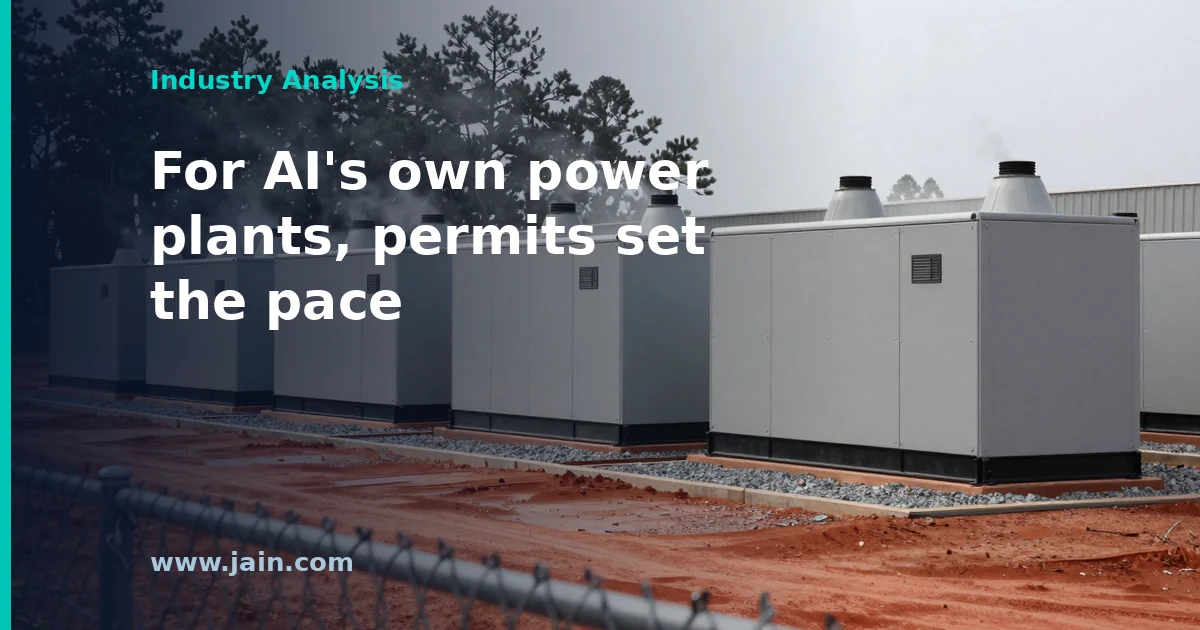
A company building a data center near Atlanta, a warehouse of computers of the kind that runs AI tools, planned its own small power plant next door. The plant uses 33 large engines burning diesel and natural gas.
Environmental groups say the companies started building before Georgia approved the air-pollution permits. The state has now issued formal violation notices.
Why it matters: building your own power is pitched as the fast way to get AI running. This case shows that government approval, not the equipment, decides how fast.
The Georgia Environmental Protection Division (EPD) has issued notices of violation to microgrid company VoltaGrid and data center company Serverfarm over a planned data center and on-site power plant in Covington, southeast of Atlanta. WABE reported the notices on July 7, 2026, citing the Southern Environmental Law Center (SELC), which said the agency acted after inspecting the site.
The companies have applied for state permits for a 33-engine “pop-up” power plant burning diesel and natural gas, plus backup generators for the data center. SELC, Altamaha Riverkeeper and Sustainable Newton allege construction began before those permits were issued and have asked EPD to halt it and assess penalties. VoltaGrid, Serverfarm and EPD did not reply to requests for comment.
Executive Summary
VoltaGrid’s permit application describes the Covington plant as “alternative, rapidly deployable prime power”: 33 internal-combustion engines supplying the data center directly rather than drawing from Georgia Power’s grid. It would be the first project of its kind in Georgia. The environmental groups say engines and emergency generators are already standing, some complete and some under construction, while the permit request is still in public comment.
The significance reaches beyond one site. On-site, or “behind-the-meter,” generation has become a favored answer to the grid bottleneck facing AI data centers, and it has drawn interest from Georgia officials worried about who pays for utility expansion. The Covington dispute shows where that model’s speed advantage runs out: engines can arrive quickly, but air permits under Georgia law and the federal Clean Air Act still have to come first. A notice of violation is not a final penalty, and the companies have not responded publicly. Still, the first project of this type in the state is now under scrutiny, and that sets the tone for the next ones.
Speed Is the Product, and the Permit Is the Clock
The appeal of a pop-up power plant is time. A large data center waiting on a utility can face years of transmission upgrades and new generation. Georgia Power is adding 10 gigawatts of capacity, mostly for data centers. Modular engines like the 33 in VoltaGrid’s application can be shipped, set on pads and wired up in a fraction of that time. VoltaGrid’s own filing calls the power “rapidly deployable,” and that phrase is the business case.
But 33 fuel-burning engines are a significant new source of air emissions. In Georgia they need a state air permit, which the groups say must be issued before construction starts. That permit process includes public comment, and residents have already used it to raise pollution concerns. So the deployment timeline is set by the permit, not by the equipment. The groups allege the companies tried to run both timelines at once. If EPD finds they did, the remedies the groups are requesting, a halt to “all prohibited construction activities” plus penalties, would turn any time saved into delay and legal exposure.
The people affected are specific. Developers pitching bring-your-own power have to schedule around permit decisions, not delivery dates. Data center tenants and financiers counting on an early energization date carry the risk if a regulator stops work. And a stop-work demand on the state’s first such project will likely be read by every developer planning a second one.
Why Bring-Your-Own Power Appeals in Georgia
Georgia is one of the country’s hottest data center markets. Meta already operates a large facility near Covington and Amazon is building one. Georgia Power’s 10-gigawatt expansion has drawn pushback from customers and advocates, who worry that households and small businesses will end up covering part of the cost through rates or fuel charges.
A self-supplied plant addresses that concern directly. If the data center generates its own electricity, there is no new utility infrastructure to recover from other ratepayers. That is why the idea has come up as the Georgia Public Service Commission and the legislature grapple with data center energy demand. The Covington case tests whether that policy preference survives contact with environmental permitting in practice.
The Emissions Trade-Off Does Not Disappear
Moving generation behind the meter changes who pays for power. It does not change what the power plant burns. The VoltaGrid engines would run on diesel and natural gas, and residents’ public comments focus on air pollution from those units, which would sit close to the community rather than at a distant central station. Carbon emissions remain a concern too.
Cleaner options that suit an on-site model, such as the small nuclear reactors some tech companies are pursuing, are still years away. For now, bring-your-own power for AI data centers mostly means fossil-fueled engines or turbines. That makes air permits the main regulatory checkpoint, and it is why the permitting process draws this much attention.
Weighing the Claims on Both Sides
The groups’ case rests on aerial photographs they say show completed and partly built engines and generators, and on EPD’s notices of violation, which SELC says followed an inspection. The notices carry weight because they reflect the regulator’s own finding after a site visit, not only the advocates’ reading of photos. The terms of those notices, and what exactly EPD found, have not been made public by the agency. It is also open to question whether everything visible in the photos counts as prohibited construction rather than staged equipment. The companies are the ones best placed to answer that, and they have not.
The opposition is also not framed as anti-data-center. Nancy Schulz of Sustainable Newton called Meta and Amazon good community partners and said the demand is simply to get permits before building. That framing makes the case about process compliance rather than whether data centers belong in Newton County. It is a narrower claim, and one that EPD’s eventual findings can settle.
Background
Metro Atlanta has become one of the largest data center markets in the United States, driven by demand for the computing that powers generative AI. Newton County, where Covington sits, already hosts a large Meta data center, and Amazon is building another. The boom has divided communities: some local officials welcome the investment and tax revenue, while residents and other leaders have opposed projects over electricity use, water consumption and pollution.
To meet the demand, Georgia Power is adding 10 gigawatts of generation, mostly for data centers. That has fueled debate at the Georgia Public Service Commission and in the legislature about who pays. Having data centers bring their own power has emerged as one proposed answer, and the VoltaGrid–Serverfarm project would be the first power plant of its kind in the state.
Cybersecurity Dive reported on July 8, 2026 that Accenture, one of the world’s largest technology consultancies, is facing a data breach described as massive — one that could put the firm’s clients at risk. Accenture serves a large share of the world’s biggest enterprises and governments, which is precisely why a breach at the firm itself reverberates far beyond its own walls.
At the time of the report, key details — the scope of the compromise, the type of data involved, the attack vector, and which clients may be affected — had not been publicly established. This article works from what the headline report substantiates and flags what it does not.
Executive Summary
The core news is simple and serious: a trade publication that covers enterprise security reported that Accenture faces a massive data breach with potential downstream exposure for its clients. For a company whose business is being trusted with other companies’ systems, data, and transformation programs, that framing — client risk, not just corporate risk — is the story.
Consultancies occupy a uniquely privileged position in the enterprise ecosystem. They hold system credentials, architecture documents, migration plans, source code, and sensitive commercial data for hundreds or thousands of client organizations at once. A breach of a consultancy is therefore best understood as a potential supply-chain event: the attacker’s real prize may not be the consultancy itself but the map it holds to everyone else’s infrastructure.
It matters just as much what the report does not yet establish. As of the July 8, 2026 publication, there was no public confirmation of how many records were taken, which clients were affected, or how the intrusion occurred. Enterprises that work with Accenture — or with any major consultancy — should treat this as a prompt to review third-party access, not as a reason to draw conclusions ahead of the evidence.
The Blast Radius Problem: Why Consultancy Breaches Are Different
When a retailer is breached, the exposure is mostly its own customers. When a consultancy is breached, the exposure is potentially every engagement it has ever run. Firms like Accenture routinely hold what security teams call “crown jewel adjacency”: privileged credentials into client environments, detailed network and cloud architecture diagrams, incident-response playbooks, and unreleased strategic plans. An attacker who compromises that material does not need to breach a hundred enterprises individually — the consultancy’s files can serve as a reconnaissance shortcut into all of them.
This is the same structural logic that made earlier software supply-chain incidents so consequential: compromise one trusted intermediary, inherit the trust of everyone downstream. The report’s framing — that the breach “could put clients at risk” — reflects exactly this dynamic, even before specific client impact is confirmed.
The Credibility Stakes for a Security Vendor
Accenture is not only a consulting client of security best practices; it sells them. The firm operates a substantial cybersecurity practice, advising enterprises on exactly the defenses that a breach of its own environment would test. That creates an uncomfortable but fair question every security-services buyer will now ask: did the firm’s internal controls meet the standard it recommends to clients?
To be even-handed: large attack surfaces get breached, including at firms with mature security programs, and a breach alone does not prove negligence. The meaningful test is what comes next — the speed and completeness of disclosure, whether affected clients are notified directly, and whether the firm publishes enough technical detail for clients to hunt for related activity in their own environments. Consultancies that handle disclosure well have historically preserved client trust; those that minimize or delay have not.
What Enterprise Clients Should Actually Do
For CISOs at organizations that use large consultancies, the practical playbook does not depend on this incident’s final details. First, inventory what access the firm holds: VPN accounts, cloud roles, service accounts, shared repositories, and data extracts sitting in the consultancy’s environment. Second, rotate credentials that the consultancy could plausibly hold and review logs for anomalous use of those accounts. Third, check contract terms — breach-notification windows, audit rights, and liability caps — because those clauses, negotiated in calmer times, determine what information clients are entitled to now.
The broader lesson is about concentration risk. Enterprises have spent a decade consolidating work with a handful of global integrators because scale brings efficiency. The same consolidation means a single compromise can touch a very large fraction of the Fortune Global 500 at once. Third-party risk programs that treat consultancies as low-risk “professional services” vendors, rather than as privileged-access technology suppliers, are mis-rating the exposure.
Incident Reporting in the Fog: Reading a One-Source Story
It is worth being candid about the evidentiary state of this story. The available source is a single trade-press headline stating that Accenture “faces” a massive breach that “could” put clients at risk — conditional language on both counts. There is no public statement from the company in the source material, no attacker claim assessed, and no technical indicators published. Early breach reporting is often directionally right but wrong on scale in either direction: some “massive” breaches shrink under investigation, while some initially minimized incidents grow.
The fair posture, for clients and observers alike, is to take the report seriously as a signal while withholding judgment on scope. The questions that matter — enumerated below — are the ones any complete disclosure would answer.
Background
Accenture is among the world’s largest professional-services and technology consulting firms, with hundreds of thousands of employees serving a substantial share of the Fortune Global 500 across strategy, systems integration, cloud migration, outsourcing, and cybersecurity. That footprint makes it one of the most deeply embedded third parties in global enterprise IT: its consultants routinely operate inside client networks and hold clients’ most sensitive technical documentation.
The firm has faced security incidents before. In 2021, the LockBit ransomware group claimed to have stolen Accenture data, and the company acknowledged and said it contained a security incident; in 2017, security researchers found misconfigured Accenture cloud-storage buckets exposing internal keys and credentials. Those episodes, like this one, drew attention because of the gap between a security consultancy’s advisory role and its own exposure — a tension the entire consulting industry manages as it becomes an ever-larger target.
Blue Owl Capital, the New York-listed alternative asset manager, has unveiled an infrastructure venture catering to data centers, according to a Bloomberg report published July 8, 2026. The available material confirms the launch itself but discloses few specifics — no fund size, capital target, anchor tenants, or geographic focus were included in the source we reviewed.
Executive Summary
According to Bloomberg, Blue Owl Capital has launched a dedicated infrastructure venture aimed at data centers. Blue Owl is already one of the most active private-capital players in digital infrastructure, so a purpose-built vehicle is less a change of direction than a formalization of where the firm has been deploying money at scale.
The significance is structural. When a major asset manager stands up a named venture for a single asset class, it signals that data centers have graduated from an opportunistic real-estate niche into a core institutional allocation — with dedicated teams, dedicated fundraising, and a mandate to deploy through cycles. For operators, hyperscalers, and competing capital providers, that changes who they negotiate with and on what terms. That said, the source material is thin: until Blue Owl or its investors disclose the venture’s size, structure, and pipeline, the announcement should be read as a statement of intent whose scale remains unverified.
Institutional Capital Is Now Purpose-Built for the AI Buildout
For most of the data center industry’s history, projects were financed by specialist REITs (real estate investment trusts — companies that own income-producing property) and corporate balance sheets. The AI era broke that model: individual campuses now carry price tags that rival power plants and airports, sums beyond what even large operators can carry alone. The gap is being filled by alternative asset managers — firms that invest institutional money such as pension and sovereign-wealth capital outside public markets.
A dedicated venture, as opposed to deal-by-deal participation, matters because it creates standing capacity. Committed capital with a single mandate can underwrite faster, warehouse land and power positions, and fund multi-year construction schedules without reassembling an investor group for each project. If Blue Owl’s new vehicle follows that pattern, it institutionalizes a pipeline rather than a transaction.
Blue Owl’s Path From Lender to Data Center Heavyweight
Blue Owl did not arrive at this from a standing start. The firm, formed in 2021 from the merger of direct lender Owl Rock and GP-stakes investor Dyal Capital, acquired IPI Partners’ digital-infrastructure business in 2024 and has since backed some of the largest data center financings on record, including a joint venture reported at roughly $27 billion to fund Meta’s hyperscale campus in Louisiana and a multibillion-dollar vehicle behind a flagship AI campus in Abilene, Texas.
Read against that history, a dedicated infrastructure venture looks like the next logical step: converting a string of headline deals into a durable franchise. The open question — unanswered by the available reporting — is whether the new venture sits alongside, absorbs, or competes with the strategies Blue Owl already runs, and whether it targets equity ownership, credit, or the net-lease structures (long-term leases where the tenant bears operating costs) the firm is known for.
The Economics: Why Data Centers Fit This Capital
Data centers leased to investment-grade hyperscalers behave, financially, like bonds with a building attached: long contracts, creditworthy counterparties, and predictable cash flows. That profile is exactly what insurance and retirement capital wants, and it explains why asset managers can raise enormous sums for the sector even as construction costs and power constraints mount.
The winners in this arrangement are developers who gain a deep-pocketed capital partner, and AI companies who can expand without consuming their own balance sheets. The tension is on pricing and risk: as more institutional money chases the same tenants, yields compress, and capital may reach further down the credit spectrum — toward newer AI firms whose long-term ability to pay decade-long leases is less proven.
Risks the Boom Should Not Obscure
Purpose-built capital cuts both ways. Concentration is the obvious hazard: much of the sector’s contracted revenue traces back to a handful of hyperscalers and AI labs, so a slowdown in AI spending would ripple through every vehicle exposed to it. Technology risk is real too — facilities designed for today’s chip densities and cooling requirements may need costly retrofits within a lease term. And power, not money, is increasingly the binding constraint; capital that cannot secure grid connections cannot deploy. None of these risks is unique to Blue Owl, but a venture of this kind will be judged on how it prices them, and the launch reporting gives no visibility into that yet.
Background
Blue Owl Capital was formed in 2021 through the merger of Owl Rock Capital, a direct-lending specialist, and Dyal Capital, which buys stakes in other asset managers; it went public via SPAC and now manages well over $200 billion. Its push into digital infrastructure accelerated with the 2024 acquisition of IPI Partners’ data center investment business and a series of landmark hyperscale financings in 2025, spanning net-lease deals and development joint ventures with major cloud and AI tenants.
The backdrop is a historic capital cycle: AI training and inference demand has pushed data center construction to record levels, with individual campuses drawing power measured in gigawatts and financing needs that have pulled in private equity, private credit, sovereign funds, and insurance capital alongside the traditional operators.
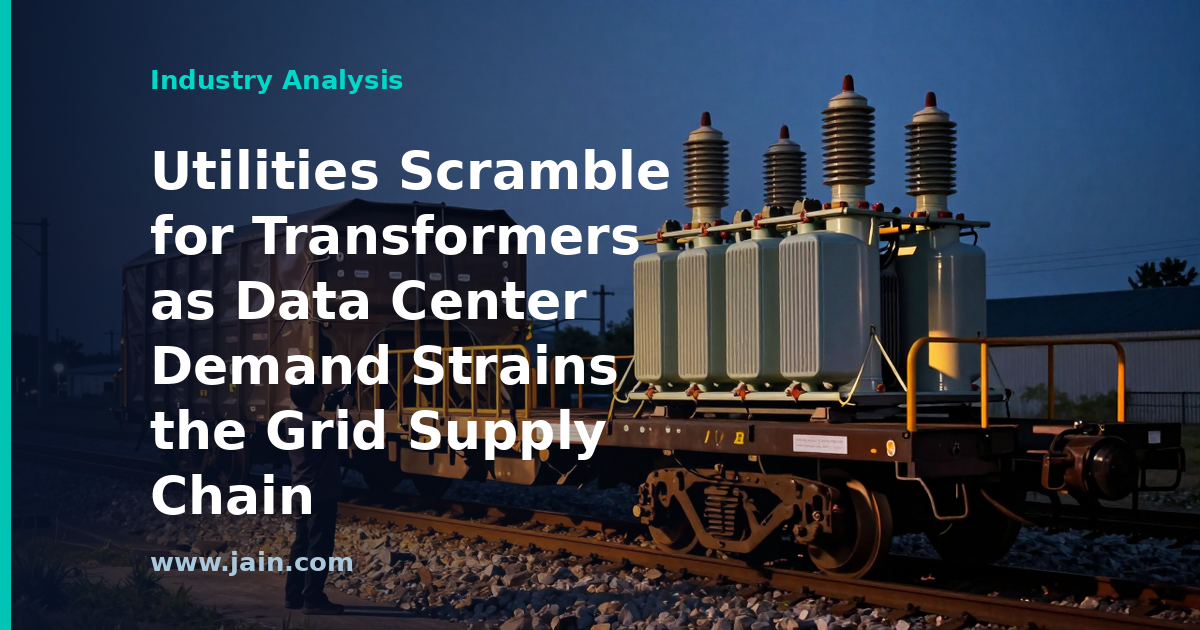
Reuters reported on July 8, 2026 that US power companies are scrambling to secure electrical equipment — the transformers, switchgear, and related grid hardware that move electricity from generators to customers — as surging demand from data centers strains available supplies. The report frames a nationwide procurement crunch: utilities that once ordered this equipment on routine replacement cycles are now competing for constrained manufacturing capacity against a wave of new large-load projects.
Executive Summary
The headline is not about a single deal or data center campus; it is about the industrial base underneath all of them. Transformers step electrical voltage up for long-distance transmission and back down for delivery, and switchgear is the apparatus that switches, protects, and isolates circuits. Neither is optional: every new data center interconnection, substation upgrade, and grid expansion needs both. Reuters’ reporting indicates that US utilities can no longer take timely delivery of this equipment for granted.
Why it matters: for the first time in decades, US electricity demand is growing meaningfully, and data centers — particularly AI-driven facilities — are a leading cause. When the equipment supply chain becomes the pacing item, it stops being a utility procurement problem and becomes a constraint on data center delivery schedules, grid reliability investment, and ultimately on how fast the AI buildout can proceed. Power availability has already emerged as the industry’s defining bottleneck; this report locates part of that bottleneck one layer deeper, in the factories that make grid components.
Why Transformers Became the Grid’s Chokepoint
Large power transformers are among the least glamorous and most consequential machines in the economy. They are heavy, highly engineered, often custom-built to a specific substation’s requirements, and produced by a relatively small number of manufacturers worldwide. Capacity to build them cannot be added quickly: it requires specialized factories, scarce materials such as grain-oriented electrical steel, and skilled workers who take years to train.
The US grid spent roughly two decades with flat electricity demand, and the supply chain sized itself accordingly — tuned for steady replacement of aging units, not for a demand shock. When data center load growth, electrification, and grid-hardening programs all began pulling on that thin manufacturing base at once, order backlogs stretched and utilities found themselves queuing for hardware. The scramble Reuters describes is the predictable result of a just-in-time supply chain meeting a step change in demand.
When Equipment Lead Times Set the Data Center Schedule
For data center developers, this crunch changes what “time to power” means. A site can have land, fiber, permits, and even a utility willing to serve it, and still wait on a transformer delivery slot. Interconnection — the process of physically and contractually tying a new load into the grid — increasingly depends less on paperwork and more on whether the required substation equipment physically exists.
That reality is reshaping behavior on both sides of the meter. Utilities are reported to be securing equipment earlier and more aggressively, which effectively shifts them from reactive procurement to strategic stockpiling. Large data center operators, for their part, have strong incentives to lock in capacity years ahead, pre-order long-lead equipment themselves, or favor sites where grid infrastructure already exists — one reason established carrier hotels and campuses with existing substation capacity have gained strategic value relative to greenfield sites.
The Economics of Scarcity: Who Absorbs the Cost
Scarcity moves pricing power toward manufacturers. Electrical-equipment makers with transformer and switchgear capacity are in an unusually strong position, and the open question is how much they will invest in expansion — factories are decade-scale bets, and executives remember the last long stretch of flat demand. Utilities, meanwhile, typically recover equipment costs through regulated rates, which means sustained price inflation in grid hardware eventually reaches ratepayers and invites regulatory scrutiny over how much of the buildout data center customers should fund directly.
Among data center players, scarcity favors scale and incumbency. Hyperscale operators can pre-purchase equipment, sign long-term supply agreements, and absorb schedule risk in ways smaller developers cannot. If the crunch persists, expect it to act as a filter: well-capitalized projects with early equipment commitments proceed, while speculative projects — announced capacity without secured power and hardware — quietly slip or die. That could rationalize an overheated development pipeline, but it also raises barriers to entry across the industry.
What Could Break the Bottleneck
Several paths out exist, none fast. Manufacturers can and do add capacity, but new production lines take years to reach output. Standardizing transformer designs — reducing the custom engineering in each order — could raise effective throughput. Utilities can extend the life of existing units, share spares, and prioritize deployments. On the demand side, data centers that bring their own generation or agree to flexible operation reduce the immediate grid equipment burden.
The honest assessment is that this is a multi-year imbalance. Equipment supply is a lagging system responding to a leading demand signal, and the gap between them is where project delays, price escalation, and strategic maneuvering will play out. For infrastructure operators, the practical takeaway is that secured power and in-hand electrical equipment are now assets in their own right, worth nearly as much as the buildings around them.
Background
For most of the 2000s and 2010s, US electricity demand barely grew, thanks to efficiency gains offsetting economic expansion. That era ended as data centers — driven most recently by AI training and inference workloads — joined manufacturing reshoring and electrification as major new sources of load. Utilities, regulators, and grid operators have spent the past several years revising demand forecasts upward and confronting the fact that generation, transmission, and the equipment supply chain were all sized for a slower world.
Concerns about transformer supply predate the AI boom — the aging of the US transformer fleet and the concentration of manufacturing capacity have been discussed in grid-security circles for years — but data center growth has converted a slow-burning replacement problem into an acute procurement race. The July 2026 Reuters report captures that shift from the utilities’ side of the table.
Ecolab, the Minnesota-based water, hygiene and industrial services company, has closed its $4.75 billion acquisition of CoolIT Systems, a Calgary-based specialist in liquid cooling for high-density computing. The deal, reported by Electronics360 on July 7, 2026, gives Ecolab a foothold in direct-to-chip cooling technology used in AI training clusters.
Executive Summary
The acquisition places Ecolab, historically known for cleaning chemicals and water treatment, squarely inside one of the fastest-growing subsegments of data center infrastructure: liquid cooling for AI workloads. CoolIT’s direct-to-chip (DTC) systems circulate coolant across cold plates mounted on processors, removing heat that increasingly cannot be shed with air alone.
At $4.75 billion, the price signals that Ecolab views AI-driven thermal management as a durable industrial category rather than a cyclical bet. It also consolidates a market that, until recently, was populated largely by specialist engineering firms. For buyers of AI infrastructure, the transaction raises questions about supplier concentration; for competitors, it raises the bar for the scale of balance sheet needed to serve hyperscale customers.
Why Liquid Cooling, and Why Now
Modern AI accelerators, such as the GPUs used to train large language models, dissipate hundreds to over a thousand watts per chip. Once rack densities exceed roughly 30-50 kilowatts, forced-air cooling becomes impractical: fans cannot move enough air, and the room-level heat load overwhelms conventional CRAC (computer room air conditioning) units. Direct-to-chip liquid cooling, which CoolIT sells, moves a fluid across a cold plate bolted to each chip and carries heat out of the rack via a coolant distribution unit. It is more efficient than air, but demands new plumbing, materials expertise, and long-term service contracts — precisely the kind of recurring industrial work Ecolab is built to sell.
The timing reflects a broader shift. Hyperscale operators and colocation providers are retrofitting existing halls and designing new campuses around liquid-ready racks. That transition creates a decade-long tail of installation, chemistry, monitoring and maintenance revenue, which fits Ecolab’s route-based service model more naturally than one-off equipment sales.
Industrial Services Meets Silicon
Ecolab’s core competency is delivering water, cleaning and process chemistry to industrial customers at scale, with technicians on site and consumables on subscription. CoolIT’s core competency is engineering cold plates, manifolds and coolant distribution units for demanding compute environments. The strategic thesis is that these are complementary: CoolIT gets access to a global services organization and enterprise procurement relationships; Ecolab gets a defensible product line in a growth market where its existing water-treatment expertise — corrosion, biofouling, fluid chemistry — is directly relevant.
The risk in that thesis is cultural and technical integration. Data center customers demand tight change control, rapid engineering iteration, and validated compatibility with each new generation of chip. Industrial-services firms historically operate on slower cycles. Whether Ecolab preserves CoolIT’s engineering cadence, or slows it in pursuit of scale efficiencies, will shape the deal’s outcome.
Market Structure and Competitive Response
Liquid cooling has been an active acquisition target across the infrastructure industry, with mechanical, electrical and chemical majors all seeking exposure. Ecolab’s $4.75 billion outlay is large enough to reset valuation expectations for remaining independent cooling specialists, and to encourage rival strategics to accelerate their own moves. For hyperscalers standardizing on multi-vendor supply chains, further consolidation could narrow sourcing options and increase reliance on a small number of large suppliers.
Competitors — including established thermal management vendors and newer entrants building rear-door heat exchangers or immersion systems — now face a rival with a global service footprint they cannot easily replicate. Immersion cooling, which submerges entire servers in dielectric fluid, remains a parallel approach that this deal does not directly address, leaving room for differentiated bets.
Background
Ecolab has spent decades building a global route-based industrial services business, selling water treatment, cleaning chemistry and related engineering to manufacturers, hospitals, food processors and utilities. CoolIT Systems, founded in Calgary, grew from PC cooling into an established supplier of liquid cooling hardware for enterprise and high-performance computing, expanding sharply as AI training clusters drove rack power densities beyond the limits of air cooling.
Liquid cooling itself is not new — mainframes used it decades ago — but the surge in AI-driven demand has turned a niche into a strategic infrastructure category. Direct-to-chip systems are now standard in new hyperscale AI builds, and retrofits of existing data halls are underway across the industry.
The Brookings Institution, a Washington-based public policy think tank, published an analysis on July 7, 2026 arguing that the wave of local opposition to data center construction across the United States is more than scattered NIMBY friction — it is an early signal of a broader political and economic fight over how much electricity artificial intelligence will consume, and who will pay for it.
Executive Summary
According to the piece’s framing, communities near proposed data center campuses are increasingly pushing back on projects through zoning hearings, moratoriums, and local elections. Brookings connects these disputes to the underlying driver: AI workloads require enormous amounts of electricity, and the infrastructure to deliver it — generation, transmission lines, and substations — lands in specific towns and counties whose residents did not sign up for it.
Why it matters: the data center industry has historically won siting battles on the strength of tax revenue and jobs arguments. If Brookings is right that opposition is hardening into an organized, durable political force, the industry’s expansion model — fast site acquisition, utility-negotiated power deals, and light-touch local engagement — may need to change. For an industry racing to build AI capacity, the constraint may prove to be not capital or chips, but community consent and grid access.
The Grid Is Where AI Meets Local Politics
Data centers are unusual among industrial facilities: they consume power on the scale of heavy manufacturing while employing relatively few permanent workers. That asymmetry is at the heart of the backlash Brookings describes. A large AI campus can draw as much electricity as a small city, which means new transmission lines, new substations, and in some regions new generation — all of which are visible, local, and subject to public process. AI is often discussed as an abstract technology; the grid is where it becomes a land-use question that a county board can vote on.
This gives local governments real leverage. Zoning approvals, special-use permits, and utility interconnection queues are choke points where a project can be delayed for years or killed outright. The industry has long treated these as procedural hurdles; the Brookings framing suggests they are becoming political contests.
Ratepayers, Tax Deals, and the Question of Who Pays
The economics beneath the backlash deserve attention. When a utility builds infrastructure to serve a massive new load, the cost recovery question — does the data center operator pay its full share, or do costs get socialized across all ratepayers — is decided in regulatory proceedings most residents never see. Where residents perceive that their electric bills are rising to serve a tech company’s servers, opposition tends to sharpen. Several state utility commissions have begun creating special large-load rate classes to address exactly this concern, an implicit acknowledgment that the old cost-allocation model strains under AI-scale demand.
Tax abatements cut the same way. Data centers are frequently recruited with incentive packages, and critics ask whether the revenue and job numbers justify them. Operators who can demonstrate full cost-of-service payment and transparent community benefit will be better positioned than those relying on confidentiality agreements and after-the-fact announcements.
What Hardening Opposition Means for the Buildout
If backlash becomes systematic, expect three shifts. First, siting migrates toward jurisdictions that actively want the load — regions with surplus generation, declining industrial demand, or explicit pro-data-center policy. Second, timelines lengthen and carry more political risk, which favors operators with existing land banks, secured power, and strong community track records over new entrants assembling projects from scratch. Third, self-supplied power — on-site generation, long-term clean energy contracts, and eventually small modular reactors — becomes more attractive precisely because it reduces the project’s visible draw on the shared grid.
None of this stops the AI buildout; demand is too strong. But it changes who can build, where, and how fast — and it rewards the operators who treat community engagement and grid stewardship as core competencies rather than public relations.
Background
Data centers — the warehouse-scale buildings full of servers that run websites, cloud services, and AI models — have expanded rapidly since generative AI took off in late 2022, with hyperscale operators and specialized developers announcing successive waves of multi-gigawatt campuses across the United States. Electricity availability has replaced land and fiber as the industry’s primary constraint, pulling utilities, state regulators, and local governments into what was once a quiet corner of commercial real estate. Northern Virginia, the world’s largest data center market, became an early flashpoint for community opposition, and similar disputes have since surfaced in markets across the country, making siting politics a national story that policy institutions like Brookings now track.
Cooling vendor Wafr Technologies has raised $100 million, according to a report carried by Data Center Dynamics on July 7, 2026. The publication characterized the raise as a report rather than a company announcement, and the item available to us does not name the investors, the round structure, or the intended use of proceeds.
Executive Summary
According to the Data Center Dynamics item, Wafr Technologies — identified simply as a cooling vendor — has reportedly secured $100 million in new funding. That is the extent of what the source substantiates: a company name, a sector, a dollar figure, and the qualifier “report,” which signals the news has not been confirmed in detail by the company itself.
Even in that skeletal form, the story matters because of what it represents. Cooling — the unglamorous business of moving heat away from computer chips — has become one of the tightest constraints on data center construction in the AI era. A nine-figure round for a cooling specialist, if confirmed, would be another data point in a clear pattern: capital that once flowed almost exclusively to chips, land, and power is now chasing thermal management, because without it the rest of the AI buildout stalls.
Why Heat Became the Industry’s Chokepoint
For most of the data center industry’s history, cooling was a solved problem: blow chilled air across servers, exhaust the hot air, repeat. That model works up to roughly the power density of a traditional enterprise rack. AI training hardware broke the equation. Modern accelerated-computing racks draw many times what air can economically remove, which is why the industry is shifting to liquid cooling — circulating fluid directly to cold plates on the chips, or immersing hardware in dielectric fluid — to carry heat away far more efficiently than air ever could.
That transition is not optional for AI-class facilities, and it is happening faster than the supply chain matured. Cold plates, coolant distribution units, rear-door heat exchangers, and the engineering talent to deploy them have all been in tight supply. When a component becomes the binding constraint on a trillion-dollar buildout, capital follows. A reported $100 million round for a cooling vendor fits that logic precisely.
What a Nine-Figure Round Signals About the Market
Cooling has historically been the domain of large industrial incumbents — the Vertivs and Schneider Electrics of the world — for whom thermal management is one product line among many. Venture-scale money flowing to independent cooling specialists suggests investors believe the liquid-cooling transition is big enough, and moving fast enough, to support new entrants rather than simply enlarging incumbents’ order books.
It also says something about where returns are perceived to be. Building data centers is capital-intensive and increasingly commoditized; supplying the critical components that gate construction can carry better margins and faster growth. Investors who missed the GPU wave or the land-and-power wave may see thermal management as the remaining underpriced layer of the AI infrastructure stack. Whether that thesis pays off depends on execution questions this report cannot answer — but the direction of the money is itself informative.
Winners, Losers, and the Scaling Test Ahead
If the raise is confirmed, the most immediate beneficiaries are data center operators and their customers: more capitalized suppliers mean more manufacturing capacity, shorter lead times, and more competitive pricing in a segment where demand has outrun supply. Chipmakers benefit indirectly, since every rack that can be cooled is a rack that can be sold.
The harder question is whether a funded challenger can convert capital into share. Cooling is a trust business — operators are conservative about anything that puts liquid near multi-million-dollar hardware — and incumbents hold deep service networks and long-standing customer relationships. History in this industry suggests that well-funded specialists either scale into meaningful suppliers, get acquired by incumbents seeking their technology, or burn capital competing on price. A $100 million war chest buys time to find out which path applies; it does not guarantee the answer.
Reading a Report, Not a Press Release
It is worth being precise about the evidentiary status here. The source is a trade-press item flagged as a report — not a company announcement, not a regulatory filing. The figure could ultimately prove different in size, structure (equity versus debt), or timing. Trade reporting on private raises is often directionally right and precisely wrong. Until Wafr Technologies or its investors confirm the details, the responsible reading is: a credible industry publication believes a cooling vendor has attracted roughly $100 million, and that belief is consistent with everything else happening in the thermal-management market.
Background
For decades, data center cooling meant air: chillers, raised floors, and hot-aisle containment, handled largely by big industrial suppliers as one product line among many. The AI era upended that. Racks built around modern accelerators draw several times the power of traditional enterprise racks, pushing the industry toward direct-to-chip liquid cooling and immersion systems that can remove heat air cannot. That transition turned a mature, sleepy segment into one of the most supply-constrained corners of the infrastructure market, and capital has followed — into incumbents’ expansion and, increasingly, into independent specialists.
Wafr Technologies enters the public record here with little published history: the report available to us identifies it only as a cooling vendor. That thinness is itself common in this cycle, where private thermal-management companies often surface in trade press via funding reports before making detailed public disclosures.
The Wall Street Journal reported on July 7, 2026 that Nokia, the Finnish company once synonymous with mobile phones, is staging a “new act”: supplying networking equipment to the AI data center buildout. The framing marks a strategic shift for a firm whose revenue has long depended on telecom operators, toward the hyperscale cloud and AI companies now driving the industry’s largest capital-spending wave.
Executive Summary
The story here is a repositioning, not a product launch. Nokia has spent the past two years assembling the pieces of a data center strategy: it closed its roughly $2.3 billion acquisition of optical-networking specialist Infinera in early 2025, installed Justin Hotard — previously head of Intel’s data center and AI business — as CEO in April 2025, and in late 2025 announced a partnership with Nvidia that included Nvidia taking an approximately $1 billion equity stake. The WSJ’s July 2026 feature treats these threads as a coherent identity change: legacy telecom vendor becomes AI-infrastructure supplier.
Why it matters: telecom-carrier capital spending — Nokia’s traditional market alongside rival Ericsson — has been stagnant for years, while spending on AI data centers has exploded. Every AI campus needs high-capacity switching inside the facility and optical links between facilities, and that is precisely the equipment Nokia now sells. Whether the pivot moves Nokia’s financial needle, however, is a claim the headline asserts more than the available material proves.
Why a Telecom Giant Is Chasing Data Centers
Nokia’s core customers — mobile and fixed-line network operators — buy equipment in cycles tied to generational upgrades like 5G, and that cycle has matured. Carriers worldwide have trimmed capital budgets, leaving suppliers fighting over a flat market. Data centers present the opposite picture: hyperscalers (the largest cloud and AI companies, such as the major U.S. cloud platforms) are committing historic sums to new AI capacity. For a networking vendor, following the capital is rational; the buildout needs exactly the routing, switching, and optical transport gear Nokia’s network-infrastructure division makes.
The strategic logic is also defensive. If AI workloads keep pulling investment away from traditional telecom networks, a supplier that stays carrier-only shrinks with its customers. Diversifying the customer base toward cloud and enterprise buyers reduces Nokia’s dependence on a concentrated, slow-growing set of operators.
The Infinera Bet and the Optical Opportunity
The most concrete evidence behind the “new act” narrative is the Infinera acquisition, completed in early 2025. Infinera builds optical transport systems — the technology that pushes enormous data volumes over fiber between sites — and counted cloud providers among its customers, something Nokia’s carrier-heavy optical business had less of. Data center interconnect, the fiber links that stitch AI campuses into distributed clusters, is one of the fastest-growing corners of optical networking, because AI training increasingly spans multiple buildings and even multiple regions.
Leadership reinforces the signal. Hiring a CEO from Intel’s data center and AI unit, rather than a telecom veteran, told the market where Nokia thinks its growth lives. The Nvidia partnership announced in late 2025 — spanning AI-powered radio networks and data center networking, with Nvidia’s equity stake attached — gave the strategy a marquee endorsement, though partnerships of that kind announce intent, not revenue.
A Crowded Field of Entrenched Rivals
The hard part is that data center networking has incumbents with deep roots. Ethernet switching inside AI facilities is dominated by established players such as Arista Networks and Cisco, with Nvidia itself selling networking gear alongside its chips, and merchant-silicon suppliers like Broadcom powering much of the market. Hyperscalers are demanding, technically sophisticated buyers who qualify vendors slowly and negotiate hard on price. Nokia is not starting from zero — it has long sold IP routing and optical gear — but winning share inside the AI cluster, as opposed to the links between facilities, means displacing suppliers the hyperscalers already trust.
That competitive reality is why the pivot should be judged by design wins and revenue mix over time, not by strategic announcements. A vendor can be genuinely present in the AI buildout while capturing only a modest slice of its economics.
Reinvention Is Nokia’s Oldest Habit — and Its Hardest Trick
Nokia has reinvented itself before: from a 19th-century paper and rubber business, to the world’s dominant handset maker, to a network-equipment company after selling its phone business to Microsoft in 2014 and absorbing Alcatel-Lucent in 2016. That history cuts both ways. It shows an organization capable of wholesale change, and it shows how brutal such transitions are — the handset collapse remains a business-school case study in losing a platform shift. The AI pivot asks Nokia to serve a customer type with different buying behavior, faster product cycles, and thinner tolerance for legacy overhead than the carriers it grew up with. The company’s ability to keep funding its telecom base while investing to hyperscaler speed is the execution question that will decide whether this act succeeds.
Background
Nokia, founded in Finland in 1865, has cycled through several corporate identities: industrial conglomerate, dominant mobile-phone maker, and — after selling its handset business to Microsoft in 2014 and acquiring Alcatel-Lucent in 2016 — a network-equipment supplier competing chiefly with Ericsson and Huawei for telecom-operator spending. That carrier market has stagnated as the 5G investment cycle matured, pressuring Nokia and its peers to find new growth.
The AI boom reshaped the equipment landscape: hyperscale cloud and AI companies became the industry’s biggest spenders, building data center campuses that consume vast amounts of networking gear. Nokia moved toward that demand with its Infinera optical acquisition (closed early 2025), the appointment of former Intel data center chief Justin Hotard as CEO (April 2025), and a late-2025 Nvidia partnership with an accompanying equity investment — the sequence of moves the WSJ’s July 2026 feature frames as the company’s “new act.”
Source: Nokia’s New Act: Supplying the AI Data Center Boom — Wall Street Journal feature on Nokia’s strategic shift from telecom-carrier equipment toward supplying the AI data center buildout, published July 7, 2026.