Wyoming officials have publicly attributed contamination in a local water system to Meta’s 715,000-square-foot data center, according to a Fortune report dated July 11, 2026. The precise nature of the contamination, its geographic scope, and the regulatory pathway that follows are not detailed in the headline itself.
Executive Summary
A state-level attribution linking a hyperscale data center to municipal water contamination is unusual and, if substantiated by underlying agency findings, notable for the industry. Meta’s Wyoming facility is a large campus by any measure — 715,000 square feet is roughly the footprint of a mid-sized regional shopping mall — and any operational connection to public water quality would sit at the intersection of two of the industry’s most contested issues: consumption and discharge.
For infrastructure buyers, developers, and municipal partners, the significance is less about a single site and more about the precedent. Water permitting for large campuses has become a gating factor in siting decisions across the western United States, and a documented contamination event — as opposed to a consumption dispute — would reshape how utilities, insurers, and regulators evaluate future projects.
What A Contamination Claim Actually Implies
Data centers interact with municipal water in two very different ways. Most public criticism focuses on consumption: evaporative cooling towers withdraw treated drinking water and release it as vapor. Contamination is a separate mechanism entirely, typically involving discharge of treated cooling water, chemical additives used to control scale and biological growth, backup generator fluids, or construction-era runoff. The Fortune headline does not specify which pathway Wyoming officials are pointing to, and that distinction will determine both the regulatory response and the difficulty of remediation.
The underlying question — one the source article, not the headline, would need to answer — is whether officials are describing a discrete incident, a chronic exceedance of a permitted limit, or a correlation that investigators have not yet mechanistically explained. Each of those is a different story, with different implications for Meta and for the surrounding community.
Wyoming’s Position In The Hyperscale Map
Wyoming has courted large data center investment for more than a decade, leveraging cold climate, low power costs, and a light regulatory footprint. That pitch has attracted multiple hyperscalers and, with them, a growing base of local jobs, tax revenue, and infrastructure spending. A state-level attribution of harm to one of those anchor tenants is, therefore, politically noteworthy: it suggests the finding survived internal review by an administration that has generally welcomed the industry.
For competing jurisdictions — Virginia, Texas, the Ohio Valley, the Pacific Northwest — a Wyoming contamination case would enter the record cited by community groups opposing new campuses. It would not, on its own, halt the buildout, but it raises the evidentiary bar operators face during permitting and community engagement.
Reading The Story Fairly
Two things can be true simultaneously. State officials making a formal attribution deserve to be taken seriously; agencies rarely name a specific operator without documentation they believe will survive scrutiny. At the same time, an operator has the right to see the technical basis, contest methodology, and propose alternative explanations before conclusions harden. The headline as circulated does not indicate whether Meta has responded, whether an enforcement action has been filed, or whether the finding is preliminary.
Readers — and buyers evaluating hyperscale partners — should watch for the underlying agency documents, any notice of violation, and Meta’s technical response. Coverage that stops at the headline, on either side, is not enough to draw conclusions about culpability or scale of harm.
Background
Meta, the parent company of Facebook, Instagram, and WhatsApp, operates a large data center portfolio to support its consumer platforms and, increasingly, its AI workloads. The company has invested in Wyoming for years, with Cheyenne serving as a long-standing hub for its western infrastructure footprint.
The broader industry is in the middle of a hyperscale buildout driven by generative AI demand. Water — both how much is consumed for cooling and what is returned to the environment — has emerged alongside power and land as one of the three constraints most likely to shape where the next generation of campuses is built.
Corning Incorporated (NYSE: GLW), the U.S. glass and optical-fiber maker, has landed a supply deal with Amazon and a tie-up with Nvidia to support AI-driven fiber expansion, according to a Yahoo Finance report dated July 11, 2026. The report identifies the two partners and the AI-infrastructure context but discloses no financial terms, volumes, or timelines.
Executive Summary
According to the report, Corning has secured two of the most consequential names in AI infrastructure as partners: Amazon, the largest cloud provider through AWS, and Nvidia, whose GPUs power the bulk of AI training clusters. The pairing matters because it spans both ends of the optical market — a hyperscale buyer locking in fiber supply for data-center construction, and a chipmaker whose networking roadmap increasingly depends on optics engineered into the systems themselves.
The deeper signal is about scarcity. For three years the AI build-out narrative has centered on GPUs, then power, then land and cooling. Deals like these suggest the industry is now moving down the stack to connectivity: the millions of fiber strands that stitch tens of thousands of accelerators into a single usable computer. When buyers of Amazon’s and Nvidia’s scale contract directly with a fiber manufacturer, it typically means they no longer trust the spot market to deliver.
Fiber Is the Layer the AI Boom Forgot to Price In
An AI data center is, in networking terms, unlike anything the cloud era built. Traditional cloud facilities connect servers that mostly work independently; AI training clusters must make thousands of GPUs behave like one machine, which requires every accelerator to talk to every other at extreme speed. That drives fiber consumption per megawatt to multiples of what conventional data centers use — dense mesh fabrics of optical links inside the building, plus long-haul routes connecting campuses into distributed training networks.
Corning has been positioning for this shift for some time. In 2024 it struck a widely reported agreement with Lumen Technologies that reserved roughly 10% of its global fiber capacity to interconnect AI data centers — an early sign that fiber, a product long treated as a commodity, was becoming something buyers reserve years ahead. A reported Amazon deal would extend that pattern from carriers to the hyperscalers themselves.
What Amazon and Nvidia Each Want — and Why It’s Not the Same Thing
Amazon’s interest is straightforward supply security. AWS has committed to one of the largest capital programs in corporate history, building AI campuses that each require enormous quantities of fiber-optic cable, connectors, and pre-terminated assemblies. Contracting directly with the manufacturer hedges against the lead-time blowouts that hit transformers and switchgear, and can lock in pricing before competitors absorb capacity.
Nvidia’s angle is architectural. As GPU clusters scale, the copper links traditionally used for short connections run out of reach and power budget, pushing the industry toward optics integrated ever closer to the chip — including co-packaged optics, where the optical components sit in the same package as the switch silicon. Nvidia has publicly built a silicon-photonics ecosystem around its networking platforms, and Corning has previously been named among its optics partners. A deepened tie-up would suggest fiber makers are moving up the value chain, from selling cable to co-engineering the optical guts of AI systems.
Winners, Losers, and What the Report Actually Establishes
If the deals are as described, Corning gains something rare for a components maker: demand visibility anchored to the two most creditworthy names in AI. Other fiber and connectivity suppliers — Prysmian, CommScope, Fujikura, Sumitomo — face a market where marquee demand is being locked up bilaterally, which can lift the whole sector’s pricing but also concentrates the best volumes with the leader. Buyers without such agreements, including telecom carriers and enterprises mid-way through their own fiber projects, may face longer lead times if AI demand absorbs available capacity.
That said, the source material here is thin: a headline confirming that deals exist, not what they contain. No dollar values, durations, capacity commitments, or product scope are disclosed. Supply agreements in this industry range from binding take-or-pay contracts to loose framework arrangements that generate headlines but little guaranteed revenue. Until terms emerge — in an SEC filing, an earnings call, or a detailed release — the prudent reading is directional: fiber is now strategic enough that Amazon and Nvidia negotiate for it directly, and that fact alone is meaningful.
Background
Corning invented the first commercially viable low-loss optical fiber in 1970 and has remained one of the world’s largest fiber producers through every connectivity cycle since — the dot-com fiber glut, fiber-to-the-home, and the cloud data-center era. Its optical communications segment sells fiber, cable, and pre-connectorized hardware to carriers and, increasingly, to hyperscale data-center operators.
The AI era reframed that business. Beginning around 2024, Corning began striking capacity-reservation agreements tied explicitly to AI data-center interconnection, including its Lumen Technologies deal, and was named among the partners in Nvidia’s silicon-photonics ecosystem. The reported Amazon and Nvidia deals of July 2026 continue that trajectory: fiber shifting from commodity purchase to strategically contracted supply.
The US Cybersecurity and Infrastructure Security Agency (CISA) had to build its incident-response playbook while an incident was already underway, the agency revealed, according to a TechCrunch report published July 11, 2026. The report indicates that the government’s lead civilian cyber-defense agency entered at least one real-world event without a finished, ready-to-run plan for handling it.
The available source material does not identify the incident in question, when it occurred, or what the playbook now contains — details that matter considerably for judging how serious the admission is.
Executive Summary
An incident-response playbook is the documented, step-by-step procedure an organization follows when it is under attack: who is in charge, who gets called, what gets isolated, what gets communicated, and in what order. The entire value of a playbook is that it exists before the crisis, so responders execute rather than improvise. According to the TechCrunch report, CISA has acknowledged that in at least one incident, that document was being written while the response was in motion.
The admission matters because CISA is not an ordinary organization. It is the agency charged with coordinating the defense of US federal civilian networks and supporting the private operators of critical infrastructure — power, water, telecommunications, and the data centers that underpin the digital economy. When the coordinating agency is improvising its own procedures mid-crisis, every organization that plans to lean on federal support during a major incident has reason to re-examine that assumption.
At the same time, the disclosure should be read with proportion. Candid admissions of this kind usually surface through after-action reviews — a sign the retrospection process is working — and improvised response is a failure mode that afflicts well-resourced private companies too. With only a single, thin source available, the honest position is that the admission is notable, the surrounding detail is missing, and the questions it raises are more valuable than any verdict.
When the Plan Is Written During the Fire
Incident response rests on a simple premise: decisions made under pressure are worse than decisions made in advance. A playbook front-loads the hard choices — escalation thresholds, containment authority, communication trees, legal notification duties — so that during an actual intrusion, responders follow a tested script instead of negotiating roles at 3 a.m. Building that script mid-incident inverts the model. It means the response absorbed effort that should have gone to containment, and it means early decisions were made without the benefit of pre-agreed procedure.
For CISA specifically, the irony is sharp. The agency is the federal government’s principal author of incident-response guidance for others: it published formal incident and vulnerability response playbooks for federal civilian agencies in 2021, following Executive Order 14028, and it routinely urges private organizations to maintain and exercise their own plans. The available reporting does not say how the newly admitted gap relates to those published playbooks — whether the incident fell outside their scope, whether internal procedures lagged the public guidance, or something else. That distinction is central to how much weight the admission should carry, and it is currently unanswered.
Paper Readiness vs. Operational Readiness
The episode illustrates a distinction every security leader knows: having a document is not the same as being ready. Plans that are written for auditors and never exercised routinely collapse on first contact with a real adversary — contact lists go stale, assumed tooling is unavailable, and the people named in the escalation chain have changed jobs. The security industry’s standard corrective is the tabletop exercise: a rehearsal that stress-tests the plan before an attacker does. If CISA’s playbook had to be authored during an incident, the implication is that for that class of event, neither the document nor the rehearsal existed in usable form.
It is worth being even-handed here. Organizations that conduct genuine after-action reviews are precisely the ones that surface uncomfortable findings like this, while organizations that never look find nothing. An agency admitting the gap — if that is what occurred — is behaving more transparently than one quietly papering over it. The fair question is not whether CISA once lacked a playbook, but whether the gap has since been closed, exercised, and independently validated. The source material does not say.
What It Means for Critical Infrastructure and Enterprise Operators
Data-center operators, network providers, and other critical-infrastructure firms sit in a shared-responsibility arrangement with CISA: the agency provides threat advisories, coordination, and in some cases direct assistance during major incidents. This disclosure is a reminder that federal support is a supplement to, not a substitute for, an operator’s own readiness. Enterprises that have penciled ‘call CISA’ into their crisis plans should treat that line as one resource among several — and should verify that their own playbooks are current, exercised, and executable without outside help.
There is also a resourcing dimension that the admission invites, without settling. Sustained readiness — maintained playbooks, regular exercises, retained senior responders — is a function of budget and staffing continuity. The reporting available here does not address CISA’s resourcing, and it would be speculation to attribute the gap to any particular cause. But it is a legitimate line of oversight inquiry: preparedness is perishable, and it decays quietly until an incident makes the decay visible.
Background
CISA was established by Congress in November 2018 as the Department of Homeland Security’s operational lead for civilian cybersecurity. Its remit spans defending federal civilian (‘.gov’) networks, publishing threat advisories and its Known Exploited Vulnerabilities catalog, and partnering with the private operators who run most US critical infrastructure. After the 2020 SolarWinds supply-chain compromise exposed coordination weaknesses, Executive Order 14028 directed a series of federal cyber reforms, including standardized incident-response playbooks that CISA published in 2021.
That history frames the current disclosure: the agency positioned as the government’s playbook author has acknowledged, per the reporting, entering at least one real incident without a finished playbook of its own — a reminder that in cybersecurity, documented preparedness and operational readiness are not the same thing.
A Brookings Institution commentary published July 10, 2026 contends that industry and utility promises to protect residential and small-business electricity customers from the cost of serving AI data centers lack the enforcement teeth needed to be credible. The piece calls on regulators and legislators to convert voluntary pledges into binding conditions.
Executive Summary
The core argument is straightforward: as hyperscale AI campuses queue up for grid interconnection, utilities and developers have offered assurances that the resulting infrastructure costs — new generation, transmission upgrades, and capacity payments — will not be socialized onto ordinary ratepayers. Brookings argues those assurances are only as strong as the mechanisms that back them.
For state public utility commissions, legislators, and the data center industry itself, the commentary reframes what has been a public-relations conversation as a regulatory design problem. Without tariff structures, cost-allocation rules, or contractual covenants that survive load forecasts going wrong, the risk of cost shift lands on households by default.
Why Pledges Alone Rarely Hold
Electricity is a shared system. When a single customer class — in this case, very large computing loads — drives new generation and transmission investment, the cost of that investment must be allocated somewhere. Utilities recover prudent investments through rates approved by state commissions, and if a large customer departs, downsizes, or renegotiates before the useful life of the asset ends, the remaining ratepayers typically absorb the stranded cost. A verbal or written pledge that this will not happen carries weight only if a tariff, contract, or regulation makes it operationally true.
Brookings’ framing is that the current moment resembles earlier episodes in utility history where load forecasts drove capital plans that later customers had to pay for. The remedy, in its view, is not to block data center growth but to make the accountability match the marketing.
What Enforcement Could Look Like
Enforcement can take several concrete forms familiar to regulatory practitioners: dedicated large-load tariffs that require the customer to underwrite the specific generation and transmission built to serve them; minimum bill or take-or-pay provisions that survive early departure; collateral or parent-company guarantees; and cost-allocation rulings that ring-fence hyperscale-driven investment from the general residential class. Each option shifts risk away from small customers, and each has trade-offs in complexity, competitiveness, and how attractive a jurisdiction remains to future investment.
The article’s contribution is less a specific policy blueprint than a call to close the gap between what is being promised in press releases and what is written in tariffs and interconnection agreements. That distinction matters because state commissions, not industry, control the enforceable side.
Winners, Losers, and Second-Order Effects
If enforceable ratepayer protections become standard, the near-term winners are residential and small-commercial customers in fast-growing data center regions, and the utilities that avoid political backlash over rising bills. The near-term losers, at least on paper, are hyperscale developers who face higher up-front commitments and potentially longer siting timelines while tariffs are litigated. In practice, well-capitalized operators generally absorb these costs; the marginal effect may be on siting geography, favoring jurisdictions with clearer rules over those with ambiguous ones.
There is also a fairness question the piece implicitly raises but does not resolve: whether existing ratepayers should share in any upside — for example, lower per-unit system costs — if hyperscale load ultimately spreads fixed costs across more kilowatt-hours. That is a legitimate counterpoint worth weighing alongside the downside protection argument.
Background
Electricity in the United States is delivered largely by regulated utilities whose rates and major investments require approval from state public utility commissions. Historically, load growth was gradual, driven by population and general economic activity. The rise of hyperscale cloud and AI computing has changed that pattern, with individual campuses requesting interconnection capacities that rival small cities and materially reshaping utility capital plans.
As bills have risen in some data center-heavy regions, policymakers, consumer advocates, and think tanks including Brookings have focused on how the costs of serving these new loads are allocated. Voluntary industry pledges to protect ordinary ratepayers have become common; the debate has now moved to whether those pledges are matched by enforceable rules.
Goldman Sachs published a note dated July 10, 2026 arguing that AI investment is rotating from headline-grabbing training clusters toward inference workloads and broader enterprise adoption. The bank frames the shift as a maturing phase of the AI capital cycle rather than a slowdown.
Executive Summary
The Goldman Sachs view, as summarized in the release, is that the marginal AI dollar is increasingly directed at inference — the runtime serving of trained models to end users and applications — and at enterprise deployments that put those models to work inside businesses. Training remains significant, but the growth vector is moving.
For infrastructure operators, that framing matters because inference and enterprise AI have a different physical and economic profile than training. They favor latency-sensitive placement, steadier utilization curves, and integration with existing corporate data — all of which reshape where capacity is built, how it is cooled and powered, and which vendors capture the spend.
What ‘Shift to Inference’ Actually Means for Infrastructure
Training a large model is a bursty, capital-intensive event: tens of thousands of accelerators wired together, run flat-out for weeks, tolerant of remote siting as long as power and interconnect are cheap. Inference — the act of answering a user’s query with a trained model — is the opposite. It runs continuously, scales with usage, and rewards proximity to users and to enterprise data. If Goldman’s read is right, the next tranche of AI capex will look less like one giant campus in a remote grid pocket and more like distributed capacity closer to demand.
That has second-order consequences the note itself does not spell out. Metro data centers, edge sites, and existing enterprise colocation footprints become more strategically valuable. Networking — low-latency fiber between inference points, users, and data gravity centers — becomes a first-class concern rather than a training-cluster afterthought.
Enterprise Adoption Changes the Buyer
A capex signal tied to enterprise adoption implies a different customer mix than the hyperscaler-and-frontier-lab spending that has dominated headlines. Enterprises buy differently: they care about data residency, regulatory posture, integration with existing systems, and predictable unit economics. They are also more sensitive to total cost of ownership than to raw peak FLOPS.
If that customer base grows as the note suggests, the winners are likely to include vendors and operators that can package AI capacity as a consumable service — with governance, observability, and support — rather than raw GPU hours. It also expands the addressable market for private cloud, sovereign cloud, and hybrid deployments where the model runs near the data.
Reading the Capex Signal With Appropriate Caution
Analyst notes are directional, not deterministic. Goldman is describing a rotation in how AI dollars are spent, not a retreat from AI spending overall, and the release as summarized does not quantify the magnitude, timing, or geographic distribution of that rotation. It is fair to ask what data underpins the call — enterprise deal flow, hyperscaler capex disclosures, chip shipment mix — and how much of the shift is already priced into infrastructure equities.
The same scrutiny applies to the counter-narrative. Claims that training demand is peaking have been made before and repeatedly revised as new model generations arrived. A durable inference-led phase would still coexist with periodic training surges tied to frontier releases. Buyers planning multi-year builds should treat the shift as a change in mix, not a substitution.
Background
AI infrastructure spending accelerated sharply from 2023 onward, dominated by large training clusters built by hyperscalers and frontier model developers. That phase concentrated capital in a small number of very large sites optimized for dense accelerator deployments, cheap power, and high-bandwidth interconnect.
As foundation models have matured and enterprise pilots have moved toward production, industry attention has increasingly turned to inference — the runtime side of AI — and to the operational, data, and governance challenges of deploying models inside businesses. Goldman’s July 2026 note sits within that broader transition, articulating a capex signal that many operators and vendors have been positioning for.
Forbes reported on July 10, 2026 that a Meta AI data center has been linked to rare bacteria detected in a city’s water system — a striking escalation of the long-running debate over how much water AI data centers consume, into a question about what they may put back. The headline alone frames the story; the publicly circulated material does not name the city, identify the bacteria, or explain the mechanism of the alleged link.
The report lands as Meta and its hyperscale peers are in the middle of the largest data center construction wave in history, much of it cooled — directly or indirectly — with municipal water.
Executive Summary
According to Forbes, a Meta data center built to serve the company’s artificial-intelligence workloads has been connected to the presence of a rare bacteria in the water system of a nearby city. If substantiated, this would mark a significant shift in the data center water debate: for years the argument has centered on quantity — how many millions of gallons evaporative cooling draws from local supplies — while this story raises a quality and public-health dimension.
Why it matters: water is the quiet dependency of the AI buildout. Many large data centers use evaporative cooling, in which water absorbs server heat and is partially evaporated away, because it is dramatically more energy-efficient than pure air-based cooling. That efficiency comes with entanglement — data centers become major customers of, and in some configurations discharge back into, the same municipal systems that serve residents.
Important caveat up front: ‘linked’ is doing heavy lifting in this headline. The available material does not establish causation, name a health authority’s finding, or describe Meta’s response. This article analyzes the stakes while flagging exactly what remains unverified.
When the Water Debate Becomes a Public-Health Story
Data center water use has been a community flashpoint for several years, but the framing has been almost entirely volumetric: how many gallons per day, whether aquifers or reservoirs can sustain it, and whether households pay more as a result. A bacteria-in-the-water-system story changes the emotional and regulatory register entirely. Volume disputes are negotiated in rate cases and zoning hearings; contamination questions summon health departments, environmental regulators, and — fairly or not — a much deeper reservoir of public anxiety.
Mechanically, there are plausible pathways for a large industrial water user to interact with a municipal system’s water quality: heavy draws can change pressure and flow patterns in distribution pipes, warm discharge or blowdown water (the mineral-concentrated water periodically flushed from cooling systems) must be treated and returned somewhere, and large open-loop cooling towers are themselves known habitats for waterborne bacteria such as Legionella. To be clear, none of these mechanisms is confirmed in this case — the source material does not say which, if any, applies. But they explain why a ‘link’ claim is at least technically conceivable rather than absurd on its face.
What ‘Linked’ Does and Does Not Establish
The scrutiny has to run in every direction. For the reporting: what evidence supports the link — sampling data, a utility investigation, a health-department finding, or expert inference? Correlation between a new industrial water customer and a new detection is not causation; municipal systems detect unusual organisms for many reasons, including aging pipes, source-water changes, and improved testing. For Meta: what water does the facility draw, what does it discharge, under what permit, and what monitoring does it publish? For the utility and local officials: what does the testing history show before and after the facility came online, and has anyone actually been harmed?
The honest answer, based on what has circulated publicly, is that we cannot yet distinguish between three very different stories: a genuine contamination pathway traced to the facility, a coincidental detection amplified by the data center’s high profile, or something in between — for example, system stress that made an existing problem visible. Each has radically different implications, and readers should hold all three open until primary documents surface.
The Economics of Water in the AI Buildout
Hyperscalers use water because physics and economics reward it. Evaporative cooling can cut a facility’s cooling energy dramatically compared with mechanical chillers, lowering both operating cost and the grid capacity a site must secure — often the binding constraint on AI campuses measured in hundreds of megawatts. The industry’s own metric, water usage effectiveness (WUE), exists precisely because operators know the trade-off is real: save electrons, spend water.
That calculus is shifting. Direct-to-chip liquid cooling and closed-loop systems — which recirculate a fixed volume of water or coolant rather than continuously evaporating fresh supply — are increasingly standard for dense AI hardware, and several operators have announced designs that consume little or no water for cooling. A public-health controversy, even an ultimately unproven one, accelerates that shift by adding reputational and permitting risk to the cost side of the evaporative-cooling ledger. Communities negotiating with data center developers now have one more reason to demand closed-loop designs, discharge transparency, and independent water-quality monitoring as conditions of approval.
Winners, Losers, and the Precedent That Matters
If the link is substantiated, the losers are obvious: the affected community first, then Meta’s siting pipeline, and then every operator whose pending permits get re-examined through a public-health lens. The beneficiaries would be vendors of waterless and closed-loop cooling, water-treatment and monitoring firms, and jurisdictions that wrote strong discharge and reporting requirements into their agreements and can now point to them.
If the link is not substantiated, the story still matters, because permitting battles run on narrative as much as data. The industry has often been slow to publish site-level water data, treating it as competitively sensitive; that opacity leaves a vacuum that headlines fill. The durable lesson either way is that transparency is cheaper than suspicion: operators who publish withdrawal, discharge, and monitoring data before a controversy get to argue from their own numbers rather than someone else’s framing.
Background
Meta operates one of the world’s largest data center fleets and has been expanding it aggressively to support its artificial-intelligence ambitions, with new campuses whose power demands are measured in the hundreds of megawatts and beyond. Like its hyperscale peers, the company has faced recurring community scrutiny over local resource impacts — power, land, and especially water — and, like those peers, has publicized water-restoration commitments intended to offset consumption.
Until now, the water controversy around AI infrastructure has been overwhelmingly about scarcity: whether local systems can supply large evaporative-cooling loads without straining households and agriculture. A report tying a facility to bacteria in a municipal system — whatever its ultimate substantiation — moves the debate from resource competition to public health, a categorically more sensitive terrain for operators, regulators, and residents alike.
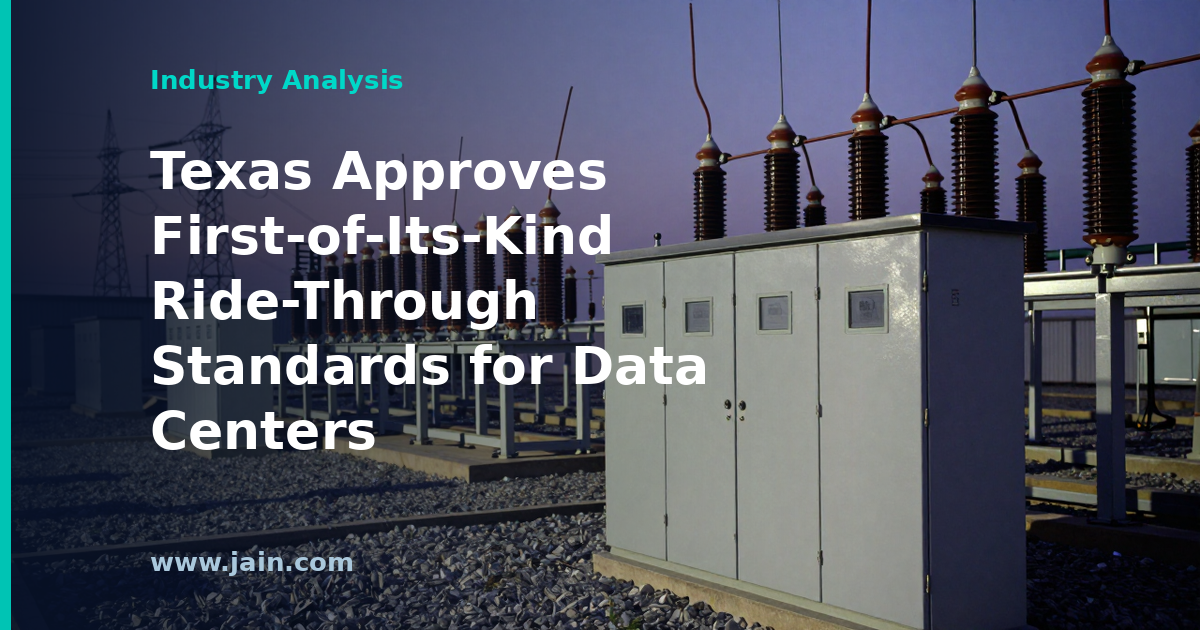
Texas regulators have approved grid standards intended to keep large data centers online during electrical disturbances, according to reporting by E&E News by POLITICO published July 10, 2026. The measure addresses so-called ride-through behavior — whether massive computing facilities stay connected and continue drawing power during voltage or frequency dips, or abruptly disconnect and shift the shock onto the rest of the grid.
The standards make the Texas grid, operated by the Electric Reliability Council of Texas (ERCOT), the first to impose formal ride-through expectations on data centers as a class of customer — a notable reversal of the usual arrangement, in which reliability rules bind generators rather than the loads that consume their output.
Executive Summary
The announcement, as reported, is straightforward: Texas has approved standards governing how large data centers must behave when the grid experiences a disturbance, with the stated goal of keeping those facilities online rather than having them drop off en masse. “Ride-through” is grid-engineering shorthand for a connected machine’s ability to tolerate a brief sag in voltage or frequency without tripping offline — a requirement long imposed on wind and solar plants, but historically never on customers.
Why it matters: data centers have become some of the largest single points of electrical demand ever connected to power systems, and ERCOT has been the epicenter of that growth. When a facility drawing hundreds of megawatts disconnects in a fraction of a second — typically because its protective equipment or uninterruptible power supplies switch to on-site backup at the first sign of trouble — the grid suddenly has surplus power with nowhere to go, which can push frequency out of bounds and cascade into a wider event. Regulating load behavior, not just generator behavior, is a genuinely new frontier in grid reliability.
For the industry, the precedent matters more than the particulars. Texas is the most attractive data center market in the United States precisely because of speed and abundant land and energy; if even Texas concludes that large loads must accept reliability obligations as a condition of interconnection, other states and grid operators facing the same demand surge are likely to follow.
The Grid’s Newest Problem Is Demand That Vanishes
For a century, grid reliability rules have concentrated on supply: power plants must stay online through disturbances so a single fault doesn’t snowball. Large data centers invert the problem. They are engineered for near-perfect uptime of the computing inside, which means their electrical systems are hair-triggered to abandon the utility feed and jump to batteries and backup generators the instant power quality wavers. That design is rational for each individual facility and destabilizing in aggregate: if many gigawatt-scale campuses in one region flee the grid simultaneously during a routine voltage dip, the disturbance they were protecting themselves from gets dramatically worse for everyone else.
ERCOT is uniquely exposed to this dynamic. It runs a largely isolated grid with limited connections to neighboring systems, so it cannot lean on imports to absorb a sudden swing. It also hosts one of the fastest-growing concentrations of data center and other large flexible load anywhere. A ride-through standard essentially tells these facilities: your protection settings are no longer purely your private business, because your collective reflexes have become a system-level risk.
A Template Other States Will Study
Texas moving first is consistent with its recent posture. State lawmakers and the Public Utility Commission have spent the past several years building a framework for very large loads — from interconnection review to provisions allowing curtailment of big customers in emergencies — as ERCOT’s demand forecasts ballooned on data center growth. Ride-through standards are a logical next brick in that wall, and the E&E News framing — standards “to keep data centers online” — suggests regulators are positioning this as pro-reliability rather than anti-industry.
Other jurisdictions are watching the same load-loss phenomenon. Grid reliability bodies in the U.S. have publicly examined incidents in which large blocks of data center load disconnected during disturbances, and utilities in Virginia, Georgia, Arizona and elsewhere face the same concentration of hyperscale demand. Because national reliability standards for loads do not yet exist the way they do for generators, a working Texas rulebook — definitions, thresholds, compliance mechanics — becomes the natural starting draft for everyone else. First-mover regulation tends to propagate: California’s emissions rules and Virginia’s zoning fights both show how one jurisdiction’s template shapes an industry’s national playbook.
The Economics: Compliance Cost Versus Queue Position
For data center operators, ride-through compliance is mostly an engineering and procurement question: configuring uninterruptible power supply systems, protection relays, and switchgear to tolerate defined disturbances rather than instantly transferring to backup. On new builds, that is a design parameter. On existing facilities, retrofits could be more intrusive, and operators will care greatly about which facilities are grandfathered — a detail the reporting summary does not settle.
The strategic calculus, though, likely favors acceptance. The binding constraint on data center growth today is not capital but grid access — interconnection queues measured in years. A clear, uniform reliability standard gives ERCOT and utilities more confidence to connect very large loads quickly, which is worth far more to developers than the cost of compliant electrical gear. Operators who fight load-behavior rules risk slower interconnection everywhere; operators who embrace them can market themselves as grid-friendly customers, a distinction that increasingly influences which projects get powered first.
Winners, Losers, and the Fine Print
The likely winners are grid operators, who gain a tool against a novel instability risk; incumbent data center operators with modern electrical infrastructure, for whom compliance is manageable and who benefit from anything that keeps Texas interconnections moving; and vendors of power equipment — UPS systems, protection relays, grid-interface controls — who now have a regulatory driver for upgrades. The pressured parties are operators of older facilities that may need retrofits, and any tenant whose uptime guarantees assumed the freedom to disconnect at the first flicker. There is a real tension here: staying connected through a disturbance transfers some risk from the grid to the facility, and enterprise customers pay for facilities engineered to take zero chances. How the standards balance grid needs against facility-level risk tolerance is the technical heart of the rule — and exactly the kind of detail that will determine whether other states copy it verbatim or rework it.
Background
Texas has become the defining battleground for data center growth in the United States. ERCOT operates a mostly self-contained grid serving the large majority of the state, and its combination of fast interconnection, abundant land, and booming generation development has drawn an extraordinary pipeline of hyperscale computing projects, alongside crypto-mining and industrial electrification. That surge pushed ERCOT’s long-term demand forecasts sharply upward and prompted Texas lawmakers and the Public Utility Commission to construct a new regulatory framework for very large loads over the past several years, including closer scrutiny of interconnection requests and emergency-management provisions for big customers.
In parallel, grid engineers across the country have documented a novel reliability phenomenon: large blocks of data center load disconnecting from the grid nearly simultaneously during disturbances, as facility protection systems shift to on-site backup. Because reliability standards historically governed generators rather than customers, no established national rulebook addressed this load behavior — the gap the newly approved Texas standards are the first to fill.
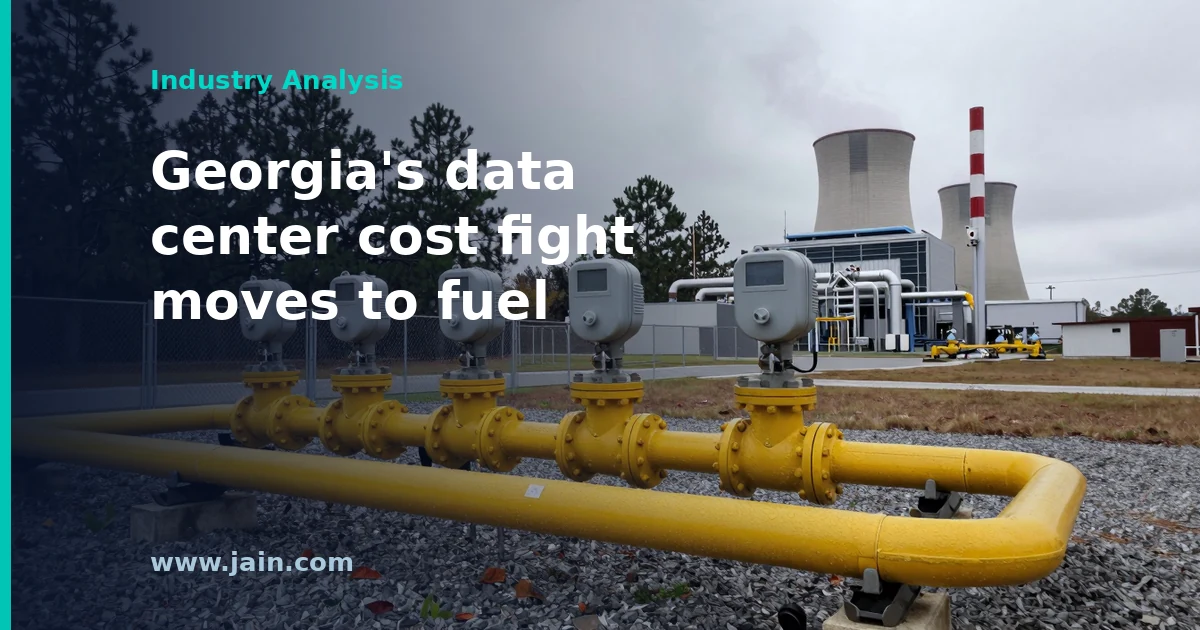
Georgia’s utility regulators are investigating whether giant data centers, the warehouse-sized computer buildings behind artificial intelligence tools, pay their fair share of the cost of fuel for power plants.
The state has already approved new power plants with nearly five times the output of its two newest nuclear reactors, mostly to serve data centers. Consumer groups say ordinary households may be paying to get fuel to those plants, even though they are only being expanded because of data centers.
Hearings start in September. The answer could show up on Georgia power bills.
WABE reported on July 8, 2026, that the Georgia Public Service Commission has opened an investigation into how Georgia Power’s largest customers, including data centers, pay for the fuel that runs the utility’s power plants. The probe examines the Real-Time Pricing (RTP) methodology used to bill those customers for fuel. Its first round of hearings is scheduled for September.
The investigation grew out of this year’s fuel-rate proceedings for residential and small-business customers. Those proceedings ended in an agreement that lowered the fuel rate and called for a review of RTP. The probe covers Georgia Power only, not the state’s other utilities. Advocacy groups, including Georgia Conservation Voters Education Fund, welcomed the move.
Executive Summary
Georgia’s utility regulator has formally opened a question it had so far left aside in its data center policy: who pays for fuel. The commission has already approved about ten gigawatts of new generating capacity, mostly for forecast data center demand. It has also approved contract terms meant to make large customers pay for infrastructure built to serve them. The new investigation turns to operating costs, and specifically to the cost of getting fuel to newly expanded power plants.
The mechanism at issue is billing. Residential and small-business customers pay a fuel rate. Data centers and other large users pay for fuel under Real-Time Pricing. Consumer advocates argue that this split leaves other Georgians carrying costs that exist only because of data center growth. The commission will now test that argument in hearings beginning in September.
The outcome matters beyond one tariff. Georgia is one of the country’s fastest-growing markets for hyperscale data center load. How it allocates fuel costs will affect the long-run energy price data center developers face there, and the bills of the households and small businesses that share the same grid.
Georgia Already Priced the Plants. Fuel Is the Open Line.
The commission’s recent data center decisions have focused on capacity: the power plants and grid equipment needed to meet future demand. Late in 2025 it approved about ten gigawatts of new capacity to serve the higher demand Georgia Power is predicting, mostly from data centers. A gigawatt is roughly the output of a large power plant, and the approved total is nearly five times the capacity of the new nuclear reactors at Plant Vogtle. Earlier in 2025 the commission approved contract terms to help ensure that data centers and other large customers pay for infrastructure built to serve them. Georgia Power has also said it will cover costs if the predicted data center demand does not materialize.
Those measures address who pays to build. The new investigation addresses who pays to run the plants, and in particular the cost of delivering fuel to newly expanded ones. Critics raised that cost during this year’s fuel hearings as the one slipping through the cracks, and it now has a formal proceeding of its own. This is the sense in which the next who-pays fight is over fuel. The capital side of the ten-gigawatt build already has a cost-allocation framework, however contested. The fuel side is where the allocation rules are now being reopened.
The shift changes what each party has to argue about. Capacity disputes turn on demand forecasts and contract terms signed before a facility is energized. Fuel disputes turn on tariff design and cost accounting that play out over the years a plant runs. For a developer planning load in Georgia, the connection terms were the headline risk. The lifetime price of energy is now also under review. For households, fuel charges are generally passed through to customers at cost, so any shift in allocation reaches monthly bills directly. That direct link is why the issue surfaced in the residential fuel-rate case.
How Real-Time Pricing Can Split the Fuel Bill
Georgia Power’s residential and small-business customers pay for fuel through a fuel rate set in periodic proceedings before the commission. Large customers such as data centers pay for fuel under Real-Time Pricing. In general, real-time pricing tariffs charge a price that tracks the utility’s cost of producing electricity hour by hour, instead of a flat, averaged fuel charge.
Consumer advocates argue that this arrangement leaves other Georgians paying for fuel infrastructure that is being built only because of data center demand. Their reasoning runs as follows. Getting fuel to an expanded plant carries costs of its own, and those costs can be committed in advance whether or not the fuel is burned in a given hour. Suppose those costs land in the averaged fuel rate, while the largest new users pay for fuel under a methodology that does not carry them the same way. Then the customers on the averaged rate absorb them. Whether Georgia’s RTP methodology actually works this way is what the investigation is meant to establish.
The stakes grow with the buildout. The larger the share of new demand billed through RTP, the more its treatment of fuel-delivery costs matters to everyone else on the system. With roughly ten gigawatts approved largely on the strength of data center forecasts, the question stops being a narrow tariff detail. It becomes a material cost-allocation issue.
What Each Side Still Has to Show
The advocates’ concern is coherent on its mechanics. The September hearings are where it needs a figure: how much fuel-delivery cost is attributable to data center-driven expansion, and how much of that RTP customers already cover. As Ja’Mae Rooks of Georgia Conservation Voters Education Fund put it, “Georgians deserve to understand exactly who is paying for the massive growth in electricity demand from data centers, and who isn’t.” That standard applies in both directions. Establishing who is not paying requires the same cost data as establishing who is.
The burden also falls on the utility and its large customers. If RTP already recovers these costs, the hearings are the place to show it with numbers. Georgia Power’s pledge to cover costs if data center demand fails to materialize addresses a different risk: infrastructure left underused. On its face, that pledge says nothing about ongoing fuel costs when the demand does arrive.
The political setting raises the proceeding’s profile. Commission seats are on the 2026 ballot, and recent races have been framed around power bill increases. The result, though, will turn on the cost record the parties put before the commission, not on the campaign.
A Test Case Worth Watching, Not Yet a Trend
Georgia’s sequence gives other regulators a view of where cost questions surface after the first round of protections is in place. The order was capacity approvals, then contract protections for infrastructure, then a review of fuel methodology. Operating-cost allocation is harder to fix in a contract signed before a data center goes live, because it depends on how plants run and what fuel costs over many years.
This is still one utility in one state, and the investigation has reached no finding. It is too early to say that fuel allocation will become a standard battleground wherever hyperscale load is growing. What Georgia does establish is that a utility can put infrastructure cost protections in place and still leave operating-cost allocation open for review.
Background
Georgia Power, a subsidiary of Southern Company, is Georgia’s largest electric utility. It is regulated by the Georgia Public Service Commission, whose elected commissioners set the rates the utility charges. In recent years the utility completed two new nuclear reactors at Plant Vogtle, and it has since forecast large demand growth driven mostly by data centers, including hyperscale facilities used for generative AI.
To meet that forecast, the commission approved about ten gigawatts of new capacity in late 2025. Earlier that year it approved contract terms intended to make large customers pay for infrastructure built to serve them. Power costs have become a political issue in the state, with commission elections in 2026 framed around recent bill increases.
On 2026-07-09, CNBC published a ranking of the ten U.S. states it judges best positioned to land new artificial-intelligence data center deals despite a rising tide of public opposition to large campuses. The list frames a national contest for hyperscale investment against the backdrop of grid strain, water concerns and local political pushback.
Executive Summary
The CNBC feature is essentially a state-by-state scorecard for AI data center attractiveness at a moment when siting has become the single hardest problem in the industry. Where a decade ago the debate was about tax abatements and fiber routes, it now turns on interconnection queues, gas turbine availability, water withdrawals and whether a county commission will approve a rezoning after a packed public hearing.
For infrastructure buyers, the ranking matters less as a definitive verdict than as a signal of where the pipeline is likely to concentrate. For host communities, it is a reminder that the states judged most ‘winnable’ by capital are precisely the ones facing the loudest local debates about who benefits from a multi-billion-dollar build.
What a ‘Best Positioned’ Ranking Actually Measures
Rankings of this kind typically blend a handful of durable inputs: available and dispatchable power, transmission headroom, permitting speed, tax treatment, land availability, workforce, fiber density and climate suitability for cooling. None of those variables is new, but their relative weight has shifted sharply. Power availability — measured in years to interconnect, not megawatts on paper — has overtaken tax policy as the binding constraint for gigawatt-scale AI campuses.
That reordering changes which states look attractive. Jurisdictions with vertically integrated utilities, permissive siting rules for gas peakers or nuclear uprates, and cooperative public utility commissions have a structural edge over states with congested interconnection queues, regardless of how generous their incentives look on a spreadsheet.
The Opposition Curve Is Bending
The CNBC framing — ‘despite rising public opposition’ — reflects a real inflection. Data center opposition, once confined to a few Northern Virginia counties, is now a recurring feature of local politics in Georgia, Texas, Arizona and the Midwest. Residents cite noise from cooling equipment, transmission line routing, water use, property tax abatements and the perception that grid costs are being socialized while benefits accrue to a handful of hyperscalers.
The important business question is not whether opposition exists, but whether it changes outcomes. So far the evidence is mixed: some projects have been delayed or downsized, others have proceeded largely on schedule after community benefit agreements. States that develop clearer siting rules and cost-allocation frameworks may quietly pull ahead of nominally cheaper jurisdictions where every hearing becomes a referendum.
Winners, Losers and the Second Tier
A top-ten list implicitly names losers — states that were competitive for cloud-era builds but are structurally disadvantaged for AI-scale campuses. The likely laggards are jurisdictions with tight grids, aggressive decarbonization timelines that constrain new gas generation, or moratoria under active consideration. That does not mean those markets go dark; they will still host inference, edge and enterprise workloads. But the trillion-dollar question of where training capacity lands is increasingly being answered elsewhere.
For the second tier — states that did not make the list — the strategic response is unglamorous: shorten interconnection timelines, publish transparent siting criteria, and negotiate cost-allocation rules that survive contact with a local newspaper. Incentive stacking alone no longer moves the needle.
What the Ranking Cannot Tell You
Any state-level scorecard obscures the fact that AI siting decisions are made at the substation, not the statehouse. Two counties within the same ‘winner’ state can face wildly different interconnection timelines, water availability and community sentiment. Investors reading the list should treat it as a starting filter, not a site selection tool. And host communities should recognize that being on such a list is a leading indicator of proposals to come, not a guarantee of net benefit.
Background
The U.S. data center industry has spent two decades clustering around a handful of markets — Northern Virginia, Dallas, Phoenix, Silicon Valley, Chicago and Atlanta — chosen for fiber, power and tax treatment. The AI training boom that accelerated after 2023 broke that pattern by demanding campuses an order of magnitude larger, with power needs measured in gigawatts and lead times measured in years.
As those requirements collided with congested grids and slow permitting in legacy markets, developers began scouting states with spare generation, cooperative utilities and available land. That shift, in turn, exported the siting debate to communities with little prior experience of large-scale digital infrastructure — and produced the public opposition the CNBC ranking now takes as its backdrop.
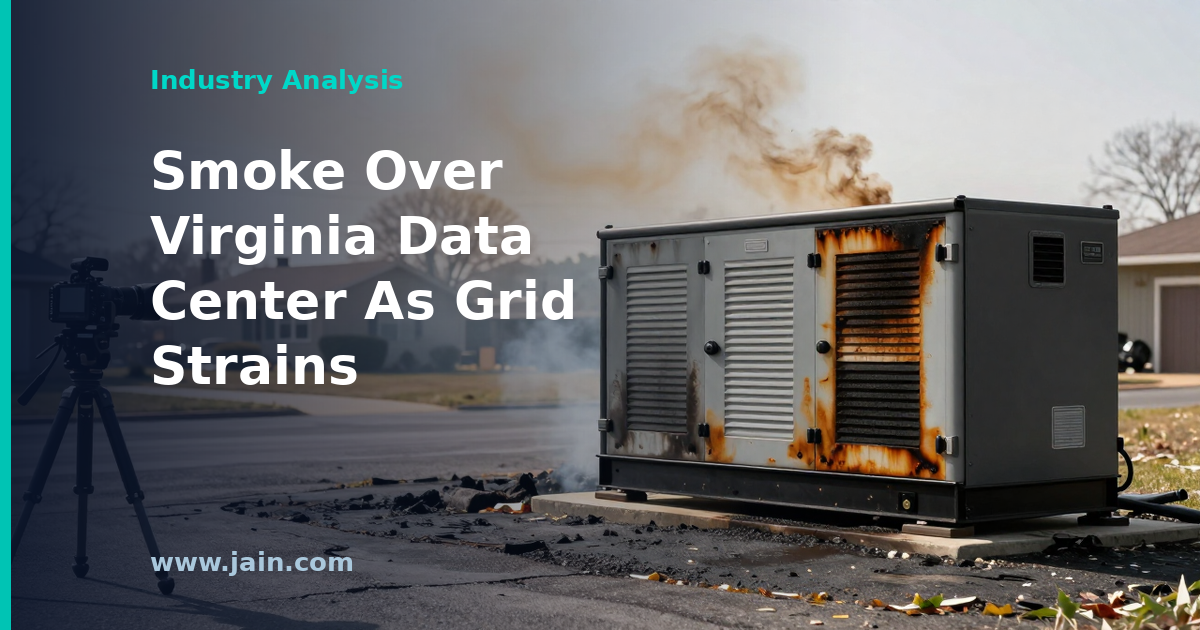
Business Insider reported that dark smoke was seen rising above a Virginia data center during a summer heat wave, at the same time PJM Interconnection — the grid operator serving the mid-Atlantic — was approaching the upper edge of its available supply. The incident occurred in the region that hosts the largest concentration of data center capacity in the world.
Executive Summary
A visible smoke event at a Virginia data center, coinciding with heat-driven stress on the PJM grid, has drawn attention to the fragility of the infrastructure that carries a large share of global internet traffic. The report does not detail the cause, the operator, or the scale of any outage, but the optics — smoke above a hyperscale campus during peak demand — are hard to ignore.
For an industry that has spent the last two years defending its power appetite in front of regulators and communities, the timing matters. Northern Virginia’s data center cluster is already the subject of intense debate over transmission buildout, ratepayer cost allocation, and permitting. A high-visibility incident during a grid emergency is the kind of event that shifts political conversations even when the technical facts turn out to be modest.
Why Loudoun County Is the Pressure Point
Northern Virginia, and Loudoun County in particular, hosts more data center capacity than any other region on Earth. That density exists because of a self-reinforcing cycle: fiber routes were built to serve early internet exchanges, cheap land and tax incentives attracted more operators, and each new campus made the next one more attractive by shortening latency between tenants. The result is a corridor where a single county’s electricity draw rivals that of a mid-sized country.
PJM Interconnection, the regional transmission organization that runs the grid across 13 states and D.C., has warned publicly for the past two years that generation retirements are outpacing new supply, and that data center growth is a major driver of load. A heat wave compresses the margin between demand and available capacity, and in that state any visible failure — smoke, sirens, a plume — reads as a system-level warning rather than a site-level problem.
The Anatomy of a Data Center Fire Risk
Smoke at a data center campus can originate from several places, and each carries different implications. Utility switchgear and transformers can fail under thermal stress, particularly when ambient temperatures push cooling systems past design points. Backup diesel generators, which typically start when grid voltage sags, can experience exhaust or lube-oil incidents when run for extended periods. Battery energy storage systems, increasingly used to bridge grid disturbances, carry their own thermal-runaway risks. Without more detail from the operator or the fire authority, the public cannot distinguish among these, and the release does not.
What is unambiguous is that data centers are designed to fail gracefully — that is the entire premise of N+1 redundancy, on-site generation, and multiple utility feeds. A visible smoke event does not, by itself, mean customer workloads went down. It does mean that at least one layer of the redundancy stack was exercised, and that the incident happened at the worst possible moment for the grid around it.
The Political Physics of a Bad Photograph
Data center operators have historically preferred to operate quietly. That posture is harder to maintain when smoke is visible from residential streets during a heat wave that has neighbors watching their thermostats. Virginia legislators have already been debating whether data center load growth should be paid for by the industry rather than socialized across residential ratepayers, and PJM’s capacity auctions have delivered sharp price increases that landed on household bills earlier this year.
None of that is caused by a single incident. But single incidents shape narratives. Operators, utilities, and regulators who want to sustain the current build-out will need to be more forthcoming — about what happened, what the redundancy actually did, and what the incident says (or does not say) about the wider grid — than the industry’s default communications posture typically allows.
What the Grid Data Actually Shows
The article’s framing — that PJM was near its limits — is worth taking seriously without overstating. Grid operators routinely run close to reserve margins during heat waves; that is what reserve margins are for. The relevant question is not whether PJM was stressed on a hot afternoon, but whether the trajectory of load growth, generator retirements, and transmission build is converging or diverging. Public filings from PJM suggest the latter, and the coincidence of a visible incident with a stressed grid gives that concern a face.
Background
Northern Virginia has been the center of gravity for the data center industry since the 1990s, when Equinix and others built exchange points that anchored transatlantic and domestic internet traffic. Loudoun County alone now hosts several gigawatts of operating capacity, with more under construction, and its tax revenue from the sector has reshaped county budgets.
PJM Interconnection, founded in 1927 as a pool among Pennsylvania and New Jersey utilities, today coordinates generation and transmission across a footprint stretching from Illinois to North Carolina. In recent capacity auctions, prices have risen sharply as generator retirements have outpaced new interconnections, a dynamic industry observers attribute in part to accelerating data center load growth.