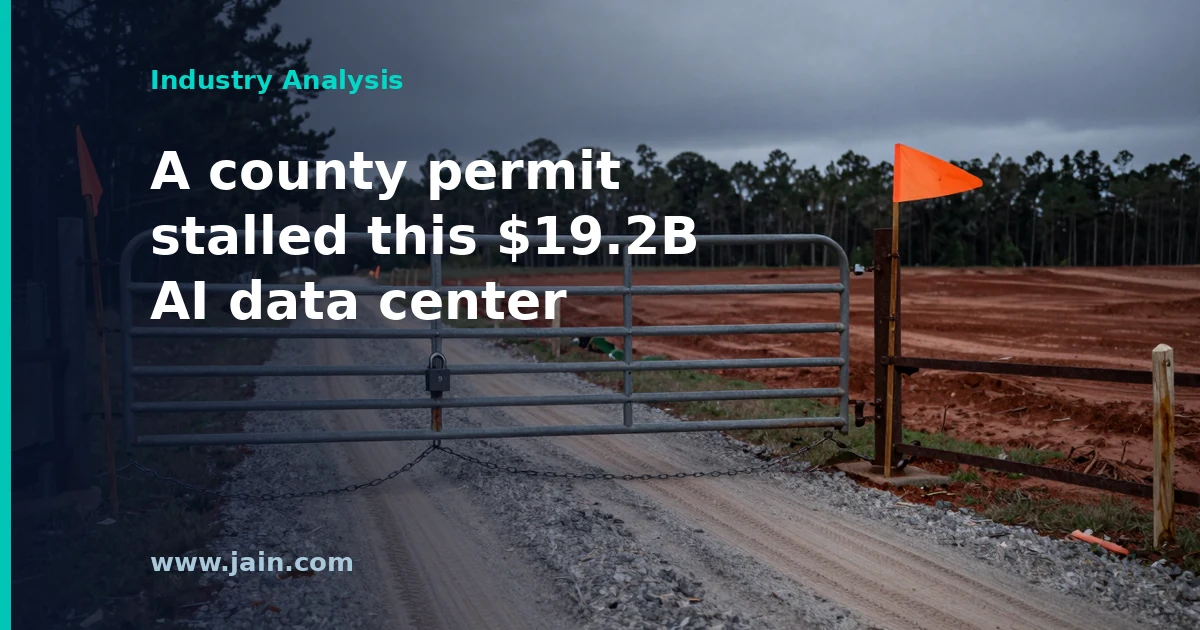
A company called Energy Storage Solutions has dropped its plan for a $19.2 billion building full of computers for artificial intelligence in a rural North Carolina county.
At first it would have used about 300 megawatts of electricity, roughly what a couple of hundred thousand homes use, and possibly three times that later.
Local officials had already refused it a permit. Now they are considering a two-year ban on any new projects like it. The takeaway: a county vote can stop part of the artificial intelligence boom before a single computer is installed.
A proposed $19.2 billion AI data center in Edgecombe County, North Carolina, has been withdrawn by its developer, Energy Storage Solutions, Data Center Dynamics reported on July 15, 2026. County Manager Eric Evans told the board of commissioners at its July 6 meeting that the company had pulled the project earlier in the month. The multi-phase campus was planned for the Kingsboro development area near Tarboro, about 70 miles east of Raleigh.
The county denied the project a special-use permit late last year, when it was described as an eight-phase, 300MW campus on 52 acres. Other accounts put the eventual build-out at 300 acres and 900MW. At the same July 6 meeting, commissioners discussed a 24-month moratorium on new data center developments. A public hearing is scheduled for August.
Executive Summary
The Edgecombe withdrawal takes one of North Carolina’s largest announced AI data center proposals off the table, at least for now. The obstacle on the public record was not chips, turbines or transformers. It was a county special-use permit, the discretionary approval a local board can grant or refuse. Commissioners refused it, the developer appealed, and the project has now been withdrawn while that appeal was reported to be ongoing.
The episode matters beyond one county because two policy layers are tightening at once. Locally, Edgecombe is weighing a two-year pause on all new data center projects. At the state level, the House has passed the Ratepayer Protection Act, which would make data center developers pay upfront for the grid expansion, transmission upgrades and new generation their facilities require. Together they change both whether a campus can be built and who pays to power it.
For developers, utilities and the cloud and AI companies that lease capacity, the practical point is that a site’s local approval status now belongs in capacity forecasts alongside land and megawatts.
The Gate on This 300MW Campus Was a County Vote
Most public discussion of AI infrastructure constraints centres on chips, power supply and electrical equipment. In Edgecombe County, the documented obstacle came earlier than any of those. Late last year, the board of commissioners denied a special-use permit for an eight-phase, 300MW data center campus on 52 acres. A special-use permit is discretionary. Even where land is zoned for industrial use, a county board can attach conditions or say no. Energy Storage Solutions appealed and said it would proceed. By early July, the county manager was telling commissioners the project had been withdrawn.
The moratorium under discussion would turn one project’s rejection into a countywide freeze. For 24 months, no developer could bring a new data center through the county’s approval process. Campuses like this one are planned in phases across several years, so a two-year stop at the approval stage delays the first phase, and every phase behind it, by at least that long. That delay holds whether or not power, financing and tenants are ready.
Several groups absorb that risk. Developers and landowners assemble parcels on the expectation of approval. Utilities plan transmission and generation around announced loads. Tenants, usually cloud and AI companies, need capacity delivered on a specific date. For all of them, entitlement status, meaning whether a site actually holds the local approvals needed to build, is as material as the megawatt figure in the announcement. A single county vote removed a planned 300MW from the pipeline here, and possibly 900MW.
A $19.2 Billion Figure Without a Fixed Size
The $19.2 billion headline is the project’s most quoted number and its least anchored one. The permit application the county reviewed described 300MW on 52 acres. Other reports described a 300-acre campus reaching 900MW. Divided across 900MW, the figure works out to about $21 million per megawatt. Divided across 300MW, it is about $64 million per megawatt. A threefold gap makes it impossible to benchmark the proposal against other campuses or to tell whether the figure includes the servers and AI chips inside the buildings, which often cost more than the buildings themselves.
Headline figures for multi-phase campuses tend to describe a full build-out rather than a first phase. That makes them useful as a measure of ambition and weak as a measure of what is financed or contracted. For readers tracking AI capacity announcements, the useful distinction is between the capacity a regulator has actually reviewed, here 300MW, and the capacity that appears in the eventual vision, here up to 900MW.
North Carolina Moves the Grid Bill Toward Developers
The state-level change could matter more than any single county’s decision. The Ratepayer Protection Act, passed by the North Carolina House and awaiting Senate approval, would require data center developers to cover the upfront costs of grid expansion, transmission upgrades and new power generation for their facilities. The practical effect is to shift those costs away from a utility’s general customer base and onto the project. That raises the capital a developer needs before a site produces revenue, and it makes locations near existing grid capacity relatively more valuable.
The bill also includes a coal plant moratorium. Public utilities could not retire coal-fired plants until regulators approve new large-scale nuclear facilities. That provision would keep existing generation on the system while new supply is planned. Its cost and environmental trade-offs will be argued on their merits in the Senate.
Taken together, the local and state layers raise the bar for projects that lack committed customers and deep financing. Developers with signed tenants and capital to fund grid upgrades are better placed under these rules than those seeking approvals first and backers later. Counties and ratepayers gain more leverage over terms. The open question for the industry is how many other North Carolina counties adopt similar tools. The state has seen resident opposition to data center proposals in several places.
Background
North Carolina has become a hotspot for data center development, with some local residents opposing new projects in several parts of the state. Edgecombe County, whose seat is Tarboro, about 70 miles east of Raleigh, became one focal point when Energy Storage Solutions proposed a multi-phase AI data center campus in the Kingsboro development area.
The county board of commissioners denied the project a special-use permit late last year. The developer appealed and said it would proceed, before withdrawing the project in early July 2026. State lawmakers are meanwhile debating the Ratepayer Protection Act, which would make data center developers pay upfront for the grid infrastructure and generation their facilities require.
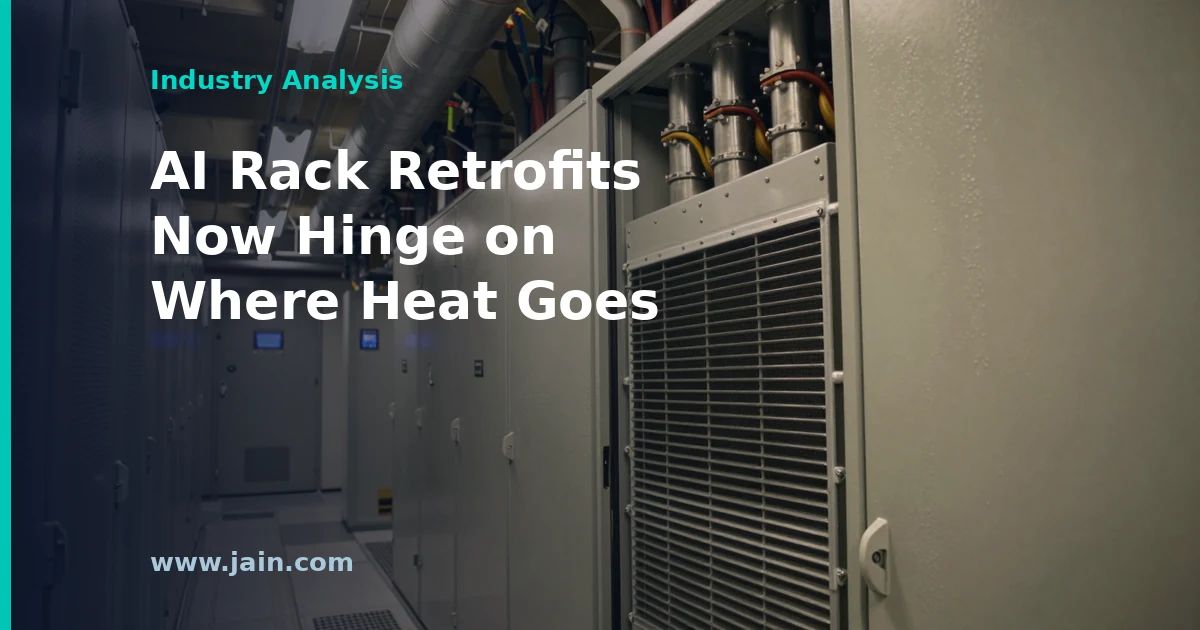
Computer chips that run artificial intelligence throw off enormous heat. Supermicro, a major server maker, now sells ten models of a water-cooled door that bolts onto the back of a server cabinet and soaks up that heat before it reaches the room.
The largest door handles about as much heat as 80 household space heaters running at once. That lets older buildings, designed around fans and air conditioning, host far hotter equipment without major rebuilding.
The catch: the heat still has to leave the building, and Supermicro has not fully explained how.
Supermicro announced in a July 15, 2026 press release that it has expanded its rear door heat exchanger (RDHx) portfolio to ten models, with cooling capacities from 10kW to 120kW per door and up to 240kW at the rack level. The doors are part of its Data Center Building Block Solutions (DCBBS) program, which packages servers, racks, power, cooling, management software and deployment services into validated, pre-integrated systems.
Supermicro says the doors mount to standard EIA, ORv3 and MGX racks, can serve as a primary liquid cooling method or be paired with its direct-to-chip cold plates, and can be installed in new or existing data centers without major facility modifications or dedicated facility chilled water.
Executive Summary
Supermicro is broadening the least invasive rung of its liquid cooling ladder. A rear door heat exchanger replaces the back door of a server cabinet with a liquid-filled coil and fans; hot exhaust passes through the coil and leaves the cabinet cooled. The new lineup spans ten models from 10kW to 120kW per door, which lets operators size the door to anything from a single dense server stack to a rack-scale AI system.
The pitch is aimed squarely at the large installed base of air-cooled data halls that were never designed for AI hardware. If a door can capture heat at the cabinet, an operator can place a high-density GPU rack in an older room without plumbing liquid to every server or rebuilding the hall’s airflow.
That solves one constraint and exposes others. A door that captures 120kW of heat still has to hand that heat to something that carries it outdoors, and a rack that needs 120kW of cooling needs roughly that much power delivered to it. For operators, the doors move the retrofit question from the room to the building’s heat rejection plant and electrical distribution.
A Door That Turns an Air-Cooled Hall Into a Liquid-Assisted One
Traditional data halls cool servers the way an office cools people: chilled air is pushed into the room, servers draw it through their chassis, and hot exhaust is returned to air handlers. That works until the heat in a single cabinet becomes so concentrated that the room cannot move enough air to carry it away. GPU servers built for AI training and inference routinely reach that point, which is why the industry has been moving toward liquid cooling.
A rear door heat exchanger is the gentlest version of that move. Instead of routing coolant into each server, which is what direct-to-chip cold plates do, it intercepts the exhaust at the back of the cabinet. The servers stay air-cooled internally; the room simply never sees most of their heat. Supermicro says its doors fit standard EIA racks (the long-established 19-inch format), ORv3 (the Open Compute Project’s Open Rack version 3) and MGX (Nvidia’s modular server reference architecture), which covers most of what operators already have on the floor or are buying for AI.
The ten-model range is the practical news. A 10kW door and a 120kW door solve different problems, and offering both lets an operator match cooling to the rack rather than overbuilding. Supermicro’s stated features include intelligent fan control, N+1 redundancy (one more fan or component than strictly needed, so a single failure does not stop cooling) and anti-condensation protection, which matters because a cold coil in a humid room can drip onto equipment.
The Retrofit Limit Moves From Airflow to Heat Rejection
A rear door changes where heat is captured, not how much heat exists. Nearly every watt a server draws ends up as heat, so a door absorbing 120kW is handing 120kW of thermal energy to its coolant, and at Supermicro’s stated rack-level maximum of 240kW, twice that. In an air-cooled hall, the traditional ceiling on rack density is airflow: how much cold air the room can deliver and how much hot exhaust it can return before it recirculates into server intakes. By neutralizing exhaust at the cabinet, a rear door largely removes that ceiling.
What remains is the plant behind the door. Captured heat has to reach the outdoors through chillers, dry coolers or cooling towers, and a building’s heat rejection capacity was sized for the hall it was originally designed to be. Supermicro says the doors deploy without the need for dedicated facility chilled water or extra hardware, but it has not said what the coil connects to instead. If the heat is dumped back into the room by a liquid-to-air unit, the existing air conditioning absorbs it and the old limit returns in another form. If the doors tie into an existing water loop, that loop’s spare capacity becomes the constraint.
The same logic applies to electricity. A rack that needs 120kW of cooling is drawing roughly that much power, and older halls were generally not built to deliver that at every position. Supermicro’s option of DC-powered doors fed from rack busbars simplifies powering the door itself, not the upstream feed to the rack. For colocation providers and enterprises weighing an AI retrofit, the door shifts the practical question from whether a rack can be cooled to how many such racks the building’s cooling plant and switchgear can actually support.
Rear Doors and Cold Plates Are Complements, Not Rivals
Supermicro positions the doors both as a standalone option and as a companion to its direct-to-chip (D2C) liquid cooling. That pairing reflects how dense AI systems are actually cooled. Cold plates mounted on processors and GPUs remove the heat from the hottest chips directly into liquid, but memory, power supplies, storage and networking gear in the same rack still shed heat into the air. A rear door can capture that residual heat so the room does not have to.
For operators, the hybrid approach offers a staged path: start with doors on air-cooled GPU servers in an existing hall, then add cold-plate systems as liquid distribution is built out, with the doors continuing to handle what the plates miss. Supermicro has not published how it splits heat between the two methods in a combined deployment, which is the figure facility engineers would need to size the loops.
Bundling Is the Strategy; the Economics Are Still Claims
The broader move is DCBBS itself. Supermicro wants to sell not just servers but the rack, power, cooling, management software and installation as one validated package, and says that approach reduces integration risk, lowers total cost of ownership and shortens time-to-online. Real-time monitoring of temperature, pressure, flow rate and pump status through Redfish (an industry standard interface for managing hardware), SNMP (a long-standing network monitoring protocol) and Supermicro’s SuperCloud Composer software is meant to fold cooling into the same management plane as the servers.
Single-vendor integration has genuine appeal when AI hardware lead times are tight and every week a facility sits unfinished is lost revenue. The trade-off buyers weigh is flexibility: a tightly validated stack is simpler to deploy but ties more of the facility’s design to one supplier’s roadmap. Supermicro’s cost and speed benefits are stated rather than quantified, so buyers will need site-specific figures before treating them as planning assumptions.
Background
Super Micro Computer (NASDAQ: SMCI) is a San Jose, California server and storage maker that designs and manufactures its systems in the United States, Taiwan and the Netherlands. It has become one of the principal suppliers of GPU servers for AI workloads and, through its Data Center Building Block Solutions program, increasingly sells complete rack-scale and data center-level systems rather than individual machines.
Liquid cooling has moved from niche to mainstream as AI hardware has pushed per-rack power far beyond what traditional air-cooled halls were built to handle. Operators generally choose among rear door heat exchangers, direct-to-chip cold plates and immersion cooling, often combining methods. Rear doors are typically the least disruptive to install, which makes them a common first step for existing facilities.
A Barcelona company best known for keeping computers cool is spending about €1 billion to build and run its own huge computer warehouse for artificial intelligence.
Submer plans to put it on the grounds of an old chemical factory in the Spanish town of Flix, which stopped operating in 2023. Catalonia’s regional president turned out for the announcement.
What makes it interesting: a company that used to sell equipment to building owners now wants to be the owner. It has not yet said how big the site will be, when it opens, or who will use it.
Submer, the Barcelona-based company that built its name in immersion cooling, plans a €1 billion ($1.14 billion) AI data center on the site of the former Ercros chemical plant in Flix, Catalonia, Data Center Dynamics reported. The facility will be built in two phases and operated by Rubix Data Centers, the AI data center division Submer launched in June, which aims to lease it to a single tenant running AI workloads.
The project was unveiled on Saturday, July 11, at an event attended by Salvador Illa, president of the government of Catalonia, and Miquel Sàmper, the regional minister of business and labor. Submer has not disclosed the facility’s planned capacity or construction timeline; renders appear to show four data halls arranged around a central building.
Executive Summary
The headline number is €1 billion, but the more consequential fact is who is spending it. Submer’s business has been supplying cooling systems to other people’s data centers. With Flix, it becomes a developer and operator in its own right, following last year’s launch of the InferX AI cloud platform and June’s launch of Rubix Data Centers.
Submer CEO Patrick Smets framed the move as a deliberate climb up the value chain: “we will expand across the full stack, from land and power to cloud and Edge.” Rubix, led by former Stack executive John Eland, leads its pitch not with cooling technology but with a claim of 8GW of power available across vacant sites in the Americas, EMEA and APAC. That ordering signals where the company believes durable value in AI infrastructure now sits.
What the announcement does not yet establish is the project’s scale, power supply, financing or customer. Until those are disclosed, Flix is best read as a statement of strategy and site selection rather than a funded, contracted build.
From Selling Cooling to Owning the Building
Submer’s trajectory over roughly a year tells the story: an immersion cooling specialist (immersion cooling submerges servers in a non-conductive liquid to carry heat away more efficiently than air) launched an AI cloud platform, InferX, then a data center division, Rubix, and now a €1 billion campus. Each step moves the company closer to the end customer and further from being a component supplier.
The economic logic is straightforward. An equipment vendor is typically paid once per deployment, and its fortunes depend on how many facilities its customers build. An operator that leases a facility earns recurring rent for the life of the lease and controls the asset that everything else depends on: the site, the building and its power supply. Smets’ own phrasing, “from land and power to cloud and Edge,” puts land and power first. Eland made the same point from the operator’s side: “We intend to operate the facility we are building here, so we are not simply passing through Flix.”
That is the substance behind reading Flix as a bet on land and power rather than on cooling hardware. The company has not said whether Submer’s own immersion systems will be deployed at Flix, which underlines the point: the announcement is about owning capacity, not showcasing a product.
Why Power Is the Asset Rubix Leads With
For AI data centers, the scarce input is increasingly not buildings or servers but a site with a large, deliverable grid connection. That is why Rubix’s headline claim is 8GW of available power across vacant sites, a figure measured in gigawatts, or thousands of megawatts. Framing a data center business around power first reflects how the market now prices development opportunities.
Former heavy-industrial sites such as the Ercros plant are attractive candidates in principle, because industrial users often required substantial electrical infrastructure and the land is already zoned for industrial use. Ercros also operates a solar farm on the site today. But Submer has not said what grid capacity is available at Flix, whether it is already connected, or how the solar installation fits into the project’s power plans. Those details will determine how quickly and how large Flix can realistically become.
The 8GW figure deserves the same even-handed reading. It is a claim about power available across vacant sites, and Rubix has not broken it down by location, by grid status or by how much of it is contractually secured versus identified. As a signal of ambition it is clear; as a measure of deliverable capacity it is not yet substantiated.
The Single-Tenant Model Cuts Both Ways
Rubix aims to lease Flix to a single tenant for AI workloads. This build-to-suit approach is common for large AI campuses: one creditworthy customer on a long lease can anchor the financing for a very large build, and two-phase construction lets capital be deployed in step with demand.
The flip side is concentration. Until a tenant signs, the €1 billion figure describes an intended investment rather than a committed one, and the facility’s design, timing and financing will likely hinge on that single counterparty. Without a disclosed capacity, it is also impossible to judge whether €1 billion is a large or modest sum per megawatt relative to comparable AI builds.
A Supplier Becoming a Peer, With Political Backing
Moving into operations can create tension with existing customers: data center operators that buy Submer cooling may now find the same company bidding for AI tenants. How Submer manages that overlap between its cooling business and Rubix will be worth watching.
On the other side of the ledger, the project arrives with visible public support. The presence of Catalonia’s president and its business minister at the launch, and Submer’s framing of the project as part of the “reindustrialization of Flix,” suggest the regional government sees AI infrastructure as a use for idled industrial land. That backing can matter for permitting and grid access, though no specific commitments from the administration were announced.
Background
Submer, based in Barcelona, established itself as a specialist in immersion cooling, a technique that submerges servers in a non-conductive fluid to remove heat more efficiently than traditional air cooling, an approach that has gained attention as AI chips grow denser and hotter. Over the past year the company has expanded beyond cooling, launching the InferX AI cloud platform and, in June 2026, Rubix Data Centers, a division that develops and operates AI data centers and is headed by John Eland, formerly of data center operator Stack.
The Flix site was home to a chemical plant run by Ercros until industrial operations ceased in January 2023. Ercros now operates a solar farm on the site. Redeveloping former industrial land for data centers has become a recurring theme as developers look for sites with industrial zoning and access to power.
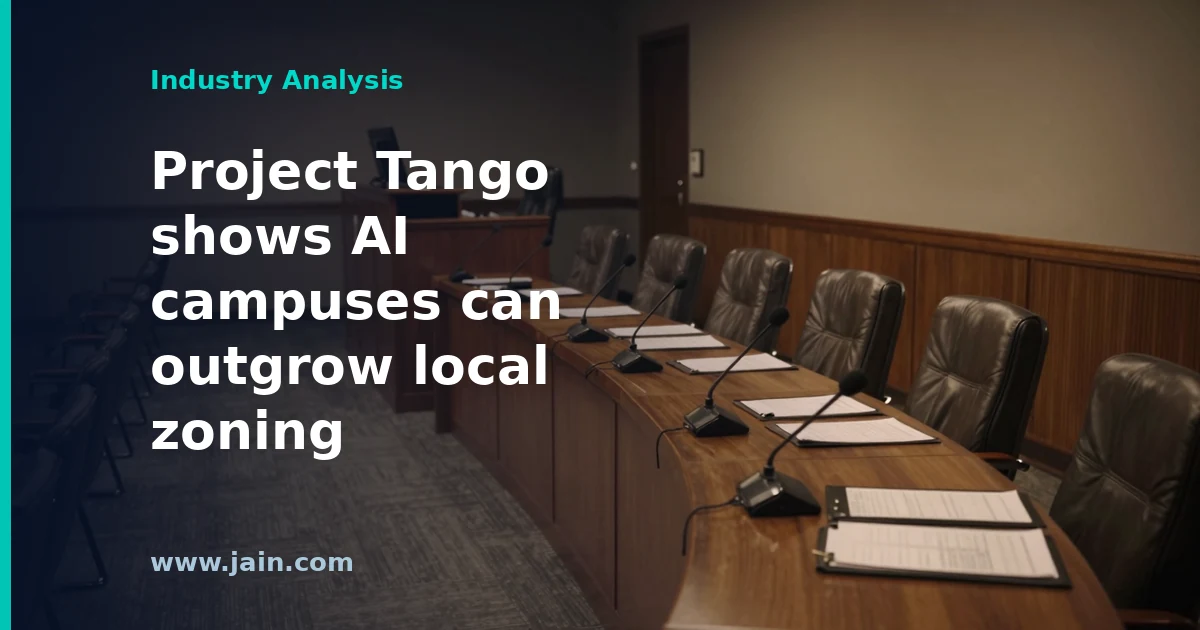
County leaders in Palm Beach County, Florida, voted 5 to 1 to turn down Project Tango. It was a giant complex of computers for artificial intelligence, planned near about 2,400 homes and an elementary school.
A big worry was a constant low hum, day and night. The builders said cooling would need a one-time fill of about 650,000 gallons of water, roughly one Olympic swimming pool.
The bigger lesson is that local building rules are struggling to decide what these new facilities even are. The developer can try again.
Palm Beach County commissioners on Wednesday, July 15, 2026, voted 5-1 to deny without prejudice Project Tango, a proposed AI data center campus in Loxahatchee, WPEC (CBS12) reported. The vote followed hours of debate over low-frequency noise, water use, traffic and compatibility with a rural area that opponents said now includes about 2,400 homes and Saddle View Elementary School. Commissioner Maria G. Marino cast the lone vote in favor. Mayor Sara Baxter recused herself on the County Attorney’s advice because of her prior public statements opposing the project.
The request before the board covered Phase 2 of the site: 280,000 square feet of data and information processing, 148,000 square feet of cooling-related utility space and about 1.15 million square feet of warehouse. The applicant projected a $34.5 billion asset at build-out over six to seven years and about $561 million in tax revenue at build-out.
Executive Summary
Project Tango did not fail on a single number. It failed because commissioners could not agree with the applicant on what the project was. The developer’s attorney argued that data processing was already a permitted use on a site approved years ago for economic development. County staff answered that the application would add roughly 1.5 million square feet to that approval. One commissioner called the proposal “an AI hyperscale whatever” and questioned whether the county’s definitions had kept pace.
That dispute is the part that matters beyond Palm Beach County. Many AI data center plans rely on land entitlements granted for warehouses, light industry or generic economic development. Project Tango shows a local board declining to treat those older approvals as covering a 24-hour computing campus. The questions it pressed hardest, on low-frequency noise and on water, are ones existing codes were not written to answer.
Because the denial was without prejudice, the applicant can return with a revised plan. The hearing showed fairly clearly what the next attempt would need to bring: independent expert evidence, a named end user, and firmer answers on noise and water.
An AI Campus the Zoning Code Wasn’t Written For
The sharpest exchange of the hearing was about categories rather than engineering. Applicant attorney Brian Seymour described the request as an “allocation of permitted uses, not a new use,” noting that data and information processing is already allowed under the county’s code for the site. County staff rejected that framing directly: “That is incorrect. That is why we are here today. This application is to add square footage.” Staff said the site is approved for 2,020,000 square feet of Economic Development Center uses and that the request would add about 1.5 million square feet to the master plan. Opponents described the result as a 3.6-million-square-foot campus.
Commissioner Joel Flores put the underlying problem plainly: “This is not exactly a data center. This is something new.” He said he was struggling with whether the county was relying on older definitions “just because they haven’t been updated.” The applicant argued the campus should be treated as light industrial and noted it would replace existing heavy industrial operations, including asphalt and concrete plants. By conventional land-use logic, that is a reasonable argument, since a data hall generates little truck traffic or dust. But a hyperscale AI campus (a very large facility built to run AI workloads at scale) runs around the clock, needs substantial cooling equipment and draws significant electricity. Those traits do not map neatly onto a code category written for offices, warehouses or light manufacturing.
This matters for developers and investors who treat an existing entitlement as a de-risked asset. Project Tango is a single case and should not be read as a statewide trend. It does show that a board can decline to extend a years-old approval to cover an AI campus, even when the use is technically listed, if it concludes the scale and operating profile are materially different from what was approved. Sites whose value depends on legacy economic-development or industrial zoning carry that risk until local codes define AI facilities explicitly.
Closed-Loop Cooling Shifted the Water Question Instead of Settling It
The applicant’s water figures for the computing itself were modest. Its engineer said the campus would use a closed-loop cooling system, which circulates the same water rather than evaporating it daily. The data processing portion would use about 1,696 gallons per day, mostly for restrooms, sinks and kitchens. For comparison, county Water Utilities Director Ali Bayat said the neighboring Arden community uses about 400,000 to 500,000 gallons of drinking water a day. On that basis, daily data center use would be well under 1% of the neighborhood’s use.
Scrutiny moved to other parts of the plan. The system would need a one-time fill of about 650,000 gallons, roughly a day and a half of Arden’s consumption. The warehouse portion was projected at about 50,000 gallons a day, around a tenth of Arden’s daily use. When Commissioner Maria Sachs asked who would be using it, Seymour said he did not know the headcount because that information came from the contract purchaser. Flores also asked what happens if the loop water must be drained or becomes contaminated. The applicant’s environmental health expert said it would be collected and disposed of off-site under Florida rules.
The lesson for operators is that closed-loop designs can defuse the familiar evaporative-cooling objection, but that alone does not end the conversation. Boards will ask about every gallon on the site plan. A number without a named user or an explanation reads as a gap, whatever the cooling design.
Why Meeting the Noise Standard Didn’t End the Noise Debate
Low-frequency noise drew one of the longest lines of questioning. The applicant’s experts said the project would meet county noise standards and keep levels near Arden and the school within existing ambient levels. Acoustics expert Dr. Norm Bronner acknowledged that low-frequency noise “will exist,” but said it likely would not be particularly noticeable at the predicted levels. Commissioners focused on whether a constant hum would be audible to residents and students. “We’re not talking about music,” Sachs said. “We’re talking about a hum that resonates.”
The one measurement taken in the chamber illustrates why compliance with the standard did not settle the matter. During a quiet moment, the applicant’s expert recorded 43.9 dBA and 59.8 dBC. A-weighted decibels (dBA), common in noise rules, discount low frequencies roughly as the human ear does at moderate volume. C-weighted readings (dBC) count low frequencies more fully. A gap of about 16 decibels in an ordinary quiet room shows how much low-frequency energy an A-weighted limit can leave out. That is the kind of sound a round-the-clock campus of fans and chillers produces.
Seymour offered pre- and post-operation noise studies, with shutdown or mitigation if the project failed its conditions. That is a meaningful commitment on paper. However, it asks a board to approve first and verify later. Sachs said she could not accept the project without a scientist able to vouch for a comparable operating facility. That standard points developers toward bringing measured data from existing sites rather than modeled projections alone.
What the Denial Leaves on the Table
The economic case was substantial: a projected $34.5 billion asset at build-out over six to seven years, much of it in equipment and computers, and about $561 million in tax revenue at build-out. Commissioner Marino, the lone dissent, said, “I would say we need this.” Other commissioners did not dispute the size of the investment. They said the evidence on compatibility was incomplete, and Vice Mayor Woodward said approval would require “a lot more experts, conditions.”
Denial without prejudice keeps the project alive in principle. A resubmission would likely need to resolve the square-footage dispute with staff, identify the end user, explain the warehouse water figure and bring independent low-frequency noise evidence. The hearing also carried signs of how heated the local debate had become. Flores disclosed that his office had received threatening calls, and a court had denied an emergency request to block the hearing. Any developer returning to this site, or pursuing a similar one elsewhere in Florida, should expect a long and closely examined process.
Background
The Project Tango site in Loxahatchee was approved in 2016 for Economic Development Center uses and currently hosts heavy industrial operations, including asphalt and concrete plants. Residential growth has since surrounded it. The Arden community and Saddle View Elementary School now sit nearby, and opponents put the number of surrounding homes at about 2,400. Residents said they learned of Project Tango about eight months before the vote.
In Florida, land-use decisions like this one are quasi-judicial. Commissioners act somewhat like judges, weighing evidence presented at a hearing, and they must avoid appearing to have prejudged the case. The Project Tango fight reflects a wider pattern in which AI data centers, designed to run power-hungry computing around the clock, are testing local zoning codes written before such facilities existed at this scale.
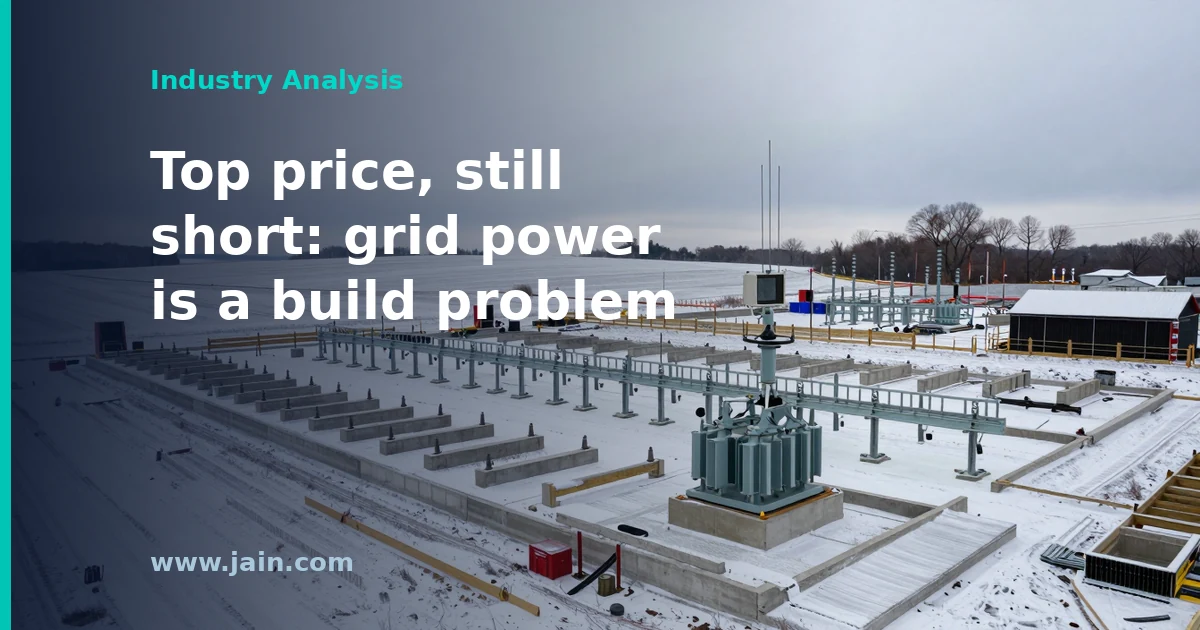
The organization that runs the electric grid for 67 million people across 13 states, including Pennsylvania, held its auction to line up power plants for 2028 and 2029. The price hit the maximum allowed, again. Even at that price, it could not secure as much power as it wanted.
Data centers, giant buildings full of computers, are one big reason demand is climbing fast. A Pennsylvania consumer advocate says higher power costs already add $220 to $320 a year to a typical household’s bill. Paying top dollar is not fixing it, because new power plants cannot be built and connected fast enough.
PJM Interconnection, the Valley Forge, Pennsylvania-based nonprofit that operates the largest electricity grid in the United States, announced on July 14, 2026 that its latest capacity auction cleared at $325 per megawatt-day for the 2028-2029 delivery year. That is the maximum allowed under a price cap first negotiated by Pennsylvania Governor Josh Shapiro’s administration after the 2024 auction set a record of $269.92, and later extended at the request of PJM-state governors and the Trump administration. The Pennsylvania Capital-Star reported that the auction also fell 6,831 megawatts short of PJM’s capacity goal, a larger deficit than in last year’s auction.
PJM President and CEO David Mills said the results show “demand for electricity continues to grow faster than electricity supply.” PJM’s peak demand forecast has risen by 66,000 megawatts through 2036, driven by retiring fossil fuel plants, electrification of transportation and industry, and proposed data center development.
Executive Summary
PJM’s capacity auction, the mechanism it uses to pay power plants to be available on the hottest and coldest days of the year, hit its price ceiling again. At $325 per megawatt-day, the 13-state grid still came up 6,831 megawatts short of its target. The cap will also apply to the next auction, scheduled for December and covering 2030 and 2031.
This matters beyond the price. When an auction clears at its maximum and still falls short, the shortfall shows how much supply the highest permitted price could not attract. Consumer advocates and the generators’ own trade association disagree on a lot, but both point to the same near-term obstacle: getting new plants built and connected to the grid. The main limit on power for data centers in the largest US grid is construction and interconnection, not willingness to pay.
For households, the cost is already visible. Pennsylvania’s former consumer advocate estimates the last two auctions added about $16 billion in reliability costs, and $220 to $320 a year to the average Pennsylvania residential bill.
At the Ceiling, the Price Signal Runs Out of Room
A capacity auction is supposed to work like any market. If the grid needs more standby power, the price rises until enough generators commit to being available. The price is quoted per megawatt-day, the payment for one megawatt of capacity held ready for one day. In this auction that mechanism hit its limit. The clearing price of $325 is the cap itself, and even at that price PJM ended up 6,831 megawatts below its capacity goal, a wider gap than last year’s.
This is the key point for anyone planning around PJM power. A market that clears below its cap tells you what supply costs. A market that clears at its cap and still comes up short only tells you that the maximum permitted price was not enough. Two years ago the record was $269.92. Prices are now pinned at the ceiling, and the ceiling has been extended through the December auction for 2030 and 2031. Patrick Cicero, the former Pennsylvania consumer advocate now with the Pennsylvania Utility Law Project, described what that looks like: “These are flat prices that are going to remain high. It’s not necessarily another spike, but it’s really, really high prices remaining.”
Why the Constraint Is Construction, Not Capital
Robert Routh of the Natural Resources Defense Council blames data center load for the price pressure, and Todd Snitchler of the Electric Power Supply Association, which represents competitive generators, defends the price as a healthy investment signal. The two still converge on where the bottleneck sits. Routh said a lack of money is not among the problems: “Tech companies, data center customers that have a need for power have deep pockets. Any power plant that can get built these days should have no problem finding buyers and arranging financing.” He named the real obstacles as supply chain delays, long construction timelines, and siting and permitting hurdles. Snitchler said “new supply is coming; the issue now is to address getting it connected to the system as quickly as possible.”
That connection step is PJM’s responsibility. The grid operator vets proposed power plants and transmission lines before approving them to connect, and it has faced intense criticism for a years-long backlog of projects waiting in that line, often called the interconnection queue. Some projects dropped out while they waited. PJM says it has made significant progress by prioritizing shovel-ready projects.
There is one honest caveat. Because the cap is binding, this auction cannot show how much supply an uncapped price might have drawn in, and EPSA’s argument that years of record-low prices discouraged investment deserves weight. Still, even the generators’ trade group names connection rather than compensation as the near-term limit. For data center developers, the implication is plain: a higher bid does not produce a megawatt that has not been built. The scarce resources are deliverable, connected capacity and the time it takes to create it.
Who Carries the Cost, and the Proposal to Separate It
The link between auction prices and retail bills is indirect, but it is real. Cicero said the last two auctions added about $16 billion to the cost of ensuring reliability. Some Pennsylvania utilities have raised default rates, the rate paid by customers who do not shop for an electricity supplier, by up to 20%. He put the added cost to the average Pennsylvania residential customer at $220 to $320 per year.
The policy response under discussion is a separate auction, sought by PJM-state governors and the Trump administration, in which data centers and other large-load customers would buy long-term power commitments that fund new capacity. Routh described it as a matchmaking venue to build new supply “without raising prices for everyone else.” By his own account, though, that process faces the same supply chain, timeline and permitting hurdles as everything else. It could change who pays for new generation. On its own, it does not shorten the time it takes to build and connect that generation, which is what closes a 6,831-megawatt gap.
Weighing the Competing Explanations
Each camp’s framing captures part of the picture. NRDC’s Routh attributes the pressure to data centers directly: “Data center load growth is degrading grid reliability, and it’s raising prices to the Governor Shapiro-negotiated cap.” PJM’s 66,000-megawatt forecast increase through 2036, nearly 80 times the output of the Three Mile Island nuclear plant, bundles three drivers into one number: retiring fossil plants, electrification, and proposed data centers. How much of that number belongs to data centers is the question that decides whether large-load cost allocation addresses most of the problem or only part of it.
The Three Mile Island example shows how the pieces fit together. That plant is set to reopen next year to serve data centers exclusively, a sign that large tech buyers are already securing dedicated supply outside the shared pool. Snitchler’s point that new supply is coming is plausible given that buying interest. Until it is connected, however, the region is running on the capped price and a growing shortfall, and the costs fall largely on customers who did not create the new load.
Background
PJM Interconnection coordinates electricity supply across 13 states, including Pennsylvania, for 67 million customers. Alongside real-time grid operations, it runs capacity auctions years in advance to ensure enough generators are on standby for peak demand. It also reviews and approves new power plants and transmission lines seeking to connect, a process that has drawn criticism for a years-long backlog.
Capacity prices in PJM were low for years, which the generators’ trade association says discouraged investment. The 2024 auction broke that pattern with a record $269.92 per megawatt-day. Pennsylvania’s governor then negotiated a price cap, and PJM later extended it at the request of state governors and the Trump administration. Demand forecasts have risen sharply since, as fossil plants retire, transportation and industry electrify, and data center proposals multiply.
On July 14, 2026, 3M and Microsoft announced a strategic partnership focused on advancing AI data center infrastructure and enterprise transformation. The announcement was carried on Microsoft’s own newsroom (Microsoft Source).
The headline positions the collaboration around AI-era infrastructure — a domain where 3M has historically supplied materials, adhesives, films and thermal management products, and where Microsoft is one of the world’s largest hyperscale operators.
Executive Summary
The release frames a tie-up between an industrial materials incumbent and a hyperscale cloud operator at a moment when AI compute is straining the physical envelope of data centers. Power density per rack, heat rejection, and materials that can survive higher junction and coolant temperatures have all become gating factors for GPU deployments.
What is substantiated in the headline is intent: a strategic partnership, AI data center infrastructure as the target, and enterprise transformation as a secondary theme. What is not yet substantiated — at least in the excerpt available to us — is scope: which 3M product lines, which Microsoft facilities, on what timeline, and under what commercial structure.
For readers evaluating the announcement, the useful posture is neither dismissal nor hype. Materials science is a genuine bottleneck for AI infrastructure, and 3M has relevant portfolios. Whether this specific partnership delivers meaningful capacity or is primarily a marketing framing will depend on details the release, as published, does not spell out.
Why Materials Suddenly Matter to Hyperscalers
For most of the cloud era, hyperscale data centers were an integration problem: racks of commodity servers, air cooling, and steady incremental efficiency gains. AI training and inference clusters have changed the physics. Modern GPU accelerators dissipate hundreds to over a thousand watts each, and racks are moving from the 10–20 kW range typical of general-purpose cloud toward 50–100 kW and beyond. At those densities, the materials in contact with silicon — thermal interface materials, dielectric fluids for immersion cooling, cold-plate seals, and vapor-barrier films — become first-order engineering constraints rather than commodity inputs.
3M’s historical relevance here is real: the company has long supplied fluorinated dielectric fluids used in two-phase immersion cooling, thermal interface products, and specialty films and tapes used inside servers and networking gear. Microsoft, for its part, has publicly experimented with immersion cooling in prior years. A partnership badged as targeting AI data center infrastructure sits squarely in this well-established technical overlap, even if the announcement itself does not enumerate specific product families.
What a Strategic Partnership Actually Buys
"Strategic partnership" is one of the more elastic phrases in corporate communications. In practice, such arrangements range from joint marketing and preferred-supplier status at the light end, to co-development agreements, capacity reservations, and equity or offtake commitments at the heavy end. The release headline as available does not disclose where on that spectrum this deal sits.
For 3M, a formal alignment with a top-three hyperscaler is commercially valuable regardless of the exact contract structure: it validates its materials portfolio for AI workloads at a moment when the company has been repositioning after divesting parts of its business and navigating environmental litigation around per- and polyfluoroalkyl substances (PFAS). For Microsoft, tying a materials supplier more closely into its infrastructure roadmap is consistent with a broader hyperscaler trend of pushing further down the stack — into custom silicon, custom racks, and now, plausibly, custom materials specifications.
Enterprise Transformation: The Ambiguous Second Leg
The headline also references enterprise transformation, a phrase that in Microsoft’s usage typically implies Azure adoption, Microsoft 365, and Copilot-branded AI products. Read literally, it suggests 3M is also a customer — modernizing its own IT and manufacturing operations on Microsoft’s stack — not only a supplier.
Two-way arrangements of this kind are common in hyperscaler deal-making: the supplier commits materials or capacity, and in return standardizes on the buyer’s cloud and AI platforms. Whether that reciprocity is present here, and on what scale, is not stated in the available excerpt. Buyers and investors should treat the enterprise-transformation framing as a signal to look for future disclosures around Azure commitments or Copilot deployments at 3M.
Risks and Open Questions on Both Sides
Any materials-heavy AI infrastructure story now runs into the PFAS question. Several of the dielectric and thermal fluids historically associated with immersion cooling belong to fluorochemical families that are under increasing regulatory scrutiny in the United States and European Union. 3M has publicly stated it intends to exit PFAS manufacturing by the end of 2025. A partnership announced in mid-2026 targeting AI infrastructure therefore raises a legitimate, non-inflammatory question: what chemistries are in scope, and how does the roadmap reconcile with that exit commitment? The release excerpt does not answer this.
On Microsoft’s side, the risk is narrative. Hyperscalers have announced many AI-era infrastructure partnerships in the past two years — with utilities, nuclear developers, chipmakers, and cooling specialists. Each individually is plausible; collectively, they can create an impression of capacity certainty that specific contracts may not yet support. The measured read is that this announcement adds one more supplier relationship to that mosaic, and its weight will be visible only when product-level or facility-level detail follows.
Background
3M is a diversified U.S. industrial company whose materials science portfolio has long included products used inside data centers — thermal interface materials, films, adhesives, filtration and, historically, dielectric fluids associated with immersion cooling. The company has been repositioning in recent years, including a stated intent to exit PFAS manufacturing by the end of 2025 amid regulatory and litigation pressure.
Microsoft is among the top three hyperscale cloud operators globally and has publicly committed to a large multi-year build-out to support AI training and inference workloads. That build-out has surfaced physical constraints — power, cooling, and materials — that were secondary concerns in the pre-AI cloud era, prompting a wave of supplier and infrastructure partnerships across the industry.
PJM Interconnection, the grid operator serving 65 million people across 13 states and Washington, D.C., announced on July 14, 2026 that its most recent Base Residual Auction procured 138,318 megawatts of generation capacity. Clearing prices reached the administrative price cap, a repeat of the prior year’s outcome.
PJM framed the result as evidence that work continues to address rising electricity demand, much of it attributed to data center growth across the footprint.
Executive Summary
A capacity auction is how PJM pays generators today to promise they will be available to deliver power on a future peak day. When the clearing price hits the ceiling PJM has set, it is a signal that the market wanted more supply than the rules allowed the price to fully reflect — a shortage indicator, not an equilibrium.
Hitting the cap two auctions in a row matters because it flows directly into wholesale capacity costs and, eventually, into retail bills across the PJM footprint. It also intensifies a policy fight that has been building for two years over how quickly new generation and transmission can be brought online, and who pays when large new loads — principally hyperscale data centers — arrive faster than steel in the ground.
For infrastructure buyers, the announcement is less a surprise than a confirmation: the tightest capacity market in the country remains tight, and the pricing signal is being absorbed by the cap rather than fully expressed.
What A Price Cap Actually Tells You
Capacity markets are designed so that when supply is comfortable, prices fall toward the cost of the cheapest available resource, and when supply is tight, prices rise to attract new plants. An administrative cap truncates that signal. Reaching it once can be an artifact; reaching it in consecutive auctions suggests the underlying scarcity is not being cleared by the response the market is meant to induce. The 138,318 MW procured is a large number in absolute terms, but the relevant question is whether it comfortably covers forecast peak demand plus a reserve margin — a figure PJM’s release, as summarized, does not itself quantify.
For laypeople: think of it like surge pricing that has been capped. The price you see at the cap does not tell you how badly buyers wanted more; it only tells you they wanted at least that much.
The Data Center Load Question
PJM has attributed a substantial share of demand growth in its footprint to data centers, particularly in Northern Virginia. That is now the operator’s stated framing again. The harder analytical question is how much of the queued data center load is firm, contracted, and in-service on the schedules developers publish, versus speculative interconnection requests that may never energize. Both PJM and independent analysts have wrestled with this in prior filings; the July 14 announcement does not, on its face, resolve it.
The commercial implication for hyperscale and colocation operators is straightforward: capacity charges are one line item in a total cost of occupancy that also includes energy, transmission, and increasingly, direct contributions to generation and grid upgrades. A cap-clearing auction reinforces the case operators have already been making internally for behind-the-meter generation, long-term power purchase agreements, and site selection outside the most constrained pockets of the PJM zone map.
Winners, Losers, And Who Pays
Existing generators inside PJM that cleared at the cap are the immediate financial beneficiaries, especially dispatchable units — gas, nuclear, and coal — whose availability is worth more in a tight market. Load-serving entities and, downstream, ratepayers absorb the cost. New entrants would benefit if they could build fast enough to catch the price signal, but interconnection queue timelines and permitting realities have historically meant the response lags the signal by years.
Politically, a second consecutive cap-clearing auction gives ammunition to every side of the ongoing PJM reform debate: to state officials who want more say over siting and cost allocation, to consumer advocates concerned about bill impact, and to developers who argue the queue and market design still under-reward new supply. The July 14 release is a data point in that debate rather than a resolution of it.
What This Means For Infrastructure Buyers
For enterprises evaluating where to put the next tranche of compute, storage, or connectivity assets, the auction outcome is best read as a durable signal rather than a one-off. Capacity cost is now a meaningful variable in PJM site selection, alongside latency, fiber, water, and property tax. Buyers with flexibility on geography can price the delta against neighboring interconnections; buyers anchored to the PJM footprint for latency or customer proximity should assume elevated capacity charges are the baseline case for the next several delivery years, not an anomaly.
Background
PJM Interconnection was formed in its modern regional transmission organization structure in the late 1990s and is regulated by the U.S. Federal Energy Regulatory Commission. It runs the wholesale energy market, the capacity market, and the transmission planning process for a footprint that stretches from northern Illinois through the Mid-Atlantic. Its capacity market, known formally as the Reliability Pricing Model, was introduced in 2007 to create a forward price signal intended to attract and retain generation.
Over the past two years, the combination of surging data center load, retirements of older coal and gas units, and slow build-out of new resources through the interconnection queue has tightened the supply-demand balance. That tightening is the backdrop against which two consecutive cap-clearing auctions must be read.
On July 14, 2026, New York Governor Kathy Hochul announced what her office describes as the first statewide moratorium on new hyperscale data centers, pausing approvals for the largest class of AI and cloud campuses across the state.
The announcement, made through the Governor’s official channels, frames the action as a siting policy intervention rather than a permanent ban, though the source material does not detail duration, thresholds, or exemptions.
Executive Summary
New York has become the first U.S. state to impose a statewide freeze specifically targeting hyperscale data centers — the campus-scale facilities, typically hundreds of megawatts and up, that host the workloads of the largest cloud and AI companies. Coming from the governor of a top-five state economy with meaningful grid, tax, and permitting leverage, the move sets a precedent other states will study closely.
Why it matters: hyperscale siting has become the single most contested piece of digital infrastructure policy in the United States, colliding with electricity availability, water use, ratepayer equity, noise, and local land use. A statewide pause reframes what has been a patchwork of town-hall fights into a top-down policy question — and shifts near-term development attention toward states with clearer rules of the road.
What we do not yet know from the release is nearly as important as what we do: the megawatt threshold that triggers the moratorium, its duration, whether projects already in queue are grandfathered, and what standards a lifted moratorium would impose. Until those details land, both celebration and alarm are premature.
Why New York, and Why Now
Hyperscale data centers — single campuses that can draw as much electricity as a mid-sized city — have moved from a niche real-estate category to a first-order infrastructure story in roughly three years, driven by generative AI training and inference demand. States that welcomed them early, notably Virginia, Texas, and Georgia, are now confronting transmission constraints, rising residential power bills, and organized community opposition. New York, which combines a constrained downstate grid with abundant upstate land and hydro, is a natural next frontier — and a natural place for a policy pause. A statewide moratorium, if that is what this ultimately is, is a signal that the state wants to define the terms of entry before, not after, a build-out.
Precedent-Setting, but the Details Will Decide Everything
The label “first statewide moratorium” is doing a lot of work in this announcement, and the substantive impact depends on parameters the release does not specify. A moratorium that applies only to facilities above, say, 500 MW and lasts six months while a siting framework is drafted is very different from an open-ended pause on anything over 50 MW. Similarly, whether the freeze covers utility interconnection queues, state environmental review, or only certain incentive programs will determine whether developers see this as a speed bump or a redirect. Reasonable observers on all sides should press for those specifics before drawing conclusions.
Winners, Losers, and Second-Order Effects
In the short run, incumbent New York operators with facilities already energized gain scarcity value; hyperscale tenants with existing leases become harder to displace. Developers holding land but not yet permits face the most uncertainty. Neighboring states with power headroom — parts of Pennsylvania, Ohio, and the Midwest — may see accelerated inbound interest, though transmission and gas-turbine lead times cap how quickly they can absorb it. Utilities, ratepayer advocates, and organized labor each have legitimate but different stakes in how a successor framework is written, and it would be a mistake to treat any one of those constituencies as speaking for “the community.”
The Harder Question: What Comes After the Pause
Moratoriums are easier to announce than to lift. The productive version of this policy ends with a clear standard: megawatt-tiered review, transparent grid-impact studies, water and noise limits, community-benefit expectations, and predictable timelines. The unproductive version leaves developers guessing and simply exports the load — and its emissions — across a state line. Both outcomes are on the table, and the release does not yet tell us which the administration is aiming for.
Background
New York has long been a major digital-infrastructure market, anchored by dense fiber and financial-services demand in the New York City metro and by cheaper power and land upstate. As artificial intelligence has driven a step-change in data center power requirements, states across the country have wrestled with how to review projects that can each request hundreds of megawatts of grid capacity — loads that historically took years or decades of organic growth to accumulate.
Governor Kathy Hochul, in office since 2021, has repeatedly emphasized both climate targets under New York’s Climate Leadership and Community Protection Act and the state’s ambitions in advanced industries. A statewide moratorium on hyperscale siting sits squarely at the intersection of those two agendas, and it lands in a national environment where data center policy has moved from a specialist concern to a mainstream one.
Crusoe and Lancium announced plans for a 1.0 gigawatt (GW) artificial-intelligence data center campus in Childress, Texas, a small city in the state’s panhandle region served by the ERCOT power grid.
The joint announcement, dated July 14, 2026, positions the site as a hyperscale-class AI compute campus, though the release itself provides only a headline-level description of the project.
Executive Summary
The Crusoe-Lancium announcement adds another gigawatt-scale AI campus to a Texas pipeline that has become the epicenter of North American data center growth. A 1.0 GW site is roughly the electrical footprint of a mid-sized city, and building one for AI training and inference workloads reflects the scale at which frontier model operators and their infrastructure partners are now planning.
The pairing is notable on its own terms. Crusoe operates AI cloud infrastructure and has historically emphasized co-locating compute with abundant or otherwise stranded energy. Lancium specializes in “controllable load” data center designs intended to flex consumption in response to grid conditions. Together, the two companies are marketing a Childress campus that, at least conceptually, blends AI-optimized halls with a grid-friendly load profile.
What the announcement does not resolve is arguably more important than what it discloses: capital structure, anchor tenants, interconnection queue position, water use, and construction phasing are all absent from the public headline.
Why Childress, and Why Now
Childress sits in the Texas panhandle, a region rich in wind generation and, increasingly, solar — but historically light on data center load. Developers have been pushing west and north out of the traditional Dallas-Fort Worth and Austin corridors in search of two things: available transmission capacity and land at prices that pencil for gigawatt campuses. A 1.0 GW footprint is difficult to interconnect anywhere on ERCOT quickly, but the panhandle’s generation surplus and long-distance transmission lines make it a plausible venue for large loads that can tolerate some siting distance from major metros.
The timing tracks with a broader industry pattern. Hyperscale AI announcements in 2025 and 2026 have shifted from megawatt-scale expansions to gigawatt-scale campuses, reflecting both the power density of modern AI accelerators and the strategic value of securing capacity years ahead of demand.
Controllable Load Meets AI Compute
Lancium’s core pitch has been that data centers can be designed as “controllable load resources” — facilities that ramp consumption up or down to help balance a renewables-heavy grid, in exchange for lower effective power costs and faster interconnection. Historically, that model has been an easier fit for cryptocurrency mining than for latency-sensitive cloud workloads. Applying it to AI compute is more nuanced: training runs are batch-like and can, in principle, tolerate curtailment windows, while inference is closer to real-time and typically cannot.
Neither company has publicly detailed how the Childress campus will split those workload types, or how curtailment obligations would flow through to tenants. That is a material question. If the campus behaves like a conventional 24/7 hyperscale load, the interconnection story is one thing; if it genuinely flexes, it is a different — and potentially more grid-constructive — proposition.
Winners, Losers, and What Is Actually Substantiated
The announcement, as issued, substantiates two things: that Crusoe and Lancium have publicly committed to the project’s existence and its nameplate scale, and that Childress has been chosen as the location. It does not substantiate a construction start date, a power-on date, an anchor customer, a capital partner, or a specific mix of on-site versus grid-supplied generation. Readers should treat 1.0 GW as a stated design intent, not a delivered capacity.
If the project proceeds as announced, the near-term beneficiaries are the local tax base, regional construction trades, and equipment vendors ranging from switchgear manufacturers to liquid-cooling suppliers. Longer term, incumbent Texas colocation operators face increased competition for transmission upgrades and skilled labor. Ratepayers and grid operators face a familiar set of questions about who pays for interconnection upgrades and how quickly load can be absorbed without stressing reliability margins.
Background
Crusoe began as an operator known for using otherwise-flared natural gas to power computing, and has since repositioned around AI cloud infrastructure and large-scale training campuses. Lancium, founded in Texas, has focused on designing data centers as flexible grid participants — an approach shaped by the state’s high share of variable renewable generation and its independent grid operator, ERCOT.
The broader context is a multi-year surge in AI compute demand that has pushed data center announcements from tens of megawatts to hundreds and now over a thousand. Texas, and the panhandle in particular, has emerged as a preferred venue because of transmission-connected wind and solar surpluses, available land, and comparatively fast large-load interconnection processes.
Meta, the company behind Facebook and Instagram, is turning its artificial intelligence data center in Richland Parish, Louisiana, into its biggest anywhere. It says it will spend more than $50 billion there.
The surprising part is the electricity. At full size, the site is planned to use about as much power as five large nuclear reactors produce. To supply it, Meta’s deal with the local utility, Entergy, pays for seven new natural gas power plants and three giant batteries.
Meta says local households will save money as a result. It has not published how it calculated that.
Meta announced on July 13, 2026 that it is expanding its Richland Parish, Louisiana data center to 5 gigawatts (GW) of compute capacity. That makes it the largest site in Meta’s fleet. The campus will house Hyperion, which Meta calls its largest multi-gigawatt AI training cluster. Meta puts the total investment in the region at more than $50 billion, supporting over 7,500 jobs at peak construction and 1,000 permanent roles once the site is operating.
The announcement also describes a new agreement with Entergy Louisiana. It will fund seven new natural gas-fueled generating plants, three grid-scale batteries, nuclear uprates and other purchased power. Meta says the agreement will deliver about $2 billion in customer savings, on top of $650 million it announced earlier, for a total of $2.65 billion over 20 years.
Executive Summary
Meta is scaling a single campus in rural northeast Louisiana to 5 GW and committing more than $50 billion to it. The site is being built to host Hyperion, a training cluster of the kind used to build large AI models, which runs tens of thousands of processors near full load around the clock. Alongside the headline figures, Meta lists $1.6 billion in contracts with Louisiana businesses to date, more than $1 billion in roads, water and wastewater improvements, a $5 million gift to Louisiana Delta Community College, and $215 million for Entergy’s affordability and efficiency programs.
The most consequential part of the announcement is the power arrangement, more than the jobs or the grants. At this scale, a data center is no longer a customer that plugs into existing grid capacity. It is a reason for a utility to build new generation. The Entergy agreement funds a portfolio of gas plants, batteries, nuclear upgrades and purchased power. Meta has also committed to help fund up to 2.5 GW of clean and renewable energy. How fast, and on what terms, that generation arrives will largely decide when Hyperion reaches full scale and who carries the cost.
At Five Gigawatts, the Utility Sets the Schedule
A gigawatt is a billion watts, and the data center industry uses it to size how much electricity a campus can draw. A large nuclear reactor produces roughly one gigawatt. Meta’s expanded Richland Parish site is rated at 5 GW of compute capacity. It will host Hyperion, described as a multi-gigawatt AI training cluster. Training clusters are an unusually demanding kind of load: thousands of accelerator chips running together for weeks at a time, drawing close to peak power continuously. A regional grid does not keep that much idle capacity in reserve, so a load of this size has to arrive with its own new generation.
That is what the Entergy agreement is for. According to Meta, it funds seven new natural gas-fueled generating plants, three grid-scale batteries, nuclear uprates and other purchased power. Nuclear uprates are upgrades that raise the output of existing reactors. Read that list next to the construction figures and the order of work becomes clear. Server halls, contractors and workforce programs are the visible part of the project. The pace, though, is governed by when the plants, batteries and grid connections come online. Construction crews can be scaled up relatively quickly. New generation depends on equipment deliveries, utility engineering and regulatory processes that a data center builder does not control.
This affects several groups. Entergy Louisiana’s other customers have bills tied to how costs are allocated. The state regulators who oversee the utility’s resource plans must weigh a single customer’s demand against system-wide reliability. And anyone forecasting Meta’s AI capacity needs to know when Hyperion actually reaches multi-gigawatt scale. Meta has not said how the seven plants’ combined output compares with the 5 GW figure. That is the number that would show how much of the campus the new generation actually covers.
The $2.65 Billion Savings Claim Needs Its Arithmetic
Meta says the new agreement is expected to deliver about $2 billion in savings to Entergy Louisiana customers, on top of $650 million announced previously. Spread over 20 years, the combined $2.65 billion averages roughly $130 million a year. The usual argument for such savings is that a very large, steady customer helps pay a utility’s fixed costs, which lowers the share left for everyone else. That argument can hold. It depends, however, on contract terms: who pays for the new plants, over what period, and what happens if the anchor customer’s demand falls short of plan.
Meta did not lay out that mechanism or the assumptions behind the figure. Its broader commitment is that it will pay for the energy, water and related infrastructure it uses so that other customers’ bills do not rise. That is a meaningful policy statement, but its strength sits in contract language that has not been published. The $215 million contribution to Entergy’s Power to Care and residential energy efficiency programs is more concrete: it is a direct transfer with a stated amount. Until the underlying terms are visible, the headline savings figure is best read as a projection, not a guarantee.
Clean-Energy Matching Next to New Gas Generation
Meta says it will match 100% of the Richland Parish site’s energy use with clean and renewable energy, as it does at its other data centers. It also commits to help fund up to 2.5 GW of clean generation. Matching is an accounting method: a company funds or buys clean electricity equal to what it consumes over a period. It does not require the clean power to be produced at the same hour or on the same grid as the consumption. The gas plants and batteries in the Entergy agreement exist because a round-the-clock training load needs power that can be supplied on demand, including at night and during low-wind periods.
Both statements can be true at once, but readers should hold them together. Up to 2.5 GW is a ceiling, not a commitment to 2.5 GW. Renewable plants also typically produce well below their rated capacity averaged over a year. Clean generation tied to this agreement alone would therefore not obviously cover the annual consumption of a 5 GW campus running near full load. Meta has not said where the balance will come from, or whether it is matched annually or hour by hour.
$50 Billion In, 1,000 Permanent Jobs Out
The job figures follow the usual pattern for hyperscale data centers, which are capital-heavy and need relatively few staff to run. Meta cites 7,500 jobs at peak construction and 1,000 operational roles, or about $50 million of investment per permanent job. The larger local effects are construction spending, tax revenue and infrastructure. Meta reports $1.6 billion contracted with Louisiana businesses to date and more than $1 billion spent on roads, water and wastewater systems. It also says Richland Parish teachers received yearly bonus checks 400% higher than the previous year because of increased tax revenue from the project.
The workforce measures are aimed at the gap between the two job numbers. They include full scholarships for data center trade certificates for Richland Parish high school graduates starting with the class of 2026, contractor-run programs at Louisiana Delta Community College, and a reported 37% rise in enrollment at the University of Louisiana at Monroe’s construction management school. Making the state’s Source Louisiana portal the default subcontracting platform widens access for local firms. The general contractors (DPR Construction, Turner Construction Company and Mortenson Construction) and in-state subcontractors benefit most directly during the build. The open question for the parish is what that construction workforce does when the peak ends.
Background
Meta Platforms, the parent of Facebook, Instagram and WhatsApp, operates a global fleet of data centers. It is one of the handful of hyperscalers, the companies that build computing capacity at the largest scale. Meta broke ground on its Richland Parish campus in northeast Louisiana in December 2024, and the July 2026 announcement expands the site to 5 GW, making it the largest in Meta’s fleet. The area is served by Entergy Louisiana, a regulated electric utility, and Meta has worked with Entergy on power supply since before the site came online.
AI training clusters have changed data center planning. Earlier facilities drew tens or hundreds of megawatts. Clusters built to train frontier AI models are now planned in gigawatts, which brings power generation, transmission and utility regulation into the center of each project. Meta has partnered since 2022 with the Center on Rural Innovation on programs near its data centers and says it is extending that partnership to Northeast Louisiana.