POWER Magazine reports that hyperscale and AI-focused data center developers are increasingly deploying on-site generation as prime power — the primary source of electricity — rather than as backup for grid supply. The shift is being driven by multi-year interconnection queues and gigawatt-scale load requests that utilities cannot serve on operators’ timelines.
The article frames the trend as a structural change in how large computing loads are powered, not a temporary workaround while the grid catches up.
Executive Summary
For decades, data center diesel generators sat idle 99% of the year, insurance against a utility outage. POWER Magazine’s May 2026 piece argues that AI-era facilities are inverting that model: on-site turbines, engines, and increasingly fuel cells are being sized to carry the base load, with the grid demoted to a secondary or supplementary role.
The change matters because it decouples data center build timelines from utility interconnection queues that now stretch five years or more in several U.S. markets. It also shifts who bears the cost of new generation, who chooses the fuel, and who is accountable for the emissions — moving decisions from regulated utility planning processes into private commercial ones.
The article does not quantify how much AI capacity is being built this way, but treats the pattern as established enough across the industry to describe as a category shift rather than a set of one-off projects.
Why the Grid Became the Bottleneck
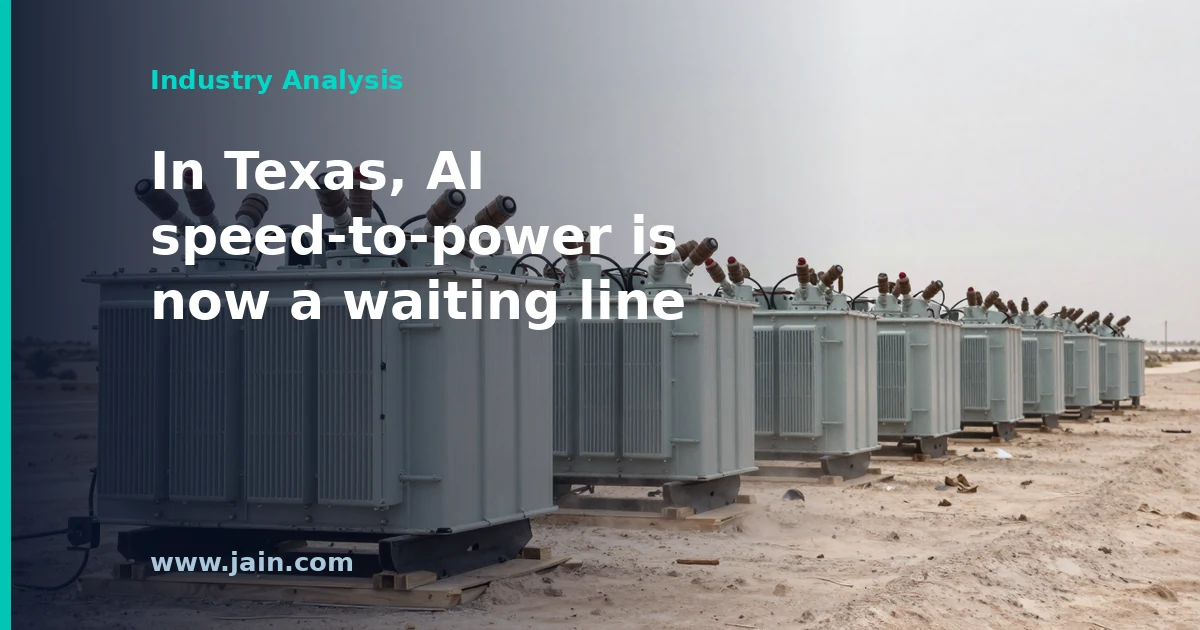
A modern AI training campus can request 500 megawatts to more than a gigawatt at a single site — roughly the draw of a mid-sized city. U.S. transmission planning, permitting, and equipment lead times were not built for loads of that size arriving in 18-month cycles. Large transformers alone now carry multi-year backlogs. Faced with utility responses measured in years, developers with hyperscaler contracts and finite construction windows are choosing to generate power themselves.
On-site prime power is not new — industrial sites, hospitals, and remote operations have done it for a century. What is new is the scale at which general-purpose computing infrastructure is adopting it, and the willingness of tenants to accept a self-generated power product rather than wait for a utility one.
The Fuel Question Nobody Wants to Answer Cleanly
Prime power at data center scale currently means natural gas turbines or reciprocating engines in most cases, with fuel cells and, in a few announced projects, small modular reactors positioned as future options. Each choice carries trade-offs the industry rarely discusses in the same sentence: gas is fast and financeable but carbon-intensive; fuel cells are cleaner per kilowatt-hour but expensive and supply-constrained; nuclear is low-carbon but years from commercial deployment at the sizes being discussed.
Operators marketing 24/7 clean energy commitments and operators building gas-fired prime power are, in some cases, the same companies. That is not necessarily hypocrisy — sustainability commitments typically cover corporate portfolios, not individual sites — but it does mean buyers and communities should read specific project disclosures carefully rather than relying on parent-company pledges.
Winners, Losers, and Who Pays for the Grid
The winners are gas turbine manufacturers, EPC contractors with power-plant experience, and developers who can site, permit, and finance generation alongside compute. Utilities lose a category of load they had expected to plan around; regulators lose visibility into where large new emissions sources are appearing; and ratepayers face a more complex question about who pays for grid upgrades if the largest new users bypass the system.
There is also a quieter loser: the narrative that AI growth would automatically pull the grid toward cleaner, more flexible operation. If the largest loads leave the grid entirely, the reverse dynamic can take hold — utilities lose the anchor customers that would have justified transmission and clean generation investment.
A Structural Shift, Not a Stopgap
The POWER Magazine framing — from backup to prime — is the important claim. If on-site generation were a bridge until interconnections cleared, the industry would treat it as temporary infrastructure. Instead, projects are being permitted, financed, and contracted on 15- to 25-year horizons, which is how long the equipment is expected to run. That is a bet that grid-served gigawatt loads will remain hard to obtain for the foreseeable future.
Whether that bet is correct depends on transmission reform, interconnection queue processing, and whether utilities can stand up large-load tariffs quickly enough to compete. None of those variables are moving at AI-buildout speed today.
Background
Data centers have historically been utility customers first and self-generators only as a fallback. Diesel backup generators, sized to carry the site through a grid outage, were standard equipment but ran only during tests and emergencies. The economics favored buying grid power because it was cheaper, cleaner in most regions, and available on request.
The AI buildout beginning in 2023 broke that model. Single-site power requests jumped from tens of megawatts to hundreds and then to gigawatts, colliding with a U.S. transmission system that had not added significant new capacity in a decade. On-site prime power emerged as the industry’s answer — controversial on emissions grounds, but faster than waiting for the grid.
Dow, one of the world’s largest materials science companies, has launched a liquid cooling support network for data centres, according to a report published by Data Centre Magazine on 18 May 2026. The reported launch positions Dow — a supplier of silicones, fluids, and specialty chemistries — as an organized participant in the fast-growing market for cooling the dense computing racks that power artificial intelligence.
Executive Summary
The announcement, as reported, is simple in outline: Dow is standing up a formal support network around liquid cooling for data centres. Support or partner networks in the materials world typically bundle products with validation, compatibility guidance, and access to a vetted ecosystem of collaborators — though the source report does not detail which of these Dow’s network includes.
Why it matters is larger than the announcement itself. Liquid cooling — circulating fluid to chips or immersing hardware in it, instead of relying on air — has moved from niche to necessity as AI servers pack more power into each rack than air can practically remove. When a company of Dow’s scale builds formal structure around that market, it signals that liquid cooling is graduating from a collection of point products into an industrial supply chain, with the materials layer — coolants, silicones, seals, thermal interfaces — treated as critical infrastructure rather than a commodity input.
Why a Chemicals Giant Is Organizing Around Server Cooling
Air cooling has a physics problem. Modern AI accelerators concentrate so much power in each rack that moving enough air through them becomes impractical, which is why the industry has shifted toward direct-to-chip liquid cooling (piping coolant across a cold plate mounted on the processor) and, in some deployments, immersion cooling (submerging entire servers in a non-conductive fluid). Every one of those approaches depends on chemistry: the coolant itself, plus the hoses, seals, gaskets, and thermal interface materials that keep fluid where it belongs for years at a time.
That is Dow’s home turf. Materials suppliers have historically sold into this market indirectly, through the vendors that build cooling hardware. A formal support network — if it follows the usual shape of such programs — moves the materials maker closer to the operators and equipment builders who actually deploy the technology, which matters because coolant compatibility failures (degraded tubing, fouled cold plates, additive breakdown) are among liquid cooling’s most feared operational risks.
Formalizing the Supply Chain Is the Real Story
The editorial significance here is less any single product and more the institutional signal. Liquid cooling’s early years were characterized by fragmented suppliers, proprietary fluids, and limited interoperability guidance. Buyers — hyperscale cloud providers, colocation operators, enterprises — have been pushing for validated, multi-vendor supply chains before committing facilities designed to run for decades. Ecosystem programs are how industrial suppliers answer that demand: they convert one-off product sales into standing relationships with documented compatibility.
Dow is not moving into an empty field. Fluid and chemistry players including Chemours, Shell, and Castrol have courted the data centre cooling market, while 3M’s announced exit from PFAS manufacturing by the end of 2025 removed a prominent supplier of certain engineered fluids and sharpened questions about fluid chemistry choices across the industry. Against that backdrop, a structured support offering from a major materials company is a bid for trust as much as for revenue: operators want assurance that the fluid in their loops will be supported, supplied, and compliant for the life of the facility.
What Buyers Should Watch For
For data centre operators and cooling equipment makers, the practical questions are concrete. Does the network provide compatibility validation across pumps, cold plates, and piping from multiple hardware vendors? Does it address regulatory exposure — notably the tightening scrutiny of per- and polyfluoroalkyl substances (PFAS) that affects some classes of engineered cooling fluids? And does it shorten the qualification cycle, which today can add months to a liquid cooling deployment?
The source report does not answer these questions, and it would be premature to credit the network with capabilities it has not publicly detailed. What can be said fairly is that the direction of travel — materials incumbents building formal, supported ecosystems around data centre liquid cooling — is exactly what a maturing market looks like, and buyers benefit when more credible suppliers compete to underwrite reliability.
Background
Dow traces its roots to 1897 and today ranks among the world’s largest materials science companies, supplying silicones, fluids, and specialty chemistries across dozens of industries. Its materials have long appeared inside electronics and thermal management applications, though typically sold through intermediaries rather than under a data centre-branded program.
The data centre cooling market has been reshaped by the AI build-out: rack power densities have climbed beyond what air cooling comfortably handles, pushing direct-to-chip and immersion cooling from experimental to mainstream. That shift has drawn fluid and chemistry suppliers — and their partner ecosystems — into a market once dominated by mechanical and HVAC vendors.
Energy storage company Fluence has signed agreements with two hyperscale data center operators, according to a report by Data Center Dynamics published May 18, 2026. The customers, deal values, and capacities were not disclosed in the source material, but the reported agreements mark a notable step: battery storage being procured directly in connection with hyperscale data center operations rather than solely by utilities and power producers.
Executive Summary
Fluence, one of the largest global suppliers of grid-scale battery energy storage systems, has reportedly landed two hyperscale data center customers — a category of buyer that historically purchased backup diesel generators and grid power, not utility-scale batteries. Hyperscale operators are the companies that run the world’s largest cloud and AI computing campuses, and their electricity demand has become one of the defining forces in power markets.
The significance is less about the (undisclosed) size of these specific deals and more about the buyer category. When hyperscalers begin contracting directly with storage integrators, batteries stop being purely a grid asset — something utilities install to balance supply and demand — and become part of the data center’s own power strategy: a tool for securing grid interconnection, riding through disturbances, and shaping when and how a facility draws power. If the pattern holds, it opens a substantial new demand channel for the storage industry and a new procurement lever for data center developers stuck in multi-year grid connection queues.
Why Hyperscalers Are Buying Batteries
The immediate driver is the collision between AI-era data center demand and a slow-moving grid. In many major markets, new large loads face interconnection waits measured in years, and utilities increasingly ask big customers to demonstrate they can soften their impact on the system. A battery energy storage system (BESS) — essentially a warehouse-scale bank of lithium-ion cells with power electronics — lets a data center reduce its peak draw, absorb power when it is cheap and plentiful, and present a more flexible, grid-friendly load. That flexibility can be the difference between an energization date in 2027 and one in 2030.
Batteries also address power quality. AI training clusters create fast, large swings in electricity demand that stress both on-site infrastructure and the surrounding grid; storage can buffer those swings. And for operators with public clean-energy commitments, batteries paired with wind and solar contracts help match consumption to carbon-free supply hour by hour, rather than only on an annual-average basis.
What Hyperscaler Customers Mean for Fluence
Fluence built its business selling storage systems and services to utilities, independent power producers, and renewable developers. Data centers represent diversification into a customer class with deep balance sheets, urgent timelines, and — critically — willingness to pay for speed and reliability rather than shopping purely on cost per megawatt-hour. For a storage integrator, that is an attractive shift in buyer mix, and landing two hyperscale names at once suggests deliberate strategy rather than a one-off win.
That said, the report gives no deal sizes, so the revenue significance cannot be assessed. Two agreements could range from pilot installations at single campuses to multi-site framework deals. The storage industry has seen announcements in both categories, and they carry very different weight. Until capacities and terms are disclosed, this is best read as a directional signal about the market, not a measurable change in Fluence’s book of business.
Batteries Versus Diesel — and Versus Gas Turbines
Data centers have long relied on diesel generators for backup: cheap to install, proven, but polluting, increasingly hard to permit, and useless for anything except emergencies. Batteries invert that profile. They are cleaner and can earn their keep daily — shaving peaks, providing grid services, arbitraging power prices — but standard four-hour lithium-ion systems cannot carry a facility through a multi-day outage. In practice, storage today complements rather than replaces backup generation, and the interesting design question is how large a battery a hyperscaler buys and what jobs it is asked to do.
The competitive backdrop matters too. Some data center developers are answering the power crunch with on-site gas turbines or fuel cells; others are betting on storage-plus-renewables or, further out, small modular reactors. Each path trades off speed, cost, carbon, and permitting risk differently. Hyperscalers signing with a storage integrator indicates that, at least for some sites, batteries have won a seat at that table — a meaningful endorsement in a market where Fluence competes with Tesla’s Megapack business, Sungrow, and a field of Chinese and Western integrators.
What Is Substantiated — and What Isn’t
It is worth being plain about the evidentiary base. The source is a single trade-press headline reporting that deals were signed; no capacities, locations, customer names, financial terms, or delivery dates accompany it. The trend it points to — storage converging with data center power strategy — is real and independently visible across the industry, but the specific commercial weight of these two agreements is unverified. Readers should treat the announcement as evidence of demand-side interest, not as proof of deployed megawatts.
Even so, thin announcements can be leading indicators. Hyperscalers rarely allow their names near a vendor’s deal news without internal conviction, and storage suppliers rarely publicize data center wins unless they expect the category to grow. The claims worth watching for next are concrete ones: megawatt-hours under contract, energization dates, and whether the systems sit behind the meter at the data center or in front of it on the grid.
Background
Fluence was created in 2018 as a joint venture between industrial group Siemens and global power company AES, combining their early battery storage businesses into a dedicated integrator. It listed on Nasdaq in 2021 and has since deployed grid-scale storage across the Americas, Europe, and Asia-Pacific, selling systems, services, and operational software primarily to utilities, independent power producers, and renewable developers.
The storage market it serves has grown rapidly as falling lithium-ion costs and rising renewable penetration made batteries a standard grid resource. What is newer is the demand side of this story: hyperscale data center operators, whose electricity needs have surged with AI computing, emerging as direct buyers of storage — a convergence of two of the fastest-growing segments in energy and digital infrastructure.
Eight of the largest U.S. communications companies have formed the C2 ISAC — an Information Sharing and Analysis Center dedicated to cybersecurity collaboration across the telecom sector. The announcement, distributed May 18, 2026 via the AT&T Newsroom, positions the new body as a vehicle for member carriers to exchange threat intelligence and coordinate defenses against attacks on communications infrastructure.
Executive Summary
An ISAC is a member-run clearinghouse where companies in one industry share indicators of compromise, attack patterns, and defensive playbooks — a model pioneered by the financial sector’s FS-ISAC in 1999 and since replicated across critical infrastructure. What is notable here is not the model but the participants: eight direct competitors, including AT&T, standing up a purpose-built cybersecurity body for communications rather than relying solely on existing government-coordinated channels.
The move lands in a sector still absorbing the lessons of the publicly reported Salt Typhoon intrusions, in which a China-linked espionage campaign penetrated multiple major U.S. carriers and was disclosed beginning in late 2024. Whatever the C2 ISAC’s precise mandate turns out to be, its formation is a clear signal that the operators of America’s communications backbone believe collective, industry-led defense is now table stakes — and that the existing sharing arrangements were not enough on their own.
Why Telecom Is Building Its Own War Room
Telecom networks are uniquely attractive targets: compromise one carrier and you can potentially observe the communications of millions of customers, including government and enterprise traffic. The Salt Typhoon campaign made that risk concrete, with public reporting indicating intruders reached deep into carrier systems, including infrastructure tied to lawful-intercept functions. Against that backdrop, a formal, carrier-owned threat-sharing body reads as an institutional response — turning ad-hoc cooperation during a crisis into a standing capability.
The sector was not starting from zero. Communications companies have long participated in government-coordinated sharing through bodies descended from the Communications ISAC and in cross-sector work with the Cybersecurity and Infrastructure Security Agency (CISA). Creating a new, industry-controlled center suggests the founders wanted something those channels did not fully provide — plausibly faster peer-to-peer exchange, tighter operational trust among a small membership, or an agenda set by carriers rather than convened by government. The release headline emphasizes collaboration; the substance will be in how the body differs from what already existed.
The Economics of Shared Defense
Cyber threat intelligence has an unusual economic property: sharing it costs the giver little and can save the receiver enormously, because attackers reuse infrastructure and techniques across targets. An indicator of compromise spotted on one carrier’s network — a malicious IP address, a tampered configuration, a phishing kit — is often the early warning that lets seven others block the same campaign. Pooling that signal across eight national-scale networks creates a sensor grid no single company could build alone.
The catch is that sharing bodies live or die on trust and reciprocity. Members must be willing to disclose incidents that are commercially embarrassing, and to do so fast enough for the intelligence to matter. The U.S. Cybersecurity Information Sharing Act of 2015 provides liability protections designed to encourage exactly this, but ISACs across industries have historically struggled with free-riding — members who consume intelligence without contributing. A small founding group of eight peers, rather than a sprawling open membership, may be a deliberate design choice to keep contribution norms enforceable.
Ripple Effects Down the Infrastructure Stack
Carriers do not defend their networks in isolation. Their infrastructure runs through data centers, interconnection points, and cloud platforms, and their security posture directly affects every enterprise that buys transit, transport, or managed services from them. If the C2 ISAC succeeds in shortening the time between one member detecting a campaign and all members blocking it, the benefit flows downstream to customers who never see the machinery — fewer carrier-side compromises means fewer avenues into the businesses that ride those networks.
There is also a competitive dimension. Security is increasingly a procurement criterion for enterprise and government connectivity contracts, and visible participation in a serious sharing body is a credential. For carriers outside the founding eight — regional operators, rural providers, wireless resellers — the open question is access: whether the C2 ISAC’s intelligence eventually reaches the broader ecosystem, or whether it deepens a capability gap between the largest operators and everyone else. Smaller operators have historically been the softer targets, so the sector-wide payoff depends on how far the sharing extends.
Background
ISACs trace to Presidential Decision Directive 63 in 1998, which urged each critical-infrastructure sector to build a hub for sharing threat information; the financial sector’s FS-ISAC, founded in 1999, became the template. The communications sector has participated in government-coordinated sharing for decades, but the disclosures beginning in late 2024 of the Salt Typhoon espionage campaign — which publicly reported accounts say penetrated multiple major U.S. carriers — sharpened scrutiny of whether existing arrangements moved fast enough. The C2 ISAC, announced in May 2026 with AT&T among its eight founding firms, is the sector’s most visible institutional answer to that question so far.
Blackstone, the world’s largest alternative asset manager, will invest $5 billion in an AI infrastructure venture with Google, with the resulting capacity powered by Google’s Tensor Processing Units (TPUs) rather than the Nvidia graphics processing units (GPUs) that have dominated AI build-outs to date, according to a CNBC report published May 18, 2026.
Executive Summary
The announcement pairs one of the deepest pools of private capital with the only hyperscaler that designs and deploys its own AI accelerator at scale. Blackstone’s $5 billion commitment funds infrastructure — the data center capacity, power, and systems needed to run AI workloads — while Google contributes its TPU silicon, custom chips it has refined over roughly a decade to train and serve machine-learning models.
Why it matters: nearly every headline AI infrastructure deal of the past three years has been, implicitly or explicitly, an Nvidia GPU deal. A marquee private-equity firm underwriting billions against TPU-based capacity is a meaningful vote of confidence that alternative accelerators can anchor institutional-grade infrastructure investment — and a signal that the financing market for AI compute is beginning to diversify beyond a single chip vendor.
The First Big Check Written Against Non-Nvidia Silicon
AI infrastructure finance has grown enormously, but it has grown narrowly: lenders and equity investors have overwhelmingly underwritten deals where the collateral and the revenue engine are Nvidia GPUs. That concentration has been rational — Nvidia’s CUDA software ecosystem and resale liquidity made its chips the safest asset to finance — but it has also made the entire capital stack a leveraged bet on one supplier. Blackstone committing $5 billion against TPU-powered capacity is the clearest sign yet that sophisticated capital now sees a second underwritable accelerator. TPUs are application-specific chips Google designed for the mathematics of neural networks; they lack the open resale market of GPUs, which is precisely why a partnership with Google — the designer, operator, and most likely demand backstop — is the structure that makes the risk financeable.
For the broader market, the precedent may matter more than the dollars. If TPU capacity can attract institutional capital on infrastructure terms, similar structures become imaginable around other custom silicon. That would gradually loosen the financing chokepoint that has funneled most AI investment through a single vendor’s order book.
Blackstone’s Compounding Digital Infrastructure Thesis
This deal extends a strategy Blackstone has pursued aggressively since taking data center operator QTS private in 2021 in a transaction valued around $10 billion — then one of the largest data center acquisitions ever. Under Blackstone’s ownership, QTS became a vehicle for hyperscale expansion, and the firm has repeatedly identified AI infrastructure — data centers and the power to run them — as one of its highest-conviction themes. A venture with Google fits the pattern: Blackstone supplies capital at a scale few can match, and captures returns from the physical layer of AI regardless of which models or applications ultimately win.
The economics of such ventures typically hinge on tenancy: infrastructure returns are attractive when long-term, creditworthy commitments stand behind the capacity. Google’s involvement suggests — though the report does not confirm — that Google itself or its cloud customers would utilize the TPU capacity, which would make this closer to a pre-leased infrastructure play than a speculative build. The announcement does not disclose the venture’s structure, so that remains an inference rather than a fact.
Winners, Losers, and the Accelerator Question
Google is an obvious beneficiary: external capital lets it scale TPU deployment faster than its own capital-expenditure budget alone would allow, and every TPU-anchored venture strengthens the case that its silicon is a genuine alternative for AI workloads, not just an internal cost-saver. For Nvidia, one $5 billion venture is immaterial to near-term demand — its chips remain heavily supply-constrained — but the directional message is unwelcome: the largest infrastructure investors are actively building expertise in financing non-Nvidia compute. Data center developers, power providers, and cooling vendors win either way; TPUs, like GPUs, are power-dense accelerators that need substantial electricity and advanced thermal management.
The risks are real, too. TPU capacity is only as valuable as demand for TPU workloads, and that demand is concentrated in Google’s own ecosystem and a handful of large AI developers. If the software world remains standardized on Nvidia’s tooling, TPU infrastructure could face a narrower tenant pool than comparable GPU builds — a concentration risk any underwriter of this deal will have had to price.
Background
Google introduced TPUs in the mid-2010s to run its own machine-learning workloads more efficiently than off-the-shelf chips allowed, and has since iterated through multiple generations while making them available to outside customers through Google Cloud. TPUs are the most mature in-house AI accelerator program among the hyperscalers, all of whom have pursued custom silicon to reduce dependence on Nvidia. Blackstone, for its part, has spent the past half-decade positioning itself as a dominant financier of digital infrastructure — anchored by its roughly $10 billion take-private of QTS in 2021 — on the thesis that AI’s appetite for compute and power represents a generational infrastructure build-out.
News reports circulating on 17 May 2026 say that intrusions into fuel-tank monitoring systems at US gas stations are suspected of being linked to Iran. The systems in question are automatic tank gauges — small networked controllers that sit in the back office of a filling station and track how much fuel is in the underground tanks, whether the level is dropping faster than sales would explain, and whether a delivery is about to overfill a tank.
The publicly available source material is a short wire aggregation that attributes the claim to other “reports.” It does not name the affected operators, the vendor or model of the equipment, the number of sites touched, the dates of the activity, the intrusion method, or any government agency that has formally confirmed the attribution. Those details matter, and at the time of writing they are not in the public record.
Executive Summary
The claim itself is simple: someone reached into the systems that watch fuel inventory at American filling stations, and the suspicion points toward Iran. What makes it worth writing about is not the novelty — it is the repetition. Tank gauges belong to a category of equipment that has been demonstrably reachable from the open internet for more than a decade, and state-aligned actors have repeatedly found value in touching exactly this kind of gear.
The strategic logic is asymmetric. Breaking into a bank or a hyperscale cloud tenant is hard and loud. Finding an unauthenticated serial-to-IP controller at a suburban gas station is cheap, quiet, and produces a headline about compromised American infrastructure regardless of whether anything was actually disrupted. The target is not the fuel; it is the demonstration.
For infrastructure buyers, the practical lesson sits below the security-vendor pitch. The weak point in this story is not enterprise IT — not the firewall, not the identity provider, not the SOC. It is a low-margin embedded device on a site that may have no IT staff at all, purchased on a maintenance budget, connected by whoever installed it, and never inventoried since. That is a procurement and asset-management problem before it is a threat-intelligence problem.
Gauges and Controllers Are Where the Perimeter Actually Ends
Operational technology, or OT, is the computing that touches physical things: valves, pumps, sensors, motors. It differs from IT in a way that matters here. IT gear is refreshed on a three-to-five-year cycle, patched monthly, and owned by someone whose job is computers. OT gear is bought once, expected to last fifteen or twenty years, and owned by whoever runs the physical process — a maintenance manager, a franchisee, a regional facilities contractor. Many of these devices were designed before continuous internet exposure was a normal condition, and some ship with serial protocols wrapped in TCP with no authentication step at all.
Automatic tank gauges are a textbook case. They exist because leak detection is a regulatory requirement for underground storage tanks, so nearly every station has one. They are networked because fuel distributors want remote inventory readings to schedule deliveries efficiently — a real and legitimate business gain. And they are frequently reachable from the open internet because the cheapest way to get a remote reading in 2008 was to point a port at the device and hope nobody looked. Security researchers have been publishing on exposed tank gauges for years; the exposure surface is not a secret, and it is not new.
The uncomfortable implication for the broader infrastructure sector is that the same pattern repeats wherever a physical process meets a cheap controller: building management systems, cooling plants, backup generator controllers, substation relays, water and wastewater pumping. A data center operator who has hardened its network fabric to an audited standard may still have a chiller controller or a fuel-farm gauge with the same architectural weakness as a gas station in Ohio.
Attribution Is a Claim Until Someone Shows the Work
“Suspected” is doing a great deal of work in this story, and readers deserve to see the seams. The available source is an aggregation citing unnamed reports. It does not indicate whether attribution rests on infrastructure overlap, tooling similarity, language artefacts, timing correlated with geopolitical events, a claim made by the actors themselves, or a government assessment with a stated confidence level. Each of those is a different quality of evidence, and they are routinely collapsed into the same one-word verdict in headlines.
There are fair questions in both directions. Toward the attribution: state-aligned groups are not the only actors who scan for exposed industrial devices, hacktivist personas sometimes overstate or fabricate access, and screenshots of a device interface do not by themselves establish control over a physical process. Toward the sceptics: the pattern of ideologically framed intrusions into low-end industrial controllers has been documented in official advisories before, including US federal warnings following the defacement of programmable logic controllers at water utilities in late 2023, so a claim of state-aligned activity in this category is not inherently implausible or agenda-driven.
The right posture is symmetric scrutiny. A government advisory that names an actor should be read for its stated evidence and confidence language, not just its conclusion. A vendor blog that arrives within hours with a product recommendation should be read for whether its telemetry actually covers the affected device class. And a group claiming credit online should be treated as an interested party making a marketing claim about itself. None of this dismisses the report; it simply declines to treat a single-sentence wire item as a finished investigation.
The Economics Explain the Neglect Better Than the Threat Intelligence Does
US fuel retail is a fragmented, thin-margin business in which a large share of sites are independently owned or franchised. The gauge is not a profit centre; it is a compliance device. Nobody buys one for its security posture, no customer chooses a station based on it, and the person who installed it may no longer be under contract. When the annualised cost of a segmented network and a managed VPN exceeds the visible cost of doing nothing, doing nothing wins on the spreadsheet — right up until the incident, whose costs land on someone else entirely.
That misalignment is the actual market failure. The site owner bears the remediation cost; the public bears the disruption risk and the strategic cost of an adversary holding a demonstrated foothold. Where this has been corrected in other sectors, it has usually come through the same three levers: a regulator making a control mandatory, an insurer pricing the absence of that control, or a large buyer pushing requirements down its supply chain. Fuel retail has a strong regulatory framework for environmental leak detection and a comparatively light one for the cyber security of the device performing it.
Winners, if the story develops, are the vendors of OT asset discovery and network segmentation, the managed service providers who can deliver it at franchise scale and franchise prices, and equipment makers who can credibly offer an authenticated, remotely updatable replacement. Losers are operators who discover during an audit that they cannot produce an inventory of what is connected at their sites. The gap between those two groups is largely a question of whether anyone ever wrote the asset list.
What This Changes for Infrastructure Buyers Today
Very little of the sensible response depends on whether the Iran attribution holds up. Exposed, unauthenticated controllers are a defect regardless of who knocks on the door. The near-term actions are unglamorous: find every device that speaks to the outside world, confirm whether it needs to, put remote access behind an authenticated tunnel rather than a forwarded port, and make sure the physical process has an out-of-band safeguard that does not trust the network — mechanical overfill protection, independent alarms, manual verification procedures.
For companies procuring infrastructure services, the durable question to put to a provider is narrower and more revealing than “are you secure?” It is: which of your operational devices are reachable from outside your network, who maintains their firmware, and how would you know within a day if one of them started behaving abnormally? An operator who can answer that quickly has done the work. An operator who has to go and find out has just identified their own gap.
The wider pattern is worth naming plainly. As more physical infrastructure gets instrumented — for efficiency, for sustainability reporting, for remote operations — the count of small networked controllers grows far faster than the security budget attached to them. That trend is not going to reverse, which means the answer has to be architectural rather than heroic: assume the cheap device will eventually be reachable and untrustworthy, and design the process so that being wrong about it is survivable.
Background
Automatic tank gauges became near-universal at American filling stations because environmental regulation of underground storage tanks requires reliable leak detection, and electronic gauging is a common way to meet it. Once the hardware was in place, fuel distributors added network connectivity so they could read inventory remotely and schedule deliveries by need rather than by calendar. That efficiency gain is real, and it is why the devices are connected at all.
The security consequence arrived later. Many of these controllers use protocols designed for a direct serial cable and later wrapped in network transport, sometimes with no authentication step. Public research has repeatedly found large numbers of such devices answering queries from the open internet, and industrial controllers of this general class — inexpensive, long-lived, widely deployed, thinly maintained — have featured in several state-linked and hacktivist campaigns against Western infrastructure in recent years.
Technical.ly reported on May 17, 2026 that a $67 billion deal between Dominion Energy and NextEra Energy could reshape Northern Virginia’s data center economy — the largest concentration of data center capacity in the world. At that price, the transaction would rank among the biggest utility deals in U.S. history.
The report frames the deal around Northern Virginia’s “Data Center Alley,” the Loudoun County–centered corridor whose electricity is supplied largely by Dominion, and whose AI-driven load growth has become the defining challenge for the regional grid.
Executive Summary
According to the report, Dominion Energy — the regulated utility serving most of Virginia, including the Northern Virginia data center corridor — and NextEra Energy, the Florida-based utility holding company that is also the largest developer of wind and solar generation in the United States, are parties to a transaction valued at roughly $67 billion. The headline figure alone signals a bet that serving data center load is now the most valuable franchise in the American power sector.
Why it matters: whoever owns the wires and generation feeding Data Center Alley effectively controls the throttle on the region’s — and arguably the industry’s — AI buildout. Dominion has publicly described a contracted and requested data center pipeline measured in tens of gigawatts, an order of magnitude beyond historical utility growth rates. Pairing that captive demand with NextEra’s generation development machine is the strategic logic the market will read into a combination of this size, whatever the final structure proves to be.
A caution up front: the source available at publication is a single news headline. The deal’s structure — acquisition, merger, asset purchase, or joint venture — its financing, and its regulatory path are not described in the material we can verify, and we treat them accordingly below.
Why a Utility Deal Is Really a Data Center Deal
Northern Virginia is not just another service territory. Loudoun County and its neighbors host tens of millions of square feet of data center space, and Dominion has for years been the region’s essential supplier — its interconnection queue, transmission buildout, and rate design decisions directly set the pace at which hyperscalers and colocation providers can energize new capacity. A $67 billion transaction touching this territory is therefore less a conventional utility consolidation story than a claim on the single most concentrated pool of AI-era electricity demand on the planet.
For readers outside the power business: regulated utilities like Dominion earn a state-approved return on the infrastructure they build, which means guaranteed-growth demand — like contracted data center load — translates almost mechanically into earnings growth. That is why data center demand has turned sleepy utility stocks into growth assets, and why a buyer or partner would pay a historic premium to be attached to it.
The NextEra Logic: Generation Meets Load
NextEra brings the other half of the equation. Through NextEra Energy Resources it has built more wind, solar, and battery capacity than any other U.S. developer, and its regulated arm, Florida Power & Light, is among the country’s largest utilities. The structural problem in Northern Virginia has never been demand — it is that generation and transmission cannot be added fast enough. Marrying the nation’s most aggressive generation developer to the nation’s most demand-rich territory is a coherent industrial thesis, and it tracks the broader pattern of power and compute vertically converging: hyperscalers signing nuclear offtakes, developers co-locating generation with campuses, and utilities racing to finance multi-decade capital plans.
It also concentrates risk. AI demand forecasts are contested; utilities and grid operators have acknowledged that interconnection queues contain speculative and duplicate requests. A $67 billion valuation built on tens of gigawatts of projected load is exposed if even a fraction of that pipeline evaporates, gets self-supplied behind the meter, or migrates to cheaper-power regions.
Who Feels This: Ratepayers, Regulators, and Tenants
Any transaction involving Dominion’s Virginia franchise runs through the State Corporation Commission, and likely federal reviews as well, at a moment when data center cost allocation is already politically charged in Richmond. Virginia regulators have been actively weighing how to keep large-load infrastructure costs from spilling onto residential bills; a mega-deal gives them maximum leverage to extract commitments on rates, reliability, and clean energy timelines as conditions of approval. Expect the approval process, not the announcement, to determine what this deal actually does.
For data center operators and tenants, the practical questions are concrete: does consolidation speed up interconnection by unifying generation and delivery under deeper-pocketed ownership, or does it reduce competitive pressure and harden pricing power over a customer base with nowhere else to plug in at scale? Both outcomes are plausible, and the answer will likely be written into regulatory conditions rather than the merger agreement.
The Consolidation Signal
Step back and the deal — if consummated — marks a phase change: AI power demand is no longer being met by incremental utility capital plans but by restructuring the ownership of the grid itself. Other demand-heavy territories (Georgia, Texas, Ohio, Arizona) and the utilities that serve them become obvious candidates for similar combinations, and every hyperscaler’s site-selection calculus now has to price in who will own their utility in five years. The financing of the AI buildout is migrating from tech balance sheets and project finance into the regulated-utility capital model — with all the ratepayer politics that entails.
Background
Northern Virginia became the internet’s landlord over three decades, as early network exchange points around Ashburn attracted carriers, then cloud providers, then AI training campuses. Dominion Energy grew into the indispensable supplier of that boom, and by the mid-2020s was publicly describing data center demand — measured in tens of gigawatts of contracted and requested capacity — as the dominant driver of its capital plans, while Virginia lawmakers and regulators debated who should pay for the grid expansion it requires.
NextEra Energy took a different route to power-sector prominence: alongside its Florida utility franchise, it built the nation’s largest renewable generation fleet and has consistently argued that electricity demand from AI and electrification marks the sector’s biggest growth era in decades. A combination with Dominion, as reported, would fuse the industry’s largest generation developer with its most demand-rich territory.
Eight leading U.S. communications companies, among them Comcast, announced on May 17, 2026 the formation of the C2 ISAC, a new Information Sharing and Analysis Center intended to strengthen cybersecurity collaboration across the communications sector. The body will serve as a venue for member firms to exchange cyber threat intelligence relevant to the networks that carry the nation’s voice, video, and data traffic.
Executive Summary
The announcement establishes a dedicated, industry-run clearinghouse for cyber threat information among major U.S. communications providers. An ISAC — an Information Sharing and Analysis Center — is a nonprofit membership organization through which companies in a critical-infrastructure sector pool indicators of compromise, attacker tradecraft, and defensive practices, so that an intrusion detected on one network can inform defenses on all the others.
The move matters because communications networks sit underneath essentially every other critical sector: finance, healthcare, energy, and government all ride on carrier infrastructure. It also arrives after a period in which U.S. telecommunications networks drew sustained attention from state-sponsored intrusion campaigns, making the case for faster, structured intelligence exchange among carriers considerably less abstract than it once was. That said, the announcement as distributed is brief, and key operational details — the full membership roster, governance, funding, and how C2 ISAC relates to existing communications-sector sharing bodies — are not spelled out in the material we reviewed.
Why Telecom Threat Sharing Is Having a Moment
The timing of a new communications-sector ISAC is not hard to read. Over the past two years, publicly disclosed intrusion campaigns attributed to state-sponsored actors — most prominently the Salt Typhoon operation revealed in late 2024 — showed that multiple major U.S. carriers could be compromised by the same adversary, using related techniques, over an extended period. When several competitors are being probed by one well-resourced attacker, the security of each network partly depends on what the others have already seen. Structured sharing converts one company’s painful discovery into every member’s early warning.
For lay readers: threat intelligence in this context means concrete technical artifacts — malicious IP addresses, malware signatures, the specific sequences of actions attackers take inside a network — plus analysis of who is attacking and why. Shared quickly, it lets a defender look for an intruder before that intruder reaches them.
Where C2 ISAC Fits in an Existing Ecosystem
The ISAC model is well established: sector-specific centers have operated since the late 1990s, with the financial sector’s FS-ISAC often cited as the benchmark. The communications sector has historically coordinated through government-adjacent structures, including the long-running Communications ISAC function associated with the National Coordinating Center for Communications. A new, carrier-founded body suggests the major providers want an industry-owned vehicle with its own governance and, presumably, its own operational tempo.
That raises a fair structural question that applies to any new sharing body, not to these companies specifically: does a new center consolidate effort or fragment it? The value of an ISAC scales with the breadth and candor of participation. If C2 ISAC becomes the primary venue where the largest carriers share at depth, it could raise the bar for the whole sector. If it operates in parallel with existing channels without clear division of labor, members could face duplicated processes and diluted signal. The announcement text we reviewed does not address this relationship.
The Economics of Cooperating With Competitors
Communications is a fiercely competitive business, and cybersecurity has sometimes been treated as a differentiator rather than a commons. ISACs work because they carve security out of the competitive arena: members compete on price, coverage, and service, but not on whether each other’s networks get breached. There is also a legal scaffold that makes this workable — the Cybersecurity Information Sharing Act of 2015 established liability protections for companies exchanging cyber threat indicators, addressing the antitrust and disclosure fears that historically chilled cooperation.
The economics favor the members, too. Duplicating threat-hunting effort eight times over is expensive; pooling it is cheaper and better. For eight firms of this scale, even modest reductions in attacker dwell time — the period an intruder operates undetected — translate into materially lower incident costs and less regulatory exposure. The open question, common to all ISACs, is free-riding: sharing bodies tend to have a few prolific contributors and many quiet consumers. Governance and culture, not press releases, determine which way that goes.
What Would Count as Success
A fair test for C2 ISAC, a year in, would look like this: Is machine-speed indicator sharing actually operating, or is exchange limited to periodic meetings? Has membership broadened beyond the founding eight to regional carriers and smaller providers, who are often the softest targets and whose networks interconnect with everyone else’s? And is there evidence — even anonymized — that shared intelligence shortened a real incident? None of this is knowable at launch, and it would be unfair to demand it of a day-one announcement. But those are the measures by which the sector, its enterprise customers, and regulators should eventually judge the effort, and the founders would strengthen their case by committing to report against them.
Background
Information Sharing and Analysis Centers date to a 1998 U.S. presidential directive encouraging each critical-infrastructure sector to build a private-sector hub for exchanging threat information; the financial industry’s FS-ISAC, founded in 1999, became the model most others emulate. The communications sector — the carriers, cable operators, and network providers whose infrastructure underlies nearly every other industry — has historically coordinated through the National Coordinating Center for Communications and its associated ISAC function, alongside direct work with federal agencies such as CISA and the FCC.
Pressure on the sector intensified after late 2024, when the Salt Typhoon espionage campaign revealed deep, sustained compromises across multiple major U.S. telecommunications providers. Those disclosures prompted congressional scrutiny, federal guidance on hardening carrier networks, and renewed debate about whether existing sharing arrangements moved fast enough — the backdrop against which eight major firms have now stood up an industry-owned center of their own.
Reuters reported on May 17, 2026 that the ongoing rush to build data centers — driven above all by AI computing demand — is worsening shortages of power equipment and of the skilled workers needed to build and connect electrical infrastructure. The report frames the industry’s constraint as no longer just the availability of electricity itself, but the transformers, switchgear, and trained grid workforce required to deliver it.
Executive Summary
The headline finding is a shift in where the AI infrastructure bottleneck sits. For the past several years, the dominant question in data center development has been access to megawatts — whether utilities can supply enough electricity to power ever-larger campuses. Reuters’ reporting points to a second-order problem: even where power generation exists on paper, the physical equipment that moves electricity (transformers, switchgear, high-voltage cable) and the people qualified to install and energize it (electricians, linemen, substation engineers) are in increasingly short supply, and data center demand is making both shortages worse.
This matters because equipment and labor constraints behave differently from generation constraints. A power plant shortfall is a capacity planning problem that utilities and regulators can see coming years ahead. Equipment lead times and workforce gaps are supply chain and demographic problems — they compound quietly, hit every project in the queue at once, and cannot be solved quickly by spending more money, because factories and apprenticeship pipelines take years to expand. For anyone planning, financing, or buying data center capacity, the practical effect is the same: schedules stretch, and the projects that secured equipment and crews early hold a widening advantage.
The Bottleneck Has Moved Down the Stack
Data center development has always been a race through sequential constraints: land, then fiber, then power, and now the electrical hardware and hands that turn a power allocation into an energized facility. A utility commitment to deliver megawatts is only the first step — that electricity still has to pass through high-voltage transformers, substations, and switchgear before a single server boots. Reuters’ framing suggests the industry has cleared enough of the megawatt question, at least in some markets, to expose the layer beneath it.
This is a meaningful change in how projects fail or slip. A site with signed power agreements can still sit idle waiting for a transformer delivery or a qualified crew to commission a substation. Because these inputs are procured late in a project’s life but have long lead times, the mismatch tends to surface after significant capital is already committed — the most expensive place in a project to discover a delay.
Why Equipment Shortages Are Hard to Fix Quickly
Large power transformers and switchgear are not commodity products. They are engineered-to-order equipment built in a limited number of factories worldwide, with specialized inputs like electrical steel and, critically, their own skilled manufacturing workforces. When demand surges — from data centers, but also from grid modernization, electrification, and renewable interconnection all competing for the same order books — manufacturers cannot simply add shifts. Expanding capacity means new plants and new trained workers, both multi-year undertakings.
The result is a queue that rewards incumbency and scale. Hyperscale operators and large utilities can place framework orders years ahead and absorb price increases; smaller developers and municipal utilities wait longer and pay more. If the Reuters reporting is right that data center demand is actively worsening the shortage, the competitive gap between well-capitalized builders and everyone else — including utilities buying replacement equipment for ordinary grid maintenance — likely widens before it narrows.
The Workforce Problem Is Demographic, Not Cyclical
The second shortage Reuters identifies — grid workers — is in some ways the harder one. Electricians, linemen, and substation technicians are trained through apprenticeships that take years, and the utility workforce in the United States has been aging toward retirement for over a decade. A demand spike from data center construction lands on a labor pool that was already thinning for structural reasons.
Unlike equipment, labor cannot be stockpiled or ordered ahead. Builders can and do bid up wages to pull crews toward their projects, but that reallocates a fixed pool rather than growing it — and it raises costs for utilities and other construction sectors drawing on the same trades. The durable fixes are training pipelines, union apprenticeship expansion, and making grid trades attractive careers, none of which pays off inside a single project’s timeline. For the industry, that means workforce constraints should be treated as a persistent planning input, not a temporary tightness that clears next quarter.
What It Means for Buyers, Builders, and the Grid
For enterprises and AI companies buying capacity, the practical takeaway is that delivery dates carry more risk than headline megawatt figures. A provider’s real differentiator is increasingly its position in equipment queues and its access to qualified construction and commissioning labor — questions worth asking directly during procurement. Operators with existing powered shells, spare substation capacity, or long-standing utility and contractor relationships can deliver on timelines that new entrants cannot match.
For the broader grid, there is a fairness dimension regulators will have to manage: data centers competing for scarce transformers and crews are competing, in part, with the routine reliability work utilities perform for everyone else. How that tension is priced and prioritized — who pays for grid upgrades, whose projects move first — is becoming one of the central policy questions of the AI buildout. It deserves scrutiny from both directions: utilities and communities are right to ask whether data center growth is crowding out other needs, and developers are right to note that their demand is also financing grid investment that would otherwise struggle for funding.
Background
Data centers are the industrial facilities that house computing hardware, and the surge in AI workloads since 2023 has pushed their power requirements from tens of megawatts per site toward campus-scale demands that rival heavy industry. That growth first collided with electricity generation and transmission capacity, making utility power agreements a gating factor for new projects. The electrical supply chain behind those agreements — transformer manufacturing, switchgear production, and the skilled-trades workforce that installs them — was already strained before the AI boom by aging grid infrastructure, electrification, and renewable energy buildouts. Reuters’ May 2026 reporting captures the point where data center demand and those pre-existing strains visibly compound.
Bloomberg reports that Meta’s data center campus in rural Louisiana — the AI supercomputing site the company calls Hyperion — now represents a commitment on the order of $200 billion, a figure that would make it the largest single data-center investment ever reported. The project, located in Richland Parish in northeast Louisiana, began as a $10 billion announcement in December 2024 and has grown alongside Meta’s escalating artificial-intelligence ambitions.
The May 17 report frames the build as transformative for the surrounding rural region, where a campus designed to scale toward multiple gigawatts of computing power is reshaping the local economy, the electric grid, and the land itself.
Executive Summary
The headline number is staggering even by hyperscale standards. When Meta first announced the Richland Parish project, its roughly $10 billion price tag and four-million-square-foot footprint already made it the company’s largest data center. A $200 billion figure — twenty times the original commitment — reflects how quickly the economics of frontier AI have escalated: the cost of a leading AI campus is no longer set by buildings and land but by the accelerator chips, networking, and power infrastructure packed inside them, refreshed on a fast cycle.
Why it matters: a single company concentrating that much capital at a single rural site is a new phenomenon in American infrastructure. It tests the capacity of a regional utility (Entergy Louisiana is building new gas-fired generation to serve the load), the absorptive capacity of a small rural parish, and the balance sheets of even the world’s most profitable companies. Meta has already turned to outside capital for this site, including a reported joint-venture financing arrangement with Blue Owl Capital — a sign that AI infrastructure at this scale is becoming its own asset class.
The caveat: the source is a single report, and it does not spell out what the $200 billion covers — committed construction capital, cumulative spending including chips over the site’s life, or a long-range projection. Those distinctions matter enormously, and we flag them below.
From $10 Billion to $200 Billion in Eighteen Months
Meta announced the Richland Parish campus in December 2024 as a $10 billion, four-million-square-foot facility — at the time, the largest in its fleet. By mid-2025, CEO Mark Zuckerberg had rebranded the site as Hyperion and described plans to scale it toward five gigawatts of computing capacity, part of a stated intent to spend hundreds of billions of dollars on AI infrastructure. A $200 billion characterization of the site is therefore less a sudden announcement than the visible endpoint of a steady escalation.
The driver is the changed composition of data-center cost. In a conventional facility, the building and electrical plant dominate. In an AI campus, the servers and GPUs (the specialized chips that train and run AI models) can represent the large majority of total investment — and unlike the building, they are replaced every few years. That is how a single site’s lifetime cost can plausibly reach twelve figures, and it is also why headline totals for AI campuses should be read carefully: they often blend one-time construction with years of recurring hardware spending.
What a Gigawatt-Class Campus Asks of a Rural Grid
Richland Parish is farm country in one of the poorer corners of Louisiana. A campus targeting multiple gigawatts — a gigawatt is roughly the output of a large power plant, enough for hundreds of thousands of homes — cannot draw on spare capacity, because rural grids do not carry spare capacity at that scale. Entergy Louisiana’s answer has been new natural-gas generation built substantially to serve this one customer, an arrangement approved by state regulators.
That model raises questions every state hosting hyperscale AI now faces. Who bears the cost if the load does not materialize or the customer leaves early — the company, or ratepayers? What happens to local reliability while multi-year grid upgrades catch up to the load? And how does a build dependent on new gas plants square with Meta’s long-standing renewable-energy commitments? These are not gotcha questions; they are the standard underwriting questions for single-customer generation, and the answers sit in regulatory filings and contract terms that headline coverage rarely reaches.
The Economics of Concentrating $200 Billion at One Site
Even for Meta, which generates tens of billions of dollars in annual free cash flow, this scale of spending strains a corporate balance sheet. The company’s reported use of joint-venture and private-credit financing for Hyperion — bringing in outside investors such as Blue Owl to own and fund data-center assets Meta then uses — signals a broader industry shift: AI infrastructure is being financed like power plants and pipelines, with long-lived structures and external capital, rather than expensed casually from operating profits.
Concentration is the risk that comes with it. A single-site bet of this magnitude assumes AI demand keeps compounding, that the chips installed are not stranded by faster successors, and that power arrives on schedule. The winners if it works: Meta, which gets training capacity rivals must match; Louisiana, which collects taxes and jobs; and the contractors, utilities, and lenders in the build chain. The losers if it doesn’t are harder to name in advance — which is precisely why the financing structures, and who holds which risk, deserve as much attention as the square footage.
Rural Transformation Cuts Both Ways
For Richland Parish, the project brings thousands of construction workers, a permanent operational workforce Meta originally described in the hundreds of jobs, and a tax base transformation few rural counties ever see. It also brings housing pressure, road and water demands, and a local economy newly tethered to one company’s AI strategy — a dependency small communities historically know from mills and plants, with mixed long-term results.
The fair reading is that both the boosters and the skeptics have real evidence. The investment, employment, and utility upgrades are concrete. So are the open questions about what the region retains if AI economics shift. Communities negotiating with hyperscalers elsewhere will study Louisiana’s terms closely — which makes transparency about those terms a matter of more than local interest.
Background
Meta operates one of the world’s largest data-center fleets, built over two decades to serve Facebook, Instagram, and WhatsApp. The generative-AI race changed the shape of that fleet: training frontier AI models requires enormous clusters of GPU chips concentrated at single sites with gigawatt-scale power. In 2025 Meta reorganized its AI efforts around ‘superintelligence’ and announced titan-scale campuses — Hyperion in Louisiana and Prometheus in Ohio — while raising capital spending to historic levels and signaling that hundreds of billions of dollars would follow.
The December 2024 Louisiana announcement landed in Richland Parish, a rural farming area, accompanied by state incentives and an Entergy plan for new gas-fired generation. The project has since become a national reference case for how AI infrastructure interacts with rural grids, utility regulation, and small-town economies.