TL;DR · 30-second read
The Short Version
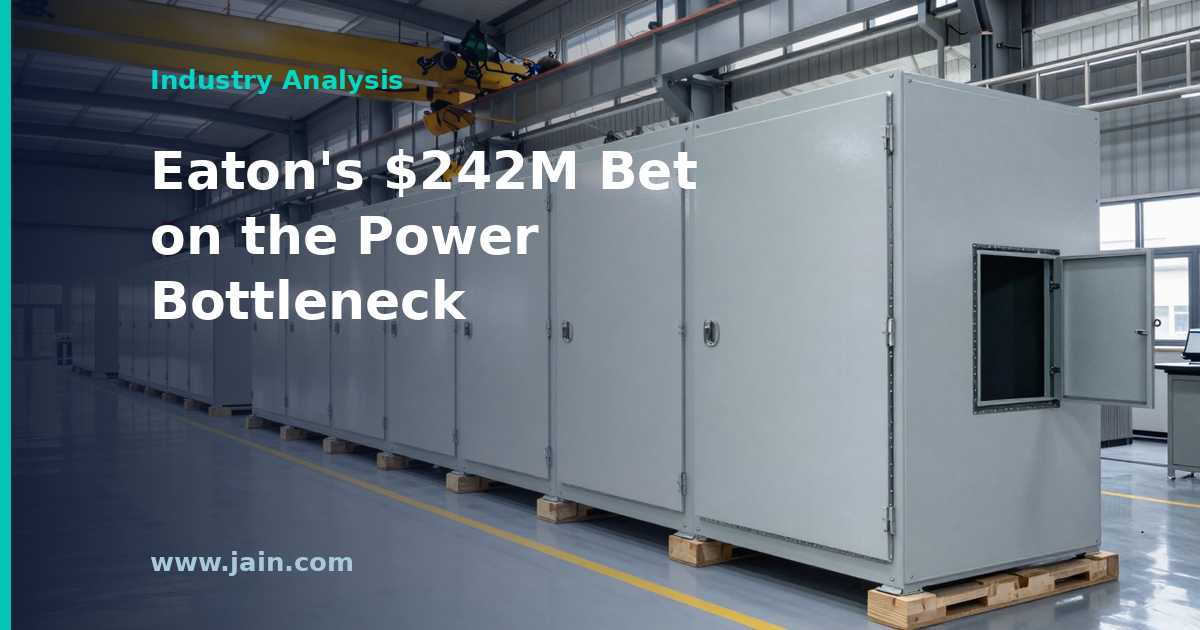
Eaton, a maker of electrical equipment, is spending more than $242 million on a new factory in North Little Rock, Arkansas. It will build the electrical rooms that feed power into data centers — assembled indoors on a production line and trucked to the site, the way a prefabricated house is.
The plant covers a million square feet, roughly seventeen football fields, and Eaton expects it to employ more than 1,200 people.
Why it matters: the thing slowing artificial intelligence down right now is not computer chips. It is getting electricity into the building.
Eaton (NYSE: ETN) announced on September 2, 2026 that it will invest more than $242 million in a new one-million-square-foot manufacturing facility in North Little Rock, Arkansas, which the company expects will double its U.S. capacity to build customized modular electrical enclosures and create more than 1,200 manufacturing, electrical and operations jobs. The plant will produce for Eaton’s Fibrebond business, which the company acquired in April 2025 and which has operated in Minden, Louisiana for more than 40 years.
Eaton says the added capacity is aimed at demand across data center, utility, industrial and digital communications markets. Arkansas Governor Sarah Huckabee Sanders, the Arkansas Economic Development Commission, the City of North Little Rock and the Metro Little Rock Alliance are named as partners on workforce development and technical-skills training tied to the site. Eaton did not announce a construction start date, a production timeline, or the value of any state or local incentives.
Executive Summary
An enclosure is the box the power gear lives in. A modular electrical enclosure is that box built in a factory — walls, switchgear, transformers, wiring, terminations — tested as a unit and shipped to site on a truck, so that work which would otherwise be done by electricians in a muddy field is instead done indoors on a production line. Eaton is committing $242 million to build more of them, and says the Arkansas plant will double what it can produce in the United States.
The scale of the check is worth keeping in proportion. Eaton reported $27.4 billion of revenue and $4.1 billion of net income in 2025; $242 million is under one percent of a single year’s sales. This is not a bet-the-company move. It is a capacity decision, and capacity decisions from component vendors are among the more honest signals available about where a supply chain is actually jammed — a factory takes years to pay back and cannot be quietly cancelled the way a press-release partnership can.
The signal here is specific: Eaton is not adding generation, or chips, or land. It is adding the ability to prefabricate the electrical middle of a data center. That points at a constraint that has migrated downstream, away from megawatts on paper and toward the physical equipment and skilled labor needed to move power the last few hundred feet into a building.
The Bottleneck Moved Downstream
For most of the current AI buildout, the public conversation about power has been about supply: whether utilities can generate enough electricity, whether gas turbines and grid interconnections can be secured, whether a region has spare capacity at all. Those constraints are real. But they are upstream constraints, and a project that clears them still has to solve a second problem — getting that power from the substation fence line into thousands of racks, through switchgear, transformers, breakers, busway and distribution equipment, all of it engineered to the specific site.
That downstream layer has become its own queue. The equipment is heavy, custom, subject to long lead times, and installed by a trade — industrial electricians — that is in short supply across the country and cannot be scaled on the schedule a hyperscale campus wants. Eaton’s own commentary points in this direction: the company said in July that it delivered record second-quarter 2026 results with accelerating orders and a growing backlog, and raised its organic growth guidance. A backlog is unshipped demand. Adding a factory is the response to a backlog you expect to persist.
Eaton’s framing supports a broad read rather than a purely AI one. The release names data center, utility, industrial and digital communications markets, and the company did not break out how much of the new capacity is earmarked for any of them. Utilities are replacing aging distribution equipment and telecom operators are densifying networks; both compete for the same factory hours. The honest statement is that Eaton sees enough aggregate demand across electrification end markets to double a product line’s U.S. footprint — with data centers as the loudest, but not the only, driver.
Why a Factory Beats a Field
The economic case for modular enclosures is a labor-arbitrage and schedule-certainty case, not a materials one. The same switchgear costs roughly the same whether it is installed on site or in a plant. What changes is who installs it, under what conditions, and when the schedule risk lands. In a factory, work is repeatable, weather-independent, inspected under controlled conditions, and performed by a trained workforce that stays put between jobs. On site, the same work is sequential, exposed to trade stacking and rain delays, and dependent on scarce electricians who must be hired into whatever county the campus was built in.
That is why Eaton’s chosen phrasing — customers wanting to deploy power infrastructure “faster, with greater certainty and less complexity” — maps onto something buyers can actually price. Certainty is the product. For an operator whose revenue starts the day the racks energize, compressing field electrical work and de-risking the commissioning date is worth paying a premium for, and it is measurable in a way that generic capacity claims are not.
The Fibrebond history explains why Eaton is doubling down rather than experimenting. Eaton bought the business in April 2025, and it had already been building enclosures in Minden, Louisiana for over 40 years; Eaton says Minden’s capacity has itself doubled over the past three years and continues to receive investment. Arkansas is therefore a second node, not a replacement — geographic diversification of a proven line, plus a labor pool in a metro area that a single small-town plant could not reach. It also fits a broader Eaton pattern of pushing toward integrated, pre-engineered data center solutions, including a reference design announced with Trane Technologies in August aimed at AI data center efficiency and installation cost.
What $242 Million Buys — and What It Doesn’t
Two arithmetic points deserve stating plainly. First, $242 million across one million square feet works out to roughly $242 per square foot of building — consistent with heavy industrial construction plus tooling, and a reminder that a meaningful share of this money is concrete and cranes, not incremental production equipment. Second, “doubles U.S. capacity” is a ratio without a denominator. Eaton has not published Minden’s current output in units, megawatts served, or dollars, so the doubling cannot be converted into how many data center halls per year the industry actually gains. Directionally credible; quantitatively opaque.
There is also a limit to what an enclosure plant can unclog. The enclosure is the wrapper; the constrained contents — large power transformers, medium-voltage switchgear, breakers, and the copper and steel behind them — have their own lead times and their own factories. Doubling enclosure assembly capacity relieves the integration and field-labor step. It does not by itself shorten the wait for a transformer. Buyers evaluating this announcement should ask which specific lead time in their own schedule it compresses.
On winners and losers: the clearest beneficiaries are large data center developers with repeatable designs, who can put standardized modular power blocks into a queue and take delivery on a predictable cadence. Regional electrical contractors lose some scope as work migrates from the field into the plant, though the field commissioning and interconnection work remains. Central Arkansas gains an anchor industrial employer and, per the release, a structured technical-training pipeline — genuinely valuable, and also the part of any plant announcement most exposed to slippage, since job counts are expectations rather than commitments and typically ramp over years. Competing enclosure and integrated-power vendors now face a rival with roughly twice the domestic assembly capacity, which is a durable competitive fact in a market where the scarce good is a delivery slot.
Background
Eaton, founded in 1911 and headquartered for operational purposes in Cleveland with legal domicile in Dublin, sells electrical and industrial power equipment into data center, utility, commercial, residential, aerospace and mobility markets. Its electrical business has been the primary beneficiary of two long-running trends the company calls electrification and digitalization — more of the economy running on electricity, and more of that electricity flowing into compute. It reported $27.4 billion of revenue in 2025 and serves customers in 180 countries.
The modular power segment it is expanding here sits at a specific choke point in data center construction. As campuses grew from tens to hundreds of megawatts, the electrical scope outgrew what could be reliably built in the field on the schedules operators demanded, and prefabrication moved from a niche option to a default for large repeatable designs. Eaton’s April 2025 purchase of Fibrebond bought it a four-decade-old position in that segment; the Arkansas plant is the first major capacity expansion announced under Eaton’s ownership, and it follows other moves toward pre-engineered data center offerings, including a reference design developed with Trane Technologies announced in August 2026. Source: Eaton expands manufacturing for modular electrical enclosures with $242+ million investment in new Arkansas facility to support the next generation of critical infrastructure development — Eaton’s September 2, 2026 announcement of a more than $242 million, one-million-square-foot plant in North Little Rock, Arkansas expected to double U.S. capacity for customized modular electrical enclosures and create over 1,200 jobs. The release as issued on the wire is available at businesswire.com.Sources